Concepts of heterosis- Genetic, Physiological and Molecular basis
 
Hybridization in plants
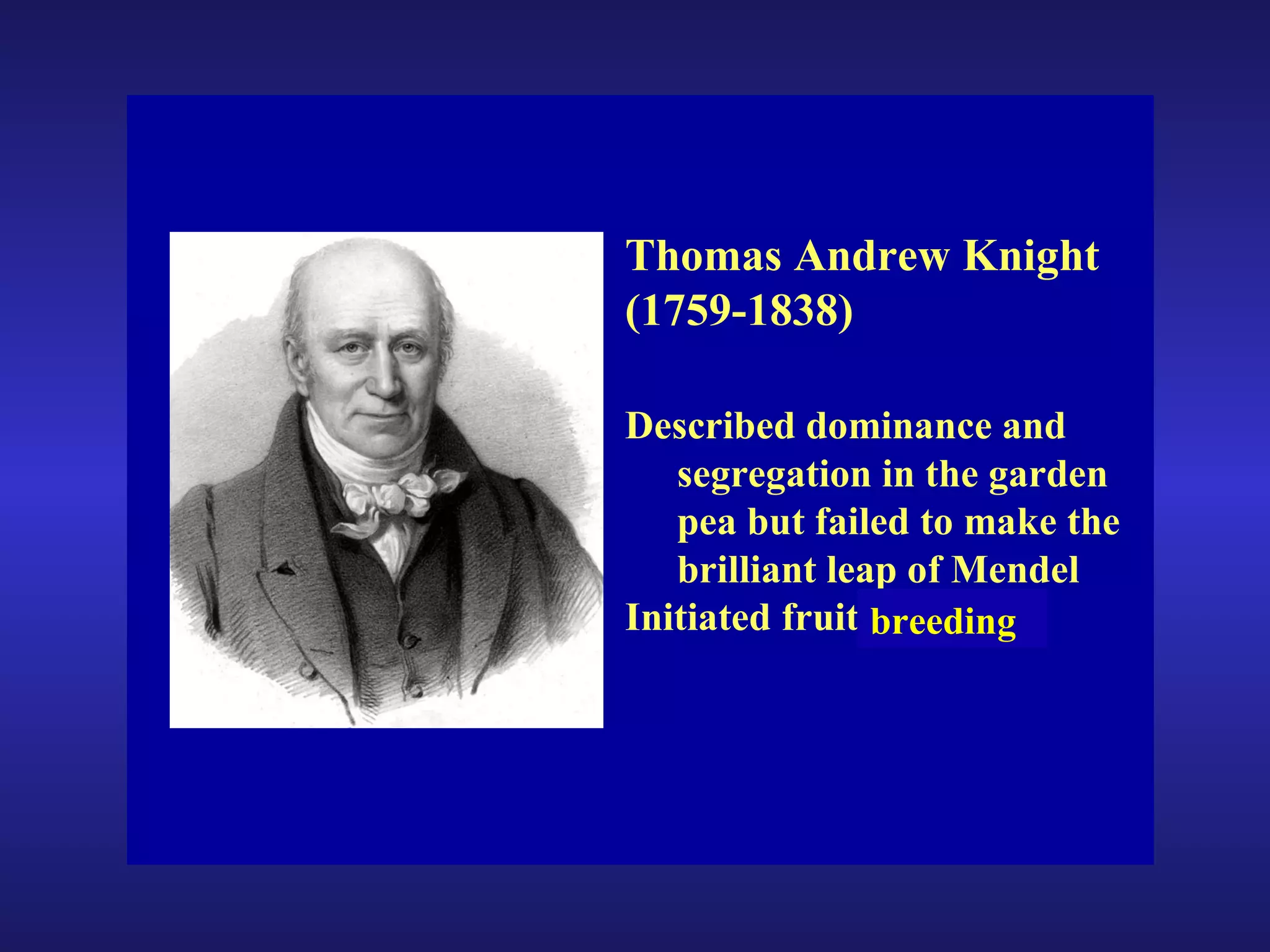
breeding
 
 
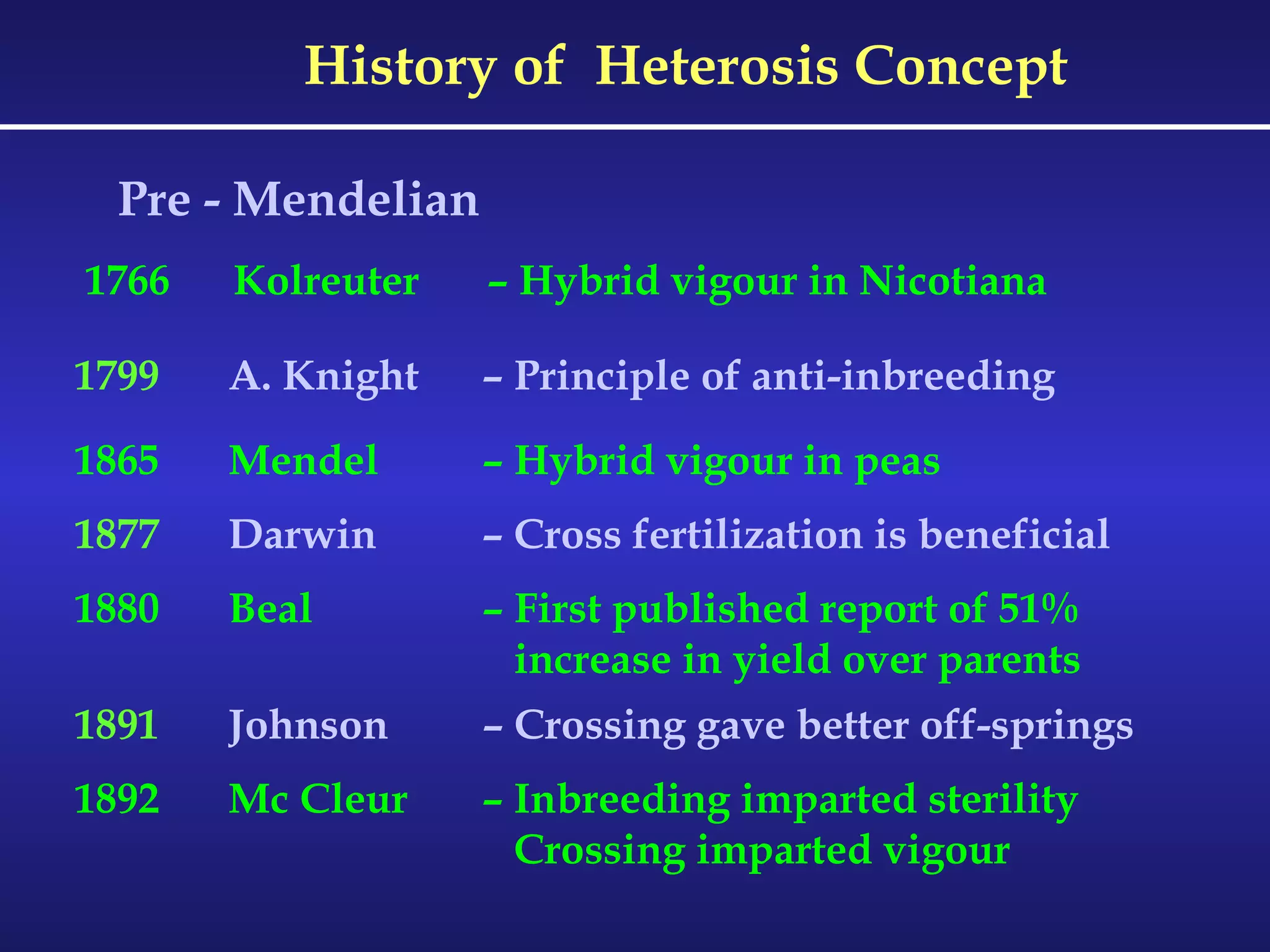
History of  Heterosis Concept Pre - Mendelian 1766  Kolreuter – Hybrid vigour in Nicotiana  1799  A. Knight – Principle of anti-inbreeding  1865  Mendel – Hybrid vigour in peas  1877 Darwin – Cross fertilization is beneficial 1880 Beal – First published report of 51%    increase in yield over parents 1891 Johnson – Crossing gave better off-springs 1892 Mc Cleur – Inbreeding imparted sterility    Crossing imparted vigour
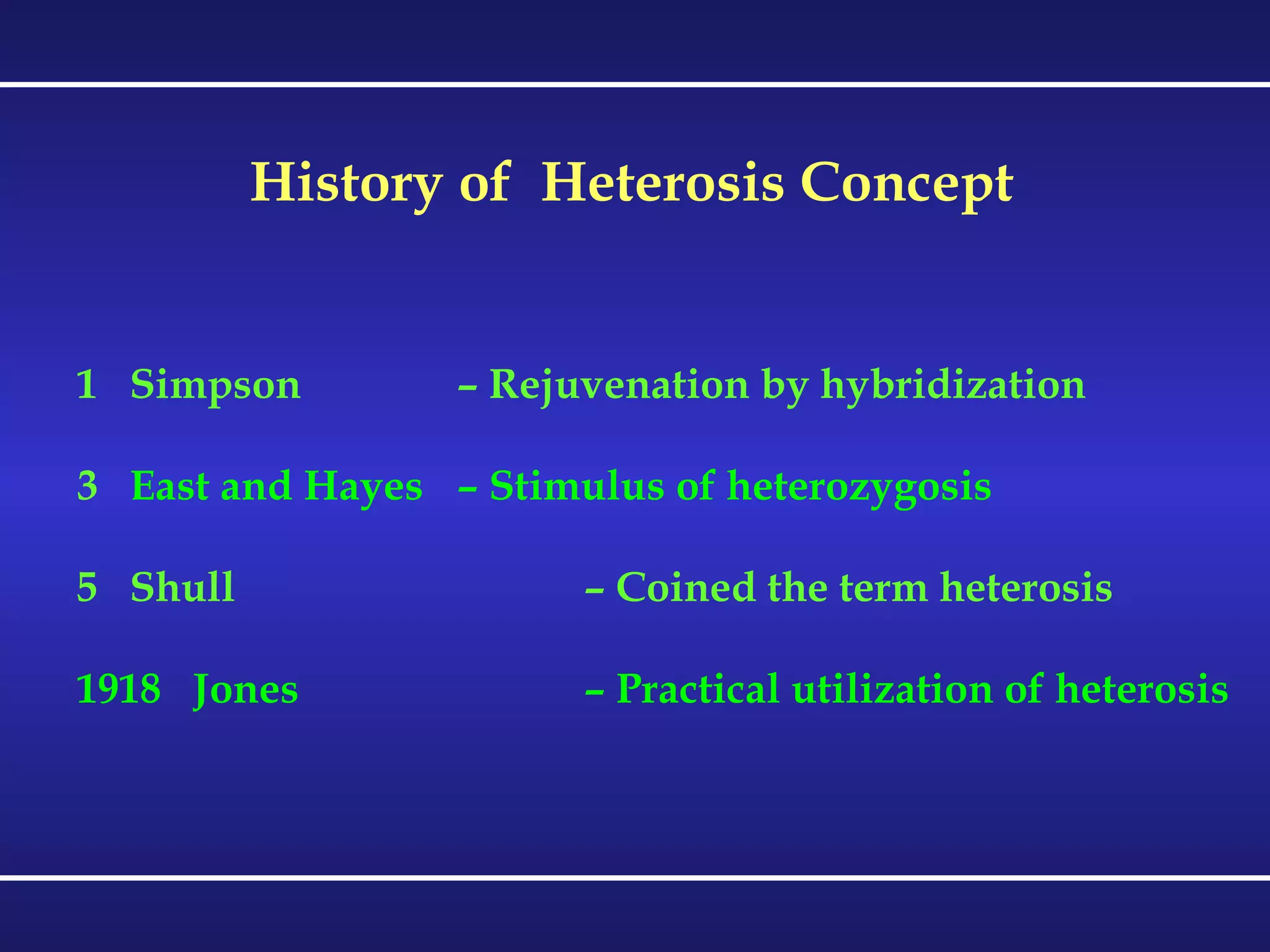
History of  Heterosis Concept Simpson – Rejuvenation by hybridization  East and Hayes – Stimulus of heterozygosis Shull – Coined the term heterosis 1918  Jones – Practical utilization of heterosis
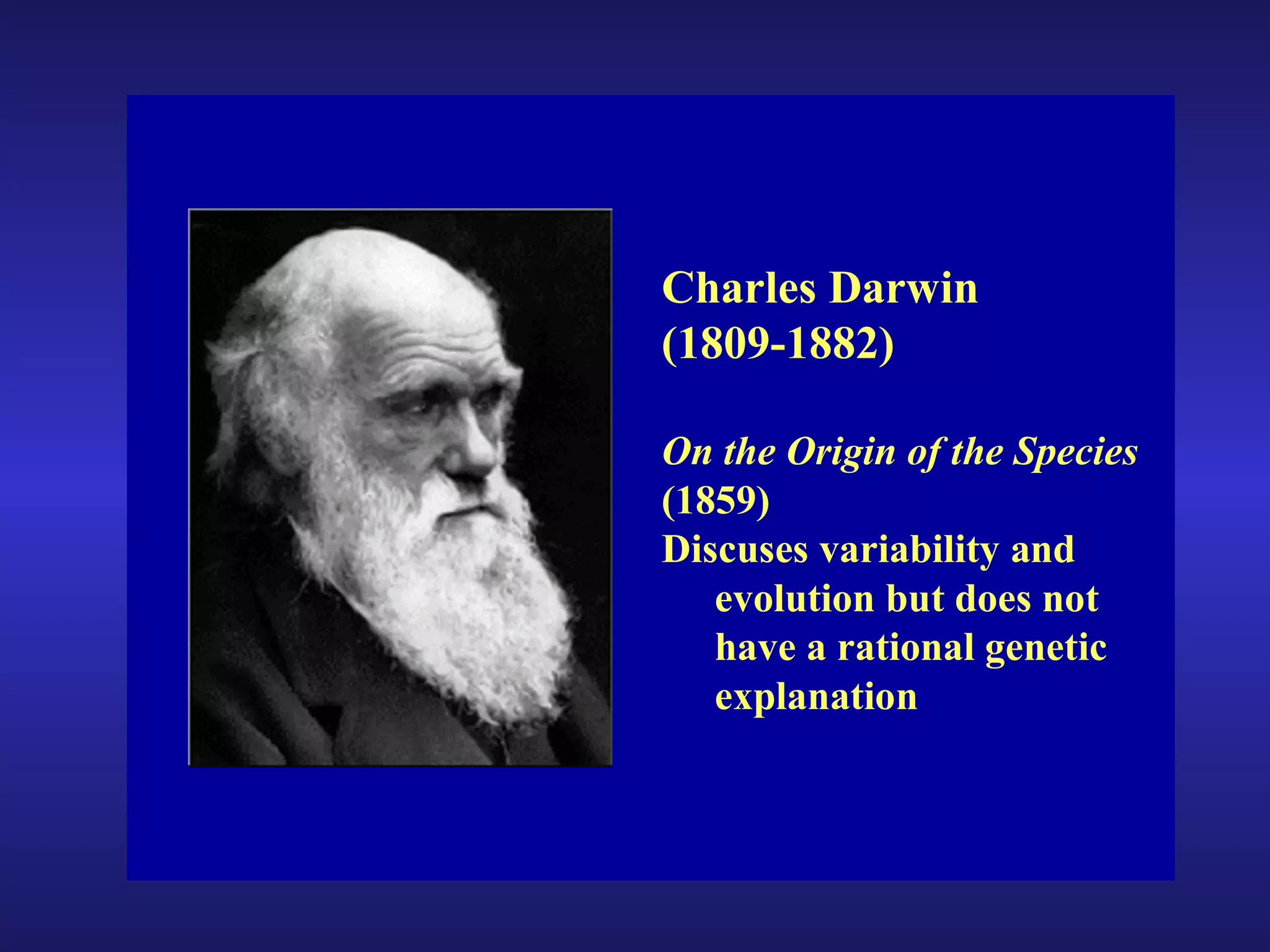
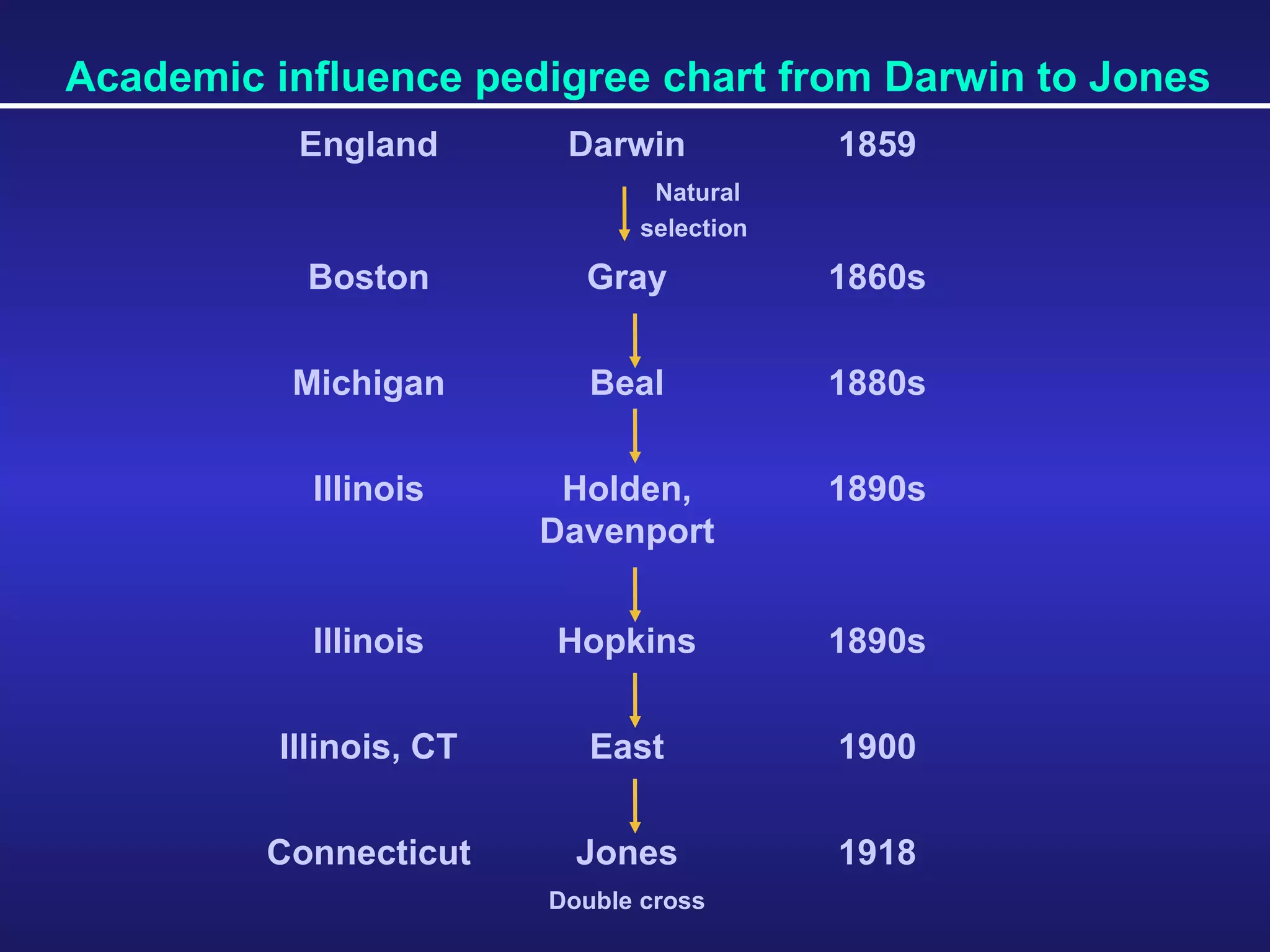
Academic influence pedigree chart from Darwin to Jones England Darwin 1859 Natural  selection Boston Gray 1860s Michigan Beal 1880s Illinois Holden, Davenport 1890s Illinois Hopkins 1890s Illinois, CT East 1900 Connecticut Jones 1918 Double cross
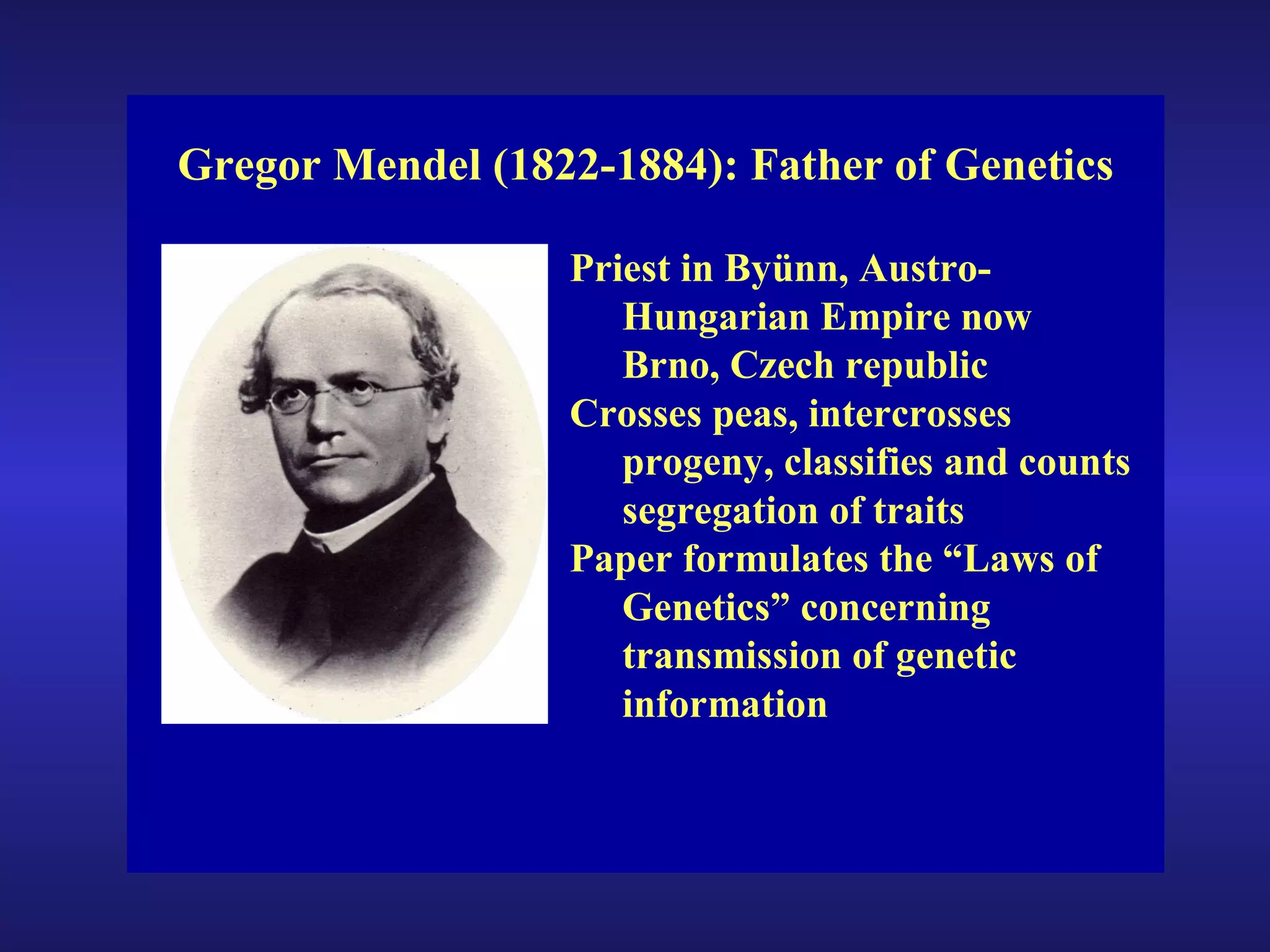
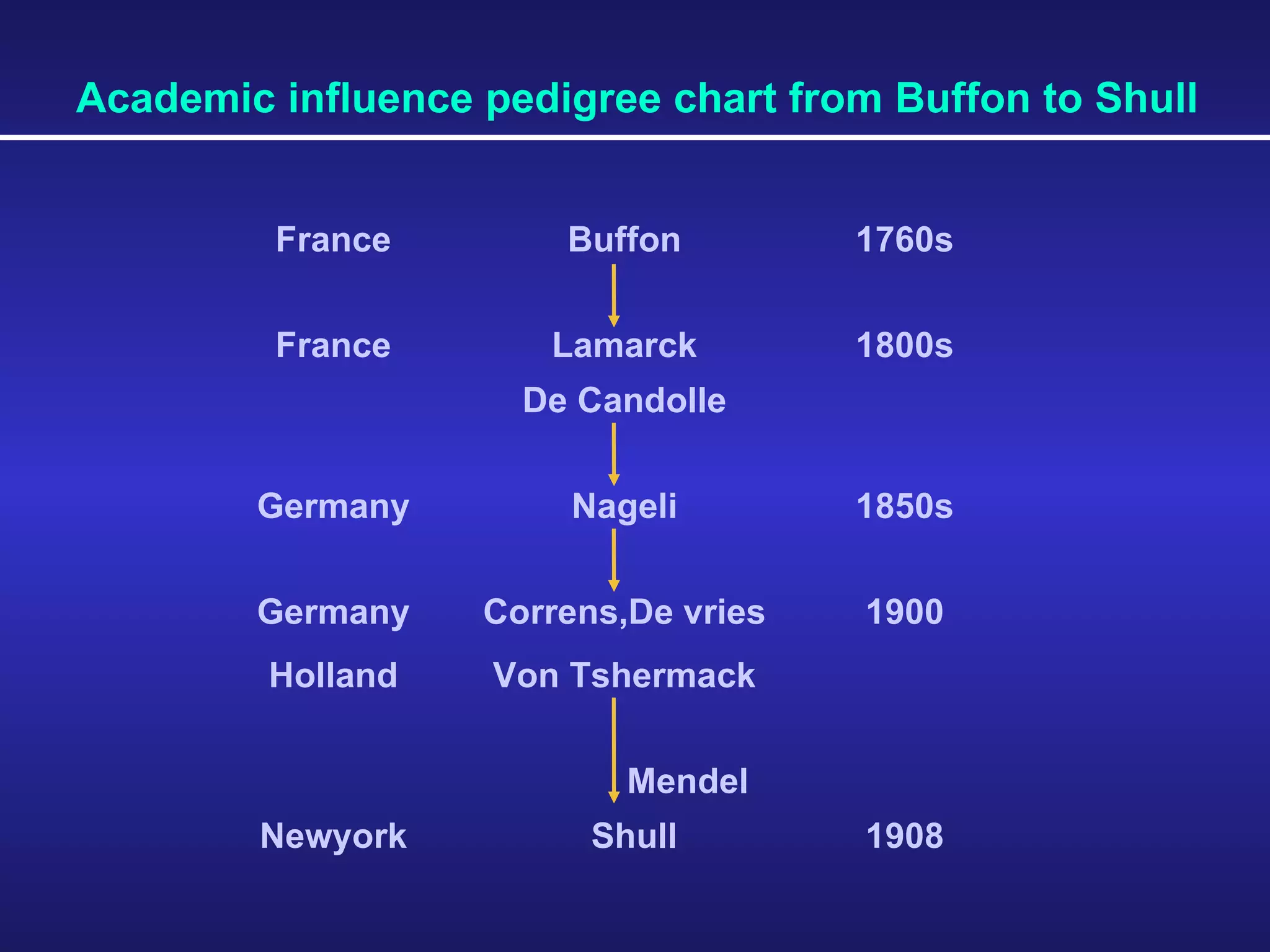
Academic influence pedigree chart from Buffon to Shull France Buffon 1760s France Lamarck 1800s De Candolle Germany Nageli 1850s Germany Correns,De vries 1900 Holland Von Tshermack Mendel Newyork Shull 1908
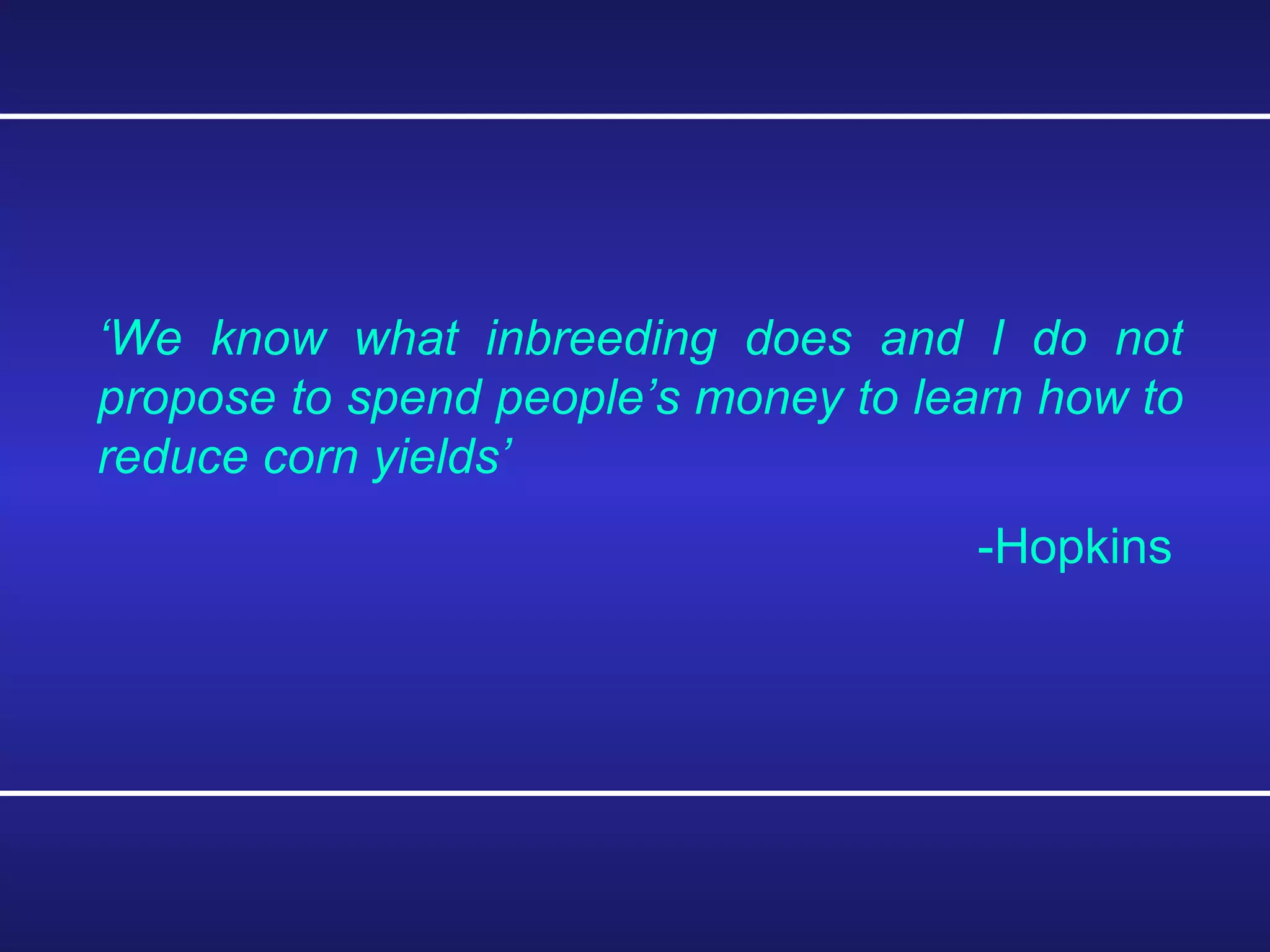
‘ We know what inbreeding does and I do not propose to spend people’s money to learn how to reduce corn yields’ -Hopkins
‘ A recent paper by Dr. G.H. Shull has given, I believe the correct interpretation of this vexed question. His idea, although clearly and reasonably developed, was supported by few data’ - East,1908 ‘ Since studying your paper, I agree entirely with your conclusion, and wonder why I have been so stupid not to see the fact myself’ - East wrote to Shull in 1952
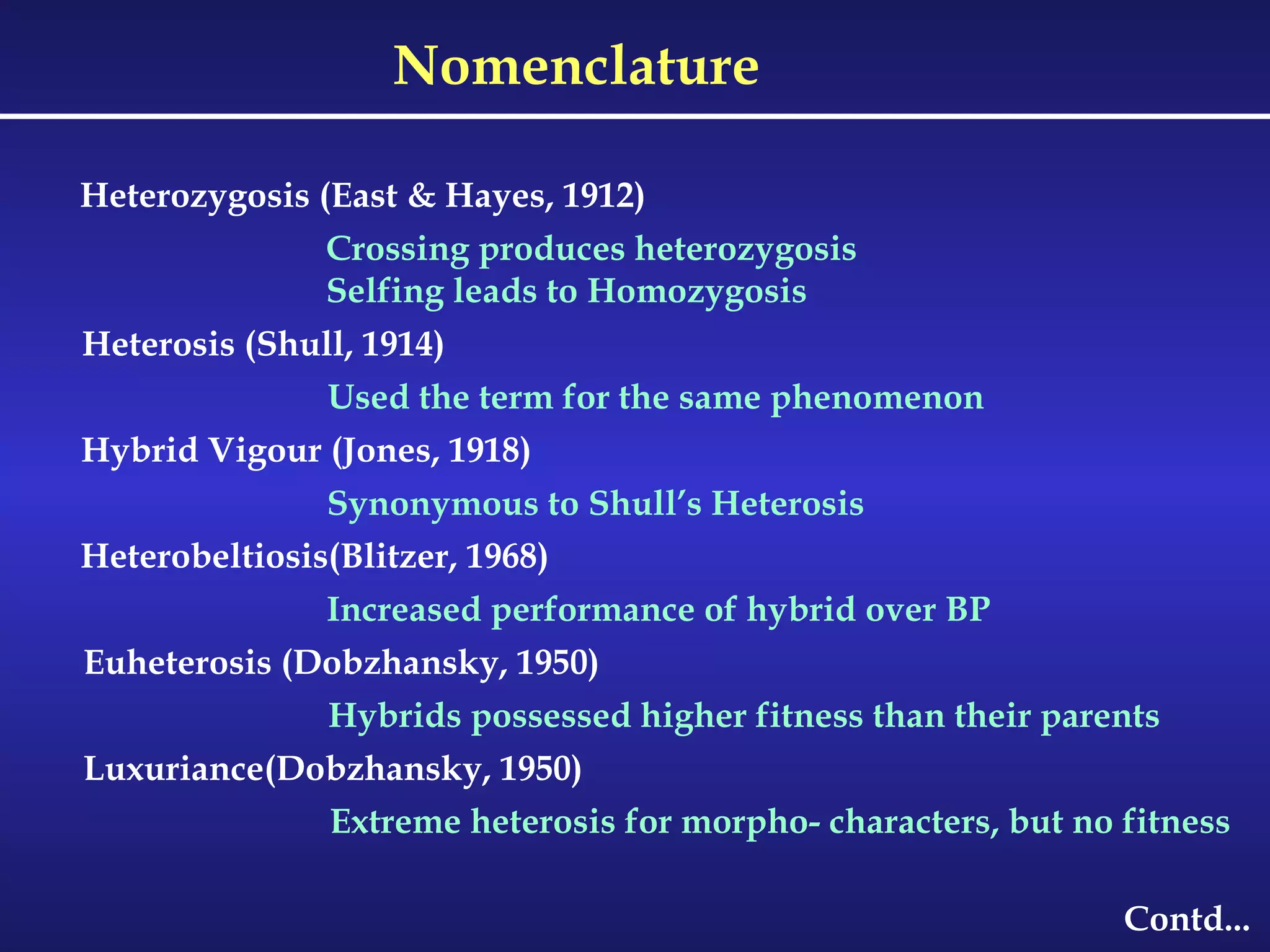
Nomenclature Contd... Heterozygosis (East & Hayes, 1912) Crossing produces heterozygosis Selfing leads to Homozygosis Heterosis (Shull, 1914) Used the term for the same phenomenon Hybrid Vigour (Jones, 1918) Synonymous to Shull’s Heterosis Heterobeltiosis(Blitzer, 1968) Increased performance of hybrid over BP Euheterosis (Dobzhansky, 1950) Hybrids possessed higher fitness than their parents Luxuriance(Dobzhansky, 1950) Extreme heterosis for morpho- characters, but no fitness
Positive and Negative heterosis(Powers, 1944) To include inferiority of hybrid over parents Adaptive Heterosis (MacKay, 1976) Heterosis for adaptability Selective Heterosis (MacKay, 1976) Heterosis for Competitive ability Luxuriant Heterosis (MacKay, 1976) Increased vigour in Size, yield but not in fitness Labile Heterosis (MacKay, 1976) Heterosis which is not fixable Fixed Heterosis (MacKay, 1976) Fixed by various mechanisms
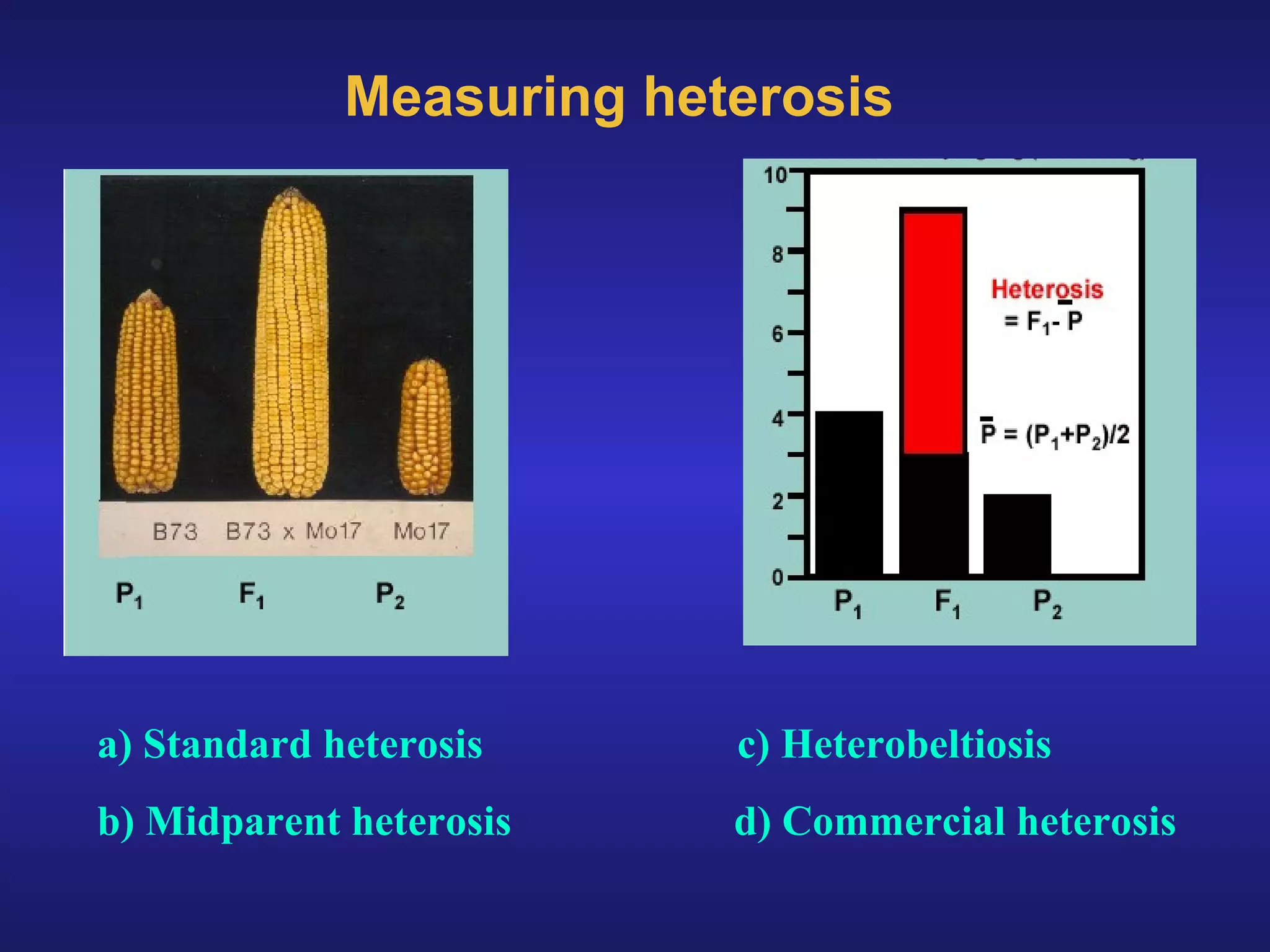
Measuring heterosis a) Standard heterosis  c) Heterobeltiosis b) Midparent heterosis  d) Commercial heterosis
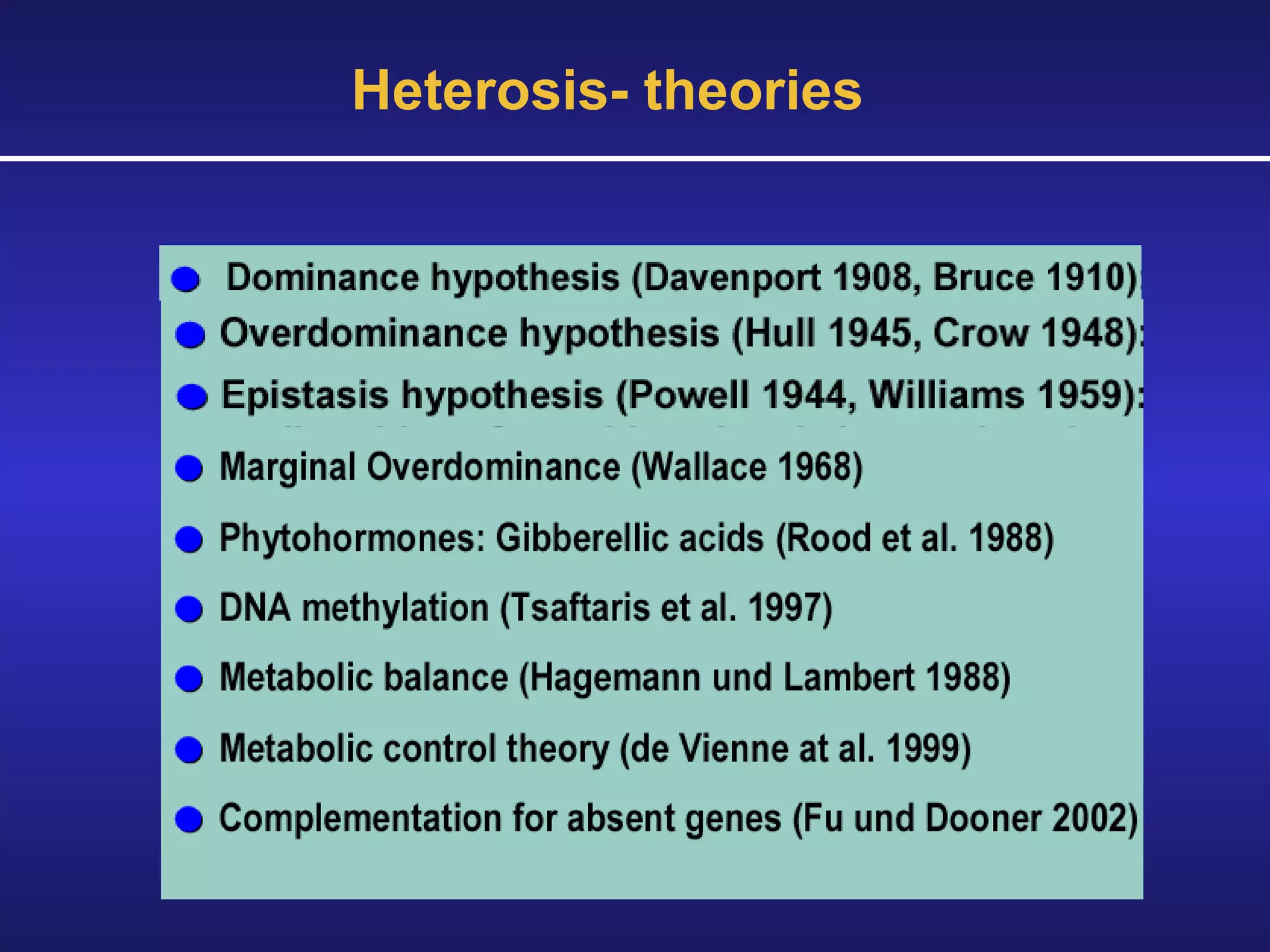
Heterosis- theories
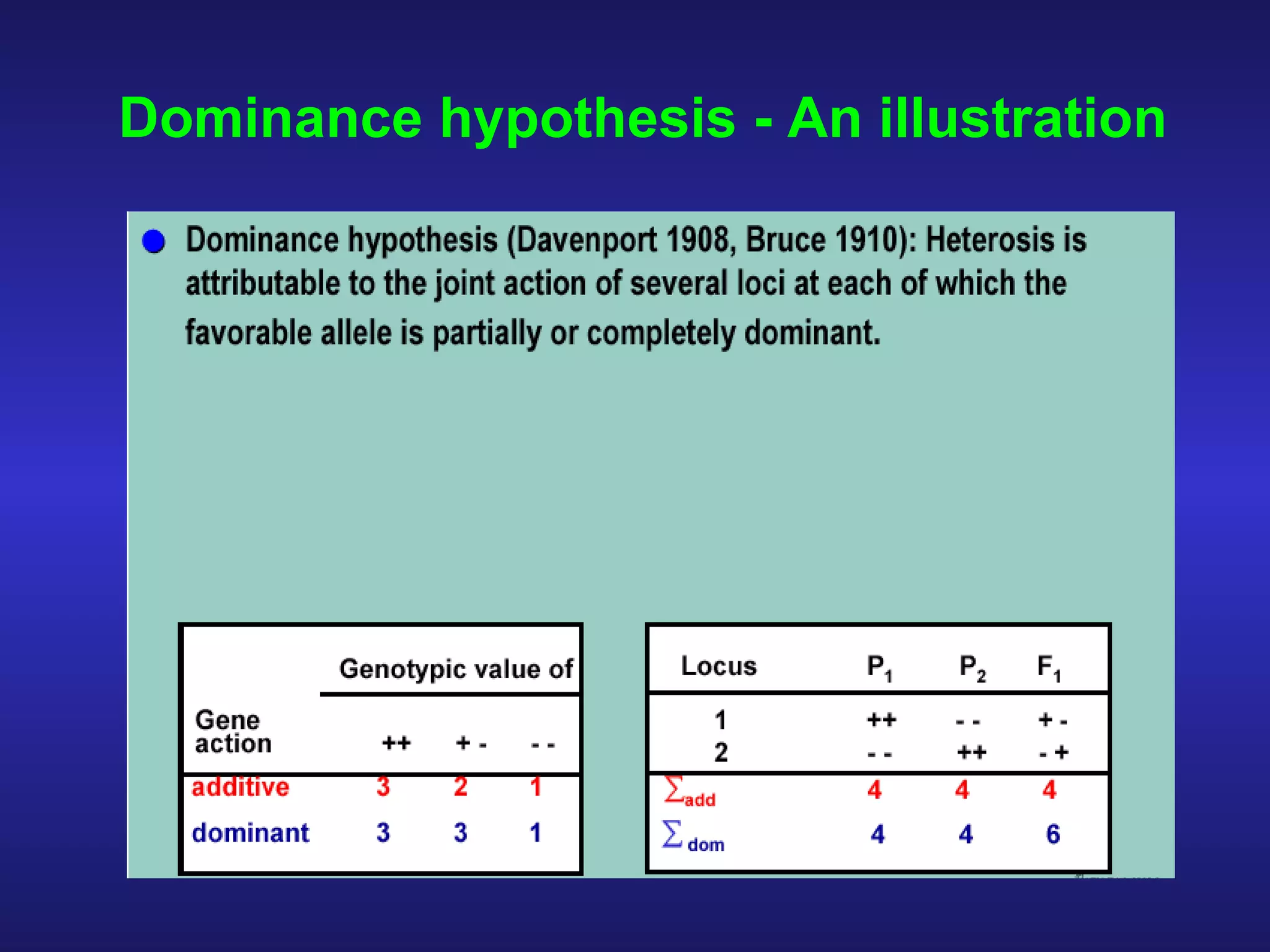
Genetic basis of heterosis 1.  Heterosis is not due to heterozygosity  per se   Dominance Hypothesis (Davenport, 1907) 2.  Superiority of dominant alleles over recessive alleles   3. Heterosis is due to masking of deleterious recessive alleles by dominant alleles 4.  Heterosis is directly proportional to the number of dominant  genes contributed by each parent
Dominance hypothesis - An illustration
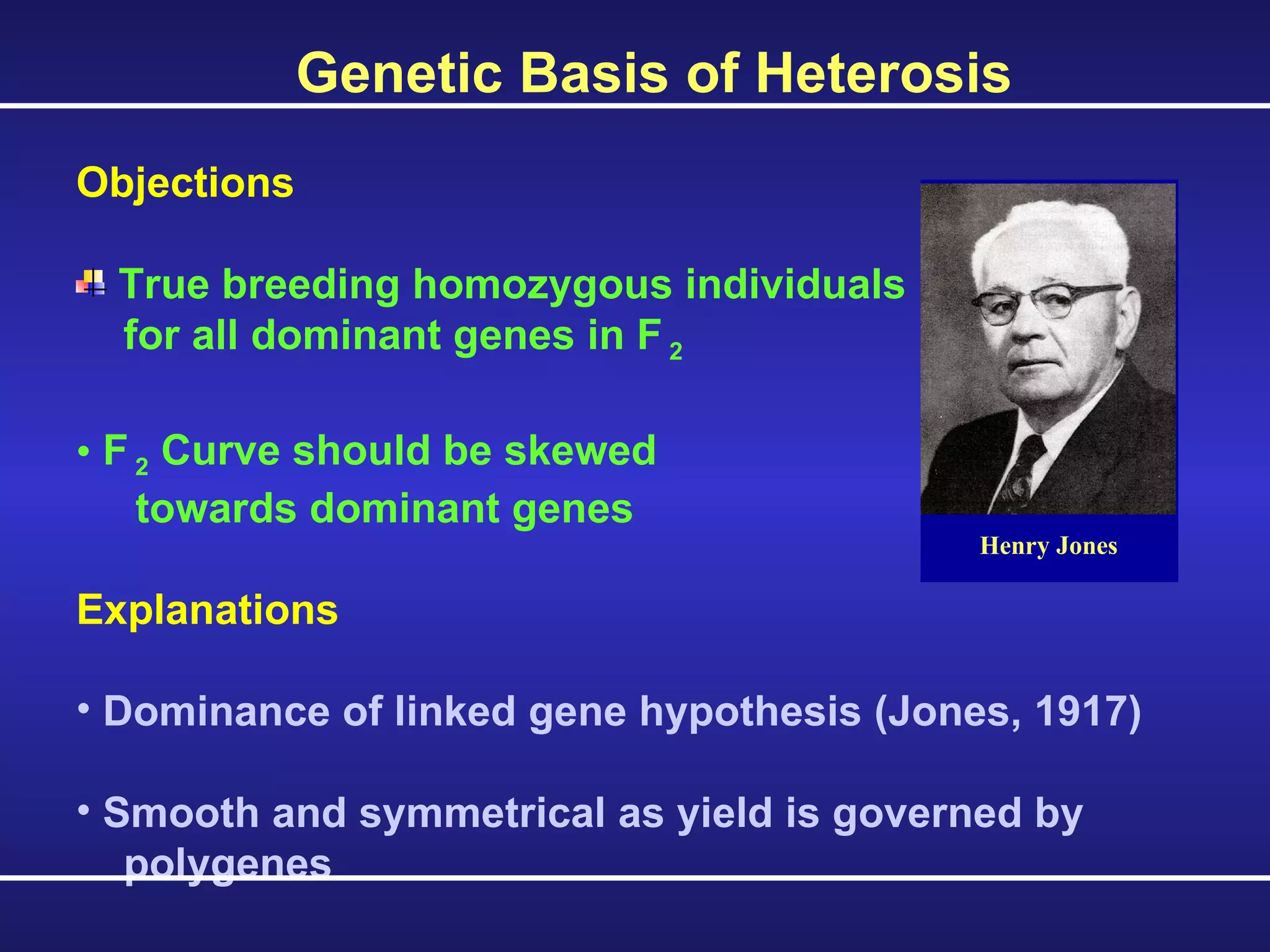
Objections True breeding homozygous individuals for all dominant genes in F  2 F  2  Curve should be skewed  towards dominant genes Explanations Dominance of linked gene hypothesis (Jones, 1917) Smooth and symmetrical as yield is governed by  polygenes Genetic Basis of Heterosis
Genetic Basis of Heterosis Over Dominance Hypothesis (Shull & East, 1908) Heterozygosity per se is the cause of Heterosis Heterozygote is superior to either of the homozygotes  Increase in vigour is directly proportional to amount of heterozygosis Superiority of heterozygote may arise due  ●  production of superior hybrid substance in heterozygote ●  cumulative action of divergent alleles More divergent alleles will exhibit more heterosis than less divergent ones
Shull’s Concept of Heterosis 1.  Self-fertilization purifies the strain and releases new variation Conclusions based on his investigations 2.  Self-fertilized plants are weaker than the cross-fertilized ones 3. Generations of close inbreeding reduces the strains into  simple  constituent bio-types which are weaker than  the hybrid  combinations 4.  Crossing the weakened pure strains would cancel the effects of inbreeding Interpretation of increased vigour, size, fruitfulness, resistance to diseases and insect pests or  climatic rigour of any kind, manifested by Cross-bred organisms as compared with corresponding inbreds, as the Specific results  of unlikeness in the constituents of the uniting parental gametes Shull (1952)
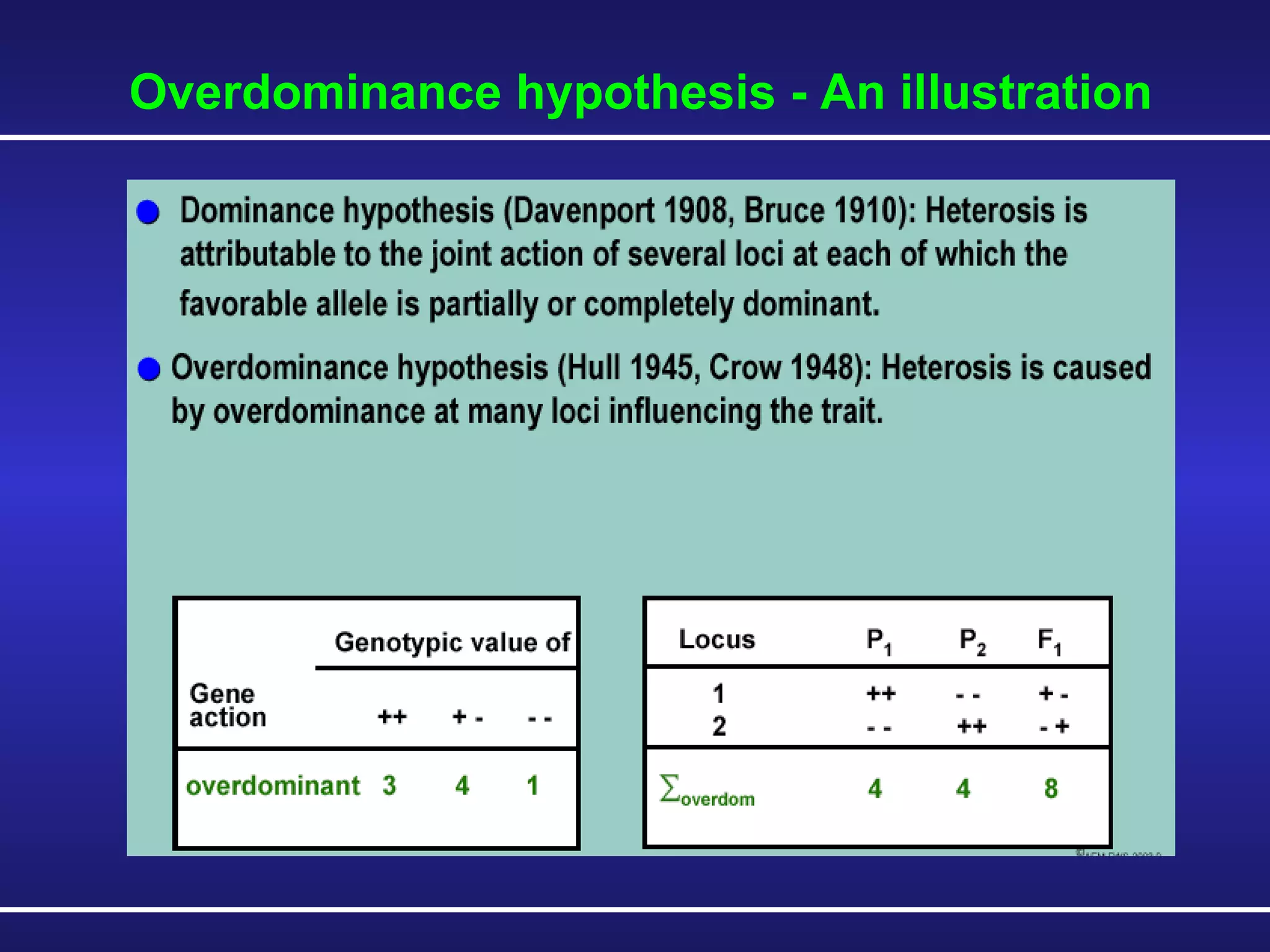
Overdominance hypothesis - An illustration
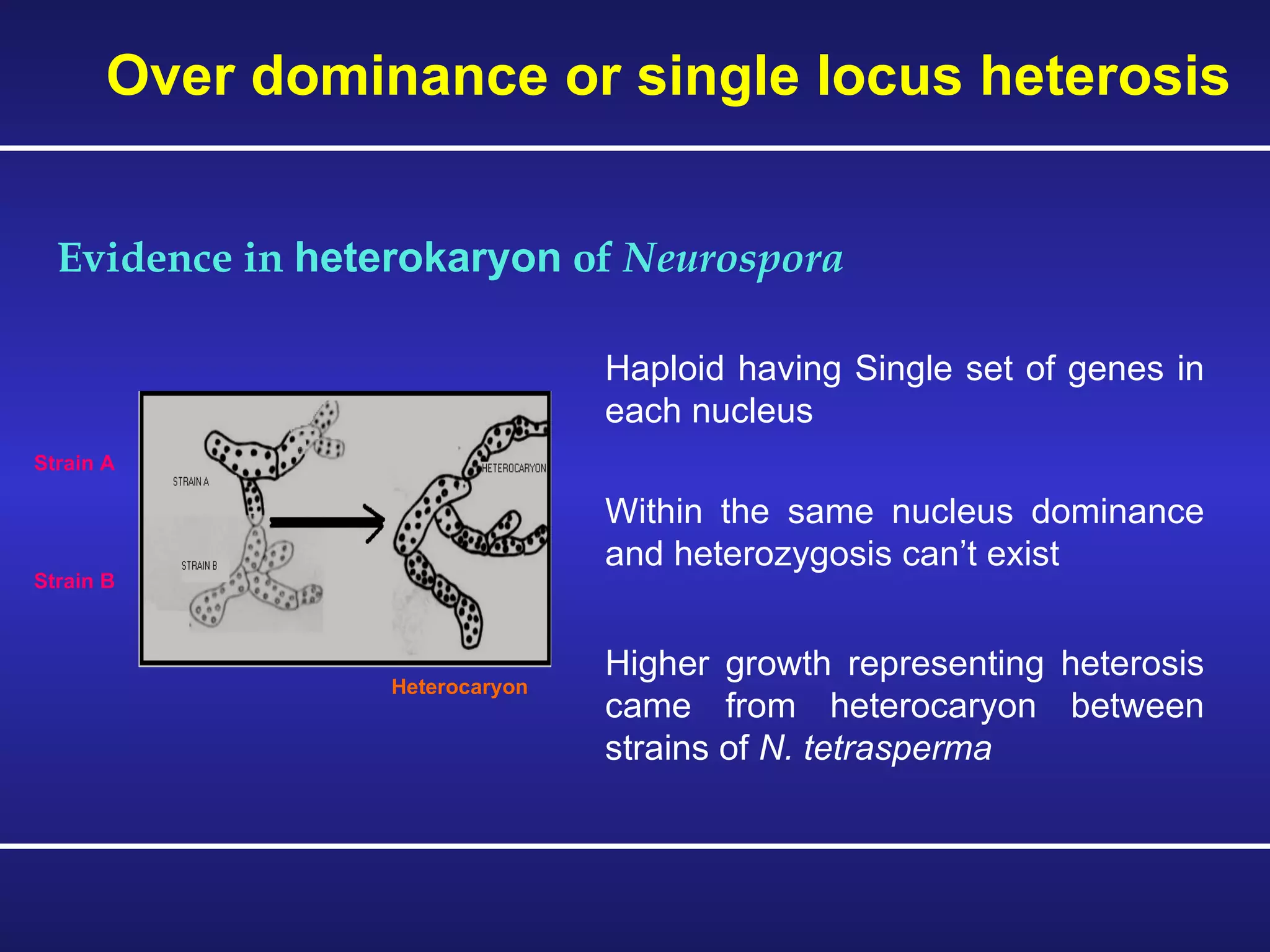
Haploid having Single set of genes in each nucleus Within the same nucleus dominance and heterozygosis can’t exist Higher growth representing heterosis came from heterocaryon between strains of  N. tetrasperma Over dominance or single locus heterosis Strain A Strain B Heterocaryon Evidence in  heterokaryon  of  Neurospora
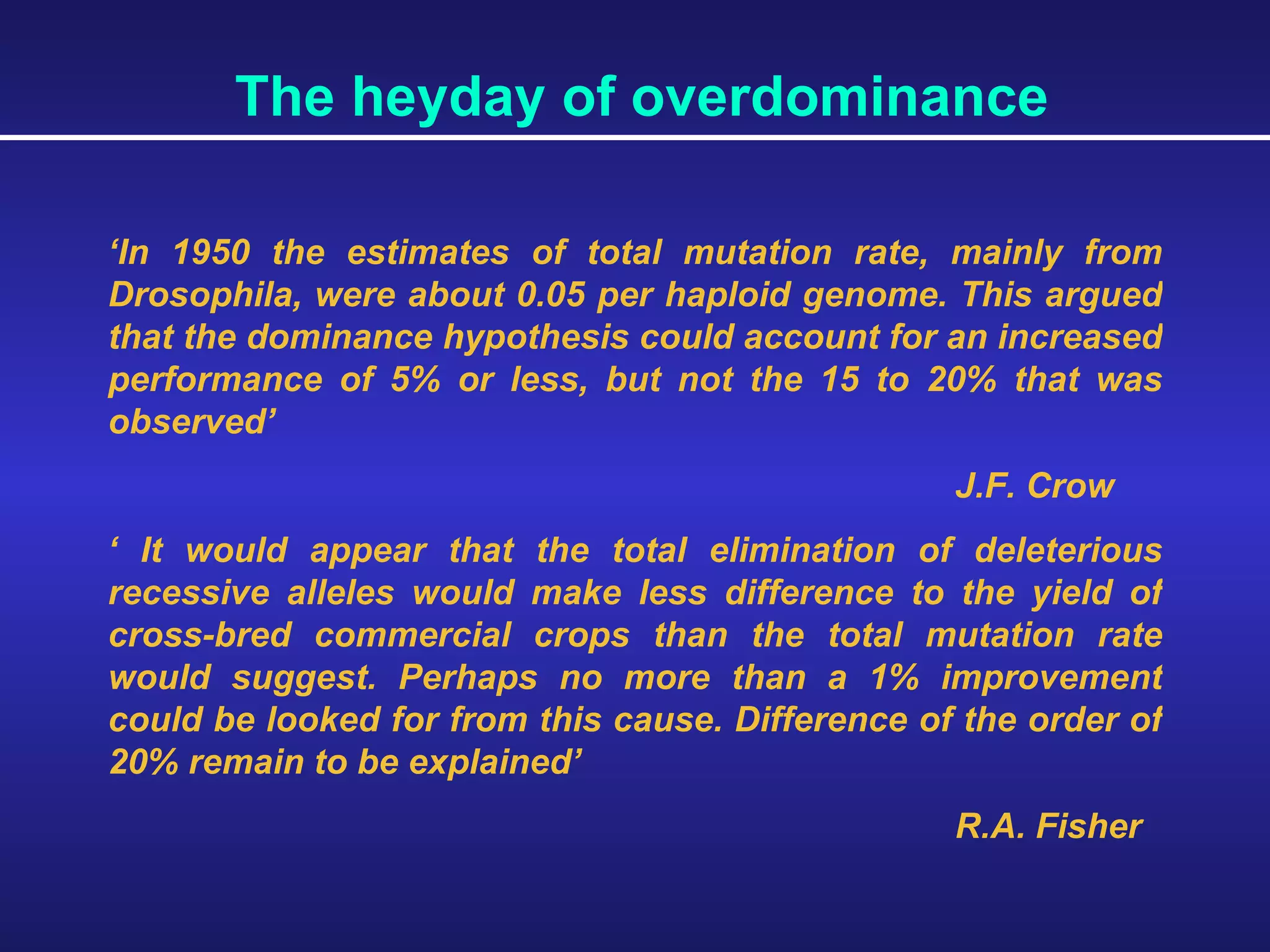
The heyday of overdominance ‘ In 1950 the estimates of total mutation rate, mainly from Drosophila, were about 0.05 per haploid genome. This argued that the dominance hypothesis could account for an increased performance of 5% or less, but not the 15 to 20% that was observed’ J.F. Crow ‘  It would appear that the total elimination of deleterious recessive alleles would make less difference to the yield of cross-bred commercial crops than the total mutation rate would suggest. Perhaps no more than a 1% improvement could be looked for from this cause. Difference of the order of 20% remain to be explained’ R.A. Fisher
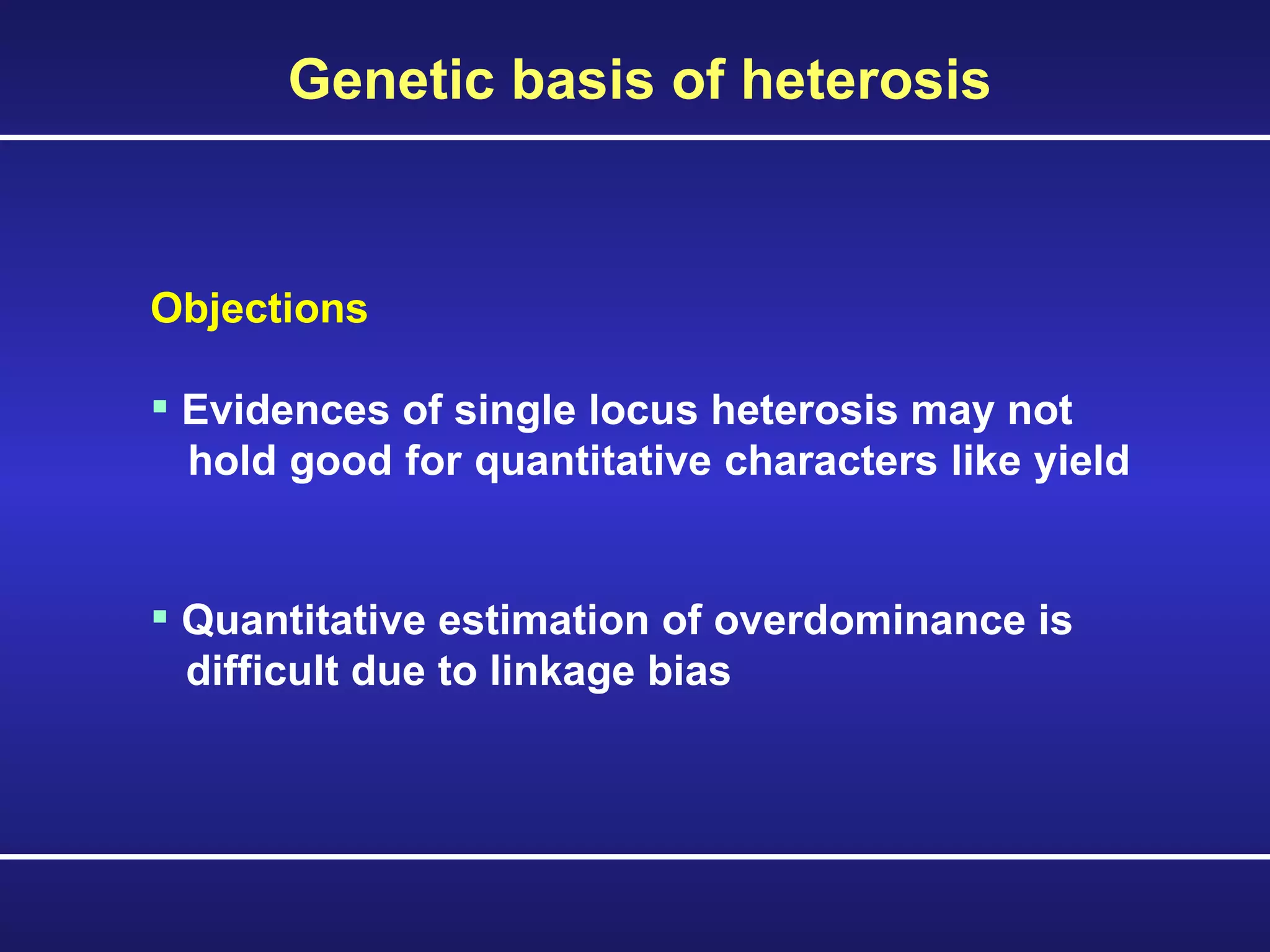
Objections Evidences of single locus heterosis may not  hold good for quantitative characters like yield  Quantitative estimation of overdominance is  difficult due to linkage bias Genetic basis of heterosis
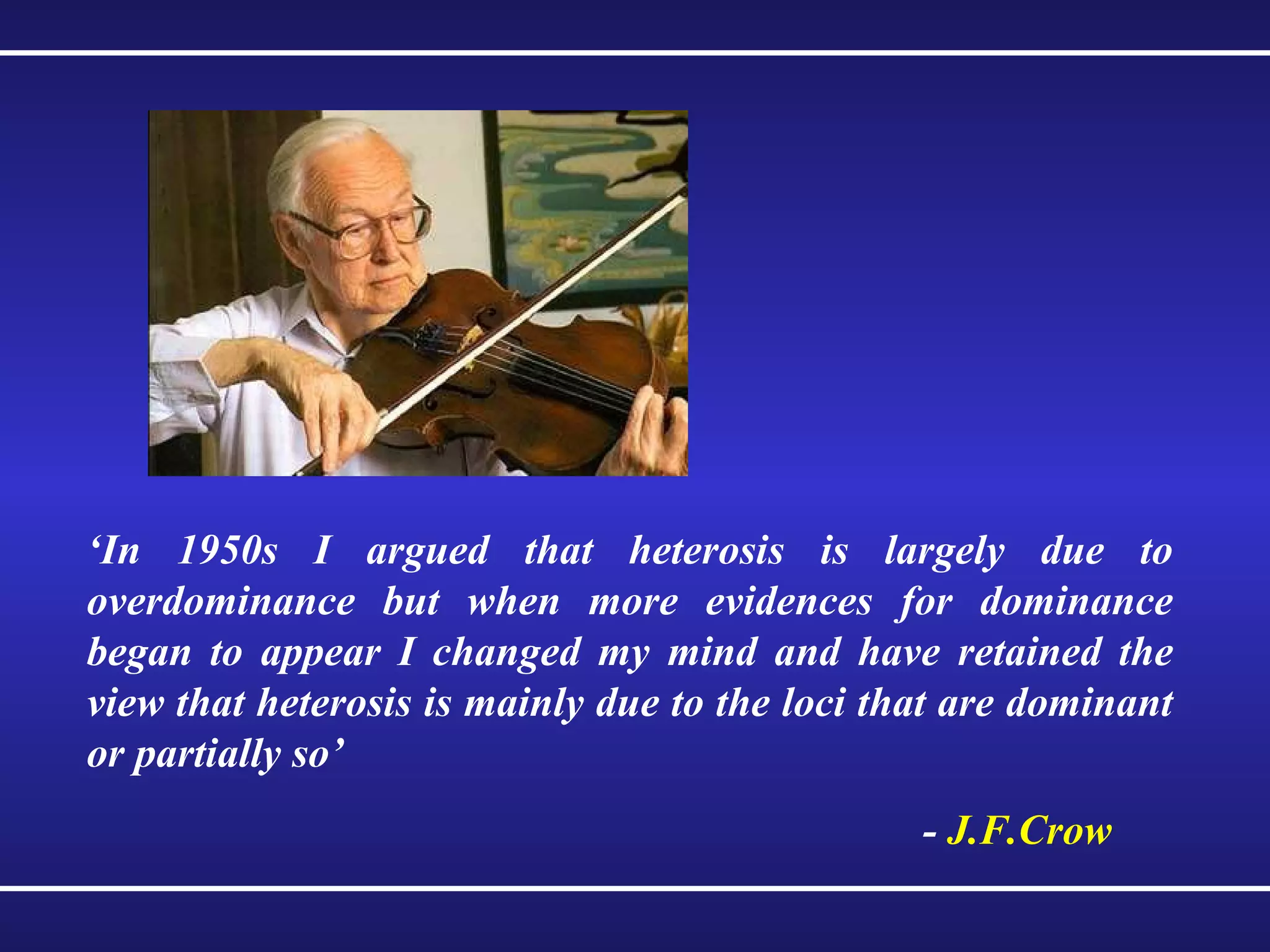
‘ In 1950s I argued that heterosis is largely due to overdominance but when more evidences for dominance began to appear I changed my mind and have retained the view that heterosis is mainly due to the loci that are dominant or partially so’ -  J.F.Crow
Epistasis hypothesis  Heterosis is mostly attributable to favourable epistatic interaction between non-allelic genes -Powell 1944, Williams 1959
Physiological Basis of Heterosis Ashby’s  Hypothesis of Greater Initial Capital Heterozygosity results from the greater initial weight of the embryo Hybrid vigour is nothing more than the maintenance of initial advantage in embryo size  Hybrids do not differ from their parents in relative growth rate
Physiological Basis of Heterosis Stages of physiological manifestation of heterosis 1. Seed and Embryo development High positive correlation was recorded between hybrid vigour and embryo weight Copland noted that hybrid embryo exhibited greater vigour in the earlier stages of development Ashbey found significant differences between embryo weight of  reciprocal crosses Early differences in embryo size in favour of hybrids resulted from  rapid growth rate of multi cellular zygote
Physiological basis of heterosis  Early seedling growth Hybrid shows higher growth rate than inbreds  immediately after germination but not later Hybrids do have a larger maximum growth rate  period Ashby says embryo size is more significant than  reserve food material
Later Seedling Growth Hoffer found root dry matter content of hybrids  to be intermediate between parents Hybrids found to absorb and utilize more  amount of N ,P than the inbred lines Catalase activity was higher in heterotic hybrids  Physiological basis of heterosis
Biochemical basis of heterosis  Bottleneck concept (Manglesdorf) (i) Excellence of genotype depents not upon its  strongest link, but upon its weakest link (ii) Emphasis is laid not on the superiority of the hybrid,  but on the inferiority of its parents (iii)Inferiority of the parents are thought to be the  bottlenecks represented by inefficient alleles (iv)It supports the dominance hypothesis
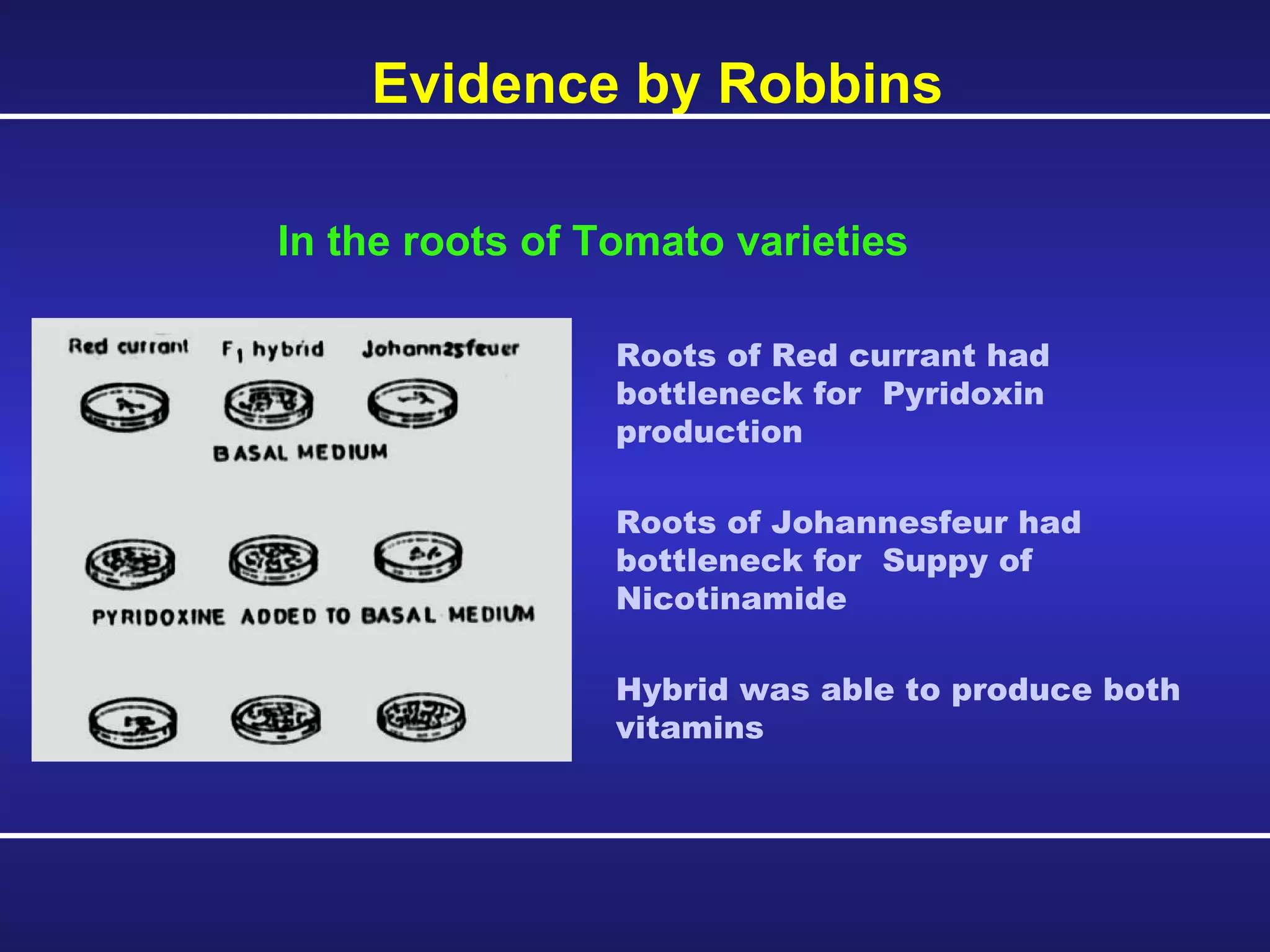
Evidence by Robbins Roots of Red currant had bottleneck for  Pyridoxin production  Roots of Johannesfeur had bottleneck for  Suppy of Nicotinamide Hybrid was able to produce both vitamins In the roots of Tomato varieties
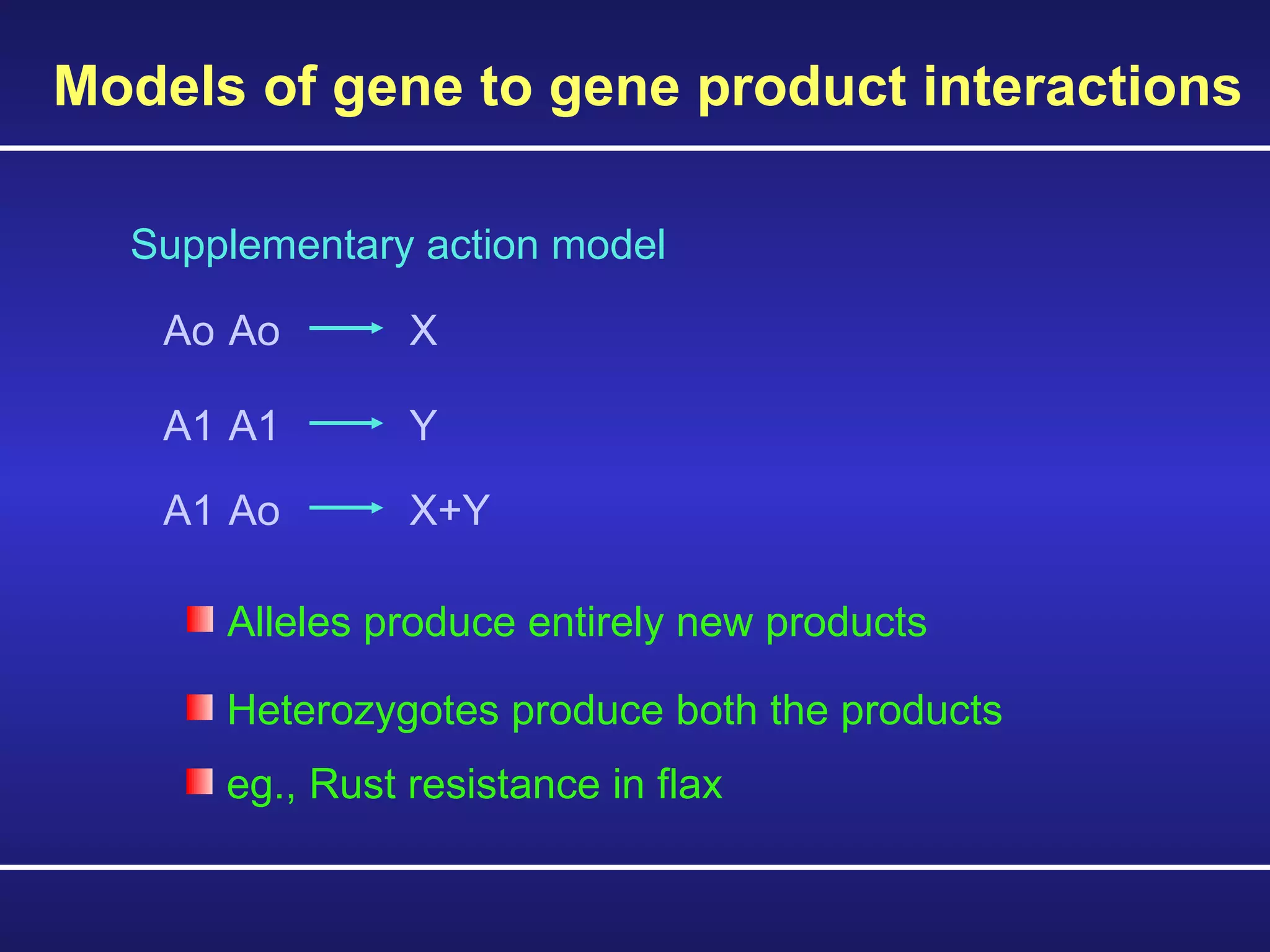
Models of gene to gene product interactions Supplementary action model Ao Ao  X  A1 A1  Y  A1 Ao  X+Y  Alleles produce entirely new products Heterozygotes produce both the products eg., Rust resistance in flax
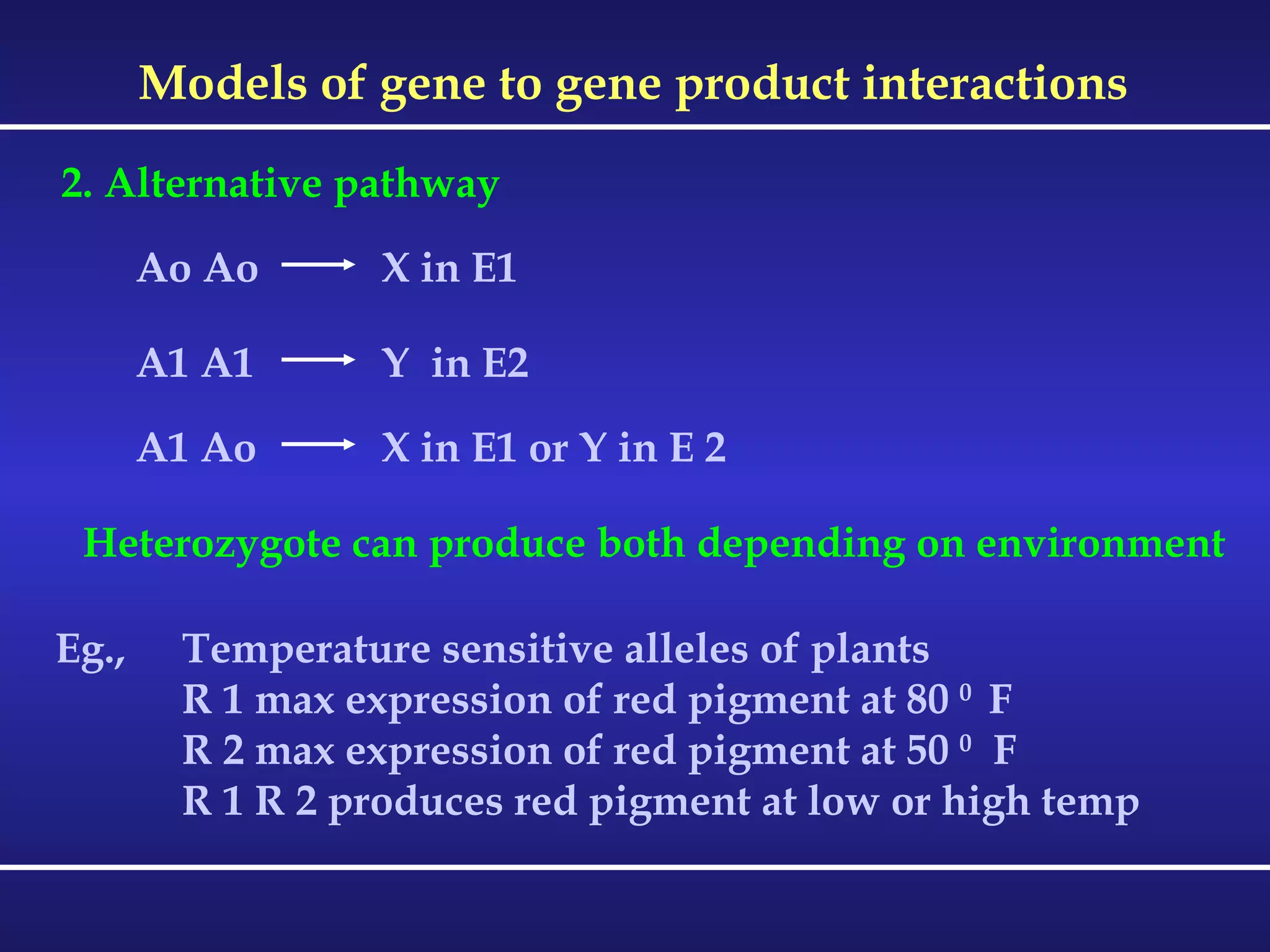
Models of gene to gene product interactions 2. Alternative pathway Ao Ao  X in E1  A1 A1  Y  in E2 A1 Ao  X in E1 or Y in E 2 Heterozygote can produce both depending on environment Eg., Temperature sensitive alleles of plants R 1 max expression of red pigment at 80  0  F R 2 max expression of red pigment at 50  0   F R 1 R 2 produces red pigment at low or high temp
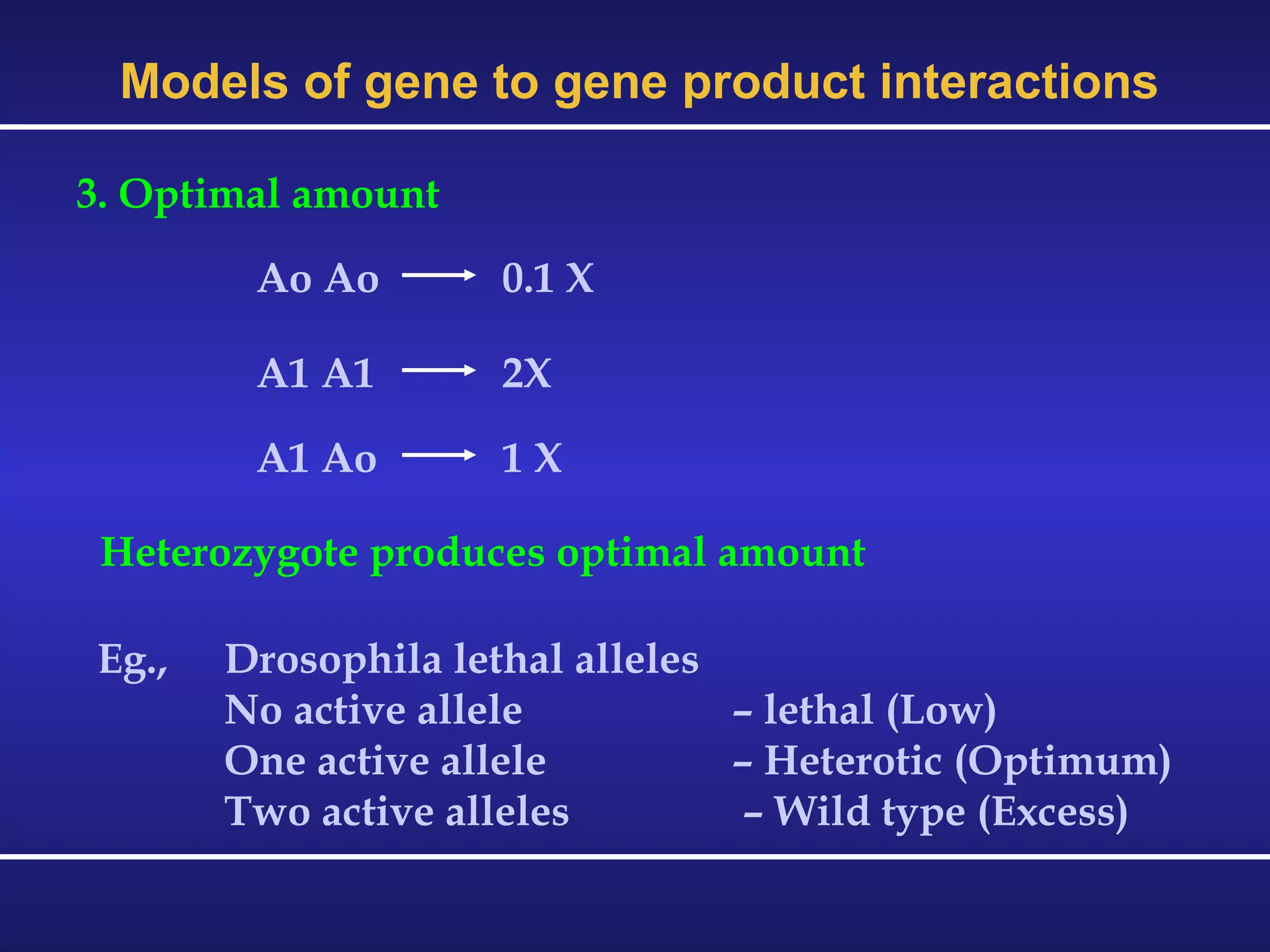
Ao Ao  0.1 X  A1 A1  2X A1 Ao  1 X Heterozygote produces optimal amount 3. Optimal amount Models of gene to gene product interactions Eg., Drosophila lethal alleles No active allele  – lethal (Low) One active allele  – Heterotic (Optimum) Two active alleles  – Wild type (Excess)
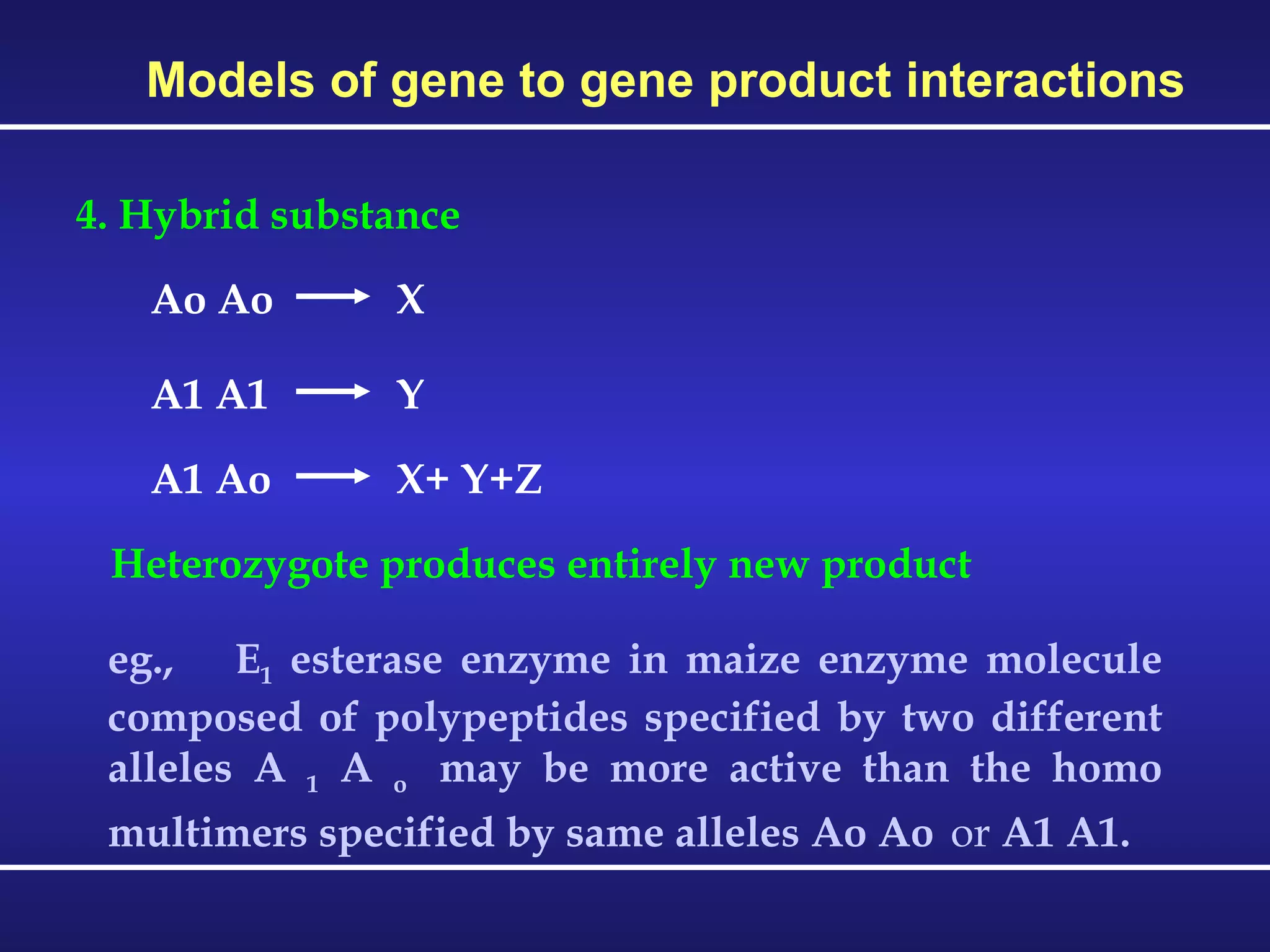
Models of gene to gene product interactions 4. Hybrid substance Ao Ao  X  A1 A1  Y A1 Ao  X+ Y+Z eg., E 1  esterase enzyme in maize enzyme molecule composed of polypeptides specified by two different alleles A  1  A  o  may be more active than the homo multimers specified by same alleles Ao Ao   or  A1 A1.   Heterozygote produces entirely new product
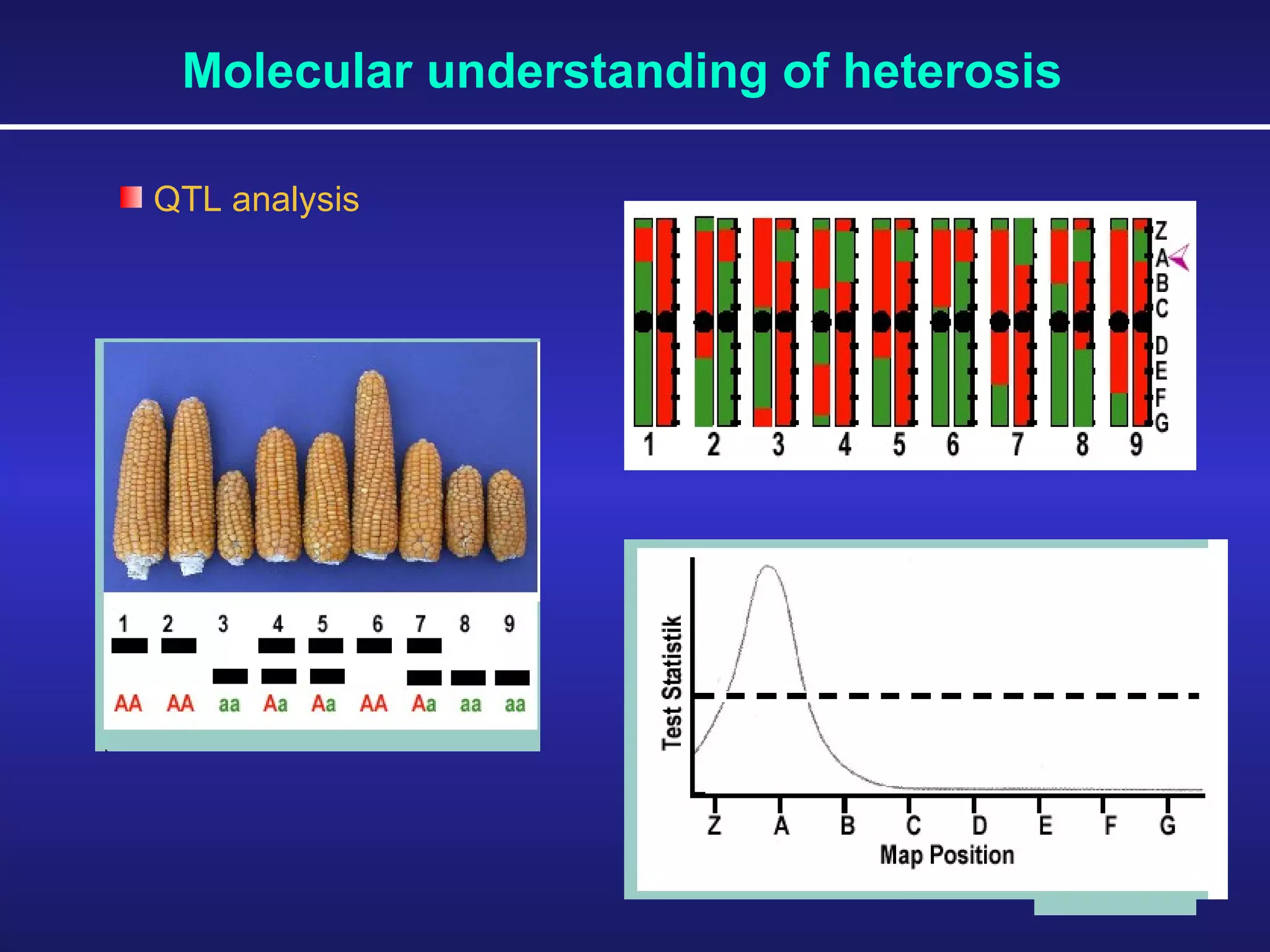
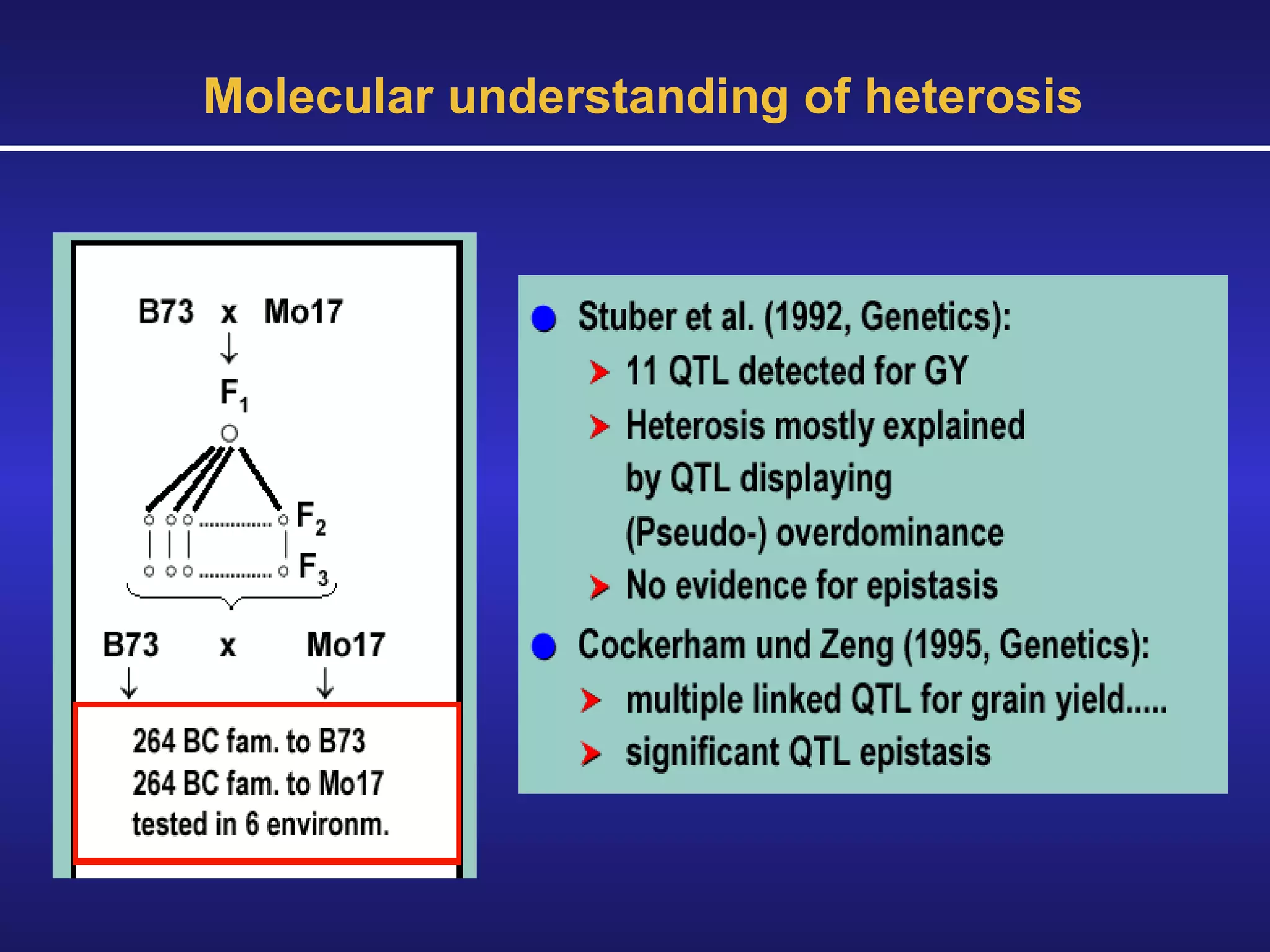
Molecular understanding of heterosis QTL analysis
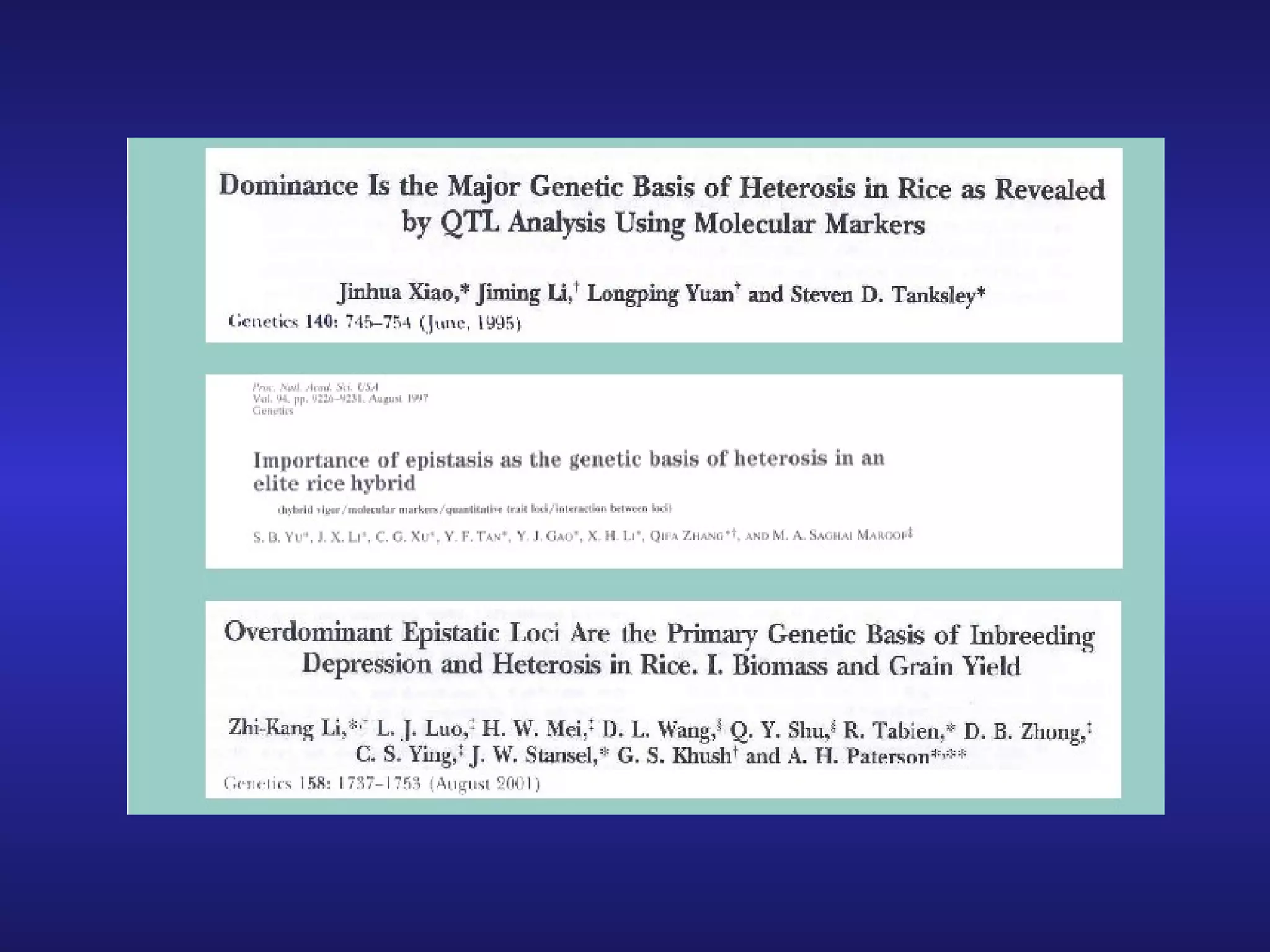
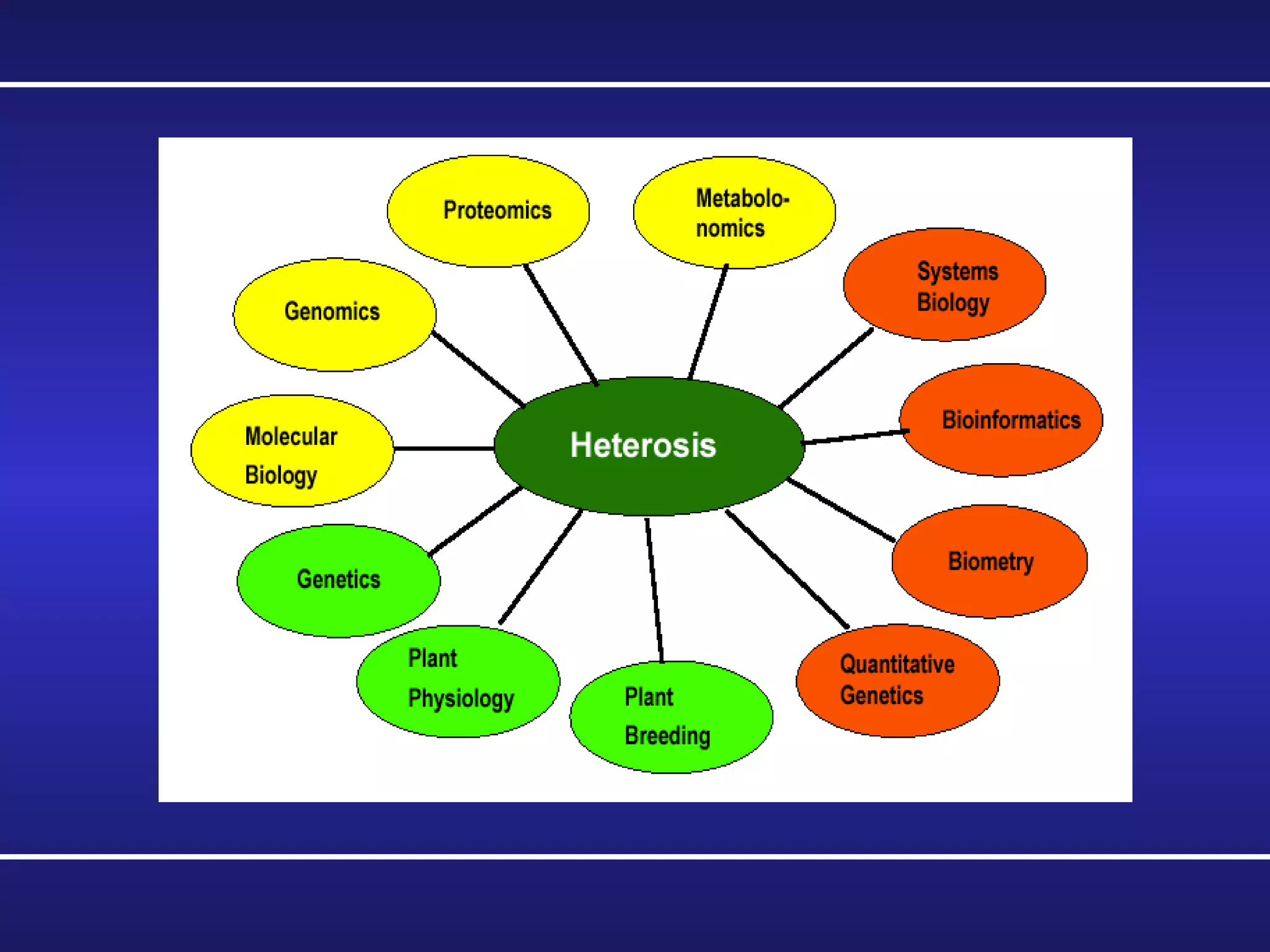
Molecular understanding of heterosis


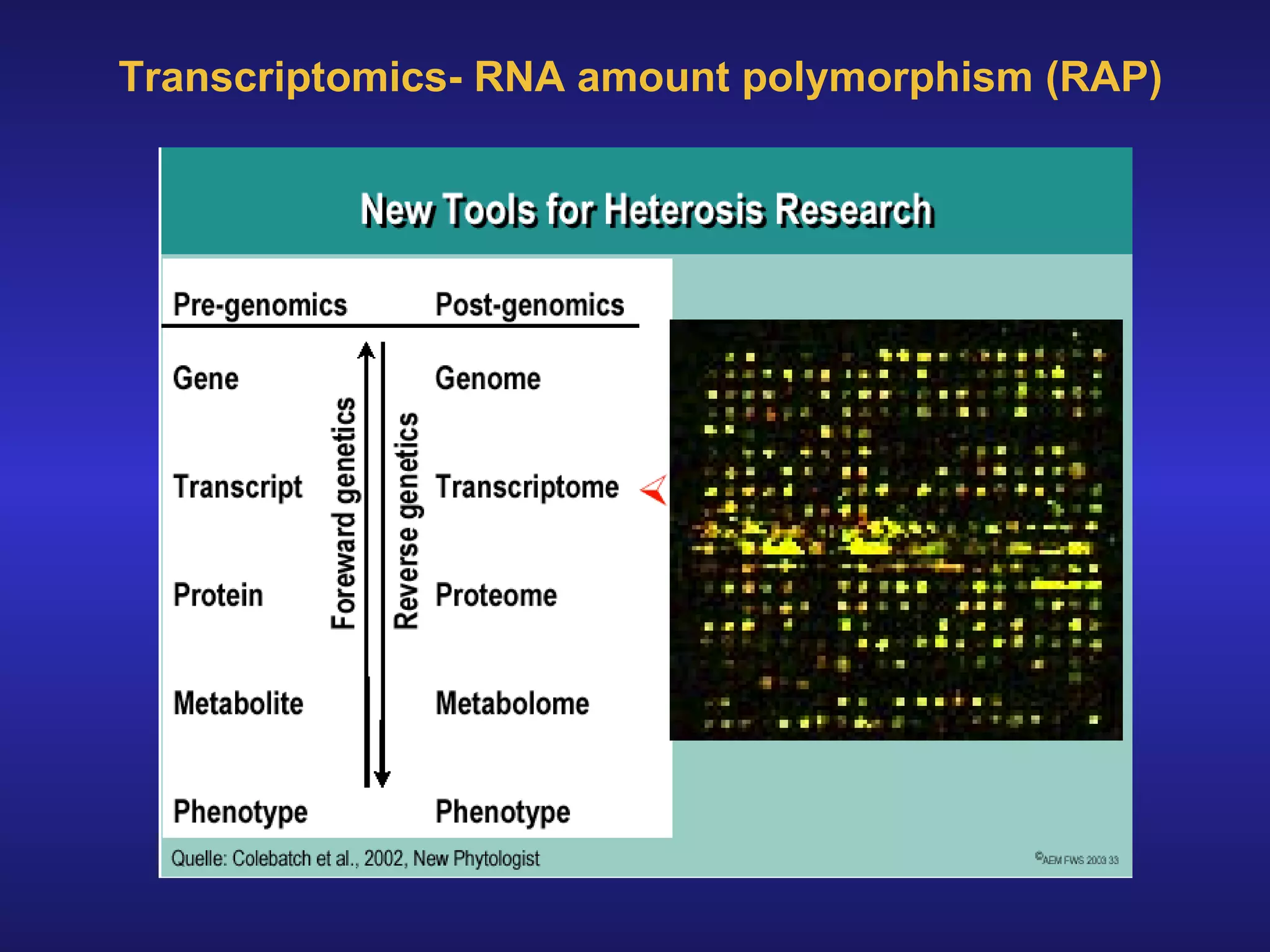
Transcriptomics- RNA amount polymorphism (RAP)
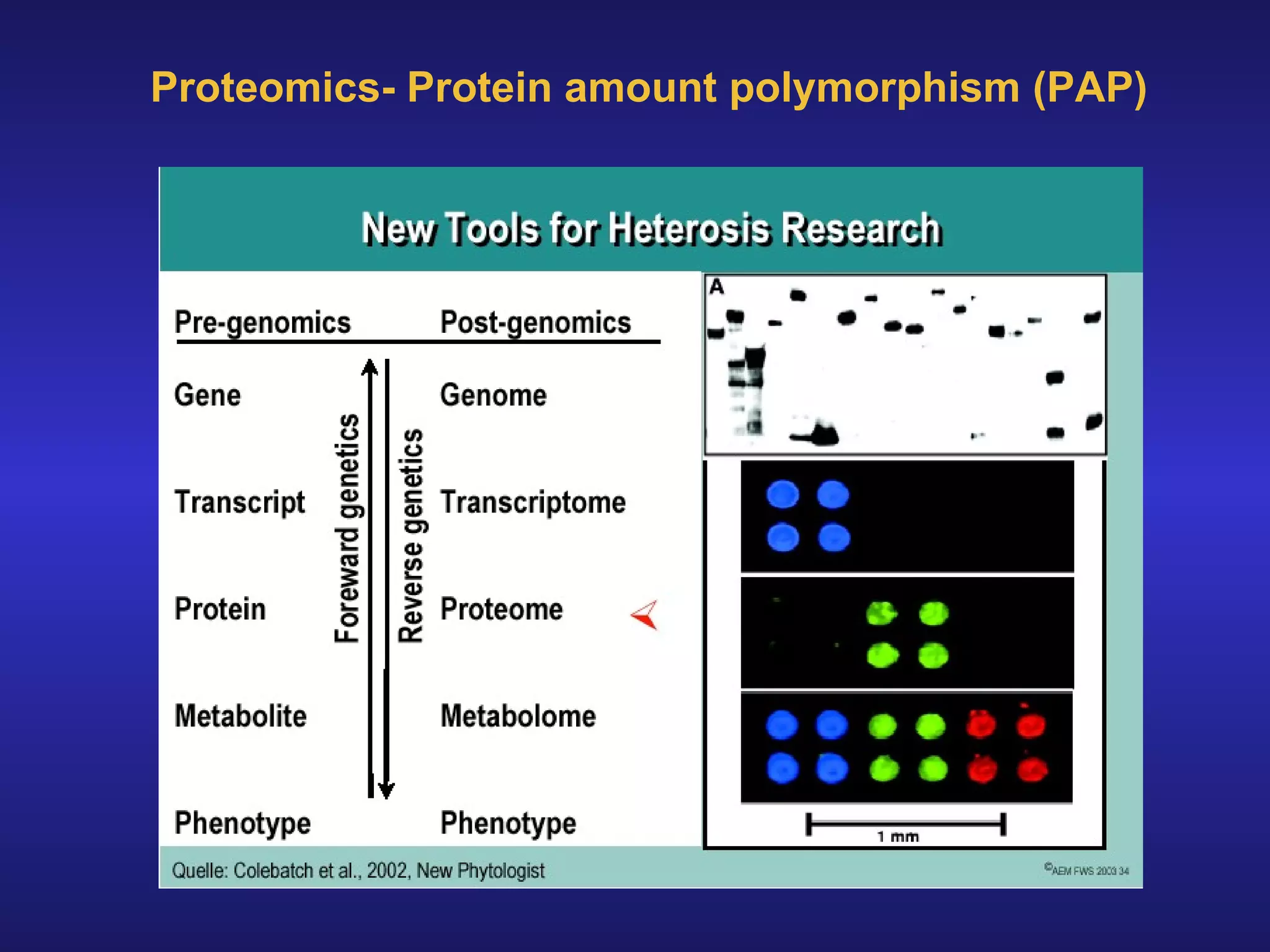
Proteomics- Protein amount polymorphism (PAP)
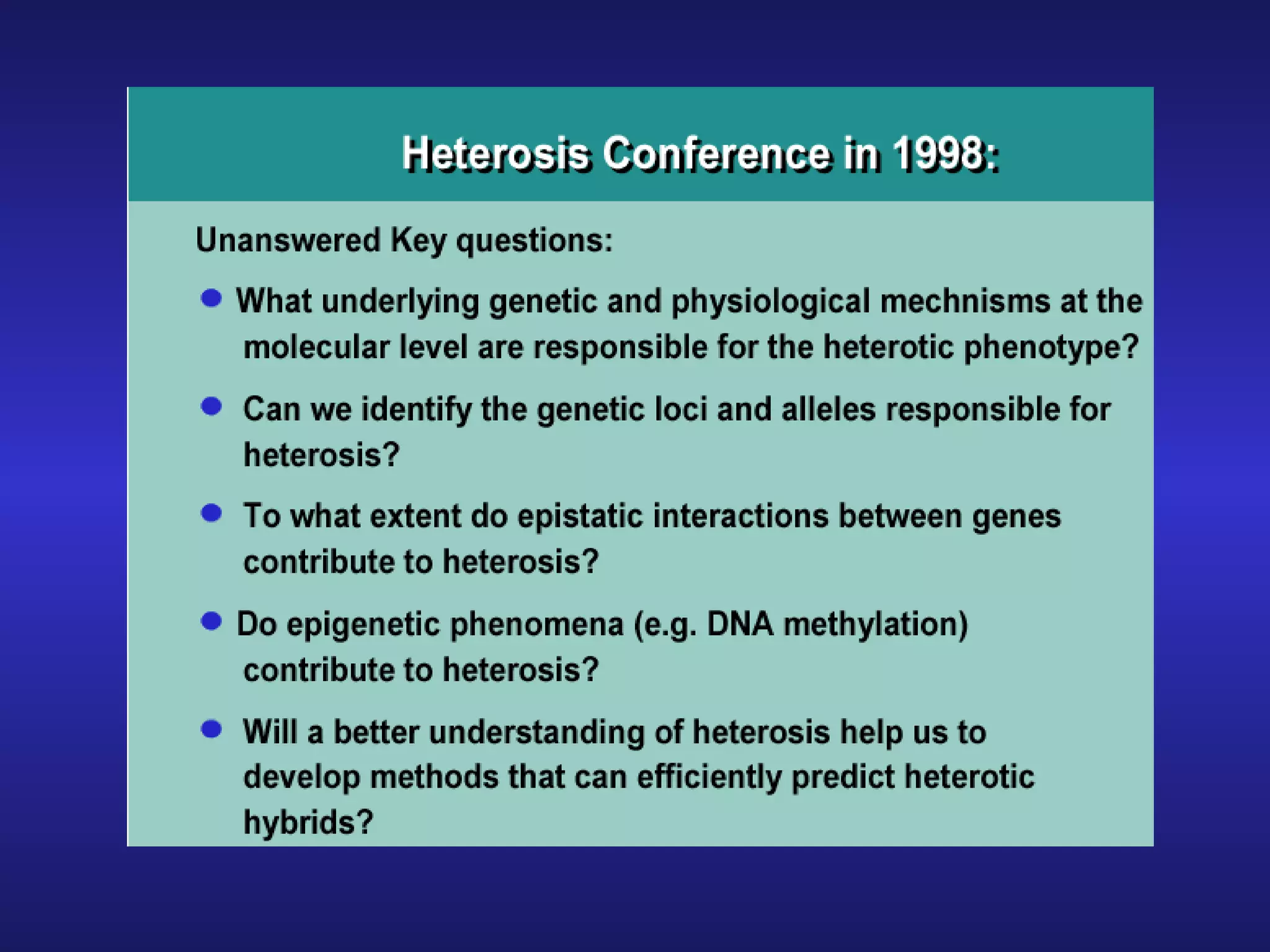
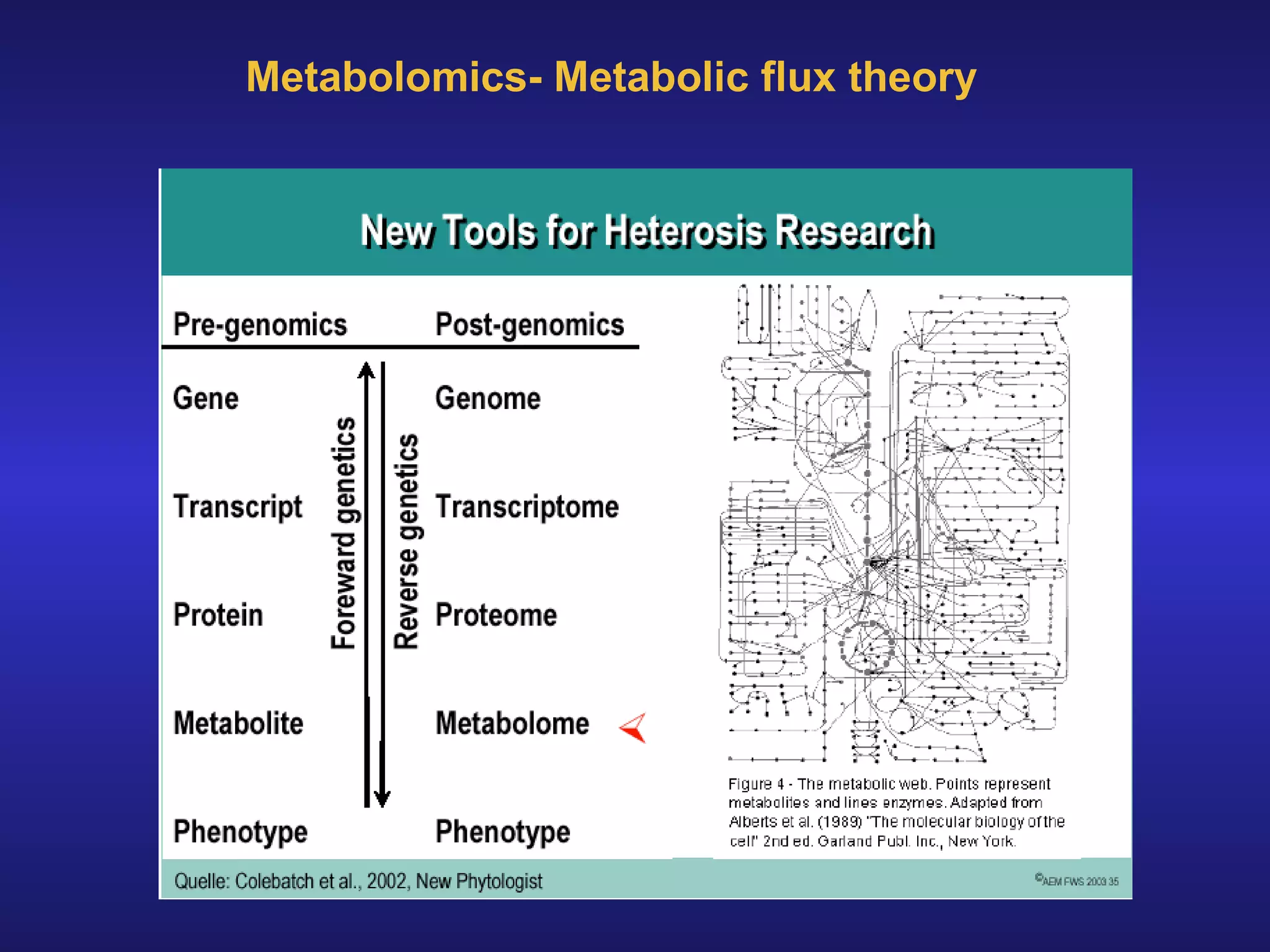
Metabolomics- Metabolic flux theory
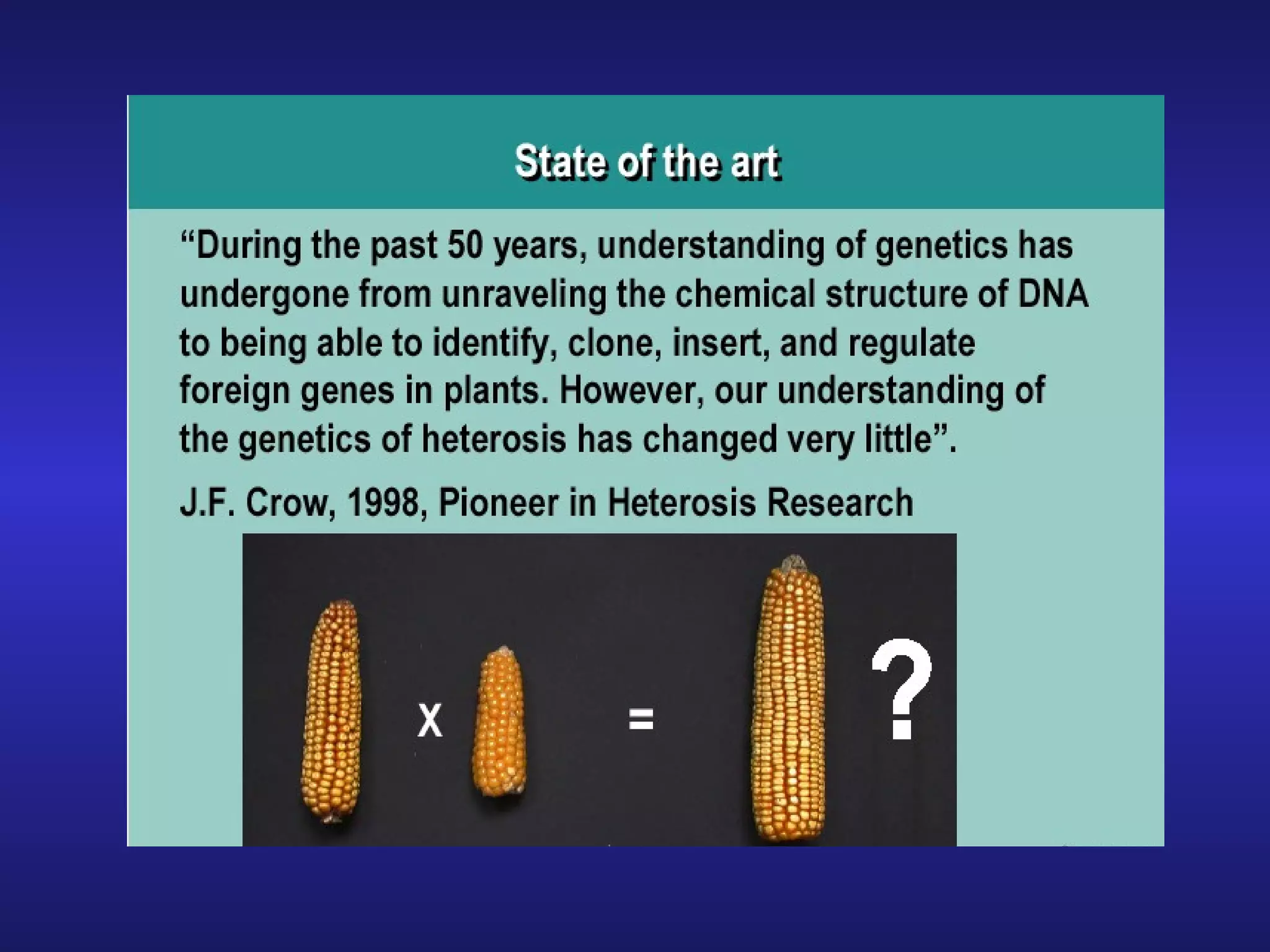
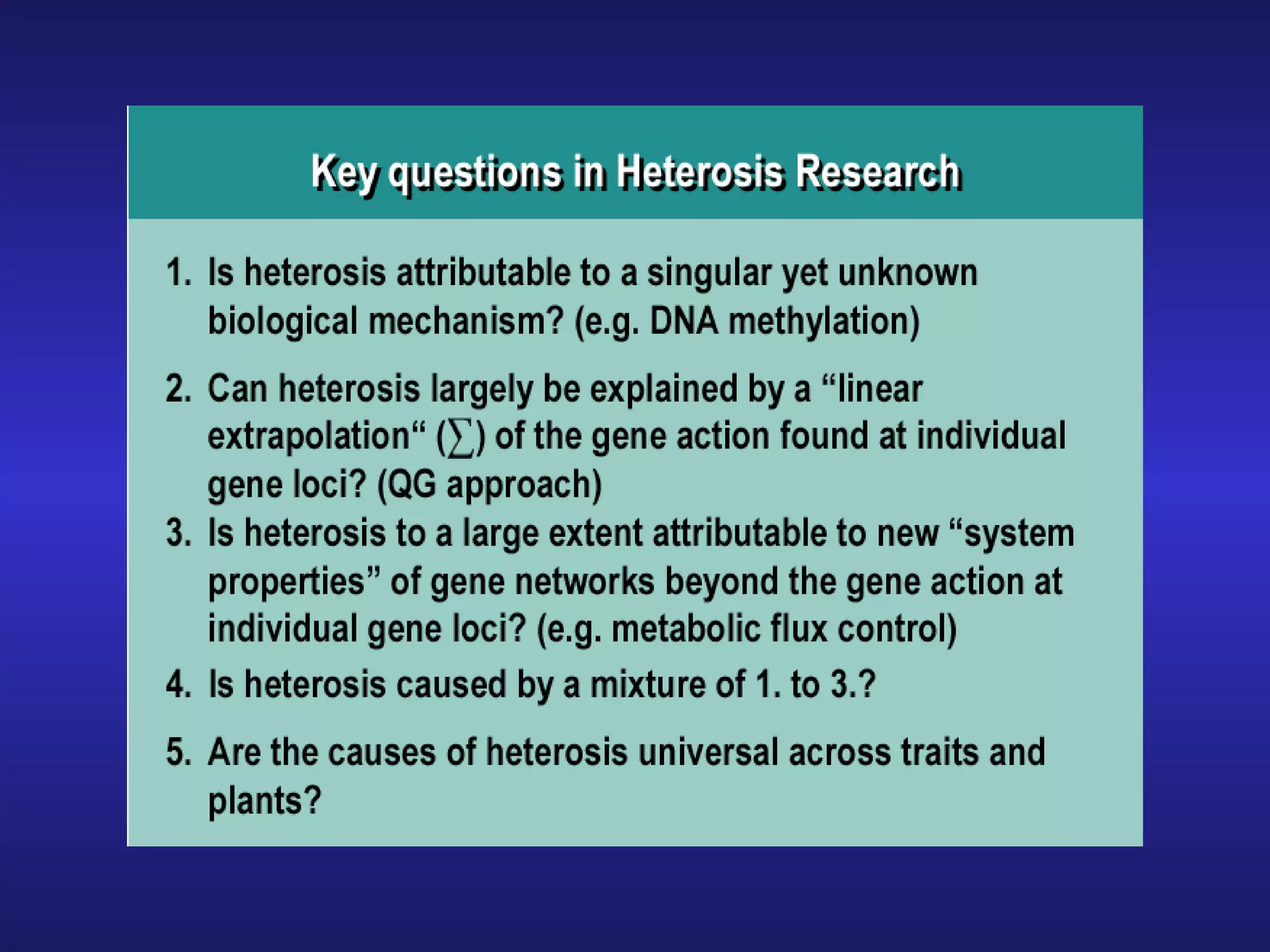
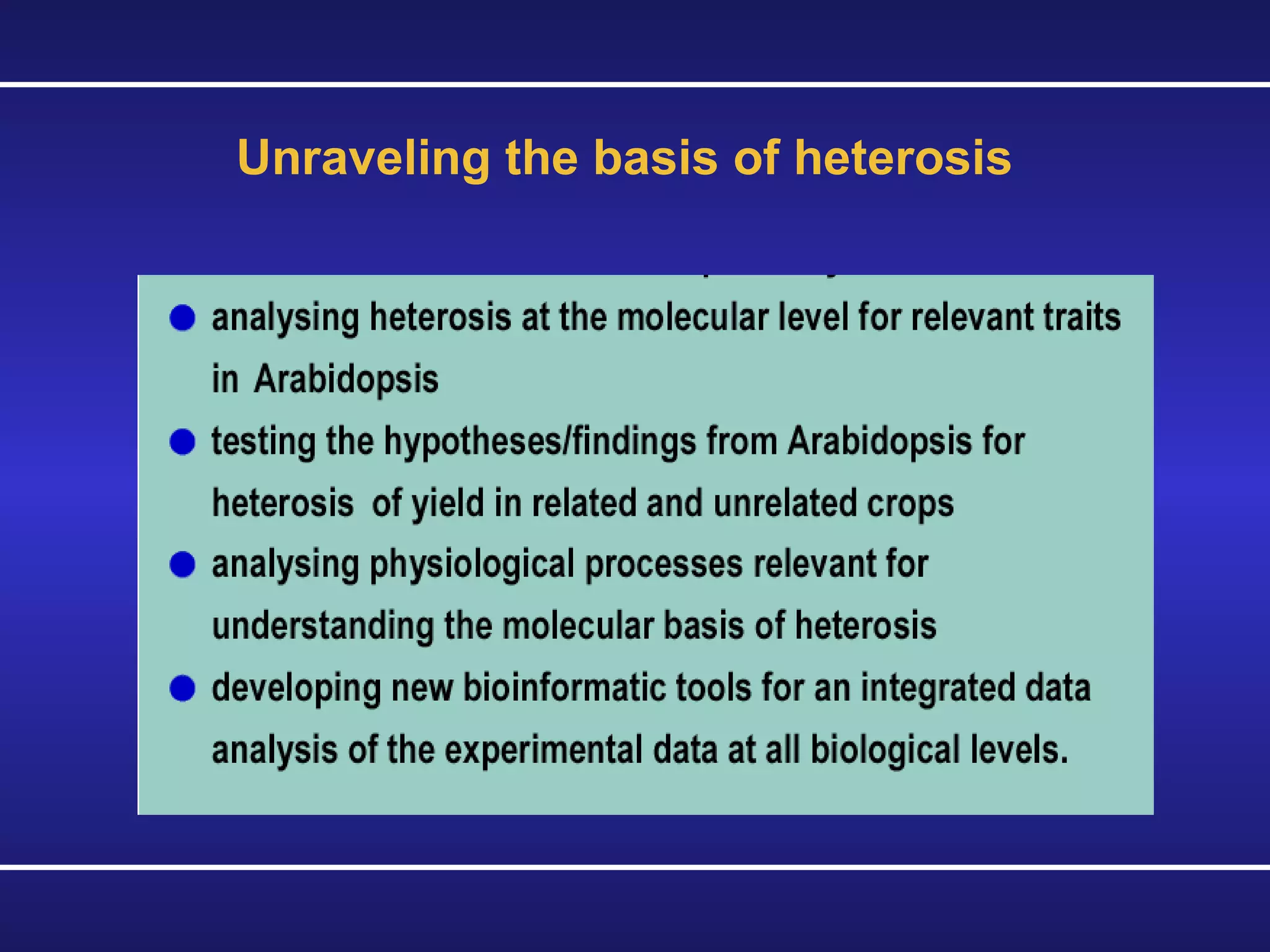
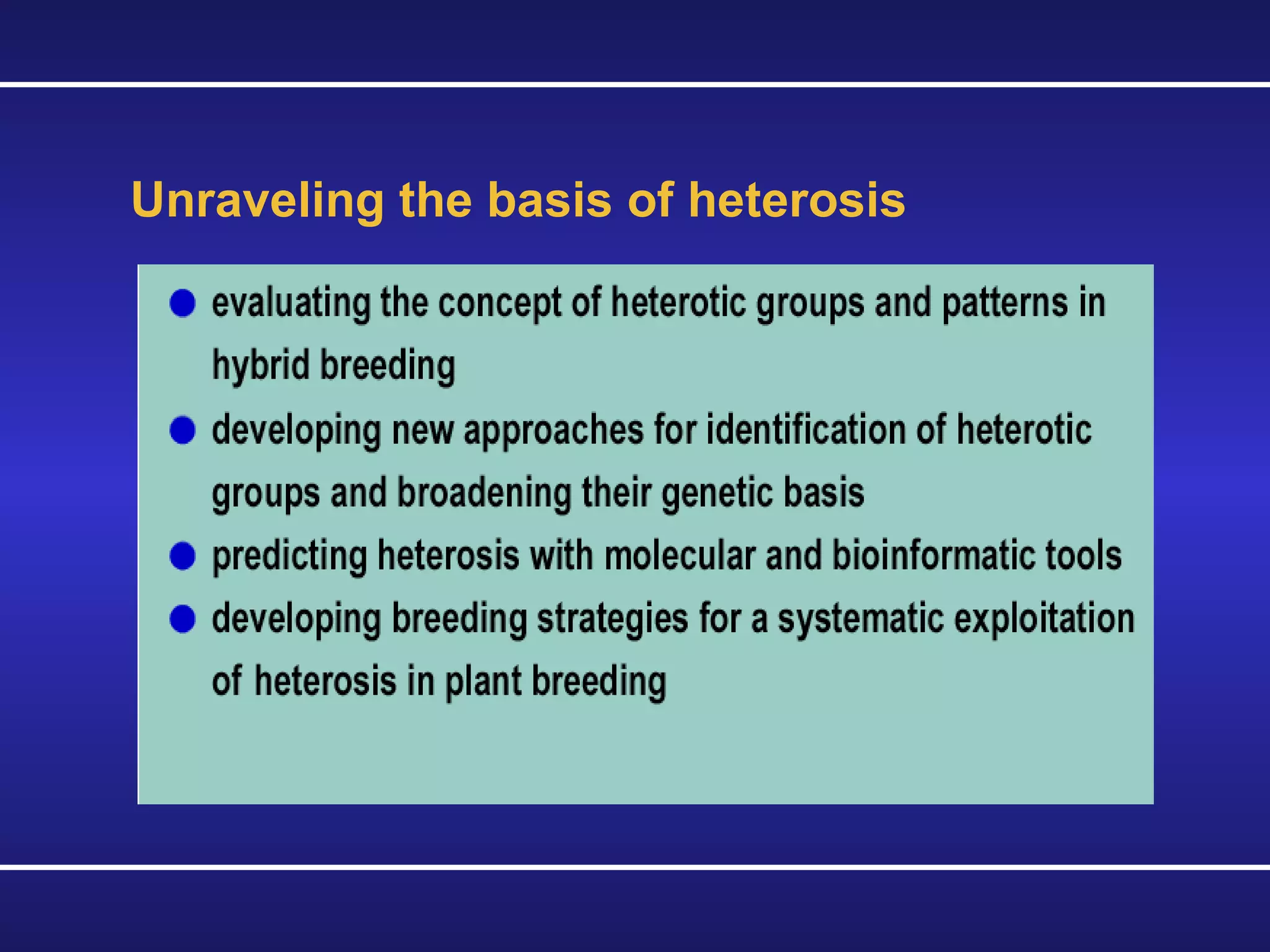
Unraveling the basis of heterosis
 
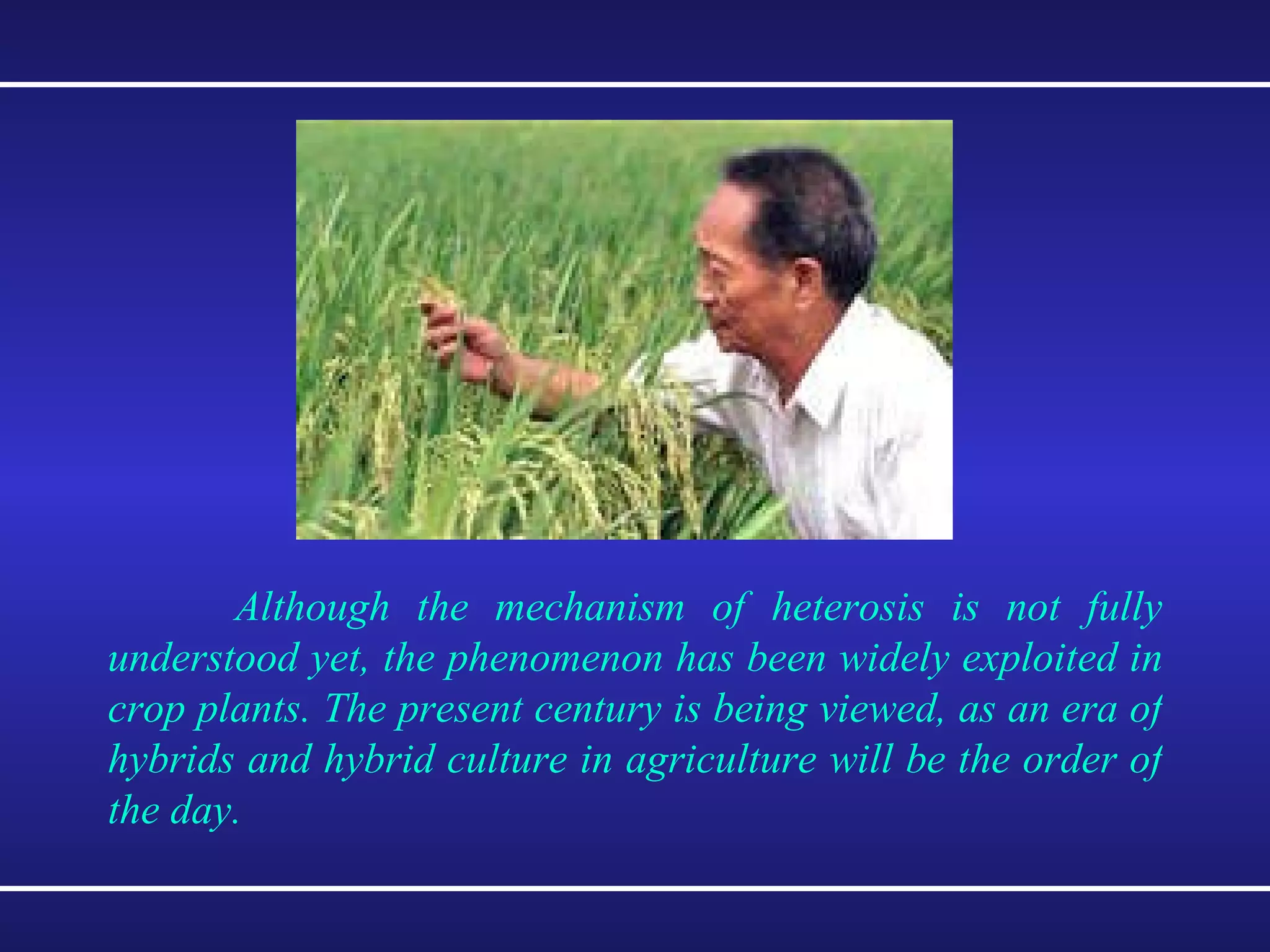
Although the mechanism of heterosis is not fully understood yet, the phenomenon has been widely exploited in crop plants. The present century is being viewed, as an era of hybrids and hybrid culture in agriculture will be the order of the day.

Heterosis concepts

  • 1.
    Concepts of heterosis-Genetic, Physiological and Molecular basis
  • 2.
  • 3.
  • 4.
  • 5.
  • 6.
  • 7.
    History of Heterosis Concept Pre - Mendelian 1766 Kolreuter – Hybrid vigour in Nicotiana 1799 A. Knight – Principle of anti-inbreeding 1865 Mendel – Hybrid vigour in peas 1877 Darwin – Cross fertilization is beneficial 1880 Beal – First published report of 51% increase in yield over parents 1891 Johnson – Crossing gave better off-springs 1892 Mc Cleur – Inbreeding imparted sterility Crossing imparted vigour
  • 8.
    History of Heterosis Concept Simpson – Rejuvenation by hybridization East and Hayes – Stimulus of heterozygosis Shull – Coined the term heterosis 1918 Jones – Practical utilization of heterosis
  • 9.
    Academic influence pedigreechart from Darwin to Jones England Darwin 1859 Natural selection Boston Gray 1860s Michigan Beal 1880s Illinois Holden, Davenport 1890s Illinois Hopkins 1890s Illinois, CT East 1900 Connecticut Jones 1918 Double cross
  • 10.
    Academic influence pedigreechart from Buffon to Shull France Buffon 1760s France Lamarck 1800s De Candolle Germany Nageli 1850s Germany Correns,De vries 1900 Holland Von Tshermack Mendel Newyork Shull 1908
  • 11.
    ‘ We knowwhat inbreeding does and I do not propose to spend people’s money to learn how to reduce corn yields’ -Hopkins
  • 12.
    ‘ A recentpaper by Dr. G.H. Shull has given, I believe the correct interpretation of this vexed question. His idea, although clearly and reasonably developed, was supported by few data’ - East,1908 ‘ Since studying your paper, I agree entirely with your conclusion, and wonder why I have been so stupid not to see the fact myself’ - East wrote to Shull in 1952
  • 13.
    Nomenclature Contd... Heterozygosis(East & Hayes, 1912) Crossing produces heterozygosis Selfing leads to Homozygosis Heterosis (Shull, 1914) Used the term for the same phenomenon Hybrid Vigour (Jones, 1918) Synonymous to Shull’s Heterosis Heterobeltiosis(Blitzer, 1968) Increased performance of hybrid over BP Euheterosis (Dobzhansky, 1950) Hybrids possessed higher fitness than their parents Luxuriance(Dobzhansky, 1950) Extreme heterosis for morpho- characters, but no fitness
  • 14.
    Positive and Negativeheterosis(Powers, 1944) To include inferiority of hybrid over parents Adaptive Heterosis (MacKay, 1976) Heterosis for adaptability Selective Heterosis (MacKay, 1976) Heterosis for Competitive ability Luxuriant Heterosis (MacKay, 1976) Increased vigour in Size, yield but not in fitness Labile Heterosis (MacKay, 1976) Heterosis which is not fixable Fixed Heterosis (MacKay, 1976) Fixed by various mechanisms
  • 15.
    Measuring heterosis a)Standard heterosis c) Heterobeltiosis b) Midparent heterosis d) Commercial heterosis
  • 16.
  • 17.
    Genetic basis ofheterosis 1. Heterosis is not due to heterozygosity per se Dominance Hypothesis (Davenport, 1907) 2. Superiority of dominant alleles over recessive alleles 3. Heterosis is due to masking of deleterious recessive alleles by dominant alleles 4. Heterosis is directly proportional to the number of dominant genes contributed by each parent
  • 18.
    Dominance hypothesis -An illustration
  • 19.
    Objections True breedinghomozygous individuals for all dominant genes in F 2 F 2 Curve should be skewed towards dominant genes Explanations Dominance of linked gene hypothesis (Jones, 1917) Smooth and symmetrical as yield is governed by polygenes Genetic Basis of Heterosis
  • 20.
    Genetic Basis ofHeterosis Over Dominance Hypothesis (Shull & East, 1908) Heterozygosity per se is the cause of Heterosis Heterozygote is superior to either of the homozygotes Increase in vigour is directly proportional to amount of heterozygosis Superiority of heterozygote may arise due ● production of superior hybrid substance in heterozygote ● cumulative action of divergent alleles More divergent alleles will exhibit more heterosis than less divergent ones
  • 21.
    Shull’s Concept ofHeterosis 1. Self-fertilization purifies the strain and releases new variation Conclusions based on his investigations 2. Self-fertilized plants are weaker than the cross-fertilized ones 3. Generations of close inbreeding reduces the strains into simple constituent bio-types which are weaker than the hybrid combinations 4. Crossing the weakened pure strains would cancel the effects of inbreeding Interpretation of increased vigour, size, fruitfulness, resistance to diseases and insect pests or climatic rigour of any kind, manifested by Cross-bred organisms as compared with corresponding inbreds, as the Specific results of unlikeness in the constituents of the uniting parental gametes Shull (1952)
  • 22.
  • 23.
    Haploid having Singleset of genes in each nucleus Within the same nucleus dominance and heterozygosis can’t exist Higher growth representing heterosis came from heterocaryon between strains of N. tetrasperma Over dominance or single locus heterosis Strain A Strain B Heterocaryon Evidence in heterokaryon of Neurospora
  • 24.
    The heyday ofoverdominance ‘ In 1950 the estimates of total mutation rate, mainly from Drosophila, were about 0.05 per haploid genome. This argued that the dominance hypothesis could account for an increased performance of 5% or less, but not the 15 to 20% that was observed’ J.F. Crow ‘ It would appear that the total elimination of deleterious recessive alleles would make less difference to the yield of cross-bred commercial crops than the total mutation rate would suggest. Perhaps no more than a 1% improvement could be looked for from this cause. Difference of the order of 20% remain to be explained’ R.A. Fisher
  • 25.
    Objections Evidences ofsingle locus heterosis may not hold good for quantitative characters like yield Quantitative estimation of overdominance is difficult due to linkage bias Genetic basis of heterosis
  • 26.
    ‘ In 1950sI argued that heterosis is largely due to overdominance but when more evidences for dominance began to appear I changed my mind and have retained the view that heterosis is mainly due to the loci that are dominant or partially so’ - J.F.Crow
  • 27.
    Epistasis hypothesis Heterosis is mostly attributable to favourable epistatic interaction between non-allelic genes -Powell 1944, Williams 1959
  • 28.
    Physiological Basis ofHeterosis Ashby’s Hypothesis of Greater Initial Capital Heterozygosity results from the greater initial weight of the embryo Hybrid vigour is nothing more than the maintenance of initial advantage in embryo size Hybrids do not differ from their parents in relative growth rate
  • 29.
    Physiological Basis ofHeterosis Stages of physiological manifestation of heterosis 1. Seed and Embryo development High positive correlation was recorded between hybrid vigour and embryo weight Copland noted that hybrid embryo exhibited greater vigour in the earlier stages of development Ashbey found significant differences between embryo weight of reciprocal crosses Early differences in embryo size in favour of hybrids resulted from rapid growth rate of multi cellular zygote
  • 30.
    Physiological basis ofheterosis Early seedling growth Hybrid shows higher growth rate than inbreds immediately after germination but not later Hybrids do have a larger maximum growth rate period Ashby says embryo size is more significant than reserve food material
  • 31.
    Later Seedling GrowthHoffer found root dry matter content of hybrids to be intermediate between parents Hybrids found to absorb and utilize more amount of N ,P than the inbred lines Catalase activity was higher in heterotic hybrids Physiological basis of heterosis
  • 32.
    Biochemical basis ofheterosis Bottleneck concept (Manglesdorf) (i) Excellence of genotype depents not upon its strongest link, but upon its weakest link (ii) Emphasis is laid not on the superiority of the hybrid, but on the inferiority of its parents (iii)Inferiority of the parents are thought to be the bottlenecks represented by inefficient alleles (iv)It supports the dominance hypothesis
  • 33.
    Evidence by RobbinsRoots of Red currant had bottleneck for Pyridoxin production Roots of Johannesfeur had bottleneck for Suppy of Nicotinamide Hybrid was able to produce both vitamins In the roots of Tomato varieties
  • 34.
    Models of geneto gene product interactions Supplementary action model Ao Ao X A1 A1 Y A1 Ao X+Y Alleles produce entirely new products Heterozygotes produce both the products eg., Rust resistance in flax
  • 35.
    Models of geneto gene product interactions 2. Alternative pathway Ao Ao X in E1 A1 A1 Y in E2 A1 Ao X in E1 or Y in E 2 Heterozygote can produce both depending on environment Eg., Temperature sensitive alleles of plants R 1 max expression of red pigment at 80 0 F R 2 max expression of red pigment at 50 0 F R 1 R 2 produces red pigment at low or high temp
  • 36.
    Ao Ao 0.1 X A1 A1 2X A1 Ao 1 X Heterozygote produces optimal amount 3. Optimal amount Models of gene to gene product interactions Eg., Drosophila lethal alleles No active allele – lethal (Low) One active allele – Heterotic (Optimum) Two active alleles – Wild type (Excess)
  • 37.
    Models of geneto gene product interactions 4. Hybrid substance Ao Ao X A1 A1 Y A1 Ao X+ Y+Z eg., E 1 esterase enzyme in maize enzyme molecule composed of polypeptides specified by two different alleles A 1 A o may be more active than the homo multimers specified by same alleles Ao Ao or A1 A1. Heterozygote produces entirely new product
  • 38.
    Molecular understanding ofheterosis QTL analysis
  • 39.
  • 40.
  • 41.
  • 42.
  • 43.
  • 44.
    Transcriptomics- RNA amountpolymorphism (RAP)
  • 45.
    Proteomics- Protein amountpolymorphism (PAP)
  • 46.
  • 47.
  • 48.
  • 49.
  • 50.
    Although the mechanismof heterosis is not fully understood yet, the phenomenon has been widely exploited in crop plants. The present century is being viewed, as an era of hybrids and hybrid culture in agriculture will be the order of the day.