The Nature – Nurture Debate
Presented By
Athira
Rajeev
Heredity & Environment Interaction
The Heredity And Environment
interact to produce individual
differences in development
Lets go through….
 Behavior genetics
 Heredity-Environment Correlations
 Shared And NonShared
Environment Experiences
 The Epigenetic View And Gene
Environment (G E ) Interaction
Behavior Genetics
 The field that seeks to discover the
influence of heredity and
environment on individuals
differences in human traits and
development
 It figure out what is responsible for
the differences among people
 It can be of two types
Twin Study
Twin Study
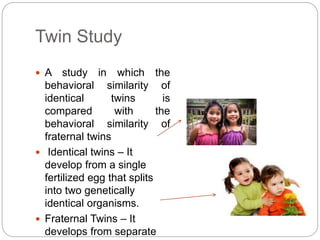
 A study in which the
behavioral similarity of
identical twins is
compared with the
behavioral similarity of
fraternal twins
 Identical twins – It
develop from a single
fertilized egg that splits
into two genetically
identical organisms.
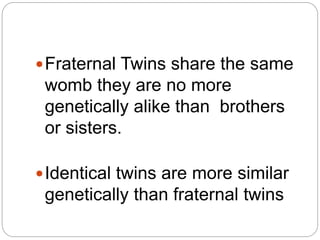
 Fraternal Twins – It
develops from separate
Fraternal Twins share the same
womb they are no more
genetically alike than brothers
or sisters.
Identical twins are more similar
genetically than fraternal twins
Adoption Study
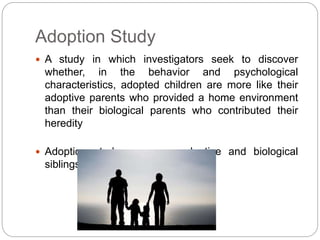
 A study in which investigators seek to discover
whether, in the behavior and psychological
characteristics, adopted children are more like their
adoptive parents who provided a home environment
than their biological parents who contributed their
heredity
 Adoption study compares adoptive and biological
siblings
Heredity- Environment
Correlations
Passive genotype- Environment
correlations
Evocative genotype –
Environment correlations
Active ( Niche Picking )
genotype- Environment
correlations
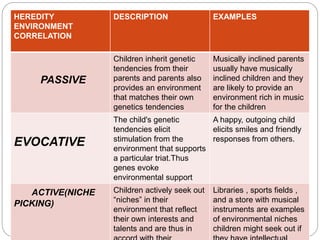
HEREDITY
ENVIRONMENT
CORRELATION
DESCRIPTION EXAMPLES
PASSIVE
Children inherit genetic
tendencies from their
parents and parents also
provides an environment
that matches their own
genetics tendencies
Musically inclined parents
usually have musically
inclined children and they
are likely to provide an
environment rich in music
for the children
EVOCATIVE
The child's genetic
tendencies elicit
stimulation from the
environment that supports
a particular triat.Thus
genes evoke
environmental support
A happy, outgoing child
elicits smiles and friendly
responses from others.
ACTIVE(NICHE
PICKING)
Children actively seek out
“niches” in their
environment that reflect
their own interests and
talents and are thus in
Libraries , sports fields ,
and a store with musical
instruments are examples
of environmental niches
children might seek out if
Shared And Non shared
Environmental Experiences
 Shared environmental experiences  Siblings
common environmental experiences, such as
their parents personalities and intellectual
orientation, the family’s social economics
status , and the neighborhood in which they
live
 Non Shared Environmental Experiences
The child’s own unique experiences, both with
in the family and outside the family, that are
not shared by another sibling. Thus
experiences occurring within the family can be
part of the “non shared environmental
Tennis Stars
Serena
Williams
And
Venus
Williams
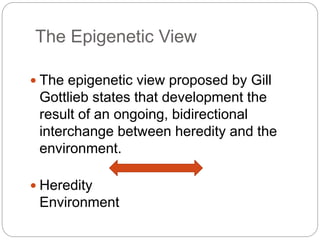
The Epigenetic View
 The epigenetic view proposed by Gill
Gottlieb states that development the
result of an ongoing, bidirectional
interchange between heredity and the
environment.
 Heredity
Environment
Gene Environment (G E)
 The interaction of a specific measured variation in
the DNA and a specific measured aspect of the
environment
 It is proposed by CASPI and others, 2010
 The field of pharmacogenetics is the study of
gene-environment interactions involving the
individuals genotype and drug treatment .
 The goal of pharmacogenetics is to discover if
certain drugs are safer or more dangerous to use
if the individual’s genotype is known
IMPORTANCE OF GENETIC
FACTORS
Genetic factors are essential in the
make up of an organism. An abnormality in any
one of the genetic factors can end up in
disastrous results. So, for the proper
development of an organism, the proper and
efficient make up of genetic factors plays a key
role.
GENETIC DISORDERS
A genetic disorder is a disease that is
caused by an abnormality in an individual's DNA.
Abnormalities can range from a small mutation in
a single gene to the addition or subtraction of an
entire chromosome or set of chromosomes
SINGLE GENE DISORDERS
These disorders result when a mutation
causes the protein product of a single gene to be
altered or missing. Eg: Phenylketonuria, sickle
cell anemia, Severe Combined
Immunodeficiency Syndrome, cystic fibrosis, etc.
CHROMOSOMAL
ABNORMALITIES
In these disorders, entire chromosomes,
or large segments of them, are missing,
duplicated, or otherwise altered. Eg: Klinefelter
syndrome, Turner syndrome, Down syndrome,
Cri-du-chat syndrome, etc.
MULTIFACTORIAL DISORDERS
Multifactorial disorders result from
mutations in multiple genes, often coupled with
environmental causes. Eg: Hypothyroidism, colon
cancer, ovarian cancer, Alzheimer’s disease, etc.
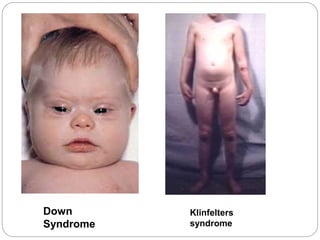
Down
Syndrome
Klinfelters
syndrome
THANK
YOU…….

Heredity _environment_interaction

  • 1.
    The Nature –Nurture Debate Presented By Athira Rajeev Heredity & Environment Interaction
  • 2.
    The Heredity AndEnvironment interact to produce individual differences in development
  • 3.
    Lets go through…. Behavior genetics  Heredity-Environment Correlations  Shared And NonShared Environment Experiences  The Epigenetic View And Gene Environment (G E ) Interaction
  • 4.
    Behavior Genetics  Thefield that seeks to discover the influence of heredity and environment on individuals differences in human traits and development  It figure out what is responsible for the differences among people  It can be of two types Twin Study
  • 5.
    Twin Study  Astudy in which the behavioral similarity of identical twins is compared with the behavioral similarity of fraternal twins  Identical twins – It develop from a single fertilized egg that splits into two genetically identical organisms.  Fraternal Twins – It develops from separate
  • 6.
    Fraternal Twins sharethe same womb they are no more genetically alike than brothers or sisters. Identical twins are more similar genetically than fraternal twins
  • 7.
    Adoption Study  Astudy in which investigators seek to discover whether, in the behavior and psychological characteristics, adopted children are more like their adoptive parents who provided a home environment than their biological parents who contributed their heredity  Adoption study compares adoptive and biological siblings
  • 8.
    Heredity- Environment Correlations Passive genotype-Environment correlations Evocative genotype – Environment correlations Active ( Niche Picking ) genotype- Environment correlations
  • 9.
    HEREDITY ENVIRONMENT CORRELATION DESCRIPTION EXAMPLES PASSIVE Children inheritgenetic tendencies from their parents and parents also provides an environment that matches their own genetics tendencies Musically inclined parents usually have musically inclined children and they are likely to provide an environment rich in music for the children EVOCATIVE The child's genetic tendencies elicit stimulation from the environment that supports a particular triat.Thus genes evoke environmental support A happy, outgoing child elicits smiles and friendly responses from others. ACTIVE(NICHE PICKING) Children actively seek out “niches” in their environment that reflect their own interests and talents and are thus in Libraries , sports fields , and a store with musical instruments are examples of environmental niches children might seek out if
  • 10.
    Shared And Nonshared Environmental Experiences  Shared environmental experiences  Siblings common environmental experiences, such as their parents personalities and intellectual orientation, the family’s social economics status , and the neighborhood in which they live  Non Shared Environmental Experiences The child’s own unique experiences, both with in the family and outside the family, that are not shared by another sibling. Thus experiences occurring within the family can be part of the “non shared environmental
  • 11.
  • 12.
    The Epigenetic View The epigenetic view proposed by Gill Gottlieb states that development the result of an ongoing, bidirectional interchange between heredity and the environment.  Heredity Environment
  • 13.
    Gene Environment (GE)  The interaction of a specific measured variation in the DNA and a specific measured aspect of the environment  It is proposed by CASPI and others, 2010  The field of pharmacogenetics is the study of gene-environment interactions involving the individuals genotype and drug treatment .  The goal of pharmacogenetics is to discover if certain drugs are safer or more dangerous to use if the individual’s genotype is known
  • 14.
    IMPORTANCE OF GENETIC FACTORS Geneticfactors are essential in the make up of an organism. An abnormality in any one of the genetic factors can end up in disastrous results. So, for the proper development of an organism, the proper and efficient make up of genetic factors plays a key role.
  • 15.
    GENETIC DISORDERS A geneticdisorder is a disease that is caused by an abnormality in an individual's DNA. Abnormalities can range from a small mutation in a single gene to the addition or subtraction of an entire chromosome or set of chromosomes
  • 16.
    SINGLE GENE DISORDERS Thesedisorders result when a mutation causes the protein product of a single gene to be altered or missing. Eg: Phenylketonuria, sickle cell anemia, Severe Combined Immunodeficiency Syndrome, cystic fibrosis, etc.
  • 17.
    CHROMOSOMAL ABNORMALITIES In these disorders,entire chromosomes, or large segments of them, are missing, duplicated, or otherwise altered. Eg: Klinefelter syndrome, Turner syndrome, Down syndrome, Cri-du-chat syndrome, etc.
  • 18.
    MULTIFACTORIAL DISORDERS Multifactorial disordersresult from mutations in multiple genes, often coupled with environmental causes. Eg: Hypothyroidism, colon cancer, ovarian cancer, Alzheimer’s disease, etc.
  • 19.
  • 20.