EVALUATION AND
MANAGEMENT OF HEMATURIA
Dept of Urology
Govt Royapettah Hospital and Kilpauk Medical College
Chennai
Moderators:
Professors:
• Prof. Dr. G. Sivasankar, M.S., M.Ch.,
• Prof. Dr. A. Senthilvel, M.S., M.Ch.,
Asst Professors:
• Dr. J. Sivabalan, M.S., M.Ch.,
• Dr. R. Bhargavi, M.S., M.Ch.,
• Dr. S. Raju, M.S., M.Ch.,
• Dr. K. Muthurathinam, M.S., M.Ch.,
• Dr. D. Tamilselvan, M.S., M.Ch.,
• Dr. K. Senthilkumar, M.S., M.Ch.
Dept of Urology, GRH and KMC, Chennai. 2
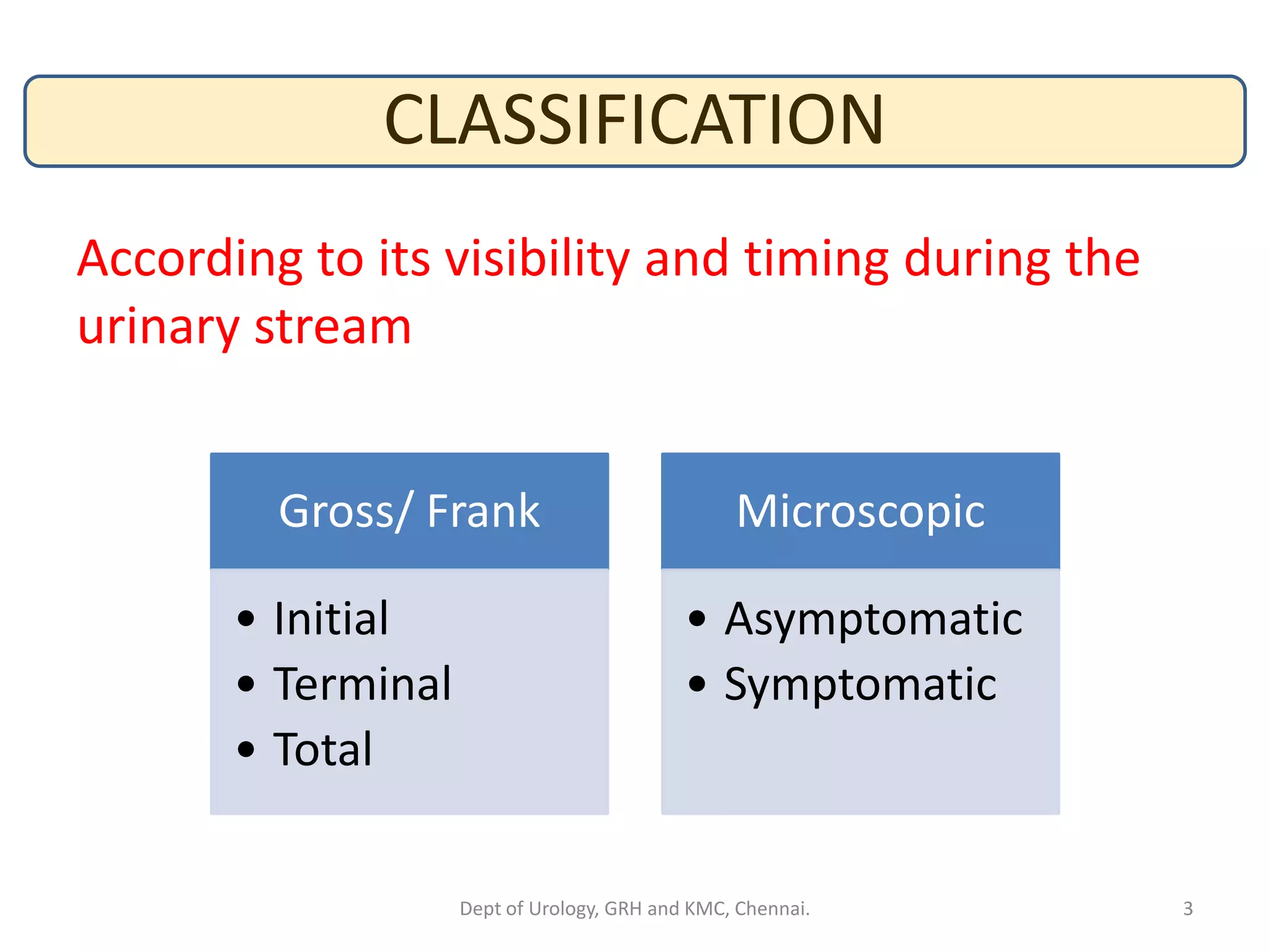
CLASSIFICATION
According to its visibility and timing during the
urinary stream
Gross/ Frank
• Initial
• Terminal
• Total
Microscopic
• Asymptomatic
• Symptomatic
3
Dept of Urology, GRH and KMC, Chennai.
CLASSIFICATION
According to origin
•Urinary bladder
•Prostate
•Urethra
•Upper urinary tract
4
Dept of Urology, GRH and KMC, Chennai.
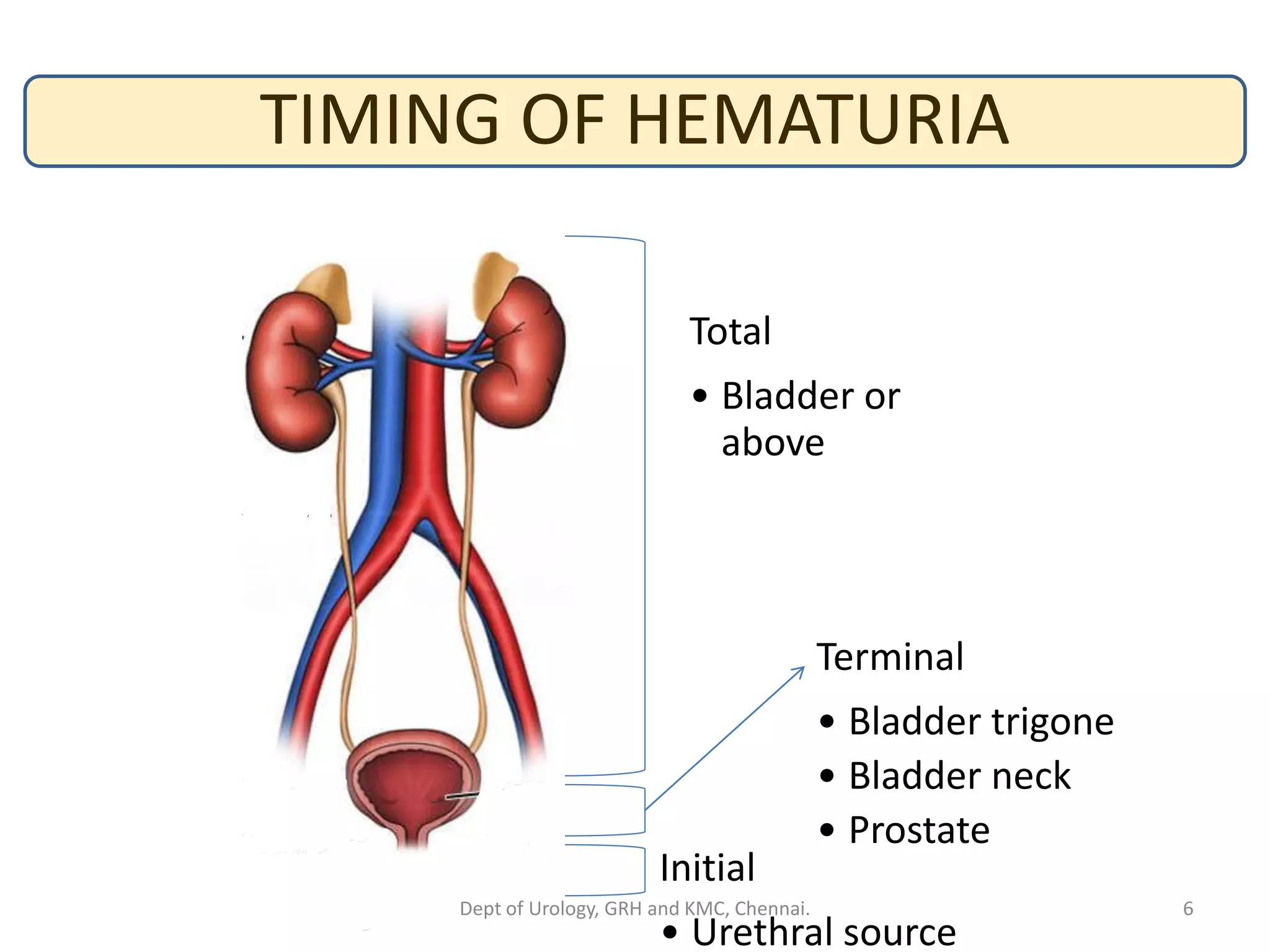
TIMING OF HEMATURIA
Gives indication of the source of hematuria,
Initial
• Urethral source Total
• Bladder or
above
Terminal
• Bladder trigone
• Bladder neck
• Prostate
5
Dept of Urology, GRH and KMC, Chennai.
TIMING OF HEMATURIA
Initial
• Urethral source
Total
• Bladder or
above
Terminal
• Bladder trigone
• Bladder neck
• Prostate
6
Dept of Urology, GRH and KMC, Chennai.
DIFFERENTIAL DIAGNOSIS
Pigmenturia
endogenous
sources
e.g., bilirubin,
myoglobin,
porphyrins
foods ingested
e.g., beets and
rhubarb
drugs taken
e.g.,
phenazopyridine
dehydration
7
Dept of Urology, GRH and KMC, Chennai.
DIFFERENTIAL DIAGNOSIS
Pigmenturia
• Cause false-positive chemical tests (e.g., urine
dipstick)
• This distinction can be made easily by
urinalysis with microscopy.
8
Dept of Urology, GRH and KMC, Chennai.
DIFFERENTIAL DIAGNOSIS
Vaginal bleeding in women
• obtaining a careful menstrual history
• collecting the specimen when the patient is
not having menstrual or gynecologic bleeding,
• if necessary, obtaining a catheterized
specimen
9
Dept of Urology, GRH and KMC, Chennai.
MICROSCOPIC HEMATURIA
• Sign rather than a symptom
• Laboratory diagnosis
• Definition
– Presence of RBCs on microscopic examination of
the urine not evident on visual inspection of the
urine.
• The prevalence of MH among healthy
participants in screening studies is
approximately 6.5%
10
Dept of Urology, GRH and KMC, Chennai.
MICROSCOPIC HEMATURIA
• Higher rates noted in
– Males
– older patients
– smokers
• Categorized by the presence or absence of
associated symptoms
• Quantified according to number of RBCs per
high-power field (HPF)
11
Dept of Urology, GRH and KMC, Chennai.
Criteria for the Diagnosis
normal processes
(e.g., sexual
activity, exercise)
significant medical
conditions
(GU malignancy)
12
Dept of Urology, GRH and KMC, Chennai.
Criteria for the Diagnosis
• Differences in thresholds for initiating an
evaluation reflect efforts to balance the
• Importantly, none have been robustly validated.
Benefits
Cost
analysis
Harms
13
Dept of Urology, GRH and KMC, Chennai.
Criteria for the Diagnosis
Criteria
3 or more
AUA- Single UA
Canada, Dutch- 2 out
of 3 UA
Japan- 5 or more RBCs/
HPF on a single UA
Kaiser permanente-
More than 3 RBCs/HPF
on 2 out of 3 UAs
NICE- 1+ blood or more
on urine dip stick test
PLUS Dysuria or
elevated leukocytosis
14
Dept of Urology, GRH and KMC, Chennai.
URINE MICROSCOPY
Specimen collection
Centrifuge
Pipette, slide
Microscopy
15
Dept of Urology, GRH and KMC, Chennai.
URINE MICROSCOPY
16
Dept of Urology, GRH and KMC, Chennai.
DIPSTICK TEST
Dipsticks frequently demonstrate both colored dots and field color change
The degree of color change is directly related to the amount of hemoglobin present
which changes color according to the degree and amount of oxidation.
catalyzes the reaction and causes subsequent oxidation of a chromogen indicator
Haemoglobin in contact with an organic peroxidase substrate
17
Dept of Urology, GRH and KMC, Chennai.
DIPSTICK TEST
• Free hemoglobin and myoglobin in the urine
• Absorbed into the reagent pad
• Catalyze the reaction within the test paper
• Produce a field change effect in color.
18
Dept of Urology, GRH and KMC, Chennai.
DIPSTICK TEST
coalescence of the dots occurs when there are more than 250 erythrocytes/mL
The greater the number of intact erythrocytes-greater the number of dots that will appear on the test paper
localized free hemoglobin on the pad produces a corresponding dot of color change.
undergo hemolysis
come in contact with the reagent test pad
Intact erythrocytes in the urine
19
Dept of Urology, GRH and KMC, Chennai.
Requirement for Microscopic Evaluation
Urine dipstick for
blood
Haemoglobin,
myoglobin
Urine microscopy
3 or more
RBCs/HPF
Further Evaluation
Detects peroxidase
activity using
benzidine
20
Dept of Urology, GRH and KMC, Chennai.
Requirement for Microscopic Evaluation
False
positive
False
Negative
dilute urine
(osmolality
<308 mOsm)
Vigorous physical
or sexual activity
prolonged
recumbency
(first void in
morning)
21
Dept of Urology, GRH and KMC, Chennai.
Selecting Patients for Evaluation
Vigorous exercise
• considered a diagnosis of exclusion.
• Thus it is necessary to confirm the absence of
MH after a period of abstinence from exercise
22
Dept of Urology, GRH and KMC, Chennai.
Selecting Patients for Evaluation
Hematuria and anticoagulants
• e.g., warfarin, enoxaparin, heparin, aspirin,
clopidogrel, apixiban, dabigatran
• Should undergo a complete evaluation in the
same manner as patients not taking such
medications
23
Dept of Urology, GRH and KMC, Chennai.
Selecting Patients for Evaluation
• Prevalence of hematuria, as well as the likelihood
of finding genitourinary cancers
– no different from patients not taking such medications
• May unmask genitourinary lesions at an earlier
stage
• Patients taking antithrombotic agents were more
than twice as likely to be diagnosed with bladder
cancer within 6 months after an episode of
hematuria
24
Dept of Urology, GRH and KMC, Chennai.
Selecting Patients for Evaluation
25
Dept of Urology, GRH and KMC, Chennai.
26
Dept of Urology, GRH and KMC, Chennai.
Selecting Patients for Evaluation
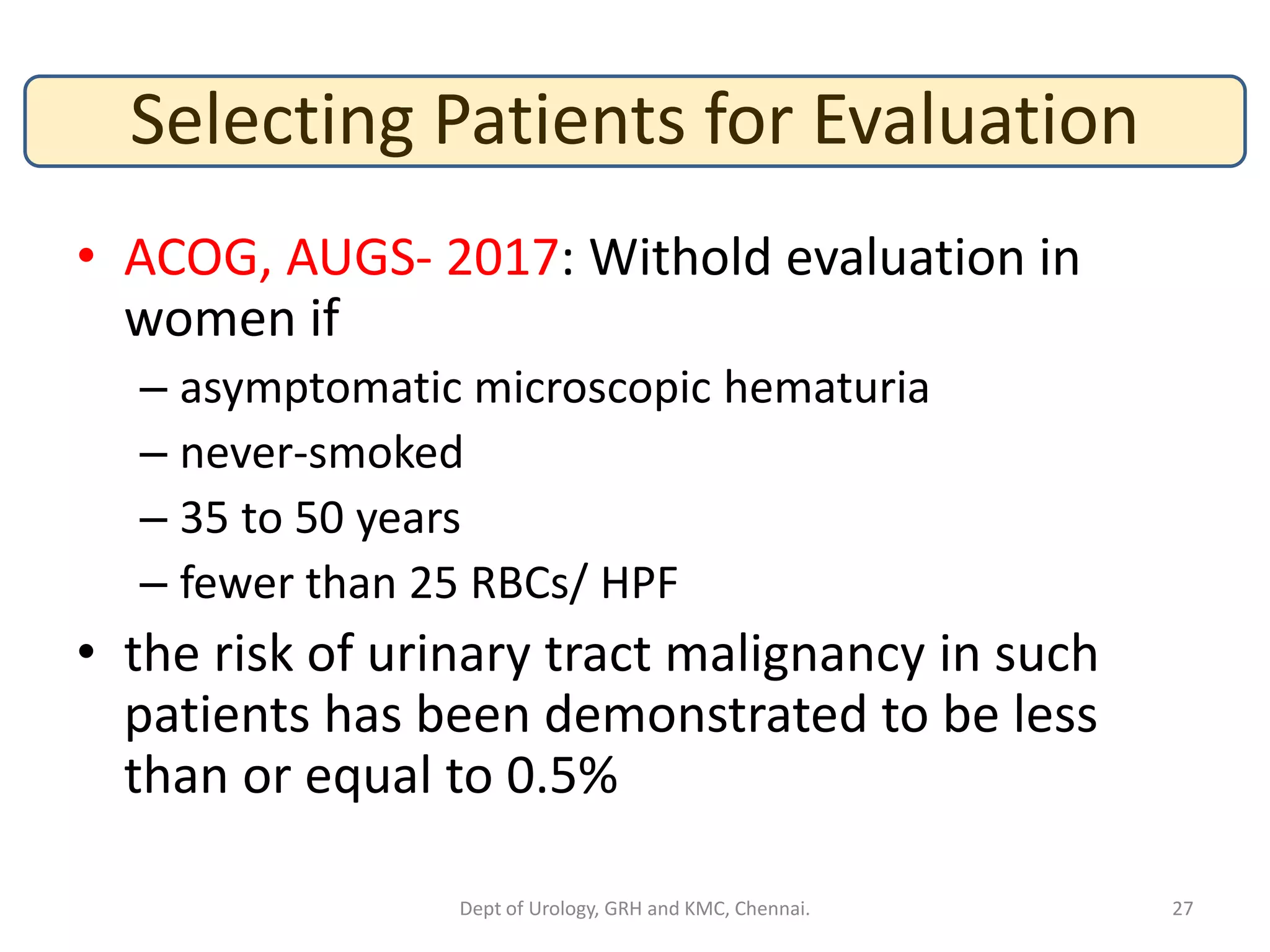
• ACOG, AUGS- 2017: Withold evaluation in
women if
– asymptomatic microscopic hematuria
– never-smoked
– 35 to 50 years
– fewer than 25 RBCs/ HPF
• the risk of urinary tract malignancy in such
patients has been demonstrated to be less
than or equal to 0.5%
27
Dept of Urology, GRH and KMC, Chennai.
Screening: Hematuria and Bladder Cancer
• Mass screening for bladder cancer
– harms and costs outweigh the potential benefits
• Opportunistic screening events
– many primary care providers perform urinalysis as
part of routine health examinations
28
Dept of Urology, GRH and KMC, Chennai.
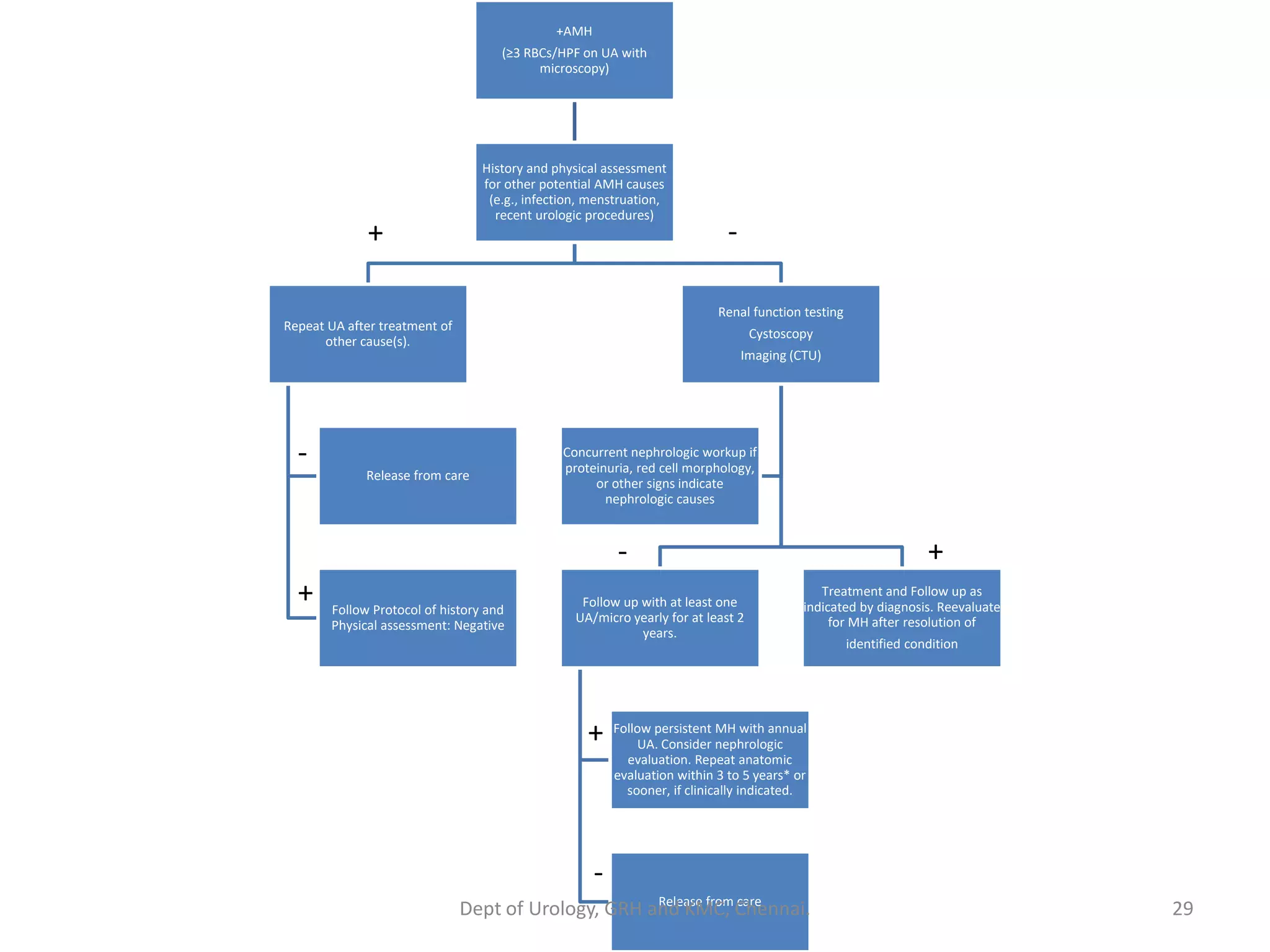
+AMH
(≥3 RBCs/HPF on UA with
microscopy)
History and physical assessment
for other potential AMH causes
(e.g., infection, menstruation,
recent urologic procedures)
Repeat UA after treatment of
other cause(s).
Release from care
Follow Protocol of history and
Physical assessment: Negative
Renal function testing
Cystoscopy
Imaging (CTU)
Follow up with at least one
UA/micro yearly for at least 2
years.
Follow persistent MH with annual
UA. Consider nephrologic
evaluation. Repeat anatomic
evaluation within 3 to 5 years* or
sooner, if clinically indicated.
Release from care
Treatment and Follow up as
indicated by diagnosis. Reevaluate
for MH after resolution of
identified condition
Concurrent nephrologic workup if
proteinuria, red cell morphology,
or other signs indicate
nephrologic causes
+
+
+
+
-
-
-
-
29
Dept of Urology, GRH and KMC, Chennai.
HISTORY
Goal should be to identify causes that would warrant
variation from the standard evaluation, such as
• Infection
• Menstruation
• Recent vigorous exercise
• Known medical renal disease
• Acute viral illness
• Trauma
• Presence of foreign bodies in the urinary tract
• Recent urologic instrumentation
30
Dept of Urology, GRH and KMC, Chennai.
HISTORY
• Associated symptoms-
– GH, voiding symptoms, or flank pain.
• Urologic history
– any surgeries or febrile UTIs.
• General medical history
– to identify potentially contributory diagnoses
– hypertension, renal insufficiency, bleeding
disorders, or sickle cell disease.
31
Dept of Urology, GRH and KMC, Chennai.
HISTORY
• Current medication use, including
– anticoagulants and antiplatelet therapies
– recent coagulation values
– any concomitant medications that would potentiate
the effects of blood thinners.
• Family history
– nephritis, polycystic kidneys, and rare familial tumor
syndromes of the kidney (e.g., von Hippel-Lindau
syndrome) or urothelium (e.g., Lynch syndrome) also
may be informative
• Tobacco use
32
Dept of Urology, GRH and KMC, Chennai.
PHYSICAL EXAMINATION
• Focus on the genitourinary system
– flank tenderness
– masses in the flank, abdomen, suprapubic area, or
urethra;
– enlarged, nodular, tender, or fluctuant prostate
33
Dept of Urology, GRH and KMC, Chennai.
PHYSICAL EXAMINATION
• Signs of coagulopathy (bruising)
• infection (fever)
• renal disease (hypertension, edema).
• If urethral stricture or BPH is suspected, a UFR
and PVR measurement may be helpful as well.
34
Dept of Urology, GRH and KMC, Chennai.
+AMH
(≥3 RBCs/HPF on UA with
microscopy)
History and physical assessment
for other potential AMH causes
(e.g., infection, menstruation,
recent urologic procedures)
Repeat UA after treatment of
other cause(s).
Release from care
Follow Protocol of history and
Physical assessment: Negative
Renal function testing
Cystoscopy
Imaging (CTU)
Follow up with at least one
UA/micro yearly for at least 2
years.
Follow persistent MH with annual
UA. Consider nephrologic
evaluation. Repeat anatomic
evaluation within 3 to 5 years* or
sooner, if clinically indicated.
Release from care
Treatment and Follow up as
indicated by diagnosis. Reevaluate
for MH after resolution of
identified condition
Concurrent nephrologic workup if
proteinuria, red cell morphology,
or other signs indicate
nephrologic causes
+
+
+
+
-
-
-
-
35
Dept of Urology, GRH and KMC, Chennai.
LABORATORY TESTING
• Urinalysis
– if not performed previously
– to confirm the presence of hematuria
– check for dysmorphic red cells, cellular casts, or
proteinuria
• Urine culture
– if the urinalysis or clinical presentation suggests infection
• Renal function testing (serum creatinine)
– to determine whether concomitant nephrologic evaluation
is indicated
– to guide the selection of appropriate upper tract imaging
• Prostate-specific antigen in the appropriate setting.
36
Dept of Urology, GRH and KMC, Chennai.
CYSTOSCOPY
• Most reliable way to evaluate the bladder for
the presence of bladder cancer
• Provides the opportunity to evaluate the
urethra.
• The AUA guidelines
– all adults who are 35 years of age or older (<1 per
100,000) and/or have risk factors for malignancy.
37
Dept of Urology, GRH and KMC, Chennai.
CYSTOSCOPY
Blue-light cystoscopy
• Using 5-aminolevulinic acid (ALA) or
hexylaminolevulinate (HAL) instillation
• Approved by the US FDA for evaluation of
patients with suspicion of papillary bladder
cancer
• Studies supporting its use have been conducted
in patients with known bladder cancer, thereby
limiting generalizability to MH patients
38
Dept of Urology, GRH and KMC, Chennai.
CYSTOSCOPY
39
Dept of Urology, GRH and KMC, Chennai.
CYSTOSCOPY
Blue-light cystoscopy
• Disadvantages
– rare anaphylactoid shock, hypersensitivity, pain,
cystitis, dysuria, hematuria
– risk for unnecessary biopsies compared with
conventional white light cystoscopy
• AUA guideline recommends against using
blue-light cystoscopy for evaluation of MH
40
Dept of Urology, GRH and KMC, Chennai.
UPPER TRACT IMAGING
Multiphasic CT urogram
• CT with precontrast, nephrographic, and
excretory series
• Imaging study recommended by the AUA
• Offers complete imaging of the urinary tract
41
Dept of Urology, GRH and KMC, Chennai.
CT UROGRAM
Unenhanced CT scan
42
Dept of Urology, GRH and KMC, Chennai.
CT UROGRAM
Cortical
nephrographic phase
• 25 to 80 s after
contrast medium
injection
• Reveals increased
enhancement of
the renal cortex (C)
relative to the
medulla (M).
43
Dept of Urology, GRH and KMC, Chennai.
CT UROGRAM
Homogeneous
nephrographic phase
• 85 and 120s after
contrast medium
administration
• reveals a
homogeneous,
uniform, increased
attenuation of the
renal parenchyma.
44
Dept of Urology, GRH and KMC, Chennai.
CT UROGRAM
Excretory phase
• 3 minutes after
contrast
medium
administration
• shows contrast
medium in the
RP bilaterally
45
Dept of Urology, GRH and KMC, Chennai.
UPPER TRACT IMAGING
Multiphasic CT urogram
• Drawbacks
– may not be appropriate for all patients (e.g.,
pregnancy, iodinated contrast allergy, renal
insufficiency)
– uses a relatively high radiation dose (20–30 mSv)-
risk of carcinogenesis
46
Dept of Urology, GRH and KMC, Chennai.
CT UROGRAM
• CT urography is not as sensitive as cystoscopy for
the detection of urothelial tumors in the bladder.
• Only large bladder tumors are visualized with CT
imaging studies as filling defect in the lumen of
the bladder.
• Carcinoma in situ cannot be visualized on CT
scanning and therefore cystoscopy is still an
important part of a comprehensive hematuria
workup.
47
Dept of Urology, GRH and KMC, Chennai.
UPPER TRACT IMAGING
• Magnetic resonance (MR) urogram
– In the setting of a contraindication to CT urogram
– contraindication
• Pacemaker
• significant renal function compromise (eGFR <30 and when
the administration of gadolinium risks nephrogenic systemic
fibrosis)
• NC CT or ultrasound, in conjunction with
retrograde pyelography to evaluate the calyces,
renal pelvis, and ureters, may be most
appropriate.
48
Dept of Urology, GRH and KMC, Chennai.
UPPER TRACT IMAGING
US plus cystoscopy vs CT urogram plus cystoscopy
• more cost effective
• nearly the same diagnostic yield
• not risk stratified and importantly has not been
prospectively tested
49
Dept of Urology, GRH and KMC, Chennai.
Urine Cytology
• Highly sensitive and specific for the detection
of HG urothelial carcinoma, LG- decreased
• Overall
– sensitivity of 15.8% to 54.5%
– specificity of 95.0% to 100% for bladder cancer
detection
50
Dept of Urology, GRH and KMC, Chennai.
Urinary Biomarkers
• Nuclear matrix protein-22 (NMP-22)
• Fluorescence in situ hybridization (FISH)
• Immunocytology for CEA and mucin
glycoproteins (ImmunoCyt and CertNDx)
51
Dept of Urology, GRH and KMC, Chennai.
Urinary Biomarkers
NMP-22
• Offers a potential advantage in management of
patients with MH: it is available as a point-of-care
test.
• Only two studies have focused on AMH, with one
finding a high sensitivity (90.9%) and the other
demonstrating very low sensitivity (6.0%).
• Specificity was moderate or high in both studies
(76.3% and 82.5%, respectively)
52
Dept of Urology, GRH and KMC, Chennai.
Urinary Biomarkers
NMP-22
53
Dept of Urology, GRH and KMC, Chennai.
Urinary Biomarkers
FISH
• for abnormalities of chromosomes 3, 7, 17,
and 9p21
• UroVysion
• sensitivity and specificity of 61% and 93%,
respectively, for bladder tumors
54
Dept of Urology, GRH and KMC, Chennai.
Urinary Biomarkers
FISH
55
Dept of Urology, GRH and KMC, Chennai.
Urinary Biomarkers
Immunocytology
• ImmunoCyt test
– Antibodies directed against
• Mucin glycoprotein- Green
• CEA- Red
– sensitivity of 68.1%- 87%.
56
Dept of Urology, GRH and KMC, Chennai.
Urinary Biomarkers
Immunocytology
• CertNDx
– assesses several markers (mutant FGFR3, quantified
MMP-2, and hypermethylation of TWIST1 and NID2).
– Sensitivity- 87.9% and specificity- 56.3%
• A similar test, looking for methylation of TWIST1,
ONECUT2, and OTX1, along with mutation of
FGFR3, TERT, and HRAS
– sensitivity of 93% and specificity of 86%
57
Dept of Urology, GRH and KMC, Chennai.
Urinary Biomarkers
• Current evidence
– none can replace cystoscopy or imaging,
– not recommended in the initial evaluation of
patients with AMH
• Cytologic examination may be considered in
– patients with a negative initial workup in whom
urothelial carcinoma is still suspected, as well as in
– patients with symptomatic MH.
58
Dept of Urology, GRH and KMC, Chennai.
GUIDELINE-BASED EVALUATION OF MH
Scenarios
• When the cause is diagnosed before complete
evaluation?
• When benign cause is diagnosed, need for
further evaluation?
• When medical Renal disease is diagnosed,
need for further evaluation?
• When the initial evaluation is negative?
59
Dept of Urology, GRH and KMC, Chennai.
GUIDELINE-BASED EVALUATION OF MH
AUA guidelines
Upper tract
imaging
Renal cancer/
ureteral calculus
Cystoscopy
Clearance of
bladder and
urethral
pathology 60
Dept of Urology, GRH and KMC, Chennai.
WHEN BENIGN CAUSE IS DIAGNOSED
ensure that the hematuria has resolved in the absence of the presumed benign cause
urine should be retested
cause should be verified and treated
benign cause of hematuria is discovered (e.g., UTI)
Initial history and physical examination
61
Dept of Urology, GRH and KMC, Chennai.
WHEN MRD IS DIAGNOSED
• If a medical renal cause of hematuria is
suspected based on the presence of renal
insufficiency, hypertension, or abnormalities
on urinalysis, nephrology evaluation is
recommended, but the patient should still
undergo urologic evaluation.
62
Dept of Urology, GRH and KMC, Chennai.
Natural History of MH With a -ve Initial
Evaluation
AUA Recommendation-
Negative workup
following up annual
urinalysis for 2 years
urinalyses confirm
resolution of hematuria
releasing the patient
from care
Persistent/recurrent
AMH or for development
of symptoms or GH
repeating the hematuria
evaluation within 3 to 5
years
63
Dept of Urology, GRH and KMC, Chennai.
64
Dept of Urology, GRH and KMC, Chennai.
+AMH
(≥3 RBCs/HPF on UA with
microscopy)
History and physical assessment
for other potential AMH causes
(e.g., infection, menstruation,
recent urologic procedures)
Repeat UA after treatment of
other cause(s).
Release from care
Follow Protocol of history and
Physical assessment: Negative
Renal function testing
Cystoscopy
Imaging (CTU)
Follow up with at least one
UA/micro yearly for at least 2
years.
Follow persistent MH with annual
UA. Consider nephrologic
evaluation. Repeat anatomic
evaluation within 3 to 5 years* or
sooner, if clinically indicated.
Release from care
Treatment and Follow up as
indicated by diagnosis. Reevaluate
for MH after resolution of
identified condition
Concurrent nephrologic workup if
proteinuria, red cell morphology,
or other signs indicate
nephrologic causes
+
+
+
+
-
-
-
-
65
Dept of Urology, GRH and KMC, Chennai.
SYMPTOMATIC MH
• Differential diagnosis- same as AMH.
• Risk for malignancy may be significantly higher
than in AMH (10.5% vs. 5.0% or less)
• Complete workup can be avoided
– In the setting of a symptomatic, culture-
documented urinary infection presenting with
hematuria, with documentation of hematuria
resolution after treatment
66
Dept of Urology, GRH and KMC, Chennai.
SYMPTOMATIC MH
AUA guidelines (Changes from AMH)
• Cystoscopy is recommended in such patients
regardless of age
• Urine cytologic examination is considered an
option in the setting of irritative voiding
symptoms
67
Dept of Urology, GRH and KMC, Chennai.
GROSS HEMATURIA
• As the degree of hematuria increases, so does
the likelihood of finding clinically significant
lesions during evaluation
• 50% -demonstrable cause
• 20% to 25% - urologic malignancy, most
commonly bladder cancer and kidney cancer
68
Dept of Urology, GRH and KMC, Chennai.
GROSS HEMATURIA
• Recommended evaluation
– urine cytologic examination
– Cystoscopy
– upper tract imaging, preferably CT urogram
• Exception
– antecedent trauma
– culture-documented UTI
69
Dept of Urology, GRH and KMC, Chennai.
GROSS HEMATURIA
• GH must be assessed for hemodynamic
stability with careful attention to
– vital signs, anemia with a complete blood count
• For patients on anticoagulation
– coagulation parameters to ensure that levels are
within the therapeutic range.
• After initial stabilization, diagnostic evaluation
should then proceed, with cause-specific
management.
70
Dept of Urology, GRH and KMC, Chennai.
HEMORRHAGIC CYSTITIS
• Intractable hematuria localizing to the bladder
• Characterized by diffuse inflammation and
bleeding from the bladder mucosa
• Unfortunately, patients in this situation are
often elderly and infirm, with medical
comorbidities that complicate plans for care
transient condition
that quickly resolves
after conservative
management
life-threatening
condition requiring
urgent intervention
71
Dept of Urology, GRH and KMC, Chennai.
72
Dept of Urology, GRH and KMC, Chennai.
HEMORRHAGIC CYSTITIS
Bacterial infections
• common cause of GH
• symptomatic resolution typically noted after
appropriate treatment
73
Dept of Urology, GRH and KMC, Chennai.
HEMORRHAGIC CYSTITIS
Viral-induced hemorrhagic cystitis
• may affect children and immunosuppressed adults
particularly (e.g., after renal or bone marrow
transplantation).
• BK virus
– member of the polyomavirus family, is the most common virus
• Adenovirus
– types 11 and 35
– correlated with HC in children and renal transplant patients
• Treatment
– primarily supportive, with hydration, diuresis, and bladder
irrigation, although case reports of success with antiviral
therapy exist
74
Dept of Urology, GRH and KMC, Chennai.
HEMORRHAGIC CYSTITIS
Oxazaphosphorine class of chemotherapeutic
agents
• Specifically cyclophosphamide and ifosfamide.
• Occur in 2% to 40% of patients treated with
cyclophosphamide
• Dose dependent.
75
Dept of Urology, GRH and KMC, Chennai.
HEMORRHAGIC CYSTITIS
Onset of hematuria is typically within 48 hours of treatment
Subsequent tissue edema/fibrosis
Stimulates bladder mucosal sloughing
Excreted in kidney
Production of metabolite acroline in liver
Cyclophosphamide
76
Dept of Urology, GRH and KMC, Chennai.
HEMORRHAGIC CYSTITIS
Treatment
• 2-Mercaptoethane sulfonate (mesna)
– binds to acrolein and renders it inert
– For prophylaxis against cyclophosphamide-induced HC
– 10% to 40% -develop HC despite preventive treatment.
• Hyperhydration with forced diuresis and/or
continuous bladder irrigation
– Debate continues: mesna is more effective?
77
Dept of Urology, GRH and KMC, Chennai.
HEMORRHAGIC CYSTITIS
Radiation therapy for pelvic malignancy
represents
• Moderate to severe hematuria- 5% of patients
• Depend on
– radiation dosage
– mode of delivery
• onset between 6 months and 10 years after
treatment
78
Dept of Urology, GRH and KMC, Chennai.
HEMORRHAGIC CYSTITIS
Further compromising tissue healing
Secondary infection frequently ensues
Local vascular compromise
Tissue necrosis and mucosal sloughing
Progressive obliterative endarteritis
Induce inflammation, fibrosis, and ischemia
Radiation damages the vascular endothelium,
79
Dept of Urology, GRH and KMC, Chennai.
HEMORRHAGIC CYSTITIS
Receipt of both cyclophosphamide
chemotherapy and pelvic radiation
• Represents risk factors for bladder cancer
• Such patients presenting with hematuria
should be evaluated for bladder cancer before
the diagnosis of hemorrhagic cystitis is
assigned
80
Dept of Urology, GRH and KMC, Chennai.
Cystectomy (with conduit uninary diversion)
Internal iliac artery angioembolization
Formalin 4%
(repeat pre-Tx cystogram)
Formalin 1%
Obtain pre-Tx cystogram
Hyperbaric Oxygen Therapy (HBOT)
Continue supportive measures
• Add bilateral nephrostomy tubes for diversion of urine if hematuria continues, ± bilateral nephro-occlusive tubes
Hematuria continues after 48 hours
Initial management
• Hydration/diuresis
• Cystoscopy with clot evacuation ± fulguration, biopsy if concern for malignancy
• Continuous bladder irrigation
• Supportive care (transfusion prn)
• Address “correctable” factors (infection, coagulopathy, tumor)
• Intravesical alum, PG, Na hyaluronate, Silver Nitrate, Aminocaproic acid
Diagnose hemorrhagic cystitis
• Patient with identified risk factors
• Hematuria evaluation (UT imaging, urine cytology, urine culture)
81
Dept of Urology, GRH and KMC, Chennai.
HEMORRHAGIC CYSTITIS- MANAGEMENT
Initial management- Intravesical agents
• Alum
• Prostaglandins
• sodium hyaluronate
• Silver nitrate
• Aminocaproic acid
82
Dept of Urology, GRH and KMC, Chennai.
HEMORRHAGIC CYSTITIS- MANAGEMENT
Alum
• Aluminum ammonium sulfate or aluminum
potassium sulfate
• In small series, widely variable success rates
(e.g., 45% to 100%), with limited durability of
hematuria control, have been reported after
alum instillation
83
Dept of Urology, GRH and KMC, Chennai.
HEMORRHAGIC CYSTITIS- MANAGEMENT
• used to irrigate the bladder at a rate of 200 to 300 mL/h.
1% alum solution
5L
sterile
water
50g
alum
84
Dept of Urology, GRH and KMC, Chennai.
HEMORRHAGIC CYSTITIS- MANAGEMENT
Arrest bleeding
stimulate vasoconstriction and a decrease in capillary permeability
cause protein precipitation on the urothelial lining
Alum- Irrigation
85
Dept of Urology, GRH and KMC, Chennai.
HEMORRHAGIC CYSTITIS- MANAGEMENT
Drawbacks
• Suprapubic discomfort and bladder spasms
• Systemic absorption
– aluminum toxicity, with consequent mental status
changes, particularly among patients with renal
insufficiency.
86
Dept of Urology, GRH and KMC, Chennai.
HEMORRHAGIC CYSTITIS- MANAGEMENT
Advantages
• Cell penetration and therefore overall toxicity of
this agent are low
• Instilled without anesthesia
• Overall relatively favorable efficacy and safety
profiles.
• Considered for first-line intravesical therapy
among patients failing initial supportive
measures, particularly among those without
renal insufficiency.
87
Dept of Urology, GRH and KMC, Chennai.
HEMORRHAGIC CYSTITIS- MANAGEMENT
Prostaglandins
• Carboprost tromethamine [PGF2-α])
• Precise mechanism of activity remains unclear,
– Thought to cause vasoconstriction
– platelet aggregation
– cytoprotection via mucous barrier regulation.
• Response rates of 50% to 60% have been noted
• Difficulties with PGF2 access, storage, and high
costs have limited generalized utility
88
Dept of Urology, GRH and KMC, Chennai.
HEMORRHAGIC CYSTITIS- MANAGEMENT
Intravesical sodium hyaluronate
• As a defect in the bladder’s glycosaminoglycan
layer has been thought to contribute to the
pathogenesis of hemorrhagic cystitis
• Noted symptomatic improvement
89
Dept of Urology, GRH and KMC, Chennai.
HEMORRHAGIC CYSTITIS- MANAGEMENT
Intravesical Silver nitrate
• Result in chemical coagulation at bleeding
sites.
• A 0.5% to 1% solution is instilled for 10 to 20
minutes
• The potential for precipitation and upper tract
obstruction with this agent led to the
recommendation for a cystogram to rule out
reflux before administration
90
Dept of Urology, GRH and KMC, Chennai.
HEMORRHAGIC CYSTITIS- MANAGEMENT
Intravesical Aminocaproic acid
• A lysine analogue
• Competitive inhibitor of activators of
plasminogen, including urokinase
– thus interrupts fibrinolysis and the cascade that
perpetuates hemorrhage
• Continuous bladder irrigation with 200 mg
aminocaproic acid/L of 0.9% normal saline has
been described
• Irrigation continued for 24 hours after hematuria
resolves.
91
Dept of Urology, GRH and KMC, Chennai.
HEMORRHAGIC CYSTITIS- MANAGEMENT
Intravesical Aminocaproic acid
• Symptom resolution- 92% of patients
• The risk for thromboembolic events may be
increased with this treatment
• Given only after the bladder has been
rendered clot free, because the agent will
otherwise lead to the formation of hard clots
difficult to eradicate from the bladder
92
Dept of Urology, GRH and KMC, Chennai.
Cystectomy (with conduit uninary diversion)
Internal iliac artery angioembolization
Formalin 4%
(repeat pre-Tx cystogram)
Formalin 1%
Obtain pre-Tx cystogram
Hyperbaric Oxygen Therapy (HBOT)
Continue supportive measures
• Add bilateral nephrostomy tubes for diversion of urine if hematuria continues, ± bilateral nephro-occlusive tubes
Hematuria continues after 48 hours
Initial management
• Hydration/diuresis
• Cystoscopy with clot evacuation ± fulguration, biopsy if concern for malignancy
• Continuous bladder irrigation
• Supportive care (transfusion prn)
• Address “correctable” factors (infection, coagulopathy, tumor)
• Intravesical alum, PG, Na hyaluronate, Silver Nitrate, Aminocaproic acid
Diagnose hemorrhagic cystitis
• Patient with identified risk factors
• Hematuria evaluation (UT imaging, urine cytology, urine culture)
93
Dept of Urology, GRH and KMC, Chennai.
HEMORRHAGIC CYSTITIS- MANAGEMENT
Hyperbaric oxygen therapy (HBOT)
• When Hematuria remains refractory to the
aforementioned measures
• Particularly with hemorrhagic cystitis resulting
from radiation therapy or cyclophosphamide
treatment
• HBOT is carried out in a specially designed
chamber
94
Dept of Urology, GRH and KMC, Chennai.
HEMORRHAGIC CYSTITIS- MANAGEMENT
Hyperbaric oxygen therapy (HBOT)
• Involves administration of
– 100% oxygen
– Pressure- 2 to 3 atmospheres
– Duration- appr. 90 minutes
– 30 to 40 sessions
• Response rates- 80% to 90%
– maintained up to 2 ½ years after treatment.
• 5-year complete response rate- only 27%
95
Dept of Urology, GRH and KMC, Chennai.
HEMORRHAGIC CYSTITIS- MANAGEMENT
• HBOT
• local tissue oxygen tension increases
• oxygen extraction by tissues increases
• Diminish edema and promote neovascularization
• critical steps in the wound healing process
96
Dept of Urology, GRH and KMC, Chennai.
HEMORRHAGIC CYSTITIS- MANAGEMENT
• Complications
– claustrophobia (20%), otalgia (17%), and, rarely,
seizures
• Bilateral nephrostomy tube insertion, with or
without occlusion of the ureters
– For patients with continued bleeding during therapy
– to decrease exposure of the hemorrhagic bladder to
urokinase and thereby theoretically facilitate
hemostasis, particularly during the relatively
prolonged time course of HBOT
97
Dept of Urology, GRH and KMC, Chennai.
Cystectomy (with conduit uninary diversion)
Internal iliac artery angioembolization
Formalin 4%
(repeat pre-Tx cystogram)
Formalin 1%
Obtain pre-Tx cystogram
Hyperbaric Oxygen Therapy (HBOT)
Continue supportive measures
• Add bilateral nephrostomy tubes for diversion of urine if hematuria continues, ± bilateral nephro-occlusive tubes
Hematuria continues after 48 hours
Initial management
• Hydration/diuresis
• Cystoscopy with clot evacuation ± fulguration, biopsy if concern for malignancy
• Continuous bladder irrigation
• Supportive care (transfusion prn)
• Address “correctable” factors (infection, coagulopathy, tumor)
• Intravesical alum, PG, Na hyaluronate, Silver Nitrate, Aminocaproic acid
Diagnose hemorrhagic cystitis
• Patient with identified risk factors
• Hematuria evaluation (UT imaging, urine cytology, urine culture)
98
Dept of Urology, GRH and KMC, Chennai.
HEMORRHAGIC CYSTITIS- MANAGEMENT
Intravesical formalin
• Induces cellular protein precipitation and
capillary occlusion.
• Control of bleeding- 80% to 90% of cases,
which are relatively higher rates than other
intravesical treatments.
• May induce significant pain, administration
under general or spinal anesthesia is
recommended
99
Dept of Urology, GRH and KMC, Chennai.
HEMORRHAGIC CYSTITIS- MANAGEMENT
Complications
• Bladder fibrosis with associated decreased
bladder capacity
• Ureteral stricturing with proximal
hydronephrosis/renal injury
• Thus pretreatment cystogram is recommended to
exclude the presence of vesicoureteral reflux
and/or bladder perforation
• Patients must be counseled regarding the
potential impact on subsequent bladder function
100
Dept of Urology, GRH and KMC, Chennai.
HEMORRHAGIC CYSTITIS- MANAGEMENT
If reflux is documented,
• placement of occlusive ureteral catheters is
recommended to limit upper tract exposure to
the medication.
• Low concentrations of formalin (1% to 4%)
should be used
101
Dept of Urology, GRH and KMC, Chennai.
HEMORRHAGIC CYSTITIS- MANAGEMENT
Instillation
• Volume
– up to 300 mL or to bladder capacity
• Should be done under gravity
– catheter no more than 15 cm above the pubic symphysis.
• Instillation should be limited to 10 to 15 minutes
• Should be performed with the catheter on light
traction to prevent urethral exposure
• Care taken to protect all external areas of skin from
exposure.
102
Dept of Urology, GRH and KMC, Chennai.
HEMORRHAGIC CYSTITIS- MANAGEMENT
Intravesical Formalin
• Given the potential toxicities of formalin,
together with the requirement for
administration under anesthesia, this agent
should be reserved for second-line therapy
103
Dept of Urology, GRH and KMC, Chennai.
Cystectomy (with conduit uninary diversion)
Internal iliac artery angioembolization
Formalin 4%
(repeat pre-Tx cystogram)
Formalin 1%
Obtain pre-Tx cystogram
Hyperbaric Oxygen Therapy (HBOT)
Continue supportive measures
• Add bilateral nephrostomy tubes for diversion of urine if hematuria continues, ± bilateral nephro-occlusive tubes
Hematuria continues after 48 hours
Initial management
• Hydration/diuresis
• Cystoscopy with clot evacuation ± fulguration, biopsy if concern for malignancy
• Continuous bladder irrigation
• Supportive care (transfusion prn)
• Address “correctable” factors (infection, coagulopathy, tumor)
• Intravesical alum, PG, Na hyaluronate, Silver Nitrate, Aminocaproic acid
Diagnose hemorrhagic cystitis
• Patient with identified risk factors
• Hematuria evaluation (UT imaging, urine cytology, urine culture)
104
Dept of Urology, GRH and KMC, Chennai.
HEMORRHAGIC CYSTITIS- MANAGEMENT
Internal iliac artery angioembolization
• Performed unilaterally or bilaterally
• Can be done even in debilitated patients, with
relatively limited risk
• Selective embolization of the anterior branch of
the internal iliac artery bilaterally is typically
required to achieve hemostasis
• May use any of a variety of embolic materials,
including gelatin microspheres, polyvinyl alcohol
particles, or coils
105
Dept of Urology, GRH and KMC, Chennai.
HEMORRHAGIC CYSTITIS- MANAGEMENT
• Initial hemorrhage control- 90%
– durability of response- not been well established
• Reliability of this approach for patients after
radiation therapy in which mucosal ischemia
underlies the pathophysiology, remains
uncertain
106
Dept of Urology, GRH and KMC, Chennai.
HEMORRHAGIC CYSTITIS- MANAGEMENT
• Complication: embolization of the posterior branch of
the internal iliac artery
• occlusion of the superior gluteal artery
• Gluteal muscle ischaemia
• significant gluteal pain.
107
Dept of Urology, GRH and KMC, Chennai.
HEMORRHAGIC CYSTITIS- MANAGEMENT
Cystectomy with urinary diversion
• In the setting of failed angioembolization and
other conservative approaches
• Supravesical urinary diversion alone (e.g., ileal
conduit) without cystectomy
– Complications- up to 80% of patients with a retained
bladder
– specifically infection (pyocystis), with rehospitalization
in 43%
– suggesting that cystectomy should be performed at
the time of urinary diversion if feasible
108
Dept of Urology, GRH and KMC, Chennai.
HEMORRHAGIC CYSTITIS- MANAGEMENT
• Typically elderly, infirm
– in poor condition for surgery.
• Perioperative complication rates
– significantly higher than what has been reported
after cystectomy for bladder cancer
• Balance the risks and benefits
109
Dept of Urology, GRH and KMC, Chennai.
HEMATURIA FROM PROSTATIC ORIGIN
• Diagnosis made after a complete GH
evaluation (including cytology, upper tract
imaging, and cystoscopy) to confirm that no
other source of hematuria exists
transient self-limiting
episodes Continuous bleeding
resulting in the obstruction
of urinary flow and in
transfusion dependence
110
Dept of Urology, GRH and KMC, Chennai.
HEMATURIA FROM PROSTATIC ORIGIN
Commonly due to
• BPH
• prostate-related infection (prostatitis)
• prostate cancer
111
Dept of Urology, GRH and KMC, Chennai.
Prostate-related gross
hematuria
• Exclude other causes of hematuria
with UT imaging, urine cytology,
cystoscopy
Initial management
• Hydration/diuresis • Continuous
bladder irrigation • Supportive care
(transfusion prn)
• Address “correctable” factors (i.e.,
coagulopathy)
BPH
5 Alpha reductase
inhibitor
Clinical/comorbidity
status poor?
Cystoscopy with
fulguration
• Consider antiandrogen
therapy
Angioembolisation
BPH-related surgery
• HOLEP • TURP •
Simple • PVP
prostatectomy
Angioembolisation
Prostatitis
• Diagnose by clinical presentation
+ urine culture
Antibiotic therapy
Prostate cancer
(typically advanced)
Androgen deprivation
therapy ± external
beam radiotherapy
Cystoscopy with
fulguration/“channel”
TURP
Urinary diversion (pending
clinical status)
• Percutaneous nephrostomy
tube • Palliative prostatectomy/
cystoprostatectomy with conduit
diversion
Angioembolisation
112
Dept of Urology, GRH and KMC, Chennai.
HEMATURIA FROM PROSTATIC ORIGIN
BPH
• Most common cause of prostate-related
bleeding
• Most common cause of GH in men older than
60 years
• Only pathological condition identified in
approximately 20% of cases from hematuria
studies .
113
Dept of Urology, GRH and KMC, Chennai.
HEMATURIA FROM PROSTATIC ORIGIN
•Benign Prostatic hyperplasia
•Higher levels of VEGF
•Higher microvessel density
•Increased prostatic vascularity
•Prone to Haematuria
114
Dept of Urology, GRH and KMC, Chennai.
HEMATURIA IN BPH- MANAGEMENT
• Expectant management with hydration
– Usually mild and selflimiting.
• Surgery
– Historically - indication for surgery
– increased understanding of the molecular
pathway contributing to the pathophysiologic
process
– targeted medical therapy
115
Dept of Urology, GRH and KMC, Chennai.
HEMATURIA IN BPH- MANAGEMENT
Estrogens and antiandrogens
• Decreases prostate bleeding
• MOA- presumably
– through the repression of androgen-stimulated
angiogenesis and
– the induction of programmed cell death within
the prostate
116
Dept of Urology, GRH and KMC, Chennai.
HEMATURIA IN BPH- MANAGEMENT
Finasteride,
• 5α-reductase inhibitor that blocks conversion of
testosterone to dihydrotestosterone
• Treatment of outlet obstructive symptoms
• Investigated extensively for BPH-related
haematuria
• MOA- associated with decreased
– VEGF expression,
– prostate microvessel density
– prostatic blood flow
117
Dept of Urology, GRH and KMC, Chennai.
HEMATURIA IN BPH- MANAGEMENT
• Demonstrated efficacy even in patients being
treated with anticoagulation.
• Symptom improvement or resolution- 90%
• Onset of action
– Variable
– improvement in bleeding noted from as short as 2
weeks to up to 9 months after initiating therapy
• Who eventually require BPH surgery, concurrent
therapy with 5α-reductase inhibitors can
decrease perioperative bleeding complications
and morbidity
118
Dept of Urology, GRH and KMC, Chennai.
HEMATURIA IN BPH- MANAGEMENT
TURP
• Patients with persistent bleeding from BPH
despite conservative therapies and/or
endoscopic fulguration
• Particularly when additional indications for
BPH surgery coexist
• Alternative
– Photoselective vaporization of the prostate
– Holmium laser enucleation of the prostate
– Suprapubic/retropubic prostatectomy
119
Dept of Urology, GRH and KMC, Chennai.
HEMATURIA IN BPH- MANAGEMENT
Selective prostatic artery embolization (PAE)
• Persistent bleeding despite TURP
• Typically bilateral embolization is performed
• Initial success- 90%
• Recurrence in 15% to 28%
120
Dept of Urology, GRH and KMC, Chennai.
HEMATURIA IN BPH- MANAGEMENT
Selective prostatic artery embolization (PAE)
• Superselective approach
– specifically addressing the Prostatic arteries with
gelatin microparticles
• Selective approach
– embolization of the anterior branch of the internal
iliac artery has been used as well
121
Dept of Urology, GRH and KMC, Chennai.
HEMATURIA IN BPH- MANAGEMENT
Selective prostatic artery
embolization (PAE)
Type I- Origin from anterior
division of IIA in a common
trunk with the superior
vesical artery (SVA)
Type II- Origin from
anterior division of IIA,
inferiorly to SVA
Type III- Origin from
obturator artery
Type IV- Origin from
internal pudendal artery
Type V- Less common
origins
122
Dept of Urology, GRH and KMC, Chennai.
HEMATURIA IN BPH- MANAGEMENT
Radical prostatectomy or cystoprostatectomy
• Must be considered
• But usually are poor surgical candidates
because of comorbidity status
123
Dept of Urology, GRH and KMC, Chennai.
HEMATURIA FROM PROSTATIC ORIGIN
Prostatitis
• Traditionally secondary to bacterial infection
• Hematuria as the manifesting symptom in 2.5% of men
• The mechanism of hematuria in prostatitis
– unclear and may be related to inflammation
• Management
– Antibiotics when culture-documented bacterial prostatitis
is present.
– Significant recurrent hematuria in the setting of
nonbacterial prostatitis is relatively uncommon
• antibiotics in addition to standard supportive measures
124
Dept of Urology, GRH and KMC, Chennai.
HEMATURIA FROM PROSTATE CA
Prostate cancer
• Hematuria typically results in cases of
significantly locally advanced tumors, often
with bladder base/trigonal invasion.
• Most common local symptom among patients
with advanced symptomatic prostate cancers
• Exclude- hemorrhagic cystitis from radiation
therapy
125
Dept of Urology, GRH and KMC, Chennai.
HEMATURIA FROM PROSTATE CA
Management
• Primarily with palliative intent
– tumors are typically invasive of the bladder and/or
pelvic sidewall (T4)
– patients are often elderly and unwell.
• Initial conservative measures
– catheter drainage with or without continuous bladder
irrigation, suffice for most cases of mild prostatic
bleeding.
126
Dept of Urology, GRH and KMC, Chennai.
HEMATURIA FROM PROSTATE CA
Management
• Palliative external beam radiotherapy
– For patients in whom hematuria is not acutely life
threatening
– patients who are radiation naïve with or without
androgen deprivation therapy may be administered
• Androgen deprivation therapy
– patients who are not candidates for local therapy
– among patients in whom disease has recurred after
previous local therapy
127
Dept of Urology, GRH and KMC, Chennai.
HEMATURIA FROM PROSTATE CA
Surgery
• Persistent hematuria in the setting of BOO
• Cystoscopy under anesthesia with fulguration
and/or limited, or channel, transurethral
resection of prostatic tissue should be
undertaken.
128
Dept of Urology, GRH and KMC, Chennai.
HEMATURIA FROM PROSTATE CA
• Selective angioembolization
– Data on this approach in the setting of prostatic
malignancy are scant and have demonstrated limited
durability of bleeding control
• Urinary diversion
– Initially may be attempted with PCN tube insertion
• Palliative extirpative surgery
– Radical prostatectomy/ cystoprostatectomy and
conduit diversion
– Considered, pending patients’ clinical and comorbidity
status.
129
Dept of Urology, GRH and KMC, Chennai.
URETHRAL BLEEDING
• Urethral bleeding (urethrorrhagia) is defined
as bleeding emanating from the urethra at a
point distal to the bladder neck, occurring
separate from micturition
• Careful history and physical examination
– blood at the urethral meatus in the absence of
volitional micturition
– initial hematuria
• Implies pathological processes distal to the
external urinary sphincter 130
Dept of Urology, GRH and KMC, Chennai.
URETHRAL BLEEDING
• Women
– differentiating bleeding from gynecologic origin
– based on history alone may be challenging
– pelvic examination is typically necessary to clarify
the site of origin
131
Dept of Urology, GRH and KMC, Chennai.
URETHRAL BLEEDING
Diagnosis
• Retrograde urethrogram
• Cystourethroscopy
– direct visualization permits identification of
pathological processes in the urethra
– biopsy and fulguration allow for histologic
characterization and cessation of bleeding.
132
Dept of Urology, GRH and KMC, Chennai.
133
Dept of Urology, GRH and KMC, Chennai.
URETHRAL BLEEDING
Trauma
• Most common cause of urethral bleeding.
• Example
– blunt trauma via straddle injury, kick to the
perineum, or pelvic fracture
– Foreign body insertion
– Penile fracture
134
Dept of Urology, GRH and KMC, Chennai.
URETHRAL BLEEDING
Trauma
• Perineal or penile bruising, accompanied by a
hematoma, often is a clear indication of injury
related to trauma.
• Retrograde urethrography is essential in
instances of trauma when a urethral injury is
suspected
135
Dept of Urology, GRH and KMC, Chennai.
URETHRAL BLEEDING
Urethritis
• Refers to infection or inflammation of the
epithelial lining of the urethra
• Has been reported secondary to
– bacterial or viral infection
– chemical irritants (i.e., spermicidal jelly),
– Medication related (i.e. amiodarone)
– autoimmune systemic conditions (HLA-B27
reactive arthritis)
136
Dept of Urology, GRH and KMC, Chennai.
URETHRAL BLEEDING
Urethritis
• Urethral discharge on palpation may be noted
with urethritis in men.
• Urine microscopy and cultures, as well as
urethral swabs for causative organisms,
represent essential components of the
evaluation.
137
Dept of Urology, GRH and KMC, Chennai.
URETHRAL BLEEDING
• Urethral tumors
– Rare
– blood per meatus may be a manifesting sign
– specifically in men who have undergone a
radical cystectomy with urethra still in situ
• Urethral caruncles
– benign urethral lesions typically originating from the posterior lip of the
urethra
– most commonly found in postmenopausal women
– These lesions are thought to arise from prolapse of distal urethra as a
consequence of estrogen deficiency.
• Urethral diverticulum
– classic presentation of dysuria, dyspareunia, and dribbling
– May also report intermittent episodes of bleeding
– urethral discharge may be noted on examination
138
Dept of Urology, GRH and KMC, Chennai.
HEMATURIA FROM THE UPPER TRACT
• Frequently asymptomatic
• “Clot colic”
– macroscopic bleeding with clots can result in
subsequent ureteral obstruction
• Anemia, and even rarely hemodynamic
instability
• Manifests as total hematuria
• Characterized by wormlike clots passed via the
urethra
139
Dept of Urology, GRH and KMC, Chennai.
140
Dept of Urology, GRH and KMC, Chennai.
MEDICAL RENAL DISEASE
Glomerular diseases
• Constellation of acquired or inherited conditions
in which the glomeruli are damaged.
• Consequences include loss of
– RBCs and protein in the urine
• Clinical sequelae
– Hematuria
– hypoproteinemia with associated edema
– reduced glomerular filtration rate.
• Urinary findings suggestive of a glomerular cause
– RBC casts in the urinary sediment, dysmorphic RBCs
– proteinuria 141
Dept of Urology, GRH and KMC, Chennai.
DIAGNOSIS
INVESTIGATION
HISTORY
GLOMERULAR
HEMATURIA
Rash,
arthritis
↑ C3, C4,
ANA
SLE
Hemoptysis
Bleeding
tendency
Microcytic
anemia
Goodpasture
syndrome
Recent URTI or
skin
infection/rash
↑ ASO titer,
C3 level
PSGN
Related to
exercise
+ Renal
biopsy for
IgA, IgG, β1c-
globulin
IgA
nephropathy
(Berger
disease)
Family history
of hematuria
and/or abn UA
Deafness
Alport
nephritis
No other
symptoms/
signs
Renal biopsy
Mesangioproliferati
ve,
mesangiocapillary,
or
Membranous GN
MEDICAL RENAL DISEASE
142
Dept of Urology, GRH and KMC, Chennai.
MEDICAL RENAL DISEASE
Tubulointerstitial diseases
• Broadly refer to kidney diseases affecting
structures in the kidney outside the glomerulus.
• Sickle cell nephropathy
– sickled erythrocytes decrease medullary blood flow,
causing local ischemia, microinfarction, and papillary
necrosis
• Analgesic nephropathy
– cause renal papillary necrosis and subsequently
chronic interstitial nephritis
143
Dept of Urology, GRH and KMC, Chennai.
MEDICAL RENAL DISEASE
Diagnosis and Management
• Percutaneous renal biopsy
– valuable diagnostic modality in case of a suspicion
for glomerular or tubulointerstitial causes of
hematuria.
• Current guidelines advocate completion of the
hematuria evaluation even when medical
renal causes are suspected
144
Dept of Urology, GRH and KMC, Chennai.
VASCULAR CONDITIONS
• Causes:
– Renal AVM, Aneurysm, Nutcracker syndrome
• Predisposing factors
– pelvic or vascular surgery, pelvic irradiation, extensive
ureteral mobilization, and chronic ureteral stenting
• Management
– high mortality rates have been reported with surgical
repair of ureteroiliac fistulas
– angiographic localization with vascular stenting has
become the current preferred management approach
145
Dept of Urology, GRH and KMC, Chennai.
VASCULAR CONDITIONS
Renal arteriovenous malformations (AVMs)
• Abnormal communications between
intrarenal arterial and venous systems
• Causes
– congenital and acquired (iatrogenic)
• Acquired AVMs
– account for 75% of such cases
– associated with renal biopsy, renal surgery (partial
nephrectomy, nephrolithotomy), and trauma
146
Dept of Urology, GRH and KMC, Chennai.
VASCULAR CONDITIONS
Renal arteriovenous malformations (AVMs)
• Arteriography with selective angioembolization
– primary diagnostic and therapeutic option
– afford symptom resolution with maximal preservation
of functional renal parenchyma.
– Thus expeditious angiography should be considered
for patients with a recent history of a renal procedure
presenting with GH.
– The goal of AVM embolization is occlusion of the site
where abnormal arterial and venous communication
exists
147
Dept of Urology, GRH and KMC, Chennai.
VASCULAR CONDITIONS
Renal artery aneurysms
• May be related to connective tissue disorders
• Generally asymptomatic.
– Hypertension may be present in up to 90% of affected
persons
– Dissecting aneurysms may cause flank pain with GH
• Management
– initially with blood pressure control
– subsequently via endovascular approaches in the
refractory albeit hemodynamically stable patient
– surgical intervention is typically necessary in the unstable
patient
148
Dept of Urology, GRH and KMC, Chennai.
VASCULAR CONDITIONS
• “Nutcracker phenomenon”
– compression of the left renal vein between the
aorta and superior mesenteric artery
149
Dept of Urology, GRH and KMC, Chennai.
VASCULAR CONDITIONS
Haematuria
Blood enters collecting system
Small-volume rupture of thin-walled capillaries into the collecting system
Increase in left renal vein pressure
Compression of left renal vein
“Nutcracker syndrome”
150
Dept of Urology, GRH and KMC, Chennai.
VASCULAR CONDITIONS
“Nutcracker syndrome”
• Management
– Surgery: Left renal vein transposition, superior
mesenteric artery transposition, and nephrectomy
– Endovascular stenting to maintain a patent renal
vein has been reported as well.
151
Dept of Urology, GRH and KMC, Chennai.
LATERALIZING ESSENTIAL HEMATURIA
• Also termed benign essential hematuria or
chronic unilateral essential hematuria
• Defined as macroscopic hematuria
cystoscopically localized to one side of the
urinary system without a clear identifiable
cause
152
Dept of Urology, GRH and KMC, Chennai.
LATERALIZING ESSENTIAL HEMATURIA
• As such, patients have typically had normal
prior radiographic studies.
• Although rare, may range from minimally
symptomatic GH to clot retention and anemia
• Many such cases no identifiable cause can be
determined
153
Dept of Urology, GRH and KMC, Chennai.
LATERALIZING ESSENTIAL HEMATURIA
• Cystoscopy
– at the time of bleeding may allow lateralization of
the source of hematuria.
• Ureteropyeloscopy
– in the absence of a clear cause for bleeding
localized to the upper tract
– recommended as a diagnostic and potentially
therapeutic modality
154
Dept of Urology, GRH and KMC, Chennai.
LATERALIZING ESSENTIAL HEMATURIA
Critical components of diagnostic ureteropyeloscopy
include
• the judicious use of guidewires (to avoid inadvertent
urothelial injury),
• low-pressure irrigation
• systematic evaluation of all calices from a superior to-
inferior approach
• Biopsy samples can be obtained for lesions suspicious
for malignancy
• fulguration of such tumors or other noted sources of
bleeding (i.e., hemangioma) can be accomplished as
well.
155
Dept of Urology, GRH and KMC, Chennai.
THANK YOU

Hematuria - evaluation and management

  • 1.
    EVALUATION AND MANAGEMENT OFHEMATURIA Dept of Urology Govt Royapettah Hospital and Kilpauk Medical College Chennai
  • 2.
    Moderators: Professors: • Prof. Dr.G. Sivasankar, M.S., M.Ch., • Prof. Dr. A. Senthilvel, M.S., M.Ch., Asst Professors: • Dr. J. Sivabalan, M.S., M.Ch., • Dr. R. Bhargavi, M.S., M.Ch., • Dr. S. Raju, M.S., M.Ch., • Dr. K. Muthurathinam, M.S., M.Ch., • Dr. D. Tamilselvan, M.S., M.Ch., • Dr. K. Senthilkumar, M.S., M.Ch. Dept of Urology, GRH and KMC, Chennai. 2
  • 3.
    CLASSIFICATION According to itsvisibility and timing during the urinary stream Gross/ Frank • Initial • Terminal • Total Microscopic • Asymptomatic • Symptomatic 3 Dept of Urology, GRH and KMC, Chennai.
  • 4.
    CLASSIFICATION According to origin •Urinarybladder •Prostate •Urethra •Upper urinary tract 4 Dept of Urology, GRH and KMC, Chennai.
  • 5.
    TIMING OF HEMATURIA Givesindication of the source of hematuria, Initial • Urethral source Total • Bladder or above Terminal • Bladder trigone • Bladder neck • Prostate 5 Dept of Urology, GRH and KMC, Chennai.
  • 6.
    TIMING OF HEMATURIA Initial •Urethral source Total • Bladder or above Terminal • Bladder trigone • Bladder neck • Prostate 6 Dept of Urology, GRH and KMC, Chennai.
  • 7.
    DIFFERENTIAL DIAGNOSIS Pigmenturia endogenous sources e.g., bilirubin, myoglobin, porphyrins foodsingested e.g., beets and rhubarb drugs taken e.g., phenazopyridine dehydration 7 Dept of Urology, GRH and KMC, Chennai.
  • 8.
    DIFFERENTIAL DIAGNOSIS Pigmenturia • Causefalse-positive chemical tests (e.g., urine dipstick) • This distinction can be made easily by urinalysis with microscopy. 8 Dept of Urology, GRH and KMC, Chennai.
  • 9.
    DIFFERENTIAL DIAGNOSIS Vaginal bleedingin women • obtaining a careful menstrual history • collecting the specimen when the patient is not having menstrual or gynecologic bleeding, • if necessary, obtaining a catheterized specimen 9 Dept of Urology, GRH and KMC, Chennai.
  • 10.
    MICROSCOPIC HEMATURIA • Signrather than a symptom • Laboratory diagnosis • Definition – Presence of RBCs on microscopic examination of the urine not evident on visual inspection of the urine. • The prevalence of MH among healthy participants in screening studies is approximately 6.5% 10 Dept of Urology, GRH and KMC, Chennai.
  • 11.
    MICROSCOPIC HEMATURIA • Higherrates noted in – Males – older patients – smokers • Categorized by the presence or absence of associated symptoms • Quantified according to number of RBCs per high-power field (HPF) 11 Dept of Urology, GRH and KMC, Chennai.
  • 12.
    Criteria for theDiagnosis normal processes (e.g., sexual activity, exercise) significant medical conditions (GU malignancy) 12 Dept of Urology, GRH and KMC, Chennai.
  • 13.
    Criteria for theDiagnosis • Differences in thresholds for initiating an evaluation reflect efforts to balance the • Importantly, none have been robustly validated. Benefits Cost analysis Harms 13 Dept of Urology, GRH and KMC, Chennai.
  • 14.
    Criteria for theDiagnosis Criteria 3 or more AUA- Single UA Canada, Dutch- 2 out of 3 UA Japan- 5 or more RBCs/ HPF on a single UA Kaiser permanente- More than 3 RBCs/HPF on 2 out of 3 UAs NICE- 1+ blood or more on urine dip stick test PLUS Dysuria or elevated leukocytosis 14 Dept of Urology, GRH and KMC, Chennai.
  • 15.
    URINE MICROSCOPY Specimen collection Centrifuge Pipette,slide Microscopy 15 Dept of Urology, GRH and KMC, Chennai.
  • 16.
    URINE MICROSCOPY 16 Dept ofUrology, GRH and KMC, Chennai.
  • 17.
    DIPSTICK TEST Dipsticks frequentlydemonstrate both colored dots and field color change The degree of color change is directly related to the amount of hemoglobin present which changes color according to the degree and amount of oxidation. catalyzes the reaction and causes subsequent oxidation of a chromogen indicator Haemoglobin in contact with an organic peroxidase substrate 17 Dept of Urology, GRH and KMC, Chennai.
  • 18.
    DIPSTICK TEST • Freehemoglobin and myoglobin in the urine • Absorbed into the reagent pad • Catalyze the reaction within the test paper • Produce a field change effect in color. 18 Dept of Urology, GRH and KMC, Chennai.
  • 19.
    DIPSTICK TEST coalescence ofthe dots occurs when there are more than 250 erythrocytes/mL The greater the number of intact erythrocytes-greater the number of dots that will appear on the test paper localized free hemoglobin on the pad produces a corresponding dot of color change. undergo hemolysis come in contact with the reagent test pad Intact erythrocytes in the urine 19 Dept of Urology, GRH and KMC, Chennai.
  • 20.
    Requirement for MicroscopicEvaluation Urine dipstick for blood Haemoglobin, myoglobin Urine microscopy 3 or more RBCs/HPF Further Evaluation Detects peroxidase activity using benzidine 20 Dept of Urology, GRH and KMC, Chennai.
  • 21.
    Requirement for MicroscopicEvaluation False positive False Negative dilute urine (osmolality <308 mOsm) Vigorous physical or sexual activity prolonged recumbency (first void in morning) 21 Dept of Urology, GRH and KMC, Chennai.
  • 22.
    Selecting Patients forEvaluation Vigorous exercise • considered a diagnosis of exclusion. • Thus it is necessary to confirm the absence of MH after a period of abstinence from exercise 22 Dept of Urology, GRH and KMC, Chennai.
  • 23.
    Selecting Patients forEvaluation Hematuria and anticoagulants • e.g., warfarin, enoxaparin, heparin, aspirin, clopidogrel, apixiban, dabigatran • Should undergo a complete evaluation in the same manner as patients not taking such medications 23 Dept of Urology, GRH and KMC, Chennai.
  • 24.
    Selecting Patients forEvaluation • Prevalence of hematuria, as well as the likelihood of finding genitourinary cancers – no different from patients not taking such medications • May unmask genitourinary lesions at an earlier stage • Patients taking antithrombotic agents were more than twice as likely to be diagnosed with bladder cancer within 6 months after an episode of hematuria 24 Dept of Urology, GRH and KMC, Chennai.
  • 25.
    Selecting Patients forEvaluation 25 Dept of Urology, GRH and KMC, Chennai.
  • 26.
    26 Dept of Urology,GRH and KMC, Chennai.
  • 27.
    Selecting Patients forEvaluation • ACOG, AUGS- 2017: Withold evaluation in women if – asymptomatic microscopic hematuria – never-smoked – 35 to 50 years – fewer than 25 RBCs/ HPF • the risk of urinary tract malignancy in such patients has been demonstrated to be less than or equal to 0.5% 27 Dept of Urology, GRH and KMC, Chennai.
  • 28.
    Screening: Hematuria andBladder Cancer • Mass screening for bladder cancer – harms and costs outweigh the potential benefits • Opportunistic screening events – many primary care providers perform urinalysis as part of routine health examinations 28 Dept of Urology, GRH and KMC, Chennai.
  • 29.
    +AMH (≥3 RBCs/HPF onUA with microscopy) History and physical assessment for other potential AMH causes (e.g., infection, menstruation, recent urologic procedures) Repeat UA after treatment of other cause(s). Release from care Follow Protocol of history and Physical assessment: Negative Renal function testing Cystoscopy Imaging (CTU) Follow up with at least one UA/micro yearly for at least 2 years. Follow persistent MH with annual UA. Consider nephrologic evaluation. Repeat anatomic evaluation within 3 to 5 years* or sooner, if clinically indicated. Release from care Treatment and Follow up as indicated by diagnosis. Reevaluate for MH after resolution of identified condition Concurrent nephrologic workup if proteinuria, red cell morphology, or other signs indicate nephrologic causes + + + + - - - - 29 Dept of Urology, GRH and KMC, Chennai.
  • 30.
    HISTORY Goal should beto identify causes that would warrant variation from the standard evaluation, such as • Infection • Menstruation • Recent vigorous exercise • Known medical renal disease • Acute viral illness • Trauma • Presence of foreign bodies in the urinary tract • Recent urologic instrumentation 30 Dept of Urology, GRH and KMC, Chennai.
  • 31.
    HISTORY • Associated symptoms- –GH, voiding symptoms, or flank pain. • Urologic history – any surgeries or febrile UTIs. • General medical history – to identify potentially contributory diagnoses – hypertension, renal insufficiency, bleeding disorders, or sickle cell disease. 31 Dept of Urology, GRH and KMC, Chennai.
  • 32.
    HISTORY • Current medicationuse, including – anticoagulants and antiplatelet therapies – recent coagulation values – any concomitant medications that would potentiate the effects of blood thinners. • Family history – nephritis, polycystic kidneys, and rare familial tumor syndromes of the kidney (e.g., von Hippel-Lindau syndrome) or urothelium (e.g., Lynch syndrome) also may be informative • Tobacco use 32 Dept of Urology, GRH and KMC, Chennai.
  • 33.
    PHYSICAL EXAMINATION • Focuson the genitourinary system – flank tenderness – masses in the flank, abdomen, suprapubic area, or urethra; – enlarged, nodular, tender, or fluctuant prostate 33 Dept of Urology, GRH and KMC, Chennai.
  • 34.
    PHYSICAL EXAMINATION • Signsof coagulopathy (bruising) • infection (fever) • renal disease (hypertension, edema). • If urethral stricture or BPH is suspected, a UFR and PVR measurement may be helpful as well. 34 Dept of Urology, GRH and KMC, Chennai.
  • 35.
    +AMH (≥3 RBCs/HPF onUA with microscopy) History and physical assessment for other potential AMH causes (e.g., infection, menstruation, recent urologic procedures) Repeat UA after treatment of other cause(s). Release from care Follow Protocol of history and Physical assessment: Negative Renal function testing Cystoscopy Imaging (CTU) Follow up with at least one UA/micro yearly for at least 2 years. Follow persistent MH with annual UA. Consider nephrologic evaluation. Repeat anatomic evaluation within 3 to 5 years* or sooner, if clinically indicated. Release from care Treatment and Follow up as indicated by diagnosis. Reevaluate for MH after resolution of identified condition Concurrent nephrologic workup if proteinuria, red cell morphology, or other signs indicate nephrologic causes + + + + - - - - 35 Dept of Urology, GRH and KMC, Chennai.
  • 36.
    LABORATORY TESTING • Urinalysis –if not performed previously – to confirm the presence of hematuria – check for dysmorphic red cells, cellular casts, or proteinuria • Urine culture – if the urinalysis or clinical presentation suggests infection • Renal function testing (serum creatinine) – to determine whether concomitant nephrologic evaluation is indicated – to guide the selection of appropriate upper tract imaging • Prostate-specific antigen in the appropriate setting. 36 Dept of Urology, GRH and KMC, Chennai.
  • 37.
    CYSTOSCOPY • Most reliableway to evaluate the bladder for the presence of bladder cancer • Provides the opportunity to evaluate the urethra. • The AUA guidelines – all adults who are 35 years of age or older (<1 per 100,000) and/or have risk factors for malignancy. 37 Dept of Urology, GRH and KMC, Chennai.
  • 38.
    CYSTOSCOPY Blue-light cystoscopy • Using5-aminolevulinic acid (ALA) or hexylaminolevulinate (HAL) instillation • Approved by the US FDA for evaluation of patients with suspicion of papillary bladder cancer • Studies supporting its use have been conducted in patients with known bladder cancer, thereby limiting generalizability to MH patients 38 Dept of Urology, GRH and KMC, Chennai.
  • 39.
    CYSTOSCOPY 39 Dept of Urology,GRH and KMC, Chennai.
  • 40.
    CYSTOSCOPY Blue-light cystoscopy • Disadvantages –rare anaphylactoid shock, hypersensitivity, pain, cystitis, dysuria, hematuria – risk for unnecessary biopsies compared with conventional white light cystoscopy • AUA guideline recommends against using blue-light cystoscopy for evaluation of MH 40 Dept of Urology, GRH and KMC, Chennai.
  • 41.
    UPPER TRACT IMAGING MultiphasicCT urogram • CT with precontrast, nephrographic, and excretory series • Imaging study recommended by the AUA • Offers complete imaging of the urinary tract 41 Dept of Urology, GRH and KMC, Chennai.
  • 42.
    CT UROGRAM Unenhanced CTscan 42 Dept of Urology, GRH and KMC, Chennai.
  • 43.
    CT UROGRAM Cortical nephrographic phase •25 to 80 s after contrast medium injection • Reveals increased enhancement of the renal cortex (C) relative to the medulla (M). 43 Dept of Urology, GRH and KMC, Chennai.
  • 44.
    CT UROGRAM Homogeneous nephrographic phase •85 and 120s after contrast medium administration • reveals a homogeneous, uniform, increased attenuation of the renal parenchyma. 44 Dept of Urology, GRH and KMC, Chennai.
  • 45.
    CT UROGRAM Excretory phase •3 minutes after contrast medium administration • shows contrast medium in the RP bilaterally 45 Dept of Urology, GRH and KMC, Chennai.
  • 46.
    UPPER TRACT IMAGING MultiphasicCT urogram • Drawbacks – may not be appropriate for all patients (e.g., pregnancy, iodinated contrast allergy, renal insufficiency) – uses a relatively high radiation dose (20–30 mSv)- risk of carcinogenesis 46 Dept of Urology, GRH and KMC, Chennai.
  • 47.
    CT UROGRAM • CTurography is not as sensitive as cystoscopy for the detection of urothelial tumors in the bladder. • Only large bladder tumors are visualized with CT imaging studies as filling defect in the lumen of the bladder. • Carcinoma in situ cannot be visualized on CT scanning and therefore cystoscopy is still an important part of a comprehensive hematuria workup. 47 Dept of Urology, GRH and KMC, Chennai.
  • 48.
    UPPER TRACT IMAGING •Magnetic resonance (MR) urogram – In the setting of a contraindication to CT urogram – contraindication • Pacemaker • significant renal function compromise (eGFR <30 and when the administration of gadolinium risks nephrogenic systemic fibrosis) • NC CT or ultrasound, in conjunction with retrograde pyelography to evaluate the calyces, renal pelvis, and ureters, may be most appropriate. 48 Dept of Urology, GRH and KMC, Chennai.
  • 49.
    UPPER TRACT IMAGING USplus cystoscopy vs CT urogram plus cystoscopy • more cost effective • nearly the same diagnostic yield • not risk stratified and importantly has not been prospectively tested 49 Dept of Urology, GRH and KMC, Chennai.
  • 50.
    Urine Cytology • Highlysensitive and specific for the detection of HG urothelial carcinoma, LG- decreased • Overall – sensitivity of 15.8% to 54.5% – specificity of 95.0% to 100% for bladder cancer detection 50 Dept of Urology, GRH and KMC, Chennai.
  • 51.
    Urinary Biomarkers • Nuclearmatrix protein-22 (NMP-22) • Fluorescence in situ hybridization (FISH) • Immunocytology for CEA and mucin glycoproteins (ImmunoCyt and CertNDx) 51 Dept of Urology, GRH and KMC, Chennai.
  • 52.
    Urinary Biomarkers NMP-22 • Offersa potential advantage in management of patients with MH: it is available as a point-of-care test. • Only two studies have focused on AMH, with one finding a high sensitivity (90.9%) and the other demonstrating very low sensitivity (6.0%). • Specificity was moderate or high in both studies (76.3% and 82.5%, respectively) 52 Dept of Urology, GRH and KMC, Chennai.
  • 53.
    Urinary Biomarkers NMP-22 53 Dept ofUrology, GRH and KMC, Chennai.
  • 54.
    Urinary Biomarkers FISH • forabnormalities of chromosomes 3, 7, 17, and 9p21 • UroVysion • sensitivity and specificity of 61% and 93%, respectively, for bladder tumors 54 Dept of Urology, GRH and KMC, Chennai.
  • 55.
    Urinary Biomarkers FISH 55 Dept ofUrology, GRH and KMC, Chennai.
  • 56.
    Urinary Biomarkers Immunocytology • ImmunoCyttest – Antibodies directed against • Mucin glycoprotein- Green • CEA- Red – sensitivity of 68.1%- 87%. 56 Dept of Urology, GRH and KMC, Chennai.
  • 57.
    Urinary Biomarkers Immunocytology • CertNDx –assesses several markers (mutant FGFR3, quantified MMP-2, and hypermethylation of TWIST1 and NID2). – Sensitivity- 87.9% and specificity- 56.3% • A similar test, looking for methylation of TWIST1, ONECUT2, and OTX1, along with mutation of FGFR3, TERT, and HRAS – sensitivity of 93% and specificity of 86% 57 Dept of Urology, GRH and KMC, Chennai.
  • 58.
    Urinary Biomarkers • Currentevidence – none can replace cystoscopy or imaging, – not recommended in the initial evaluation of patients with AMH • Cytologic examination may be considered in – patients with a negative initial workup in whom urothelial carcinoma is still suspected, as well as in – patients with symptomatic MH. 58 Dept of Urology, GRH and KMC, Chennai.
  • 59.
    GUIDELINE-BASED EVALUATION OFMH Scenarios • When the cause is diagnosed before complete evaluation? • When benign cause is diagnosed, need for further evaluation? • When medical Renal disease is diagnosed, need for further evaluation? • When the initial evaluation is negative? 59 Dept of Urology, GRH and KMC, Chennai.
  • 60.
    GUIDELINE-BASED EVALUATION OFMH AUA guidelines Upper tract imaging Renal cancer/ ureteral calculus Cystoscopy Clearance of bladder and urethral pathology 60 Dept of Urology, GRH and KMC, Chennai.
  • 61.
    WHEN BENIGN CAUSEIS DIAGNOSED ensure that the hematuria has resolved in the absence of the presumed benign cause urine should be retested cause should be verified and treated benign cause of hematuria is discovered (e.g., UTI) Initial history and physical examination 61 Dept of Urology, GRH and KMC, Chennai.
  • 62.
    WHEN MRD ISDIAGNOSED • If a medical renal cause of hematuria is suspected based on the presence of renal insufficiency, hypertension, or abnormalities on urinalysis, nephrology evaluation is recommended, but the patient should still undergo urologic evaluation. 62 Dept of Urology, GRH and KMC, Chennai.
  • 63.
    Natural History ofMH With a -ve Initial Evaluation AUA Recommendation- Negative workup following up annual urinalysis for 2 years urinalyses confirm resolution of hematuria releasing the patient from care Persistent/recurrent AMH or for development of symptoms or GH repeating the hematuria evaluation within 3 to 5 years 63 Dept of Urology, GRH and KMC, Chennai.
  • 64.
    64 Dept of Urology,GRH and KMC, Chennai.
  • 65.
    +AMH (≥3 RBCs/HPF onUA with microscopy) History and physical assessment for other potential AMH causes (e.g., infection, menstruation, recent urologic procedures) Repeat UA after treatment of other cause(s). Release from care Follow Protocol of history and Physical assessment: Negative Renal function testing Cystoscopy Imaging (CTU) Follow up with at least one UA/micro yearly for at least 2 years. Follow persistent MH with annual UA. Consider nephrologic evaluation. Repeat anatomic evaluation within 3 to 5 years* or sooner, if clinically indicated. Release from care Treatment and Follow up as indicated by diagnosis. Reevaluate for MH after resolution of identified condition Concurrent nephrologic workup if proteinuria, red cell morphology, or other signs indicate nephrologic causes + + + + - - - - 65 Dept of Urology, GRH and KMC, Chennai.
  • 66.
    SYMPTOMATIC MH • Differentialdiagnosis- same as AMH. • Risk for malignancy may be significantly higher than in AMH (10.5% vs. 5.0% or less) • Complete workup can be avoided – In the setting of a symptomatic, culture- documented urinary infection presenting with hematuria, with documentation of hematuria resolution after treatment 66 Dept of Urology, GRH and KMC, Chennai.
  • 67.
    SYMPTOMATIC MH AUA guidelines(Changes from AMH) • Cystoscopy is recommended in such patients regardless of age • Urine cytologic examination is considered an option in the setting of irritative voiding symptoms 67 Dept of Urology, GRH and KMC, Chennai.
  • 68.
    GROSS HEMATURIA • Asthe degree of hematuria increases, so does the likelihood of finding clinically significant lesions during evaluation • 50% -demonstrable cause • 20% to 25% - urologic malignancy, most commonly bladder cancer and kidney cancer 68 Dept of Urology, GRH and KMC, Chennai.
  • 69.
    GROSS HEMATURIA • Recommendedevaluation – urine cytologic examination – Cystoscopy – upper tract imaging, preferably CT urogram • Exception – antecedent trauma – culture-documented UTI 69 Dept of Urology, GRH and KMC, Chennai.
  • 70.
    GROSS HEMATURIA • GHmust be assessed for hemodynamic stability with careful attention to – vital signs, anemia with a complete blood count • For patients on anticoagulation – coagulation parameters to ensure that levels are within the therapeutic range. • After initial stabilization, diagnostic evaluation should then proceed, with cause-specific management. 70 Dept of Urology, GRH and KMC, Chennai.
  • 71.
    HEMORRHAGIC CYSTITIS • Intractablehematuria localizing to the bladder • Characterized by diffuse inflammation and bleeding from the bladder mucosa • Unfortunately, patients in this situation are often elderly and infirm, with medical comorbidities that complicate plans for care transient condition that quickly resolves after conservative management life-threatening condition requiring urgent intervention 71 Dept of Urology, GRH and KMC, Chennai.
  • 72.
    72 Dept of Urology,GRH and KMC, Chennai.
  • 73.
    HEMORRHAGIC CYSTITIS Bacterial infections •common cause of GH • symptomatic resolution typically noted after appropriate treatment 73 Dept of Urology, GRH and KMC, Chennai.
  • 74.
    HEMORRHAGIC CYSTITIS Viral-induced hemorrhagiccystitis • may affect children and immunosuppressed adults particularly (e.g., after renal or bone marrow transplantation). • BK virus – member of the polyomavirus family, is the most common virus • Adenovirus – types 11 and 35 – correlated with HC in children and renal transplant patients • Treatment – primarily supportive, with hydration, diuresis, and bladder irrigation, although case reports of success with antiviral therapy exist 74 Dept of Urology, GRH and KMC, Chennai.
  • 75.
    HEMORRHAGIC CYSTITIS Oxazaphosphorine classof chemotherapeutic agents • Specifically cyclophosphamide and ifosfamide. • Occur in 2% to 40% of patients treated with cyclophosphamide • Dose dependent. 75 Dept of Urology, GRH and KMC, Chennai.
  • 76.
    HEMORRHAGIC CYSTITIS Onset ofhematuria is typically within 48 hours of treatment Subsequent tissue edema/fibrosis Stimulates bladder mucosal sloughing Excreted in kidney Production of metabolite acroline in liver Cyclophosphamide 76 Dept of Urology, GRH and KMC, Chennai.
  • 77.
    HEMORRHAGIC CYSTITIS Treatment • 2-Mercaptoethanesulfonate (mesna) – binds to acrolein and renders it inert – For prophylaxis against cyclophosphamide-induced HC – 10% to 40% -develop HC despite preventive treatment. • Hyperhydration with forced diuresis and/or continuous bladder irrigation – Debate continues: mesna is more effective? 77 Dept of Urology, GRH and KMC, Chennai.
  • 78.
    HEMORRHAGIC CYSTITIS Radiation therapyfor pelvic malignancy represents • Moderate to severe hematuria- 5% of patients • Depend on – radiation dosage – mode of delivery • onset between 6 months and 10 years after treatment 78 Dept of Urology, GRH and KMC, Chennai.
  • 79.
    HEMORRHAGIC CYSTITIS Further compromisingtissue healing Secondary infection frequently ensues Local vascular compromise Tissue necrosis and mucosal sloughing Progressive obliterative endarteritis Induce inflammation, fibrosis, and ischemia Radiation damages the vascular endothelium, 79 Dept of Urology, GRH and KMC, Chennai.
  • 80.
    HEMORRHAGIC CYSTITIS Receipt ofboth cyclophosphamide chemotherapy and pelvic radiation • Represents risk factors for bladder cancer • Such patients presenting with hematuria should be evaluated for bladder cancer before the diagnosis of hemorrhagic cystitis is assigned 80 Dept of Urology, GRH and KMC, Chennai.
  • 81.
    Cystectomy (with conduituninary diversion) Internal iliac artery angioembolization Formalin 4% (repeat pre-Tx cystogram) Formalin 1% Obtain pre-Tx cystogram Hyperbaric Oxygen Therapy (HBOT) Continue supportive measures • Add bilateral nephrostomy tubes for diversion of urine if hematuria continues, ± bilateral nephro-occlusive tubes Hematuria continues after 48 hours Initial management • Hydration/diuresis • Cystoscopy with clot evacuation ± fulguration, biopsy if concern for malignancy • Continuous bladder irrigation • Supportive care (transfusion prn) • Address “correctable” factors (infection, coagulopathy, tumor) • Intravesical alum, PG, Na hyaluronate, Silver Nitrate, Aminocaproic acid Diagnose hemorrhagic cystitis • Patient with identified risk factors • Hematuria evaluation (UT imaging, urine cytology, urine culture) 81 Dept of Urology, GRH and KMC, Chennai.
  • 82.
    HEMORRHAGIC CYSTITIS- MANAGEMENT Initialmanagement- Intravesical agents • Alum • Prostaglandins • sodium hyaluronate • Silver nitrate • Aminocaproic acid 82 Dept of Urology, GRH and KMC, Chennai.
  • 83.
    HEMORRHAGIC CYSTITIS- MANAGEMENT Alum •Aluminum ammonium sulfate or aluminum potassium sulfate • In small series, widely variable success rates (e.g., 45% to 100%), with limited durability of hematuria control, have been reported after alum instillation 83 Dept of Urology, GRH and KMC, Chennai.
  • 84.
    HEMORRHAGIC CYSTITIS- MANAGEMENT •used to irrigate the bladder at a rate of 200 to 300 mL/h. 1% alum solution 5L sterile water 50g alum 84 Dept of Urology, GRH and KMC, Chennai.
  • 85.
    HEMORRHAGIC CYSTITIS- MANAGEMENT Arrestbleeding stimulate vasoconstriction and a decrease in capillary permeability cause protein precipitation on the urothelial lining Alum- Irrigation 85 Dept of Urology, GRH and KMC, Chennai.
  • 86.
    HEMORRHAGIC CYSTITIS- MANAGEMENT Drawbacks •Suprapubic discomfort and bladder spasms • Systemic absorption – aluminum toxicity, with consequent mental status changes, particularly among patients with renal insufficiency. 86 Dept of Urology, GRH and KMC, Chennai.
  • 87.
    HEMORRHAGIC CYSTITIS- MANAGEMENT Advantages •Cell penetration and therefore overall toxicity of this agent are low • Instilled without anesthesia • Overall relatively favorable efficacy and safety profiles. • Considered for first-line intravesical therapy among patients failing initial supportive measures, particularly among those without renal insufficiency. 87 Dept of Urology, GRH and KMC, Chennai.
  • 88.
    HEMORRHAGIC CYSTITIS- MANAGEMENT Prostaglandins •Carboprost tromethamine [PGF2-α]) • Precise mechanism of activity remains unclear, – Thought to cause vasoconstriction – platelet aggregation – cytoprotection via mucous barrier regulation. • Response rates of 50% to 60% have been noted • Difficulties with PGF2 access, storage, and high costs have limited generalized utility 88 Dept of Urology, GRH and KMC, Chennai.
  • 89.
    HEMORRHAGIC CYSTITIS- MANAGEMENT Intravesicalsodium hyaluronate • As a defect in the bladder’s glycosaminoglycan layer has been thought to contribute to the pathogenesis of hemorrhagic cystitis • Noted symptomatic improvement 89 Dept of Urology, GRH and KMC, Chennai.
  • 90.
    HEMORRHAGIC CYSTITIS- MANAGEMENT IntravesicalSilver nitrate • Result in chemical coagulation at bleeding sites. • A 0.5% to 1% solution is instilled for 10 to 20 minutes • The potential for precipitation and upper tract obstruction with this agent led to the recommendation for a cystogram to rule out reflux before administration 90 Dept of Urology, GRH and KMC, Chennai.
  • 91.
    HEMORRHAGIC CYSTITIS- MANAGEMENT IntravesicalAminocaproic acid • A lysine analogue • Competitive inhibitor of activators of plasminogen, including urokinase – thus interrupts fibrinolysis and the cascade that perpetuates hemorrhage • Continuous bladder irrigation with 200 mg aminocaproic acid/L of 0.9% normal saline has been described • Irrigation continued for 24 hours after hematuria resolves. 91 Dept of Urology, GRH and KMC, Chennai.
  • 92.
    HEMORRHAGIC CYSTITIS- MANAGEMENT IntravesicalAminocaproic acid • Symptom resolution- 92% of patients • The risk for thromboembolic events may be increased with this treatment • Given only after the bladder has been rendered clot free, because the agent will otherwise lead to the formation of hard clots difficult to eradicate from the bladder 92 Dept of Urology, GRH and KMC, Chennai.
  • 93.
    Cystectomy (with conduituninary diversion) Internal iliac artery angioembolization Formalin 4% (repeat pre-Tx cystogram) Formalin 1% Obtain pre-Tx cystogram Hyperbaric Oxygen Therapy (HBOT) Continue supportive measures • Add bilateral nephrostomy tubes for diversion of urine if hematuria continues, ± bilateral nephro-occlusive tubes Hematuria continues after 48 hours Initial management • Hydration/diuresis • Cystoscopy with clot evacuation ± fulguration, biopsy if concern for malignancy • Continuous bladder irrigation • Supportive care (transfusion prn) • Address “correctable” factors (infection, coagulopathy, tumor) • Intravesical alum, PG, Na hyaluronate, Silver Nitrate, Aminocaproic acid Diagnose hemorrhagic cystitis • Patient with identified risk factors • Hematuria evaluation (UT imaging, urine cytology, urine culture) 93 Dept of Urology, GRH and KMC, Chennai.
  • 94.
    HEMORRHAGIC CYSTITIS- MANAGEMENT Hyperbaricoxygen therapy (HBOT) • When Hematuria remains refractory to the aforementioned measures • Particularly with hemorrhagic cystitis resulting from radiation therapy or cyclophosphamide treatment • HBOT is carried out in a specially designed chamber 94 Dept of Urology, GRH and KMC, Chennai.
  • 95.
    HEMORRHAGIC CYSTITIS- MANAGEMENT Hyperbaricoxygen therapy (HBOT) • Involves administration of – 100% oxygen – Pressure- 2 to 3 atmospheres – Duration- appr. 90 minutes – 30 to 40 sessions • Response rates- 80% to 90% – maintained up to 2 ½ years after treatment. • 5-year complete response rate- only 27% 95 Dept of Urology, GRH and KMC, Chennai.
  • 96.
    HEMORRHAGIC CYSTITIS- MANAGEMENT •HBOT • local tissue oxygen tension increases • oxygen extraction by tissues increases • Diminish edema and promote neovascularization • critical steps in the wound healing process 96 Dept of Urology, GRH and KMC, Chennai.
  • 97.
    HEMORRHAGIC CYSTITIS- MANAGEMENT •Complications – claustrophobia (20%), otalgia (17%), and, rarely, seizures • Bilateral nephrostomy tube insertion, with or without occlusion of the ureters – For patients with continued bleeding during therapy – to decrease exposure of the hemorrhagic bladder to urokinase and thereby theoretically facilitate hemostasis, particularly during the relatively prolonged time course of HBOT 97 Dept of Urology, GRH and KMC, Chennai.
  • 98.
    Cystectomy (with conduituninary diversion) Internal iliac artery angioembolization Formalin 4% (repeat pre-Tx cystogram) Formalin 1% Obtain pre-Tx cystogram Hyperbaric Oxygen Therapy (HBOT) Continue supportive measures • Add bilateral nephrostomy tubes for diversion of urine if hematuria continues, ± bilateral nephro-occlusive tubes Hematuria continues after 48 hours Initial management • Hydration/diuresis • Cystoscopy with clot evacuation ± fulguration, biopsy if concern for malignancy • Continuous bladder irrigation • Supportive care (transfusion prn) • Address “correctable” factors (infection, coagulopathy, tumor) • Intravesical alum, PG, Na hyaluronate, Silver Nitrate, Aminocaproic acid Diagnose hemorrhagic cystitis • Patient with identified risk factors • Hematuria evaluation (UT imaging, urine cytology, urine culture) 98 Dept of Urology, GRH and KMC, Chennai.
  • 99.
    HEMORRHAGIC CYSTITIS- MANAGEMENT Intravesicalformalin • Induces cellular protein precipitation and capillary occlusion. • Control of bleeding- 80% to 90% of cases, which are relatively higher rates than other intravesical treatments. • May induce significant pain, administration under general or spinal anesthesia is recommended 99 Dept of Urology, GRH and KMC, Chennai.
  • 100.
    HEMORRHAGIC CYSTITIS- MANAGEMENT Complications •Bladder fibrosis with associated decreased bladder capacity • Ureteral stricturing with proximal hydronephrosis/renal injury • Thus pretreatment cystogram is recommended to exclude the presence of vesicoureteral reflux and/or bladder perforation • Patients must be counseled regarding the potential impact on subsequent bladder function 100 Dept of Urology, GRH and KMC, Chennai.
  • 101.
    HEMORRHAGIC CYSTITIS- MANAGEMENT Ifreflux is documented, • placement of occlusive ureteral catheters is recommended to limit upper tract exposure to the medication. • Low concentrations of formalin (1% to 4%) should be used 101 Dept of Urology, GRH and KMC, Chennai.
  • 102.
    HEMORRHAGIC CYSTITIS- MANAGEMENT Instillation •Volume – up to 300 mL or to bladder capacity • Should be done under gravity – catheter no more than 15 cm above the pubic symphysis. • Instillation should be limited to 10 to 15 minutes • Should be performed with the catheter on light traction to prevent urethral exposure • Care taken to protect all external areas of skin from exposure. 102 Dept of Urology, GRH and KMC, Chennai.
  • 103.
    HEMORRHAGIC CYSTITIS- MANAGEMENT IntravesicalFormalin • Given the potential toxicities of formalin, together with the requirement for administration under anesthesia, this agent should be reserved for second-line therapy 103 Dept of Urology, GRH and KMC, Chennai.
  • 104.
    Cystectomy (with conduituninary diversion) Internal iliac artery angioembolization Formalin 4% (repeat pre-Tx cystogram) Formalin 1% Obtain pre-Tx cystogram Hyperbaric Oxygen Therapy (HBOT) Continue supportive measures • Add bilateral nephrostomy tubes for diversion of urine if hematuria continues, ± bilateral nephro-occlusive tubes Hematuria continues after 48 hours Initial management • Hydration/diuresis • Cystoscopy with clot evacuation ± fulguration, biopsy if concern for malignancy • Continuous bladder irrigation • Supportive care (transfusion prn) • Address “correctable” factors (infection, coagulopathy, tumor) • Intravesical alum, PG, Na hyaluronate, Silver Nitrate, Aminocaproic acid Diagnose hemorrhagic cystitis • Patient with identified risk factors • Hematuria evaluation (UT imaging, urine cytology, urine culture) 104 Dept of Urology, GRH and KMC, Chennai.
  • 105.
    HEMORRHAGIC CYSTITIS- MANAGEMENT Internaliliac artery angioembolization • Performed unilaterally or bilaterally • Can be done even in debilitated patients, with relatively limited risk • Selective embolization of the anterior branch of the internal iliac artery bilaterally is typically required to achieve hemostasis • May use any of a variety of embolic materials, including gelatin microspheres, polyvinyl alcohol particles, or coils 105 Dept of Urology, GRH and KMC, Chennai.
  • 106.
    HEMORRHAGIC CYSTITIS- MANAGEMENT •Initial hemorrhage control- 90% – durability of response- not been well established • Reliability of this approach for patients after radiation therapy in which mucosal ischemia underlies the pathophysiology, remains uncertain 106 Dept of Urology, GRH and KMC, Chennai.
  • 107.
    HEMORRHAGIC CYSTITIS- MANAGEMENT •Complication: embolization of the posterior branch of the internal iliac artery • occlusion of the superior gluteal artery • Gluteal muscle ischaemia • significant gluteal pain. 107 Dept of Urology, GRH and KMC, Chennai.
  • 108.
    HEMORRHAGIC CYSTITIS- MANAGEMENT Cystectomywith urinary diversion • In the setting of failed angioembolization and other conservative approaches • Supravesical urinary diversion alone (e.g., ileal conduit) without cystectomy – Complications- up to 80% of patients with a retained bladder – specifically infection (pyocystis), with rehospitalization in 43% – suggesting that cystectomy should be performed at the time of urinary diversion if feasible 108 Dept of Urology, GRH and KMC, Chennai.
  • 109.
    HEMORRHAGIC CYSTITIS- MANAGEMENT •Typically elderly, infirm – in poor condition for surgery. • Perioperative complication rates – significantly higher than what has been reported after cystectomy for bladder cancer • Balance the risks and benefits 109 Dept of Urology, GRH and KMC, Chennai.
  • 110.
    HEMATURIA FROM PROSTATICORIGIN • Diagnosis made after a complete GH evaluation (including cytology, upper tract imaging, and cystoscopy) to confirm that no other source of hematuria exists transient self-limiting episodes Continuous bleeding resulting in the obstruction of urinary flow and in transfusion dependence 110 Dept of Urology, GRH and KMC, Chennai.
  • 111.
    HEMATURIA FROM PROSTATICORIGIN Commonly due to • BPH • prostate-related infection (prostatitis) • prostate cancer 111 Dept of Urology, GRH and KMC, Chennai.
  • 112.
    Prostate-related gross hematuria • Excludeother causes of hematuria with UT imaging, urine cytology, cystoscopy Initial management • Hydration/diuresis • Continuous bladder irrigation • Supportive care (transfusion prn) • Address “correctable” factors (i.e., coagulopathy) BPH 5 Alpha reductase inhibitor Clinical/comorbidity status poor? Cystoscopy with fulguration • Consider antiandrogen therapy Angioembolisation BPH-related surgery • HOLEP • TURP • Simple • PVP prostatectomy Angioembolisation Prostatitis • Diagnose by clinical presentation + urine culture Antibiotic therapy Prostate cancer (typically advanced) Androgen deprivation therapy ± external beam radiotherapy Cystoscopy with fulguration/“channel” TURP Urinary diversion (pending clinical status) • Percutaneous nephrostomy tube • Palliative prostatectomy/ cystoprostatectomy with conduit diversion Angioembolisation 112 Dept of Urology, GRH and KMC, Chennai.
  • 113.
    HEMATURIA FROM PROSTATICORIGIN BPH • Most common cause of prostate-related bleeding • Most common cause of GH in men older than 60 years • Only pathological condition identified in approximately 20% of cases from hematuria studies . 113 Dept of Urology, GRH and KMC, Chennai.
  • 114.
    HEMATURIA FROM PROSTATICORIGIN •Benign Prostatic hyperplasia •Higher levels of VEGF •Higher microvessel density •Increased prostatic vascularity •Prone to Haematuria 114 Dept of Urology, GRH and KMC, Chennai.
  • 115.
    HEMATURIA IN BPH-MANAGEMENT • Expectant management with hydration – Usually mild and selflimiting. • Surgery – Historically - indication for surgery – increased understanding of the molecular pathway contributing to the pathophysiologic process – targeted medical therapy 115 Dept of Urology, GRH and KMC, Chennai.
  • 116.
    HEMATURIA IN BPH-MANAGEMENT Estrogens and antiandrogens • Decreases prostate bleeding • MOA- presumably – through the repression of androgen-stimulated angiogenesis and – the induction of programmed cell death within the prostate 116 Dept of Urology, GRH and KMC, Chennai.
  • 117.
    HEMATURIA IN BPH-MANAGEMENT Finasteride, • 5α-reductase inhibitor that blocks conversion of testosterone to dihydrotestosterone • Treatment of outlet obstructive symptoms • Investigated extensively for BPH-related haematuria • MOA- associated with decreased – VEGF expression, – prostate microvessel density – prostatic blood flow 117 Dept of Urology, GRH and KMC, Chennai.
  • 118.
    HEMATURIA IN BPH-MANAGEMENT • Demonstrated efficacy even in patients being treated with anticoagulation. • Symptom improvement or resolution- 90% • Onset of action – Variable – improvement in bleeding noted from as short as 2 weeks to up to 9 months after initiating therapy • Who eventually require BPH surgery, concurrent therapy with 5α-reductase inhibitors can decrease perioperative bleeding complications and morbidity 118 Dept of Urology, GRH and KMC, Chennai.
  • 119.
    HEMATURIA IN BPH-MANAGEMENT TURP • Patients with persistent bleeding from BPH despite conservative therapies and/or endoscopic fulguration • Particularly when additional indications for BPH surgery coexist • Alternative – Photoselective vaporization of the prostate – Holmium laser enucleation of the prostate – Suprapubic/retropubic prostatectomy 119 Dept of Urology, GRH and KMC, Chennai.
  • 120.
    HEMATURIA IN BPH-MANAGEMENT Selective prostatic artery embolization (PAE) • Persistent bleeding despite TURP • Typically bilateral embolization is performed • Initial success- 90% • Recurrence in 15% to 28% 120 Dept of Urology, GRH and KMC, Chennai.
  • 121.
    HEMATURIA IN BPH-MANAGEMENT Selective prostatic artery embolization (PAE) • Superselective approach – specifically addressing the Prostatic arteries with gelatin microparticles • Selective approach – embolization of the anterior branch of the internal iliac artery has been used as well 121 Dept of Urology, GRH and KMC, Chennai.
  • 122.
    HEMATURIA IN BPH-MANAGEMENT Selective prostatic artery embolization (PAE) Type I- Origin from anterior division of IIA in a common trunk with the superior vesical artery (SVA) Type II- Origin from anterior division of IIA, inferiorly to SVA Type III- Origin from obturator artery Type IV- Origin from internal pudendal artery Type V- Less common origins 122 Dept of Urology, GRH and KMC, Chennai.
  • 123.
    HEMATURIA IN BPH-MANAGEMENT Radical prostatectomy or cystoprostatectomy • Must be considered • But usually are poor surgical candidates because of comorbidity status 123 Dept of Urology, GRH and KMC, Chennai.
  • 124.
    HEMATURIA FROM PROSTATICORIGIN Prostatitis • Traditionally secondary to bacterial infection • Hematuria as the manifesting symptom in 2.5% of men • The mechanism of hematuria in prostatitis – unclear and may be related to inflammation • Management – Antibiotics when culture-documented bacterial prostatitis is present. – Significant recurrent hematuria in the setting of nonbacterial prostatitis is relatively uncommon • antibiotics in addition to standard supportive measures 124 Dept of Urology, GRH and KMC, Chennai.
  • 125.
    HEMATURIA FROM PROSTATECA Prostate cancer • Hematuria typically results in cases of significantly locally advanced tumors, often with bladder base/trigonal invasion. • Most common local symptom among patients with advanced symptomatic prostate cancers • Exclude- hemorrhagic cystitis from radiation therapy 125 Dept of Urology, GRH and KMC, Chennai.
  • 126.
    HEMATURIA FROM PROSTATECA Management • Primarily with palliative intent – tumors are typically invasive of the bladder and/or pelvic sidewall (T4) – patients are often elderly and unwell. • Initial conservative measures – catheter drainage with or without continuous bladder irrigation, suffice for most cases of mild prostatic bleeding. 126 Dept of Urology, GRH and KMC, Chennai.
  • 127.
    HEMATURIA FROM PROSTATECA Management • Palliative external beam radiotherapy – For patients in whom hematuria is not acutely life threatening – patients who are radiation naïve with or without androgen deprivation therapy may be administered • Androgen deprivation therapy – patients who are not candidates for local therapy – among patients in whom disease has recurred after previous local therapy 127 Dept of Urology, GRH and KMC, Chennai.
  • 128.
    HEMATURIA FROM PROSTATECA Surgery • Persistent hematuria in the setting of BOO • Cystoscopy under anesthesia with fulguration and/or limited, or channel, transurethral resection of prostatic tissue should be undertaken. 128 Dept of Urology, GRH and KMC, Chennai.
  • 129.
    HEMATURIA FROM PROSTATECA • Selective angioembolization – Data on this approach in the setting of prostatic malignancy are scant and have demonstrated limited durability of bleeding control • Urinary diversion – Initially may be attempted with PCN tube insertion • Palliative extirpative surgery – Radical prostatectomy/ cystoprostatectomy and conduit diversion – Considered, pending patients’ clinical and comorbidity status. 129 Dept of Urology, GRH and KMC, Chennai.
  • 130.
    URETHRAL BLEEDING • Urethralbleeding (urethrorrhagia) is defined as bleeding emanating from the urethra at a point distal to the bladder neck, occurring separate from micturition • Careful history and physical examination – blood at the urethral meatus in the absence of volitional micturition – initial hematuria • Implies pathological processes distal to the external urinary sphincter 130 Dept of Urology, GRH and KMC, Chennai.
  • 131.
    URETHRAL BLEEDING • Women –differentiating bleeding from gynecologic origin – based on history alone may be challenging – pelvic examination is typically necessary to clarify the site of origin 131 Dept of Urology, GRH and KMC, Chennai.
  • 132.
    URETHRAL BLEEDING Diagnosis • Retrogradeurethrogram • Cystourethroscopy – direct visualization permits identification of pathological processes in the urethra – biopsy and fulguration allow for histologic characterization and cessation of bleeding. 132 Dept of Urology, GRH and KMC, Chennai.
  • 133.
    133 Dept of Urology,GRH and KMC, Chennai.
  • 134.
    URETHRAL BLEEDING Trauma • Mostcommon cause of urethral bleeding. • Example – blunt trauma via straddle injury, kick to the perineum, or pelvic fracture – Foreign body insertion – Penile fracture 134 Dept of Urology, GRH and KMC, Chennai.
  • 135.
    URETHRAL BLEEDING Trauma • Perinealor penile bruising, accompanied by a hematoma, often is a clear indication of injury related to trauma. • Retrograde urethrography is essential in instances of trauma when a urethral injury is suspected 135 Dept of Urology, GRH and KMC, Chennai.
  • 136.
    URETHRAL BLEEDING Urethritis • Refersto infection or inflammation of the epithelial lining of the urethra • Has been reported secondary to – bacterial or viral infection – chemical irritants (i.e., spermicidal jelly), – Medication related (i.e. amiodarone) – autoimmune systemic conditions (HLA-B27 reactive arthritis) 136 Dept of Urology, GRH and KMC, Chennai.
  • 137.
    URETHRAL BLEEDING Urethritis • Urethraldischarge on palpation may be noted with urethritis in men. • Urine microscopy and cultures, as well as urethral swabs for causative organisms, represent essential components of the evaluation. 137 Dept of Urology, GRH and KMC, Chennai.
  • 138.
    URETHRAL BLEEDING • Urethraltumors – Rare – blood per meatus may be a manifesting sign – specifically in men who have undergone a radical cystectomy with urethra still in situ • Urethral caruncles – benign urethral lesions typically originating from the posterior lip of the urethra – most commonly found in postmenopausal women – These lesions are thought to arise from prolapse of distal urethra as a consequence of estrogen deficiency. • Urethral diverticulum – classic presentation of dysuria, dyspareunia, and dribbling – May also report intermittent episodes of bleeding – urethral discharge may be noted on examination 138 Dept of Urology, GRH and KMC, Chennai.
  • 139.
    HEMATURIA FROM THEUPPER TRACT • Frequently asymptomatic • “Clot colic” – macroscopic bleeding with clots can result in subsequent ureteral obstruction • Anemia, and even rarely hemodynamic instability • Manifests as total hematuria • Characterized by wormlike clots passed via the urethra 139 Dept of Urology, GRH and KMC, Chennai.
  • 140.
    140 Dept of Urology,GRH and KMC, Chennai.
  • 141.
    MEDICAL RENAL DISEASE Glomerulardiseases • Constellation of acquired or inherited conditions in which the glomeruli are damaged. • Consequences include loss of – RBCs and protein in the urine • Clinical sequelae – Hematuria – hypoproteinemia with associated edema – reduced glomerular filtration rate. • Urinary findings suggestive of a glomerular cause – RBC casts in the urinary sediment, dysmorphic RBCs – proteinuria 141 Dept of Urology, GRH and KMC, Chennai.
  • 142.
    DIAGNOSIS INVESTIGATION HISTORY GLOMERULAR HEMATURIA Rash, arthritis ↑ C3, C4, ANA SLE Hemoptysis Bleeding tendency Microcytic anemia Goodpasture syndrome RecentURTI or skin infection/rash ↑ ASO titer, C3 level PSGN Related to exercise + Renal biopsy for IgA, IgG, β1c- globulin IgA nephropathy (Berger disease) Family history of hematuria and/or abn UA Deafness Alport nephritis No other symptoms/ signs Renal biopsy Mesangioproliferati ve, mesangiocapillary, or Membranous GN MEDICAL RENAL DISEASE 142 Dept of Urology, GRH and KMC, Chennai.
  • 143.
    MEDICAL RENAL DISEASE Tubulointerstitialdiseases • Broadly refer to kidney diseases affecting structures in the kidney outside the glomerulus. • Sickle cell nephropathy – sickled erythrocytes decrease medullary blood flow, causing local ischemia, microinfarction, and papillary necrosis • Analgesic nephropathy – cause renal papillary necrosis and subsequently chronic interstitial nephritis 143 Dept of Urology, GRH and KMC, Chennai.
  • 144.
    MEDICAL RENAL DISEASE Diagnosisand Management • Percutaneous renal biopsy – valuable diagnostic modality in case of a suspicion for glomerular or tubulointerstitial causes of hematuria. • Current guidelines advocate completion of the hematuria evaluation even when medical renal causes are suspected 144 Dept of Urology, GRH and KMC, Chennai.
  • 145.
    VASCULAR CONDITIONS • Causes: –Renal AVM, Aneurysm, Nutcracker syndrome • Predisposing factors – pelvic or vascular surgery, pelvic irradiation, extensive ureteral mobilization, and chronic ureteral stenting • Management – high mortality rates have been reported with surgical repair of ureteroiliac fistulas – angiographic localization with vascular stenting has become the current preferred management approach 145 Dept of Urology, GRH and KMC, Chennai.
  • 146.
    VASCULAR CONDITIONS Renal arteriovenousmalformations (AVMs) • Abnormal communications between intrarenal arterial and venous systems • Causes – congenital and acquired (iatrogenic) • Acquired AVMs – account for 75% of such cases – associated with renal biopsy, renal surgery (partial nephrectomy, nephrolithotomy), and trauma 146 Dept of Urology, GRH and KMC, Chennai.
  • 147.
    VASCULAR CONDITIONS Renal arteriovenousmalformations (AVMs) • Arteriography with selective angioembolization – primary diagnostic and therapeutic option – afford symptom resolution with maximal preservation of functional renal parenchyma. – Thus expeditious angiography should be considered for patients with a recent history of a renal procedure presenting with GH. – The goal of AVM embolization is occlusion of the site where abnormal arterial and venous communication exists 147 Dept of Urology, GRH and KMC, Chennai.
  • 148.
    VASCULAR CONDITIONS Renal arteryaneurysms • May be related to connective tissue disorders • Generally asymptomatic. – Hypertension may be present in up to 90% of affected persons – Dissecting aneurysms may cause flank pain with GH • Management – initially with blood pressure control – subsequently via endovascular approaches in the refractory albeit hemodynamically stable patient – surgical intervention is typically necessary in the unstable patient 148 Dept of Urology, GRH and KMC, Chennai.
  • 149.
    VASCULAR CONDITIONS • “Nutcrackerphenomenon” – compression of the left renal vein between the aorta and superior mesenteric artery 149 Dept of Urology, GRH and KMC, Chennai.
  • 150.
    VASCULAR CONDITIONS Haematuria Blood enterscollecting system Small-volume rupture of thin-walled capillaries into the collecting system Increase in left renal vein pressure Compression of left renal vein “Nutcracker syndrome” 150 Dept of Urology, GRH and KMC, Chennai.
  • 151.
    VASCULAR CONDITIONS “Nutcracker syndrome” •Management – Surgery: Left renal vein transposition, superior mesenteric artery transposition, and nephrectomy – Endovascular stenting to maintain a patent renal vein has been reported as well. 151 Dept of Urology, GRH and KMC, Chennai.
  • 152.
    LATERALIZING ESSENTIAL HEMATURIA •Also termed benign essential hematuria or chronic unilateral essential hematuria • Defined as macroscopic hematuria cystoscopically localized to one side of the urinary system without a clear identifiable cause 152 Dept of Urology, GRH and KMC, Chennai.
  • 153.
    LATERALIZING ESSENTIAL HEMATURIA •As such, patients have typically had normal prior radiographic studies. • Although rare, may range from minimally symptomatic GH to clot retention and anemia • Many such cases no identifiable cause can be determined 153 Dept of Urology, GRH and KMC, Chennai.
  • 154.
    LATERALIZING ESSENTIAL HEMATURIA •Cystoscopy – at the time of bleeding may allow lateralization of the source of hematuria. • Ureteropyeloscopy – in the absence of a clear cause for bleeding localized to the upper tract – recommended as a diagnostic and potentially therapeutic modality 154 Dept of Urology, GRH and KMC, Chennai.
  • 155.
    LATERALIZING ESSENTIAL HEMATURIA Criticalcomponents of diagnostic ureteropyeloscopy include • the judicious use of guidewires (to avoid inadvertent urothelial injury), • low-pressure irrigation • systematic evaluation of all calices from a superior to- inferior approach • Biopsy samples can be obtained for lesions suspicious for malignancy • fulguration of such tumors or other noted sources of bleeding (i.e., hemangioma) can be accomplished as well. 155 Dept of Urology, GRH and KMC, Chennai.
  • 156.