Jim Spohrer (IBM), Daniel Pakkala (VTT), Susan Malaika (IBM)
IBM Finland HQ, Tue-Wed March 13-14, 2018
http://www.slideshare.net/spohrer/helsinki-20180314-v7
3/14/2018 1
Opentech AI Workshop Helsinki
Finland and Linus Torvalds changed the world
with Linux and later GitHub;
IBM always strong in patents, embraced open
technologies as a leader as well
3/14/2018
© IBM MAP COG2018
2
Twitter Event Hashtag: “#OpenTechAI” or “opentechai”
Day 1: Tuesday March 13
• 3:00 Tutorials
– (please use this URL https://ibm.biz/BdZYZx to get
a cloud account if there is a hands-on element for
the tutorial that you will attend)
• 17:00 Break & poster set-up
• 17:30 Welcome receptions, posters,
refreshments
3/14/2018
© IBM MAP COG2018
3
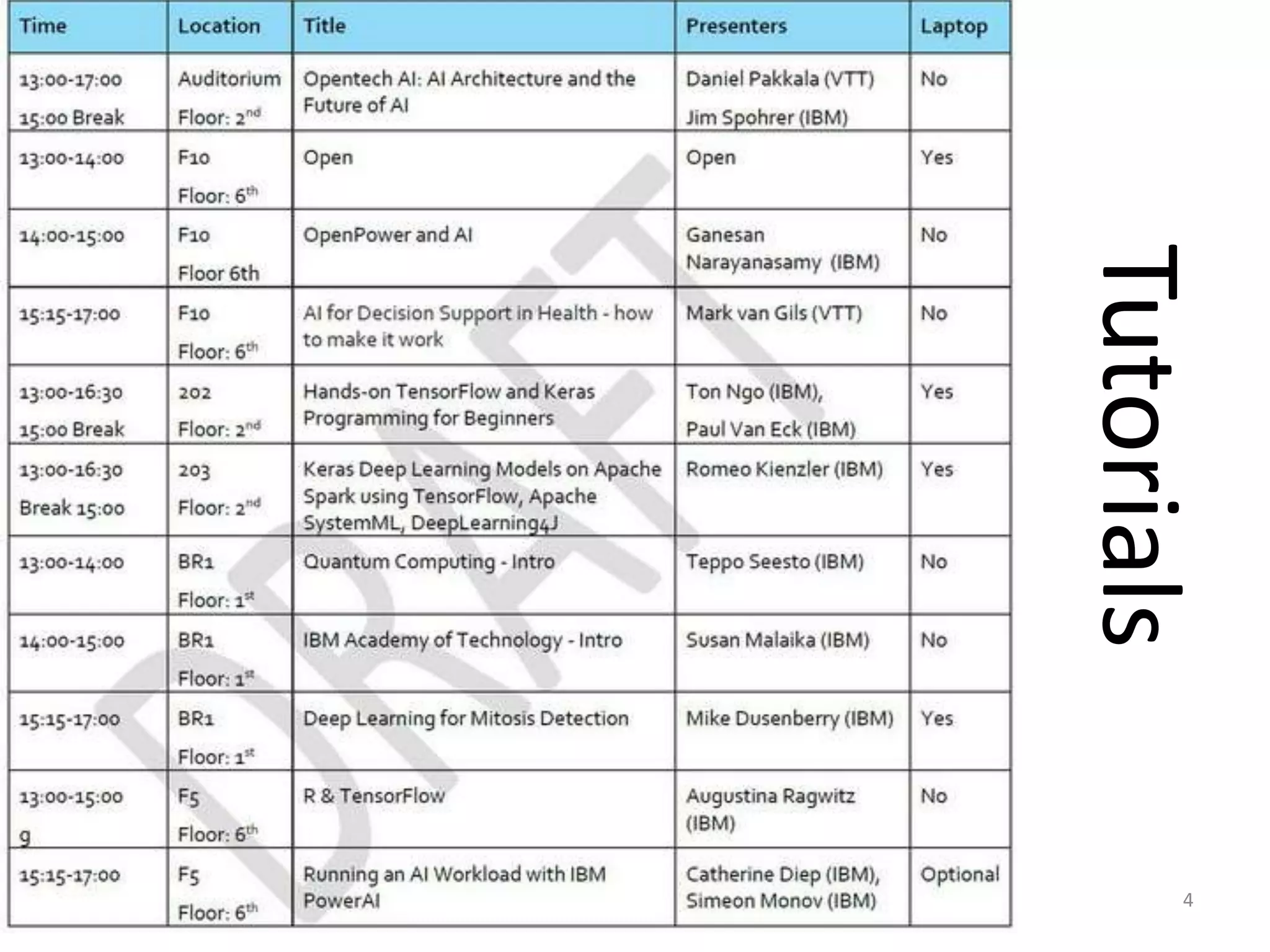
Day 1: Tutorials
3/14/2018
© IBM MAP COG2018
4
Tutorials
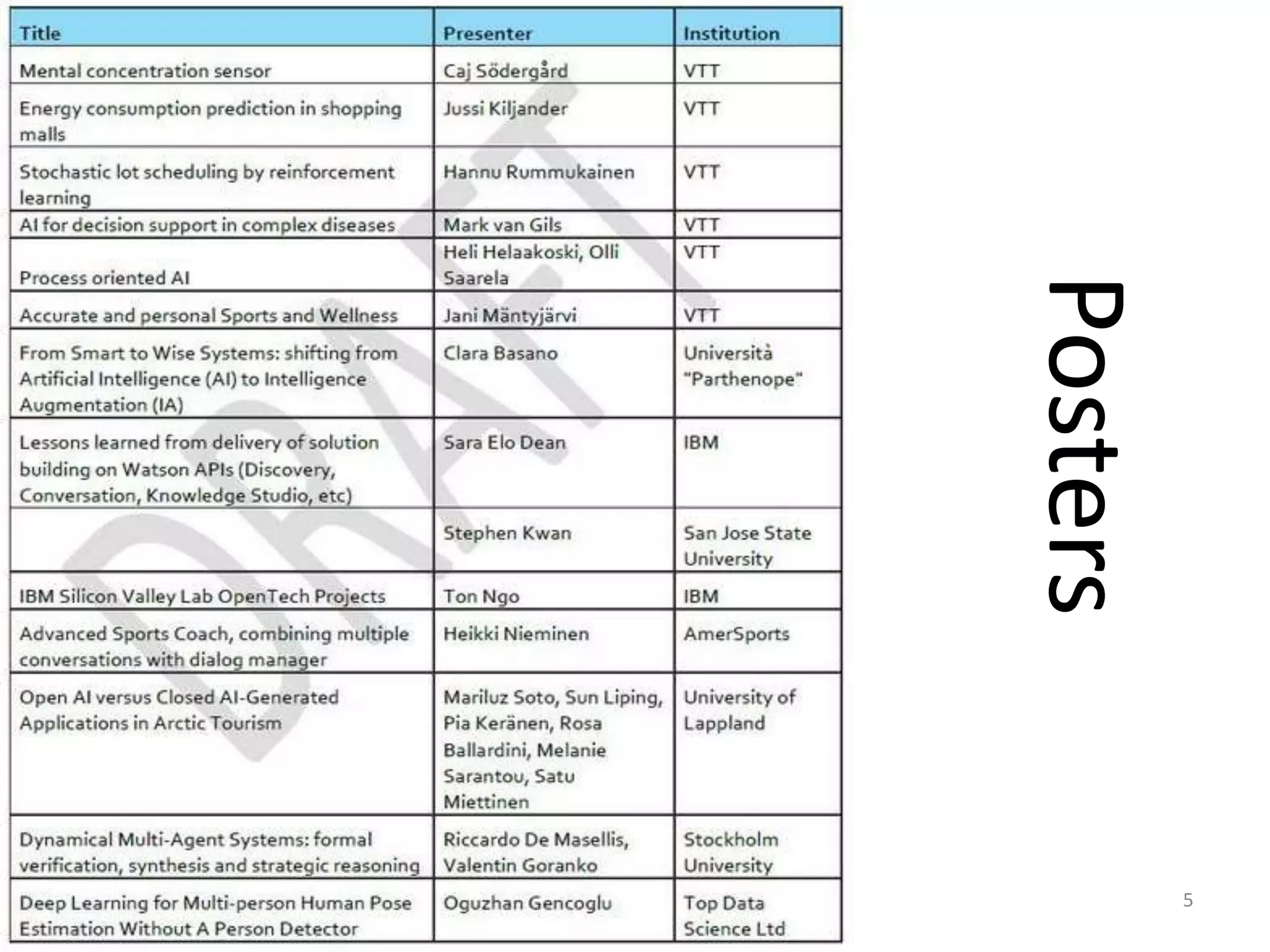
Day 1: Posters
3/14/2018
© IBM MAP COG2018
5
Posters
Day 2 – Wed March 14 (3.14 Pi-Day)
• 8:00 Registration
• 8:30 Welcome; Mirva Antila (General Manager, IBM Finland) & Antti Vasara (CEO, VTT)
• 9:00 Keynote 1 – Introduction, Tuomo Tuikka (Research Manager Intelligent Systems, VTT) ; Finland AI Strategy;
Pekka Sivonen (Director of Digitization, Business Finland)
• 10:00 Break 1
• 10:30 Keynote 2 – Introduction, Tuomo Tuikka (Research Manager Intelligent Systems, VTT) ; EU AI Strategy; Juha
Heikkilä (Head of Robotics and AI unit, European Commission)
• 11:30 Lunch
• (optional: Birds of a Feather 1 in Room N202: PowerAI from Ganesan Narayanasamy ; Birds of a Feather 2 in Room
N203: UNESCO award from Maarit Palo)
• 12:30 Panel 1 – AI and Applications; Moderator: Jim Spohrer (Director of Open Source AI, IBM) ; Panelists include
Kalle Kantola (VP Research Smart Industry, VTT), Robin Burgener (Inventor, President 20Q.net Inc), Michael Richey
(Chief Learning Scientist, Boeing)
• 13:30 Panel 2 – AI & Healthcare; Moderator : Niina Levo (Global Services Partner, IBM) ; Panelists include Mike
Dusenberry (Machine Learning Engineer, IBM Spark Technology Center), Mark van Gils (Principal Scientist
Healthcare Applications, VTT), Pekka Neittaanmäki (Dean of Information Technology, University of Jyväskylä)
• 14:30 Break 2
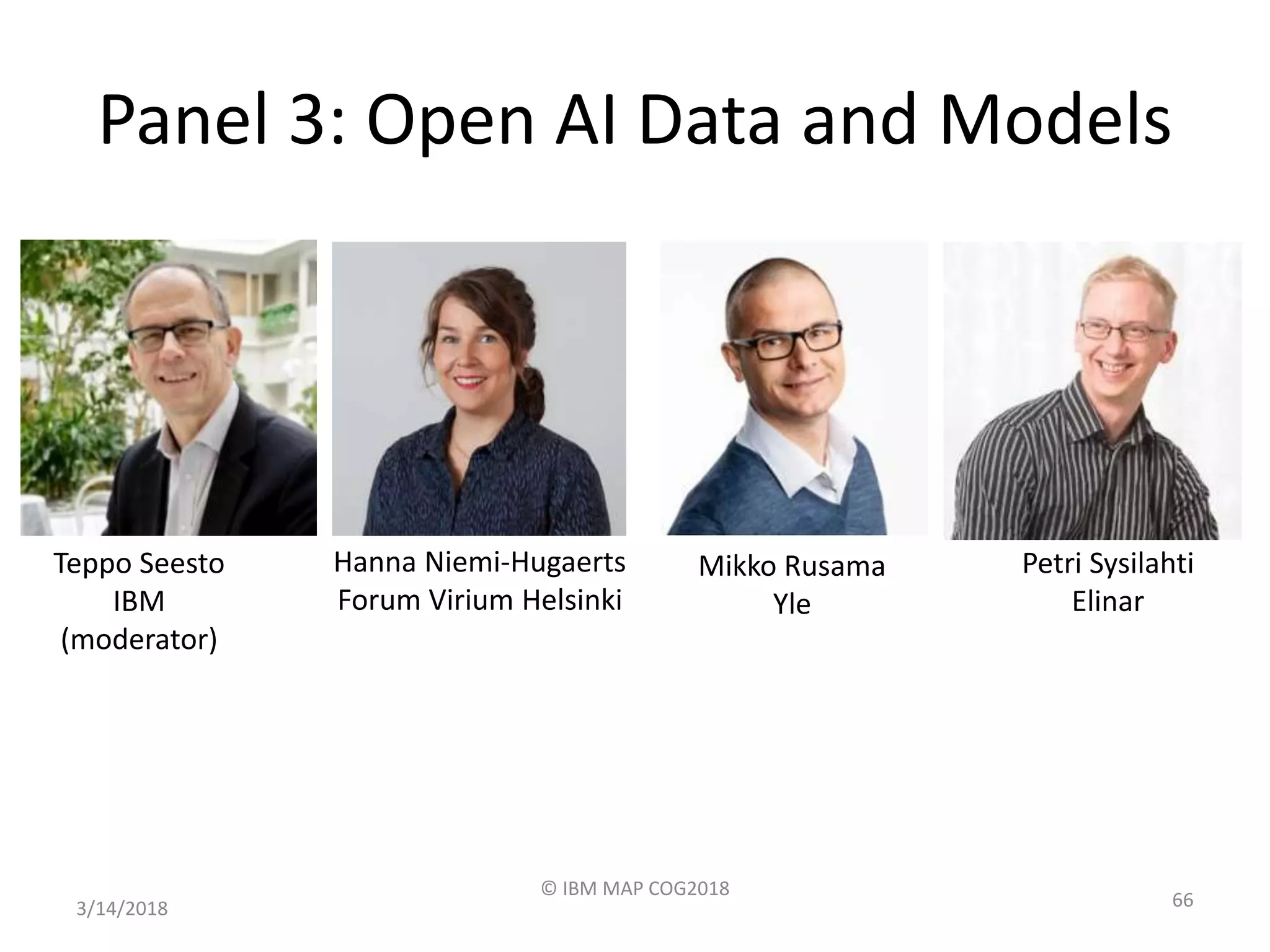
• 15:00 Panel 3 – Open AI and Data, Models; Moderator : Teppo Seesto (Solution Architect, IBM) ; Panelists include
Hanna Niemi-Hugaerts (Program Director, Forum Virium Helsinki), Mikko Rusama (Chief Digital Officer, Yle), Petri
Sysilahti (Solution Architect, Elinar)
• 16:00 Next Steps; Jim Spohrer (IBM Director of Open Source AI), Daniel Pakkala (VTT Principal Scientists
Intelligence Industry Applications)
• 16:30 Depart
3/14/2018
© IBM MAP COG2018
6
Twitter Event Hashtag: “#OpenTechAI” or “opentechai”
OpenTechAI Survey: https://www.surveymonkey.com/r/Opentechai
Some VTT-IBM Collaborations
• VTT and IBM Research - Haifa/Zurich interact in these groups:
– http://www.nessi-europe.com/default.aspx?page=home
– http://www.bdva.eu/
• VTT and IBM Research - Haifa/Zurich in H2020 funded projects:
– DATABIO - lead by VTT in which IBM participates
– BigMedilytics - IBM leads a sub-project in which VTT participates
• VTT - IBM IRELAND
– http://www.midasproject.eu
• VTT – IBM Research – Almaden
– Opentech AI https://opentechai.blog/
– ISSIP-IBM-VTT Survey https://www.surveymonkey.com/r/Opentechai
3/14/2018
© IBM MAP COG2018
7
Welcome
3/14/2018
© IBM MAP COG2018
8
Jim Spohrer
IBM
(agenda review)
Mirva Antila
IBM Finland GM
Antti Vasara
VTT CEO
Twitter Event Hashtag: “#OpenTechAI” or “opentechai”
OpenTechAI Survey: https://www.surveymonkey.com/r/Opentechai
Mirva Antila
Country General Manager
IBM Finland
Opentech AI
100%
1969
Apollo
mission
1971
Floppy
disk
1973 UPC
barcode
1973 ATM
machines
1911
Scales
1931
Translator
system
1957
FORTRAN1928
IBM 80
Column
punch
card
1944
Mark 1
calculator
1962
SABRE
1964
System/360
1961
Selectric
typewriter
1993
Blue Gene
1997
e-business
2008
Smarter
Planet
2010 Watson
Jeopardy
2000
IBM
eServer
1992
IBM Consulting
Group
2006
IBM
Information Server
1996
IBM Net.Commerce
1997
Deep Blue
World Chess
Champion
1981 PC
1981 Excimer
Laser Surgery
IBM
Revenue
(%)
0%
1960 20001980 2016
50%
Hardware and
systems management
Services
Software Platforms
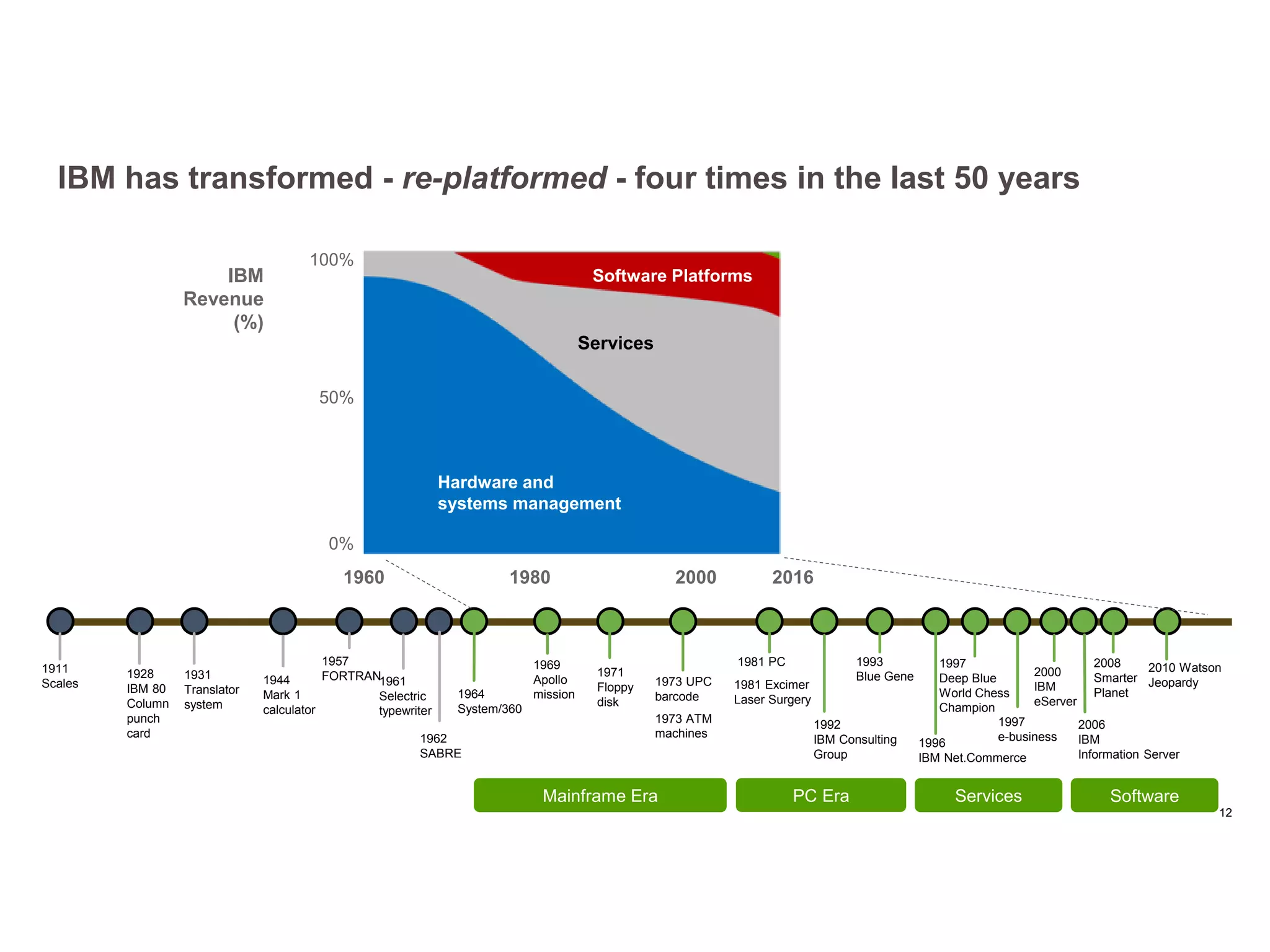
IBM has transformed - re-platformed - four times in the last 50 years
12
Mainframe Era PC Era Services Software
Watson Open sourcePowerAI
Cloud vs on-premise
Positioning of AI tools
Connecting AI technologies
with industry needs
Antti Vasara, CEO
VTT Technical Research Centre of Finland Ltd
1st International Workshop on Opentech AI
14.3.2018
14
Ministry of
Economic
Affairs and
Employment
VTT – impact through scientific and
technological excellence
Vision
A brighter future is created through science-based
innovations.
Mission
VTT helps customers and society to grow and renew
through applied research.
Strategy
We make an impact through scientific and technological
excellence.
Established
1942
269 M€Turnover and other
operating income
(VTT Group 2016)
2368
Employees
(VTT Group 2017)
33%
Of turnover
foreign revenue
(VTT Group
2016)
27%
Doctors and
licentiates
(VTT Group 2017)
15VTT 2018
16
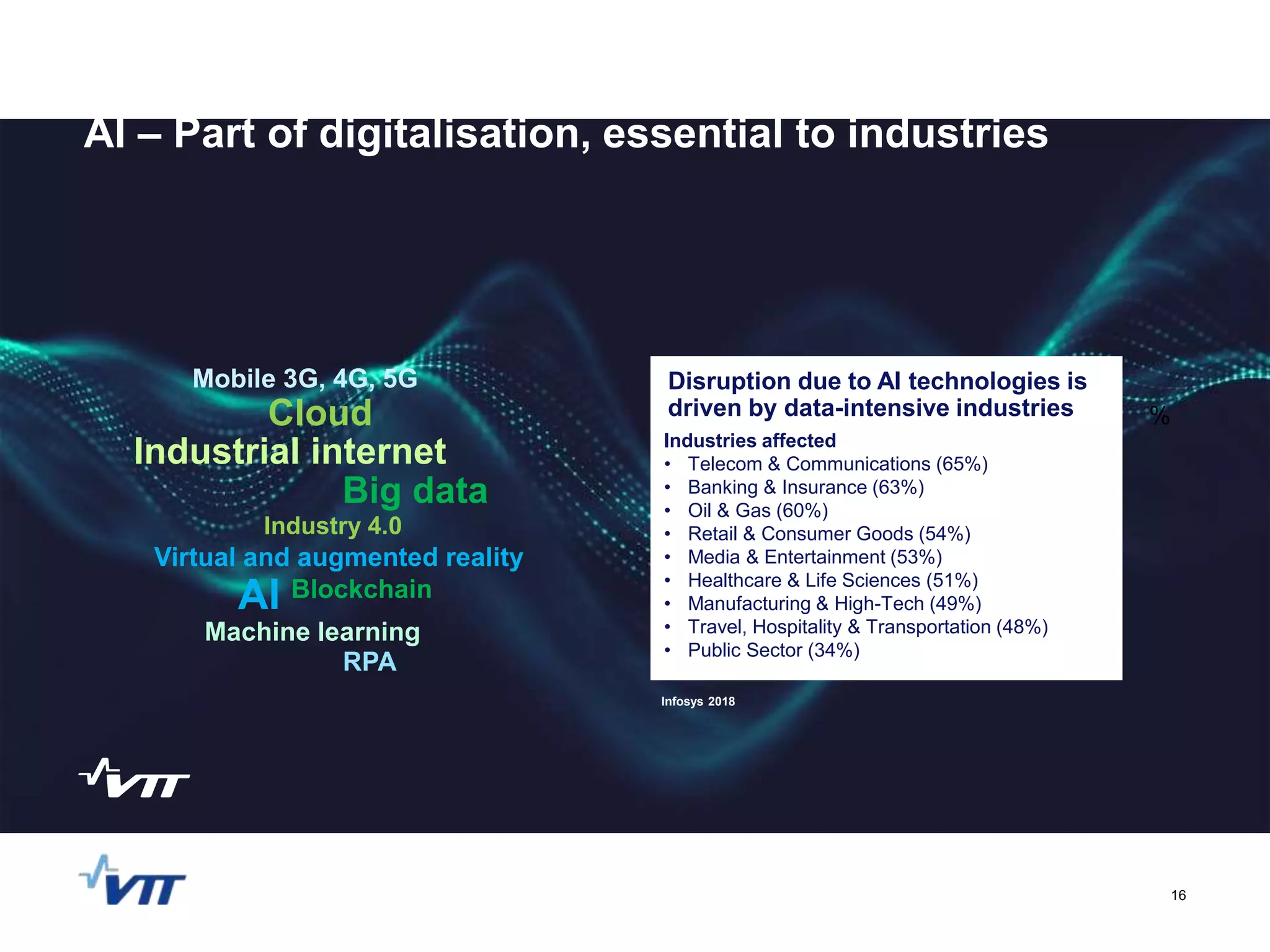
AI – Part of digitalisation, essential to industries
Mobile 3G, 4G, 5G
Cloud
Big data
Industrial internet
Industry 4.0
Virtual and augmented reality
AI
Machine learning
RPA
Blockchain
%
Infosys 2018
Disruption due to AI technologies is
driven by data-intensive industries
Industries affected
• Telecom & Communications (65%)
• Banking & Insurance (63%)
• Oil & Gas (60%)
• Retail & Consumer Goods (54%)
• Media & Entertainment (53%)
• Healthcare & Life Sciences (51%)
• Manufacturing & High-Tech (49%)
• Travel, Hospitality & Transportation (48%)
• Public Sector (34%)
17
Time to exploit the data
DATA
Ensure reliable and
relevant data
from multiple sources
Easy-to-understand
visualisation
of complex data
Interactive methods
to focus on relevant data
Monitor and report in real-time
Predict next best actions
Optimise logistics, energy and material use
Expose new business
opportunities
Collect past and real-time
data
Acquire essential data from
different sources
Manage high volumes data
Integrate analytics into
enterprise IT systems and
decision chains
Application specific
implementation of algorithms
and analysis
Appropriate tools for domain
specific applications
17
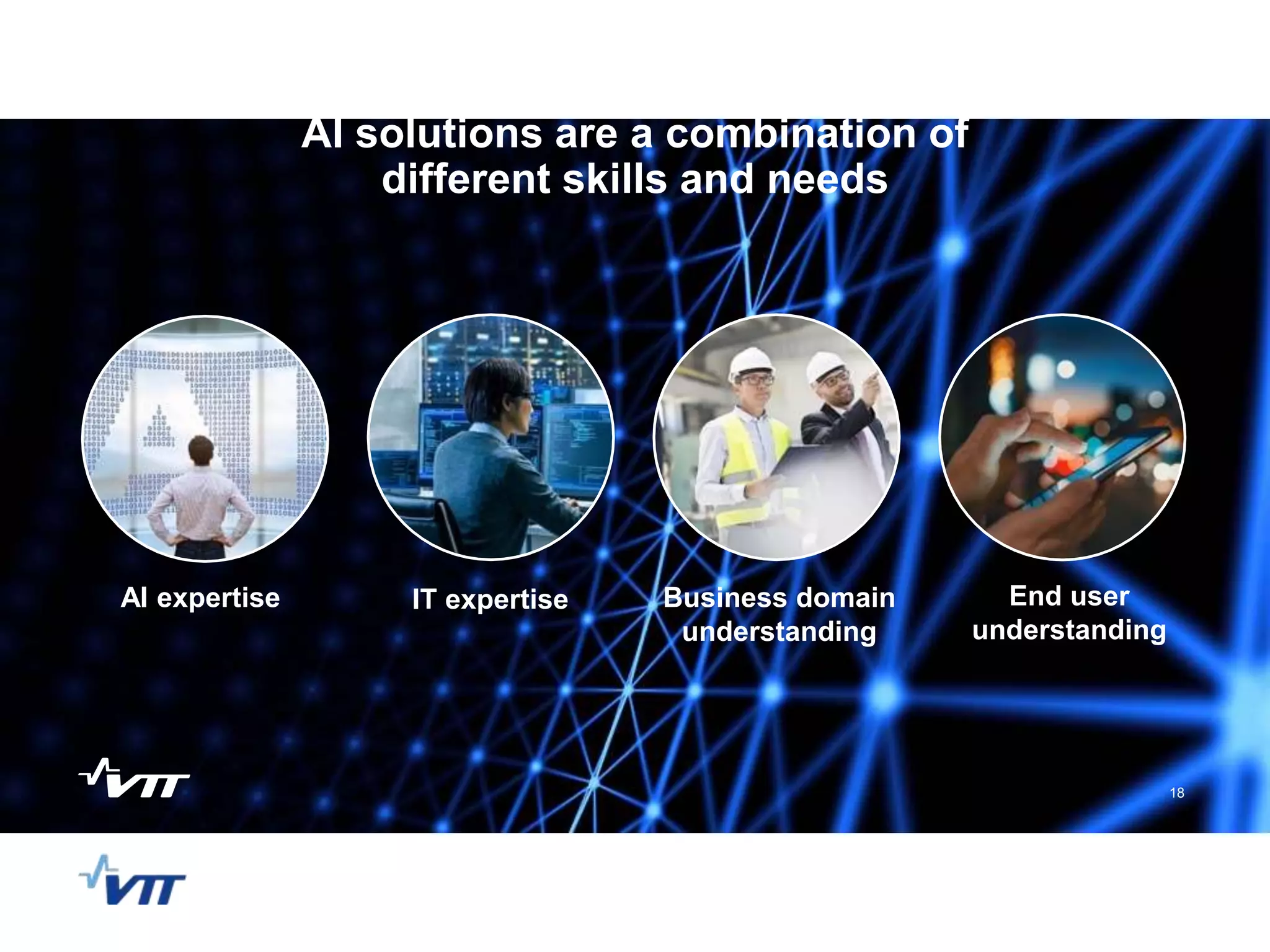
AI solutions are a combination of
different skills and needs
AI expertise IT expertise Business domain
understanding
End user
understanding
18
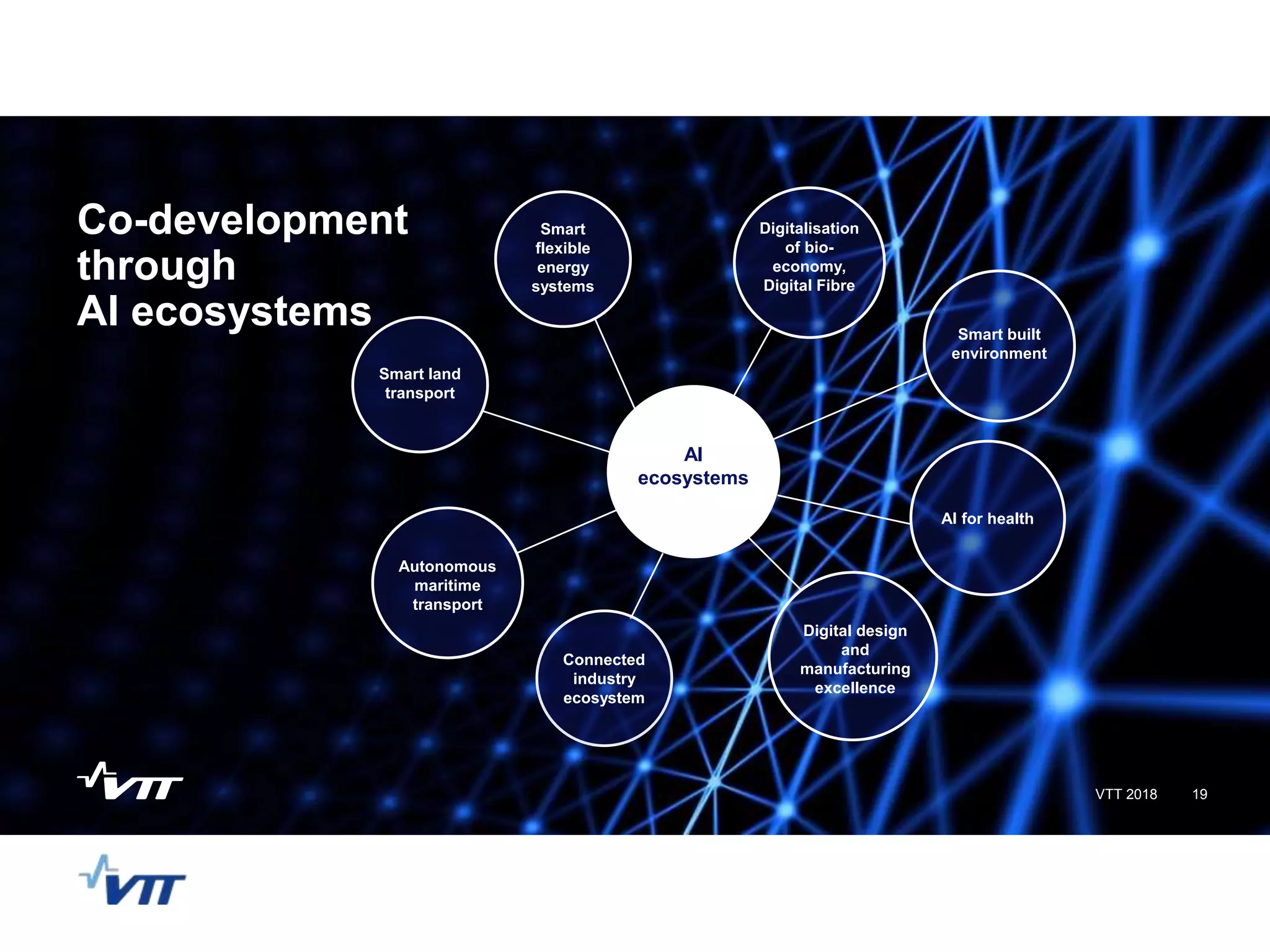
Co-development
through
AI ecosystems
AI
ecosystems
Smart land
transport
Smart
flexible
energy
systems
Smart built
environment
Digitalisation
of bio-
economy,
Digital Fibre
Autonomous
maritime
transport
Connected
industry
ecosystem
AI for health
Digital design
and
manufacturing
excellence
19VTT 2018
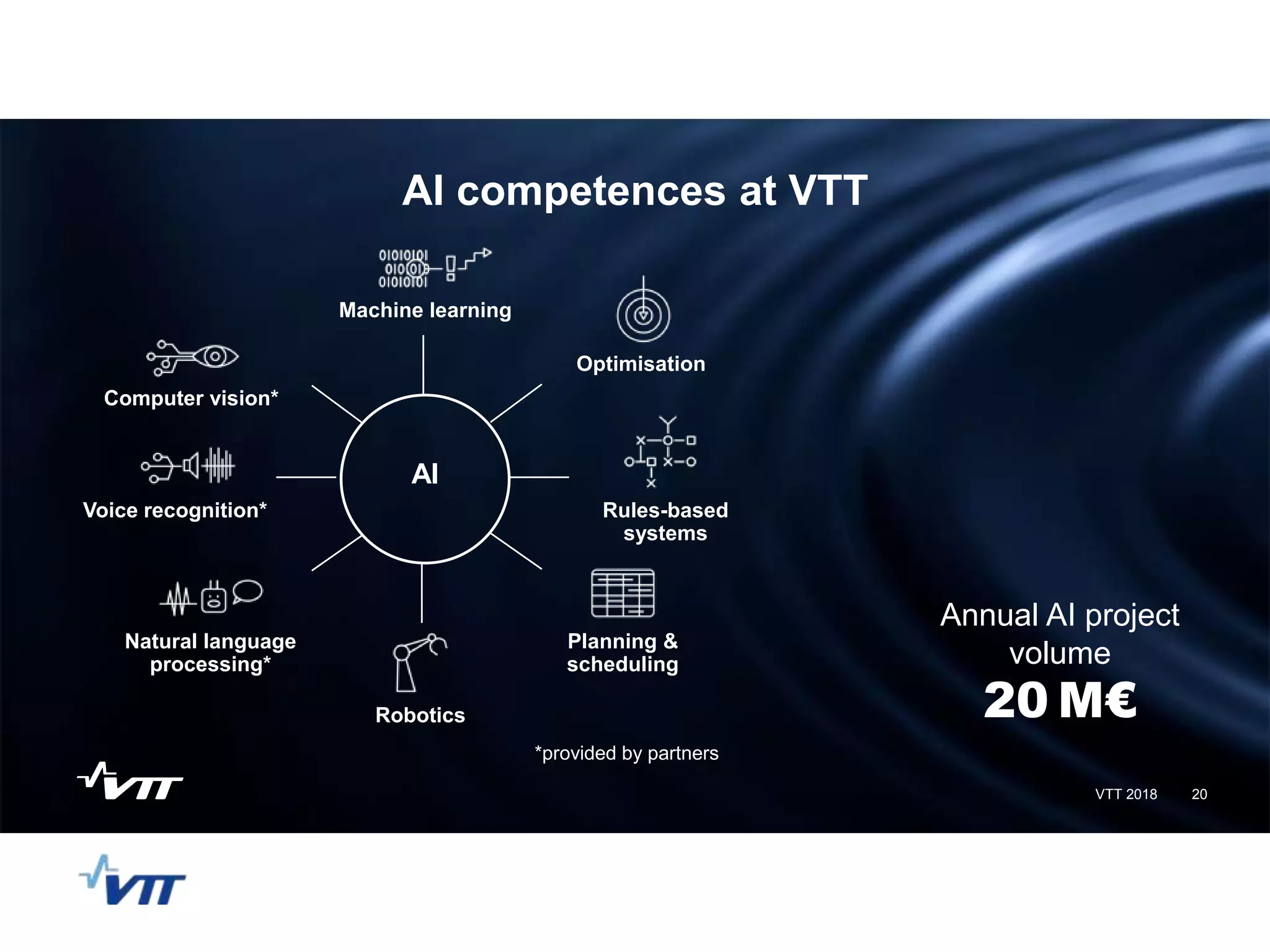
AI competences at VTT
Annual AI project
volume
20 M€
Computer vision*
AI
Voice recognition* Rules-based
systems
Robotics
Planning &
scheduling
Optimisation
Natural language
processing*
Machine learning
*provided by partners
20VTT 2018
Our AI solutions delivered to customers
21VTT 2018
The most energy
efficient super
market in the world
S-Market
The best quality
steel
SSAB
Efficient quality monitoring
for pulp production
MetsäFibre
Early detection
of cognitive
problems
Customer-friendly
sports analytics
algorithm
Diagnostics and
decision-making
support for doctors
Election
news bot
Accurate activity
recognition and
personalised
tracking tool
Risk prevention
sensors to detect
downfalls
Eye movement
tracking and
analysis for control
rooms
21
www.vttresearch.com
#vttpeople / @VTTFinland
22
Keynotes
3/14/2018
© IBM MAP COG2018
23
Tuomo Tuikka
VTT
(moderator)
Pekka Sivonen
Business Finland
“Finland AI Strategy”
Juha Heikkila
European Commission
Robotics & AI
“EU AI Strategy”
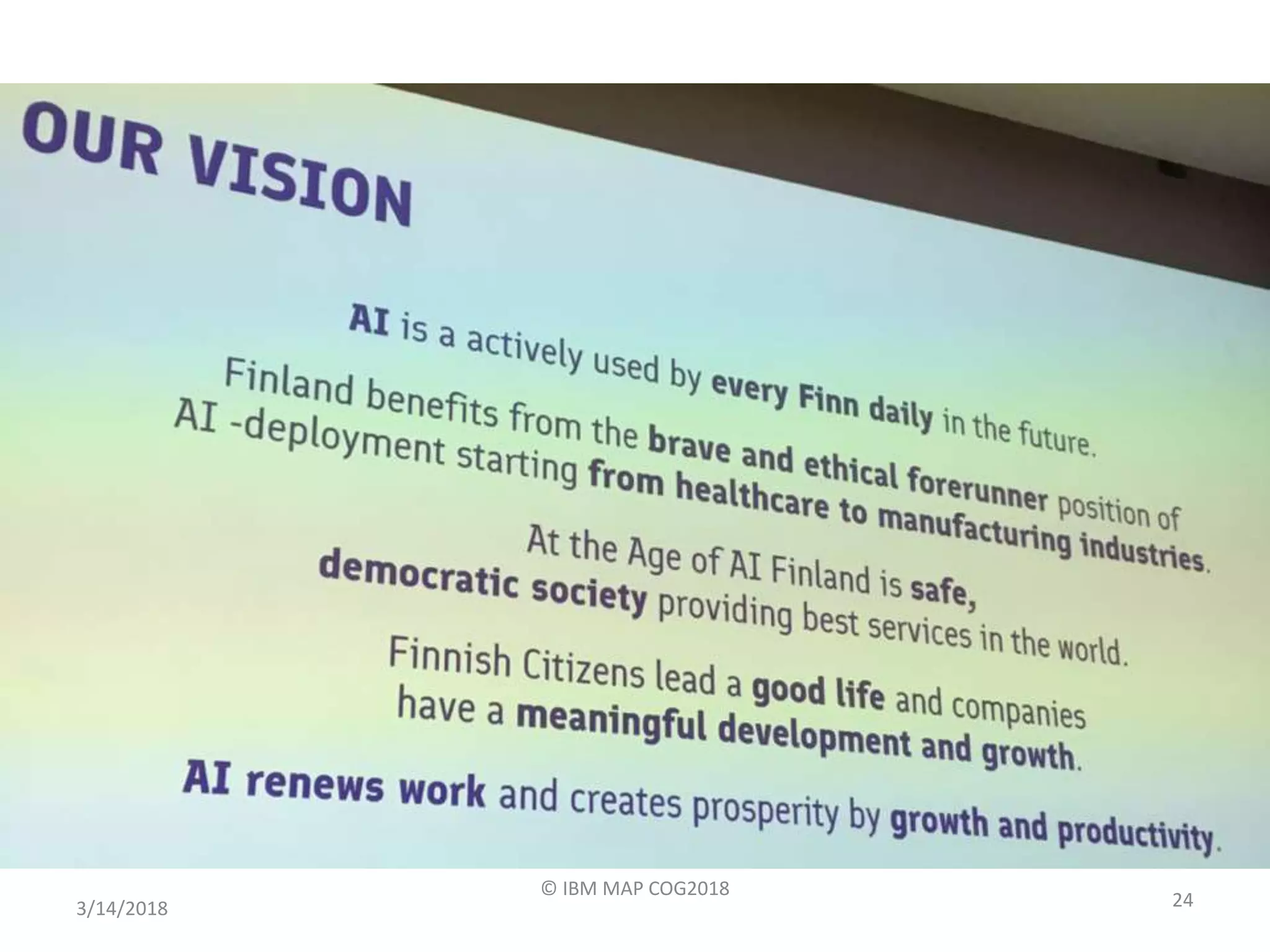
Finland AI Strategy Vision
3/14/2018
© IBM MAP COG2018
24
Finland AI Approach
3/14/2018
© IBM MAP COG2018
25
EU Challenges
3/14/2018
© IBM MAP COG2018
26
EU AI Strategy
3/14/2018
© IBM MAP COG2018
27
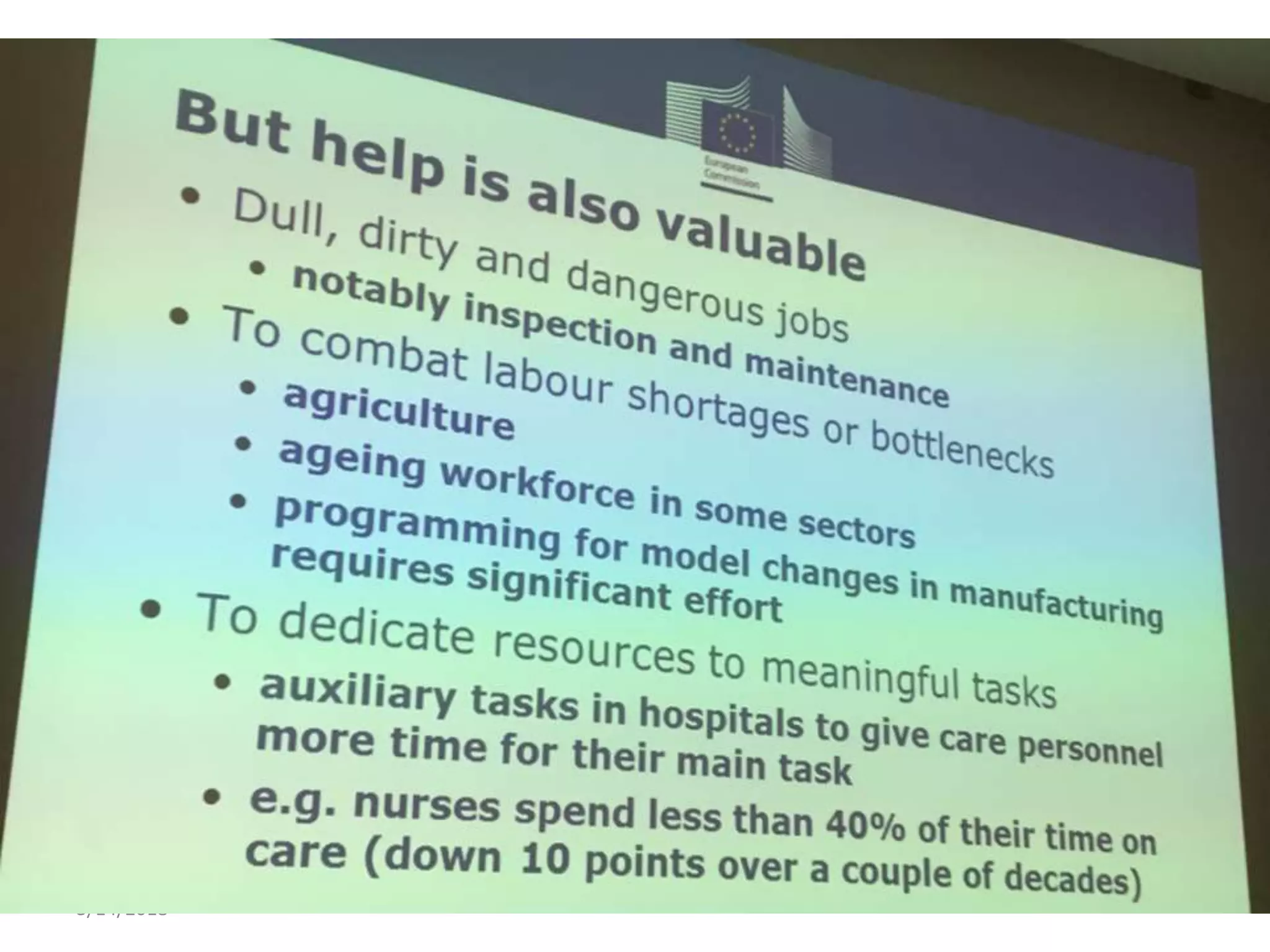
EU Help Labor Force By…
3/14/2018
© IBM MAP COG2018
28
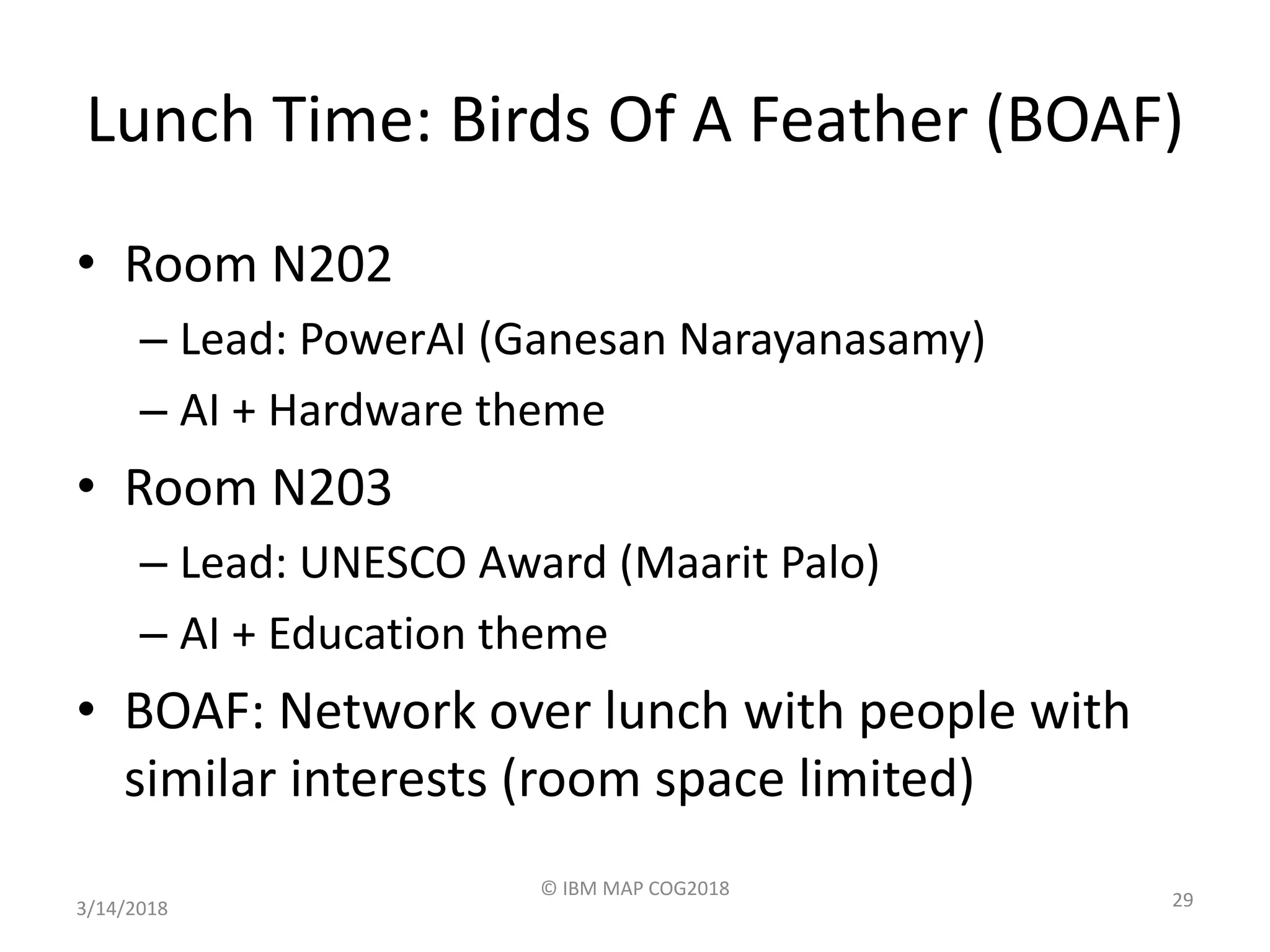
Lunch Time: Birds Of A Feather (BOAF)
• Room N202
– Lead: PowerAI (Ganesan Narayanasamy)
– AI + Hardware theme
• Room N203
– Lead: UNESCO Award (Maarit Palo)
– AI + Education theme
• BOAF: Network over lunch with people with
similar interests (room space limited)
3/14/2018
© IBM MAP COG2018
29
PowerAI
3/14/2018
© IBM MAP COG2018
30
** IBM Internal Use Only ** 31
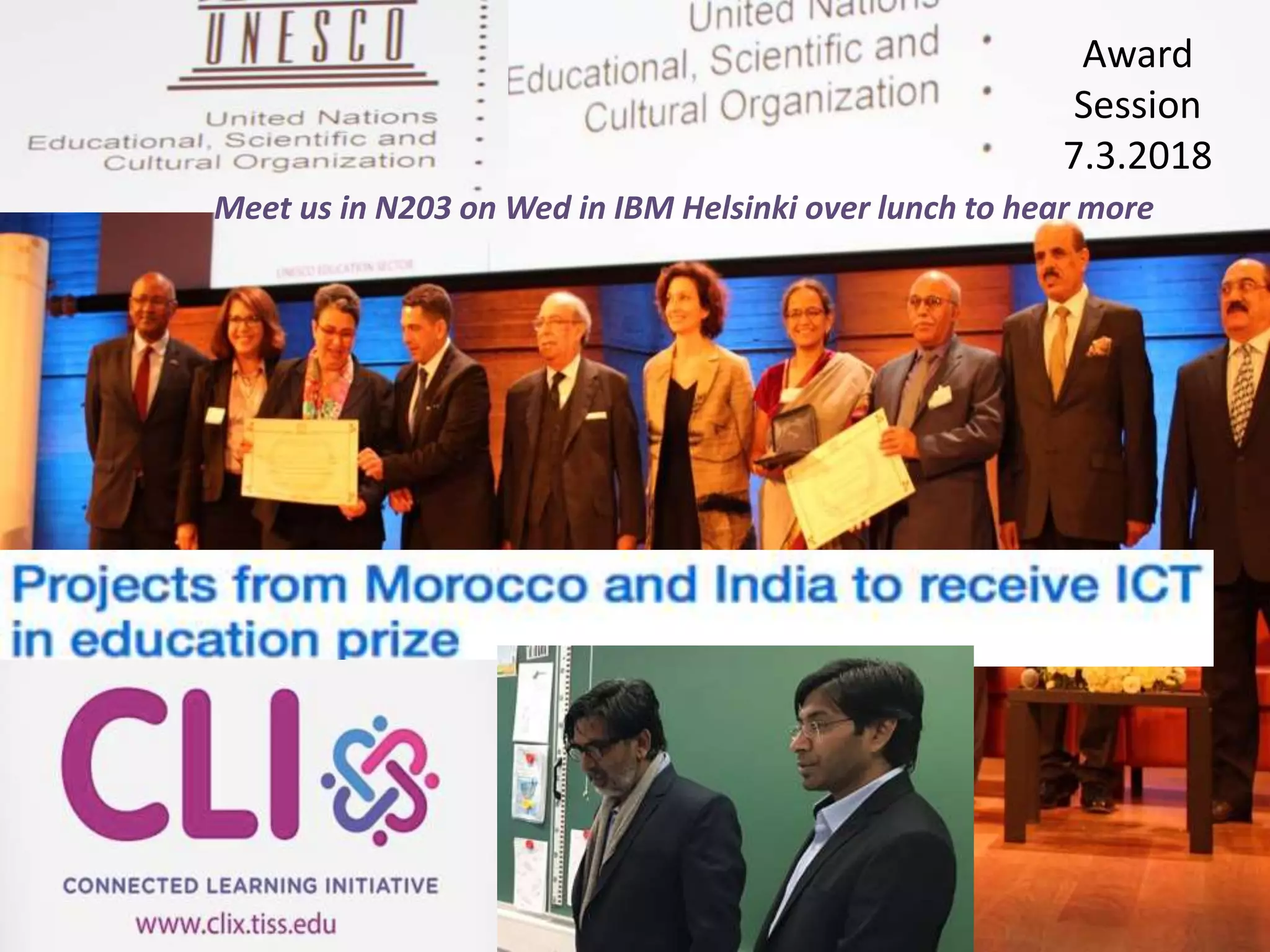
Award
Session
7.3.2018
Meet us in N203 on Wed in IBM Helsinki over lunch to hear more
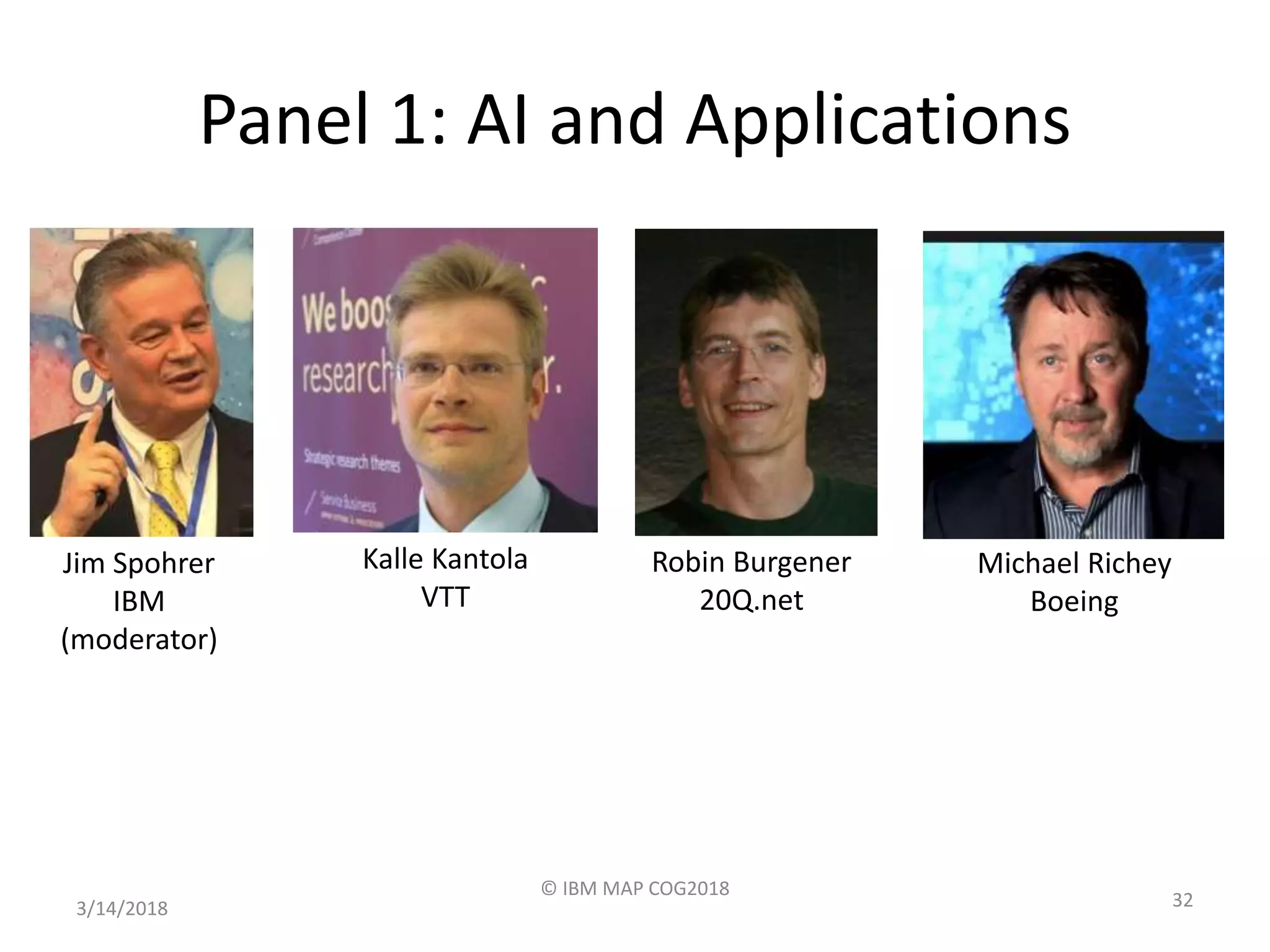
Panel 1: AI and Applications
3/14/2018
© IBM MAP COG2018
32
Jim Spohrer
IBM
(moderator)
Kalle Kantola
VTT
Robin Burgener
20Q.net
Michael Richey
Boeing
AI and Applications
Kalle Kantola
VP Research
Smart Industry and energy systems, VTT
The value of AI is realized through
applications.
AI needs to be supported by data source and other
critical technologies
Data
AI
Cyber IoT
Applications
Data sources and
availability
AI and other
technologies
Business and Value add
35VTT 2018
3
6
VTT 2018
36VTT 2018
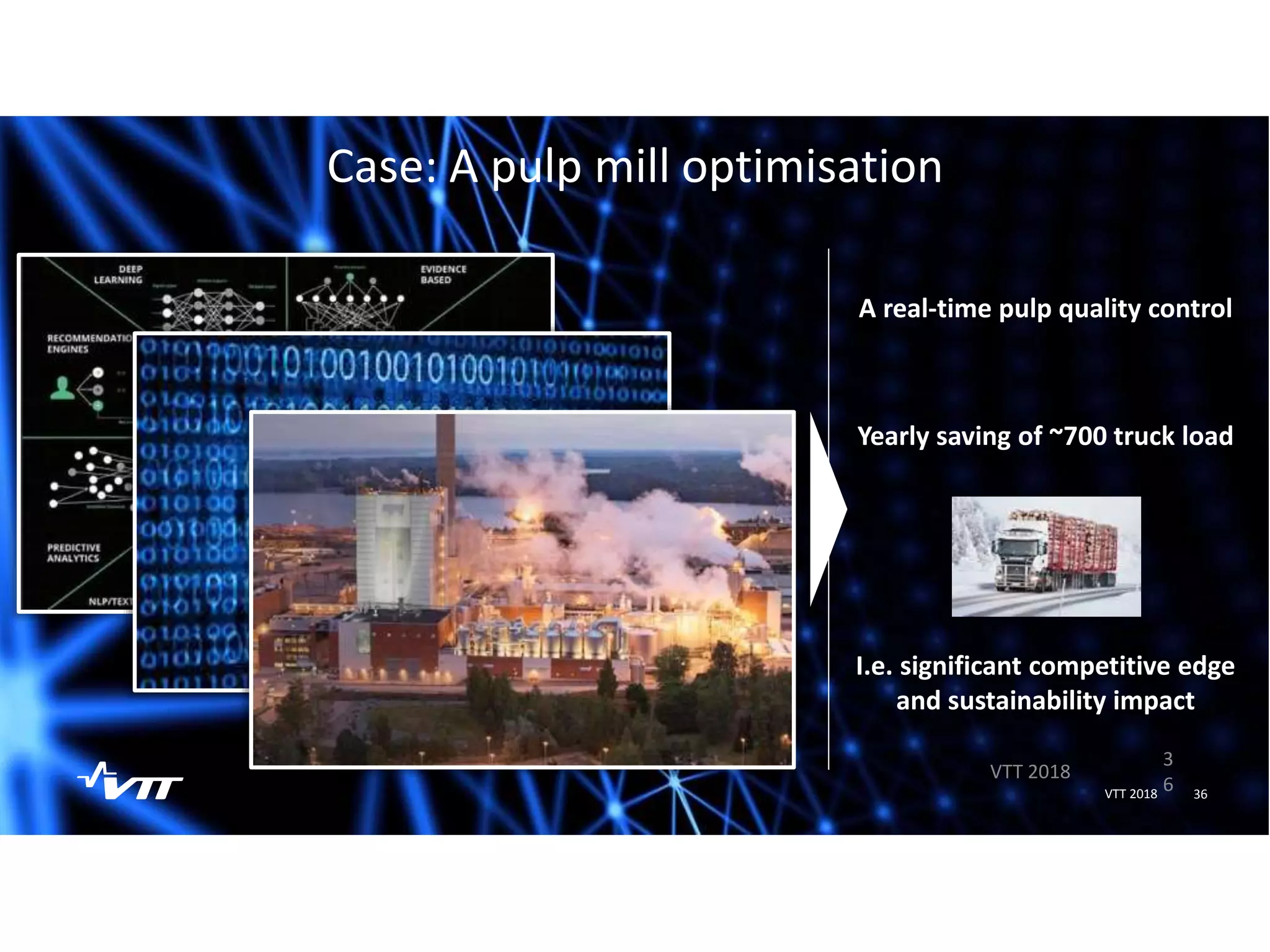
Case: A pulp mill optimisation
A real-time pulp quality control
Yearly saving of ~700 truck load
I.e. significant competitive edge
and sustainability impact
Artificial intelligence is the new
electricity
EFFICIENT
PUBLIC SECTOR
Responsive
public services
Sound
economic growth
COMPETITIVE
BUSINESS AND INDUSTRY
PROACTIVE
SOCIETY
Prosperity and
wellbeing in
Finland
AI tools expertise
ICT system
expertise
Business and
domain expertise
Users
38VTT 2018
AI applications requires multidisciplinary
competences
y
38VTT 2018
Effective Innovation network and expertise
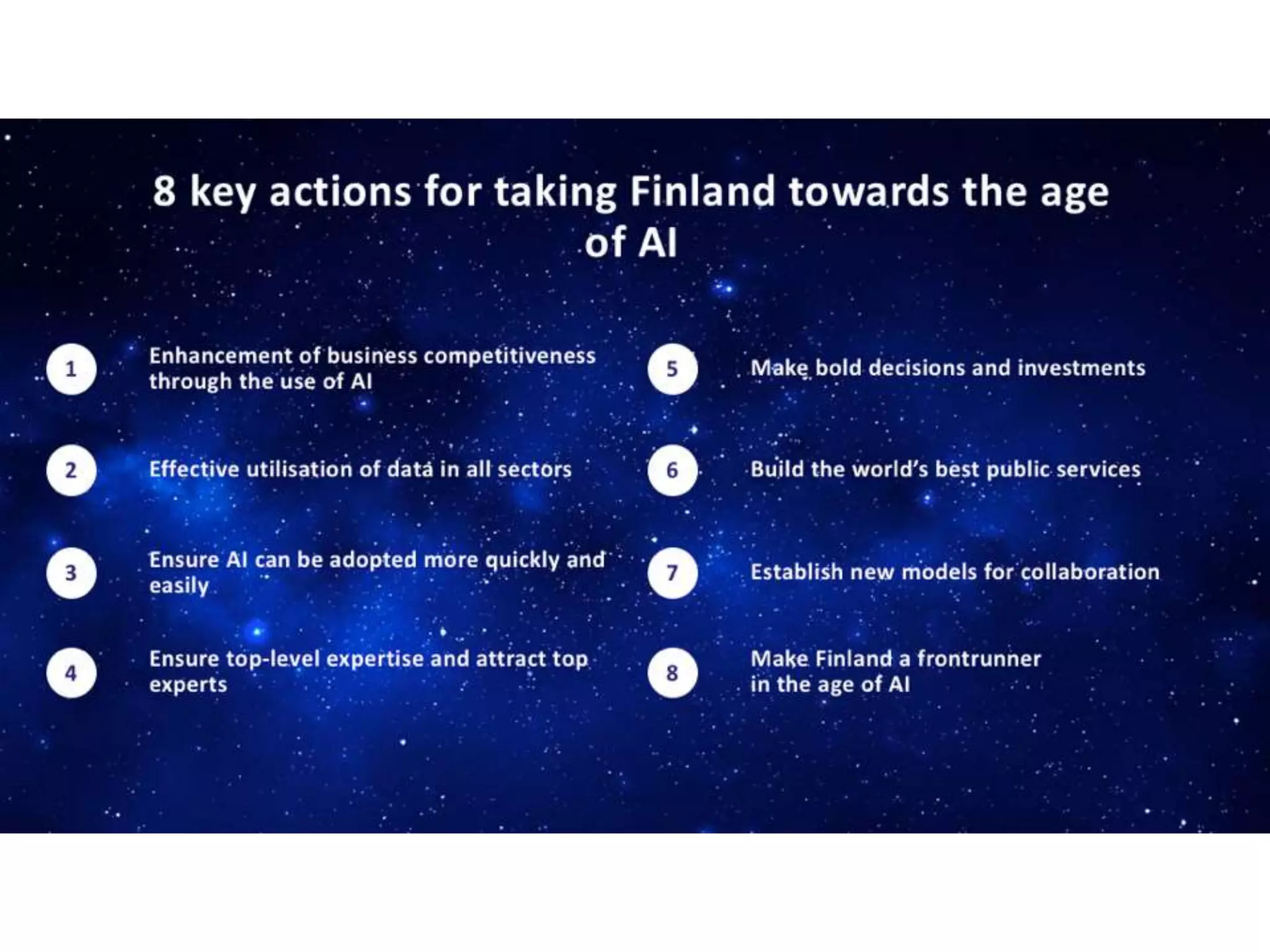
Enhancement of business competitiveness
through the use of AI
1
Effective utilisation of data in all sectors2
Ensure AI can be adopted more quickly and
easily3
Ensure top-level expertise and attract top
experts4
Make bold decisions and investments5
Build the world’s best public services6
Establish new models for collaboration7
Make Finland a frontrunner
in the age of AI8
8 key actions for taking Finland towards the age
of AI
The payback time for an AI
investment can be only days.
Original 20Q Ball
3/14/2018
© IBM MAP COG2018
41
What is 20Q
• A brief history of 20Q and 20Q.net
• How 20Q sees “a candle”
• Artificial intelligence is no match for natural
stupidity
• Censorship and its effect on 20Q
Robin Burgener, president and inventor
20Q.net Inc., Ottawa, Canada
3/14/2018
© IBM MAP COG2018
42
Michael Richey, Ph.D
Associate Technical Fellow
Learning, Leadership and
Organizational Development
The Boeing Company
Michael.c.richeyboeing.com
1st International Workshop on Opentech AI
Learning in Professional Networks: Effect of Social Capital,
Pathways, and Artifact Creation
National Academy of Sciences:
Modeling and Visualizing Science and Technology
Developments
Michael Ginda
Research Analyst,/Assistant Instructor
Cyberinfrastructure for Network Science
Center School of Informatics and Computing
Indiana University
Kerrie Anna Douglas
Assistant Professor
Engineering Education Wang
Purdue University
Katy Borner
Victor H. Yngve Distinguished Professor of
Engineering and Information Science
School of Informatics, Computing, and
Engineering
Indiana University
George Siemens , Ph.D
Professor, Executive Director
LINK Research Lab
University of Texas Arlington
Convergence Exponential Information and Complexity
“The Ages of our civilization evolve slowly and with incredible resistance, displacement ends as
information adoption rates reach a tipping point. .”
1900-1950 20201970-1980
Knowledge
doubled in
400 years
Knowledge
doubled in
10 years.
Knowledge is
doubling every
13 months.
IBM predicts the build out of the
“internet of things” will lead to the
doubling of knowledge every 12 hours.
Industrial Revolution
Industrial production
Information Age
Computerization – digital
data
Post-Information Age
2017
Knowledge
doubled in
50 years
1440 -1900 1950-1970
Knowledge
doubled in
20 years
Knowledge
doubled in
8 years.
1980-2000
IoT Tipping Point
100 years
40 years
20 years
“Convergence refers to both the convergence of
expertise across disciplines and the convergence of
academic, government, and industry stakeholders to
support scientific investigations and enable rapid
translation of the resulting advances”
(Roco, NSF Convergence Workshop Report 11.02.17)
Reductionist, Linear & Mechanistic
Complex, convergent networks
with agile organizational forms
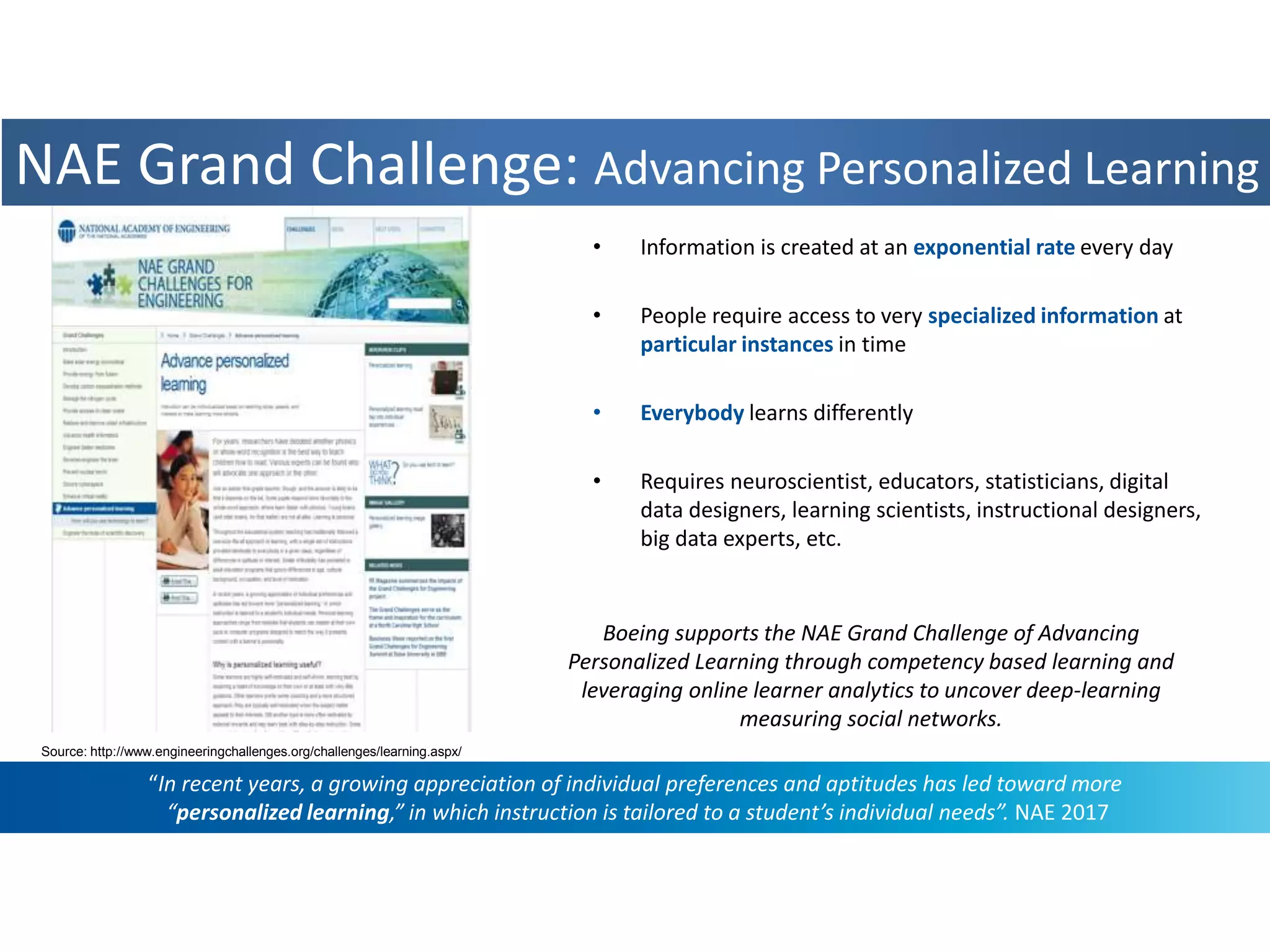
• Information is created at an exponential rate every day
• People require access to very specialized information at
particular instances in time
• Everybody learns differently
• Requires neuroscientist, educators, statisticians, digital
data designers, learning scientists, instructional designers,
big data experts, etc.
“In recent years, a growing appreciation of individual preferences and aptitudes has led toward more
“personalized learning,” in which instruction is tailored to a student’s individual needs”. NAE 2017
Source: http://www.engineeringchallenges.org/challenges/learning.aspx/
NAE Grand Challenge: Advancing Personalized Learning
Boeing supports the NAE Grand Challenge of Advancing
Personalized Learning through competency based learning and
leveraging online learner analytics to uncover deep-learning
measuring social networks.
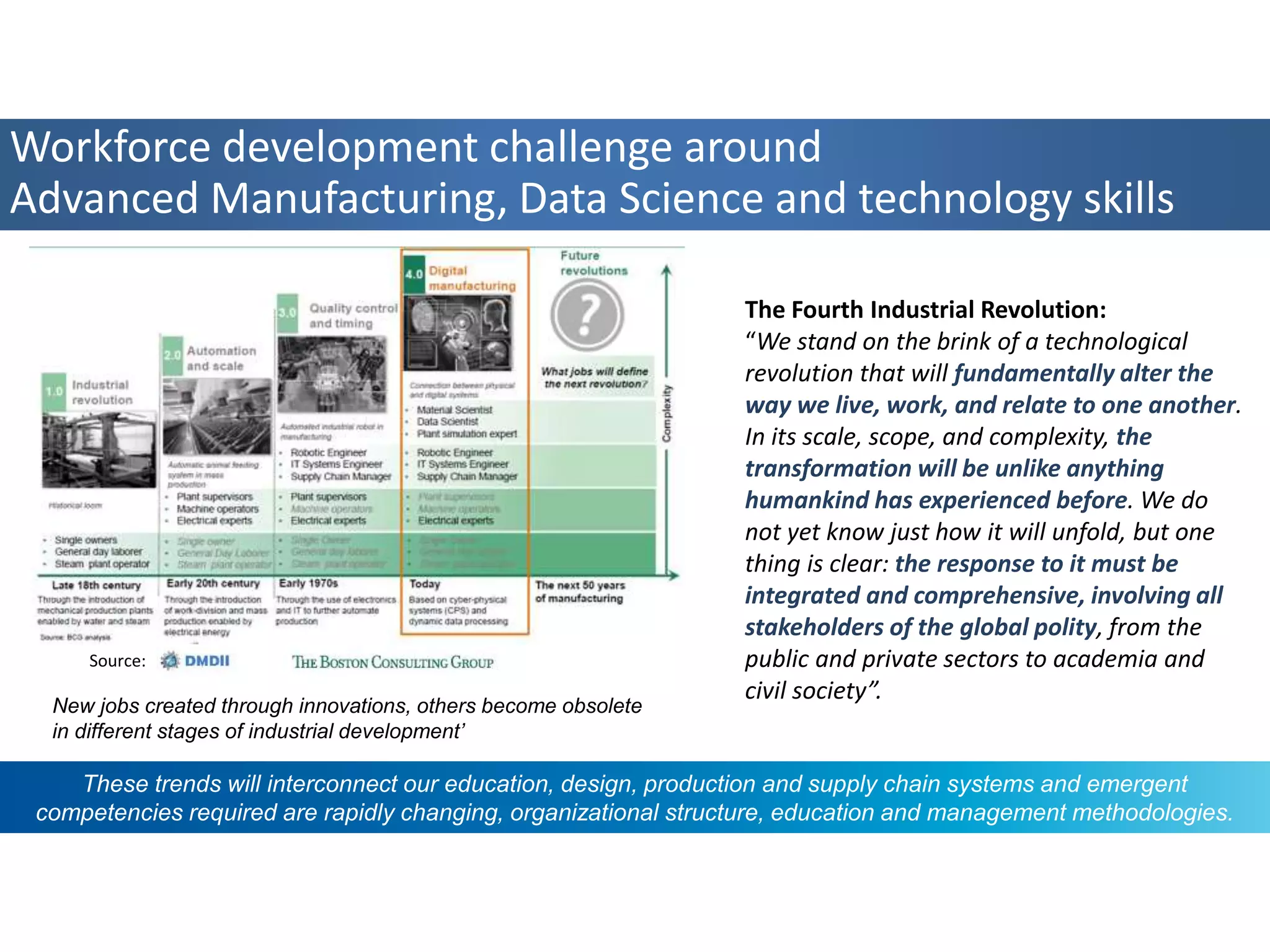
New jobs created through innovations, others become obsolete
in different stages of industrial development’
The Fourth Industrial Revolution:
“We stand on the brink of a technological
revolution that will fundamentally alter the
way we live, work, and relate to one another.
In its scale, scope, and complexity, the
transformation will be unlike anything
humankind has experienced before. We do
not yet know just how it will unfold, but one
thing is clear: the response to it must be
integrated and comprehensive, involving all
stakeholders of the global polity, from the
public and private sectors to academia and
civil society”.
Workforce development challenge around
Advanced Manufacturing, Data Science and technology skills
These trends will interconnect our education, design, production and supply chain systems and emergent
competencies required are rapidly changing, organizational structure, education and management methodologies.
Source:
Case Study: EdX MIT – Boeing – NASA
Partnership
Professional Education in Architecture and Systems Engineering: Models and Methods to Manage Complex SystemsSmall Private Online Certificate SPOC
The purpose of the micro – certificate is to grow the system
engineering and modeling competencies of Boeing - NASA
engineers (including all design centers and partners).
• On-line format, Basic to Intermediate SE KSA development
• Addresses structural (academic – industry) KSA alignment (i.e., industry
relevant )
• Scalable enterprise delivery structure ( supports all design centers
• Responsive to space and brick and mortar instructor led constraints
• Cost effective
• Earns CEU’s (LTP funded)
• Improves retention (skin in the game)
• Potential matriculation towards accredited degree (with prerequisite)
• Ability to serve non-traditional populations (public audit intro course for
free)
• Changes role of SME and faculty, guide on side vs. lecture and drill model
• Provides click stream data analytics, who – what – where -how
This certificate represents a new form of micro credential that blend industry (practice) with traditional academic (theory) i.e.,
employee competency based credentials.
Additional Micro-certificates under development include: Program
Management, IoT, Advanced Manufacturing, Additive Manufacturing,
Data Science, Cyber Security and Leadership for non-managers.
Certificate Design Principles
Force-directed layout of hierarchical course module structure
The relationships between learning technologies, learning science research, educational psychology, and theories of instructional design are
complex, more like an interacting ecology of ideas and practices than a clear hierarchical structure-organization.
Week One: Systems Thinking 3.5 rs.
Network as a context for the cognitive
AI capability development
“Social network analysis combined with qualitative demographic data
demonstrated that these emerging communities were interest-based, and
that their development was facilitated via technical nodes (i.e., hashtags)
and one or two active social nodes (i.e., course participants)”
Personal Learning Graphs:
Overview of the conceptual model for the assessment of the
performance of groups emerging from learning in networks.
Joksimović et al., 2016
Skrypnyk, O., Joksimović, S., Kovanović, V., Gašević, D.,
& Dawson, S. (2015).
Education from a “complex adaptive social system” perspective requires academia and industry to rethink the boundaries of educational research
within the broader ecosystem of classic STEM education”.
Examples of Interaction
networks:
• The Blogosphere
• Biochemical networks
• Gene-protein networks
• Food webs: who eats whom
• The World Wide Web
• Airline networks
• Call networks (AT&T)
• Expert – Novice networks
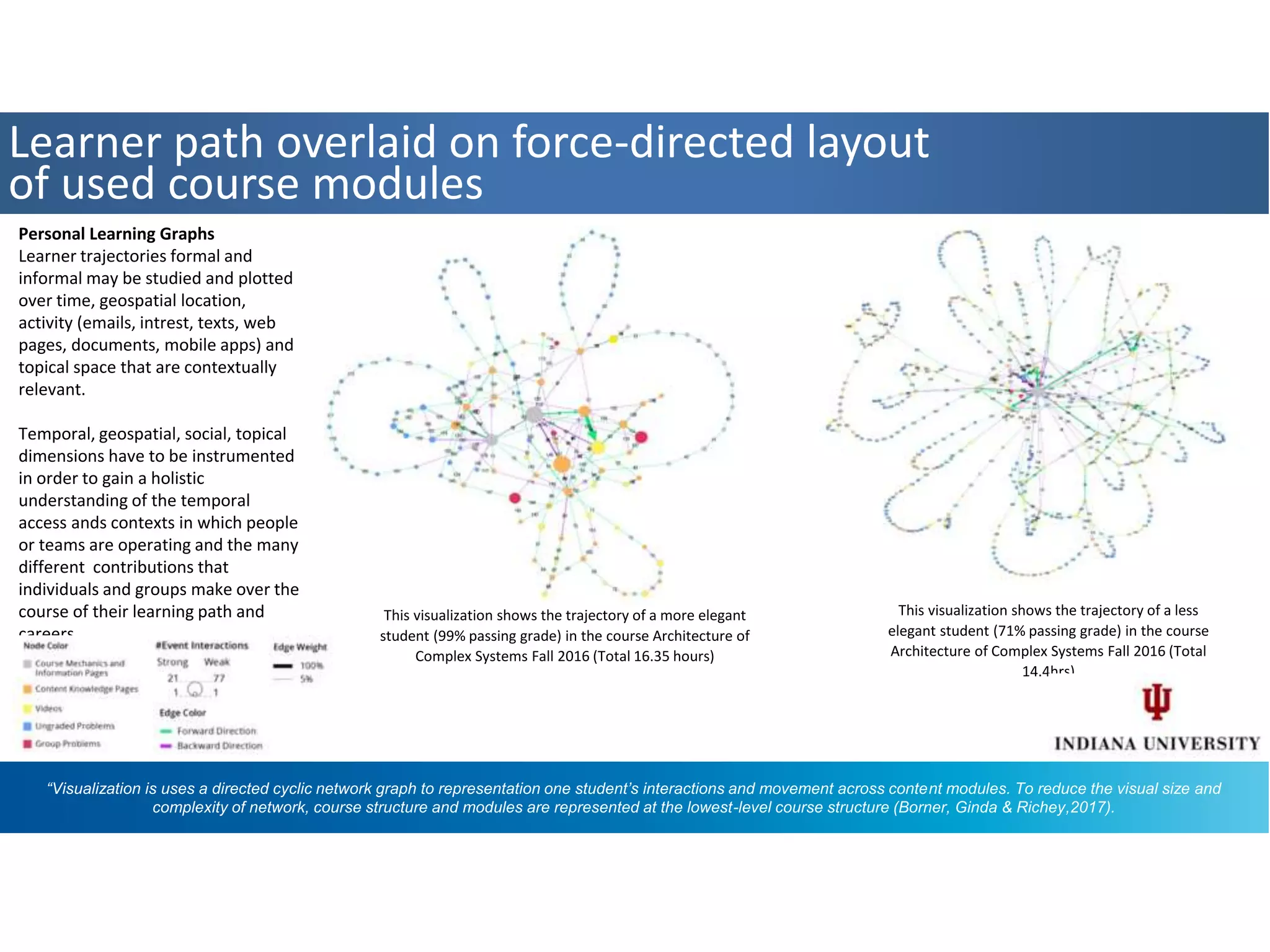
Learner path overlaid on force-directed layout
of used course modules
“Visualization is uses a directed cyclic network graph to representation one student’s interactions and movement across content modules. To reduce the visual size and
complexity of network, course structure and modules are represented at the lowest-level course structure (Borner, Ginda & Richey,2017).
This visualization shows the trajectory of a less
elegant student (71% passing grade) in the course
Architecture of Complex Systems Fall 2016 (Total
14.4hrs)
This visualization shows the trajectory of a more elegant
student (99% passing grade) in the course Architecture of
Complex Systems Fall 2016 (Total 16.35 hours)
Personal Learning Graphs
Learner trajectories formal and
informal may be studied and plotted
over time, geospatial location,
activity (emails, intrest, texts, web
pages, documents, mobile apps) and
topical space that are contextually
relevant.
Temporal, geospatial, social, topical
dimensions have to be instrumented
in order to gain a holistic
understanding of the temporal
access ands contexts in which people
or teams are operating and the many
different contributions that
individuals and groups make over the
course of their learning path and
careers.
Learner path overlaid on linear sequence of course modules
“Who talks to whom about what and to what effect?” (Lazarsfeld, 1944). Attitudes, social connections, intentions,
knowledge, how we learn, what we might do next.)
Personal Learning Graphs
“learners' intents expressed through trajectory's, language and discourse shape social interactions and influence the development of social capital in distributed
environments”.
(Siemens, Gasevic, Baker, 2015)
Social dimension:
Complex construct of social capital where individuals develop through the interaction with their
peers using various social media, here we primarily rely on the Lin's (2008) definition of social capital,
exploring connections between individual actors that enable access to the resources already
embedded in the network (e.g., Joksimovic et al).
Affective dimension:
Knowledge development is not only a cognitive process. Knowledge is developed in systems and
cognition is rooted in context (Hutchins, p. 282, 1995). Research on emotions and affect is advancing
in
domains such as psychology, education, and neuroscience (Immordino-Yang & Damasio, 2007; Pekrun
& Stephens, 2012). Findings are related to some of the consequences of considering multiple
modalities (this could include facial recognition, context, eye tracking) for affect detection.
Cognitive dimension:
The cognitive dimension of learning has been the primary focus of assessment in higher education
and
corporate learning. Attempts to automate support for cognition have been ongoing for several
decades
(Anderson, Boyle, Reiser, 1985, Corbett & Koedinger, 1997). PLeG will use the prominent cognitive
frameworks developed in science domains such as physics and engineering (Novak, 1990).
Assessment
Metacognitive dimension:
Effective learning in the modern age requires high degree of self-regulation and autonomy (Schunk &
Zimmerman, 2012; Pintrich, 2000). Existing models of self-regulated learning describe different
phases
and processes that shape effective knowledge construction. Here we follow the theoretical grounding
of constructivist, metacognitive approach to self-regulated learning expounded by Winne and Hadwin
(Winne 2011; Winne and Hadwin 1998).
backup
“xxxx”
Backup Slides
Complicated, Complexity and Convergence
Complex System—
Some ingredients:
• Distributed system of many interrelated parts
• Nonlinear relationships
• Existence of feedback loops
• Complex systems are open (out of
equilibrium)
• Presence of Memory
• Modular (nested)/multiscale structure
• Opaque boundaries
• Emergence—‘More is Different’
Peter Dodds, 2009
M. E. J. Newman.
The structure and function of complex networks.
SIAM Review, 45(2):167–256, 2003
We are living in an age
obsessed with intelligent
systems. All walks of life are
being transformed by
innovations in machine
learning, by software platforms
that amplify human ability
(from Mathematica to
LinkedIn), improving online
educational opportunities
(MOOCs), and unprecedented
access to the collective insights
of globally dispersed
communities of researchers
and data sets (Wikipedia, Stack
Exchange). These facts are
changing both science and
business. ” SFI Action Business
Network
Piranha physicus
Education from a “complex adaptive social system” perspective requires academia and industry to rethink the boundaries of educational research
within the broader ecosystem of classic STEM education”.
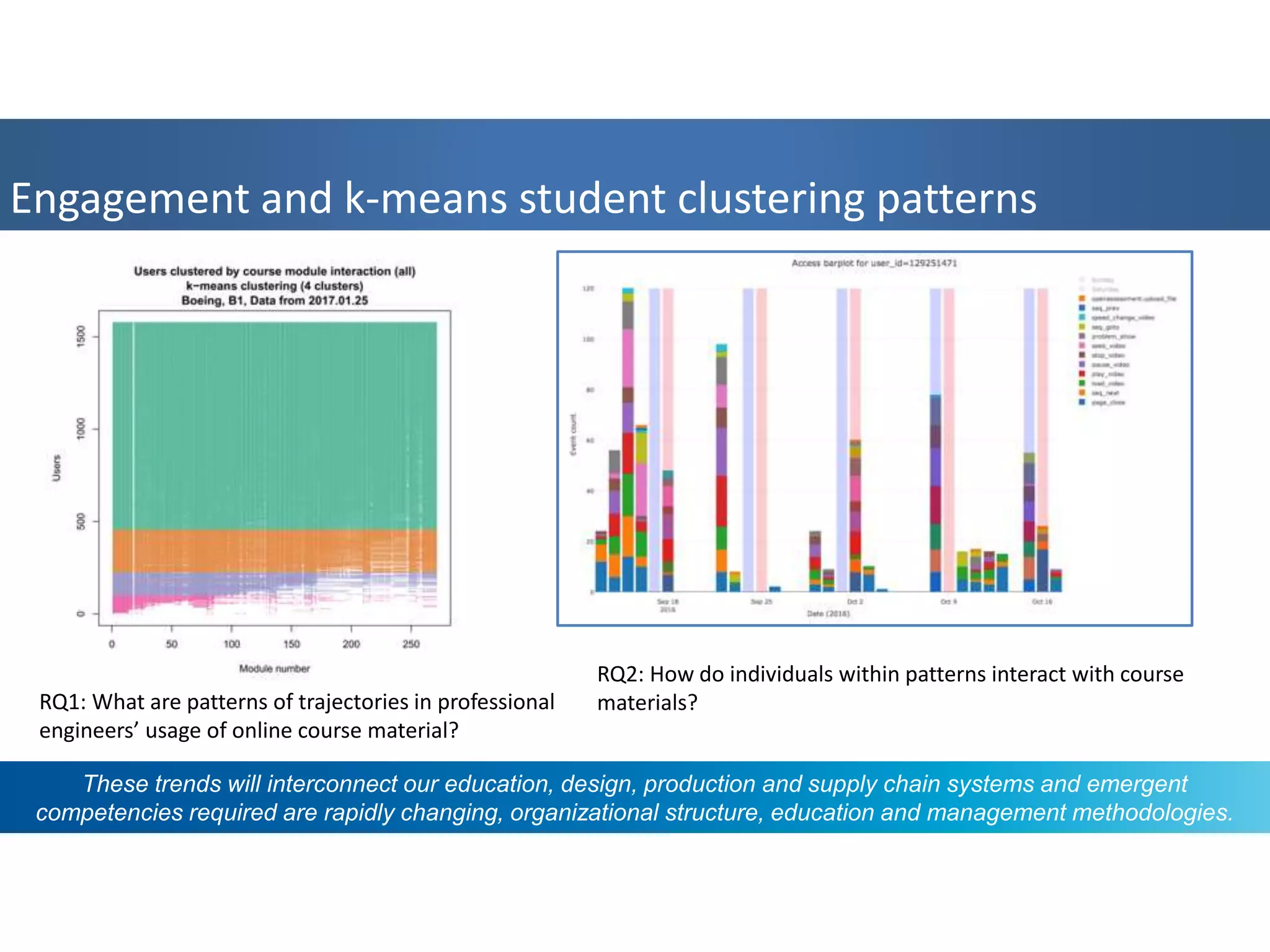
Engagement and k-means student clustering patterns
These trends will interconnect our education, design, production and supply chain systems and emergent
competencies required are rapidly changing, organizational structure, education and management methodologies.
RQ2: How do individuals within patterns interact with course
materials?RQ1: What are patterns of trajectories in professional
engineers’ usage of online course material?
Learning analytics is the measurement, collection, analysis
and reporting of data about learners and their context, for
purposes of understanding and optimizing learning and the
environments in which it occurs (Siemens et al., 2010)
Leverage Big Data and Learning Analytics to
Uncover expert cognitive streams
Tacit knowledge
Explicit knowledge
Peer generated
network knowledge
Peer generated
network knowledge
“Who talks to whom about what and to what effect?” (Lazarsfeld, 1944). Attitudes, social connections, intentions,
knowledge, how we learn, what we might do next.)
Adding depth to the
characterizations - Extremely
complex graphs:
• Predictive analytics using
machine learning
approaches can personalize
learning
• Significant challenge of
finding a critical path and
providing appropriate
intelligent support for those
paths will vary by learner,
topic, and expertise level.
Critical Edge Sequencing: How do we achieve pathway and content optimization?
“The slightest move in the virtual landscape has to be paid for in lines of code” (Latour, 2010)
In open environments, learners do NOT follow preset pathways
+Documents
Math Models
Videos
E-Media
resource
Images
Software Tools
Audio
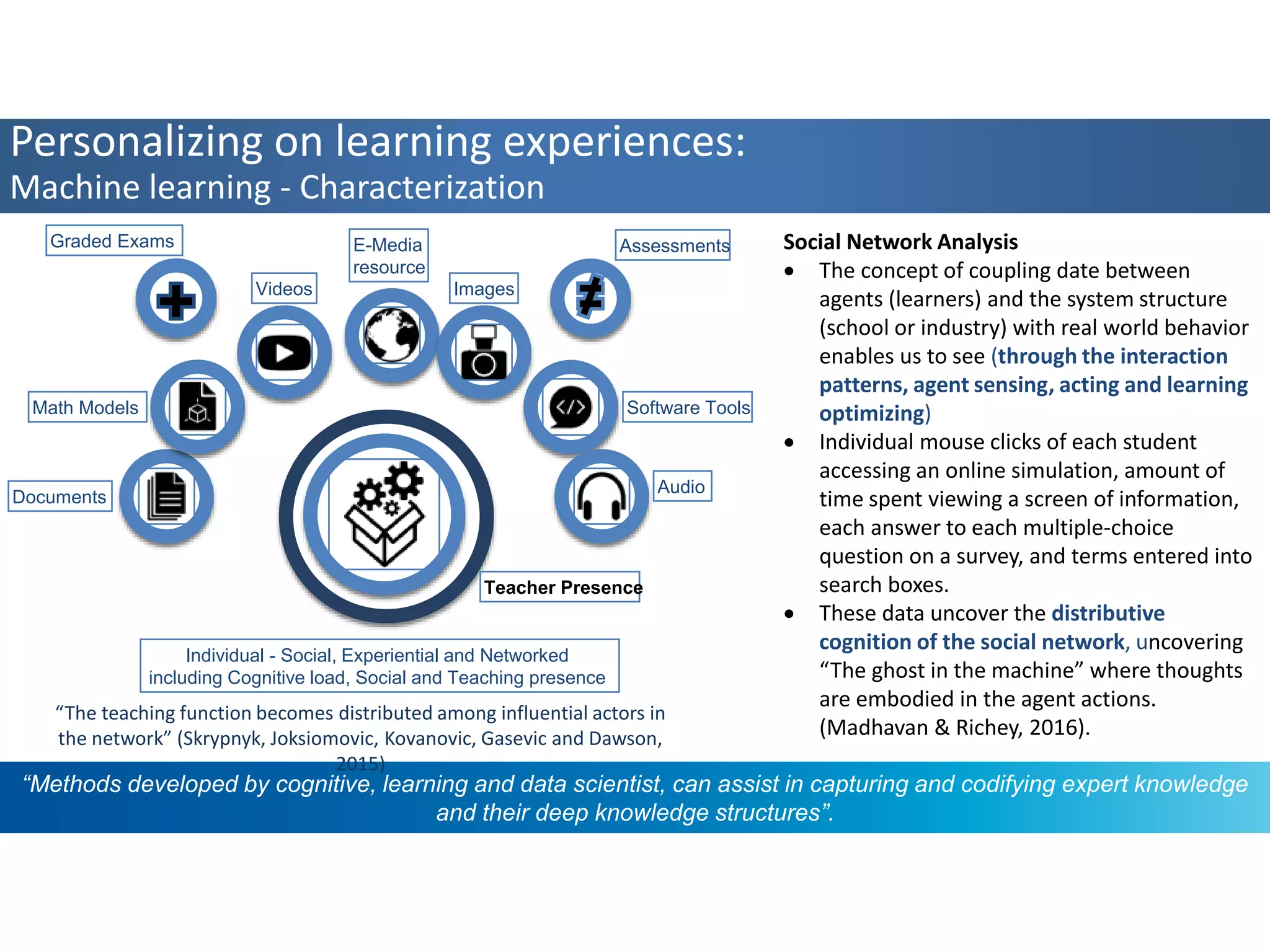
Personalizing on learning experiences:
Machine learning - Characterization
“Methods developed by cognitive, learning and data scientist, can assist in capturing and codifying expert knowledge
and their deep knowledge structures”.
Social Network Analysis
 The concept of coupling date between
agents (learners) and the system structure
(school or industry) with real world behavior
enables us to see (through the interaction
patterns, agent sensing, acting and learning
optimizing)
 Individual mouse clicks of each student
accessing an online simulation, amount of
time spent viewing a screen of information,
each answer to each multiple-choice
question on a survey, and terms entered into
search boxes.
 These data uncover the distributive
cognition of the social network, uncovering
“The ghost in the machine” where thoughts
are embodied in the agent actions.
(Madhavan & Richey, 2016).
Individual - Social, Experiential and Networked
including Cognitive load, Social and Teaching presence
AssessmentsGraded Exams
“The teaching function becomes distributed among influential actors in
the network” (Skrypnyk, Joksiomovic, Kovanovic, Gasevic and Dawson,
2015)
Teacher Presence
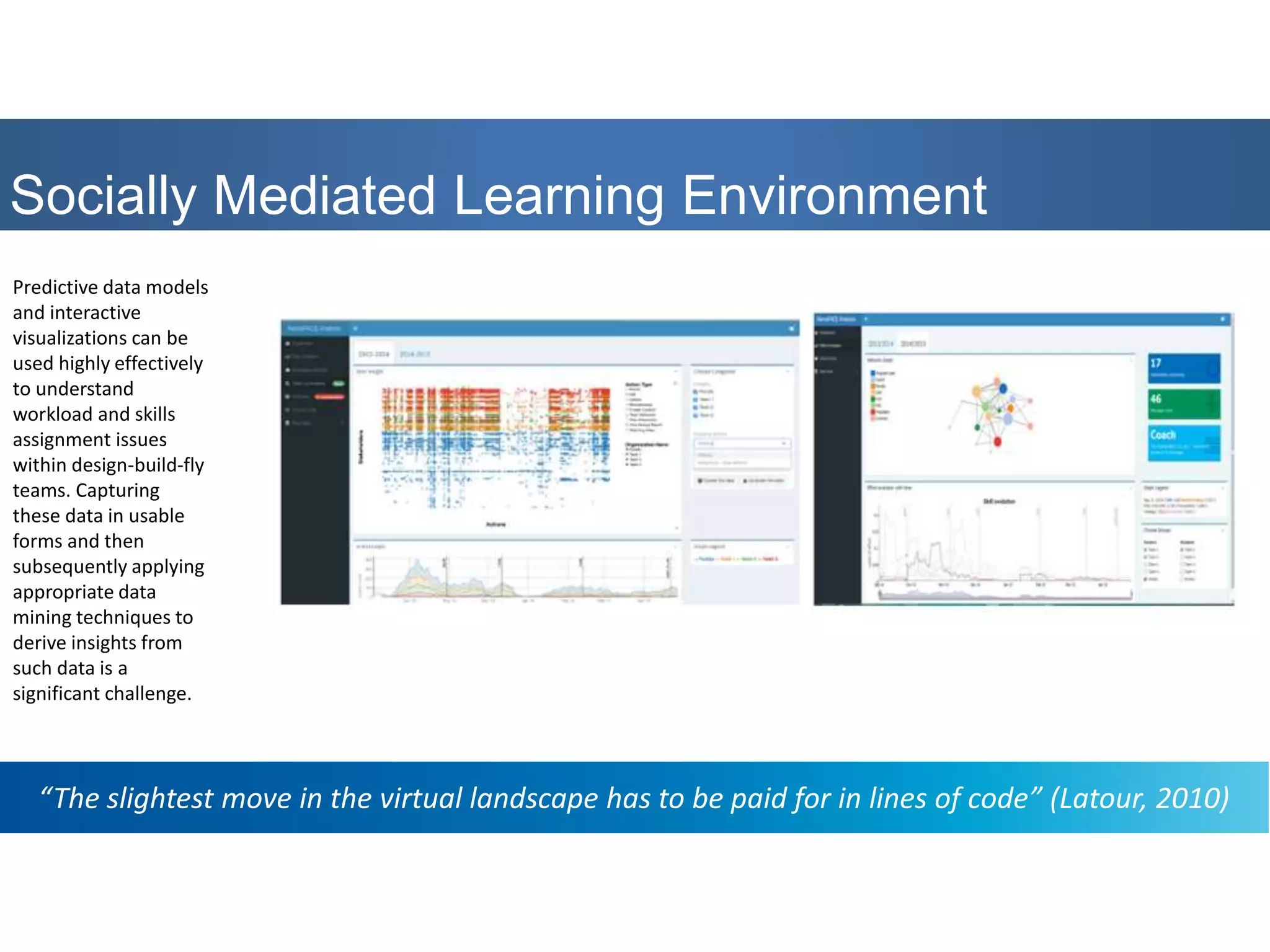
Socially Mediated Learning Environment
“The slightest move in the virtual landscape has to be paid for in lines of code” (Latour, 2010)
Predictive data models
and interactive
visualizations can be
used highly effectively
to understand
workload and skills
assignment issues
within design-build-fly
teams. Capturing
these data in usable
forms and then
subsequently applying
appropriate data
mining techniques to
derive insights from
such data is a
significant challenge.
The Penguin Problem:
“The future is already here, its just not very evenly distributed” (Gibson, 2012)
Strategies for Starting
Penguin Problem:
– Penguins huddle at the edge of iceberg
– Want food, fear whales eat first entrant,
all stay
out. (Farell & Saloner)
Subsidies for early adopters
– Prime the pump
– Support bootstrap innovation
• Early research to uncover new
methods and computational models
• Co-develop and research new
academic – industry micro-credentials
Starting strategies are largely based on Eisenmann article from reader. Managing
Proprietary and Shared Platforms (CMR402); Platform-Mediated Networks
(807049)
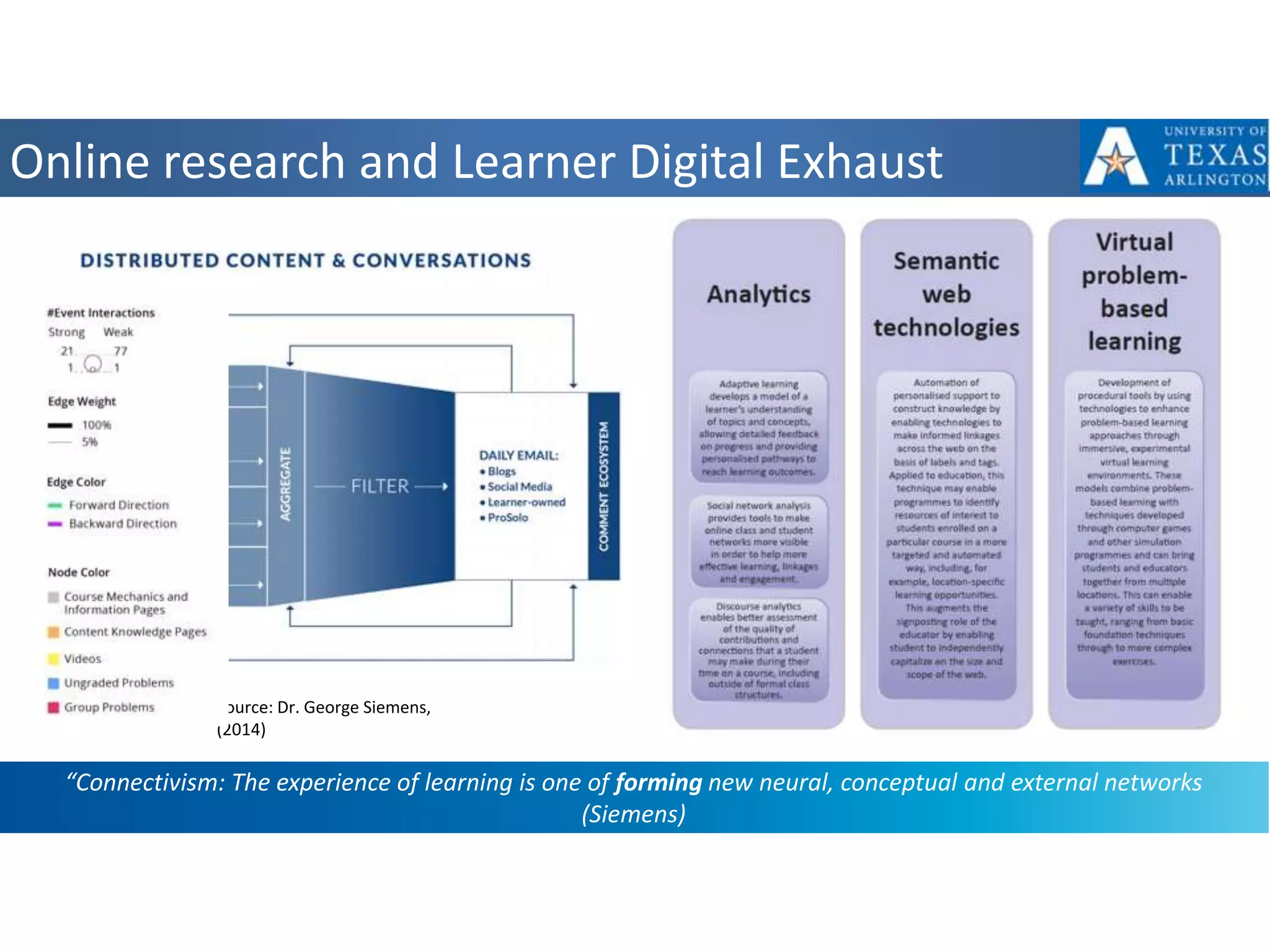
Source: Dr. George Siemens,
(2014)
Online research and Learner Digital Exhaust
“Connectivism: The experience of learning is one of forming new neural, conceptual and external networks
(Siemens)
Panel 2: AI and Healthcare
3/14/2018
© IBM MAP COG2018
62
Niina Levo
IBM
(moderator)
Mike Dusenberry
IBM
Martin van Gils
VTT
Pekka Neittaanmaki
JYU
Breast Cancer
3/14/2018
© IBM MAP COG2018
63
Priorities Health
3/14/2018
© IBM MAP COG2018
64
Research Directions
3/14/2018
© IBM MAP COG2018
65
Panel 3: Open AI Data and Models
3/14/2018
© IBM MAP COG2018
66
Teppo Seesto
IBM
(moderator)
Hanna Niemi-Hugaerts
Forum Virium Helsinki
Mikko Rusama
Yle
Petri Sysilahti
Elinar
Role of Data is Chaning
3/14/2018
© IBM MAP COG2018
67
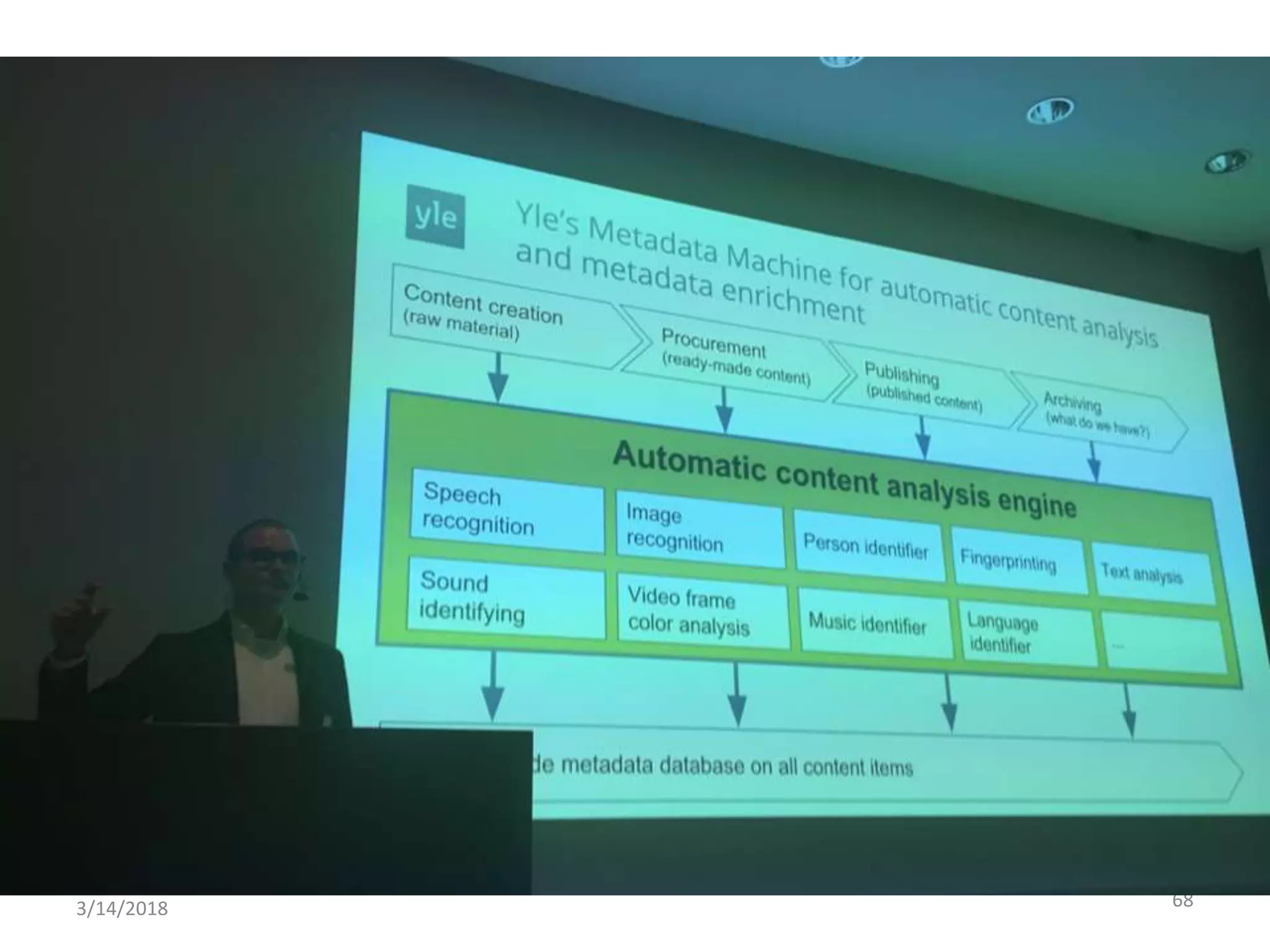
Metadata Machine
3/14/2018
© IBM MAP COG2018
68
Data Extraction
3/14/2018
© IBM MAP COG2018
69
Next Steps: Opentech AI
3/14/2018
© IBM MAP COG2018
70
Jim SpohrerDaniel Pakkala
Silicon Valley Collaboration
at IBM Research - Almaden
(March 09, 2018)
Twitter Event Hashtag: “#OpenTechAI” or “opentechai”
OpenTechAI Survey: https://www.surveymonkey.com/r/Opentechai
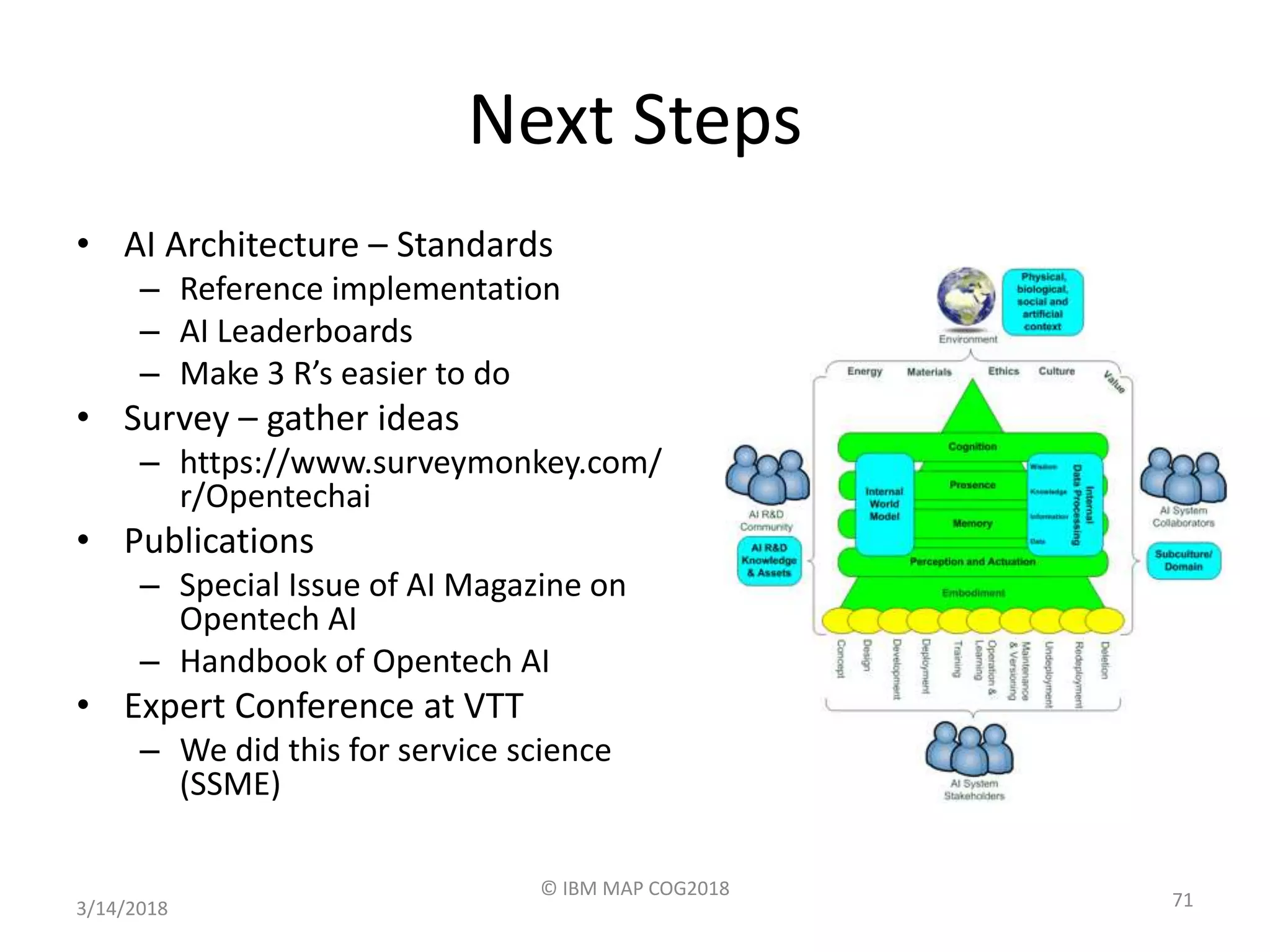
Next Steps
• AI Architecture – Standards
– Reference implementation
– AI Leaderboards
– Make 3 R’s easier to do
• Survey – gather ideas
– https://www.surveymonkey.com/
r/Opentechai
• Publications
– Special Issue of AI Magazine on
Opentech AI
– Handbook of Opentech AI
• Expert Conference at VTT
– We did this for service science
(SSME)
3/14/2018
© IBM MAP COG2018
71
Two Communities
3/14/2018
© IBM MAP COG2018
72
Service
Science
OpenTech
AI
Trust:
Value Co-Creation,
Transdisciplinary
Trust:
Ethical, Safe, Explainable,
Open Communities
Special Issue
AI Magazine?
Handbook of
OpenTech AI?
Opentech AI Inspiration
• Danko Nikolic (EU Science, Germany)
• Lukasz Kaiser (Google, USA)
• Fei-Fei Li (Stanford/Google, USA)
• Francesca Rossi (IBM, Italy and USA)
• Jose Hernadez-Orallo (Spain)
• Derek Roos (Mendix, Netherlands)
• Ben Goertzel (Hong Kong)
• Alexandra Medina-Borja (NSF, USA)
• Ashok Goel (GeorgiaTech, USA)
• Ken Forbus (Northwestern University, USA)
• Henry Chesbrough (Berkeley, USA)
• Linux Foundation (San Francisco, USA)
• INDEX Event, THINK Event, etc. (San Francisco, USA)
3/14/2018
© IBM MAP COG2018
73
Danko Nikolic (Max-Planck)
Resource URL
AI Kindergarten https://www.youtube.com/watch?v=Xz--
yoU842w
T3 AI Systems https://arxiv.org/abs/1505.00775
Practopoiesis https://arxiv.org/abs/1402.5332
Website http://www.danko-nikolic.com/
3/14/2018
© IBM MAP COG2018
74
“We define adaptive practopoietic systems in
terms of hierarchy of policies and calculate
whether the total variety of behavior required by
real-life conditions of an adult human can be
satisfactorily accounted for by a traditional
approach to artificial intelligence…”
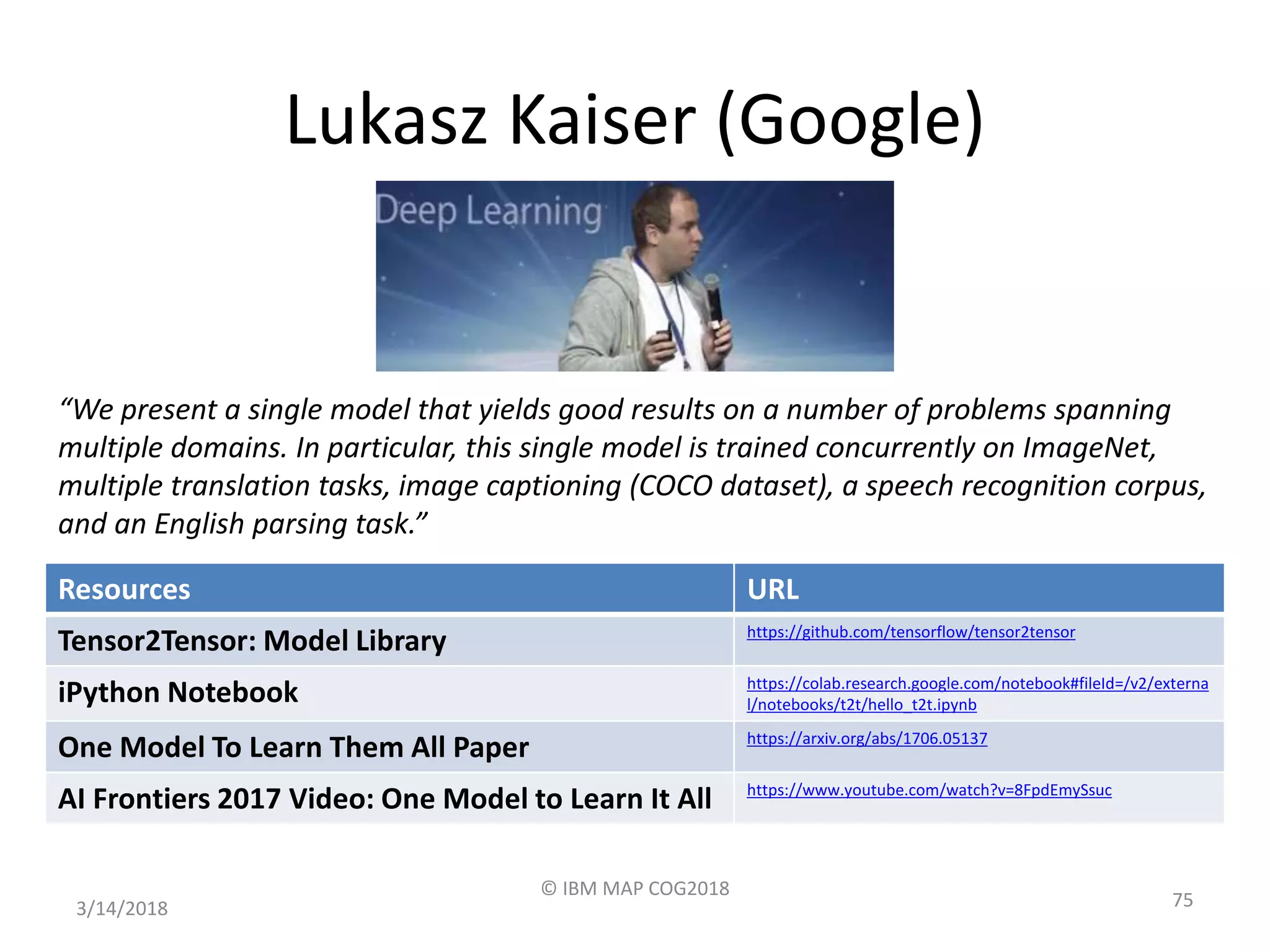
Lukasz Kaiser (Google)
Resources URL
Tensor2Tensor: Model Library https://github.com/tensorflow/tensor2tensor
iPython Notebook https://colab.research.google.com/notebook#fileId=/v2/externa
l/notebooks/t2t/hello_t2t.ipynb
One Model To Learn Them All Paper https://arxiv.org/abs/1706.05137
AI Frontiers 2017 Video: One Model to Learn It All https://www.youtube.com/watch?v=8FpdEmySsuc
3/14/2018
© IBM MAP COG2018
75
“We present a single model that yields good results on a number of problems spanning
multiple domains. In particular, this single model is trained concurrently on ImageNet,
multiple translation tasks, image captioning (COCO dataset), a speech recognition corpus,
and an English parsing task.”
FfDL (pronounced fiddle)
• Github:
• https://github.com/IBM/FfDL
3/14/2018
© IBM MAP COG2018
76
Thank-you to all!
• Executive Sponsors
– Antti Vasara, VTT (CEO)
– Mirva Antila, IBM Finland (GM)
• Program Committee
– Jim Spohrer, IBM (Co-chair)
– Daniel Pakkala, VTT (Co-chair)
– Susan Malaika, IBM (Tutorials and Posters)
– Tuomo Tuikka, VTT (Keynotes)
– Teppo Seesto, IBM (Panels)
– Maarit Palo, IBM (University Programs)
– Sergey Belov, IBM (University Programs)
– Ganesan Narayanasamy, IBM (PowerAI)
– Paivi Cederberg, IBM (Systems)
• Local Arrangements
– Saara Vilokkinen, IBM Finland
– Vertti Sinisalo, IBM Finland
• And of course our Keynoters, Panelists,
Moderators, Tutorial Leads, Poster Presenters, and
wonderful Participants!
3/14/2018
© IBM MAP COG2018
77
Special thanks to
Tekes/Business Finland for
supporting the research
co-operation of IBM and
VTT on Opentech AI by
enabling Research Visit to
IBM Research - Almaden.
…and to ectalent.global
for local arrangements in
San Jose, CA USA.
IBM Cognitive Opentech Team:
Thomas Truong, Catherine Diep,
Ton Ngo, Paul Van Eck,
Simeon Monov, Mike Dusenberry,
Susan Malaika, Augustina Ragwitz
3/14/2018
© IBM MAP COG2018 78
Helsinki
• IBM, Saaga, and main hotels
3/14/2018
© IBM MAP COG2018
79
Saaga
IBM
HolidayInn CityCenter
Hilton Strand
Promotions
• For Free Access to IBM Cloud use this promo-code to register:
https://ibm.biz/BdZ2ZR
• Sign up for an IBMid and create your IBM Cloud account
• Build on IBM Cloud for free with no time restrictions
• Guaranteed free development with Lite plans
• Develop worry-free and at no cost with cap based Lite plan services
for as long as you like.
• Start on your projects right away
• Skip entering your credit card info and get working in just a few
short steps.
• Get $200 to do more on our platform.
• Use the credit to try new services or scale your projects. Offer is
available for 1 month after upgrade, for platform services only.
• Ready to get started? Sign up today!
3/14/2018
© IBM MAP COG2018
80
IBM Finland HQ
• A: Saaga Restaurant
• B: Holiday Inn City Center
• C: Hilton Strand
• D. Radisson Blue Royale
3/14/2018
© IBM MAP COG2018
81

Helsinki 20180314 v7

  • 1.
    Jim Spohrer (IBM),Daniel Pakkala (VTT), Susan Malaika (IBM) IBM Finland HQ, Tue-Wed March 13-14, 2018 http://www.slideshare.net/spohrer/helsinki-20180314-v7 3/14/2018 1 Opentech AI Workshop Helsinki
  • 2.
    Finland and LinusTorvalds changed the world with Linux and later GitHub; IBM always strong in patents, embraced open technologies as a leader as well 3/14/2018 © IBM MAP COG2018 2 Twitter Event Hashtag: “#OpenTechAI” or “opentechai”
  • 3.
    Day 1: TuesdayMarch 13 • 3:00 Tutorials – (please use this URL https://ibm.biz/BdZYZx to get a cloud account if there is a hands-on element for the tutorial that you will attend) • 17:00 Break & poster set-up • 17:30 Welcome receptions, posters, refreshments 3/14/2018 © IBM MAP COG2018 3
  • 4.
    Day 1: Tutorials 3/14/2018 ©IBM MAP COG2018 4 Tutorials
  • 5.
    Day 1: Posters 3/14/2018 ©IBM MAP COG2018 5 Posters
  • 6.
    Day 2 –Wed March 14 (3.14 Pi-Day) • 8:00 Registration • 8:30 Welcome; Mirva Antila (General Manager, IBM Finland) & Antti Vasara (CEO, VTT) • 9:00 Keynote 1 – Introduction, Tuomo Tuikka (Research Manager Intelligent Systems, VTT) ; Finland AI Strategy; Pekka Sivonen (Director of Digitization, Business Finland) • 10:00 Break 1 • 10:30 Keynote 2 – Introduction, Tuomo Tuikka (Research Manager Intelligent Systems, VTT) ; EU AI Strategy; Juha Heikkilä (Head of Robotics and AI unit, European Commission) • 11:30 Lunch • (optional: Birds of a Feather 1 in Room N202: PowerAI from Ganesan Narayanasamy ; Birds of a Feather 2 in Room N203: UNESCO award from Maarit Palo) • 12:30 Panel 1 – AI and Applications; Moderator: Jim Spohrer (Director of Open Source AI, IBM) ; Panelists include Kalle Kantola (VP Research Smart Industry, VTT), Robin Burgener (Inventor, President 20Q.net Inc), Michael Richey (Chief Learning Scientist, Boeing) • 13:30 Panel 2 – AI & Healthcare; Moderator : Niina Levo (Global Services Partner, IBM) ; Panelists include Mike Dusenberry (Machine Learning Engineer, IBM Spark Technology Center), Mark van Gils (Principal Scientist Healthcare Applications, VTT), Pekka Neittaanmäki (Dean of Information Technology, University of Jyväskylä) • 14:30 Break 2 • 15:00 Panel 3 – Open AI and Data, Models; Moderator : Teppo Seesto (Solution Architect, IBM) ; Panelists include Hanna Niemi-Hugaerts (Program Director, Forum Virium Helsinki), Mikko Rusama (Chief Digital Officer, Yle), Petri Sysilahti (Solution Architect, Elinar) • 16:00 Next Steps; Jim Spohrer (IBM Director of Open Source AI), Daniel Pakkala (VTT Principal Scientists Intelligence Industry Applications) • 16:30 Depart 3/14/2018 © IBM MAP COG2018 6 Twitter Event Hashtag: “#OpenTechAI” or “opentechai” OpenTechAI Survey: https://www.surveymonkey.com/r/Opentechai
  • 7.
    Some VTT-IBM Collaborations •VTT and IBM Research - Haifa/Zurich interact in these groups: – http://www.nessi-europe.com/default.aspx?page=home – http://www.bdva.eu/ • VTT and IBM Research - Haifa/Zurich in H2020 funded projects: – DATABIO - lead by VTT in which IBM participates – BigMedilytics - IBM leads a sub-project in which VTT participates • VTT - IBM IRELAND – http://www.midasproject.eu • VTT – IBM Research – Almaden – Opentech AI https://opentechai.blog/ – ISSIP-IBM-VTT Survey https://www.surveymonkey.com/r/Opentechai 3/14/2018 © IBM MAP COG2018 7
  • 8.
    Welcome 3/14/2018 © IBM MAPCOG2018 8 Jim Spohrer IBM (agenda review) Mirva Antila IBM Finland GM Antti Vasara VTT CEO Twitter Event Hashtag: “#OpenTechAI” or “opentechai” OpenTechAI Survey: https://www.surveymonkey.com/r/Opentechai
  • 9.
    Mirva Antila Country GeneralManager IBM Finland Opentech AI
  • 10.
    100% 1969 Apollo mission 1971 Floppy disk 1973 UPC barcode 1973 ATM machines 1911 Scales 1931 Translator system 1957 FORTRAN1928 IBM80 Column punch card 1944 Mark 1 calculator 1962 SABRE 1964 System/360 1961 Selectric typewriter 1993 Blue Gene 1997 e-business 2008 Smarter Planet 2010 Watson Jeopardy 2000 IBM eServer 1992 IBM Consulting Group 2006 IBM Information Server 1996 IBM Net.Commerce 1997 Deep Blue World Chess Champion 1981 PC 1981 Excimer Laser Surgery IBM Revenue (%) 0% 1960 20001980 2016 50% Hardware and systems management Services Software Platforms IBM has transformed - re-platformed - four times in the last 50 years 12 Mainframe Era PC Era Services Software
  • 12.
    Watson Open sourcePowerAI Cloudvs on-premise Positioning of AI tools
  • 14.
    Connecting AI technologies withindustry needs Antti Vasara, CEO VTT Technical Research Centre of Finland Ltd 1st International Workshop on Opentech AI 14.3.2018 14
  • 15.
    Ministry of Economic Affairs and Employment VTT– impact through scientific and technological excellence Vision A brighter future is created through science-based innovations. Mission VTT helps customers and society to grow and renew through applied research. Strategy We make an impact through scientific and technological excellence. Established 1942 269 M€Turnover and other operating income (VTT Group 2016) 2368 Employees (VTT Group 2017) 33% Of turnover foreign revenue (VTT Group 2016) 27% Doctors and licentiates (VTT Group 2017) 15VTT 2018
  • 16.
    16 AI – Partof digitalisation, essential to industries Mobile 3G, 4G, 5G Cloud Big data Industrial internet Industry 4.0 Virtual and augmented reality AI Machine learning RPA Blockchain % Infosys 2018 Disruption due to AI technologies is driven by data-intensive industries Industries affected • Telecom & Communications (65%) • Banking & Insurance (63%) • Oil & Gas (60%) • Retail & Consumer Goods (54%) • Media & Entertainment (53%) • Healthcare & Life Sciences (51%) • Manufacturing & High-Tech (49%) • Travel, Hospitality & Transportation (48%) • Public Sector (34%)
  • 17.
    17 Time to exploitthe data DATA Ensure reliable and relevant data from multiple sources Easy-to-understand visualisation of complex data Interactive methods to focus on relevant data Monitor and report in real-time Predict next best actions Optimise logistics, energy and material use Expose new business opportunities Collect past and real-time data Acquire essential data from different sources Manage high volumes data Integrate analytics into enterprise IT systems and decision chains Application specific implementation of algorithms and analysis Appropriate tools for domain specific applications 17
  • 18.
    AI solutions area combination of different skills and needs AI expertise IT expertise Business domain understanding End user understanding 18
  • 19.
    Co-development through AI ecosystems AI ecosystems Smart land transport Smart flexible energy systems Smartbuilt environment Digitalisation of bio- economy, Digital Fibre Autonomous maritime transport Connected industry ecosystem AI for health Digital design and manufacturing excellence 19VTT 2018
  • 20.
    AI competences atVTT Annual AI project volume 20 M€ Computer vision* AI Voice recognition* Rules-based systems Robotics Planning & scheduling Optimisation Natural language processing* Machine learning *provided by partners 20VTT 2018
  • 21.
    Our AI solutionsdelivered to customers 21VTT 2018 The most energy efficient super market in the world S-Market The best quality steel SSAB Efficient quality monitoring for pulp production MetsäFibre Early detection of cognitive problems Customer-friendly sports analytics algorithm Diagnostics and decision-making support for doctors Election news bot Accurate activity recognition and personalised tracking tool Risk prevention sensors to detect downfalls Eye movement tracking and analysis for control rooms 21
  • 22.
  • 23.
    Keynotes 3/14/2018 © IBM MAPCOG2018 23 Tuomo Tuikka VTT (moderator) Pekka Sivonen Business Finland “Finland AI Strategy” Juha Heikkila European Commission Robotics & AI “EU AI Strategy”
  • 24.
    Finland AI StrategyVision 3/14/2018 © IBM MAP COG2018 24
  • 25.
  • 26.
  • 27.
    EU AI Strategy 3/14/2018 ©IBM MAP COG2018 27
  • 28.
    EU Help LaborForce By… 3/14/2018 © IBM MAP COG2018 28
  • 29.
    Lunch Time: BirdsOf A Feather (BOAF) • Room N202 – Lead: PowerAI (Ganesan Narayanasamy) – AI + Hardware theme • Room N203 – Lead: UNESCO Award (Maarit Palo) – AI + Education theme • BOAF: Network over lunch with people with similar interests (room space limited) 3/14/2018 © IBM MAP COG2018 29
  • 30.
  • 31.
    ** IBM InternalUse Only ** 31 Award Session 7.3.2018 Meet us in N203 on Wed in IBM Helsinki over lunch to hear more
  • 32.
    Panel 1: AIand Applications 3/14/2018 © IBM MAP COG2018 32 Jim Spohrer IBM (moderator) Kalle Kantola VTT Robin Burgener 20Q.net Michael Richey Boeing
  • 33.
    AI and Applications KalleKantola VP Research Smart Industry and energy systems, VTT
  • 34.
    The value ofAI is realized through applications.
  • 35.
    AI needs tobe supported by data source and other critical technologies Data AI Cyber IoT Applications Data sources and availability AI and other technologies Business and Value add 35VTT 2018
  • 36.
    3 6 VTT 2018 36VTT 2018 Case:A pulp mill optimisation A real-time pulp quality control Yearly saving of ~700 truck load I.e. significant competitive edge and sustainability impact
  • 37.
    Artificial intelligence isthe new electricity EFFICIENT PUBLIC SECTOR Responsive public services Sound economic growth COMPETITIVE BUSINESS AND INDUSTRY PROACTIVE SOCIETY Prosperity and wellbeing in Finland
  • 38.
    AI tools expertise ICTsystem expertise Business and domain expertise Users 38VTT 2018 AI applications requires multidisciplinary competences y 38VTT 2018 Effective Innovation network and expertise
  • 39.
    Enhancement of businesscompetitiveness through the use of AI 1 Effective utilisation of data in all sectors2 Ensure AI can be adopted more quickly and easily3 Ensure top-level expertise and attract top experts4 Make bold decisions and investments5 Build the world’s best public services6 Establish new models for collaboration7 Make Finland a frontrunner in the age of AI8 8 key actions for taking Finland towards the age of AI
  • 40.
    The payback timefor an AI investment can be only days.
  • 41.
  • 42.
    What is 20Q •A brief history of 20Q and 20Q.net • How 20Q sees “a candle” • Artificial intelligence is no match for natural stupidity • Censorship and its effect on 20Q Robin Burgener, president and inventor 20Q.net Inc., Ottawa, Canada 3/14/2018 © IBM MAP COG2018 42
  • 43.
    Michael Richey, Ph.D AssociateTechnical Fellow Learning, Leadership and Organizational Development The Boeing Company Michael.c.richeyboeing.com 1st International Workshop on Opentech AI Learning in Professional Networks: Effect of Social Capital, Pathways, and Artifact Creation National Academy of Sciences: Modeling and Visualizing Science and Technology Developments Michael Ginda Research Analyst,/Assistant Instructor Cyberinfrastructure for Network Science Center School of Informatics and Computing Indiana University Kerrie Anna Douglas Assistant Professor Engineering Education Wang Purdue University Katy Borner Victor H. Yngve Distinguished Professor of Engineering and Information Science School of Informatics, Computing, and Engineering Indiana University George Siemens , Ph.D Professor, Executive Director LINK Research Lab University of Texas Arlington
  • 44.
    Convergence Exponential Informationand Complexity “The Ages of our civilization evolve slowly and with incredible resistance, displacement ends as information adoption rates reach a tipping point. .” 1900-1950 20201970-1980 Knowledge doubled in 400 years Knowledge doubled in 10 years. Knowledge is doubling every 13 months. IBM predicts the build out of the “internet of things” will lead to the doubling of knowledge every 12 hours. Industrial Revolution Industrial production Information Age Computerization – digital data Post-Information Age 2017 Knowledge doubled in 50 years 1440 -1900 1950-1970 Knowledge doubled in 20 years Knowledge doubled in 8 years. 1980-2000 IoT Tipping Point 100 years 40 years 20 years “Convergence refers to both the convergence of expertise across disciplines and the convergence of academic, government, and industry stakeholders to support scientific investigations and enable rapid translation of the resulting advances” (Roco, NSF Convergence Workshop Report 11.02.17) Reductionist, Linear & Mechanistic Complex, convergent networks with agile organizational forms
  • 45.
    • Information iscreated at an exponential rate every day • People require access to very specialized information at particular instances in time • Everybody learns differently • Requires neuroscientist, educators, statisticians, digital data designers, learning scientists, instructional designers, big data experts, etc. “In recent years, a growing appreciation of individual preferences and aptitudes has led toward more “personalized learning,” in which instruction is tailored to a student’s individual needs”. NAE 2017 Source: http://www.engineeringchallenges.org/challenges/learning.aspx/ NAE Grand Challenge: Advancing Personalized Learning Boeing supports the NAE Grand Challenge of Advancing Personalized Learning through competency based learning and leveraging online learner analytics to uncover deep-learning measuring social networks.
  • 46.
    New jobs createdthrough innovations, others become obsolete in different stages of industrial development’ The Fourth Industrial Revolution: “We stand on the brink of a technological revolution that will fundamentally alter the way we live, work, and relate to one another. In its scale, scope, and complexity, the transformation will be unlike anything humankind has experienced before. We do not yet know just how it will unfold, but one thing is clear: the response to it must be integrated and comprehensive, involving all stakeholders of the global polity, from the public and private sectors to academia and civil society”. Workforce development challenge around Advanced Manufacturing, Data Science and technology skills These trends will interconnect our education, design, production and supply chain systems and emergent competencies required are rapidly changing, organizational structure, education and management methodologies. Source:
  • 47.
    Case Study: EdXMIT – Boeing – NASA Partnership Professional Education in Architecture and Systems Engineering: Models and Methods to Manage Complex SystemsSmall Private Online Certificate SPOC The purpose of the micro – certificate is to grow the system engineering and modeling competencies of Boeing - NASA engineers (including all design centers and partners). • On-line format, Basic to Intermediate SE KSA development • Addresses structural (academic – industry) KSA alignment (i.e., industry relevant ) • Scalable enterprise delivery structure ( supports all design centers • Responsive to space and brick and mortar instructor led constraints • Cost effective • Earns CEU’s (LTP funded) • Improves retention (skin in the game) • Potential matriculation towards accredited degree (with prerequisite) • Ability to serve non-traditional populations (public audit intro course for free) • Changes role of SME and faculty, guide on side vs. lecture and drill model • Provides click stream data analytics, who – what – where -how This certificate represents a new form of micro credential that blend industry (practice) with traditional academic (theory) i.e., employee competency based credentials. Additional Micro-certificates under development include: Program Management, IoT, Advanced Manufacturing, Additive Manufacturing, Data Science, Cyber Security and Leadership for non-managers.
  • 48.
    Certificate Design Principles Force-directedlayout of hierarchical course module structure The relationships between learning technologies, learning science research, educational psychology, and theories of instructional design are complex, more like an interacting ecology of ideas and practices than a clear hierarchical structure-organization. Week One: Systems Thinking 3.5 rs.
  • 49.
    Network as acontext for the cognitive AI capability development “Social network analysis combined with qualitative demographic data demonstrated that these emerging communities were interest-based, and that their development was facilitated via technical nodes (i.e., hashtags) and one or two active social nodes (i.e., course participants)” Personal Learning Graphs: Overview of the conceptual model for the assessment of the performance of groups emerging from learning in networks. Joksimović et al., 2016 Skrypnyk, O., Joksimović, S., Kovanović, V., Gašević, D., & Dawson, S. (2015). Education from a “complex adaptive social system” perspective requires academia and industry to rethink the boundaries of educational research within the broader ecosystem of classic STEM education”. Examples of Interaction networks: • The Blogosphere • Biochemical networks • Gene-protein networks • Food webs: who eats whom • The World Wide Web • Airline networks • Call networks (AT&T) • Expert – Novice networks
  • 50.
    Learner path overlaidon force-directed layout of used course modules “Visualization is uses a directed cyclic network graph to representation one student’s interactions and movement across content modules. To reduce the visual size and complexity of network, course structure and modules are represented at the lowest-level course structure (Borner, Ginda & Richey,2017). This visualization shows the trajectory of a less elegant student (71% passing grade) in the course Architecture of Complex Systems Fall 2016 (Total 14.4hrs) This visualization shows the trajectory of a more elegant student (99% passing grade) in the course Architecture of Complex Systems Fall 2016 (Total 16.35 hours) Personal Learning Graphs Learner trajectories formal and informal may be studied and plotted over time, geospatial location, activity (emails, intrest, texts, web pages, documents, mobile apps) and topical space that are contextually relevant. Temporal, geospatial, social, topical dimensions have to be instrumented in order to gain a holistic understanding of the temporal access ands contexts in which people or teams are operating and the many different contributions that individuals and groups make over the course of their learning path and careers.
  • 51.
    Learner path overlaidon linear sequence of course modules “Who talks to whom about what and to what effect?” (Lazarsfeld, 1944). Attitudes, social connections, intentions, knowledge, how we learn, what we might do next.)
  • 52.
    Personal Learning Graphs “learners'intents expressed through trajectory's, language and discourse shape social interactions and influence the development of social capital in distributed environments”. (Siemens, Gasevic, Baker, 2015) Social dimension: Complex construct of social capital where individuals develop through the interaction with their peers using various social media, here we primarily rely on the Lin's (2008) definition of social capital, exploring connections between individual actors that enable access to the resources already embedded in the network (e.g., Joksimovic et al). Affective dimension: Knowledge development is not only a cognitive process. Knowledge is developed in systems and cognition is rooted in context (Hutchins, p. 282, 1995). Research on emotions and affect is advancing in domains such as psychology, education, and neuroscience (Immordino-Yang & Damasio, 2007; Pekrun & Stephens, 2012). Findings are related to some of the consequences of considering multiple modalities (this could include facial recognition, context, eye tracking) for affect detection. Cognitive dimension: The cognitive dimension of learning has been the primary focus of assessment in higher education and corporate learning. Attempts to automate support for cognition have been ongoing for several decades (Anderson, Boyle, Reiser, 1985, Corbett & Koedinger, 1997). PLeG will use the prominent cognitive frameworks developed in science domains such as physics and engineering (Novak, 1990). Assessment Metacognitive dimension: Effective learning in the modern age requires high degree of self-regulation and autonomy (Schunk & Zimmerman, 2012; Pintrich, 2000). Existing models of self-regulated learning describe different phases and processes that shape effective knowledge construction. Here we follow the theoretical grounding of constructivist, metacognitive approach to self-regulated learning expounded by Winne and Hadwin (Winne 2011; Winne and Hadwin 1998).
  • 53.
  • 54.
    Complicated, Complexity andConvergence Complex System— Some ingredients: • Distributed system of many interrelated parts • Nonlinear relationships • Existence of feedback loops • Complex systems are open (out of equilibrium) • Presence of Memory • Modular (nested)/multiscale structure • Opaque boundaries • Emergence—‘More is Different’ Peter Dodds, 2009 M. E. J. Newman. The structure and function of complex networks. SIAM Review, 45(2):167–256, 2003 We are living in an age obsessed with intelligent systems. All walks of life are being transformed by innovations in machine learning, by software platforms that amplify human ability (from Mathematica to LinkedIn), improving online educational opportunities (MOOCs), and unprecedented access to the collective insights of globally dispersed communities of researchers and data sets (Wikipedia, Stack Exchange). These facts are changing both science and business. ” SFI Action Business Network Piranha physicus Education from a “complex adaptive social system” perspective requires academia and industry to rethink the boundaries of educational research within the broader ecosystem of classic STEM education”.
  • 55.
    Engagement and k-meansstudent clustering patterns These trends will interconnect our education, design, production and supply chain systems and emergent competencies required are rapidly changing, organizational structure, education and management methodologies. RQ2: How do individuals within patterns interact with course materials?RQ1: What are patterns of trajectories in professional engineers’ usage of online course material?
  • 56.
    Learning analytics isthe measurement, collection, analysis and reporting of data about learners and their context, for purposes of understanding and optimizing learning and the environments in which it occurs (Siemens et al., 2010) Leverage Big Data and Learning Analytics to Uncover expert cognitive streams Tacit knowledge Explicit knowledge Peer generated network knowledge Peer generated network knowledge “Who talks to whom about what and to what effect?” (Lazarsfeld, 1944). Attitudes, social connections, intentions, knowledge, how we learn, what we might do next.)
  • 57.
    Adding depth tothe characterizations - Extremely complex graphs: • Predictive analytics using machine learning approaches can personalize learning • Significant challenge of finding a critical path and providing appropriate intelligent support for those paths will vary by learner, topic, and expertise level. Critical Edge Sequencing: How do we achieve pathway and content optimization? “The slightest move in the virtual landscape has to be paid for in lines of code” (Latour, 2010) In open environments, learners do NOT follow preset pathways
  • 58.
    +Documents Math Models Videos E-Media resource Images Software Tools Audio Personalizingon learning experiences: Machine learning - Characterization “Methods developed by cognitive, learning and data scientist, can assist in capturing and codifying expert knowledge and their deep knowledge structures”. Social Network Analysis  The concept of coupling date between agents (learners) and the system structure (school or industry) with real world behavior enables us to see (through the interaction patterns, agent sensing, acting and learning optimizing)  Individual mouse clicks of each student accessing an online simulation, amount of time spent viewing a screen of information, each answer to each multiple-choice question on a survey, and terms entered into search boxes.  These data uncover the distributive cognition of the social network, uncovering “The ghost in the machine” where thoughts are embodied in the agent actions. (Madhavan & Richey, 2016). Individual - Social, Experiential and Networked including Cognitive load, Social and Teaching presence AssessmentsGraded Exams “The teaching function becomes distributed among influential actors in the network” (Skrypnyk, Joksiomovic, Kovanovic, Gasevic and Dawson, 2015) Teacher Presence
  • 59.
    Socially Mediated LearningEnvironment “The slightest move in the virtual landscape has to be paid for in lines of code” (Latour, 2010) Predictive data models and interactive visualizations can be used highly effectively to understand workload and skills assignment issues within design-build-fly teams. Capturing these data in usable forms and then subsequently applying appropriate data mining techniques to derive insights from such data is a significant challenge.
  • 60.
    The Penguin Problem: “Thefuture is already here, its just not very evenly distributed” (Gibson, 2012) Strategies for Starting Penguin Problem: – Penguins huddle at the edge of iceberg – Want food, fear whales eat first entrant, all stay out. (Farell & Saloner) Subsidies for early adopters – Prime the pump – Support bootstrap innovation • Early research to uncover new methods and computational models • Co-develop and research new academic – industry micro-credentials Starting strategies are largely based on Eisenmann article from reader. Managing Proprietary and Shared Platforms (CMR402); Platform-Mediated Networks (807049)
  • 61.
    Source: Dr. GeorgeSiemens, (2014) Online research and Learner Digital Exhaust “Connectivism: The experience of learning is one of forming new neural, conceptual and external networks (Siemens)
  • 62.
    Panel 2: AIand Healthcare 3/14/2018 © IBM MAP COG2018 62 Niina Levo IBM (moderator) Mike Dusenberry IBM Martin van Gils VTT Pekka Neittaanmaki JYU
  • 63.
  • 64.
  • 65.
  • 66.
    Panel 3: OpenAI Data and Models 3/14/2018 © IBM MAP COG2018 66 Teppo Seesto IBM (moderator) Hanna Niemi-Hugaerts Forum Virium Helsinki Mikko Rusama Yle Petri Sysilahti Elinar
  • 67.
    Role of Datais Chaning 3/14/2018 © IBM MAP COG2018 67
  • 68.
  • 69.
  • 70.
    Next Steps: OpentechAI 3/14/2018 © IBM MAP COG2018 70 Jim SpohrerDaniel Pakkala Silicon Valley Collaboration at IBM Research - Almaden (March 09, 2018) Twitter Event Hashtag: “#OpenTechAI” or “opentechai” OpenTechAI Survey: https://www.surveymonkey.com/r/Opentechai
  • 71.
    Next Steps • AIArchitecture – Standards – Reference implementation – AI Leaderboards – Make 3 R’s easier to do • Survey – gather ideas – https://www.surveymonkey.com/ r/Opentechai • Publications – Special Issue of AI Magazine on Opentech AI – Handbook of Opentech AI • Expert Conference at VTT – We did this for service science (SSME) 3/14/2018 © IBM MAP COG2018 71
  • 72.
    Two Communities 3/14/2018 © IBMMAP COG2018 72 Service Science OpenTech AI Trust: Value Co-Creation, Transdisciplinary Trust: Ethical, Safe, Explainable, Open Communities Special Issue AI Magazine? Handbook of OpenTech AI?
  • 73.
    Opentech AI Inspiration •Danko Nikolic (EU Science, Germany) • Lukasz Kaiser (Google, USA) • Fei-Fei Li (Stanford/Google, USA) • Francesca Rossi (IBM, Italy and USA) • Jose Hernadez-Orallo (Spain) • Derek Roos (Mendix, Netherlands) • Ben Goertzel (Hong Kong) • Alexandra Medina-Borja (NSF, USA) • Ashok Goel (GeorgiaTech, USA) • Ken Forbus (Northwestern University, USA) • Henry Chesbrough (Berkeley, USA) • Linux Foundation (San Francisco, USA) • INDEX Event, THINK Event, etc. (San Francisco, USA) 3/14/2018 © IBM MAP COG2018 73
  • 74.
    Danko Nikolic (Max-Planck) ResourceURL AI Kindergarten https://www.youtube.com/watch?v=Xz-- yoU842w T3 AI Systems https://arxiv.org/abs/1505.00775 Practopoiesis https://arxiv.org/abs/1402.5332 Website http://www.danko-nikolic.com/ 3/14/2018 © IBM MAP COG2018 74 “We define adaptive practopoietic systems in terms of hierarchy of policies and calculate whether the total variety of behavior required by real-life conditions of an adult human can be satisfactorily accounted for by a traditional approach to artificial intelligence…”
  • 75.
    Lukasz Kaiser (Google) ResourcesURL Tensor2Tensor: Model Library https://github.com/tensorflow/tensor2tensor iPython Notebook https://colab.research.google.com/notebook#fileId=/v2/externa l/notebooks/t2t/hello_t2t.ipynb One Model To Learn Them All Paper https://arxiv.org/abs/1706.05137 AI Frontiers 2017 Video: One Model to Learn It All https://www.youtube.com/watch?v=8FpdEmySsuc 3/14/2018 © IBM MAP COG2018 75 “We present a single model that yields good results on a number of problems spanning multiple domains. In particular, this single model is trained concurrently on ImageNet, multiple translation tasks, image captioning (COCO dataset), a speech recognition corpus, and an English parsing task.”
  • 76.
    FfDL (pronounced fiddle) •Github: • https://github.com/IBM/FfDL 3/14/2018 © IBM MAP COG2018 76
  • 77.
    Thank-you to all! •Executive Sponsors – Antti Vasara, VTT (CEO) – Mirva Antila, IBM Finland (GM) • Program Committee – Jim Spohrer, IBM (Co-chair) – Daniel Pakkala, VTT (Co-chair) – Susan Malaika, IBM (Tutorials and Posters) – Tuomo Tuikka, VTT (Keynotes) – Teppo Seesto, IBM (Panels) – Maarit Palo, IBM (University Programs) – Sergey Belov, IBM (University Programs) – Ganesan Narayanasamy, IBM (PowerAI) – Paivi Cederberg, IBM (Systems) • Local Arrangements – Saara Vilokkinen, IBM Finland – Vertti Sinisalo, IBM Finland • And of course our Keynoters, Panelists, Moderators, Tutorial Leads, Poster Presenters, and wonderful Participants! 3/14/2018 © IBM MAP COG2018 77 Special thanks to Tekes/Business Finland for supporting the research co-operation of IBM and VTT on Opentech AI by enabling Research Visit to IBM Research - Almaden. …and to ectalent.global for local arrangements in San Jose, CA USA. IBM Cognitive Opentech Team: Thomas Truong, Catherine Diep, Ton Ngo, Paul Van Eck, Simeon Monov, Mike Dusenberry, Susan Malaika, Augustina Ragwitz
  • 78.
  • 79.
    Helsinki • IBM, Saaga,and main hotels 3/14/2018 © IBM MAP COG2018 79 Saaga IBM HolidayInn CityCenter Hilton Strand
  • 80.
    Promotions • For FreeAccess to IBM Cloud use this promo-code to register: https://ibm.biz/BdZ2ZR • Sign up for an IBMid and create your IBM Cloud account • Build on IBM Cloud for free with no time restrictions • Guaranteed free development with Lite plans • Develop worry-free and at no cost with cap based Lite plan services for as long as you like. • Start on your projects right away • Skip entering your credit card info and get working in just a few short steps. • Get $200 to do more on our platform. • Use the credit to try new services or scale your projects. Offer is available for 1 month after upgrade, for platform services only. • Ready to get started? Sign up today! 3/14/2018 © IBM MAP COG2018 80
  • 81.
    IBM Finland HQ •A: Saaga Restaurant • B: Holiday Inn City Center • C: Hilton Strand • D. Radisson Blue Royale 3/14/2018 © IBM MAP COG2018 81

Editor's Notes

  • #2 Please reuse – contact spohrer@us.ibm.com Reference: Spohrer J, Pakkala D. (2018) Opentech AI Workshop. Tue-Wed March 13-14, 2018 URL http://www.slideshare.net/spohrer/helsinki-20180314-v7 IBM Research - Almaden as Silicon Valley Distinguished Visiting Research Host program that Jim Spohrer (IBM) and Daniel Pakkala (VTT) are working on (via ectalent.global)... VTT and IBM collaboration points: VTT and IBM Research - Haifa/Zurich interact in these groups: http://www.nessi-europe.com/default.aspx?page=home http://www.bdva.eu/ VTT and IBM Research - Haifa/Zurich in H2020 funded projects: DATABIO - lead by VTT in which IBM participates  BigMedilytics - IBM leads a sub-project in which VTT participates VTT -  IBM IRELAND: http://www.midasproject.eu  
  • #10 Hello, I am…. You’re interested in learning more about “What is Watson”? Great, let me show you this quick presentation, it will only take a few mins and I think will help answer some of your general questions on this topic.
  • #11 IBM ushered in a whole new era for the world in technology. We ushered in new markets – altogether: If you roll back 50 years and look at the history of IBM, the one thing that is more remarkable than what we’ve done, is that we keep reinventing ourselves. You go back to the 60’s and we were a billion dollar company, mostly a hardware company. You can see the things we were selling at that time. In ‘64 we built a franchise that is maybe the most durable technology franchise: the mainframe. The mainframe did more than just provide a new computing system, in a very real way it fueled trade, the world’s financial system, globalization, it was the fuel that drove the economy in many ways. IBM back then, in the blue, was largely a hardware and systems management company and even the services, in white, a lot of that was maintenance so was essentially at that foundational layer of the stack. Then, IBM ushered in a whole new era for the world in technology. We ushered in new markets – altogether: The PC era (bringing computing to the desktop) The IT services industry – which IBM created. Systems Software – building one of the world’s largest software companies So there are many common themes that have stuck with us over the years, but then now ask yourself, what's IBM of the future? MILESTONES DURING THIS ERA Pre-1964 1961 IBM introduces the "Selectric" Typewriter, an electric typewriter which uses a replaceable golf ball-shaped typing element rather than type bars or movable carriages. 1962 IBM develops the SABRE (Semi-Automatic Business-Related Environment) reservation system for American Airlines, the industry's first to work over phone lines in "real time." The system links high-speed computers and data communications to handle seat inventory and passenger records from terminals in more than 50 cities. On April 7, 1964, IBM introduced the System/360, the first large "family" of computers to use interchangeable software and peripheral equipment. It was a bold departure from the monolithic, one-size-fits-all mainframe. Fortune magazine dubbed it "IBM's $5 billion gamble.”
  • #14 This is about you. You to the power of data. You to the power of expertise. You to the power of cloud. You to the power of AI. You: Who make markets. Who invent. Who serve customers. Today, you have more power than any human being before you. This is you to the power of IBM.   IBM Watson is the AI platform for business. With Watson, you can discover hidden insights, engage in new ways and make decisions with greater confidence.
  • #15  Heli Helaakoski Heikki Ailisto Marko Jurvansuu
  • #16 VTT 2016-2020 Our actions are guided by the vision that “a brighter future is created through science-based innovations. Our mission, therefore, is to help customers and society to grow and renew through applied research. These lead into our strategy: to make an impact through scientific and technological excellence.
  • #17 Since 2000, we have witnessed the rise of a number of digitalisation related trends and buzzwords. But Artificial Intelligence is more than a buzzword, it is an essential component in the digital disruption of a number of industries. https://www.infosys.com/age-of-ai/ An Infosys research Study, Leadership in the Age of AI, 2018 From Infosys report: Industries that are mostly disrupted by AI (percentage = have adapted AI technologies in their operations): Telecom & Communication Service Providers (65%) Banking & Insurance (63%) Oil % Gas (60%), Retail & Consumer Product Goods (54%) Media & Entertainment (53%) Healthcare & Life Sciences (51%) Manufacturing & Hight-tech (49%) Travel, hospitality and Transportation (48%) Puplic sector (34%) Enterprises in the late stage of AI-driven digital transformation have realized: New and better insights to improve time efficiencies (68%) Increased production (63%) Reduced operating costs (61%) Improved customer retention (60%) Improved process life cycles (56%) Improved market share due to AI deployment (56%)  The most data-intensive sectors (eg. Banking & Insurance or telecoms) are the ones utilizing AI most, as lot of potential is seen in Public sector, travel, hospitality & transportation
  • #18 VTT’s offering in data analytics - Enablers and competences Knowlegde over whole data-analytics pipeline. Solutions are build utilising these components. Describe starting from the bottom – Data acquisition to utilisation Data collection Perform wireless online measurements in demanding environment (instrumentation) Acquire essential data from existing systems (integration) Visualisation Visualise data intensive processes in easy-to-understand manner (visual analytics) Analytics Data analysis – statistical data analysis methods, descriptive (clustering etc.) and predictive (regression, neural networks etc.) Data analytics – several application ares included: manufacturing, business, logistics Understanding of domain specific physical phenomenas Latest know-how of data analytics tools and new solutions (academic approach) Scientific approach for data validity and exactness Data mining sort through huge data sets using sophisticated software to identify undiscovered patterns and establish hidden relationships Data analytics focuses on inference, the process of deriving a conclusion based solely on what is already known by the researcher
  • #19 Technology skills alone are not enough. To apply AI, so that it provides actual business benefits, requires a lot of expertise: We have AI experts who know the relevant technologies and IT experts who know how to design and implement new solutions. We have an in-depth understanding of different business domains, so we can work out the best solution to each individual business case. With relevant end-user understanding and practical experience gained from past projects, we can guarantee our AI solutions have a positive impact on your business and world beyond.
  • #20 We are a part of several business ecosystems that already apply artificial intelligence. What is needed for these ecosystems to really become productive, is wider networking across boarders, more accurate understanding of the speed of change and of the opportunities (and practical examples) in different fields. Smart flexible energy system ABB, Empower, Nokia, Siemens Smart land transport Transtech, Dynniq, Nokia, Vaisala Autonomous maritime transport, OneSea Rolls-Royce, ABB, Tieto, Cargotec, Ericsson, Meyer, Wärtsilä Digitalisation of bioeonomy, Digital Fiber Siemens + 30 other organisations Smart built environment Kone Oyj Connected industry ecosystem Cargotec, Fastems, Konecranes, Ponsse, Nokia, Tieto Ai for health GE, HUS, IBM, VTT; THL, Orion, Nokia Digital design & manufacturing excellence Sandvik, AGCO, Roima, Normet, Intopalo, Wabice, Creanex, Futurice, Insta
  • #21 AI is a collection of technologies and methods: Machine learning, vision and speech, robotics, planning and optimisation, expert systems, neural networks, natural language processing (Voice recognition, Natural language processing, Computer vision) provided by partners
  • #22 The most energy efficient super market in the world S-Market Finland has the world's most energy-efficient supermarket, which consumes only 40% of the energy of a normal grocery store. A new solution is saving the retailer around EUR 180,000 in energy costs. The technology is now ready for use on commercial premises in general. System optimizes energy by levelling out consumption peaks on the power grid. Renewable solar energy (solar panels installed on the roof of the building) even enables the occasional disconnection of the shop's cold chain from grid electricity. In this energy-saving pilot supermarket, annual electricity consumption totals 240 kWh per square metre, which is close to the consumption of a normal residence, whereas a normal grocery store consumes 600 kWh a year. Challenge: Production and consumption in power grid needs to always be in balance. Renewables with variable production challenge this balance and there is a need for intelligent demand side management to adjust to the situation. To this end, a key aspect is to be able to predict the consumption and available flexibility at different levels of the power grid so that demand side actions can be planned and executed in advance. Solution: Idea is to utilize machine-learning technologies and fine grained data to predict power loads in bottom-up manner. Neural network based machine learning models have been developed for predicting: Power loads of two different grocery stores in Oulu. Flexibility potential of resources such as ventilation system and vapour compression cycle. The work is still in early phase and experimentation with different types of machine learning models and approaches is underway. Benefit: Accurate prediction of power loads and flexibility potential at different levels of the grid make it possible to execute load balancing with intelligent demand side management in order to lower the energy costs and improve the stability of the power grid. The best quality steel SSAB Data Analytics in Steel Industry - case SSAB and Outokumpu Customer’s challenge was to discover product quality deviation early enough in strip hot rolling, as number of process variables was difficult to monitor in real-time and there was lack of performance figures. VTT developed customised, model-based online quality monitoring system that uses mathematical models to predict the upcoming quality and to find root-cause for lower product quality in real-time. This brought the customer cost savings in the early product/process failure detection and helped to optimize its process adjustments. Efficient quality monitoring for pulp production MetsäFibre Challenge: Quality information from pulp is based on few samples and results are available after several days from sampling. Solution: Development of real-time pulp quality control method. The core computational model was developed by VTT combining the theoretical domain knowledge, customer feedback and data mining. Benefit: Real-time quality information improves efficiency throughout the value chain Material efficiency has been improved up to 2-3 % Early detection of cognitive problems Challenge: There is no single test that could reliably detect neurodegenerative diseases (e.g., Alzheimer’s disease). Patients come to tests only after clear symptoms are present. Diagnosis is available only after several clinical tests. The diagnoses are delayed. Solution: VTT has developed computerized memory tests and gait analysis methods for early detection of cognitive decline. The computer tests can be played with web browsers. Gait analysis methods use wearable sensor data collected during walking and dual tasks. Benefit: In future, the gait analysis methods could continuously detect gait changes, e.g. in mobile phones. The vision is that the computer tests and gait analysis could detect cognitive decline earlier, and allow earlier, personalized treatments. Election news bot Valtteri news bot writes over 2 million news items in 3 languages (Finnish, Swedish, English). In this case example Valtteri utilizes election data from the Finnish Ministry of Justice and combines the data with templates created by the research team and forms ready editorial texts based on selected themes. Diagnostics and decision-making support for doctors Challenge: More efficient and objective decision making in health settings requires extracting knowledge from vast amounts of different data sources. It also requires presenting such knowledge in an easy-to-use manner in real-life practice. Solution: VTT has developed a combination of image analysis and machine learning methods that interpret and visualise complex patient data to support decision making. The methods are implemented in a software tool designed for health practice. Benefit: Improved decision making, resulting in cost containment and better quality of life. The data analysis approach can be used in a wide range of applications. Accurate activity recognition and personalised tracking tool Challenge: Nowadays, wearable devices and smart phones come equipped with various sensors. However, population-based activity detection is inaccurate eg. physical activity detection is not accurate and personal. Solution: The algorithm can be used to develop adaptive (personal) Health-on-the-Move applications and services. Applicable to several domains: sports, well-being health-care. Utilises latest machine learning methods. Combines simple activities to form complex models over time. Benefit: High accuracy, with a learning model that is immediately personal. No feature engineering requirement and small enough to fit e.g. into a smartphone. Risk prevention sensors to detect downfalls Challenge: Falls are a large societal and economic problem; falls cause 36000 deaths and 25 billion € costs yearly in EU. Injurious falls also decrease the quality of life of older people. Fall risk screening is time and money consuming and there is no method for recognizing acutely or incrementally increasing fall risk. Solution: VTT has developed a method for estimating the fall risk. The method uses accelerometer signal and analyses the person’s walking style (gait). The fall risk is calculated based on gait features. The results are utilized to give user feedback with visualizations and alarms. Benefit: Enables continuous screening and recognizing acutely or incrementally increasing risk. The method detects persons at risk of falling and allows prevention. Brings cost savings for the society, insurance companies and individuals. Eye movement tracking and analysis for control rooms Challenge: Next generation data glasses capture user activities, surroundings and behavior. Inefficiency of existing data analytics solutions slows down the technology adoption Solution: Using 3D tracking technology we automatically position the eye-tracking data in the 3D model of the scene. Large amount of eye-tracking data can be automatically aggregated, without a time-consuming manual coding step Benefit: A completely new way of analyzing user behavior in physical environments - attention analytics providing a new level of context-awareness. Results can be exploited in many domains: consumer research, user interaction, traffic, safety, manufacturing etc.
  • #30 https://developer.ibm.com/opentech/2018/01/29/helsinki-march-2018-opentech-ai-workshop/ (optional: Birds of a Feather 1 in Room N202: PowerAI from Ganesan Narayanasamy ; Birds of a Feather 2 in Room N203: UNESCO award from Maarit Palo) Lead: UNESCO Award and AI+Education Theme Maarit Palo, Executive Government Affairs, Corporate Social Responsibility, IBM Finland, University Relations, IBM Nordic Mobile: +358-40-5544 601 Internet: maarit.palo@fi.ibm.com, Twitter @maaritpalo Y-tunnus 0195876-3 Name: Omkar Balli DoB: 11-Oct-1982 Title/Position: Implementation Lead, CLIx Institute: Centre of Education, Innovation and Action Research, Tata Institute of Social Science, Mumbai. India Email: omkar.balli@tiss.edu Name: Ajay Kumar Singh DoB: 21-July-1982 Title/Position: Associate Professor Institute: Centre of Education, Innovation and Action Research, Tata Institute of Social Science, Mumbai. India Email: ajay.singh@tiss.edu
  • #33 Question: "Michael, You have given a good perspective on why AI is Education/Learning is important to Boeing - thank-you.   I am sure you are familiar with Japan's TODAI robot that scores better than 80% of students taking the Tokyo University Entrance exam, as well as China's IFLYTEK that scores quite well on China's medical exam - given these development, how long do you think it will be before an AI system can take and pass the introductory programming, data science, and AI courses online?” Japan - TODAI - takes U Tokyo entrance exam: http://www.businessinsider.com/robot-beat-most-students-on-university-tokyo-entrance-exam-2017-9 China - IFLYTEK - takes medical exam: http://www.chinadaily.com.cn/bizchina/tech/2017-11/10/content_34362656.htm
  • #44 Also see Bowen, W et al., Interactive Learning Online: Evidence from Randomized Trails (2012)
  • #45 R. Buckminster Fuller was a 20th century inventor and visionary who did not limit himself to one field but worked as a 'comprehensive anticipatory design scientist' to solve global problems. In the Post Information Age YOUR destiny is in YOUR hands.” Focusing on our existing strengths and copying from our immediate competitors will only help us incrementally. Building and testing new learning networked ecosystem, and collaborating with external broader networks in unrelated industries will generate Transdisciplinary models and competitive strategies. Challenges: Knowledge elicitation and codification Social Networking Theory and codification Social Capital Theory and codification Big Data learning and analytics
  • #46 “In recent years, a growing appreciation of individual preferences and aptitudes has led toward more “personalized learning,” in which instruction is tailored to a student’s individual needs”. NAE 2017
  • #49 There are 4 course in the certificate (4 to 6 weeks in length) Approximately 5 modules per course Approximately 8 sections per  module Course one: Architecture of Complex Systems Course two: Models in Systems Engineering Course three: Model Based System Engineering Course four: Quantitative Methods in Systems Engineering We are leveraging formative – summative (pre-post) assessments to probe student understanding to determine “what is in the Black Box” of the learner’s mind (Black & Wiliam, 1998).
  • #50 Skrypnyk, O., Joksimović, S., Kovanović, V., Gašević, D., & Dawson, S. (2015). Roles of course facilitators, learners, and technology in the flow of information of a cMOOC. The International Review Of Research In Open And Distributed Learning, 16(3). doi:http://dx.doi.org/10.19173/irrodl.v16i3.2170 Also see Bowen, W et al., Interactive Learning Online: Evidence from Randomized Trails (2012) Operating at the system level doesn’t require understanding every aspect of a system for every issue, but does require mental models that are mindful of the whole, with appropriate tools and methods. Cutcher-Gershenfeld & Lawson
  • #55 Also see Bowen, W et al., Interactive Learning Online: Evidence from Randomized Trails (2012)
  • #59 Social Capital Theory Demographics, interactivity patterns, goal of cohesion (Kovanovic et al., 2014) Intent, motivation and access to social capital Cognitive, emotional and Behavioral engagement Language - Self regulated skills (Dowell et al., 2015)
  • #60 Using clickstream data, our analyses contain a mapping over time of students’ interactions with faculty and industrial partners and time series distribution of skills and collaborative messages. Additionally, text mining and web log mining techniques allows researchers to gain deep insights on the major discussion topics. Further exploration based on the analysis of the behavior of the users by clustering them and extracting most important patterns is also enabled by our research. Learner behavioral similarity is computed using a page co-occurrence method. Topics are found within the messages using the Latent Dirichlet Allocation model.
  • #67  "Hanna Niemi-Hugaerts (MA in New Media) works as a Program Director leading teams working on Forum Virium’s new IoT projects mySMARTLife and SynchroniCity as well as teams boosting data-driven business through the Six City Strategy’s Open Data spearhead project. During her years in Forum Virium Hanna has promoted and piloted open interoperable CitySDK APIs, pursuing new means to fuel and sustain third party engagement in city service development. Her list of presentations, hosted sessions and papers covers key international Smart City and Open Data related events. She has previously worked at the Finnish Meteorological Institute, digital agency Frantic and Aalto University, providing her with more than 10 years of experience on developing digital services for both public sector and businesses."
  • #76 Tensor2Tensor: Model Library https://github.com/tensorflow/tensor2tensor iPython Notebook https://colab.research.google.com/notebook#fileId=/v2/external/notebooks/t2t/hello_t2t.ipynb One Model To Learn Them All Paper https://arxiv.org/abs/1706.05137 AI Frontiers 2017 Video: One Model to Learn It All https://www.youtube.com/watch?v=8FpdEmySsuc