Hebrews Series:
Resurrection trumps Religion
Part 4 (Ch 7-10):
the Reverse Incarnation
– Jesus takes earth to
heaven.
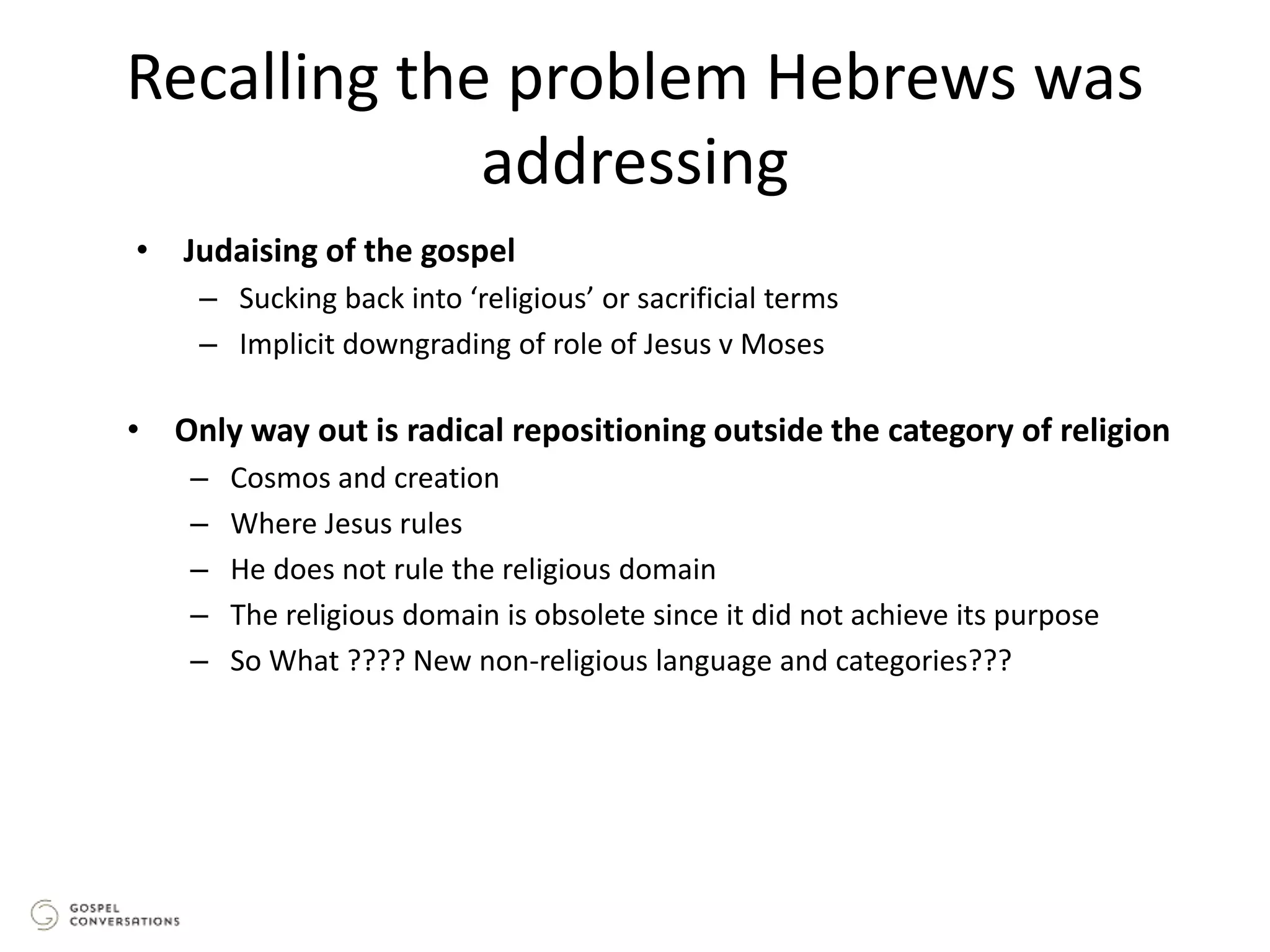
Recalling the problem Hebrews was
addressing
• Judaising of the gospel
– Sucking back into ‘religious’ or sacrificial terms
– Implicit downgrading of role of Jesus v Moses
• Only way out is radical repositioning outside the category of religion
– Cosmos and creation
– Where Jesus rules
– He does not rule the religious domain
– The religious domain is obsolete since it did not achieve its purpose
– So What ???? New non-religious language and categories???
So we cannot be religious ‘specialists’
“God is no stop-gap; he must be recognised at
the centre of life, not when we are at the end
our resources. It is his will to recognised in life,
not only in death; in our activities, not only in
our sin. In Christ, there are not ‘Christian’
problems”
“The Christian adds nothing to the human; the Christian does not add anything
more to the human than God adds to the world. The Christian is the human
being, the entirely human man.”
Governing theme of 7-10
• Explores the ‘ministry’ of Christ (Function that Christ fulfils)
– Flesh out the roles of Christ
– Position them in plans of God
– Specify qualities that equip & authorize Christ for that task
– Explains and exhorts the consequences for us (beneficiaries and partners in
the enterprise)
• Person & role of Christ becomes the main topic
– He becomes the agent
– The new era is his design and working system
– His qualities are explored
– His work is explained
– Importantly all of this is on our behalf – If you want to understand your
relationship with God, you must study Jesus’ relation with God
This new ‘operating system’ is ongoing
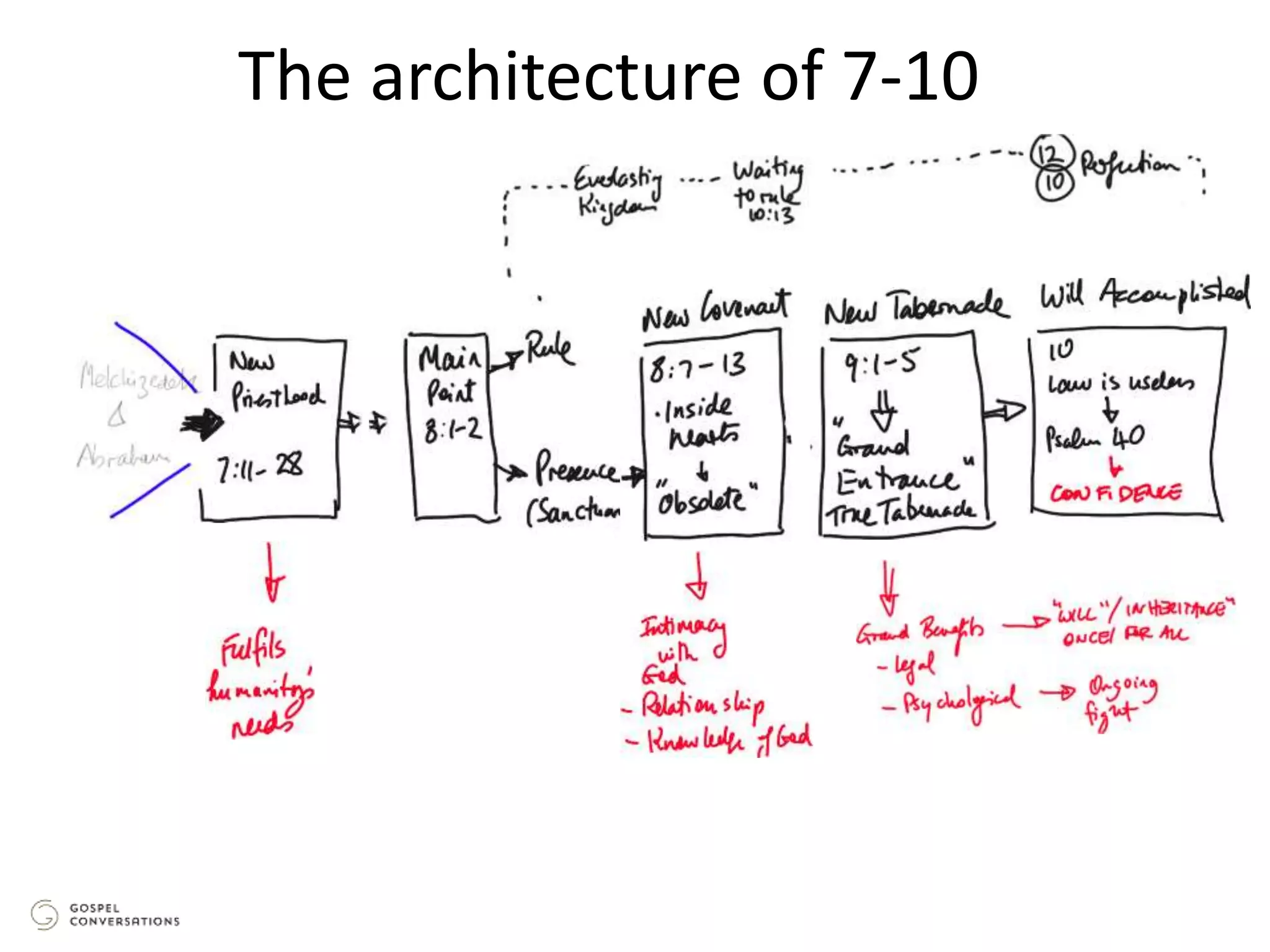
The architecture of 7-10
The New Priesthood
Now there have been many of those priests, since
death prevented them from continuing in office;
24 but because Jesus lives forever, he has a
permanent priesthood. 25 Therefore he is able to
save completely[c] those who come to God
through him, because he always lives to intercede
for them.
26 Such a high priest truly meets our need—one
who is holy, blameless, pure, set apart from
sinners, exalted above the heavens. 27 Unlike the
other high priests, he does not need to offer
sacrifices day after day, first for his own sins, and
then for the sins of the people. He sacrificed for
their sins once for all when he offered himself. 28
For the law appoints as high priests men in all
their weakness; but the oath, which came after
the law, appointed the Son, who has been made
perfect forever.
What is a priest???
Holy
Sinful
Infinite
Finite
Uncreated
Created
The New Priesthood
Now there have been many of those priests, since
death prevented them from continuing in office;
24 but because Jesus lives forever, he has a
permanent priesthood. 25 Therefore he is able to
save completely[c] those who come to God
through him, because he always lives to intercede
for them.
26 Such a high priest truly meets our need—one
who is holy, blameless, pure, set apart from
sinners, exalted above the heavens. 27 Unlike the
other high priests, he does not need to offer
sacrifices day after day, first for his own sins, and
then for the sins of the people. He sacrificed for
their sins once for all when he offered himself. 28
For the law appoints as high priests men in all
their weakness; but the oath, which came after
the law, appointed the Son, who has been made
perfect forever.
Qualities that equip?
Christ’s resurrection
immortality
Once for all event –
cataclysmic and final
The “Main Point”
Now the main point of what we are saying is
this: We do have such a high priest, who sat
down at the right hand of the throne of the
Majesty in heaven, 2 and who serves in the
sanctuary, the true tabernacle set up by the
Lord, not by a mere human being.
Daniel 7 – RULE & REST
Sanctuary - RELATIONSHIP
“As I looked,
“thrones were set in place,
and the Ancient of Days took his seat.
His clothing was as white as snow;
the hair of his head was white like wool.
His throne was flaming with fire,
and its wheels were all ablaze.
10
A river of fire was flowing,
coming out from before him.
Thousands upon thousands attended him;
ten thousand times ten thousand stood before him.
The court was seated,
and the books were opened.
11 “Then I continued to watch because of the boastful words the horn was speaking. I kept looking until the
beast was slain and its body destroyed and thrown into the blazing fire. 12 (The other beasts had been
stripped of their authority, but were allowed to live for a period of time.)
13 “In my vision at night I looked, and there before me was one like a son of man,[a] coming with the clouds
of heaven. He approached the Ancient of Days and was led into his presence. 14 He was given authority, glory
and sovereign power; all nations and peoples of every language worshiped him. His dominion is an
everlasting dominion that will not pass away, and his kingdom is one that will never be destroyed.
The “Son of Man” Rule of Daniel
“The days are coming, declares the Lord,
when I will make a new covenant
with the people of Israel
and with the people of Judah.
9
It will not be like the covenant
I made with their ancestors
when I took them by the hand
to lead them out of Egypt,
because they did not remain faithful to my covenant,
and I turned away from them,
declares the Lord.
10
This is the covenant I will establish with the people of Israel
after that time, declares the Lord.
I will put my laws in their minds
and write them on their hearts.
I will be their God,
and they will be my people.
11
No longer will they teach their neighbor,
or say to one another, ‘Know the Lord,’
because they will all know me,
from the least of them to the greatest.
12
For I will forgive their wickedness
and will remember their sins no more.”[c]
For if there had been nothing
wrong with that first covenant,
no place would have been sought
for another. 8 But God found
fault with the people and said[b]:
By calling this covenant “new,”
he has made the first one
obsolete; and what is obsolete
and outdated will soon
disappear.
Inaugurating a new covenant
What is a ‘covenant’?
• Non-religious terms
– Agreement to bind two parties together – a legal framework to
create a binding relationship where one does not exist
– Higher order than ‘regulations’
– Creates a new social entity
– Requires intangibles – trust to work
• Covenant in OT (Walton)
– Based on treaties formula common in ANE world (political genre
not religious)
– Unique use in OT? God forms the covenant…
– Follows ‘conquest’ by the overlord
– Yahweh’s conquest of Egypt …. Christ’s conquest of enemies
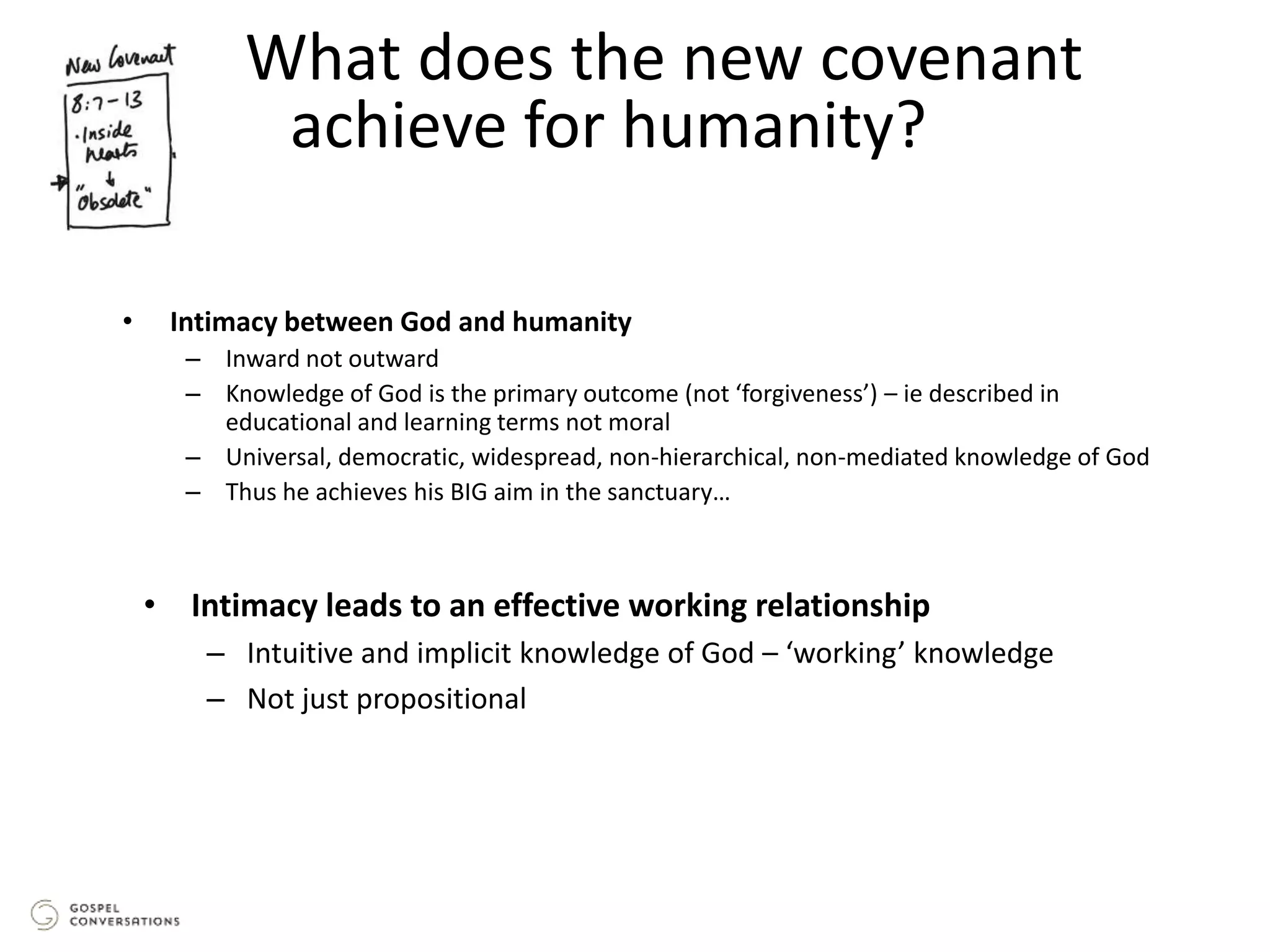
• Intimacy between God and humanity
– Inward not outward
– Knowledge of God is the primary outcome (not ‘forgiveness’) – ie described in
educational and learning terms not moral
– Universal, democratic, widespread, non-hierarchical, non-mediated knowledge of God
– Thus he achieves his BIG aim in the sanctuary…
What does the new covenant
achieve for humanity?
• Intimacy leads to an effective working relationship
– Intuitive and implicit knowledge of God – ‘working’ knowledge
– Not just propositional
Christ built and sustains a ‘true
tabernacle’
Now the first covenant had regulations for worship and also an earthly
sanctuary. 2 A tabernacle was set up. In its first room were the lampstand and
the table with its consecrated bread; this was called the Holy Place. 3 Behind the
second curtain was a room called the Most Holy Place, 4 which had the golden
altar of incense and the gold-covered ark of the covenant. This ark contained the
gold jar of manna, Aaron’s staff that had budded, and the stone tablets of the
covenant. 5 Above the ark were the cherubim of the Glory, overshadowing the
atonement cover. But we cannot discuss these things in detail now.
6 When everything had been arranged like this, the priests entered regularly
into the outer room to carry on their ministry. 7 But only the high priest entered
the inner room, and that only once a year, and never without blood, which he
offered for himself and for the sins the people had committed in ignorance. 8
The Holy Spirit was showing by this that the way into the Most Holy Place had
not yet been disclosed as long as the first tabernacle was still functioning. 9 This
is an illustration for the present time, indicating that the gifts and sacrifices
being offered were not able to clear the conscience of the worshiper. 10 They
are only a matter of food and drink and various ceremonial washings—external
regulations applying until the time of the new order.
This is the goal
of everything …
The ‘Grand entrance’ follows
But when Christ came as high priest of the good things that
are now already here,[a] he went through the greater and
more perfect tabernacle that is not made with human hands,
that is to say, is not a part of this creation. 12 He did not
enter by means of the blood of goats and calves; but he
entered the Most Holy Place once for all by his own blood,
thus obtaining[b] eternal redemption. 13 The blood of goats
and bulls and the ashes of a heifer sprinkled on those who
are ceremonially unclean sanctify them so that they are
outwardly clean. 14 How much more, then, will the blood of
Christ, who through the eternal Spirit offered himself
unblemished to God, cleanse our consciences from acts that
lead to death,[c] so that we may serve the living God!
15 For this reason Christ is the mediator of a new covenant,
that those who are called may receive the promised eternal
inheritance—now that he has died as a ransom to set them
free from the sins committed under the first covenant.
The earth is the Lord’s, and everything in it,
the world, and all who live in it;
2 for he founded it on the seas
and established it on the waters.
3 Who may ascend the mountain of the Lord?
Who may stand in his holy place?
4 The one who has clean hands and a pure heart,
who does not trust in an idol
or swear by a false god.[a]
5 They will receive blessing from the Lord
and vindication from God their Savior.
6 Such is the generation of those who seek him,
who seek your face, God of Jacob.[b][c]
7 Lift up your heads, you gates;
be lifted up, you ancient doors,
that the King of glory may come in.
8 Who is this King of glory?
The Lord strong and mighty,
the Lord mighty in battle.
9 Lift up your heads, you gates;
lift them up, you ancient doors,
that the King of glory may come in.
10 Who is he, this King of glory?
The Lord Almighty—
he is the King of glory.
The ‘Grand entrance’ foreshadowed
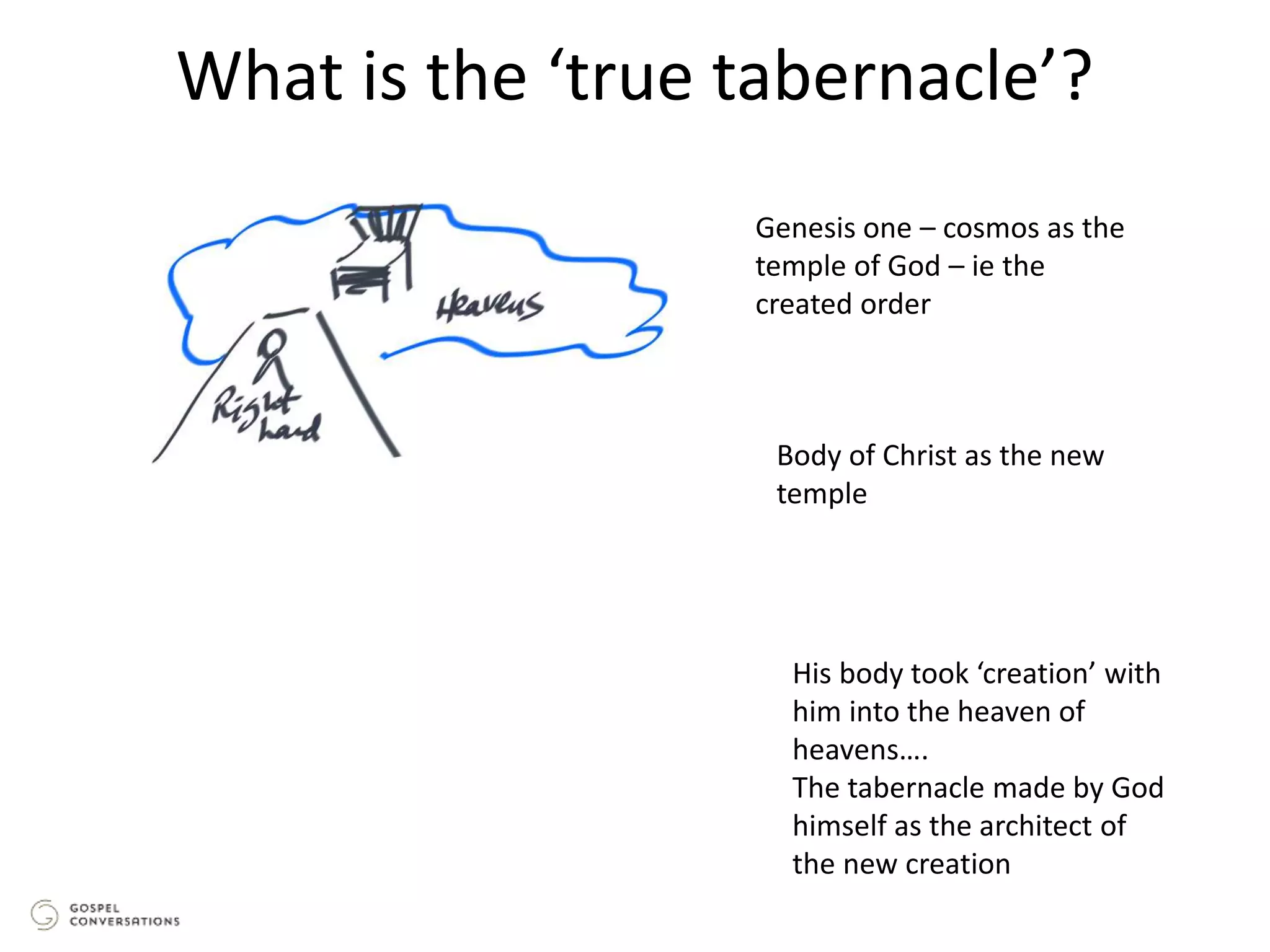
What is the ‘true tabernacle’?
Genesis one – cosmos as the
temple of God – ie the
created order
Body of Christ as the new
temple
His body took ‘creation’ with
him into the heaven of
heavens….
The tabernacle made by God
himself as the architect of
the new creation
The benefits and desired effects?
But when Christ came as high priest of the good things that
are now already here,[a] he went through the greater and
more perfect tabernacle that is not made with human hands,
that is to say, is not a part of this creation. 12 He did not
enter by means of the blood of goats and calves; but he
entered the Most Holy Place once for all by his own blood,
thus obtaining[b] eternal redemption. 13 The blood of goats
and bulls and the ashes of a heifer sprinkled on those who
are ceremonially unclean sanctify them so that they are
outwardly clean. 14 How much more, then, will the blood of
Christ, who through the eternal Spirit offered himself
unblemished to God, cleanse our consciences from acts that
lead to death,[c] so that we may serve the living God!
15 For this reason Christ is the mediator of a new covenant,
that those who are called may receive the promised eternal
inheritance—now that he has died as a ransom to set them
free from the sins committed under the first covenant.
• Both legal and
psychological
• “dead works to
serve the living
God”

Hebrews - Jesus and the Reverse Incarnation

  • 1.
    Hebrews Series: Resurrection trumpsReligion Part 4 (Ch 7-10): the Reverse Incarnation – Jesus takes earth to heaven.
  • 2.
    Recalling the problemHebrews was addressing • Judaising of the gospel – Sucking back into ‘religious’ or sacrificial terms – Implicit downgrading of role of Jesus v Moses • Only way out is radical repositioning outside the category of religion – Cosmos and creation – Where Jesus rules – He does not rule the religious domain – The religious domain is obsolete since it did not achieve its purpose – So What ???? New non-religious language and categories???
  • 3.
    So we cannotbe religious ‘specialists’ “God is no stop-gap; he must be recognised at the centre of life, not when we are at the end our resources. It is his will to recognised in life, not only in death; in our activities, not only in our sin. In Christ, there are not ‘Christian’ problems” “The Christian adds nothing to the human; the Christian does not add anything more to the human than God adds to the world. The Christian is the human being, the entirely human man.”
  • 5.
    Governing theme of7-10 • Explores the ‘ministry’ of Christ (Function that Christ fulfils) – Flesh out the roles of Christ – Position them in plans of God – Specify qualities that equip & authorize Christ for that task – Explains and exhorts the consequences for us (beneficiaries and partners in the enterprise) • Person & role of Christ becomes the main topic – He becomes the agent – The new era is his design and working system – His qualities are explored – His work is explained – Importantly all of this is on our behalf – If you want to understand your relationship with God, you must study Jesus’ relation with God
  • 6.
    This new ‘operatingsystem’ is ongoing
  • 7.
  • 8.
    The New Priesthood Nowthere have been many of those priests, since death prevented them from continuing in office; 24 but because Jesus lives forever, he has a permanent priesthood. 25 Therefore he is able to save completely[c] those who come to God through him, because he always lives to intercede for them. 26 Such a high priest truly meets our need—one who is holy, blameless, pure, set apart from sinners, exalted above the heavens. 27 Unlike the other high priests, he does not need to offer sacrifices day after day, first for his own sins, and then for the sins of the people. He sacrificed for their sins once for all when he offered himself. 28 For the law appoints as high priests men in all their weakness; but the oath, which came after the law, appointed the Son, who has been made perfect forever. What is a priest??? Holy Sinful Infinite Finite Uncreated Created
  • 9.
    The New Priesthood Nowthere have been many of those priests, since death prevented them from continuing in office; 24 but because Jesus lives forever, he has a permanent priesthood. 25 Therefore he is able to save completely[c] those who come to God through him, because he always lives to intercede for them. 26 Such a high priest truly meets our need—one who is holy, blameless, pure, set apart from sinners, exalted above the heavens. 27 Unlike the other high priests, he does not need to offer sacrifices day after day, first for his own sins, and then for the sins of the people. He sacrificed for their sins once for all when he offered himself. 28 For the law appoints as high priests men in all their weakness; but the oath, which came after the law, appointed the Son, who has been made perfect forever. Qualities that equip? Christ’s resurrection immortality Once for all event – cataclysmic and final
  • 10.
    The “Main Point” Nowthe main point of what we are saying is this: We do have such a high priest, who sat down at the right hand of the throne of the Majesty in heaven, 2 and who serves in the sanctuary, the true tabernacle set up by the Lord, not by a mere human being. Daniel 7 – RULE & REST Sanctuary - RELATIONSHIP
  • 11.
    “As I looked, “throneswere set in place, and the Ancient of Days took his seat. His clothing was as white as snow; the hair of his head was white like wool. His throne was flaming with fire, and its wheels were all ablaze. 10 A river of fire was flowing, coming out from before him. Thousands upon thousands attended him; ten thousand times ten thousand stood before him. The court was seated, and the books were opened. 11 “Then I continued to watch because of the boastful words the horn was speaking. I kept looking until the beast was slain and its body destroyed and thrown into the blazing fire. 12 (The other beasts had been stripped of their authority, but were allowed to live for a period of time.) 13 “In my vision at night I looked, and there before me was one like a son of man,[a] coming with the clouds of heaven. He approached the Ancient of Days and was led into his presence. 14 He was given authority, glory and sovereign power; all nations and peoples of every language worshiped him. His dominion is an everlasting dominion that will not pass away, and his kingdom is one that will never be destroyed. The “Son of Man” Rule of Daniel
  • 12.
    “The days arecoming, declares the Lord, when I will make a new covenant with the people of Israel and with the people of Judah. 9 It will not be like the covenant I made with their ancestors when I took them by the hand to lead them out of Egypt, because they did not remain faithful to my covenant, and I turned away from them, declares the Lord. 10 This is the covenant I will establish with the people of Israel after that time, declares the Lord. I will put my laws in their minds and write them on their hearts. I will be their God, and they will be my people. 11 No longer will they teach their neighbor, or say to one another, ‘Know the Lord,’ because they will all know me, from the least of them to the greatest. 12 For I will forgive their wickedness and will remember their sins no more.”[c] For if there had been nothing wrong with that first covenant, no place would have been sought for another. 8 But God found fault with the people and said[b]: By calling this covenant “new,” he has made the first one obsolete; and what is obsolete and outdated will soon disappear. Inaugurating a new covenant
  • 13.
    What is a‘covenant’? • Non-religious terms – Agreement to bind two parties together – a legal framework to create a binding relationship where one does not exist – Higher order than ‘regulations’ – Creates a new social entity – Requires intangibles – trust to work • Covenant in OT (Walton) – Based on treaties formula common in ANE world (political genre not religious) – Unique use in OT? God forms the covenant… – Follows ‘conquest’ by the overlord – Yahweh’s conquest of Egypt …. Christ’s conquest of enemies
  • 14.
    • Intimacy betweenGod and humanity – Inward not outward – Knowledge of God is the primary outcome (not ‘forgiveness’) – ie described in educational and learning terms not moral – Universal, democratic, widespread, non-hierarchical, non-mediated knowledge of God – Thus he achieves his BIG aim in the sanctuary… What does the new covenant achieve for humanity? • Intimacy leads to an effective working relationship – Intuitive and implicit knowledge of God – ‘working’ knowledge – Not just propositional
  • 15.
    Christ built andsustains a ‘true tabernacle’ Now the first covenant had regulations for worship and also an earthly sanctuary. 2 A tabernacle was set up. In its first room were the lampstand and the table with its consecrated bread; this was called the Holy Place. 3 Behind the second curtain was a room called the Most Holy Place, 4 which had the golden altar of incense and the gold-covered ark of the covenant. This ark contained the gold jar of manna, Aaron’s staff that had budded, and the stone tablets of the covenant. 5 Above the ark were the cherubim of the Glory, overshadowing the atonement cover. But we cannot discuss these things in detail now. 6 When everything had been arranged like this, the priests entered regularly into the outer room to carry on their ministry. 7 But only the high priest entered the inner room, and that only once a year, and never without blood, which he offered for himself and for the sins the people had committed in ignorance. 8 The Holy Spirit was showing by this that the way into the Most Holy Place had not yet been disclosed as long as the first tabernacle was still functioning. 9 This is an illustration for the present time, indicating that the gifts and sacrifices being offered were not able to clear the conscience of the worshiper. 10 They are only a matter of food and drink and various ceremonial washings—external regulations applying until the time of the new order. This is the goal of everything …
  • 16.
    The ‘Grand entrance’follows But when Christ came as high priest of the good things that are now already here,[a] he went through the greater and more perfect tabernacle that is not made with human hands, that is to say, is not a part of this creation. 12 He did not enter by means of the blood of goats and calves; but he entered the Most Holy Place once for all by his own blood, thus obtaining[b] eternal redemption. 13 The blood of goats and bulls and the ashes of a heifer sprinkled on those who are ceremonially unclean sanctify them so that they are outwardly clean. 14 How much more, then, will the blood of Christ, who through the eternal Spirit offered himself unblemished to God, cleanse our consciences from acts that lead to death,[c] so that we may serve the living God! 15 For this reason Christ is the mediator of a new covenant, that those who are called may receive the promised eternal inheritance—now that he has died as a ransom to set them free from the sins committed under the first covenant.
  • 17.
    The earth isthe Lord’s, and everything in it, the world, and all who live in it; 2 for he founded it on the seas and established it on the waters. 3 Who may ascend the mountain of the Lord? Who may stand in his holy place? 4 The one who has clean hands and a pure heart, who does not trust in an idol or swear by a false god.[a] 5 They will receive blessing from the Lord and vindication from God their Savior. 6 Such is the generation of those who seek him, who seek your face, God of Jacob.[b][c] 7 Lift up your heads, you gates; be lifted up, you ancient doors, that the King of glory may come in. 8 Who is this King of glory? The Lord strong and mighty, the Lord mighty in battle. 9 Lift up your heads, you gates; lift them up, you ancient doors, that the King of glory may come in. 10 Who is he, this King of glory? The Lord Almighty— he is the King of glory. The ‘Grand entrance’ foreshadowed
  • 18.
    What is the‘true tabernacle’? Genesis one – cosmos as the temple of God – ie the created order Body of Christ as the new temple His body took ‘creation’ with him into the heaven of heavens…. The tabernacle made by God himself as the architect of the new creation
  • 19.
    The benefits anddesired effects? But when Christ came as high priest of the good things that are now already here,[a] he went through the greater and more perfect tabernacle that is not made with human hands, that is to say, is not a part of this creation. 12 He did not enter by means of the blood of goats and calves; but he entered the Most Holy Place once for all by his own blood, thus obtaining[b] eternal redemption. 13 The blood of goats and bulls and the ashes of a heifer sprinkled on those who are ceremonially unclean sanctify them so that they are outwardly clean. 14 How much more, then, will the blood of Christ, who through the eternal Spirit offered himself unblemished to God, cleanse our consciences from acts that lead to death,[c] so that we may serve the living God! 15 For this reason Christ is the mediator of a new covenant, that those who are called may receive the promised eternal inheritance—now that he has died as a ransom to set them free from the sins committed under the first covenant. • Both legal and psychological • “dead works to serve the living God”