APPLICATION NOTE
                                         Hearing Aid Testing
                   System Overview
                   SoundCheckTM is an easily configurable, windows-
                   based system for efficient and comprehensive
                   testing of hearing aids.
                   Applications include:
                      • Incoming Inspection
                      • Pre and Post service evaluation
                      • Research and Development
                      • Amplifier test and measurement
                      • Evaluating audio performance of DSP
                           algorithms
                   Utilizing a variety of readily available hardware
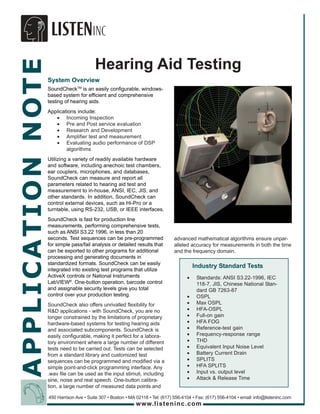
                   and software, including anechoic test chambers,
                   ear couplers, microphones, and databases,
                   SoundCheck can measure and report all
                   parameters related to hearing aid test and
                   measurement to in-house, ANSI, IEC, JIS, and
                   other standards. In addition, SoundCheck can
                   control external devices, such as Hi-Pro or a
                   turntable, using RS-232, USB, or IEEE interfaces.
                   SoundCheck is fast for production line
                   measurements, performing comprehensive tests,
                   such as ANSI S3.22 1996, in less than 20
                   seconds. Test sequences can be pre-programmed                 advanced mathematical algorithms ensure unpar-
                   for simple pass/fail analysis or detailed results that        alleled accuracy for measurements in both the time
                   can be exported to other programs for additional              and the frequency domain.
                   processing and generating documents in
                   standardized formats. SoundCheck can be easily
                                                                                           Industry Standard Tests
                   integrated into existing test programs that utilize
                   ActiveX controls or National Instruments                            •    Standards: ANSI S3.22-1996, IEC
                   LabVIEW®. One-button operation, barcode control                          118-7, JIS, Chinese National Stan-
                   and assignable security levels give you total                            dard GB 7263-87
                   control over your production testing.                               •    OSPL
                   SoundCheck also offers unrivalled flexibility for                   •    Max OSPL
                   R&D applications - with SoundCheck, you are no                      •    HFA-OSPL
                   longer constrained by the limitations of proprietary                •    Full-on gain
                   hardware-based systems for testing hearing aids                     •    HFA FOG
                   and associated subcomponents. SoundCheck is                         •    Reference-test gain
                   easily configurable, making it perfect for a labora-                •    Frequency-response range
                   tory environment where a large number of different                  •    THD
                   tests need to be carried out. Tests can be selected                 •    Equivalent Input Noise Level
                   from a standard library and customized test                         •    Battery Current Drain
                   sequences can be programmed and modified via a                      •    SPLITS
                   simple point-and-click programming interface. Any                   •    HFA SPLITS
                   .wav file can be used as the input stimuli, including               •    Input vs. output level
                   sine, noise and real speech. One-button calibra-                    •    Attack & Release Time
                   tion, a large number of measured data points and

                   450 Harrison Ave • Suite 307 • Boston • MA 02118 • Tel: (617) 556-4104 • Fax: (617) 556-4104 • email: info@listeninc.com
                                                              www.listeninc.com
Hearing Aid Testing
Typical System Configuration


                                                                            SoundConnect
                                                                             Mic Power
                                     SoundCheck™                               Supply
                                     for Hearing Aid
                                         Testing
                     PASSED

                                                                                              Anechoic Test Chamber

                                            Sound
                                           Card Input


                                                                              DC Voltage
                                               USB                             to Battery
                                            connection                          Adapter
                Sound Card Output             to PC                               Input

                  to Amp Input                                DC Connect
                                             Right Amp Output to Telecoil Loop Input
                                                                                                    Hearing Aid
                                                                                                     in coupler
                 Power Amplifier               Left Amp Output to Speaker Input


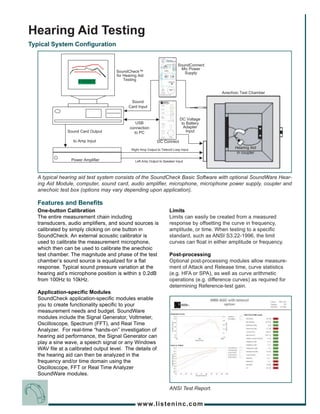
   A typical hearing aid test system consists of the SoundCheck Basic Software with optional SoundWare Hear-
   ing Aid Module, computer, sound card, audio amplifier, microphone, microphone power supply, coupler and
   anechoic test box (options may vary depending upon application).

   Features and Benefits
   One-button Calibration                                              Limits
   The entire measurement chain including                              Limits can easily be created from a measured
   transducers, audio amplifiers, and sound sources is                 response by offsetting the curve in frequency,
   calibrated by simply clicking on one button in                      amplitude, or time. When testing to a specific
   SoundCheck. An external acoustic calibrator is                      standard, such as ANSI S3.22-1996, the limit
   used to calibrate the measurement microphone,                       curves can float in either amplitude or frequency.
   which then can be used to calibrate the anechoic
   test chamber. The magnitude and phase of the test                   Post-processing
   chamber’s sound source is equalized for a flat                      Optional post-processing modules allow measure-
   response. Typical sound pressure variation at the                   ment of Attack and Release time, curve statistics
   hearing aid’s microphone position is within ± 0.2dB                 (e.g. HFA or SPA), as well as curve arithmetic
   from 100Hz to 10kHz.                                                operations (e.g. difference curves) as required for
                                                                       determining Reference-test gain.
   Application-specific Modules
   SoundCheck application-specific modules enable
   you to create functionality specific to your
   measurement needs and budget. SoundWare
   modules include the Signal Generator, Voltmeter,
   Oscilloscope, Spectrum (FFT), and Real Time
   Analyzer. For real-time “hands-on” investigation of
   hearing aid performance, the Signal Generator can
   play a sine wave, a speech signal or any Windows
   WAV file at a calibrated output level. The details of
   the hearing aid can then be analyzed in the
   frequency and/or time domain using the
   Oscilloscope, FFT or Real Time Analyzer
   SoundWare modules.

                                                                       ANSI Test Report.


                                                www.listeninc.com

Hearing Aid Testing

  • 1.
    APPLICATION NOTE Hearing Aid Testing System Overview SoundCheckTM is an easily configurable, windows- based system for efficient and comprehensive testing of hearing aids. Applications include: • Incoming Inspection • Pre and Post service evaluation • Research and Development • Amplifier test and measurement • Evaluating audio performance of DSP algorithms Utilizing a variety of readily available hardware and software, including anechoic test chambers, ear couplers, microphones, and databases, SoundCheck can measure and report all parameters related to hearing aid test and measurement to in-house, ANSI, IEC, JIS, and other standards. In addition, SoundCheck can control external devices, such as Hi-Pro or a turntable, using RS-232, USB, or IEEE interfaces. SoundCheck is fast for production line measurements, performing comprehensive tests, such as ANSI S3.22 1996, in less than 20 seconds. Test sequences can be pre-programmed advanced mathematical algorithms ensure unpar- for simple pass/fail analysis or detailed results that alleled accuracy for measurements in both the time can be exported to other programs for additional and the frequency domain. processing and generating documents in standardized formats. SoundCheck can be easily Industry Standard Tests integrated into existing test programs that utilize ActiveX controls or National Instruments • Standards: ANSI S3.22-1996, IEC LabVIEW®. One-button operation, barcode control 118-7, JIS, Chinese National Stan- and assignable security levels give you total dard GB 7263-87 control over your production testing. • OSPL SoundCheck also offers unrivalled flexibility for • Max OSPL R&D applications - with SoundCheck, you are no • HFA-OSPL longer constrained by the limitations of proprietary • Full-on gain hardware-based systems for testing hearing aids • HFA FOG and associated subcomponents. SoundCheck is • Reference-test gain easily configurable, making it perfect for a labora- • Frequency-response range tory environment where a large number of different • THD tests need to be carried out. Tests can be selected • Equivalent Input Noise Level from a standard library and customized test • Battery Current Drain sequences can be programmed and modified via a • SPLITS simple point-and-click programming interface. Any • HFA SPLITS .wav file can be used as the input stimuli, including • Input vs. output level sine, noise and real speech. One-button calibra- • Attack & Release Time tion, a large number of measured data points and 450 Harrison Ave • Suite 307 • Boston • MA 02118 • Tel: (617) 556-4104 • Fax: (617) 556-4104 • email: info@listeninc.com www.listeninc.com
  • 2.
    Hearing Aid Testing TypicalSystem Configuration SoundConnect Mic Power SoundCheck™ Supply for Hearing Aid Testing PASSED Anechoic Test Chamber Sound Card Input DC Voltage USB to Battery connection Adapter Sound Card Output to PC Input to Amp Input DC Connect Right Amp Output to Telecoil Loop Input Hearing Aid in coupler Power Amplifier Left Amp Output to Speaker Input A typical hearing aid test system consists of the SoundCheck Basic Software with optional SoundWare Hear- ing Aid Module, computer, sound card, audio amplifier, microphone, microphone power supply, coupler and anechoic test box (options may vary depending upon application). Features and Benefits One-button Calibration Limits The entire measurement chain including Limits can easily be created from a measured transducers, audio amplifiers, and sound sources is response by offsetting the curve in frequency, calibrated by simply clicking on one button in amplitude, or time. When testing to a specific SoundCheck. An external acoustic calibrator is standard, such as ANSI S3.22-1996, the limit used to calibrate the measurement microphone, curves can float in either amplitude or frequency. which then can be used to calibrate the anechoic test chamber. The magnitude and phase of the test Post-processing chamber’s sound source is equalized for a flat Optional post-processing modules allow measure- response. Typical sound pressure variation at the ment of Attack and Release time, curve statistics hearing aid’s microphone position is within ± 0.2dB (e.g. HFA or SPA), as well as curve arithmetic from 100Hz to 10kHz. operations (e.g. difference curves) as required for determining Reference-test gain. Application-specific Modules SoundCheck application-specific modules enable you to create functionality specific to your measurement needs and budget. SoundWare modules include the Signal Generator, Voltmeter, Oscilloscope, Spectrum (FFT), and Real Time Analyzer. For real-time “hands-on” investigation of hearing aid performance, the Signal Generator can play a sine wave, a speech signal or any Windows WAV file at a calibrated output level. The details of the hearing aid can then be analyzed in the frequency and/or time domain using the Oscilloscope, FFT or Real Time Analyzer SoundWare modules. ANSI Test Report. www.listeninc.com