

DR SRIRAMA ANJANEYULU MD DM
              NEUROPHYSICIAN
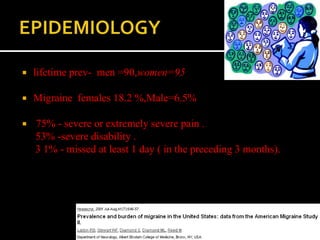
   lifetime prev- men =90,women=95

   Migraine females 18.2 %,Male=6.5%

   75% - severe or extremely severe pain .
    53% -severe disability .
    3 1% - missed at least 1 day ( in the preceding 3 months).
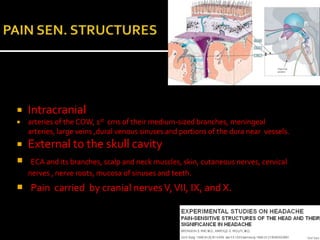
   Intracranial
   arteries of the COW, 1st cms of their medium-sized branches, meningeal
    arteries, large veins ,dural venous sinuses and portions of the dura near vessels.
   External to the skull cavity
    ECA and its branches, scalp and neck muscles, skin, cutaneous nerves, cervical
    nerves , nerve roots, mucosa of sinuses and teeth.
 Pain carried by cranial nerves V, VII, IX, and X.
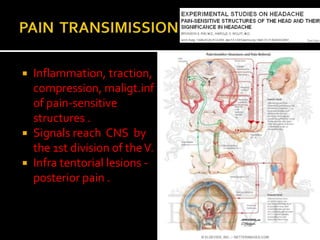
 Inflammation, traction,
  compression, maligt.inf
  of pain-sensitive
  structures .
 Signals reach CNS by
  the 1st division of the V.
 Infra tentorial lesions -
  posterior pain .
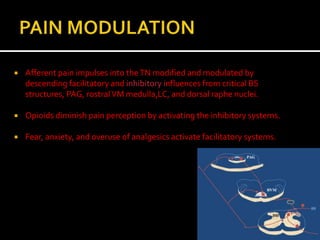
   Afferent pain impulses into the TN modified and modulated by
    descending facilitatory and inhibitory influences from critical BS
    structures, PAG, rostral VM medulla,LC, and dorsal raphe nuclei.

   Opioids diminish pain perception by activating the inhibitory systems.

   Fear, anxiety, and overuse of analgesics activate facilitatory systems.
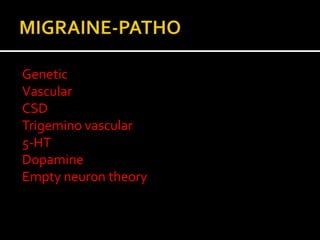
Genetic
Vascular
CSD
Trigemino vascular
5-HT
Dopamine
Empty neuron theory
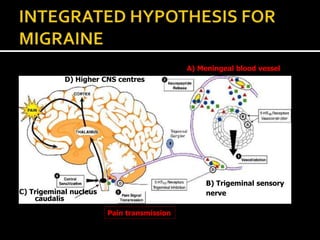
A) Meningeal blood vessel
            D) Higher CNS centres


                                                 B) Trigeminal sensory
C) Trigeminal nucleus                            nerve
    caudalis

                        Pain transmission   Nerve activation 
                                                                 Neuropeptid
                                                                 e release
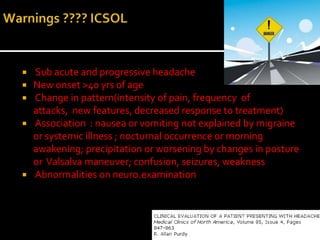
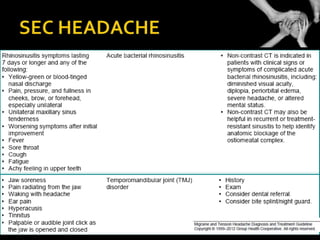
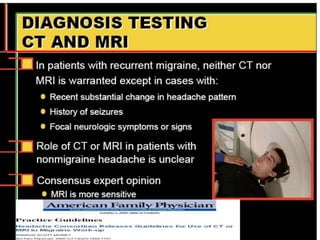
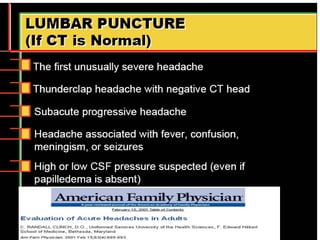
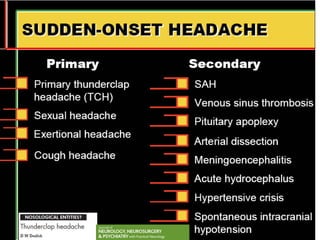
   Sub acute and progressive headache
   New onset >40 yrs of age
   Change in pattern(intensity of pain, frequency of
    attacks, new features, decreased response to treatment)
   Association : nausea or vomiting not explained by migraine
    or systemic illness ; nocturnal occurrence or morning
    awakening; precipitation or worsening by changes in posture
    or Valsalva maneuver; confusion, seizures, weakness
   Abnormalities on neuro.examination
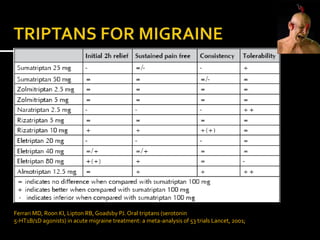
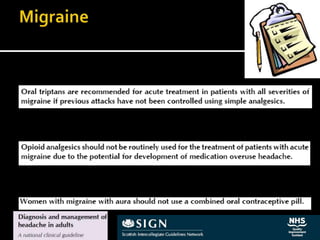
Ferrari MD, Roon KI, Lipton RB, Goadsby PJ. Oral triptans (serotonin
5-HT1B/1D agonists) in acute migraine treatment: a meta-analysis of 53 trials Lancet, 2001;
HEADACHE
HEADACHE
HEADACHE
HEADACHE
HEADACHE
HEADACHE
HEADACHE
HEADACHE
HEADACHE
HEADACHE
HEADACHE
HEADACHE
HEADACHE
HEADACHE
HEADACHE
HEADACHE
HEADACHE
HEADACHE
HEADACHE
HEADACHE

HEADACHE

  • 1.
    DR SRIRAMA ANJANEYULUMD DM NEUROPHYSICIAN
  • 2.
    lifetime prev- men =90,women=95  Migraine females 18.2 %,Male=6.5%  75% - severe or extremely severe pain . 53% -severe disability . 3 1% - missed at least 1 day ( in the preceding 3 months).
  • 5.
    Intracranial  arteries of the COW, 1st cms of their medium-sized branches, meningeal arteries, large veins ,dural venous sinuses and portions of the dura near vessels.  External to the skull cavity  ECA and its branches, scalp and neck muscles, skin, cutaneous nerves, cervical nerves , nerve roots, mucosa of sinuses and teeth.  Pain carried by cranial nerves V, VII, IX, and X.
  • 6.
     Inflammation, traction, compression, maligt.inf of pain-sensitive structures .  Signals reach CNS by the 1st division of the V.  Infra tentorial lesions - posterior pain .
  • 7.
    Afferent pain impulses into the TN modified and modulated by descending facilitatory and inhibitory influences from critical BS structures, PAG, rostral VM medulla,LC, and dorsal raphe nuclei.  Opioids diminish pain perception by activating the inhibitory systems.  Fear, anxiety, and overuse of analgesics activate facilitatory systems.
  • 8.
  • 9.
    A) Meningeal bloodvessel D) Higher CNS centres B) Trigeminal sensory C) Trigeminal nucleus nerve caudalis Pain transmission Nerve activation  Neuropeptid e release
  • 14.
    Sub acute and progressive headache  New onset >40 yrs of age  Change in pattern(intensity of pain, frequency of attacks, new features, decreased response to treatment)  Association : nausea or vomiting not explained by migraine or systemic illness ; nocturnal occurrence or morning awakening; precipitation or worsening by changes in posture or Valsalva maneuver; confusion, seizures, weakness  Abnormalities on neuro.examination
  • 34.
    Ferrari MD, RoonKI, Lipton RB, Goadsby PJ. Oral triptans (serotonin 5-HT1B/1D agonists) in acute migraine treatment: a meta-analysis of 53 trials Lancet, 2001;