HCS103 Topic 7
Presentation draws on resources written by Karen Bell
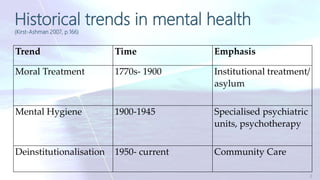
Historical trends in mental health
(Kirst-Ashman 2007, p.166)
2
Trend Time Emphasis
Moral Treatment 1770s- 1900 Institutional treatment/
asylum
Mental Hygiene 1900-1945 Specialised psychiatric
units, psychotherapy
Deinstitutionalisation 1950- current Community Care
3
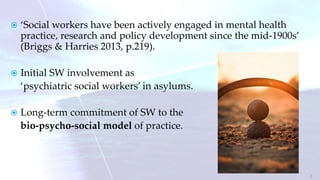
 ‘Social workers have been actively engaged in mental health
practice, research and policy development since the mid-1900s’
(Briggs & Harries 2013, p.219).
 Initial SW involvement as
‘psychiatric social workers’ in asylums.
 Long-term commitment of SW to the
bio-psycho-social model of practice.
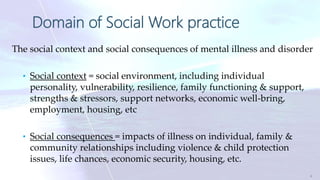
Domain of Social Work practice
The social context and social consequences of mental illness and disorder
• Social context = social environment, including individual
personality, vulnerability, resilience, family functioning & support,
strengths & stressors, support networks, economic well-bring,
employment, housing, etc
• Social consequences = impacts of illness on individual, family &
community relationships including violence & child protection
issues, life chances, economic security, housing, etc.
4
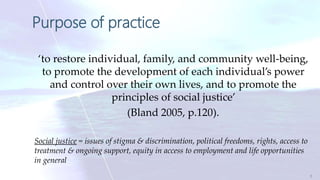
Purpose of practice
‘to restore individual, family, and community well-being,
to promote the development of each individual’s power
and control over their own lives, and to promote the
principles of social justice’
(Bland 2005, p.120).
Social justice = issues of stigma & discrimination, political freedoms, rights, access to
treatment & ongoing support, equity in access to employment and life opportunities
in general
5
Social work values underpinning practice
Respect
Self determination
Confidentiality
6
Social work values underpinning practice
 People are much more than an illness or a diagnostic label
 Individuals have broad needs beyond specific treatment
needs
 Social workers stress ‘personhood’ rather than ‘patienthood’
 Importance of family and friendships relationships beyond
concepts of ‘carer’
(Bland 2005, p.120)
7
Policy context
The National Mental Health Strategy aims to:
• Promote mental health
• Prevent mental health problems
• Reduce impacts of mental illnesses on individuals, families
and the broader community
• Assure rights of people with mental health issues
• Centrality of ‘consumer and carer’ voices
(Briggs & Harries 2013).
8
Underlying principles of mental health policy
 Multifaceted services, multidisciplinary teams
 People with mental illness have same rights as all other people
 Community & individuals have justifiable right to protection
 Positive outcomes for consumers
 Priority to severe mental illness & disability
 Consumer participation in decision-making
 Strong support for carers & advocates
9
Consumer & carer issues
Participation
• Is a right – full information &
involvement in planning,
delivering & evaluating services
• Encourages better services,
strengthens accountability &
responsiveness to consumer &
carer needs
10
Effective social work in mental health requires knowledge of;
 Psychiatric disorders, treatment & prognosis, medication & side-
effects
 Legislation, e.g. involuntary admissions to hospital
 Community resources, including income support,
accommodation, referrals, etc
 Ability to advocate for clients, to be assertive, to appreciate
contribution of SW to multidisciplinary teams, good counselling
skills
 Need to balance rights of consumer & community needs
(Bland 2005, p.124)
11
Ethical issues
 Social control – to restore and maintain as much
as possible the power of individuals over their own lives
 Self-determination – e.g. justification for treating people against
their will, issues of competency in acute episodes of mental
illness, maximising self-determination
 Individual / family / community needs & rights – potential for
competing needs & rights, conflicts
 Importance of Code of Ethics as basis for professional decision-
making
12
Access to allied (mental) health professionals through Medicare
 Registered psychologists
 Accredited occupational therapists
 Accredited social workers
 For further information on access to mental health professionals covered
by Medicare–
http://www.health.gov.au/mentalhealth-betteraccess
13
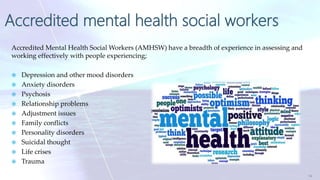
Accredited mental health social workers
Accredited Mental Health Social Workers (AMHSW) have a breadth of experience in assessing and
working effectively with people experiencing;
 Depression and other mood disorders
 Anxiety disorders
 Psychosis
 Relationship problems
 Adjustment issues
 Family conflicts
 Personality disorders
 Suicidal thought
 Life crises
 Trauma
14
Accredited mental health social workers
 Accredited Mental Health Social Workers help individuals with mental health
problems to resolve associated psychosocial issues and improve their quality of
life. This may involve family as well as individual counselling, and group
therapy.
 The Australian Association of Social Workers is the accrediting body on behalf
of Medicare Australia and the Australian Government for assessment of
Accredited Mental Health Social Workers. Successful applicants are able to
apply to Medicare Australia for a Medicare Provider Number and access
referrals under the Government funded programs.
 See the AASW website for more information on the
process for accreditation of mental health social workers
https://www.aasw.asn.au/information-for-the-community/mental-health-social-workers
15
References
 AASW - https://www.aasw.asn.au/information-for-the-community/mental-health-social-
workers
 Bland, R. 2005. ‘Social work practice in mental health’. In Alston, M. & McKinnon, J. (eds)
Social work fields of practice. Melbourne, OUP
 Briggs, L. & Harries, M. 2013. Mental health social work in Australia. In Connolly, M. &
Harms, L. (eds). 2009. Social work contexts and practice. Melbourne, OUP, chapter 17.
 Chenoweth, L. & McAuliffe, D. 2005. The road to social work and human service practice: An
introductory text. Sydney, Thompson
 Kirst-Ashman, K. 2007. Introduction to social work and social welfare practice: Critical thinking
perspectives. Belmont, Thomson.
16

HCS103 Topic 9

  • 1.
    HCS103 Topic 7 Presentationdraws on resources written by Karen Bell
  • 2.
    Historical trends inmental health (Kirst-Ashman 2007, p.166) 2 Trend Time Emphasis Moral Treatment 1770s- 1900 Institutional treatment/ asylum Mental Hygiene 1900-1945 Specialised psychiatric units, psychotherapy Deinstitutionalisation 1950- current Community Care
  • 3.
    3  ‘Social workershave been actively engaged in mental health practice, research and policy development since the mid-1900s’ (Briggs & Harries 2013, p.219).  Initial SW involvement as ‘psychiatric social workers’ in asylums.  Long-term commitment of SW to the bio-psycho-social model of practice.
  • 4.
    Domain of SocialWork practice The social context and social consequences of mental illness and disorder • Social context = social environment, including individual personality, vulnerability, resilience, family functioning & support, strengths & stressors, support networks, economic well-bring, employment, housing, etc • Social consequences = impacts of illness on individual, family & community relationships including violence & child protection issues, life chances, economic security, housing, etc. 4
  • 5.
    Purpose of practice ‘torestore individual, family, and community well-being, to promote the development of each individual’s power and control over their own lives, and to promote the principles of social justice’ (Bland 2005, p.120). Social justice = issues of stigma & discrimination, political freedoms, rights, access to treatment & ongoing support, equity in access to employment and life opportunities in general 5
  • 6.
    Social work valuesunderpinning practice Respect Self determination Confidentiality 6
  • 7.
    Social work valuesunderpinning practice  People are much more than an illness or a diagnostic label  Individuals have broad needs beyond specific treatment needs  Social workers stress ‘personhood’ rather than ‘patienthood’  Importance of family and friendships relationships beyond concepts of ‘carer’ (Bland 2005, p.120) 7
  • 8.
    Policy context The NationalMental Health Strategy aims to: • Promote mental health • Prevent mental health problems • Reduce impacts of mental illnesses on individuals, families and the broader community • Assure rights of people with mental health issues • Centrality of ‘consumer and carer’ voices (Briggs & Harries 2013). 8
  • 9.
    Underlying principles ofmental health policy  Multifaceted services, multidisciplinary teams  People with mental illness have same rights as all other people  Community & individuals have justifiable right to protection  Positive outcomes for consumers  Priority to severe mental illness & disability  Consumer participation in decision-making  Strong support for carers & advocates 9
  • 10.
    Consumer & carerissues Participation • Is a right – full information & involvement in planning, delivering & evaluating services • Encourages better services, strengthens accountability & responsiveness to consumer & carer needs 10
  • 11.
    Effective social workin mental health requires knowledge of;  Psychiatric disorders, treatment & prognosis, medication & side- effects  Legislation, e.g. involuntary admissions to hospital  Community resources, including income support, accommodation, referrals, etc  Ability to advocate for clients, to be assertive, to appreciate contribution of SW to multidisciplinary teams, good counselling skills  Need to balance rights of consumer & community needs (Bland 2005, p.124) 11
  • 12.
    Ethical issues  Socialcontrol – to restore and maintain as much as possible the power of individuals over their own lives  Self-determination – e.g. justification for treating people against their will, issues of competency in acute episodes of mental illness, maximising self-determination  Individual / family / community needs & rights – potential for competing needs & rights, conflicts  Importance of Code of Ethics as basis for professional decision- making 12
  • 13.
    Access to allied(mental) health professionals through Medicare  Registered psychologists  Accredited occupational therapists  Accredited social workers  For further information on access to mental health professionals covered by Medicare– http://www.health.gov.au/mentalhealth-betteraccess 13
  • 14.
    Accredited mental healthsocial workers Accredited Mental Health Social Workers (AMHSW) have a breadth of experience in assessing and working effectively with people experiencing;  Depression and other mood disorders  Anxiety disorders  Psychosis  Relationship problems  Adjustment issues  Family conflicts  Personality disorders  Suicidal thought  Life crises  Trauma 14
  • 15.
    Accredited mental healthsocial workers  Accredited Mental Health Social Workers help individuals with mental health problems to resolve associated psychosocial issues and improve their quality of life. This may involve family as well as individual counselling, and group therapy.  The Australian Association of Social Workers is the accrediting body on behalf of Medicare Australia and the Australian Government for assessment of Accredited Mental Health Social Workers. Successful applicants are able to apply to Medicare Australia for a Medicare Provider Number and access referrals under the Government funded programs.  See the AASW website for more information on the process for accreditation of mental health social workers https://www.aasw.asn.au/information-for-the-community/mental-health-social-workers 15
  • 16.
    References  AASW -https://www.aasw.asn.au/information-for-the-community/mental-health-social- workers  Bland, R. 2005. ‘Social work practice in mental health’. In Alston, M. & McKinnon, J. (eds) Social work fields of practice. Melbourne, OUP  Briggs, L. & Harries, M. 2013. Mental health social work in Australia. In Connolly, M. & Harms, L. (eds). 2009. Social work contexts and practice. Melbourne, OUP, chapter 17.  Chenoweth, L. & McAuliffe, D. 2005. The road to social work and human service practice: An introductory text. Sydney, Thompson  Kirst-Ashman, K. 2007. Introduction to social work and social welfare practice: Critical thinking perspectives. Belmont, Thomson. 16