HBase Sizing Notes
                                     Lars George
                         Director EMEA Services @ Cloudera
                                 lars@cloudera.com


Saturday, June 30, 12
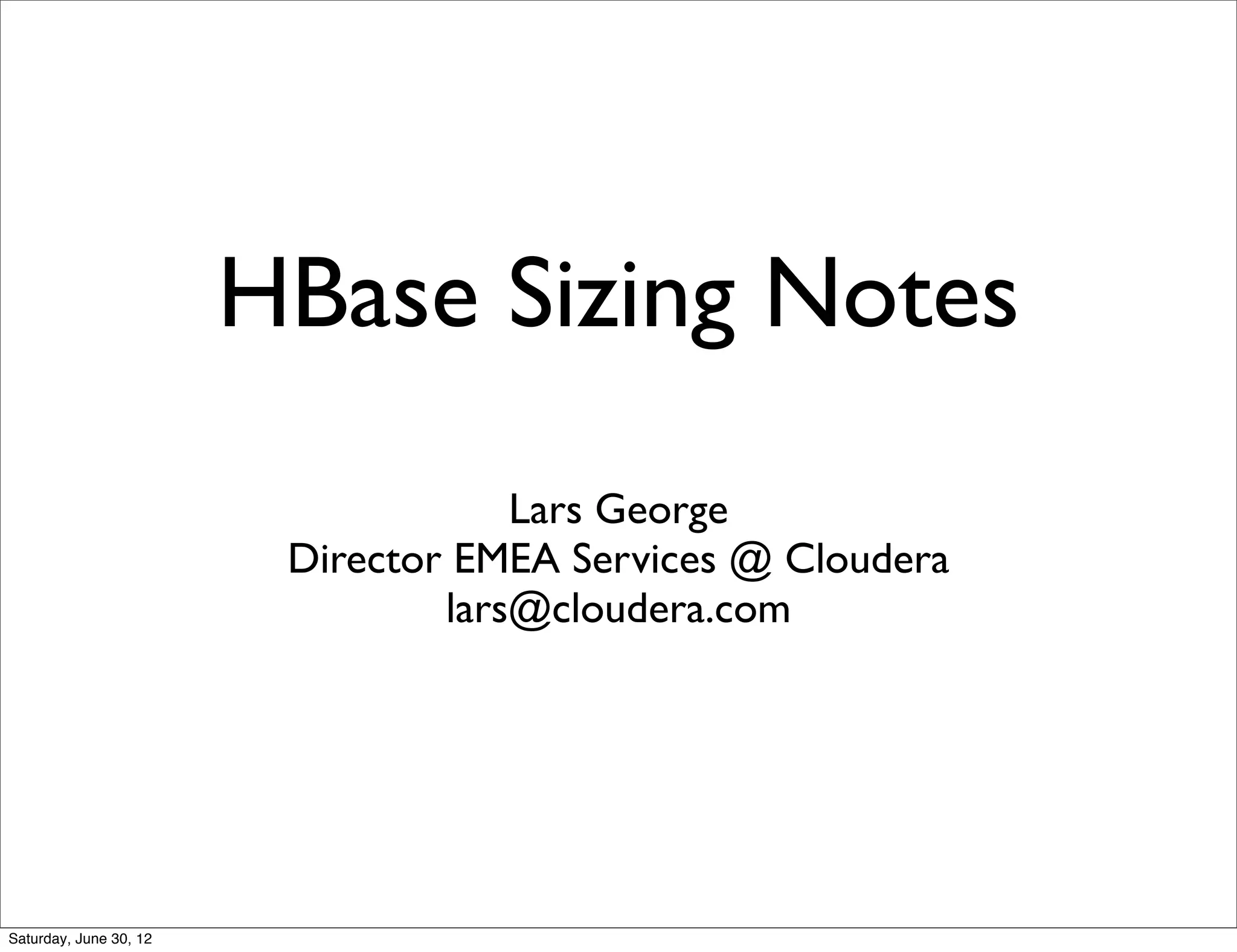
Competing Resources

                        • Reads and Writes compete for the same
                          low-level resources
                         ‣ Disk (HDFS) and Network I/O
                         ‣ RPC Handlers and Threads
                        • Otherwise the do exercise completely
                          separate code paths


Saturday, June 30, 12
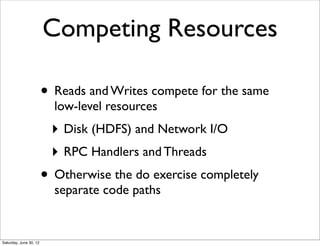
Memory Sharing
                        • By default every region server is dividing its
                          memory (i.e. given maximum heap) into
                          ‣ 40% for in-memory stores (write ops)
                          ‣ 20% for block caching (reads ops)
                          ‣ remaining space (here 40%) go towards
                            usual Java heap usage (objects etc.)
                        • Share of memory needs to be tweaked
Saturday, June 30, 12
Reads
                        • Locate and route request to appropriate
                          region server
                          ‣ Client caches information for faster
                            lookups ➜ consider prefetching option
                            for fast warmups
                        • Eliminate store files if possible using time
                          ranges or Bloom filter
                        • Try block cache, if block is missing then
                          load from disk

Saturday, June 30, 12
Block Cache
                        • Use exported metrics to see effectiveness
                          of block cache
                         ‣ Check fill and eviction rate, as well as hit
                            ratios ➜ random reads are not ideal
                        • Tweak up or down as needed, but watch
                          overall heap usage
                        • You absolutely need the block cache
                         ‣ Set to 10% at least for short term benefits
Saturday, June 30, 12
Writes
                        •   The cluster size is often determined by the
                            write performance
                        •   Log structured merge trees like
                            ‣   Store mutation in in-memory store and
                                write-ahead log
                            ‣   Flush out aggregated, sorted maps at specified
                                threshold - or - when under pressure
                            ‣   Discard logs with no pending edits
                            ‣   Perform regular compactions of store files

Saturday, June 30, 12
Write Performance
                        • There are many factors to the overall write
                          performance of a cluster
                          ‣ Key Distribution ➜ Avoid region hotspot
                          ‣ Handlers ➜ Do not pile up too early
                          ‣ Write-ahead log ➜ Bottleneck #1
                          ‣ Compactions ➜ Badly tuned can cause
                            ever increasing background noise

Saturday, June 30, 12
Write-Ahead Log
                        • Currently only one per region server
                         ‣ Shared across all stores (i.e. column
                            families)
                         ‣ Synchronized on file append calls
                        • Work being done on mitigating this
                         ‣ WAL Compression
                         ‣ Multiple WAL’s per region server ➜ Start
                            more than one region server per node?

Saturday, June 30, 12
Write-Ahead Log (cont.)
                        • Size set to 95% of default block size
                          ‣ 64MB or 128MB, but check config!
                        • Keep number low to reduce recovery time
                          ‣ Limit set to 32, but can be increased
                        • Increase size of logs - and/or - increase the
                          number of logs before blocking
                        • Compute number based on fill distribution
                          and flush frequencies

Saturday, June 30, 12
Write-Ahead Log (cont.)
                        • Writes are synchronized across all stores
                          ‣ A large cell in one family can stop all
                            writes of another
                          ‣ In this case the RPC handlers go binary,
                            i.e. either work or all block
                        • Can be bypassed on writes, but means no
                          real durability and no replication
                          ‣ Maybe use coprocessor to restore
                            dependent data sets (preWALRestore)
Saturday, June 30, 12
Flushes

                        • Every mutation call (put, delete etc.) causes
                          a check for a flush
                        • If threshold is met, flush file to disk and
                          schedule a compaction
                          ‣ Try to compact newly flushed files quickly
                        • The compaction returns - if necessary -
                          where a region should be split


Saturday, June 30, 12
Compaction Storms
                        • Premature flushing because of # of logs or
                          memory pressure
                         ‣ Files will be smaller than the configured
                            flush size
                        • The background compactions are hard at
                          work merging small flush files into the
                          existing, larger store files
                         ‣ Rewrite hundreds of MB over and over

Saturday, June 30, 12
Dependencies

                        • Flushes happen across all stores/column
                          families, even if just one triggers it
                        • The flush size is compared to the size of all
                          stores combined
                          ‣ Many column families dilute the size
                          ‣ Example: 55MB + 5MB + 4MB


Saturday, June 30, 12
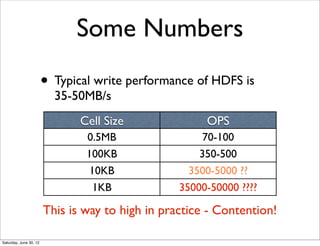
Some Numbers
                        • Typical write performance of HDFS is
                          35-50MB/s
                               Cell Size               OPS
                                0.5MB                  70-100
                                100KB                 350-500
                                 10KB               3500-5000 ??
                                  1KB             35000-50000 ????

                        This is way to high in practice - Contention!

Saturday, June 30, 12
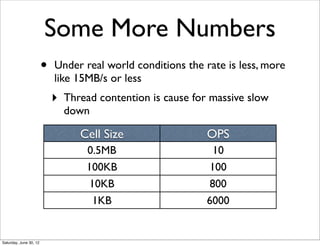
Some More Numbers
                        •   Under real world conditions the rate is less, more
                            like 15MB/s or less
                            ‣   Thread contention is cause for massive slow
                                down

                                   Cell Size                  OPS
                                    0.5MB                       10
                                    100KB                      100
                                     10KB                      800
                                      1KB                     6000


Saturday, June 30, 12
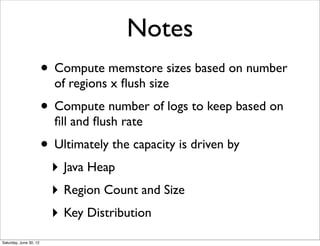
Notes
                        • Compute memstore sizes based on number
                          of regions x flush size
                        • Compute number of logs to keep based on
                          fill and flush rate
                        • Ultimately the capacity is driven by
                          ‣ Java Heap
                          ‣ Region Count and Size
                          ‣ Key Distribution
Saturday, June 30, 12
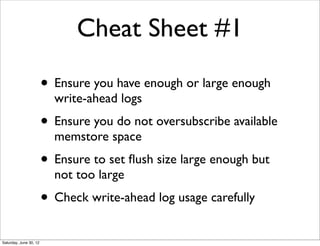
Cheat Sheet #1

                        • Ensure you have enough or large enough
                          write-ahead logs
                        • Ensure you do not oversubscribe available
                          memstore space
                        • Ensure to set flush size large enough but
                          not too large
                        • Check write-ahead log usage carefully
Saturday, June 30, 12
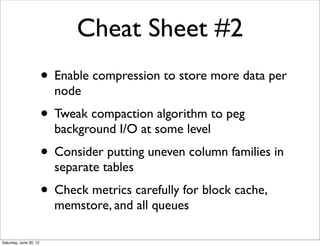
Cheat Sheet #2
                        • Enable compression to store more data per
                          node
                        • Tweak compaction algorithm to peg
                          background I/O at some level
                        • Consider putting uneven column families in
                          separate tables
                        • Check metrics carefully for block cache,
                          memstore, and all queues

Saturday, June 30, 12
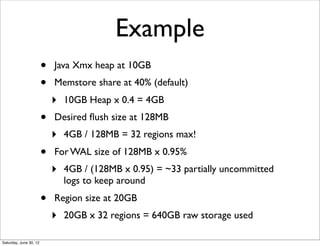
Example
                        •   Java Xmx heap at 10GB
                        •   Memstore share at 40% (default)
                            ‣   10GB Heap x 0.4 = 4GB
                        •   Desired flush size at 128MB
                            ‣   4GB / 128MB = 32 regions max!
                        •   For WAL size of 128MB x 0.95%
                            ‣   4GB / (128MB x 0.95) = ~33 partially uncommitted
                                logs to keep around
                        •   Region size at 20GB
                            ‣   20GB x 32 regions = 640GB raw storage used

Saturday, June 30, 12

HBase Sizing Notes

  • 1.
    HBase Sizing Notes Lars George Director EMEA Services @ Cloudera lars@cloudera.com Saturday, June 30, 12
  • 2.
    Competing Resources • Reads and Writes compete for the same low-level resources ‣ Disk (HDFS) and Network I/O ‣ RPC Handlers and Threads • Otherwise the do exercise completely separate code paths Saturday, June 30, 12
  • 3.
    Memory Sharing • By default every region server is dividing its memory (i.e. given maximum heap) into ‣ 40% for in-memory stores (write ops) ‣ 20% for block caching (reads ops) ‣ remaining space (here 40%) go towards usual Java heap usage (objects etc.) • Share of memory needs to be tweaked Saturday, June 30, 12
  • 4.
    Reads • Locate and route request to appropriate region server ‣ Client caches information for faster lookups ➜ consider prefetching option for fast warmups • Eliminate store files if possible using time ranges or Bloom filter • Try block cache, if block is missing then load from disk Saturday, June 30, 12
  • 5.
    Block Cache • Use exported metrics to see effectiveness of block cache ‣ Check fill and eviction rate, as well as hit ratios ➜ random reads are not ideal • Tweak up or down as needed, but watch overall heap usage • You absolutely need the block cache ‣ Set to 10% at least for short term benefits Saturday, June 30, 12
  • 6.
    Writes • The cluster size is often determined by the write performance • Log structured merge trees like ‣ Store mutation in in-memory store and write-ahead log ‣ Flush out aggregated, sorted maps at specified threshold - or - when under pressure ‣ Discard logs with no pending edits ‣ Perform regular compactions of store files Saturday, June 30, 12
  • 7.
    Write Performance • There are many factors to the overall write performance of a cluster ‣ Key Distribution ➜ Avoid region hotspot ‣ Handlers ➜ Do not pile up too early ‣ Write-ahead log ➜ Bottleneck #1 ‣ Compactions ➜ Badly tuned can cause ever increasing background noise Saturday, June 30, 12
  • 8.
    Write-Ahead Log • Currently only one per region server ‣ Shared across all stores (i.e. column families) ‣ Synchronized on file append calls • Work being done on mitigating this ‣ WAL Compression ‣ Multiple WAL’s per region server ➜ Start more than one region server per node? Saturday, June 30, 12
  • 9.
    Write-Ahead Log (cont.) • Size set to 95% of default block size ‣ 64MB or 128MB, but check config! • Keep number low to reduce recovery time ‣ Limit set to 32, but can be increased • Increase size of logs - and/or - increase the number of logs before blocking • Compute number based on fill distribution and flush frequencies Saturday, June 30, 12
  • 10.
    Write-Ahead Log (cont.) • Writes are synchronized across all stores ‣ A large cell in one family can stop all writes of another ‣ In this case the RPC handlers go binary, i.e. either work or all block • Can be bypassed on writes, but means no real durability and no replication ‣ Maybe use coprocessor to restore dependent data sets (preWALRestore) Saturday, June 30, 12
  • 11.
    Flushes • Every mutation call (put, delete etc.) causes a check for a flush • If threshold is met, flush file to disk and schedule a compaction ‣ Try to compact newly flushed files quickly • The compaction returns - if necessary - where a region should be split Saturday, June 30, 12
  • 12.
    Compaction Storms • Premature flushing because of # of logs or memory pressure ‣ Files will be smaller than the configured flush size • The background compactions are hard at work merging small flush files into the existing, larger store files ‣ Rewrite hundreds of MB over and over Saturday, June 30, 12
  • 13.
    Dependencies • Flushes happen across all stores/column families, even if just one triggers it • The flush size is compared to the size of all stores combined ‣ Many column families dilute the size ‣ Example: 55MB + 5MB + 4MB Saturday, June 30, 12
  • 14.
    Some Numbers • Typical write performance of HDFS is 35-50MB/s Cell Size OPS 0.5MB 70-100 100KB 350-500 10KB 3500-5000 ?? 1KB 35000-50000 ???? This is way to high in practice - Contention! Saturday, June 30, 12
  • 15.
    Some More Numbers • Under real world conditions the rate is less, more like 15MB/s or less ‣ Thread contention is cause for massive slow down Cell Size OPS 0.5MB 10 100KB 100 10KB 800 1KB 6000 Saturday, June 30, 12
  • 16.
    Notes • Compute memstore sizes based on number of regions x flush size • Compute number of logs to keep based on fill and flush rate • Ultimately the capacity is driven by ‣ Java Heap ‣ Region Count and Size ‣ Key Distribution Saturday, June 30, 12
  • 17.
    Cheat Sheet #1 • Ensure you have enough or large enough write-ahead logs • Ensure you do not oversubscribe available memstore space • Ensure to set flush size large enough but not too large • Check write-ahead log usage carefully Saturday, June 30, 12
  • 18.
    Cheat Sheet #2 • Enable compression to store more data per node • Tweak compaction algorithm to peg background I/O at some level • Consider putting uneven column families in separate tables • Check metrics carefully for block cache, memstore, and all queues Saturday, June 30, 12
  • 19.
    Example • Java Xmx heap at 10GB • Memstore share at 40% (default) ‣ 10GB Heap x 0.4 = 4GB • Desired flush size at 128MB ‣ 4GB / 128MB = 32 regions max! • For WAL size of 128MB x 0.95% ‣ 4GB / (128MB x 0.95) = ~33 partially uncommitted logs to keep around • Region size at 20GB ‣ 20GB x 32 regions = 640GB raw storage used Saturday, June 30, 12