






1
At the beginning, let’s review
some basic definitions
2
Hazard
Something with the potential to cause harm
such as FIRE Hazard
Risk
The probability of that harm to occur and it’s
consequences.
3
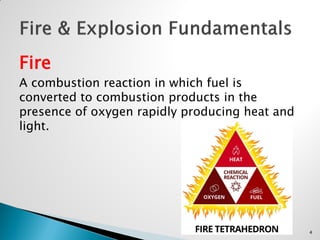
Fire
A combustion reaction in which fuel is
converted to combustion products in the
presence of oxygen rapidly producing heat and
light.
4
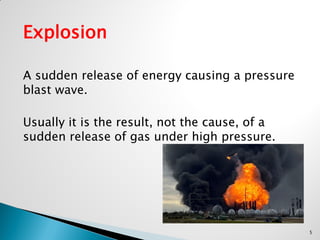
Explosion
A sudden release of energy causing a pressure
blast wave.
Usually it is the result, not the cause, of a
sudden release of gas under high pressure.
5
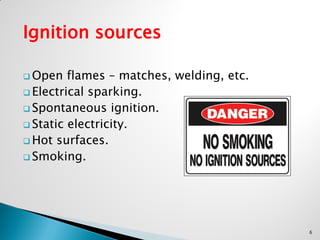
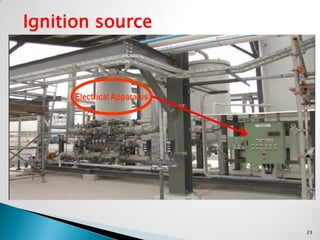
Ignition sources
 Open flames – matches, welding, etc.
 Electrical sparking.
 Spontaneous ignition.
 Static electricity.
 Hot surfaces.
 Smoking.
6
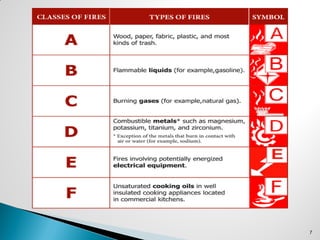
7
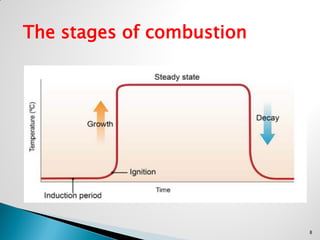
The stages of combustion
8
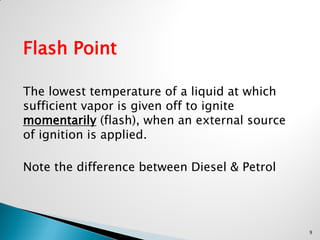
Flash Point
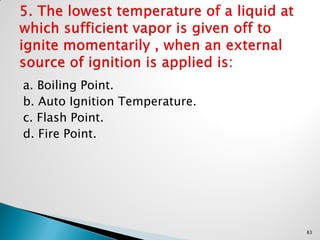
The lowest temperature of a liquid at which
sufficient vapor is given off to ignite
momentarily (flash), when an external source
of ignition is applied.
Note the difference between Diesel & Petrol
9
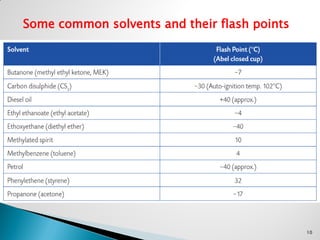
Some common solvents and their flash points
10
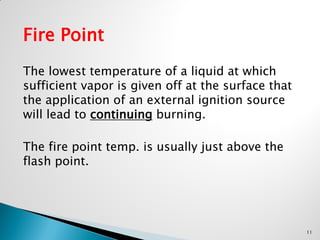
Fire Point
The lowest temperature of a liquid at which
sufficient vapor is given off at the surface that
the application of an external ignition source
will lead to continuing burning.
The fire point temp. is usually just above the
flash point.
11
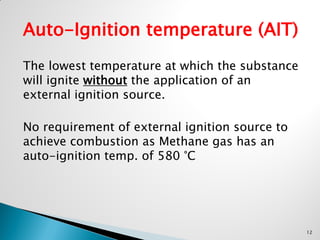
Auto-Ignition temperature (AIT)
The lowest temperature at which the substance
will ignite without the application of an
external ignition source.
No requirement of external ignition source to
achieve combustion as Methane gas has an
auto-ignition temp. of 580 °C
12
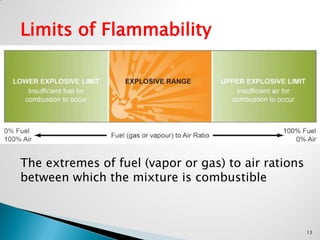
Limits of Flammability
The extremes of fuel (vapor or gas) to air rations
between which the mixture is combustible
13
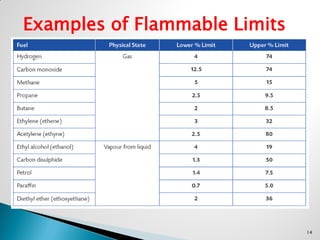
Examples of Flammable Limits
14
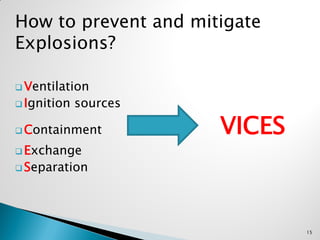
How to prevent and mitigate
Explosions?
 Ventilation
 Ignition sources
 Containment VICES
 Exchange
 Separation
15
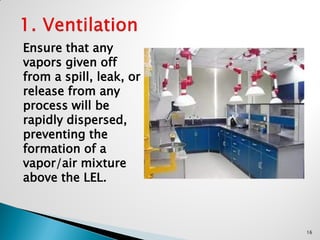
Ensure that any
vapors given off
from a spill, leak, or
release from any
process will be
rapidly dispersed,
preventing the
formation of a
vapor/air mixture
above the LEL.
16
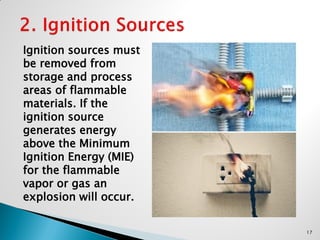
Ignition sources must
be removed from
storage and process
areas of flammable
materials. If the
ignition source
generates energy
above the Minimum
Ignition Energy (MIE)
for the flammable
vapor or gas an
explosion will occur.
17
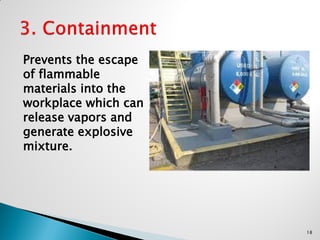
Prevents the escape
of flammable
materials into the
workplace which can
release vapors and
generate explosive
mixture.
18
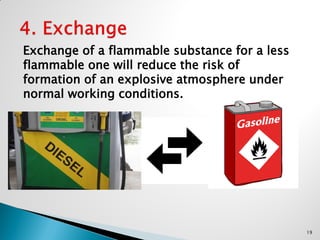
Exchange of a flammable substance for a less
flammable one will reduce the risk of
formation of an explosive atmosphere under
normal working conditions.
19
Separation of flammable substances from other
processes and general storage areas by
physical barriers, walls or partitions will
contribute to a safer workplace by controlling
the zone in which flammable atmosphere may
be present.
20
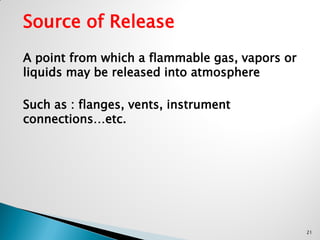
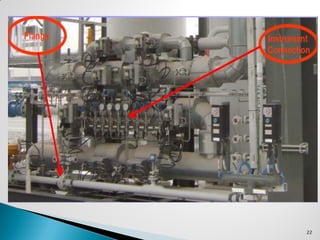
Source of Release
A point from which a flammable gas, vapors or
liquids may be released into atmosphere
Such as : flanges, vents, instrument
connections…etc.
21
22
Ignition source
23
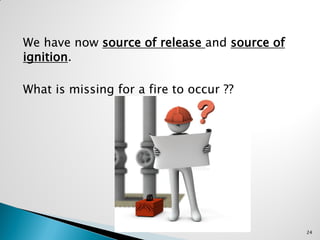
We have now source of release and source of
ignition.
What is missing for a fire to occur ??
24
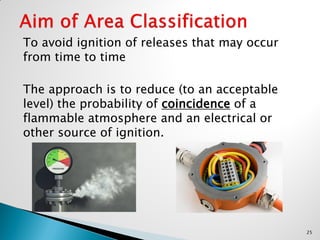
To avoid ignition of releases that may occur
from time to time
The approach is to reduce (to an acceptable
level) the probability of coincidence of a
flammable atmosphere and an electrical or
other source of ignition.
25
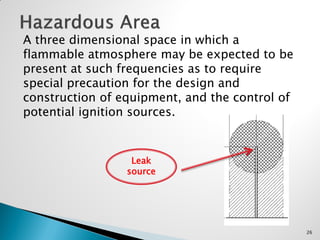
A three dimensional space in which a
flammable atmosphere may be expected to be
present at such frequencies as to require
special precaution for the design and
construction of equipment, and the control of
potential ignition sources.
26
Leak
source
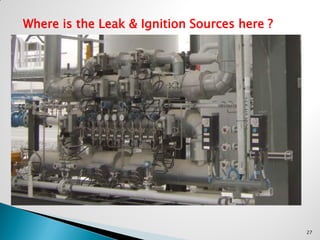
Where is the Leak & Ignition Sources here ?
27
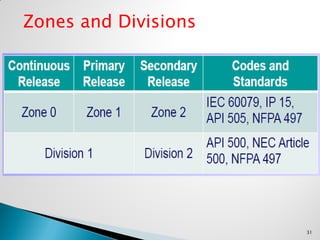
Subdivisions of Hazardous Area
The European classification
Zone 0 – Zone 1 – Zone 2
The American classification
Division 1 – Division 2
28
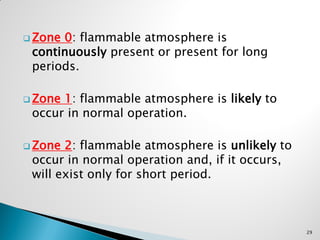
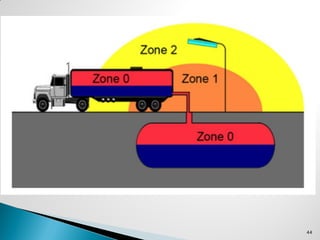
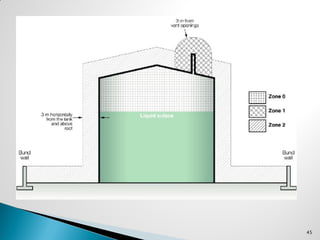
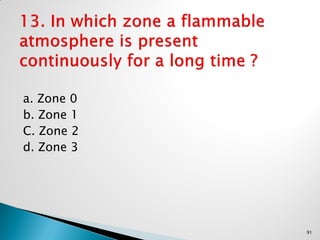
 Zone 0: flammable atmosphere is
continuously present or present for long
periods.
 Zone 1: flammable atmosphere is likely to
occur in normal operation.
 Zone 2: flammable atmosphere is unlikely to
occur in normal operation and, if it occurs,
will exist only for short period.
29
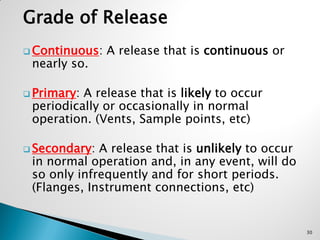
Grade of Release
 Continuous: A release that is continuous or
nearly so.
 Primary: A release that is likely to occur
periodically or occasionally in normal
operation. (Vents, Sample points, etc)
 Secondary: A release that is unlikely to occur
in normal operation and, in any event, will do
so only infrequently and for short periods.
(Flanges, Instrument connections, etc)
30
Zones and Divisions
31
32
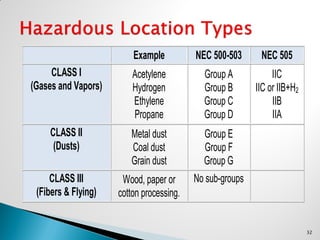
Example NEC 500-503 NEC 505
CLASS I
(Gases and Vapors)
Acetylene
Hydrogen
Ethylene
Propane
Group A
Group B
Group C
Group D
IIC
IIC or IIB+H2
IIB
IIA
CLASS II
(Dusts)
Metal dust
Coal dust
Grain dust
Group E
Group F
Group G
CLASS III
(Fibers & Flying)
Wood, paper or
cotton processing.
No sub-groups
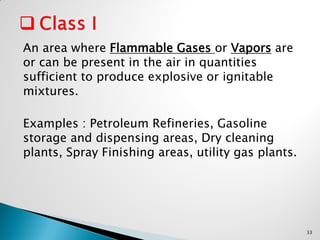
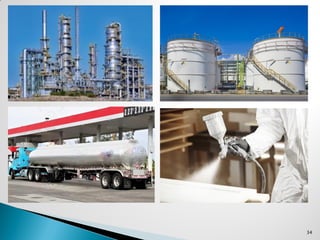
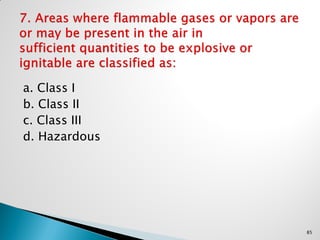
An area where Flammable Gases or Vapors are
or can be present in the air in quantities
sufficient to produce explosive or ignitable
mixtures.
Examples : Petroleum Refineries, Gasoline
storage and dispensing areas, Dry cleaning
plants, Spray Finishing areas, utility gas plants.
33
34
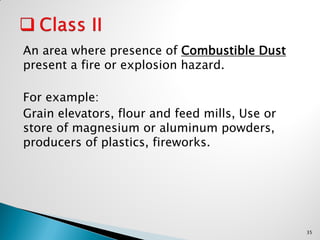
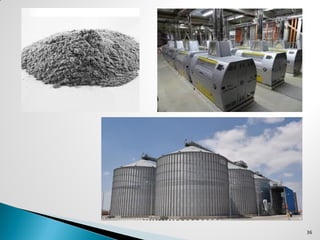
An area where presence of Combustible Dust
present a fire or explosion hazard.
For example:
Grain elevators, flour and feed mills, Use or
store of magnesium or aluminum powders,
producers of plastics, fireworks.
35
36
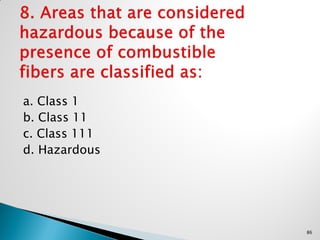
An area made hazardous due to the presence
of easily Ignitable Fibers or flings.
For example:
Textile mills, cotton gins, cotton seed mills,
plants that shape or cut wood and create
sawdust or flings.
37
38
In addition to the types of hazardous locations,
the kind of conditions under which these
hazards are present are very important :
Normal Conditions & Abnormal Conditions
Division 1: Normal Conditions
Division 2 : Abnormal Conditions
39
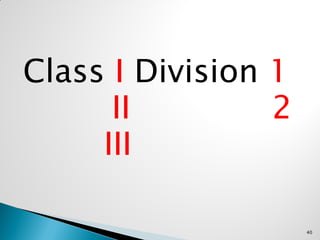
Class I Division 1
II 2
III
40
 Where ignitable concentration of flammable
gases, vapors or liquids can exist all of the time
or some of the time under normal operating
conditions. (Remember Zone 0 & Zone 1)
 Where ignitable concentrations of such gases or
vapors may exist frequently because of repair or
maintenance operations or because of leakage.
 Faulty operations of equipment or processes
might release ignitable concentrations of
flammable gases or vapors and might cause
simultaneous failure of electrical equipment in
such a way as to directly cause the electrical
equipment to become a source of ignition.
41
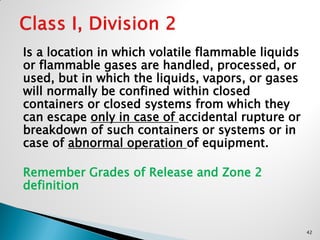
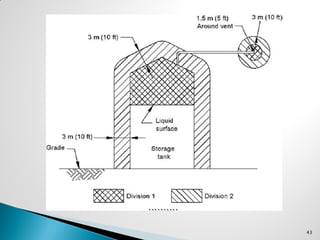
Is a location in which volatile flammable liquids
or flammable gases are handled, processed, or
used, but in which the liquids, vapors, or gases
will normally be confined within closed
containers or closed systems from which they
can escape only in case of accidental rupture or
breakdown of such containers or systems or in
case of abnormal operation of equipment.
Remember Grades of Release and Zone 2
definition
42
43
44
45
46
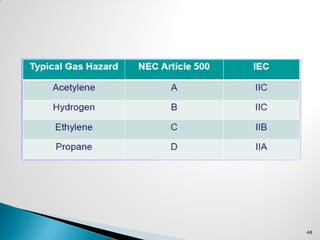
The gases and vapors of class I locations are
broken into four groups : A, B, C, and D.
These materials are grouped according to the
ignition temperature of the substance, its
explosion pressure, and other flammable
characteristics.
47
48
Group A
An atmosphere containing Acetylene.
Group B
Atmosphere containing a flammable gas, a
flammable liquid produced vapor, or a
combustible liquid produced vapor mixed with
air that may burn or explode, such as
Hydrogen or fuel and combustible process
gases containing more than 30% hydrogen by
volume - or gases of equivalent hazard such as
butadiene, ethylene oxide.
49
Group C
Atmosphere containing a flammable gas, a
flammable liquid produced vapor or a
combustible liquid such as carbon monoxide,
ether, hydrogen sulfide, Morphline,
cyclopropane, ethyl, isoprene, Acetaldhyde and
ethylene or gases of equivalent hazard.
50
Group D
Atmosphere containing flammable gas,
flammable liquid produced vapor, or
combustible liquid produced vapor mixed with
air that may burn or explode, such as gasoline,
acetone, ammonia, benzene, butane, ethanol,
hexane, methanol, methane, vinyl chloride,
natural gas, naphtha, propane or gases of
equivalent hazard
51
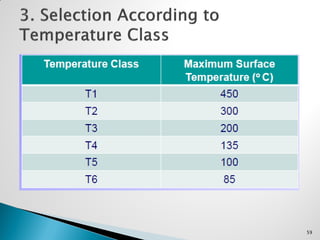
 It is important to know how hot equipment
gets, so that hot surfaces cannot be ignition
sources.
 Six temperature classes are used T1 – T6
 The lower the number the higher the
maximum allowable surface temperature
 Temperature classification is based on fault
conditions.
 T-class must be below Auto-ignition
Temperature of the gas.
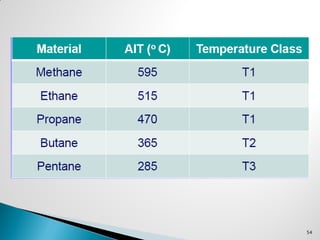
52
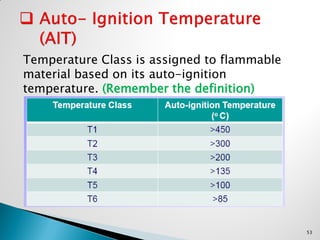
Temperature Class is assigned to flammable
material based on its auto-ignition
temperature. (Remember the definition)
53
54
55
1- Zone in which the equipment will be used.
2- Sensitivity to ignition of the material likely
to be present, expressed as a gas group.
3- Sensitivity of the material present to
ignition by hot surfaces, expressed as a
temperature class.
56
 Equipment suitable for Zone 0 can be used in
Zones 0, 1 or 2.
 Equipment suitable for Zone 1 can be used in
Zones 1 or 2.
 Equipment suitable for Zone 2 can be used
only in Zone 2.
57
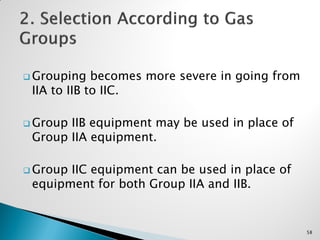
 Grouping becomes more severe in going from
IIA to IIB to IIC.
 Group IIB equipment may be used in place of
Group IIA equipment.
 Group IIC equipment can be used in place of
equipment for both Group IIA and IIB.
58
59
60
61
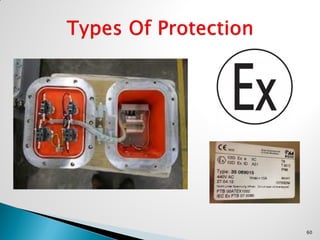
1. Flameproof Enclosures “d”
2. Intrinsic Safety “i”
3. Increased Safety “e”
4. Powder/Sand Filled “q”
5. Pressurized Apparatus “p”
6. Oil Immersion “o”
7. Special Protection “s”
8. Encapsulation “m”
9. Type of protection N “N”
62
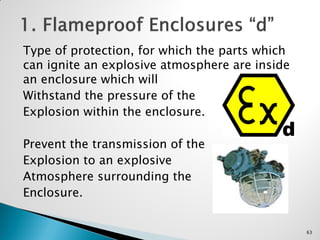
Type of protection, for which the parts which
can ignite an explosive atmosphere are inside
an enclosure which will
Withstand the pressure of the
Explosion within the enclosure.
Prevent the transmission of the
Explosion to an explosive
Atmosphere surrounding the
Enclosure.
63
Type of protection, for which the energy in the
electrical circuit is held so low that sparks, arcs
or temperatures capable of causing ignition
cannot occur.
Includes sub-division into the categories ia &
ib
ia must not produce any ignition when any
combination of two faults is present.
ib must not produce any ignition, in normal
operation, when one fault is present.
64
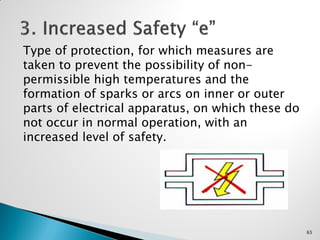
Type of protection, for which measures are
taken to prevent the possibility of non-
permissible high temperatures and the
formation of sparks or arcs on inner or outer
parts of electrical apparatus, on which these do
not occur in normal operation, with an
increased level of safety.
65
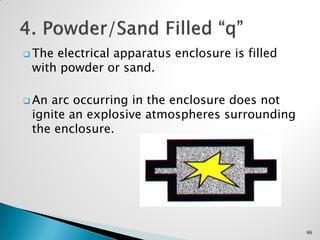
 The electrical apparatus enclosure is filled
with powder or sand.
 An arc occurring in the enclosure does not
ignite an explosive atmospheres surrounding
the enclosure.
66
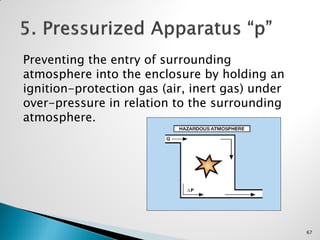
Preventing the entry of surrounding
atmosphere into the enclosure by holding an
ignition-protection gas (air, inert gas) under
over-pressure in relation to the surrounding
atmosphere.
67
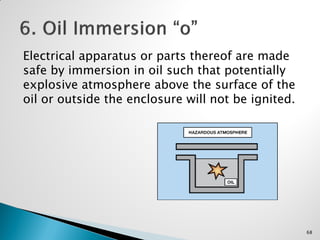
Electrical apparatus or parts thereof are made
safe by immersion in oil such that potentially
explosive atmosphere above the surface of the
oil or outside the enclosure will not be ignited.
68
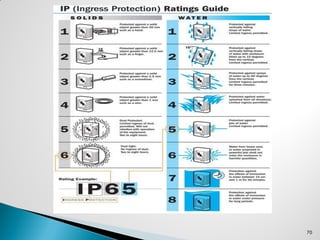
Ingress protection ratings or IP ratings, refer to the
level of protection offered by an electrical
enclosure, against solids and liquids.
In an environment where dust or water could
damage electronic components, a sealed enclosure
is used to prevent such ingress and safe house the
electronics.
They are commonly used for applications which
may be exposed to the elements, as well as dust or
moisture. Typical industries include marine,
offshore oil and gas platforms, lighting, food
processing and more.
69
70
71
Gas, Vapors, Dusts….??
Hydrogen, LPG, Gasoline ??
72
Identify sources of release and determine
grade of release.
and hence Zone 0 – Zone 1- Zone 2 or Division
1, 2
73
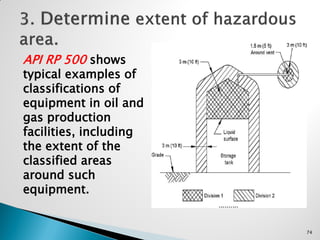
API RP 500 shows
typical examples of
classifications of
equipment in oil and
gas production
facilities, including
the extent of the
classified areas
around such
equipment.
74
Gas Groups : A, B, C, D OR IIA, IIB, IIC
Temp. classes from T1 to T6
75
76
77
78
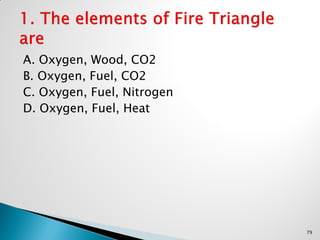
A. Oxygen, Wood, CO2
B. Oxygen, Fuel, CO2
C. Oxygen, Fuel, Nitrogen
D. Oxygen, Fuel, Heat
79
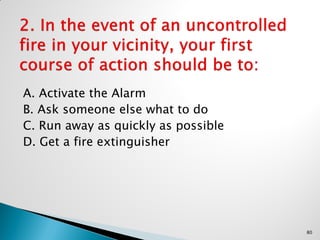
A. Activate the Alarm
B. Ask someone else what to do
C. Run away as quickly as possible
D. Get a fire extinguisher
80
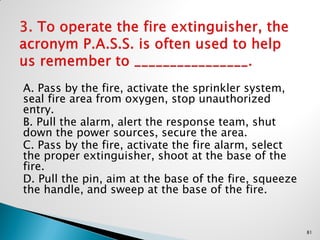
A. Pass by the fire, activate the sprinkler system,
seal fire area from oxygen, stop unauthorized
entry.
B. Pull the alarm, alert the response team, shut
down the power sources, secure the area.
C. Pass by the fire, activate the fire alarm, select
the proper extinguisher, shoot at the base of the
fire.
D. Pull the pin, aim at the base of the fire, squeeze
the handle, and sweep at the base of the fire.
81
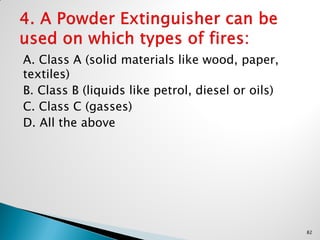
A. Class A (solid materials like wood, paper,
textiles)
B. Class B (liquids like petrol, diesel or oils)
C. Class C (gasses)
D. All the above
82
a. Boiling Point.
b. Auto Ignition Temperature.
c. Flash Point.
d. Fire Point.
83
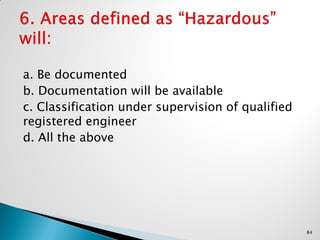
a. Be documented
b. Documentation will be available
c. Classification under supervision of qualified
registered engineer
d. All the above
84
a. Class I
b. Class II
c. Class III
d. Hazardous
85
a. Class 1
b. Class 11
c. Class 111
d. Hazardous
86
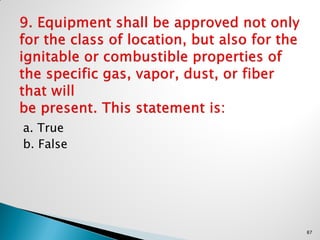
a. True
b. False
87
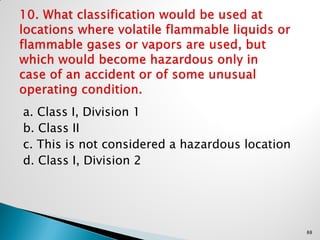
a. Class I, Division 1
b. Class II
c. This is not considered a hazardous location
d. Class I, Division 2
88
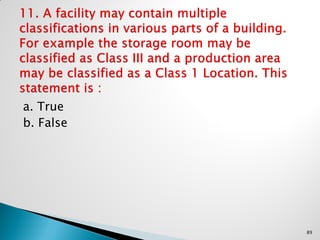
a. True
b. False
89
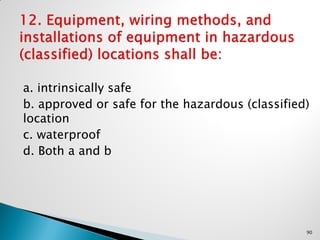
a. intrinsically safe
b. approved or safe for the hazardous (classified)
location
c. waterproof
d. Both a and b
90
a. Zone 0
b. Zone 1
C. Zone 2
d. Zone 3
91
92
93
94
95

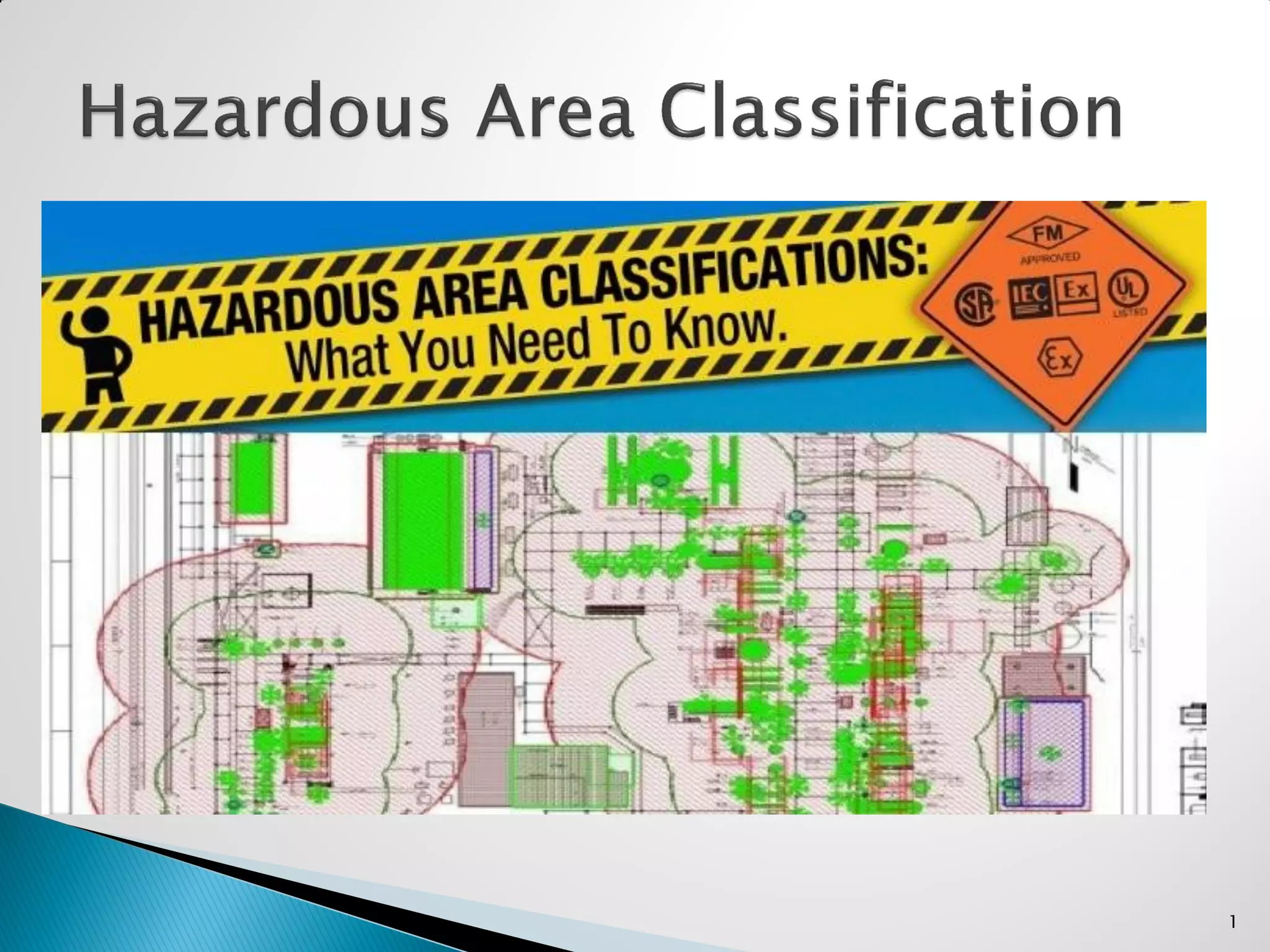
Hazardous Area Classification

  • 1.
  • 2.
    At the beginning,let’s review some basic definitions 2
  • 3.
    Hazard Something with thepotential to cause harm such as FIRE Hazard Risk The probability of that harm to occur and it’s consequences. 3
  • 4.
    Fire A combustion reactionin which fuel is converted to combustion products in the presence of oxygen rapidly producing heat and light. 4
  • 5.
    Explosion A sudden releaseof energy causing a pressure blast wave. Usually it is the result, not the cause, of a sudden release of gas under high pressure. 5
  • 6.
    Ignition sources  Openflames – matches, welding, etc.  Electrical sparking.  Spontaneous ignition.  Static electricity.  Hot surfaces.  Smoking. 6
  • 7.
  • 8.
    The stages ofcombustion 8
  • 9.
    Flash Point The lowesttemperature of a liquid at which sufficient vapor is given off to ignite momentarily (flash), when an external source of ignition is applied. Note the difference between Diesel & Petrol 9
  • 10.
    Some common solventsand their flash points 10
  • 11.
    Fire Point The lowesttemperature of a liquid at which sufficient vapor is given off at the surface that the application of an external ignition source will lead to continuing burning. The fire point temp. is usually just above the flash point. 11
  • 12.
    Auto-Ignition temperature (AIT) Thelowest temperature at which the substance will ignite without the application of an external ignition source. No requirement of external ignition source to achieve combustion as Methane gas has an auto-ignition temp. of 580 °C 12
  • 13.
    Limits of Flammability Theextremes of fuel (vapor or gas) to air rations between which the mixture is combustible 13
  • 14.
  • 15.
    How to preventand mitigate Explosions?  Ventilation  Ignition sources  Containment VICES  Exchange  Separation 15
  • 16.
    Ensure that any vaporsgiven off from a spill, leak, or release from any process will be rapidly dispersed, preventing the formation of a vapor/air mixture above the LEL. 16
  • 17.
    Ignition sources must beremoved from storage and process areas of flammable materials. If the ignition source generates energy above the Minimum Ignition Energy (MIE) for the flammable vapor or gas an explosion will occur. 17
  • 18.
    Prevents the escape offlammable materials into the workplace which can release vapors and generate explosive mixture. 18
  • 19.
    Exchange of aflammable substance for a less flammable one will reduce the risk of formation of an explosive atmosphere under normal working conditions. 19
  • 20.
    Separation of flammablesubstances from other processes and general storage areas by physical barriers, walls or partitions will contribute to a safer workplace by controlling the zone in which flammable atmosphere may be present. 20
  • 21.
    Source of Release Apoint from which a flammable gas, vapors or liquids may be released into atmosphere Such as : flanges, vents, instrument connections…etc. 21
  • 22.
  • 23.
  • 24.
    We have nowsource of release and source of ignition. What is missing for a fire to occur ?? 24
  • 25.
    To avoid ignitionof releases that may occur from time to time The approach is to reduce (to an acceptable level) the probability of coincidence of a flammable atmosphere and an electrical or other source of ignition. 25
  • 26.
    A three dimensionalspace in which a flammable atmosphere may be expected to be present at such frequencies as to require special precaution for the design and construction of equipment, and the control of potential ignition sources. 26 Leak source
  • 27.
    Where is theLeak & Ignition Sources here ? 27
  • 28.
    Subdivisions of HazardousArea The European classification Zone 0 – Zone 1 – Zone 2 The American classification Division 1 – Division 2 28
  • 29.
     Zone 0:flammable atmosphere is continuously present or present for long periods.  Zone 1: flammable atmosphere is likely to occur in normal operation.  Zone 2: flammable atmosphere is unlikely to occur in normal operation and, if it occurs, will exist only for short period. 29
  • 30.
    Grade of Release Continuous: A release that is continuous or nearly so.  Primary: A release that is likely to occur periodically or occasionally in normal operation. (Vents, Sample points, etc)  Secondary: A release that is unlikely to occur in normal operation and, in any event, will do so only infrequently and for short periods. (Flanges, Instrument connections, etc) 30
  • 31.
  • 32.
    32 Example NEC 500-503NEC 505 CLASS I (Gases and Vapors) Acetylene Hydrogen Ethylene Propane Group A Group B Group C Group D IIC IIC or IIB+H2 IIB IIA CLASS II (Dusts) Metal dust Coal dust Grain dust Group E Group F Group G CLASS III (Fibers & Flying) Wood, paper or cotton processing. No sub-groups
  • 33.
    An area whereFlammable Gases or Vapors are or can be present in the air in quantities sufficient to produce explosive or ignitable mixtures. Examples : Petroleum Refineries, Gasoline storage and dispensing areas, Dry cleaning plants, Spray Finishing areas, utility gas plants. 33
  • 34.
  • 35.
    An area wherepresence of Combustible Dust present a fire or explosion hazard. For example: Grain elevators, flour and feed mills, Use or store of magnesium or aluminum powders, producers of plastics, fireworks. 35
  • 36.
  • 37.
    An area madehazardous due to the presence of easily Ignitable Fibers or flings. For example: Textile mills, cotton gins, cotton seed mills, plants that shape or cut wood and create sawdust or flings. 37
  • 38.
  • 39.
    In addition tothe types of hazardous locations, the kind of conditions under which these hazards are present are very important : Normal Conditions & Abnormal Conditions Division 1: Normal Conditions Division 2 : Abnormal Conditions 39
  • 40.
    Class I Division1 II 2 III 40
  • 41.
     Where ignitableconcentration of flammable gases, vapors or liquids can exist all of the time or some of the time under normal operating conditions. (Remember Zone 0 & Zone 1)  Where ignitable concentrations of such gases or vapors may exist frequently because of repair or maintenance operations or because of leakage.  Faulty operations of equipment or processes might release ignitable concentrations of flammable gases or vapors and might cause simultaneous failure of electrical equipment in such a way as to directly cause the electrical equipment to become a source of ignition. 41
  • 42.
    Is a locationin which volatile flammable liquids or flammable gases are handled, processed, or used, but in which the liquids, vapors, or gases will normally be confined within closed containers or closed systems from which they can escape only in case of accidental rupture or breakdown of such containers or systems or in case of abnormal operation of equipment. Remember Grades of Release and Zone 2 definition 42
  • 43.
  • 44.
  • 45.
  • 46.
  • 47.
    The gases andvapors of class I locations are broken into four groups : A, B, C, and D. These materials are grouped according to the ignition temperature of the substance, its explosion pressure, and other flammable characteristics. 47
  • 48.
  • 49.
    Group A An atmospherecontaining Acetylene. Group B Atmosphere containing a flammable gas, a flammable liquid produced vapor, or a combustible liquid produced vapor mixed with air that may burn or explode, such as Hydrogen or fuel and combustible process gases containing more than 30% hydrogen by volume - or gases of equivalent hazard such as butadiene, ethylene oxide. 49
  • 50.
    Group C Atmosphere containinga flammable gas, a flammable liquid produced vapor or a combustible liquid such as carbon monoxide, ether, hydrogen sulfide, Morphline, cyclopropane, ethyl, isoprene, Acetaldhyde and ethylene or gases of equivalent hazard. 50
  • 51.
    Group D Atmosphere containingflammable gas, flammable liquid produced vapor, or combustible liquid produced vapor mixed with air that may burn or explode, such as gasoline, acetone, ammonia, benzene, butane, ethanol, hexane, methanol, methane, vinyl chloride, natural gas, naphtha, propane or gases of equivalent hazard 51
  • 52.
     It isimportant to know how hot equipment gets, so that hot surfaces cannot be ignition sources.  Six temperature classes are used T1 – T6  The lower the number the higher the maximum allowable surface temperature  Temperature classification is based on fault conditions.  T-class must be below Auto-ignition Temperature of the gas. 52
  • 53.
    Temperature Class isassigned to flammable material based on its auto-ignition temperature. (Remember the definition) 53
  • 54.
  • 55.
  • 56.
    1- Zone inwhich the equipment will be used. 2- Sensitivity to ignition of the material likely to be present, expressed as a gas group. 3- Sensitivity of the material present to ignition by hot surfaces, expressed as a temperature class. 56
  • 57.
     Equipment suitablefor Zone 0 can be used in Zones 0, 1 or 2.  Equipment suitable for Zone 1 can be used in Zones 1 or 2.  Equipment suitable for Zone 2 can be used only in Zone 2. 57
  • 58.
     Grouping becomesmore severe in going from IIA to IIB to IIC.  Group IIB equipment may be used in place of Group IIA equipment.  Group IIC equipment can be used in place of equipment for both Group IIA and IIB. 58
  • 59.
  • 60.
  • 61.
  • 62.
    1. Flameproof Enclosures“d” 2. Intrinsic Safety “i” 3. Increased Safety “e” 4. Powder/Sand Filled “q” 5. Pressurized Apparatus “p” 6. Oil Immersion “o” 7. Special Protection “s” 8. Encapsulation “m” 9. Type of protection N “N” 62
  • 63.
    Type of protection,for which the parts which can ignite an explosive atmosphere are inside an enclosure which will Withstand the pressure of the Explosion within the enclosure. Prevent the transmission of the Explosion to an explosive Atmosphere surrounding the Enclosure. 63
  • 64.
    Type of protection,for which the energy in the electrical circuit is held so low that sparks, arcs or temperatures capable of causing ignition cannot occur. Includes sub-division into the categories ia & ib ia must not produce any ignition when any combination of two faults is present. ib must not produce any ignition, in normal operation, when one fault is present. 64
  • 65.
    Type of protection,for which measures are taken to prevent the possibility of non- permissible high temperatures and the formation of sparks or arcs on inner or outer parts of electrical apparatus, on which these do not occur in normal operation, with an increased level of safety. 65
  • 66.
     The electricalapparatus enclosure is filled with powder or sand.  An arc occurring in the enclosure does not ignite an explosive atmospheres surrounding the enclosure. 66
  • 67.
    Preventing the entryof surrounding atmosphere into the enclosure by holding an ignition-protection gas (air, inert gas) under over-pressure in relation to the surrounding atmosphere. 67
  • 68.
    Electrical apparatus orparts thereof are made safe by immersion in oil such that potentially explosive atmosphere above the surface of the oil or outside the enclosure will not be ignited. 68
  • 69.
    Ingress protection ratingsor IP ratings, refer to the level of protection offered by an electrical enclosure, against solids and liquids. In an environment where dust or water could damage electronic components, a sealed enclosure is used to prevent such ingress and safe house the electronics. They are commonly used for applications which may be exposed to the elements, as well as dust or moisture. Typical industries include marine, offshore oil and gas platforms, lighting, food processing and more. 69
  • 70.
  • 71.
  • 72.
  • 73.
    Identify sources ofrelease and determine grade of release. and hence Zone 0 – Zone 1- Zone 2 or Division 1, 2 73
  • 74.
    API RP 500shows typical examples of classifications of equipment in oil and gas production facilities, including the extent of the classified areas around such equipment. 74
  • 75.
    Gas Groups :A, B, C, D OR IIA, IIB, IIC Temp. classes from T1 to T6 75
  • 76.
  • 77.
  • 78.
  • 79.
    A. Oxygen, Wood,CO2 B. Oxygen, Fuel, CO2 C. Oxygen, Fuel, Nitrogen D. Oxygen, Fuel, Heat 79
  • 80.
    A. Activate theAlarm B. Ask someone else what to do C. Run away as quickly as possible D. Get a fire extinguisher 80
  • 81.
    A. Pass bythe fire, activate the sprinkler system, seal fire area from oxygen, stop unauthorized entry. B. Pull the alarm, alert the response team, shut down the power sources, secure the area. C. Pass by the fire, activate the fire alarm, select the proper extinguisher, shoot at the base of the fire. D. Pull the pin, aim at the base of the fire, squeeze the handle, and sweep at the base of the fire. 81
  • 82.
    A. Class A(solid materials like wood, paper, textiles) B. Class B (liquids like petrol, diesel or oils) C. Class C (gasses) D. All the above 82
  • 83.
    a. Boiling Point. b.Auto Ignition Temperature. c. Flash Point. d. Fire Point. 83
  • 84.
    a. Be documented b.Documentation will be available c. Classification under supervision of qualified registered engineer d. All the above 84
  • 85.
    a. Class I b.Class II c. Class III d. Hazardous 85
  • 86.
    a. Class 1 b.Class 11 c. Class 111 d. Hazardous 86
  • 87.
  • 88.
    a. Class I,Division 1 b. Class II c. This is not considered a hazardous location d. Class I, Division 2 88
  • 89.
  • 90.
    a. intrinsically safe b.approved or safe for the hazardous (classified) location c. waterproof d. Both a and b 90
  • 91.
    a. Zone 0 b.Zone 1 C. Zone 2 d. Zone 3 91
  • 92.
  • 93.
  • 94.
  • 95.