Opening access to educational resources for
use and reuse. OOER MEDEV! A progress
report
Suzanne Hardy
Senior Advisor (Information)
March 2010
UHMLG Spring Forum, Woburn House, London
www.medev.ac.uk
The HEFCE/JISC/HEA OER programme
(14/08) - Background
• Higher Education Funding Council for England
(HEFCE) announced an initial £5.7 million of funding
for pilot projects that will open up existing
high-quality education resources from UK higher
education institutions to the world
• Higher Education Academy and JISC working in
partnership to deliver 12-month pilot projects -
formally launched in April 2009
www.medev.ac.uk
The HEFCE/JISC/HEA OER programme
(14/08)
• Aims to make a wide range of learning resources created
by academics freely available, easily discovered and
routinely re-used by both educators and learners.
• Expected that funded projects demonstrate long term
commitment to release of OER resources. Projects
working towards sustainability of long term open
resources release via the adoption of appropriate
business models to support this
• Recommendations may include modifications to
institutional policies and processes, with the aim of making
open resources release an expected part of the
educational resources creation cycle
www.medev.ac.uk
The HEFCE/JISC/HEA OER programme
(14/08)
• OER could include full courses, course materials,
complete modules, notes, videos, assessments,
tests, simulations, worked examples, software, and
any other tools or materials or techniques used to
support access to knowledge. These resources will
be released under an intellectual property license that
permits open use and adaptation (e.g. Creative
Commons)
www.medev.ac.uk
Creative Commons: example
www.medev.ac.uk
The HEFCE/JISC/HEA OER programme
(14/08)
• Pilot projects to release existing learning resources
under a suitable license for open use and
repurposing under 3 strands of activity:
1. Institutional
2. Individual
3. Subject
www.medev.ac.uk
The HEFCE/JISC/HEA OER programme
(14/08)
• Not about creating new content
• Exposing existing content to wider audiences
• Exploring the drivers, challenges and barriers and
making recommendations
• Projects mandated to deposit into Jorum Open
• Evaluation of pilot programme, including synthesis of
project outcomes, to be carried out by Glasgow
Caledonian University
www.medev.ac.uk
www.medev.ac.uk
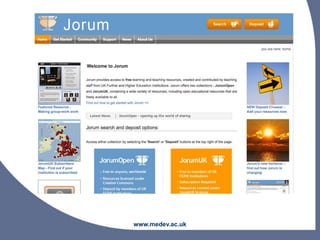
JorumOpen
• JorumOpen - for content whose creators and owners
who are willing and are able to share their content on
a worldwide basis under the terms of a Creative
Commons (CC)
• www.jorum.ac.uk
• Limited metadata requirements, many more optional
fields: http://www.jorum.ac.uk/docs/pdf/japv1p0.pdf
• Use #ukoer as tag in web2.0 e.g. blogs, Twitter and
del.icio.us
www.medev.ac.uk
www.medev.ac.uk
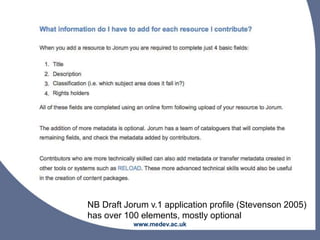
NB Draft Jorum v.1 application profile (Stevenson 2005)
has over 100 elements, mostly optional
OOER
• Organising Open Educational Resources
• Bid can be downloaded from www.medev.ac.uk/oer
• Focusses on issues relating to consent, securing ER from
staff delivering programmes who are non-HEI employed,
and complements other projects in the programme
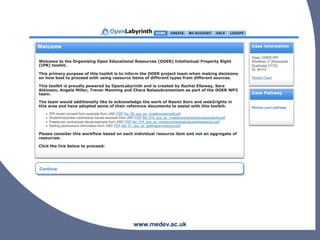
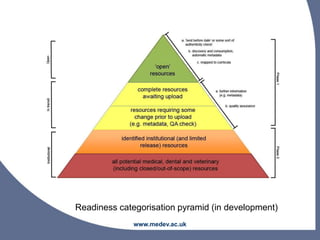
• Results of mapping and readiness categorisation together
with development of simple toolkits (to help HEIs, Subjects
and Individuals) will inform identification of ER to be
included
• Uploading OER will test toolkits
www.medev.ac.uk
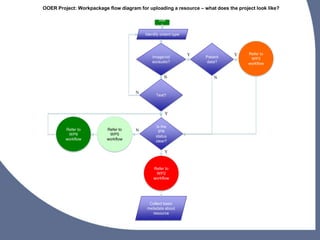
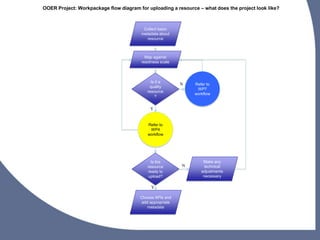
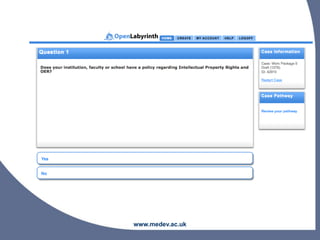
OOER Project: Workpackage flow diagram for uploading a resource – what does the project look like?
Y
Star
t
Identify ontent type
Image/vid
eo/audio?
Patient
data?
Y Y
Text?
N
N
N
Refer to
WP3
workflow
Refer to
WP2
workflow
Refer to
WP5
workflow
Is the
IPR
status
clear?
Y
NRefer to
WP6
workflow
Collect basic
metadata about
resource
Collect basic
metadata about
resource
Map against
readiness scale
Is it a
quality
resource
?
Refer to
WP7
workflow
Refer to
WP4
workflow
N
Y
Is the
resource
ready to
upload?
Make any
technical
adjustments
necessary
N
Choose APIs and
add appropriate
metadata
Y
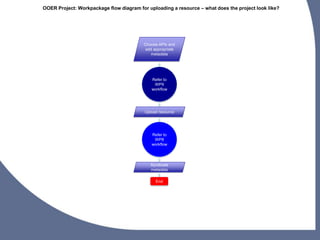
OOER Project: Workpackage flow diagram for uploading a resource – what does the project look like?
Choose APIs and
add appropriate
metadata
Refer to
WP9
workflow
Upload resource
Refer to
WP8
workflow
Syndicate
metadata
End
OOER Project: Workpackage flow diagram for uploading a resource – what does the project look like?
www.medev.ac.uk
www.medev.ac.uk
www.medev.ac.uk
www.medev.ac.uk
Readiness categorisation pyramid (in development)
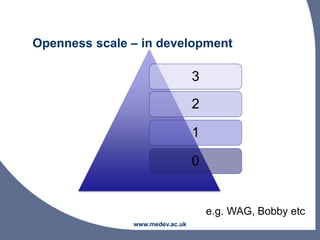
Openness scale – in development
www.medev.ac.uk
3
2
1
0
e.g. WAG, Bobby etc
Upload? Share? Publish? Deposit?
• As easy as possible to end user
• API toolkit
– Put
– In
– Many
– Places
– Syndicates resource info
www.medev.ac.uk
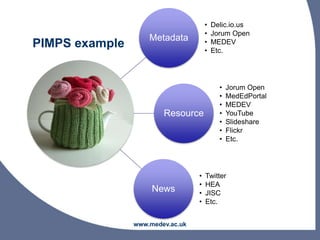
PIMPS example
Metadata
• Delic.io.us
• Jorum Open
• MEDEV
• Etc.
Resource
• Jorum Open
• MedEdPortal
• MEDEV
• YouTube
• Slideshare
• Flickr
• Etc.
News
• Twitter
• HEA
• JISC
• Etc.
www.medev.ac.uk
www.medev.ac.uk
OOER
• Toolkits available so far (all feedback gratefully
received!):
– IPR and copyright
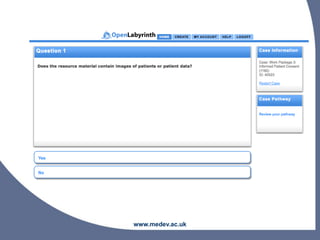
– Patient consent
– Institutional policy and procedure
– See www.medev.ac.uk/oer
• Ready soon:
– Quality and pedagogy
– Resource discovery and reuse
– Metadata and API
– Impact on existing projects – senior manager briefing paper
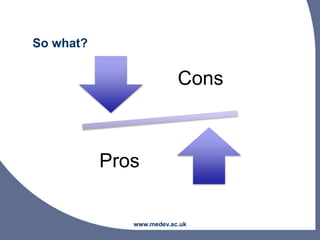
So what?
www.medev.ac.uk
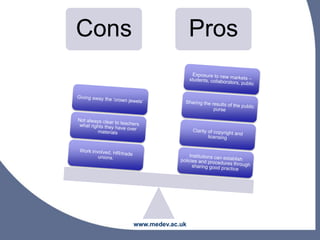
Cons
Pros
Cons Pros
www.medev.ac.uk
Draft OOER value statement:
Teaching resource quality
• The quality of educational resources, as a whole, will
be driven upwards due to competition, feedback and
peer review.
www.medev.ac.uk
Draft OOER value statement:
Financial
• Time saved in not duplicating resources or parts of resources,
with novel resources having a foundation to build upon (Yuan,
2009).
• Time saved in using an IPR and Patient Consent cleared
repository of OER (Fleming & Massey, 2007).
• Promotion of an institution’s teaching portfolio and recruitment of
new students (Yuan, 2009).
• There is potential for new funding and revenue generation
opportunities (Fleming & Massey, 2007).
• Opportunity to build upon institutional repuation at the
national/global level, dependent on project scale, enhancing the
institutional reputation and providing publicity as a promoter of
educational altruism (McGill et al. 2008).
www.medev.ac.uk
Draft OOER value statement:
Diversity
• OER may increase diversity in student applications to
undergraduate programmes. E.g. OU
• OER may aid in widening participation (OECD,
2007).
www.medev.ac.uk
Draft OOER value statement:
Institutional
• OER development will allow comparison of institutional policies and will
lead to development of UK wide best practices (IPR, Patient Consent) more
quickly and efficiently (Fleming & Massey, 2007).
• OER portfolio and institutional brand image will be linked in the future (thus
OER cost will become a ‘necessary overhead’) (Smith, 2009).
• Used as evidence of efficiency and value for money as required by funding
bodies and taxpayers (Fleming & Massey, 2007).
• Potential students may view a portfolio of OER from a host institution and
use, in part, to decide if institutional teaching approaches are compatible
with their own learning style.
• An OER repository can be a means to an effective individual staff teaching
portfolio of learning resources/activities.
• Increase in collaboration between institutions, including inter-discipline
exchange (Yuan, 2009).
• Increased institutional publicity and reputation (OECD, 2007).
• If an OER culture is inevitable, such as directed by future funding body
requirements, early adoption is preferable.
www.medev.ac.uk
Draft OOER value statement:
Student recruitment, satisfaction and
retention
• Address specific student learning resource needs more
rapidly by finding appropriate resources available from
other institutions uploads to an OER repository.
• Students could access resources that have a different
approach (visual, audio, text, etc.) in their teaching
method and add them to their own personal learning
environment to complement host institution resources.
• Potential students may view a portfolio of OER from a host
institution and use, in part, to decide if institutional
teaching approaches are compatible with their own
learning style.
www.medev.ac.uk
Draft OOER value statement:
Sustainability
• Over 75% of staff surveyed in the WM-Share project were
engaged in departmental sharing prior to the project (WM-
Share, 2006). This highlights the strong culture for sharing
that currently exists within academia and emphasises the
likelihood for continued sharing of OER after project
completion once the tools are put in place.
• The paper by McGill et al. (2008) highlights the significant
impact that OER can have on the sustained long-term
sharing of resources for both the Communities of Practice
(CoP) and subject-based areas.
www.medev.ac.uk
Draft OOER value statement:
References
• Li Yuan, Sheila MacNeil and Wilbert Kraan. Open Educational
Resources – Opportunities and Challenges for Higher
Education. JISC CETIS. 2009
• Catherine Fleming and Moira Massey. Jorum Open Educational
Resources (OER) Report. 2007.
• Marshall S. Smith. Opening Education. Science. 89 ; 323. 2009.
• Giving Knowledge for Free: the Emergence of Open Educational
Resources. OECD. 2007.
• WM-Share Final Report. WM-Share. 2006.
• Lou McGill, Sarah Currier, Charles Duncan, Peter Douglas.
Good Intentions: improving the evidence base in support of
sharing and learning materials. McGill et al. 2008
www.medev.ac.uk
Demonstrating impact
• GMC patient consent guidance (revised)
• eVIP – embedded IPR process
• Policy development e.g. Southampton, RVC
• Already working with over 50% of UK schools of
medicine, dentistry and veterinary medicine
• In discussions with the NHS eLearning Repository

www.medev.ac.uk
www.medev.ac.uk
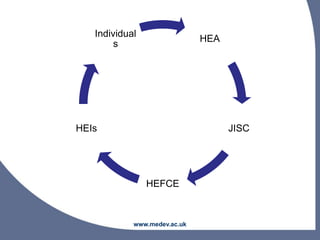
HEA
JISC
HEFCE
HEIs
Individual
s
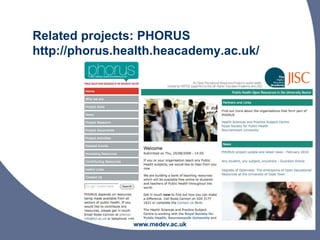
Related projects: PHORUS
http://phorus.health.heacademy.ac.uk/
www.medev.ac.uk
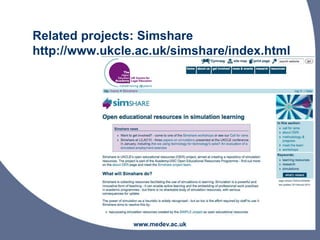
Related projects: Simshare
http://www.ukcle.ac.uk/simshare/index.html
www.medev.ac.uk
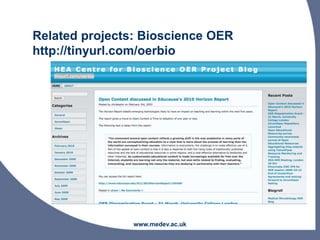
Related projects: Bioscience OER
http://tinyurl.com/oerbio
www.medev.ac.uk
Further information
• www.hefce.ac.uk/news/hefce/2008/os.htm
• www.jisc.ac.uk/whatwedo/programmes/elearning/oer
www.heacademy.ac.uk/ourwork/teachingandlearning/
oer
• www.medev.ac.uk/oer
• www.health.heacademy.ac.uk
• phorus.health.heacademy.ac.uk
• www.ukcle.ac.uk/simshare/index.html
• tinyurl.com/oerbio
www.medev.ac.uk
www.medev.ac.uk
Call: 0191 246 4550
Email: suzanne@medev.ac.uk

Hardy2010

  • 1.
    Opening access toeducational resources for use and reuse. OOER MEDEV! A progress report Suzanne Hardy Senior Advisor (Information) March 2010 UHMLG Spring Forum, Woburn House, London www.medev.ac.uk
  • 2.
    The HEFCE/JISC/HEA OERprogramme (14/08) - Background • Higher Education Funding Council for England (HEFCE) announced an initial £5.7 million of funding for pilot projects that will open up existing high-quality education resources from UK higher education institutions to the world • Higher Education Academy and JISC working in partnership to deliver 12-month pilot projects - formally launched in April 2009 www.medev.ac.uk
  • 3.
    The HEFCE/JISC/HEA OERprogramme (14/08) • Aims to make a wide range of learning resources created by academics freely available, easily discovered and routinely re-used by both educators and learners. • Expected that funded projects demonstrate long term commitment to release of OER resources. Projects working towards sustainability of long term open resources release via the adoption of appropriate business models to support this • Recommendations may include modifications to institutional policies and processes, with the aim of making open resources release an expected part of the educational resources creation cycle www.medev.ac.uk
  • 4.
    The HEFCE/JISC/HEA OERprogramme (14/08) • OER could include full courses, course materials, complete modules, notes, videos, assessments, tests, simulations, worked examples, software, and any other tools or materials or techniques used to support access to knowledge. These resources will be released under an intellectual property license that permits open use and adaptation (e.g. Creative Commons) www.medev.ac.uk
  • 5.
  • 6.
    The HEFCE/JISC/HEA OERprogramme (14/08) • Pilot projects to release existing learning resources under a suitable license for open use and repurposing under 3 strands of activity: 1. Institutional 2. Individual 3. Subject www.medev.ac.uk
  • 7.
    The HEFCE/JISC/HEA OERprogramme (14/08) • Not about creating new content • Exposing existing content to wider audiences • Exploring the drivers, challenges and barriers and making recommendations • Projects mandated to deposit into Jorum Open • Evaluation of pilot programme, including synthesis of project outcomes, to be carried out by Glasgow Caledonian University www.medev.ac.uk
  • 8.
  • 9.
    JorumOpen • JorumOpen -for content whose creators and owners who are willing and are able to share their content on a worldwide basis under the terms of a Creative Commons (CC) • www.jorum.ac.uk • Limited metadata requirements, many more optional fields: http://www.jorum.ac.uk/docs/pdf/japv1p0.pdf • Use #ukoer as tag in web2.0 e.g. blogs, Twitter and del.icio.us www.medev.ac.uk
  • 10.
    www.medev.ac.uk NB Draft Jorumv.1 application profile (Stevenson 2005) has over 100 elements, mostly optional
  • 11.
    OOER • Organising OpenEducational Resources • Bid can be downloaded from www.medev.ac.uk/oer • Focusses on issues relating to consent, securing ER from staff delivering programmes who are non-HEI employed, and complements other projects in the programme • Results of mapping and readiness categorisation together with development of simple toolkits (to help HEIs, Subjects and Individuals) will inform identification of ER to be included • Uploading OER will test toolkits www.medev.ac.uk
  • 12.
    OOER Project: Workpackageflow diagram for uploading a resource – what does the project look like? Y Star t Identify ontent type Image/vid eo/audio? Patient data? Y Y Text? N N N Refer to WP3 workflow Refer to WP2 workflow Refer to WP5 workflow Is the IPR status clear? Y NRefer to WP6 workflow Collect basic metadata about resource
  • 13.
    Collect basic metadata about resource Mapagainst readiness scale Is it a quality resource ? Refer to WP7 workflow Refer to WP4 workflow N Y Is the resource ready to upload? Make any technical adjustments necessary N Choose APIs and add appropriate metadata Y OOER Project: Workpackage flow diagram for uploading a resource – what does the project look like?
  • 14.
    Choose APIs and addappropriate metadata Refer to WP9 workflow Upload resource Refer to WP8 workflow Syndicate metadata End OOER Project: Workpackage flow diagram for uploading a resource – what does the project look like?
  • 15.
  • 16.
  • 17.
  • 18.
  • 19.
    Openness scale –in development www.medev.ac.uk 3 2 1 0 e.g. WAG, Bobby etc
  • 20.
    Upload? Share? Publish?Deposit? • As easy as possible to end user • API toolkit – Put – In – Many – Places – Syndicates resource info www.medev.ac.uk
  • 21.
    PIMPS example Metadata • Delic.io.us •Jorum Open • MEDEV • Etc. Resource • Jorum Open • MedEdPortal • MEDEV • YouTube • Slideshare • Flickr • Etc. News • Twitter • HEA • JISC • Etc. www.medev.ac.uk
  • 22.
    www.medev.ac.uk OOER • Toolkits availableso far (all feedback gratefully received!): – IPR and copyright – Patient consent – Institutional policy and procedure – See www.medev.ac.uk/oer • Ready soon: – Quality and pedagogy – Resource discovery and reuse – Metadata and API – Impact on existing projects – senior manager briefing paper
  • 23.
  • 24.
  • 25.
    Draft OOER valuestatement: Teaching resource quality • The quality of educational resources, as a whole, will be driven upwards due to competition, feedback and peer review. www.medev.ac.uk
  • 26.
    Draft OOER valuestatement: Financial • Time saved in not duplicating resources or parts of resources, with novel resources having a foundation to build upon (Yuan, 2009). • Time saved in using an IPR and Patient Consent cleared repository of OER (Fleming & Massey, 2007). • Promotion of an institution’s teaching portfolio and recruitment of new students (Yuan, 2009). • There is potential for new funding and revenue generation opportunities (Fleming & Massey, 2007). • Opportunity to build upon institutional repuation at the national/global level, dependent on project scale, enhancing the institutional reputation and providing publicity as a promoter of educational altruism (McGill et al. 2008). www.medev.ac.uk
  • 27.
    Draft OOER valuestatement: Diversity • OER may increase diversity in student applications to undergraduate programmes. E.g. OU • OER may aid in widening participation (OECD, 2007). www.medev.ac.uk
  • 28.
    Draft OOER valuestatement: Institutional • OER development will allow comparison of institutional policies and will lead to development of UK wide best practices (IPR, Patient Consent) more quickly and efficiently (Fleming & Massey, 2007). • OER portfolio and institutional brand image will be linked in the future (thus OER cost will become a ‘necessary overhead’) (Smith, 2009). • Used as evidence of efficiency and value for money as required by funding bodies and taxpayers (Fleming & Massey, 2007). • Potential students may view a portfolio of OER from a host institution and use, in part, to decide if institutional teaching approaches are compatible with their own learning style. • An OER repository can be a means to an effective individual staff teaching portfolio of learning resources/activities. • Increase in collaboration between institutions, including inter-discipline exchange (Yuan, 2009). • Increased institutional publicity and reputation (OECD, 2007). • If an OER culture is inevitable, such as directed by future funding body requirements, early adoption is preferable. www.medev.ac.uk
  • 29.
    Draft OOER valuestatement: Student recruitment, satisfaction and retention • Address specific student learning resource needs more rapidly by finding appropriate resources available from other institutions uploads to an OER repository. • Students could access resources that have a different approach (visual, audio, text, etc.) in their teaching method and add them to their own personal learning environment to complement host institution resources. • Potential students may view a portfolio of OER from a host institution and use, in part, to decide if institutional teaching approaches are compatible with their own learning style. www.medev.ac.uk
  • 30.
    Draft OOER valuestatement: Sustainability • Over 75% of staff surveyed in the WM-Share project were engaged in departmental sharing prior to the project (WM- Share, 2006). This highlights the strong culture for sharing that currently exists within academia and emphasises the likelihood for continued sharing of OER after project completion once the tools are put in place. • The paper by McGill et al. (2008) highlights the significant impact that OER can have on the sustained long-term sharing of resources for both the Communities of Practice (CoP) and subject-based areas. www.medev.ac.uk
  • 31.
    Draft OOER valuestatement: References • Li Yuan, Sheila MacNeil and Wilbert Kraan. Open Educational Resources – Opportunities and Challenges for Higher Education. JISC CETIS. 2009 • Catherine Fleming and Moira Massey. Jorum Open Educational Resources (OER) Report. 2007. • Marshall S. Smith. Opening Education. Science. 89 ; 323. 2009. • Giving Knowledge for Free: the Emergence of Open Educational Resources. OECD. 2007. • WM-Share Final Report. WM-Share. 2006. • Lou McGill, Sarah Currier, Charles Duncan, Peter Douglas. Good Intentions: improving the evidence base in support of sharing and learning materials. McGill et al. 2008 www.medev.ac.uk
  • 32.
    Demonstrating impact • GMCpatient consent guidance (revised) • eVIP – embedded IPR process • Policy development e.g. Southampton, RVC • Already working with over 50% of UK schools of medicine, dentistry and veterinary medicine • In discussions with the NHS eLearning Repository www.medev.ac.uk
  • 33.
  • 34.
  • 35.
  • 36.
    Related projects: BioscienceOER http://tinyurl.com/oerbio www.medev.ac.uk
  • 37.
    Further information • www.hefce.ac.uk/news/hefce/2008/os.htm •www.jisc.ac.uk/whatwedo/programmes/elearning/oer www.heacademy.ac.uk/ourwork/teachingandlearning/ oer • www.medev.ac.uk/oer • www.health.heacademy.ac.uk • phorus.health.heacademy.ac.uk • www.ukcle.ac.uk/simshare/index.html • tinyurl.com/oerbio www.medev.ac.uk
  • 38.
    www.medev.ac.uk Call: 0191 2464550 Email: suzanne@medev.ac.uk