Let it go: Exposing digital collections 
for accessible and useful data 
Juliet L. Hardesty 
Metadata Analyst, Indiana University Libraries 
DLF Forum, Atlanta, Georgia 
October 28, 2014 
#dlfforum @jlhardes
@jlhardes 
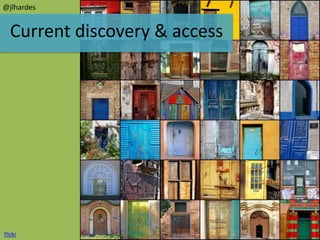
Current discovery & access 
flickr
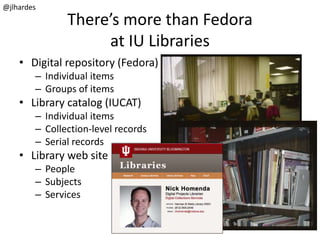
There’s more than Fedora 
at IU Libraries 
@jlhardes 
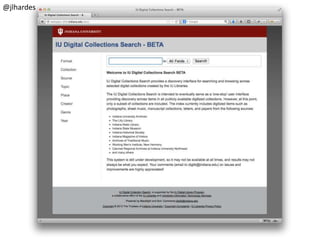
• Digital repository (Fedora) 
– Individual items 
– Groups of items 
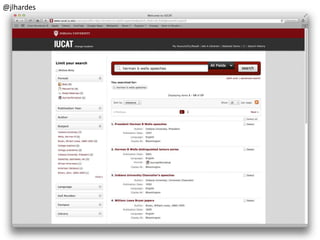
• Library catalog (IUCAT) 
– Individual items 
– Collection-level records 
– Serial records 
• Library web site 
– People 
– Subjects 
– Services
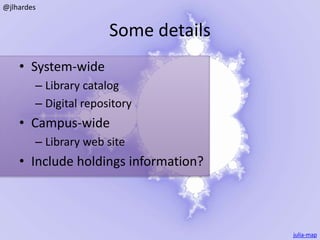
Some details 
• System-wide 
– Library catalog 
– Digital repository 
• Campus-wide 
– Library web site 
• Include holdings information? 
julia-map 
@jlhardes
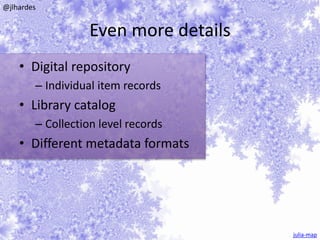
Even more details 
• Digital repository 
– Individual item records 
• Library catalog 
– Collection level records 
• Different metadata formats 
julia-map 
@jlhardes
@jlhardes
@jlhardes
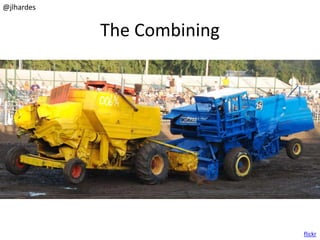
The Combining 
flickr 
@jlhardes
@jlhardes
Letting it go 
flickr 
@jlhardes
References 
@jlhardes 
jlhardes@iu.edu 
• Breeding, M. (2005). Plotting a new course for metasearch. Computers in Libraries, 25(2), 27-29. 
• Emde, J. Z., Morris, S. E., & Claassen-Wilson, M. (2009). Testing an academic library website for 
usability with faculty and graduate students. Evidence Based Library and Information Practice, 4(4), 
24-36. 
• Hofmann, M. A. & Yang, S. Q. (2011). How next-gen r u? A review of academic OPACs in the United 
States and Canada. Computers in Libraries, 31(6), 26-29. 
• Hofmann, M. A. (2012). “Discovering” what’s changed: a revisit of the OPACs of 260 academic 
libraries. Library Hi Tech, 30(2), 253-274. 
• Johnson, T. (2013). Indexing linked bibliographic data with JSON-LD, BibJSON and Elasticsearch. The 
Code4Lib Journal, 19. Retrieved from http://journal.code4lib.org/articles/7949 
• Kipp, M. E. I. (2005). Complementary or discrete contexts in online indexing: A comparison of user, 
creator, and intermediary keywords. Canadian Journal of Information & Library Sciences, 29(4), 419- 
436. 
• Stephens, O. (2011). Mashups and open data in libraries. Serials: The Journal for the Serials 
Community, 24(3), 245-250. 
• Thomas, M., Caudle, D. M., and Schmitz, C. M. (2009). To tag or not to tag? Library Hi Tech, 27(3), 
411-434. 
• Voorbij, H. J. (1998). Title keywords and subject descriptors: A comparison of subject search entries 
of books in the humanities and social sciences. Journal of Documentation, 54(4), 466-476. 
flickr

Let it go: Exposing digital collections for accessible and useful data

  • 1.
    Let it go:Exposing digital collections for accessible and useful data Juliet L. Hardesty Metadata Analyst, Indiana University Libraries DLF Forum, Atlanta, Georgia October 28, 2014 #dlfforum @jlhardes
  • 2.
  • 3.
    There’s more thanFedora at IU Libraries @jlhardes • Digital repository (Fedora) – Individual items – Groups of items • Library catalog (IUCAT) – Individual items – Collection-level records – Serial records • Library web site – People – Subjects – Services
  • 4.
    Some details •System-wide – Library catalog – Digital repository • Campus-wide – Library web site • Include holdings information? julia-map @jlhardes
  • 5.
    Even more details • Digital repository – Individual item records • Library catalog – Collection level records • Different metadata formats julia-map @jlhardes
  • 6.
  • 7.
  • 8.
  • 9.
  • 10.
    Letting it go flickr @jlhardes
  • 11.
    References @jlhardes jlhardes@iu.edu • Breeding, M. (2005). Plotting a new course for metasearch. Computers in Libraries, 25(2), 27-29. • Emde, J. Z., Morris, S. E., & Claassen-Wilson, M. (2009). Testing an academic library website for usability with faculty and graduate students. Evidence Based Library and Information Practice, 4(4), 24-36. • Hofmann, M. A. & Yang, S. Q. (2011). How next-gen r u? A review of academic OPACs in the United States and Canada. Computers in Libraries, 31(6), 26-29. • Hofmann, M. A. (2012). “Discovering” what’s changed: a revisit of the OPACs of 260 academic libraries. Library Hi Tech, 30(2), 253-274. • Johnson, T. (2013). Indexing linked bibliographic data with JSON-LD, BibJSON and Elasticsearch. The Code4Lib Journal, 19. Retrieved from http://journal.code4lib.org/articles/7949 • Kipp, M. E. I. (2005). Complementary or discrete contexts in online indexing: A comparison of user, creator, and intermediary keywords. Canadian Journal of Information & Library Sciences, 29(4), 419- 436. • Stephens, O. (2011). Mashups and open data in libraries. Serials: The Journal for the Serials Community, 24(3), 245-250. • Thomas, M., Caudle, D. M., and Schmitz, C. M. (2009). To tag or not to tag? Library Hi Tech, 27(3), 411-434. • Voorbij, H. J. (1998). Title keywords and subject descriptors: A comparison of subject search entries of books in the humanities and social sciences. Journal of Documentation, 54(4), 466-476. flickr