INTRODUCTION :
Guidancehas been an integral part of human civilization since its inception.
The informal unstructured advices play vital role in Indian culture, where
family elders offer advice on education, career and personal matters.
Indian society relied on family and community leaders for guidance.
As society evolved, factors like globalization, liberalization & consumerism
made guidance more complex.
Traditional leaders are no longer equipped to provide guidance.
Nursing students need comprehensive support, guidance & mentorship to
unlock their full potential.
3.
MEANING :
Itmeans “to direct”, “to indicate”, “to illuminate the route”
It is the support or assistance given by a more experienced person to a less
experienced person in order to help them solve significant challenges in
areas such as education, career and personal development.
It is a concept that includes both an idea and useful procedure.
It is to support people’s best possible to development.
4.
DEFINITION :
Itis the process of helping individuals to discover & develop their
educational, vocational and psychological potentialities and thereby to
achieve an optimal level of personal happiness & social usefulness. -
G.L.Harrington
It is a process of assisting the individual to understand himself and his
world. – D.E.Super
It is a process by which an individual is able to guide himself. – J.M.Brew
It is a personal help that is designed to assist a person to go somewhere and
do something. – Arthur Jones
5.
OBJECTIVES :
1. Provideindividuals with information about their potential.
2. Facilitate experiences that enable individuals to make wise choices.
3. Assist individuals in developing self – direction skills to solve problems.
4. Help individuals understand, accept & utilize their talents.
5. Guide individuals in selecting educational programs that best fit their
needs.
6. Assist individuals in resolving personal issues.
7. Help individuals in adapting to various life demands.
8. Aid individuals achieve successful social adjustments.
9. Provide essential information about different occupation & their
requirements.
6.
PURPOSES :
1. Providingnecessary information and support.
2. Assisting individuals in making wise decisions.
3. Enhancing self – awareness.
4. Helping with adaptation to new situations.
5. Fostering personal & professional growth.
6. Promoting balanced growth across physical, psychological, emotional.
Social and spiritual dimensions.
7. Supporting overall development & a productive life.
7.
IMPORTANCE OF GUIDANCE:
The primary aim of health guidance in nursing education is to promote &
maintain overall health and well being of students.
1. Providing information.
2. Promoting self awareness.
3. Offering emotional support.
4. Conflict resolution.
5. Facilitating decision making.
8.
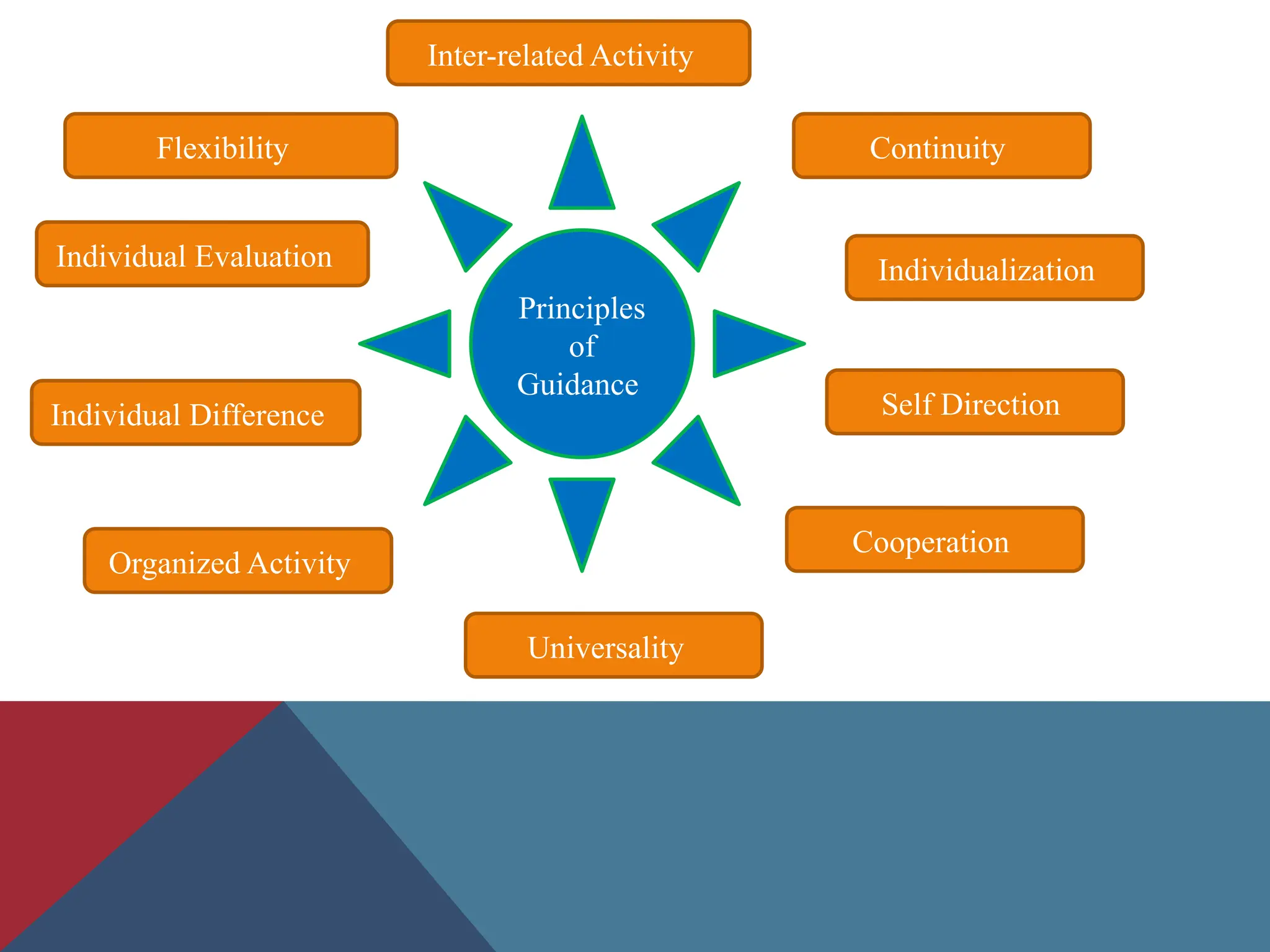
TYPES OF GUIDANCE:
1. Educational Guidance
2. Vocational guidance
3. Personal Guidance
4. Social Guidance
5. Avocational Guidance
6. Health Guidance
7. Financial Guidance
ROLE OF ACADEMICADVISOR / FACULTY IN GUIDANCE :
- Active engagement
- Educational & career planning
- Orientation support for new comer.
- Ongoing support for continuing advices
- Program planning assistance
- Progress monitoring.
- Instructional program & career links
- Policy interpretation.
……….Continued
11.
- Follow upon academic performance
- Approval of educational transactions.
- Informal contacts
- Record maintenance
- Referral to institutional resources
- Proactive communication
- Consultation with colleagues
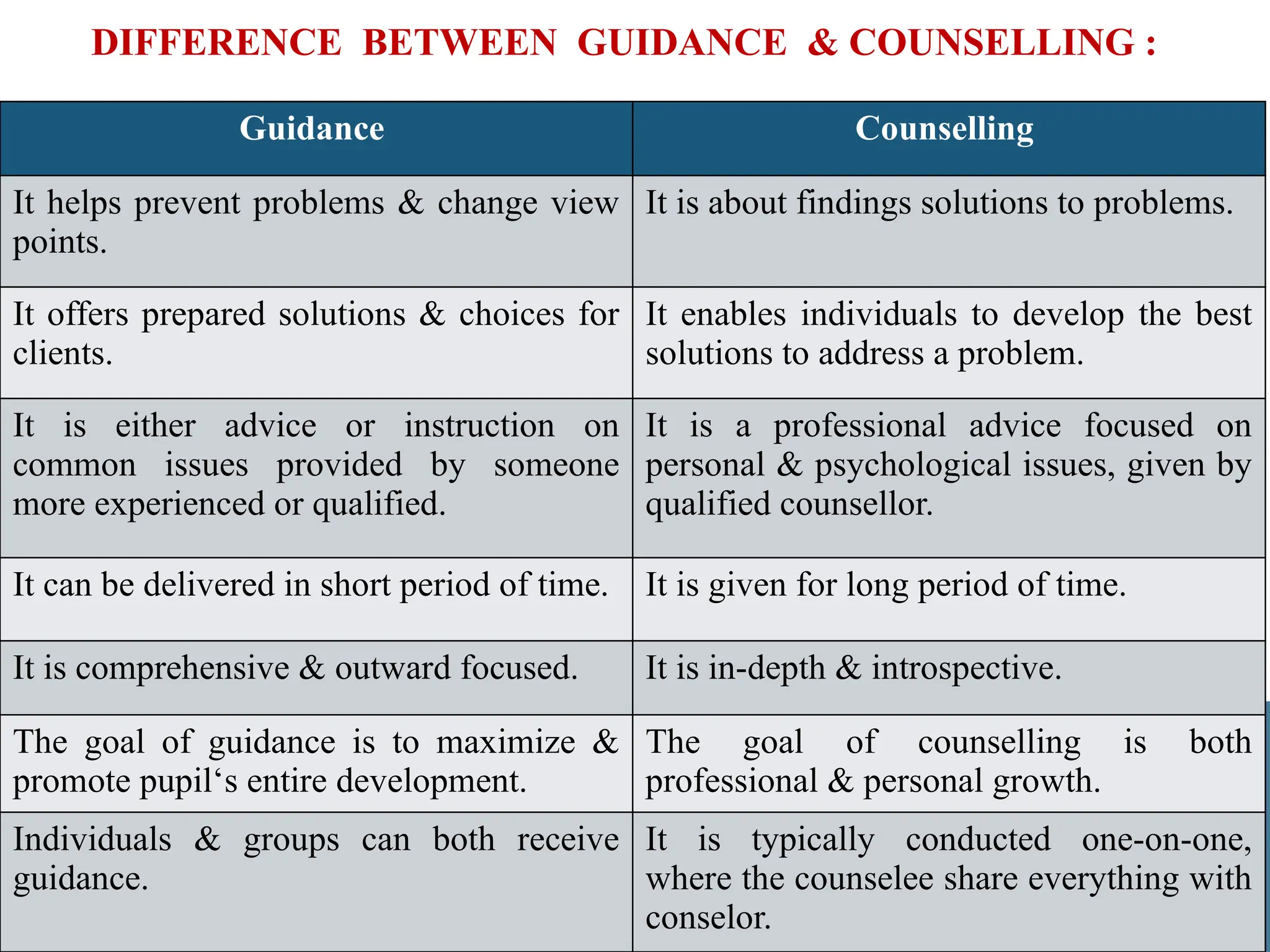
DIFFERENCE BETWEEN GUIDANCE& COUNSELLING :
Guidance Counselling
It helps prevent problems & change view
points.
It is about findings solutions to problems.
It offers prepared solutions & choices for
clients.
It enables individuals to develop the best
solutions to address a problem.
It is either advice or instruction on
common issues provided by someone
more experienced or qualified.
It is a professional advice focused on
personal & psychological issues, given by
qualified counsellor.
It can be delivered in short period of time. It is given for long period of time.
It is comprehensive & outward focused. It is in-depth & introspective.
The goal of guidance is to maximize &
promote pupil‘s entire development.
The goal of counselling is both
professional & personal growth.
Individuals & groups can both receive
guidance.
It is typically conducted one-on-one,
where the counselee share everything with
conselor.
14.
DEFINITION :
Counsellingis essentially a process in which the counsellor assists the
counselee to make interpretations of facts relating to a choice, plan or
adjustment which he needs to make. - Glenn .F .Smith
It is a series of direct contacts with the individual which aims to offer him
assistance in changing his attitude & behaviours. – Carl Rogers
It is an interaction process that facilitates meaningful understanding of self
& environment and result in the establishment and for clarification of goals
& values for future behaviour. – Stone & Shertze.
15.
PURPOSES :
Individual related:
1. Assist students in recognizing and developing their potential.
2. Enabling students to make choices based on their aptitudes, interests, future
growth and requirements.
3. Support students in overall personal & social development.
4. Help students realize their abilities, gain self confidence and adapt to
academic & school related problems.
16.
Society related :
1.Encourage the formation of good citizenship in students.
2. Encourage a favourable attitude toward family and community living.
3. Ensure the proper utilization of resources.
17.
OBJECTIVES :
- Ensurea balanced personal, intellectual & living atmosphere within the
school.
- Set up an excellent communication mechanism within the institution.
- Provide assistance to students with their developmental challenges.
- Provide assistance & support to students in coping with temporary crisis.
- Promote early detection of deviant, disturbed or problematic behavior
among students.
- Set up referral services for those who require specialised therapy.
- Make efficient & appropriate use of available resources.
- Provide counsellors with supportive services to help them.
18.
SCOPE OF COUNSELLING:
Counselling covers broad range of areas, addressing various facets of
individual’s life.
1. Emotional support : express & process their feelings.
2. Mental Health : anxiety, depression, trauma.
3. Relationships : family, friends, partners.
4. Career Guidance : career options, setting goals.
5. Personal development : supporting growth in self awareness.
6. Behavioural issues : negative behaviours & habits.
7. Crisis intervention : support during grief, loss or sudden life changes.
8. Educational counselling.
9. Health & wellness.
19.
PRINCIPLES OF COUNSELLING:
The process is dedicated to supporting the self direction & self realization of
clients.
It encourages & values individual thinking.
A strong relationship of trust & confidence is maintained with the client.
It helps develop insights & understanding about relationship.
Counselling methods are tailored to meet the specific needs of client.
The approach is mainly preventive & remedial.
Participation in counselling is voluntary for students.
The dignity of each individual is upheld, recognizing the individual as the
primary focus in counselling.
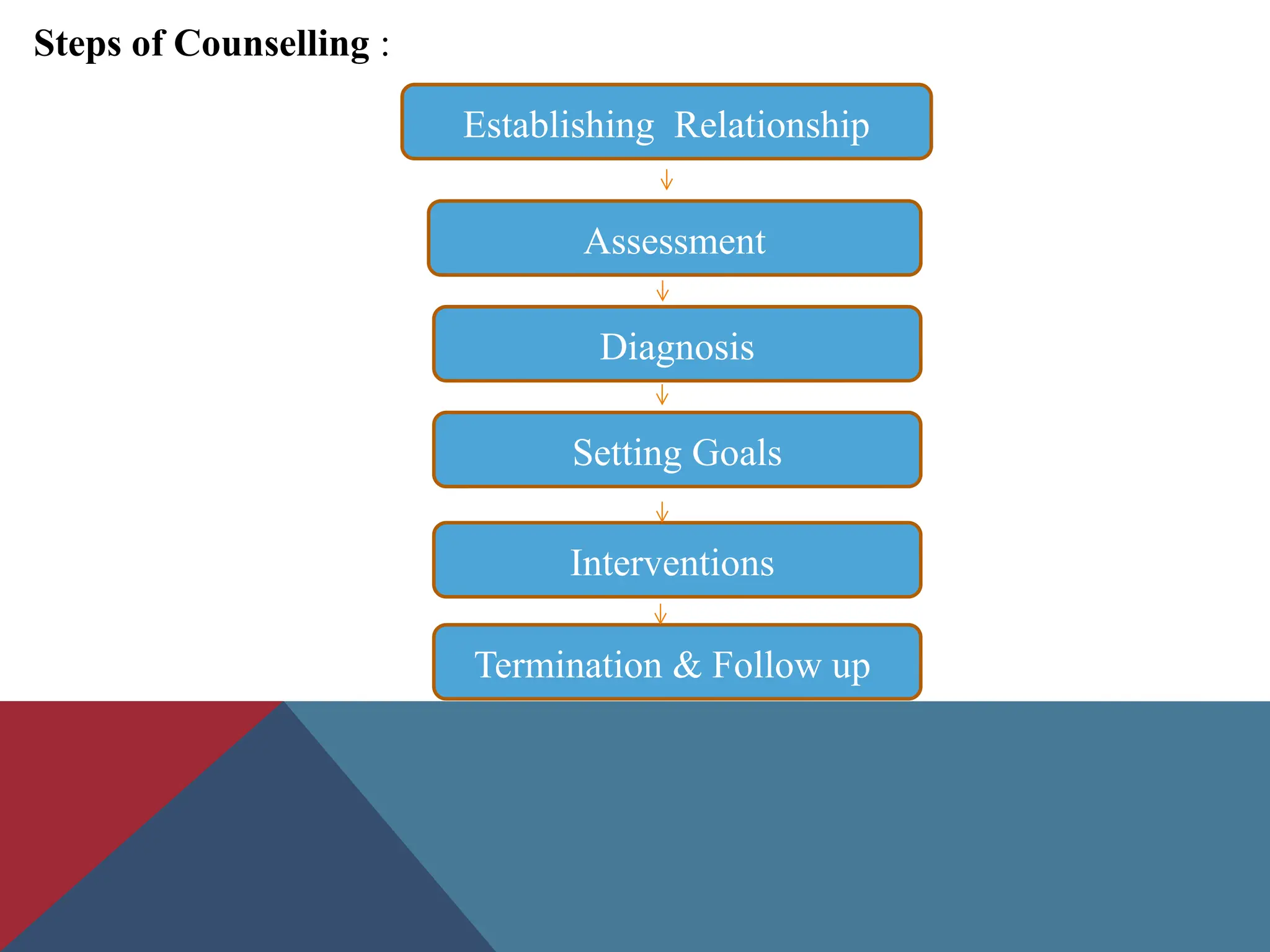
Steps of Counselling:
Establishing Relationship
Assessment
Diagnosis
Setting Goals
Interventions
Termination & Follow up
22.
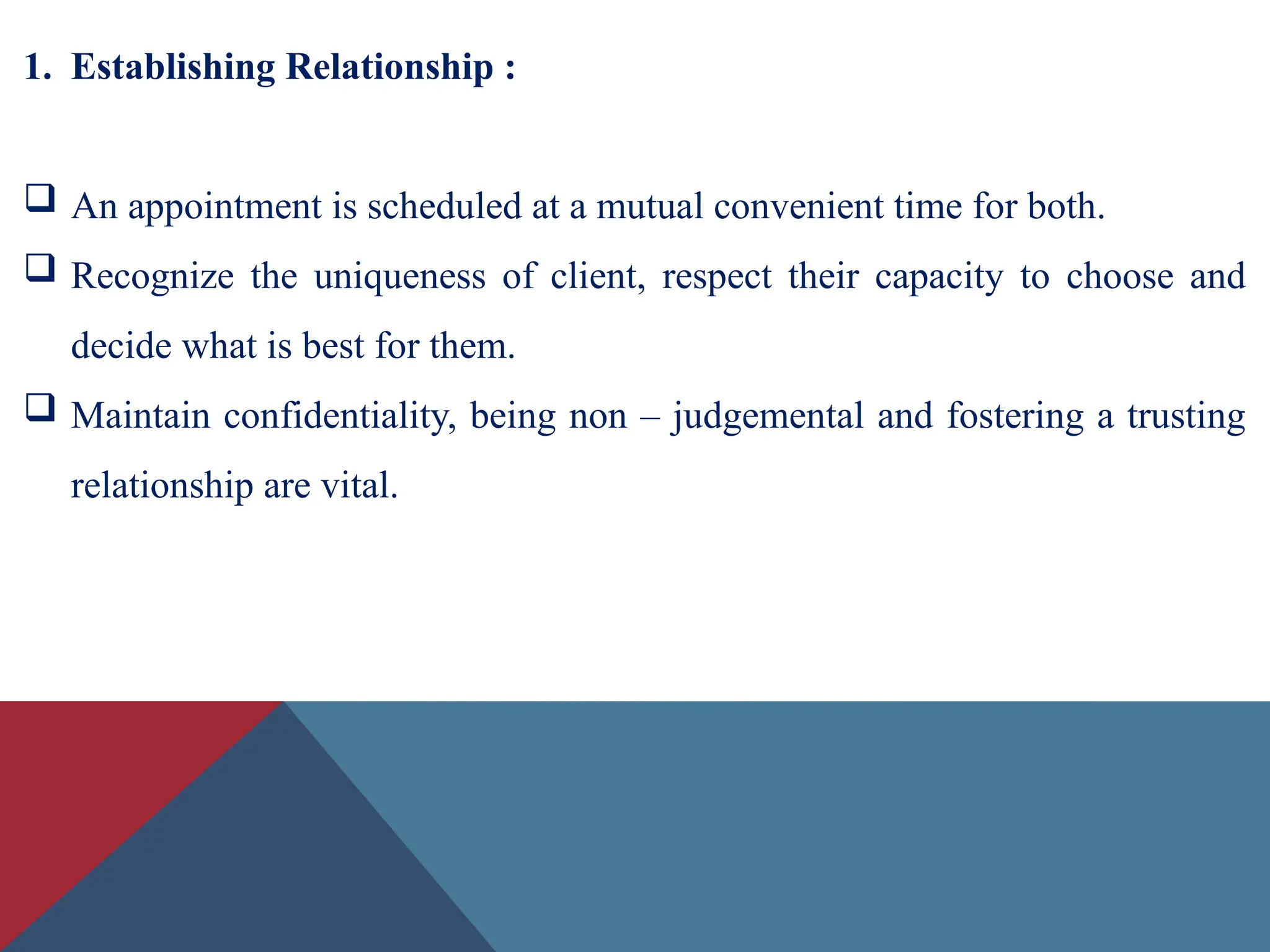
1. Establishing Relationship:
An appointment is scheduled at a mutual convenient time for both.
Recognize the uniqueness of client, respect their capacity to choose and
decide what is best for them.
Maintain confidentiality, being non – judgemental and fostering a trusting
relationship are vital.
23.
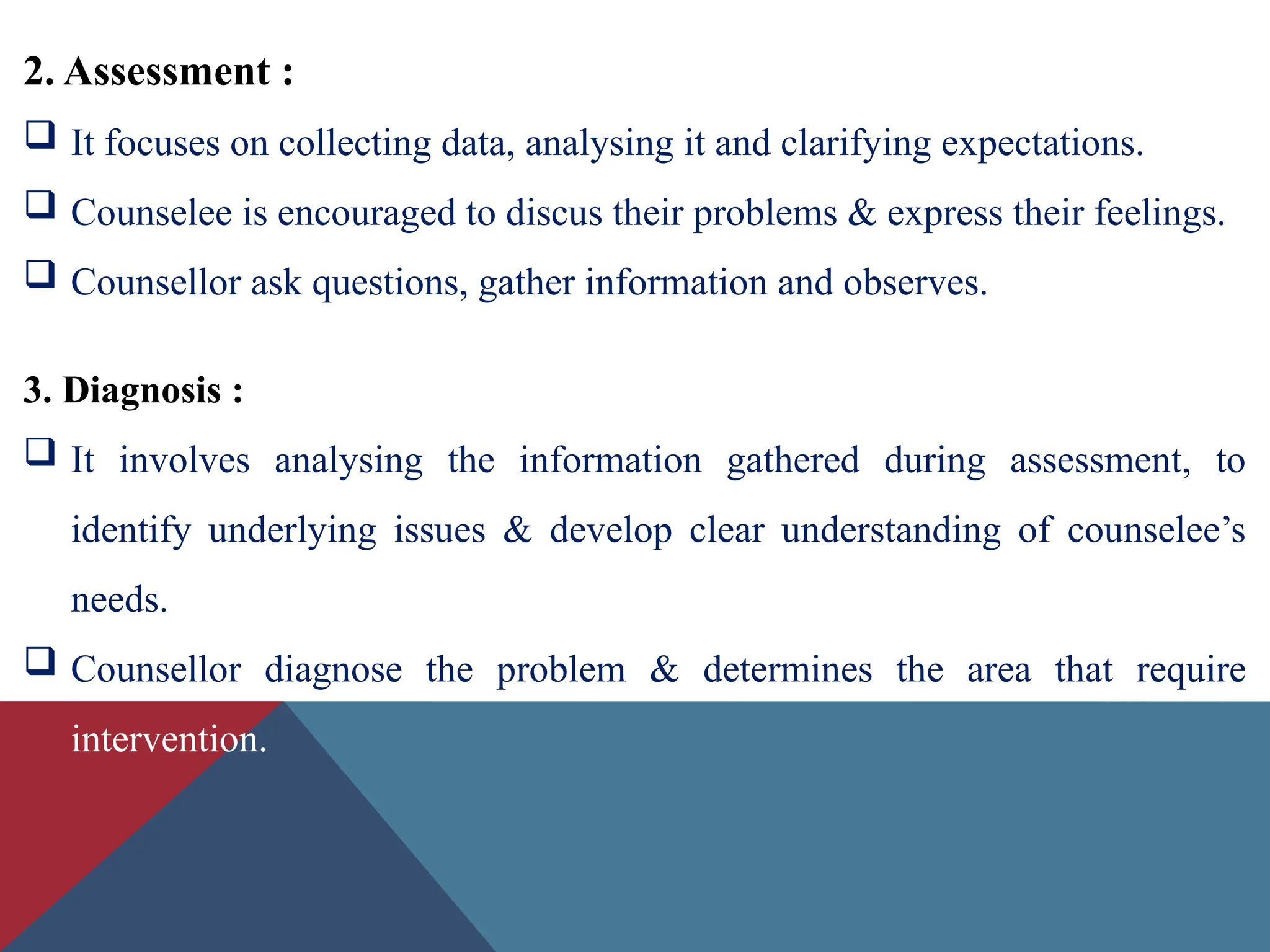
2. Assessment :
It focuses on collecting data, analysing it and clarifying expectations.
Counselee is encouraged to discus their problems & express their feelings.
Counsellor ask questions, gather information and observes.
3. Diagnosis :
It involves analysing the information gathered during assessment, to
identify underlying issues & develop clear understanding of counselee’s
needs.
Counsellor diagnose the problem & determines the area that require
intervention.
24.
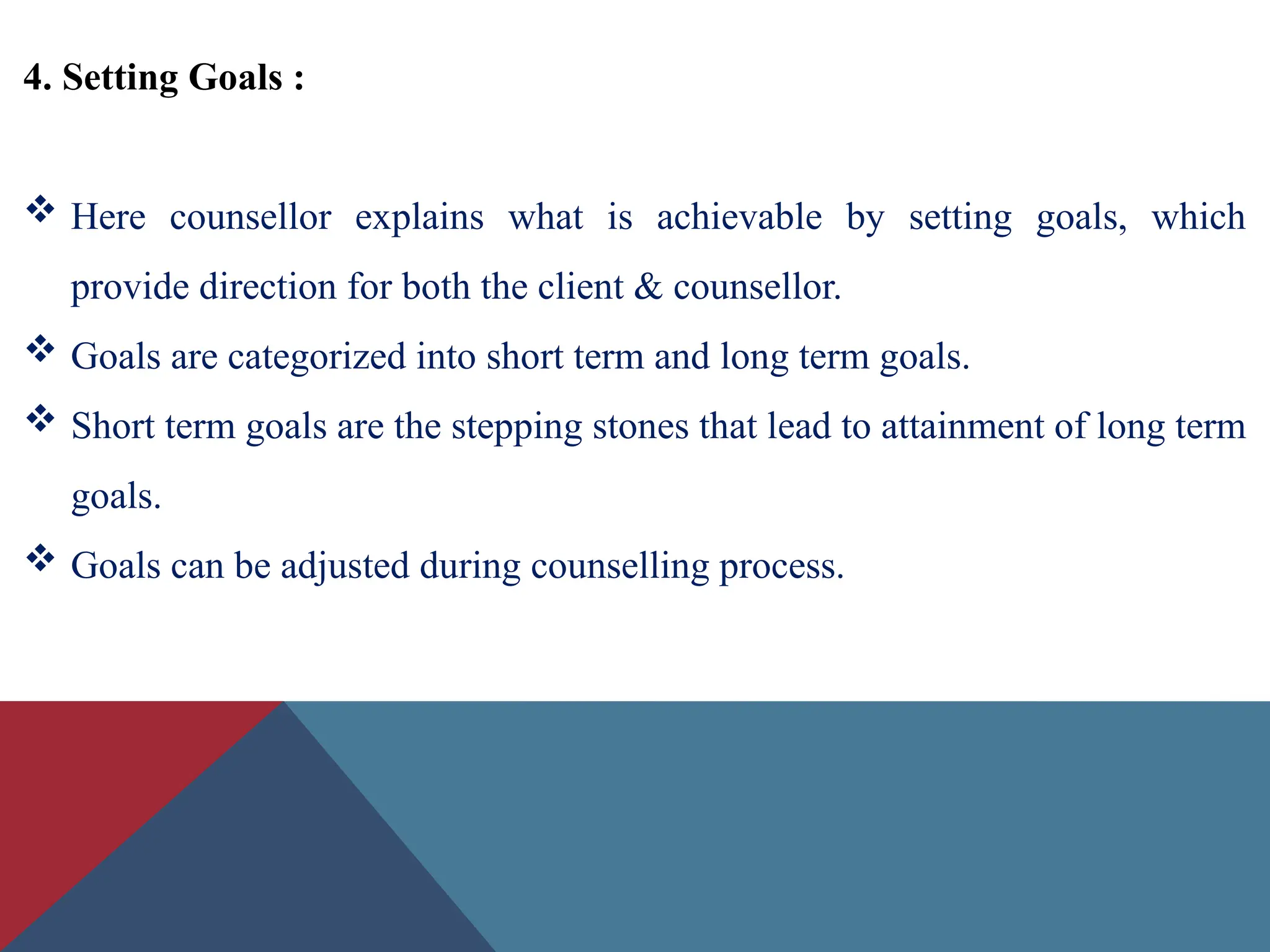
4. Setting Goals:
Here counsellor explains what is achievable by setting goals, which
provide direction for both the client & counsellor.
Goals are categorized into short term and long term goals.
Short term goals are the stepping stones that lead to attainment of long term
goals.
Goals can be adjusted during counselling process.
25.
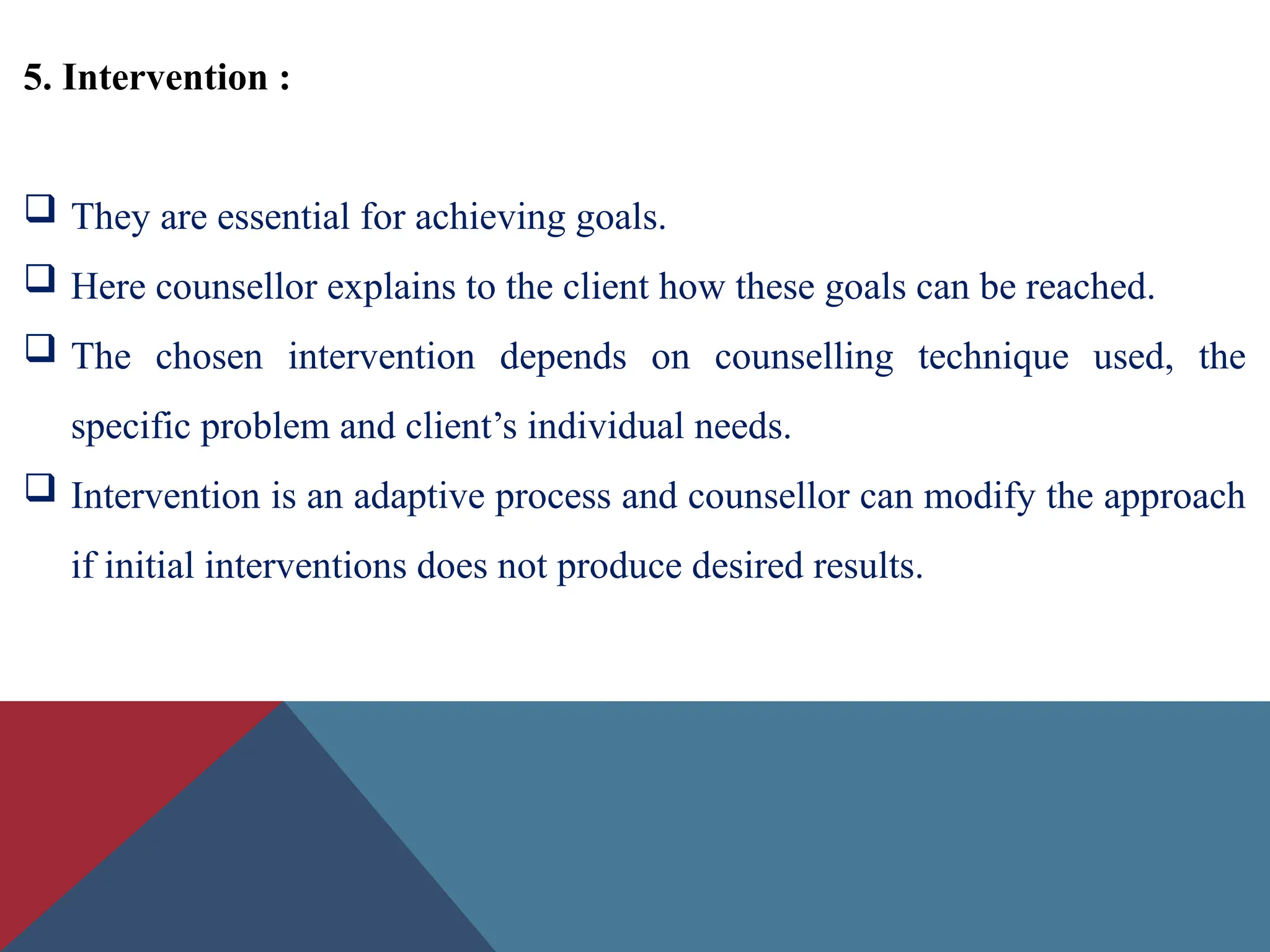
5. Intervention :
They are essential for achieving goals.
Here counsellor explains to the client how these goals can be reached.
The chosen intervention depends on counselling technique used, the
specific problem and client’s individual needs.
Intervention is an adaptive process and counsellor can modify the approach
if initial interventions does not produce desired results.
26.
6. Termination andFollow – up:
Successful termination is a crucial aspect of counselling.
It should be conducted in a phased manner over several sessions to avoid
undermining the progress made and to prevent the client from feeling a
sense of loss.
Follow – up appointments should be scheduled to monitor on-going
progress.
27.
QUALITIES OF GOODCOUNSELLOR :
G – Good technical Knowledge.
O – Obtaining appropriate information from patient.
O – Objectively answering questions.
D – Demonstrating professionalism.
C – Confidentiality maintenance.
O – Observant.
U – Unbiased.
….continued
28.
N – Nonjudgemental.
S – Sensitive to the needs of patient.
E – Empathetic.
L – Listens carefully.
L – Let the patient make decision.
O – Open minded.
R – Respects the rights of patient.
29.
COUNSELLING SKILLS /TECHNIQUES :
1. Active listening & Responsiveness:
• It is very essential to achieve better counselling.
• It involves techniques like maintaining eye contact, nodding, using
appropriate facial expressions and body language, changing the tone of
voice.
30.
2. Questioning Ability:
• Counsellors also need to excel in questioning too along with listening.
• There are two primary styles of questioning.
• Open : They are designed to encourage clients to elaborate and provide
more information.
• Closed : They seek specific answers and typically result in “yes or no”
response.
31.
3. Ability tointerpret information :
Its very crucial for counsellor to interpret information beyond what client
express.
Sometimes they rely on non-verbal cues like body language and facial
expression.
Understanding what clients do not say or attempt to minimize is often as
significant than their verbal disclosures.
This interpretive skills enable counsellors to grasp underlying issues &
emotions thereby facilitate more effectiveness.
32.
4.Trustworthiness :
Clientsshould believe that their counsellor, will uphold confidentiality,
respect their experiences without judgement and maintain professional
boundaries.
Establishing trust allows clients to feel comfortable sharing personal &
challenging emotions and information.
Its crucial for clients to feel assured.
33.
5. Empathy :
It means genuinely putting yourself in their shoes to grasp their feelings
and challenges.
It is important to be authentic and sincere in your interactions creating
supportive environment.
As a counsellor, displaying empathy is very essential (self disclosure some
times demonstrate empathy) and should be used judiciously.
34.
ROLE OF COUNSELLOR:
Arrange orientation program for support staff.
Maintain up-to date list of resources, information, referrals & available
energy.
Organize guidance committee.
Display collected information attractively.
Disseminate information through career talks, group discussions & similar
activities.
Arrange talks by experts from various fields.
35.
Organize careerdays, career weeks, career conference events.
Educate students about proper study habits & assist in their development.
Arrange individual discussion with students & their parents.
Organize visits to workplace such as industries, business, establishments,
offices, higher education institutions, etc.
Refer serious mental health cases to clinical psychologists.
Administer psychological tests.
Provide counselling services to students..
Assist students in placements.
36.
ORGANIZATION OF COUNSELLINGSERVICES :
In education, there are different forms of organizing these services.
Each form has its own structure & methods for delivering effective guidance &
counselling to students.
They are :
1. Centralized services
2. Decentralized services
3. Combination of both.
37.
1. Centralized services:
In this type, the entire responsibility lies with the group of trained
personnel or a designated department.
Selected members of the teaching staff, under the direction & supervision
of guidance staff carry out counselling services.
This method requires patience & persistence.
38.
2. Decentralized Services:
In this type, the responsibility for providing guidance is vested in the
teachers.
Teachers who are inclined towards guidance can offer excellent & timely
assistance to their students.
Absence of specially trained personnel to provide professional assistance
is a drawback of this model.
39.
Combination of both:
It is the most effective way to organize guidance and counselling services.
In this hybrid model, counselling department headed by counsellor, works
in cooperation with faculty.
The counsellor provides special services professionally, while faculty
members offer non-specialized support & refer students in need of special
services to the counsellor.
40.
ISSUES FOR COUNSELLINGIN NURSING STUDENTS :
The demanding nature of nursing education, with its rigorous academic
requirements and intense clinical experiences can lead to high level of
stress, burnout and anxiety.
Shifting from class room learning to hands on patient care is daunting,
requiring nursing students to rapidly acquire technical skills, master time
management and build emotional resilience to handle patient care
responsibilities.
41.
COMMON ISSUES :
1.Academic Pressure :
Nursing programs are challenging, leading to stress related to exams, clinical
placements and assignments.
2. Emotional strain :
Students encounter many situation that affect their mental well – being.
3. Balance :
Juggling clinical placements, course work & personal life poses challenges for
work life balance.
42.
4. Professional Identity:
Students struggle with defining their professional identity.
5. Ethical concern :
Ethical dilemma’s in clinical practice.
6. Burnout & Compassion Fatigue :
The demanding nature of nursing profession lead to burnout during training.
7. Self care :
Students forget / neglect prioritize self care due to time constraints.
43.
DISCIPLINE :
“It is a force that prompts individuals or groups to observe the rules,
regulations and procedures which are deemed to be necessary for the
effective functioning of an organization.”
It is mandatory in educational institutions to take disciplinary actions to
maintain healthy environment.
44.
Objectives of Discipline:
- To demonstrate consequences of inappropriate action for breaking rules.
- Correct student’s wrong doing.
- Develop a culture of willing compliance with rules, regulations &
procedures.
- Establish a sense of stability & consistency.
- Cultivate the spirit of adaptability, tolerance & cooperation among students.
- Define & assign roles, responsibilities & expectations.
- Promote work environment that respects human dignity, individuality &
relationships.
45.
TYPES OF DISCIPLINE:
1. Self controlled Discipline :
• This occurs when an employee voluntarily aligns their behaviour with the
organization’s official code of conduct, regulating their own action.
• This type of discipline demonstrates personal responsibility & commitment
to organizational values.
2. Enforced Discipline :
• It involves managerial action to ensure employee compliance with
organizational rules and regulations.
• It relies on authority & consequences to maintain order.
46.
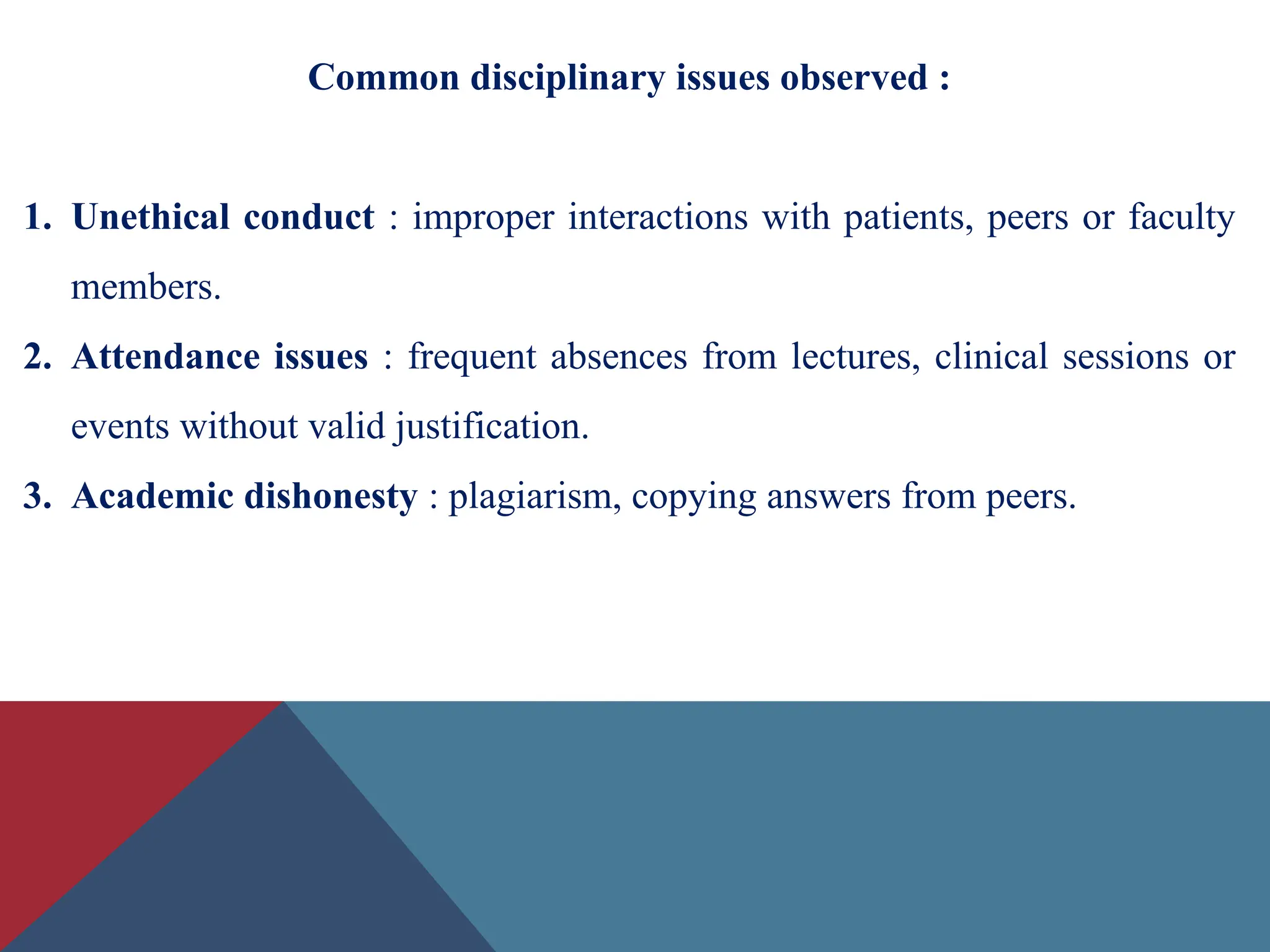
Common disciplinary issuesobserved :
1. Unethical conduct : improper interactions with patients, peers or faculty
members.
2. Attendance issues : frequent absences from lectures, clinical sessions or
events without valid justification.
3. Academic dishonesty : plagiarism, copying answers from peers.
47.
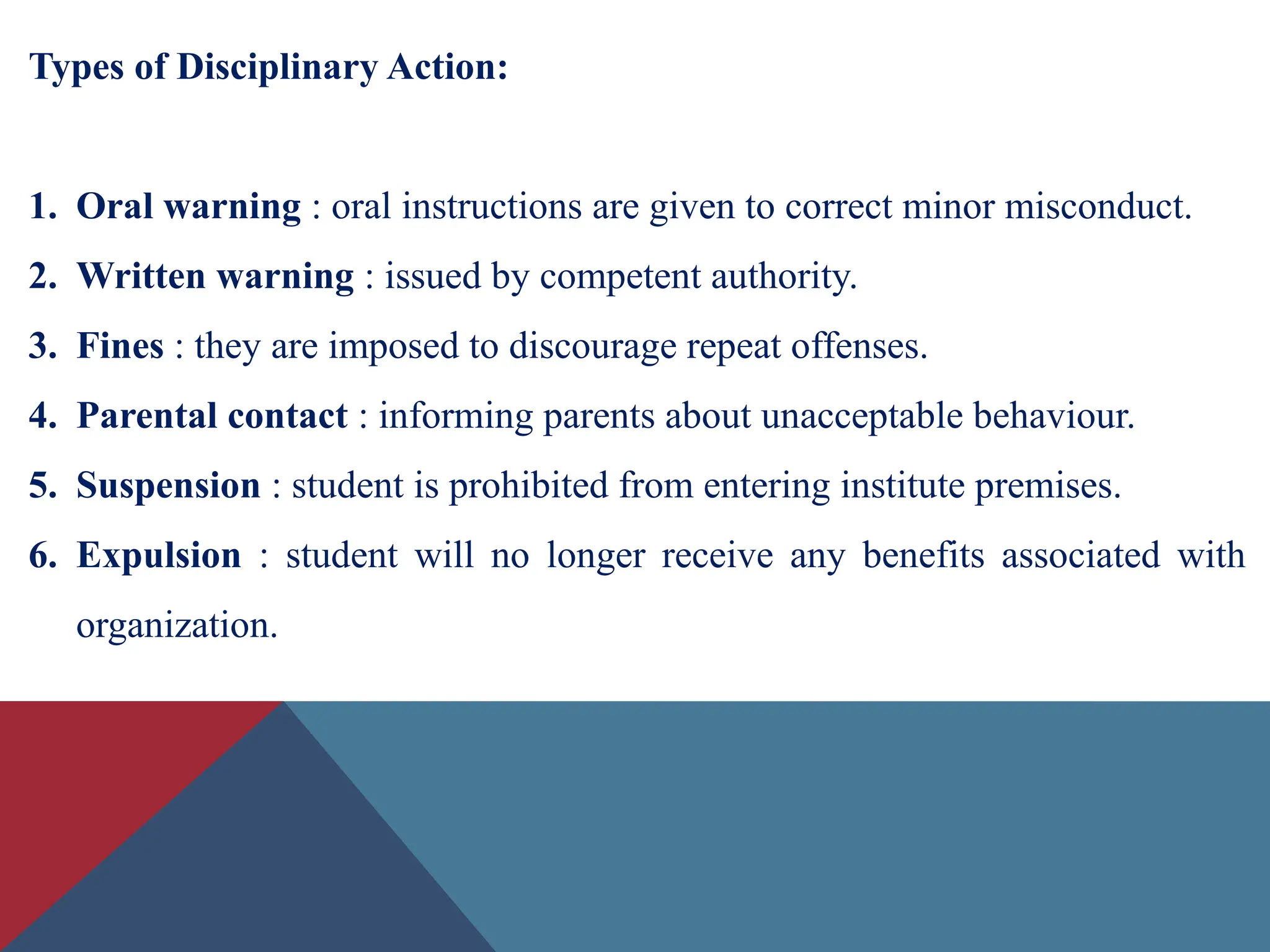
Types of DisciplinaryAction:
1. Oral warning : oral instructions are given to correct minor misconduct.
2. Written warning : issued by competent authority.
3. Fines : they are imposed to discourage repeat offenses.
4. Parental contact : informing parents about unacceptable behaviour.
5. Suspension : student is prohibited from entering institute premises.
6. Expulsion : student will no longer receive any benefits associated with
organization.
48.
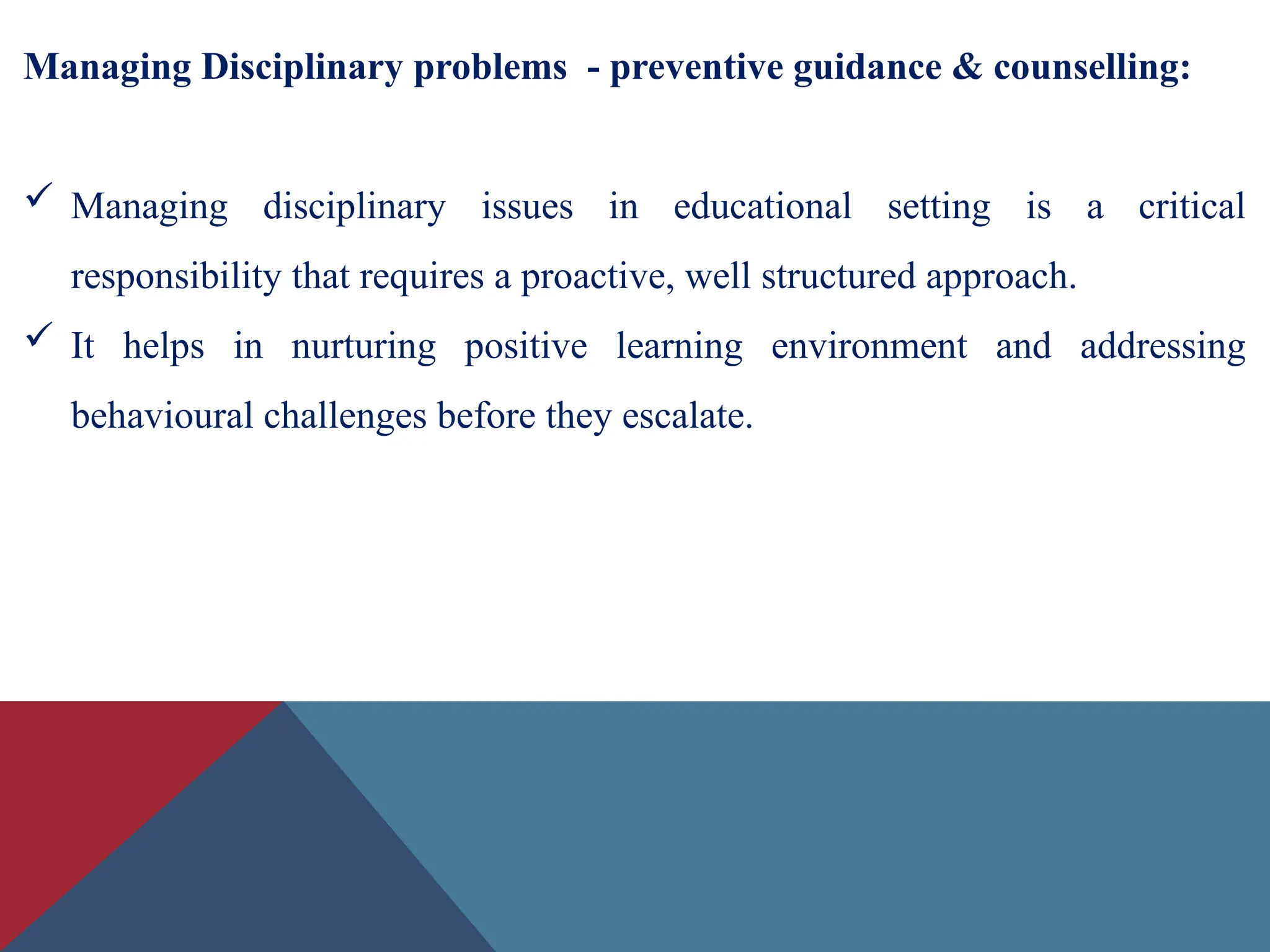
Managing Disciplinary problems- preventive guidance & counselling:
Managing disciplinary issues in educational setting is a critical
responsibility that requires a proactive, well structured approach.
It helps in nurturing positive learning environment and addressing
behavioural challenges before they escalate.
49.
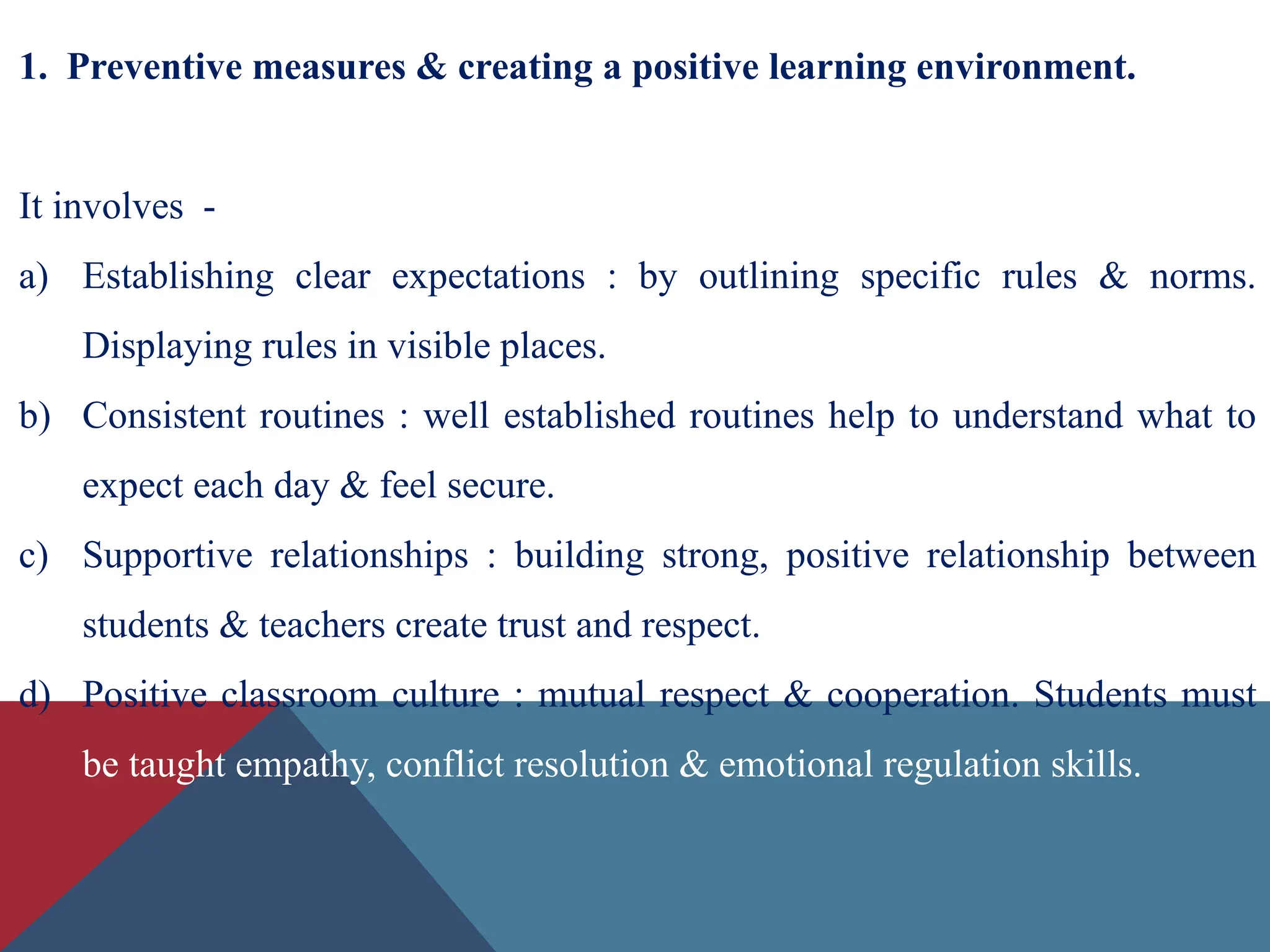
1. Preventive measures& creating a positive learning environment.
It involves -
a) Establishing clear expectations : by outlining specific rules & norms.
Displaying rules in visible places.
b) Consistent routines : well established routines help to understand what to
expect each day & feel secure.
c) Supportive relationships : building strong, positive relationship between
students & teachers create trust and respect.
d) Positive classroom culture : mutual respect & cooperation. Students must
be taught empathy, conflict resolution & emotional regulation skills.
50.
2. Identification ofdisciplinary issues & understanding root causes :
Understanding why students misbehave is essential for managing discipline.
This can be achieved through
a) Observation : observe student’s behaviour, situations & looking for
patterns that lead to disruptive conduct.
b) Interviews & Conversation : direct communication with students. One –
on – one conversations.
c) Survey & Assessment : anonymous surveys helps to gather information
about classroom issues, mental health concerns, learning disabilities,
factors contributing for discipline problems.
d) Family & Peer insights : family members & peers can provide additional
context regarding student’s behaviour.
51.
3. Intervention strategies& tailoring solutions to address root causes :
Approaches include :
a) Positive reinforcement : verbal praise, privileges, rewards like certificates
or stickers. When talent is recognized & valued, they get motivated.
b) Behavioural contracts & goal setting : this outline specific behavioural
changes & consequences. Goals help to focus on small, manageable
behaviour improvements.
c) Counselling & mentorship : coping strategies, emotional regulation skills
& improved interpersonal relationship.
d) Restorative practices : instead of punishment, it focus on repairing harm
& rebuilding relationships.
e) Disciplinary actions : time outs, detention or suspension.
52.
4. Evaluation :Assessing the effectiveness of intervention strategies
This process include :
a) Ongoing observation : tracking of progress after intervention.
b) Feedback mechanism : it is taken from students, parents & colleagues.
c) Data analysis : about frequency, duration & intensity of disciplinary
problems before & after the intervention.
d) Adapting & modifying interventions : if initial strategies prove
ineffective, they must be adjusted or replaced with alternate approach.
53.
GRIEVANCE :
Itis a formal complaint or concern expressed by an individual or group
regarding perceived injustice, unfair treatment or dissatisfaction in the
particular / specific situation.
They are very common in workplace, organization, institutions and social
settings.
Grievance is defined as a formal dispute between an employee and
management on the condition of employment.
54.
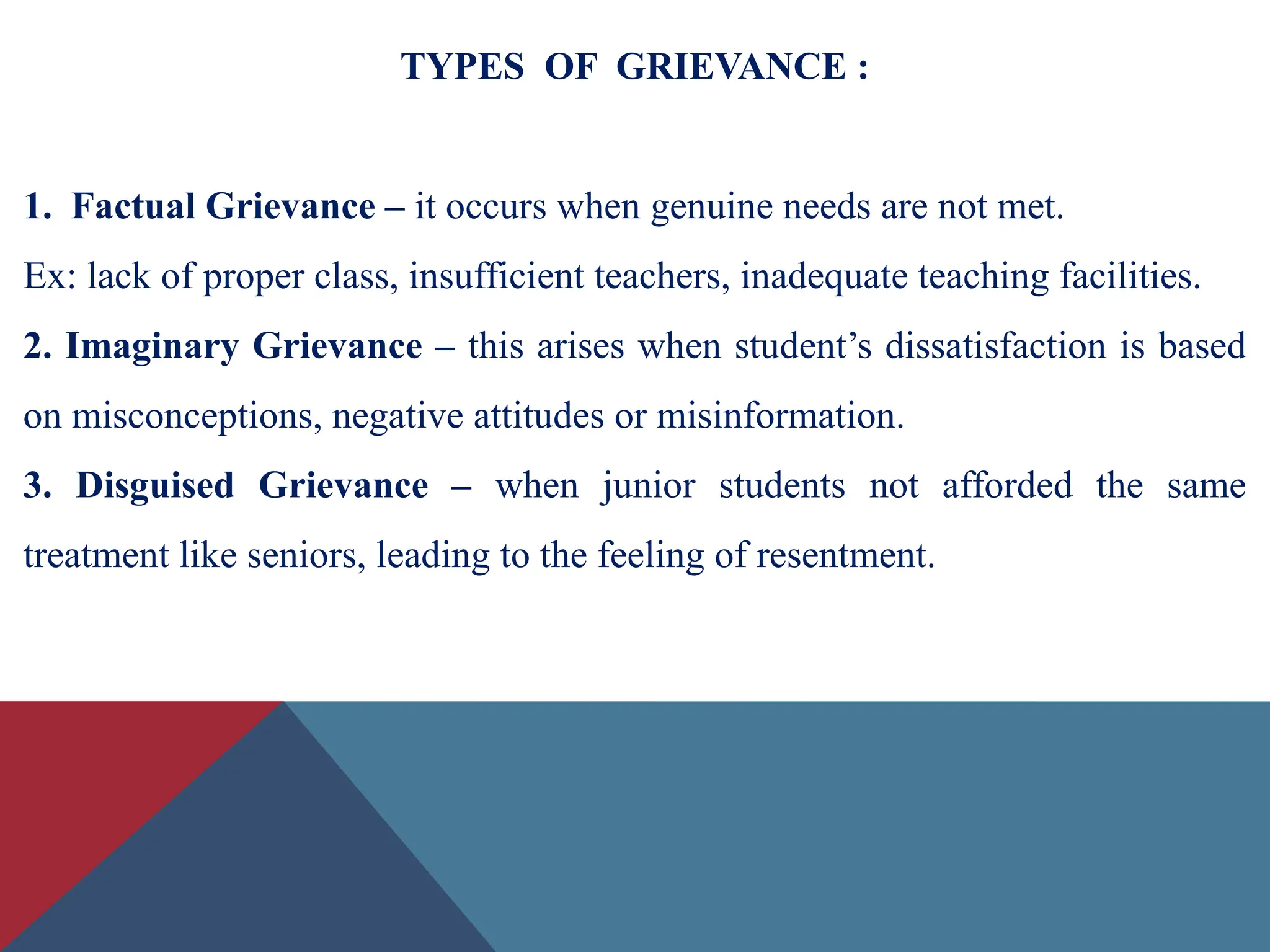
TYPES OF GRIEVANCE:
1. Factual Grievance – it occurs when genuine needs are not met.
Ex: lack of proper class, insufficient teachers, inadequate teaching facilities.
2. Imaginary Grievance – this arises when student’s dissatisfaction is based
on misconceptions, negative attitudes or misinformation.
3. Disguised Grievance – when junior students not afforded the same
treatment like seniors, leading to the feeling of resentment.
55.
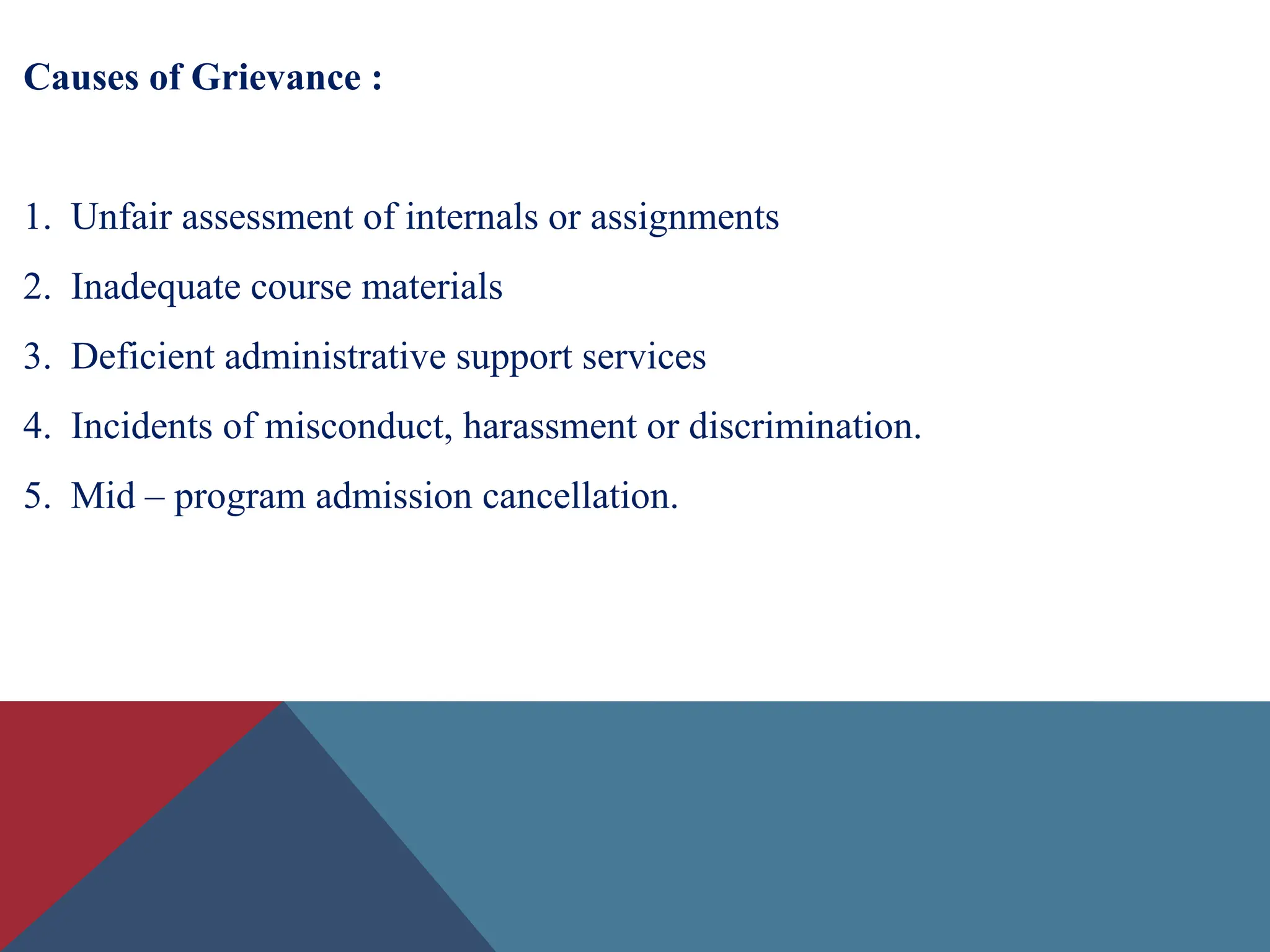
Causes of Grievance:
1. Unfair assessment of internals or assignments
2. Inadequate course materials
3. Deficient administrative support services
4. Incidents of misconduct, harassment or discrimination.
5. Mid – program admission cancellation.
56.
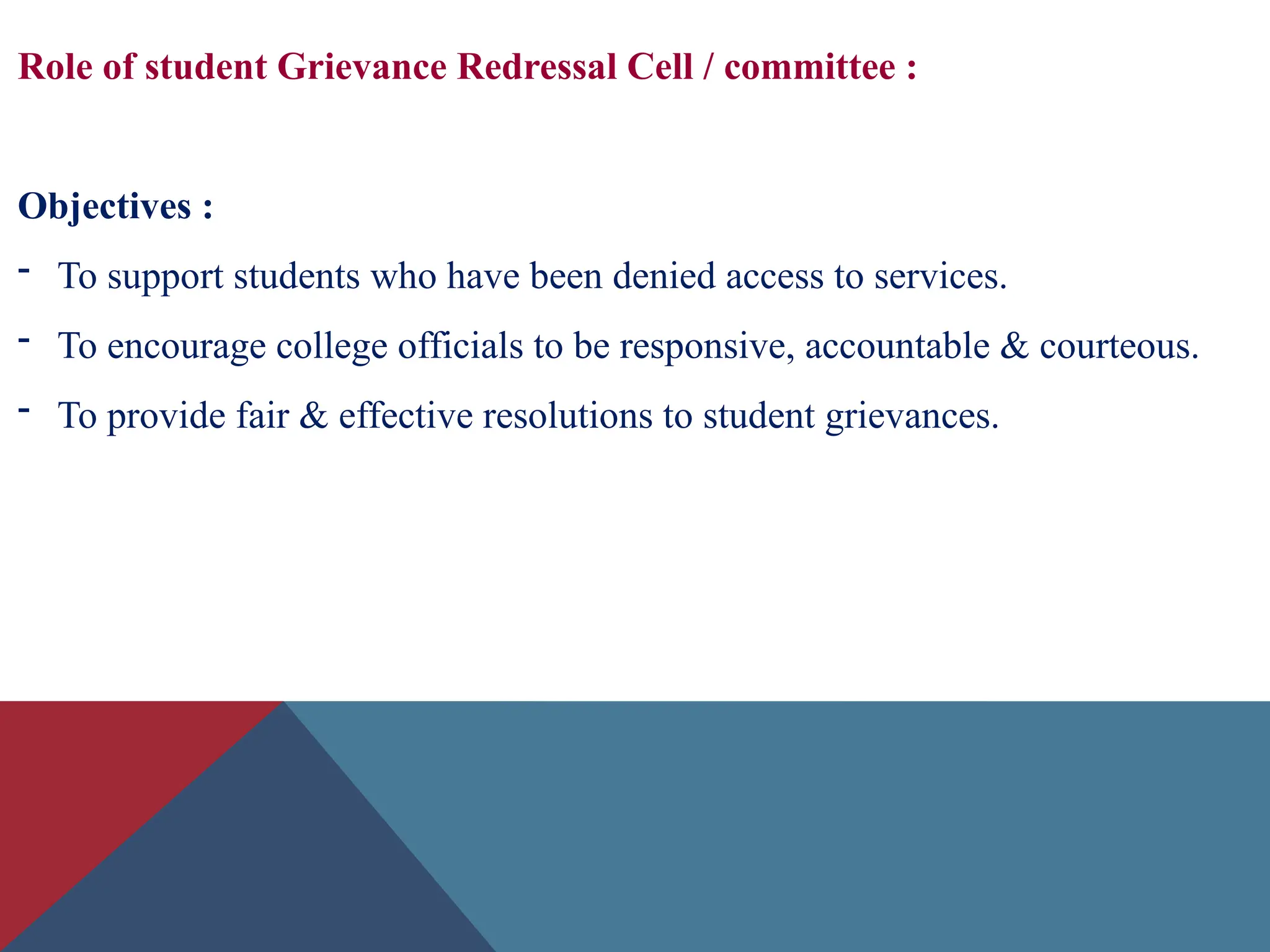
Role of studentGrievance Redressal Cell / committee :
Objectives :
- To support students who have been denied access to services.
- To encourage college officials to be responsive, accountable & courteous.
- To provide fair & effective resolutions to student grievances.
57.
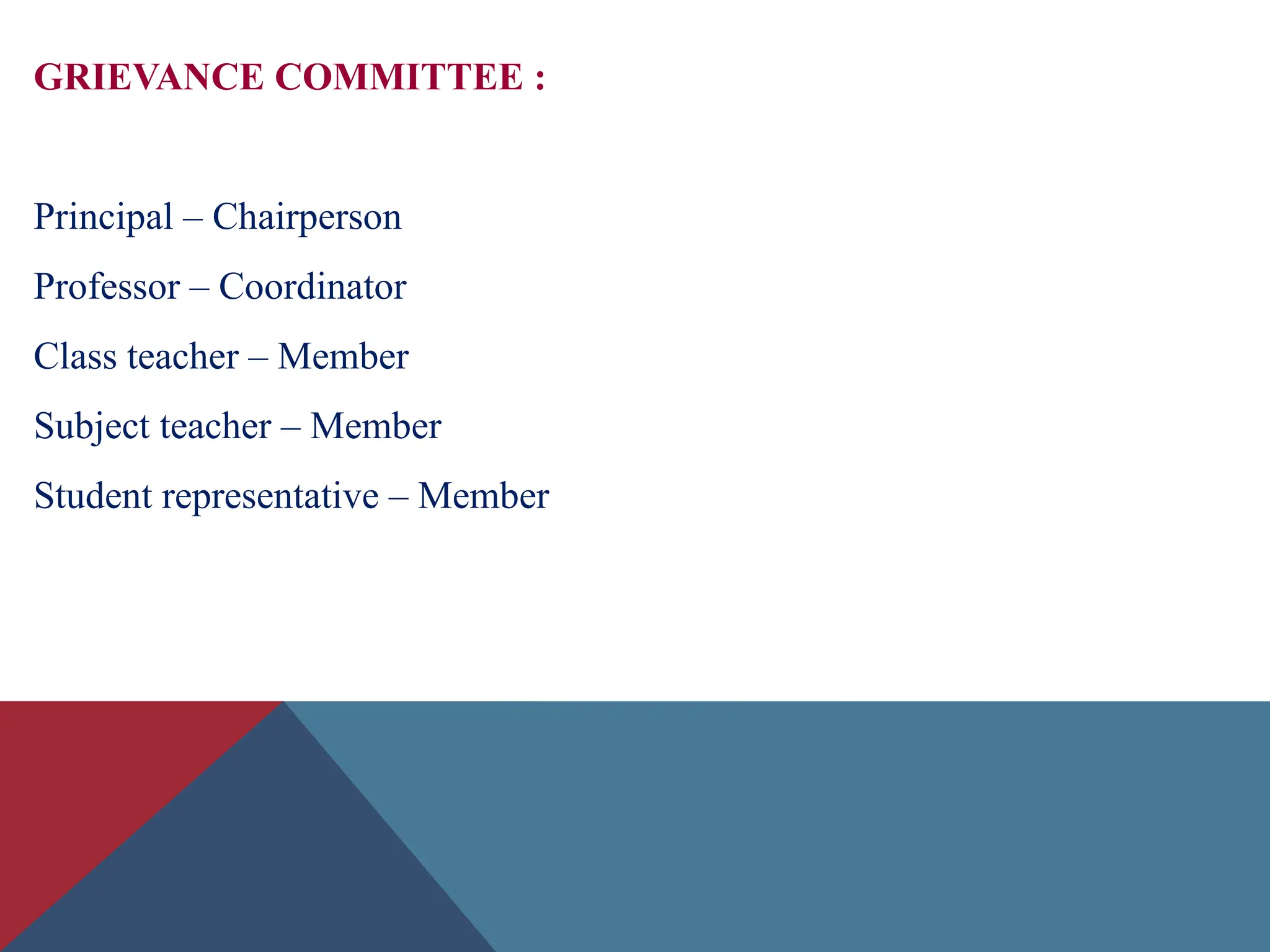
GRIEVANCE COMMITTEE :
Principal– Chairperson
Professor – Coordinator
Class teacher – Member
Subject teacher – Member
Student representative – Member
58.
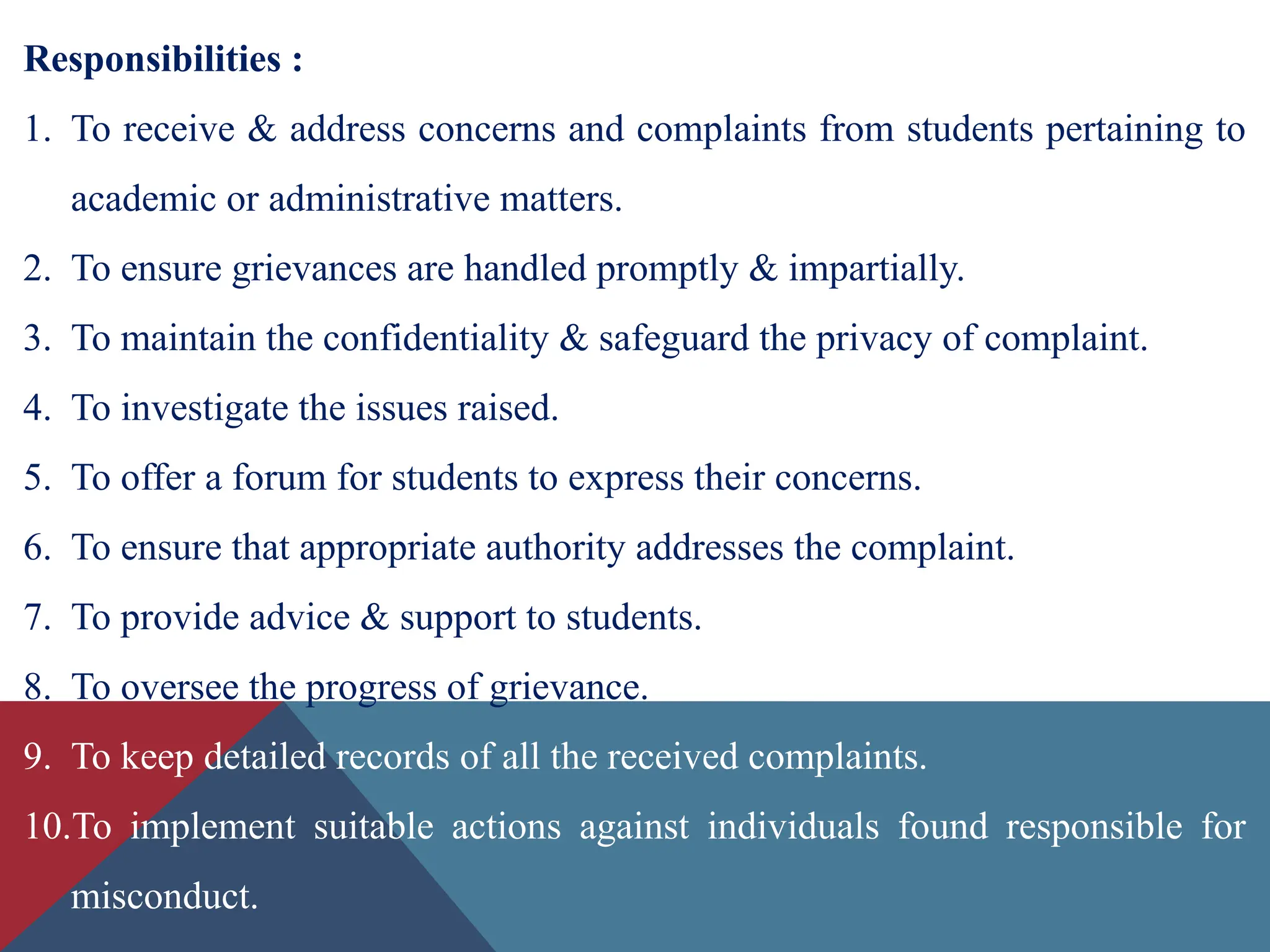
Responsibilities :
1. Toreceive & address concerns and complaints from students pertaining to
academic or administrative matters.
2. To ensure grievances are handled promptly & impartially.
3. To maintain the confidentiality & safeguard the privacy of complaint.
4. To investigate the issues raised.
5. To offer a forum for students to express their concerns.
6. To ensure that appropriate authority addresses the complaint.
7. To provide advice & support to students.
8. To oversee the progress of grievance.
9. To keep detailed records of all the received complaints.
10.To implement suitable actions against individuals found responsible for
misconduct.




![guidance_and_counselling_ppt[1] SHITAL.pptx](https://cdn.slidesharecdn.com/ss_thumbnails/guidanceandcounsellingppt1shital-250718185534-68f677f8-thumbnail.jpg?width=640&height=640&fit=bounds)


