TEST REPORT                  LNB


Diamond line LNB’s of
GT-SAT International
Powerful LNB’s
                                                                                                                                                 08-09/2008
                                                                                                                            GT-SAT INTERNATIONAL
                                                                                                                              DIAMOND LINE LNB’S
                                                                                                                        High output and low distortion make
                                                                                                                         these LNBs ideal solutions for any
                                                                                                                                satellite installation


A few years ago, we were observing the improvement in
noise performance of LNB’s. The older LNBs that had the
noise figure of 0.8 dB or even larger than 1 dB have been
replaced by LNBs with noise figures specified as 0.6, 0.3 or
even 0.2 dB (typically). If you read regularly TELE-satellite,
you know that not always the measurements do prove that
0.2 dB marked devices are better than 0.6 dB devices for
every frequency or polarization. Our recent tests showed
that there is a rather low difference in noise performance of
today’s good quality products. So, how can a manufacturer
make a difference and offer a customer a better product?


   Another parameter that is          SAT International are just
quite important for systems           such products, which we took     TELE-satellite World                            www.TELE-satellite.com/...
                                                                       Download this report in other languages from the Internet:
with long coax cables is the          from the market: single, twin,   Arabic         ‫ﺍﻟﻌﺮﺑﻴﺔ‬           www.TELE-satellite.com/TELE-satellite-0807/ara/gtsat.pdf
output power provided by              quad and quattro LNB’s (GT-      Indonesian     Indonesia         www.TELE-satellite.com/TELE-satellite-0807/bid/gtsat.pdf
                                                                       Bulgarian      Български         www.TELE-satellite.com/TELE-satellite-0807/bul/gtsat.pdf
the LNB. Since a coax cable           LST40D, GT-T40D, GT-QD40D        Czech          Česky             www.TELE-satellite.com/TELE-satellite-0807/ces/gtsat.pdf
attenuates the signal, if we          and GT-QT40D). These prod-       German         Deutsch           www.TELE-satellite.com/TELE-satellite-0807/deu/gtsat.pdf
                                                                       English        English           www.TELE-satellite.com/TELE-satellite-0807/eng/gtsat.pdf
need to feed a receiver that          ucts have high conversion        Spanish        Español           www.TELE-satellite.com/TELE-satellite-0807/esp/gtsat.pdf
                                                                       Farsi          ‫ﻓﺎﺭﺳﻲ‬             www.TELE-satellite.com/TELE-satellite-0807/far/gtsat.pdf
is far away from an LNB, we           gain, so when compared with      French         Français          www.TELE-satellite.com/TELE-satellite-0807/fra/gtsat.pdf
need to insert an amplifier at         a regular LNB they should        Greek          Ελληνικά          www.TELE-satellite.com/TELE-satellite-0807/hel/gtsat.pdf
                                                                       Croatian       Hrvatski          www.TELE-satellite.com/TELE-satellite-0807/hrv/gtsat.pdf
the LNB output. Such ampli-           create visible stronger signal   Italian        Italiano          www.TELE-satellite.com/TELE-satellite-0807/ita/gtsat.pdf
fier means additional cost. It         at the output.                   Hungarian      Magyar            www.TELE-satellite.com/TELE-satellite-0807/mag/gtsat.pdf
                                                                       Mandarin       中文                www.TELE-satellite.com/TELE-satellite-0807/man/gtsat.pdf
can also spoil the noise per-           To check this, we quickly      Dutch          Nederlands        www.TELE-satellite.com/TELE-satellite-0807/ned/gtsat.pdf
                                                                       Polish         Polski            www.TELE-satellite.com/TELE-satellite-0807/pol/gtsat.pdf
formance of the system.               build    the    measurement      Portuguese     Português         www.TELE-satellite.com/TELE-satellite-0807/por/gtsat.pdf
   The alternative is to use an       system: 60 cm dish aimed at      Romanian       Românesc          www.TELE-satellite.com/TELE-satellite-0807/rom/gtsat.pdf
                                                                       Russian        Русский           www.TELE-satellite.com/TELE-satellite-0807/rus/gtsat.pdf
LNB that already provides a           HOTBIRD 13° East, 0.3dB ref-     Swedish        Svenska           www.TELE-satellite.com/TELE-satellite-0807/sve/gtsat.pdf
stronger signal. And the Dia-         erence LNB, satellite signal     Turkish        Türkçe            www.TELE-satellite.com/TELE-satellite-0807/tur/gtsat.pdf

mond high gain line of GT-            analyzer, 10dB signal attenu-                                Available online starting from 25 July 2008


48 TELE-satellite & Broadband — 08-09/2008 — www.TELE-satellite.com
Table 1. Transponders selected as
                    signal sources.

ator, a piece of coax cable
and a few 75 ohm termina-
tions (to terminate not con-                                    Fig. 1. Outputs of the single and twin LNB’s of GT-SAT compared to the reference LNB.
nected outputs of a quad and
quattro LNB’s). We selected
transponders situated at the
beginning, at the end and
in the middle of the low and
high subband of Ku-Band. Six
transponders for vertical and                                                                                                           Reference
six for horizontal polarization
                                                                                                                                        Quad Out 1
– see Table 1.
   Graphs in Figure 1 and 2                                                                                                             Quad Out 2
show the results. The yellow                                                                                                            Quad Out 3
bar represents the reference                                                                                                            Quad Out 4
LNB. The specification was
                                                                                                                                        Quattro
not overoptimistic. Every-
body can see that the whole
family provide much stronger
signal than the regular LNB
by 7 to 12 dB. Please mind
that a coax cable introduces
20~30 dB attenuation per
100 m. Based on our results,
we can say that the dia-
mond line LNB’s compensate                                    Fig. 2. Outputs of the quad and quattro LNB’s of GT-SAT compared to the reference LNB.
the attenuation introduced
by 30~50 meters of a coax
cable. That is 10~15 stories
of a building!
   We knew already before
the measurements that these
LNB’s should have bigger
output power than normally.
So it was not a big sur-
prise. But there are no free
lunches. If you improve one
parameter, you usually have
to agree for a degradation of
something else. In this case,
we were afraid that the noise
performance had suffered.
We measured the modula-
tion error ratio (MER). This
is the very practical method
to check noise performance
when real life signals like
transponders are used.
                                                      Fig. 3. Noise performance of the single and twin LNB’s of GT-SAT compared to the reference LNB.
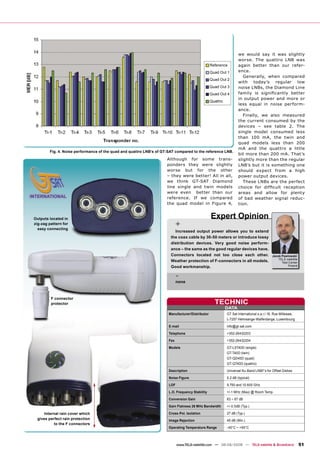
   In Figure 3 and 4 you can
see that our fears were base-
less. The single and twin
LNB’s proved to be very com-
parable with our reference.
                                                                                                               Table 2. DC current consumption [mA]


50 TELE-satellite & Broadband — 08-09/2008 — www.TELE-satellite.com
we would say it was slightly
                                                                                                                   worse. The quattro LNB was
                                                                                                 Reference         again better than our refer-
                                                                                                 Quad Out 1        ence.
                                                                                                                      Generally, when compared
                                                                                                 Quad Out 2
                                                                                                                   with today’s regular low
                                                                                                 Quad Out 3        noise LNBs, the Diamond Line
                                                                                                 Quad Out 4        family is significantly better
                                                                                                                   in output power and more or
                                                                                                 Quattro
                                                                                                                   less equal in noise perform-
                                                                                                                   ance.
                                                                                                                      Finally, we also measured
                                                                                                                   the current consumed by the
                                                                                                                   devices – see table 2. The
                                                                                                                   single model consumed less
                                                                                                                   than 100 mA, the twin and
                                                                                                                   quad models less than 200
                                                                                                                   mA and the quattro a little
        Fig. 4. Noise performance of the quad and quattro LNB’s of GT-SAT compared to the reference LNB.
                                                                                                                   bit more than 200 mA. That’s
                                                                     Although for some trans-                      slightly more than the regular
                                                                     ponders they were slightly                    LNB’s but it is something one
                                                                     worse but for the other                       should expect from a high
                                                                     – they were better! All in all,               power output devices.
                                                                     we think GT-SAT Diamond                          These LNBs are the perfect
                                                                     line single and twin models                   choice for difficult reception
                                                                     were even better than our                     areas and allow for plenty
                                                                     reference. If we compared                     of bad weather signal reduc-
                                                                     the quad model in Figure 4,                   tion.


Outputs located in                                                                               Expert Opinion
zig-zag pattern for
  easy connecting
                                                                            +
                                                                         Increased output power allows you to extend
                                                                       the coax cable by 30-50 meters or introduce lossy
                                                                       distribution devices. Very good noise perform-
                                                                       ance – the same as the good regular devices have.
                                                                       Connectors located not too close each other.                      Jacek Pawlowski
                                                                                                                                             TELE-satellite
                                                                       Weather protection of F-connectors in all models.                       Test Center
                                                                       Good workmanship.                                                            Poland


                                                                            -
                                                                            none


         F connector
         protector                                                                                 TECHNIC
                                                                                                           DATA
                                                                      Manufacturer/Distributor             GT Sat International s.a.r.l 16, Rue Millewee,
                                                                                                           L-7257 Helmsange-Walferdange, Luxembourg

                                                                      E-mail                               info@gt-sat.com
                                                                      Telephone                            +352-26432203

                                                                      Fax                                  +352-26432204

                                                                      Models                               GT-LST40D (single)
                                                                                                           GT-T40D (twin)
                                                                                                           GT-QD40D (quad)
                                                                                                           GT-QT40D (quattro)

                                                                      Description                          Universal Ku-Band LNBF’s for Offset Dishes
                                                                      Noise Figure                         0.2 dB (typical)

                                                                      LOF                                  9.750 and 10.600 GHz
                                                                      L.O. Frequency Stability             +/-1 MHz (Max) @ Room Temp.

                                                                      Conversion Gain                      63 ~ 67 dB

                                                                      Gain Flatness 26 MHz Bandwidth       +/-0.5dB (Typ.)

      Internal rain cover which                                       Cross-Pol. Isolation                 27 dB (Typ.)
  gives perfect rain protection                                       Image Rejection                      45 dB (Min.)
           to the F connectors
                                                                      Operating Temperature Range          -40°C ~ +65°C


                                                                            www.TELE-satellite.com — 08-09/2008 — TELE-satellite & Broadband                  51

Gtsat

  • 1.
    TEST REPORT LNB Diamond line LNB’s of GT-SAT International Powerful LNB’s 08-09/2008 GT-SAT INTERNATIONAL DIAMOND LINE LNB’S High output and low distortion make these LNBs ideal solutions for any satellite installation A few years ago, we were observing the improvement in noise performance of LNB’s. The older LNBs that had the noise figure of 0.8 dB or even larger than 1 dB have been replaced by LNBs with noise figures specified as 0.6, 0.3 or even 0.2 dB (typically). If you read regularly TELE-satellite, you know that not always the measurements do prove that 0.2 dB marked devices are better than 0.6 dB devices for every frequency or polarization. Our recent tests showed that there is a rather low difference in noise performance of today’s good quality products. So, how can a manufacturer make a difference and offer a customer a better product? Another parameter that is SAT International are just quite important for systems such products, which we took TELE-satellite World www.TELE-satellite.com/... Download this report in other languages from the Internet: with long coax cables is the from the market: single, twin, Arabic ‫ﺍﻟﻌﺮﺑﻴﺔ‬ www.TELE-satellite.com/TELE-satellite-0807/ara/gtsat.pdf output power provided by quad and quattro LNB’s (GT- Indonesian Indonesia www.TELE-satellite.com/TELE-satellite-0807/bid/gtsat.pdf Bulgarian Български www.TELE-satellite.com/TELE-satellite-0807/bul/gtsat.pdf the LNB. Since a coax cable LST40D, GT-T40D, GT-QD40D Czech Česky www.TELE-satellite.com/TELE-satellite-0807/ces/gtsat.pdf attenuates the signal, if we and GT-QT40D). These prod- German Deutsch www.TELE-satellite.com/TELE-satellite-0807/deu/gtsat.pdf English English www.TELE-satellite.com/TELE-satellite-0807/eng/gtsat.pdf need to feed a receiver that ucts have high conversion Spanish Español www.TELE-satellite.com/TELE-satellite-0807/esp/gtsat.pdf Farsi ‫ﻓﺎﺭﺳﻲ‬ www.TELE-satellite.com/TELE-satellite-0807/far/gtsat.pdf is far away from an LNB, we gain, so when compared with French Français www.TELE-satellite.com/TELE-satellite-0807/fra/gtsat.pdf need to insert an amplifier at a regular LNB they should Greek Ελληνικά www.TELE-satellite.com/TELE-satellite-0807/hel/gtsat.pdf Croatian Hrvatski www.TELE-satellite.com/TELE-satellite-0807/hrv/gtsat.pdf the LNB output. Such ampli- create visible stronger signal Italian Italiano www.TELE-satellite.com/TELE-satellite-0807/ita/gtsat.pdf fier means additional cost. It at the output. Hungarian Magyar www.TELE-satellite.com/TELE-satellite-0807/mag/gtsat.pdf Mandarin 中文 www.TELE-satellite.com/TELE-satellite-0807/man/gtsat.pdf can also spoil the noise per- To check this, we quickly Dutch Nederlands www.TELE-satellite.com/TELE-satellite-0807/ned/gtsat.pdf Polish Polski www.TELE-satellite.com/TELE-satellite-0807/pol/gtsat.pdf formance of the system. build the measurement Portuguese Português www.TELE-satellite.com/TELE-satellite-0807/por/gtsat.pdf The alternative is to use an system: 60 cm dish aimed at Romanian Românesc www.TELE-satellite.com/TELE-satellite-0807/rom/gtsat.pdf Russian Русский www.TELE-satellite.com/TELE-satellite-0807/rus/gtsat.pdf LNB that already provides a HOTBIRD 13° East, 0.3dB ref- Swedish Svenska www.TELE-satellite.com/TELE-satellite-0807/sve/gtsat.pdf stronger signal. And the Dia- erence LNB, satellite signal Turkish Türkçe www.TELE-satellite.com/TELE-satellite-0807/tur/gtsat.pdf mond high gain line of GT- analyzer, 10dB signal attenu- Available online starting from 25 July 2008 48 TELE-satellite & Broadband — 08-09/2008 — www.TELE-satellite.com
  • 2.
    Table 1. Transpondersselected as signal sources. ator, a piece of coax cable and a few 75 ohm termina- tions (to terminate not con- Fig. 1. Outputs of the single and twin LNB’s of GT-SAT compared to the reference LNB. nected outputs of a quad and quattro LNB’s). We selected transponders situated at the beginning, at the end and in the middle of the low and high subband of Ku-Band. Six transponders for vertical and Reference six for horizontal polarization Quad Out 1 – see Table 1. Graphs in Figure 1 and 2 Quad Out 2 show the results. The yellow Quad Out 3 bar represents the reference Quad Out 4 LNB. The specification was Quattro not overoptimistic. Every- body can see that the whole family provide much stronger signal than the regular LNB by 7 to 12 dB. Please mind that a coax cable introduces 20~30 dB attenuation per 100 m. Based on our results, we can say that the dia- mond line LNB’s compensate Fig. 2. Outputs of the quad and quattro LNB’s of GT-SAT compared to the reference LNB. the attenuation introduced by 30~50 meters of a coax cable. That is 10~15 stories of a building! We knew already before the measurements that these LNB’s should have bigger output power than normally. So it was not a big sur- prise. But there are no free lunches. If you improve one parameter, you usually have to agree for a degradation of something else. In this case, we were afraid that the noise performance had suffered. We measured the modula- tion error ratio (MER). This is the very practical method to check noise performance when real life signals like transponders are used. Fig. 3. Noise performance of the single and twin LNB’s of GT-SAT compared to the reference LNB. In Figure 3 and 4 you can see that our fears were base- less. The single and twin LNB’s proved to be very com- parable with our reference. Table 2. DC current consumption [mA] 50 TELE-satellite & Broadband — 08-09/2008 — www.TELE-satellite.com
  • 3.
    we would sayit was slightly worse. The quattro LNB was Reference again better than our refer- Quad Out 1 ence. Generally, when compared Quad Out 2 with today’s regular low Quad Out 3 noise LNBs, the Diamond Line Quad Out 4 family is significantly better in output power and more or Quattro less equal in noise perform- ance. Finally, we also measured the current consumed by the devices – see table 2. The single model consumed less than 100 mA, the twin and quad models less than 200 mA and the quattro a little Fig. 4. Noise performance of the quad and quattro LNB’s of GT-SAT compared to the reference LNB. bit more than 200 mA. That’s Although for some trans- slightly more than the regular ponders they were slightly LNB’s but it is something one worse but for the other should expect from a high – they were better! All in all, power output devices. we think GT-SAT Diamond These LNBs are the perfect line single and twin models choice for difficult reception were even better than our areas and allow for plenty reference. If we compared of bad weather signal reduc- the quad model in Figure 4, tion. Outputs located in Expert Opinion zig-zag pattern for easy connecting + Increased output power allows you to extend the coax cable by 30-50 meters or introduce lossy distribution devices. Very good noise perform- ance – the same as the good regular devices have. Connectors located not too close each other. Jacek Pawlowski TELE-satellite Weather protection of F-connectors in all models. Test Center Good workmanship. Poland - none F connector protector TECHNIC DATA Manufacturer/Distributor GT Sat International s.a.r.l 16, Rue Millewee, L-7257 Helmsange-Walferdange, Luxembourg E-mail info@gt-sat.com Telephone +352-26432203 Fax +352-26432204 Models GT-LST40D (single) GT-T40D (twin) GT-QD40D (quad) GT-QT40D (quattro) Description Universal Ku-Band LNBF’s for Offset Dishes Noise Figure 0.2 dB (typical) LOF 9.750 and 10.600 GHz L.O. Frequency Stability +/-1 MHz (Max) @ Room Temp. Conversion Gain 63 ~ 67 dB Gain Flatness 26 MHz Bandwidth +/-0.5dB (Typ.) Internal rain cover which Cross-Pol. Isolation 27 dB (Typ.) gives perfect rain protection Image Rejection 45 dB (Min.) to the F connectors Operating Temperature Range -40°C ~ +65°C www.TELE-satellite.com — 08-09/2008 — TELE-satellite & Broadband 51