Objectives:
-Cell structure.
-Cell membrane.
-Transport mechanism through cell membrane.
ORGANIZATION OF THE CELL
• cells consist of a nucleus surrounded by a nuclear
membrane, and a cytoplasm surrounded by plasma
membrane.
• cellular components (protoplasm) are made of :
1- water
2- Ions
3- proteins
4- lipids
5- carbohydrates
Cell membrane
• Thin, pliable and almost entirely made of
proteins and lipids
the lipid bilayer impedes water penetration
cell membrane proteins are of two types:
integral and peripheral, these proteins
perform various functions (channels, carriers,
receptors, enzymes, controllers)
TRANSPORT THROUGH CELL
MEMBRANE
• The lipid bilayer prevents mixing of ECF & ICF  water
and water-soluble substances cannot move freely
through it.
• lipid-soluble substances move freely through the
plasma membrane
• Water, ions and water-soluble substances are
transported through proteins (channel proteins &
carriers)
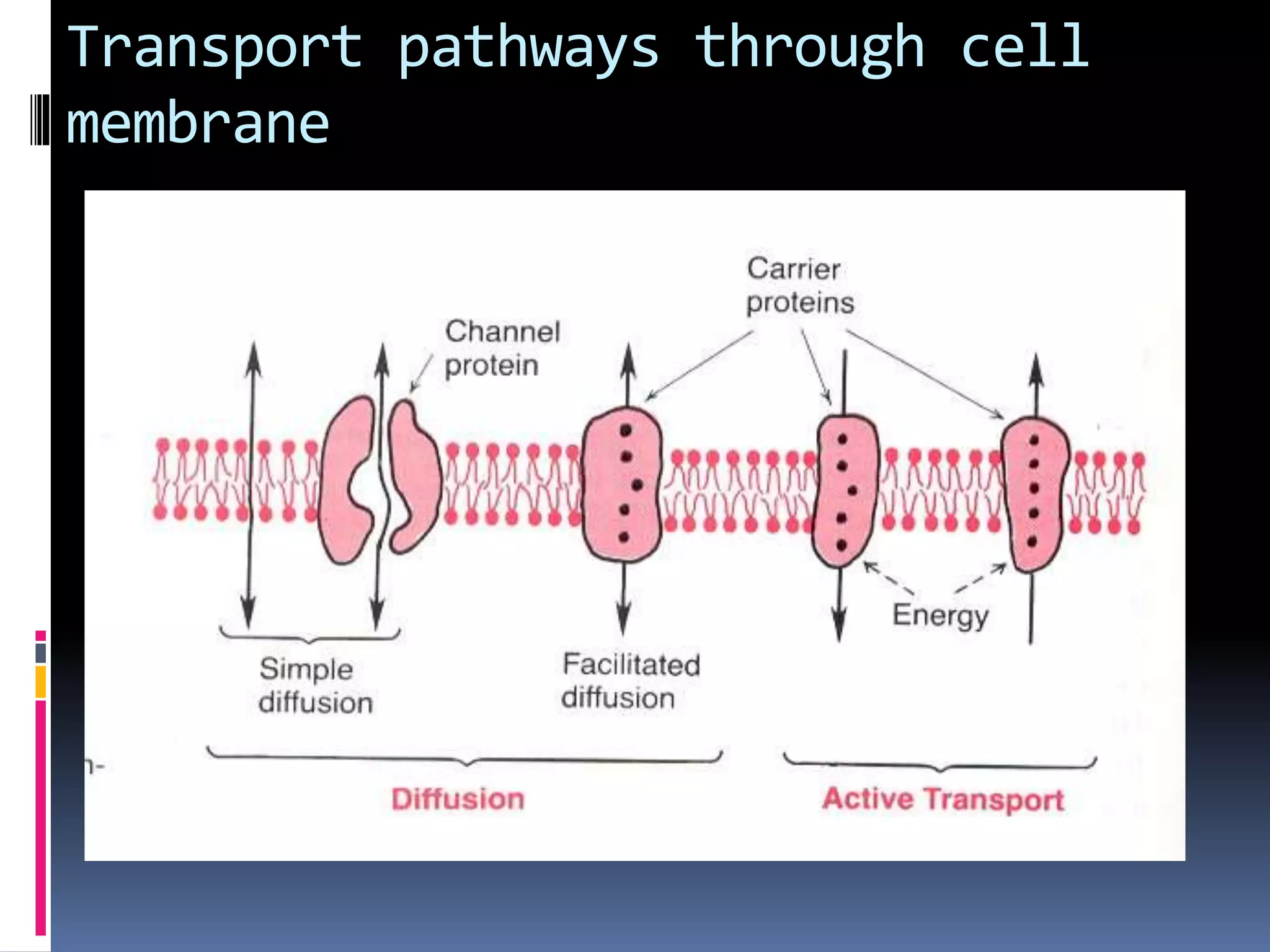
Transport pathways through cell
membrane
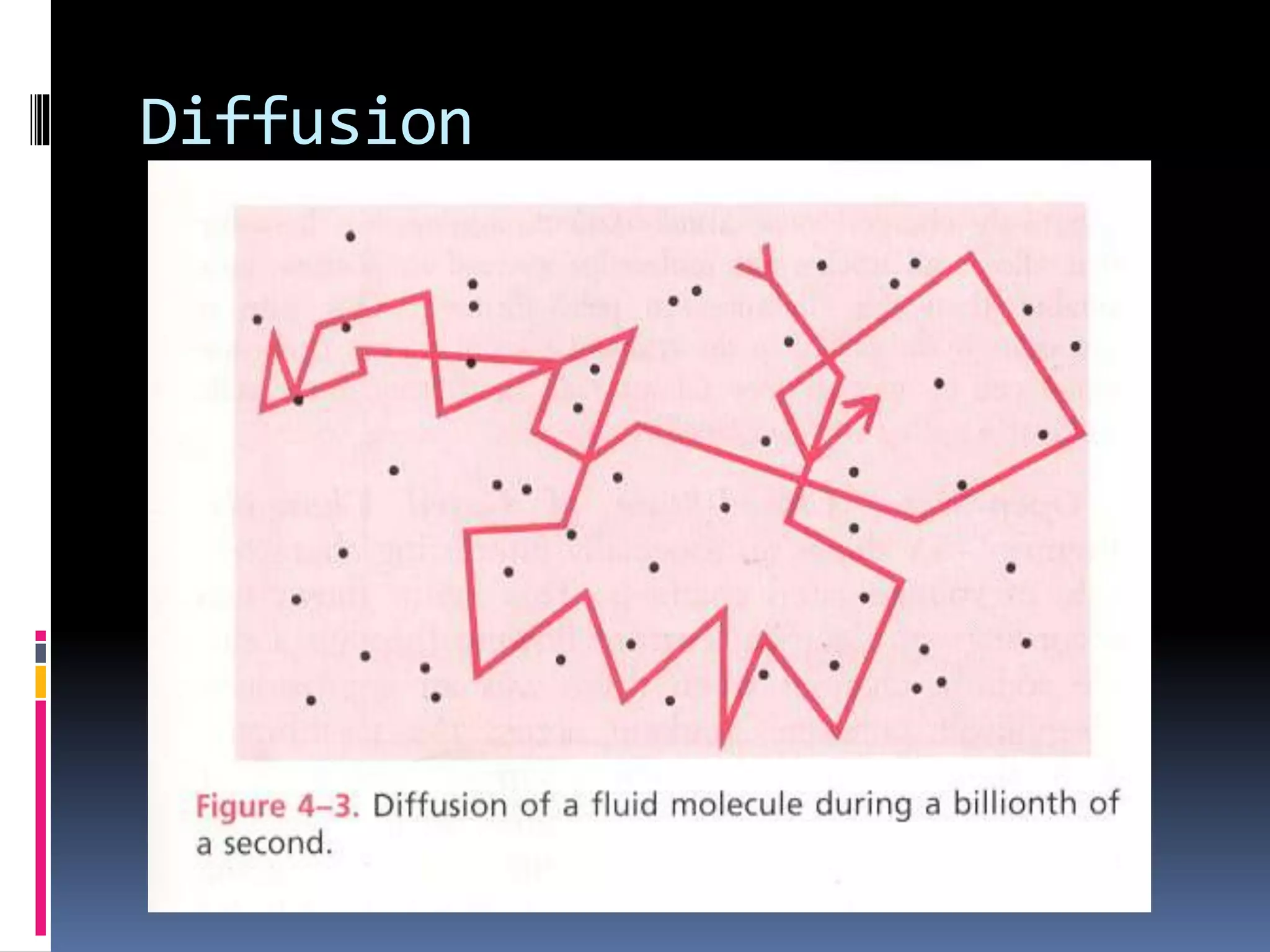
• Constant motion of molecules, ions, colloid
particles through cell membrane
• Two types:
1-Simple diffusion.
2-facilitated.
diffusion
Diffusion
Simple diffusion
• Diffusion of a matter through the lipid bilayer is
determined by its lipid solubility (O2, N2 ,CO2 move
easily through the membrane)
• Water and some water-soluble substances (urea) pass
through channels “pores” in proteins that penetrate all
the way through the membrane
• Diffusion through channels is characterized by:
 1-selective permeability (charge) , (size)
 2-controled by opening and closing gates (voltage,
ligand)
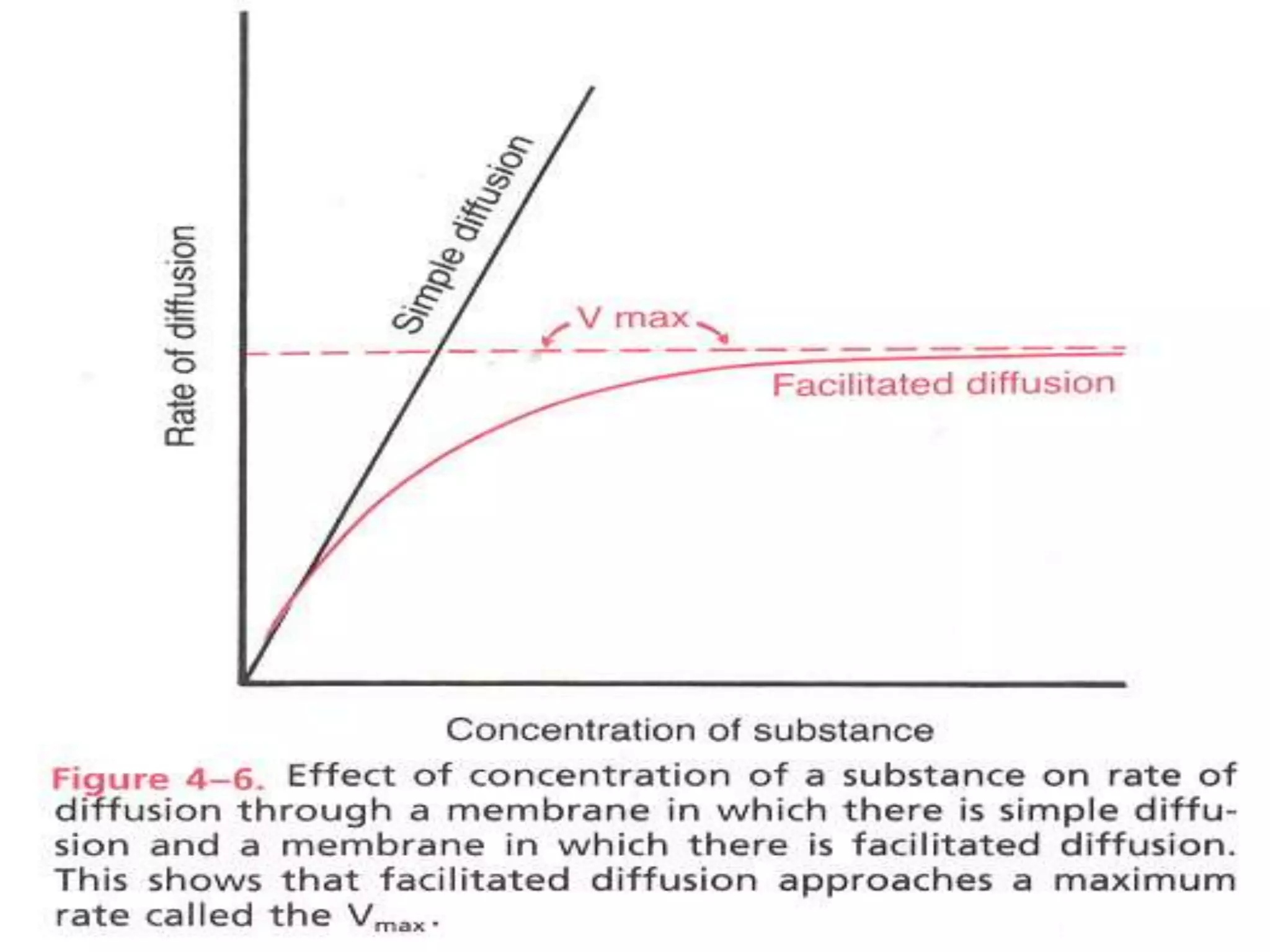
• Carrier-mediated diffusion
• the rate of diffusion reaches a maximum (Vmax)
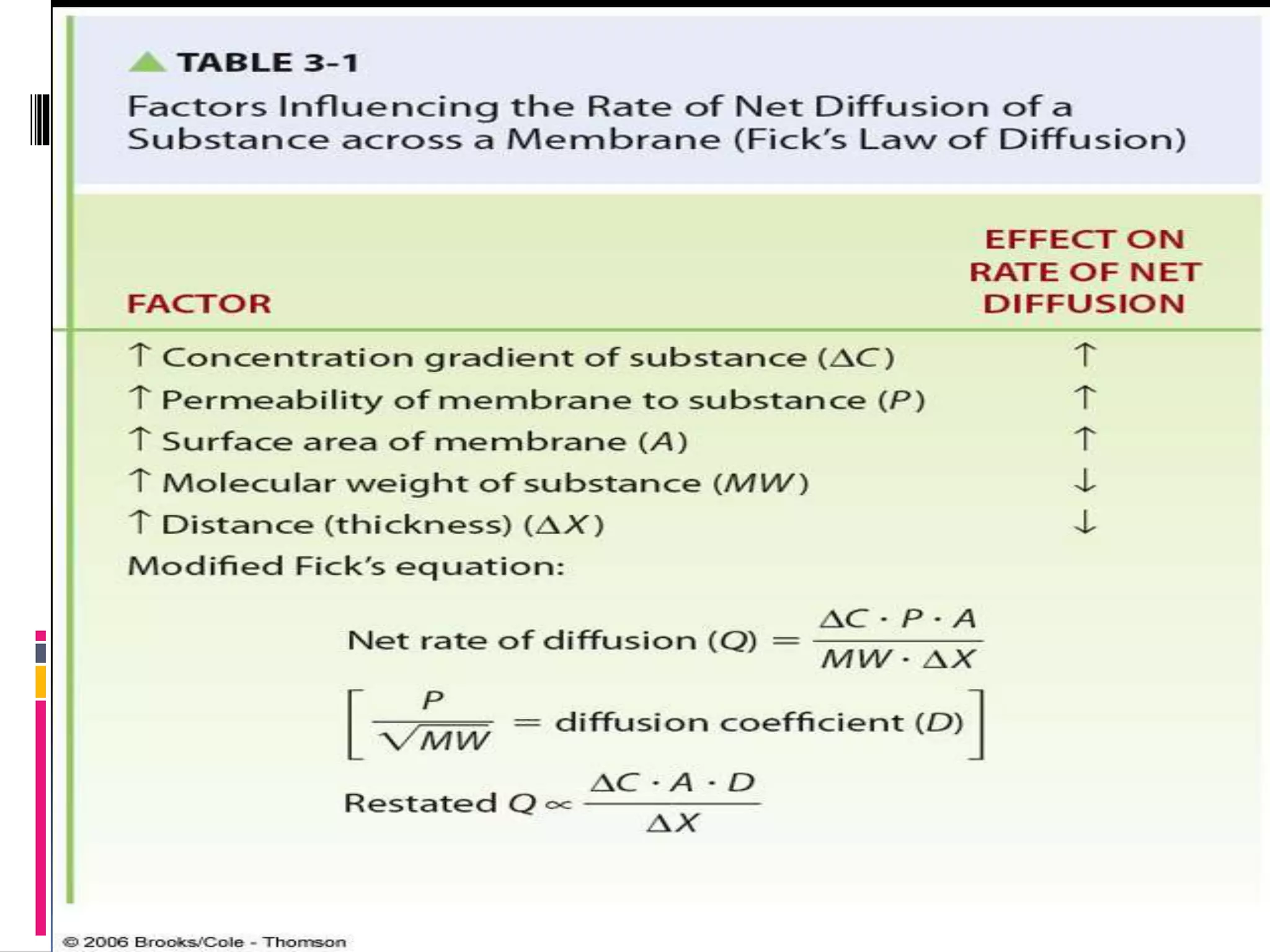
• According to Fick’s law, the rate of diffusion
depends on:
1-the magnitude of the concentration gradient
2-the permeability of the plasma membrane to a
substance.
3-the surface area of the membrane across which
diffusion takes place
4-the molecular weight of a substance
5-the distance through which diffusion takes place
Facilitated diffusion
Fig. 3-14a, p. 56
Step 1
Conformation X of
carrier (binding sites
exposed to ECF)
Molecule to be
transported binds to
carrier
Molecule to be
transported
Concentration
gradient
Plasma
membrane
Carrier molecule
(Low)
(High)ECF
ICF
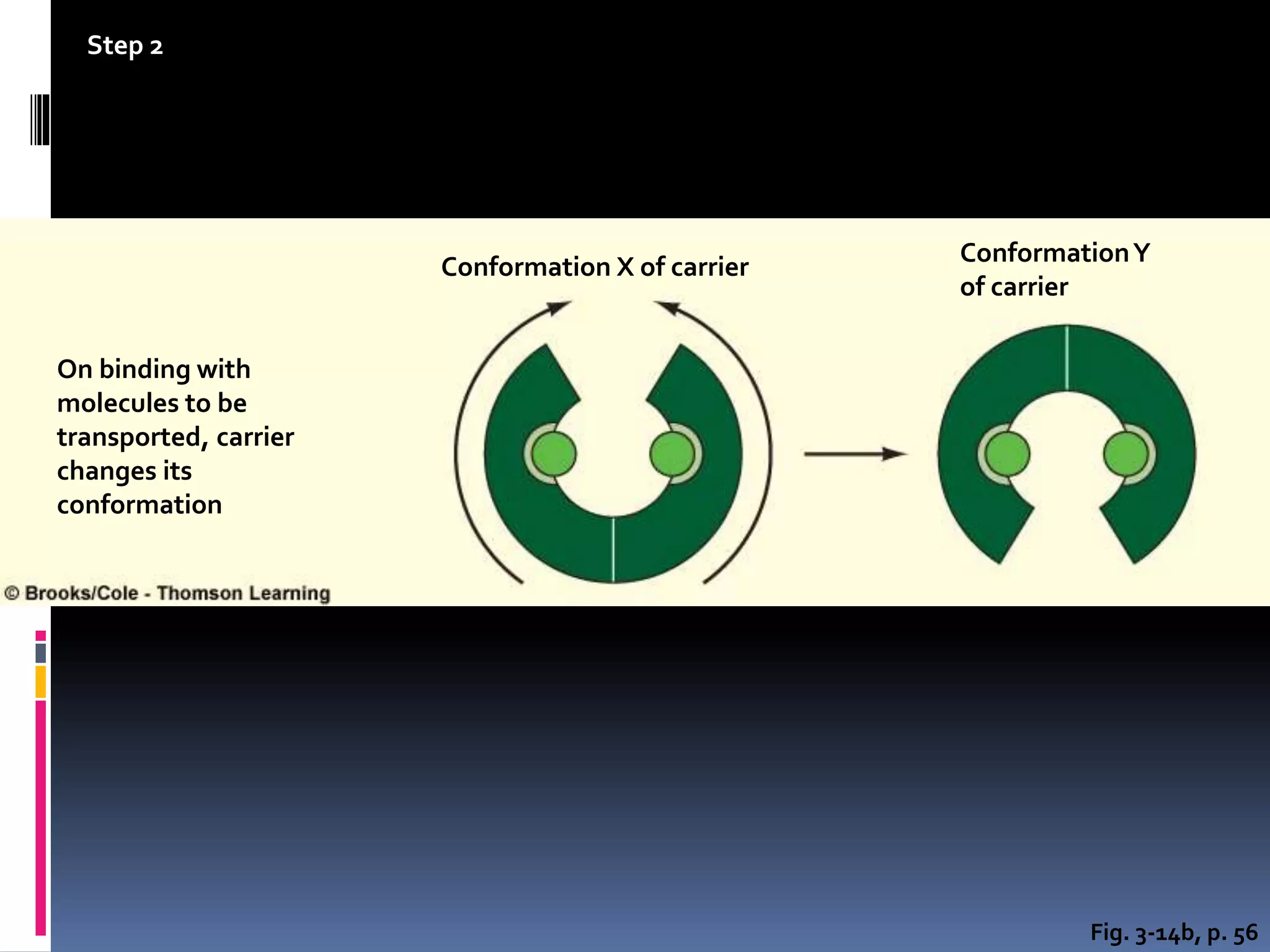
Fig. 3-14b, p. 56
Step 2
On binding with
molecules to be
transported, carrier
changes its
conformation
Conformation X of carrier
ConformationY
of carrier
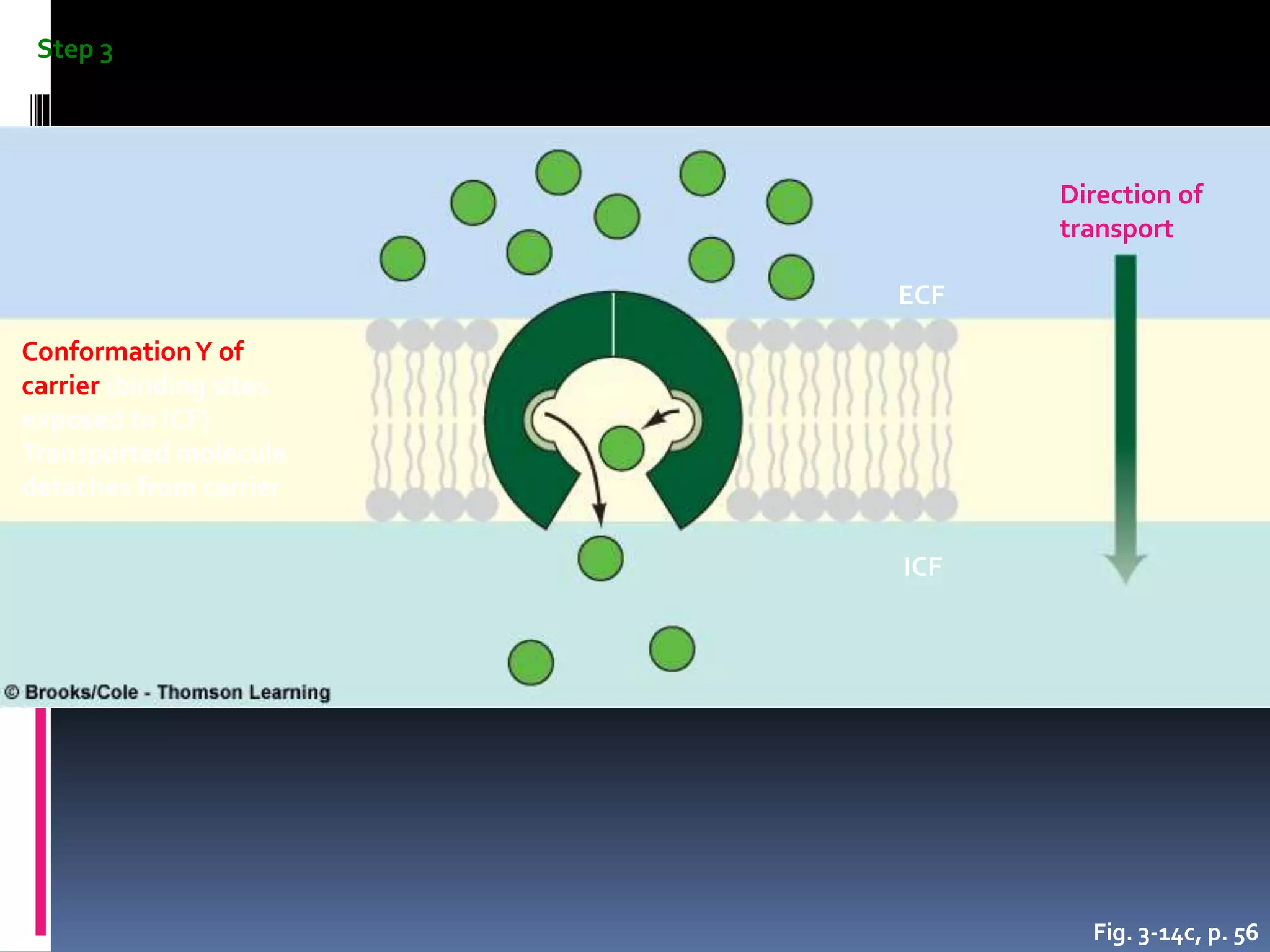
Fig. 3-14c, p. 56
Step 3
ConformationY of
carrier (binding sites
exposed to ICF)
Transported molecule
detaches from carrier
Direction of
transport
ECF
ICF
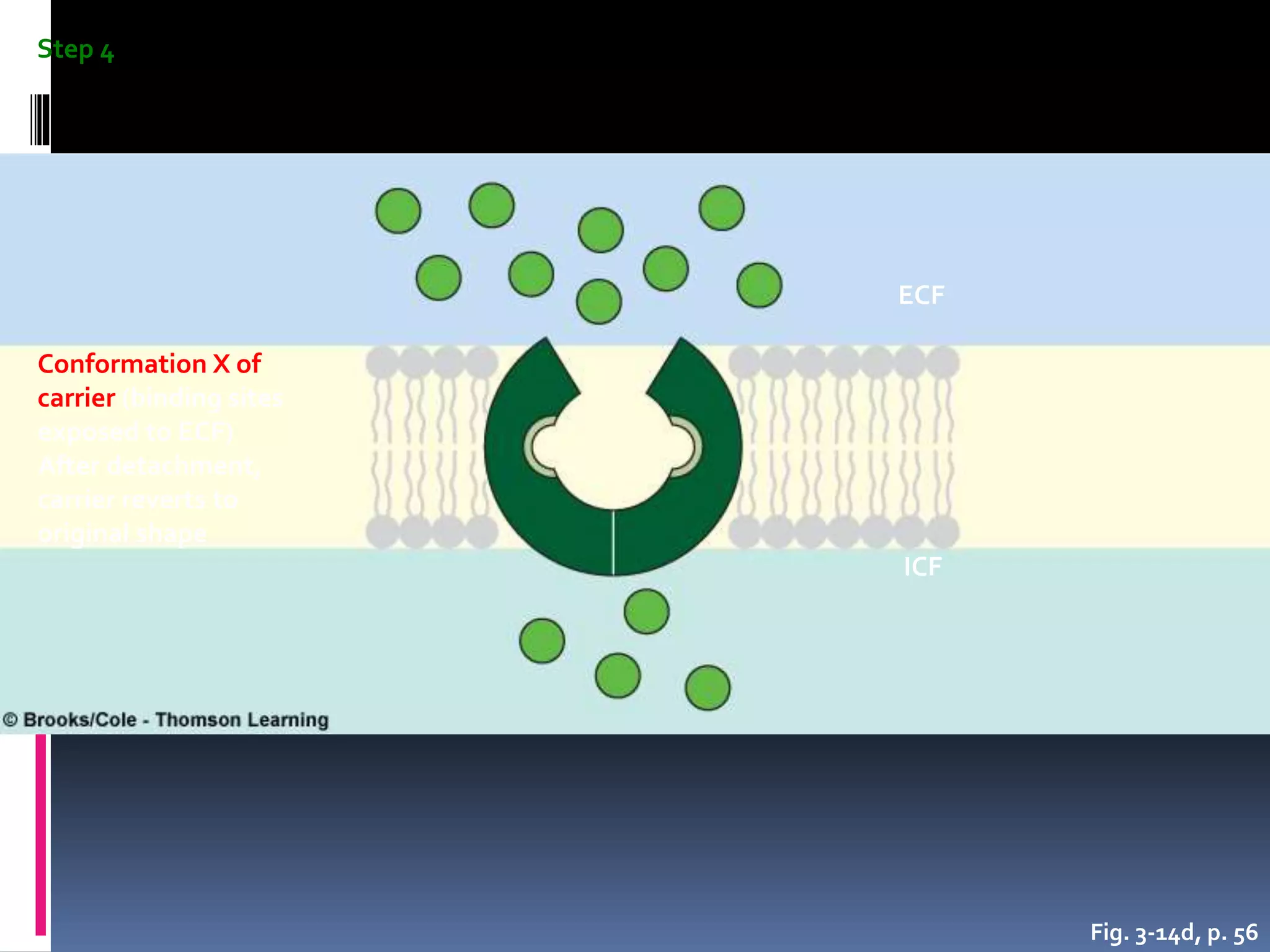
Fig. 3-14d, p. 56
Step 4
ECF
ICF
Conformation X of
carrier (binding sites
exposed to ECF)
After detachment,
carrier reverts to
original shape
II. ActiveTransport:
Primary : - Secondary
Na-K pump Co- & counter-tr.
Ca - pump Na - Gl Na -aa
H - pump Na -H Na - Ca
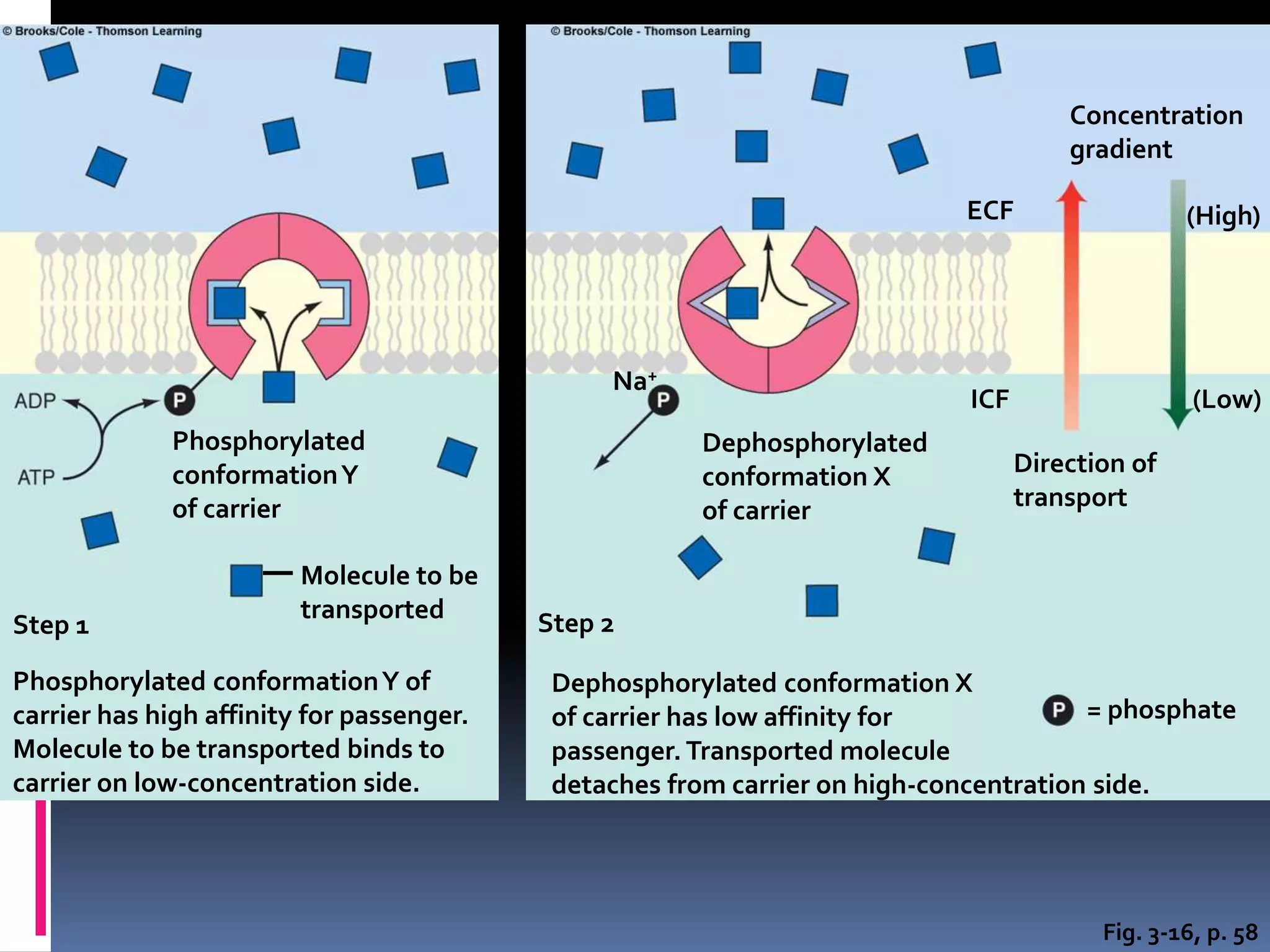
Fig. 3-16, p. 58
Phosphorylated
conformationY
of carrier
Step 1
Phosphorylated conformationY of
carrier has high affinity for passenger.
Molecule to be transported binds to
carrier on low-concentration side.
Molecule to be
transported Step 2
Dephosphorylated conformation X
of carrier has low affinity for
passenger. Transported molecule
detaches from carrier on high-concentration side.
= phosphate
Direction of
transport
Concentration
gradient
(High)
(Low)
Dephosphorylated
conformation X
of carrier
ICF
ECF
Na+
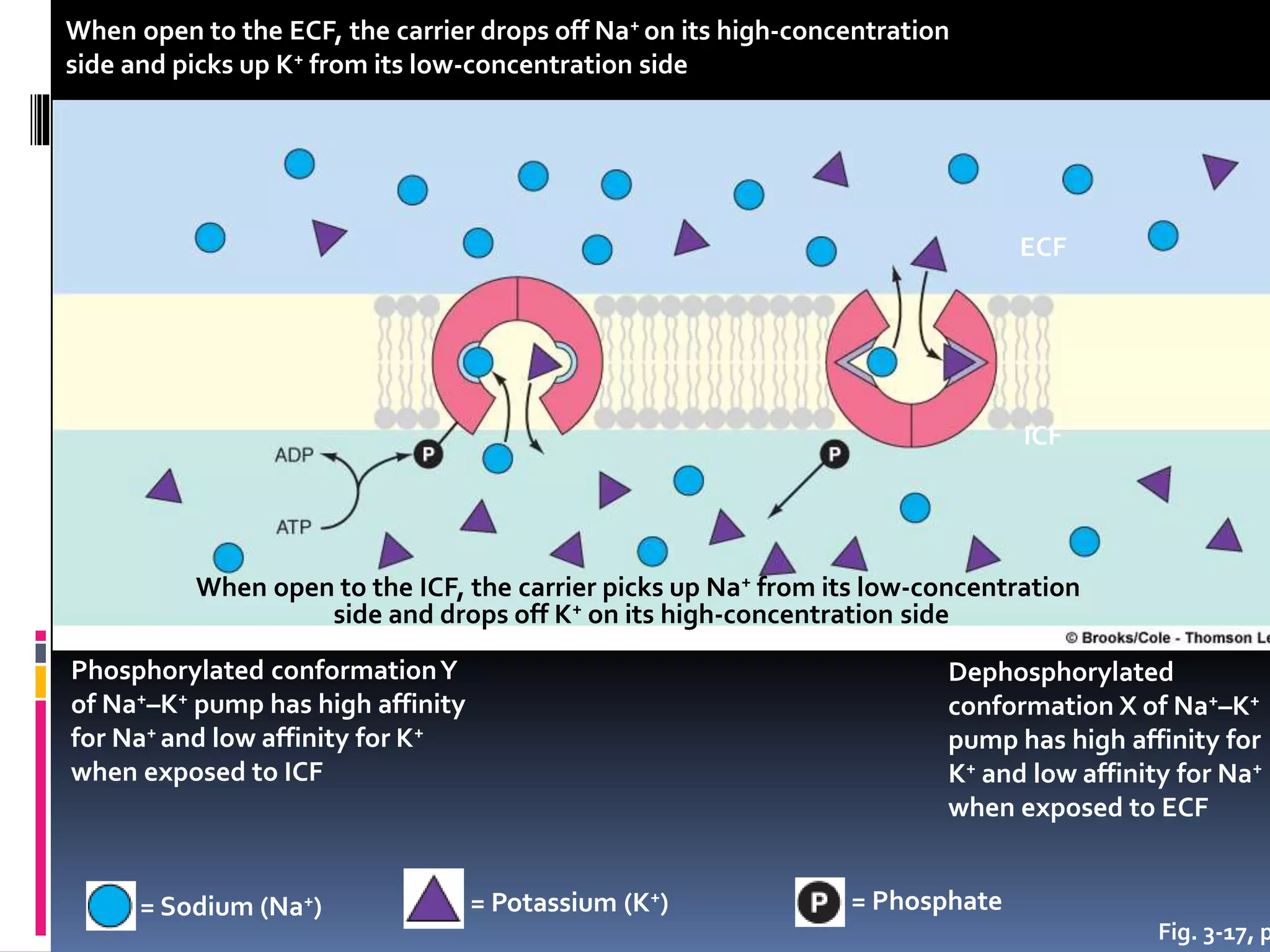
Fig. 3-17, p
= Sodium (Na+) = Potassium (K+) = Phosphate
When open to the ECF, the carrier drops off Na+ on its high-concentration
side and picks up K+ from its low-concentration side
Phosphorylated conformationY
of Na+–K+ pump has high affinity
for Na+ and low affinity for K+
when exposed to ICF
When open to the ICF, the carrier picks up Na+ from its low-concentration
side and drops off K+ on its high-concentration side
Dephosphorylated
conformation X of Na+–K+
pump has high affinity for
K+ and low affinity for Na+
when exposed to ECF
ICF
ECF
Transport of big particles
 - Endocytosis
 - Exocytosis
 - Pancytosis
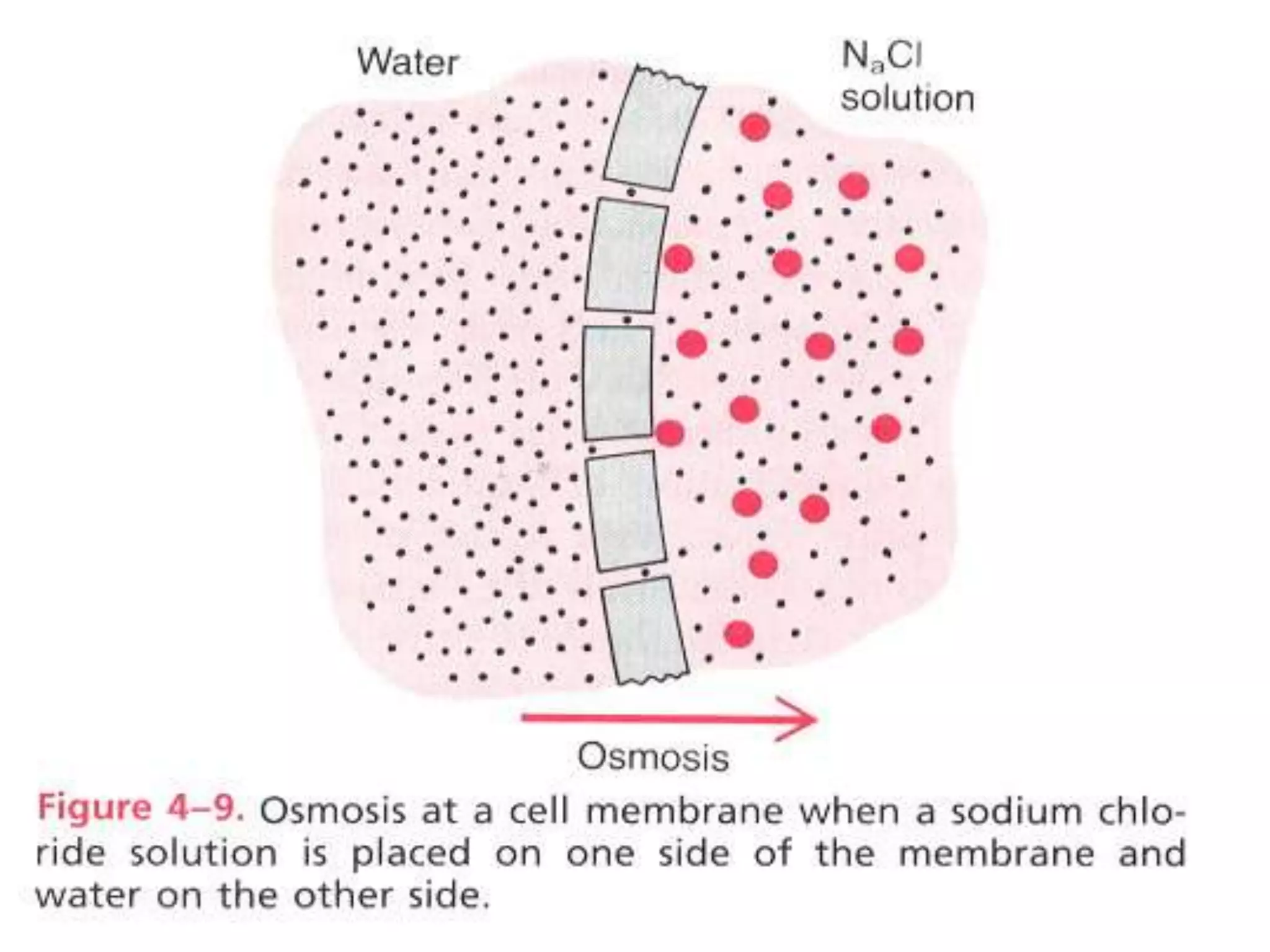
•Basic principles of osmosis:
water diffuses from high [H2O] to
region of lower [H2O] . (Kinetics).
Osmosis
OSMOTIC PRESSURE
•the exact amount of pressure required to stop osmosis.
•osmotic pressure is determined by the number of particles
rather than their mass.
•osmole: 1 gram molecular weight of osmotically active
solute
“ a solution having 1 osmole of solute
dissolved in each Kg of water is said to have
an osmolality of 1 osmole/Kg”
• 1 milliosmole/liter  19.3 mmHg osmotic pressure at
normal body temperature
Osmosis across selectively
permeable membranes
Fig. 3-9, p. 53
100% water concentration
0% solute concentration
90% water concentration
10% solute concentration
= Water molecule = Solute molecule
Fig. 3-10, p. 53
Membrane
Higher H2O
concentration,
lower solute
concentration
Lower H2O
concentration,
higher solute
concentration
= Water molecule = Solute molecule
H2O
Fig. 3-11, p. 53
Membrane (permeable to both water and solute)
Side 1 Side 2
Higher H2O concentration,
lower solute concentration
Lower H2O concentration,
higher solute concentration
H2O moves from side 1 to side 2
down its concentration gradient
Solute moves from side 2 to side 1
down its concentration gradient
• Water concentrations equal
• Solute concentrations equal
• No further net diffusion
• Steady state exists
Side 1 Side 2
= Water molecule
= Solute molecule
H2O
Solute
Fig. 3-12, p. 54
= Water molecule
= Solute molecule
Membrane (permeable to H2O but impermeable to solute)
Higher H2O concentration,
lower solute concentration
Lower H2O concentration,
higher solute concentration
H2O moves from side 1 to side 2
down its concentration gradient
• Water concentrations equal
• Solute concentrations equal
• No further net diffusion
• Steady state exists
Solute unable to move from side 2 to
side 1 down its concentration gradient
Side 1 Side 2
Side 1 Side 2
Original
level of
solutions
H2O
Fig. 3-13, p. 54
= Water molecule
= Solute molecule
Membrane (permeable to H2O but impermeable to solute)
Pure water Lower H2O concentration,
higher solute concentration
H2O moves from side 1 to side 2
down its concentration gradient
Solute unable to move from side 2 to
side 1 down its concentration gradient
Side 1 Side 2
Side 1 Side 2
Original
level of
solutions
H2O
• Water concentrations not equal
• Solute concentrations not equal
• Tendency for water to diffuse by
osmosis into side 2 is exactly
balanced by opposing tendency for
hydrostatic pressure difference to
push water into side 1
• Osmosis ceases
• Opposing pressure necessary to
completely stop osmosis is equal
to osmotic pressure of solution
Hydrostatic
(fluid)
pressure
difference
Osmosis
Hydrostatic
pressure
1 osmole = 1 mole of solute particles (6.02 x10).
1 mole glucose = 1 osm.
1 mole NaCl = 2 osm.
1 mole Na2SO3 = 3 osm.
Relation between moles and
osmoles
- Osmolality and osmolarity in
human fluids are equal.
•Osmotic pressure : pressure that prevents
the osmosis .
•The higher the osmotic pressure of a
solution, the lower its [H2O] but the higher its
[solute].
•According to van’t hoff’s law:
π = CRT
π= 19300 mm Hg for 1 osmole/liter at body
temp.
π(osmotic pr.) C(solute con. In osmole/liter)
R (ideal gas const.) T(absolute temp.)
• osmotic pr. = osmolarity(mOsm/L) X 19.3 mmHg
• the calculated value is not 100% correct due to intraionic
and intermolecular interactions between the particles and
it has to be multiplied by the “osmotic coefficient” of the
particles to reach the true value.
• the osmolarity of the body fluids is around 300 mOsm/L,
the plasma being 1mOsm/L higher because of the
osmotic effect of plasma proteins

Cell membrane

  • 1.
  • 2.
    ORGANIZATION OF THECELL • cells consist of a nucleus surrounded by a nuclear membrane, and a cytoplasm surrounded by plasma membrane. • cellular components (protoplasm) are made of : 1- water 2- Ions 3- proteins 4- lipids 5- carbohydrates
  • 3.
    Cell membrane • Thin,pliable and almost entirely made of proteins and lipids the lipid bilayer impedes water penetration cell membrane proteins are of two types: integral and peripheral, these proteins perform various functions (channels, carriers, receptors, enzymes, controllers)
  • 4.
    TRANSPORT THROUGH CELL MEMBRANE •The lipid bilayer prevents mixing of ECF & ICF  water and water-soluble substances cannot move freely through it. • lipid-soluble substances move freely through the plasma membrane • Water, ions and water-soluble substances are transported through proteins (channel proteins & carriers)
  • 5.
  • 6.
    • Constant motionof molecules, ions, colloid particles through cell membrane • Two types: 1-Simple diffusion. 2-facilitated. diffusion
  • 7.
  • 8.
    Simple diffusion • Diffusionof a matter through the lipid bilayer is determined by its lipid solubility (O2, N2 ,CO2 move easily through the membrane) • Water and some water-soluble substances (urea) pass through channels “pores” in proteins that penetrate all the way through the membrane • Diffusion through channels is characterized by:  1-selective permeability (charge) , (size)  2-controled by opening and closing gates (voltage, ligand)
  • 9.
    • Carrier-mediated diffusion •the rate of diffusion reaches a maximum (Vmax) • According to Fick’s law, the rate of diffusion depends on: 1-the magnitude of the concentration gradient 2-the permeability of the plasma membrane to a substance. 3-the surface area of the membrane across which diffusion takes place 4-the molecular weight of a substance 5-the distance through which diffusion takes place Facilitated diffusion
  • 12.
    Fig. 3-14a, p.56 Step 1 Conformation X of carrier (binding sites exposed to ECF) Molecule to be transported binds to carrier Molecule to be transported Concentration gradient Plasma membrane Carrier molecule (Low) (High)ECF ICF
  • 13.
    Fig. 3-14b, p.56 Step 2 On binding with molecules to be transported, carrier changes its conformation Conformation X of carrier ConformationY of carrier
  • 14.
    Fig. 3-14c, p.56 Step 3 ConformationY of carrier (binding sites exposed to ICF) Transported molecule detaches from carrier Direction of transport ECF ICF
  • 15.
    Fig. 3-14d, p.56 Step 4 ECF ICF Conformation X of carrier (binding sites exposed to ECF) After detachment, carrier reverts to original shape
  • 16.
    II. ActiveTransport: Primary :- Secondary Na-K pump Co- & counter-tr. Ca - pump Na - Gl Na -aa H - pump Na -H Na - Ca
  • 18.
    Fig. 3-16, p.58 Phosphorylated conformationY of carrier Step 1 Phosphorylated conformationY of carrier has high affinity for passenger. Molecule to be transported binds to carrier on low-concentration side. Molecule to be transported Step 2 Dephosphorylated conformation X of carrier has low affinity for passenger. Transported molecule detaches from carrier on high-concentration side. = phosphate Direction of transport Concentration gradient (High) (Low) Dephosphorylated conformation X of carrier ICF ECF Na+
  • 19.
    Fig. 3-17, p =Sodium (Na+) = Potassium (K+) = Phosphate When open to the ECF, the carrier drops off Na+ on its high-concentration side and picks up K+ from its low-concentration side Phosphorylated conformationY of Na+–K+ pump has high affinity for Na+ and low affinity for K+ when exposed to ICF When open to the ICF, the carrier picks up Na+ from its low-concentration side and drops off K+ on its high-concentration side Dephosphorylated conformation X of Na+–K+ pump has high affinity for K+ and low affinity for Na+ when exposed to ECF ICF ECF
  • 22.
    Transport of bigparticles  - Endocytosis  - Exocytosis  - Pancytosis
  • 23.
    •Basic principles ofosmosis: water diffuses from high [H2O] to region of lower [H2O] . (Kinetics). Osmosis
  • 25.
    OSMOTIC PRESSURE •the exactamount of pressure required to stop osmosis. •osmotic pressure is determined by the number of particles rather than their mass. •osmole: 1 gram molecular weight of osmotically active solute “ a solution having 1 osmole of solute dissolved in each Kg of water is said to have an osmolality of 1 osmole/Kg” • 1 milliosmole/liter  19.3 mmHg osmotic pressure at normal body temperature
  • 26.
  • 27.
    Fig. 3-9, p.53 100% water concentration 0% solute concentration 90% water concentration 10% solute concentration = Water molecule = Solute molecule
  • 28.
    Fig. 3-10, p.53 Membrane Higher H2O concentration, lower solute concentration Lower H2O concentration, higher solute concentration = Water molecule = Solute molecule H2O
  • 29.
    Fig. 3-11, p.53 Membrane (permeable to both water and solute) Side 1 Side 2 Higher H2O concentration, lower solute concentration Lower H2O concentration, higher solute concentration H2O moves from side 1 to side 2 down its concentration gradient Solute moves from side 2 to side 1 down its concentration gradient • Water concentrations equal • Solute concentrations equal • No further net diffusion • Steady state exists Side 1 Side 2 = Water molecule = Solute molecule H2O Solute
  • 30.
    Fig. 3-12, p.54 = Water molecule = Solute molecule Membrane (permeable to H2O but impermeable to solute) Higher H2O concentration, lower solute concentration Lower H2O concentration, higher solute concentration H2O moves from side 1 to side 2 down its concentration gradient • Water concentrations equal • Solute concentrations equal • No further net diffusion • Steady state exists Solute unable to move from side 2 to side 1 down its concentration gradient Side 1 Side 2 Side 1 Side 2 Original level of solutions H2O
  • 31.
    Fig. 3-13, p.54 = Water molecule = Solute molecule Membrane (permeable to H2O but impermeable to solute) Pure water Lower H2O concentration, higher solute concentration H2O moves from side 1 to side 2 down its concentration gradient Solute unable to move from side 2 to side 1 down its concentration gradient Side 1 Side 2 Side 1 Side 2 Original level of solutions H2O • Water concentrations not equal • Solute concentrations not equal • Tendency for water to diffuse by osmosis into side 2 is exactly balanced by opposing tendency for hydrostatic pressure difference to push water into side 1 • Osmosis ceases • Opposing pressure necessary to completely stop osmosis is equal to osmotic pressure of solution Hydrostatic (fluid) pressure difference Osmosis Hydrostatic pressure
  • 32.
    1 osmole =1 mole of solute particles (6.02 x10). 1 mole glucose = 1 osm. 1 mole NaCl = 2 osm. 1 mole Na2SO3 = 3 osm. Relation between moles and osmoles
  • 33.
    - Osmolality andosmolarity in human fluids are equal.
  • 34.
    •Osmotic pressure :pressure that prevents the osmosis . •The higher the osmotic pressure of a solution, the lower its [H2O] but the higher its [solute]. •According to van’t hoff’s law: π = CRT π= 19300 mm Hg for 1 osmole/liter at body temp. π(osmotic pr.) C(solute con. In osmole/liter) R (ideal gas const.) T(absolute temp.)
  • 35.
    • osmotic pr.= osmolarity(mOsm/L) X 19.3 mmHg • the calculated value is not 100% correct due to intraionic and intermolecular interactions between the particles and it has to be multiplied by the “osmotic coefficient” of the particles to reach the true value. • the osmolarity of the body fluids is around 300 mOsm/L, the plasma being 1mOsm/L higher because of the osmotic effect of plasma proteins