The Mis-Education
of the Negro
Book by:
• Carter Godwin Woodson
Presentation by:
• Danielle Card
• Selena Dillard
• Fouad Elsenbary
• Ryanne Jackson
• Rashad Smalls
• Ronnie Woolard
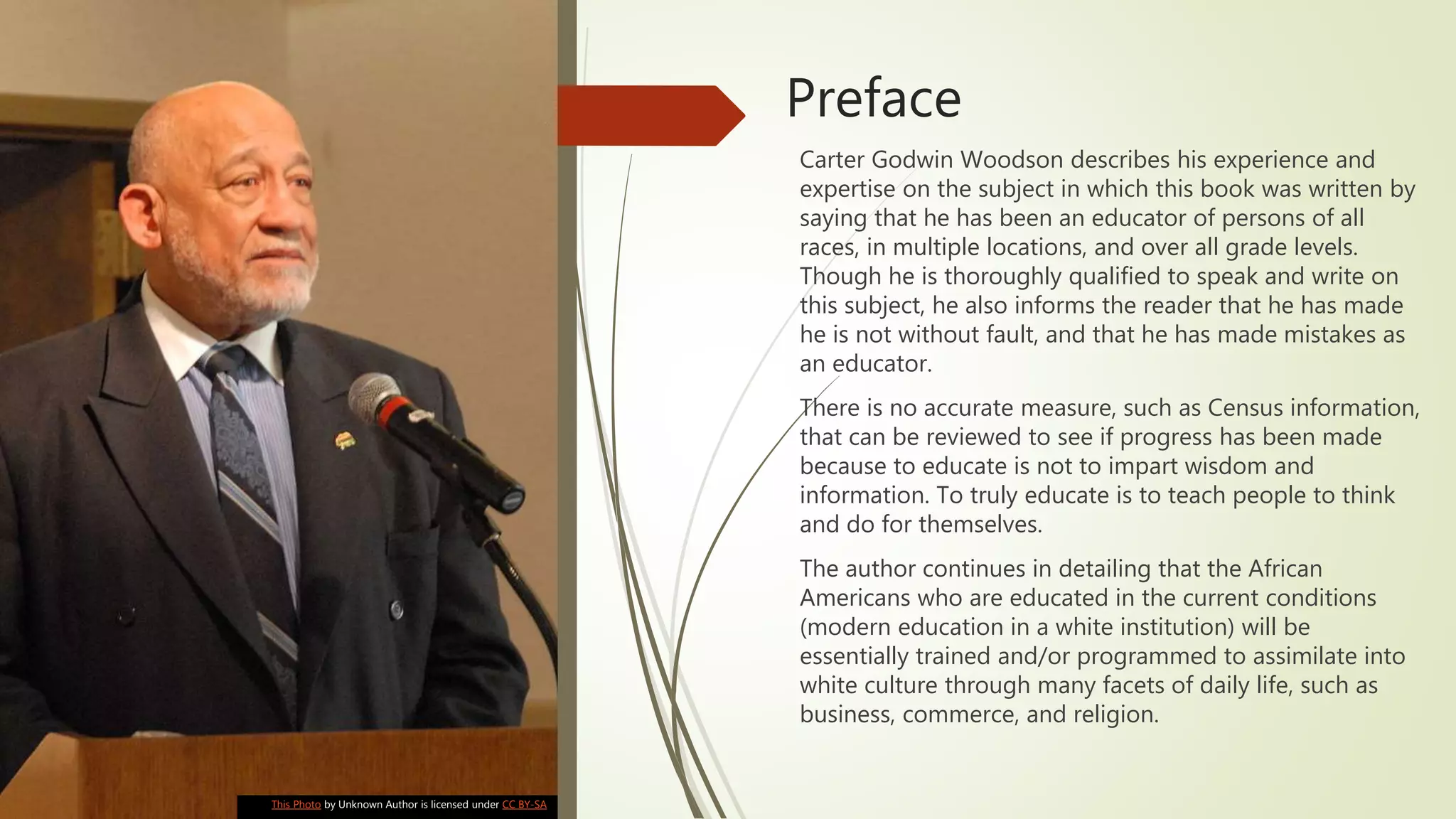
Preface
Carter Godwin Woodson describes his experience and
expertise on the subject in which this book was written by
saying that he has been an educator of persons of all
races, in multiple locations, and over all grade levels.
Though he is thoroughly qualified to speak and write on
this subject, he also informs the reader that he has made
he is not without fault, and that he has made mistakes as
an educator.
There is no accurate measure, such as Census information,
that can be reviewed to see if progress has been made
because to educate is not to impart wisdom and
information. To truly educate is to teach people to think
and do for themselves.
The author continues in detailing that the African
Americans who are educated in the current conditions
(modern education in a white institution) will be
essentially trained and/or programmed to assimilate into
white culture through many facets of daily life, such as
business, commerce, and religion.
This Photo by Unknown Author is licensed under CC BY-SA
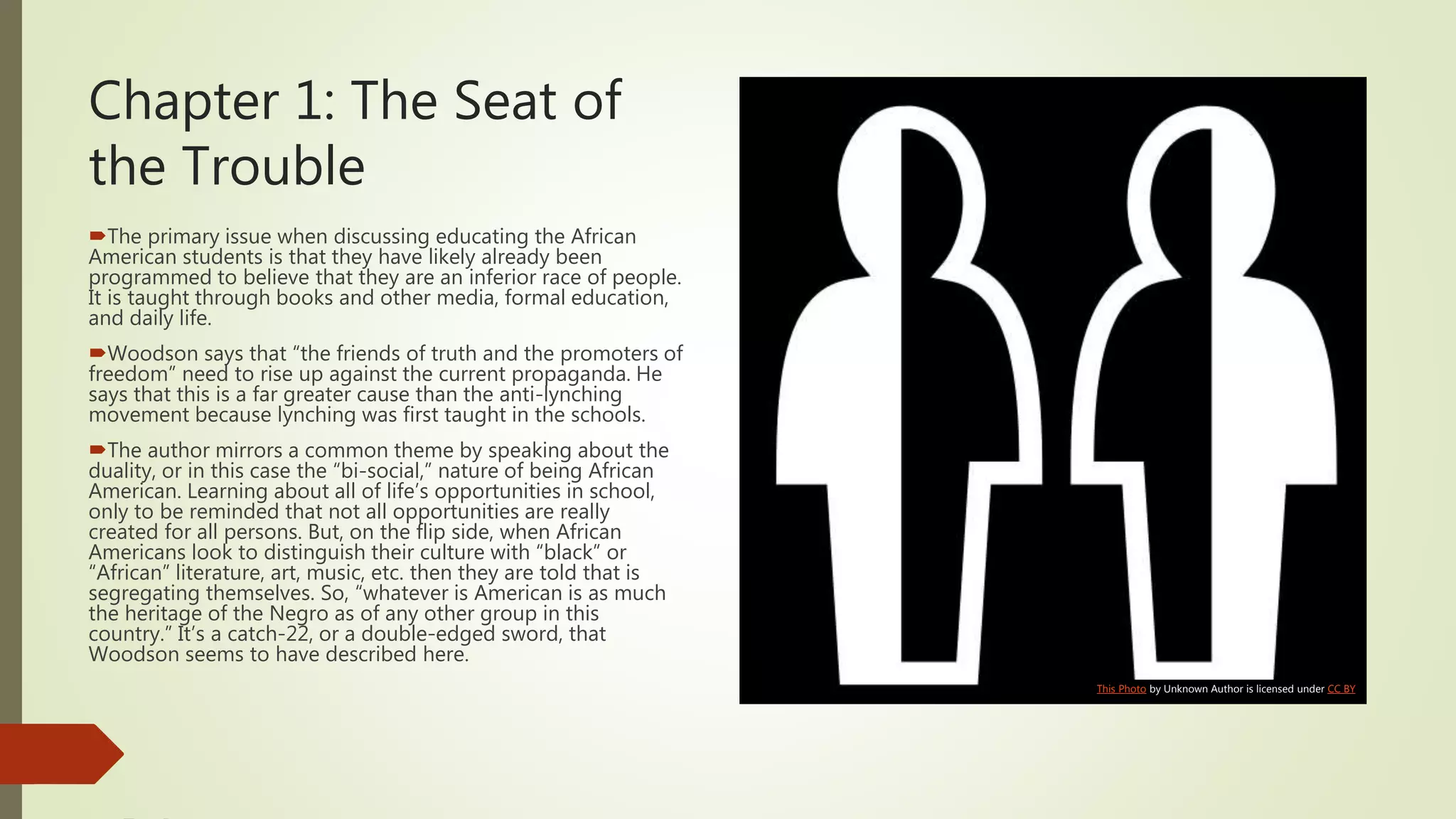
Chapter 1: The Seat of
the Trouble
The primary issue when discussing educating the African
American students is that they have likely already been
programmed to believe that they are an inferior race of people.
It is taught through books and other media, formal education,
and daily life.
Woodson says that “the friends of truth and the promoters of
freedom” need to rise up against the current propaganda. He
says that this is a far greater cause than the anti-lynching
movement because lynching was first taught in the schools.
The author mirrors a common theme by speaking about the
duality, or in this case the “bi-social,” nature of being African
American. Learning about all of life’s opportunities in school,
only to be reminded that not all opportunities are really
created for all persons. But, on the flip side, when African
Americans look to distinguish their culture with “black” or
“African” literature, art, music, etc. then they are told that is
segregating themselves. So, “whatever is American is as much
the heritage of the Negro as of any other group in this
country.” It’s a catch-22, or a double-edged sword, that
Woodson seems to have described here.
This Photo by Unknown Author is licensed under CC BY
Chapter 2: How We Missed the Mark
Woodson begins by stating that the context in which he is referring to is post-Emancipation,
and tells readers that in studying the past we can see how we got to the present. Even after
they were considered “freedmen,” the former slave was still a slave, in an economic sense. That
is, they could not afford to survive. The only change that the Reconstruction period had on
these men and women was that they were now able to join the lower-class white people in
menial labor in exchange for wages.
The Reconstruction also brought about a schooling that was still geared toward white
students, then there was a shift in ideals about education altogether. There was a hot debate
over whether classical (formal) or practical (trade/industrial) education was more important to
teach African Americans. Both sides had valid points, but ultimately both avenues for education
failed. Both classical and industrial schools inadequately prepared their students. Classical
schools failed because they taught information that was culturally irrelevant, and industrial
schools failed because they were not as well-rounded as the hands-on apprenticeships that
white students received.
One way Woodson suggested to combat this poor educational system is to flee the country
and recover from its poor teachings, which is what several people did.
Chapter 3: How We Drifted Away From The Truth
 In this chapter the Caucasians thought they were superior to the
Black race. They thought this because of the contributions that
the Blacks gave during history. The Caucasians hated the negro
culture because of their teachings. These teachings consisted of
history, science, and literature.
 In law schools, they were called criminals, in medical schools
they were convinced they were “germ carriers,” and in history
African Americans were also told they had no place.
 “The white man does not need the Negroe’s professional,
commercial or industrial assistance,” which left the African
Americans to become teachers and preachers. However, the
teachers are powerless to change the system because even
those who are given a voice are “mis-educated” themselves, thus
creating a never-ending cycle.
This Photo by Unknown Author is licensed under CC BY-NC-ND
Chapter 4: Education Outside Control
 Dr. Woodson essentially said that you need an education to be successful.
There is a noticeable difference with raising a family, having goals for
oneself, and having a better career.
 Woodson briefly presents on how having an education will make you have
a better life. Most African Americans were taught by white people. They
did not understand what the blacks wanted, and many had set goals for
themselves.
This Photo by Unknown Author is licensed under CC BY
Chapter 5: The Failure to Learn to
Make a Living
 The author summed up that Black people would fail at trying to make
a living. He believed that they would fail because of a lack of
education.
 Types of jobs that they would fail at is to become business owners and
entrepreneurs within their own community. Dr. Woodson tells us that
the blacks are consumers where the whites are producers, meaning the
blacks worked for the whites.
This Photo by Unknown Author is licensed under CC BY-NC-ND
Chapter 6: The Educated
Negro Leaves the Masses
 In the next two chapters, Carter Godwin
Woodson describes Negro’s problems and
behaviors in terms of religion.
 In chapter six specifically, Woodson
discusses how education affects Negro’s
views of the church and why blacks leave
their churches in search for churches that
align with Caucasian philosophies.
Chapter 6: The Educated Negro Leaves
the Masses (continued)
Woodson sites three reasons for
the religious changes:
1. In educated Negro’s minds, Negro
churches do NOT measure up to
the standards of university
preachers.
2. Educated Negros believe the more
“intellectual atmosphere” within
the Caucasian church better
stimulates their thinking.
3. Foreigners beliefs in theology has
also drawn Negros away from
Negro churches.
Woodson indicates the results of
Negro’s actions:
1. Once educated Negros leave, the
door is left open for corrupt leaders
to come in and manipulate Negro
churches.
2. The Negro race is divided. The
Negro race is left behind by the
educated Negro causing
resentment.
3. An unnecessary subdivision
(denominations) and confusion is
caused within the Negro faith.
Chapter 7: Dissension & Weakness
 In chapter 7, Woodson goes on to describe the reasons for
dissension and weakness within the religious community.
 Reasons:
 Lack of qualified Negros studying theology at the university
level.
 Negro religious departments do NOT tolerate others’ religious
beliefs which causes division.
 A lack of intelligent guidance. Uneducated Negros are chosen
to lead Negro churches and they are not properly educated
about important religious concepts.
This Photo by Unknown Author is licensed under CC BY-NC-ND
Chapter 8: Professional Education Discouraged
Woodson explains the limitations of Negros within each school of study at the university level:
• A lack of economic status
plagues Negro practicing
professionals. Negros are
flushed out of practicing
due to the aristocratic
system brought on by
Caucasians.
Woodson begins with
practicing professionals
(physicians, dentists, and
lawyers)
• Negros are forced to rely
on Caucasians to hire them
for these positions. Most
negros studying technology
feel compelled to leave the
field due to disinterest on
the part of Caucasians.
Next, Woodson describes
the obstacles students
studying technology faces
(engineering, drafting and
architecture).
• Negros studying art are told
that they are already gifted
in these areas and need no
further instruction therefore,
students lack the ambition
necessary to become better
in their field.
Finally, Woodson shares the
setbacks of students
studying art (actors,
musicians and singers).
Chapter 9: Political Education
Neglected
 Woodson stated that the lack of political education among African Americans
during the 1930s was due to the actions of the whites.
 The textbooks that African Americans used did not contain the U.S Constitution
because political figures did not want Blacks to demand their rights.
 Southern apologists controlled what was contained in textbooks.
 Woodson’s main message: ”If you can control a man’s thinking you do not have
to worry about his action. When you determine what a man shall think you do
not have to concern yourself about what he will do. If you make a man feel that
he is inferior, you do not have to compel him to accept an inferior status, for he
will seek it himself. If you make a man think that he is justly an outcast, you do
not have to order him to the back door. He will go without being told and if
there is no back door, his very nature will demand one.”
This Photo by Unknown Author is licensed under CC BY-SA
Chapter 10: The Loss
of Vision
 There was a loss of vision because African
Americans did not think for themselves
 Lack of confidence in the Negro himself, kept
him down
 The Negro must think differently in order to
change his oppression
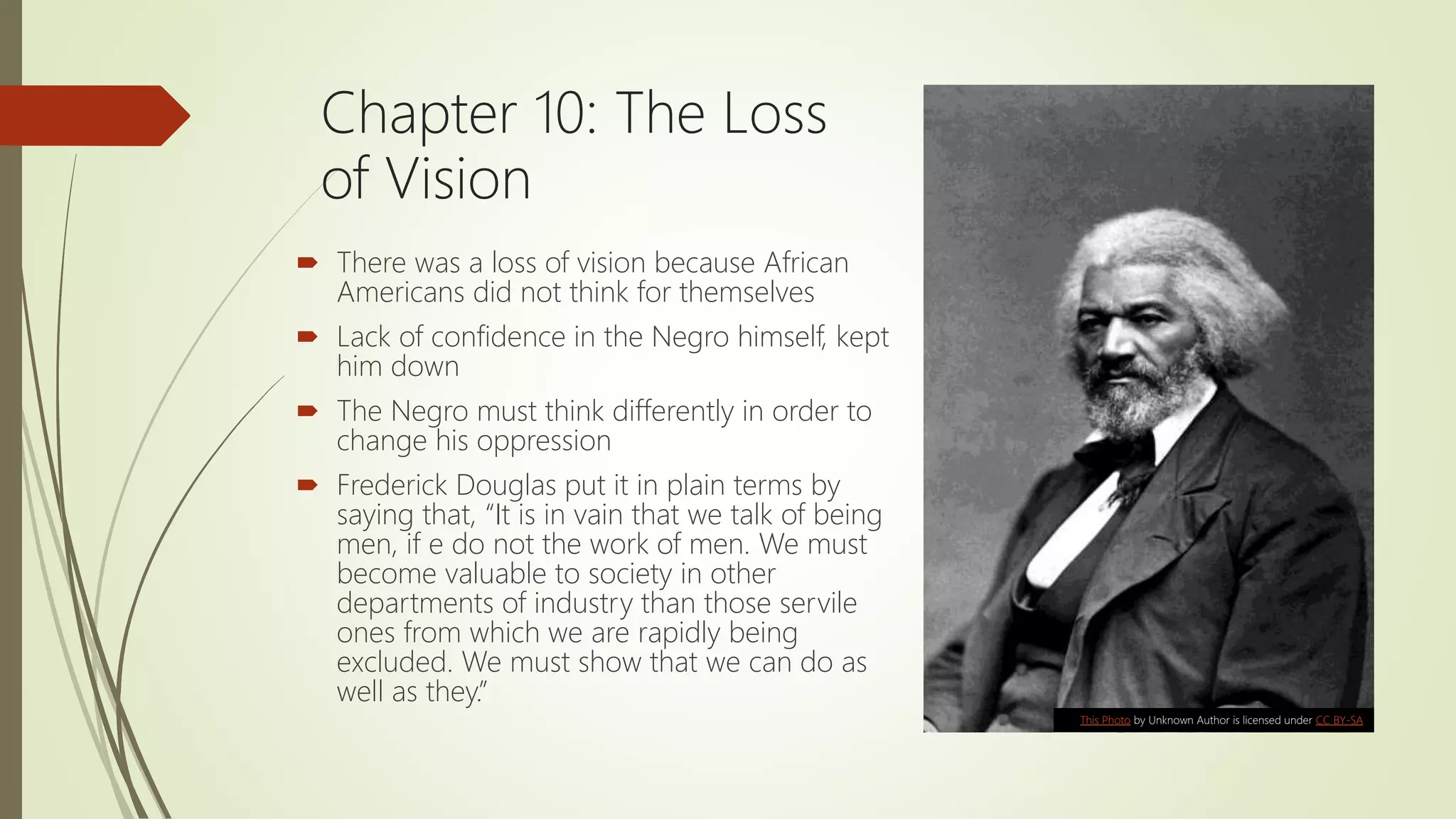
 Frederick Douglas put it in plain terms by
saying that, “It is in vain that we talk of being
men, if e do not the work of men. We must
become valuable to society in other
departments of industry than those servile
ones from which we are rapidly being
excluded. We must show that we can do as
well as they.”
This Photo by Unknown Author is licensed under CC BY-SA
Chapter 11: The Need of
Service Rather Than
Leadership
 Dr. Woodson discusses why is there a
greater need for service rather than
leadership in black communities across
America.
 He brings up the problems that African-
American communities have had with
leadership in the past.
 African-Americans often find themselves
giving money & moral support to various
people and institutions that influence the
race in the wrong way.
Chapter 12: Hirelings in the Places of
Public Servants
 Dr. Woodson discusses the concept of “hirelings” as opposed to
“public servants.”
 A hireling is a person who is paid to serve.
 Dr. Woodson defines the real servant of the people as “one who
lives among them, thinks with them, feels for them and perhaps
dies for them.”
This Photo by Unknown Author is licensed under CC BY
Chapter 13: Understand the Negro
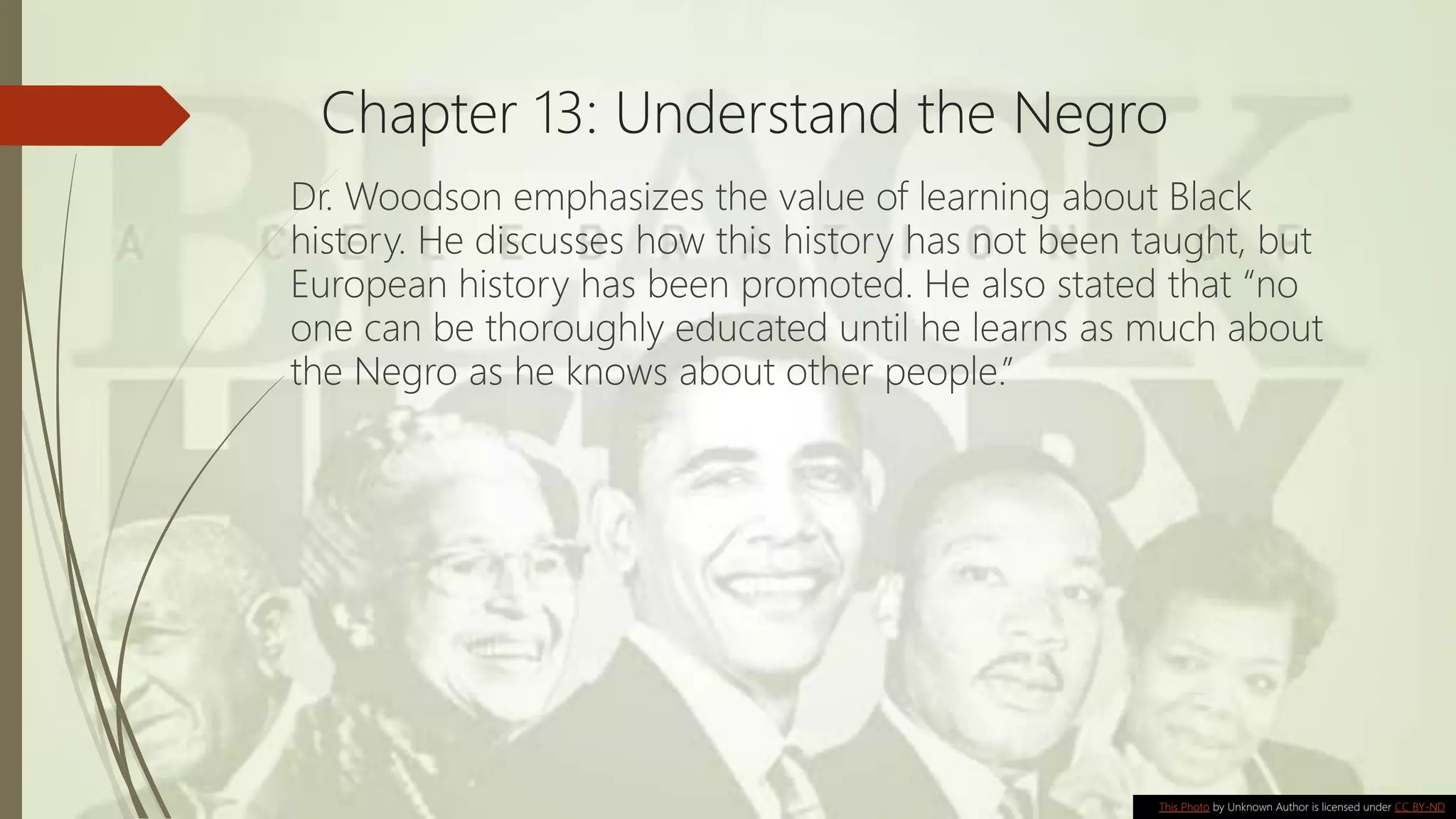
Dr. Woodson emphasizes the value of learning about Black
history. He discusses how this history has not been taught, but
European history has been promoted. He also stated that “no
one can be thoroughly educated until he learns as much about
the Negro as he knows about other people.”
This Photo by Unknown Author is licensed under CC BY-ND
Chapter 14: The New Program
Woodson Compares the New program with the successful education of the
Filipinos.
Highly educated Americans went to the Philippine Islands after the Spanish-
American War in 1898, and tried to teach the Filipinos the same way that
American children were taught.
It was a failure. These children needed to be taught through the use of objects
from their culture., but Filipinos didn't know a lot about Americans and their
history or culture.
Woodson Stated that the education of Black Americans would emphasize Black
American culture. Black Americans should be given equal time, honor, and
respect.
This Photo by Unknown Author is licensed under CC BY-SA
Chapter 15: Vocational Guidance
According to Dr. Woodson, schools were not preparing African American
students to make a living. He made a point that the schools Black students went
to had sub-par equipment that needed to be updated with more advanced
technology. He also believed that there should be a change in the type of
instruction African Americans were receiving, and a change in the methods by
which that instruction was given.
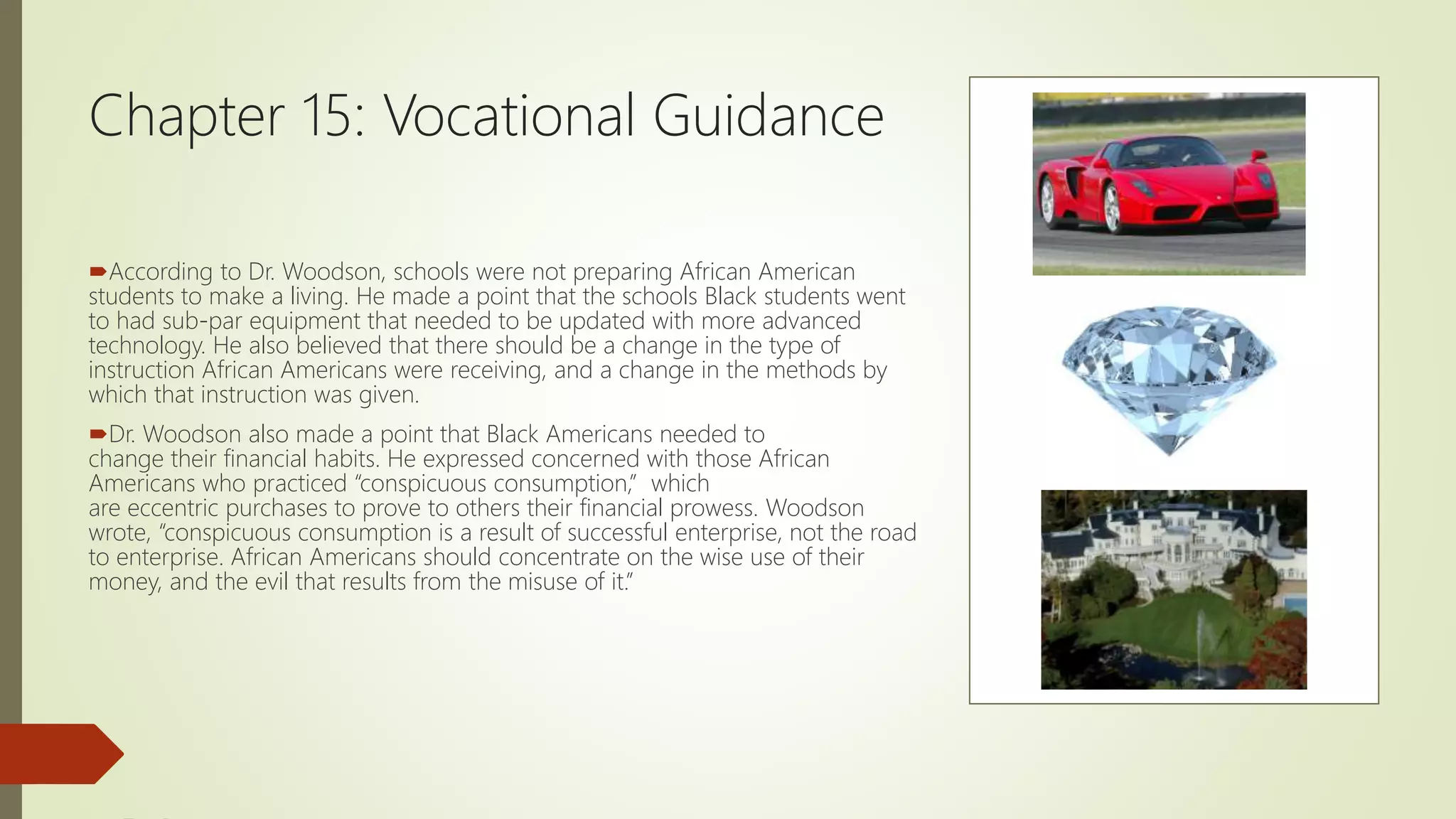
Dr. Woodson also made a point that Black Americans needed to
change their financial habits. He expressed concerned with those African
Americans who practiced “conspicuous consumption,” which
are eccentric purchases to prove to others their financial prowess. Woodson
wrote, “conspicuous consumption is a result of successful enterprise, not the road
to enterprise. African Americans should concentrate on the wise use of their
money, and the evil that results from the misuse of it.”
Chapter 16: The New Type of
Professional Man Required
Dr. Woodson believed that Black students need to go into professionalism in order
to serve their own people. African Americans are affected by the law more than any
other race and African American lawyers are needed to address certain aspects of
law. African American lawyers need to know more about people they serve in order
to meet the specific needs of these people. According to Woodson, past Supreme
Court cases were not won because the lawyers lacked the knowledge to present their
cases properly in court. Woodson suggested that law schools need to expand course
work in Constitutional law to prepare lawyers to protect rights guaranteed by the
Constitution.
African American doctors were more likely to work with their own people than
African American lawyers. However, all too often African American doctors had
entered the profession to “increase their income and spend it on joyous living.”
Instead of spending money in a frivolous manner, Woodson argued that these
doctors should focus on research and dedicate themselves to the African
American community. Woodson also felt that African American students shouldn't
strive to be just doctors and lawyers, but should pursue careers in arts as well. This is
due to African Americans demonstrating an aptitude for the arts. Since African
American contributions were not always recognized in the United States, Woodson
felt that the African American artists should seek appreciation in other forums outside
of the United States. “In Europe, African American artists are not seen as imitators,”
Woodson wrote. “There is a desire among Europeans to view the art of the African
not from the vantage point of the oppressor, but from the Negro himself.”
This Photo by Unknown Author is licensed under CC BY-SA
Chapter 17: Higher Strivings in the Service of the
Country
 Woodson placed a great deal of emphasis on politics. Woodson felt that in
politics, African Americans should not only concern themselves with what
directly effects them, but they should address issues facing others as well.
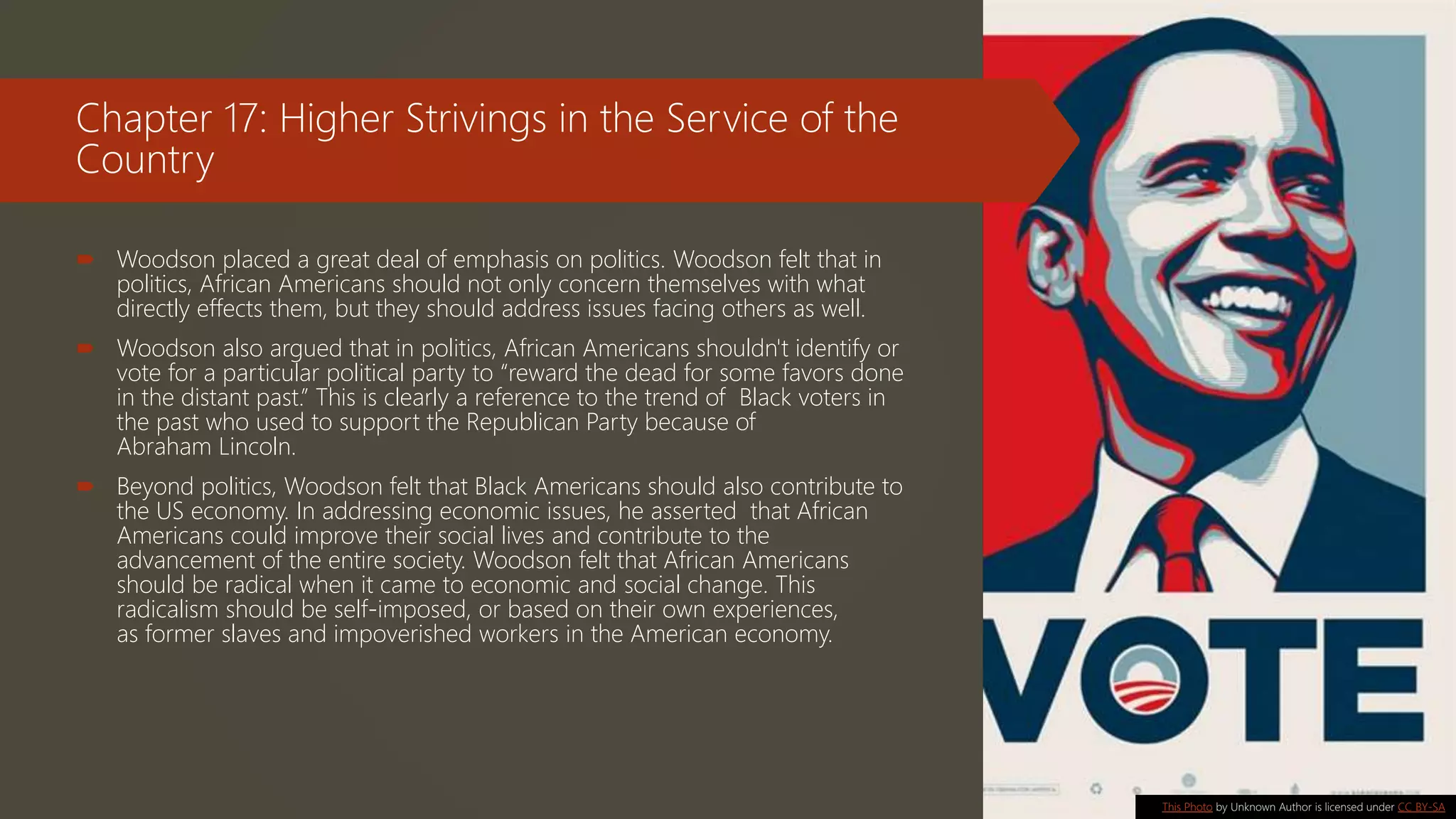
 Woodson also argued that in politics, African Americans shouldn't identify or
vote for a particular political party to “reward the dead for some favors done
in the distant past.” This is clearly a reference to the trend of Black voters in
the past who used to support the Republican Party because of
Abraham Lincoln.
 Beyond politics, Woodson felt that Black Americans should also contribute to
the US economy. In addressing economic issues, he asserted that African
Americans could improve their social lives and contribute to the
advancement of the entire society. Woodson felt that African Americans
should be radical when it came to economic and social change. This
radicalism should be self-imposed, or based on their own experiences,
as former slaves and impoverished workers in the American economy.
This Photo by Unknown Author is licensed under CC BY-SA
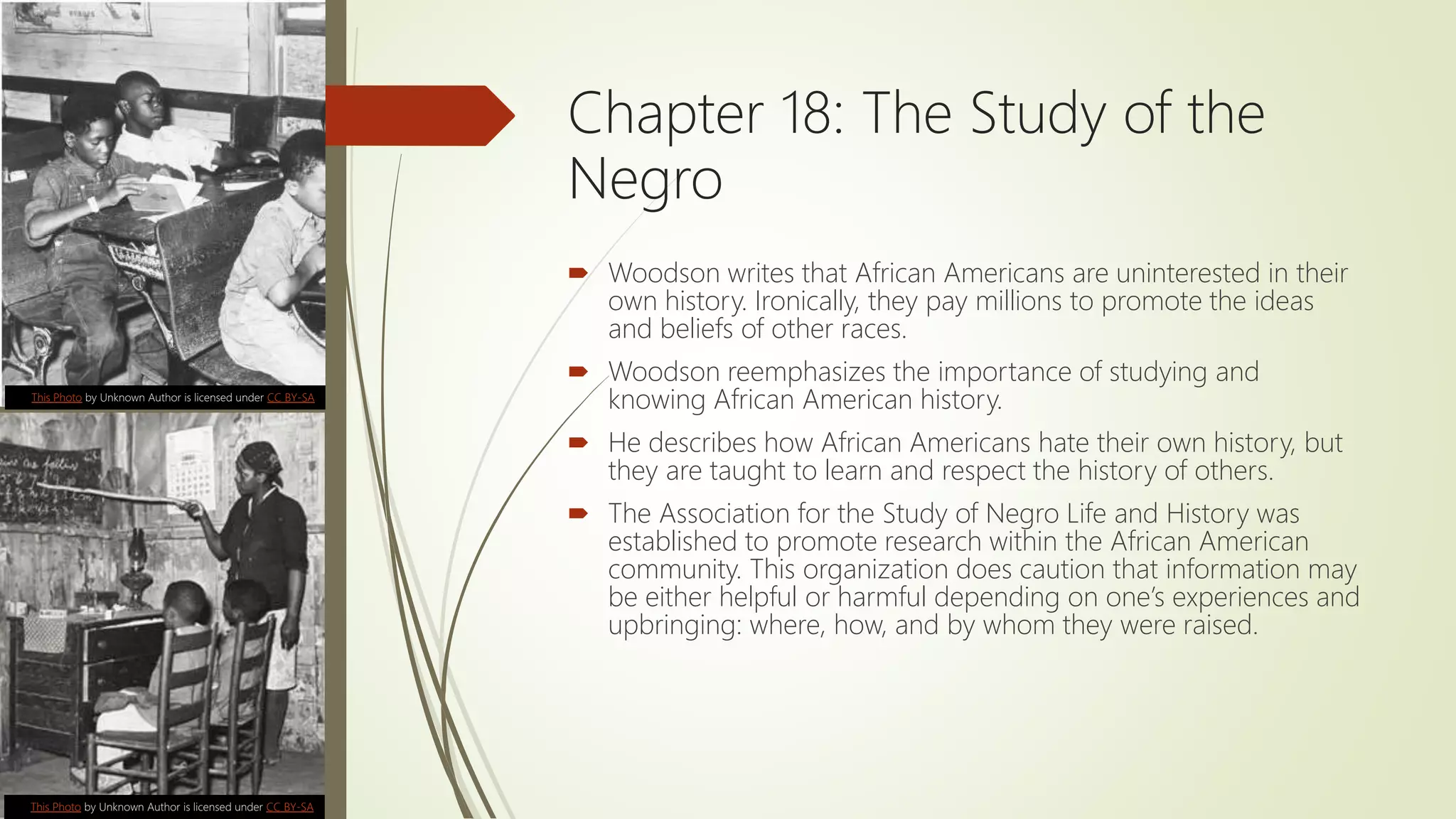
Chapter 18: The Study of the
Negro
 Woodson writes that African Americans are uninterested in their
own history. Ironically, they pay millions to promote the ideas
and beliefs of other races.
 Woodson reemphasizes the importance of studying and
knowing African American history.
 He describes how African Americans hate their own history, but
they are taught to learn and respect the history of others.
 The Association for the Study of Negro Life and History was
established to promote research within the African American
community. This organization does caution that information may
be either helpful or harmful depending on one’s experiences and
upbringing: where, how, and by whom they were raised.
This Photo by Unknown Author is licensed under CC BY-SA

Group4 wiki2 themiseducation

  • 1.
    The Mis-Education of theNegro Book by: • Carter Godwin Woodson Presentation by: • Danielle Card • Selena Dillard • Fouad Elsenbary • Ryanne Jackson • Rashad Smalls • Ronnie Woolard
  • 2.
    Preface Carter Godwin Woodsondescribes his experience and expertise on the subject in which this book was written by saying that he has been an educator of persons of all races, in multiple locations, and over all grade levels. Though he is thoroughly qualified to speak and write on this subject, he also informs the reader that he has made he is not without fault, and that he has made mistakes as an educator. There is no accurate measure, such as Census information, that can be reviewed to see if progress has been made because to educate is not to impart wisdom and information. To truly educate is to teach people to think and do for themselves. The author continues in detailing that the African Americans who are educated in the current conditions (modern education in a white institution) will be essentially trained and/or programmed to assimilate into white culture through many facets of daily life, such as business, commerce, and religion. This Photo by Unknown Author is licensed under CC BY-SA
  • 3.
    Chapter 1: TheSeat of the Trouble The primary issue when discussing educating the African American students is that they have likely already been programmed to believe that they are an inferior race of people. It is taught through books and other media, formal education, and daily life. Woodson says that “the friends of truth and the promoters of freedom” need to rise up against the current propaganda. He says that this is a far greater cause than the anti-lynching movement because lynching was first taught in the schools. The author mirrors a common theme by speaking about the duality, or in this case the “bi-social,” nature of being African American. Learning about all of life’s opportunities in school, only to be reminded that not all opportunities are really created for all persons. But, on the flip side, when African Americans look to distinguish their culture with “black” or “African” literature, art, music, etc. then they are told that is segregating themselves. So, “whatever is American is as much the heritage of the Negro as of any other group in this country.” It’s a catch-22, or a double-edged sword, that Woodson seems to have described here. This Photo by Unknown Author is licensed under CC BY
  • 4.
    Chapter 2: HowWe Missed the Mark Woodson begins by stating that the context in which he is referring to is post-Emancipation, and tells readers that in studying the past we can see how we got to the present. Even after they were considered “freedmen,” the former slave was still a slave, in an economic sense. That is, they could not afford to survive. The only change that the Reconstruction period had on these men and women was that they were now able to join the lower-class white people in menial labor in exchange for wages. The Reconstruction also brought about a schooling that was still geared toward white students, then there was a shift in ideals about education altogether. There was a hot debate over whether classical (formal) or practical (trade/industrial) education was more important to teach African Americans. Both sides had valid points, but ultimately both avenues for education failed. Both classical and industrial schools inadequately prepared their students. Classical schools failed because they taught information that was culturally irrelevant, and industrial schools failed because they were not as well-rounded as the hands-on apprenticeships that white students received. One way Woodson suggested to combat this poor educational system is to flee the country and recover from its poor teachings, which is what several people did.
  • 5.
    Chapter 3: HowWe Drifted Away From The Truth  In this chapter the Caucasians thought they were superior to the Black race. They thought this because of the contributions that the Blacks gave during history. The Caucasians hated the negro culture because of their teachings. These teachings consisted of history, science, and literature.  In law schools, they were called criminals, in medical schools they were convinced they were “germ carriers,” and in history African Americans were also told they had no place.  “The white man does not need the Negroe’s professional, commercial or industrial assistance,” which left the African Americans to become teachers and preachers. However, the teachers are powerless to change the system because even those who are given a voice are “mis-educated” themselves, thus creating a never-ending cycle. This Photo by Unknown Author is licensed under CC BY-NC-ND
  • 6.
    Chapter 4: EducationOutside Control  Dr. Woodson essentially said that you need an education to be successful. There is a noticeable difference with raising a family, having goals for oneself, and having a better career.  Woodson briefly presents on how having an education will make you have a better life. Most African Americans were taught by white people. They did not understand what the blacks wanted, and many had set goals for themselves. This Photo by Unknown Author is licensed under CC BY
  • 7.
    Chapter 5: TheFailure to Learn to Make a Living  The author summed up that Black people would fail at trying to make a living. He believed that they would fail because of a lack of education.  Types of jobs that they would fail at is to become business owners and entrepreneurs within their own community. Dr. Woodson tells us that the blacks are consumers where the whites are producers, meaning the blacks worked for the whites. This Photo by Unknown Author is licensed under CC BY-NC-ND
  • 8.
    Chapter 6: TheEducated Negro Leaves the Masses  In the next two chapters, Carter Godwin Woodson describes Negro’s problems and behaviors in terms of religion.  In chapter six specifically, Woodson discusses how education affects Negro’s views of the church and why blacks leave their churches in search for churches that align with Caucasian philosophies.
  • 9.
    Chapter 6: TheEducated Negro Leaves the Masses (continued) Woodson sites three reasons for the religious changes: 1. In educated Negro’s minds, Negro churches do NOT measure up to the standards of university preachers. 2. Educated Negros believe the more “intellectual atmosphere” within the Caucasian church better stimulates their thinking. 3. Foreigners beliefs in theology has also drawn Negros away from Negro churches. Woodson indicates the results of Negro’s actions: 1. Once educated Negros leave, the door is left open for corrupt leaders to come in and manipulate Negro churches. 2. The Negro race is divided. The Negro race is left behind by the educated Negro causing resentment. 3. An unnecessary subdivision (denominations) and confusion is caused within the Negro faith.
  • 10.
    Chapter 7: Dissension& Weakness  In chapter 7, Woodson goes on to describe the reasons for dissension and weakness within the religious community.  Reasons:  Lack of qualified Negros studying theology at the university level.  Negro religious departments do NOT tolerate others’ religious beliefs which causes division.  A lack of intelligent guidance. Uneducated Negros are chosen to lead Negro churches and they are not properly educated about important religious concepts. This Photo by Unknown Author is licensed under CC BY-NC-ND
  • 11.
    Chapter 8: ProfessionalEducation Discouraged Woodson explains the limitations of Negros within each school of study at the university level: • A lack of economic status plagues Negro practicing professionals. Negros are flushed out of practicing due to the aristocratic system brought on by Caucasians. Woodson begins with practicing professionals (physicians, dentists, and lawyers) • Negros are forced to rely on Caucasians to hire them for these positions. Most negros studying technology feel compelled to leave the field due to disinterest on the part of Caucasians. Next, Woodson describes the obstacles students studying technology faces (engineering, drafting and architecture). • Negros studying art are told that they are already gifted in these areas and need no further instruction therefore, students lack the ambition necessary to become better in their field. Finally, Woodson shares the setbacks of students studying art (actors, musicians and singers).
  • 12.
    Chapter 9: PoliticalEducation Neglected  Woodson stated that the lack of political education among African Americans during the 1930s was due to the actions of the whites.  The textbooks that African Americans used did not contain the U.S Constitution because political figures did not want Blacks to demand their rights.  Southern apologists controlled what was contained in textbooks.  Woodson’s main message: ”If you can control a man’s thinking you do not have to worry about his action. When you determine what a man shall think you do not have to concern yourself about what he will do. If you make a man feel that he is inferior, you do not have to compel him to accept an inferior status, for he will seek it himself. If you make a man think that he is justly an outcast, you do not have to order him to the back door. He will go without being told and if there is no back door, his very nature will demand one.” This Photo by Unknown Author is licensed under CC BY-SA
  • 13.
    Chapter 10: TheLoss of Vision  There was a loss of vision because African Americans did not think for themselves  Lack of confidence in the Negro himself, kept him down  The Negro must think differently in order to change his oppression  Frederick Douglas put it in plain terms by saying that, “It is in vain that we talk of being men, if e do not the work of men. We must become valuable to society in other departments of industry than those servile ones from which we are rapidly being excluded. We must show that we can do as well as they.” This Photo by Unknown Author is licensed under CC BY-SA
  • 14.
    Chapter 11: TheNeed of Service Rather Than Leadership  Dr. Woodson discusses why is there a greater need for service rather than leadership in black communities across America.  He brings up the problems that African- American communities have had with leadership in the past.  African-Americans often find themselves giving money & moral support to various people and institutions that influence the race in the wrong way.
  • 15.
    Chapter 12: Hirelingsin the Places of Public Servants  Dr. Woodson discusses the concept of “hirelings” as opposed to “public servants.”  A hireling is a person who is paid to serve.  Dr. Woodson defines the real servant of the people as “one who lives among them, thinks with them, feels for them and perhaps dies for them.” This Photo by Unknown Author is licensed under CC BY
  • 16.
    Chapter 13: Understandthe Negro Dr. Woodson emphasizes the value of learning about Black history. He discusses how this history has not been taught, but European history has been promoted. He also stated that “no one can be thoroughly educated until he learns as much about the Negro as he knows about other people.” This Photo by Unknown Author is licensed under CC BY-ND
  • 17.
    Chapter 14: TheNew Program Woodson Compares the New program with the successful education of the Filipinos. Highly educated Americans went to the Philippine Islands after the Spanish- American War in 1898, and tried to teach the Filipinos the same way that American children were taught. It was a failure. These children needed to be taught through the use of objects from their culture., but Filipinos didn't know a lot about Americans and their history or culture. Woodson Stated that the education of Black Americans would emphasize Black American culture. Black Americans should be given equal time, honor, and respect. This Photo by Unknown Author is licensed under CC BY-SA
  • 18.
    Chapter 15: VocationalGuidance According to Dr. Woodson, schools were not preparing African American students to make a living. He made a point that the schools Black students went to had sub-par equipment that needed to be updated with more advanced technology. He also believed that there should be a change in the type of instruction African Americans were receiving, and a change in the methods by which that instruction was given. Dr. Woodson also made a point that Black Americans needed to change their financial habits. He expressed concerned with those African Americans who practiced “conspicuous consumption,” which are eccentric purchases to prove to others their financial prowess. Woodson wrote, “conspicuous consumption is a result of successful enterprise, not the road to enterprise. African Americans should concentrate on the wise use of their money, and the evil that results from the misuse of it.”
  • 19.
    Chapter 16: TheNew Type of Professional Man Required Dr. Woodson believed that Black students need to go into professionalism in order to serve their own people. African Americans are affected by the law more than any other race and African American lawyers are needed to address certain aspects of law. African American lawyers need to know more about people they serve in order to meet the specific needs of these people. According to Woodson, past Supreme Court cases were not won because the lawyers lacked the knowledge to present their cases properly in court. Woodson suggested that law schools need to expand course work in Constitutional law to prepare lawyers to protect rights guaranteed by the Constitution. African American doctors were more likely to work with their own people than African American lawyers. However, all too often African American doctors had entered the profession to “increase their income and spend it on joyous living.” Instead of spending money in a frivolous manner, Woodson argued that these doctors should focus on research and dedicate themselves to the African American community. Woodson also felt that African American students shouldn't strive to be just doctors and lawyers, but should pursue careers in arts as well. This is due to African Americans demonstrating an aptitude for the arts. Since African American contributions were not always recognized in the United States, Woodson felt that the African American artists should seek appreciation in other forums outside of the United States. “In Europe, African American artists are not seen as imitators,” Woodson wrote. “There is a desire among Europeans to view the art of the African not from the vantage point of the oppressor, but from the Negro himself.” This Photo by Unknown Author is licensed under CC BY-SA
  • 20.
    Chapter 17: HigherStrivings in the Service of the Country  Woodson placed a great deal of emphasis on politics. Woodson felt that in politics, African Americans should not only concern themselves with what directly effects them, but they should address issues facing others as well.  Woodson also argued that in politics, African Americans shouldn't identify or vote for a particular political party to “reward the dead for some favors done in the distant past.” This is clearly a reference to the trend of Black voters in the past who used to support the Republican Party because of Abraham Lincoln.  Beyond politics, Woodson felt that Black Americans should also contribute to the US economy. In addressing economic issues, he asserted that African Americans could improve their social lives and contribute to the advancement of the entire society. Woodson felt that African Americans should be radical when it came to economic and social change. This radicalism should be self-imposed, or based on their own experiences, as former slaves and impoverished workers in the American economy. This Photo by Unknown Author is licensed under CC BY-SA
  • 21.
    Chapter 18: TheStudy of the Negro  Woodson writes that African Americans are uninterested in their own history. Ironically, they pay millions to promote the ideas and beliefs of other races.  Woodson reemphasizes the importance of studying and knowing African American history.  He describes how African Americans hate their own history, but they are taught to learn and respect the history of others.  The Association for the Study of Negro Life and History was established to promote research within the African American community. This organization does caution that information may be either helpful or harmful depending on one’s experiences and upbringing: where, how, and by whom they were raised. This Photo by Unknown Author is licensed under CC BY-SA This Photo by Unknown Author is licensed under CC BY-SA