PRESENTED BY:
KAPISH GIRDHAR RNO. 58
GROUP DYNAMICS
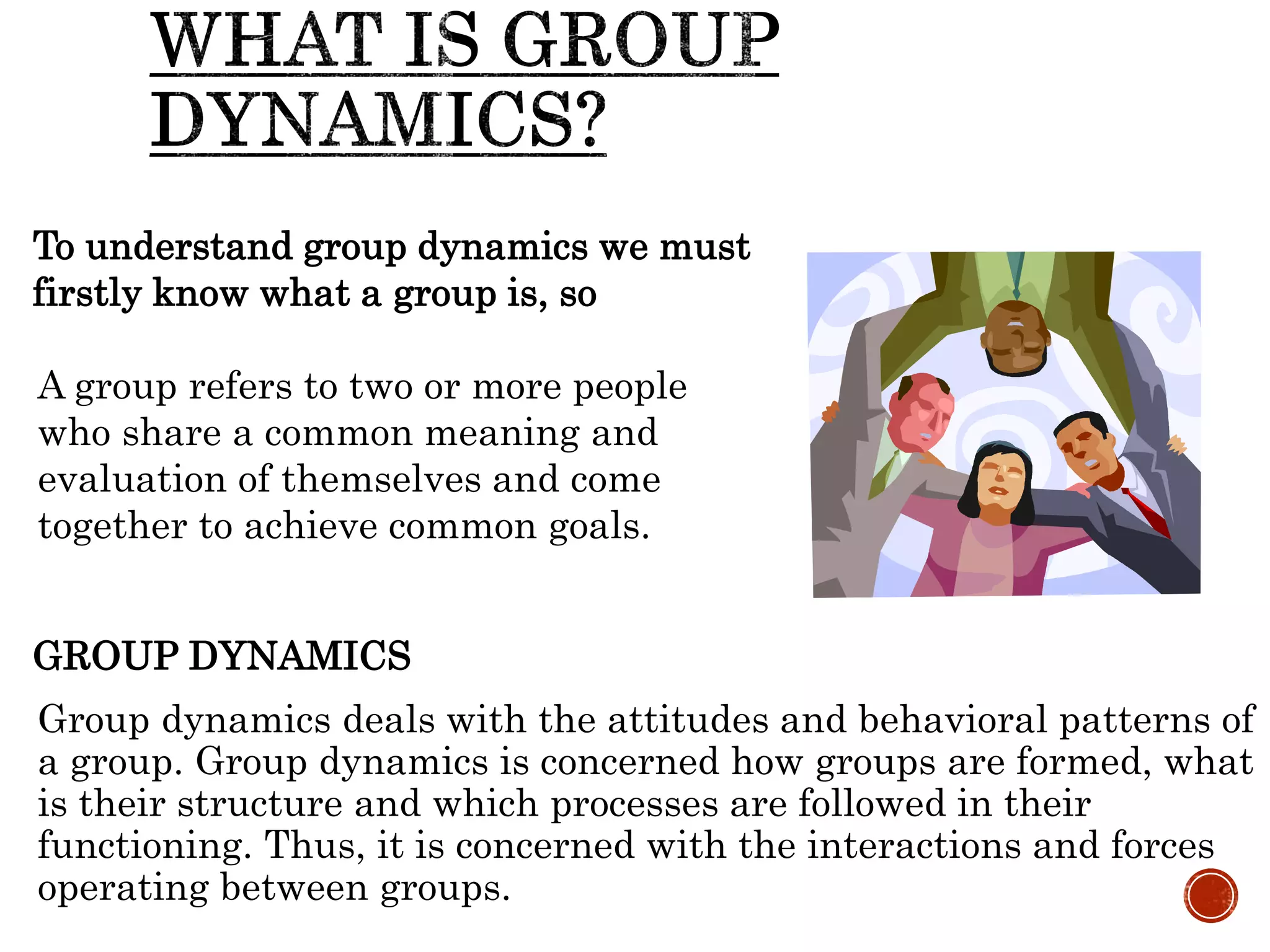
Group dynamics deals with the attitudes and behavioral patterns of
a group. Group dynamics is concerned how groups are formed, what
is their structure and which processes are followed in their
functioning. Thus, it is concerned with the interactions and forces
operating between groups.
To understand group dynamics we must
firstly know what a group is, so
A group refers to two or more people
who share a common meaning and
evaluation of themselves and come
together to achieve common goals.
The members of the group must have a strong sense of
belonging to the group.
 The more attraction a group member is to its members, the
greater influence it would exercise on its members.
 The successful efforts to change individuals sub parts of the
group would result in making them confirm to the norms of
the group.
 Information relating to the need for change , plans for
change and the consequences of the changes must be shared
by the members of the group.
 The changes in one pact of the groups may produce stress
in the other parts, which can be reduced only by eliminating
the change or by bringing about readjustments in the
related parts.
 The groups arise and function owing to common motives.
The intergroup relations , group organization , member
participation is essential for effectiveness of a group.
Confidentiality is a major requirement which is achieved
by mutual respect for one another.
Group Dynamics refers to the study of forces operating within a
group. Following are some of its salient features :
 Group orientation: Group Dynamics is concerned with group
.Wherever a group exists the individuals interact and members
are continuously changing and adjusting relationship with
respect to each other .
 Various changes: Changes go on occurring like introduction of
the new members, changes in leadership, presence of old and
new members and the rate of change – fast or slow . The
groups may dissolve if the members are not enthusiastic about
the goals .
 Dynamic Nature: There may be rigidity or flexibility that
influences a group dynamics .If the members get along well
there is smooth sailing for the group and if there is conflict it
leads to problems
 Group Activities: The group organization is
essential. It leads to greater group effectiveness,
participation, cooperation and a constructive morale.
 Adjustments: Dynamic groups are always in
continuous process of restructuring, adjusting and
readjusting members to one another for the purpose of
reducing the tensions, eliminating the conflicts and
solving the problems which its members have in
common.
TASK RELATED ACTIONS
 Showing initiative and activity: making suggestions, expressing ideas,
tackling an existing problem anew, restructuring material.
 Looking for information: asking questions to specify suggestions,
asking for additional information.
 Learning others' opinions: trying to find out other people's feeling in
regard to suggestions that have been made, etc.
 Providing information: introducing others to the facts, sharing in
experiences.
 Delving into the issue at hand: giving example, trying to imagine the
consequences of specific suggestions.
 Coordinating: organizing relationships and ideas, combining the
activities of various smaller groups.
 Summarizing.
 Encouraging: being friendly, considerate, ready to respond to others, praising
others and their ideas, agreeing to what others have said.
 Staying within boundaries: helping others express themselves (e.g. "We still
haven't heard John's opinion"), limiting the length of one's turns so that everyone
has time to express themselves.
 Agreeing to rules: setting rules for the group that regulate content, processes, and
decision making.
 Following along: complying with the group's decisions, carefully listening to others
and accepting their ideas, being an active listener in group discussions.
 Expressing the emotions of the group: defining the emotions generated by the
group, sharing observations about group members.
 Analyzing: checking whether the group's decisions comply with the rules.
 Diagnosing: defining sources of problems, determining next steps, analysing the
main obstacles to further activity.
 Analyzing the stage of the group's development: finding out the members'
opinions, evaluating whether the group is nearing a collective solution.
 Being an intermediary: harmonizing, smoothing out differing opinions, offering
compromises.
 Lessening tension: using humour to avert negative emotions, calming the
situation by looking at the bigger picture.
 Aggressive action: determining one's status by criticizing others or doing
them in; hostile actions towards the group or individuals in the group;
always trying to dominate.
 Blocking: sabotaging the further development of the group by focusing on
insignificant problems or talking about one's own experiences that is not
associated with the problem at hand; a prejudiced rejection of others' ideas.
 Fishing for sympathy: using the group as an audience for expressing one's
own feelings or opinions (that are not associated with the goals of the
group); trying to get on the good side of group members by telling them
about one's problems and failures; explaining things in a very complicated
way.
 Dominating: arguing with others about the best ideas; talking non-stop;
trying to be the most important person; taking over leadership.
 Being a clown: playing the fool, telling jokes, imitating others; interrupting
the group's work.
 Looking for attention: attracting the attention of others, for example, by
talking loudly or at length; expressing extreme ideas; acting strangely.
 Stepping back: acting in a passive or inappropriate way, for example,
daydreaming, whispering, avoiding the topic.
 Equalizing Participation
The facilitator is responsible for the fair distribution of attention
during meetings
 Listing
for the discussion to be smooth, those who want to speak can silently
signal the facilitator, who would add the person's name to a list and
call them in that order.
 Stacking
If many people want to speak at the same time, it is useful to ask all
those who would like to speak to raise their hands. Have them count
off, and then have them speak in that order.
 Pacing
The pace or flow of the meeting is the responsibility of the facilitator.
If the atmosphere starts to become tense, choose techniques which
encourage balance and cooperation.
 Checking the Process
If the flow of the meeting is breaking down or if one person or small
group seems to be dominating, anyone can call into question the
technique being used and suggest an alternative.
 Silence
it is appropriate for anyone to suggest a moment of silence to calm
and refocus energy.
 Taking a Break
In the heat of discussion, people are usually resistant to interrupting
the flow to take a break, but a wise facilitator knows when to take
refreshing breaks.
 Call for Consensus
The facilitator, or any member recognized to speak by the facilitator
asks if there are any unresolved concerns, which remain
unaddressed.
 Summarizing
The facilitator might choose to focus what has been said by
summarizing.
 Reformulating the Proposal
After a long discussion, it sometimes happens that the proposal
becomes modified without any formal decision. The facilitator needs
to reformulate the proposal with the new information, modifications,
or deletions.
 Fishbowl
The fishbowl is a special form of small group discussion. Several
members representing differing points of view meet in an inner
circle to discuss the issue
 Active Listening
Listen to the speaker, then acknowledge back what was heard.
 Brainstorming
process for generating creative ideas and solutions through intensive
and freewheeling group discussion.
 Go-rounds
This is a simple technique that encourages participation. The
facilitator states a question and then goes around the room inviting
everyone to answer briefly. This isn’t like an open discussion.
 Identification
It is good to address each other by name. when people speak, it is
useful for them to identify themselves so all can gradually learn each
others names.
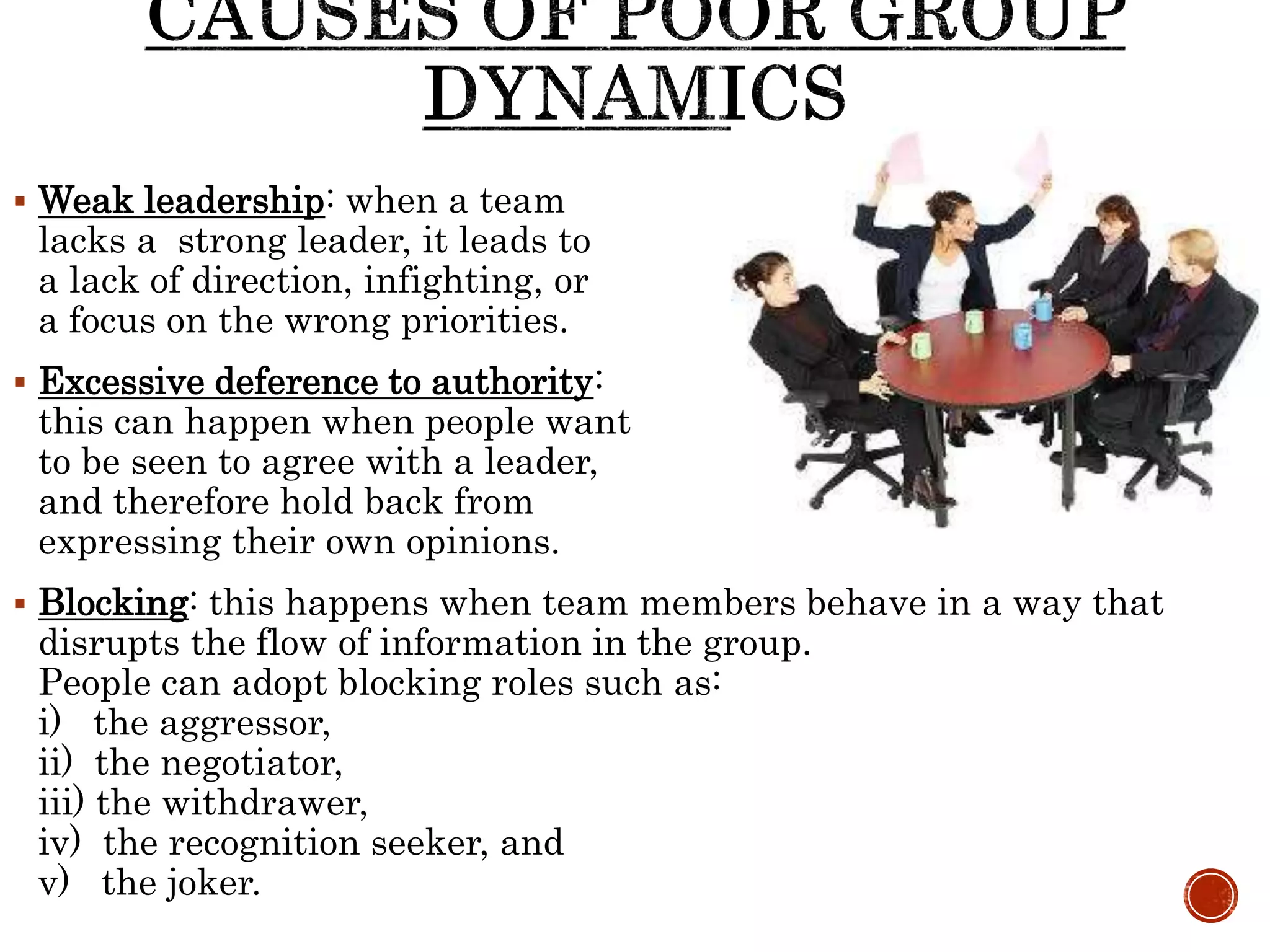
 Weak leadership: when a team
lacks a strong leader, it leads to
a lack of direction, infighting, or
a focus on the wrong priorities.
 Excessive deference to authority:
this can happen when people want
to be seen to agree with a leader,
and therefore hold back from
expressing their own opinions.
 Blocking: this happens when team members behave in a way that
disrupts the flow of information in the group.
People can adopt blocking roles such as:
i) the aggressor,
ii) the negotiator,
iii) the withdrawer,
iv) the recognition seeker, and
v) the joker.
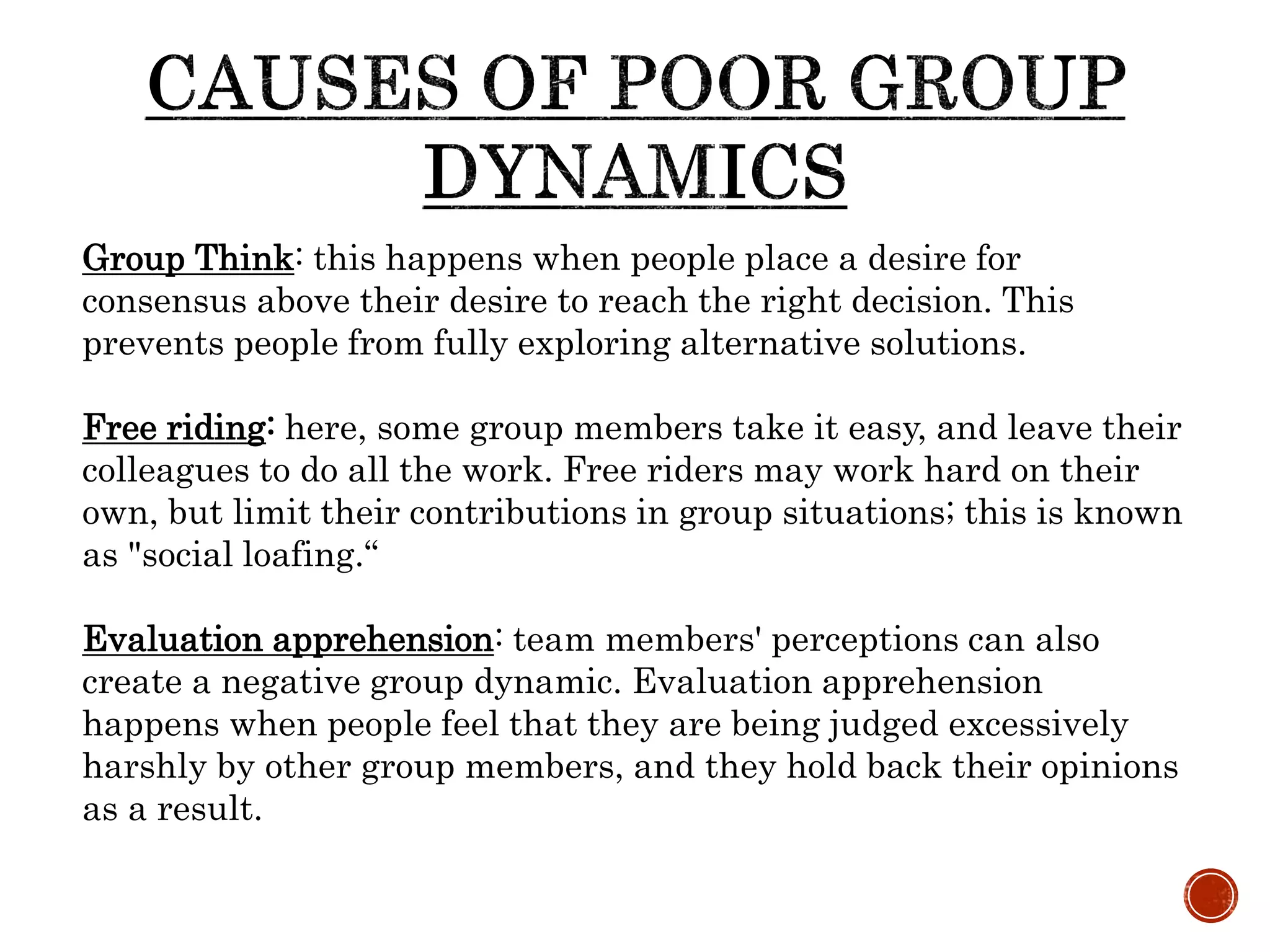
Group Think: this happens when people place a desire for
consensus above their desire to reach the right decision. This
prevents people from fully exploring alternative solutions.
Free riding: here, some group members take it easy, and leave their
colleagues to do all the work. Free riders may work hard on their
own, but limit their contributions in group situations; this is known
as "social loafing.“
Evaluation apprehension: team members' perceptions can also
create a negative group dynamic. Evaluation apprehension
happens when people feel that they are being judged excessively
harshly by other group members, and they hold back their opinions
as a result.
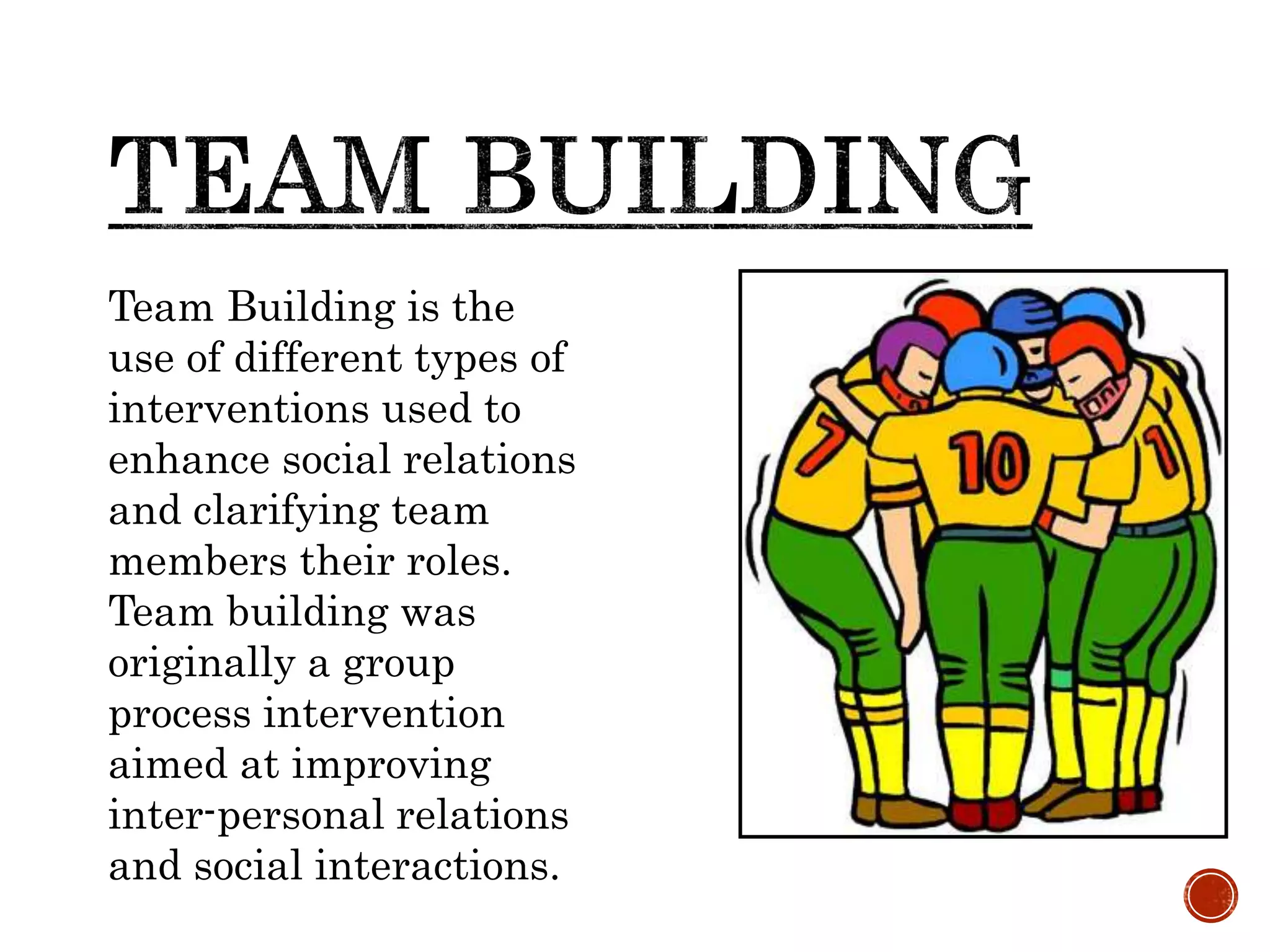
Team Building is the
use of different types of
interventions used to
enhance social relations
and clarifying team
members their roles.
Team building was
originally a group
process intervention
aimed at improving
inter-personal relations
and social interactions.
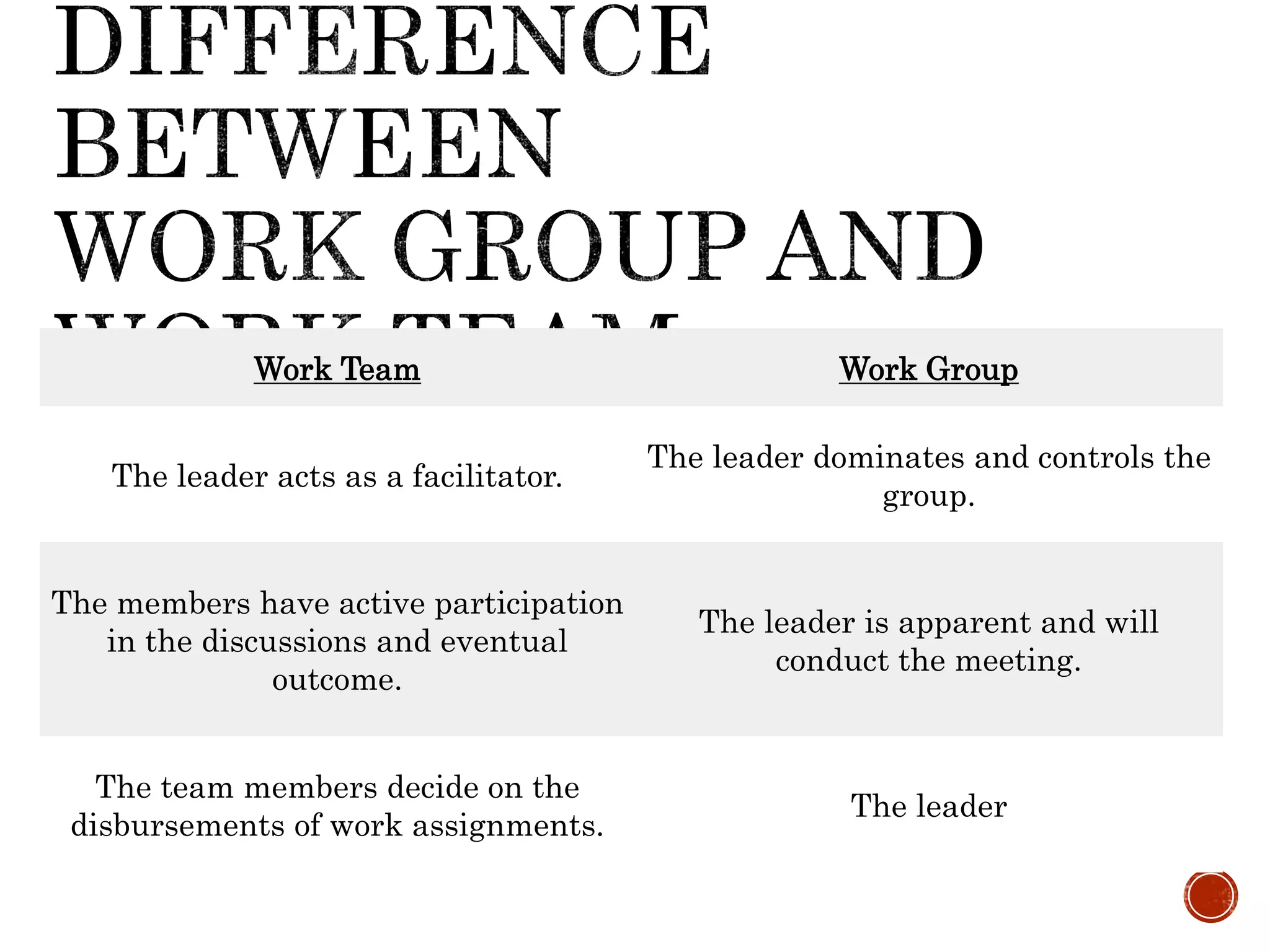
Work Team Work Group
The leader acts as a facilitator.
The leader dominates and controls the
group.
The members have active participation
in the discussions and eventual
outcome.
The leader is apparent and will
conduct the meeting.
The team members decide on the
disbursements of work assignments.
The leader
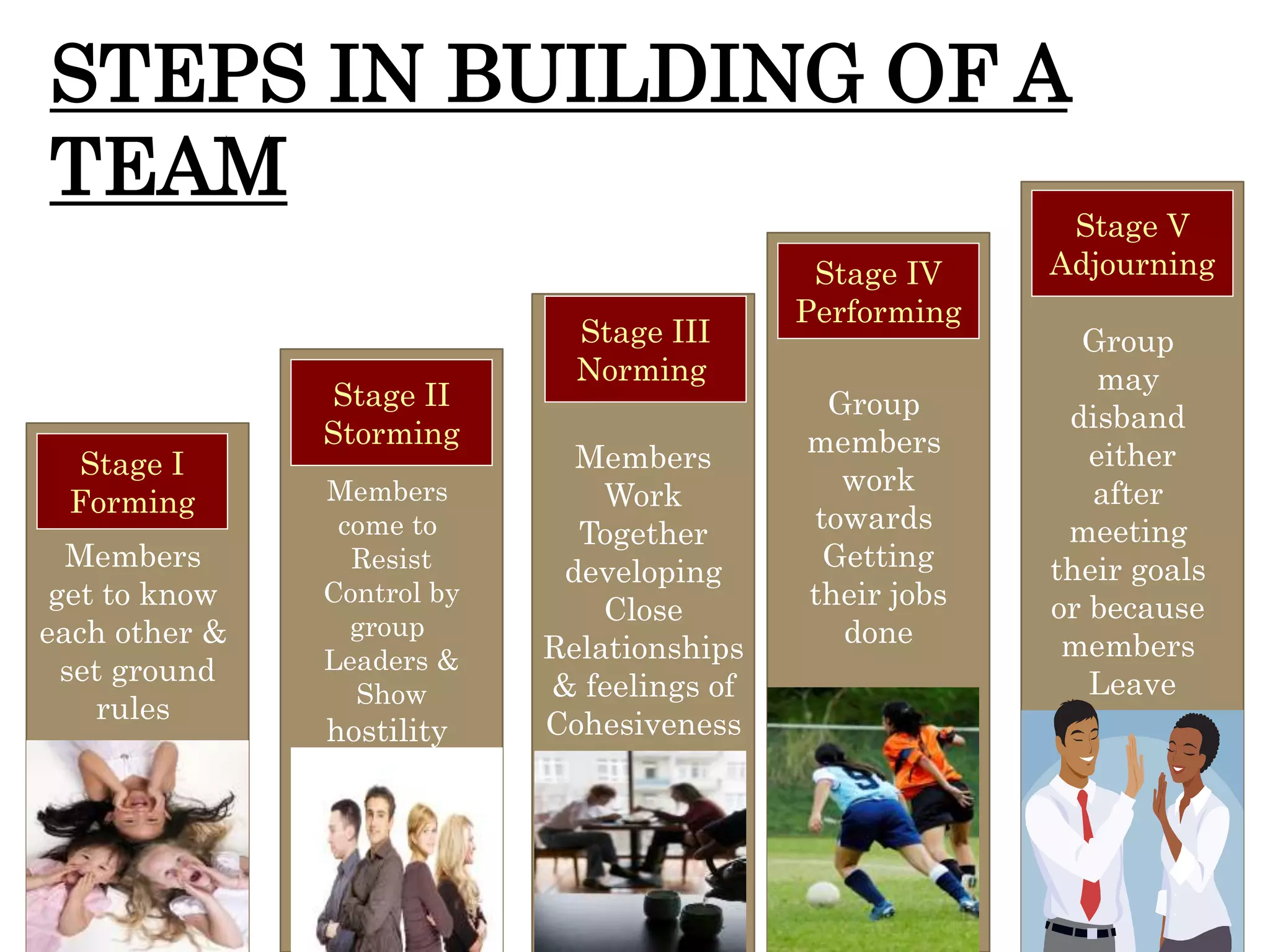
Members
get to know
each other &
set ground
rules
Members
come to
Resist
Control by
group
Leaders &
Show
hostility
Members
Work
Together
developing
Close
Relationships
& feelings of
Cohesiveness
Group
members
work
towards
Getting
their jobs
done
Group
may
disband
either
after
meeting
their goals
or because
members
Leave
Stage I
Forming
Stage II
Storming
Stage III
Norming
Stage IV
Performing
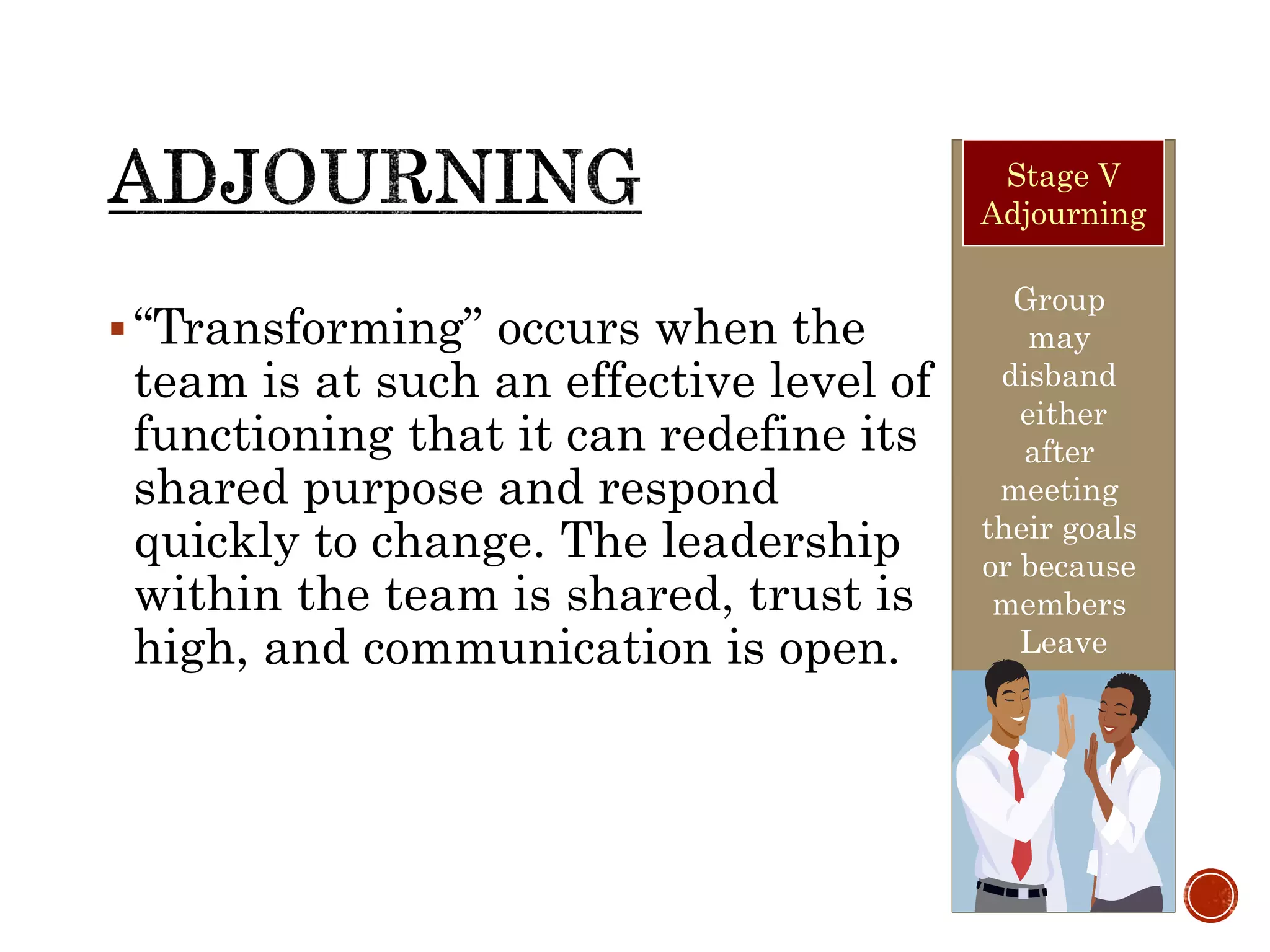
Stage V
Adjourning
STEPS IN BUILDING OF A
TEAM
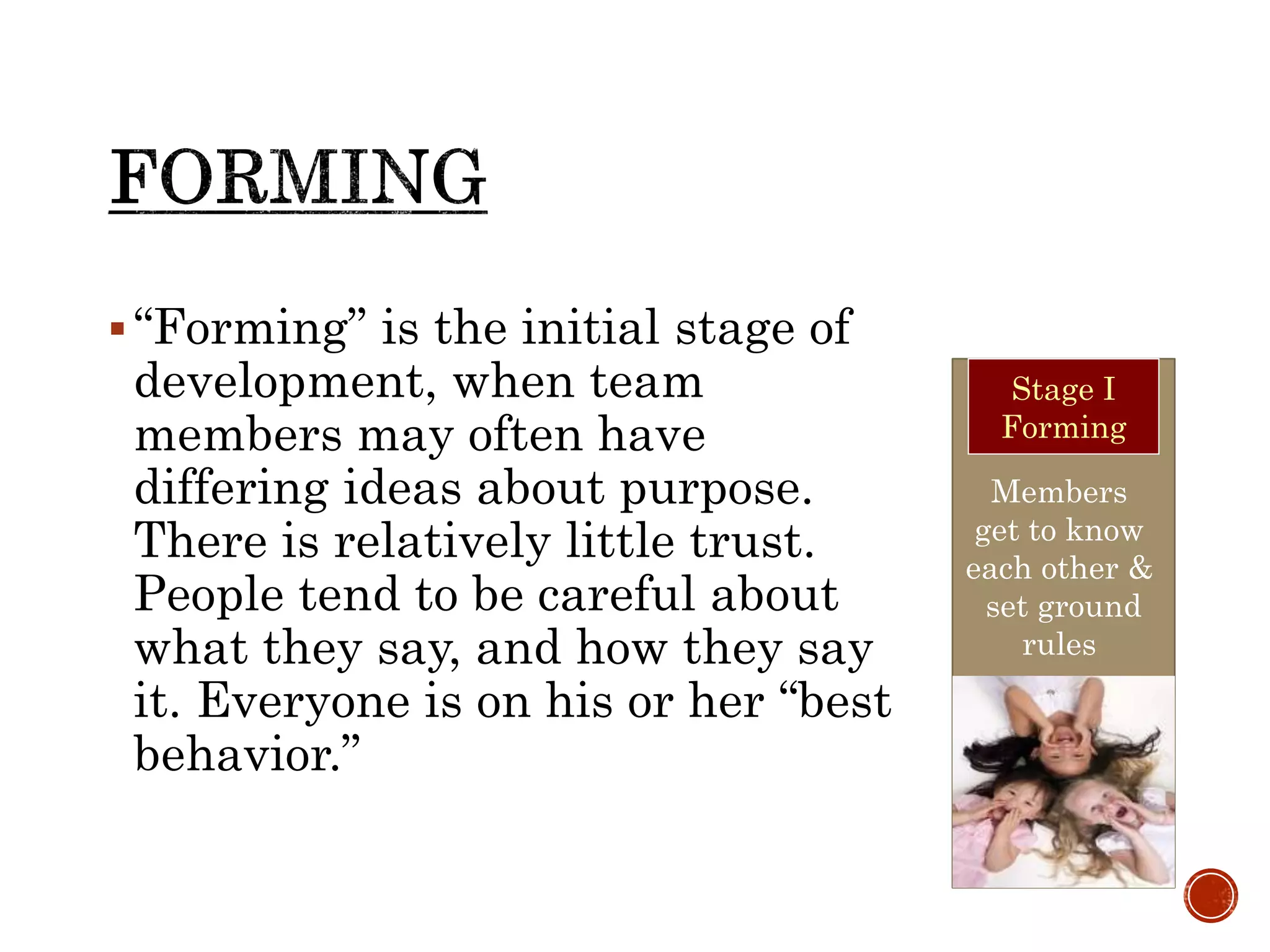
“Forming” is the initial stage of
development, when team
members may often have
differing ideas about purpose.
There is relatively little trust.
People tend to be careful about
what they say, and how they say
it. Everyone is on his or her “best
behavior.”
Members
get to know
each other &
set ground
rules
Stage I
Forming
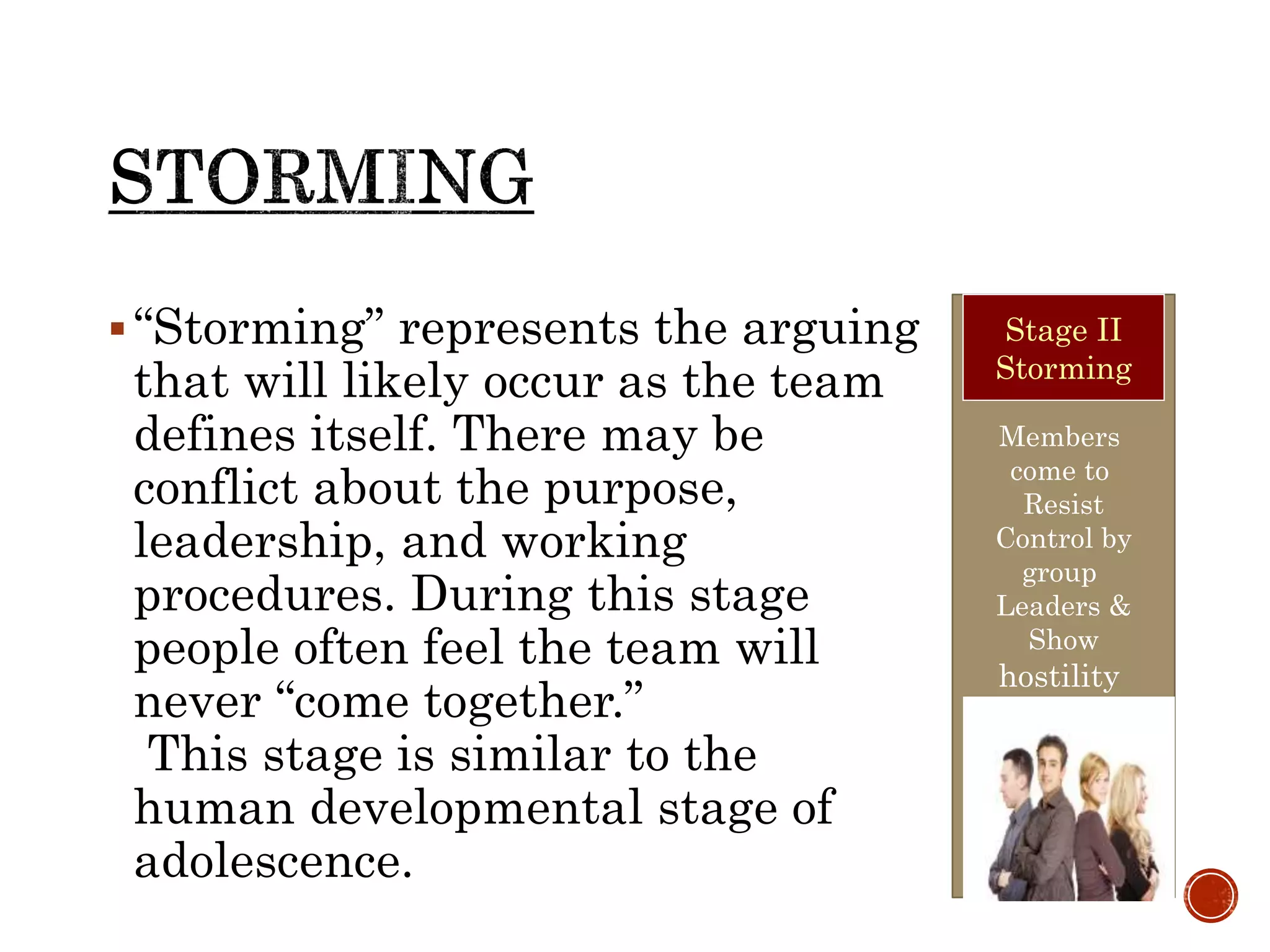
“Storming” represents the arguing
that will likely occur as the team
defines itself. There may be
conflict about the purpose,
leadership, and working
procedures. During this stage
people often feel the team will
never “come together.”
This stage is similar to the
human developmental stage of
adolescence.
Members
come to
Resist
Control by
group
Leaders &
Show
hostility
Stage II
Storming
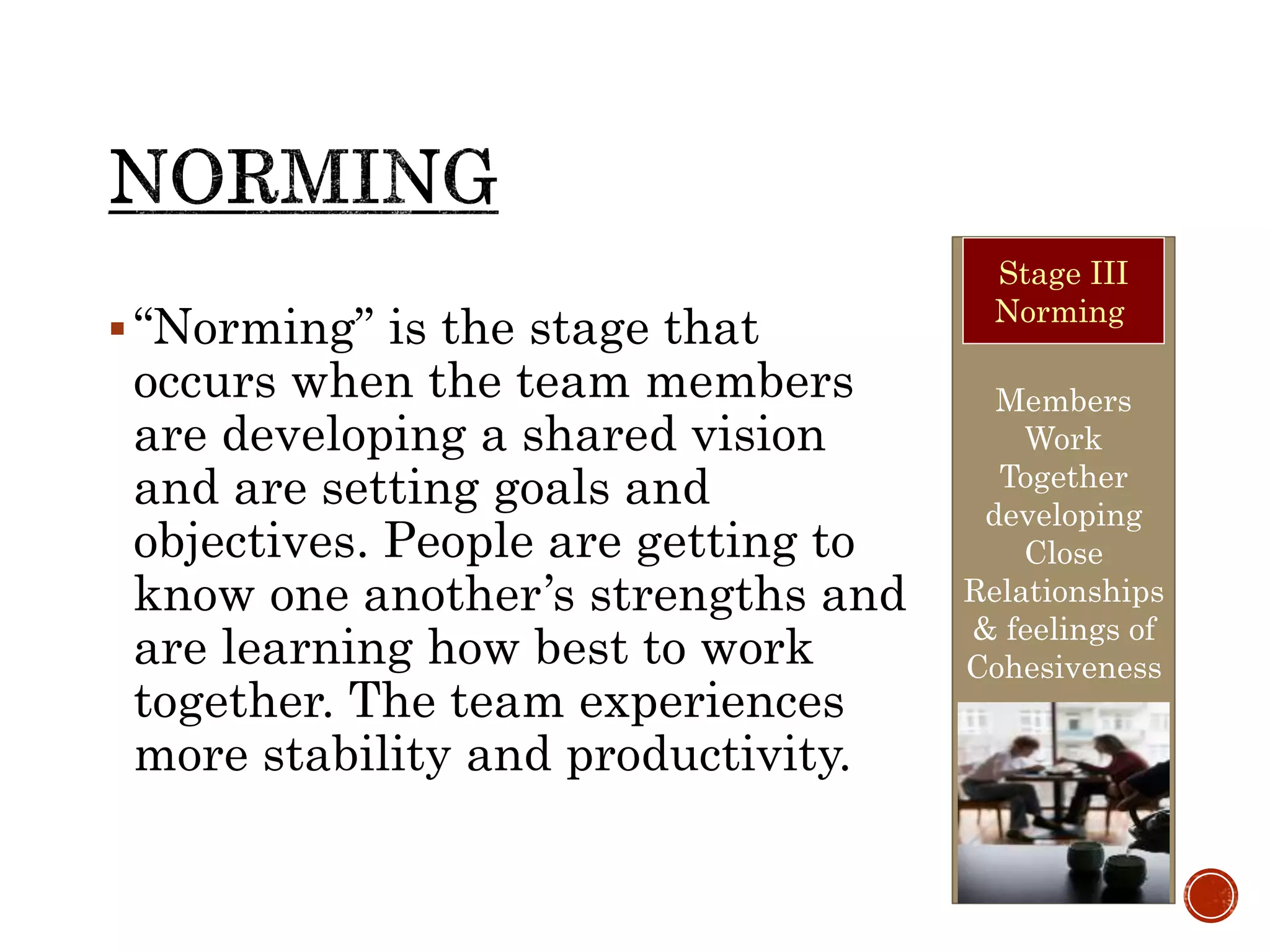
“Norming” is the stage that
occurs when the team members
are developing a shared vision
and are setting goals and
objectives. People are getting to
know one another’s strengths and
are learning how best to work
together. The team experiences
more stability and productivity.
Members
Work
Together
developing
Close
Relationships
& feelings of
Cohesiveness
Stage III
Norming
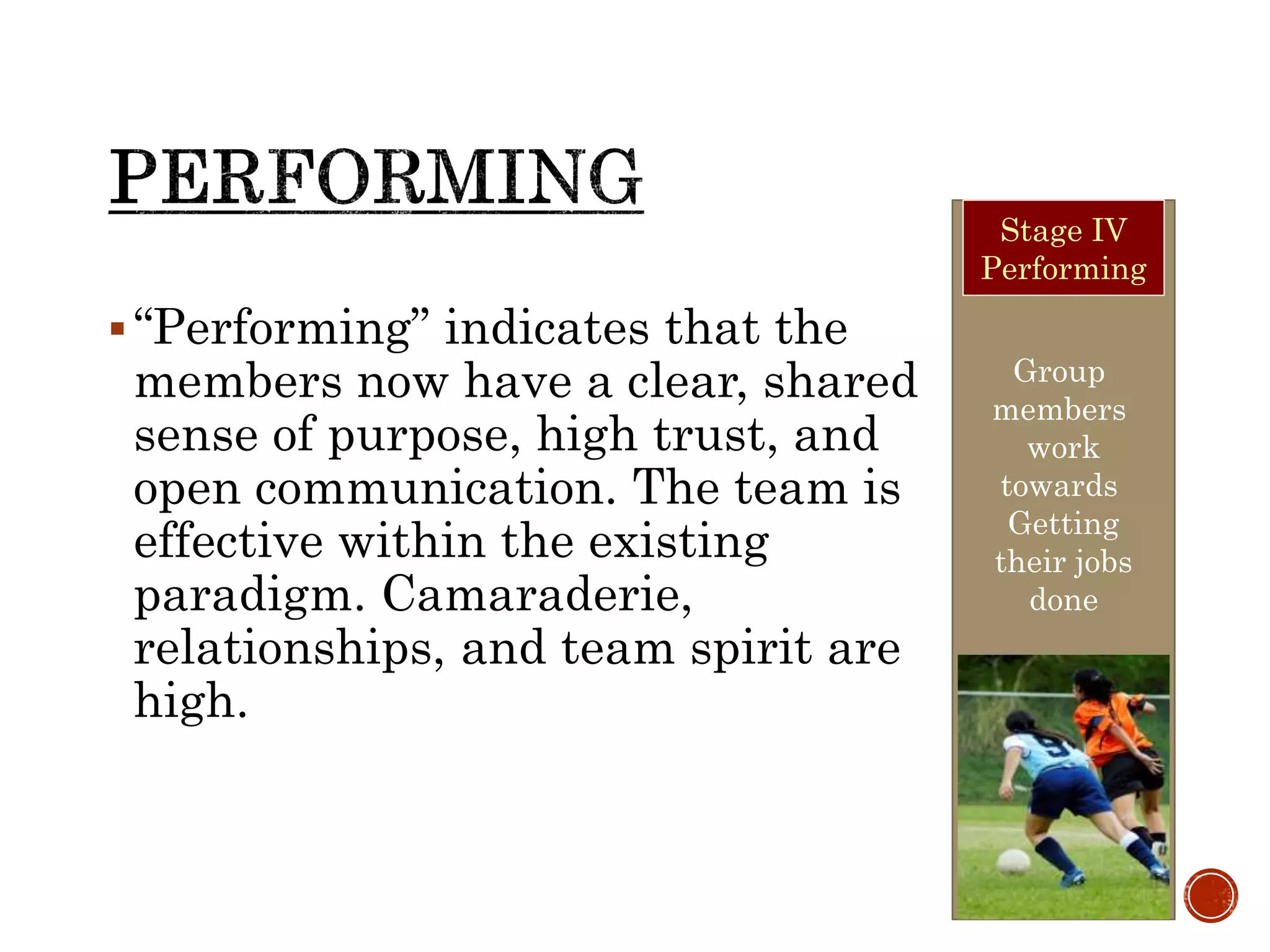
“Performing” indicates that the
members now have a clear, shared
sense of purpose, high trust, and
open communication. The team is
effective within the existing
paradigm. Camaraderie,
relationships, and team spirit are
high.
Group
members
work
towards
Getting
their jobs
done
Stage IV
Performing
Group
may
disband
either
after
meeting
their goals
or because
members
Leave
Stage V
Adjourning
“Transforming” occurs when the
team is at such an effective level of
functioning that it can redefine its
shared purpose and respond
quickly to change. The leadership
within the team is shared, trust is
high, and communication is open.
 Improved Communication: Team building is useful for breaking down
barriers between individuals through group participation in activities.
People who are not used to working together get a chance to participate
and work as a team.
 Develop Team Roles: Team building allows each member of the team to
develop and focus on what they are best at, and allow the team members
to find their niche within the team so that everyone can best contribute
as an individual while still performing together.
 Time to Develop Skills: Team-building activities can allow each member
of the team a chance to take charge and develop leadership skills, as well
as skills in other areas of the business.
 Long-Term Benefits: giving everyone a greater sense of involvement and
belonging; and empowering teams to become more mission focused and
to achieve more with less direction, saving time and money.
 Better Relationships: team building provides a chance for the team to
participate together in an experience where everyone starts with an
equal level of knowledge about the given task.
 Productivity Improvement: Learning to work together can produce
more effective goal achievement and improved output.
 Motivation: Team building activities can drive your employees to
succeed by building their confidence and showing them that the
business wants to invest in their success as an employee
 Problem Solving and Creativity: working together helps increase
creative skills that are developed during team building activities can
be transferred back into the workplace for improved success.
GROUP DYNAMICS AND TEAM BUILDING

GROUP DYNAMICS AND TEAM BUILDING

  • 1.
  • 2.
    GROUP DYNAMICS Group dynamicsdeals with the attitudes and behavioral patterns of a group. Group dynamics is concerned how groups are formed, what is their structure and which processes are followed in their functioning. Thus, it is concerned with the interactions and forces operating between groups. To understand group dynamics we must firstly know what a group is, so A group refers to two or more people who share a common meaning and evaluation of themselves and come together to achieve common goals.
  • 3.
    The members ofthe group must have a strong sense of belonging to the group.  The more attraction a group member is to its members, the greater influence it would exercise on its members.  The successful efforts to change individuals sub parts of the group would result in making them confirm to the norms of the group.  Information relating to the need for change , plans for change and the consequences of the changes must be shared by the members of the group.  The changes in one pact of the groups may produce stress in the other parts, which can be reduced only by eliminating the change or by bringing about readjustments in the related parts.
  • 4.
     The groupsarise and function owing to common motives. The intergroup relations , group organization , member participation is essential for effectiveness of a group. Confidentiality is a major requirement which is achieved by mutual respect for one another.
  • 5.
    Group Dynamics refersto the study of forces operating within a group. Following are some of its salient features :  Group orientation: Group Dynamics is concerned with group .Wherever a group exists the individuals interact and members are continuously changing and adjusting relationship with respect to each other .  Various changes: Changes go on occurring like introduction of the new members, changes in leadership, presence of old and new members and the rate of change – fast or slow . The groups may dissolve if the members are not enthusiastic about the goals .  Dynamic Nature: There may be rigidity or flexibility that influences a group dynamics .If the members get along well there is smooth sailing for the group and if there is conflict it leads to problems
  • 6.
     Group Activities:The group organization is essential. It leads to greater group effectiveness, participation, cooperation and a constructive morale.  Adjustments: Dynamic groups are always in continuous process of restructuring, adjusting and readjusting members to one another for the purpose of reducing the tensions, eliminating the conflicts and solving the problems which its members have in common.
  • 7.
    TASK RELATED ACTIONS Showing initiative and activity: making suggestions, expressing ideas, tackling an existing problem anew, restructuring material.  Looking for information: asking questions to specify suggestions, asking for additional information.  Learning others' opinions: trying to find out other people's feeling in regard to suggestions that have been made, etc.  Providing information: introducing others to the facts, sharing in experiences.  Delving into the issue at hand: giving example, trying to imagine the consequences of specific suggestions.  Coordinating: organizing relationships and ideas, combining the activities of various smaller groups.  Summarizing.
  • 8.
     Encouraging: beingfriendly, considerate, ready to respond to others, praising others and their ideas, agreeing to what others have said.  Staying within boundaries: helping others express themselves (e.g. "We still haven't heard John's opinion"), limiting the length of one's turns so that everyone has time to express themselves.  Agreeing to rules: setting rules for the group that regulate content, processes, and decision making.  Following along: complying with the group's decisions, carefully listening to others and accepting their ideas, being an active listener in group discussions.  Expressing the emotions of the group: defining the emotions generated by the group, sharing observations about group members.  Analyzing: checking whether the group's decisions comply with the rules.  Diagnosing: defining sources of problems, determining next steps, analysing the main obstacles to further activity.  Analyzing the stage of the group's development: finding out the members' opinions, evaluating whether the group is nearing a collective solution.  Being an intermediary: harmonizing, smoothing out differing opinions, offering compromises.  Lessening tension: using humour to avert negative emotions, calming the situation by looking at the bigger picture.
  • 9.
     Aggressive action:determining one's status by criticizing others or doing them in; hostile actions towards the group or individuals in the group; always trying to dominate.  Blocking: sabotaging the further development of the group by focusing on insignificant problems or talking about one's own experiences that is not associated with the problem at hand; a prejudiced rejection of others' ideas.  Fishing for sympathy: using the group as an audience for expressing one's own feelings or opinions (that are not associated with the goals of the group); trying to get on the good side of group members by telling them about one's problems and failures; explaining things in a very complicated way.  Dominating: arguing with others about the best ideas; talking non-stop; trying to be the most important person; taking over leadership.  Being a clown: playing the fool, telling jokes, imitating others; interrupting the group's work.  Looking for attention: attracting the attention of others, for example, by talking loudly or at length; expressing extreme ideas; acting strangely.  Stepping back: acting in a passive or inappropriate way, for example, daydreaming, whispering, avoiding the topic.
  • 10.
     Equalizing Participation Thefacilitator is responsible for the fair distribution of attention during meetings  Listing for the discussion to be smooth, those who want to speak can silently signal the facilitator, who would add the person's name to a list and call them in that order.  Stacking If many people want to speak at the same time, it is useful to ask all those who would like to speak to raise their hands. Have them count off, and then have them speak in that order.  Pacing The pace or flow of the meeting is the responsibility of the facilitator. If the atmosphere starts to become tense, choose techniques which encourage balance and cooperation.  Checking the Process If the flow of the meeting is breaking down or if one person or small group seems to be dominating, anyone can call into question the technique being used and suggest an alternative.
  • 11.
     Silence it isappropriate for anyone to suggest a moment of silence to calm and refocus energy.  Taking a Break In the heat of discussion, people are usually resistant to interrupting the flow to take a break, but a wise facilitator knows when to take refreshing breaks.  Call for Consensus The facilitator, or any member recognized to speak by the facilitator asks if there are any unresolved concerns, which remain unaddressed.  Summarizing The facilitator might choose to focus what has been said by summarizing.  Reformulating the Proposal After a long discussion, it sometimes happens that the proposal becomes modified without any formal decision. The facilitator needs to reformulate the proposal with the new information, modifications, or deletions.
  • 12.
     Fishbowl The fishbowlis a special form of small group discussion. Several members representing differing points of view meet in an inner circle to discuss the issue  Active Listening Listen to the speaker, then acknowledge back what was heard.  Brainstorming process for generating creative ideas and solutions through intensive and freewheeling group discussion.  Go-rounds This is a simple technique that encourages participation. The facilitator states a question and then goes around the room inviting everyone to answer briefly. This isn’t like an open discussion.  Identification It is good to address each other by name. when people speak, it is useful for them to identify themselves so all can gradually learn each others names.
  • 13.
     Weak leadership:when a team lacks a strong leader, it leads to a lack of direction, infighting, or a focus on the wrong priorities.  Excessive deference to authority: this can happen when people want to be seen to agree with a leader, and therefore hold back from expressing their own opinions.  Blocking: this happens when team members behave in a way that disrupts the flow of information in the group. People can adopt blocking roles such as: i) the aggressor, ii) the negotiator, iii) the withdrawer, iv) the recognition seeker, and v) the joker.
  • 14.
    Group Think: thishappens when people place a desire for consensus above their desire to reach the right decision. This prevents people from fully exploring alternative solutions. Free riding: here, some group members take it easy, and leave their colleagues to do all the work. Free riders may work hard on their own, but limit their contributions in group situations; this is known as "social loafing.“ Evaluation apprehension: team members' perceptions can also create a negative group dynamic. Evaluation apprehension happens when people feel that they are being judged excessively harshly by other group members, and they hold back their opinions as a result.
  • 15.
    Team Building isthe use of different types of interventions used to enhance social relations and clarifying team members their roles. Team building was originally a group process intervention aimed at improving inter-personal relations and social interactions.
  • 16.
    Work Team WorkGroup The leader acts as a facilitator. The leader dominates and controls the group. The members have active participation in the discussions and eventual outcome. The leader is apparent and will conduct the meeting. The team members decide on the disbursements of work assignments. The leader
  • 17.
    Members get to know eachother & set ground rules Members come to Resist Control by group Leaders & Show hostility Members Work Together developing Close Relationships & feelings of Cohesiveness Group members work towards Getting their jobs done Group may disband either after meeting their goals or because members Leave Stage I Forming Stage II Storming Stage III Norming Stage IV Performing Stage V Adjourning STEPS IN BUILDING OF A TEAM
  • 18.
    “Forming” is theinitial stage of development, when team members may often have differing ideas about purpose. There is relatively little trust. People tend to be careful about what they say, and how they say it. Everyone is on his or her “best behavior.” Members get to know each other & set ground rules Stage I Forming
  • 19.
    “Storming” represents thearguing that will likely occur as the team defines itself. There may be conflict about the purpose, leadership, and working procedures. During this stage people often feel the team will never “come together.” This stage is similar to the human developmental stage of adolescence. Members come to Resist Control by group Leaders & Show hostility Stage II Storming
  • 20.
    “Norming” is thestage that occurs when the team members are developing a shared vision and are setting goals and objectives. People are getting to know one another’s strengths and are learning how best to work together. The team experiences more stability and productivity. Members Work Together developing Close Relationships & feelings of Cohesiveness Stage III Norming
  • 21.
    “Performing” indicates thatthe members now have a clear, shared sense of purpose, high trust, and open communication. The team is effective within the existing paradigm. Camaraderie, relationships, and team spirit are high. Group members work towards Getting their jobs done Stage IV Performing
  • 22.
    Group may disband either after meeting their goals or because members Leave StageV Adjourning “Transforming” occurs when the team is at such an effective level of functioning that it can redefine its shared purpose and respond quickly to change. The leadership within the team is shared, trust is high, and communication is open.
  • 23.
     Improved Communication:Team building is useful for breaking down barriers between individuals through group participation in activities. People who are not used to working together get a chance to participate and work as a team.  Develop Team Roles: Team building allows each member of the team to develop and focus on what they are best at, and allow the team members to find their niche within the team so that everyone can best contribute as an individual while still performing together.  Time to Develop Skills: Team-building activities can allow each member of the team a chance to take charge and develop leadership skills, as well as skills in other areas of the business.  Long-Term Benefits: giving everyone a greater sense of involvement and belonging; and empowering teams to become more mission focused and to achieve more with less direction, saving time and money.
  • 24.
     Better Relationships:team building provides a chance for the team to participate together in an experience where everyone starts with an equal level of knowledge about the given task.  Productivity Improvement: Learning to work together can produce more effective goal achievement and improved output.  Motivation: Team building activities can drive your employees to succeed by building their confidence and showing them that the business wants to invest in their success as an employee  Problem Solving and Creativity: working together helps increase creative skills that are developed during team building activities can be transferred back into the workplace for improved success.