GREEN COMPUTING
By Group : 13
By : Group 13
Full Name ID
1. Nejash Mohammed 366/07
2. Solomon Ashebir 420/07
3. Gezachew Atlabachew 220/07
4. Birke negesse 121/07
5. Kefene guta 282/07
 What is Green Computing ?
 Green Computing-Why?
 In a word
 Green Use, Green Disposal, Green Design, Green Manufacturing
 Manufacturing of PC’s
 Green manufacturing
 Energy use of PC
 Energy star
 How to save energy while working on the internet ??
 How to go Green
 Disposal of components
 Green Disposal
 Example of Green computing: Thin Client
 Conclusion
Environmentally responsible use of computers and
related resources
 Implementation of energy-efficient central
processing units (CPUs),servers and peripherals
 Reduced resource consumption and proper disposal
of electronic waste (e-waste)
 computer energy is often wasteful
o leaving the computer on when not in use (CPU and fan consume power, screen savers
consume power)
 pollution
o manufacturing techniques
o packaging
o disposal of computers and components
 Toxicity
o as we will see, there are toxic chemicals used in the manufacturing of computers and
components which can enter the food chain and water!
o More directly, it means using computers or devices in ways that save
the environment, save energy and save money
4 Aspects to be “GREEN”
1. Green Use : Minimizing the electricity consumption of computers and other
devices.
2. Green Disposal : Re-making or recycling unwanted electronic equipments.
3. Green Design : Designing energy-efficient computers, servers, printers and
other digital devices.
4. Green Manufacturing : Minimizing waste during the manufacturing of
computers and other subsystems.
 Lead : used in soldering of printed circuit boards lead can cause
damage to the central and peripheral nervous system , blood
systems and kidneys .
 Mercury: used in batteries, switches . Mercury spreads out in
water transforming into methylated mercury that can cause
chronic brain damage.
 Cadmium :used in resistors for chips and in semiconductors .
Cadmium is classified as toxic , these compounds accumulate in
the human body.
 Bamboo : is becoming increasingly popular for making casings for
computers and peripherals.
 Recyclable Plastics : computers are constructed from non-
recyclable plastics i.e recyclable polycarbonate resin.
 Eco-friendly flame retardant :there are flame retardant silicone
compounds available that are flame retardant and completely
non-toxic.
 Inventory management : reducing the quantity of both hazardous
materials used in the process and the amount of excess raw
materials.
 Volume reduction : removes hazardous portion of waste from non
hazardous portion.
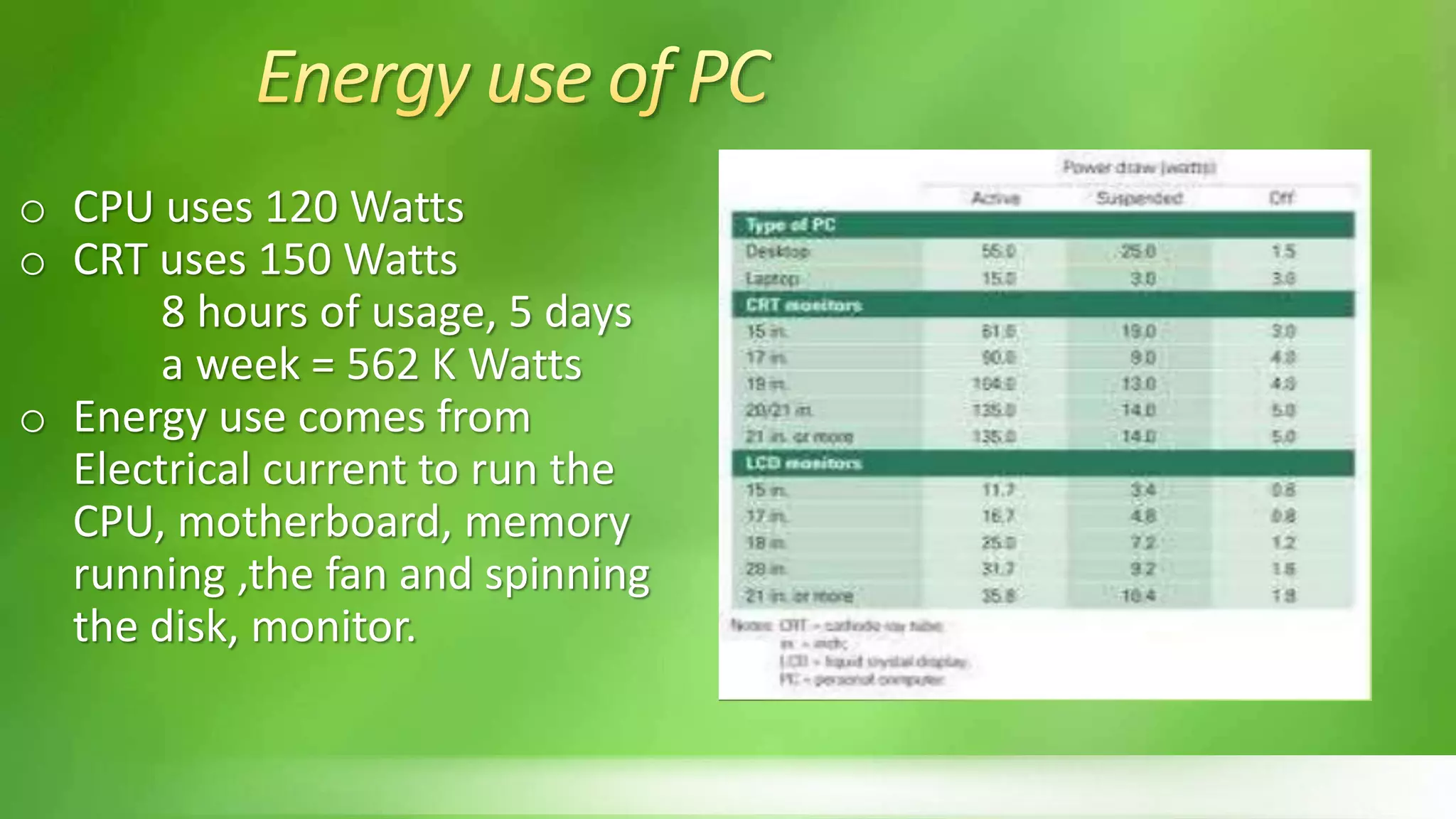
o CPU uses 120 Watts
o CRT uses 150 Watts
8 hours of usage, 5 days
a week = 562 K Watts
o Energy use comes from
Electrical current to run the
CPU, motherboard, memory
running ,the fan and spinning
the disk, monitor.
 One of the first manifestations of the green computing
movement was the launch of energy star program back in 1992.
 Energy Star served as a kind of voluntary label awarded to
computing products that succeeded in minimizing use of energy
while maximizing efficiency.
 Energy Star applied to products like computer monitors,
television sets and temperature control devices like
refrigerators, air conditioners, and similar items.
 Blackle :is a website powered by Google Custom Search and created
by Heap Media, which aims to save energy by displaying a black
background and using grayish-white font color for search results.
 Blackle : saves energy because the screen is predominantly blac
• Turn off the computer when not in use, even if just for
an hour.
• Use power saver mode
• Use hardware/software with the Energy Star label
• Don’t print unless necessary and you are ready
• Use LCDs instead of CRTs as they are more power
efficient
• Consider a smaller monitor-a 14-inch display uses 40%
less energy than a 17-inch one.
• Enable Stand By/Sleep mode.
• Switching from a locally hosted email system to cloud
based email system
• Recycling
• Europe has outlawed using landfills for computer
components
• Disposal of these devices constituted 20-50 million tons per
year (about 5% of the total waste of the planet)
• this waste is called e-waste
• Toxic chemicals in electronics products can reach into the
land over time or are released into the atmosphere,
impacting nearby communities and the environment.This
releases heavy metals such as lead, cadmium and mercury
into the air and ashes.
• Reuse : donate your computer components to people who may not have
or have lesser quality computers.
• Reduce : rather than discarding your computer upgrade it. Change its
some of the parts in order to make it new .
• Recycle : One of the major challenges is recycling the printed circuit
boards from the electronic wastes. The circuit boards contain such precious
metals as gold, silver, platinum, etc. and such base metals as copper, iron,
aluminum.
Thin Client
A Thin Client is a computer or a computer program which depends heavily on some
other computer (its server) to fulfill its traditional computational roles.
Thin Client: a regular computer
• do not have to have hard drives
• can run the software, with the help of a server
• connected to servers through network
 While the performance and the breadth of application is
increasing, so awareness of the cost & scarcity of the energy
required to power them, as well as the materials needed to
make them is necessary.
 Through more environmentally aware usage(such as more
effective power management & shut-down during periods of
inactivity) and by adopting current lower power technologies,
computers can be made significantly more energy efficient.
 Green Computing = Green Earth.
http://thefutureofthings.com/3083greencomputing/
https://www.slideshare.net/vyommaheshwari9/green-computing-
26819161
https://www.slideshare.net/snehasispanigrahi/green-computing-
9739418
https://www.slideshare.net/neenasahni/green-computing-ppt
THANK YOU!!!
“GO GREEN
SAVE OUR EARTH “

Green computing by nejash

  • 1.
  • 2.
    By : Group13 Full Name ID 1. Nejash Mohammed 366/07 2. Solomon Ashebir 420/07 3. Gezachew Atlabachew 220/07 4. Birke negesse 121/07 5. Kefene guta 282/07
  • 3.
     What isGreen Computing ?  Green Computing-Why?  In a word  Green Use, Green Disposal, Green Design, Green Manufacturing  Manufacturing of PC’s  Green manufacturing  Energy use of PC  Energy star  How to save energy while working on the internet ??  How to go Green  Disposal of components  Green Disposal  Example of Green computing: Thin Client  Conclusion
  • 4.
    Environmentally responsible useof computers and related resources  Implementation of energy-efficient central processing units (CPUs),servers and peripherals  Reduced resource consumption and proper disposal of electronic waste (e-waste)
  • 5.
     computer energyis often wasteful o leaving the computer on when not in use (CPU and fan consume power, screen savers consume power)  pollution o manufacturing techniques o packaging o disposal of computers and components  Toxicity o as we will see, there are toxic chemicals used in the manufacturing of computers and components which can enter the food chain and water!
  • 6.
    o More directly,it means using computers or devices in ways that save the environment, save energy and save money 4 Aspects to be “GREEN” 1. Green Use : Minimizing the electricity consumption of computers and other devices. 2. Green Disposal : Re-making or recycling unwanted electronic equipments. 3. Green Design : Designing energy-efficient computers, servers, printers and other digital devices. 4. Green Manufacturing : Minimizing waste during the manufacturing of computers and other subsystems.
  • 8.
     Lead :used in soldering of printed circuit boards lead can cause damage to the central and peripheral nervous system , blood systems and kidneys .  Mercury: used in batteries, switches . Mercury spreads out in water transforming into methylated mercury that can cause chronic brain damage.  Cadmium :used in resistors for chips and in semiconductors . Cadmium is classified as toxic , these compounds accumulate in the human body.
  • 9.
     Bamboo :is becoming increasingly popular for making casings for computers and peripherals.  Recyclable Plastics : computers are constructed from non- recyclable plastics i.e recyclable polycarbonate resin.  Eco-friendly flame retardant :there are flame retardant silicone compounds available that are flame retardant and completely non-toxic.  Inventory management : reducing the quantity of both hazardous materials used in the process and the amount of excess raw materials.  Volume reduction : removes hazardous portion of waste from non hazardous portion.
  • 10.
    o CPU uses120 Watts o CRT uses 150 Watts 8 hours of usage, 5 days a week = 562 K Watts o Energy use comes from Electrical current to run the CPU, motherboard, memory running ,the fan and spinning the disk, monitor.
  • 11.
     One ofthe first manifestations of the green computing movement was the launch of energy star program back in 1992.  Energy Star served as a kind of voluntary label awarded to computing products that succeeded in minimizing use of energy while maximizing efficiency.  Energy Star applied to products like computer monitors, television sets and temperature control devices like refrigerators, air conditioners, and similar items.
  • 12.
     Blackle :isa website powered by Google Custom Search and created by Heap Media, which aims to save energy by displaying a black background and using grayish-white font color for search results.  Blackle : saves energy because the screen is predominantly blac
  • 13.
    • Turn offthe computer when not in use, even if just for an hour. • Use power saver mode • Use hardware/software with the Energy Star label • Don’t print unless necessary and you are ready • Use LCDs instead of CRTs as they are more power efficient • Consider a smaller monitor-a 14-inch display uses 40% less energy than a 17-inch one. • Enable Stand By/Sleep mode. • Switching from a locally hosted email system to cloud based email system • Recycling
  • 14.
    • Europe hasoutlawed using landfills for computer components • Disposal of these devices constituted 20-50 million tons per year (about 5% of the total waste of the planet) • this waste is called e-waste • Toxic chemicals in electronics products can reach into the land over time or are released into the atmosphere, impacting nearby communities and the environment.This releases heavy metals such as lead, cadmium and mercury into the air and ashes.
  • 15.
    • Reuse :donate your computer components to people who may not have or have lesser quality computers. • Reduce : rather than discarding your computer upgrade it. Change its some of the parts in order to make it new . • Recycle : One of the major challenges is recycling the printed circuit boards from the electronic wastes. The circuit boards contain such precious metals as gold, silver, platinum, etc. and such base metals as copper, iron, aluminum.
  • 16.
    Thin Client A ThinClient is a computer or a computer program which depends heavily on some other computer (its server) to fulfill its traditional computational roles. Thin Client: a regular computer • do not have to have hard drives • can run the software, with the help of a server • connected to servers through network
  • 17.
     While theperformance and the breadth of application is increasing, so awareness of the cost & scarcity of the energy required to power them, as well as the materials needed to make them is necessary.  Through more environmentally aware usage(such as more effective power management & shut-down during periods of inactivity) and by adopting current lower power technologies, computers can be made significantly more energy efficient.  Green Computing = Green Earth.
  • 18.
  • 19.