Welcome To Our
Presentation
Course Title: Algorithm
Course Code: CSE221
Course Teacher: Mr. Moushumi Zaman Bonny
• Group Members:
i. Md. Musfiqur Rahman Foysal ID – 163-15-8489
ii. Rasel Khandokar ID – 161-15-7040
iii. Rabia Basri Kanta ID – 142-15-3733
iv. Shahrear Alam ID – 161-15-7651
Greedy Algorithm
Fractional Knapsack
01
Greedy Algorithm
A greedy algorithm is a mathematical process that looks for simple, easy to
complex one, multiply step problem by designed which next step will be most
benefits.
Characteristics of greedy algorithm
=> Make a sequence of choices
=> Each choice is the one that seems best so far, only depends on what’s been
done so far
=> Choice produces a smaller problem to be solved
02
Fractional Knapsack
Given some items, pack the knapsack to get the maximum total value. Each
item has some weight and some value. Total weight that we can carry is no
more than some fixed number. So we must consider weights of items as well
as their values.
Item 1 2 3
Value 8 6 5
Weight 1 3 5
03
Fractional Knapsack
Pseudo code:
Input: Set S of items w, benefits bi and weight 𝒘𝒊, Weight W
Output: Amount 𝑿𝒊 of each item i to maximize benefits
𝑿𝒊 = 0, w = 0
For each item i in S
𝑽𝒊 =
𝒃 𝒊
𝒘 𝒊
While w<W
//remove item i with highest 𝑽𝒊
𝑿𝒊 = min (𝒘𝒊, 𝐖 − 𝐰)
w = w + min (𝒘𝒊, 𝐖 − 𝐰)
04
Code Implementation (Part-1) 05
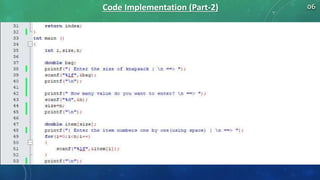
Code Implementation (Part-2) 06
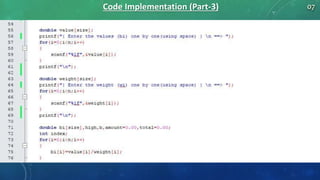
Code Implementation (Part-3) 07
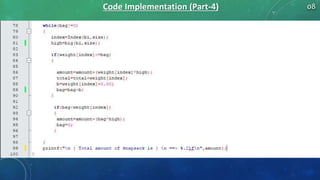
Code Implementation (Part-4) 08
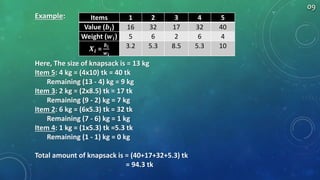
Example: Items 1 2 3 4 5
Value (𝒃𝒊) 16 32 17 32 40
Weight (𝒘𝒊) 5 6 2 6 4
𝑿𝒊 =
𝒃𝒊
𝒘 𝒊
3.2 5.3 8.5 5.3 10
Here, The size of knapsack is = 13 kg
Item 5: 4 kg = (4x10) tk = 40 tk
Remaining (13 - 4) kg = 9 kg
Item 3: 2 kg = (2x8.5) tk = 17 tk
Remaining (9 - 2) kg = 7 kg
Item 2: 6 kg = (6x5.3) tk = 32 tk
Remaining (7 - 6) kg = 1 kg
Item 4: 1 kg = (1x5.3) tk =5.3 tk
Remaining (1 - 1) kg = 0 kg
Total amount of knapsack is = (40+17+32+5.3) tk
= 94.3 tk
09
Code Implementation Output Screenshot:
10
Dynamic Programming
0/1 Knapsack
11
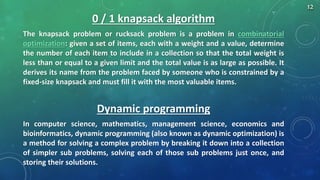
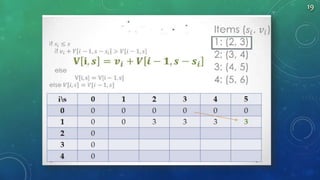
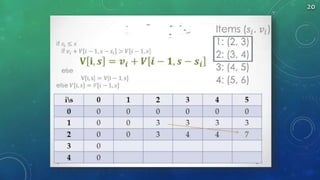
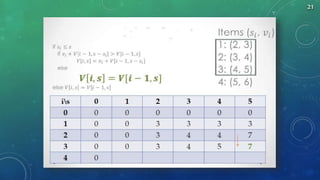
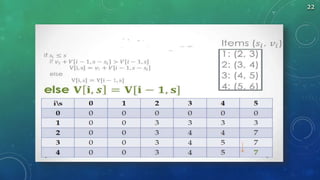
0 / 1 knapsack algorithm
The knapsack problem or rucksack problem is a problem in combinatorial
optimization: given a set of items, each with a weight and a value, determine
the number of each item to include in a collection so that the total weight is
less than or equal to a given limit and the total value is as large as possible. It
derives its name from the problem faced by someone who is constrained by a
fixed-size knapsack and must fill it with the most valuable items.
Dynamic programming
In computer science, mathematics, management science, economics and
bioinformatics, dynamic programming (also known as dynamic optimization) is
a method for solving a complex problem by breaking it down into a collection
of simpler sub problems, solving each of those sub problems just once, and
storing their solutions.
12
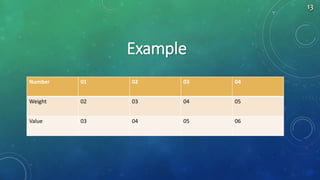
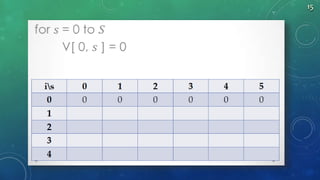
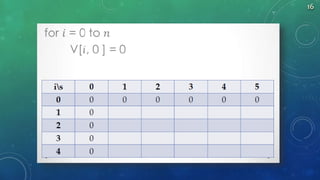
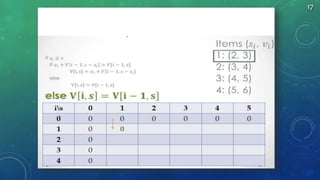
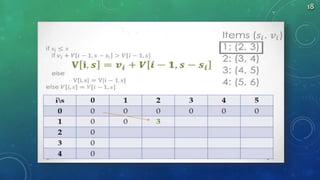
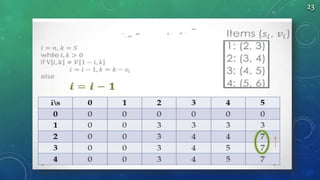
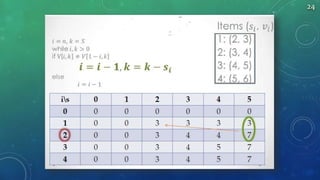
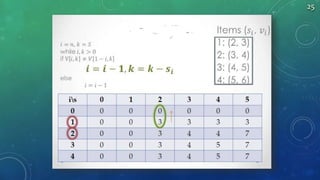
Example
Number 01 02 03 04
Weight 02 03 04 05
Value 03 04 05 06
13
14
15
16
17
18
19
20
21
22
23
24
25
Longest Common
Subsequence (LCS)
26
Definition
Longest common subsequence (LCS) of 2 sequences is a subsequence,
with maximal length, which is common to both the sequences. Given
two sequence of integers, and , find any one longest common
subsequence.
Dynamic programming
1) It is used, when the solution can be
recursively described in terms of solutions
to subproblems (optimal substructure)
2) Algorithm finds solutions to subproblems
and stores them in memory for later use
3) More efficient than “brute-force methods”,
which solve the same subproblems over
and over again
27
LCS Length Algorithm
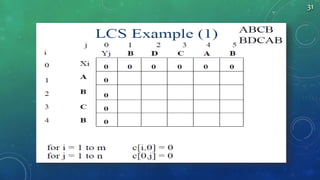
LCS-Length(X, Y)
1. m = length(X) // get the # of symbols in X
2. n = length(Y) // get the # of symbols in Y
3. for i = 1 to m c[i,0] = 0 // special case: Y0
4. for j = 1 to n c[0,j] = 0 // special case: X0
5. for i = 1 to m // for all Xi
6. for j = 1 to n // for all Yj
7. if ( Xi == Yj )
8. c[i,j] = c[i-1,j-1] + 1
9. else c[i,j] = max( c[i-1,j], c[i,j-1] )
28
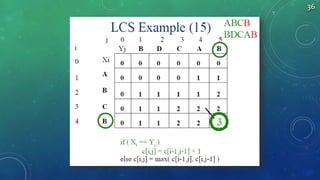
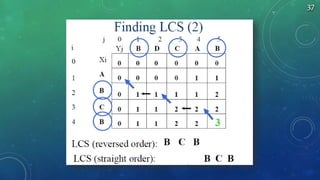
LCS Example
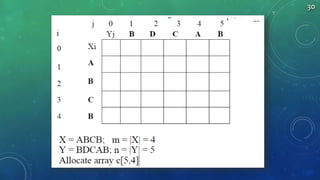
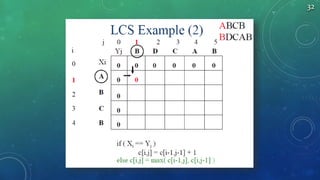
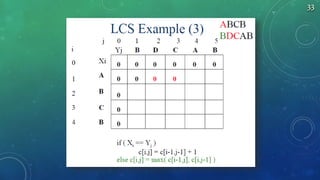
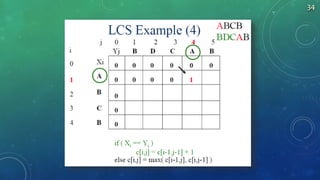
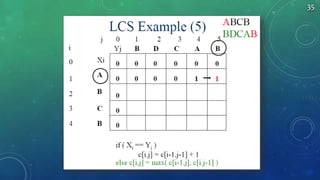
We’ll see how LCS algorithm works on the
following example:
X = ABCB
Y = BDCAB
29
30
31
32
33
34
35
36
37
Huffman Code
38
ALGORITHM
• n = |C|
• Q = C
• for i =1 to n-1
• do allocate a new node z
• left [z] = x = EXTRACT-MIN (Q)
• right [z] = y = EXTRACT-MIN (Q)
• f[z] = f[x] +f[y]
• INSERT(Q, Z)
• return EXTRACT-MIN (Q)
39
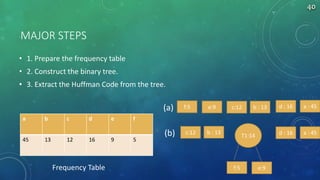
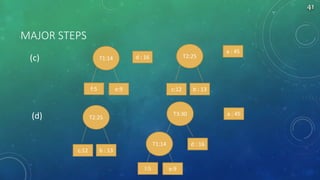
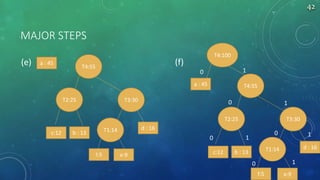
MAJOR STEPS
• 1. Prepare the frequency table
• 2. Construct the binary tree.
• 3. Extract the Huffman Code from the tree.
a b c d e f
45 13 12 16 9 5
Frequency Table
(b)
(a) f:5 e:9 c:12 b : 13 d : 16 a : 45
c:12 b : 13 d : 16 a : 45
f:5 e:9
T1:14
40
MAJOR STEPS
(c)
(d)
f:5 e:9
d : 16
a : 45
T1:14
c:12 b : 13
T2:25
c:12 b : 13
T2:25
a : 45
f:5 e:9
d : 16T1:14
T3:30
41
MAJOR STEPS
a : 45
c:12 b : 13
T2:25
f:5 e:9
d : 16T1:14
T3:30
(e) (f)T4:55
c:12 b : 13
T2:25
f:5 e:9
d : 16T1:14
T3:30
T4:55a : 45
T4:100
1
0
0
0
0
0
11
1
1
42
Thank you!

greedy algorithm Fractional Knapsack

  • 1.
  • 2.
    Course Title: Algorithm CourseCode: CSE221 Course Teacher: Mr. Moushumi Zaman Bonny • Group Members: i. Md. Musfiqur Rahman Foysal ID – 163-15-8489 ii. Rasel Khandokar ID – 161-15-7040 iii. Rabia Basri Kanta ID – 142-15-3733 iv. Shahrear Alam ID – 161-15-7651
  • 3.
  • 4.
    Greedy Algorithm A greedyalgorithm is a mathematical process that looks for simple, easy to complex one, multiply step problem by designed which next step will be most benefits. Characteristics of greedy algorithm => Make a sequence of choices => Each choice is the one that seems best so far, only depends on what’s been done so far => Choice produces a smaller problem to be solved 02
  • 5.
    Fractional Knapsack Given someitems, pack the knapsack to get the maximum total value. Each item has some weight and some value. Total weight that we can carry is no more than some fixed number. So we must consider weights of items as well as their values. Item 1 2 3 Value 8 6 5 Weight 1 3 5 03
  • 6.
    Fractional Knapsack Pseudo code: Input:Set S of items w, benefits bi and weight 𝒘𝒊, Weight W Output: Amount 𝑿𝒊 of each item i to maximize benefits 𝑿𝒊 = 0, w = 0 For each item i in S 𝑽𝒊 = 𝒃 𝒊 𝒘 𝒊 While w<W //remove item i with highest 𝑽𝒊 𝑿𝒊 = min (𝒘𝒊, 𝐖 − 𝐰) w = w + min (𝒘𝒊, 𝐖 − 𝐰) 04
  • 7.
  • 8.
  • 9.
  • 10.
  • 11.
    Example: Items 12 3 4 5 Value (𝒃𝒊) 16 32 17 32 40 Weight (𝒘𝒊) 5 6 2 6 4 𝑿𝒊 = 𝒃𝒊 𝒘 𝒊 3.2 5.3 8.5 5.3 10 Here, The size of knapsack is = 13 kg Item 5: 4 kg = (4x10) tk = 40 tk Remaining (13 - 4) kg = 9 kg Item 3: 2 kg = (2x8.5) tk = 17 tk Remaining (9 - 2) kg = 7 kg Item 2: 6 kg = (6x5.3) tk = 32 tk Remaining (7 - 6) kg = 1 kg Item 4: 1 kg = (1x5.3) tk =5.3 tk Remaining (1 - 1) kg = 0 kg Total amount of knapsack is = (40+17+32+5.3) tk = 94.3 tk 09
  • 12.
  • 13.
  • 14.
    0 / 1knapsack algorithm The knapsack problem or rucksack problem is a problem in combinatorial optimization: given a set of items, each with a weight and a value, determine the number of each item to include in a collection so that the total weight is less than or equal to a given limit and the total value is as large as possible. It derives its name from the problem faced by someone who is constrained by a fixed-size knapsack and must fill it with the most valuable items. Dynamic programming In computer science, mathematics, management science, economics and bioinformatics, dynamic programming (also known as dynamic optimization) is a method for solving a complex problem by breaking it down into a collection of simpler sub problems, solving each of those sub problems just once, and storing their solutions. 12
  • 15.
    Example Number 01 0203 04 Weight 02 03 04 05 Value 03 04 05 06 13
  • 16.
  • 17.
  • 18.
  • 19.
  • 20.
  • 21.
  • 22.
  • 23.
  • 24.
  • 25.
  • 26.
  • 27.
  • 28.
  • 29.
    Definition Longest common subsequence(LCS) of 2 sequences is a subsequence, with maximal length, which is common to both the sequences. Given two sequence of integers, and , find any one longest common subsequence. Dynamic programming 1) It is used, when the solution can be recursively described in terms of solutions to subproblems (optimal substructure) 2) Algorithm finds solutions to subproblems and stores them in memory for later use 3) More efficient than “brute-force methods”, which solve the same subproblems over and over again 27
  • 30.
    LCS Length Algorithm LCS-Length(X,Y) 1. m = length(X) // get the # of symbols in X 2. n = length(Y) // get the # of symbols in Y 3. for i = 1 to m c[i,0] = 0 // special case: Y0 4. for j = 1 to n c[0,j] = 0 // special case: X0 5. for i = 1 to m // for all Xi 6. for j = 1 to n // for all Yj 7. if ( Xi == Yj ) 8. c[i,j] = c[i-1,j-1] + 1 9. else c[i,j] = max( c[i-1,j], c[i,j-1] ) 28
  • 31.
    LCS Example We’ll seehow LCS algorithm works on the following example: X = ABCB Y = BDCAB 29
  • 32.
  • 33.
  • 34.
  • 35.
  • 36.
  • 37.
  • 38.
  • 39.
  • 40.
  • 41.
    ALGORITHM • n =|C| • Q = C • for i =1 to n-1 • do allocate a new node z • left [z] = x = EXTRACT-MIN (Q) • right [z] = y = EXTRACT-MIN (Q) • f[z] = f[x] +f[y] • INSERT(Q, Z) • return EXTRACT-MIN (Q) 39
  • 42.
    MAJOR STEPS • 1.Prepare the frequency table • 2. Construct the binary tree. • 3. Extract the Huffman Code from the tree. a b c d e f 45 13 12 16 9 5 Frequency Table (b) (a) f:5 e:9 c:12 b : 13 d : 16 a : 45 c:12 b : 13 d : 16 a : 45 f:5 e:9 T1:14 40
  • 43.
    MAJOR STEPS (c) (d) f:5 e:9 d: 16 a : 45 T1:14 c:12 b : 13 T2:25 c:12 b : 13 T2:25 a : 45 f:5 e:9 d : 16T1:14 T3:30 41
  • 44.
    MAJOR STEPS a :45 c:12 b : 13 T2:25 f:5 e:9 d : 16T1:14 T3:30 (e) (f)T4:55 c:12 b : 13 T2:25 f:5 e:9 d : 16T1:14 T3:30 T4:55a : 45 T4:100 1 0 0 0 0 0 11 1 1 42
  • 45.