GraphQL Advanced Concepts: A
Comprehensive Guide
Welcome to our comprehensive guide on GraphQL Advanced
concepts. In this article, we will delve into the intricacies of
GraphQL and explore advanced techniques and concepts that will
enhance your GraphQL development skills. Whether you are a
beginner looking to expand your knowledge or an experienced
developer seeking to master GraphQL, this guide will provide you
with valuable insights and practical examples to help you level up
your GraphQL game.
1. What is GraphQL?
GraphQL is a query language and runtime for APIs, developed by
Facebook. It provides a flexible and efficient approach to query and
manipulate data by allowing clients to request only the specific data
they need. In GraphQL, clients define the structure of the responses
they receive, eliminating over-fetching and under-fetching of data
common in REST APIs.
GraphQL consists of three main components: the schema, resolvers,
and queries/mutations. The schema defines the available types and
operations in the API, resolvers handle the logic for fetching the
data, and queries/mutations allow clients to request and modify
data.
GraphQL API has gained popularity due to its flexibility, strong
typing system, and ability to aggregate data from multiple sources. It
empowers developers to build efficient and robust APIs that
precisely match the needs of the client applications.
2. Understanding GraphQL Schema
The GraphQL schema is the contract between the server and the
client, defining the available types, fields, and operations. It serves
as the blueprint for the GraphQL API, enabling clients to understand
and interact with the data.
2.1 Schema Definition Language (SDL)
The Schema Definition Language (SDL) is a concise and human-
readable way to define the GraphQL schema. It allows developers to
define types, fields, relationships, and directives. SDL provides a
declarative approach to specify the structure of the API, making it
easier to communicate and collaborate on the API design.
2.2 Types in GraphQL
GraphQL introduces a powerful type system that allows developers
to define custom types. Scalar types represent primitive values like
integers, floats, strings, booleans, and dates. Object types represent
complex entities with multiple fields, while Enum types define a set
of allowed values. Interface types define a common set of fields that
can be implemented by multiple object types.
2.3 Fields and Relationships
Fields represent the properties of a GraphQL type and define the
data that can be queried. They can be scalar types or object types,
allowing for nested and related data retrieval. Relationships between
types are defined using fields and can be one-to-one, one-to-many,
or many-to-many.
2.4 Directives
Directives provide a way to modify the behavior of a GraphQL
schema or query. They can be used to apply validation rules, control
caching, enable or disable fields, and more. Directives allow for fine-
grained control over the execution and behavior of GraphQL
operations.
3. Advanced Querying Techniques
GraphQL provides powerful querying capabilities that go beyond
basic field selection. Here are some advanced querying techniques to
optimize your GraphQL queries:
3.1 Fragments
Fragments allow you to define reusable selections of fields that can
be included in multiple queries. They promote code reuse and help
in maintaining clean and readable queries.
3.2 Aliases
Aliases allow you to rename the result of a field in a query. This is
useful when you need to query the same field with different
arguments or when you want to avoid naming conflicts in the
response.
3.3 Query Variables
Query variables enable parameterization of GraphQL queries. They
allow you to pass dynamic values to the query, making it more
flexible and reusable.
3.4 Pagination
Pagination is a common requirement when dealing with large
datasets. GraphQL provides standardized pagination techniques like
cursor-based pagination and offset-based pagination. These
techniques allow you to efficiently retrieve and navigate through
paginated data.
3.5 Batched Queries
Batched queries enable you to send multiple queries in a single
request to reduce network overhead. This can significantly improve
the performance of your GraphQL API, especially when fetching
data from multiple sources.
4. Optimizing GraphQL Performance
As your GraphQL API grows, it’s essential to optimize its
performance to ensure fast and efficient data retrieval. Here are
some techniques to optimize GraphQL performance:
4.1 DataLoader
DataLoader is a library that helps you optimize the loading of data in
a GraphQL API. It batches and caches data fetching requests,
reducing the number of database queries and improving response
times.
4.2 Caching
Caching is crucial for improving the performance of GraphQL APIs.
By caching frequently accessed data, you can reduce the load on
your backend systems and provide faster responses to clients.
Popular caching strategies for GraphQL include edge caching, result
caching, and data loader caching.
4.3 Debouncing and Throttling
Debouncing and throttling are techniques used to limit the
frequency of expensive or resource-intensive operations. By
controlling the rate at which certain operations are executed, you
can prevent overload and improve overall system performance.
4.4 Cost Analysis and Query Complexity
Analyzing the cost and complexity of GraphQL queries can help
identify potential performance bottlenecks. By assigning costs to
fields and limiting query complexity, you can ensure that your API
remains performant even when handling complex queries.
4.5 Schema Stitching and Federation
Schema stitching and federation are advanced techniques for
combining multiple GraphQL schemas into a single, unified schema.
These techniques enable modular development and scalability by
allowing independent teams to work on separate parts of the
schema.
5. Implementing GraphQL Subscriptions
GraphQL Subscriptions enable real-time communication between
the client and the server. Subscriptions allow clients to subscribe to
specific events or data changes and receive updates in real-time.
Here’s how you can implement GraphQL subscriptions:
5.1 Pub-Sub Systems
Pub-Sub systems play a crucial role in implementing GraphQL
subscriptions. They provide the infrastructure for broadcasting
events and delivering updates to the subscribed clients. Popular
Pub-Sub systems for GraphQL include Apollo PubSub, Redis
PubSub, and MQTT.
5.2 Subscriptions Resolver
The subscriptions resolver is responsible for resolving and
broadcasting subscription events to the subscribed clients. It listens
for specific triggers or events and sends the updates to the clients.
5.3 Subscriptions Client
The subscriptions client is responsible for establishing and
maintaining a WebSocket connection with the server. It listens for
updates and notifies the client application whenever new data is
received.
6. Authentication and Authorization in GraphQL
Authentication and authorization are critical aspects of building
secure GraphQL APIs. Here’s how you can implement
authentication and authorization in GraphQL:
6.1 Authentication
Authentication ensures that only authenticated users can access
protected resources in your GraphQL API. Common authentication
mechanisms include JWT (JSON Web Tokens), OAuth, and session-
based authentication.
6.2 Authorization
Authorization controls what actions and data a user can access
within your GraphQL API. You can implement role-based access
control (RBAC), attribute-based access control (ABAC), or custom
authorization logic to enforce access restrictions.
6.3 Protecting GraphQL Resolvers
To protect your GraphQL resolvers, you can implement middleware
or directives that intercept and validate requests before executing
the resolver logic. This allows you to enforce fine-grained
authorization rules and protect sensitive data.
7. Error Handling in GraphQL
Error handling is an essential aspect of building robust GraphQL
APIs. GraphQL provides a structured approach to handle errors and
communicate them to clients effectively.
7.1 Error Types
GraphQL defines several error types, including field errors, query
errors, and syntax errors. These error types provide detailed
information about the nature of the error and help clients
understand and handle them appropriately.
7.2 Error Extensions
GraphQL allows you to extend error information with custom error
codes, error messages, and additional metadata. Error extensions
can be used to provide specific guidance to clients on how to handle
different types of errors.
7.3 Global Error Handling
Implementing global error handling enables you to centralize error
processing and apply consistent error handling logic across your
GraphQL API. You can use GraphQL middleware or error handling
middleware to intercept and process errors.
8. Caching Strategies for GraphQL
Caching is crucial for improving the performance and scalability of
GraphQL APIs. Here are some caching strategies you can employ:
8.1 Edge Caching
Edge caching involves caching GraphQL responses at the edge of
your network, typically using a CDN (Content Delivery Network). By
caching responses close to the client, you can reduce network
latency and improve overall API performance.
8.2 Result Caching
Result caching involves caching the results of individual GraphQL
queries. By caching query results, you can avoid executing expensive
resolver logic and reduce the load on your backend systems.
8.3 Data Loader Caching
Data Loader caching is specific to the DataLoader library. It allows
you to cache data loading operations and prevent redundant
database queries. By caching data, you can improve the efficiency of
your GraphQL API and reduce the response time.
9. Advanced GraphQL Tools and Libraries
GraphQL offers a wide range of tools and libraries that simplify and
enhance the development process. Here are some advanced tools
and libraries you can leverage:
9.1 Apollo Server
Apollo Server is a popular GraphQL server implementation that
provides essential features like schema stitching, subscriptions,
caching, and more. It offers a robust and extensible platform for
building GraphQL APIs.
9.2 Prisma
Prisma is an open-source database toolkit that simplifies database
access in GraphQL APIs. It provides an auto-generated and type-
safe query builder, schema migrations, and performance
optimizations.
9.3 GraphiQL and GraphQL Playground
GraphiQL and GraphQL Playground are powerful IDEs (Integrated
Development Environments) for interacting with GraphQL APIs.
They offer features like auto-completion, schema exploration, query
debugging, and documentation generation.
9.4 Apollo Federation
Apollo Federation is a schema composition technique that enables
you to combine multiple GraphQL services into a single federated
schema. It simplifies microservices architecture and allows
independent teams to develop and deploy services independently.
9.5 Relay
Relay is a JavaScript framework developed by Facebook that
optimizes data fetching and caching for GraphQL. It provides a
declarative approach to building efficient and scalable client
applications.
10. Testing GraphQL APIs
Testing is a crucial part of the development process to ensure the
correctness and stability of your GraphQL APIs. Here are some
strategies for testing GraphQL APIs:
10.1 Unit Testing Resolvers
Unit testing resolvers helps validate the logic and behavior of
individual resolver functions. By mocking dependencies and input
data, you can ensure that resolvers return the expected results.
10.2 Integration Testing
Integration testing involves testing the interaction between different
components of your GraphQL API. It ensures that the API functions
correctly as a whole, including the schema, resolvers, and data
sources.
10.3 Performance Testing
Performance testing measures the performance characteristics of
your GraphQL API under different workloads and usage patterns. It
helps identify bottlenecks, optimize query execution, and ensure
that your API can handle high loads.
11. Monitoring and Debugging GraphQL
Monitoring and debugging are essential for maintaining and
improving the quality of your GraphQL APIs. Here are some
techniques for monitoring and debugging GraphQL:
11.1 Logging and Error Tracking
Logging and error tracking help you monitor the behavior of your
GraphQL API and identify issues or anomalies. By logging relevant
information and capturing errors, you can gain insights into the
performance and stability of your API.
11.2 Performance Monitoring
Performance monitoring involves measuring and analyzing the
performance metrics of your GraphQL API. This includes response
times, query execution times, and resource utilization. Performance
monitoring helps you identify performance bottlenecks and optimize
your API for better responsiveness.
11.3 Debugging Tools
GraphQL debugging tools like Apollo Studio and GraphQL
Playground provide interactive environments for exploring and
debugging GraphQL APIs. They offer features like query execution
tracing, error analysis, and real-time monitoring.
12. Migrating from REST to GraphQL
Migrating from a REST API to GraphQL can be a complex process.
Here are some considerations and steps to follow when migrating
from REST to GraphQL:
12.1 Analyze and Plan
Start by analyzing your existing REST API and understanding its
strengths and weaknesses. Identify the pain points that GraphQL
can address and plan the migration process accordingly.
12.2 Schema Design
Design the GraphQL schema that aligns with your existing REST
API’s resources and endpoints. Consider the needs of the client
applications and design the schema to optimize data fetching and
manipulation.
12.3 Resolver Development
Develop the resolvers that map GraphQL queries and mutations to
the corresponding REST API calls. Implement the logic to transform
GraphQL requests into RESTful requests and handle data retrieval
and manipulation.
12.4 Incremental Migration
Consider an incremental migration approach where you gradually
introduce GraphQL alongside your existing REST API. This allows
you to test and validate the GraphQL implementation while
minimizing disruption to the existing systems.
13. GraphQL Best Practices
To ensure the success of your GraphQL projects, it’s important to
follow best practices. Here are some best practices to consider:
13.1 Versioning
Implement versioning in your GraphQL APIs to ensure backward
compatibility and provide a stable contract for clients. Versioning
allows you to introduce changes without breaking existing client
applications.
13.2 Documentation
Provide comprehensive and up-to-date documentation for your
GraphQL APIs. Document the schema, types, fields, input objects,
and possible queries/mutations. Clear documentation helps
developers understand and utilize your APIs effectively.
13.3 Error Handling and Validation
Implement robust error handling and validation in your GraphQL
APIs. Use GraphQL error types and extensions to communicate
errors effectively to clients. Validate input data and provide
meaningful error messages to guide clients in making correct
requests.
13.4 Security
Implement security measures to protect your GraphQL APIs from
common vulnerabilities like injection attacks, denial-of-service
attacks, and unauthorized access. Use authentication, authorization,
and rate limiting techniques to secure your APIs.
13.5 Performance Optimization
Optimize the performance of your GraphQL APIs by implementing
caching, pagination, and efficient data fetching techniques. Monitor
and analyze the performance metrics to identify bottlenecks and
optimize query execution.
14. GraphQL in Production
When deploying GraphQL APIs to production, it’s important to
consider various factors for scalability, reliability, and
maintainability. Here are some considerations for running GraphQL
in production:
14.1 Scalability
Design your GraphQL APIs to be scalable by considering factors like
caching, load balancing, horizontal scaling, and efficient data
fetching. Monitor the performance and resource utilization to ensure
optimal scalability.
14.2 Error Monitoring and Alerting
Implement error monitoring and alerting systems to detect and
respond to errors and anomalies in your GraphQL APIs. Use tools
like logging, error tracking, and real-time monitoring to identify and
resolve issues promptly.
14.3 Deployment and CI/CD
Establish a robust deployment and continuous
integration/continuous deployment (CI/CD) process for your
GraphQL APIs. Automate the deployment, testing, and versioning to
ensure smooth and reliable releases.
14.4 Monitoring and Metrics
Monitor the performance metrics and usage patterns of your
GraphQL APIs in production. Track key metrics like response times,
error rates, and query complexity to identify potential bottlenecks
and optimize the performance.
15. GraphQL Federation
GraphQL Federation is an approach for composing multiple
GraphQL services into a single federated schema. It allows
independent teams to work on separate services and enables
efficient data aggregation and composition.
15.1 Schema Composition
Schema composition involves combining multiple GraphQL
schemas into a federated schema. Each service maintains its own
schema, and a gateway stitches them together to form a unified API.
15.2 Distributed Development
GraphQL Federation enables distributed development, where
multiple teams can work independently on different services. Each
team can focus on a specific domain or functionality and develop
their service without tight coupling.
15.3 Service-to-Service Communication
GraphQL Federation facilitates service-to-service communication by
allowing services to reference and fetch data from other services.
This enables efficient data aggregation and avoids the need for
clients to make multiple requests to different services.
16. Securing GraphQL APIs
Securing GraphQL APIs is crucial to protect sensitive data and
prevent unauthorized access. Here are some security measures you
can implement:
16.1 Input Validation
Implement input validation to ensure that client requests meet the
expected format and constraints. Validate input data to prevent
common security vulnerabilities like SQL injection, cross-site
scripting (XSS), and malicious file uploads.
16.2 Rate Limiting
Implement rate limiting to prevent abusive or malicious usage of
your GraphQL APIs. Limit the number of requests per client or IP
address to protect against denial-of-service (DoS) attacks and
excessive resource consumption.
16.3 Authentication and Authorization
Implement authentication mechanisms like JWT, OAuth, or session-
based authentication to verify the identity of clients. Use
authorization techniques like role-based access control (RBAC) or
attribute-based access control (ABAC) to control access to resources.
16.4 Input Whitelisting
Implement input whitelisting to restrict the types of data that clients
can provide in their requests. Define strict validation rules for input
fields to prevent injection attacks and enforce data integrity.
17. Building Real-time Applications with GraphQL
GraphQL’s real-time capabilities make it a powerful choice for
building real-time applications. Here are some considerations for
building real-time applications with GraphQL:
17.1 Subscriptions
Utilize GraphQL subscriptions to enable real-time communication
between clients and servers. Subscriptions allow clients to subscribe
to specific events or data changes and receive updates in real-time.
17.2 WebSocket Support
Ensure that your GraphQL server supports WebSocket connections
to enable real-time communication. WebSocket provides full-duplex
communication channels between the client and the server, allowing
real-time data updates.
17.3 Real-time Data Sources
Integrate real-time data sources into your GraphQL APIs to provide
live updates to clients. This can include integrating with event-
driven systems, message queues, or real-time databases.
17.4 Optimizing Real-time Performance
Optimize the performance of real-time GraphQL APIs by
implementing techniques like batching, payload compression, and
efficient data synchronization. Consider the scalability and resource
utilization when dealing with a large number of real-time
connections.
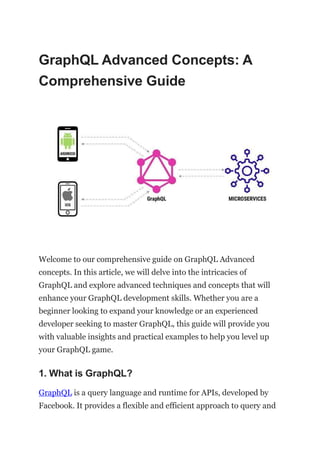
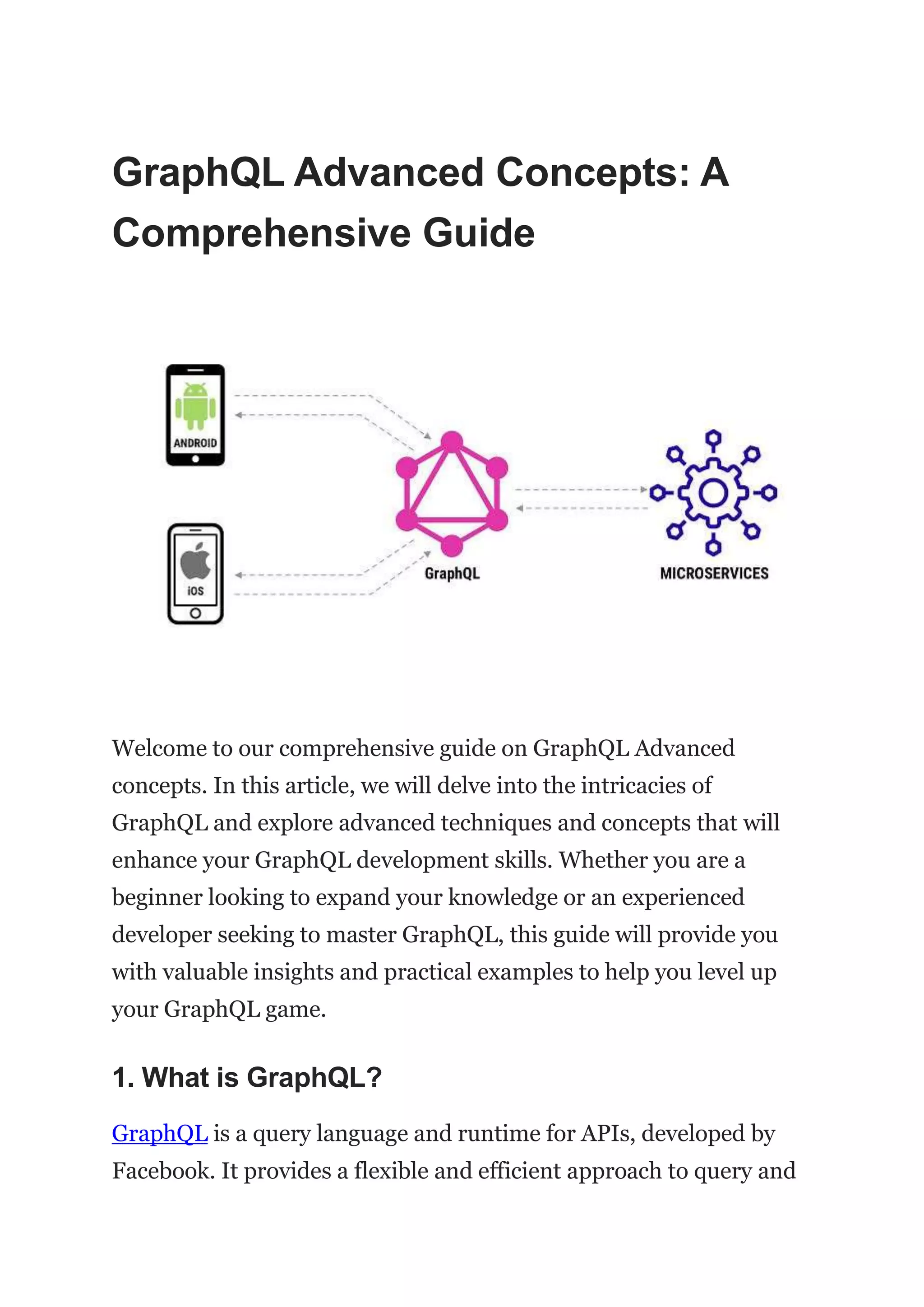
18. GraphQL and Microservices
GraphQL and microservices are a natural fit due to their modular
and independent nature. Here’s how you can leverage GraphQL in a
microservices architecture:
18.1 Independent Services
Develop each microservice with its own GraphQL schema,
representing a specific domain or functionality. Each service can
have its own data sources and business logic, allowing teams to work
independently.
18.2 Schema Stitching and Federation
Use schema stitching or federation to combine the individual
GraphQL schemas into a single federated schema. This allows
clients to query data from multiple microservices using a single
GraphQL API.
18.3 Separation of Concerns
Design the microservices in a way that each service has a clear
separation of concerns. Each service should encapsulate a specific
business capability and expose a well-defined GraphQL API for that
functionality.
18.4 Team Autonomy
Leverage GraphQL’s modular nature to enable independent teams to
develop and deploy microservices. Each team can focus on their
service’s development and maintenance, reducing dependencies and
enabling faster iteration.
19. GraphQL Performance Monitoring
Monitoring the performance of your GraphQL APIs is crucial to
ensure optimal user experience. Here are some techniques for
GraphQL performance monitoring:
19.1 Query Complexity Analysis
Analyze the complexity of GraphQL queries to identify potential
performance bottlenecks. Use tools like query complexity analyzers
to measure the complexity score of queries and optimize them for
better performance.
19.2 Response Time Monitoring
Monitor the response times of your GraphQL API to ensure timely
and efficient data retrieval. Track response times for different query
patterns and optimize slow-performing queries.
19.3 Field-Level Metrics
Collect field-level metrics to gain insights into the performance of
individual fields in your GraphQL schema. This helps identify fields
that contribute to slower response times and optimize their
execution.
19.4 Load Testing
Perform load testing to simulate high user loads and identify the
scalability limits of your GraphQL APIs. Load testing helps you
understand how your APIs perform under heavy traffic and ensure
they can handle production-level loads.
20. GraphQL API Versioning
Versioning is important when evolving GraphQL APIs to introduce
changes without breaking existing clients. Here are some strategies
for GraphQL API versioning:
20.1 URL-based Versioning
Use URL-based versioning to distinguish between different versions
of your GraphQL API. Include the version number in the URL path
to ensure that clients can access the desired API version.
20.2 Schema Stitching and Federation
Use schema stitching or federation to combine multiple versions of
your GraphQL API into a single unified schema. This allows clients
to query data from different versions using a single GraphQL
endpoint.
20.3 Deprecation and Sunset Policies
Implement deprecation and sunset policies to communicate the
lifecycle of API versions to clients. Clearly indicate which API
versions are deprecated and define a timeline for their eventual
sunset.
20.4 Client-Side Versioning
Allow clients to specify the desired API version in their requests
using custom headers or query parameters. This gives clients control
over the API version they want to consume.
21. Handling File Uploads with GraphQL
Uploading files through GraphQL APIs requires special
considerations and techniques. Here’s how you can handle file
uploads with GraphQL:
21.1 Mutations for File Uploads
Define mutations specifically for file uploads in your GraphQL
schema. These mutations should accept file input and handle the file
upload process, including validation, storage, and processing.
21.2 File Input Types
Create custom file input types in your GraphQL schema to represent
the file uploads. These types should include fields for the file name,
size, MIME type, and any additional metadata required.
21.3 File Storage
Implement a file storage solution to store the uploaded files. This
can be a local file system, cloud storage, or a combination of both.
Consider security, scalability, and performance when choosing a
storage option.
21.4 File Processing
If required, implement file processing logic to perform additional
operations on the uploaded files. This can include resizing images,
converting file formats, or extracting metadata.
22. GraphQL Pagination and Cursor-based Pagination
Pagination is a common requirement in GraphQL APIs to retrieve
large result sets in smaller chunks. Cursor-based pagination
provides a flexible and efficient approach to implement pagination.
Here’s how you can implement cursor-based pagination:
22.1 Pagination Arguments
Define pagination arguments in your GraphQL queries to specify the
number of items to retrieve and the starting cursor position. These
arguments allow clients to navigate through the paginated result set.
22.2 Cursor Cursors
Use cursor cursors, such as encoded opaque strings or database
cursors, to represent the position in the paginated result set. Cursors
provide a unique identifier for each item and allow clients to fetch
the next or previous page of data.
22.3 Edge Nodes
Wrap each item in the paginated result set with additional metadata,
such as a cursor and node information. This edge node structure
allows clients to easily traverse the result set and retrieve the
required data.
22.4 hasNextPage and hasPreviousPage Flags
Include flags in the pagination response to indicate whether there
are more pages of data available. These flags help clients determine
if they should display additional pagination controls.
23. Implementing GraphQL Caching with Redis
Redis is a popular in-memory data store that can be used to
implement caching in GraphQL APIs. Here’s how you can
implement GraphQL caching with Redis:
23.1 Cache Layer
Introduce a cache layer between your GraphQL server and data
sources. This cache layer intercepts requests and checks if the
response is available in Redis cache. If so, it returns the cached
response instead of querying the data sources.
23.2 Cache Key Generation
Generate cache keys based on the GraphQL query, including the
operation type, operation name, and input arguments. These cache
keys ensure that responses are cached and retrieved correctly based
on the unique query parameters.
23.3 Cache Invalidation
Implement cache invalidation strategies to ensure that cached data
remains up-to-date. Invalidate cache entries when relevant data is
modified or deleted, ensuring that clients always receive fresh data.
23.4 Time-to-Live (TTL)
Set a time-to-live (TTL) value for cached entries to control how long
the data remains in the cache. This ensures that stale data is
automatically removed from the cache and reduces the risk of
serving outdated information.
24. GraphQL and Database Performance
Efficient database access is crucial for the performance of GraphQL
APIs. Here are some considerations for improving database
performance in GraphQL:
24.1 Batched Data Fetching
Implement batched data fetching techniques to reduce the number
of database queries. Group multiple data fetch requests into a single
database query, reducing the overhead of network communication.
24.2 Data Loader
Utilize DataLoader, a library that optimizes the loading of data in
GraphQL APIs. DataLoader batches and caches data fetching
requests, reducing the number of database queries and improving
response times.
24.3 Database Indexing
Optimize your database schema and create appropriate indexes to
speed up query execution. Analyze the query patterns of your
GraphQL API and create indexes that align with the most frequently
executed queries.
24.4 Query Optimization
Analyze and optimize your GraphQL queries to ensure efficient data
retrieval from the database. Eliminate unnecessary fields and nested
selections, and use query planning tools to identify and resolve
performance bottlenecks.
25. GraphQL Code Generation
Code generation can greatly simplify the development process of
GraphQL APIs. Here’s how you can leverage code generation in your
GraphQL projects:
25.1 GraphQL Schema Generation
Use code generation tools to automatically generate the GraphQL
schema based on your data models or database schema. This saves
time and reduces the chances of manual errors when defining the
schema.
25.2 Type Safety
Code generation enables type safety by automatically generating
TypeScript or other statically-typed language bindings for your
GraphQL schema. This allows for compile-time validation and type-
checking of queries and mutations.
25.3 Query and Mutation Generation
Automatically generate query and mutation operations based on
your GraphQL schema. Code generation tools can create strongly-
typed functions or methods for executing queries, eliminating the
need for manual request construction.
25.4 Mocking and Testing
Code generation can generate mock implementations of resolvers
and data sources for testing purposes. This simplifies the setup of
test environments and allows for easy integration testing of
GraphQL APIs.
Conclusion
In this comprehensive guide, we have explored various advanced
concepts and techniques in GraphQL. We covered topics ranging
from schema design to performance optimization, authentication,
and real-time communication. By mastering these concepts, you can
become an expert in GraphQL development and deliver robust and
efficient APIs.
GraphQL Advanced concepts provide developers with the flexibility
and power to build modern and scalable applications. By following
best practices, leveraging the right tools, and considering
performance and security aspects, you can unlock the full potential
of GraphQL and create exceptional user experiences.
GraphQL Advanced Concepts A Comprehensive Guide.docx

GraphQL Advanced Concepts A Comprehensive Guide.docx

  • 1.
    GraphQL Advanced Concepts:A Comprehensive Guide Welcome to our comprehensive guide on GraphQL Advanced concepts. In this article, we will delve into the intricacies of GraphQL and explore advanced techniques and concepts that will enhance your GraphQL development skills. Whether you are a beginner looking to expand your knowledge or an experienced developer seeking to master GraphQL, this guide will provide you with valuable insights and practical examples to help you level up your GraphQL game. 1. What is GraphQL? GraphQL is a query language and runtime for APIs, developed by Facebook. It provides a flexible and efficient approach to query and
  • 2.
    manipulate data byallowing clients to request only the specific data they need. In GraphQL, clients define the structure of the responses they receive, eliminating over-fetching and under-fetching of data common in REST APIs. GraphQL consists of three main components: the schema, resolvers, and queries/mutations. The schema defines the available types and operations in the API, resolvers handle the logic for fetching the data, and queries/mutations allow clients to request and modify data. GraphQL API has gained popularity due to its flexibility, strong typing system, and ability to aggregate data from multiple sources. It empowers developers to build efficient and robust APIs that precisely match the needs of the client applications. 2. Understanding GraphQL Schema The GraphQL schema is the contract between the server and the client, defining the available types, fields, and operations. It serves as the blueprint for the GraphQL API, enabling clients to understand and interact with the data. 2.1 Schema Definition Language (SDL) The Schema Definition Language (SDL) is a concise and human- readable way to define the GraphQL schema. It allows developers to define types, fields, relationships, and directives. SDL provides a declarative approach to specify the structure of the API, making it easier to communicate and collaborate on the API design.
  • 3.
    2.2 Types inGraphQL GraphQL introduces a powerful type system that allows developers to define custom types. Scalar types represent primitive values like integers, floats, strings, booleans, and dates. Object types represent complex entities with multiple fields, while Enum types define a set of allowed values. Interface types define a common set of fields that can be implemented by multiple object types. 2.3 Fields and Relationships Fields represent the properties of a GraphQL type and define the data that can be queried. They can be scalar types or object types, allowing for nested and related data retrieval. Relationships between types are defined using fields and can be one-to-one, one-to-many, or many-to-many. 2.4 Directives Directives provide a way to modify the behavior of a GraphQL schema or query. They can be used to apply validation rules, control caching, enable or disable fields, and more. Directives allow for fine- grained control over the execution and behavior of GraphQL operations. 3. Advanced Querying Techniques GraphQL provides powerful querying capabilities that go beyond basic field selection. Here are some advanced querying techniques to optimize your GraphQL queries:
  • 4.
    3.1 Fragments Fragments allowyou to define reusable selections of fields that can be included in multiple queries. They promote code reuse and help in maintaining clean and readable queries. 3.2 Aliases Aliases allow you to rename the result of a field in a query. This is useful when you need to query the same field with different arguments or when you want to avoid naming conflicts in the response. 3.3 Query Variables Query variables enable parameterization of GraphQL queries. They allow you to pass dynamic values to the query, making it more flexible and reusable. 3.4 Pagination Pagination is a common requirement when dealing with large datasets. GraphQL provides standardized pagination techniques like cursor-based pagination and offset-based pagination. These techniques allow you to efficiently retrieve and navigate through paginated data. 3.5 Batched Queries Batched queries enable you to send multiple queries in a single request to reduce network overhead. This can significantly improve
  • 5.
    the performance ofyour GraphQL API, especially when fetching data from multiple sources. 4. Optimizing GraphQL Performance As your GraphQL API grows, it’s essential to optimize its performance to ensure fast and efficient data retrieval. Here are some techniques to optimize GraphQL performance: 4.1 DataLoader DataLoader is a library that helps you optimize the loading of data in a GraphQL API. It batches and caches data fetching requests, reducing the number of database queries and improving response times. 4.2 Caching Caching is crucial for improving the performance of GraphQL APIs. By caching frequently accessed data, you can reduce the load on your backend systems and provide faster responses to clients. Popular caching strategies for GraphQL include edge caching, result caching, and data loader caching. 4.3 Debouncing and Throttling Debouncing and throttling are techniques used to limit the frequency of expensive or resource-intensive operations. By controlling the rate at which certain operations are executed, you can prevent overload and improve overall system performance.
  • 6.
    4.4 Cost Analysisand Query Complexity Analyzing the cost and complexity of GraphQL queries can help identify potential performance bottlenecks. By assigning costs to fields and limiting query complexity, you can ensure that your API remains performant even when handling complex queries. 4.5 Schema Stitching and Federation Schema stitching and federation are advanced techniques for combining multiple GraphQL schemas into a single, unified schema. These techniques enable modular development and scalability by allowing independent teams to work on separate parts of the schema. 5. Implementing GraphQL Subscriptions GraphQL Subscriptions enable real-time communication between the client and the server. Subscriptions allow clients to subscribe to specific events or data changes and receive updates in real-time. Here’s how you can implement GraphQL subscriptions: 5.1 Pub-Sub Systems Pub-Sub systems play a crucial role in implementing GraphQL subscriptions. They provide the infrastructure for broadcasting events and delivering updates to the subscribed clients. Popular Pub-Sub systems for GraphQL include Apollo PubSub, Redis PubSub, and MQTT. 5.2 Subscriptions Resolver
  • 7.
    The subscriptions resolveris responsible for resolving and broadcasting subscription events to the subscribed clients. It listens for specific triggers or events and sends the updates to the clients. 5.3 Subscriptions Client The subscriptions client is responsible for establishing and maintaining a WebSocket connection with the server. It listens for updates and notifies the client application whenever new data is received. 6. Authentication and Authorization in GraphQL Authentication and authorization are critical aspects of building secure GraphQL APIs. Here’s how you can implement authentication and authorization in GraphQL: 6.1 Authentication Authentication ensures that only authenticated users can access protected resources in your GraphQL API. Common authentication mechanisms include JWT (JSON Web Tokens), OAuth, and session- based authentication. 6.2 Authorization Authorization controls what actions and data a user can access within your GraphQL API. You can implement role-based access control (RBAC), attribute-based access control (ABAC), or custom authorization logic to enforce access restrictions.
  • 8.
    6.3 Protecting GraphQLResolvers To protect your GraphQL resolvers, you can implement middleware or directives that intercept and validate requests before executing the resolver logic. This allows you to enforce fine-grained authorization rules and protect sensitive data. 7. Error Handling in GraphQL Error handling is an essential aspect of building robust GraphQL APIs. GraphQL provides a structured approach to handle errors and communicate them to clients effectively. 7.1 Error Types GraphQL defines several error types, including field errors, query errors, and syntax errors. These error types provide detailed information about the nature of the error and help clients understand and handle them appropriately. 7.2 Error Extensions GraphQL allows you to extend error information with custom error codes, error messages, and additional metadata. Error extensions can be used to provide specific guidance to clients on how to handle different types of errors. 7.3 Global Error Handling Implementing global error handling enables you to centralize error processing and apply consistent error handling logic across your
  • 9.
    GraphQL API. Youcan use GraphQL middleware or error handling middleware to intercept and process errors. 8. Caching Strategies for GraphQL Caching is crucial for improving the performance and scalability of GraphQL APIs. Here are some caching strategies you can employ: 8.1 Edge Caching Edge caching involves caching GraphQL responses at the edge of your network, typically using a CDN (Content Delivery Network). By caching responses close to the client, you can reduce network latency and improve overall API performance. 8.2 Result Caching Result caching involves caching the results of individual GraphQL queries. By caching query results, you can avoid executing expensive resolver logic and reduce the load on your backend systems. 8.3 Data Loader Caching Data Loader caching is specific to the DataLoader library. It allows you to cache data loading operations and prevent redundant database queries. By caching data, you can improve the efficiency of your GraphQL API and reduce the response time. 9. Advanced GraphQL Tools and Libraries
  • 10.
    GraphQL offers awide range of tools and libraries that simplify and enhance the development process. Here are some advanced tools and libraries you can leverage: 9.1 Apollo Server Apollo Server is a popular GraphQL server implementation that provides essential features like schema stitching, subscriptions, caching, and more. It offers a robust and extensible platform for building GraphQL APIs. 9.2 Prisma Prisma is an open-source database toolkit that simplifies database access in GraphQL APIs. It provides an auto-generated and type- safe query builder, schema migrations, and performance optimizations. 9.3 GraphiQL and GraphQL Playground GraphiQL and GraphQL Playground are powerful IDEs (Integrated Development Environments) for interacting with GraphQL APIs. They offer features like auto-completion, schema exploration, query debugging, and documentation generation. 9.4 Apollo Federation Apollo Federation is a schema composition technique that enables you to combine multiple GraphQL services into a single federated schema. It simplifies microservices architecture and allows independent teams to develop and deploy services independently.
  • 11.
    9.5 Relay Relay isa JavaScript framework developed by Facebook that optimizes data fetching and caching for GraphQL. It provides a declarative approach to building efficient and scalable client applications. 10. Testing GraphQL APIs Testing is a crucial part of the development process to ensure the correctness and stability of your GraphQL APIs. Here are some strategies for testing GraphQL APIs: 10.1 Unit Testing Resolvers Unit testing resolvers helps validate the logic and behavior of individual resolver functions. By mocking dependencies and input data, you can ensure that resolvers return the expected results. 10.2 Integration Testing Integration testing involves testing the interaction between different components of your GraphQL API. It ensures that the API functions correctly as a whole, including the schema, resolvers, and data sources. 10.3 Performance Testing Performance testing measures the performance characteristics of your GraphQL API under different workloads and usage patterns. It helps identify bottlenecks, optimize query execution, and ensure that your API can handle high loads.
  • 12.
    11. Monitoring andDebugging GraphQL Monitoring and debugging are essential for maintaining and improving the quality of your GraphQL APIs. Here are some techniques for monitoring and debugging GraphQL: 11.1 Logging and Error Tracking Logging and error tracking help you monitor the behavior of your GraphQL API and identify issues or anomalies. By logging relevant information and capturing errors, you can gain insights into the performance and stability of your API. 11.2 Performance Monitoring Performance monitoring involves measuring and analyzing the performance metrics of your GraphQL API. This includes response times, query execution times, and resource utilization. Performance monitoring helps you identify performance bottlenecks and optimize your API for better responsiveness. 11.3 Debugging Tools GraphQL debugging tools like Apollo Studio and GraphQL Playground provide interactive environments for exploring and debugging GraphQL APIs. They offer features like query execution tracing, error analysis, and real-time monitoring. 12. Migrating from REST to GraphQL
  • 13.
    Migrating from aREST API to GraphQL can be a complex process. Here are some considerations and steps to follow when migrating from REST to GraphQL: 12.1 Analyze and Plan Start by analyzing your existing REST API and understanding its strengths and weaknesses. Identify the pain points that GraphQL can address and plan the migration process accordingly. 12.2 Schema Design Design the GraphQL schema that aligns with your existing REST API’s resources and endpoints. Consider the needs of the client applications and design the schema to optimize data fetching and manipulation. 12.3 Resolver Development Develop the resolvers that map GraphQL queries and mutations to the corresponding REST API calls. Implement the logic to transform GraphQL requests into RESTful requests and handle data retrieval and manipulation. 12.4 Incremental Migration Consider an incremental migration approach where you gradually introduce GraphQL alongside your existing REST API. This allows you to test and validate the GraphQL implementation while minimizing disruption to the existing systems.
  • 14.
    13. GraphQL BestPractices To ensure the success of your GraphQL projects, it’s important to follow best practices. Here are some best practices to consider: 13.1 Versioning Implement versioning in your GraphQL APIs to ensure backward compatibility and provide a stable contract for clients. Versioning allows you to introduce changes without breaking existing client applications. 13.2 Documentation Provide comprehensive and up-to-date documentation for your GraphQL APIs. Document the schema, types, fields, input objects, and possible queries/mutations. Clear documentation helps developers understand and utilize your APIs effectively. 13.3 Error Handling and Validation Implement robust error handling and validation in your GraphQL APIs. Use GraphQL error types and extensions to communicate errors effectively to clients. Validate input data and provide meaningful error messages to guide clients in making correct requests. 13.4 Security Implement security measures to protect your GraphQL APIs from common vulnerabilities like injection attacks, denial-of-service
  • 15.
    attacks, and unauthorizedaccess. Use authentication, authorization, and rate limiting techniques to secure your APIs. 13.5 Performance Optimization Optimize the performance of your GraphQL APIs by implementing caching, pagination, and efficient data fetching techniques. Monitor and analyze the performance metrics to identify bottlenecks and optimize query execution. 14. GraphQL in Production When deploying GraphQL APIs to production, it’s important to consider various factors for scalability, reliability, and maintainability. Here are some considerations for running GraphQL in production: 14.1 Scalability Design your GraphQL APIs to be scalable by considering factors like caching, load balancing, horizontal scaling, and efficient data fetching. Monitor the performance and resource utilization to ensure optimal scalability. 14.2 Error Monitoring and Alerting Implement error monitoring and alerting systems to detect and respond to errors and anomalies in your GraphQL APIs. Use tools like logging, error tracking, and real-time monitoring to identify and resolve issues promptly.
  • 16.
    14.3 Deployment andCI/CD Establish a robust deployment and continuous integration/continuous deployment (CI/CD) process for your GraphQL APIs. Automate the deployment, testing, and versioning to ensure smooth and reliable releases. 14.4 Monitoring and Metrics Monitor the performance metrics and usage patterns of your GraphQL APIs in production. Track key metrics like response times, error rates, and query complexity to identify potential bottlenecks and optimize the performance. 15. GraphQL Federation GraphQL Federation is an approach for composing multiple GraphQL services into a single federated schema. It allows independent teams to work on separate services and enables efficient data aggregation and composition. 15.1 Schema Composition Schema composition involves combining multiple GraphQL schemas into a federated schema. Each service maintains its own schema, and a gateway stitches them together to form a unified API. 15.2 Distributed Development GraphQL Federation enables distributed development, where multiple teams can work independently on different services. Each
  • 17.
    team can focuson a specific domain or functionality and develop their service without tight coupling. 15.3 Service-to-Service Communication GraphQL Federation facilitates service-to-service communication by allowing services to reference and fetch data from other services. This enables efficient data aggregation and avoids the need for clients to make multiple requests to different services. 16. Securing GraphQL APIs Securing GraphQL APIs is crucial to protect sensitive data and prevent unauthorized access. Here are some security measures you can implement: 16.1 Input Validation Implement input validation to ensure that client requests meet the expected format and constraints. Validate input data to prevent common security vulnerabilities like SQL injection, cross-site scripting (XSS), and malicious file uploads. 16.2 Rate Limiting Implement rate limiting to prevent abusive or malicious usage of your GraphQL APIs. Limit the number of requests per client or IP address to protect against denial-of-service (DoS) attacks and excessive resource consumption. 16.3 Authentication and Authorization
  • 18.
    Implement authentication mechanismslike JWT, OAuth, or session- based authentication to verify the identity of clients. Use authorization techniques like role-based access control (RBAC) or attribute-based access control (ABAC) to control access to resources. 16.4 Input Whitelisting Implement input whitelisting to restrict the types of data that clients can provide in their requests. Define strict validation rules for input fields to prevent injection attacks and enforce data integrity. 17. Building Real-time Applications with GraphQL GraphQL’s real-time capabilities make it a powerful choice for building real-time applications. Here are some considerations for building real-time applications with GraphQL: 17.1 Subscriptions Utilize GraphQL subscriptions to enable real-time communication between clients and servers. Subscriptions allow clients to subscribe to specific events or data changes and receive updates in real-time. 17.2 WebSocket Support Ensure that your GraphQL server supports WebSocket connections to enable real-time communication. WebSocket provides full-duplex communication channels between the client and the server, allowing real-time data updates. 17.3 Real-time Data Sources
  • 19.
    Integrate real-time datasources into your GraphQL APIs to provide live updates to clients. This can include integrating with event- driven systems, message queues, or real-time databases. 17.4 Optimizing Real-time Performance Optimize the performance of real-time GraphQL APIs by implementing techniques like batching, payload compression, and efficient data synchronization. Consider the scalability and resource utilization when dealing with a large number of real-time connections. 18. GraphQL and Microservices GraphQL and microservices are a natural fit due to their modular and independent nature. Here’s how you can leverage GraphQL in a microservices architecture: 18.1 Independent Services Develop each microservice with its own GraphQL schema, representing a specific domain or functionality. Each service can have its own data sources and business logic, allowing teams to work independently. 18.2 Schema Stitching and Federation Use schema stitching or federation to combine the individual GraphQL schemas into a single federated schema. This allows clients to query data from multiple microservices using a single GraphQL API.
  • 20.
    18.3 Separation ofConcerns Design the microservices in a way that each service has a clear separation of concerns. Each service should encapsulate a specific business capability and expose a well-defined GraphQL API for that functionality. 18.4 Team Autonomy Leverage GraphQL’s modular nature to enable independent teams to develop and deploy microservices. Each team can focus on their service’s development and maintenance, reducing dependencies and enabling faster iteration. 19. GraphQL Performance Monitoring Monitoring the performance of your GraphQL APIs is crucial to ensure optimal user experience. Here are some techniques for GraphQL performance monitoring: 19.1 Query Complexity Analysis Analyze the complexity of GraphQL queries to identify potential performance bottlenecks. Use tools like query complexity analyzers to measure the complexity score of queries and optimize them for better performance. 19.2 Response Time Monitoring Monitor the response times of your GraphQL API to ensure timely and efficient data retrieval. Track response times for different query patterns and optimize slow-performing queries.
  • 21.
    19.3 Field-Level Metrics Collectfield-level metrics to gain insights into the performance of individual fields in your GraphQL schema. This helps identify fields that contribute to slower response times and optimize their execution. 19.4 Load Testing Perform load testing to simulate high user loads and identify the scalability limits of your GraphQL APIs. Load testing helps you understand how your APIs perform under heavy traffic and ensure they can handle production-level loads. 20. GraphQL API Versioning Versioning is important when evolving GraphQL APIs to introduce changes without breaking existing clients. Here are some strategies for GraphQL API versioning: 20.1 URL-based Versioning Use URL-based versioning to distinguish between different versions of your GraphQL API. Include the version number in the URL path to ensure that clients can access the desired API version. 20.2 Schema Stitching and Federation Use schema stitching or federation to combine multiple versions of your GraphQL API into a single unified schema. This allows clients to query data from different versions using a single GraphQL endpoint.
  • 22.
    20.3 Deprecation andSunset Policies Implement deprecation and sunset policies to communicate the lifecycle of API versions to clients. Clearly indicate which API versions are deprecated and define a timeline for their eventual sunset. 20.4 Client-Side Versioning Allow clients to specify the desired API version in their requests using custom headers or query parameters. This gives clients control over the API version they want to consume. 21. Handling File Uploads with GraphQL Uploading files through GraphQL APIs requires special considerations and techniques. Here’s how you can handle file uploads with GraphQL: 21.1 Mutations for File Uploads Define mutations specifically for file uploads in your GraphQL schema. These mutations should accept file input and handle the file upload process, including validation, storage, and processing. 21.2 File Input Types Create custom file input types in your GraphQL schema to represent the file uploads. These types should include fields for the file name, size, MIME type, and any additional metadata required. 21.3 File Storage
  • 23.
    Implement a filestorage solution to store the uploaded files. This can be a local file system, cloud storage, or a combination of both. Consider security, scalability, and performance when choosing a storage option. 21.4 File Processing If required, implement file processing logic to perform additional operations on the uploaded files. This can include resizing images, converting file formats, or extracting metadata. 22. GraphQL Pagination and Cursor-based Pagination Pagination is a common requirement in GraphQL APIs to retrieve large result sets in smaller chunks. Cursor-based pagination provides a flexible and efficient approach to implement pagination. Here’s how you can implement cursor-based pagination: 22.1 Pagination Arguments Define pagination arguments in your GraphQL queries to specify the number of items to retrieve and the starting cursor position. These arguments allow clients to navigate through the paginated result set. 22.2 Cursor Cursors Use cursor cursors, such as encoded opaque strings or database cursors, to represent the position in the paginated result set. Cursors provide a unique identifier for each item and allow clients to fetch the next or previous page of data.
  • 24.
    22.3 Edge Nodes Wrapeach item in the paginated result set with additional metadata, such as a cursor and node information. This edge node structure allows clients to easily traverse the result set and retrieve the required data. 22.4 hasNextPage and hasPreviousPage Flags Include flags in the pagination response to indicate whether there are more pages of data available. These flags help clients determine if they should display additional pagination controls. 23. Implementing GraphQL Caching with Redis Redis is a popular in-memory data store that can be used to implement caching in GraphQL APIs. Here’s how you can implement GraphQL caching with Redis: 23.1 Cache Layer Introduce a cache layer between your GraphQL server and data sources. This cache layer intercepts requests and checks if the response is available in Redis cache. If so, it returns the cached response instead of querying the data sources. 23.2 Cache Key Generation Generate cache keys based on the GraphQL query, including the operation type, operation name, and input arguments. These cache keys ensure that responses are cached and retrieved correctly based on the unique query parameters.
  • 25.
    23.3 Cache Invalidation Implementcache invalidation strategies to ensure that cached data remains up-to-date. Invalidate cache entries when relevant data is modified or deleted, ensuring that clients always receive fresh data. 23.4 Time-to-Live (TTL) Set a time-to-live (TTL) value for cached entries to control how long the data remains in the cache. This ensures that stale data is automatically removed from the cache and reduces the risk of serving outdated information. 24. GraphQL and Database Performance Efficient database access is crucial for the performance of GraphQL APIs. Here are some considerations for improving database performance in GraphQL: 24.1 Batched Data Fetching Implement batched data fetching techniques to reduce the number of database queries. Group multiple data fetch requests into a single database query, reducing the overhead of network communication. 24.2 Data Loader Utilize DataLoader, a library that optimizes the loading of data in GraphQL APIs. DataLoader batches and caches data fetching requests, reducing the number of database queries and improving response times.
  • 26.
    24.3 Database Indexing Optimizeyour database schema and create appropriate indexes to speed up query execution. Analyze the query patterns of your GraphQL API and create indexes that align with the most frequently executed queries. 24.4 Query Optimization Analyze and optimize your GraphQL queries to ensure efficient data retrieval from the database. Eliminate unnecessary fields and nested selections, and use query planning tools to identify and resolve performance bottlenecks. 25. GraphQL Code Generation Code generation can greatly simplify the development process of GraphQL APIs. Here’s how you can leverage code generation in your GraphQL projects: 25.1 GraphQL Schema Generation Use code generation tools to automatically generate the GraphQL schema based on your data models or database schema. This saves time and reduces the chances of manual errors when defining the schema. 25.2 Type Safety Code generation enables type safety by automatically generating TypeScript or other statically-typed language bindings for your
  • 27.
    GraphQL schema. Thisallows for compile-time validation and type- checking of queries and mutations. 25.3 Query and Mutation Generation Automatically generate query and mutation operations based on your GraphQL schema. Code generation tools can create strongly- typed functions or methods for executing queries, eliminating the need for manual request construction. 25.4 Mocking and Testing Code generation can generate mock implementations of resolvers and data sources for testing purposes. This simplifies the setup of test environments and allows for easy integration testing of GraphQL APIs. Conclusion In this comprehensive guide, we have explored various advanced concepts and techniques in GraphQL. We covered topics ranging from schema design to performance optimization, authentication, and real-time communication. By mastering these concepts, you can become an expert in GraphQL development and deliver robust and efficient APIs. GraphQL Advanced concepts provide developers with the flexibility and power to build modern and scalable applications. By following best practices, leveraging the right tools, and considering performance and security aspects, you can unlock the full potential of GraphQL and create exceptional user experiences.