Group 1: Michael Kwon,
Marian Gomez, Zach
Soposop
CHEERDANCE
TABLE OF CONTENTS
What is
Cheerdance
History of
Cheerleading/
Cheerdance
Cheerleading
Motions
Types of
Cheerleading
Motions ( 25 )
Cheerleading
Jumps
Types of
Cheerleading
Jumps ( 8 )
Cheerleading
Injuries
Comon Injuries
and how to
prevent it
01 02 03 04
What is
cheerdance?
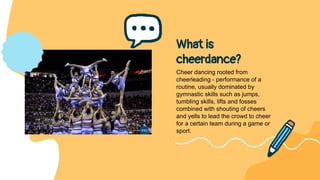
Cheer dancing rooted from
cheerleading - performance of a
routine, usually dominated by
gymnastic skills such as jumps,
tumbling skills, lifts and fosses
combined with shouting of cheers
and yells to lead the crowd to cheer
for a certain team during a game or
sport.
The Cheerleading Philippines or CP was
formed in 1993 and was affiliated with the
International Federation of Cheerleading
(IFC) in 2007. By early 2008, the CPF is
represented 16 regional centers in key
cities and provinces in the Philippines.
It includes affiliate
members who are nationals but residing
outside the country including the first
member societies representing United
States, Japan, Australia, and Canada. The
CF had grown to include 49 national
cheerleading chapters, representing 3
inhabited sub regions (Luzon, Visayas and
Mindanao in the Philippines.
History of
cheerdance in the
Philippines.
Medals of the Philippines
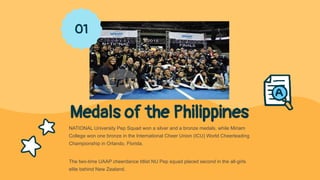
NATIONAL University Pep Squad won a silver and a bronze medals, while Miriam
College won one bronze in the International Cheer Union (ICU) World Cheerleading
Championship in Orlando, Florida.
The two-time UAAP cheerdance titlist NU Pep squad placed second in the all-girls
elite behind New Zealand.
01
CHEERLEADING
MOTIONS
02
Basic cheerleading Motions
1.) Hand Clasp
This creates a sharp look to the
routine and is more dramatic
when the cheerleader is trying
to get the audience to clap with
her.
Basic cheerleading Motions
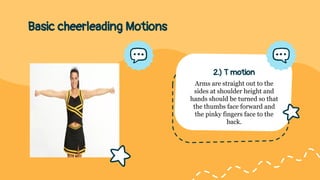
2.) T motion
Arms are straight out to the
sides at shoulder height and
hands should be turned so that
the thumbs face forward and
the pinky fingers face to the
back.
Basic cheerleading Motions
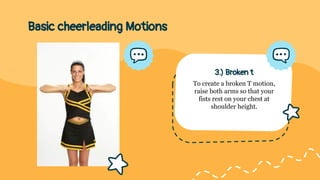
3.) Broken t
To create a broken T motion,
raise both arms so that your
fists rest on your chest at
shoulder height.
Basic cheerleading Motions
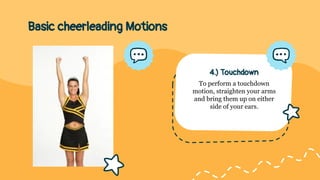
4.) Touchdown
To perform a touchdown
motion, straighten your arms
and bring them up on either
side of your ears.
Basic cheerleading Motions
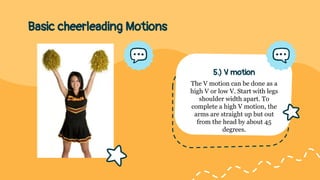
5.) V motion
The V motion can be done as a
high V or low V. Start with legs
shoulder width apart. To
complete a high V motion, the
arms are straight up but out
from the head by about 45
degrees.
Basic cheerleading Motions
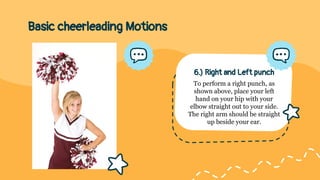
6.) Right and Left punch
To perform a right punch, as
shown above, place your left
hand on your hip with your
elbow straight out to your side.
The right arm should be straight
up beside your ear.
CHEERLEADING
JUMPS
03
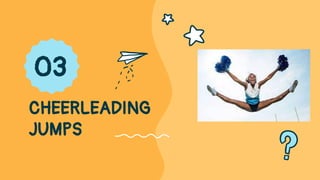
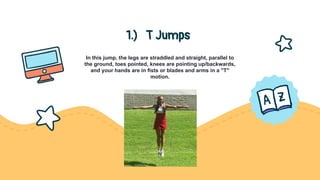
1.) T Jumps
In this jump, the legs are straddled and straight, parallel to
the ground, toes pointed, knees are pointing up/backwards,
and your hands are in fists or blades and arms in a "T"
motion.
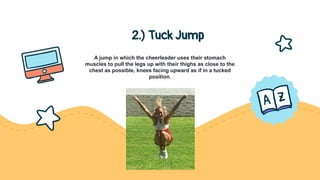
2.) Tuck Jump
A jump in which the cheerleader uses their stomach
muscles to pull the legs up with their thighs as close to the
chest as possible, knees facing upward as if in a tucked
position.
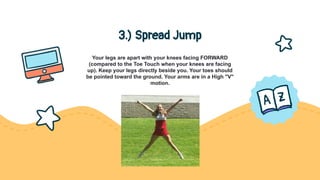
3.) Spread Jump
Your legs are apart with your knees facing FORWARD
(compared to the Toe Touch when your knees are facing
up). Keep your legs directly beside you. Your toes should
be pointed toward the ground. Your arms are in a High "V"
motion.
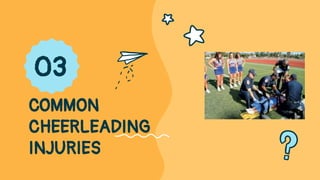
COMMON
CHEERLEADING
INJURIES
03
COMMON CHEERLEADING INJURIES
Common Cheerleading Injuries
Common injuries that can occur in competitive
cheerleading include:
• Muscle strains in the hip, lower back, and legs
• Ligament sprains in the knees and ankles
• Finger and hand injuries
Fractures, including those of the spine Dislocations
of the shoulder or elbow
Causes of cheerleading injuries
Performing skills too difficult for the cheerleader's
current level
• Poor conditioning or training
• Poor nutrition
• Lack of proper equipment for training or
performance
• Lack of experience with the sport or a particular
skill
• Poor flexibility
• Lack of good core and abdominal strength
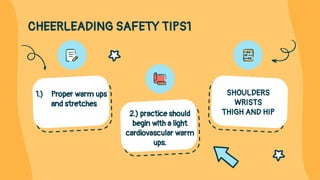
1.) Proper warm ups
and stretches
2.) practice should
begin with a light
cardiovascular warm
ups.
SHOULDERS
WRISTS
THIGH AND HIP
CHEERLEADING SAFETY TIPS1

GRADE 10- CHEERDANCE.pdf

  • 1.
    Group 1: MichaelKwon, Marian Gomez, Zach Soposop CHEERDANCE
  • 2.
    TABLE OF CONTENTS Whatis Cheerdance History of Cheerleading/ Cheerdance Cheerleading Motions Types of Cheerleading Motions ( 25 ) Cheerleading Jumps Types of Cheerleading Jumps ( 8 ) Cheerleading Injuries Comon Injuries and how to prevent it 01 02 03 04
  • 3.
    What is cheerdance? Cheer dancingrooted from cheerleading - performance of a routine, usually dominated by gymnastic skills such as jumps, tumbling skills, lifts and fosses combined with shouting of cheers and yells to lead the crowd to cheer for a certain team during a game or sport.
  • 4.
    The Cheerleading Philippinesor CP was formed in 1993 and was affiliated with the International Federation of Cheerleading (IFC) in 2007. By early 2008, the CPF is represented 16 regional centers in key cities and provinces in the Philippines. It includes affiliate members who are nationals but residing outside the country including the first member societies representing United States, Japan, Australia, and Canada. The CF had grown to include 49 national cheerleading chapters, representing 3 inhabited sub regions (Luzon, Visayas and Mindanao in the Philippines. History of cheerdance in the Philippines.
  • 5.
    Medals of thePhilippines NATIONAL University Pep Squad won a silver and a bronze medals, while Miriam College won one bronze in the International Cheer Union (ICU) World Cheerleading Championship in Orlando, Florida. The two-time UAAP cheerdance titlist NU Pep squad placed second in the all-girls elite behind New Zealand. 01
  • 6.
  • 7.
    Basic cheerleading Motions 1.)Hand Clasp This creates a sharp look to the routine and is more dramatic when the cheerleader is trying to get the audience to clap with her.
  • 8.
    Basic cheerleading Motions 2.)T motion Arms are straight out to the sides at shoulder height and hands should be turned so that the thumbs face forward and the pinky fingers face to the back.
  • 9.
    Basic cheerleading Motions 3.)Broken t To create a broken T motion, raise both arms so that your fists rest on your chest at shoulder height.
  • 10.
    Basic cheerleading Motions 4.)Touchdown To perform a touchdown motion, straighten your arms and bring them up on either side of your ears.
  • 11.
    Basic cheerleading Motions 5.)V motion The V motion can be done as a high V or low V. Start with legs shoulder width apart. To complete a high V motion, the arms are straight up but out from the head by about 45 degrees.
  • 12.
    Basic cheerleading Motions 6.)Right and Left punch To perform a right punch, as shown above, place your left hand on your hip with your elbow straight out to your side. The right arm should be straight up beside your ear.
  • 13.
  • 14.
    1.) T Jumps Inthis jump, the legs are straddled and straight, parallel to the ground, toes pointed, knees are pointing up/backwards, and your hands are in fists or blades and arms in a "T" motion.
  • 15.
    2.) Tuck Jump Ajump in which the cheerleader uses their stomach muscles to pull the legs up with their thighs as close to the chest as possible, knees facing upward as if in a tucked position.
  • 16.
    3.) Spread Jump Yourlegs are apart with your knees facing FORWARD (compared to the Toe Touch when your knees are facing up). Keep your legs directly beside you. Your toes should be pointed toward the ground. Your arms are in a High "V" motion.
  • 17.
  • 18.
    COMMON CHEERLEADING INJURIES CommonCheerleading Injuries Common injuries that can occur in competitive cheerleading include: • Muscle strains in the hip, lower back, and legs • Ligament sprains in the knees and ankles • Finger and hand injuries Fractures, including those of the spine Dislocations of the shoulder or elbow Causes of cheerleading injuries Performing skills too difficult for the cheerleader's current level • Poor conditioning or training • Poor nutrition • Lack of proper equipment for training or performance • Lack of experience with the sport or a particular skill • Poor flexibility • Lack of good core and abdominal strength
  • 19.
    1.) Proper warmups and stretches 2.) practice should begin with a light cardiovascular warm ups. SHOULDERS WRISTS THIGH AND HIP CHEERLEADING SAFETY TIPS1