Government Budget
PREPARED BY
HEMANT KUMAR JAIN
PGT ECONOMICS
KV AMBIKAPUR
Topics
• Meaning of Budget
• Objectives of Budget
• Classification of Budget
• Types of Budget deficit and there implication
Meaning of Budget
• “A government budget is an annual financial
statement showing estimates of expected
revenue and anticipated expenditure during a
fiscal year.”
• It does not show actual values.
• It also explains about government’s last
budget performance.
Objectives of Budget
• Economic stability
• GDP growth
• Redistribution of income and wealth
• Allocation of resources
• Directly production of goods and services.
• Management of PSU’s
Economic stability
• It implies control on price
fluctuations.
• Govt. do this by tax and
expenditure policies.
• During inflationary
conditions govt. impose
high taxes and reduce
expenses.
• During recessionary
condition taxes are reduced
and expenses are increased.
GDP growth
• It refers to sustainable
increase in production of
goods and services.
• Govt. try to motivate
production activities by giving
incentives to producers
through tax holidays ,
subsidies, technical support
etc.
• Govt. prepare infrastructure
that directly and indirectly
supports the growth process.
• GDP growth reduces the
poverty and unemployment in
economy.
Redistribution of income and wealth
• Govt. try to reduce the
income disparities by using
budgetary tools.
• Govt. impose tax on rich
and give subsidies to poor.
• Govt. directly fulfill the
basic needs of poor like
education, health, food etc.
• By this disposal income of
rich reduces and living
standard of poor improves.
Allocation of Resources
• Govt. try to influence the
allocation of resources by using
budgetary tools.
• Govt. promotes the production
of essential goods and
demotivate the production of
hazardous goods.
• Govt. give incentive to the
producers for investing in
backward areas.
• Govt. try to balance the
regional disparities.
Directly Production of goods and
services
• Govt. directly produce the
goods and services which
are not produced by private
sector.
• Sectors which are less
profitable, govt. produce for
that sector.
• Sector which require huge
investment, govt. invest in
those sectors.
• Goods and services which
are essential for people,
govt. produces those goods
and services
Management of PSUs
• Govt. manage the PSUs
through the budget
policies.
• Expansion, investment ,
cost, profit related
decision are taken by
govt. through budget
policies.
• Profit of PSUs is used by
govt. to support its
expanses.
Classification of Budget
Budget
Receipts
Revenue
receipts
Capital
receipts
Expenditures
Revenue
expenditures
Capital
expenditures
Budget Receipt:-It refers to all estimated money
receipt of the govt. during a financial year.
Revenue Receipt
1. Do not create libility for
govt.
2. Do not reduce assets of
govt.
Capital Receipt
1. Create libility on
govt.
2. Reduce assets of
govt.
Revenue Receipt
Revenue
Receipts
Tax Receipts
Income
Tax
GST
Corpora
tion Tax
Excise
duty
Other
taxes
Non-tax
Receipts
Income from
PSE
Grants &
donations
Special
assessmentEscheat
Capital Receipt
Capital
Receipts
Recovery of
Loans
Borrowings Disinvestment
Budget Expenditure:-It refers to all estimated
expenditure of govt. during a financial year.
Revenue Expenditure
1. Do not reduce libility of
govt.
2. Do not increase assets for
govt.
Capital Expenditure
1. Reduce libility of govt.
2. Increase assets for govt.
Revenue and Capital expenditure
Budget
expenditure
Revenue
expenditure
Wages and
salaries
Subsidies
Defence
expenses
Capital
expenditure
Purchase of
shares
Expenditure
on assets Purchase of
machinery
Loans to
the other
Find out followings are revenue receipt Or
capital receipt or revenue exp. Or capital exp.
1. Borrowings
2. GST collection
3. Recovery of loans
4. Profit of PSU
5. Disinvestment
6. Grants received from
world bank
--Capital receipt
--Revenue receipt
Find out followings are revenue exp. Or capital exp.
1. Construction of school building –capital expenditure
2. Interest payment –revenue expenditure
3. Loans given to state govt.
4. Purchase of machinery
5. Nationalization of company.
6. Subsidies
7. Expenditure on tax collection
Budget Deficit
• It refers to excess of budget expenditure over
budget receipts.
Budget Deficit= Budget Expenditure-Budget
receipt
Types of Budget Deficit
Budget
Deficit
Revenue
Deficit
Fiscal
Deficit
Primary
Deficit
Revenue Deficit
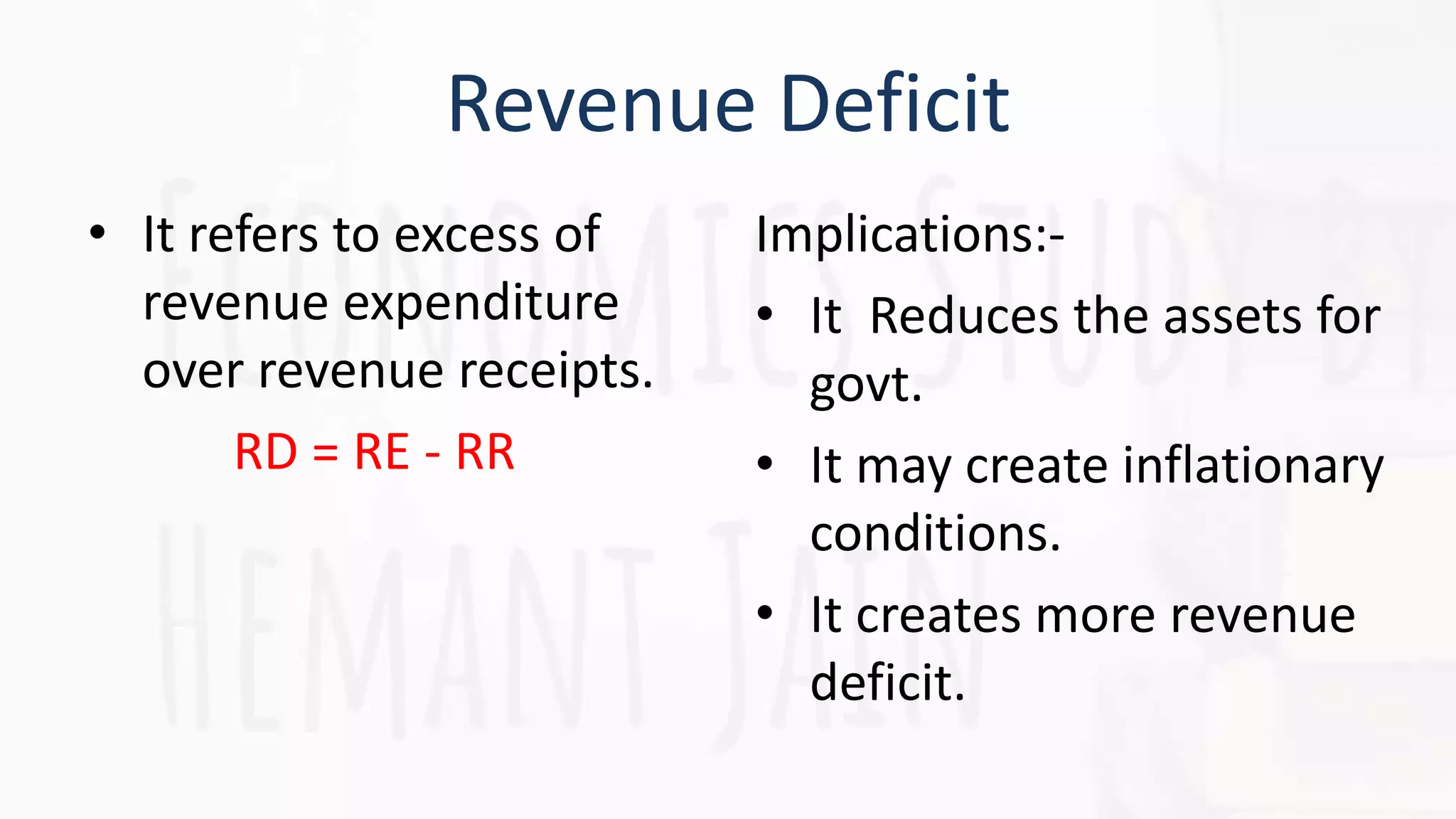
• It refers to excess of
revenue expenditure
over revenue receipts.
RD = RE - RR
Implications:-
• It Reduces the assets for
govt.
• It may create inflationary
conditions.
• It creates more revenue
deficit.
Fiscal Deficit
• The total borrowings of government during a financial year.
OR
• Excess of budget expenditure over budget receipt excluding
borrowings.
FD = BE(RE+CE) – BR (RR+CR excluding borrowings) or
• Fiscal Deficit = Total borrowings =
Borrowings from RBI + borrowings from public + borrowings
from external sources. or
• Fiscal Deficit = RD +(CE- CR excluding Borrowings)
• It creates the condition of debt trap.( a situation in
which govt. borrow to pay its past borrowings)
• Crowding out(reduction of funds for private sector
due to borrowing by govt. from market)
• Burden on future generations.
• Burden on economy.
• Vicious cycle of high fiscal deficit and low GDP.
Implications of Fiscal Deficit:-
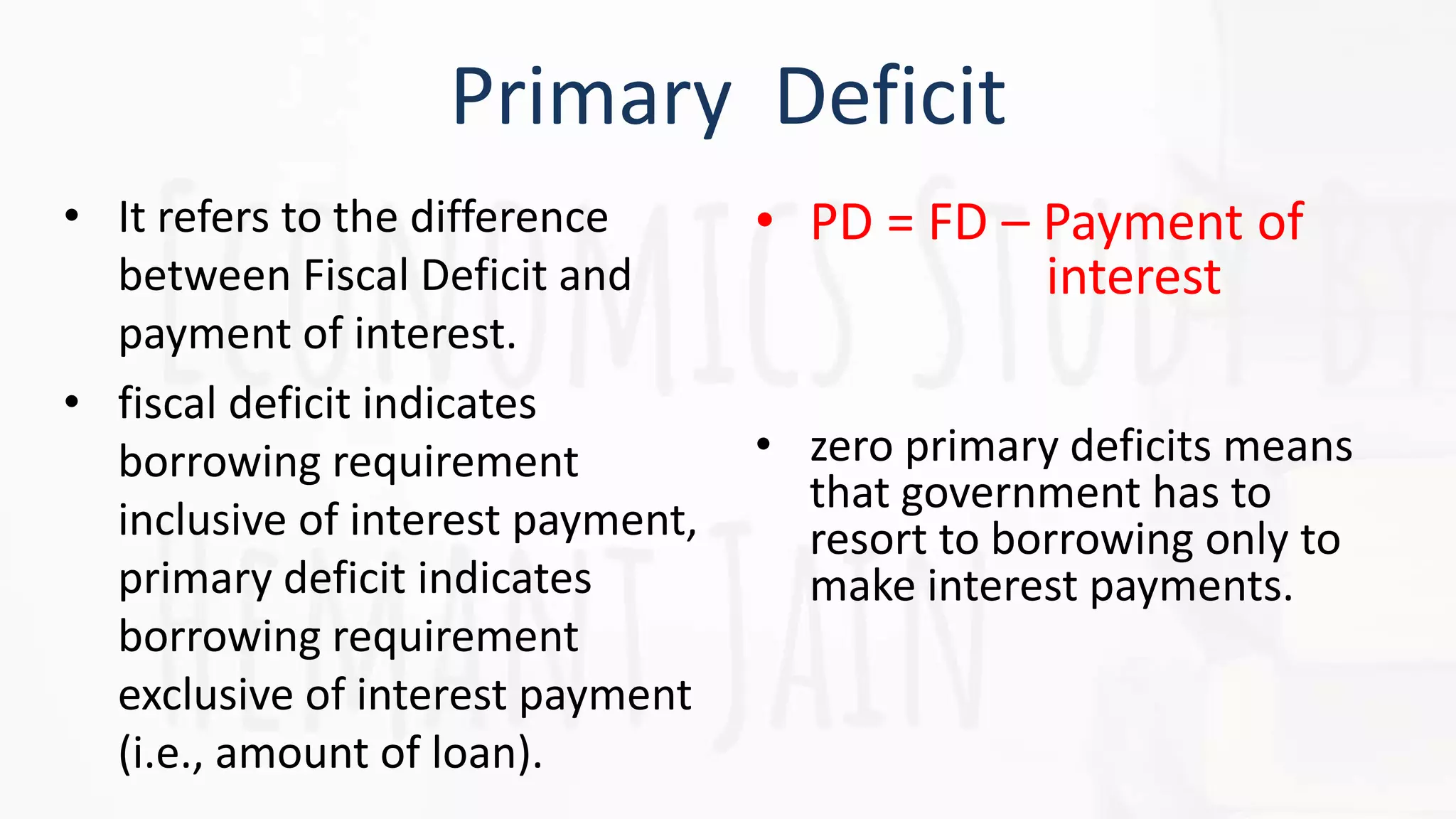
Primary Deficit
• It refers to the difference
between Fiscal Deficit and
payment of interest.
• fiscal deficit indicates
borrowing requirement
inclusive of interest payment,
primary deficit indicates
borrowing requirement
exclusive of interest payment
(i.e., amount of loan).
• PD = FD – Payment of
interest
• zero primary deficits means
that government has to
resort to borrowing only to
make interest payments.
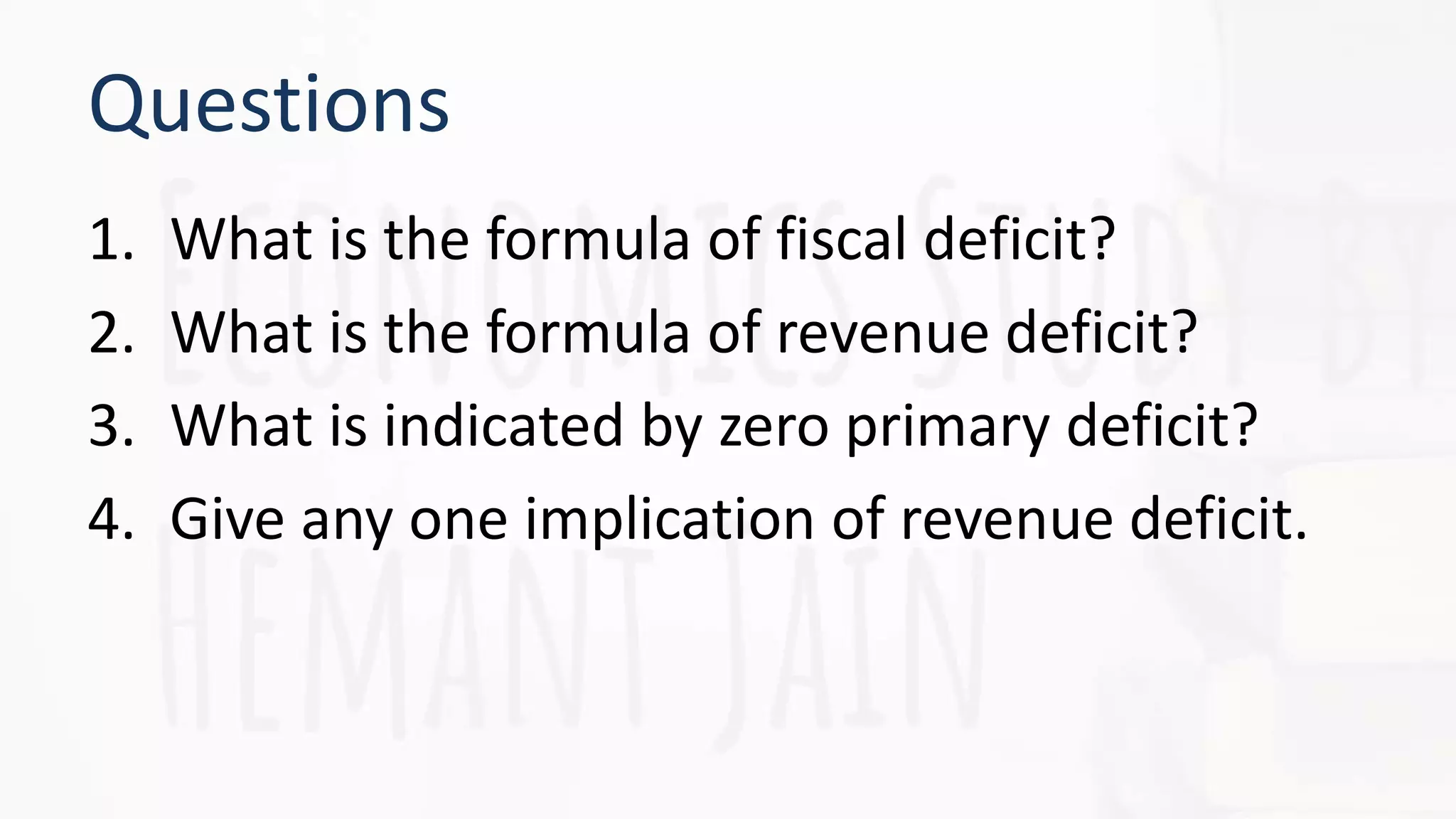
Questions
1. What is the formula of fiscal deficit?
2. What is the formula of revenue deficit?
3. What is indicated by zero primary deficit?
4. Give any one implication of revenue deficit.

Government budget

  • 1.
    Government Budget PREPARED BY HEMANTKUMAR JAIN PGT ECONOMICS KV AMBIKAPUR
  • 3.
    Topics • Meaning ofBudget • Objectives of Budget • Classification of Budget • Types of Budget deficit and there implication
  • 4.
    Meaning of Budget •“A government budget is an annual financial statement showing estimates of expected revenue and anticipated expenditure during a fiscal year.” • It does not show actual values. • It also explains about government’s last budget performance.
  • 5.
    Objectives of Budget •Economic stability • GDP growth • Redistribution of income and wealth • Allocation of resources • Directly production of goods and services. • Management of PSU’s
  • 6.
    Economic stability • Itimplies control on price fluctuations. • Govt. do this by tax and expenditure policies. • During inflationary conditions govt. impose high taxes and reduce expenses. • During recessionary condition taxes are reduced and expenses are increased.
  • 7.
    GDP growth • Itrefers to sustainable increase in production of goods and services. • Govt. try to motivate production activities by giving incentives to producers through tax holidays , subsidies, technical support etc. • Govt. prepare infrastructure that directly and indirectly supports the growth process. • GDP growth reduces the poverty and unemployment in economy.
  • 8.
    Redistribution of incomeand wealth • Govt. try to reduce the income disparities by using budgetary tools. • Govt. impose tax on rich and give subsidies to poor. • Govt. directly fulfill the basic needs of poor like education, health, food etc. • By this disposal income of rich reduces and living standard of poor improves.
  • 9.
    Allocation of Resources •Govt. try to influence the allocation of resources by using budgetary tools. • Govt. promotes the production of essential goods and demotivate the production of hazardous goods. • Govt. give incentive to the producers for investing in backward areas. • Govt. try to balance the regional disparities.
  • 10.
    Directly Production ofgoods and services • Govt. directly produce the goods and services which are not produced by private sector. • Sectors which are less profitable, govt. produce for that sector. • Sector which require huge investment, govt. invest in those sectors. • Goods and services which are essential for people, govt. produces those goods and services
  • 11.
    Management of PSUs •Govt. manage the PSUs through the budget policies. • Expansion, investment , cost, profit related decision are taken by govt. through budget policies. • Profit of PSUs is used by govt. to support its expanses.
  • 12.
  • 13.
    Budget Receipt:-It refersto all estimated money receipt of the govt. during a financial year. Revenue Receipt 1. Do not create libility for govt. 2. Do not reduce assets of govt. Capital Receipt 1. Create libility on govt. 2. Reduce assets of govt.
  • 14.
    Revenue Receipt Revenue Receipts Tax Receipts Income Tax GST Corpora tionTax Excise duty Other taxes Non-tax Receipts Income from PSE Grants & donations Special assessmentEscheat
  • 15.
  • 16.
    Budget Expenditure:-It refersto all estimated expenditure of govt. during a financial year. Revenue Expenditure 1. Do not reduce libility of govt. 2. Do not increase assets for govt. Capital Expenditure 1. Reduce libility of govt. 2. Increase assets for govt.
  • 17.
    Revenue and Capitalexpenditure Budget expenditure Revenue expenditure Wages and salaries Subsidies Defence expenses Capital expenditure Purchase of shares Expenditure on assets Purchase of machinery Loans to the other
  • 18.
    Find out followingsare revenue receipt Or capital receipt or revenue exp. Or capital exp. 1. Borrowings 2. GST collection 3. Recovery of loans 4. Profit of PSU 5. Disinvestment 6. Grants received from world bank --Capital receipt --Revenue receipt
  • 19.
    Find out followingsare revenue exp. Or capital exp. 1. Construction of school building –capital expenditure 2. Interest payment –revenue expenditure 3. Loans given to state govt. 4. Purchase of machinery 5. Nationalization of company. 6. Subsidies 7. Expenditure on tax collection
  • 20.
    Budget Deficit • Itrefers to excess of budget expenditure over budget receipts. Budget Deficit= Budget Expenditure-Budget receipt
  • 21.
    Types of BudgetDeficit Budget Deficit Revenue Deficit Fiscal Deficit Primary Deficit
  • 22.
    Revenue Deficit • Itrefers to excess of revenue expenditure over revenue receipts. RD = RE - RR Implications:- • It Reduces the assets for govt. • It may create inflationary conditions. • It creates more revenue deficit.
  • 23.
    Fiscal Deficit • Thetotal borrowings of government during a financial year. OR • Excess of budget expenditure over budget receipt excluding borrowings. FD = BE(RE+CE) – BR (RR+CR excluding borrowings) or • Fiscal Deficit = Total borrowings = Borrowings from RBI + borrowings from public + borrowings from external sources. or • Fiscal Deficit = RD +(CE- CR excluding Borrowings)
  • 24.
    • It createsthe condition of debt trap.( a situation in which govt. borrow to pay its past borrowings) • Crowding out(reduction of funds for private sector due to borrowing by govt. from market) • Burden on future generations. • Burden on economy. • Vicious cycle of high fiscal deficit and low GDP. Implications of Fiscal Deficit:-
  • 25.
    Primary Deficit • Itrefers to the difference between Fiscal Deficit and payment of interest. • fiscal deficit indicates borrowing requirement inclusive of interest payment, primary deficit indicates borrowing requirement exclusive of interest payment (i.e., amount of loan). • PD = FD – Payment of interest • zero primary deficits means that government has to resort to borrowing only to make interest payments.
  • 26.
    Questions 1. What isthe formula of fiscal deficit? 2. What is the formula of revenue deficit? 3. What is indicated by zero primary deficit? 4. Give any one implication of revenue deficit.