Range Of Motion
Why Is It Performed ?
• Determining the presence of joint
impairment
• Developing treatment goals.
• Evaluating progress or lack of progress.
• Modifying treatment.
• Motivating the subject.
• Research
PLANES AND AXIS
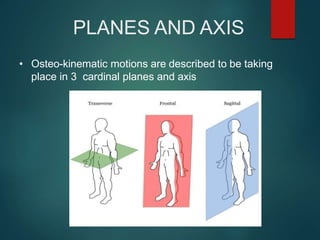
• Osteo-kinematic motions are described to be taking
place in 3 cardinal planes and axis
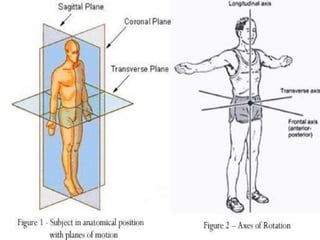
A frontal or coronal axis lies parallel to the transverse suture of the
skull. It is also horizontal and at right angle to the sagittal axis.
Movement about frontal axis occurs in a sagittal plane. Flexion and
extension (except of the thumb) occurs about a frontal axis and in a
sagittal plane.
A sagittal or antero-posterior axis lies parallel to the sagittal suture
of the skull, i.e., in an antero-posterior direction. Movement about this
axis occurs in a frontal plane. Abduction and adduction (except pf the
thumb) and side flexion movements are said to take about a sagittal
axis and in a frontal plane.
 A vertical axis lies parallel to the line of gravity and movement about
it occurs in a horizontal plane. Rotation occurs about a vertical axis
and in a horizontal plane
Joint Ranges
Active ROM Passive ROM
• Active motion is the unassisted
voluntary movement of a joint.
(Quality of ROM)
• Passive motion is attained by the examiner
without the patient’s assistance.(Quantity of
ROM)
• Normally, PROM is slightly greater than
AROM because joints have a small amount
of motion at the end range that is not under
voluntary control.
MEASURING JOINT RANGE OF
MOTION
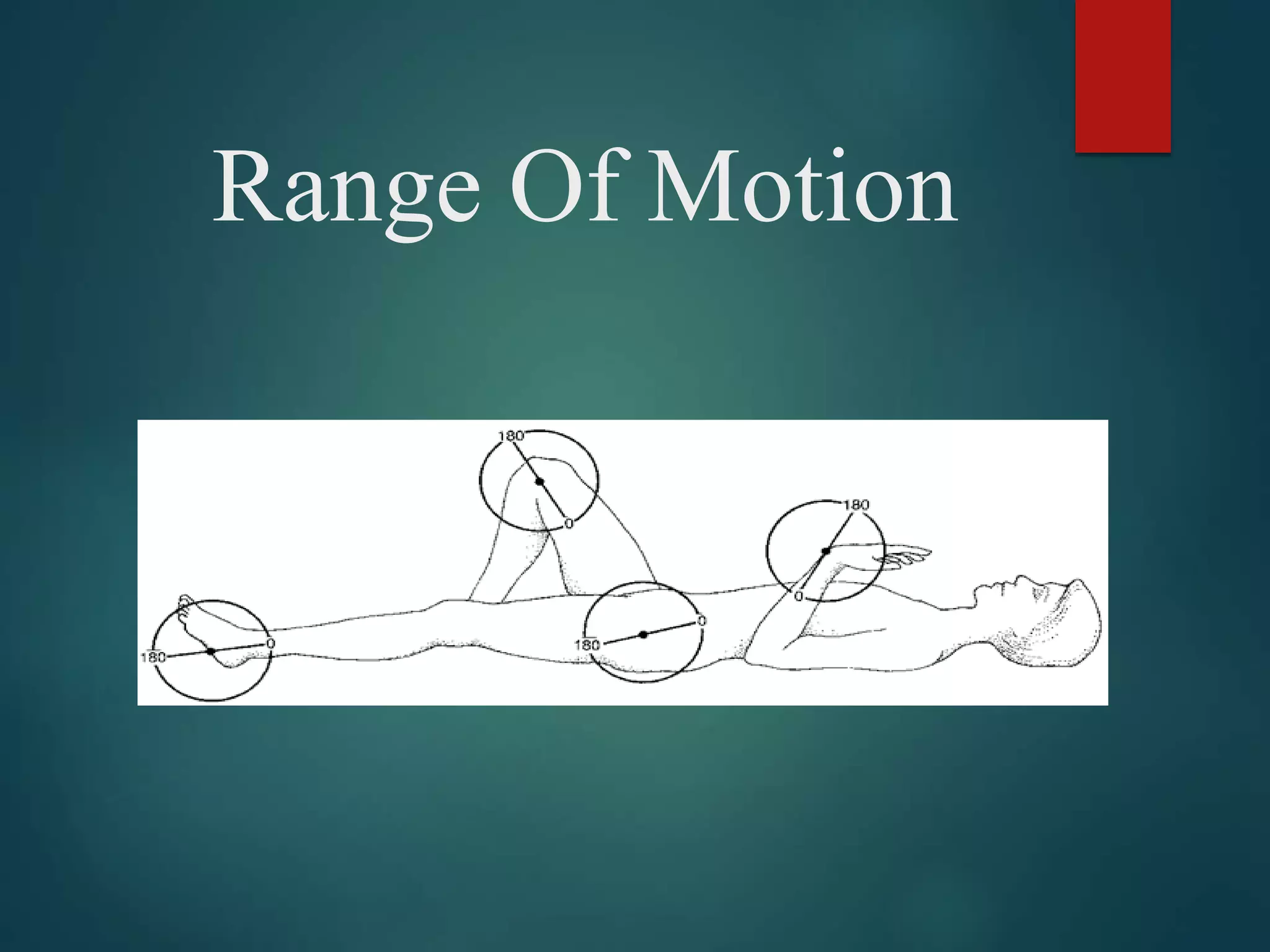
• Range Of Motion (ROM) is the arc of motion
that occurs at a joint or a series of joints.
• Three notation systems have been
used to define ROM :
1. The 0 to 180 degree system
2. The 180 to 0 degree system
3. The 360 degree system
 Most commonly used is the 0 to 180
degree notation system
Prerequisite Knowledge For Measuring
ROM
a) Normal ROM’s (Range)
b) Joint Structure And Function
c) Recommended positioning for self and
patient
d) Bony landmarks related to each joint
e) Alignment of Goniometer
f) Normal end-feel
g) Factors that can alter normal ROM
FACTORS DETERMINING AMOUNT
OF ROM
Integrity
Of Joint
SurfaceRELIABILI
TY
Amount
Of
Scarring
Present
AG
E
GEND
ER
Shape Of
Articulati
ng
Surface
Healt
h Of
Joint
Various
diseases/
pathologic
al
conditions
Health Of
Surroundi
ng
Tissues
Mobilty &
Pliabilty Of
Soft Tissue
Common pathological causes of
ROM Restriction
• Skin/soft tissue contracture
• Arthritis
• Fracture
• Burns
• Muscle weakness/paralysis
• Pain
• Edema
• Spasticity
• Presence of foreign body in the
joint
Prerequisite Skills For Measuring
ROM
• The therapist should be skilled in
 Correct positioning
 Stabilization for measurement
 Palpation
 Alignment
 Recording measurements accurately
 Documentation
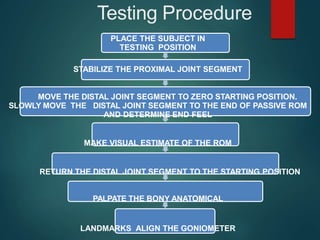
Testing Procedure
PLACE THE SUBJECT IN
TESTING POSITION
STABILIZE THE PROXIMAL JOINT SEGMENT
MOVE THE DISTAL JOINT SEGMENT TO ZERO STARTING POSITION.
SLOWLY MOVE THE DISTAL JOINT SEGMENT TO THE END OF PASSIVE ROM
AND DETERMINE END FEEL
MAKE VISUAL ESTIMATE OF THE ROM
RETURN THE DISTAL JOINT SEGMENT TO THE STARTING POSITION
PALPATE THE BONY ANATOMICAL
LANDMARKS ALIGN THE GONIOMETER
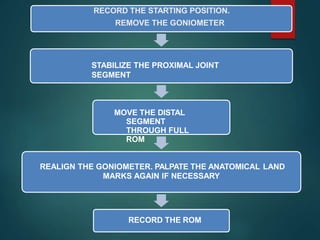
RECORD THE STARTING POSITION.
REMOVE THE GONIOMETER
STABILIZE THE PROXIMAL JOINT
SEGMENT
MOVE THE DISTAL
SEGMENT
THROUGH FULL
ROM
REALIGN THE GONIOMETER. PALPATE THE ANATOMICAL LAND
MARKS AGAIN IF NECESSARY
RECORD THE ROM
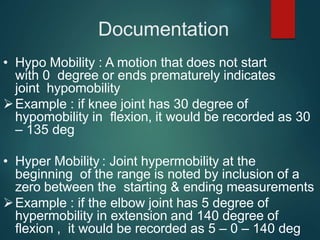
Documentation
• Hypo Mobility : A motion that does not start
with 0 degree or ends prematurely indicates
joint hypomobility
Example : if knee joint has 30 degree of
hypomobility in flexion, it would be recorded as 30
– 135 deg
• Hyper Mobility : Joint hypermobility at the
beginning of the range is noted by inclusion of a
zero between the starting & ending measurements
Example : if the elbow joint has 5 degree of
hypermobility in extension and 140 degree of
flexion , it would be recorded as 5 – 0 – 140 deg
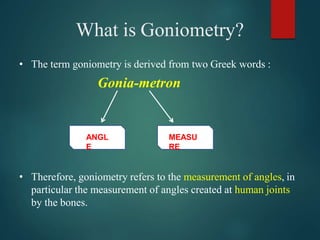
What is Goniometry?
• The term goniometry is derived from two Greek words :
Gonia-metron
• Therefore, goniometry refers to the measurement of angles, in
particular the measurement of angles created at human joints
by the bones.
ANGL
E
MEASU
RE
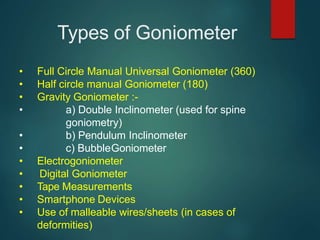
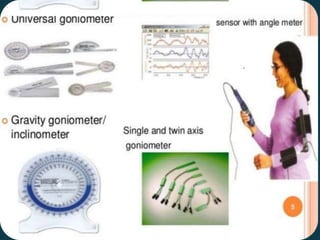
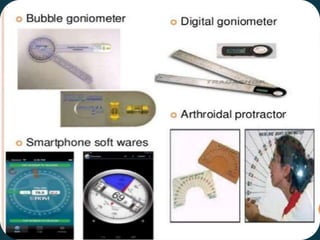
Types of Goniometer
• Full Circle Manual Universal Goniometer (360)
• Half circle manual Goniometer (180)
• Gravity Goniometer :-
• a) Double Inclinometer (used for spine
goniometry)
• b) Pendulum Inclinometer
• c) BubbleGoniometer
• Electrogoniometer
• Digital Goniometer
• Tape Measurements
• Smartphone Devices
• Use of malleable wires/sheets (in cases of
deformities)
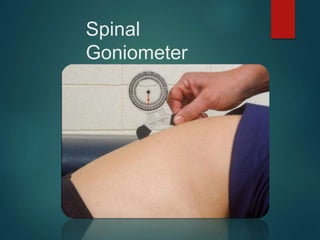
Spinal
Goniometer
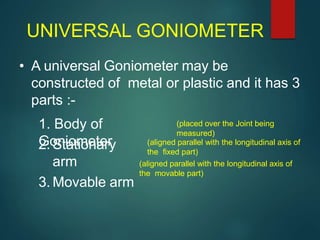
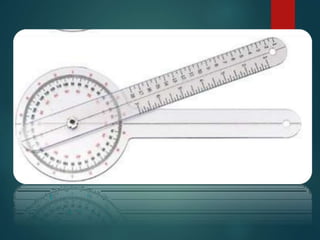
UNIVERSAL GONIOMETER
• A universal Goniometer may be
constructed of metal or plastic and it has 3
parts :-
1. Body of
Goniometer2. Stationary
arm
3. Movable arm
(placed over the Joint being
measured)
(aligned parallel with the longitudinal axis of
the fixed part)
(aligned parallel with the longitudinal axis of
the movable part)
Precautions !!!
1. Joint irritability status
2. Presence of Pain
3. Instability
4. Recent trauma
5. Is it really important to assess accurate
ROM ??
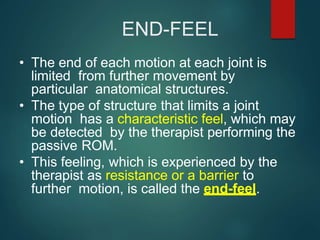
END-FEEL
• The end of each motion at each joint is
limited from further movement by
particular anatomical structures.
• The type of structure that limits a joint
motion has a characteristic feel, which may
be detected by the therapist performing the
passive ROM.
• This feeling, which is experienced by the
therapist as resistance or a barrier to
further motion, is called the end-feel.
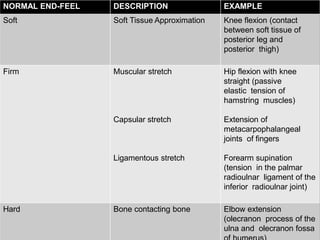
NORMAL END-FEEL DESCRIPTION EXAMPLE
Soft Soft Tissue Approximation Knee flexion (contact
between soft tissue of
posterior leg and
posterior thigh)
Firm Muscular stretch Hip flexion with knee
straight (passive
elastic tension of
hamstring muscles)
Capsular stretch Extension of
metacarpophalangeal
joints of fingers
Ligamentous stretch Forearm supination
(tension in the palmar
radioulnar ligament of the
inferior radioulnar joint)
Hard Bone contacting bone Elbow extension
(olecranon process of the
ulna and olecranon fossa
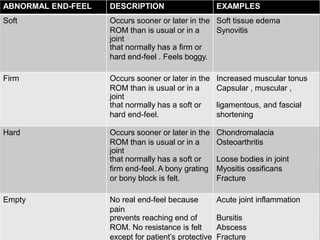
ABNORMAL END-FEEL DESCRIPTION EXAMPLES
Soft Occurs sooner or later in the Soft tissue edema
ROM than is usual or in a
joint
Synovitis
that normally has a firm or
hard end-feel . Feels boggy.
Firm Occurs sooner or later in the Increased muscular tonus
ROM than is usual or in a
joint
Capsular , muscular ,
that normally has a soft or ligamentous, and fascial
hard end-feel. shortening
Hard Occurs sooner or later in the Chondromalacia
ROM than is usual or in a
joint
Osteoarthritis
that normally has a soft or Loose bodies in joint
firm end-feel. A bony grating Myositis ossificans
or bony block is felt. Fracture
Empty No real end-feel because
pain
Acute joint inflammation
prevents reaching end of Bursitis
ROM. No resistance is felt Abscess
except for patient’s protective Fracture
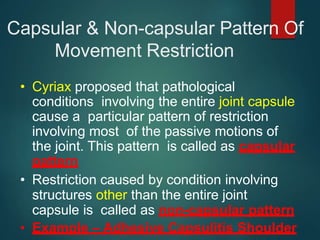
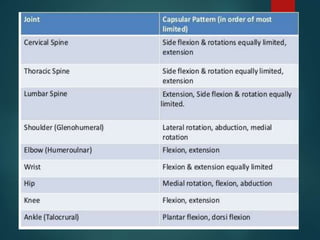
Capsular & Non-capsular Pattern Of
Movement Restriction
• Cyriax proposed that pathological
conditions involving the entire joint capsule
cause a particular pattern of restriction
involving most of the passive motions of
the joint. This pattern is called as capsular
pattern
• Restriction caused by condition involving
structures other than the entire joint
capsule is called as non-capsular pattern
• Example – Adhesive Capsulitis Shoulder
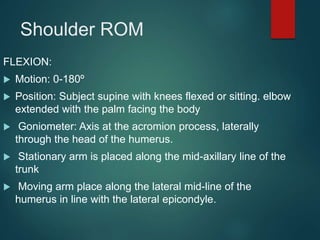
Shoulder ROM
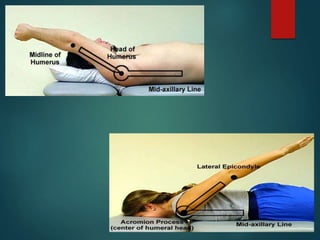
FLEXION:
 Motion: 0-180º
 Position: Subject supine with knees flexed or sitting. elbow
extended with the palm facing the body
 Goniometer: Axis at the acromion process, laterally
through the head of the humerus.
 Stationary arm is placed along the mid-axillary line of the
trunk
 Moving arm place along the lateral mid-line of the
humerus in line with the lateral epicondyle.
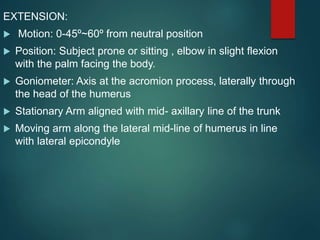
EXTENSION:
 Motion: 0-45º~60º from neutral position
 Position: Subject prone or sitting , elbow in slight flexion
with the palm facing the body.
 Goniometer: Axis at the acromion process, laterally through
the head of the humerus
 Stationary Arm aligned with mid- axillary line of the trunk
 Moving arm along the lateral mid-line of humerus in line
with lateral epicondyle
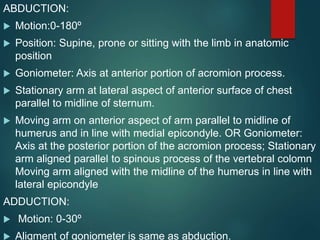
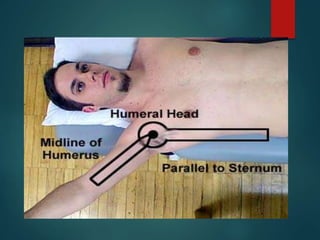
ABDUCTION:
 Motion:0-180º
 Position: Supine, prone or sitting with the limb in anatomic
position
 Goniometer: Axis at anterior portion of acromion process.
 Stationary arm at lateral aspect of anterior surface of chest
parallel to midline of sternum.
 Moving arm on anterior aspect of arm parallel to midline of
humerus and in line with medial epicondyle. OR Goniometer:
Axis at the posterior portion of the acromion process; Stationary
arm aligned parallel to spinous process of the vertebral colomn
Moving arm aligned with the midline of the humerus in line with
lateral epicondyle
ADDUCTION:
 Motion: 0-30º
 Aligment of goniometer is same as abduction.
EXTERNAL ROTATION:
 Motion: 0-90º
 Position: Supine. Shoulder is abducted to 90º. Elbow flexed with
forearm in neutral and perpendicular to table top such that the palm is
facing the feet. Elbow not supported. Humerus is fully supported on
the table. Stabilize the distal humerus, thorax, and scapula.
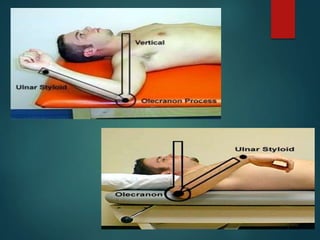
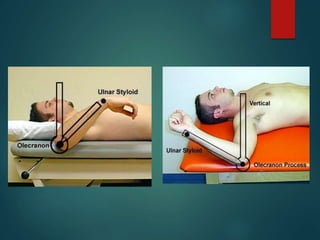
 Goniometer: Axis at olecranon process of the ulna.
 Stationary arm placed parallel to the table top or perpendicular to the
floor.
 Moving arm along the ulnar shaft aligned with the styloid process of
the ulna.
INTERNAL ROTATION:
 Motion: 0-65~90º
 Positioning and goniometer alignment is same as in external rotation
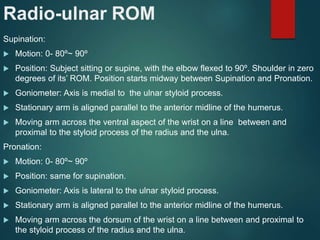
Radio-ulnar ROM
Supination:
 Motion: 0- 80º~ 90º
 Position: Subject sitting or supine, with the elbow flexed to 90º. Shoulder in zero
degrees of its’ ROM. Position starts midway between Supination and Pronation.
 Goniometer: Axis is medial to the ulnar styloid process.
 Stationary arm is aligned parallel to the anterior midline of the humerus.
 Moving arm across the ventral aspect of the wrist on a line between and
proximal to the styloid process of the radius and the ulna.
Pronation:
 Motion: 0- 80º~ 90º
 Position: same for supination.
 Goniometer: Axis is lateral to the ulnar styloid process.
 Stationary arm is aligned parallel to the anterior midline of the humerus.
 Moving arm across the dorsum of the wrist on a line between and proximal to
the styloid process of the radius and the ulna.
JOINT MOTION TESTING
POSITION
STABILIZATION MEASUREMENT
S
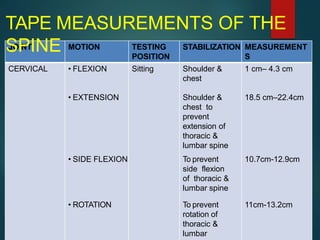
CERVICAL • FLEXION Sitting Shoulder &
chest
1 cm– 4.3 cm
• EXTENSION Shoulder &
chest to
prevent
extension of
thoracic &
lumbar spine
18.5 cm–22.4cm
• SIDE FLEXION To prevent
side flexion
of thoracic &
lumbar spine
10.7cm-12.9cm
• ROTATION To prevent
rotation of
thoracic &
lumbar
11cm-13.2cm
TAPE MEASUREMENTS OF THE
SPINE
JOINT MOTION TESTING
POSITION
STABILIZATION MEASUREMEN
TS
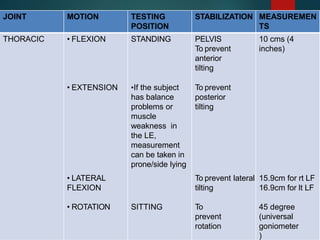
THORACIC • FLEXION STANDING PELVIS
To prevent
anterior
tilting
10 cms (4
inches)
• EXTENSION •If the subject
has balance
problems or
muscle
weakness in
the LE,
measurement
can be taken in
prone/side lying
To prevent
posterior
tilting
• LATERAL
FLEXION
To prevent lateral
tilting
15.9cm for rt LF
16.9cm for lt LF
• ROTATION SITTING To
prevent
rotation
45 degree
(universal
goniometer
)
JOINT MOTION TESTIN
G
POSITIO
N
STABILIZATIO
N
MEASUREMEN
TS
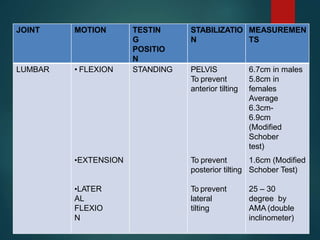
LUMBAR • FLEXION STANDING PELVIS
To prevent
anterior tilting
6.7cm in males
5.8cm in
females
Average
6.3cm-
6.9cm
(Modified
Schober
test)
•EXTENSION To prevent
posterior tilting
1.6cm (Modified
Schober Test)
•LATER
AL
FLEXIO
N
To prevent
lateral
tilting
25 – 30
degree by
AMA (double
inclinometer)
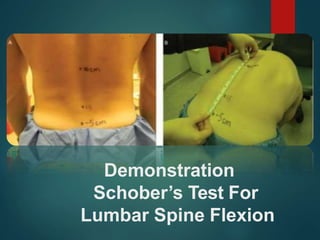
Demonstration
Schober’s Test For
Lumbar Spine Flexion
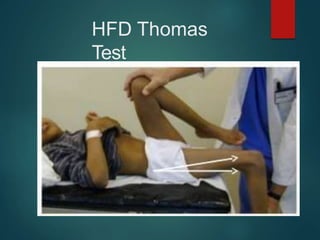
HFD Thomas
Test
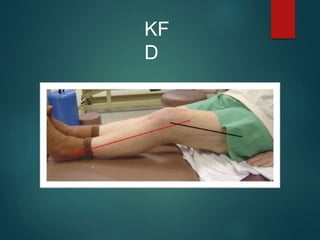
KF
D
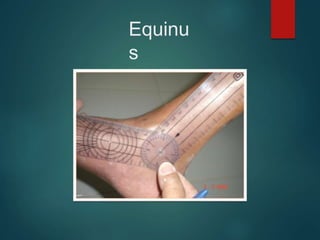
Equinu
s
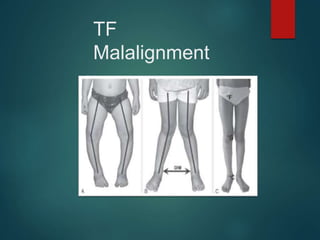
TF
Malalignment
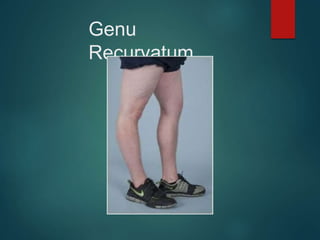
Genu
Recurvatum

Goniometer (range of motion )

  • 1.
  • 2.
    Why Is ItPerformed ? • Determining the presence of joint impairment • Developing treatment goals. • Evaluating progress or lack of progress. • Modifying treatment. • Motivating the subject. • Research
  • 3.
    PLANES AND AXIS •Osteo-kinematic motions are described to be taking place in 3 cardinal planes and axis
  • 5.
    A frontal orcoronal axis lies parallel to the transverse suture of the skull. It is also horizontal and at right angle to the sagittal axis. Movement about frontal axis occurs in a sagittal plane. Flexion and extension (except of the thumb) occurs about a frontal axis and in a sagittal plane. A sagittal or antero-posterior axis lies parallel to the sagittal suture of the skull, i.e., in an antero-posterior direction. Movement about this axis occurs in a frontal plane. Abduction and adduction (except pf the thumb) and side flexion movements are said to take about a sagittal axis and in a frontal plane.  A vertical axis lies parallel to the line of gravity and movement about it occurs in a horizontal plane. Rotation occurs about a vertical axis and in a horizontal plane
  • 6.
    Joint Ranges Active ROMPassive ROM • Active motion is the unassisted voluntary movement of a joint. (Quality of ROM) • Passive motion is attained by the examiner without the patient’s assistance.(Quantity of ROM) • Normally, PROM is slightly greater than AROM because joints have a small amount of motion at the end range that is not under voluntary control.
  • 7.
    MEASURING JOINT RANGEOF MOTION • Range Of Motion (ROM) is the arc of motion that occurs at a joint or a series of joints. • Three notation systems have been used to define ROM : 1. The 0 to 180 degree system 2. The 180 to 0 degree system 3. The 360 degree system  Most commonly used is the 0 to 180 degree notation system
  • 8.
    Prerequisite Knowledge ForMeasuring ROM a) Normal ROM’s (Range) b) Joint Structure And Function c) Recommended positioning for self and patient d) Bony landmarks related to each joint e) Alignment of Goniometer f) Normal end-feel g) Factors that can alter normal ROM
  • 9.
    FACTORS DETERMINING AMOUNT OFROM Integrity Of Joint SurfaceRELIABILI TY Amount Of Scarring Present AG E GEND ER Shape Of Articulati ng Surface Healt h Of Joint Various diseases/ pathologic al conditions Health Of Surroundi ng Tissues Mobilty & Pliabilty Of Soft Tissue
  • 10.
    Common pathological causesof ROM Restriction • Skin/soft tissue contracture • Arthritis • Fracture • Burns • Muscle weakness/paralysis • Pain • Edema • Spasticity • Presence of foreign body in the joint
  • 11.
    Prerequisite Skills ForMeasuring ROM • The therapist should be skilled in  Correct positioning  Stabilization for measurement  Palpation  Alignment  Recording measurements accurately  Documentation
  • 12.
    Testing Procedure PLACE THESUBJECT IN TESTING POSITION STABILIZE THE PROXIMAL JOINT SEGMENT MOVE THE DISTAL JOINT SEGMENT TO ZERO STARTING POSITION. SLOWLY MOVE THE DISTAL JOINT SEGMENT TO THE END OF PASSIVE ROM AND DETERMINE END FEEL MAKE VISUAL ESTIMATE OF THE ROM RETURN THE DISTAL JOINT SEGMENT TO THE STARTING POSITION PALPATE THE BONY ANATOMICAL LANDMARKS ALIGN THE GONIOMETER
  • 13.
    RECORD THE STARTINGPOSITION. REMOVE THE GONIOMETER STABILIZE THE PROXIMAL JOINT SEGMENT MOVE THE DISTAL SEGMENT THROUGH FULL ROM REALIGN THE GONIOMETER. PALPATE THE ANATOMICAL LAND MARKS AGAIN IF NECESSARY RECORD THE ROM
  • 14.
    Documentation • Hypo Mobility: A motion that does not start with 0 degree or ends prematurely indicates joint hypomobility Example : if knee joint has 30 degree of hypomobility in flexion, it would be recorded as 30 – 135 deg • Hyper Mobility : Joint hypermobility at the beginning of the range is noted by inclusion of a zero between the starting & ending measurements Example : if the elbow joint has 5 degree of hypermobility in extension and 140 degree of flexion , it would be recorded as 5 – 0 – 140 deg
  • 15.
    What is Goniometry? •The term goniometry is derived from two Greek words : Gonia-metron • Therefore, goniometry refers to the measurement of angles, in particular the measurement of angles created at human joints by the bones. ANGL E MEASU RE
  • 16.
    Types of Goniometer •Full Circle Manual Universal Goniometer (360) • Half circle manual Goniometer (180) • Gravity Goniometer :- • a) Double Inclinometer (used for spine goniometry) • b) Pendulum Inclinometer • c) BubbleGoniometer • Electrogoniometer • Digital Goniometer • Tape Measurements • Smartphone Devices • Use of malleable wires/sheets (in cases of deformities)
  • 19.
  • 20.
    UNIVERSAL GONIOMETER • Auniversal Goniometer may be constructed of metal or plastic and it has 3 parts :- 1. Body of Goniometer2. Stationary arm 3. Movable arm (placed over the Joint being measured) (aligned parallel with the longitudinal axis of the fixed part) (aligned parallel with the longitudinal axis of the movable part)
  • 22.
    Precautions !!! 1. Jointirritability status 2. Presence of Pain 3. Instability 4. Recent trauma 5. Is it really important to assess accurate ROM ??
  • 23.
    END-FEEL • The endof each motion at each joint is limited from further movement by particular anatomical structures. • The type of structure that limits a joint motion has a characteristic feel, which may be detected by the therapist performing the passive ROM. • This feeling, which is experienced by the therapist as resistance or a barrier to further motion, is called the end-feel.
  • 24.
    NORMAL END-FEEL DESCRIPTIONEXAMPLE Soft Soft Tissue Approximation Knee flexion (contact between soft tissue of posterior leg and posterior thigh) Firm Muscular stretch Hip flexion with knee straight (passive elastic tension of hamstring muscles) Capsular stretch Extension of metacarpophalangeal joints of fingers Ligamentous stretch Forearm supination (tension in the palmar radioulnar ligament of the inferior radioulnar joint) Hard Bone contacting bone Elbow extension (olecranon process of the ulna and olecranon fossa
  • 25.
    ABNORMAL END-FEEL DESCRIPTIONEXAMPLES Soft Occurs sooner or later in the Soft tissue edema ROM than is usual or in a joint Synovitis that normally has a firm or hard end-feel . Feels boggy. Firm Occurs sooner or later in the Increased muscular tonus ROM than is usual or in a joint Capsular , muscular , that normally has a soft or ligamentous, and fascial hard end-feel. shortening Hard Occurs sooner or later in the Chondromalacia ROM than is usual or in a joint Osteoarthritis that normally has a soft or Loose bodies in joint firm end-feel. A bony grating Myositis ossificans or bony block is felt. Fracture Empty No real end-feel because pain Acute joint inflammation prevents reaching end of Bursitis ROM. No resistance is felt Abscess except for patient’s protective Fracture
  • 26.
    Capsular & Non-capsularPattern Of Movement Restriction • Cyriax proposed that pathological conditions involving the entire joint capsule cause a particular pattern of restriction involving most of the passive motions of the joint. This pattern is called as capsular pattern • Restriction caused by condition involving structures other than the entire joint capsule is called as non-capsular pattern • Example – Adhesive Capsulitis Shoulder
  • 27.
    Shoulder ROM FLEXION:  Motion:0-180º  Position: Subject supine with knees flexed or sitting. elbow extended with the palm facing the body  Goniometer: Axis at the acromion process, laterally through the head of the humerus.  Stationary arm is placed along the mid-axillary line of the trunk  Moving arm place along the lateral mid-line of the humerus in line with the lateral epicondyle.
  • 28.
    EXTENSION:  Motion: 0-45º~60ºfrom neutral position  Position: Subject prone or sitting , elbow in slight flexion with the palm facing the body.  Goniometer: Axis at the acromion process, laterally through the head of the humerus  Stationary Arm aligned with mid- axillary line of the trunk  Moving arm along the lateral mid-line of humerus in line with lateral epicondyle
  • 30.
    ABDUCTION:  Motion:0-180º  Position:Supine, prone or sitting with the limb in anatomic position  Goniometer: Axis at anterior portion of acromion process.  Stationary arm at lateral aspect of anterior surface of chest parallel to midline of sternum.  Moving arm on anterior aspect of arm parallel to midline of humerus and in line with medial epicondyle. OR Goniometer: Axis at the posterior portion of the acromion process; Stationary arm aligned parallel to spinous process of the vertebral colomn Moving arm aligned with the midline of the humerus in line with lateral epicondyle ADDUCTION:  Motion: 0-30º  Aligment of goniometer is same as abduction.
  • 32.
    EXTERNAL ROTATION:  Motion:0-90º  Position: Supine. Shoulder is abducted to 90º. Elbow flexed with forearm in neutral and perpendicular to table top such that the palm is facing the feet. Elbow not supported. Humerus is fully supported on the table. Stabilize the distal humerus, thorax, and scapula.  Goniometer: Axis at olecranon process of the ulna.  Stationary arm placed parallel to the table top or perpendicular to the floor.  Moving arm along the ulnar shaft aligned with the styloid process of the ulna. INTERNAL ROTATION:  Motion: 0-65~90º  Positioning and goniometer alignment is same as in external rotation
  • 34.
    Radio-ulnar ROM Supination:  Motion:0- 80º~ 90º  Position: Subject sitting or supine, with the elbow flexed to 90º. Shoulder in zero degrees of its’ ROM. Position starts midway between Supination and Pronation.  Goniometer: Axis is medial to the ulnar styloid process.  Stationary arm is aligned parallel to the anterior midline of the humerus.  Moving arm across the ventral aspect of the wrist on a line between and proximal to the styloid process of the radius and the ulna. Pronation:  Motion: 0- 80º~ 90º  Position: same for supination.  Goniometer: Axis is lateral to the ulnar styloid process.  Stationary arm is aligned parallel to the anterior midline of the humerus.  Moving arm across the dorsum of the wrist on a line between and proximal to the styloid process of the radius and the ulna.
  • 36.
    JOINT MOTION TESTING POSITION STABILIZATIONMEASUREMENT S CERVICAL • FLEXION Sitting Shoulder & chest 1 cm– 4.3 cm • EXTENSION Shoulder & chest to prevent extension of thoracic & lumbar spine 18.5 cm–22.4cm • SIDE FLEXION To prevent side flexion of thoracic & lumbar spine 10.7cm-12.9cm • ROTATION To prevent rotation of thoracic & lumbar 11cm-13.2cm TAPE MEASUREMENTS OF THE SPINE
  • 37.
    JOINT MOTION TESTING POSITION STABILIZATIONMEASUREMEN TS THORACIC • FLEXION STANDING PELVIS To prevent anterior tilting 10 cms (4 inches) • EXTENSION •If the subject has balance problems or muscle weakness in the LE, measurement can be taken in prone/side lying To prevent posterior tilting • LATERAL FLEXION To prevent lateral tilting 15.9cm for rt LF 16.9cm for lt LF • ROTATION SITTING To prevent rotation 45 degree (universal goniometer )
  • 38.
    JOINT MOTION TESTIN G POSITIO N STABILIZATIO N MEASUREMEN TS LUMBAR• FLEXION STANDING PELVIS To prevent anterior tilting 6.7cm in males 5.8cm in females Average 6.3cm- 6.9cm (Modified Schober test) •EXTENSION To prevent posterior tilting 1.6cm (Modified Schober Test) •LATER AL FLEXIO N To prevent lateral tilting 25 – 30 degree by AMA (double inclinometer)
  • 39.
  • 49.
  • 50.
  • 51.
  • 52.
  • 53.