

GOAL FORMULATION
AND TARGET SETTING
Sectoral Goals
are whatever it takes to close the visio
n – reality gap identified in the specific
sector.
Importance of Goals in Planning
 As an end toward which all future actions specified in the
plan are directed.
 As a set of criteria for evaluating alternative strategies
and approaches
 As a standard against which the success or failure of
each action is measured
Goals serve at least three (3) purposes in the planning
process:
Sources of Sectoral Goals
Vision – Reality Gap
Problem – Solution Finding Matrix
Map Overlay Analysis
Community-based Monitoring System
Local Governance Performance Management
System
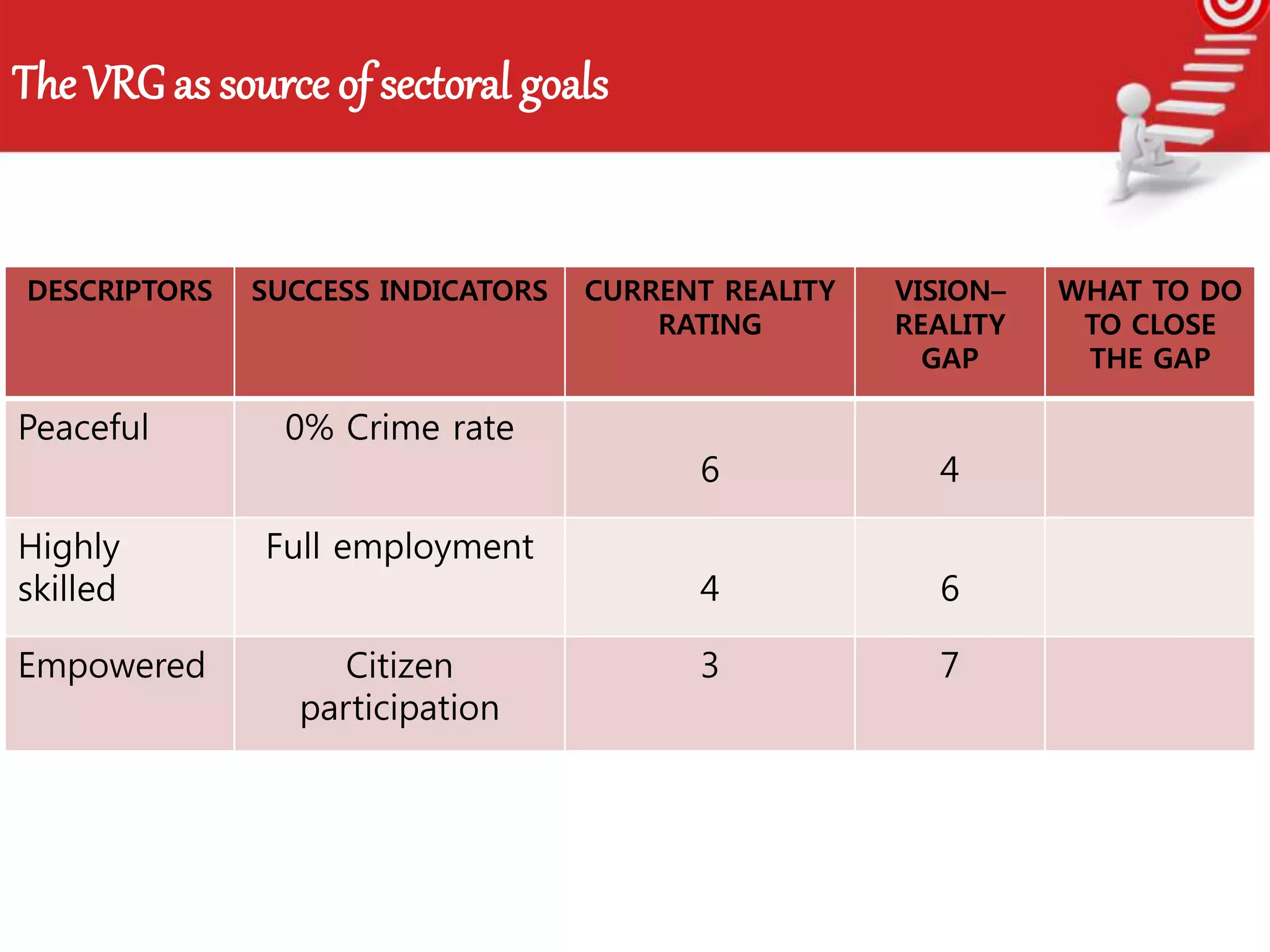
The VRG as source of sectoral goals
DESCRIPTORS SUCCESS INDICATORS CURRENT REALITY
RATING
VISION–
REALITY
GAP
WHAT TO DO
TO CLOSE
THE GAP
Peaceful 0% Crime rate
6 4
Highly
skilled
Full employment
4 6
Empowered Citizen
participation
3 7
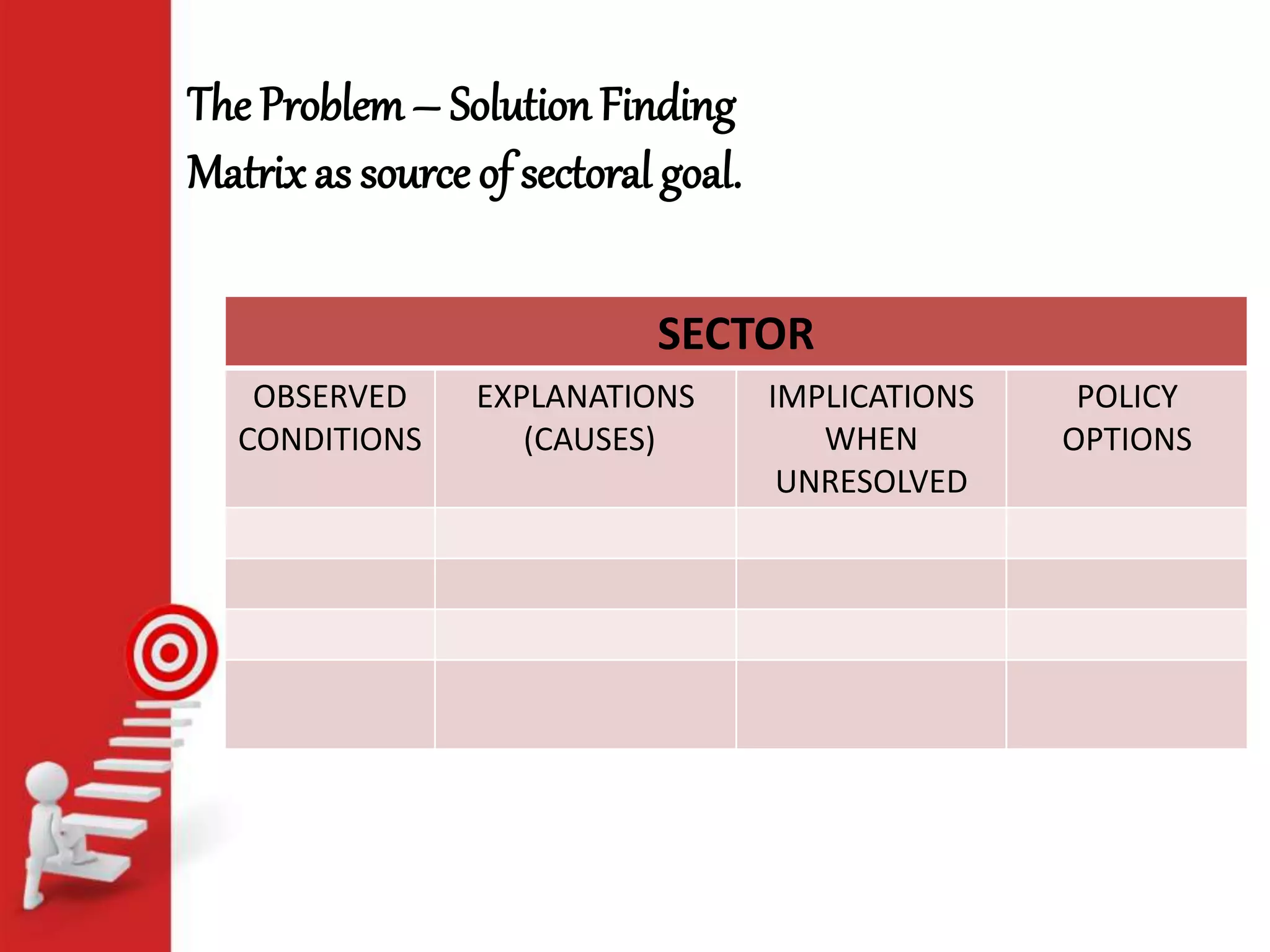
The Problem– Solution Finding
Matrix as source of sectoral goal.
SECTOR
OBSERVED
CONDITIONS
EXPLANATIONS
(CAUSES)
IMPLICATIONS
WHEN
UNRESOLVED
POLICY
OPTIONS
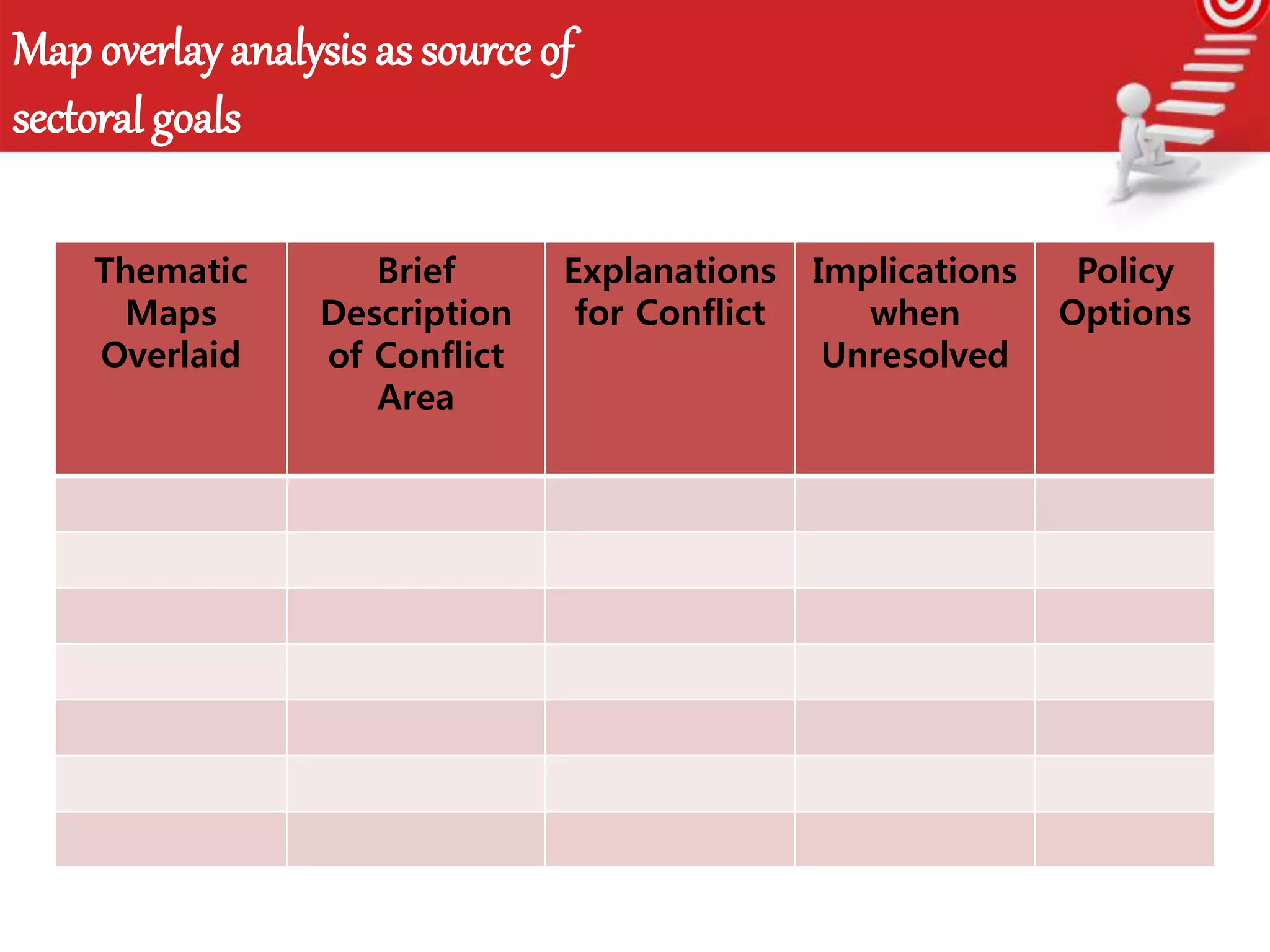
Map overlay analysis as source of
sectoral goals
Thematic
Maps
Overlaid
Brief
Description
of Conflict
Area
Explanations
for Conflict
Implications
when
Unresolved
Policy
Options
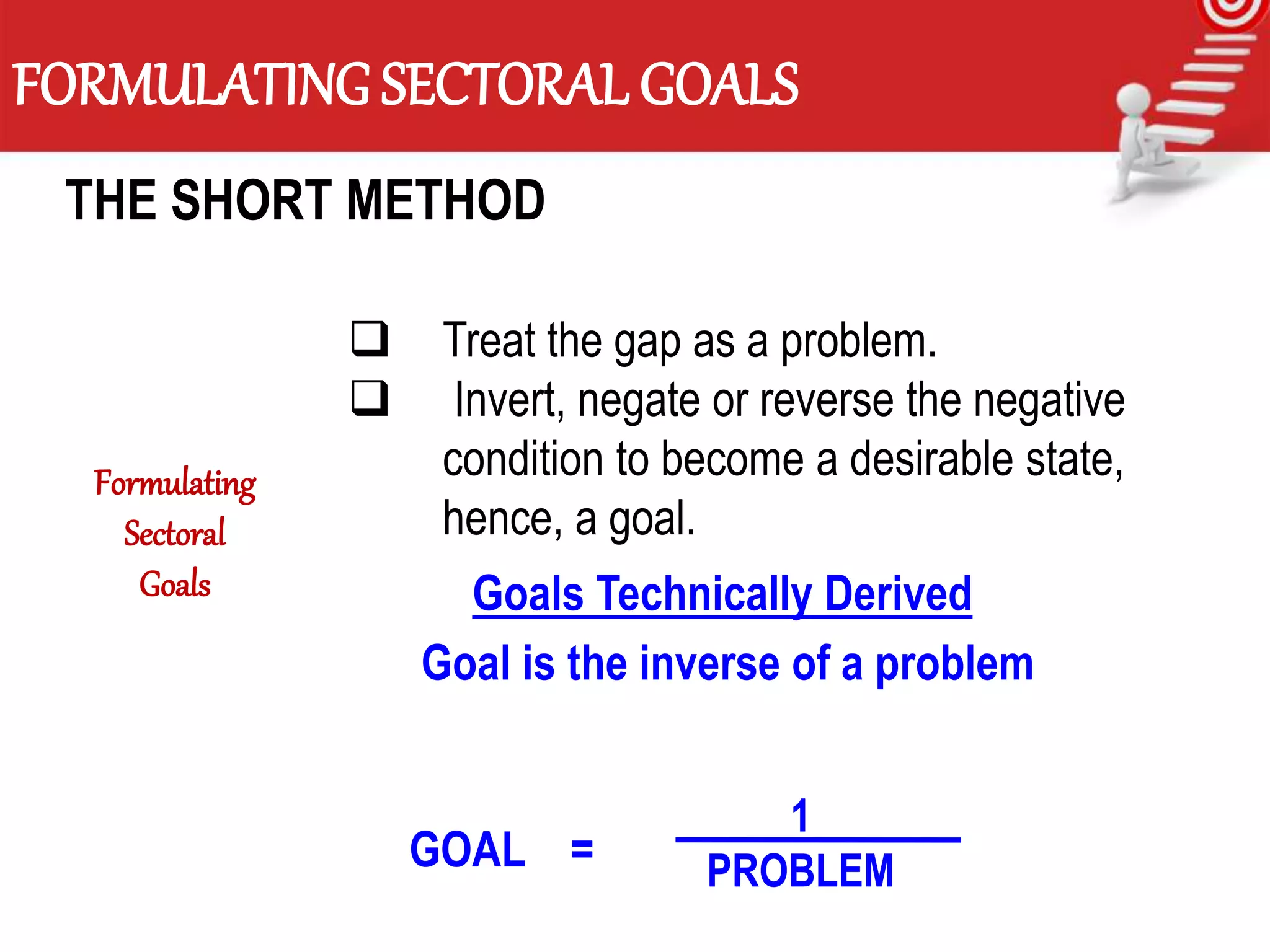
FORMULATING SECTORAL GOALS
THE SHORT METHOD
 Treat the gap as a problem.
 Invert, negate or reverse the negative
condition to become a desirable state,
hence, a goal.
Goals Technically Derived
Goal is the inverse of a problem
GOAL =
1
PROBLEM
Formulating
Sectoral
Goals
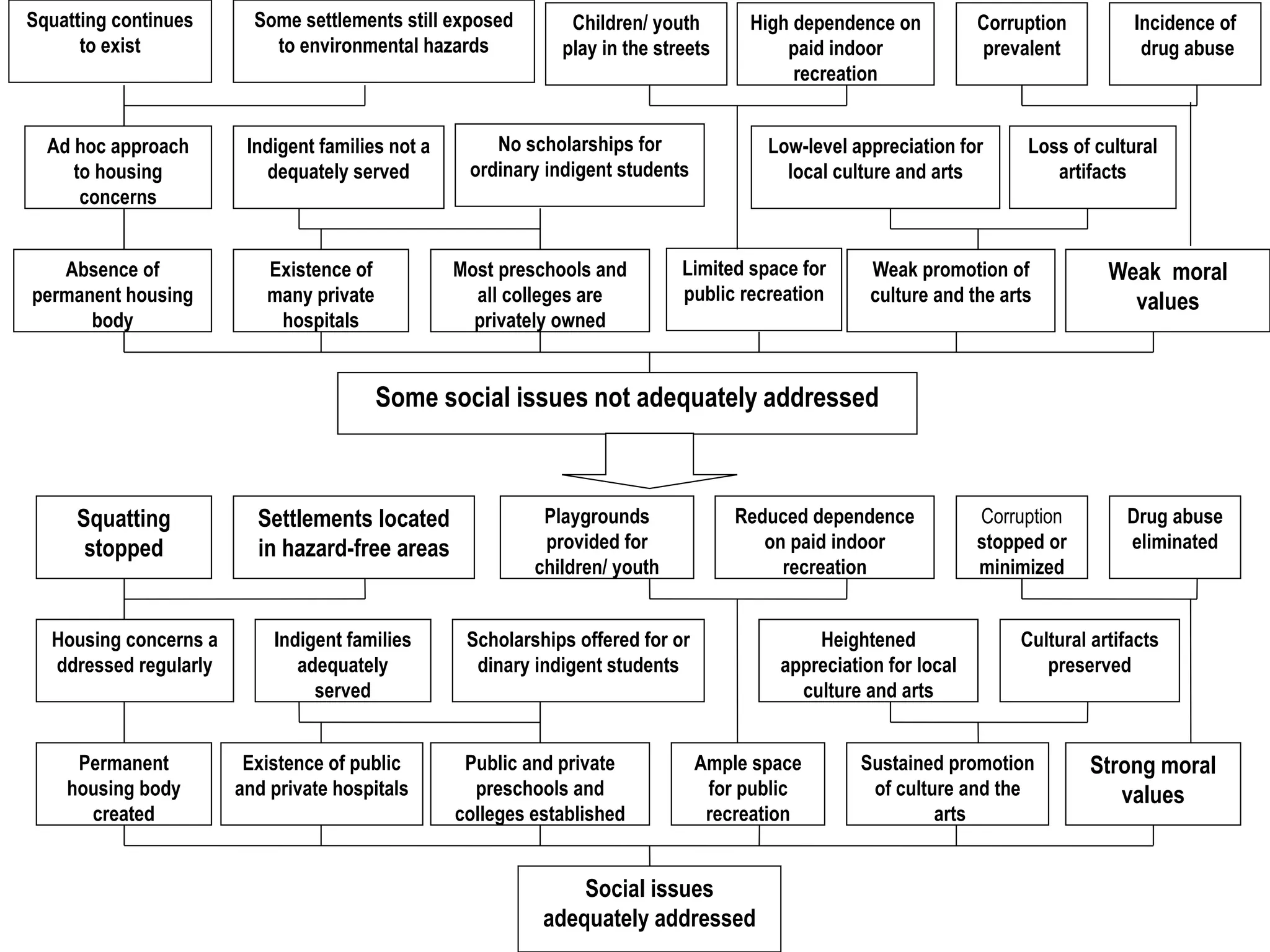
Squatting continues
to exist
Ad hoc approach
to housing
concerns
Absence of
permanent housing
body
Some settlements still exposed
to environmental hazards
Indigent families not a
dequately served
Existence of
many private
hospitals
Incidence of
drug abuse
Loss of cultural
artifacts
Weak moral
values
Corruption
prevalent
Low-level appreciation for
local culture and arts
Weak promotion of
culture and the arts
High dependence on
paid indoor
recreation
Some social issues not adequately addressed
Limited space for
public recreation
Children/ youth
play in the streets
No scholarships for
ordinary indigent students
Most preschools and
all colleges are
privately owned
Squatting
stopped
Housing concerns a
ddressed regularly
Permanent
housing body
created
Settlements located
in hazard-free areas
Indigent families
adequately
served
Existence of public
and private hospitals
Drug abuse
eliminated
Cultural artifacts
preserved
Strong moral
values
Corruption
stopped or
minimized
Heightened
appreciation for local
culture and arts
Sustained promotion
of culture and the
arts
Reduced dependence
on paid indoor
recreation
Social issues
adequately addressed
Ample space
for public
recreation
Playgrounds
provided for
children/ youth
Scholarships offered for or
dinary indigent students
Public and private
preschools and
colleges established
FORMULATING SECTORAL GOALS
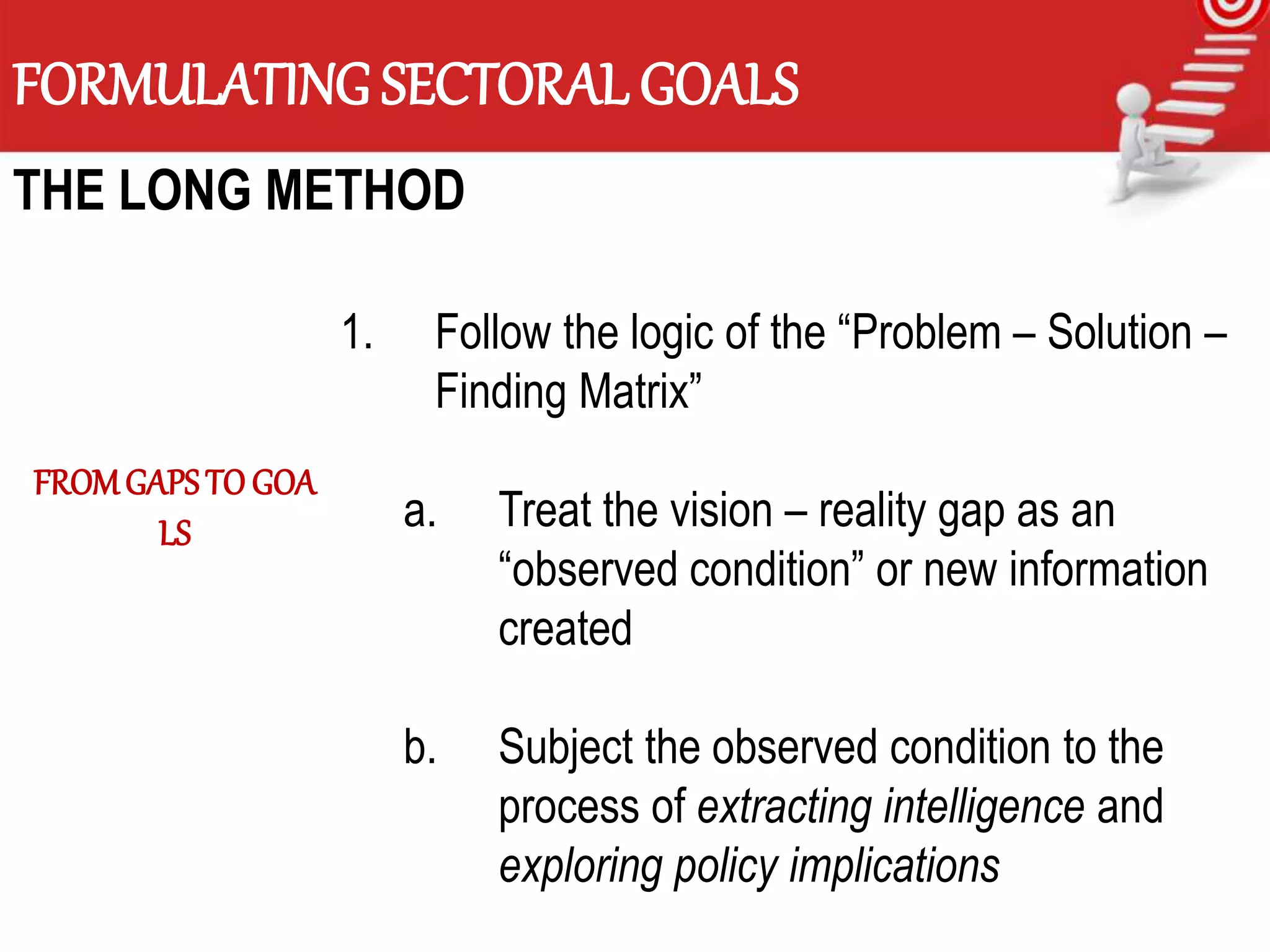
THE LONG METHOD
1. Follow the logic of the “Problem – Solution –
Finding Matrix”
a. Treat the vision – reality gap as an
“observed condition” or new information
created
b. Subject the observed condition to the
process of extracting intelligence and
exploring policy implications
FROMGAPSTO GOA
LS
FORMULATING SECTORAL GOALS
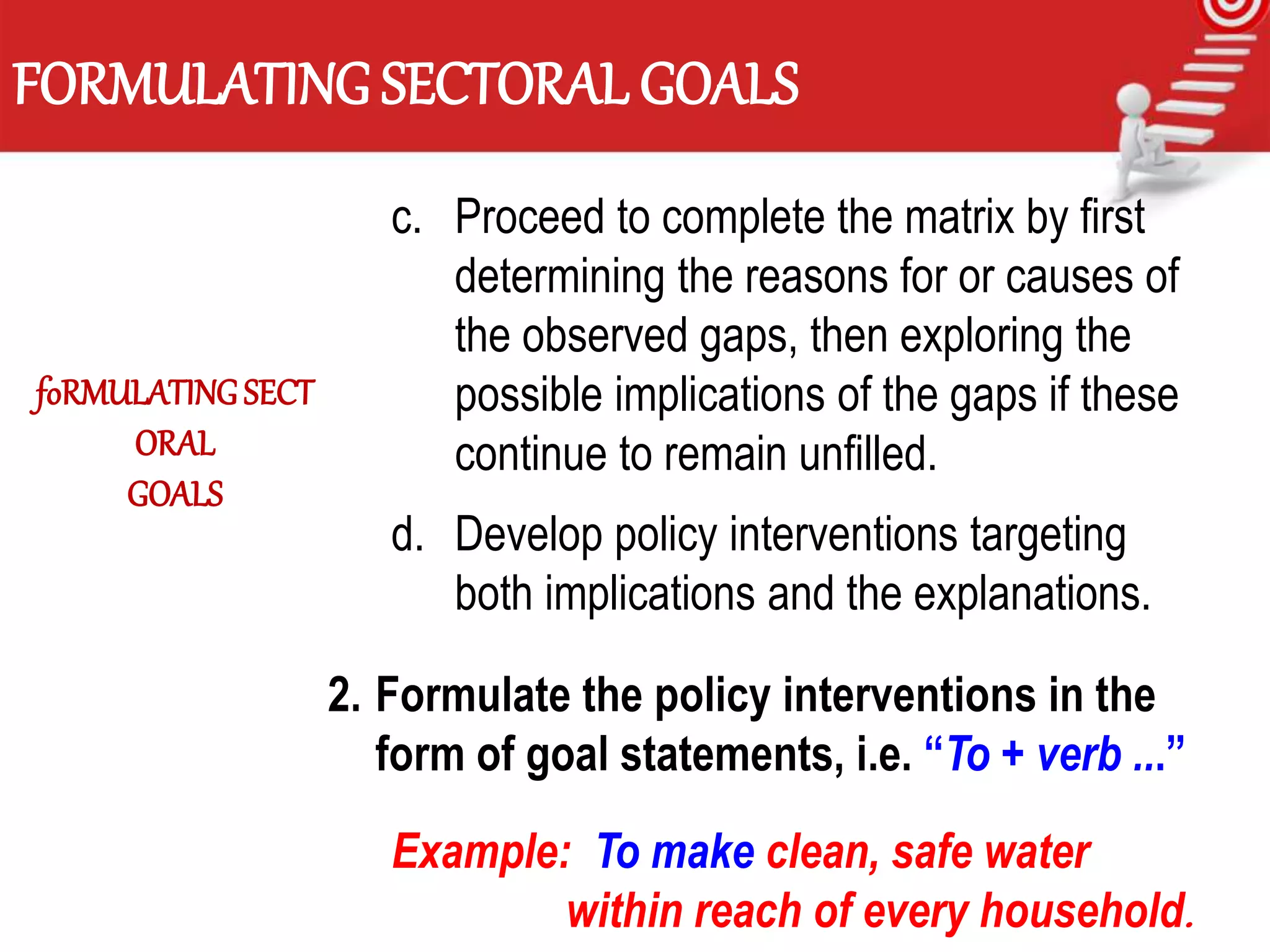
c. Proceed to complete the matrix by first
determining the reasons for or causes of
the observed gaps, then exploring the
possible implications of the gaps if these
continue to remain unfilled.
d. Develop policy interventions targeting
both implications and the explanations.
2. Formulate the policy interventions in the
form of goal statements, i.e. “To + verb ...”
Example: To make clean, safe water
within reach of every household.
foRMULATINGSECT
ORAL
GOALS
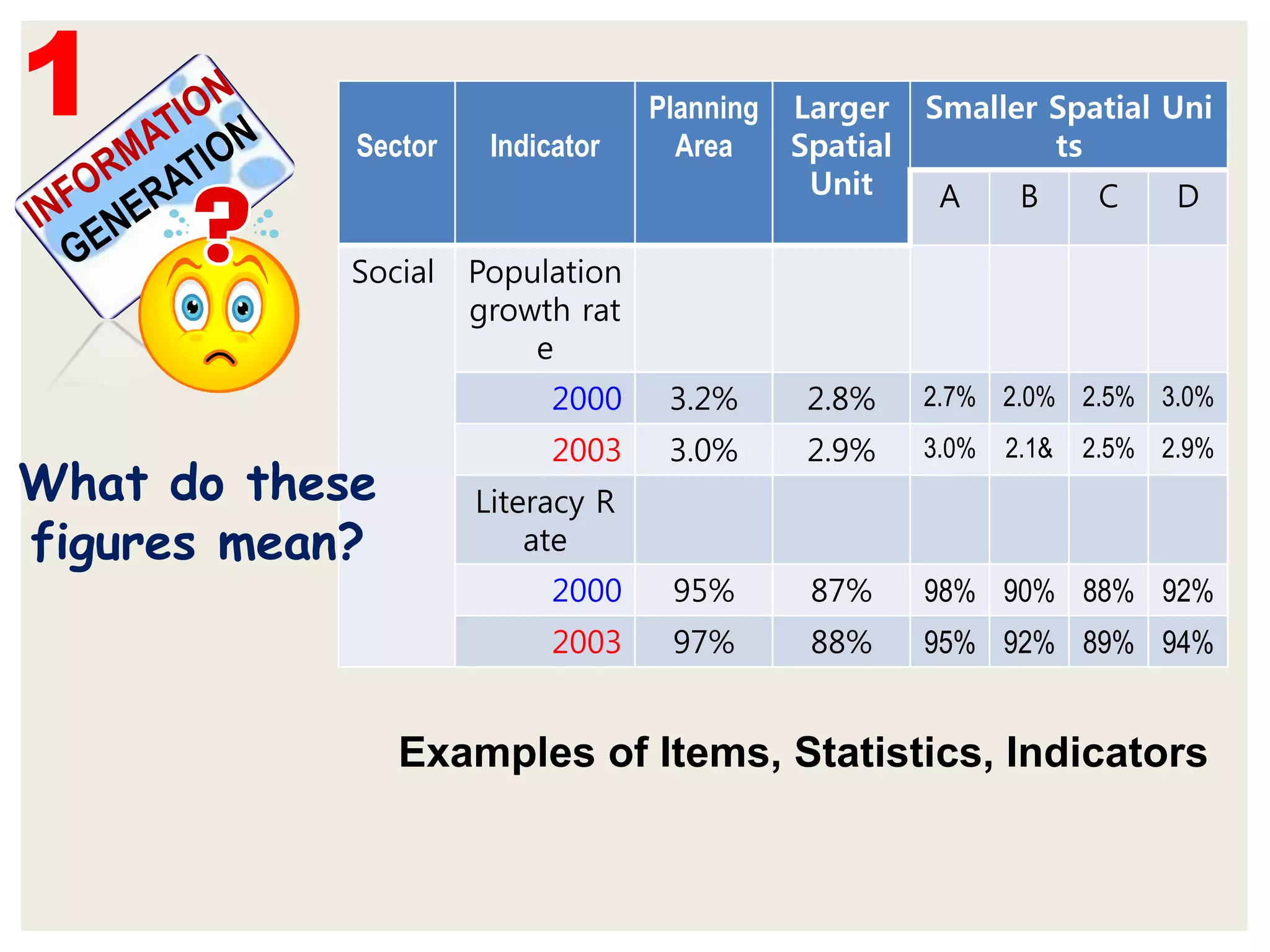
Sector Indicator
Planning
Area
Larger
Spatial
Unit
Smaller Spatial Uni
ts
A B C D
Social Population
growth rat
e
2000 3.2% 2.8% 2.7% 2.0% 2.5% 3.0%
2003 3.0% 2.9% 3.0% 2.1& 2.5% 2.9%
Literacy R
ate
2000 95% 87% 98% 90% 88% 92%
2003 97% 88% 95% 92% 89% 94%
Examples of Items, Statistics, Indicators
What do these
figures mean?
1
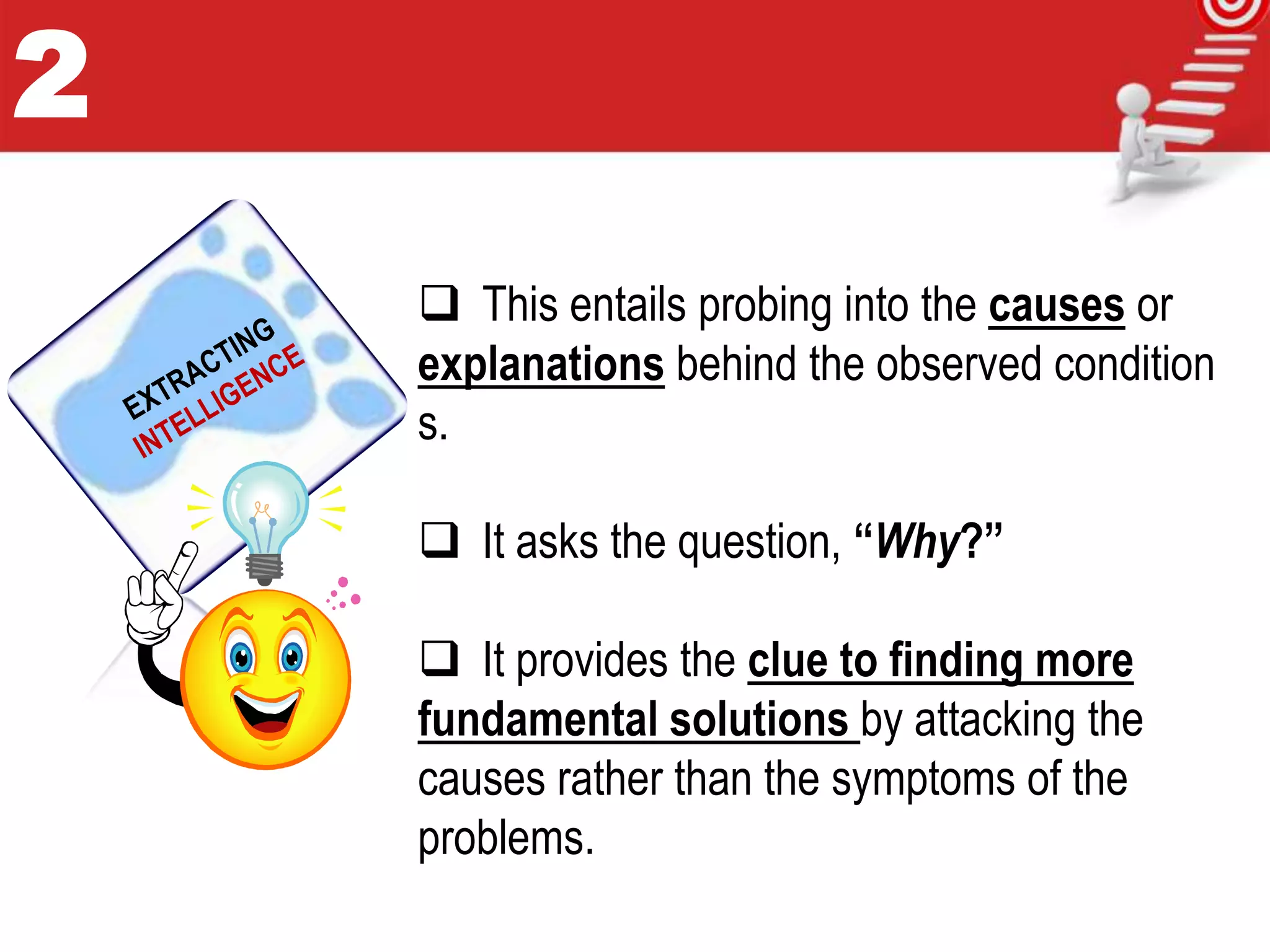
 This entails probing into the causes or
explanations behind the observed condition
s.
 It asks the question, “Why?”
 It provides the clue to finding more
fundamental solutions by attacking the
causes rather than the symptoms of the
problems.
2
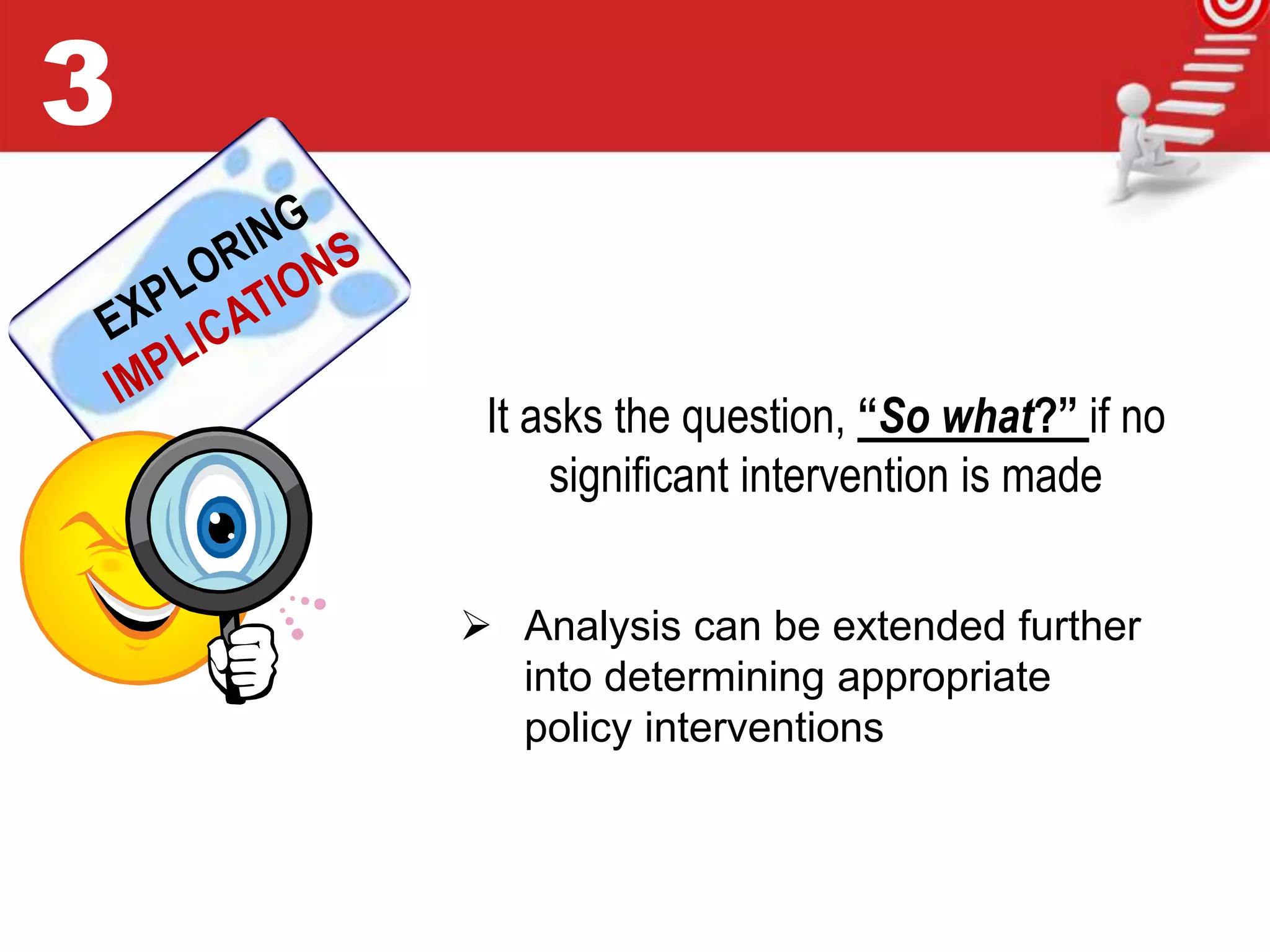
It asks the question, “So what?” if no
significant intervention is made
 Analysis can be extended further
into determining appropriate
policy interventions
3
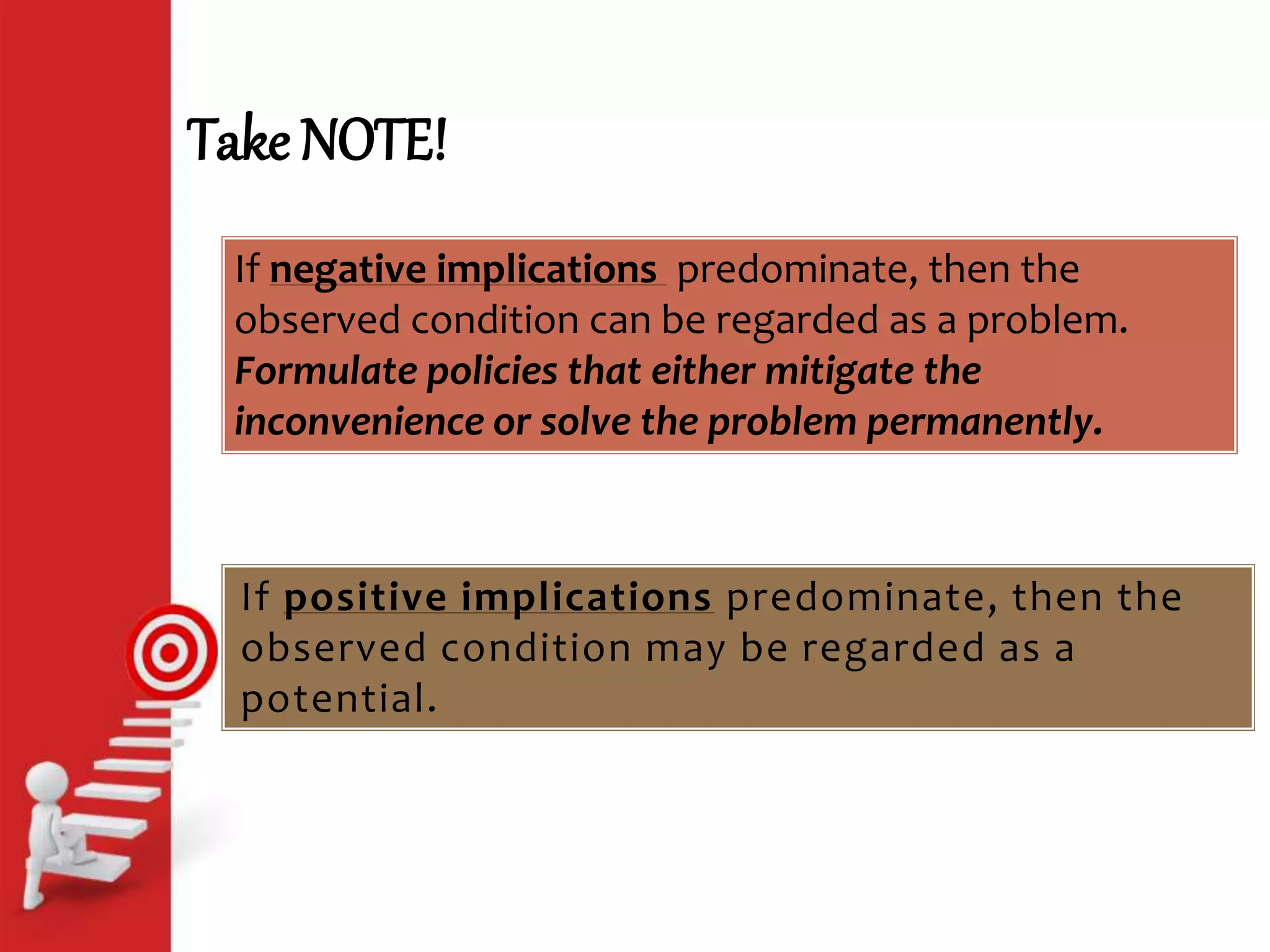
Take NOTE!
If positive implications predominate, then the
observed condition may be regarded as a
potential.
If negative implications predominate, then the
observed condition can be regarded as a problem.
Formulate policies that either mitigate the
inconvenience or solve the problem permanently.
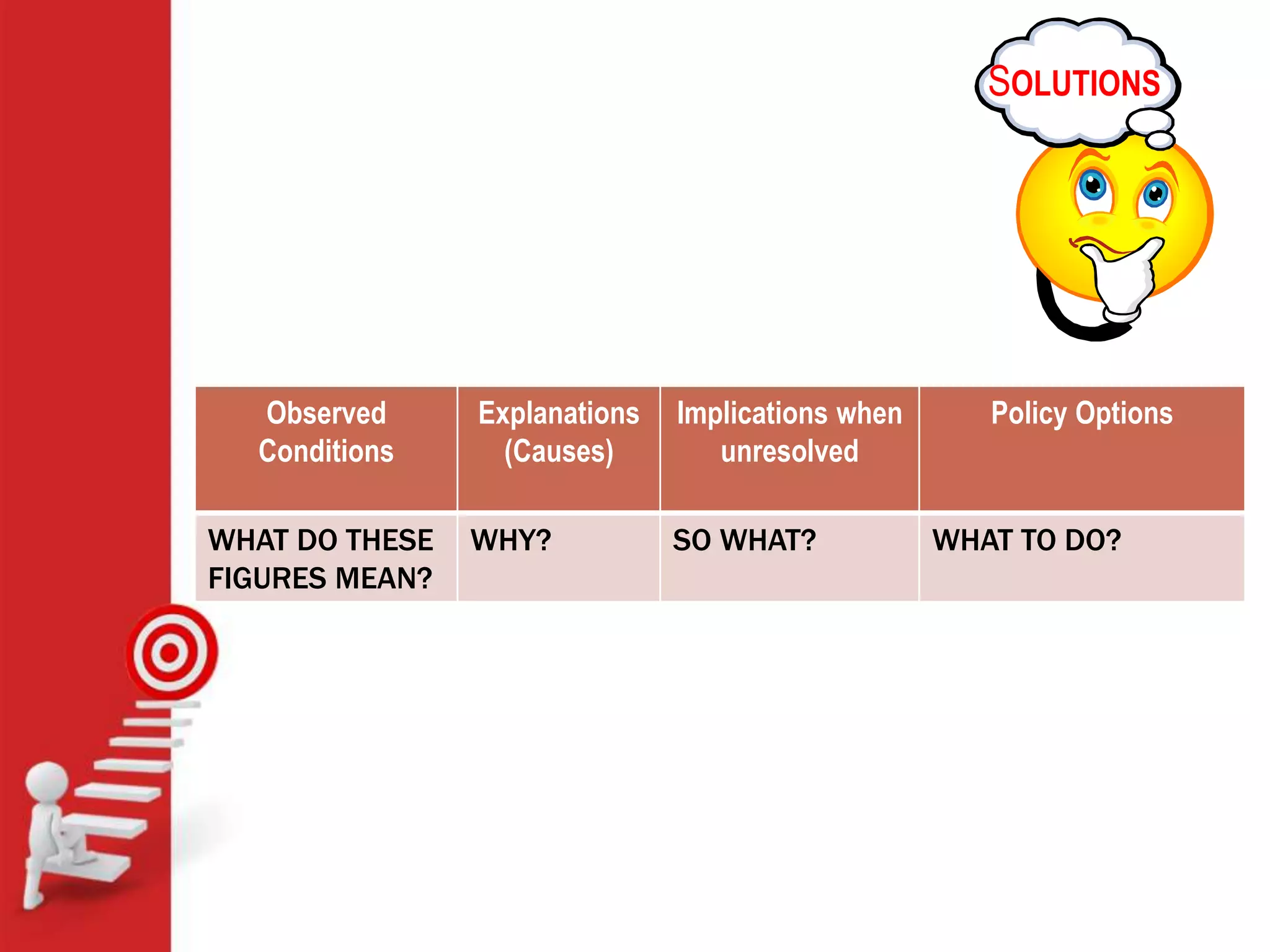
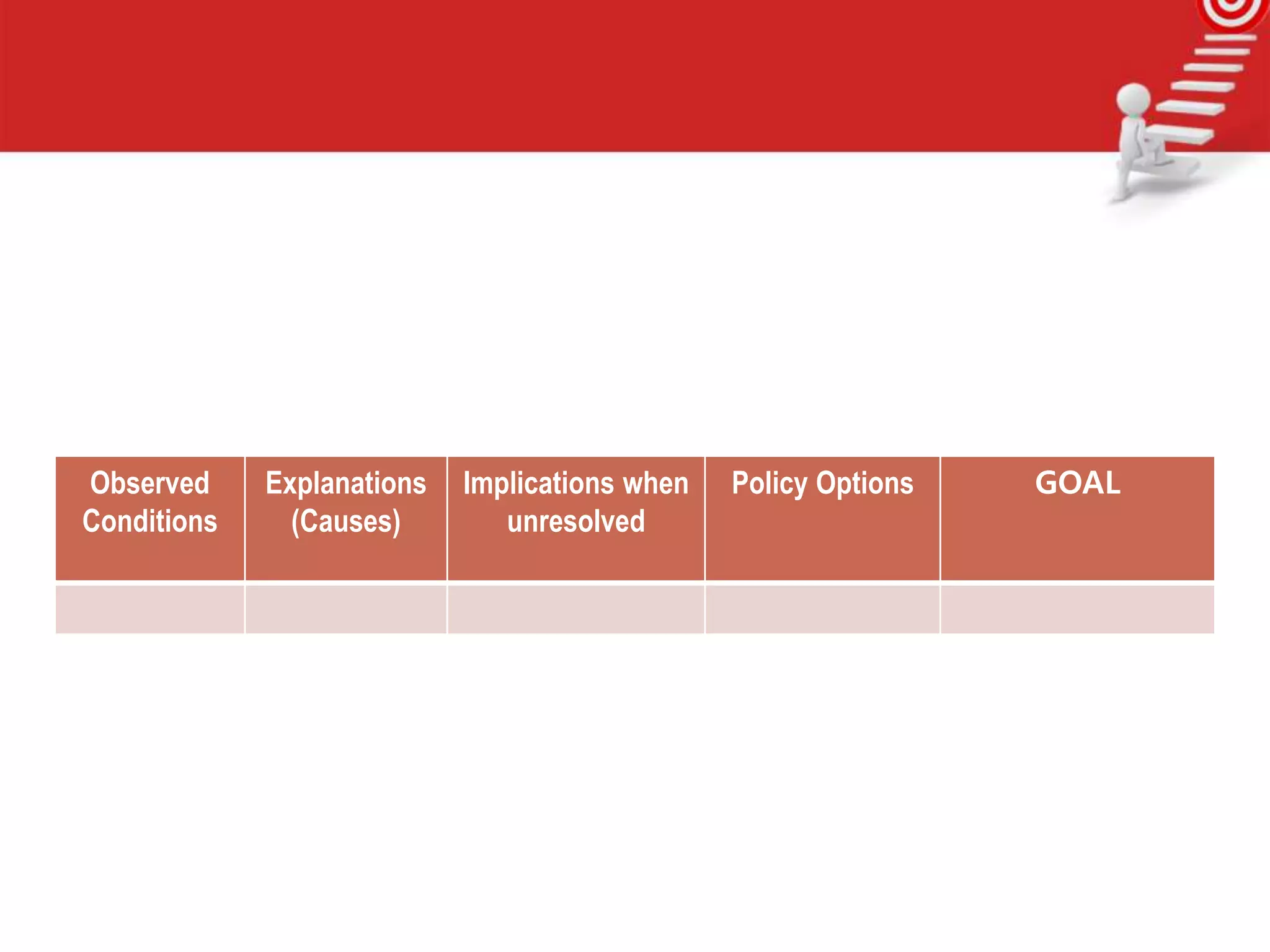
Observed
Conditions
Explanations
(Causes)
Implications when
unresolved
Policy Options
WHAT DO THESE
FIGURES MEAN?
WHY? SO WHAT? WHAT TO DO?
SOLUTIONS
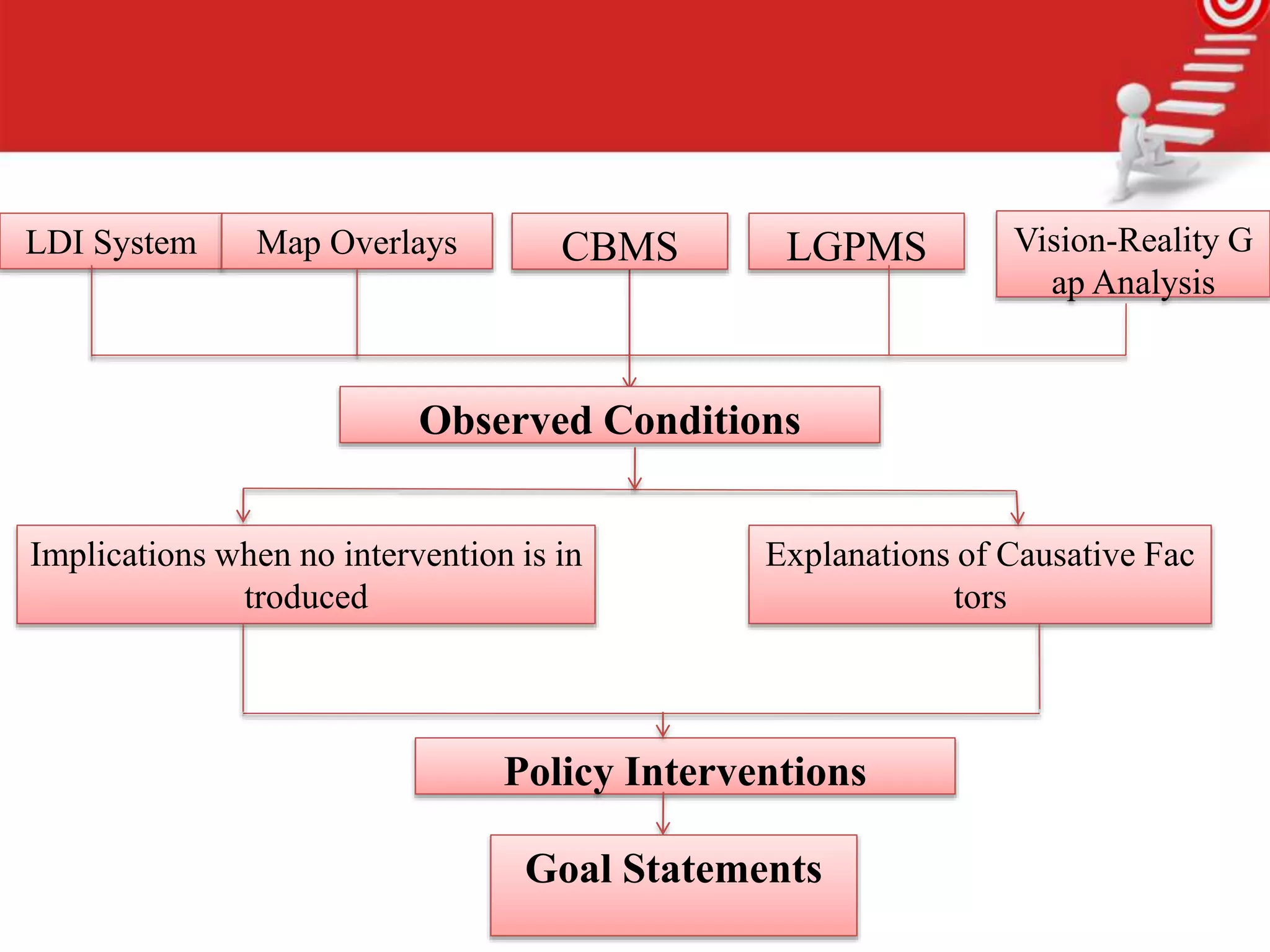
LDI System Map Overlays
Observed Conditions
Implications when no intervention is in
troduced
Explanations of Causative Fac
tors
Policy Interventions
CBMS LGPMS Vision-Reality G
ap Analysis
Goal Statements
Observed
Conditions
Explanations
(Causes)
Implications when
unresolved
Policy Options GOAL
Thank you!

Goal formulation and target setting

  • 1.
  • 2.
    Sectoral Goals are whateverit takes to close the visio n – reality gap identified in the specific sector.
  • 3.
    Importance of Goalsin Planning  As an end toward which all future actions specified in the plan are directed.  As a set of criteria for evaluating alternative strategies and approaches  As a standard against which the success or failure of each action is measured Goals serve at least three (3) purposes in the planning process:
  • 4.
    Sources of SectoralGoals Vision – Reality Gap Problem – Solution Finding Matrix Map Overlay Analysis Community-based Monitoring System Local Governance Performance Management System
  • 5.
    The VRG assource of sectoral goals DESCRIPTORS SUCCESS INDICATORS CURRENT REALITY RATING VISION– REALITY GAP WHAT TO DO TO CLOSE THE GAP Peaceful 0% Crime rate 6 4 Highly skilled Full employment 4 6 Empowered Citizen participation 3 7
  • 6.
    The Problem– SolutionFinding Matrix as source of sectoral goal. SECTOR OBSERVED CONDITIONS EXPLANATIONS (CAUSES) IMPLICATIONS WHEN UNRESOLVED POLICY OPTIONS
  • 7.
    Map overlay analysisas source of sectoral goals Thematic Maps Overlaid Brief Description of Conflict Area Explanations for Conflict Implications when Unresolved Policy Options
  • 8.
    FORMULATING SECTORAL GOALS THESHORT METHOD  Treat the gap as a problem.  Invert, negate or reverse the negative condition to become a desirable state, hence, a goal. Goals Technically Derived Goal is the inverse of a problem GOAL = 1 PROBLEM Formulating Sectoral Goals
  • 9.
    Squatting continues to exist Adhoc approach to housing concerns Absence of permanent housing body Some settlements still exposed to environmental hazards Indigent families not a dequately served Existence of many private hospitals Incidence of drug abuse Loss of cultural artifacts Weak moral values Corruption prevalent Low-level appreciation for local culture and arts Weak promotion of culture and the arts High dependence on paid indoor recreation Some social issues not adequately addressed Limited space for public recreation Children/ youth play in the streets No scholarships for ordinary indigent students Most preschools and all colleges are privately owned Squatting stopped Housing concerns a ddressed regularly Permanent housing body created Settlements located in hazard-free areas Indigent families adequately served Existence of public and private hospitals Drug abuse eliminated Cultural artifacts preserved Strong moral values Corruption stopped or minimized Heightened appreciation for local culture and arts Sustained promotion of culture and the arts Reduced dependence on paid indoor recreation Social issues adequately addressed Ample space for public recreation Playgrounds provided for children/ youth Scholarships offered for or dinary indigent students Public and private preschools and colleges established
  • 10.
    FORMULATING SECTORAL GOALS THELONG METHOD 1. Follow the logic of the “Problem – Solution – Finding Matrix” a. Treat the vision – reality gap as an “observed condition” or new information created b. Subject the observed condition to the process of extracting intelligence and exploring policy implications FROMGAPSTO GOA LS
  • 11.
    FORMULATING SECTORAL GOALS c.Proceed to complete the matrix by first determining the reasons for or causes of the observed gaps, then exploring the possible implications of the gaps if these continue to remain unfilled. d. Develop policy interventions targeting both implications and the explanations. 2. Formulate the policy interventions in the form of goal statements, i.e. “To + verb ...” Example: To make clean, safe water within reach of every household. foRMULATINGSECT ORAL GOALS
  • 12.
    Sector Indicator Planning Area Larger Spatial Unit Smaller SpatialUni ts A B C D Social Population growth rat e 2000 3.2% 2.8% 2.7% 2.0% 2.5% 3.0% 2003 3.0% 2.9% 3.0% 2.1& 2.5% 2.9% Literacy R ate 2000 95% 87% 98% 90% 88% 92% 2003 97% 88% 95% 92% 89% 94% Examples of Items, Statistics, Indicators What do these figures mean? 1
  • 13.
     This entailsprobing into the causes or explanations behind the observed condition s.  It asks the question, “Why?”  It provides the clue to finding more fundamental solutions by attacking the causes rather than the symptoms of the problems. 2
  • 14.
    It asks thequestion, “So what?” if no significant intervention is made  Analysis can be extended further into determining appropriate policy interventions 3
  • 15.
    Take NOTE! If positiveimplications predominate, then the observed condition may be regarded as a potential. If negative implications predominate, then the observed condition can be regarded as a problem. Formulate policies that either mitigate the inconvenience or solve the problem permanently.
  • 16.
  • 17.
    LDI System MapOverlays Observed Conditions Implications when no intervention is in troduced Explanations of Causative Fac tors Policy Interventions CBMS LGPMS Vision-Reality G ap Analysis Goal Statements
  • 18.
  • 19.