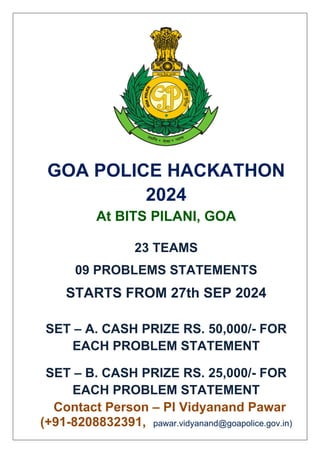
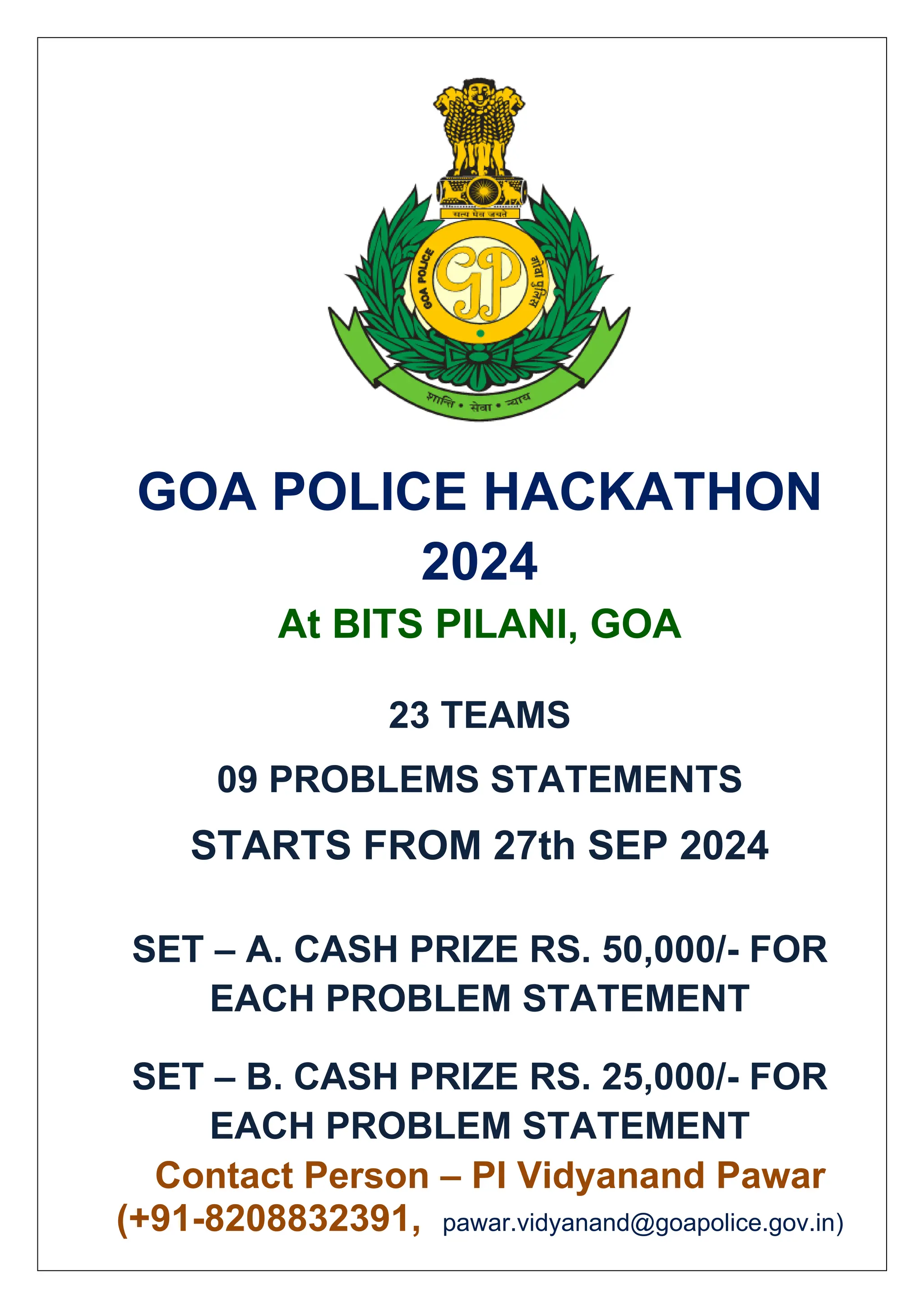
GOA POLICE HACKATHON
2024
At BITS PILANI, GOA
23 TEAMS
09 PROBLEMS STATEMENTS
STARTS FROM 27th SEP 2024
SET – A. CASH PRIZE RS. 50,000/- FOR
EACH PROBLEM STATEMENT
SET – B. CASH PRIZE RS. 25,000/- FOR
EACH PROBLEM STATEMENT
Contact Person – PI Vidyanand Pawar
(+91-8208832391, pawar.vidyanand@goapolice.gov.in)
Goa Police is excited to announce its Second Hackathon to
encourage the students to use their logical and/or coding skills to
solve core Policing problems. With increasing reliance on
technologies while on one hand prevalence of Cybercrimes has
increased on the other hand technology has transformed the way
things are done. With the aim of using technology to boost Police
efficiency and to use technological advancements to augment
conventional way of detecting crimes, Goa Police urges all Goan
students to enthusiastically participate in the event and contribute to
the service of the people and nation building.
Hackathon is being organized as a partnership between Goa Police
and students who can use their innovative thinking, technical
knowhow and enthusiasm for building digital solutions for effective
policing and assuring civil safety. Though the Hackathon is being
organized in acompetitive format, but it is in fact the first step in
partnership of socially responsible students with law enforcement
agencies in building a safe andsecure society.
All Goan students are invited regardless of the field they are
pursuing to participate in this endeavour to ensure safety in the
society through technological solutions for crime detection and
prevention.
Format of the Hackathon
Online Registration opens on 17th
September 2024
Abstract Submission by 24th
September 2024
Shortlisting of teams based on the Abstract Submitted by 25th
Sep
2024
48 hours Hackathon for designing of solutions starting from 27th
Sep 2024, 19:00 hrs till 29th
Sep 2024, 19:00 hrs. Venue – BITS
PILANI, GOA Campus
Final Presentation in the First Week of October 2024 (Date to be
decided later) Tentative venue – Conference hall, PHQ
Registration & Abstract Submission
Participant needs to register their teams online at
https://shorturl.at/Uoabz
Team should have at least 2 members and at the most 4
members.
Teams may enter the contest by submitting an abstract on any
one ormore of the problem statements (list of Problem statement
is annexed).
Teams need to submit a two-page abstract for the chosen
problemcontaining:
o An explanation of the Problem statement (max. 100 words)
o Proposed solution to the Problem statement (max 200 words)
o Features of the Final solution to be designed (max 200
words)
o Reason for opting for the Problem statement (max 100
words)
o Past expertise in the area (if any)
Deadline for emailing the abstracts on Official Email Id -
pawar.vidyanand@goapolice.gov.in is 23:59 hrs on 24th
September 2024
Shortlisting of Teams
Only 23 Teams will be selected to participate in the final 48 hours
Hackathon based on the Abstract submitted. The 03 Teams for SET - A
problems and 02 each Teams for SET - B problems. The abstract will be
evaluated on following parameters:
Suitability of the proposed solution to the requirements of police
Usability of Policing application
Technical and economic feasibility of the proposed solution
Scope of scalability of the proposed solution
Scope of deployment during the 48 hours Hackathon duration
The results of the selection of teams following scrutiny of the
abstract willbe declared on September 25, 2024.
48 hours Hackathon
The 23 teams selected on the basis of the abstract submitted will
be invited to participate in the final non-stop 48 hours hackathon to bring
their ideas to fruition. At this stage the teams are expected to design a
working prototype of the solution based on the chosen problem
statement. The event will start from 27th
Sep 2024 at 19:00 hrs and shall
continue till 18:59 hours on 29th
Sep 2024 At BITS Pilani Goa campus.
In the end the designed application/ solutions alongwith data, libraries,
dependencies etc. shall be submitted to the Goa Police Team at the
venue.
Final Presentation
• All 23 teams shall present the prototype designed during the
Hackathonperiod to a panel of judges in the First week of
October.
• Each team will be given a 10 minutes slot for presentation.
• The presentation shall be evaluated on the basis of suitability to
policerequirements, technical innovation, design robustness and
UI/IX.
• The marking criterion for final presentation shall be communicated
later.
Prizes & Rewards
Certificate of Participation will be awarded to all the participants and
Cash Prizes will be awarded to the Winners of the Hackathon,
immediately after the presentation and evaluation on the decided date, is
as following:
SET – A
1st
Problem Statement Winner, Cash Prize of Rs. 50,000/-
2nd
Problem Statement Winner, Cash Prize of Rs. 50,000/-
3rd
Problem Statement Winner, Cash Prize of Rs.
50,000/-
4th
Problem Statement Winner, Cash Prize of Rs. 50,000/-
5th
Problem Statement Winner, Cash Prize of Rs.
50,000/-
SET – B
6th
Problem Statement Winner, Cash Prize of Rs. 25,000/-
7th
Problem Statement Winner, Cash Prize of Rs. 25,000/-
8th
Problem Statement Winner, Cash Prize of Rs.
25,000/-
9th
Problem Statement Winner, Cash Prize of Rs. 25,000/-
SET – A
I. SOCIAL MEDIA MONITORING (SMM) TOOL
- Objective:
- Develop a tool to monitor social media platforms (Facebook, Instagram,
X) for detecting and analysing Fake news, Hoaxes, Rumours,
Communal, seditious and other illegal content.
- The tool should:
1. Surf social media feeds based on keywords, hashtags, and location
2. Alert law enforcement when unwanted content (e.g., communal,
seditious posts, illegal activities like drug-related or indecent
content) is detected
3. Perform sentiment analysis of social media posts
4. Identify networks of individuals promoting harmful sentiments
5. Track and trace the originators of such content for further
investigation
II. AI/ML SYSTEM FOR DETECTING AND CATEGORIZING
FRAUDULENT ONLINE PLATFORMS – WEBSITES AND MOBILE
APPLICATIONS
- Objective:
- Develop an AI/ML-powered system to detect and categorize fraudulent
online content, including fake websites and mobile applications.
- The tool should:
1. Verify the legitimacy of websites and mobile applications by
analysing domain information, SSL certificates, and other
authentication indicators.
2. Use Natural Language Processing (NLP) and image recognition
techniques to evaluate the authenticity of online advertisements and
app store listings.
3. Cross-check customer care numbers and other contact details
against a verified fraud database (Provided by Goa Police) to identify
potential scams.
4. Continuously improve its fraud detection capabilities using machine
learning models that adapt based on previously identified fraudulent
patterns.
III. AI-BASED TOOL TO ANALYZE RELIGIOUS PREACHING AND
IDENTIFY RADICAL CONTENT
- Objective:
- Develop an AI-based tool to monitor religious preaching videos and
reels on platforms like YouTube, Twitter, Facebook, and Instagram to
detect radical or extremist content.
- The tool should:
1. Be capable of scanning content in both English and Hindi for
radical or extremist narratives.
2. Analyse all videos of a particular user or a specific video based on
the link provided to the system.
3. Perform content analysis by identifying keywords and harmful
narratives indicative of radicalization.
4. Generate real-time alerts if radical content is detected.
5. Utilize machine learning to continuously improve by learning from
previously generated assessments and refining its detection accuracy
over time.
IV. AI-BASED TOOL TO ASSIST VISITORS AT POLICE STATIONS
- Objective:
- Develop an AI-based assistant to help visitors at police stations by
providing basic legal knowledge and overcoming language barriers.
- The tool should:
1. Provide Basic Legal Information:
- Answer common queries such as procedures for reporting house
theft, dealing with molestation or assault, obtaining a Police Clearance
Certificate, and other frequent concerns.
2. Multilingual Support:
- Interact with users in English and Hindi to facilitate effective
communication.
3. User-Friendly Interaction:
- Utilize conversational AI for natural and intuitive engagement,
supporting both text and voice interactions.
4. Assist with Procedures:
- Guide visitors through necessary steps for filing reports or
complaints, including required documentation.
5. Overcome Language Barriers:
- Act as a translation intermediary between visitors and police
personnel when needed.
V. VULNERABILITY ASSESSMENT TOOL FOR GOVERNMENT IT
WEBSITES AND MOBILE APPLICATIONS
- Objective:
- Develop a tool to perform security vulnerability assessments on
government websites and mobile applications.
- The tool should:
1. Accept input as a website URL or an APK file of a mobile
application.
2. Analyse the input for security vulnerabilities based on various
security parameters.
3. Generate a comprehensive vulnerability assessment report
highlighting identified issues.
- For websites:
- Check for common vulnerabilities like SQL injection, cross-site
scripting (XSS), and SSL certificate validity.
- For mobile applications:
- Perform static analysis to detect insecure coding practices and
permission issues.
- Present findings in a clear report with severity levels and
recommended remediation steps.
SET - B
VI. MOBILE APPLICATION-BASED VEHICLE PASS FOR TRAFFIC
VIOLATION CHECKS
- Objective:
- During traffic checking, a lot of complaints are received where a
vehicle is stopped multiple times by Police staff placed at various nakas.
We want to develop a mobile application to issue digital vehicle passes
for vehicle already checked that will reducing harassment of commuters
and improving traffic flow.
- The tool should:
1. Real-time Pass Generation:
- Allow traffic officers to issue a digital pass valid for 4 hours after a
vehicle or driver is checked.
2. QR Code Integration:
- Generate passes with scannable QR codes or barcodes for easy
verification by other officers.
3. Vehicle and Driver Database:
- Maintain a secure backend database storing vehicle and driver
information, along with violation history.
4. Geo-tagging and Timestamping:
- Record the location and time of each violation check and pass
issuance.
5. Officer Authentication:
- Require officers to authenticate themselves with unique login
credentials before issuing or verifying passes.
6. Alert System:
- Provide real-time alerts to officers if a vehicle is flagged for a
violation after a pass has been issued.
VII. MOBILE APPLICATION TO MAP PARKING SPACES WITH
REAL-TIME VACANCY INFORMATION
- Objective:
- Develop a web-based mobile application that maps all available
parking spaces in Goa, providing tourists and locals with real-time
information on vacant spots along with integrated payment system for
parking charges
- The tool should:
1. Map All Parking Spaces:
- Include comprehensive data on all public and private parking
facilities across Goa. Data is already available with Police authorities,
will be provided to the students.
2. Real-Time Vacancy Information:
- Provide up-to-date information on available parking spots in each
facility. Students undertaking this problem may bring a prototype of
motion sensor-based counter to count number of vehicles parked in the
parking space.
3. User Navigation:
- Enable users to locate and navigate to the nearest available
parking space with ease.
4. Scalability for Payment Integration:
- Include a payment interface for paid parking spaces incorporating
wallet and payment gateway facilities.
5. Support Traffic Authorities:
- Provide tools or data analytics to assist traffic police in monitoring
parking space usage and reducing the need for manpower to manage
parking-related congestion.
VIII. MOBILE APPLICATION TO LOCATE NEAREST CCTV
CAMERAS FOR INVESTIGATING OFFICERS
- Objective:
- Develop a software solution (web app or mobile application) that
assists investigating officers in locating the nearest CCTV cameras
based on their current location. The tool aims to streamline
investigations by providing quick access to geo tagged CCTV data,
including details such as owner information and days of backup
available.
- The tool should:
1. Access Geo tagged CCTV Database:
- Utilize the compiled geo tagged information of all CCTV cameras
across Goa.
2. Location-Based Search:
- Allow officers to input a specific location or use their current GPS
location to find the nearest CCTV cameras relative to a scene of crime.
3. Detailed Camera Information:
- Provide essential details for each CCTV camera, including:
- Owner's name and contact information.
- Number of days footage is retained (backup duration).
- Camera specifications (e.g., resolution, field of view).
- Operational status and accessibility notes.
4. Interactive Map Interface:
- Display CCTV camera locations on an interactive map for easy
visualization.
- Enable officers to select a camera icon to view detailed information.
5. Navigation Assistance:
- Offer navigation directions to the selected CCTV camera location
from the officer's current position.
6. Search and Filter Options:
- Enable filtering of cameras based on criteria such as distance,
backup duration, ownership (public or private), and camera capabilities.
7. Secure Access and Authentication:
- Restrict access to authorized personnel through secure login
credentials.
- Ensure that sensitive information is protected and complies with
data privacy regulations.
8. Data Update Mechanism:
- Allow for regular updates to the CCTV database to add new
cameras or modify existing entries.
- Include a feature for officers to report discrepancies or updates in
camera information.
IX. E-BANDOBAST
- Objective:
- Create a digital tool to manage the deployment and track the
movement of police personnel during large events using real-time
location tracking.
- The tool should:
1. Allow deployment data to be uploaded in a predefined Excel
format, containing details such as officer’s name, mobile number, duty
location, supervisory officer, charter of duty, timing, call sign, and other
relevant information.
2. Send SMS notifications to officers with a link to check in at their
assigned duty location.
3. Track the officer’s location throughout the shift using geofencing.
4. Trigger real-time alerts to the supervisor if the officer deviates from
the assigned duty area.
5. Require the supervisor’s approval for log-off at the end of the shift
to confirm duty completion and stop location tracking.
6. Automate deployment instructions, manage check-ins, and log-offs
seamlessly through SMS integration.

Goa_Police_Hackathon-2024.pdfejjejejejee

  • 1.
    GOA POLICE HACKATHON 2024 AtBITS PILANI, GOA 23 TEAMS 09 PROBLEMS STATEMENTS STARTS FROM 27th SEP 2024 SET – A. CASH PRIZE RS. 50,000/- FOR EACH PROBLEM STATEMENT SET – B. CASH PRIZE RS. 25,000/- FOR EACH PROBLEM STATEMENT Contact Person – PI Vidyanand Pawar (+91-8208832391, pawar.vidyanand@goapolice.gov.in)
  • 2.
    Goa Police isexcited to announce its Second Hackathon to encourage the students to use their logical and/or coding skills to solve core Policing problems. With increasing reliance on technologies while on one hand prevalence of Cybercrimes has increased on the other hand technology has transformed the way things are done. With the aim of using technology to boost Police efficiency and to use technological advancements to augment conventional way of detecting crimes, Goa Police urges all Goan students to enthusiastically participate in the event and contribute to the service of the people and nation building. Hackathon is being organized as a partnership between Goa Police and students who can use their innovative thinking, technical knowhow and enthusiasm for building digital solutions for effective policing and assuring civil safety. Though the Hackathon is being organized in acompetitive format, but it is in fact the first step in partnership of socially responsible students with law enforcement agencies in building a safe andsecure society. All Goan students are invited regardless of the field they are pursuing to participate in this endeavour to ensure safety in the society through technological solutions for crime detection and prevention.
  • 3.
    Format of theHackathon Online Registration opens on 17th September 2024 Abstract Submission by 24th September 2024 Shortlisting of teams based on the Abstract Submitted by 25th Sep 2024 48 hours Hackathon for designing of solutions starting from 27th Sep 2024, 19:00 hrs till 29th Sep 2024, 19:00 hrs. Venue – BITS PILANI, GOA Campus Final Presentation in the First Week of October 2024 (Date to be decided later) Tentative venue – Conference hall, PHQ Registration & Abstract Submission Participant needs to register their teams online at https://shorturl.at/Uoabz Team should have at least 2 members and at the most 4 members. Teams may enter the contest by submitting an abstract on any one ormore of the problem statements (list of Problem statement is annexed). Teams need to submit a two-page abstract for the chosen problemcontaining: o An explanation of the Problem statement (max. 100 words) o Proposed solution to the Problem statement (max 200 words) o Features of the Final solution to be designed (max 200 words)
  • 4.
    o Reason foropting for the Problem statement (max 100 words) o Past expertise in the area (if any) Deadline for emailing the abstracts on Official Email Id - pawar.vidyanand@goapolice.gov.in is 23:59 hrs on 24th September 2024
  • 5.
    Shortlisting of Teams Only23 Teams will be selected to participate in the final 48 hours Hackathon based on the Abstract submitted. The 03 Teams for SET - A problems and 02 each Teams for SET - B problems. The abstract will be evaluated on following parameters: Suitability of the proposed solution to the requirements of police Usability of Policing application Technical and economic feasibility of the proposed solution Scope of scalability of the proposed solution Scope of deployment during the 48 hours Hackathon duration The results of the selection of teams following scrutiny of the abstract willbe declared on September 25, 2024. 48 hours Hackathon The 23 teams selected on the basis of the abstract submitted will be invited to participate in the final non-stop 48 hours hackathon to bring their ideas to fruition. At this stage the teams are expected to design a working prototype of the solution based on the chosen problem statement. The event will start from 27th Sep 2024 at 19:00 hrs and shall continue till 18:59 hours on 29th Sep 2024 At BITS Pilani Goa campus. In the end the designed application/ solutions alongwith data, libraries, dependencies etc. shall be submitted to the Goa Police Team at the venue.
  • 6.
    Final Presentation • All23 teams shall present the prototype designed during the Hackathonperiod to a panel of judges in the First week of October. • Each team will be given a 10 minutes slot for presentation. • The presentation shall be evaluated on the basis of suitability to policerequirements, technical innovation, design robustness and UI/IX. • The marking criterion for final presentation shall be communicated later. Prizes & Rewards Certificate of Participation will be awarded to all the participants and Cash Prizes will be awarded to the Winners of the Hackathon, immediately after the presentation and evaluation on the decided date, is as following: SET – A 1st Problem Statement Winner, Cash Prize of Rs. 50,000/- 2nd Problem Statement Winner, Cash Prize of Rs. 50,000/- 3rd Problem Statement Winner, Cash Prize of Rs. 50,000/- 4th Problem Statement Winner, Cash Prize of Rs. 50,000/- 5th Problem Statement Winner, Cash Prize of Rs. 50,000/-
  • 7.
    SET – B 6th ProblemStatement Winner, Cash Prize of Rs. 25,000/- 7th Problem Statement Winner, Cash Prize of Rs. 25,000/- 8th Problem Statement Winner, Cash Prize of Rs. 25,000/- 9th Problem Statement Winner, Cash Prize of Rs. 25,000/-
  • 8.
    SET – A I.SOCIAL MEDIA MONITORING (SMM) TOOL - Objective: - Develop a tool to monitor social media platforms (Facebook, Instagram, X) for detecting and analysing Fake news, Hoaxes, Rumours, Communal, seditious and other illegal content. - The tool should: 1. Surf social media feeds based on keywords, hashtags, and location 2. Alert law enforcement when unwanted content (e.g., communal, seditious posts, illegal activities like drug-related or indecent content) is detected 3. Perform sentiment analysis of social media posts 4. Identify networks of individuals promoting harmful sentiments 5. Track and trace the originators of such content for further investigation II. AI/ML SYSTEM FOR DETECTING AND CATEGORIZING FRAUDULENT ONLINE PLATFORMS – WEBSITES AND MOBILE APPLICATIONS - Objective: - Develop an AI/ML-powered system to detect and categorize fraudulent online content, including fake websites and mobile applications. - The tool should: 1. Verify the legitimacy of websites and mobile applications by analysing domain information, SSL certificates, and other
  • 9.
    authentication indicators. 2. UseNatural Language Processing (NLP) and image recognition techniques to evaluate the authenticity of online advertisements and app store listings. 3. Cross-check customer care numbers and other contact details against a verified fraud database (Provided by Goa Police) to identify potential scams. 4. Continuously improve its fraud detection capabilities using machine learning models that adapt based on previously identified fraudulent patterns. III. AI-BASED TOOL TO ANALYZE RELIGIOUS PREACHING AND IDENTIFY RADICAL CONTENT - Objective: - Develop an AI-based tool to monitor religious preaching videos and reels on platforms like YouTube, Twitter, Facebook, and Instagram to detect radical or extremist content. - The tool should: 1. Be capable of scanning content in both English and Hindi for radical or extremist narratives. 2. Analyse all videos of a particular user or a specific video based on the link provided to the system. 3. Perform content analysis by identifying keywords and harmful narratives indicative of radicalization. 4. Generate real-time alerts if radical content is detected. 5. Utilize machine learning to continuously improve by learning from previously generated assessments and refining its detection accuracy over time.
  • 10.
    IV. AI-BASED TOOLTO ASSIST VISITORS AT POLICE STATIONS - Objective: - Develop an AI-based assistant to help visitors at police stations by providing basic legal knowledge and overcoming language barriers. - The tool should: 1. Provide Basic Legal Information: - Answer common queries such as procedures for reporting house theft, dealing with molestation or assault, obtaining a Police Clearance Certificate, and other frequent concerns. 2. Multilingual Support: - Interact with users in English and Hindi to facilitate effective communication. 3. User-Friendly Interaction: - Utilize conversational AI for natural and intuitive engagement, supporting both text and voice interactions. 4. Assist with Procedures: - Guide visitors through necessary steps for filing reports or complaints, including required documentation. 5. Overcome Language Barriers: - Act as a translation intermediary between visitors and police personnel when needed. V. VULNERABILITY ASSESSMENT TOOL FOR GOVERNMENT IT WEBSITES AND MOBILE APPLICATIONS - Objective: - Develop a tool to perform security vulnerability assessments on government websites and mobile applications. - The tool should: 1. Accept input as a website URL or an APK file of a mobile application.
  • 11.
    2. Analyse theinput for security vulnerabilities based on various security parameters. 3. Generate a comprehensive vulnerability assessment report highlighting identified issues. - For websites: - Check for common vulnerabilities like SQL injection, cross-site scripting (XSS), and SSL certificate validity. - For mobile applications: - Perform static analysis to detect insecure coding practices and permission issues. - Present findings in a clear report with severity levels and recommended remediation steps. SET - B VI. MOBILE APPLICATION-BASED VEHICLE PASS FOR TRAFFIC VIOLATION CHECKS - Objective: - During traffic checking, a lot of complaints are received where a vehicle is stopped multiple times by Police staff placed at various nakas. We want to develop a mobile application to issue digital vehicle passes for vehicle already checked that will reducing harassment of commuters and improving traffic flow. - The tool should: 1. Real-time Pass Generation: - Allow traffic officers to issue a digital pass valid for 4 hours after a vehicle or driver is checked. 2. QR Code Integration: - Generate passes with scannable QR codes or barcodes for easy verification by other officers.
  • 12.
    3. Vehicle andDriver Database: - Maintain a secure backend database storing vehicle and driver information, along with violation history. 4. Geo-tagging and Timestamping: - Record the location and time of each violation check and pass issuance. 5. Officer Authentication: - Require officers to authenticate themselves with unique login credentials before issuing or verifying passes. 6. Alert System: - Provide real-time alerts to officers if a vehicle is flagged for a violation after a pass has been issued. VII. MOBILE APPLICATION TO MAP PARKING SPACES WITH REAL-TIME VACANCY INFORMATION - Objective: - Develop a web-based mobile application that maps all available parking spaces in Goa, providing tourists and locals with real-time information on vacant spots along with integrated payment system for parking charges - The tool should: 1. Map All Parking Spaces: - Include comprehensive data on all public and private parking facilities across Goa. Data is already available with Police authorities, will be provided to the students. 2. Real-Time Vacancy Information: - Provide up-to-date information on available parking spots in each facility. Students undertaking this problem may bring a prototype of motion sensor-based counter to count number of vehicles parked in the parking space.
  • 13.
    3. User Navigation: -Enable users to locate and navigate to the nearest available parking space with ease. 4. Scalability for Payment Integration: - Include a payment interface for paid parking spaces incorporating wallet and payment gateway facilities. 5. Support Traffic Authorities: - Provide tools or data analytics to assist traffic police in monitoring parking space usage and reducing the need for manpower to manage parking-related congestion. VIII. MOBILE APPLICATION TO LOCATE NEAREST CCTV CAMERAS FOR INVESTIGATING OFFICERS - Objective: - Develop a software solution (web app or mobile application) that assists investigating officers in locating the nearest CCTV cameras based on their current location. The tool aims to streamline investigations by providing quick access to geo tagged CCTV data, including details such as owner information and days of backup available. - The tool should: 1. Access Geo tagged CCTV Database: - Utilize the compiled geo tagged information of all CCTV cameras across Goa. 2. Location-Based Search: - Allow officers to input a specific location or use their current GPS location to find the nearest CCTV cameras relative to a scene of crime. 3. Detailed Camera Information: - Provide essential details for each CCTV camera, including: - Owner's name and contact information.
  • 14.
    - Number ofdays footage is retained (backup duration). - Camera specifications (e.g., resolution, field of view). - Operational status and accessibility notes. 4. Interactive Map Interface: - Display CCTV camera locations on an interactive map for easy visualization. - Enable officers to select a camera icon to view detailed information. 5. Navigation Assistance: - Offer navigation directions to the selected CCTV camera location from the officer's current position. 6. Search and Filter Options: - Enable filtering of cameras based on criteria such as distance, backup duration, ownership (public or private), and camera capabilities. 7. Secure Access and Authentication: - Restrict access to authorized personnel through secure login credentials. - Ensure that sensitive information is protected and complies with data privacy regulations. 8. Data Update Mechanism: - Allow for regular updates to the CCTV database to add new cameras or modify existing entries. - Include a feature for officers to report discrepancies or updates in camera information. IX. E-BANDOBAST - Objective: - Create a digital tool to manage the deployment and track the movement of police personnel during large events using real-time location tracking. - The tool should:
  • 15.
    1. Allow deploymentdata to be uploaded in a predefined Excel format, containing details such as officer’s name, mobile number, duty location, supervisory officer, charter of duty, timing, call sign, and other relevant information. 2. Send SMS notifications to officers with a link to check in at their assigned duty location. 3. Track the officer’s location throughout the shift using geofencing. 4. Trigger real-time alerts to the supervisor if the officer deviates from the assigned duty area. 5. Require the supervisor’s approval for log-off at the end of the shift to confirm duty completion and stop location tracking. 6. Automate deployment instructions, manage check-ins, and log-offs seamlessly through SMS integration.