National Income Accounting
Depression—Surprise!

•   After being blind-sided by the Great Depression, policymakers
    decided that they needed measures of economic activity.
•   A Keynesian economist, Simon Kuznets, was charged with
    establishing the methodology for this in the late 1930s.
•   Kuznets later received the Nobel Prize for his efforts.
Macroeconomics and national income accounts

• GDP and its measurement

• Output approach, income approach and
  expenditure approach

• The components of GDP

• From GDP to GNP to National Income

• How good an indicator of a country’s living
  standards is GDP?
National income accounting
• National income accounting is about measuring
  economic activity
• One of the most comprehensive measures of a
  country’s economic activity is the value of total
  production of its goods and services, called
  national product
• The rate of economic growth is an important
  indicator of a country’s economic performance
  (although a high growth rate does not necessarily
  lead to less poverty)
Gross Domestic Product
• Gross Domestic Product (GDP) is the most widely
  reported measure to indicate a country’s economic
  performance


• GDP is the market value of all final goods and
  services produced in a nation during a specific
  period of time, usually a quarter or a year
Gross National Product
• Gross National Product (GNP) is the market value
  of all goods and services produced by nationals
  (e.g. UK citizens) wherever they are located.


• GDP/GNP are expressed in monetary terms, thus
  rely on the markets to establish the relative
  values of goods and services
GDP vs. GNP
• Gross Domestic Product (GDP) is the total value of final
  goods and services produced during a given period within
  the geographic boundaries of a country regardless of by
  whom. The goods and services are produced domestically.

• Gross National Product (GNP) is the total value of final
  goods and services produced during a given period by the
  citizens of a country no matter where they live. The goods
  and services are produced by the “nationals” of the
  country.
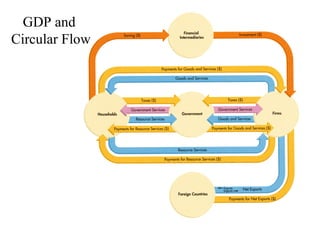
GDP and
Circular Flow
Points to remember when measuring GDP...
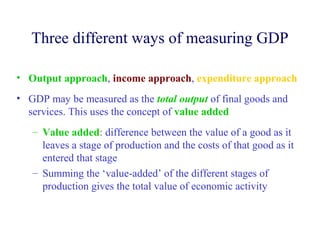
(a) Secondhand transactions are not included (since merely
    exchanges of previously produced goods)
(b) Private or public transfer payments are not counted (e.g.
    unemployment insurance benefits – not made in exchange of
    a service => no new production)
(c) Only final goods, intermediate goods not included (e.g.
    bread yes, flour no)
    => If any of these items were included in the calculations,
       the measurement of economic activity would be subject
    to ‘double-counting’
(d) Excludes financial transactions and income transfers
    since these do not reflect production.
Three different ways of measuring GDP

• Output approach, income approach, expenditure approach
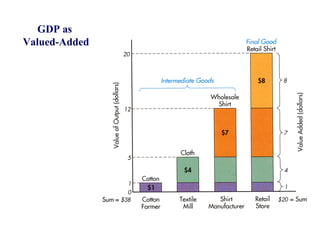
• GDP may be measured as the total output of final goods and
  services. This uses the concept of value added
   – Value added: difference between the value of a good as it
     leaves a stage of production and the costs of that good as it
     entered that stage
   – Summing the ‘value-added’ of the different stages of
     production gives the total value of economic activity
GDP as
Valued-Added
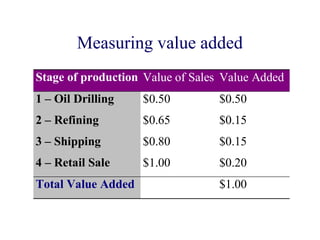
Measuring value added
Stage of production Value of Sales Value Added
1 – Oil Drilling    $0.50         $0.50
2 – Refining        $0.65         $0.15
3 – Shipping        $0.80         $0.15
4 – Retail Sale     $1.00         $0.20
Total Value Added                 $1.00
• GDP may be measured as the total income earned
  by the factors of production (i.e. land, labour and
  capital) derived from producing the output =>
  sum of factor incomes

• GDP may be measured by using the expenditure
   on total output. It is measured initially at market
   prices, including indirect taxes such as VAT but
   excluding subsidies. This approach provides a
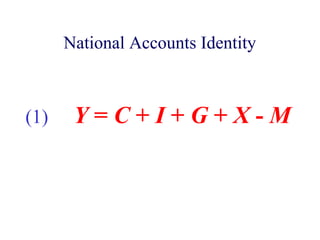
   very useful identity Y = C + I + G + X – M
(see why in a couple of slides!)
• The income and expenditure measures are expressed in
  monetary terms at the market prices that prevail (i.e. at
  current prices or in nominal terms)
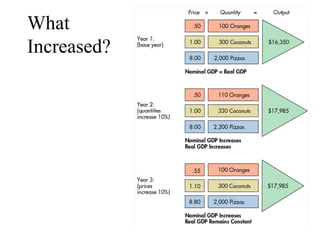
• Nominal GDP (p x q) can grow because of three reasons:
   – Output (q) rises and prices remain unchanged
   – Prices (p) rise and output remains unchanged
   – Both output and prices rise

• In order to control for price changes GDP can be
  calculated using a base set of prices. The real measures can
  then be obtained by deflating GDP by a relevant price
  index
What
Increased?
Three Key Price Indexes

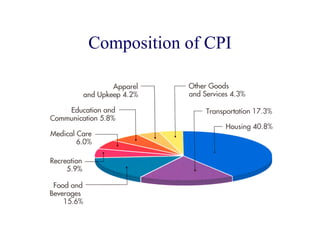
•   Consumer Price Index (CPI)
     – measures the impact of price changes on the cost of the typical
       bundle of goods and services purchased by households.
•   Producer Price Index (PPI)
     – A measure of the average prices received by producers for raw
       materials, intermediate, and final goods. The PPI used to be
       called the Wholesale Price Index (WPI).
•   GDP Deflator (GDP Price Index or GDPPI)
     – Is a broader price index than the CPI. It is designed to measure
       the change in the average price of all the goods and services
       included in GDP.
Composition of CPI
The Expenditure approach is important for
  highlighting linkages between macroeconomic
  indicators ….
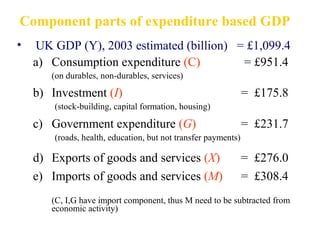
Component parts of expenditure based GDP
•   UK GDP (Y), 2003 estimated (billion) = £1,099.4
    a) Consumption expenditure (C)        = £951.4
       (on durables, non-durables, services)

    b) Investment (I)                                           = £175.8
        (stock-building, capital formation, housing)

    c) Government expenditure (G)                               = £231.7
        (roads, health, education, but not transfer payments)

    d) Exports of goods and services (X)                        = £276.0
    e) Imports of goods and services (M)                        = £308.4
       (C, I,G have import component, thus M need to be subtracted from
       economic activity)
National Accounts Identity


(1)    Y=C+I+G+X-M
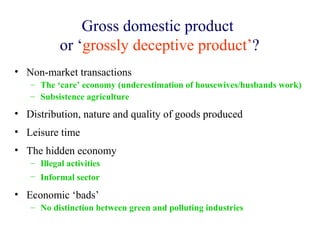
Gross domestic product
           or ‘grossly deceptive product’?
• Non-market transactions
   – The ‘care’ economy (underestimation of housewives/husbands work)
   – Subsistence agriculture

• Distribution, nature and quality of goods produced
• Leisure time
• The hidden economy
   – Illegal activities
   – Informal sector

• Economic ‘bads’
   – No distinction between green and polluting industries
• This list of omissions suggests that GDP figures
  are a dubious guide to the quality of life in
  different countries
• Nevertheless GDP per capita is used a broad
  indicator of living standards

• Examples of alternative measures:
   – HDI (weighted average of life expectancy,
     education and income)
Other national accounts
• GDP + Net Factor Income (NFI) = GNP
• Net National Product (NNP) = GNP - Depreciation
   (depreciation: estimate of the capital worn out by producing GDP)
• National Income: total income earned by the owners of
  resources, including wages, rents, interest and profits
   NI = NNP - indirect taxes [taxes on goods sold, e.g. VAT]
• Personal Income: total income received by households that is
  available for consumption, saving and the payment of personal
  taxes
• Personal disposable Income (PDI): Personal Income minus
  personal income taxes plus transfer payments received by
  individuals
   – PDI = PI – income taxes + transfers

Gross National Product

  • 1.
  • 2.
    Depression—Surprise! • After being blind-sided by the Great Depression, policymakers decided that they needed measures of economic activity. • A Keynesian economist, Simon Kuznets, was charged with establishing the methodology for this in the late 1930s. • Kuznets later received the Nobel Prize for his efforts.
  • 3.
    Macroeconomics and nationalincome accounts • GDP and its measurement • Output approach, income approach and expenditure approach • The components of GDP • From GDP to GNP to National Income • How good an indicator of a country’s living standards is GDP?
  • 4.
    National income accounting •National income accounting is about measuring economic activity • One of the most comprehensive measures of a country’s economic activity is the value of total production of its goods and services, called national product • The rate of economic growth is an important indicator of a country’s economic performance (although a high growth rate does not necessarily lead to less poverty)
  • 5.
    Gross Domestic Product •Gross Domestic Product (GDP) is the most widely reported measure to indicate a country’s economic performance • GDP is the market value of all final goods and services produced in a nation during a specific period of time, usually a quarter or a year
  • 6.
    Gross National Product •Gross National Product (GNP) is the market value of all goods and services produced by nationals (e.g. UK citizens) wherever they are located. • GDP/GNP are expressed in monetary terms, thus rely on the markets to establish the relative values of goods and services
  • 7.
    GDP vs. GNP •Gross Domestic Product (GDP) is the total value of final goods and services produced during a given period within the geographic boundaries of a country regardless of by whom. The goods and services are produced domestically. • Gross National Product (GNP) is the total value of final goods and services produced during a given period by the citizens of a country no matter where they live. The goods and services are produced by the “nationals” of the country.
  • 8.
  • 9.
    Points to rememberwhen measuring GDP... (a) Secondhand transactions are not included (since merely exchanges of previously produced goods) (b) Private or public transfer payments are not counted (e.g. unemployment insurance benefits – not made in exchange of a service => no new production) (c) Only final goods, intermediate goods not included (e.g. bread yes, flour no) => If any of these items were included in the calculations, the measurement of economic activity would be subject to ‘double-counting’ (d) Excludes financial transactions and income transfers since these do not reflect production.
  • 10.
    Three different waysof measuring GDP • Output approach, income approach, expenditure approach • GDP may be measured as the total output of final goods and services. This uses the concept of value added – Value added: difference between the value of a good as it leaves a stage of production and the costs of that good as it entered that stage – Summing the ‘value-added’ of the different stages of production gives the total value of economic activity
  • 11.
  • 12.
    Measuring value added Stageof production Value of Sales Value Added 1 – Oil Drilling $0.50 $0.50 2 – Refining $0.65 $0.15 3 – Shipping $0.80 $0.15 4 – Retail Sale $1.00 $0.20 Total Value Added $1.00
  • 13.
    • GDP maybe measured as the total income earned by the factors of production (i.e. land, labour and capital) derived from producing the output => sum of factor incomes • GDP may be measured by using the expenditure on total output. It is measured initially at market prices, including indirect taxes such as VAT but excluding subsidies. This approach provides a very useful identity Y = C + I + G + X – M (see why in a couple of slides!)
  • 14.
    • The incomeand expenditure measures are expressed in monetary terms at the market prices that prevail (i.e. at current prices or in nominal terms) • Nominal GDP (p x q) can grow because of three reasons: – Output (q) rises and prices remain unchanged – Prices (p) rise and output remains unchanged – Both output and prices rise • In order to control for price changes GDP can be calculated using a base set of prices. The real measures can then be obtained by deflating GDP by a relevant price index
  • 15.
  • 16.
    Three Key PriceIndexes • Consumer Price Index (CPI) – measures the impact of price changes on the cost of the typical bundle of goods and services purchased by households. • Producer Price Index (PPI) – A measure of the average prices received by producers for raw materials, intermediate, and final goods. The PPI used to be called the Wholesale Price Index (WPI). • GDP Deflator (GDP Price Index or GDPPI) – Is a broader price index than the CPI. It is designed to measure the change in the average price of all the goods and services included in GDP.
  • 17.
  • 18.
    The Expenditure approachis important for highlighting linkages between macroeconomic indicators ….
  • 19.
    Component parts ofexpenditure based GDP • UK GDP (Y), 2003 estimated (billion) = £1,099.4 a) Consumption expenditure (C) = £951.4 (on durables, non-durables, services) b) Investment (I) = £175.8 (stock-building, capital formation, housing) c) Government expenditure (G) = £231.7 (roads, health, education, but not transfer payments) d) Exports of goods and services (X) = £276.0 e) Imports of goods and services (M) = £308.4 (C, I,G have import component, thus M need to be subtracted from economic activity)
  • 20.
  • 21.
    Gross domestic product or ‘grossly deceptive product’? • Non-market transactions – The ‘care’ economy (underestimation of housewives/husbands work) – Subsistence agriculture • Distribution, nature and quality of goods produced • Leisure time • The hidden economy – Illegal activities – Informal sector • Economic ‘bads’ – No distinction between green and polluting industries
  • 22.
    • This listof omissions suggests that GDP figures are a dubious guide to the quality of life in different countries • Nevertheless GDP per capita is used a broad indicator of living standards • Examples of alternative measures: – HDI (weighted average of life expectancy, education and income)
  • 23.
    Other national accounts •GDP + Net Factor Income (NFI) = GNP • Net National Product (NNP) = GNP - Depreciation (depreciation: estimate of the capital worn out by producing GDP) • National Income: total income earned by the owners of resources, including wages, rents, interest and profits NI = NNP - indirect taxes [taxes on goods sold, e.g. VAT] • Personal Income: total income received by households that is available for consumption, saving and the payment of personal taxes • Personal disposable Income (PDI): Personal Income minus personal income taxes plus transfer payments received by individuals – PDI = PI – income taxes + transfers