Presenters:- 
Nitin Sharma 
Ribhu Vashishtha
 Investigate how domestic and international 
companies conduct HR practices around the 
world. 
 To identify trends in HRM across five 
countries: United Kingdom, France, USA, Japan 
and Lithuania. 
 How the adoption of New Public 
Management(NPM) has affected civil public 
infrastructures across the world. 
Globalization & HRM-Nitin & Ribhu 15-09-2014 2
 Impact of Globalization on HRM(Determine the 
challenges that organizations face when trying to 
globalize their HR function and practices.) 
 Determine what organizations are doing to 
institute a consistent corporate culture across all 
locations/offices. 
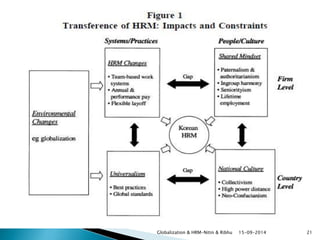
 Impact of Globalization on HRM: Case of South 
Korea 
 Impact of Globalization on HRM function in 
developing countries : Case Study of Kenya Public 
Corporations 
Globalization & HRM-Nitin & Ribhu 15-09-2014 3
 The globalization of HR is characterized 
by increasing levels of decentralization. 
 Half of all international organizations 
reported having one primary HR 
department with independent regional 
HR staff. 
 
Globalization & HRM-Nitin & Ribhu 15-09-2014 4
 Many international (37 percent) and 
domestic (42 percent) companies 
reported using a more centralized 
approach—one primary HR department 
with dependent regional HR staff. 
 More than a third of domestic 
organizations reported having only a 
primary HR department with no regional 
HR staff. 
Globalization & HRM-Nitin & Ribhu 15-09-2014 5
 System Architecture 
 Policy Alternatives 
 Practice Process 
Globalization & HRM-Nitin & Ribhu 15-09-2014 6
International and domestic organizations 
identified similar HR priorities for the 
next two years. 
 The top priority, identified by 52 
percent of international companies, was 
leadership development. Domestic 
organizations also ranked leadership 
development as a top priority (35 
percent). 
 Globalization & HRM-Nitin & Ribhu 15-09-2014 7
Recruiting high-quality employees 
ranked second as a priority for both 
international (40 percent) and domestic 
companies (46 percent). 
Employee retention was also a top 
concern for both international (33 
percent) and domestic companies (46 
percent). In fact, retention was the top 
priority for domestic organizations. 
Globalization & HRM-Nitin & Ribhu 15-09-2014 8
A majority of international (79 percent) 
and domestic (87 percent) organizations 
reported that their parent organizations 
are taking action to make HR practices 
more consistent across all locations 
offices. 
Globalization & HRM-Nitin & Ribhu 15-09-2014 9
 International organizations use 
consistent HR practices to help 
develop a common corporate culture 
(75 percent) and to improve the 
effectiveness of the HR function (73 
percent). 
 Domestic organizations are creating 
consistent HR practices to improve 
both the effectiveness (81 percent) 
and the efficiency (71 percent) of the 
HR function. 
Globalization & HRM-Nitin & Ribhu 15-09-2014 10
 Selection practices vary greatly across 
locations in international 
organizations. Selection practices that 
vary the most include: 
o — Assessments (role plays and 
simulations). 
o — Testing for selection purposes. 
o — Internet advertising (recruiting). 
Globalization & HRM-Nitin & Ribhu 15-09-2014 11
International companies face many 
challenges when trying to make HR 
practices consistent across all 
locations/offices. The top three 
challenges include: 
Globalization & HRM-Nitin & Ribhu 15-09-2014 12
i. Variations in social, political, and economic 
circumstances. 
ii. Different locations/offices have their own 
way of doing things and are resistant to 
change. 
iii. The perceived value of the HR function 
varies across locations/offices. 
Globalization & HRM-Nitin & Ribhu 15-09-2014 13
Developed a long-term HR plan to ensure 
alignment of HR strategies/objectives with 
corporate objectives. 
Created centralized reporting relationships 
around the globe. 
Standardized assessment, development, and 
compensation practices. 
Globalization & HRM-Nitin & Ribhu 15-09-2014 14
Introduced practices to regions around the 
globe and allowed the HR function in each 
region the autonomy to do the job. 
Created global policies/processes for data 
management, performance management, 
compensation, education, and development. 
Tied regional accountability to performance 
management. 
Shared HR best practices used in certain 
locations with all other locations. 
Developed an HR mission statement. 
Globalization & HRM-Nitin & Ribhu 15-09-2014 15
 Communicated to all locations about a 
common corporate culture. 
 Allowed local cultures to maintain their 
identity in the context of the corporate 
culture. 
 Established common systems (e.g., 
accounting, marketing, MIS). 
Globalization & HRM-Nitin & Ribhu 15-09-2014 16
 Provided management with education 
outlining how the company does 
business. 
 Created an organizational mission 
with input from all locations. 
 Created a written strategy outlining 
the corporate culture. 
Globalization & HRM-Nitin & Ribhu 15-09-2014 17
 Coordination of activities in many different 
locations. 
 Understanding the continual change of the 
globally competitive environment. 
 Building a global awareness in all HR 
departments/divisions. 
 Creating a multicultural HR team. 
Globalization & HRM-Nitin & Ribhu 15-09-2014 18
Many international companies (83 percent) 
use expatriate assignments, which last an 
average of 2.65 years. 
International assignments are quite 
expensive. 
Most international companies (88 percent) 
report spending more than two times an 
expatriate’s salary during the span of the 
assignment. 
Globalization & HRM-Nitin & Ribhu 15-09-2014 19
The most important characteristic to look for 
when recruiting an expatriate is a willingness to 
travel. The ability to speak other languages was 
third, behind having international business 
experience. 
Most organizations provide pre-departure 
training for expatriates, but relatively few provide 
a process for managing the expatriate’s re-entry 
to his or her home country. 
Only 68 percent of respondent organizations 
agreed that international assignments help an 
expatriate’s career. 
Globalization & HRM-Nitin & Ribhu 15-09-2014 20
Globalization & HRM-Nitin & Ribhu 15-09-2014 21
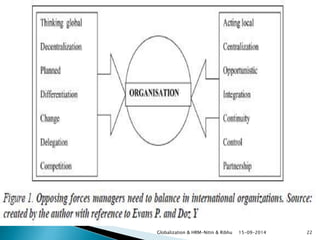
Globalization & HRM-Nitin & Ribhu 15-09-2014 22
Bibliography 
By Sheila M. Rioux, P. P. (n.d.). The Globalization of Human Resource Practices. 
Gachunga, H. G. (n.d.). IMPACT OF GLOBALIZATION ON THE HUMAN RESOURCE MANAGEMENT 
FUNCTION IN DEVELOPING COUNTRIES. A CASE STUDY OF KENYA PUBLIC CORPORATIONS. 
PLAGENS, S. W. (n.d.). Human Resource Management Best Practices. The Universality of common sense. 
Rowley, J. B. (n.d.). The Impact of Globalization. The Impact of Globalization. 
Globalization & HRM-Nitin & Ribhu 15-09-2014 23 
Websites:- 
1. www.wikipedia.com 
2. www.google.com 
3. www.entrepreneur.com 
4. www.hbs.edu
Globalization & HRM-Nitin & Ribhu 15-09-2014 24

Globalization & Human Resource Management (HRM)

  • 1.
    Presenters:- Nitin Sharma Ribhu Vashishtha
  • 2.
     Investigate howdomestic and international companies conduct HR practices around the world.  To identify trends in HRM across five countries: United Kingdom, France, USA, Japan and Lithuania.  How the adoption of New Public Management(NPM) has affected civil public infrastructures across the world. Globalization & HRM-Nitin & Ribhu 15-09-2014 2
  • 3.
     Impact ofGlobalization on HRM(Determine the challenges that organizations face when trying to globalize their HR function and practices.)  Determine what organizations are doing to institute a consistent corporate culture across all locations/offices.  Impact of Globalization on HRM: Case of South Korea  Impact of Globalization on HRM function in developing countries : Case Study of Kenya Public Corporations Globalization & HRM-Nitin & Ribhu 15-09-2014 3
  • 4.
     The globalizationof HR is characterized by increasing levels of decentralization.  Half of all international organizations reported having one primary HR department with independent regional HR staff.  Globalization & HRM-Nitin & Ribhu 15-09-2014 4
  • 5.
     Many international(37 percent) and domestic (42 percent) companies reported using a more centralized approach—one primary HR department with dependent regional HR staff.  More than a third of domestic organizations reported having only a primary HR department with no regional HR staff. Globalization & HRM-Nitin & Ribhu 15-09-2014 5
  • 6.
     System Architecture  Policy Alternatives  Practice Process Globalization & HRM-Nitin & Ribhu 15-09-2014 6
  • 7.
    International and domesticorganizations identified similar HR priorities for the next two years.  The top priority, identified by 52 percent of international companies, was leadership development. Domestic organizations also ranked leadership development as a top priority (35 percent).  Globalization & HRM-Nitin & Ribhu 15-09-2014 7
  • 8.
    Recruiting high-quality employees ranked second as a priority for both international (40 percent) and domestic companies (46 percent). Employee retention was also a top concern for both international (33 percent) and domestic companies (46 percent). In fact, retention was the top priority for domestic organizations. Globalization & HRM-Nitin & Ribhu 15-09-2014 8
  • 9.
    A majority ofinternational (79 percent) and domestic (87 percent) organizations reported that their parent organizations are taking action to make HR practices more consistent across all locations offices. Globalization & HRM-Nitin & Ribhu 15-09-2014 9
  • 10.
     International organizationsuse consistent HR practices to help develop a common corporate culture (75 percent) and to improve the effectiveness of the HR function (73 percent).  Domestic organizations are creating consistent HR practices to improve both the effectiveness (81 percent) and the efficiency (71 percent) of the HR function. Globalization & HRM-Nitin & Ribhu 15-09-2014 10
  • 11.
     Selection practicesvary greatly across locations in international organizations. Selection practices that vary the most include: o — Assessments (role plays and simulations). o — Testing for selection purposes. o — Internet advertising (recruiting). Globalization & HRM-Nitin & Ribhu 15-09-2014 11
  • 12.
    International companies facemany challenges when trying to make HR practices consistent across all locations/offices. The top three challenges include: Globalization & HRM-Nitin & Ribhu 15-09-2014 12
  • 13.
    i. Variations insocial, political, and economic circumstances. ii. Different locations/offices have their own way of doing things and are resistant to change. iii. The perceived value of the HR function varies across locations/offices. Globalization & HRM-Nitin & Ribhu 15-09-2014 13
  • 14.
    Developed a long-termHR plan to ensure alignment of HR strategies/objectives with corporate objectives. Created centralized reporting relationships around the globe. Standardized assessment, development, and compensation practices. Globalization & HRM-Nitin & Ribhu 15-09-2014 14
  • 15.
    Introduced practices toregions around the globe and allowed the HR function in each region the autonomy to do the job. Created global policies/processes for data management, performance management, compensation, education, and development. Tied regional accountability to performance management. Shared HR best practices used in certain locations with all other locations. Developed an HR mission statement. Globalization & HRM-Nitin & Ribhu 15-09-2014 15
  • 16.
     Communicated toall locations about a common corporate culture.  Allowed local cultures to maintain their identity in the context of the corporate culture.  Established common systems (e.g., accounting, marketing, MIS). Globalization & HRM-Nitin & Ribhu 15-09-2014 16
  • 17.
     Provided managementwith education outlining how the company does business.  Created an organizational mission with input from all locations.  Created a written strategy outlining the corporate culture. Globalization & HRM-Nitin & Ribhu 15-09-2014 17
  • 18.
     Coordination ofactivities in many different locations.  Understanding the continual change of the globally competitive environment.  Building a global awareness in all HR departments/divisions.  Creating a multicultural HR team. Globalization & HRM-Nitin & Ribhu 15-09-2014 18
  • 19.
    Many international companies(83 percent) use expatriate assignments, which last an average of 2.65 years. International assignments are quite expensive. Most international companies (88 percent) report spending more than two times an expatriate’s salary during the span of the assignment. Globalization & HRM-Nitin & Ribhu 15-09-2014 19
  • 20.
    The most importantcharacteristic to look for when recruiting an expatriate is a willingness to travel. The ability to speak other languages was third, behind having international business experience. Most organizations provide pre-departure training for expatriates, but relatively few provide a process for managing the expatriate’s re-entry to his or her home country. Only 68 percent of respondent organizations agreed that international assignments help an expatriate’s career. Globalization & HRM-Nitin & Ribhu 15-09-2014 20
  • 21.
    Globalization & HRM-Nitin& Ribhu 15-09-2014 21
  • 22.
    Globalization & HRM-Nitin& Ribhu 15-09-2014 22
  • 23.
    Bibliography By SheilaM. Rioux, P. P. (n.d.). The Globalization of Human Resource Practices. Gachunga, H. G. (n.d.). IMPACT OF GLOBALIZATION ON THE HUMAN RESOURCE MANAGEMENT FUNCTION IN DEVELOPING COUNTRIES. A CASE STUDY OF KENYA PUBLIC CORPORATIONS. PLAGENS, S. W. (n.d.). Human Resource Management Best Practices. The Universality of common sense. Rowley, J. B. (n.d.). The Impact of Globalization. The Impact of Globalization. Globalization & HRM-Nitin & Ribhu 15-09-2014 23 Websites:- 1. www.wikipedia.com 2. www.google.com 3. www.entrepreneur.com 4. www.hbs.edu
  • 24.
    Globalization & HRM-Nitin& Ribhu 15-09-2014 24