GLOBAL WARMING Science, economics, ethics Iain Murray MA MBA DIC Senior Fellow Competitive Enterprise Institute Presentation to YAF July 9 2007
The Science What do we know? What don’t we know?
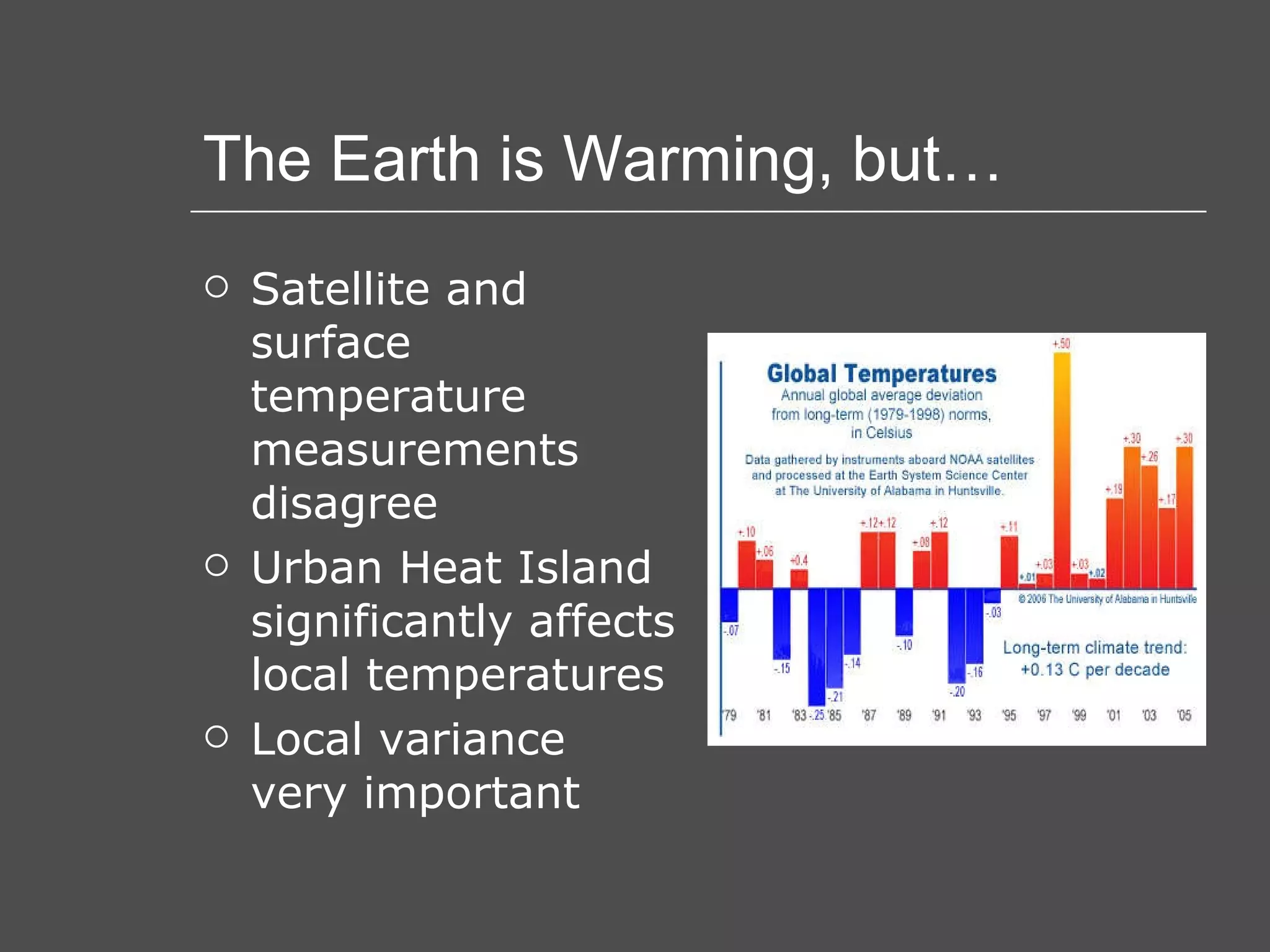
The Earth is Warming, but… Satellite and surface temperature measurements disagree Urban Heat Island significantly affects local temperatures Local variance very important
Global warming isn’t global
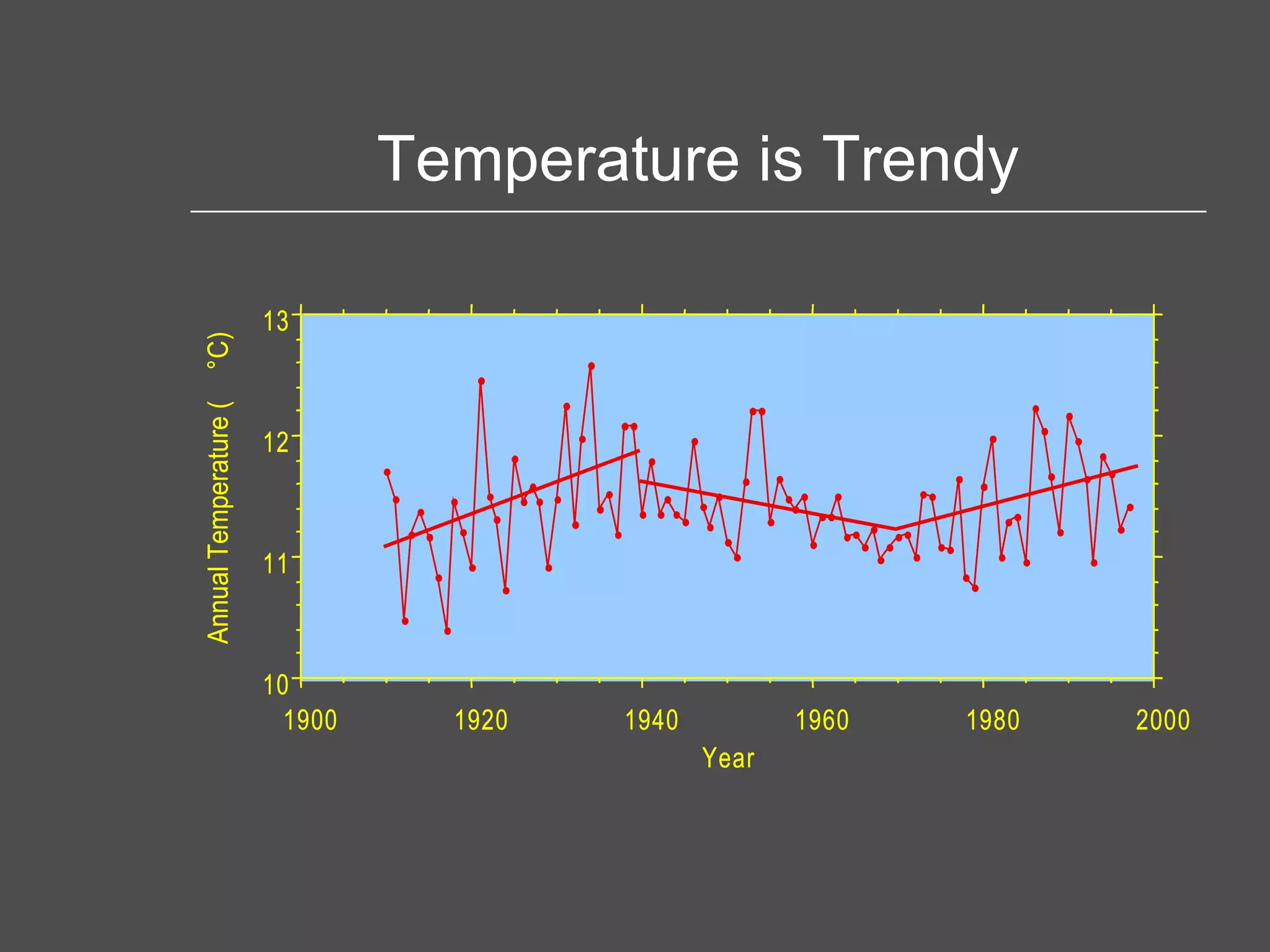
Temperature is Trendy
E.G.: What About those Polar Bears?
Warmer than it was in 1880
But colder than it was in 1934
Is Warming Man-made? All things being equal, yes …but are other things equal?
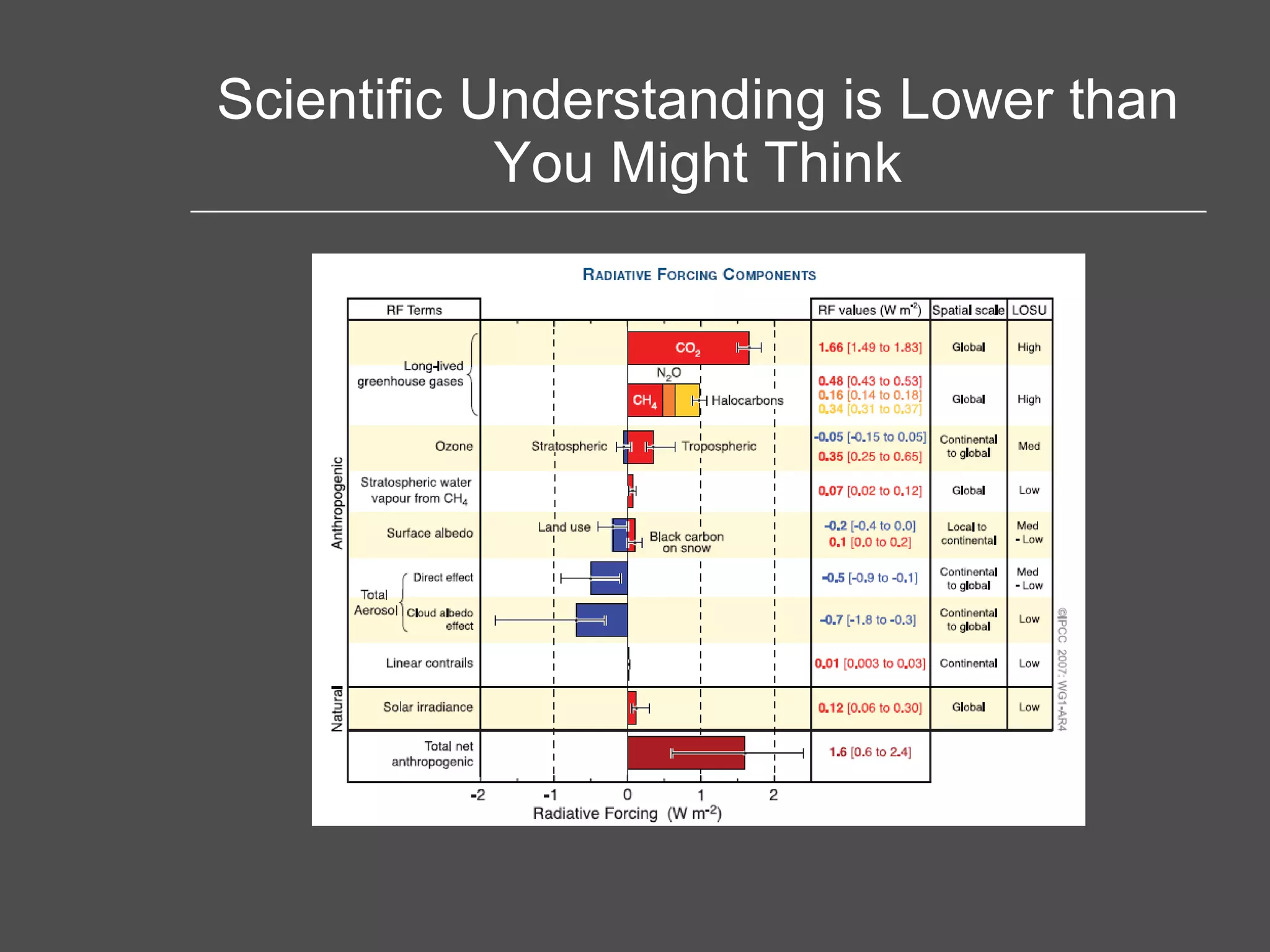
Scientific Understanding is Lower than You Might Think
Significant Room for Doubt
Is Current Warming Unusual? We Can’t Be Sure
Abrupt Changes in the Earth’s Climate Measured in Central Greenland Over the Last 17,000 Years Paleo Temperatures & Snowfall  - After Cuffey and Clow 1997 / Alley 2000 -25 -30 -35 -40 -45 -50 -55 -60 0.35 0.30 0.25 0.20 0.15 0.10 0.05 Temperature (°C) Accumulation (m ice/year) 0  5  10  15 Age (thousand years before present) Little Ice Age 400-150 BP Medieval Warm Period 800-1300 YBF Temperature 1000K Hunters & Gathers Pottery NA Plant Domestication Birch and  Conifer Widespread Tree Growth (Pollen) 2 - 4°C Low CO 2 Sparse Vegetation Dry Africa Dry Tundra Plants ~6-7°C Eastern Canada Snowfall El Nino Begins 5300 • Iceman of The Alps  1500 Year Spacing 8200 Cooling Event World Wide 1st Dynasty of Egypt • Bronze Age Early Domestication of Plants? Squash Animal and Plant Domestication (Near East) Abrupt Iron Age Corn and Beans Younger Dryas Cooling Steps Widespread Forests Languages Develop Americas Almaty, Kazakastan (Father of Apples) Coffee in Ethopia Tigris & Euphrates Allerod Warm
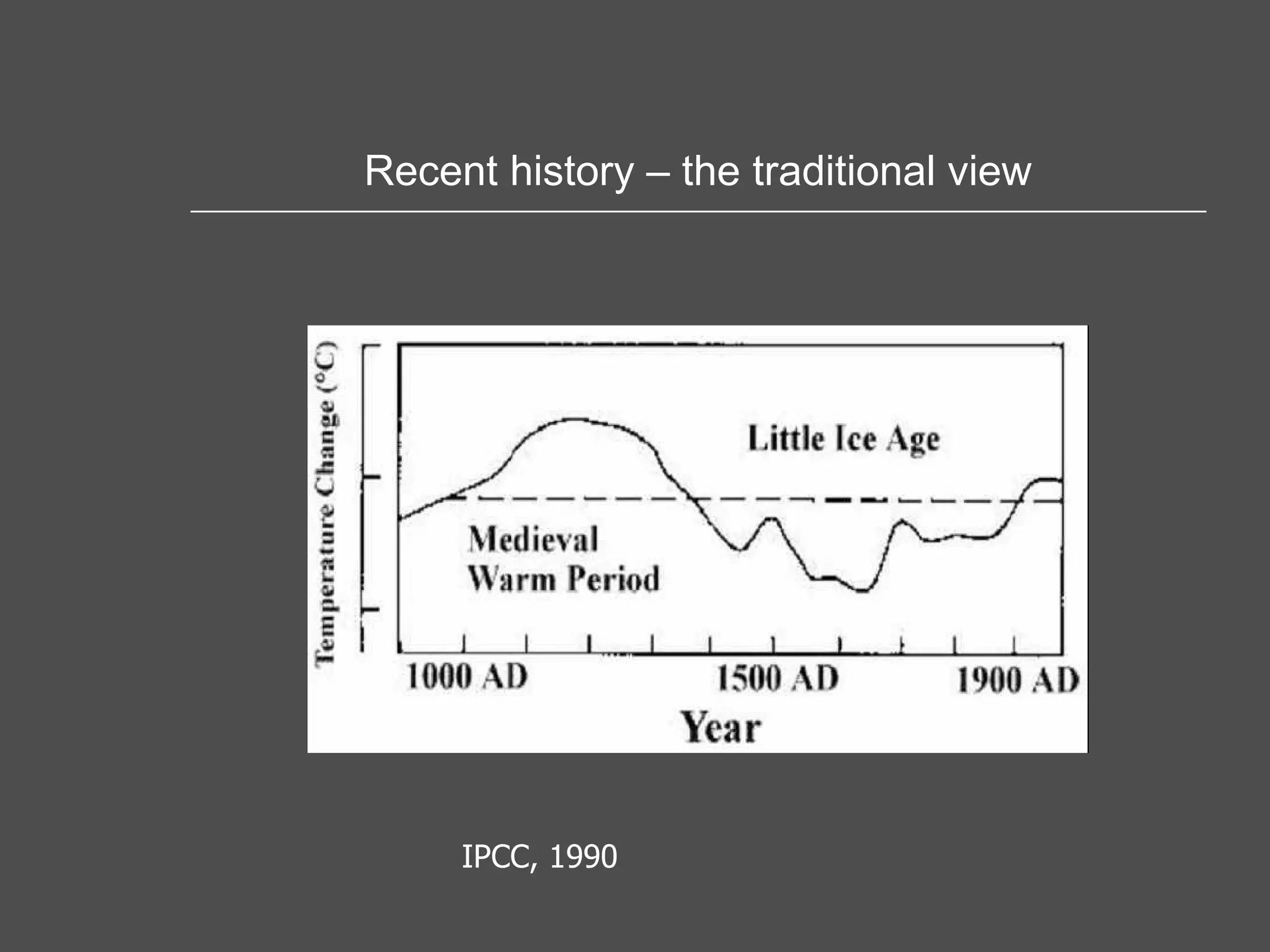
Recent history – the traditional view IPCC, 1990
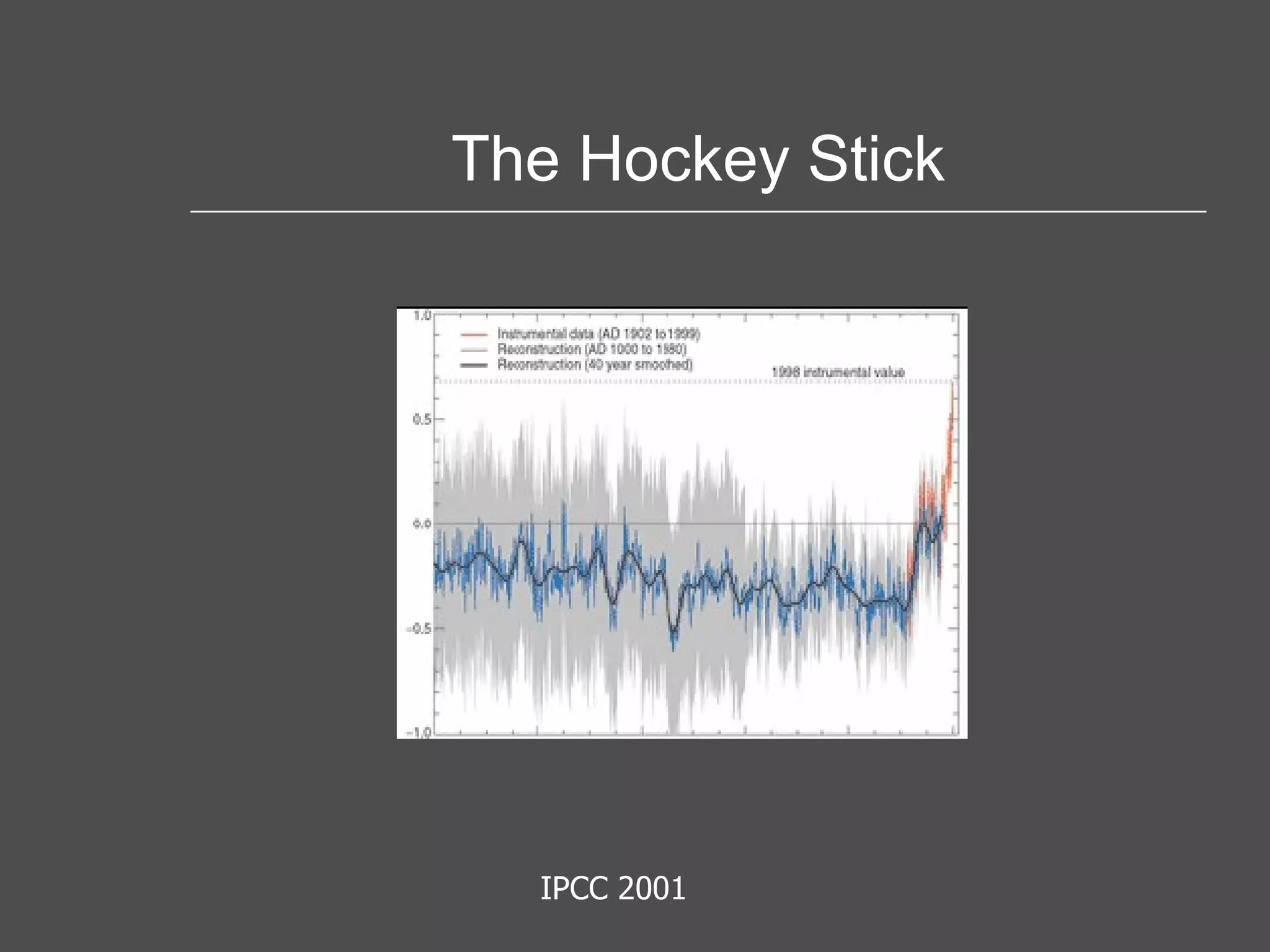
The Hockey Stick IPCC 2001
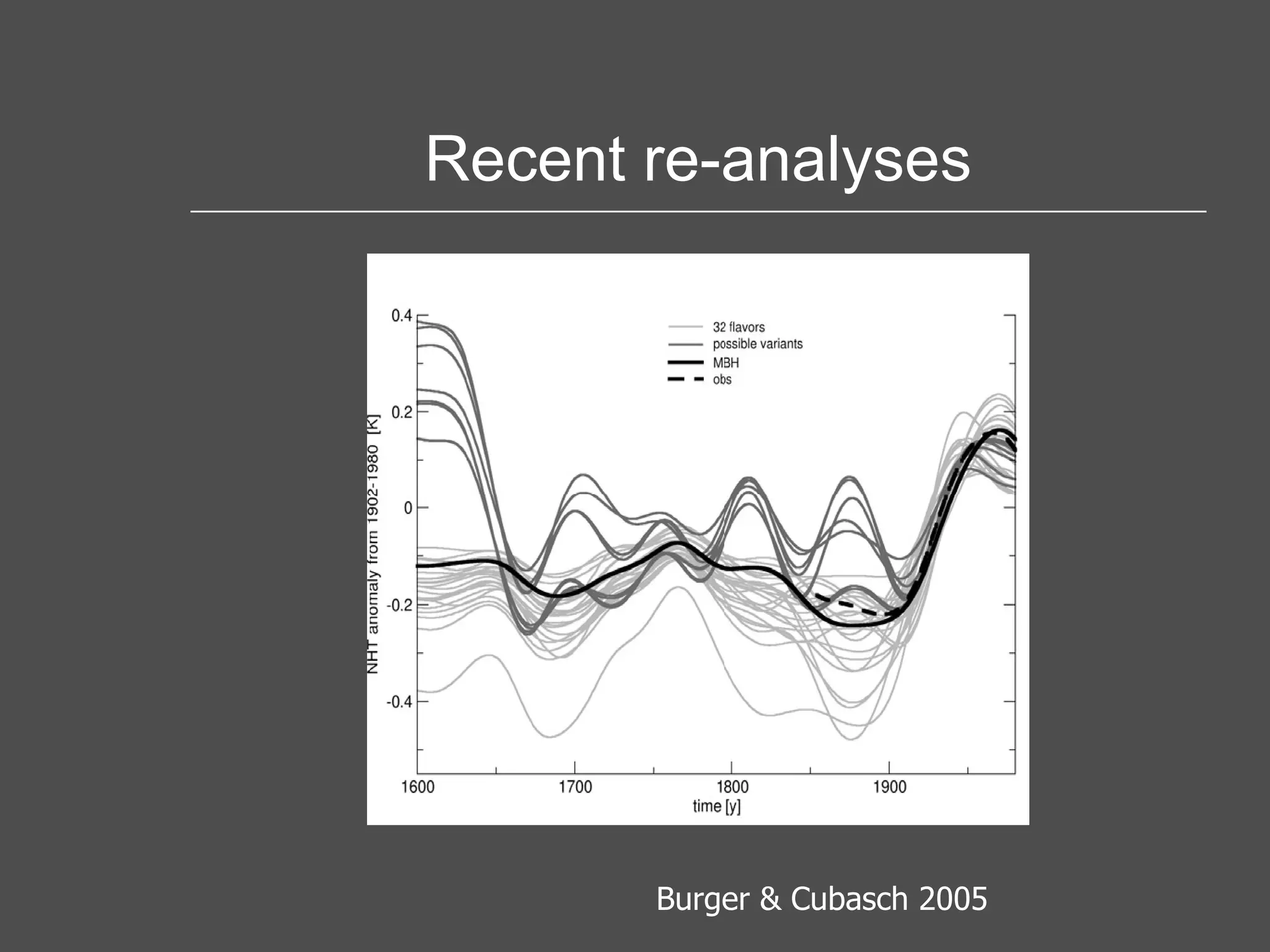
Recent re-analyses Burger & Cubasch 2005
If the hockey stick is broken… “ [E]nhanced variability during pre-industrial times, would result in a redistribution of weight towards the role of natural factors in forcing temperature changes, thereby relatively devaluing the impact of anthropogenic emissions and affecting future predicted scenarios. If that turns out to be the case, agreements such as the Kyoto protocol that intend to reduce emissions of anthropogenic greenhouse gases, would be less effective than thought.” Jan Esper, Robert J.S. Wilson, David C. Frank, Anders Moberg, Heinz Wanner, Jurg Luterbacher, “Climate: Past Changes and Future Ranges,” Quaternary Science Reviews, 24 (2005), 2164-2166
How much more warming can we expect? Probably less than they tell us
IPCC projections – NOT predictions
Scenarios
The Models Are Essentially Linear
Data – the Modeler’s Burden
Models vs Data
Famine, Flood and Pestilence What do we know?
Sea Level Rise Using two climate models, we project sea level rise due to melting of mountain glaciers and icecaps to be 0.046 and 0.051 m by 2100, about half that of previous projections  – Raper & Braithwaite, Nature, 19/1/06 East Antarctic Ice Sheet (biggest on the planet) is growing: Davis, C. H., et al., Science 2005.  Snowfall-driven growth in East Antarctic ice sheet mitigates recent sea-level rise. IPCC estimates of sea level rise range from 7 to 23 inches by 2100
Floods and Droughts Global warming theory suggests we should have seen increases in floods and droughts over recent decades Despite media coverage, scientists have not been able to find the increases they expected (Huntington et al, 2006; Smith et al, 2006)
Pestilence Malariologists and their colleagues agree: Vector borne diseases  are  on the increase Many factors come into play Climate is rarely relevant See - Reiter et al, Global Warming and Malaria: A Call for Accuracy, The Lancet, June 2004
Hurricanes The World Meteorological Organization (2006) says: No one storm is attributable to global warming There is no expectation of an increase in hurricane frequency due to global warming The rapid increase of economic damage and disruption by tropical cyclones has been caused, to a large extent, by increasing coastal populations, by increasing insured values in coastal areas and, perhaps, a rising sensitivity of modern societies to disruptions of infrastructure.
The Economics Cost and Benefits
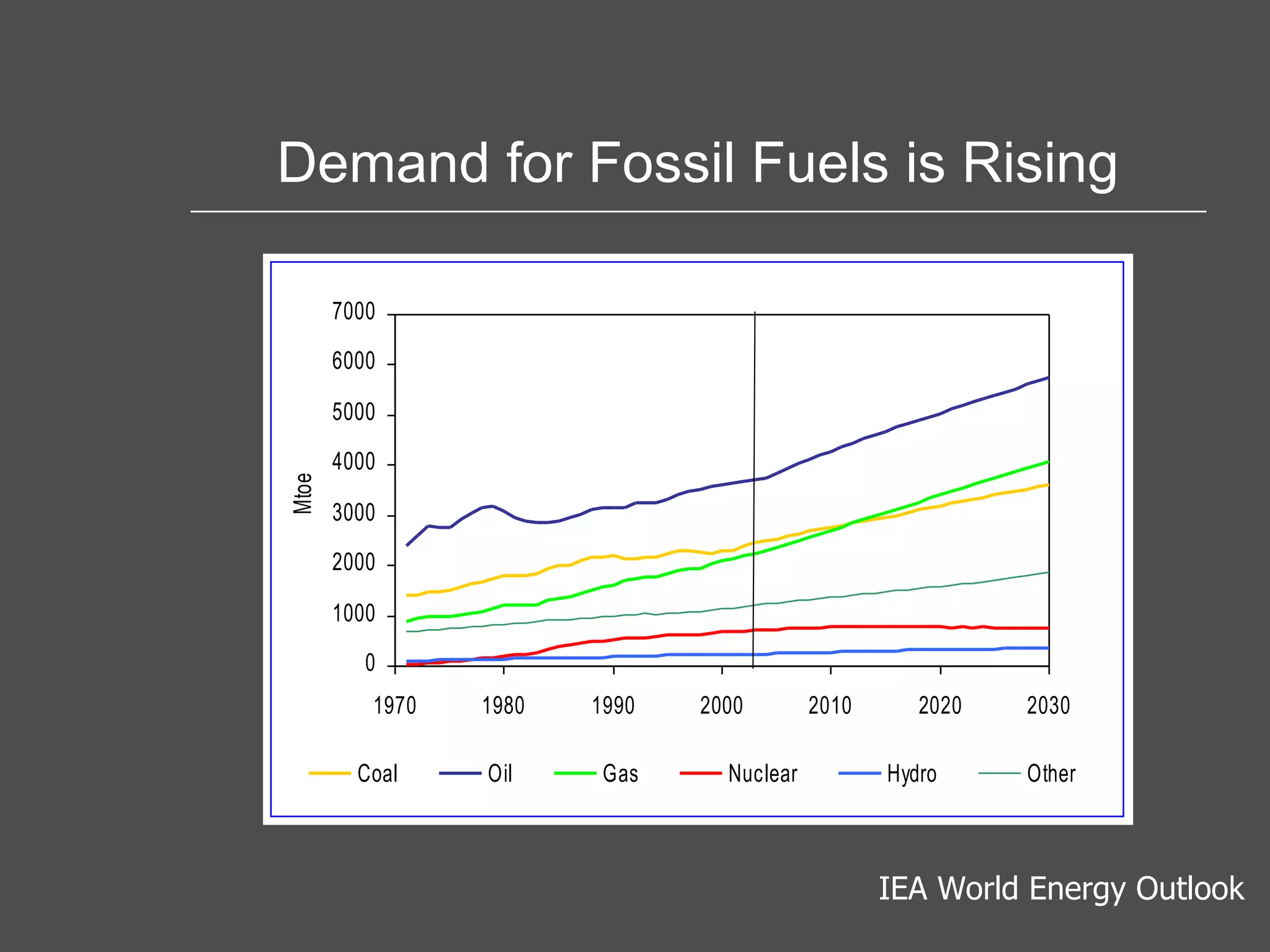
Demand for Fossil Fuels is Rising IEA World Energy Outlook
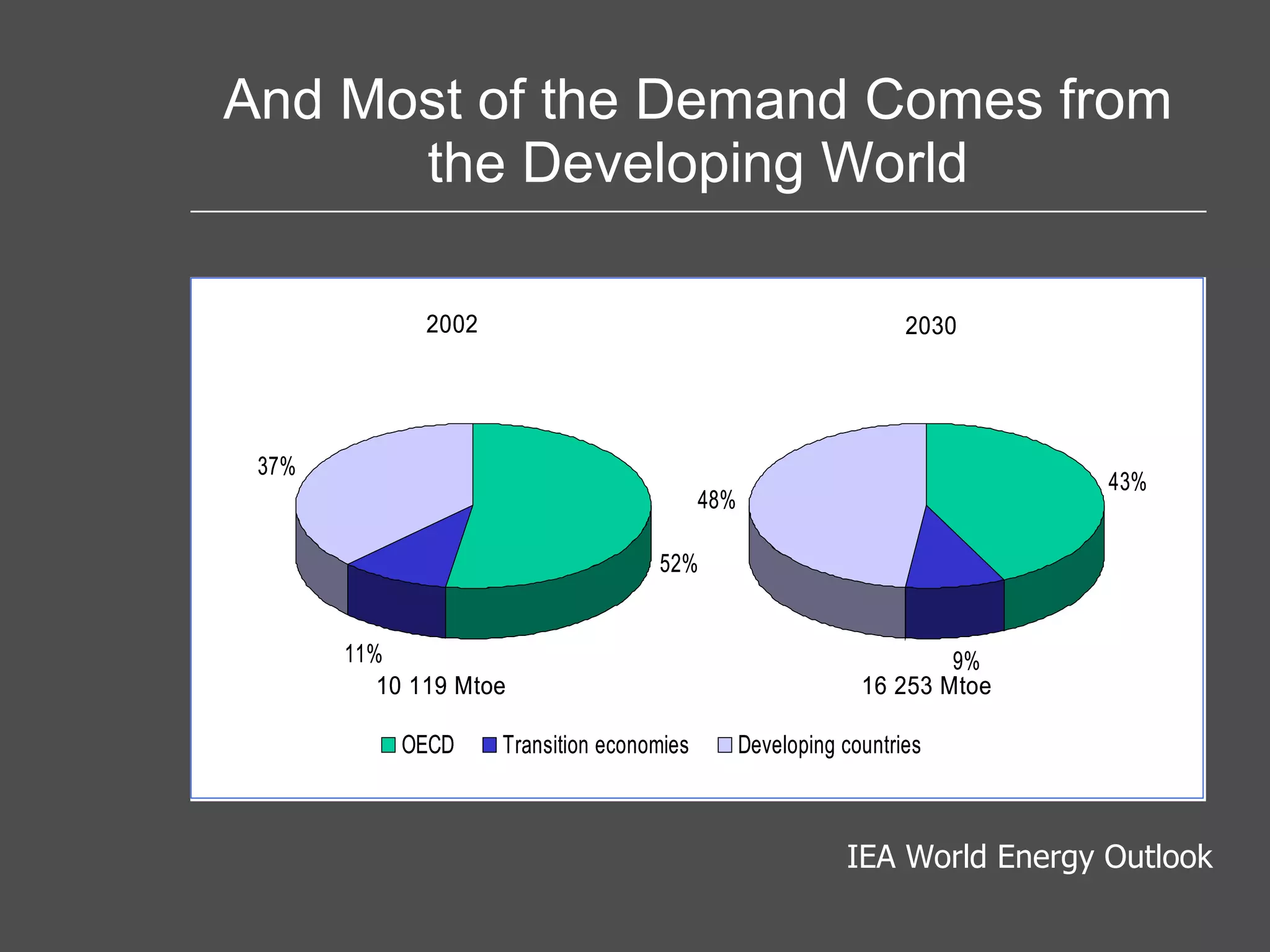
And Most of the Demand Comes from the Developing World IEA World Energy Outlook
The Developed World is Not the Problem
And the Problem Will Only Get Worse Lomborg 2001 from Wigley 1998
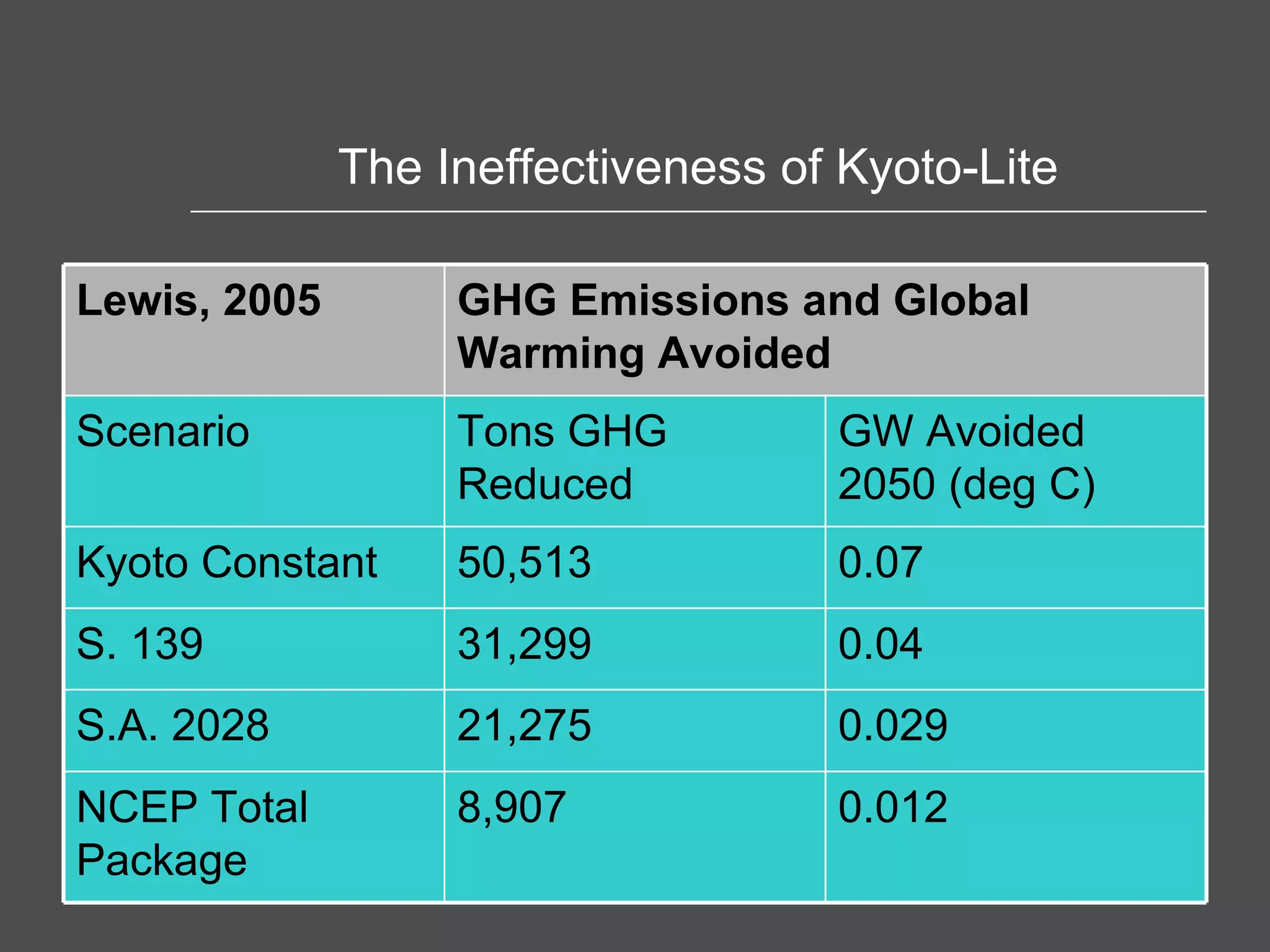
The Ineffectiveness of Kyoto Wigley 1998 Kyoto, if fully implemented, will avert 0.07 deg. C of warming by 2050 This is too small to be measurable
The Ineffectiveness of Kyoto-Lite 0.012  8,907  NCEP Total Package  0.029  21,275  S.A. 2028  0.04  31,299  S. 139  0.07  50,513  Kyoto Constant  GW Avoided 2050 (deg C) Tons GHG Reduced  Scenario  GHG Emissions and Global Warming Avoided  Lewis, 2005
The Costs Unmitigated warming – 2% of world GDP Developed world – 1.5% of GDP Developing world – 2-9% of GDP Kyoto – 4% of GDP  plus  warming costs Kyoto-lite - $100 billion of US GDP  plus  warming costs
Stern – No Basis for Policy HMG’s review of the economics of climate change is flawed Based on a revolutionary economic view of intergenerational equity Implies we are immoral if we do not save 95% of our earnings for our descendents
Stern ctd. Social welfare cost figure of $85 per ton of CO2 an outlier in literature Tol (2002): “It is unlikely that the marginal damage costs of carbon dioxide emissions exceed $50/tC [dollars per ton of carbon] and are likely to be substantially smaller than that.” [$50/tC = $14/tCO2].  Mean estimate of all studies at 3% discount rate is $16/tC [$16/tC = $5/tCO2] Stern’s damages figures are therefore massively over-inflated
So What Do We Do? The Ethical Solution
The Undercover Economist Speaks “ If we are honest, then, the argument that trade leads to economic growth, which leads to climate change, leads us then to a stark conclusion: we should cut our trade links to make sure that the Chinese, Indians and Africans stay poor.  The question is whether any environmental catastrophe, even severe climate change, could possibly inflict the same terrible human cost as keeping three or four billion people in poverty.  To ask that question is to answer it.” -- Tim Harford,  The Undercover Economist , 2006
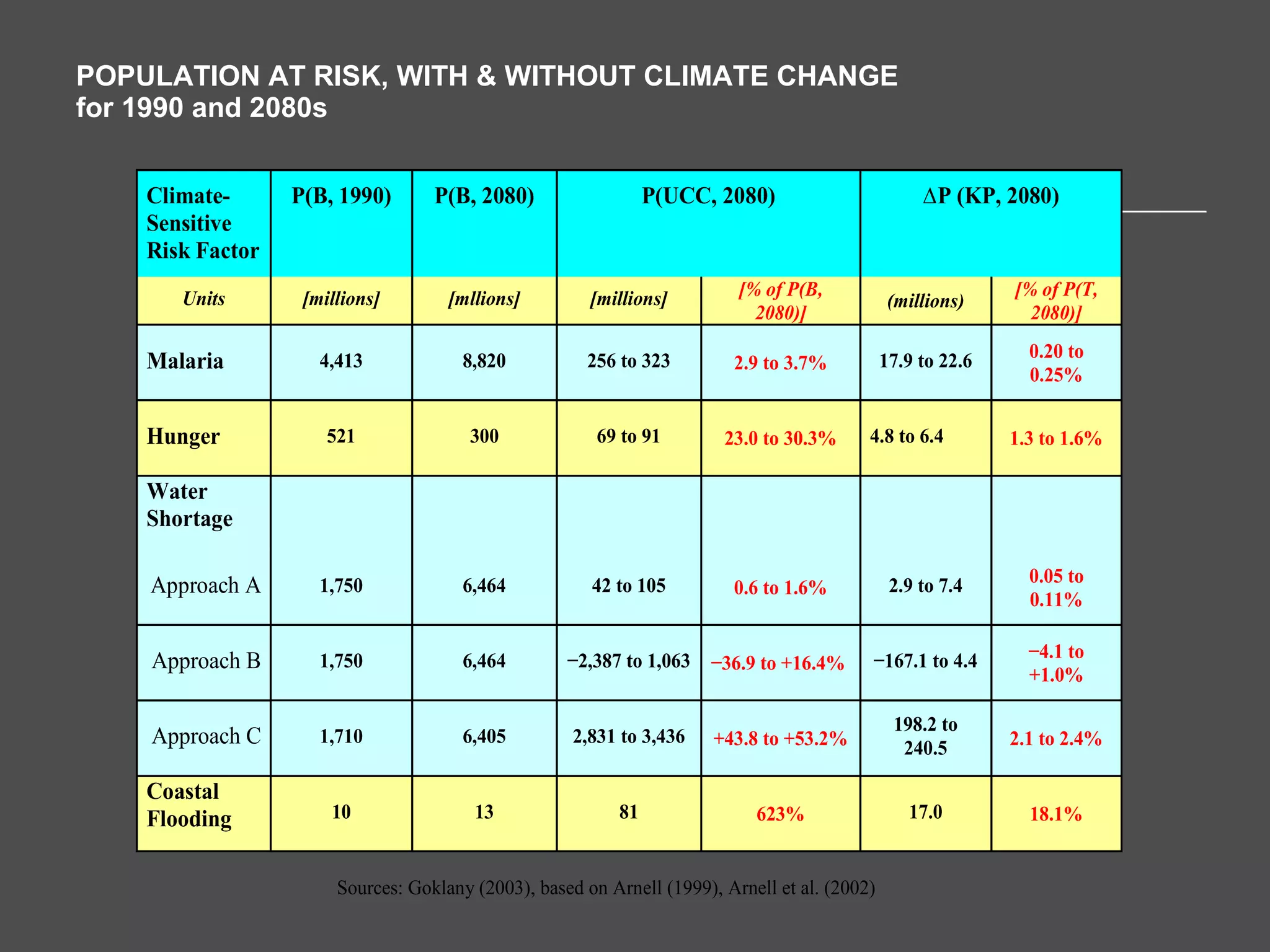
POPULATION AT RISK, WITH & WITHOUT CLIMATE CHANGE for 1990 and 2080s
Comparing Mitigation v. Adaptation
Adaptation is the Answer Even if global warming and, more importantly, its impacts, unfold as the IPCC predicts, it will not be as important as many existing problems, at least until the 2080s — unless today’s problems are solved. It is cheaper and/or more beneficial by orders of magnitude to solve these existing problems (for the next several decades). Assuming a 50-yr lag time to turn over the energy system, we don’t need to go beyond “no regret” actions until at least the 2030s.
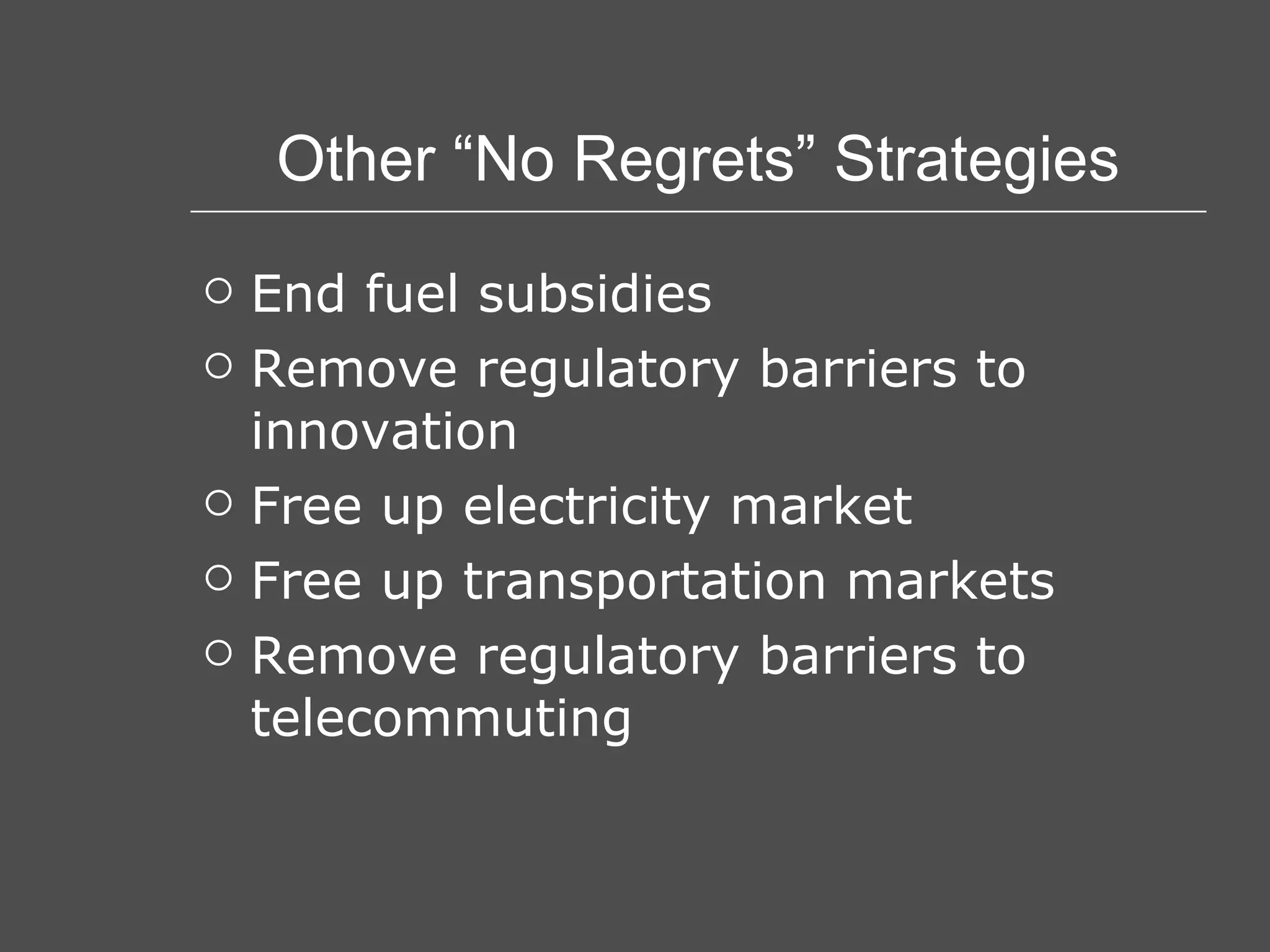
Other “No Regrets” Strategies End fuel subsidies Remove regulatory barriers to innovation Free up electricity market Free up transportation markets Remove regulatory barriers to telecommuting
“ If we cut carbon, we’ll make money!” The free lunch argument
“ In the colloquialism of economics, this analysis suggests not only that there are free lunches, but that in some restaurants you can get paid to eat!” -- William Nordhaus, 1991
“ In short, if we can rise to the challenge, the permanent abolition of the wheel would have the marvelously synergistic effect of creating thousands of new jobs - as blacksmiths, farriers, grooms and so on - at the same time as it conserved energy and saved the planet from otherwise inevitable devastation.” -- Catherine Bennett, The Guardian, 2004

Global Warming Yaf July 07

  • 1.
    GLOBAL WARMING Science,economics, ethics Iain Murray MA MBA DIC Senior Fellow Competitive Enterprise Institute Presentation to YAF July 9 2007
  • 2.
    The Science Whatdo we know? What don’t we know?
  • 3.
    The Earth isWarming, but… Satellite and surface temperature measurements disagree Urban Heat Island significantly affects local temperatures Local variance very important
  • 4.
  • 5.
  • 6.
    E.G.: What Aboutthose Polar Bears?
  • 7.
    Warmer than itwas in 1880
  • 8.
    But colder thanit was in 1934
  • 9.
    Is Warming Man-made?All things being equal, yes …but are other things equal?
  • 10.
    Scientific Understanding isLower than You Might Think
  • 11.
  • 12.
    Is Current WarmingUnusual? We Can’t Be Sure
  • 13.
    Abrupt Changes inthe Earth’s Climate Measured in Central Greenland Over the Last 17,000 Years Paleo Temperatures & Snowfall - After Cuffey and Clow 1997 / Alley 2000 -25 -30 -35 -40 -45 -50 -55 -60 0.35 0.30 0.25 0.20 0.15 0.10 0.05 Temperature (°C) Accumulation (m ice/year) 0 5 10 15 Age (thousand years before present) Little Ice Age 400-150 BP Medieval Warm Period 800-1300 YBF Temperature 1000K Hunters & Gathers Pottery NA Plant Domestication Birch and Conifer Widespread Tree Growth (Pollen) 2 - 4°C Low CO 2 Sparse Vegetation Dry Africa Dry Tundra Plants ~6-7°C Eastern Canada Snowfall El Nino Begins 5300 • Iceman of The Alps 1500 Year Spacing 8200 Cooling Event World Wide 1st Dynasty of Egypt • Bronze Age Early Domestication of Plants? Squash Animal and Plant Domestication (Near East) Abrupt Iron Age Corn and Beans Younger Dryas Cooling Steps Widespread Forests Languages Develop Americas Almaty, Kazakastan (Father of Apples) Coffee in Ethopia Tigris & Euphrates Allerod Warm
  • 14.
    Recent history –the traditional view IPCC, 1990
  • 15.
  • 16.
  • 17.
    If the hockeystick is broken… “ [E]nhanced variability during pre-industrial times, would result in a redistribution of weight towards the role of natural factors in forcing temperature changes, thereby relatively devaluing the impact of anthropogenic emissions and affecting future predicted scenarios. If that turns out to be the case, agreements such as the Kyoto protocol that intend to reduce emissions of anthropogenic greenhouse gases, would be less effective than thought.” Jan Esper, Robert J.S. Wilson, David C. Frank, Anders Moberg, Heinz Wanner, Jurg Luterbacher, “Climate: Past Changes and Future Ranges,” Quaternary Science Reviews, 24 (2005), 2164-2166
  • 18.
    How much morewarming can we expect? Probably less than they tell us
  • 19.
    IPCC projections –NOT predictions
  • 20.
  • 21.
    The Models AreEssentially Linear
  • 22.
    Data – theModeler’s Burden
  • 23.
  • 24.
    Famine, Flood andPestilence What do we know?
  • 25.
    Sea Level RiseUsing two climate models, we project sea level rise due to melting of mountain glaciers and icecaps to be 0.046 and 0.051 m by 2100, about half that of previous projections – Raper & Braithwaite, Nature, 19/1/06 East Antarctic Ice Sheet (biggest on the planet) is growing: Davis, C. H., et al., Science 2005. Snowfall-driven growth in East Antarctic ice sheet mitigates recent sea-level rise. IPCC estimates of sea level rise range from 7 to 23 inches by 2100
  • 26.
    Floods and DroughtsGlobal warming theory suggests we should have seen increases in floods and droughts over recent decades Despite media coverage, scientists have not been able to find the increases they expected (Huntington et al, 2006; Smith et al, 2006)
  • 27.
    Pestilence Malariologists andtheir colleagues agree: Vector borne diseases are on the increase Many factors come into play Climate is rarely relevant See - Reiter et al, Global Warming and Malaria: A Call for Accuracy, The Lancet, June 2004
  • 28.
    Hurricanes The WorldMeteorological Organization (2006) says: No one storm is attributable to global warming There is no expectation of an increase in hurricane frequency due to global warming The rapid increase of economic damage and disruption by tropical cyclones has been caused, to a large extent, by increasing coastal populations, by increasing insured values in coastal areas and, perhaps, a rising sensitivity of modern societies to disruptions of infrastructure.
  • 29.
    The Economics Costand Benefits
  • 30.
    Demand for FossilFuels is Rising IEA World Energy Outlook
  • 31.
    And Most ofthe Demand Comes from the Developing World IEA World Energy Outlook
  • 32.
    The Developed Worldis Not the Problem
  • 33.
    And the ProblemWill Only Get Worse Lomborg 2001 from Wigley 1998
  • 34.
    The Ineffectiveness ofKyoto Wigley 1998 Kyoto, if fully implemented, will avert 0.07 deg. C of warming by 2050 This is too small to be measurable
  • 35.
    The Ineffectiveness ofKyoto-Lite 0.012 8,907 NCEP Total Package 0.029 21,275 S.A. 2028 0.04 31,299 S. 139 0.07 50,513 Kyoto Constant GW Avoided 2050 (deg C) Tons GHG Reduced Scenario GHG Emissions and Global Warming Avoided Lewis, 2005
  • 36.
    The Costs Unmitigatedwarming – 2% of world GDP Developed world – 1.5% of GDP Developing world – 2-9% of GDP Kyoto – 4% of GDP plus warming costs Kyoto-lite - $100 billion of US GDP plus warming costs
  • 37.
    Stern – NoBasis for Policy HMG’s review of the economics of climate change is flawed Based on a revolutionary economic view of intergenerational equity Implies we are immoral if we do not save 95% of our earnings for our descendents
  • 38.
    Stern ctd. Socialwelfare cost figure of $85 per ton of CO2 an outlier in literature Tol (2002): “It is unlikely that the marginal damage costs of carbon dioxide emissions exceed $50/tC [dollars per ton of carbon] and are likely to be substantially smaller than that.” [$50/tC = $14/tCO2]. Mean estimate of all studies at 3% discount rate is $16/tC [$16/tC = $5/tCO2] Stern’s damages figures are therefore massively over-inflated
  • 39.
    So What DoWe Do? The Ethical Solution
  • 40.
    The Undercover EconomistSpeaks “ If we are honest, then, the argument that trade leads to economic growth, which leads to climate change, leads us then to a stark conclusion: we should cut our trade links to make sure that the Chinese, Indians and Africans stay poor. The question is whether any environmental catastrophe, even severe climate change, could possibly inflict the same terrible human cost as keeping three or four billion people in poverty. To ask that question is to answer it.” -- Tim Harford, The Undercover Economist , 2006
  • 41.
    POPULATION AT RISK,WITH & WITHOUT CLIMATE CHANGE for 1990 and 2080s
  • 42.
  • 43.
    Adaptation is theAnswer Even if global warming and, more importantly, its impacts, unfold as the IPCC predicts, it will not be as important as many existing problems, at least until the 2080s — unless today’s problems are solved. It is cheaper and/or more beneficial by orders of magnitude to solve these existing problems (for the next several decades). Assuming a 50-yr lag time to turn over the energy system, we don’t need to go beyond “no regret” actions until at least the 2030s.
  • 44.
    Other “No Regrets”Strategies End fuel subsidies Remove regulatory barriers to innovation Free up electricity market Free up transportation markets Remove regulatory barriers to telecommuting
  • 45.
    “ If wecut carbon, we’ll make money!” The free lunch argument
  • 46.
    “ In thecolloquialism of economics, this analysis suggests not only that there are free lunches, but that in some restaurants you can get paid to eat!” -- William Nordhaus, 1991
  • 47.
    “ In short,if we can rise to the challenge, the permanent abolition of the wheel would have the marvelously synergistic effect of creating thousands of new jobs - as blacksmiths, farriers, grooms and so on - at the same time as it conserved energy and saved the planet from otherwise inevitable devastation.” -- Catherine Bennett, The Guardian, 2004