GLAUCOMA
presentation by:Bhawana paudel
Definition
• Glaucoma is'nt a single disease ,rather it is a large group
disorder that are characterized by widely dverse clinical
and histological manifestation.
• Glaucoma suspect - individuals presenting with
concerning optic nerve apperences with normal IOP and
either normal visual firlds or borderline VF loss
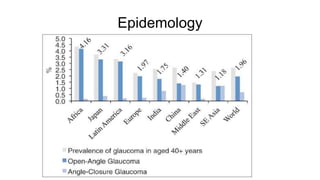
Epidemology
Causes of raised IOP in Glaucoma
• Hypersecretory Glaucoma-Excess secretion of aqueous humour ,-
epidemic dropsy .
• Obstruction of flow of aqueous humour from postrior chamber to
anterior chamber ,- pupillary block glaucoma.
• Blockage of angle - due to peripheral anterior synechiae/apposition
in PACG.
• Blockage of aqueous outflow -due to peripheral anterior
synechiae/apposition in PACG
• Blockage of aqueous outflow - due to sclerosis of the trabecular
meshwork in POAG
• High episcleral venous pressure - Sturge Weber syndrome
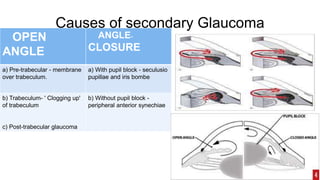
Causes of secondary Glaucoma
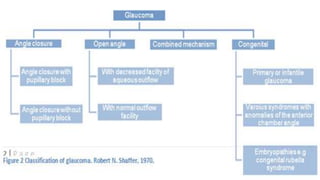
OPEN
ANGLE
ANGLE-
CLOSURE
a) Pre-trabecular - membrane
over trabeculum.
a) With pupil block - seculusio
pupillae and iris bombe
b) Trabeculum- ' Clogging up'
of trabeculum
c) Post-trabecular glaucoma
b) Without pupil block -
peripheral anterior synechiae
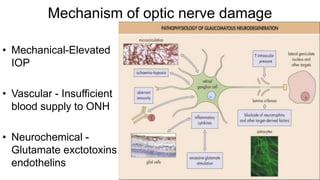
Mechanism of optic nerve damage
• Mechanical-Elevated
IOP
• Vascular - Insufficient
blood supply to ONH
• Neurochemical -
Glutamate exctotoxins ,
endothelins
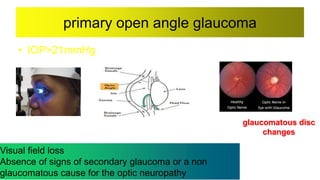
primary open angle glaucoma
• IOP>21mmHg
glaucomatous disc
changes
Visual field loss
Absence of signs of secondary glaucoma or a non
glaucomatous cause for the optic neuropathy
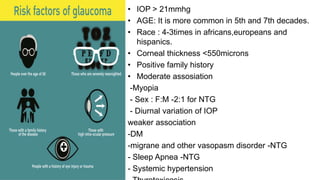
• IOP > 21mmhg
• AGE: It is more common in 5th and 7th decades.
• Race : 4-3times in africans,europeans and
hispanics.
• Corneal thickness <550microns
• Positive family history
• Moderate assosiation
-Myopia
- Sex : F:M -2:1 for NTG
- Diurnal variation of IOP
weaker association
-DM
-migrane and other vasopasm disorder -NTG
- Sleep Apnea -NTG
- Systemic hypertension
Pathagenesis of rise in IOP in POAG
• Thickening and sclerosis of trebecular meshwork with
faulty collagen tissue
• Narrowing of intertrabecular spaces.
• Depositon of amorphous material in the juxtacanalicular
space.
• Collapse of schlemms canal and absence of giant
vaculoes in the cells lining it.
Clinical Features
SYMTOMS:
• The disease is insidious and asymptomatic ,until it has
caused a significant loss of VF.
• Headache and eyeache of mild intensity may be
experienced in the course.
• Scotoma may be noticed
• Difficulty in reading and close work .
• Delayed dark adaptation
• Significant loss of vision and blindness is the end result of
• SIGNS:
• Anterior segment signs
-Pupil reflex become sluggish and cornea with slight haze .
- A low (<555mn) CCT
Raised IOP:
- Approximately 2% of the general population over the age of40 yrs have
IOPs>24mmhg and 7% have IOP>21mmhg. however only 1% of these have
glaucomatous VF loss.
Diurnal fluctations: In POAG this fluctuations is exaggerated and occur in about
90% of cases
Asymmetry of the IOP between the two eyes:
If 5mmhg or more should arouse suspicion
Optic disc changes:
1)Baring of the curve linear blood vessels due to loss of the
neuroglial fibrous tissue as a result of ischemia.leaving the blood
vessel unsupported
2)Optic disc hemorrhage ( Splinter or flame shaped) in
2-4% of cases .It isue to easy rupture of the non - supported
curve linear vessesls .
3) Nasalization of central blood vessesls .
4)Enlargement of the physiological cup.
5) Asymmetry cup/disc ratio between both eyes
6) Specific glaucomatous cupping :
- Narrow opening .
- Depth : very deep
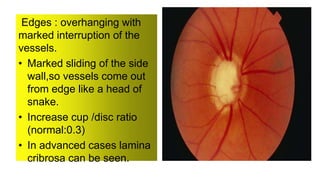
Edges : overhanging with
marked interruption of the
vessels.
• Marked sliding of the side
wall,so vessels come out
from edge like a head of
snake.
• Increase cup /disc ratio
(normal:0.3)
• In advanced cases lamina
cribrosa can be seen.
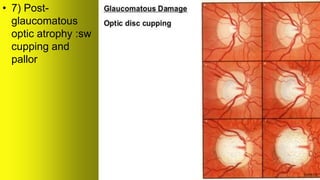
• 7) Post-
glaucomatous
optic atrophy :sw
cupping and
pallor
Visual fields (perimetry)
• A) Central changes :
• 1) Paracentral scotomata : Are isolated scotomata which later becomes
connected ith the blind spot to form the arcuate scotoma .
• 2)Baring of the blind spot : Is exclusion of the blind spot from the centralfield (
due to localized contraction of the temporal edge of the central field )
• 3)Siedel scotoma : Is a tapering wing like elongation of the upper and lower
pole of the blind spot >
• 4) Bjerrum (arcuate) scoloma:upper and/or lower bundle defect around and
joining the blind spot and is concentric with the fixation point.
• 5)Annular scotoma: By fusion of the 2 (upper and lower ) bjerrum scotomata
in the nasal field.
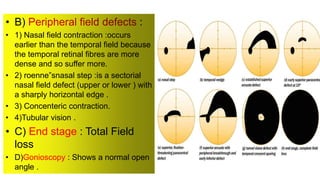
• B) :
• 1) Nasal field contraction :occurs
earlier than the temporal field because
the temporal retinal fibres are more
dense and so suffer more.
• 2) roenne”snasal step :is a sectorial
nasal field defect (upper or lower ) with
a sharply horizontal edge .
• 3) Concenteric contraction.
• 4)Tubular vision .
• C) End stage : Total Field
loss
• D)Gonioscopy : Shows a normal open
angle .
Management
• Aim :
• The primary aim of treatment is to prevent functional impairement
of vision within the patient's lifetime by slowing the rate of
ganglion cell.
• Method of achieving this goal is by lowering of IOP.
• Target pressure:Is is an IOP level below which further damage is
unlikely.Therapy should maintain the IOP at or below the target
level.
• Monitoring is performed of the optic nerve and visual fields. In the
event of further damage the target IOP is a reset at a lower level.
• Patient instructions
• Including :
• 1) A simple explanation of the nature of the disease .
• 2) The patient should be taught how to instil drops and the
intervals between medicatons should ne specified.
• 3) in order to minimize systemic absorption the patient should be
intructed either to perfoem lacrimal sac acclusion ( by applying
pressure at the medical canthus or to close the eyes for about
3minutes after instillation.
• 4) Potential adverse effects should be explained and
subsequently asked fot at follow -up visits.
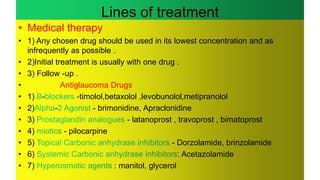
Lines of treatment
• Medical therapy
• 1) Any chosen drug should be used in its lowest concentration and as
infrequently as possible .
• 2)Initial treatment is usually with one drug .
• 3) Follow -up .
• Antiglaucoma Drugs
• 1) - -timolol,betaxolol ,levobunolol,metipranolol
• 2) - - brimonidine, Apraclonidine
• 3) - latanoprost , travoprost , bimatoprost
• 4) - pilocarpine
• 5) - Dorzolamide, brinzolamide
• 6) : Acetazolamide
• 7) : manitol, glycerol
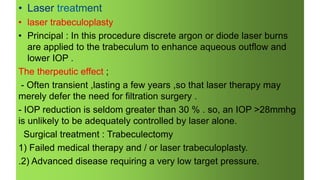
• laser trabeculoplasty
• Principal : In this procedure discrete argon or diode laser burns
are applied to the trabeculum to enhance aqueous outflow and
lower IOP .
The therpeutic effect ;
- Often transient ,lasting a few years ,so that laser therapy may
merely defer the need for filtration surgery .
- IOP reduction is seldom greater than 30 % . so, an IOP >28mmhg
is unlikely to be adequately controlled by laser alone.
Surgical treatment : Trabeculectomy
1) Failed medical therapy and / or laser trabeculoplasty.
.2) Advanced disease requiring a very low target pressure.
Normal Tension glaucoma
• Is a varient of POAG. It is characterized by:
• A mean IOP equal to or less than 21mmhg on diurnal
testing.
• glaucomatous optic disc damage and VF loss
• Open drainage angle on gonioscopy.
• Absence of secondary causesfor glaucomatous optic disc
damage
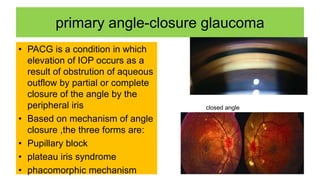
primary angle-closure glaucoma
• PACG is a condition in which
elevation of IOP occurs as a
result of obstrution of aqueous
outflow by partial or complete
closure of the angle by the
peripheral iris
• Based on mechanism of angle
closure ,the three forms are:
• Pupillary block
• plateau iris syndrome
• phacomorphic mechanism
closed angle
PACG with pupillary block
• Anatomical predisposing factors
1) Relatively anterior location of the iris-lens diaphragm>
2) Shallow anterior chamber.
3)Narrow chamber angle.
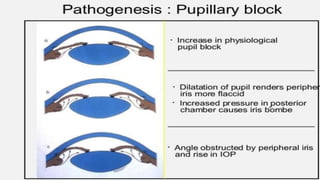
Pathogenesis
-contaction of dilator pupillae exerts a posterior vector.This increases the
amount of apposition between rhe iris and anteriorly located lens, enhancing
the degree of physiological resistance at the pupil (pupil block)
-Dilation of the pupil renders the peripheral iris more flaccid
- The pupil block cuses the pressure in the posterior chamber to increase
pheripheral irirs bows anteriorly (iris bombe)
Eventually the iris touches the posterior corneal surafce , obstructing the angle
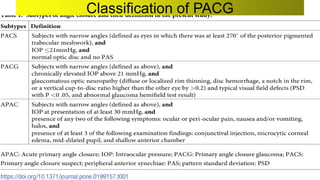
Classification of PACG
Latent angle closure glaucoma
• Implies an anatomically predisposed eye, It can only be suspected
prospectively
• Clinical features
- Symptoms are absent
-The eclipse sign.
-Slit -lamp biomicroscopy:
Axial anterior chamber depth is less than normal.
convex-shaped iris -lens diaphragm.
close proximity of the iris to the cornea.
Gonioscopy shows an'occudable ' angle.
Treatment
Prophylactic peripheral laser Iridotomy : if the other eye has had acute or sub
acute PACG
• Pathogenesis : SubacutePACG occurs in a predisposed eye with an
occludable angle in association with intermittent pupillary block.Rapid closure of the
angle results in sudden increase in IOP . The pupillary block is then spomtaneously
relieved , the angle opens and the IOP return to normal.
Precipating factor : Attack may be precipitated by:
1) Physiological mydriasis
2)Physiological shallowing of the anterior chamber when the patient assumes a prone
position
3) emotional stress.
Diagnosis:
1) Transient blurring of vision associatewith haloes around lights due to curneal
epithelial edema.
2)Ocular discomfort or frontal headache
3) the attack reoccur
Subacute angle closure glaucoma
Acute cngestive 3 angle -closure glaucoma
• This is a sight thresting emergency , involving painful loss of vision, due to
sudden and total closure of the angle.
Clinical features
SYMPTOMS:
Rapidly progressive unilateral visual loss
Periocular pain and congestion
Nausea and vomiting may occur in severe cases.
History if trensient blurring and haloes
SIGNS:
1) conjunctiva,”ciliary” flush (Ciliary injection ) due to injection of the limbal and
conjunctival blood vessels.
2) Cornea : Corneal odema with epithelial vesicals and stromal thickening .
3)AC: Shallow anterior chamber with peripheral iridpcorneal contact . Aqueous flare
may be seen once the corneal oedema has resolved .
• 4) The pupil: is vertically oval, fixed in the semi dilated position
and unreactive to both light and accommodation.
• 5)The iris:blood vessels are dilared.
• 6)The IOP : is severely elevated (50-100mmhg)
• 7)Gonioscopy:may need to be deffered until the corneal oedema
has resolved .It is ,however,viral to perform this examination in the
fellow eye,which usually ehibits characteristics of latent angle
closure.The affected eye shows complete peripral iridocorneal
contact.
• 9)Ophthalmoscopy:shows optic disc oedema and hyperaemia.
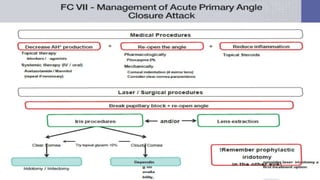
• Treatment :
• (*)Control of the attack :
• A)Immediate treatment :
• 1) systemic : Acetazolamide 500 mg intravenously and 500mg orally.
• 2)topical :-pilocarpine 2% two drops to both eyes.
• - Dexamethasone(or equivalent )
• -Beta -blocker
• 3) Analgesia and anti emetics . patient to lie supine for1hour.
• B) After 1 hour :
• pilocarpine 2% should be repeated, by which time reduction of iris
ischemia and lowering of IOP allows the sphincher papillae to respond to
the drug.
• C) After further 30 minutes :
• If IOP has not fallen to below 35mmhg:
• 1) Glycerol 505 Orally (1kg/g ) (with caution in diabeties ) and fluid
intake limited for maximum effect.
• 2) Mannitol 20 % ( 1-2 g/kg ) may be given intravenously over 45
minutes , if the patient is unable to tolerate oral glycerol.
• D)A high IOP unresponsive to medication may sometimes
respond to axail corneal indentation,this allows aqueous humour
to force its way between the iris ad cornea to the angle , thus
opening it and gaining access to the trabecular meshwork.
*Surgical treatment :
• 1) Nd: YAG:
• 2) Trabeculectomy :
Chronic angle -4 closure glaucoma
• Pathogenesis:
• 1) Type1 (creeping): is caused and progressive angle closure.
• Type 2is caused by angle closure as a result of intermittent
subacute attacks.
• Type3 (mixed): is caused by a combination of POAG with narrow
angles usually associated with the long term use of miotics
• Clinical Features
• These are similar to POAG.
• Shallow AC
• Gonioscopy shows a variable degree of angle closure
Primary angle -closure glaucoma without
pupillary block (Plateau Iris)
• Plateau iris configuration:
Chacterized by a closed anterior chamber angle in assosiation with a flat iris
plane and a deep anterior chamber.
Plateau iris glaucoma:
Acute angle closureours with pupillary dilatation despire a patient iridotomy .
When the pupil dilates , the peripheral iris becomes bunched up and occludes
the trabeculum .
Clinically : All the features of acute congestive angle closure are present except
that the axial anterior chamber depth is normal and the iris plane is flat rather
than convex.
Treatment
1) Laser peripheral iridotomy.
2) pilocarpine 1% drops
Congenital Glaucoma
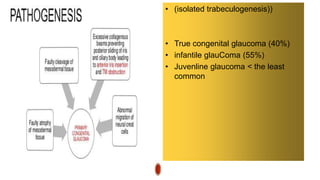
• (isolated trabeculogenesis))
• True congenital glaucoma (40%)
• infantile glauComa (55%)
• Juvenline glaucoma < the least
common
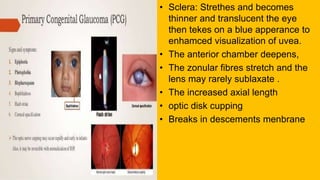
• Sclera: Strethes and becomes
thinner and translucent the eye
then tekes on a blue apperance to
enhamced visualization of uvea.
• The anterior chamber deepens,
• The zonular fibres stretch and the
lens may rarely sublaxate .
• The increased axial length
• optic disk cupping
• Breaks in descements menbrane
Treatment
• 1) Goniotomy is perfermed at the initial examination if the
diagnosis is confirmed. Provide there is sufficiet , corneal
clarity and the angle can be visualized.
• 2) Trabeculotomy may be necessary if corneal clouding
prevents visualization of the angle or when repeated
goniotomy has failed.
• 3) Trabeculectomy is often successful is often successful ,
paticularly when combilned with trabeculotomy and
adjunctive anti - metabolics.
Secondary glaucoma
• Secondary glaucoma per se is not a disease entity, but a group of
disorder in which rise of intraocular pressure is associated
withsome primary ocular or systemic disease . therefore , clinical
features comprise thst of primary disease and that due to effects
of raised IOP.
• Classification depending the causative primary disease
,secondary glaucomas are named as follow:
• Lens-induced (phacogenic ) glaucomas
• Inflammatory glaucoma ( glaucoma due to intraocular
inflammation)
• Pigmentary glaucoma
• Neovascular glaucoma
• Glaucomas associated with iridocorneal endothelial
syndromes
• Psedoexfoliative glaucoma
• Glaucoma associated with intraocular haemorrhage.
• Steroid - induced glaucoma
• Traumatic glaucoma
• Glaucoma -in- aphakia
• Glaucoma associated with intraocular tumors
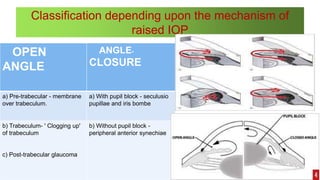
Classification depending upon the mechanism of
raised IOP
OPEN
ANGLE
ANGLE-
CLOSURE
a) Pre-trabecular - membrane
over trabeculum.
a) With pupil block - seculusio
pupillae and iris bombe
b) Trabeculum- ' Clogging up'
of trabeculum
c) Post-trabecular glaucoma
b) Without pupil block -
peripheral anterior synechiae
Important types of secondary glaucoms
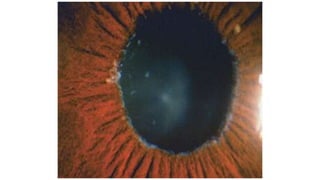
• Pseudoexopholiation: Glaucoma
Pathogenesis : PEX Syndrome : syndrome a condition characterized by
deposition of grey -white , fibrillogranular material in the anterior lems capsule ,
zonules,ciliarybody , iris, trabeculum,anteriorvitreous face and conjunctivs.
PEX Glaucoma occurs when secondary trabecular block occurs by clogging up
of the trabeculum by pseudoexopholiation material.
CLINICAL PICTURE
1) Cormea PEX material on the posterior surface<
2) Iris atrophy -PEX material
3) Lens PEX material forming central disc and peripheral bsnd cataract -
subluxation
4) Gonioscopy : trabecular hyperpigmentation and PEX materisl
Treatment: AS POAG
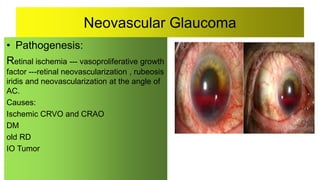
Neovascular Glaucoma
• Pathogenesis:
Retinal ischemia --- vasoproliferative growth
factor ---retinal neovascularization , rubeosis
iridis and neovascularization at the angle of
AC.
Causes:
Ischemic CRVO and CRAO
DM
old RD
IO Tumor
clinical picture
1)Rubeosis iridis iris new vessles.
Treatment : Argon laser photocogulation of the ischemic retina.
2) secondary open angle glaucoma due to neovascular membrane
in front of the tebeculum.
Treatment:
*medical: antiglauc (avoid miotics)-steroids- atopine.
*Argon laser photocoagulation of the ischemic retina.
3)2yr angle closure glaucoma :due to contraction of the membrane.
Treatment: * Medical usally fails
* Argon laser photocoagulation of the ischemic retina.
* surgery : Trabeculectomy with adjunctive mitimycin
Lens induced Glaucoma
• A) Phacolytic glaucoma:
Pathogenesis:
Hypermature cataract - lens proteins leak through intact capsule -
blockage of the trabeculum with protein and macrophages leden
and proteins
Clinical picture:
-corneal edema.
-deepAC with floating white particles (pseudohypopyon)
-gonioscopy : open angle
Treatment : -1st : control IOP medically.
- then cataract surgery
• Phacoanphylactic glaucoma:
Rupture of lens capsule - autoimmune reaction to lens protein - uveitis and
glaucoma
Phacomorphic glaucoma:
Pathogenesis:
intumesecent cataract (Swollen lens)- pupillary block -iris bombe - angle closure
.
treatment:
-control of IOP as in PACG
- Cataract surgery
THANK YOU

Glaucoma

  • 1.
  • 2.
    Definition • Glaucoma is'nta single disease ,rather it is a large group disorder that are characterized by widely dverse clinical and histological manifestation. • Glaucoma suspect - individuals presenting with concerning optic nerve apperences with normal IOP and either normal visual firlds or borderline VF loss
  • 3.
  • 5.
    Causes of raisedIOP in Glaucoma • Hypersecretory Glaucoma-Excess secretion of aqueous humour ,- epidemic dropsy . • Obstruction of flow of aqueous humour from postrior chamber to anterior chamber ,- pupillary block glaucoma. • Blockage of angle - due to peripheral anterior synechiae/apposition in PACG. • Blockage of aqueous outflow -due to peripheral anterior synechiae/apposition in PACG • Blockage of aqueous outflow - due to sclerosis of the trabecular meshwork in POAG • High episcleral venous pressure - Sturge Weber syndrome
  • 6.
    Causes of secondaryGlaucoma OPEN ANGLE ANGLE- CLOSURE a) Pre-trabecular - membrane over trabeculum. a) With pupil block - seculusio pupillae and iris bombe b) Trabeculum- ' Clogging up' of trabeculum c) Post-trabecular glaucoma b) Without pupil block - peripheral anterior synechiae
  • 7.
    Mechanism of opticnerve damage • Mechanical-Elevated IOP • Vascular - Insufficient blood supply to ONH • Neurochemical - Glutamate exctotoxins , endothelins
  • 8.
    primary open angleglaucoma • IOP>21mmHg glaucomatous disc changes Visual field loss Absence of signs of secondary glaucoma or a non glaucomatous cause for the optic neuropathy
  • 9.
    • IOP >21mmhg • AGE: It is more common in 5th and 7th decades. • Race : 4-3times in africans,europeans and hispanics. • Corneal thickness <550microns • Positive family history • Moderate assosiation -Myopia - Sex : F:M -2:1 for NTG - Diurnal variation of IOP weaker association -DM -migrane and other vasopasm disorder -NTG - Sleep Apnea -NTG - Systemic hypertension
  • 10.
    Pathagenesis of risein IOP in POAG • Thickening and sclerosis of trebecular meshwork with faulty collagen tissue • Narrowing of intertrabecular spaces. • Depositon of amorphous material in the juxtacanalicular space. • Collapse of schlemms canal and absence of giant vaculoes in the cells lining it.
  • 11.
    Clinical Features SYMTOMS: • Thedisease is insidious and asymptomatic ,until it has caused a significant loss of VF. • Headache and eyeache of mild intensity may be experienced in the course. • Scotoma may be noticed • Difficulty in reading and close work . • Delayed dark adaptation • Significant loss of vision and blindness is the end result of
  • 12.
    • SIGNS: • Anteriorsegment signs -Pupil reflex become sluggish and cornea with slight haze . - A low (<555mn) CCT Raised IOP: - Approximately 2% of the general population over the age of40 yrs have IOPs>24mmhg and 7% have IOP>21mmhg. however only 1% of these have glaucomatous VF loss. Diurnal fluctations: In POAG this fluctuations is exaggerated and occur in about 90% of cases Asymmetry of the IOP between the two eyes: If 5mmhg or more should arouse suspicion
  • 13.
    Optic disc changes: 1)Baringof the curve linear blood vessels due to loss of the neuroglial fibrous tissue as a result of ischemia.leaving the blood vessel unsupported 2)Optic disc hemorrhage ( Splinter or flame shaped) in 2-4% of cases .It isue to easy rupture of the non - supported curve linear vessesls . 3) Nasalization of central blood vessesls . 4)Enlargement of the physiological cup. 5) Asymmetry cup/disc ratio between both eyes 6) Specific glaucomatous cupping : - Narrow opening . - Depth : very deep
  • 14.
    Edges : overhangingwith marked interruption of the vessels. • Marked sliding of the side wall,so vessels come out from edge like a head of snake. • Increase cup /disc ratio (normal:0.3) • In advanced cases lamina cribrosa can be seen.
  • 15.
    • 7) Post- glaucomatous opticatrophy :sw cupping and pallor
  • 16.
    Visual fields (perimetry) •A) Central changes : • 1) Paracentral scotomata : Are isolated scotomata which later becomes connected ith the blind spot to form the arcuate scotoma . • 2)Baring of the blind spot : Is exclusion of the blind spot from the centralfield ( due to localized contraction of the temporal edge of the central field ) • 3)Siedel scotoma : Is a tapering wing like elongation of the upper and lower pole of the blind spot > • 4) Bjerrum (arcuate) scoloma:upper and/or lower bundle defect around and joining the blind spot and is concentric with the fixation point. • 5)Annular scotoma: By fusion of the 2 (upper and lower ) bjerrum scotomata in the nasal field.
  • 17.
    • B) : •1) Nasal field contraction :occurs earlier than the temporal field because the temporal retinal fibres are more dense and so suffer more. • 2) roenne”snasal step :is a sectorial nasal field defect (upper or lower ) with a sharply horizontal edge . • 3) Concenteric contraction. • 4)Tubular vision . • C) End stage : Total Field loss • D)Gonioscopy : Shows a normal open angle .
  • 18.
    Management • Aim : •The primary aim of treatment is to prevent functional impairement of vision within the patient's lifetime by slowing the rate of ganglion cell. • Method of achieving this goal is by lowering of IOP. • Target pressure:Is is an IOP level below which further damage is unlikely.Therapy should maintain the IOP at or below the target level. • Monitoring is performed of the optic nerve and visual fields. In the event of further damage the target IOP is a reset at a lower level.
  • 19.
    • Patient instructions •Including : • 1) A simple explanation of the nature of the disease . • 2) The patient should be taught how to instil drops and the intervals between medicatons should ne specified. • 3) in order to minimize systemic absorption the patient should be intructed either to perfoem lacrimal sac acclusion ( by applying pressure at the medical canthus or to close the eyes for about 3minutes after instillation. • 4) Potential adverse effects should be explained and subsequently asked fot at follow -up visits.
  • 20.
    Lines of treatment •Medical therapy • 1) Any chosen drug should be used in its lowest concentration and as infrequently as possible . • 2)Initial treatment is usually with one drug . • 3) Follow -up . • Antiglaucoma Drugs • 1) - -timolol,betaxolol ,levobunolol,metipranolol • 2) - - brimonidine, Apraclonidine • 3) - latanoprost , travoprost , bimatoprost • 4) - pilocarpine • 5) - Dorzolamide, brinzolamide • 6) : Acetazolamide • 7) : manitol, glycerol
  • 21.
    • laser trabeculoplasty •Principal : In this procedure discrete argon or diode laser burns are applied to the trabeculum to enhance aqueous outflow and lower IOP . The therpeutic effect ; - Often transient ,lasting a few years ,so that laser therapy may merely defer the need for filtration surgery . - IOP reduction is seldom greater than 30 % . so, an IOP >28mmhg is unlikely to be adequately controlled by laser alone. Surgical treatment : Trabeculectomy 1) Failed medical therapy and / or laser trabeculoplasty. .2) Advanced disease requiring a very low target pressure.
  • 22.
    Normal Tension glaucoma •Is a varient of POAG. It is characterized by: • A mean IOP equal to or less than 21mmhg on diurnal testing. • glaucomatous optic disc damage and VF loss • Open drainage angle on gonioscopy. • Absence of secondary causesfor glaucomatous optic disc damage
  • 23.
    primary angle-closure glaucoma •PACG is a condition in which elevation of IOP occurs as a result of obstrution of aqueous outflow by partial or complete closure of the angle by the peripheral iris • Based on mechanism of angle closure ,the three forms are: • Pupillary block • plateau iris syndrome • phacomorphic mechanism closed angle
  • 24.
    PACG with pupillaryblock • Anatomical predisposing factors 1) Relatively anterior location of the iris-lens diaphragm> 2) Shallow anterior chamber. 3)Narrow chamber angle. Pathogenesis -contaction of dilator pupillae exerts a posterior vector.This increases the amount of apposition between rhe iris and anteriorly located lens, enhancing the degree of physiological resistance at the pupil (pupil block) -Dilation of the pupil renders the peripheral iris more flaccid - The pupil block cuses the pressure in the posterior chamber to increase pheripheral irirs bows anteriorly (iris bombe) Eventually the iris touches the posterior corneal surafce , obstructing the angle
  • 26.
  • 28.
    Latent angle closureglaucoma • Implies an anatomically predisposed eye, It can only be suspected prospectively • Clinical features - Symptoms are absent -The eclipse sign. -Slit -lamp biomicroscopy: Axial anterior chamber depth is less than normal. convex-shaped iris -lens diaphragm. close proximity of the iris to the cornea. Gonioscopy shows an'occudable ' angle. Treatment Prophylactic peripheral laser Iridotomy : if the other eye has had acute or sub acute PACG
  • 29.
    • Pathogenesis :SubacutePACG occurs in a predisposed eye with an occludable angle in association with intermittent pupillary block.Rapid closure of the angle results in sudden increase in IOP . The pupillary block is then spomtaneously relieved , the angle opens and the IOP return to normal. Precipating factor : Attack may be precipitated by: 1) Physiological mydriasis 2)Physiological shallowing of the anterior chamber when the patient assumes a prone position 3) emotional stress. Diagnosis: 1) Transient blurring of vision associatewith haloes around lights due to curneal epithelial edema. 2)Ocular discomfort or frontal headache 3) the attack reoccur Subacute angle closure glaucoma
  • 30.
    Acute cngestive 3angle -closure glaucoma • This is a sight thresting emergency , involving painful loss of vision, due to sudden and total closure of the angle. Clinical features SYMPTOMS: Rapidly progressive unilateral visual loss Periocular pain and congestion Nausea and vomiting may occur in severe cases. History if trensient blurring and haloes SIGNS: 1) conjunctiva,”ciliary” flush (Ciliary injection ) due to injection of the limbal and conjunctival blood vessels. 2) Cornea : Corneal odema with epithelial vesicals and stromal thickening . 3)AC: Shallow anterior chamber with peripheral iridpcorneal contact . Aqueous flare may be seen once the corneal oedema has resolved .
  • 31.
    • 4) Thepupil: is vertically oval, fixed in the semi dilated position and unreactive to both light and accommodation. • 5)The iris:blood vessels are dilared. • 6)The IOP : is severely elevated (50-100mmhg) • 7)Gonioscopy:may need to be deffered until the corneal oedema has resolved .It is ,however,viral to perform this examination in the fellow eye,which usually ehibits characteristics of latent angle closure.The affected eye shows complete peripral iridocorneal contact. • 9)Ophthalmoscopy:shows optic disc oedema and hyperaemia.
  • 32.
    • Treatment : •(*)Control of the attack : • A)Immediate treatment : • 1) systemic : Acetazolamide 500 mg intravenously and 500mg orally. • 2)topical :-pilocarpine 2% two drops to both eyes. • - Dexamethasone(or equivalent ) • -Beta -blocker • 3) Analgesia and anti emetics . patient to lie supine for1hour. • B) After 1 hour : • pilocarpine 2% should be repeated, by which time reduction of iris ischemia and lowering of IOP allows the sphincher papillae to respond to the drug.
  • 33.
    • C) Afterfurther 30 minutes : • If IOP has not fallen to below 35mmhg: • 1) Glycerol 505 Orally (1kg/g ) (with caution in diabeties ) and fluid intake limited for maximum effect. • 2) Mannitol 20 % ( 1-2 g/kg ) may be given intravenously over 45 minutes , if the patient is unable to tolerate oral glycerol. • D)A high IOP unresponsive to medication may sometimes respond to axail corneal indentation,this allows aqueous humour to force its way between the iris ad cornea to the angle , thus opening it and gaining access to the trabecular meshwork. *Surgical treatment : • 1) Nd: YAG: • 2) Trabeculectomy :
  • 34.
    Chronic angle -4closure glaucoma • Pathogenesis: • 1) Type1 (creeping): is caused and progressive angle closure. • Type 2is caused by angle closure as a result of intermittent subacute attacks. • Type3 (mixed): is caused by a combination of POAG with narrow angles usually associated with the long term use of miotics • Clinical Features • These are similar to POAG. • Shallow AC • Gonioscopy shows a variable degree of angle closure
  • 35.
    Primary angle -closureglaucoma without pupillary block (Plateau Iris) • Plateau iris configuration: Chacterized by a closed anterior chamber angle in assosiation with a flat iris plane and a deep anterior chamber. Plateau iris glaucoma: Acute angle closureours with pupillary dilatation despire a patient iridotomy . When the pupil dilates , the peripheral iris becomes bunched up and occludes the trabeculum . Clinically : All the features of acute congestive angle closure are present except that the axial anterior chamber depth is normal and the iris plane is flat rather than convex. Treatment 1) Laser peripheral iridotomy. 2) pilocarpine 1% drops
  • 36.
  • 37.
    • (isolated trabeculogenesis)) •True congenital glaucoma (40%) • infantile glauComa (55%) • Juvenline glaucoma < the least common
  • 38.
    • Sclera: Strethesand becomes thinner and translucent the eye then tekes on a blue apperance to enhamced visualization of uvea. • The anterior chamber deepens, • The zonular fibres stretch and the lens may rarely sublaxate . • The increased axial length • optic disk cupping • Breaks in descements menbrane
  • 39.
    Treatment • 1) Goniotomyis perfermed at the initial examination if the diagnosis is confirmed. Provide there is sufficiet , corneal clarity and the angle can be visualized. • 2) Trabeculotomy may be necessary if corneal clouding prevents visualization of the angle or when repeated goniotomy has failed. • 3) Trabeculectomy is often successful is often successful , paticularly when combilned with trabeculotomy and adjunctive anti - metabolics.
  • 40.
    Secondary glaucoma • Secondaryglaucoma per se is not a disease entity, but a group of disorder in which rise of intraocular pressure is associated withsome primary ocular or systemic disease . therefore , clinical features comprise thst of primary disease and that due to effects of raised IOP. • Classification depending the causative primary disease ,secondary glaucomas are named as follow: • Lens-induced (phacogenic ) glaucomas • Inflammatory glaucoma ( glaucoma due to intraocular inflammation) • Pigmentary glaucoma • Neovascular glaucoma
  • 41.
    • Glaucomas associatedwith iridocorneal endothelial syndromes • Psedoexfoliative glaucoma • Glaucoma associated with intraocular haemorrhage. • Steroid - induced glaucoma • Traumatic glaucoma • Glaucoma -in- aphakia • Glaucoma associated with intraocular tumors
  • 42.
    Classification depending uponthe mechanism of raised IOP OPEN ANGLE ANGLE- CLOSURE a) Pre-trabecular - membrane over trabeculum. a) With pupil block - seculusio pupillae and iris bombe b) Trabeculum- ' Clogging up' of trabeculum c) Post-trabecular glaucoma b) Without pupil block - peripheral anterior synechiae
  • 43.
    Important types ofsecondary glaucoms • Pseudoexopholiation: Glaucoma Pathogenesis : PEX Syndrome : syndrome a condition characterized by deposition of grey -white , fibrillogranular material in the anterior lems capsule , zonules,ciliarybody , iris, trabeculum,anteriorvitreous face and conjunctivs. PEX Glaucoma occurs when secondary trabecular block occurs by clogging up of the trabeculum by pseudoexopholiation material. CLINICAL PICTURE 1) Cormea PEX material on the posterior surface< 2) Iris atrophy -PEX material 3) Lens PEX material forming central disc and peripheral bsnd cataract - subluxation 4) Gonioscopy : trabecular hyperpigmentation and PEX materisl Treatment: AS POAG
  • 45.
    Neovascular Glaucoma • Pathogenesis: Retinalischemia --- vasoproliferative growth factor ---retinal neovascularization , rubeosis iridis and neovascularization at the angle of AC. Causes: Ischemic CRVO and CRAO DM old RD IO Tumor
  • 46.
    clinical picture 1)Rubeosis iridisiris new vessles. Treatment : Argon laser photocogulation of the ischemic retina. 2) secondary open angle glaucoma due to neovascular membrane in front of the tebeculum. Treatment: *medical: antiglauc (avoid miotics)-steroids- atopine. *Argon laser photocoagulation of the ischemic retina. 3)2yr angle closure glaucoma :due to contraction of the membrane. Treatment: * Medical usally fails * Argon laser photocoagulation of the ischemic retina. * surgery : Trabeculectomy with adjunctive mitimycin
  • 47.
    Lens induced Glaucoma •A) Phacolytic glaucoma: Pathogenesis: Hypermature cataract - lens proteins leak through intact capsule - blockage of the trabeculum with protein and macrophages leden and proteins Clinical picture: -corneal edema. -deepAC with floating white particles (pseudohypopyon) -gonioscopy : open angle Treatment : -1st : control IOP medically. - then cataract surgery
  • 48.
    • Phacoanphylactic glaucoma: Ruptureof lens capsule - autoimmune reaction to lens protein - uveitis and glaucoma Phacomorphic glaucoma: Pathogenesis: intumesecent cataract (Swollen lens)- pupillary block -iris bombe - angle closure . treatment: -control of IOP as in PACG - Cataract surgery
  • 50.