Glasgow Coma Scale
Past, Present, Future
KKH Morning Teaching - March 2013
Tan Hon Liang
Past: Background
 1940s
 WWII: Medical Research Council, UK issued glossary of terms
used in cases of head injury.
 16 terms included coma, semi-coma, stupor, confusion,
obtundation.
 Tedious and not unified.
Past: Background
 Advent of Critical Care (1947 Polio outbreak)
 Improved survival with resuscitation.
 Intensivists wanted to know how to predict who was worth
treating (or continuing to treat), and to assess the relative value
of alternative management
 Need for uniform language to communicate patient status and
for research
Past: Background
 In 1974
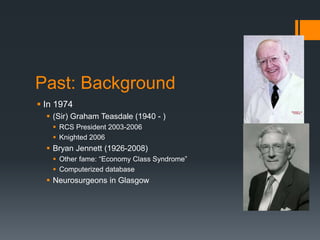
 (Sir) Graham Teasdale (1940 - )
 RCS President 2003-2006
 Knighted 2006
 Bryan Jennett (1926-2008)
 Other fame: “Economy Class Syndrome”
 Computerized database
 Neurosurgeons in Glasgow
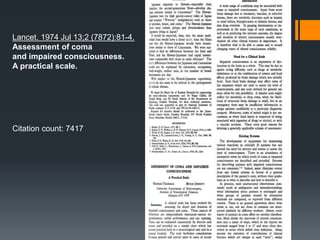
Lancet. 1974 Jul 13;2 (7872):81-4.
Assessment of coma
and impaired consciousness.
A practical scale.
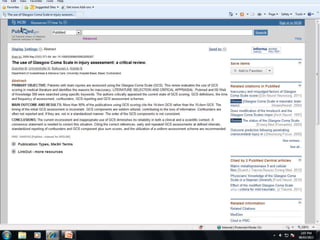
Citation count: 7417
Past: Background
 Original 14 point scale intended to objectively determine the
severity of brain dysfunction and coma six hours after the
occurrence of head trauma.
 Why 6 hours?
 Subsequent revised in 1976 with the addition of a sixth point
in the motor response subscale for “withdrawal from painful
stimulus”
Past: Background
 Accepted classification:
 13-15 (mild HI)
 9-12 (moderate HI)
 < 8 (severe HI)
Past: Background
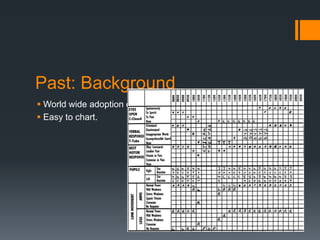
 World wide adoption contributed in no small part by nurses.
 Easy to chart.
Past: Background
 Numerical, easy to analyze.
 Since 1974, > 4000 articles published.
 Added into other scores: APACHE, SAPS, TRISS, CRAMS,
ASCOT.
 Used to prognosticate.
 Used to recommend treatment: WFNS for SAH, ATLS for
intubation.
 Advocates and detractors.
Past: Background
 How about kids?
Past: Background
 Different total score proposed:
 9 (at six months),
 11 (at 1 year),
 13-14 (at 5 years)
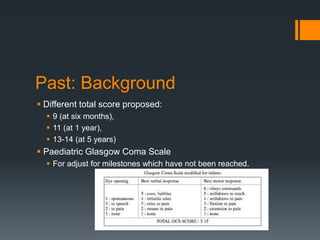
 Paediatric Glasgow Coma Scale
 For adjust for milestones which have not been reached.
Past: Background
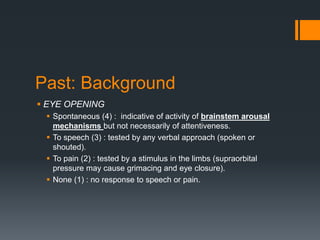
 EYE OPENING
 Spontaneous (4) : indicative of activity of brainstem arousal
mechanisms but not necessarily of attentiveness.
 To speech (3) : tested by any verbal approach (spoken or
shouted).
 To pain (2) : tested by a stimulus in the limbs (supraorbital
pressure may cause grimacing and eye closure).
 None (1) : no response to speech or pain.
Past: Background
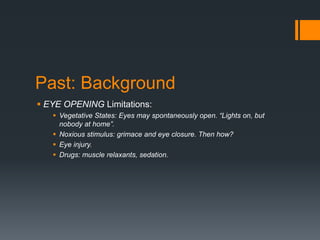
 EYE OPENING Limitations:
 Vegetative States: Eyes may spontaneously open. “Lights on, but
nobody at home”.
 Noxious stimulus: grimace and eye closure. Then how?
 Eye injury.
 Drugs: muscle relaxants, sedation.
Past: Background
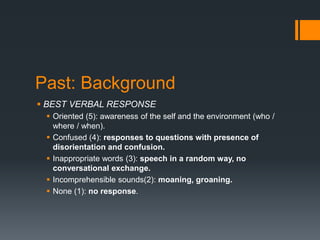
 BEST VERBAL RESPONSE
 Oriented (5): awareness of the self and the environment (who /
where / when).
 Confused (4): responses to questions with presence of
disorientation and confusion.
 Inappropriate words (3): speech in a random way, no
conversational exchange.
 Incomprehensible sounds(2): moaning, groaning.
 None (1): no response.
Past: Background
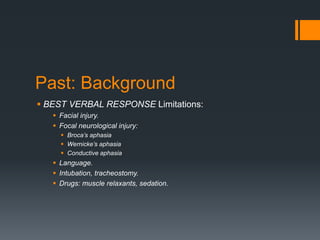
 BEST VERBAL RESPONSE Limitations:
 Facial injury.
 Focal neurological injury:
 Broca’s aphasia
 Wernicke’s aphasia
 Conductive aphasia
 Language.
 Intubation, tracheostomy.
 Drugs: muscle relaxants, sedation.
Past: Background
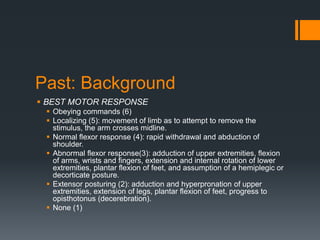
 BEST MOTOR RESPONSE
 Obeying commands (6)
 Localizing (5): movement of limb as to attempt to remove the
stimulus, the arm crosses midline.
 Normal flexor response (4): rapid withdrawal and abduction of
shoulder.
 Abnormal flexor response(3): adduction of upper extremities, flexion
of arms, wrists and fingers, extension and internal rotation of lower
extremities, plantar flexion of feet, and assumption of a hemiplegic or
decorticate posture.
 Extensor posturing (2): adduction and hyperpronation of upper
extremities, extension of legs, plantar flexion of feet, progress to
opisthotonus (decerebration).
 None (1)
Past: Background
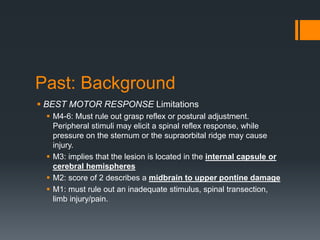
 BEST MOTOR RESPONSE Limitations
 M4-6: Must rule out grasp reflex or postural adjustment.
Peripheral stimuli may elicit a spinal reflex response, while
pressure on the sternum or the supraorbital ridge may cause
injury.
 M3: implies that the lesion is located in the internal capsule or
cerebral hemispheres
 M2: score of 2 describes a midbrain to upper pontine damage
 M1: must rule out an inadequate stimulus, spinal transection,
limb injury/pain.
Past: Background
 Despite all that limitation, GCS continues to be widely
adapted.
 Used to:
 assess coma, monitor changes in coma,
 as indicator of severity of illness
 Triage patients with head injury in EMD/to ICU
 aid in clinical decisions, such as intubation
Present: True or False
1. Glasgow Coma Scale is an accurate neurological assessment
tool.
2. GCS predicts outcome.
3. GCS < 9: I should intubate the patient.
 If I don’t, the patient will aspirate/die.
 Other than trauma, I can use GCS for
 Poisoning,
 Stroke,
 Sepsis.
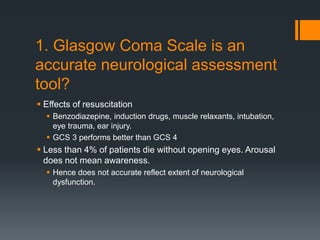
1. Glasgow Coma Scale is an
accurate neurological assessment
tool?
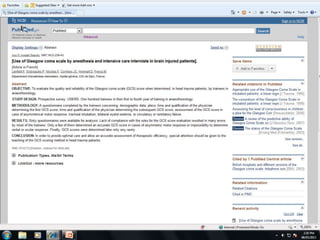
 Effects of resuscitation
 Benzodiazepine, induction drugs, muscle relaxants, intubation,
eye trauma, ear injury.
 GCS 3 performs better than GCS 4
 Less than 4% of patients die without opening eyes. Arousal
does not mean awareness.
 Hence does not accurate reflect extent of neurological
dysfunction.
GCS has observer bias.
- Observations may not be standardized.
- Errors up to 2 points.
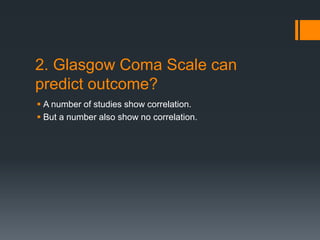
2. Glasgow Coma Scale can
predict outcome?
 A number of studies show correlation.
 But a number also show no correlation.
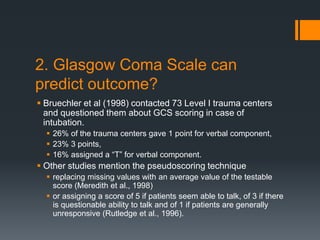
2. Glasgow Coma Scale can
predict outcome?
 Bruechler et al (1998) contacted 73 Level I trauma centers
and questioned them about GCS scoring in case of
intubation.
 26% of the trauma centers gave 1 point for verbal component,
 23% 3 points,
 16% assigned a “T” for verbal component.
 Other studies mention the pseudoscoring technique
 replacing missing values with an average value of the testable
score (Meredith et al., 1998)
 or assigning a score of 5 if patients seem able to talk, of 3 if there
is questionable ability to talk and of 1 if patients are generally
unresponsive (Rutledge et al., 1996).
As a result, a lot of research cannot be reliably intepreted.
Or trusted.
2. Glasgow Coma Scale can
predict outcome?
 The GCS is an ordinal scale.
 The difference between unit values is not consistent and
compares only better with worse
 Yet, minimal differences of GCS scores are important in terms of
prognosis.
 The scale incorporates a numerical skew towards motor
response, because there are only 4 points for eye response,
versus 5 for verbal and 6 for motor responses.
 Summing the three sub- scales assumes an equal weighting for
each one, thus leading to loss of information since the same
score can be made up in various ways
2. Glasgow Coma Scale can
predict outcome?
 GCS: collection of 120 mathematical combinations
 eighteen possible permutations exist for total GCS score of 9
 seventeen for scores 8 and 10
 fourteen for scores 7 and 11
 ten for scores 6 and 12
 Therefore, not all GCS 9 are equal.
 How can one prognosticate outcome if not all that seems are
equal?
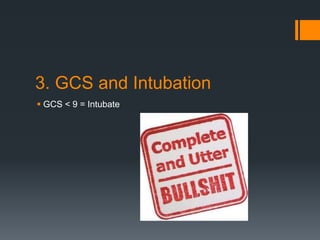
3. GCS and Intubation
 GCS < 9 = Intubate
Clinical Case 1
 You are the Anaesthetic On Call.
 You are called to the Emergency Department to assist in the
airway management of a 14 year old female, A.
Clinical Case 1
 You are informed that this child was found by her parents
drowsy at home in bed with 2 empty can of beer and 1 empty
750 ml bottle of wine.
 You assess the patient…
Clinical Case 1
 Eyes do not open to stimulus.
 Speech is incoherent and slurred.
 There is flexion of her upper limbs to stimulus.
Clinical Case 1
 What do you do next?
 Do you intubate this patient?
Clinical Case 2
 You are the Anaesthetic On Call.
 You are called to the Emergency Department to assist in the
airway management of a 14 year old female, B.
Clinical Case 2
 You are informed that this child was found by her parents
drowsy at home in bed.
 She is known to have epilepsy.
 You assess the patient…
Clinical Case 2
 Eyes do not open to stimulus.
 Speech is incoherent and slurred.
 There is flexion of her upper limbs to stimulus.
Clinical Case 2
 What do you do next?
 Do you intubate this patient?
Advocates
 On the basis of recommendations from
 the American College of Surgeons Committee on Trauma,
 the European Society of Intensive Care Medicine and
 the Eastern Association for the Surgery of Trauma,
 GCS <9 is used as the level at which intubation is considered
mandatory.
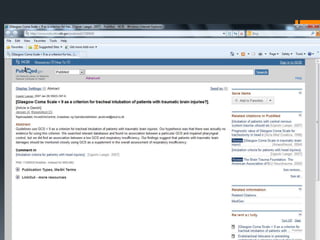
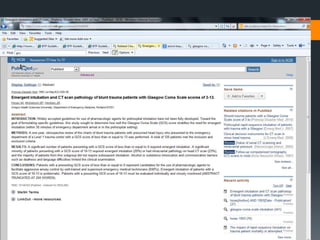
One paper that ruled them all….
Advocates
 Rationale:
 Hypoxemia is bad for the injured brain.
 Tracheal intubation is the surest way of delivering oxygen.
 Therefore, intubation is mandatory.
 (How about just providing oxygen with jaw thrust??)
 Additional benefit of preventing aspiration.
 (Chances are it would already have occurred)
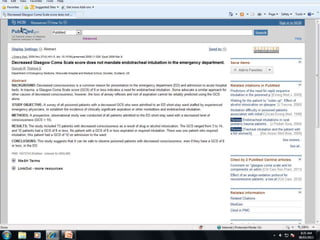
3. GCS < 9 does not mandate
intubation
 Not all GCS < 9 are equal.
 GCS scoring wise, we seen that.
 Not to be extrapolated to all forms of depressed neurology.
 Trauma is different from poisoning, stroke, sepsis.
 Not all GCS < 9 lose gag/cough reflex.
 Not all who loses gag/cough reflex aspirates.
Association with respiratory insufficiency but no association
between a particular GCS and impaired pharyngeal control!
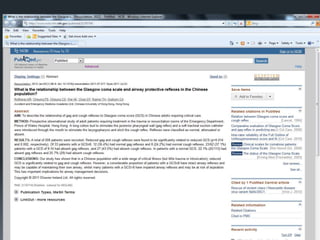
GCS < 9 does not mandate intubation
Considerable proportion of patients with low GCS had
gag/cough.
Many patients with GCS>8 had impaired airway reflexes.
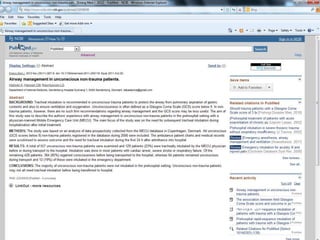
GCS < 9 does not mandate intubation
All GCS < 9 non trauma EMD patients included:
557 patients. 129 tubed for cardiac arrest, resp failure, severe stroke.
428 not tubed: 364 (85%) regained consciousness,
64 remained unconscious – 12 of these needed to be tubed
GCS < 9 does not mandate intubation
Drug or alcohol intoxication: 73 patients
12 GCS <9 but none required intubation or
aspirated.
1 patient intubated: GCS 12 on presentation!
Clinical Cases
 Case 1: intoxicated A
 Tube?
 Case 2: post ictal B
 Tube?
The Future?
 GCS
 Past has been glorious.
 Present is murky.
 Future is uncertain.
My Conclusion
 GCS:
 It’s for Head Injury. Be careful extrapolating beyond what it is
meant to do.
 After 6 hours.
 For communication
 For standardized classification/research.
 Useful for trending, but beware observer error. Drop in 2 points
probably good trigger for reassessment.
 No magic number for intubation
 <9 doesn’t always mean tube, while >/= 9 does means it is safe.
tan.hon.liang@sgh.com.sg

Glasgow Coma Scale - Past Present Future

  • 1.
    Glasgow Coma Scale Past,Present, Future KKH Morning Teaching - March 2013 Tan Hon Liang
  • 2.
    Past: Background  1940s WWII: Medical Research Council, UK issued glossary of terms used in cases of head injury.  16 terms included coma, semi-coma, stupor, confusion, obtundation.  Tedious and not unified.
  • 3.
    Past: Background  Adventof Critical Care (1947 Polio outbreak)  Improved survival with resuscitation.  Intensivists wanted to know how to predict who was worth treating (or continuing to treat), and to assess the relative value of alternative management  Need for uniform language to communicate patient status and for research
  • 4.
    Past: Background  In1974  (Sir) Graham Teasdale (1940 - )  RCS President 2003-2006  Knighted 2006  Bryan Jennett (1926-2008)  Other fame: “Economy Class Syndrome”  Computerized database  Neurosurgeons in Glasgow
  • 5.
    Lancet. 1974 Jul13;2 (7872):81-4. Assessment of coma and impaired consciousness. A practical scale. Citation count: 7417
  • 6.
    Past: Background  Original14 point scale intended to objectively determine the severity of brain dysfunction and coma six hours after the occurrence of head trauma.  Why 6 hours?  Subsequent revised in 1976 with the addition of a sixth point in the motor response subscale for “withdrawal from painful stimulus”
  • 7.
    Past: Background  Acceptedclassification:  13-15 (mild HI)  9-12 (moderate HI)  < 8 (severe HI)
  • 8.
    Past: Background  Worldwide adoption contributed in no small part by nurses.  Easy to chart.
  • 9.
    Past: Background  Numerical,easy to analyze.  Since 1974, > 4000 articles published.  Added into other scores: APACHE, SAPS, TRISS, CRAMS, ASCOT.  Used to prognosticate.  Used to recommend treatment: WFNS for SAH, ATLS for intubation.  Advocates and detractors.
  • 10.
  • 11.
    Past: Background  Differenttotal score proposed:  9 (at six months),  11 (at 1 year),  13-14 (at 5 years)  Paediatric Glasgow Coma Scale  For adjust for milestones which have not been reached.
  • 12.
    Past: Background  EYEOPENING  Spontaneous (4) : indicative of activity of brainstem arousal mechanisms but not necessarily of attentiveness.  To speech (3) : tested by any verbal approach (spoken or shouted).  To pain (2) : tested by a stimulus in the limbs (supraorbital pressure may cause grimacing and eye closure).  None (1) : no response to speech or pain.
  • 13.
    Past: Background  EYEOPENING Limitations:  Vegetative States: Eyes may spontaneously open. “Lights on, but nobody at home”.  Noxious stimulus: grimace and eye closure. Then how?  Eye injury.  Drugs: muscle relaxants, sedation.
  • 14.
    Past: Background  BESTVERBAL RESPONSE  Oriented (5): awareness of the self and the environment (who / where / when).  Confused (4): responses to questions with presence of disorientation and confusion.  Inappropriate words (3): speech in a random way, no conversational exchange.  Incomprehensible sounds(2): moaning, groaning.  None (1): no response.
  • 15.
    Past: Background  BESTVERBAL RESPONSE Limitations:  Facial injury.  Focal neurological injury:  Broca’s aphasia  Wernicke’s aphasia  Conductive aphasia  Language.  Intubation, tracheostomy.  Drugs: muscle relaxants, sedation.
  • 16.
    Past: Background  BESTMOTOR RESPONSE  Obeying commands (6)  Localizing (5): movement of limb as to attempt to remove the stimulus, the arm crosses midline.  Normal flexor response (4): rapid withdrawal and abduction of shoulder.  Abnormal flexor response(3): adduction of upper extremities, flexion of arms, wrists and fingers, extension and internal rotation of lower extremities, plantar flexion of feet, and assumption of a hemiplegic or decorticate posture.  Extensor posturing (2): adduction and hyperpronation of upper extremities, extension of legs, plantar flexion of feet, progress to opisthotonus (decerebration).  None (1)
  • 17.
    Past: Background  BESTMOTOR RESPONSE Limitations  M4-6: Must rule out grasp reflex or postural adjustment. Peripheral stimuli may elicit a spinal reflex response, while pressure on the sternum or the supraorbital ridge may cause injury.  M3: implies that the lesion is located in the internal capsule or cerebral hemispheres  M2: score of 2 describes a midbrain to upper pontine damage  M1: must rule out an inadequate stimulus, spinal transection, limb injury/pain.
  • 18.
    Past: Background  Despiteall that limitation, GCS continues to be widely adapted.  Used to:  assess coma, monitor changes in coma,  as indicator of severity of illness  Triage patients with head injury in EMD/to ICU  aid in clinical decisions, such as intubation
  • 19.
    Present: True orFalse 1. Glasgow Coma Scale is an accurate neurological assessment tool. 2. GCS predicts outcome. 3. GCS < 9: I should intubate the patient.  If I don’t, the patient will aspirate/die.  Other than trauma, I can use GCS for  Poisoning,  Stroke,  Sepsis.
  • 20.
    1. Glasgow ComaScale is an accurate neurological assessment tool?  Effects of resuscitation  Benzodiazepine, induction drugs, muscle relaxants, intubation, eye trauma, ear injury.  GCS 3 performs better than GCS 4  Less than 4% of patients die without opening eyes. Arousal does not mean awareness.  Hence does not accurate reflect extent of neurological dysfunction.
  • 21.
    GCS has observerbias. - Observations may not be standardized. - Errors up to 2 points.
  • 22.
    2. Glasgow ComaScale can predict outcome?  A number of studies show correlation.  But a number also show no correlation.
  • 23.
    2. Glasgow ComaScale can predict outcome?  Bruechler et al (1998) contacted 73 Level I trauma centers and questioned them about GCS scoring in case of intubation.  26% of the trauma centers gave 1 point for verbal component,  23% 3 points,  16% assigned a “T” for verbal component.  Other studies mention the pseudoscoring technique  replacing missing values with an average value of the testable score (Meredith et al., 1998)  or assigning a score of 5 if patients seem able to talk, of 3 if there is questionable ability to talk and of 1 if patients are generally unresponsive (Rutledge et al., 1996).
  • 24.
    As a result,a lot of research cannot be reliably intepreted. Or trusted.
  • 25.
    2. Glasgow ComaScale can predict outcome?  The GCS is an ordinal scale.  The difference between unit values is not consistent and compares only better with worse  Yet, minimal differences of GCS scores are important in terms of prognosis.  The scale incorporates a numerical skew towards motor response, because there are only 4 points for eye response, versus 5 for verbal and 6 for motor responses.  Summing the three sub- scales assumes an equal weighting for each one, thus leading to loss of information since the same score can be made up in various ways
  • 26.
    2. Glasgow ComaScale can predict outcome?  GCS: collection of 120 mathematical combinations  eighteen possible permutations exist for total GCS score of 9  seventeen for scores 8 and 10  fourteen for scores 7 and 11  ten for scores 6 and 12  Therefore, not all GCS 9 are equal.  How can one prognosticate outcome if not all that seems are equal?
  • 27.
    3. GCS andIntubation  GCS < 9 = Intubate
  • 28.
    Clinical Case 1 You are the Anaesthetic On Call.  You are called to the Emergency Department to assist in the airway management of a 14 year old female, A.
  • 29.
    Clinical Case 1 You are informed that this child was found by her parents drowsy at home in bed with 2 empty can of beer and 1 empty 750 ml bottle of wine.  You assess the patient…
  • 30.
    Clinical Case 1 Eyes do not open to stimulus.  Speech is incoherent and slurred.  There is flexion of her upper limbs to stimulus.
  • 31.
    Clinical Case 1 What do you do next?  Do you intubate this patient?
  • 32.
    Clinical Case 2 You are the Anaesthetic On Call.  You are called to the Emergency Department to assist in the airway management of a 14 year old female, B.
  • 33.
    Clinical Case 2 You are informed that this child was found by her parents drowsy at home in bed.  She is known to have epilepsy.  You assess the patient…
  • 34.
    Clinical Case 2 Eyes do not open to stimulus.  Speech is incoherent and slurred.  There is flexion of her upper limbs to stimulus.
  • 35.
    Clinical Case 2 What do you do next?  Do you intubate this patient?
  • 36.
    Advocates  On thebasis of recommendations from  the American College of Surgeons Committee on Trauma,  the European Society of Intensive Care Medicine and  the Eastern Association for the Surgery of Trauma,  GCS <9 is used as the level at which intubation is considered mandatory.
  • 37.
    One paper thatruled them all….
  • 38.
    Advocates  Rationale:  Hypoxemiais bad for the injured brain.  Tracheal intubation is the surest way of delivering oxygen.  Therefore, intubation is mandatory.  (How about just providing oxygen with jaw thrust??)  Additional benefit of preventing aspiration.  (Chances are it would already have occurred)
  • 39.
    3. GCS <9 does not mandate intubation  Not all GCS < 9 are equal.  GCS scoring wise, we seen that.  Not to be extrapolated to all forms of depressed neurology.  Trauma is different from poisoning, stroke, sepsis.  Not all GCS < 9 lose gag/cough reflex.  Not all who loses gag/cough reflex aspirates.
  • 40.
    Association with respiratoryinsufficiency but no association between a particular GCS and impaired pharyngeal control! GCS < 9 does not mandate intubation
  • 41.
    Considerable proportion ofpatients with low GCS had gag/cough. Many patients with GCS>8 had impaired airway reflexes. GCS < 9 does not mandate intubation
  • 42.
    All GCS <9 non trauma EMD patients included: 557 patients. 129 tubed for cardiac arrest, resp failure, severe stroke. 428 not tubed: 364 (85%) regained consciousness, 64 remained unconscious – 12 of these needed to be tubed GCS < 9 does not mandate intubation
  • 43.
    GCS < 9does not mandate intubation Drug or alcohol intoxication: 73 patients 12 GCS <9 but none required intubation or aspirated. 1 patient intubated: GCS 12 on presentation!
  • 44.
    Clinical Cases  Case1: intoxicated A  Tube?  Case 2: post ictal B  Tube?
  • 45.
    The Future?  GCS Past has been glorious.  Present is murky.  Future is uncertain.
  • 46.
    My Conclusion  GCS: It’s for Head Injury. Be careful extrapolating beyond what it is meant to do.  After 6 hours.  For communication  For standardized classification/research.  Useful for trending, but beware observer error. Drop in 2 points probably good trigger for reassessment.  No magic number for intubation  <9 doesn’t always mean tube, while >/= 9 does means it is safe.
  • 47.