Common Core
  Georgia Performance
       Standards
                     Kindergarten
Turtle Gunn Toms                    Brooke Kline
Elementary Mathematics Specialist   Secondary Mathematics Specialist
Thank you for being here today.
    You will need the following materials
          during today’s broadcast:
• Kindergarten handouts/resource packet
• Large index cards, tape, markers
• Note-taking materials
 (This session is being recorded, and all materials, including the powerpoint, are available for download)
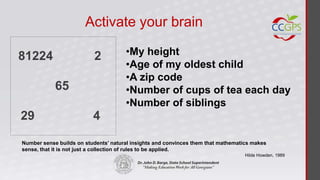
Activate your brain

81224                     2           •My height
                                      •Age of my oldest child
                                      •A zip code
            65                        •Number of cups of tea each day
                                      •Number of siblings
29                        4

Number sense builds on students’ natural insights and convinces them that mathematics makes
sense, that it is not just a collection of rules to be applied.
                                                                                   Hilde Howden, 1989
Why Common Core Standards?
• Preparation: The standards are college- and career-
  ready. They will help prepare students with the
  knowledge and skills they need to succeed in
  education and training after high school.
• Competition: The standards are internationally
  benchmarked. Common standards will help ensure
  our students are globally competitive.
• Equity: Expectations are consistent for all – and not
  dependent on a student’s zip code.
Why Common Core Standards?
• Clarity: The standards are focused, coherent, and
  clear. Clearer standards help students (and
  parents and teachers) understand what is
  expected of them.
• Collaboration: The standards create a foundation
  to work collaboratively across states and districts,
  pooling resources and expertise, to create
  curricular tools, professional development,
  common assessments and other materials.
Common Core State Standards
Building on the strength of current state
standards, the CCSS are designed to be:
•   Focused, coherent, clear and rigorous
•   Internationally benchmarked
•   Anchored in college and career readiness
•   Evidence and research based
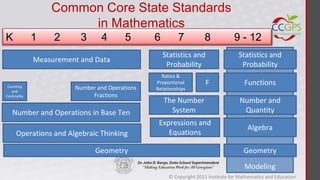
Common Core State Standards
                       in Mathematics
K             1    2      3      4       5      6        7          8            9 - 12
                                                    Statistics and                 Statistics and
              Measurement and Data
                                                     Probability                    Probability
                                                  Ratios &
                                                Proportional         F                Functions
 Counting
   and
                        Number and Operations   Relationships
Cardinality                  Fractions
                                                    The Number                      Number and
   Number and Operations in Base Ten                  System                         Quantity
                                                 Expressions and
                                                                                       Algebra
      Operations and Algebraic Thinking             Equations

                              Geometry                                                Geometry
                                                                                      Modeling
                                                     © Copyright 2011 Institute for Mathematics and Education
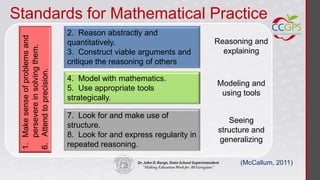
Standards for Mathematical Practice
                                 2. Reason abstractly and
 1. Make sense of problems and

                                 quantitatively.                         Reasoning and
    persevere in solving them.

                                 3. Construct viable arguments and         explaining
                                 critique the reasoning of others
 6. Attend to precision.


                                 4. Model with mathematics.
                                                                         Modeling and
                                 5. Use appropriate tools
                                                                          using tools
                                 strategically.

                                 7. Look for and make use of
                                                                            Seeing
                                 structure.
                                                                         structure and
                                 8. Look for and express regularity in
                                                                         generalizing
                                 repeated reasoning.

                                                                               (McCallum, 2011)
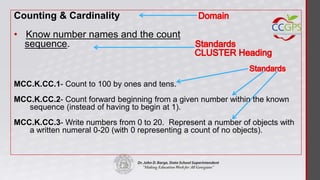
Counting & Cardinality
• Know number names and the count
  sequence.


MCC.K.CC.1- Count to 100 by ones and tens.
MCC.K.CC.2- Count forward beginning from a given number within the known
   sequence (instead of having to begin at 1).
MCC.K.CC.3- Write numbers from 0 to 20. Represent a number of objects with
   a written numeral 0-20 (with 0 representing a count of no objects).
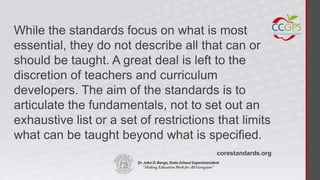
While the standards focus on what is most
essential, they do not describe all that can or
should be taught. A great deal is left to the
discretion of teachers and curriculum
developers. The aim of the standards is to
articulate the fundamentals, not to set out an
exhaustive list or a set of restrictions that limits
what can be taught beyond what is specified.
                                         corestandards.org
So what’s a Kindergarten
            teacher to do?
• Read your grade level standards. Use the
  CCGPS Teaching Guide found on
  georgiastandards.org and in Learning
  Village.
• Discuss the standards with your
  colleagues.
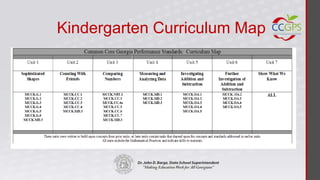
Kindergarten Curriculum Map
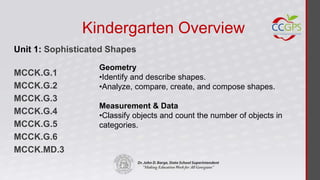
Kindergarten Overview
Unit 1: Sophisticated Shapes
                   Geometry
MCCK.G.1           •Identify and describe shapes.
MCCK.G.2           •Analyze, compare, create, and compose shapes.
MCCK.G.3
                   Measurement & Data
MCCK.G.4           •Classify objects and count the number of objects in
MCCK.G.5           categories.
MCCK.G.6
MCCK.MD.3
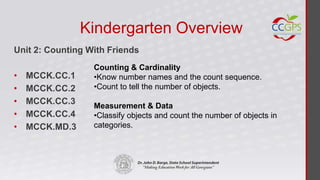
Kindergarten Overview
Unit 2: Counting With Friends
                  Counting & Cardinality
•   MCCK.CC.1     •Know number names and the count sequence.
•   MCCK.CC.2     •Count to tell the number of objects.
•   MCCK.CC.3     Measurement & Data
•   MCCK.CC.4     •Classify objects and count the number of objects in
•   MCCK.MD.3     categories.
Kindergarten Overview
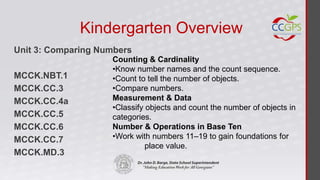
Unit 3: Comparing Numbers
                    Counting & Cardinality
                    •Know number names and the count sequence.
MCCK.NBT.1          •Count to tell the number of objects.
MCCK.CC.3           •Compare numbers.
MCCK.CC.4a          Measurement & Data
                    •Classify objects and count the number of objects in
MCCK.CC.5           categories.
MCCK.CC.6           Number & Operations in Base Ten
MCCK.CC.7           •Work with numbers 11–19 to gain foundations for
                              place value.
MCCK.MD.3
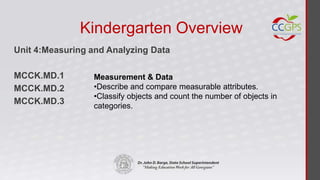
Kindergarten Overview
Unit 4:Measuring and Analyzing Data

MCCK.MD.1        Measurement & Data
MCCK.MD.2        •Describe and compare measurable attributes.
                 •Classify objects and count the number of objects in
MCCK.MD.3        categories.
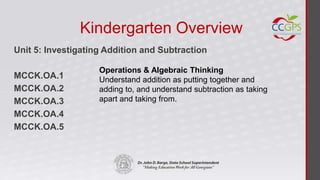
Kindergarten Overview
Unit 5: Investigating Addition and Subtraction

                    Operations & Algebraic Thinking
MCCK.OA.1           Understand addition as putting together and
MCCK.OA.2           adding to, and understand subtraction as taking
MCCK.OA.3           apart and taking from.
MCCK.OA.4
MCCK.OA.5
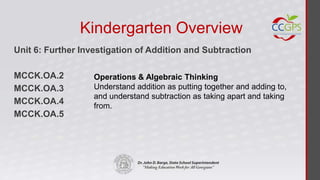
Kindergarten Overview
Unit 6: Further Investigation of Addition and Subtraction

MCCK.OA.2          Operations & Algebraic Thinking
MCCK.OA.3          Understand addition as putting together and adding to,
                   and understand subtraction as taking apart and taking
MCCK.OA.4          from.
MCCK.OA.5
Kindergarten Overview
Unit 7: Show What You Know
What’s New in Kindergarten
Counting and Cardinality
• Rote count by ones and tens to 100
• Count forward from a given number within 100
• Count to tell how many about orderly arrangements of objects (to
  20)
• Count to tell how many about scattered configurations (to 10)
• Compare written numerals (1-10)
Operations and Algebraic Thinking
• Fluently add and subtract within 5
What’s New in Kindergarten
Number and Operations in Base Ten
• Compose and decompose numbers from 11-19 into ten ones and
  some further ones. Understand that these numbers are composed
  of ten ones and some further ones.
Measurement and Data
• Describe several measureable attributes of the same object.
Geometry
• Correctly name shapes regardless of their orientation or size.
• Identify shapes as 2-D or 3-D.
Common Misconceptions
Counting and Cardinality
• Not seeing zero as a number
• Confusing count with item being counted
Operations and Algebraic Thinking
• Overgeneralization of vocabulary
• Skipping the development of mental images
Number and Operations in Base Ten
• Unitizing- failing to see ten things as one ten
Geometry
• Overgeneralization of terminology, giving 2-D names to 3-D shapes.
• Connecting orientation to shape
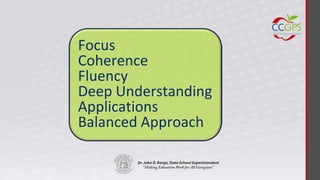
Focus
Coherence
Fluency
Deep Understanding
Applications
Balanced Approach
Focus
Coherence
Fluency
Deep Understanding
Applications
Balanced Approach
Focus
The student…
• spends more time thinking and working on
  priority concepts.
• is able to understand concepts and their
  connections to processes (algorithms).
Focus
The teacher...
• builds knowledge, fluency, and understanding of why
  and how certain mathematics concepts are done.
• thinks about how the concepts connect to one another.
• pays more attention to priority content and invests the
  appropriate time for all students to learn before moving
  onto the next topic.
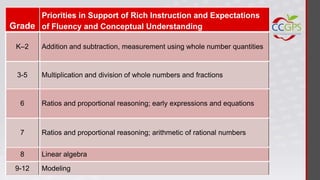
Priorities in Support of Rich Instruction and Expectations
Grade of Fluency and Conceptual Understanding

 K–2    Addition and subtraction, measurement using whole number quantities


 3-5    Multiplication and division of whole numbers and fractions


  6     Ratios and proportional reasoning; early expressions and equations


  7     Ratios and proportional reasoning; arithmetic of rational numbers


  8     Linear algebra
 9-12   Modeling
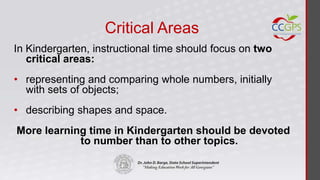
Critical Areas
In Kindergarten, instructional time should focus on two
   critical areas:
• representing and comparing whole numbers, initially
  with sets of objects;
• describing shapes and space.
More learning time in Kindergarten should be devoted
            to number than to other topics.
Priorities in Kindergarten
• Quantity and number
• Geometric thinking
Sample high leverage task


    10 frame riddles
  (Handout set #1, index cards, tape)
What is no longer in
             Kindergarten?
Where are
• time?
• money?
• temperature?
Why? How does this look now?
• What about Calendar Time?
Focus
Coherence
Fluency
Deep Understanding
Applications
Balanced Approach
Coherence
The student…
• builds on knowledge from year to year, in
  a coherent learning progression.
Coherence
The teacher...…
• connects mathematical ideas across grade levels.
• thinks deeply about what is being focused on.
• thinks about the way those ideas connect to how
  they were taught the year before and the years
  after.
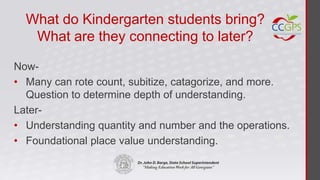
What do Kindergarten students bring?
   What are they connecting to later?

Now-
• Many can rote count, subitize, catagorize, and more.
  Question to determine depth of understanding.
Later-
• Understanding quantity and number and the operations.
• Foundational place value understanding.
What the heck is a rekenrek?

• Let’s make 10 on the rekenrek. Show as
  many ways as you can to make 10. Share
  what you see.
• Why is this important?
Again, where is it going?
• Know that the number word tells a quantity.
• The number you end on represents the whole
  amount counted.
• Noticing similarities and differences in
  quantities.
• Add and subtract within 20, and place value for
  the long haul..
Focus
Coherence
Fluency
Deep Understanding
Applications
Balanced Approach
Fluency
The student…
• spends time practicing skills with intensity
  and frequency.
Fluency
The teacher...
• pushes students to know basic skills at a
  greater level of fluency based on
  understanding.
• focuses on the listed fluencies by grade
  level.
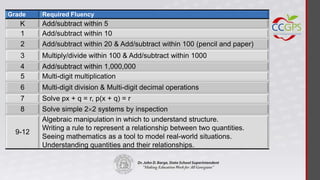
Grade
   K
         Required Fluency
                          Key Fluencies
         Add/subtract within 5
   1     Add/subtract within 10
   2     Add/subtract within 20 & Add/subtract within 100 (pencil and paper)
   3     Multiply/divide within 100 & Add/subtract within 1000
   4     Add/subtract within 1,000,000
   5     Multi-digit multiplication
   6     Multi-digit division & Multi-digit decimal operations
   7     Solve px + q = r, p(x + q) = r
   8     Solve simple 2×2 systems by inspection
         Algebraic manipulation in which to understand structure.
         Writing a rule to represent a relationship between two quantities.
  9-12
         Seeing mathematics as a tool to model real-world situations.
         Understanding quantities and their relationships.
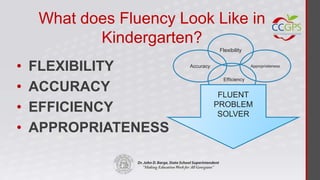
What does Fluency Look Like in
            Kindergarten?
                                     Flexibility


•   FLEXIBILITY          Accuracy                  Appropriateness


                                      Efficiency

•   ACCURACY                         FLUENT
                                    PROBLEM
•   EFFICIENCY                       SOLVER
•   APPROPRIATENESS
What does Fluency Look Like
               in Kindergarten?
                       Add and Subtract within 5

MCCK.OA.5- Fluently add and subtract within 5.

Build fluency using:
• dot plates
• five frames
• Rekenrek
• meaningful tasks
Focus
Coherence
Fluency
Deep Understanding
Applications
Balanced Approach
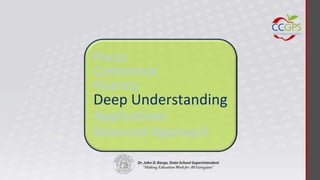
Deep Understanding
The student…
• shows mastery of material at a deep level
  in numerous ways.
• uses mathematical practices to
  demonstrate understanding of different
  material and concepts.
Deep Understanding
The teacher...
• asks self what mastery/proficiency really looks like
  and means.
• plans for progressions of levels of understanding.
• spends the time necessary to gain the depth of
  the understanding.
• becomes flexible and comfortable in own depth of
  content knowledge.
Old McDonald
Old Farmer McDonald needed to put all of his
  animals into different barns each night. Each
  barn could have no more than 10 feet. What
  animals did Old McDonald put in his barn to
  equal ten feet? Find the different combinations
  of farm animals that equal ten feet. Be sure to
  justify your combinations.
Task Structure
•   Pre-Assessment/Opening
•   Collaborative activity
•   Whole-class discussion
•   Return to the pre-assessment/opening
    and bring it all back to the standards
Focus
Coherence
Fluency
Deep Understanding
Applications
Balanced Approach
Application
The student…
• applies mathematics in other content
  areas and situations.
• chooses the right mathematics concept to
  solve a problem when not necessarily
  prompted to do so.
Application
The teacher...
• contextualizes mathematics.
• creates real world experiences in which
  students use what they know, and in
  which they are not necessarily prompted
  to apply mathematics.
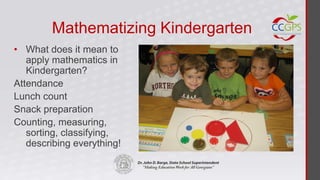
Mathematizing Kindergarten
• What does it mean to
   apply mathematics in
   Kindergarten?
Attendance
Lunch count
Snack preparation
Counting, measuring,
   sorting, classifying,
   describing everything!
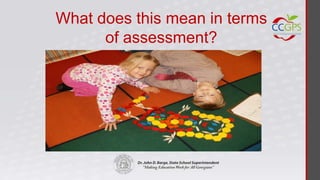
What does this mean in terms
      of assessment?
Focus
Coherence
Fluency
Deep Understanding
Applications
Balanced Approach
Balanced Approach
The student…
• practices mathematics skills to achieve
  fluency.
• practices math concepts to ensure
  application in novel situations.
Balanced Approach
The teacher...
• finds the balance between understanding
  and practice.
• normalizes the productive struggle.
• ritualizes skills practice.
What does balance mean in
             Kindergarten?
Little Bo Peep loved to play dominoes. One
  day she had a domino in her pocket and
  the sum of the pips on her domino was 5.
  What could the domino in Bo Peep’s
  pocket look like?
How could we launch this
                  task?
• Bo-peep diagnostic- look for potential
  misconceptions
• Dot card/ten frame flash
• Number talks
Focus
Coherence
Fluency
Deep Understanding
Applications
Balanced Approach
CCGPS Suggestions:
1. Read the CCGPS. The Teaching Guide for next year,
   curriculum maps and the standards can be found in
   Learning Village, on the math program page, and on
   Georgiastandards.org.
2. View the Fall 2011 Grade Level Webinars if you haven’t
   already seen them.
3. Review this broadcast with your team to identify key
   areas of focus.
CCGPS Suggestions:
4. Participate in the unit-by-unit webinars beginning in May.
           Kindergarten Unit 1- 3:15, May 1, 2012.
5.Structure time for grade level/content areas to use
  framework units as a guide for planning.
6. Plan to get together with your colleagues at the end of
   each CCGPS unit to analyze student work samples and
   compare how student learning and performance look.
Kindergarten Support:
Now-
• Fall 2011 Grade Level Webinars
• Teaching Guide
• Curriculum map
• Standards document
Coming soon-
• Frameworks units- posting in April, 2012
• Unit-by-unit webinars:
        Kindergarten Unit 1, 3:15 pm, May 1, 2012
Takeaways?
               3 Things-
1. What’s new?
2. What’s different?
3. What resources and support are
   available for CCGPS mathematics?
Food for Thought
“The resources we need in order to grow as
teachers are abundant within the community
of colleagues. Good talk about good teaching
is what we need…”

                                    Parker Palmer
                                  Courage to Teach
Turtle Gunn Toms
tgunn@doe.k12.ga.us
Thank you for participating in this CCGPS Professional Learning Session.
         We value your feedback. Please go to the following website, take the
          anonymous feedback survey, and complete the participation log to
                         receive a certificate of participation:
    http://survey.sedl.org/efm/wsb.dll/s/1g10a
    If you have questions, feel free to contact any of the English/Language Arts or
                 Mathematics staff at the following email addresses:
Sandi Woodall, Georgia Mathematics Coordinator            Kim Jeffcoat, Georgia ELA Coordinator
swoodall@doe.k12.ga.us                                    kjeffcoat@doe.k12.ga.us
James Pratt, Secondary Mathematics                        Susan Jacobs, Secondary ELA
jpratt@doe.k12.ga.us                                      sjacobs@doe.k12.ga.us
Brooke Kline, Secondary Mathematics                       Sallie Mills, Elementary ELA
bkline@doe.k12.ga.us                                      smills@doe.k12.ga.us
Turtle Gunn Toms, Elementary Mathematics                  Andria Bunner, Elementary ELA
tgunn@doe.k12.ga.us                                       abunner@doe.k12.ga.us

Getting Started

  • 2.
    Common Core Georgia Performance Standards Kindergarten Turtle Gunn Toms Brooke Kline Elementary Mathematics Specialist Secondary Mathematics Specialist
  • 3.
    Thank you forbeing here today. You will need the following materials during today’s broadcast: • Kindergarten handouts/resource packet • Large index cards, tape, markers • Note-taking materials (This session is being recorded, and all materials, including the powerpoint, are available for download)
  • 4.
    Activate your brain 81224 2 •My height •Age of my oldest child •A zip code 65 •Number of cups of tea each day •Number of siblings 29 4 Number sense builds on students’ natural insights and convinces them that mathematics makes sense, that it is not just a collection of rules to be applied. Hilde Howden, 1989
  • 5.
    Why Common CoreStandards? • Preparation: The standards are college- and career- ready. They will help prepare students with the knowledge and skills they need to succeed in education and training after high school. • Competition: The standards are internationally benchmarked. Common standards will help ensure our students are globally competitive. • Equity: Expectations are consistent for all – and not dependent on a student’s zip code.
  • 6.
    Why Common CoreStandards? • Clarity: The standards are focused, coherent, and clear. Clearer standards help students (and parents and teachers) understand what is expected of them. • Collaboration: The standards create a foundation to work collaboratively across states and districts, pooling resources and expertise, to create curricular tools, professional development, common assessments and other materials.
  • 7.
    Common Core StateStandards Building on the strength of current state standards, the CCSS are designed to be: • Focused, coherent, clear and rigorous • Internationally benchmarked • Anchored in college and career readiness • Evidence and research based
  • 8.
    Common Core StateStandards in Mathematics K 1 2 3 4 5 6 7 8 9 - 12 Statistics and Statistics and Measurement and Data Probability Probability Ratios & Proportional F Functions Counting and Number and Operations Relationships Cardinality Fractions The Number Number and Number and Operations in Base Ten System Quantity Expressions and Algebra Operations and Algebraic Thinking Equations Geometry Geometry Modeling © Copyright 2011 Institute for Mathematics and Education
  • 9.
    Standards for MathematicalPractice 2. Reason abstractly and 1. Make sense of problems and quantitatively. Reasoning and persevere in solving them. 3. Construct viable arguments and explaining critique the reasoning of others 6. Attend to precision. 4. Model with mathematics. Modeling and 5. Use appropriate tools using tools strategically. 7. Look for and make use of Seeing structure. structure and 8. Look for and express regularity in generalizing repeated reasoning. (McCallum, 2011)
  • 10.
    Counting & Cardinality •Know number names and the count sequence. MCC.K.CC.1- Count to 100 by ones and tens. MCC.K.CC.2- Count forward beginning from a given number within the known sequence (instead of having to begin at 1). MCC.K.CC.3- Write numbers from 0 to 20. Represent a number of objects with a written numeral 0-20 (with 0 representing a count of no objects).
  • 11.
    While the standardsfocus on what is most essential, they do not describe all that can or should be taught. A great deal is left to the discretion of teachers and curriculum developers. The aim of the standards is to articulate the fundamentals, not to set out an exhaustive list or a set of restrictions that limits what can be taught beyond what is specified. corestandards.org
  • 12.
    So what’s aKindergarten teacher to do? • Read your grade level standards. Use the CCGPS Teaching Guide found on georgiastandards.org and in Learning Village. • Discuss the standards with your colleagues.
  • 13.
  • 14.
    Kindergarten Overview Unit 1:Sophisticated Shapes Geometry MCCK.G.1 •Identify and describe shapes. MCCK.G.2 •Analyze, compare, create, and compose shapes. MCCK.G.3 Measurement & Data MCCK.G.4 •Classify objects and count the number of objects in MCCK.G.5 categories. MCCK.G.6 MCCK.MD.3
  • 15.
    Kindergarten Overview Unit 2:Counting With Friends Counting & Cardinality • MCCK.CC.1 •Know number names and the count sequence. • MCCK.CC.2 •Count to tell the number of objects. • MCCK.CC.3 Measurement & Data • MCCK.CC.4 •Classify objects and count the number of objects in • MCCK.MD.3 categories.
  • 16.
    Kindergarten Overview Unit 3:Comparing Numbers Counting & Cardinality •Know number names and the count sequence. MCCK.NBT.1 •Count to tell the number of objects. MCCK.CC.3 •Compare numbers. MCCK.CC.4a Measurement & Data •Classify objects and count the number of objects in MCCK.CC.5 categories. MCCK.CC.6 Number & Operations in Base Ten MCCK.CC.7 •Work with numbers 11–19 to gain foundations for place value. MCCK.MD.3
  • 17.
    Kindergarten Overview Unit 4:Measuringand Analyzing Data MCCK.MD.1 Measurement & Data MCCK.MD.2 •Describe and compare measurable attributes. •Classify objects and count the number of objects in MCCK.MD.3 categories.
  • 18.
    Kindergarten Overview Unit 5:Investigating Addition and Subtraction Operations & Algebraic Thinking MCCK.OA.1 Understand addition as putting together and MCCK.OA.2 adding to, and understand subtraction as taking MCCK.OA.3 apart and taking from. MCCK.OA.4 MCCK.OA.5
  • 19.
    Kindergarten Overview Unit 6:Further Investigation of Addition and Subtraction MCCK.OA.2 Operations & Algebraic Thinking MCCK.OA.3 Understand addition as putting together and adding to, and understand subtraction as taking apart and taking MCCK.OA.4 from. MCCK.OA.5
  • 20.
  • 21.
    What’s New inKindergarten Counting and Cardinality • Rote count by ones and tens to 100 • Count forward from a given number within 100 • Count to tell how many about orderly arrangements of objects (to 20) • Count to tell how many about scattered configurations (to 10) • Compare written numerals (1-10) Operations and Algebraic Thinking • Fluently add and subtract within 5
  • 22.
    What’s New inKindergarten Number and Operations in Base Ten • Compose and decompose numbers from 11-19 into ten ones and some further ones. Understand that these numbers are composed of ten ones and some further ones. Measurement and Data • Describe several measureable attributes of the same object. Geometry • Correctly name shapes regardless of their orientation or size. • Identify shapes as 2-D or 3-D.
  • 23.
    Common Misconceptions Counting andCardinality • Not seeing zero as a number • Confusing count with item being counted Operations and Algebraic Thinking • Overgeneralization of vocabulary • Skipping the development of mental images Number and Operations in Base Ten • Unitizing- failing to see ten things as one ten Geometry • Overgeneralization of terminology, giving 2-D names to 3-D shapes. • Connecting orientation to shape
  • 24.
  • 25.
  • 26.
    Focus The student… • spendsmore time thinking and working on priority concepts. • is able to understand concepts and their connections to processes (algorithms).
  • 27.
    Focus The teacher... • buildsknowledge, fluency, and understanding of why and how certain mathematics concepts are done. • thinks about how the concepts connect to one another. • pays more attention to priority content and invests the appropriate time for all students to learn before moving onto the next topic.
  • 28.
    Priorities in Supportof Rich Instruction and Expectations Grade of Fluency and Conceptual Understanding K–2 Addition and subtraction, measurement using whole number quantities 3-5 Multiplication and division of whole numbers and fractions 6 Ratios and proportional reasoning; early expressions and equations 7 Ratios and proportional reasoning; arithmetic of rational numbers 8 Linear algebra 9-12 Modeling
  • 29.
    Critical Areas In Kindergarten,instructional time should focus on two critical areas: • representing and comparing whole numbers, initially with sets of objects; • describing shapes and space. More learning time in Kindergarten should be devoted to number than to other topics.
  • 30.
    Priorities in Kindergarten •Quantity and number • Geometric thinking
  • 31.
    Sample high leveragetask 10 frame riddles (Handout set #1, index cards, tape)
  • 32.
    What is nolonger in Kindergarten? Where are • time? • money? • temperature? Why? How does this look now? • What about Calendar Time?
  • 33.
  • 34.
    Coherence The student… • buildson knowledge from year to year, in a coherent learning progression.
  • 35.
    Coherence The teacher...… • connectsmathematical ideas across grade levels. • thinks deeply about what is being focused on. • thinks about the way those ideas connect to how they were taught the year before and the years after.
  • 36.
    What do Kindergartenstudents bring? What are they connecting to later? Now- • Many can rote count, subitize, catagorize, and more. Question to determine depth of understanding. Later- • Understanding quantity and number and the operations. • Foundational place value understanding.
  • 37.
    What the heckis a rekenrek? • Let’s make 10 on the rekenrek. Show as many ways as you can to make 10. Share what you see. • Why is this important?
  • 38.
    Again, where isit going? • Know that the number word tells a quantity. • The number you end on represents the whole amount counted. • Noticing similarities and differences in quantities. • Add and subtract within 20, and place value for the long haul..
  • 39.
  • 40.
    Fluency The student… • spendstime practicing skills with intensity and frequency.
  • 41.
    Fluency The teacher... • pushesstudents to know basic skills at a greater level of fluency based on understanding. • focuses on the listed fluencies by grade level.
  • 42.
    Grade K Required Fluency Key Fluencies Add/subtract within 5 1 Add/subtract within 10 2 Add/subtract within 20 & Add/subtract within 100 (pencil and paper) 3 Multiply/divide within 100 & Add/subtract within 1000 4 Add/subtract within 1,000,000 5 Multi-digit multiplication 6 Multi-digit division & Multi-digit decimal operations 7 Solve px + q = r, p(x + q) = r 8 Solve simple 2×2 systems by inspection Algebraic manipulation in which to understand structure. Writing a rule to represent a relationship between two quantities. 9-12 Seeing mathematics as a tool to model real-world situations. Understanding quantities and their relationships.
  • 43.
    What does FluencyLook Like in Kindergarten? Flexibility • FLEXIBILITY Accuracy Appropriateness Efficiency • ACCURACY FLUENT PROBLEM • EFFICIENCY SOLVER • APPROPRIATENESS
  • 44.
    What does FluencyLook Like in Kindergarten? Add and Subtract within 5 MCCK.OA.5- Fluently add and subtract within 5. Build fluency using: • dot plates • five frames • Rekenrek • meaningful tasks
  • 45.
  • 46.
    Deep Understanding The student… •shows mastery of material at a deep level in numerous ways. • uses mathematical practices to demonstrate understanding of different material and concepts.
  • 47.
    Deep Understanding The teacher... •asks self what mastery/proficiency really looks like and means. • plans for progressions of levels of understanding. • spends the time necessary to gain the depth of the understanding. • becomes flexible and comfortable in own depth of content knowledge.
  • 48.
    Old McDonald Old FarmerMcDonald needed to put all of his animals into different barns each night. Each barn could have no more than 10 feet. What animals did Old McDonald put in his barn to equal ten feet? Find the different combinations of farm animals that equal ten feet. Be sure to justify your combinations.
  • 49.
    Task Structure • Pre-Assessment/Opening • Collaborative activity • Whole-class discussion • Return to the pre-assessment/opening and bring it all back to the standards
  • 50.
  • 51.
    Application The student… • appliesmathematics in other content areas and situations. • chooses the right mathematics concept to solve a problem when not necessarily prompted to do so.
  • 52.
    Application The teacher... • contextualizesmathematics. • creates real world experiences in which students use what they know, and in which they are not necessarily prompted to apply mathematics.
  • 53.
    Mathematizing Kindergarten • Whatdoes it mean to apply mathematics in Kindergarten? Attendance Lunch count Snack preparation Counting, measuring, sorting, classifying, describing everything!
  • 54.
    What does thismean in terms of assessment?
  • 55.
  • 56.
    Balanced Approach The student… •practices mathematics skills to achieve fluency. • practices math concepts to ensure application in novel situations.
  • 57.
    Balanced Approach The teacher... •finds the balance between understanding and practice. • normalizes the productive struggle. • ritualizes skills practice.
  • 58.
    What does balancemean in Kindergarten? Little Bo Peep loved to play dominoes. One day she had a domino in her pocket and the sum of the pips on her domino was 5. What could the domino in Bo Peep’s pocket look like?
  • 59.
    How could welaunch this task? • Bo-peep diagnostic- look for potential misconceptions • Dot card/ten frame flash • Number talks
  • 60.
  • 61.
    CCGPS Suggestions: 1. Readthe CCGPS. The Teaching Guide for next year, curriculum maps and the standards can be found in Learning Village, on the math program page, and on Georgiastandards.org. 2. View the Fall 2011 Grade Level Webinars if you haven’t already seen them. 3. Review this broadcast with your team to identify key areas of focus.
  • 62.
    CCGPS Suggestions: 4. Participatein the unit-by-unit webinars beginning in May. Kindergarten Unit 1- 3:15, May 1, 2012. 5.Structure time for grade level/content areas to use framework units as a guide for planning. 6. Plan to get together with your colleagues at the end of each CCGPS unit to analyze student work samples and compare how student learning and performance look.
  • 63.
    Kindergarten Support: Now- • Fall2011 Grade Level Webinars • Teaching Guide • Curriculum map • Standards document Coming soon- • Frameworks units- posting in April, 2012 • Unit-by-unit webinars: Kindergarten Unit 1, 3:15 pm, May 1, 2012
  • 64.
    Takeaways? 3 Things- 1. What’s new? 2. What’s different? 3. What resources and support are available for CCGPS mathematics?
  • 65.
    Food for Thought “Theresources we need in order to grow as teachers are abundant within the community of colleagues. Good talk about good teaching is what we need…” Parker Palmer Courage to Teach
  • 67.
  • 68.
    Thank you forparticipating in this CCGPS Professional Learning Session. We value your feedback. Please go to the following website, take the anonymous feedback survey, and complete the participation log to receive a certificate of participation: http://survey.sedl.org/efm/wsb.dll/s/1g10a If you have questions, feel free to contact any of the English/Language Arts or Mathematics staff at the following email addresses: Sandi Woodall, Georgia Mathematics Coordinator Kim Jeffcoat, Georgia ELA Coordinator swoodall@doe.k12.ga.us kjeffcoat@doe.k12.ga.us James Pratt, Secondary Mathematics Susan Jacobs, Secondary ELA jpratt@doe.k12.ga.us sjacobs@doe.k12.ga.us Brooke Kline, Secondary Mathematics Sallie Mills, Elementary ELA bkline@doe.k12.ga.us smills@doe.k12.ga.us Turtle Gunn Toms, Elementary Mathematics Andria Bunner, Elementary ELA tgunn@doe.k12.ga.us abunner@doe.k12.ga.us