Download to read offline


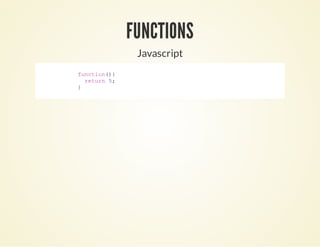
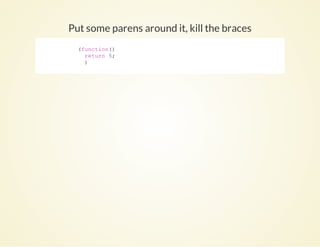
![Change 'function' to 'fn', makes args into a vector
(fn []
return 5;
)](https://image.slidesharecdn.com/bohconf2013-clojureworkshop-130722122223-phpapp01/85/Getting-Clojure-parentheses-are-just-hugs-for-your-code-4-320.jpg)
![Kill the 'return', last thing's always returned.
Welcome to Clojure.
(fn [] 5)](https://image.slidesharecdn.com/bohconf2013-clojureworkshop-130722122223-phpapp01/85/Getting-Clojure-parentheses-are-just-hugs-for-your-code-5-320.jpg)

![Should look familiar
Don't freak out
DON'T FREAK OUT
{:key1 5,
:key2 nil}
[1 2 3 4 "five"]
[1 [2] #{3} {4 4} (constantly 5)]
=> (range 10)
(0 1 2 3 4 5 6 7 8 9)
=> (take 11 (range))
(0 1 2 3 4 5 6 7 8 9 10)
=> (last (range)) ;;Hope you don't mind waiting a long time.
DATADATA](https://image.slidesharecdn.com/bohconf2013-clojureworkshop-130722122223-phpapp01/85/Getting-Clojure-parentheses-are-just-hugs-for-your-code-9-320.jpg)
![Evals to...
;; semicolons are comments, commas are ignored,
;; check out this weird hashmap
{:akeyword 5,
"a string key" "a string value",
["a" :vector "acting" :as [:a :compound] "key"]
(fn [] "a noarg function
that returns this multiline string,
the function itself is the value"),
+ '(functions can be keys too, and when
you quote symbols, you just
have symbols, not what they represent)}
{:akeyword 5, "a string key" "a string value",
["a" :vector "acting" :as [:a :compound] "key"]
#<user$eval331$fn__332 user$eval331$fn__332@a585ef>,
#<core$_PLUS_ clojure.core$_PLUS_@20a12d8f>
(functions can be keys too and when you quote symbols
you just have symbols not what they represent)}
EVERYTHING IS DATAEVERYTHING IS DATA](https://image.slidesharecdn.com/bohconf2013-clojureworkshop-130722122223-phpapp01/85/Getting-Clojure-parentheses-are-just-hugs-for-your-code-10-320.jpg)
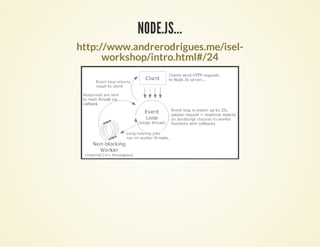
![APPROXIMATING NODE.JSAPPROXIMATING NODE.JS
'Agents' are asynchronous queues, sharing threadpools to
do work, storing the last value returned.
(defn inclast [val]
(conj val (inc (last val))))
;; We make a sequence of 10 inclast tasks,
;; then followup with a 'println' task
(def tasks
(concat (repeat 10 inclast)
[(fn [val]
(println val)
val)]))](https://image.slidesharecdn.com/bohconf2013-clojureworkshop-130722122223-phpapp01/85/Getting-Clojure-parentheses-are-just-hugs-for-your-code-16-320.jpg)
![;; starts off with a value of [0]
(let [a (agent [0])]
(doseq [t tasks]
(send a t)))
;; prints: [0 1 2 3 4 5 6 7 8 9 10]
Agents are not values, they are mutable references with
asynchronous semantics
Clojure has other mutable references types, acting as
'containers' for values, for various use cases.
Nothing prevents you from making your own.](https://image.slidesharecdn.com/bohconf2013-clojureworkshop-130722122223-phpapp01/85/Getting-Clojure-parentheses-are-just-hugs-for-your-code-17-320.jpg)
![(let [f (future (doabunchofstuff))] ;; in another thread
(dostuffinthisthread)
;; return the value in f, blocking if it's not finished
(deref f))
MORE!MORE!
Basically,
Clojure promotes your ability to do whatever you want, by
simplifying things to their bare essence.](https://image.slidesharecdn.com/bohconf2013-clojureworkshop-130722122223-phpapp01/85/Getting-Clojure-parentheses-are-just-hugs-for-your-code-18-320.jpg)
![This is only the beginning
(defn onlyeven!
[val]
(if (and (integer? val) (odd? val))
(inc val)
val))
(map onlyeven! (readstring "(+ 1 2)"))
;; '(+ 2 2)
(eval (map onlyeven! (readstring "(+ 1 2)")))
;; 4](https://image.slidesharecdn.com/bohconf2013-clojureworkshop-130722122223-phpapp01/85/Getting-Clojure-parentheses-are-just-hugs-for-your-code-22-320.jpg)
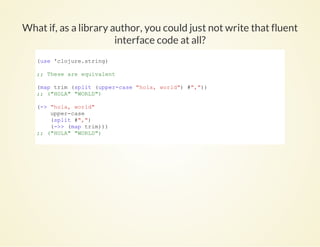
![Really useful when you're doing a lot of collection operations,
filtering, etc.
(>> (range)
(filter even?)
(map (partial * 2))
(take 10)
(into []))
;; [0 4 8 12 16 20 24 28 32 36]
;; versus
(into []
(take 10 (map (partial * 2)
(filter even? (range)))))
1. I find the flat one easier to think about.
2. Semantically equivalent.
3. No burden on implementing code. Functions don't care
about how they're used.
Giving the user choices is more effective with more powerful
languages. Leads to simple, composable libraries.](https://image.slidesharecdn.com/bohconf2013-clojureworkshop-130722122223-phpapp01/85/Getting-Clojure-parentheses-are-just-hugs-for-your-code-25-320.jpg)
![Let's look at a real one.
(defmacro lazyseq
"Takes a body of expressions that returns an ISeq or nil, and yields
a Seqable object that will invoke the body only the first time seq
is called, and will cache the result and return it on all subsequent
seq calls. See also realized?"
{:added "1.0"}
[& body]
(list 'new 'clojure.lang.LazySeq (list* '^{:once true} fn* [] body)))
;; simply returns a list, allocates a Java object (LazySeq) and wraps
;; your expressions in a function
(macroexpand1 '(lazyseq ANYTHING1 ANYTHING2))
;; '(new clojure.lang.LazySeq (fn* [] ANYTHING1 ANYTHING2))
MACROSMACROS](https://image.slidesharecdn.com/bohconf2013-clojureworkshop-130722122223-phpapp01/85/Getting-Clojure-parentheses-are-just-hugs-for-your-code-26-320.jpg)
![Let's create an infinite sequence representing a square-wave
--__--__--__--__
No mutable variables
(defn squarewave
"t is the period for a halfcycle"
[t]
(letfn
[(osc [curvalue sofar]
(let [sofar (mod sofar t)
nextval (if (zero? sofar)
( curvalue)
curvalue)]
(cons nextval
(lazyseq (osc nextval
(inc sofar))))))]
(osc 1 0)))
(take 10 (squarewave 3))
;; (1 1 1 1 1 1 1 1 1 1)](https://image.slidesharecdn.com/bohconf2013-clojureworkshop-130722122223-phpapp01/85/Getting-Clojure-parentheses-are-just-hugs-for-your-code-27-320.jpg)





This document introduces Clojure concepts through comparisons to JavaScript and examples. It explains that Clojure code uses S-expressions like Lisp with parentheses instead of curly braces. Functions are defined using fn instead of function. Data types in Clojure include vectors, maps, and sequences. Everything in Clojure is treated as data, allowing different types to be used interchangeably as keys or values. Immutability allows safe sharing of data between parts of a program. The document provides examples of macros, lazy sequences, and functional programming techniques in Clojure.


