DEPARTMENT OF FINANCEDEPARTMENT OF FINANCE
University Of Dar Es Salaam BusinessUniversity Of Dar Es Salaam Business
SchoolSchool
FN 101: Principles of Macroeconomics
Lecture 7:
Government and Fiscal
Policy
Genuine Martin
B.Com, M.A. (Economics)
2
Role of Government in the
Economy
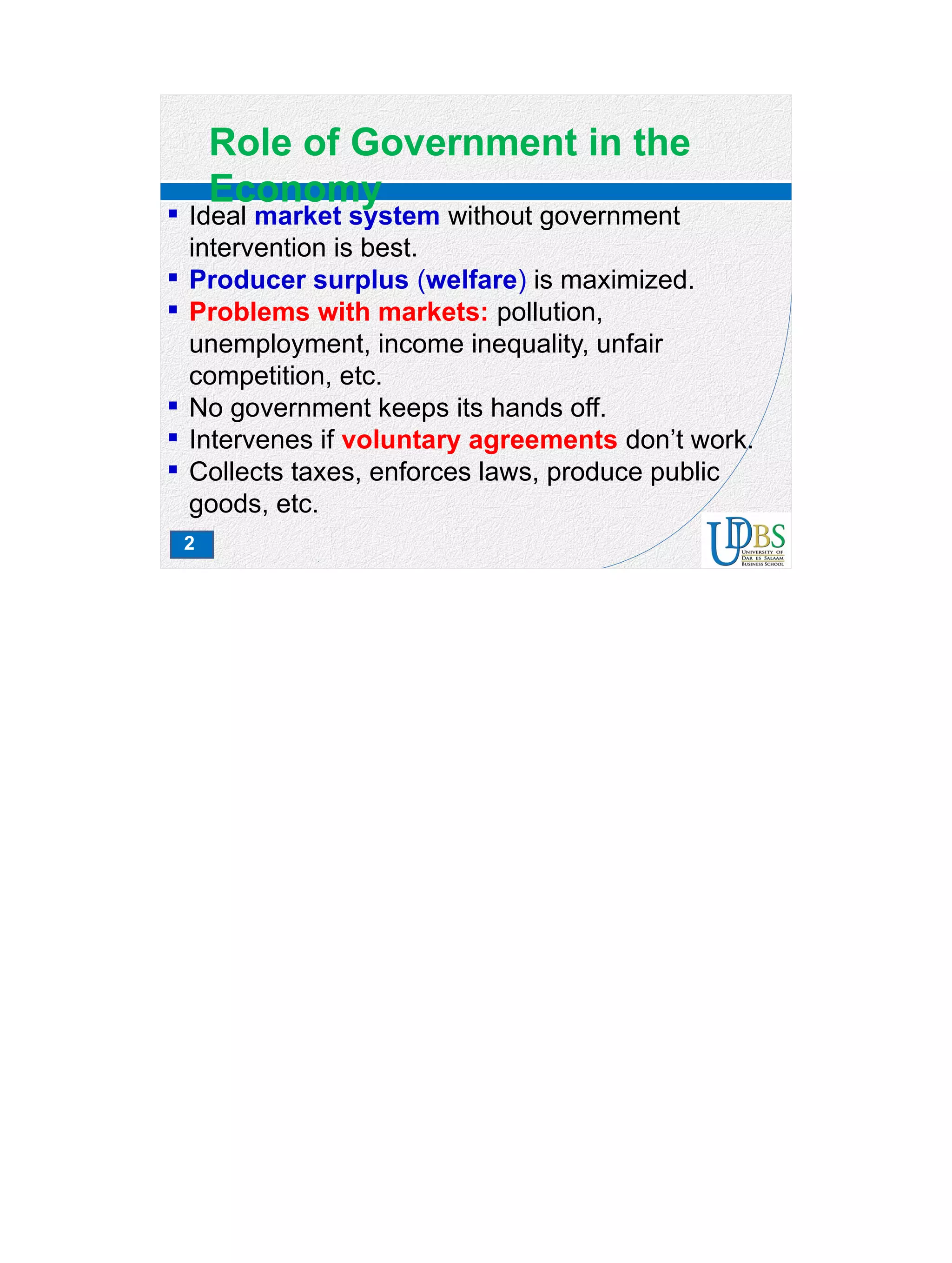
 Ideal market system without government
intervention is best.
 Producer surplus (welfare) is maximized.
 Problems with markets: pollution,
unemployment, income inequality, unfair
competition, etc.
 No government keeps its hands off.
 Intervenes if voluntary agreements don’t work.
 Collects taxes, enforces laws, produce public
goods, etc.
3
Role of Government in the
Economy
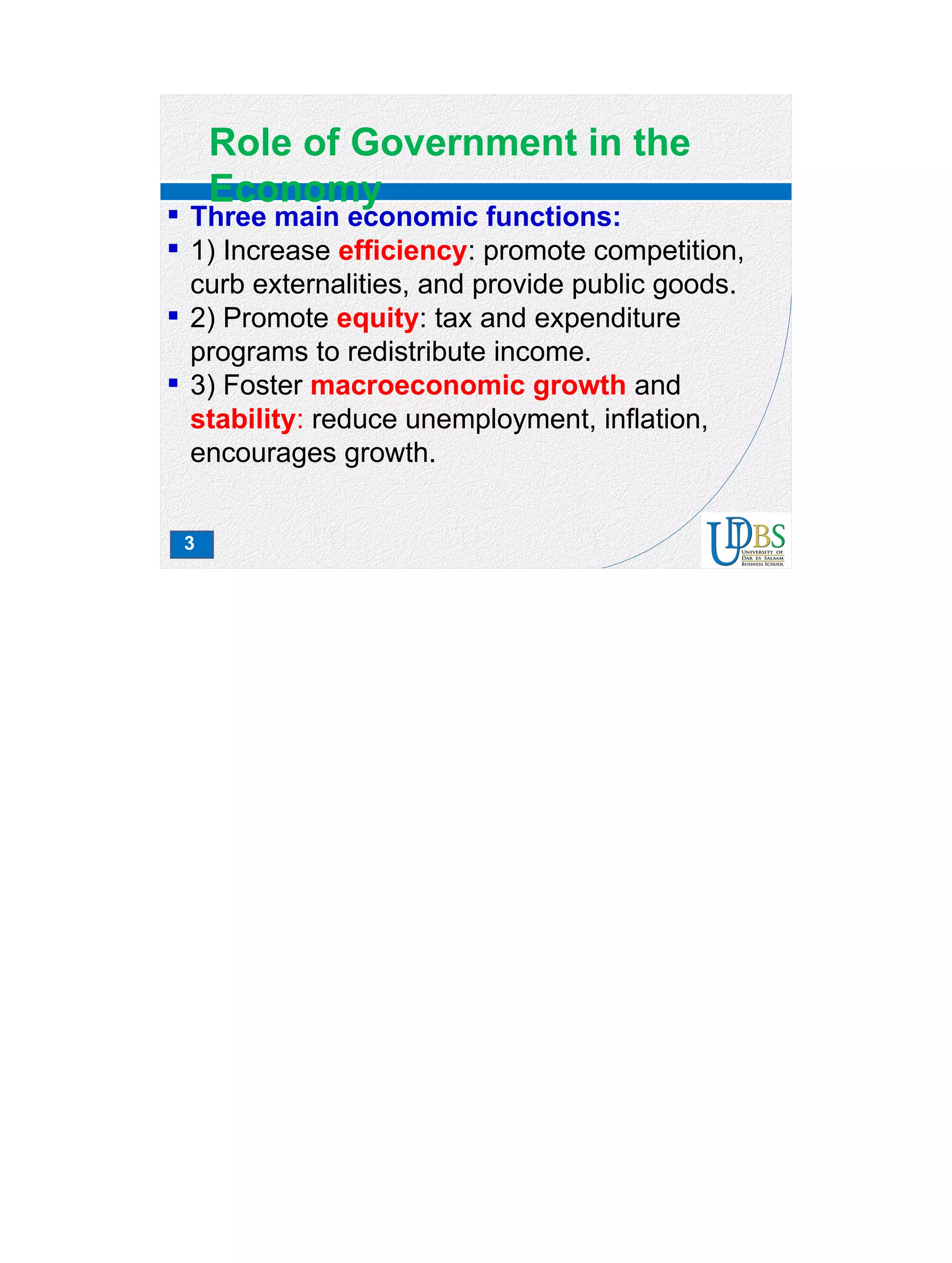
 Three main economic functions:
 1) Increase efficiency: promote competition,
curb externalities, and provide public goods.
 2) Promote equity: tax and expenditure
programs to redistribute income.
 3) Foster macroeconomic growth and
stability: reduce unemployment, inflation,
encourages growth.
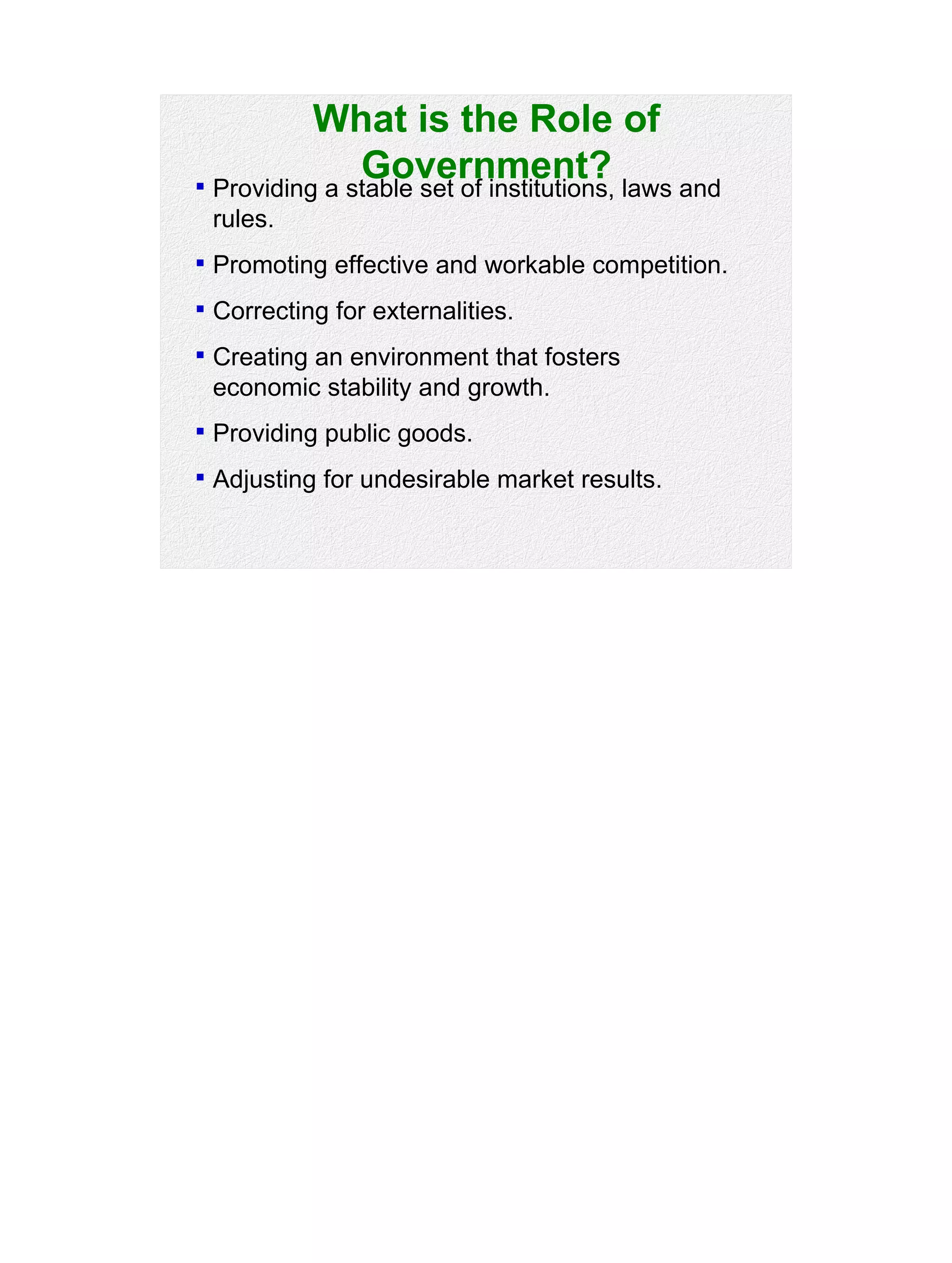
What is the Role of
Government? Providing a stable set of institutions, laws and
rules.
 Promoting effective and workable competition.
 Correcting for externalities.
 Creating an environment that fosters
economic stability and growth.
 Providing public goods.
 Adjusting for undesirable market results.
Government in the Economy
• Nothing arouses as much controversy as
the role of government in the economy.
• Government can affect the macroeconomy
through two policy channels: fiscal policy
and monetary policy.
• Fiscal policy is the manipulation of
government spending and taxation.
• Monetary policy refers to the behavior of
the Bank of Tanzania regarding the
nation’s money supply.
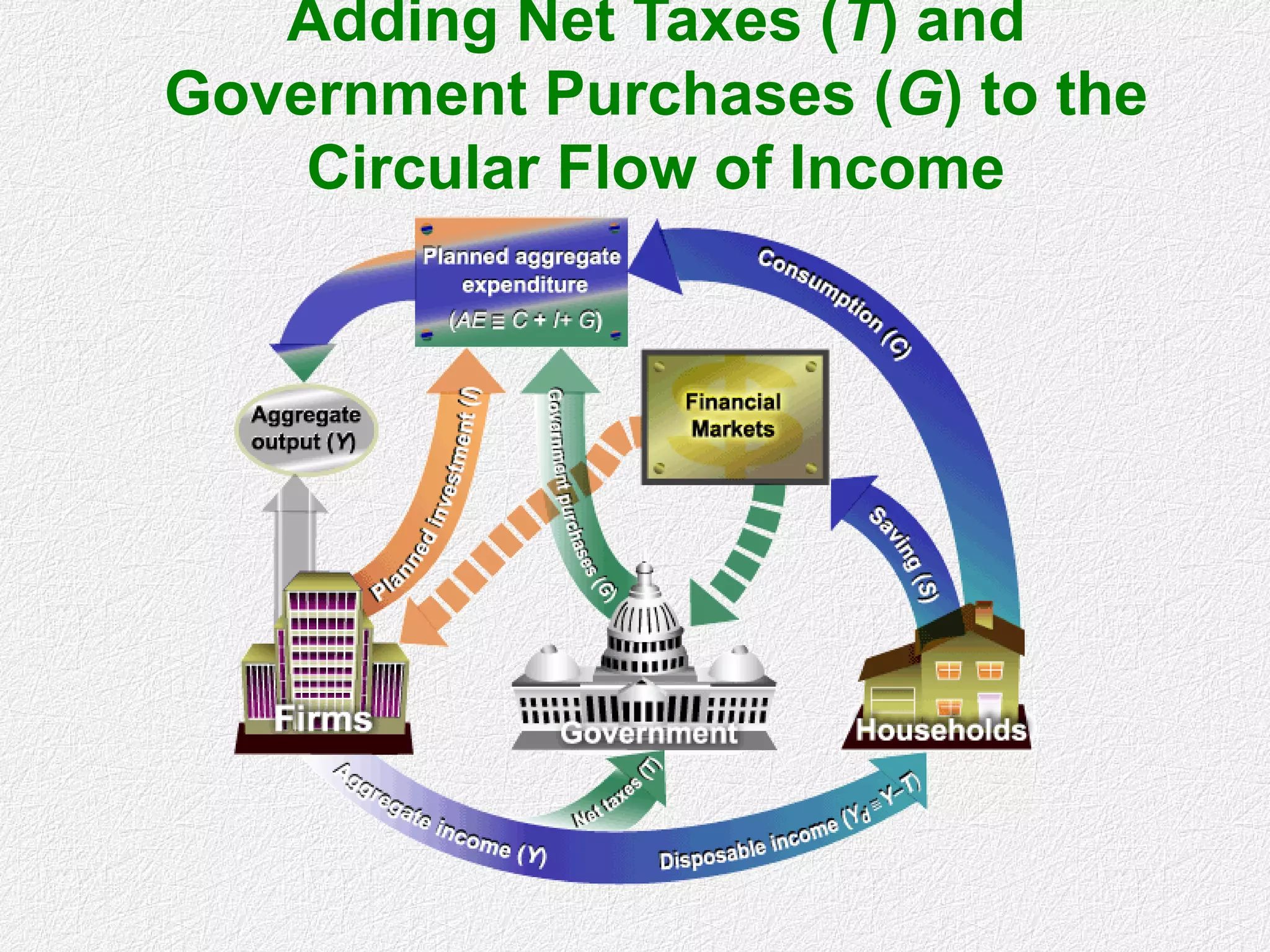
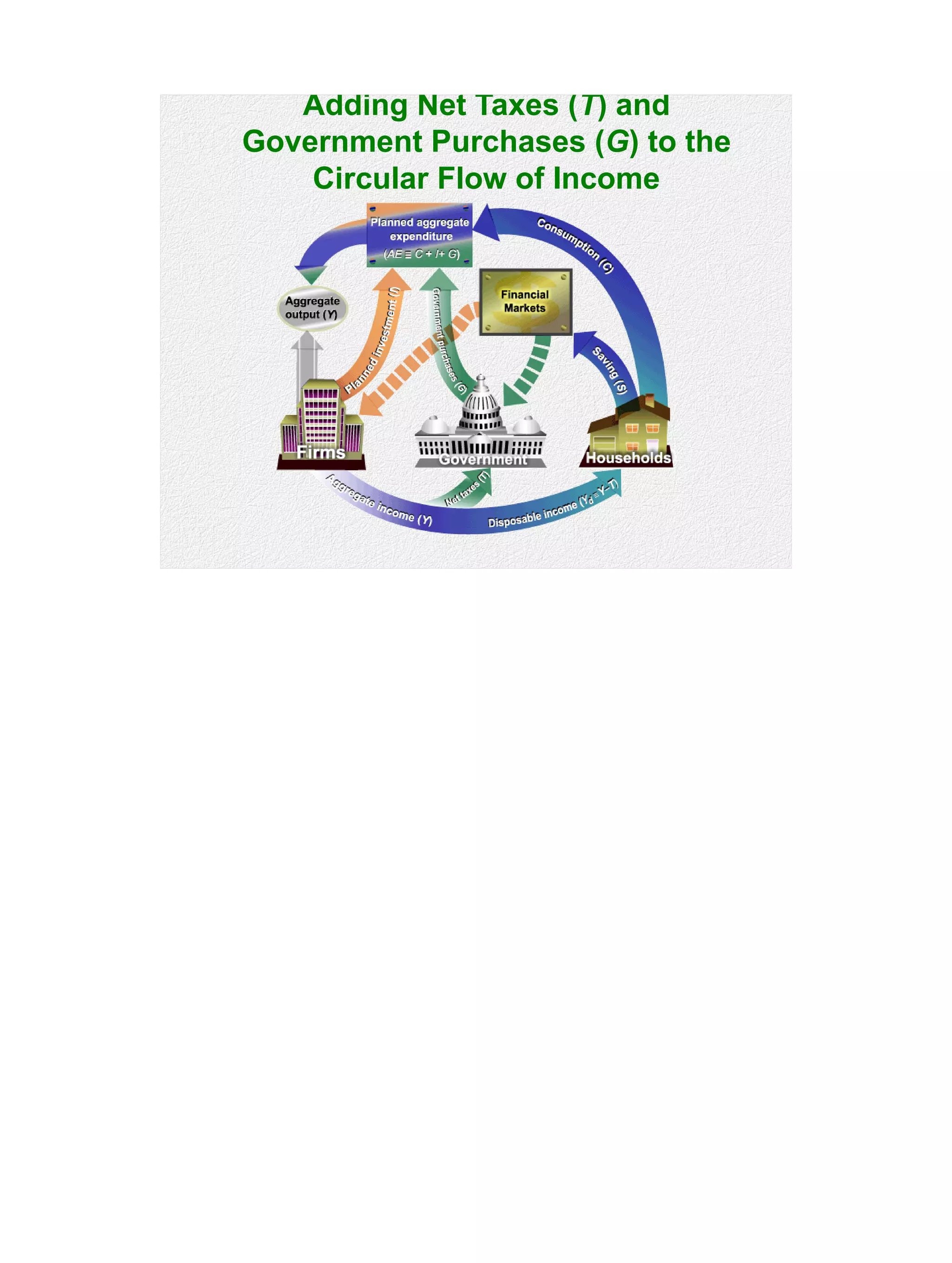
Adding Net Taxes (T) and
Government Purchases (G) to the
Circular Flow of Income
7
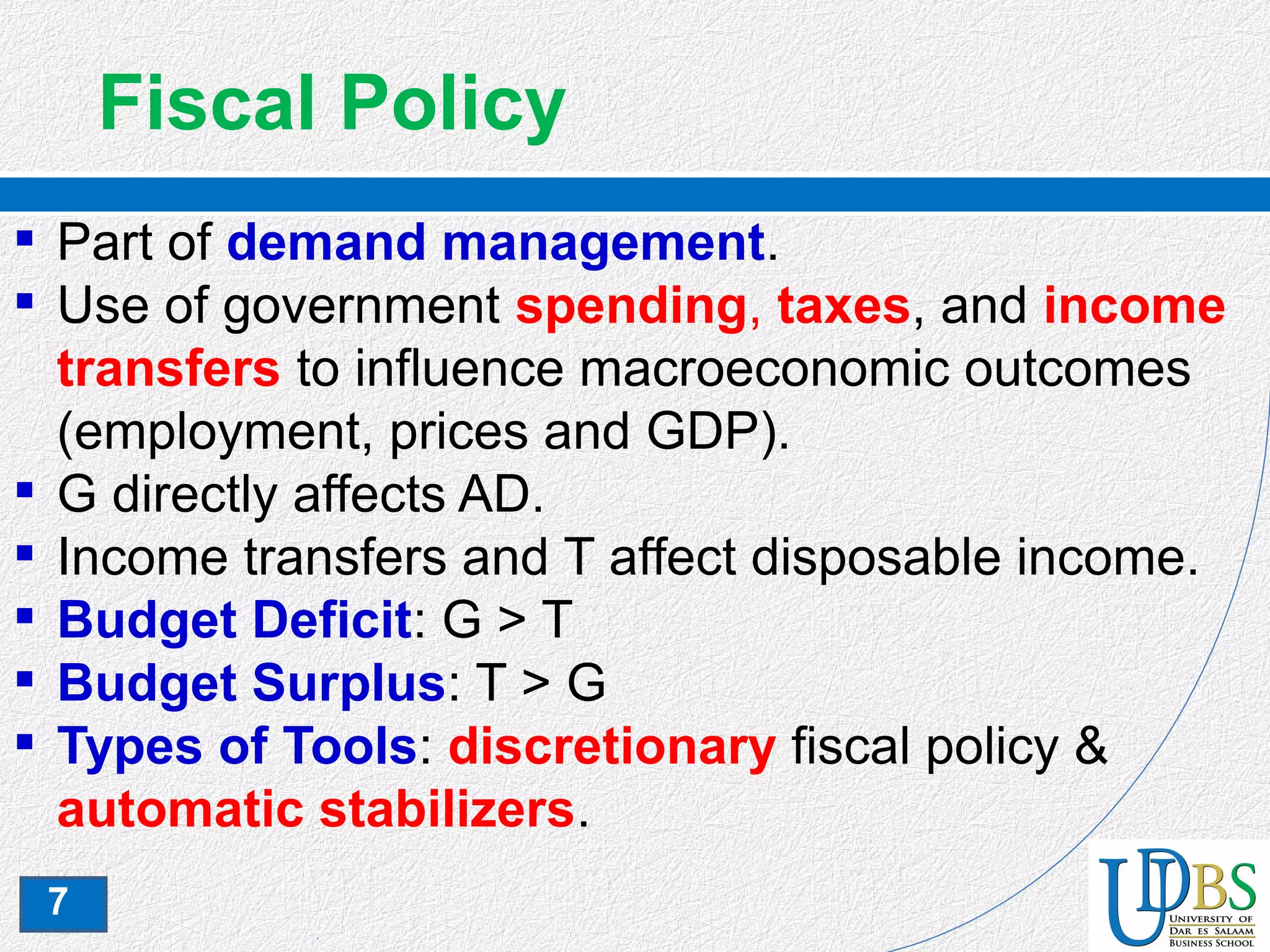
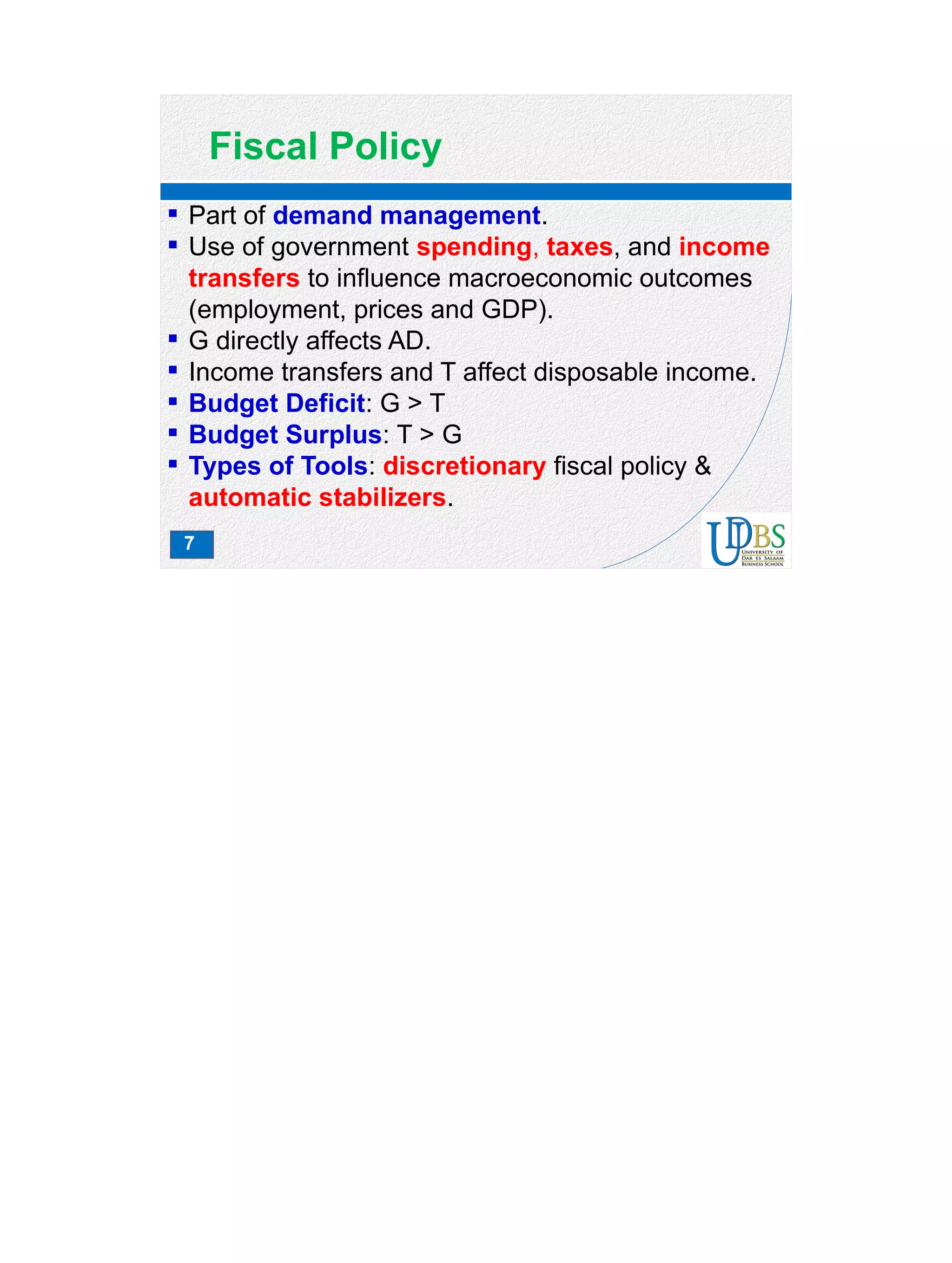
Fiscal Policy
 Part of demand management.
 Use of government spending, taxes, and income
transfers to influence macroeconomic outcomes
(employment, prices and GDP).
 G directly affects AD.
 Income transfers and T affect disposable income.
 Budget Deficit: G > T
 Budget Surplus: T > G
 Types of Tools: discretionary fiscal policy &
automatic stabilizers.
8
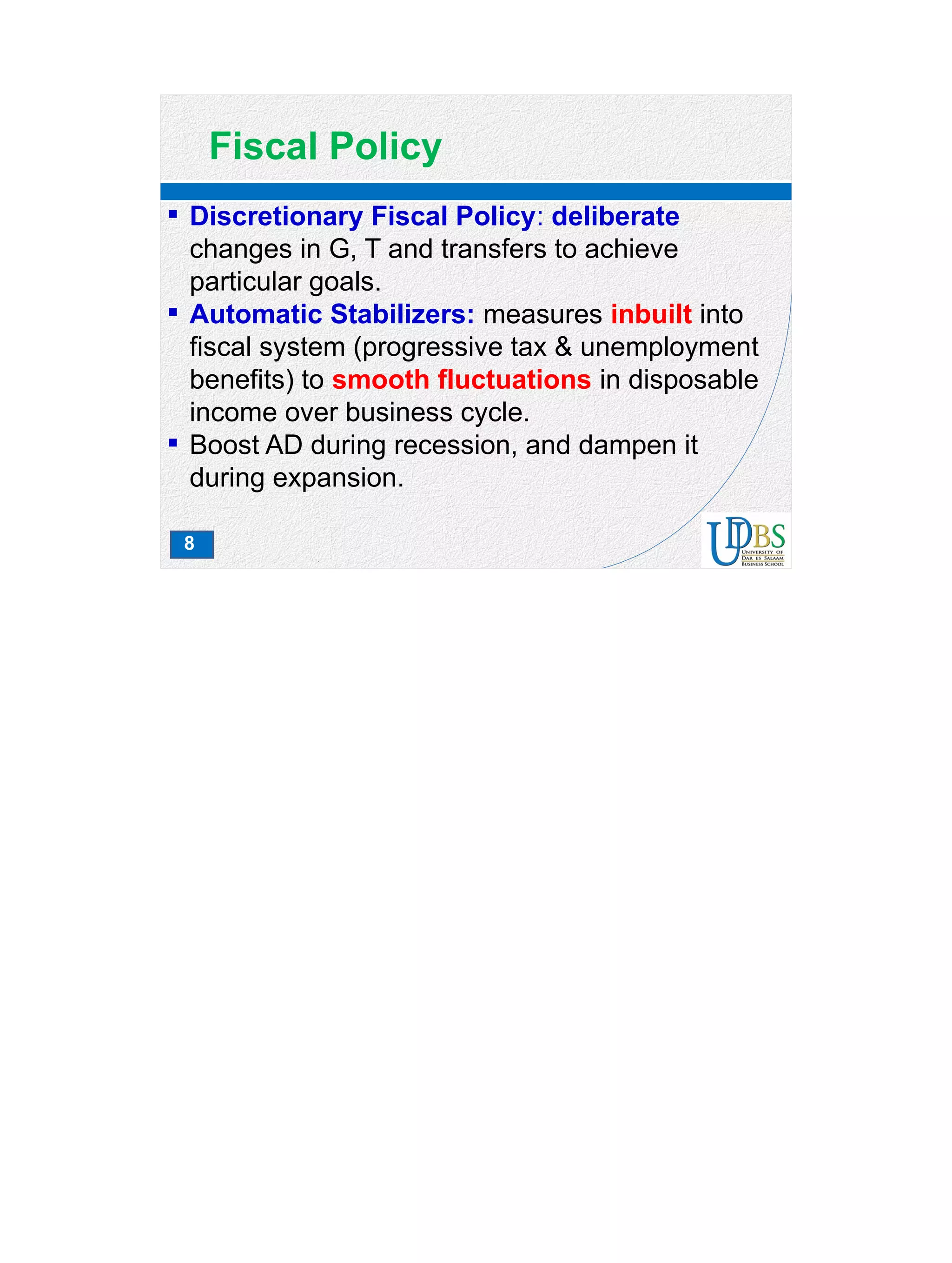
Fiscal Policy
 Discretionary Fiscal Policy: deliberate
changes in G, T and transfers to achieve
particular goals.
 Automatic Stabilizers: measures inbuilt into
fiscal system (progressive tax & unemployment
benefits) to smooth fluctuations in disposable
income over business cycle.
 Boost AD during recession, and dampen it
during expansion.
9
Fiscal Policy
 As a result, real GDP fluctuates less over a
business cycle, and disposable income varies
proportionally less than does real GDP.
10
Challenges in Implementing
Fiscal Policy
 1) Inflexibility of government spending: major
portion is wages and salaries (difficult to
adjust), social projects are long-run, cuts in
expenditure is political process, interest on
national debt, unemployment benefits and old
age pensions are difficult to adjust.
 2) Lengthy budget process – average
recessions last less than a year, budget
preparations begin about a year before effect,
planning discretionary measures is difficult.
11
Challenges in Implementing
Fiscal Policy 3) Political problems – politicians want to maximize
votes, and voters like public spending and hate to
pay taxes, contractionary fiscal measures are a
challenge before election.
 4) Information – assembling accurate information
quickly and use in short-run AD management is a
challenge.
 5) Time lags – takes time to assimilate information,
appreciate an economic situation, formulate policy,
implement it, and taking effect.
 Possibility of policy working in a wrong time.
12
Challenges in Implementing
Fiscal Policy
 Takes about six months to identify a recession.
 Data lags – time needed to gather data on
economic variables.
 Recognition lag – time needed to analyze
trends suggested by economic variables.
 Legislative lag – legislative approval is a long
process.
 Implementation lag – time to put tax and
expenditure policy into effect.
13
Challenges in Implementing
Fiscal Policy
 Impact lag – time for policy to take effect on
the economy after implementation.
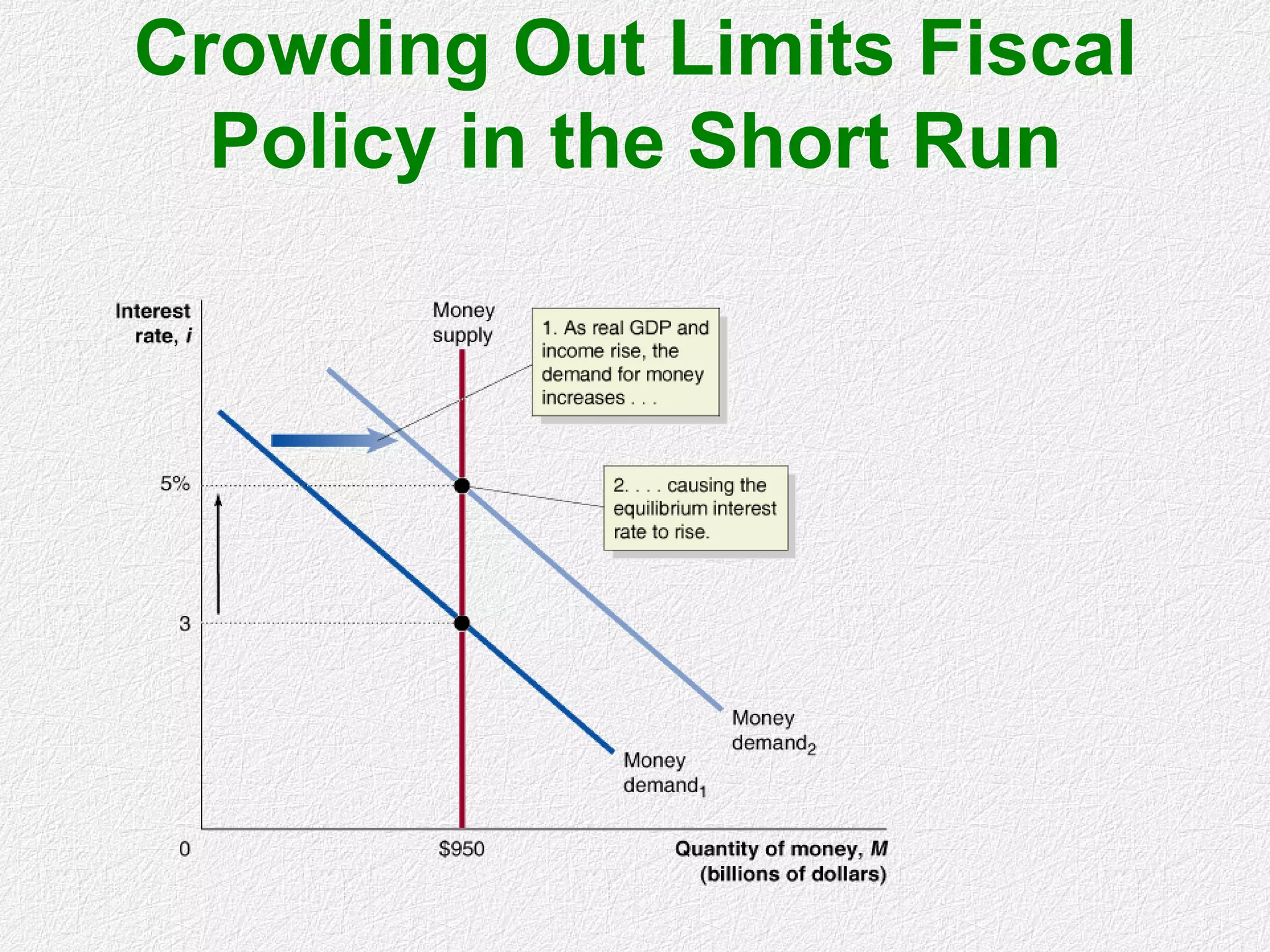
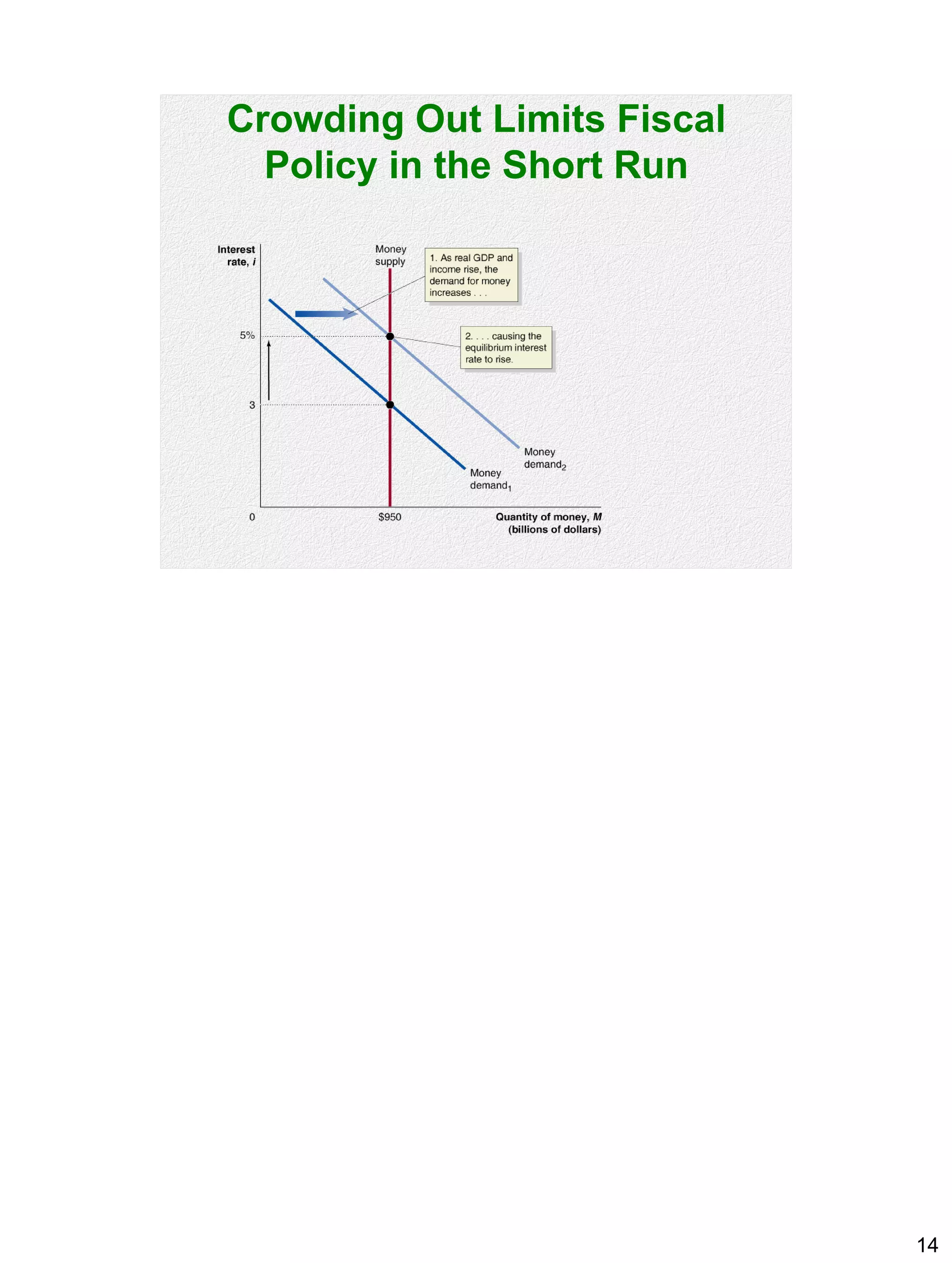
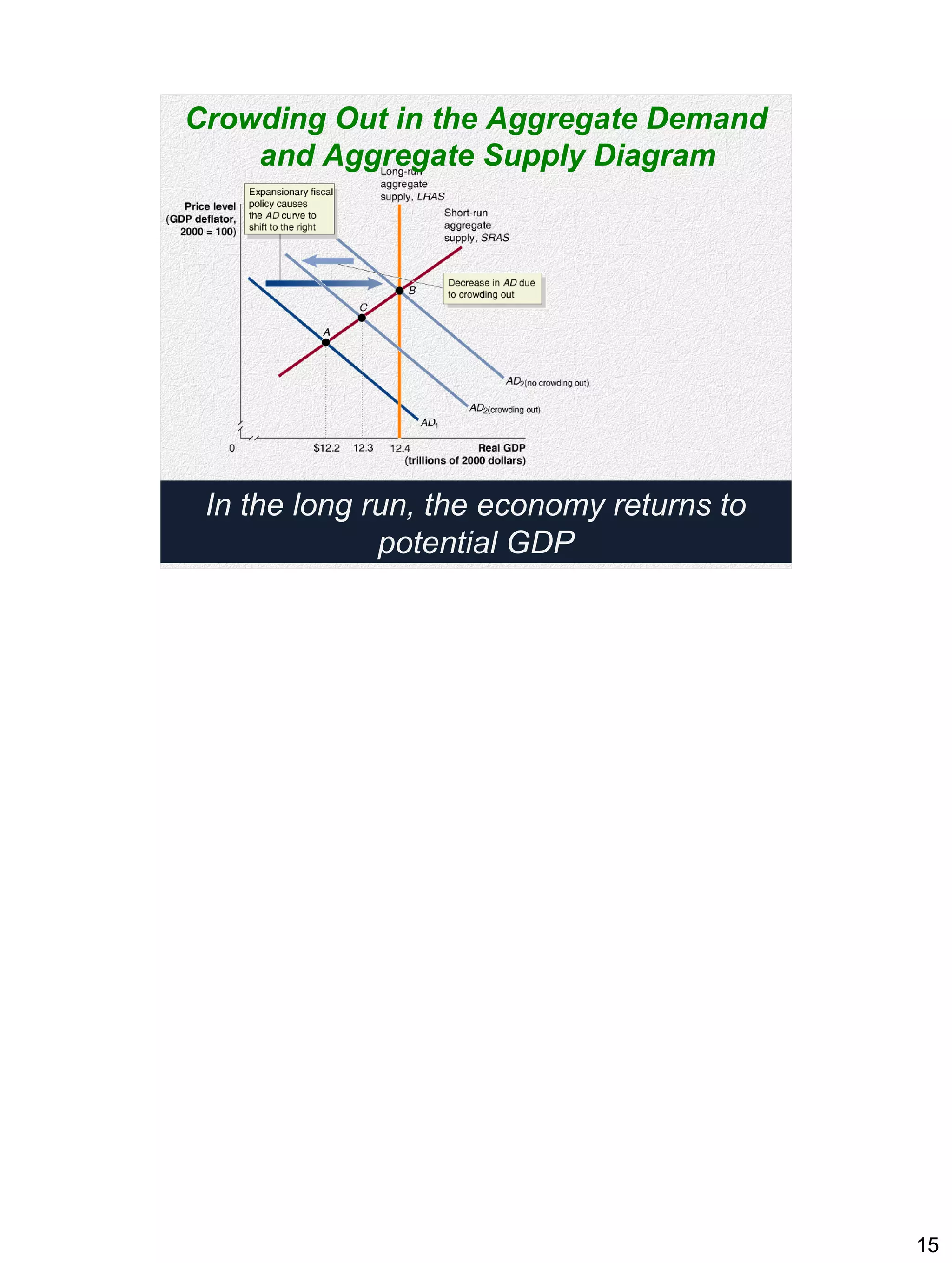
 6) Crowding Out – government borrowing
starves the real sector and forces interest up.
 This discourages investment and consumption,
and slowing economic activities.
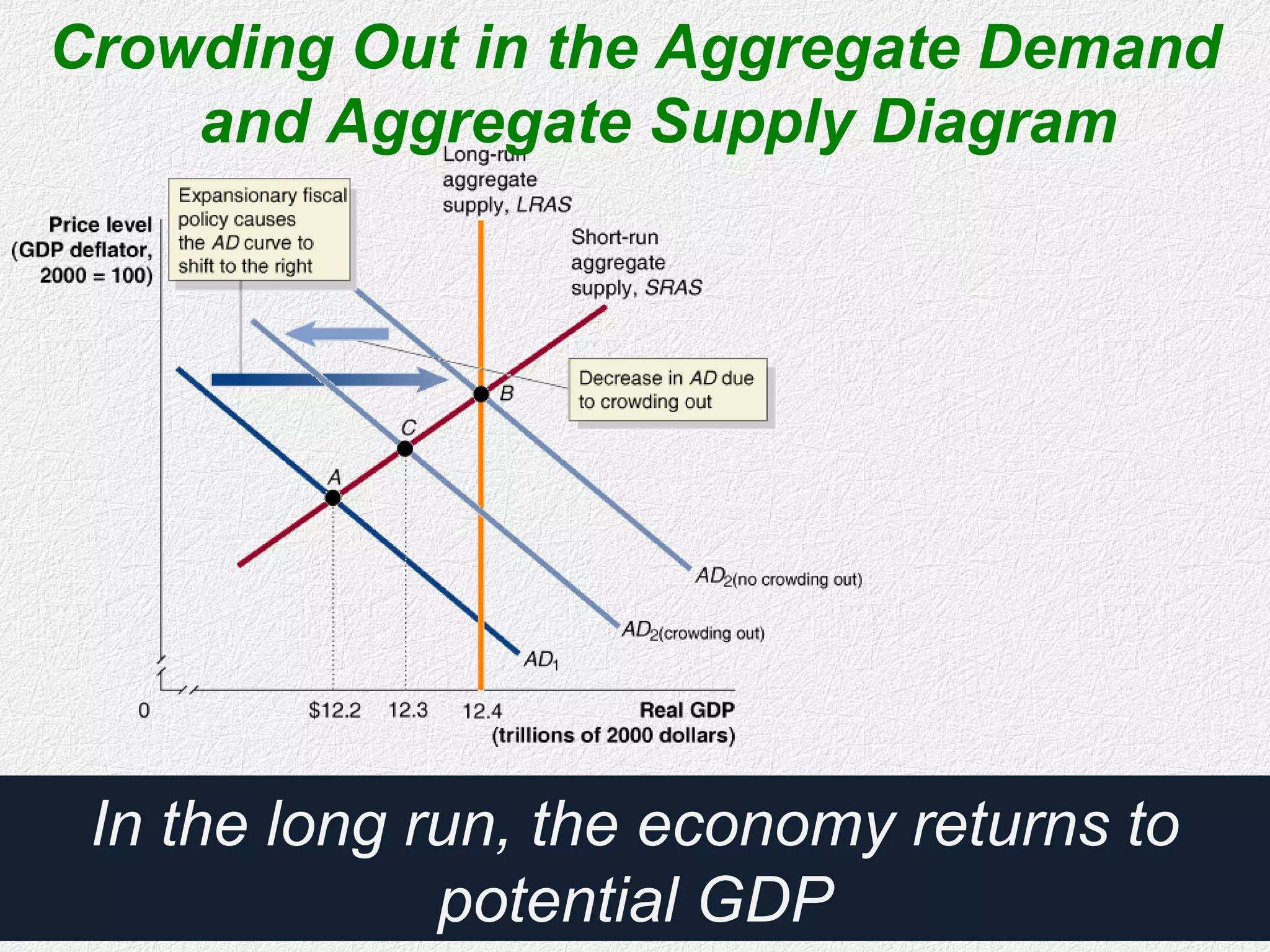
Crowding Out Limits Fiscal
Policy in the Short Run
In the long run, the economy returns to
potential GDP
Crowding Out in the Aggregate Demand
and Aggregate Supply Diagram
16
Budgetary Issues
 A. Budget Deficits: G + TP exceed T.
 Deficit financing is justified if it increases
productivity (highways, waterways, dams), etc.
 Increase during recession bse of higher TP and
less taxes.
 B. Crowding Out and In: Financing deficits by
borrowing increases demand for credit, less
available for real investments and pushes
interest up (Crowding Out).
17
Budgetary Issues
 If operating below capacity, deficit financing could
increase AD, boost employment, and increasing
business confidence leading to more investments
(crowding in).
 C. Twin Deficit: budget deficit financing thru borrowing
pushes up interest rate, encouraging new capital inflow
that causes appreciation.
 Makes imports cheaper and exports dearer, leading to
current account deficit (twin deficit).
 Budget Balance and Government Debt
 Budget deficit is a flow variable.
18
Budgetary Issues
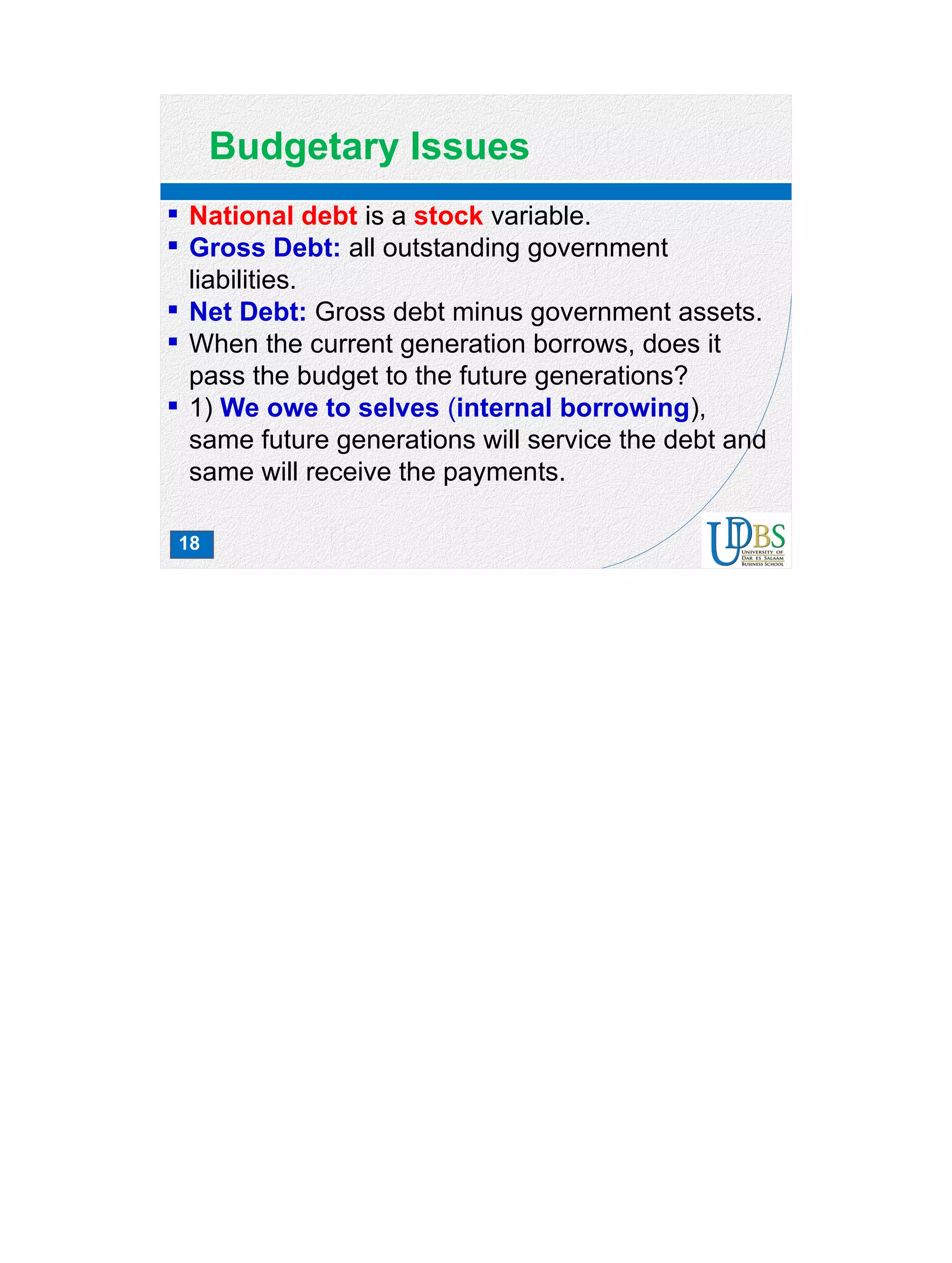
 National debt is a stock variable.
 Gross Debt: all outstanding government
liabilities.
 Net Debt: Gross debt minus government assets.
 When the current generation borrows, does it
pass the budget to the future generations?
 1) We owe to selves (internal borrowing),
same future generations will service the debt and
same will receive the payments.
19
Budgetary Issues
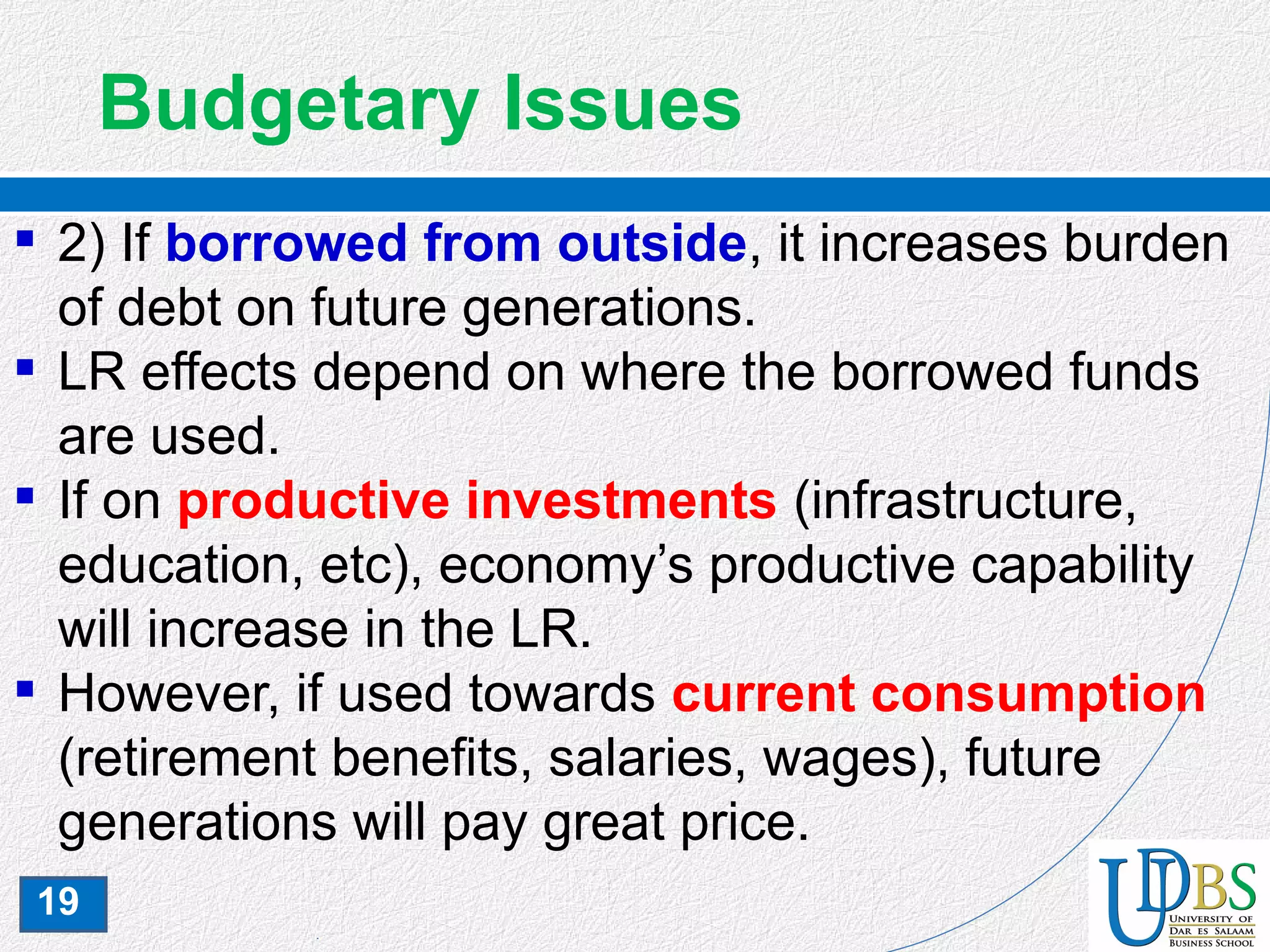
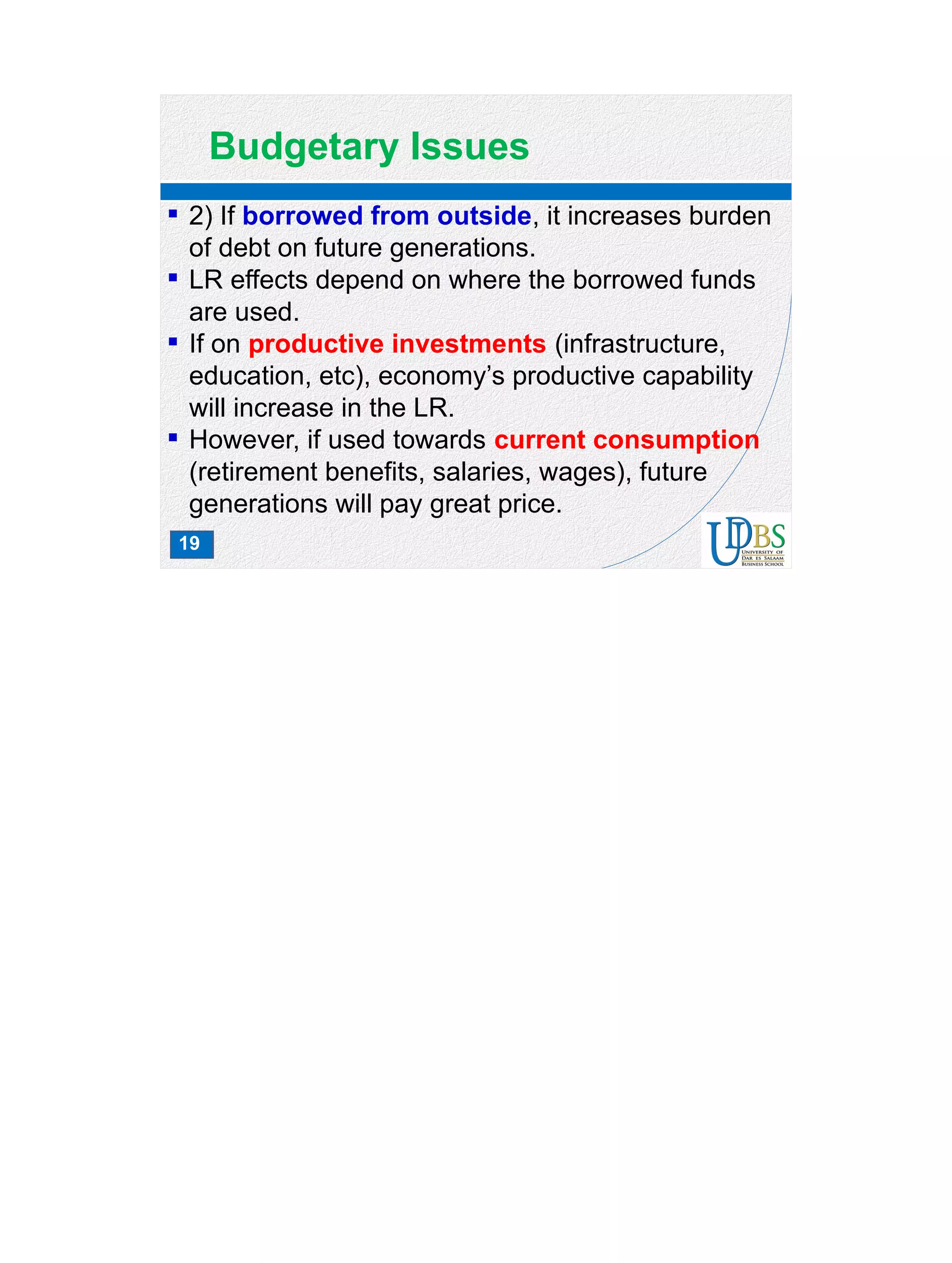
 2) If borrowed from outside, it increases burden
of debt on future generations.
 LR effects depend on where the borrowed funds
are used.
 If on productive investments (infrastructure,
education, etc), economy’s productive capability
will increase in the LR.
 However, if used towards current consumption
(retirement benefits, salaries, wages), future
generations will pay great price.
20
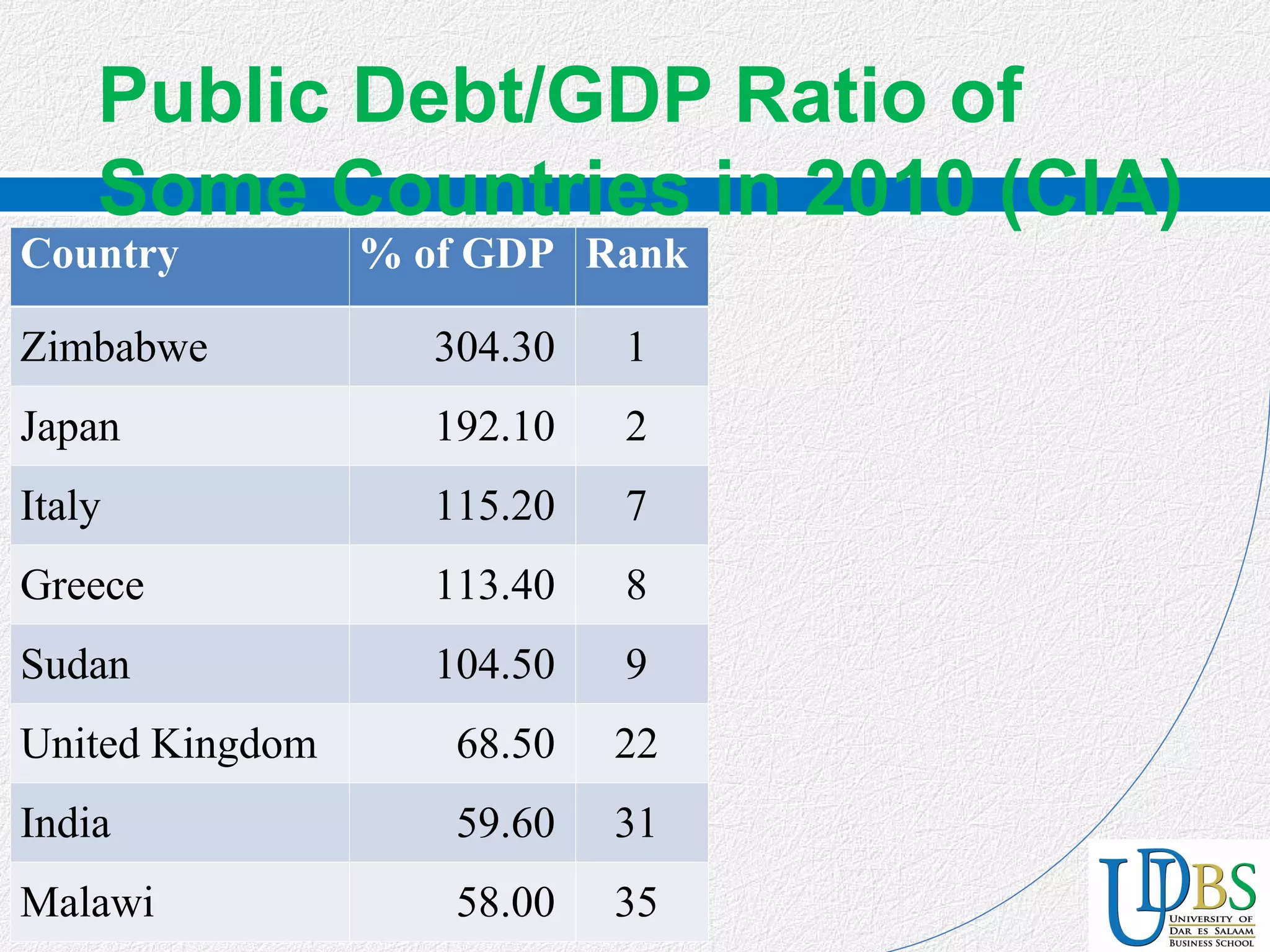
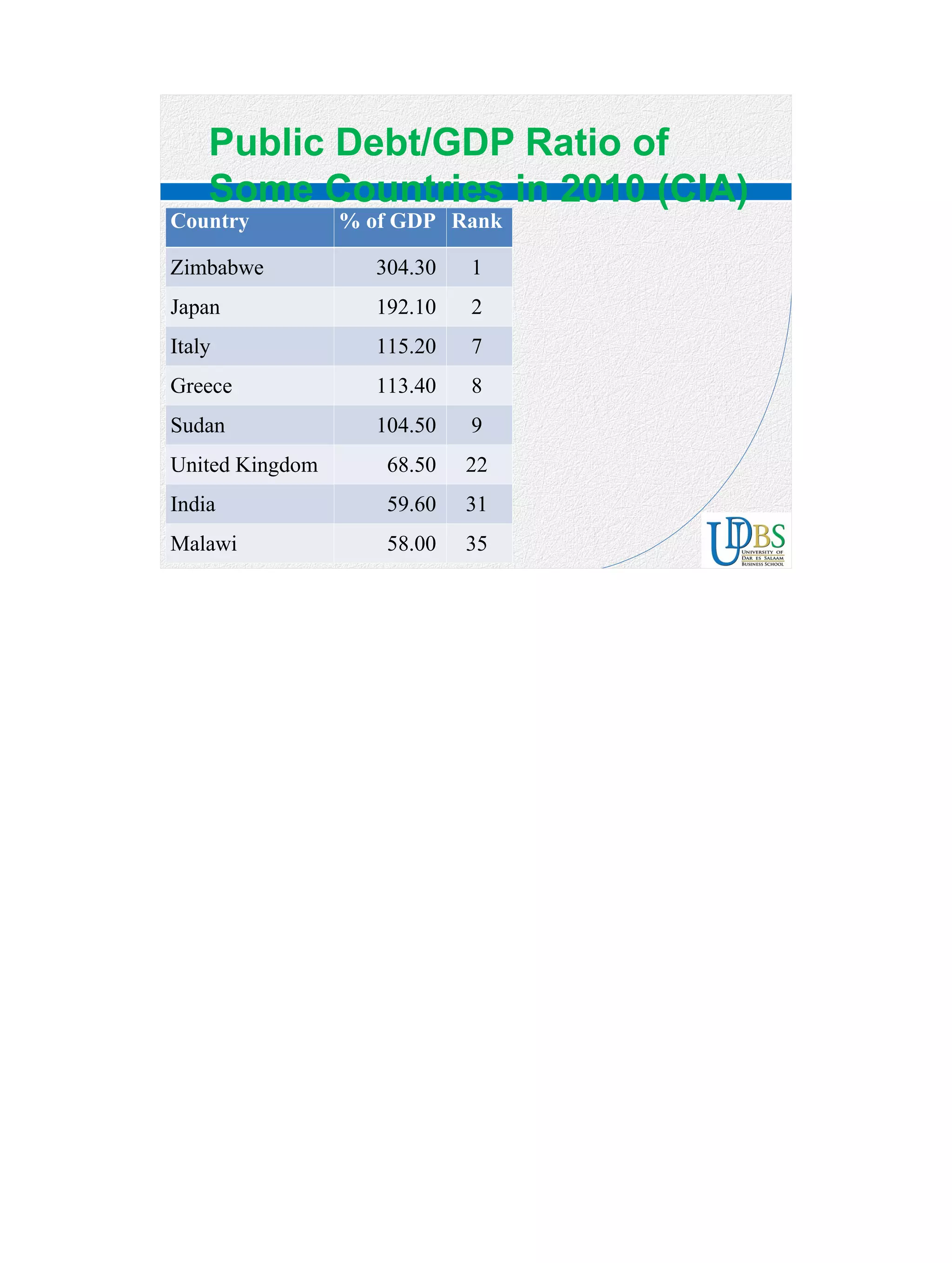
Public Debt/GDP Ratio of
Some Countries in 2010 (CIA)
Country % of GDP Rank
Zimbabwe 304.30 1
Japan 192.10 2
Italy 115.20 7
Greece 113.40 8
Sudan 104.50 9
United Kingdom 68.50 22
India 59.60 31
Malawi 58.00 35
21
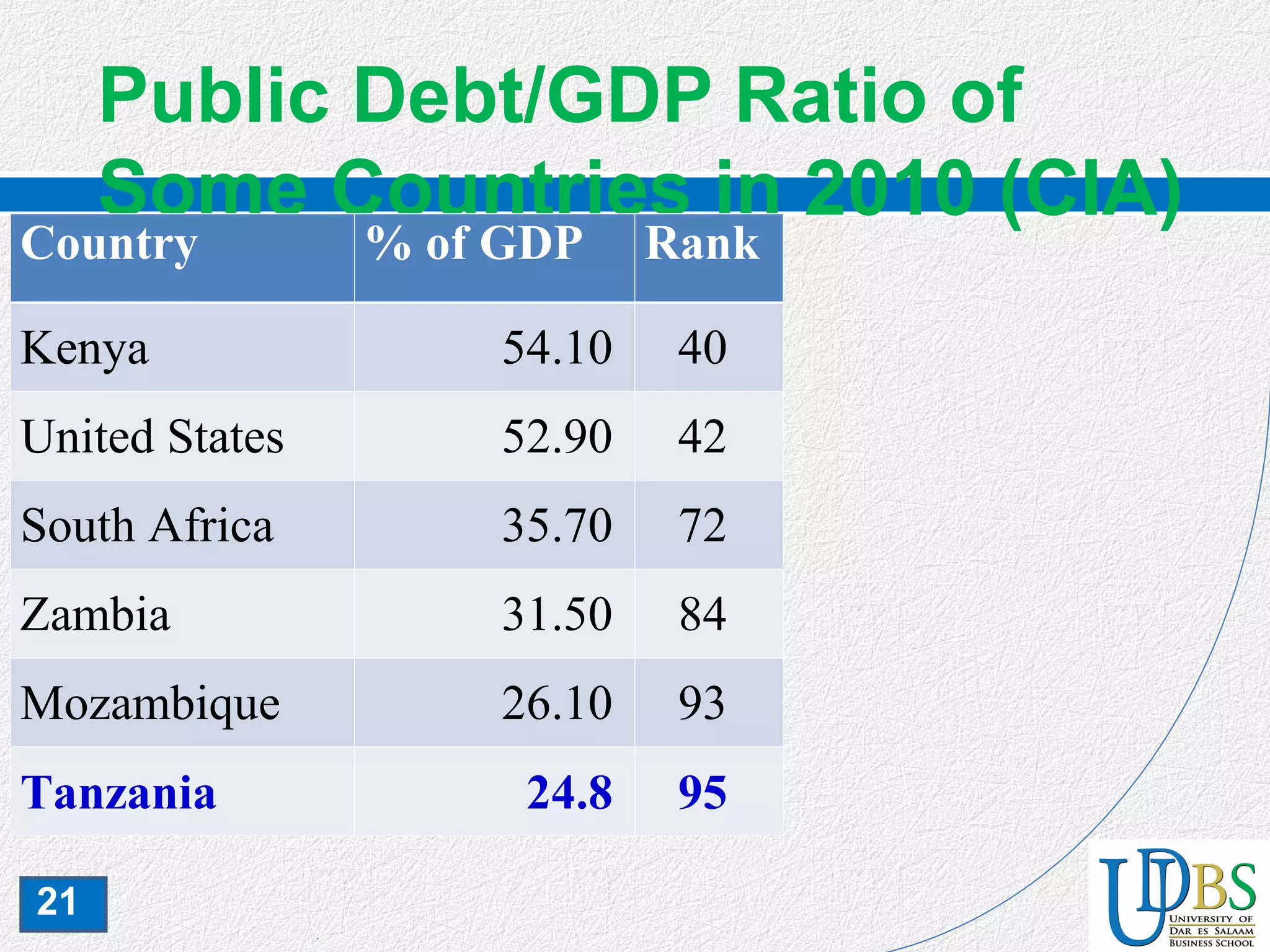
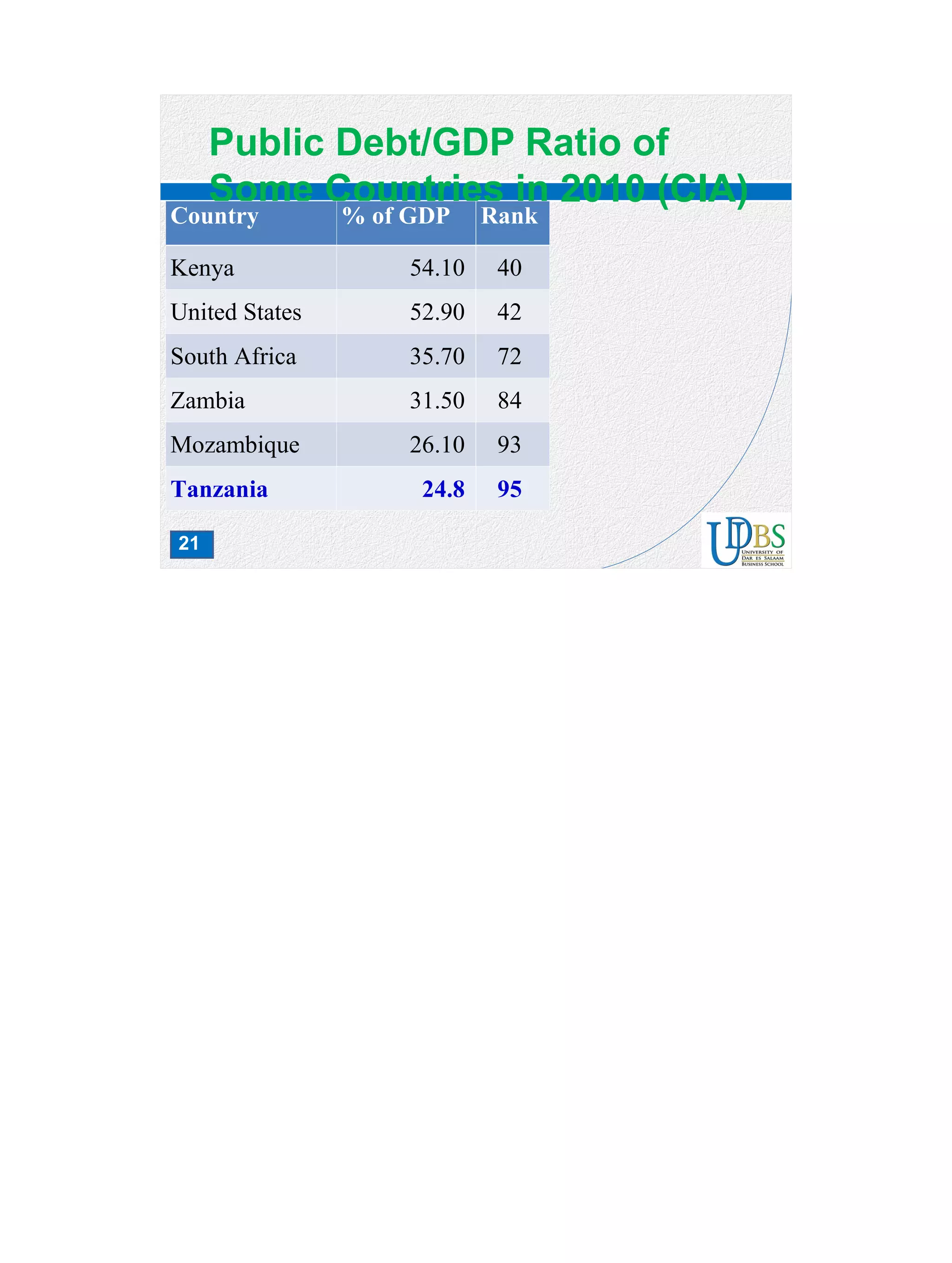
Public Debt/GDP Ratio of
Some Countries in 2010 (CIA)
Country % of GDP Rank
Kenya 54.10 40
United States 52.90 42
South Africa 35.70 72
Zambia 31.50 84
Mozambique 26.10 93
Tanzania 24.8 95
22
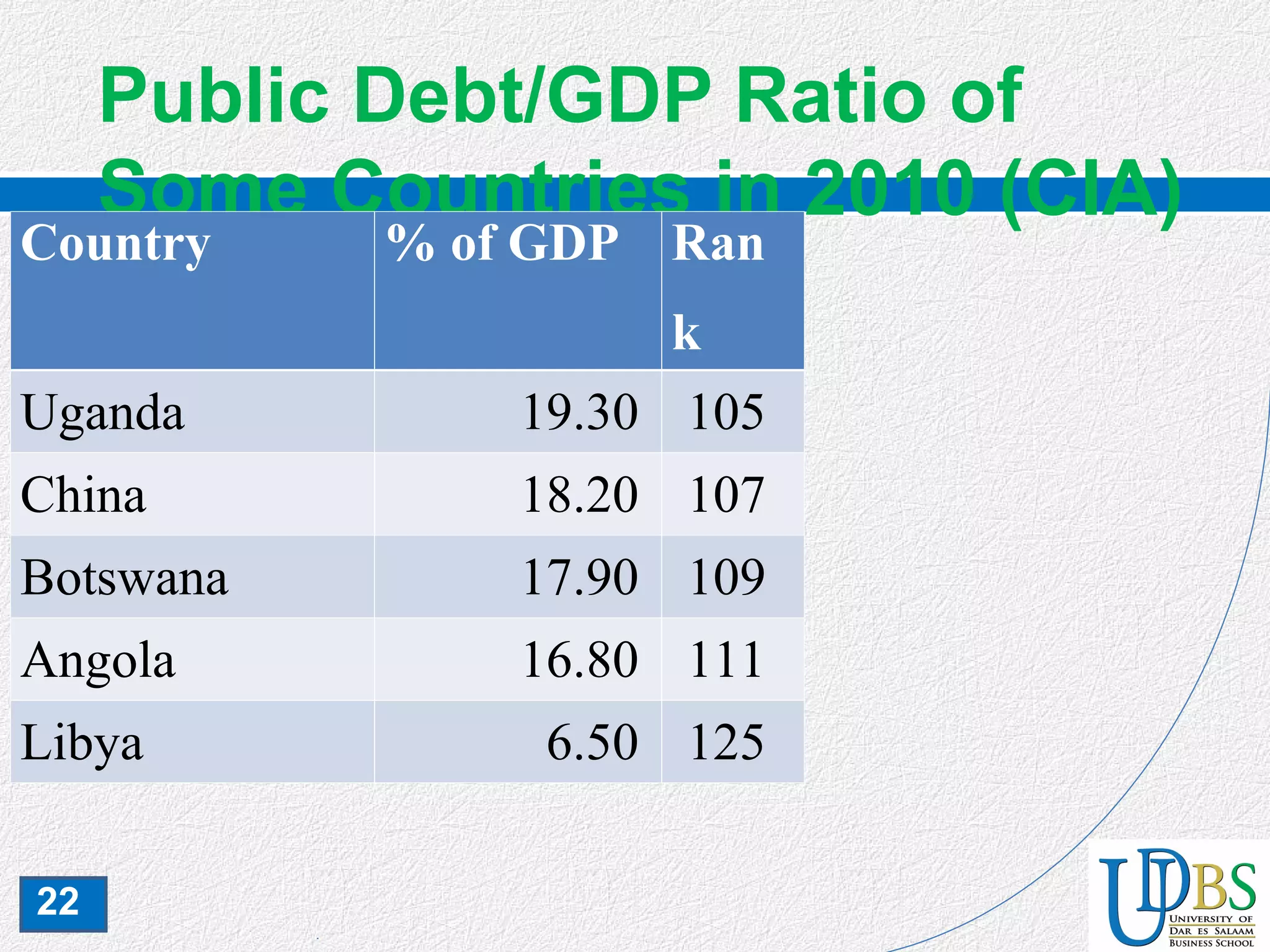
Public Debt/GDP Ratio of
Some Countries in 2010 (CIA)
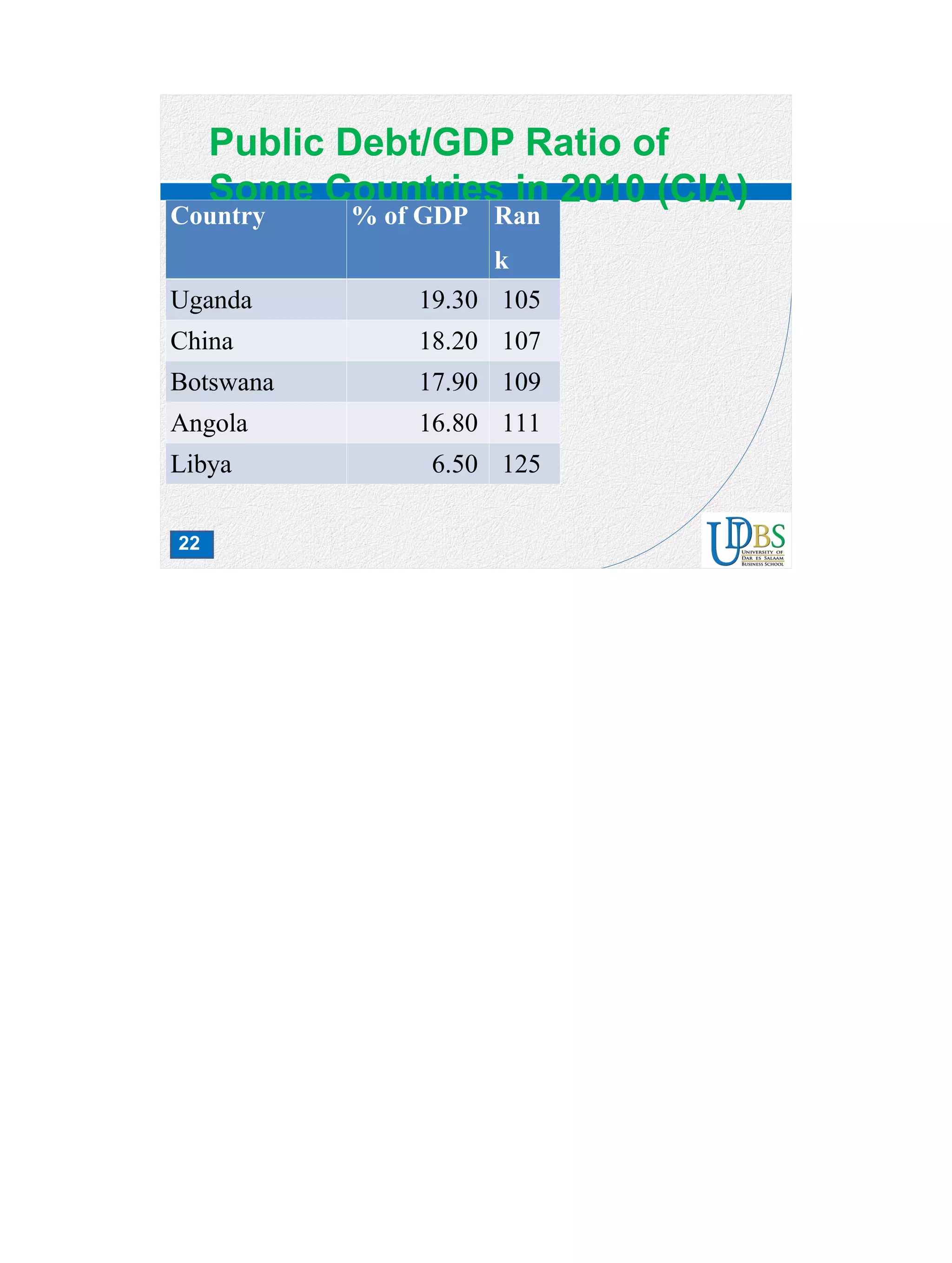
Country % of GDP Ran
k
Uganda 19.30 105
China 18.20 107
Botswana 17.90 109
Angola 16.80 111
Libya 6.50 125
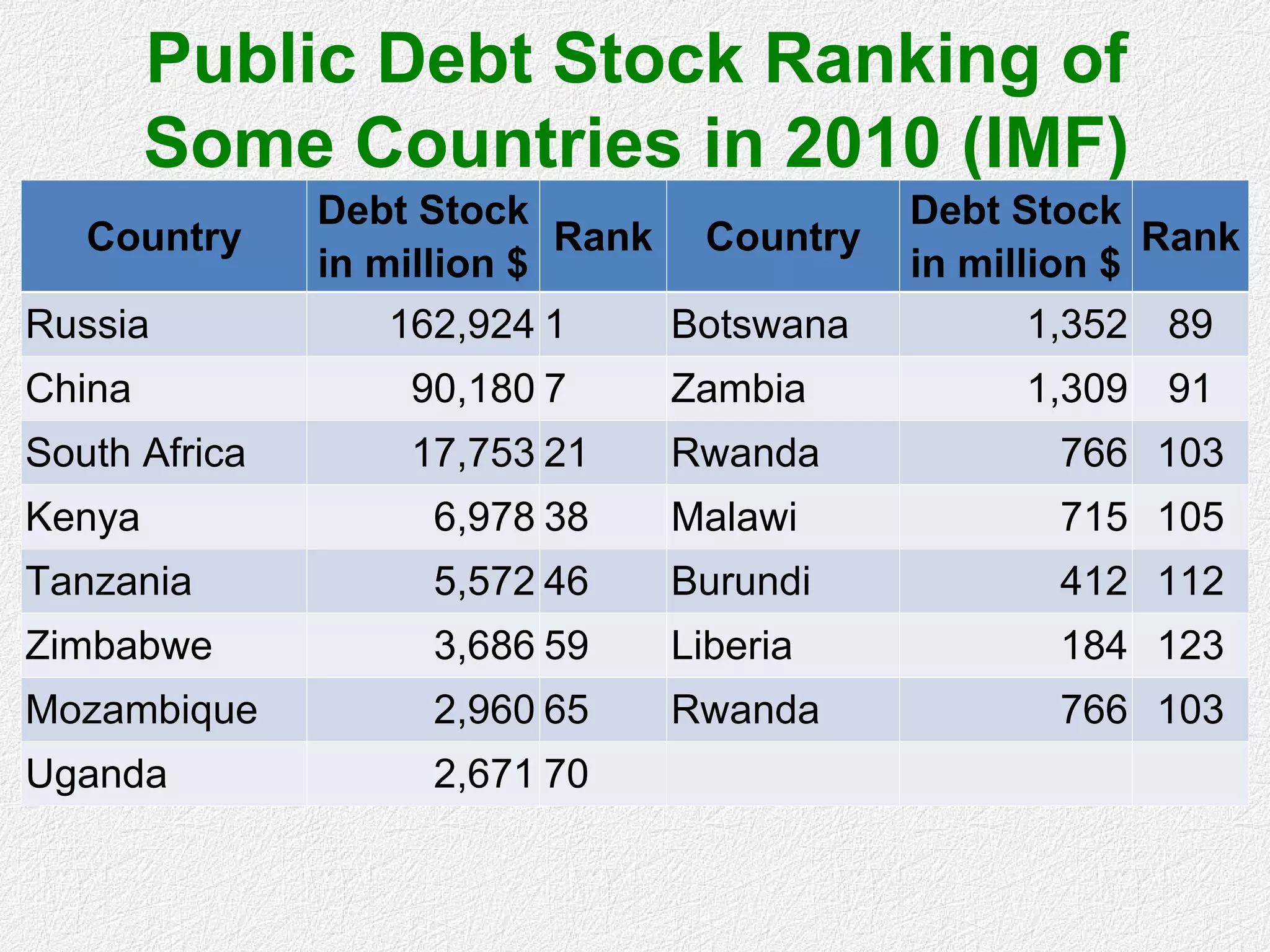
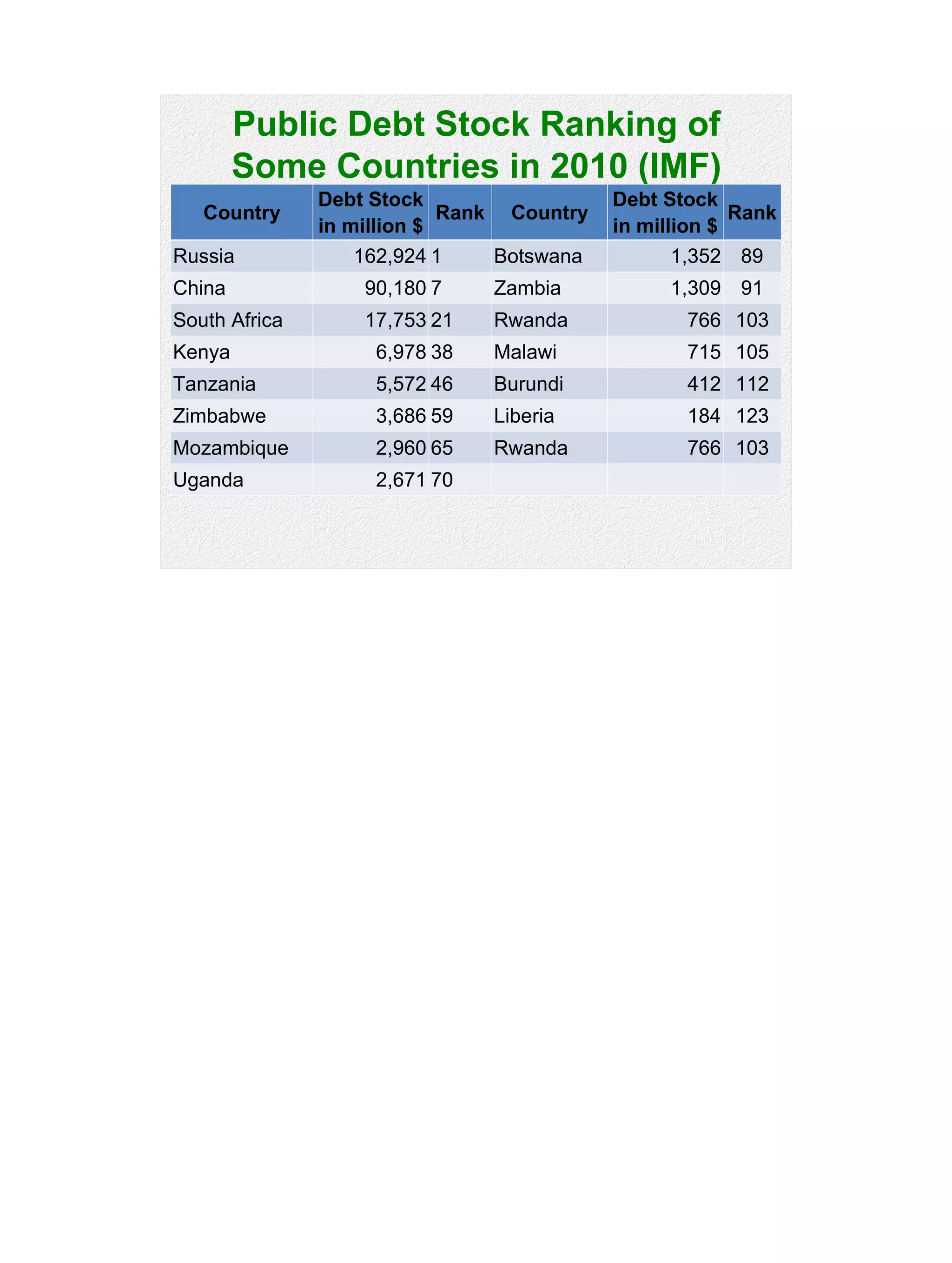
Public Debt Stock Ranking of
Some Countries in 2010 (IMF)
Country
Debt Stock
in million $
Rank Country
Debt Stock
in million $
Rank
Russia 162,924 1 Botswana 1,352 89
China 90,180 7 Zambia 1,309 91
South Africa 17,753 21 Rwanda 766 103
Kenya 6,978 38 Malawi 715 105
Tanzania 5,572 46 Burundi 412 112
Zimbabwe 3,686 59 Liberia 184 123
Mozambique 2,960 65 Rwanda 766 103
Uganda 2,671 70
24
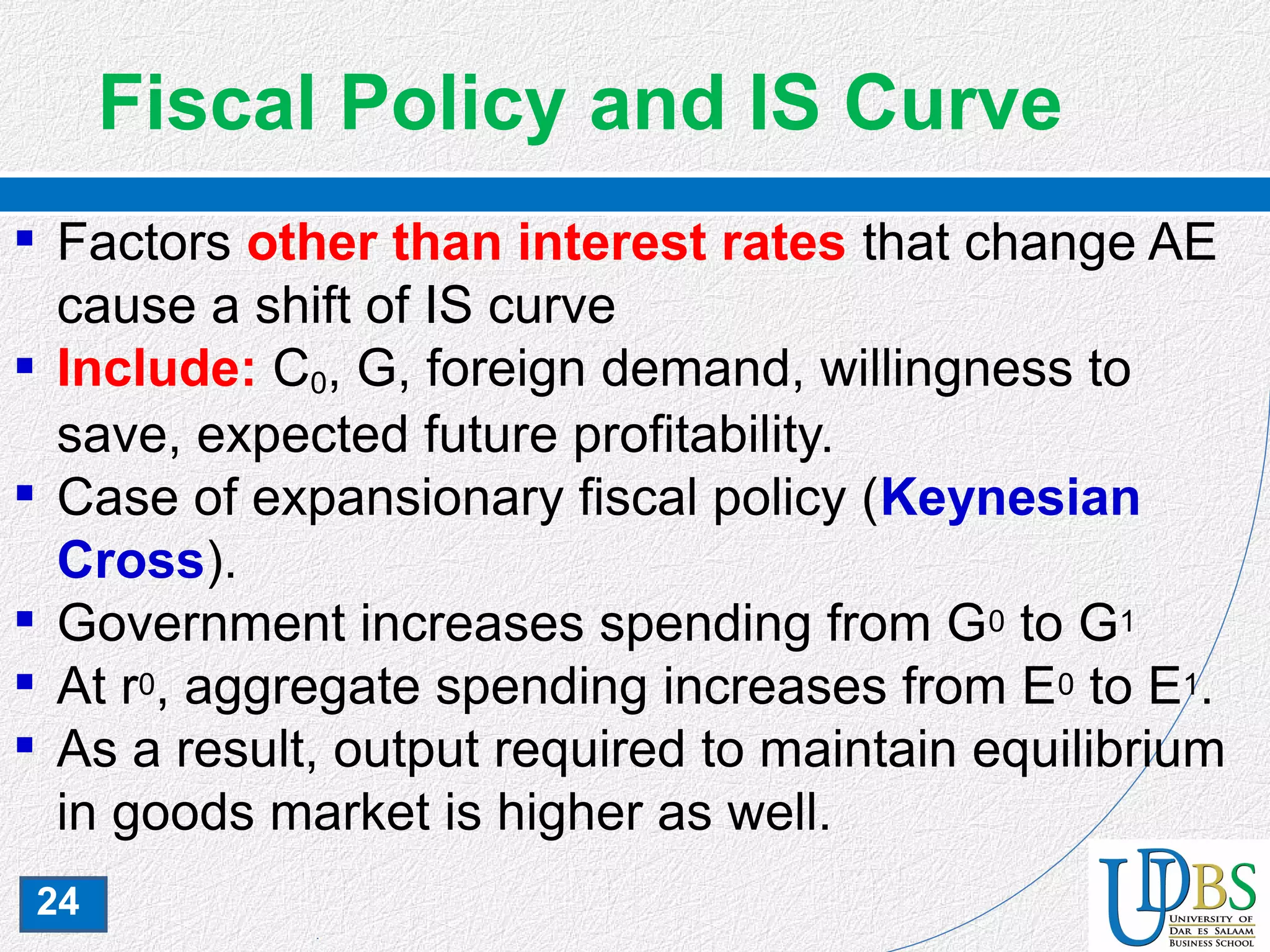
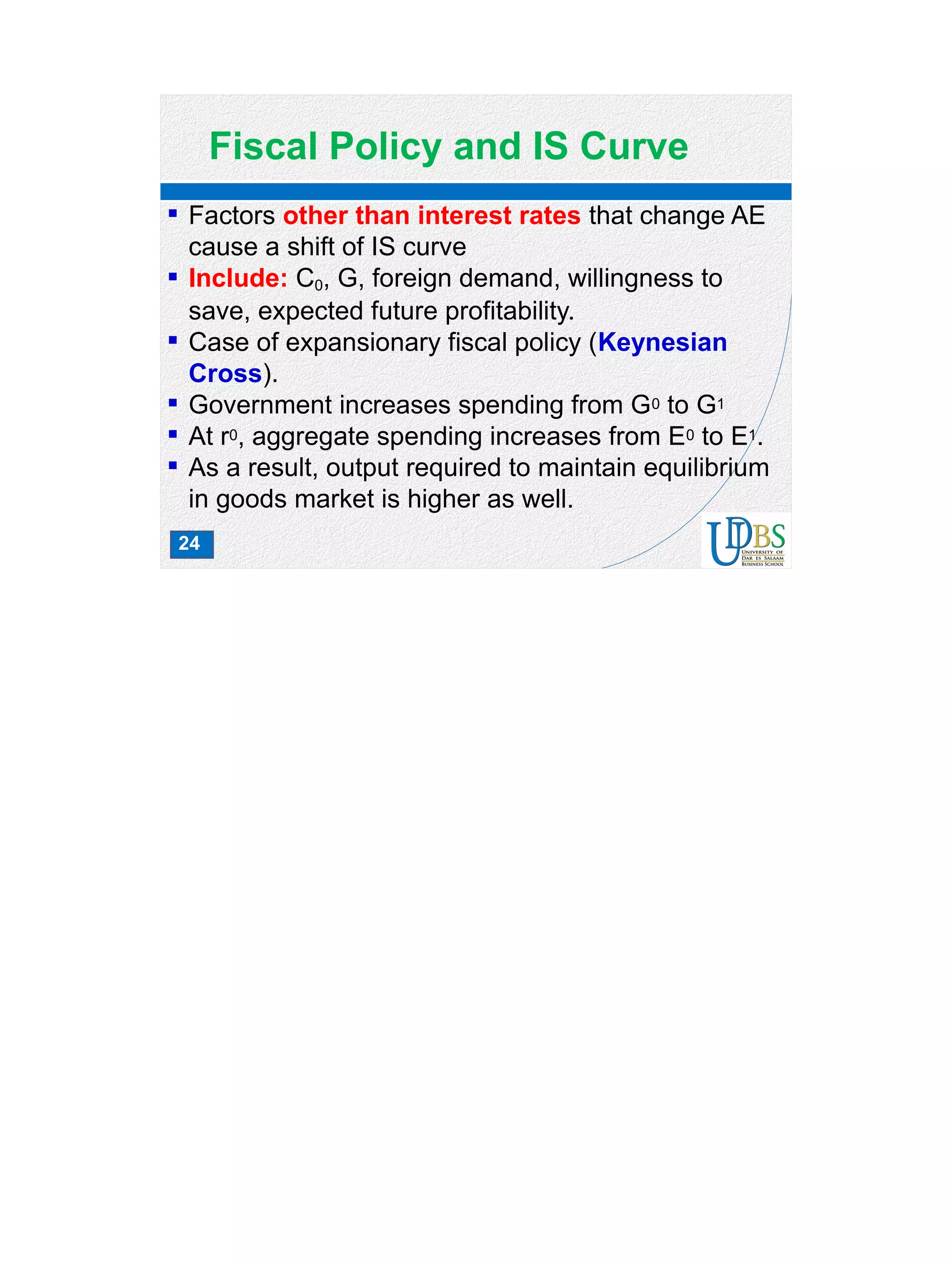
Fiscal Policy and IS Curve
 Factors other than interest rates that change AE
cause a shift of IS curve
 Include: C0, G, foreign demand, willingness to
save, expected future profitability.
 Case of expansionary fiscal policy (Keynesian
Cross).
 Government increases spending from G0 to G1
 At r0, aggregate spending increases from E0 to E1.
 As a result, output required to maintain equilibrium
in goods market is higher as well.
25
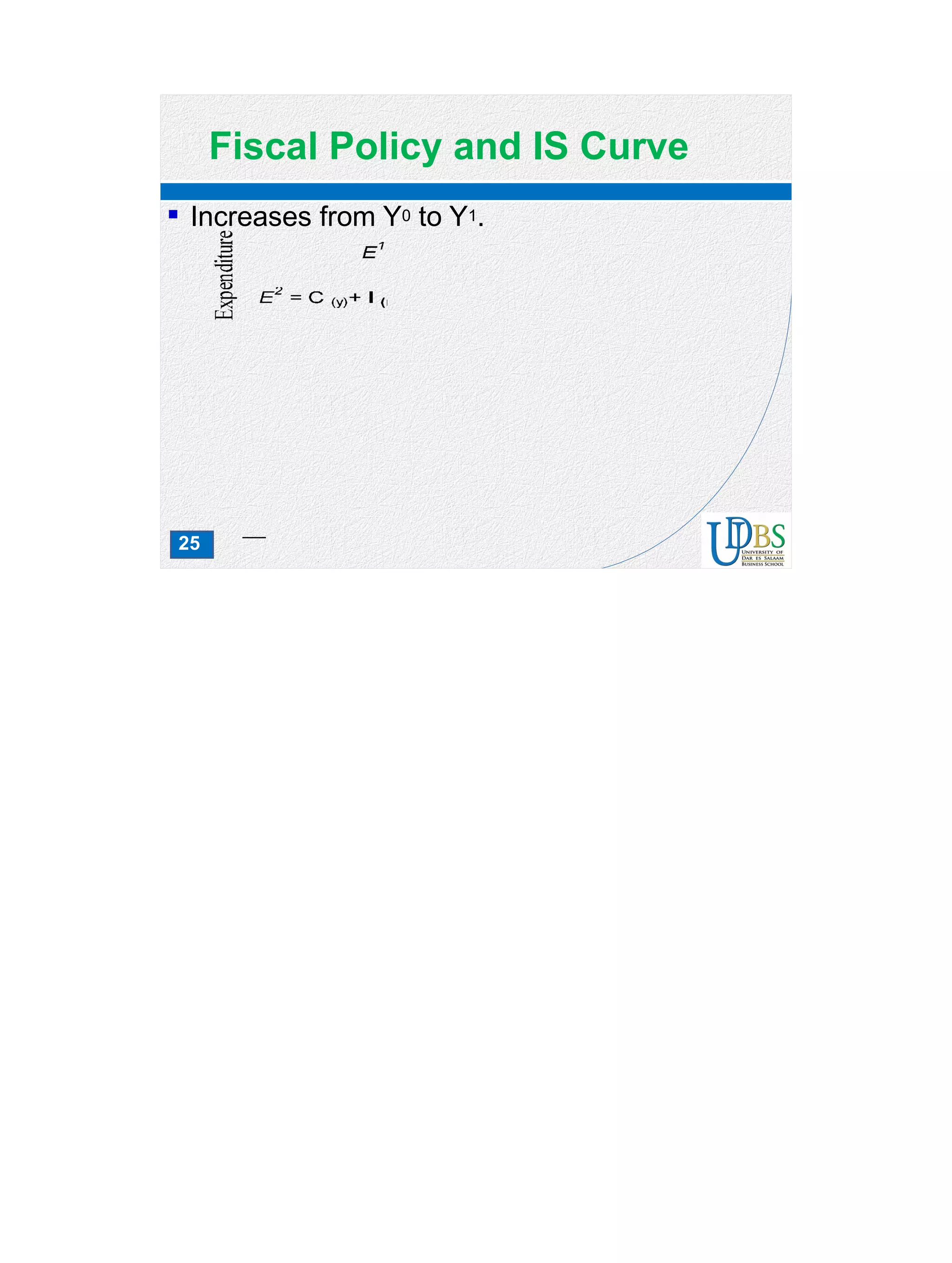
Fiscal Policy and IS Curve
 Increases from Y0 to Y1.
26
Fiscal Policy and IS Curve
 IS curve shifts rightward (Y0 to Y1, at r0).
27
Fiscal Policy and IS Curve
 As Y increases, demand for money increases
as well.
 With fixed nominal money supply, interest rate
increases causing a movement along same
LM curve.
28
Fiscal Policy and IS Curve
29
Fiscal Policy and IS Curve
30
Fiscal Policy and IS Curve
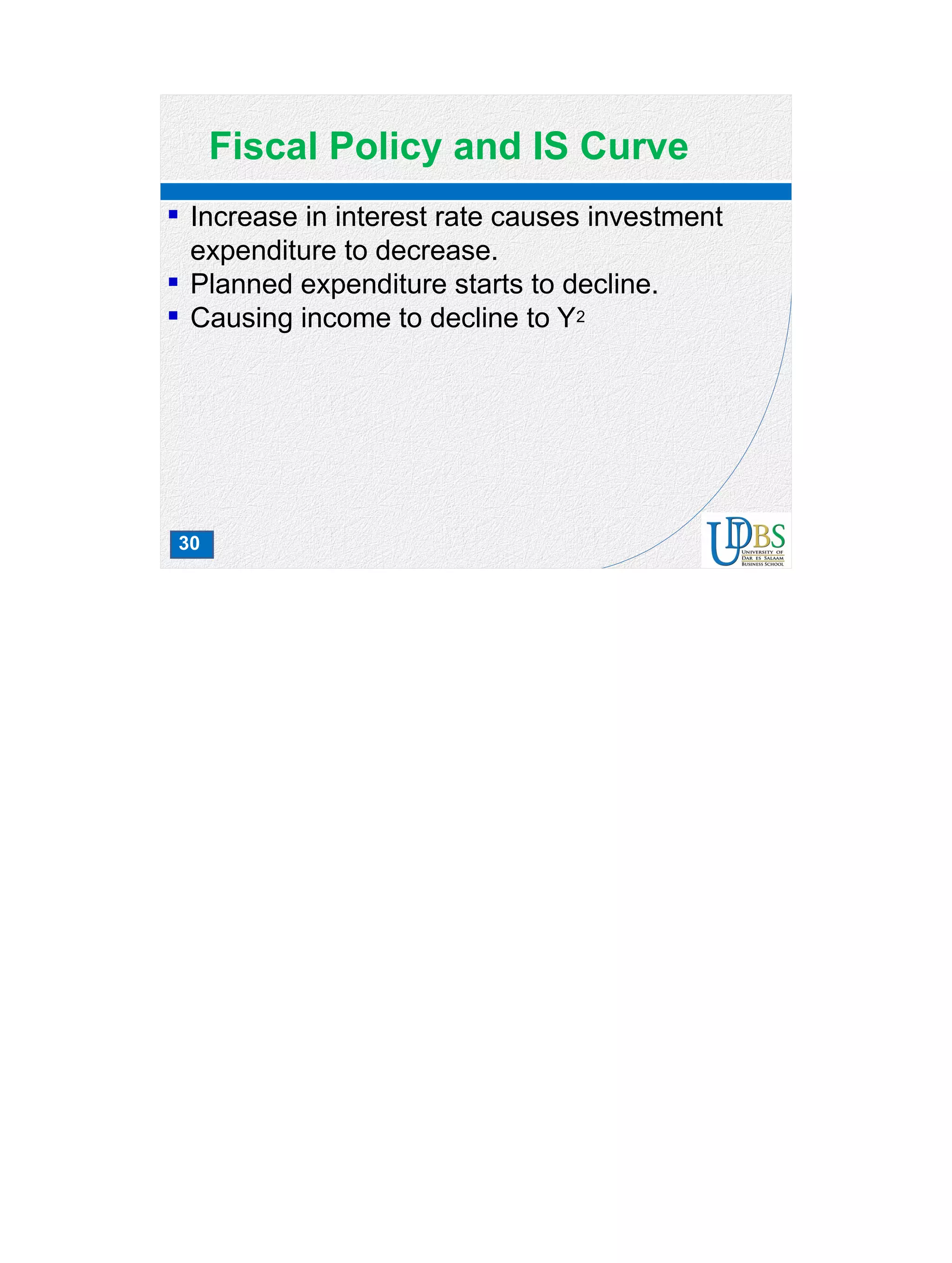
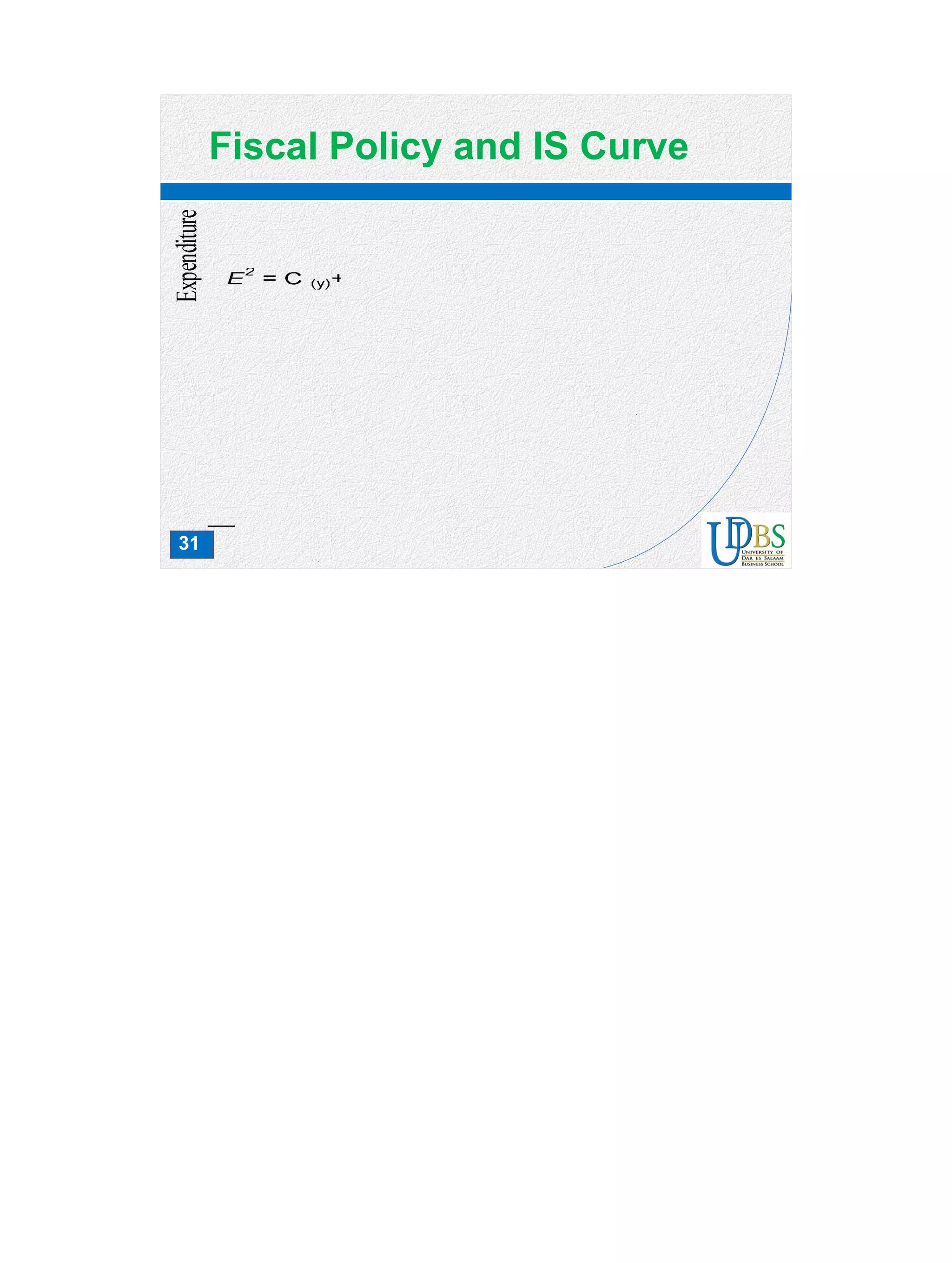
 Increase in interest rate causes investment
expenditure to decrease.
 Planned expenditure starts to decline.
 Causing income to decline to Y2
DEPARTMENT OF FINANCEDEPARTMENT OF FINANCE
University Of Dar Es Salaam BusinessUniversity Of Dar Es Salaam Business
SchoolSchool
FN 101: Principles of Macroeconomics
Lecture 7:
Government and Fiscal
Policy
Genuine Martin
B.Com, M.A. (Economics)
2
Role of Government in the
Economy
 Ideal market system without government
intervention is best.
 Producer surplus (welfare) is maximized.
 Problems with markets: pollution,
unemployment, income inequality, unfair
competition, etc.
 No government keeps its hands off.
 Intervenes if voluntary agreements don’t work.
 Collects taxes, enforces laws, produce public
goods, etc.
3
Role of Government in the
Economy
 Three main economic functions:
 1) Increase efficiency: promote competition,
curb externalities, and provide public goods.
 2) Promote equity: tax and expenditure
programs to redistribute income.
 3) Foster macroeconomic growth and
stability: reduce unemployment, inflation,
encourages growth.
What is the Role of
Government? Providing a stable set of institutions, laws and
rules.
 Promoting effective and workable competition.
 Correcting for externalities.
 Creating an environment that fosters
economic stability and growth.
 Providing public goods.
 Adjusting for undesirable market results.
Government in the Economy
• Nothing arouses as much controversy as
the role of government in the economy.
• Government can affect the macroeconomy
through two policy channels: fiscal policy
and monetary policy.
• Fiscal policy is the manipulation of
government spending and taxation.
• Monetary policy refers to the behavior of
the Bank of Tanzania regarding the
nation’s money supply.
Adding Net Taxes (T) and
Government Purchases (G) to the
Circular Flow of Income
7
Fiscal Policy
 Part of demand management.
 Use of government spending, taxes, and income
transfers to influence macroeconomic outcomes
(employment, prices and GDP).
 G directly affects AD.
 Income transfers and T affect disposable income.
 Budget Deficit: G > T
 Budget Surplus: T > G
 Types of Tools: discretionary fiscal policy &
automatic stabilizers.
8
Fiscal Policy
 Discretionary Fiscal Policy: deliberate
changes in G, T and transfers to achieve
particular goals.
 Automatic Stabilizers: measures inbuilt into
fiscal system (progressive tax & unemployment
benefits) to smooth fluctuations in disposable
income over business cycle.
 Boost AD during recession, and dampen it
during expansion.
9
Fiscal Policy
 As a result, real GDP fluctuates less over a
business cycle, and disposable income varies
proportionally less than does real GDP.
10
Challenges in Implementing
Fiscal Policy
 1) Inflexibility of government spending: major
portion is wages and salaries (difficult to
adjust), social projects are long-run, cuts in
expenditure is political process, interest on
national debt, unemployment benefits and old
age pensions are difficult to adjust.
 2) Lengthy budget process – average
recessions last less than a year, budget
preparations begin about a year before effect,
planning discretionary measures is difficult.
11
Challenges in Implementing
Fiscal Policy 3) Political problems – politicians want to maximize
votes, and voters like public spending and hate to
pay taxes, contractionary fiscal measures are a
challenge before election.
 4) Information – assembling accurate information
quickly and use in short-run AD management is a
challenge.
 5) Time lags – takes time to assimilate information,
appreciate an economic situation, formulate policy,
implement it, and taking effect.
 Possibility of policy working in a wrong time.
12
Challenges in Implementing
Fiscal Policy
 Takes about six months to identify a recession.
 Data lags – time needed to gather data on
economic variables.
 Recognition lag – time needed to analyze
trends suggested by economic variables.
 Legislative lag – legislative approval is a long
process.
 Implementation lag – time to put tax and
expenditure policy into effect.
13
Challenges in Implementing
Fiscal Policy
 Impact lag – time for policy to take effect on
the economy after implementation.
 6) Crowding Out – government borrowing
starves the real sector and forces interest up.
 This discourages investment and consumption,
and slowing economic activities.
14
Crowding Out Limits Fiscal
Policy in the Short Run
15
In the long run, the economy returns to
potential GDP
Crowding Out in the Aggregate Demand
and Aggregate Supply Diagram
16
Budgetary Issues
 A. Budget Deficits: G + TP exceed T.
 Deficit financing is justified if it increases
productivity (highways, waterways, dams), etc.
 Increase during recession bse of higher TP and
less taxes.
 B. Crowding Out and In: Financing deficits by
borrowing increases demand for credit, less
available for real investments and pushes
interest up (Crowding Out).
17
Budgetary Issues
 If operating below capacity, deficit financing could
increase AD, boost employment, and increasing
business confidence leading to more investments
(crowding in).
 C. Twin Deficit: budget deficit financing thru borrowing
pushes up interest rate, encouraging new capital inflow
that causes appreciation.
 Makes imports cheaper and exports dearer, leading to
current account deficit (twin deficit).
 Budget Balance and Government Debt
 Budget deficit is a flow variable.
18
Budgetary Issues
 National debt is a stock variable.
 Gross Debt: all outstanding government
liabilities.
 Net Debt: Gross debt minus government assets.
 When the current generation borrows, does it
pass the budget to the future generations?
 1) We owe to selves (internal borrowing),
same future generations will service the debt and
same will receive the payments.
19
Budgetary Issues
 2) If borrowed from outside, it increases burden
of debt on future generations.
 LR effects depend on where the borrowed funds
are used.
 If on productive investments (infrastructure,
education, etc), economy’s productive capability
will increase in the LR.
 However, if used towards current consumption
(retirement benefits, salaries, wages), future
generations will pay great price.
20
Public Debt/GDP Ratio of
Some Countries in 2010 (CIA)
Country % of GDP Rank
Zimbabwe 304.30 1
Japan 192.10 2
Italy 115.20 7
Greece 113.40 8
Sudan 104.50 9
United Kingdom 68.50 22
India 59.60 31
Malawi 58.00 35
21
Public Debt/GDP Ratio of
Some Countries in 2010 (CIA)
Country % of GDP Rank
Kenya 54.10 40
United States 52.90 42
South Africa 35.70 72
Zambia 31.50 84
Mozambique 26.10 93
Tanzania 24.8 95
22
Public Debt/GDP Ratio of
Some Countries in 2010 (CIA)
Country % of GDP Ran
k
Uganda 19.30 105
China 18.20 107
Botswana 17.90 109
Angola 16.80 111
Libya 6.50 125
Public Debt Stock Ranking of
Some Countries in 2010 (IMF)
Country
Debt Stock
in million $
Rank Country
Debt Stock
in million $
Rank
Russia 162,924 1 Botswana 1,352 89
China 90,180 7 Zambia 1,309 91
South Africa 17,753 21 Rwanda 766 103
Kenya 6,978 38 Malawi 715 105
Tanzania 5,572 46 Burundi 412 112
Zimbabwe 3,686 59 Liberia 184 123
Mozambique 2,960 65 Rwanda 766 103
Uganda 2,671 70
24
Fiscal Policy and IS Curve
 Factors other than interest rates that change AE
cause a shift of IS curve
 Include: C0, G, foreign demand, willingness to
save, expected future profitability.
 Case of expansionary fiscal policy (Keynesian
Cross).
 Government increases spending from G0 to G1
 At r0, aggregate spending increases from E0 to E1.
 As a result, output required to maintain equilibrium
in goods market is higher as well.
25
Fiscal Policy and IS Curve
 Increases from Y0 to Y1.
26
Fiscal Policy and IS Curve
 IS curve shifts rightward (Y0 to Y1, at r0).
27
Fiscal Policy and IS Curve
 As Y increases, demand for money increases
as well.
 With fixed nominal money supply, interest rate
increases causing a movement along same
LM curve.
28
Fiscal Policy and IS Curve
29
Fiscal Policy and IS Curve
30
Fiscal Policy and IS Curve
 Increase in interest rate causes investment
expenditure to decrease.
 Planned expenditure starts to decline.
 Causing income to decline to Y2
31
Fiscal Policy and IS Curve
32
Fiscal Policy and IS Curve
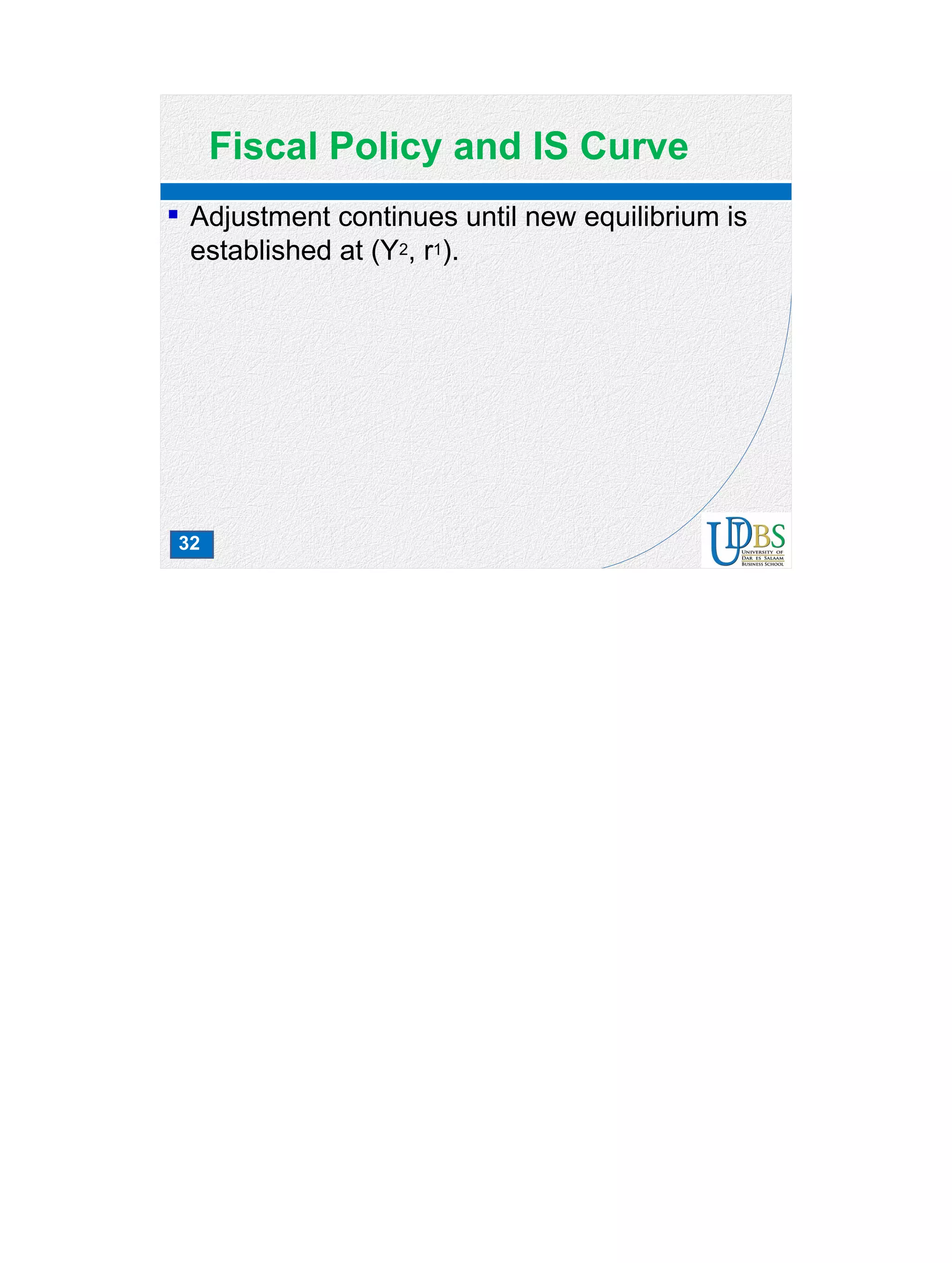
 Adjustment continues until new equilibrium is
established at (Y2, r1).
33
Fiscal Policy and IS Curve
34
slid
e
34
causing output & income
to rise.
IS1
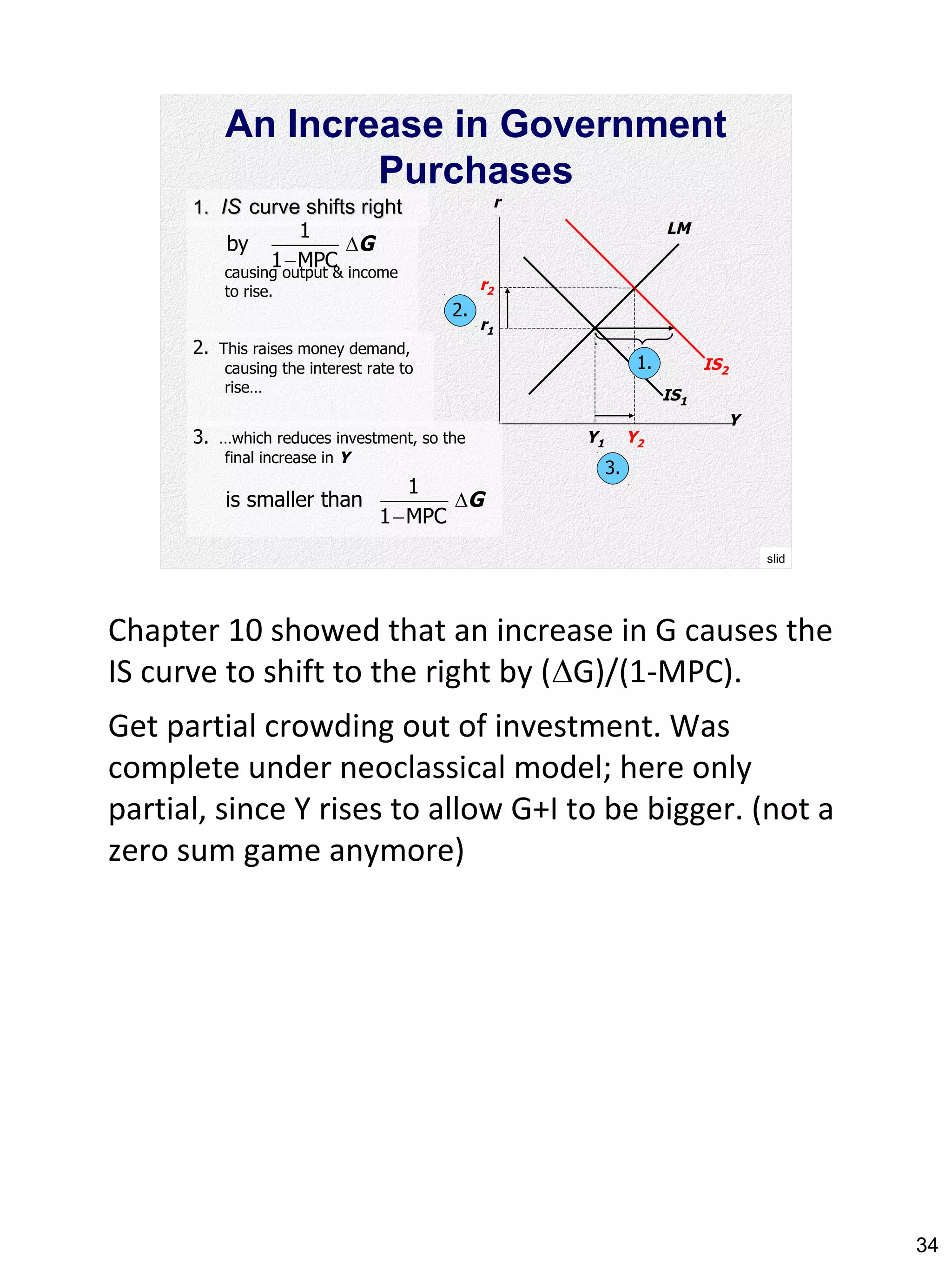
An Increase in Government
Purchases
1.1. ISIS curve shifts rightcurve shifts right
Y
r
LM
r1
Y1
1
by
1 MPC
GD
-
IS2
Y2
r2
1.
2. This raises money demand,
causing the interest rate to
rise…
2.
3. …which reduces investment, so the
final increase in Y
1
is smaller than
1 MPC
GD
-
3.
Chapter 10 showed that an increase in G causes the
IS curve to shift to the right by (G)/(1-MPC).
Get partial crowding out of investment. Was
complete under neoclassical model; here only
partial, since Y rises to allow G+I to be bigger. (not a
zero sum game anymore)
35
slid
e
35
IS1
1.
A Tax Cut
Y
r
LM
r1
Y1
IS2
Y2
r2
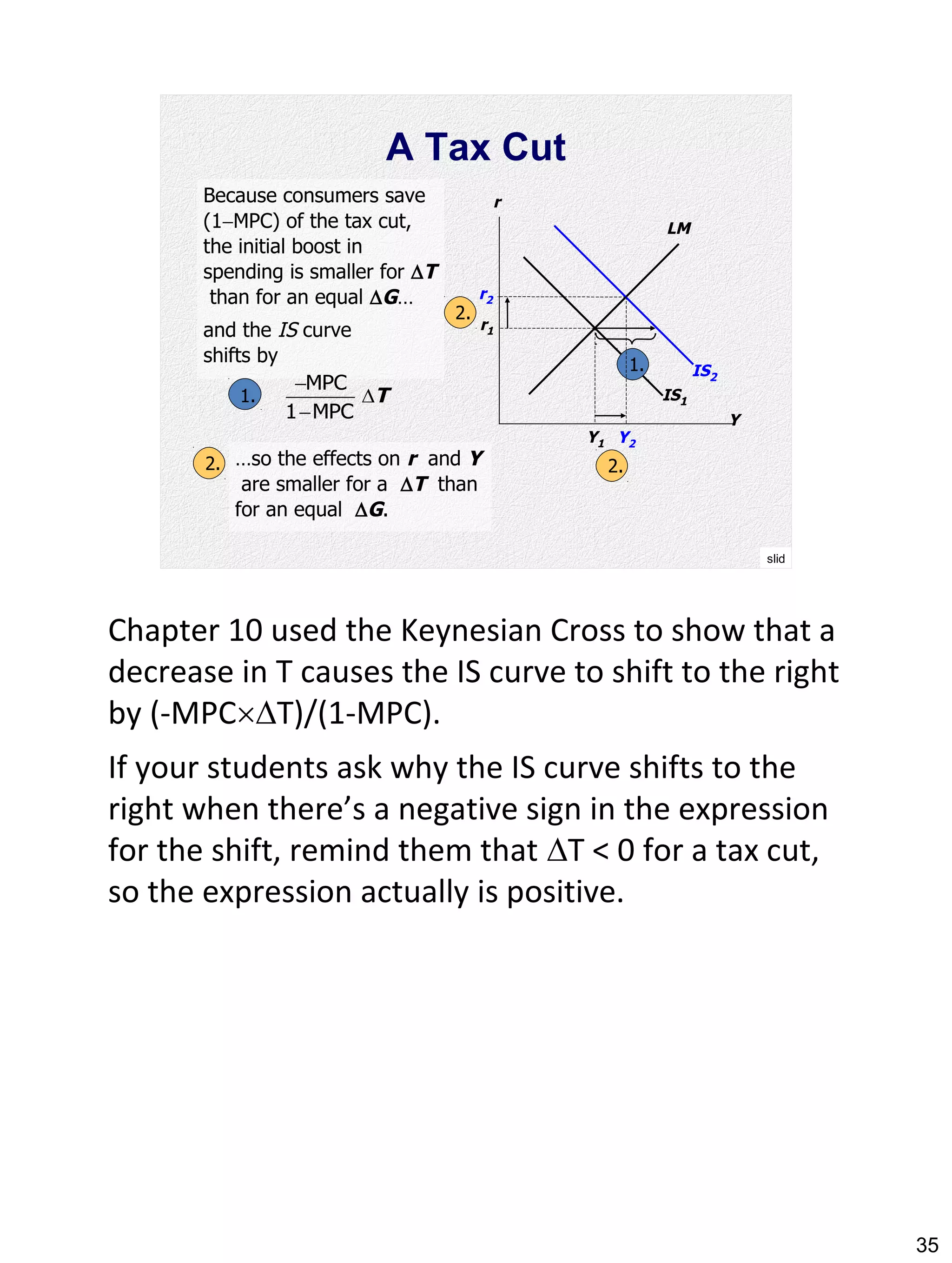
Because consumers save
(1MPC) of the tax cut,
the initial boost in
spending is smaller for T
than for an equal G…
and the IS curve
shifts by
MPC
1 MPC
T
-
D
-
1.
2.
2.…so the effects on r and Y
are smaller for a T than
for an equal G.
2.
Chapter 10 used the Keynesian Cross to show that a
decrease in T causes the IS curve to shift to the right
by (-MPCT)/(1-MPC).
If your students ask why the IS curve shifts to the
right when there’s a negative sign in the expression
for the shift, remind them that T < 0 for a tax cut,
so the expression actually is positive.
36
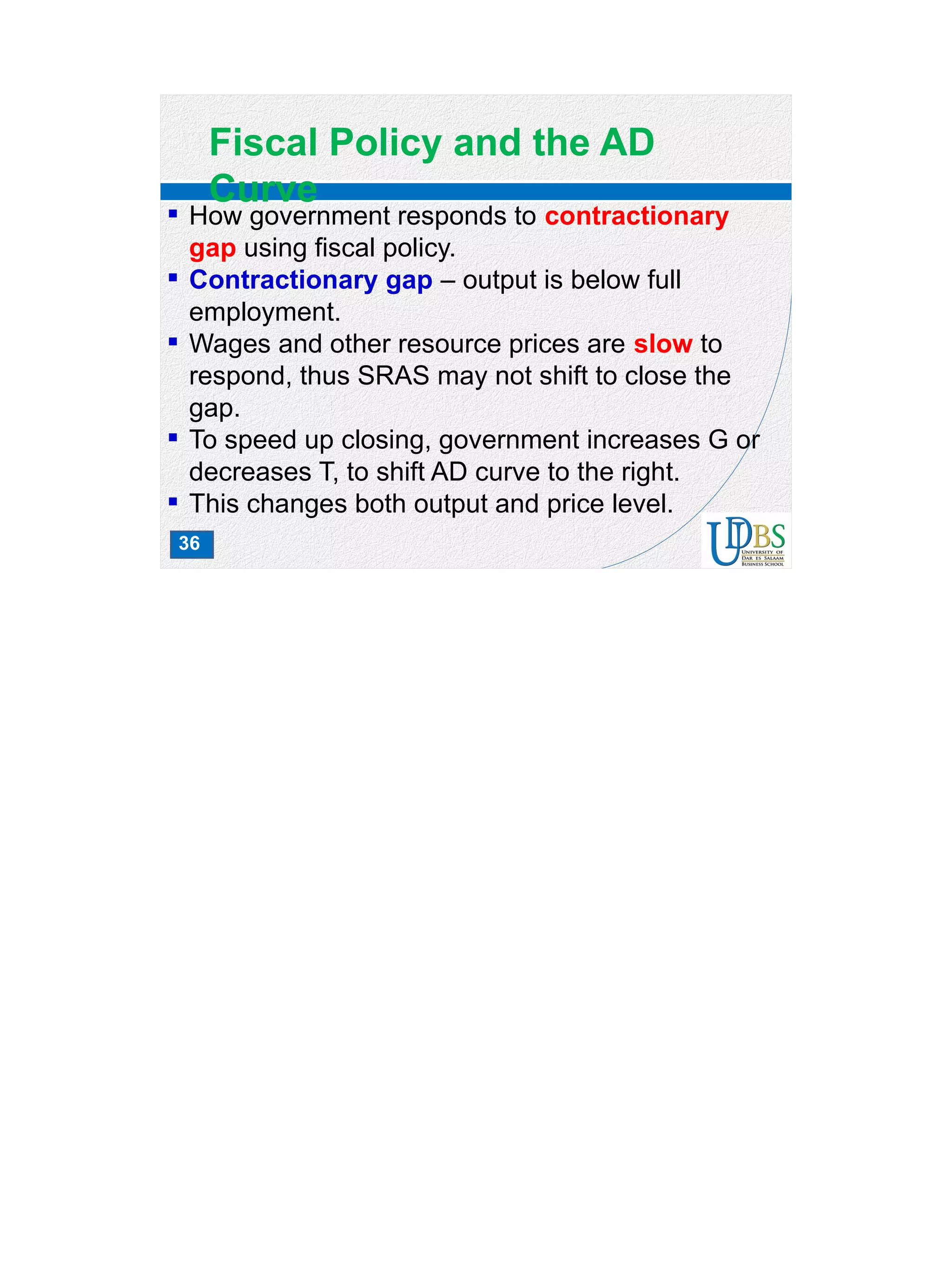
Fiscal Policy and the AD
Curve
 How government responds to contractionary
gap using fiscal policy.
 Contractionary gap – output is below full
employment.
 Wages and other resource prices are slow to
respond, thus SRAS may not shift to close the
gap.
 To speed up closing, government increases G or
decreases T, to shift AD curve to the right.
 This changes both output and price level.
37
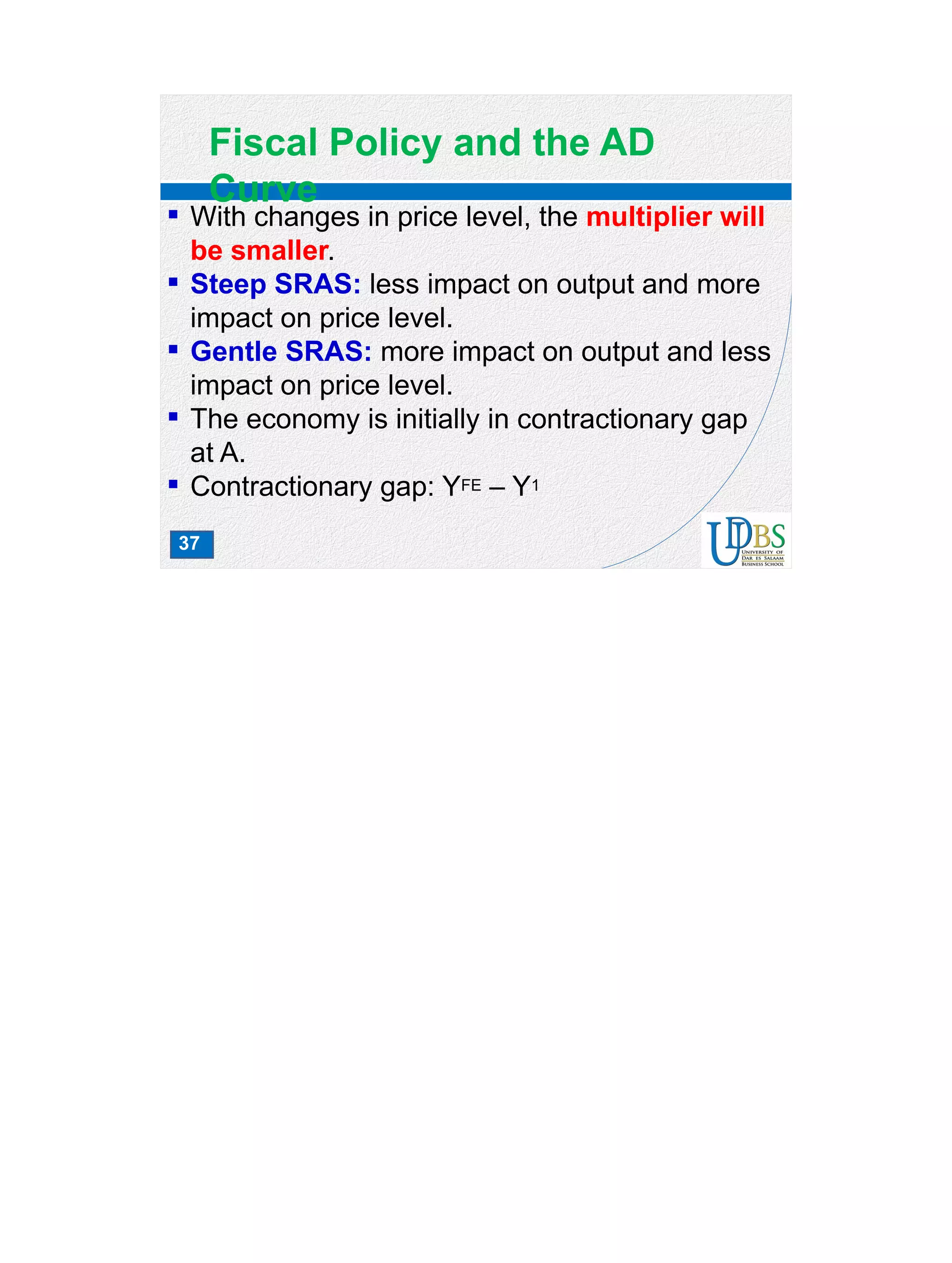
Fiscal Policy and the AD
Curve
 With changes in price level, the multiplier will
be smaller.
 Steep SRAS: less impact on output and more
impact on price level.
 Gentle SRAS: more impact on output and less
impact on price level.
 The economy is initially in contractionary gap
at A.
 Contractionary gap: YFE – Y1
38
Fiscal Policy and the AD
Curve
39
Fiscal Policy and the AD
Curve
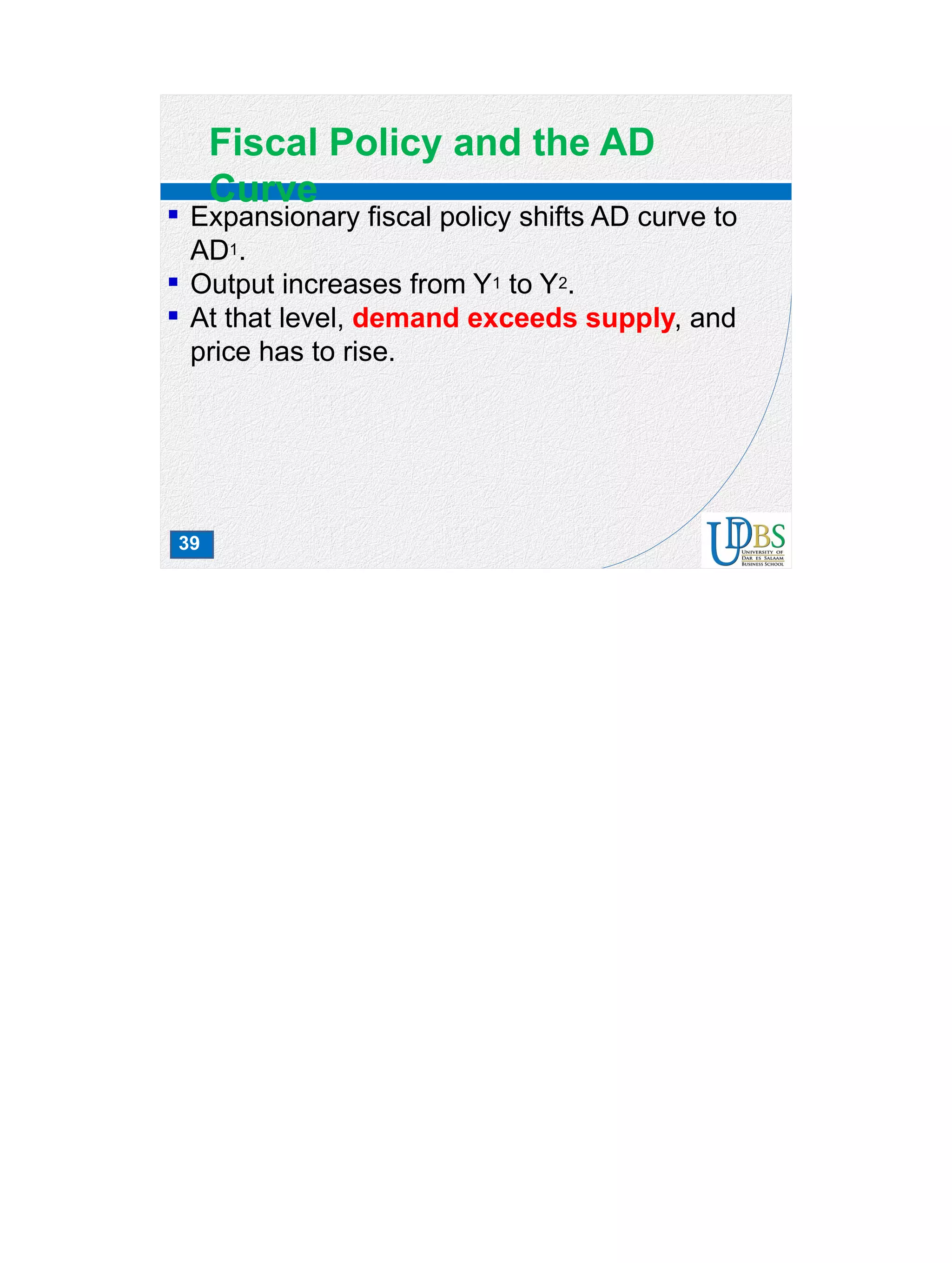
 Expansionary fiscal policy shifts AD curve to
AD1.
 Output increases from Y1 to Y2.
 At that level, demand exceeds supply, and
price has to rise.
40
Fiscal Policy and the AD
Curve
41
Feedback Effects of Fiscal
Policy on Aggregate Supply
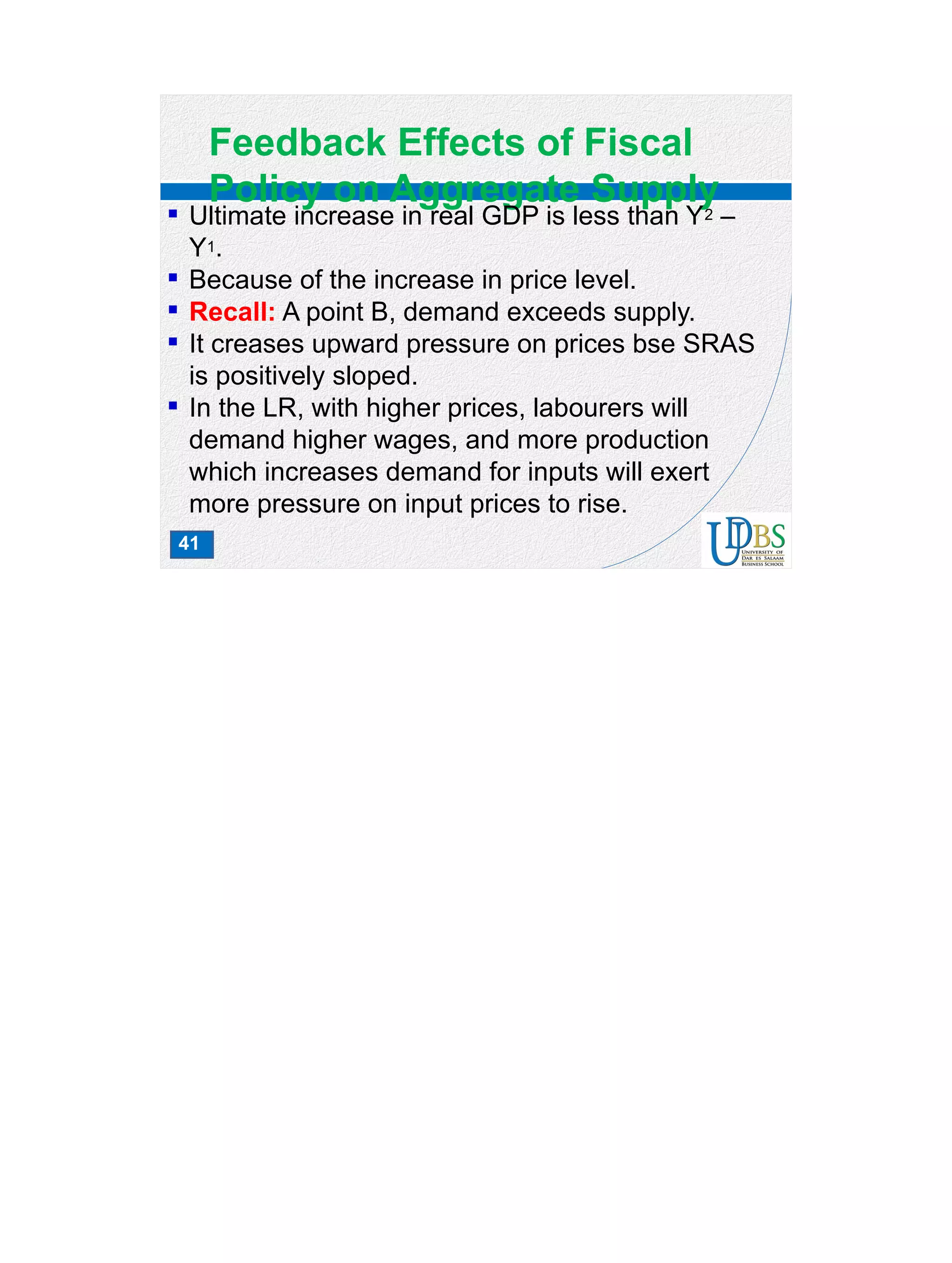
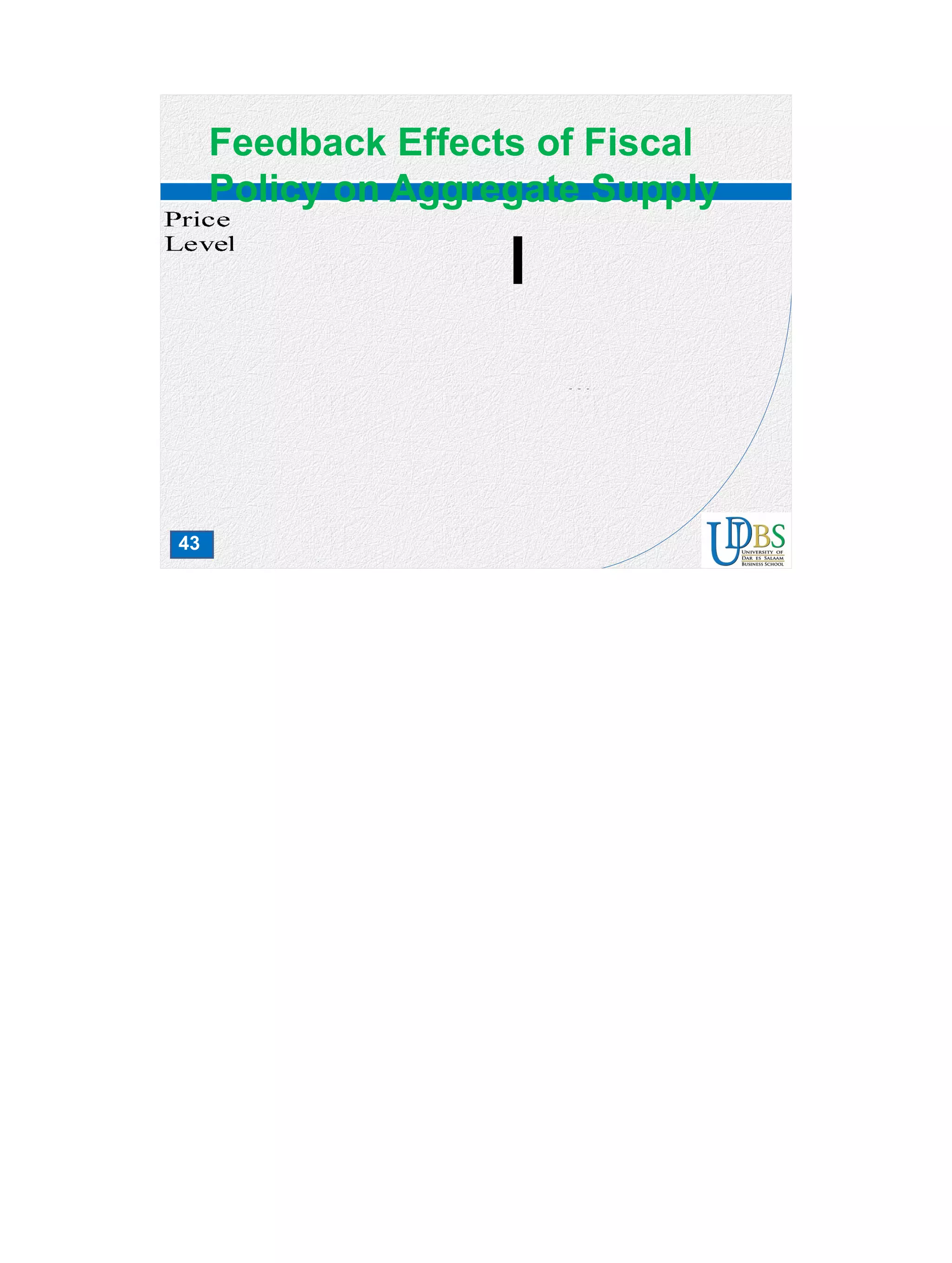
 Ultimate increase in real GDP is less than Y2 –
Y1.
 Because of the increase in price level.
 Recall: A point B, demand exceeds supply.
 It creases upward pressure on prices bse SRAS
is positively sloped.
 In the LR, with higher prices, labourers will
demand higher wages, and more production
which increases demand for inputs will exert
more pressure on input prices to rise.
42
Feedback Effects of Fiscal
Policy on Aggregate Supply
 As a whole, costs of production will increase,
and that will shrink production capabilities, and
supply will shrink back from Y2 to YFE.
 The final result will be at point C, where output
is at full employment YFE, and prices rise to P1.
43
Feedback Effects of Fiscal
Policy on Aggregate Supply
44
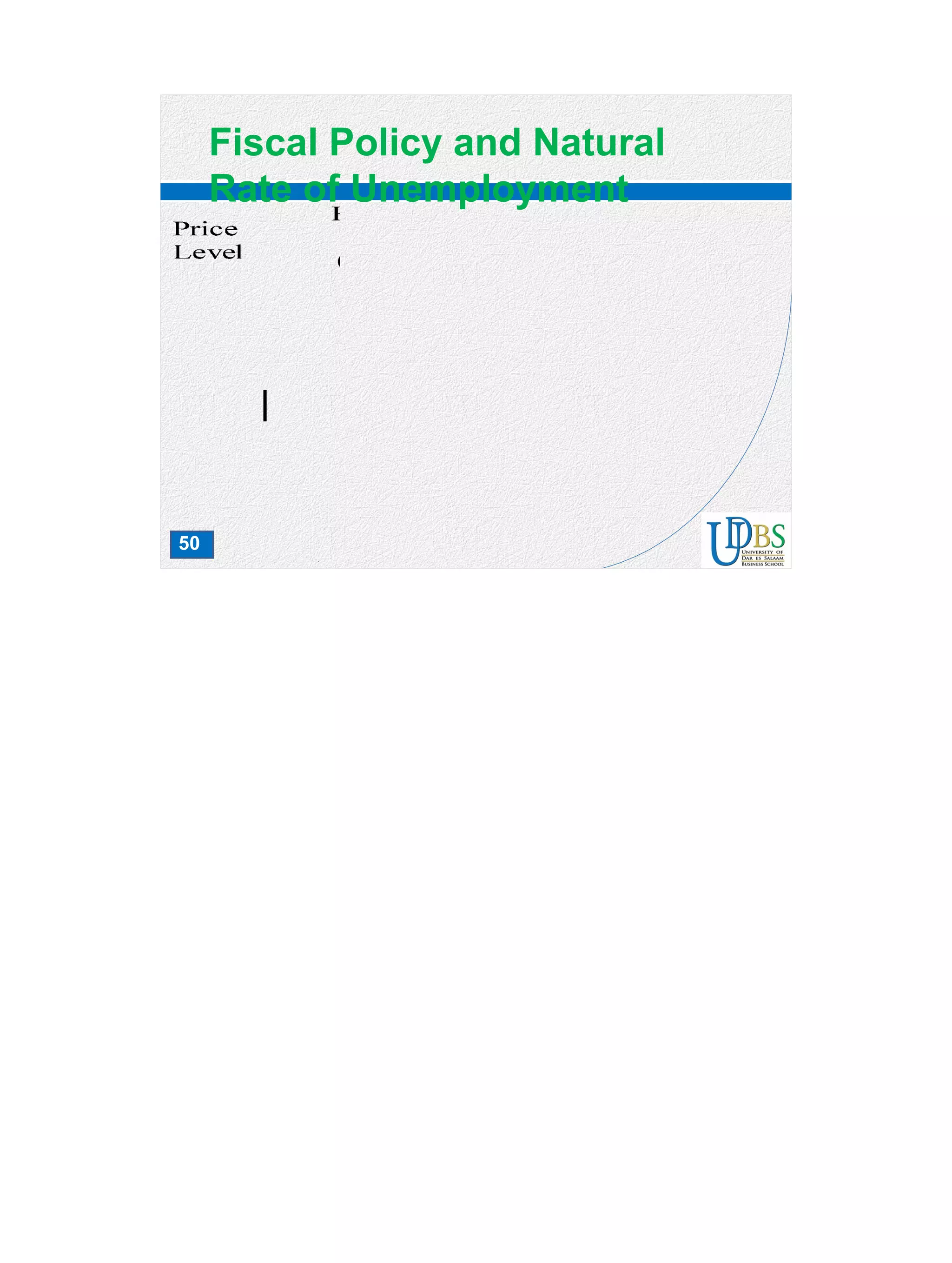
Fiscal Policy and Natural
Rate of Unemployment
 Natural Rate of Unemployment occurs when
economy produces at potential level of output.
 If incorrectly estimated, economy will be pushed to
the level that is unsustainable.
 E.g. if the government thinks it is 4% but in fact
actually is 5%.
 Fiscal policy would be implemented to increase
employment and reduce unemployment to 4%.
 When it reaches 5%, the economy is already at
full employment.
45
Fiscal Policy and Natural
Rate of Unemployment
 Attempt to reduce it to 4% will create an
expansionary gap.
 In LR, nominal wages will rise, SRAS will shift
up and unemployment will return to its natural
rate of 5%.
 We illustrate this below.
 Initially natural rate of employment is at A
where economy produces at full employment
output.
46
Fiscal Policy and Natural
Rate of Unemployment
47
Fiscal Policy and Natural
Rate of Unemployment
 If the government underestimates the natural
rate of employment at 4% instead of 5%.
 i.e. it believes the potential level of output is at
Y1 instead of YFE (LRAS*).
48
Fiscal Policy and Natural
Rate of Unemployment
49
Fiscal Policy and Natural
Rate of Unemployment
 The government thus increases spending to
close the gap.
 AD increases from AD0 to AD1, moving along
the SRAS from point A to B.
 At point B, however, we are actually at
expansionary gap and the price level rises.
50
Fiscal Policy and Natural
Rate of Unemployment
51
Fiscal Policy and Natural
Rate of Unemployment
 In LR, in response, workers negotiate higher
nominal wages, and SRAS shifts up to SRAS1.
 We are back to potential output level at point
C.
 However, the underestimation of natural rate of
unemployment leads to higher inflation in the
LR.
52
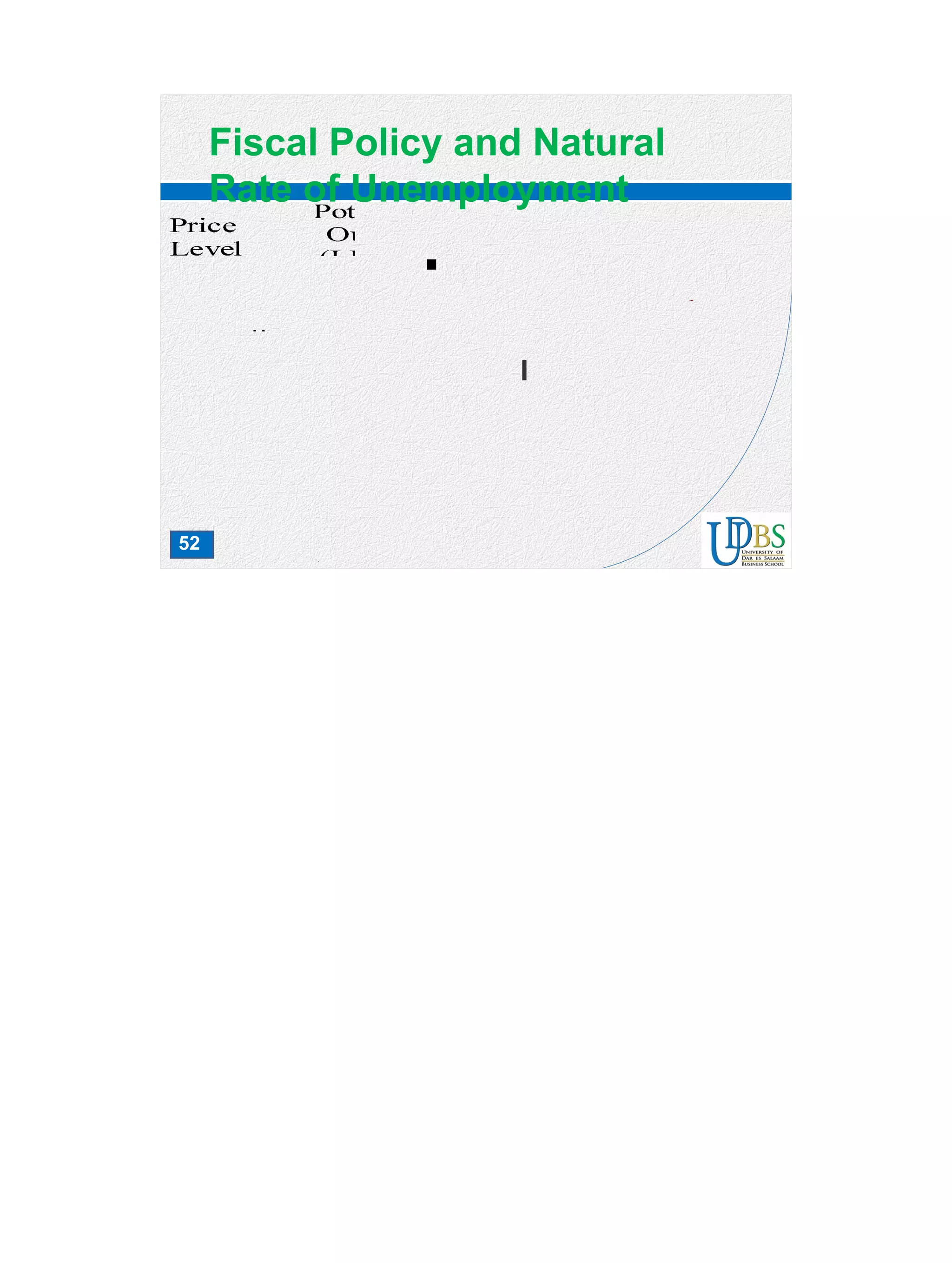
Fiscal Policy and Natural
Rate of Unemployment
53
Taxation and Government
 Government needs money to provide goods and
services, e.g. defence, social services,
infrastructure, security, law enforcement, public
goods, etc.
 It raises money via grants, aids, borrowing, fees
and taxes.
 User Fees: a price paid by users of governments
goods and services, e.g. court fines.
 Taxes: paid by everyone or only the users of a
good/service.
54
Taxation and Government
 Taxation is primary vehicle of government finance.
 Are imposed on transactions, institutions, property,
meals, etc.
 But finally paid by individuals or households.
 Tax Base: measure or value upon which tax is
imposed.
 Includes income, consumption or wealth.
 Tax Rate Structure: percentage of a tax base paid
in taxes, e.g. 30% of income, 18% of selling prices,
etc.
55
Taxation and Government
 Types of Taxes: personal income taxes,
corporate income taxes, excise taxes, customs
taxes, VAT, property taxes, social security
taxes, sales taxes, etc.
 Most taxes are levied on measurable
economic flows, e.g. profits, net income, etc.
56
Principles of Taxation
 1) Efficiency: tax system should not be
distortionary, but used to enhance economic
efficiency.
 2) Administrative Simplicity: low cost of
administration and compliance.
 3) Flexibility: allow easy adaptation to changed
circumstances (automatic stabilizers).
 4) Policy Responsibility: transparent tax
system.
57
Principles of Taxation
 5) Fairness: impose higher taxes on those
who can better bear the burden.
58
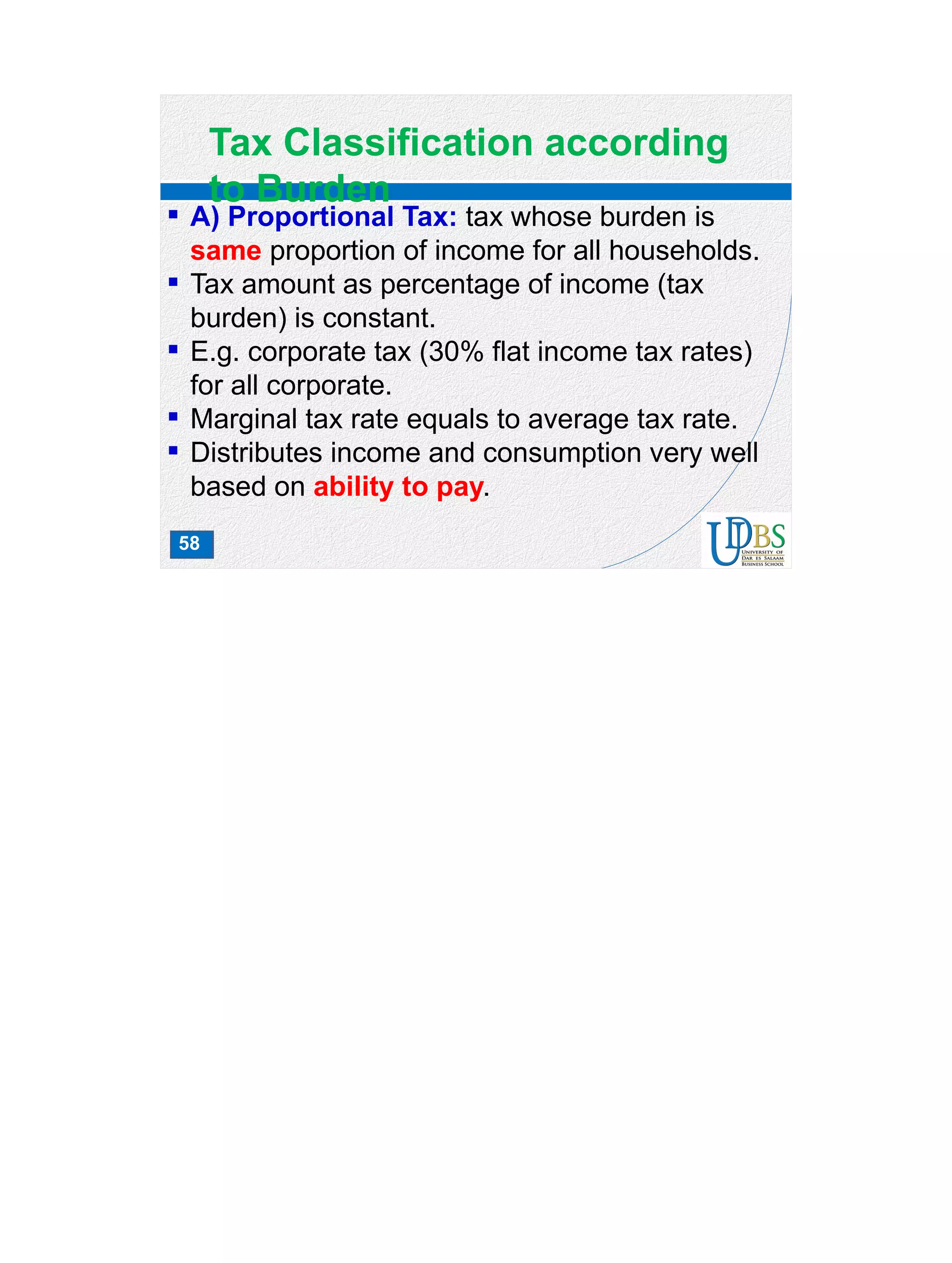
Tax Classification according
to Burden
 A) Proportional Tax: tax whose burden is
same proportion of income for all households.
 Tax amount as percentage of income (tax
burden) is constant.
 E.g. corporate tax (30% flat income tax rates)
for all corporate.
 Marginal tax rate equals to average tax rate.
 Distributes income and consumption very well
based on ability to pay.
59
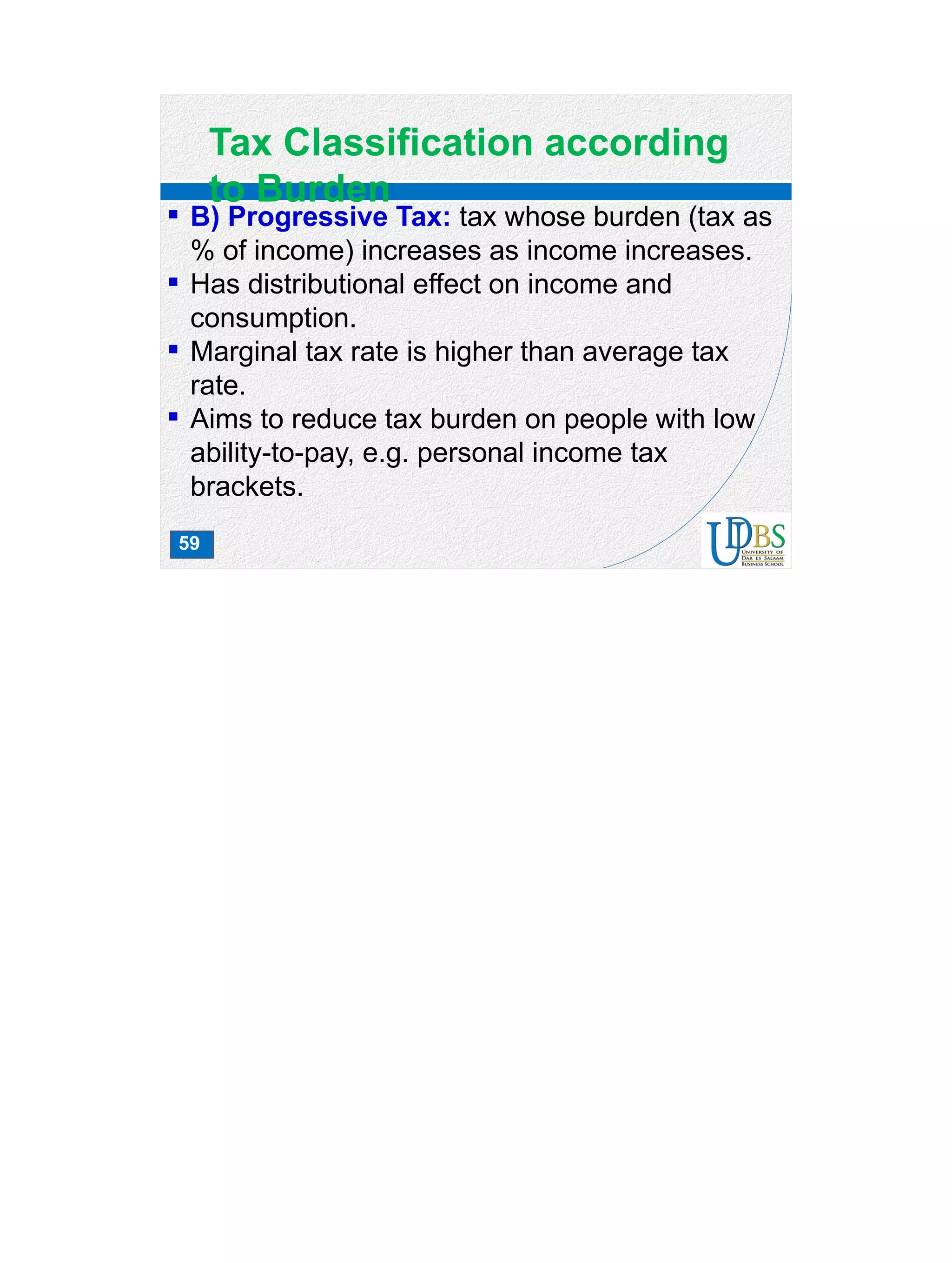
Tax Classification according
to Burden
 B) Progressive Tax: tax whose burden (tax as
% of income) increases as income increases.
 Has distributional effect on income and
consumption.
 Marginal tax rate is higher than average tax
rate.
 Aims to reduce tax burden on people with low
ability-to-pay, e.g. personal income tax
brackets.
60
Tax Classification according
to Burden
 Applied also in form of tax exemptions
(selective taxation) to create progressive
distribution effects, e.g. import duties
exemption on agricultural inputs.
© 2002 Prentice Hall Business Publishing© 2002 Prentice Hall Business Publishing Principles of Economics, 6/ePrinciples of Economics, 6/e Karl Case, Ray FairKarl Case, Ray Fair
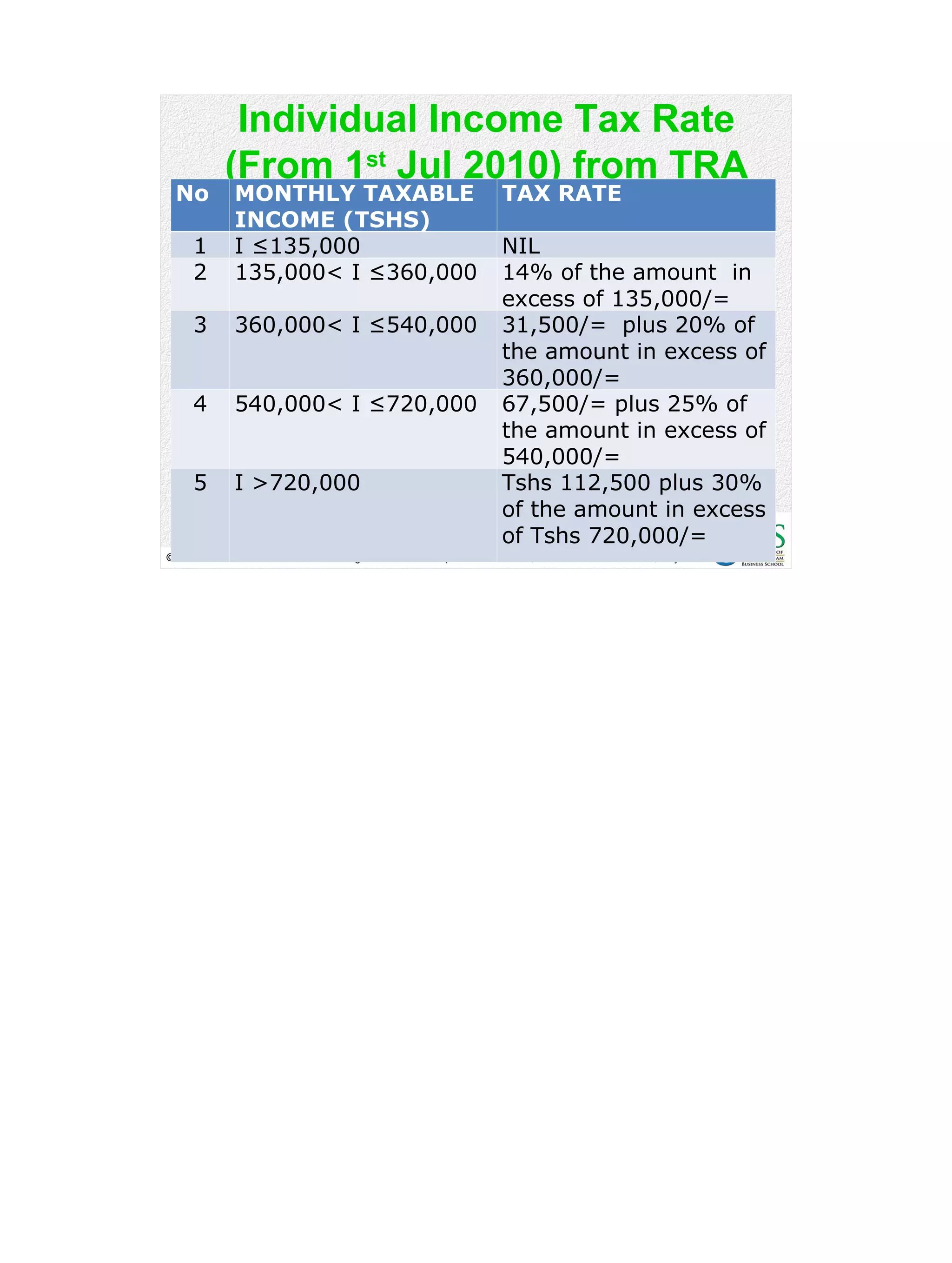
Individual Income Tax Rate
(From 1st
Jul 2010) from TRA
No MONTHLY TAXABLE
INCOME (TSHS)
TAX RATE
1 I ≤135,000 NIL
2 135,000< I ≤360,000 14% of the amount  in
excess of 135,000/=
3 360,000< I ≤540,000 31,500/=  plus 20% of
the amount in excess of
360,000/=
4 540,000< I ≤720,000 67,500/= plus 25% of
the amount in excess of
540,000/=
5 I >720,000 Tshs 112,500 plus 30%
of the amount in excess
of Tshs 720,000/=
© 2002 Prentice Hall Business Publishing© 2002 Prentice Hall Business Publishing Principles of Economics, 6/ePrinciples of Economics, 6/e Karl Case, Ray FairKarl Case, Ray Fair
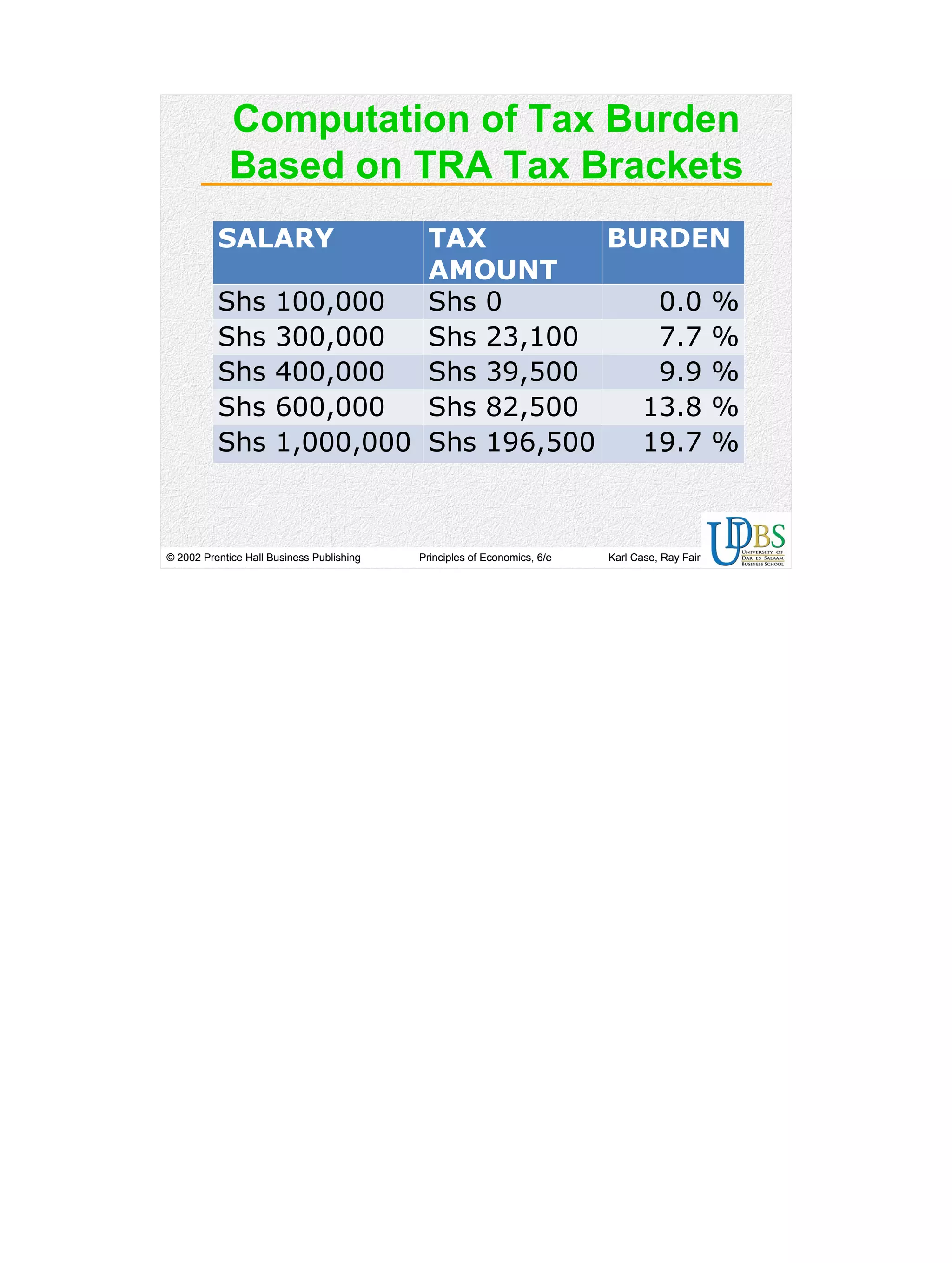
Computation of Tax Burden
Based on TRA Tax Brackets
SALARY TAX
AMOUNT
BURDEN
Shs 100,000 Shs 0 0.0 %
Shs 300,000 Shs 23,100 7.7 %
Shs 400,000 Shs 39,500 9.9 %
Shs 600,000 Shs 82,500 13.8 %
Shs 1,000,000 Shs 196,500 19.7 %
63
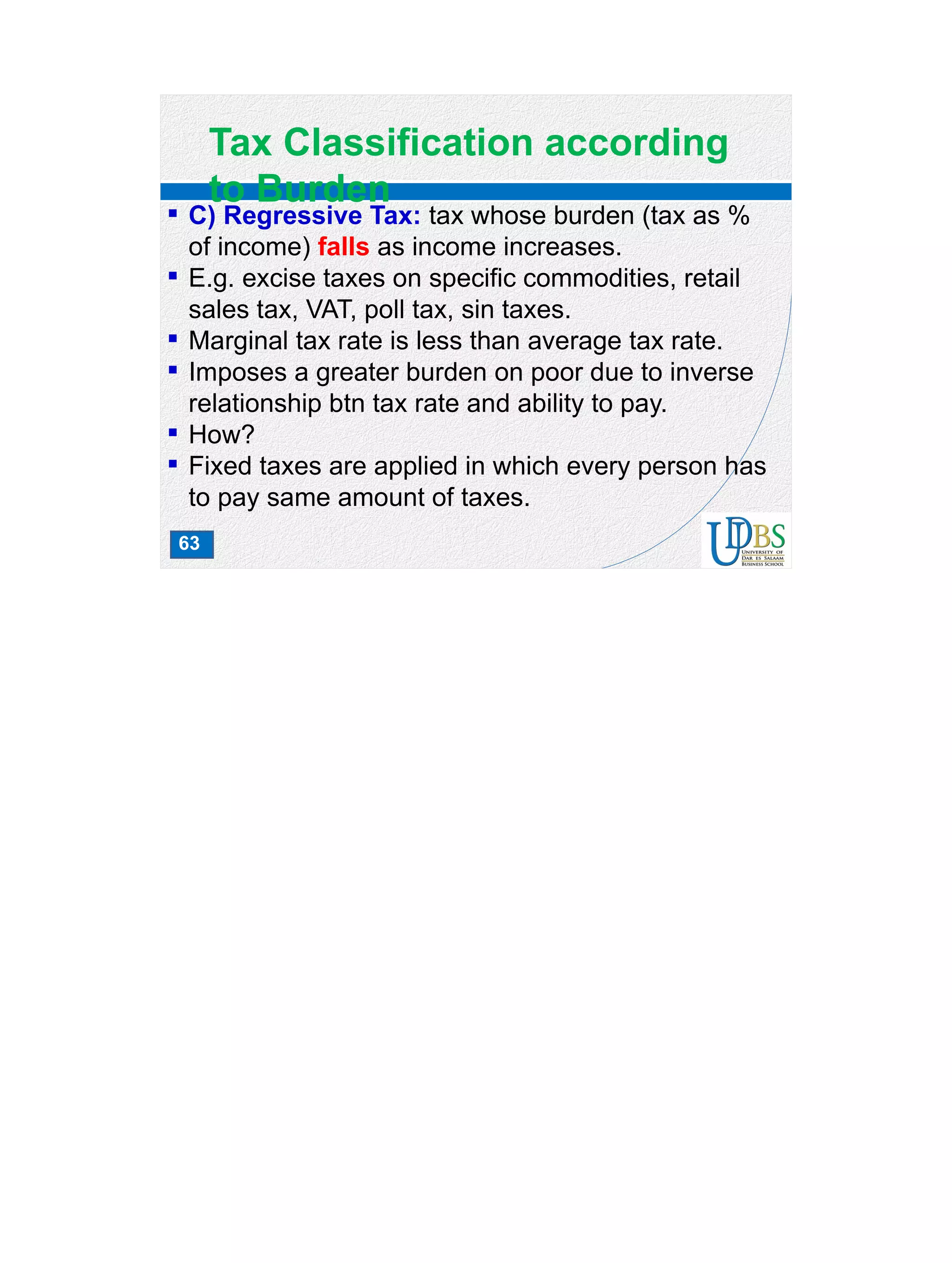
Tax Classification according
to Burden
 C) Regressive Tax: tax whose burden (tax as %
of income) falls as income increases.
 E.g. excise taxes on specific commodities, retail
sales tax, VAT, poll tax, sin taxes.
 Marginal tax rate is less than average tax rate.
 Imposes a greater burden on poor due to inverse
relationship btn tax rate and ability to pay.
 How?
 Fixed taxes are applied in which every person has
to pay same amount of taxes.
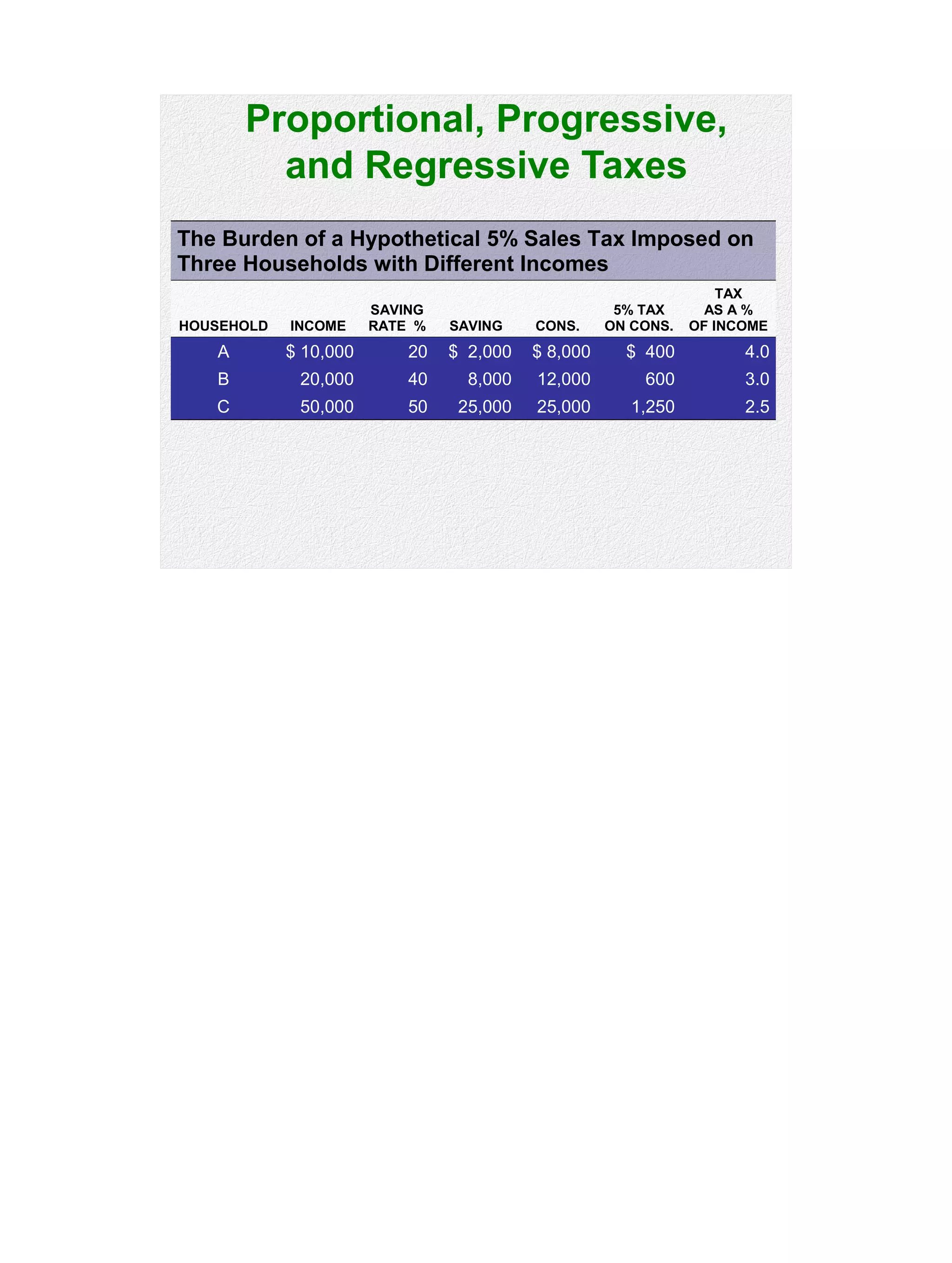
Proportional, Progressive,
and Regressive Taxes
The Burden of a Hypothetical 5% Sales Tax Imposed on
Three Households with Different Incomes
HOUSEHOLD INCOME
SAVING
RATE % SAVING CONS.
5% TAX
ON CONS.
TAX
AS A %
OF INCOME
A $ 10,000 20 $ 2,000 $ 8,000 $ 400 4.0
B 20,000 40 8,000 12,000 600 3.0
C 50,000 50 25,000 25,000 1,250 2.5
65
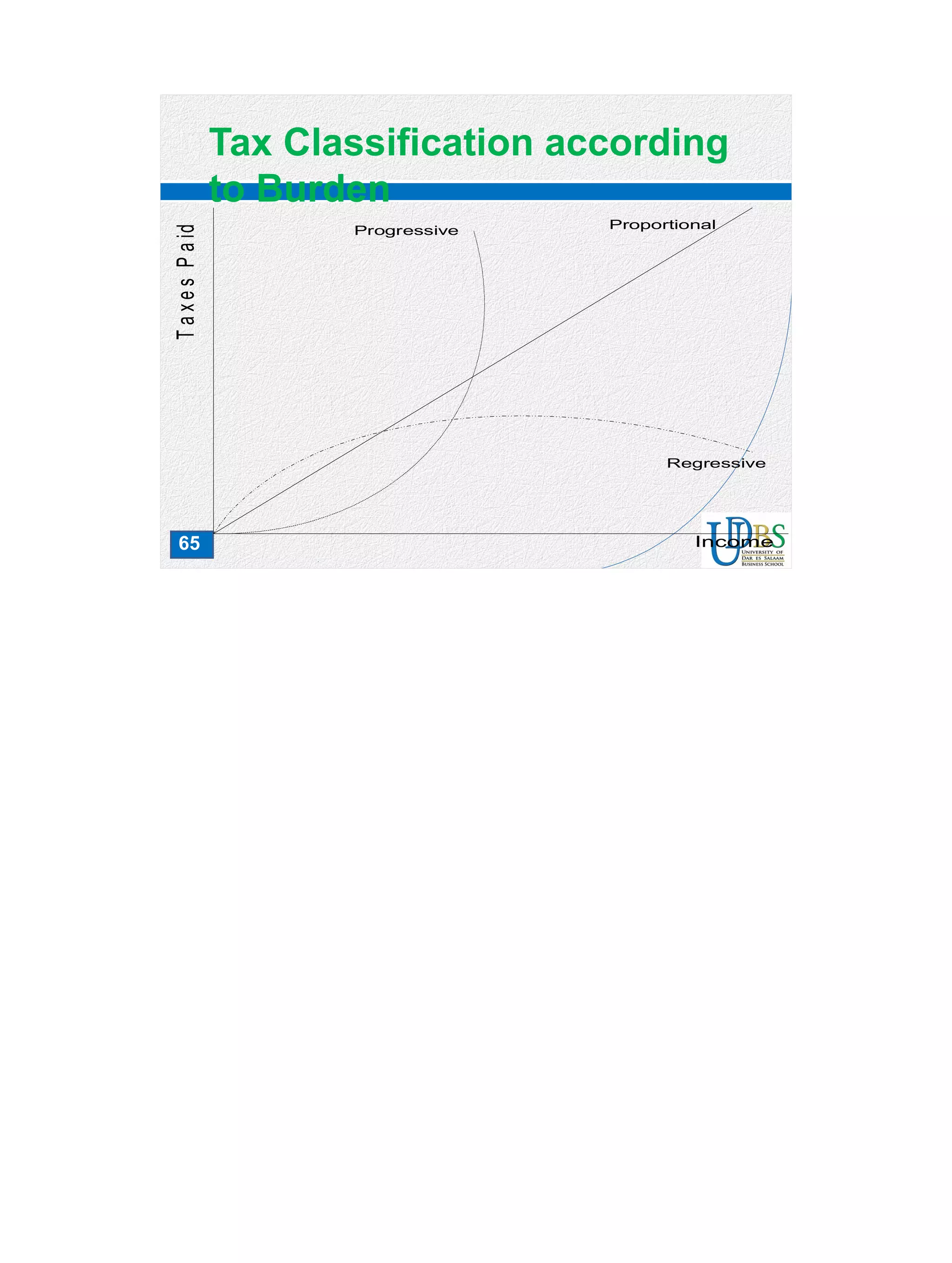
Tax Classification according
to Burden
Proportional
Regressive
Progressive
Income
TaxesPaid

Genuine%20 %2007%20-%20 government%20and%20fiscal%20policy

  • 1.
    DEPARTMENT OF FINANCEDEPARTMENTOF FINANCE University Of Dar Es Salaam BusinessUniversity Of Dar Es Salaam Business SchoolSchool FN 101: Principles of Macroeconomics Lecture 7: Government and Fiscal Policy Genuine Martin B.Com, M.A. (Economics)
  • 2.
    2 Role of Governmentin the Economy  Ideal market system without government intervention is best.  Producer surplus (welfare) is maximized.  Problems with markets: pollution, unemployment, income inequality, unfair competition, etc.  No government keeps its hands off.  Intervenes if voluntary agreements don’t work.  Collects taxes, enforces laws, produce public goods, etc.
  • 3.
    3 Role of Governmentin the Economy  Three main economic functions:  1) Increase efficiency: promote competition, curb externalities, and provide public goods.  2) Promote equity: tax and expenditure programs to redistribute income.  3) Foster macroeconomic growth and stability: reduce unemployment, inflation, encourages growth.
  • 4.
    What is theRole of Government? Providing a stable set of institutions, laws and rules.  Promoting effective and workable competition.  Correcting for externalities.  Creating an environment that fosters economic stability and growth.  Providing public goods.  Adjusting for undesirable market results.
  • 5.
    Government in theEconomy • Nothing arouses as much controversy as the role of government in the economy. • Government can affect the macroeconomy through two policy channels: fiscal policy and monetary policy. • Fiscal policy is the manipulation of government spending and taxation. • Monetary policy refers to the behavior of the Bank of Tanzania regarding the nation’s money supply.
  • 6.
    Adding Net Taxes(T) and Government Purchases (G) to the Circular Flow of Income
  • 7.
    7 Fiscal Policy  Partof demand management.  Use of government spending, taxes, and income transfers to influence macroeconomic outcomes (employment, prices and GDP).  G directly affects AD.  Income transfers and T affect disposable income.  Budget Deficit: G > T  Budget Surplus: T > G  Types of Tools: discretionary fiscal policy & automatic stabilizers.
  • 8.
    8 Fiscal Policy  DiscretionaryFiscal Policy: deliberate changes in G, T and transfers to achieve particular goals.  Automatic Stabilizers: measures inbuilt into fiscal system (progressive tax & unemployment benefits) to smooth fluctuations in disposable income over business cycle.  Boost AD during recession, and dampen it during expansion.
  • 9.
    9 Fiscal Policy  Asa result, real GDP fluctuates less over a business cycle, and disposable income varies proportionally less than does real GDP.
  • 10.
    10 Challenges in Implementing FiscalPolicy  1) Inflexibility of government spending: major portion is wages and salaries (difficult to adjust), social projects are long-run, cuts in expenditure is political process, interest on national debt, unemployment benefits and old age pensions are difficult to adjust.  2) Lengthy budget process – average recessions last less than a year, budget preparations begin about a year before effect, planning discretionary measures is difficult.
  • 11.
    11 Challenges in Implementing FiscalPolicy 3) Political problems – politicians want to maximize votes, and voters like public spending and hate to pay taxes, contractionary fiscal measures are a challenge before election.  4) Information – assembling accurate information quickly and use in short-run AD management is a challenge.  5) Time lags – takes time to assimilate information, appreciate an economic situation, formulate policy, implement it, and taking effect.  Possibility of policy working in a wrong time.
  • 12.
    12 Challenges in Implementing FiscalPolicy  Takes about six months to identify a recession.  Data lags – time needed to gather data on economic variables.  Recognition lag – time needed to analyze trends suggested by economic variables.  Legislative lag – legislative approval is a long process.  Implementation lag – time to put tax and expenditure policy into effect.
  • 13.
    13 Challenges in Implementing FiscalPolicy  Impact lag – time for policy to take effect on the economy after implementation.  6) Crowding Out – government borrowing starves the real sector and forces interest up.  This discourages investment and consumption, and slowing economic activities.
  • 14.
    Crowding Out LimitsFiscal Policy in the Short Run
  • 15.
    In the longrun, the economy returns to potential GDP Crowding Out in the Aggregate Demand and Aggregate Supply Diagram
  • 16.
    16 Budgetary Issues  A.Budget Deficits: G + TP exceed T.  Deficit financing is justified if it increases productivity (highways, waterways, dams), etc.  Increase during recession bse of higher TP and less taxes.  B. Crowding Out and In: Financing deficits by borrowing increases demand for credit, less available for real investments and pushes interest up (Crowding Out).
  • 17.
    17 Budgetary Issues  Ifoperating below capacity, deficit financing could increase AD, boost employment, and increasing business confidence leading to more investments (crowding in).  C. Twin Deficit: budget deficit financing thru borrowing pushes up interest rate, encouraging new capital inflow that causes appreciation.  Makes imports cheaper and exports dearer, leading to current account deficit (twin deficit).  Budget Balance and Government Debt  Budget deficit is a flow variable.
  • 18.
    18 Budgetary Issues  Nationaldebt is a stock variable.  Gross Debt: all outstanding government liabilities.  Net Debt: Gross debt minus government assets.  When the current generation borrows, does it pass the budget to the future generations?  1) We owe to selves (internal borrowing), same future generations will service the debt and same will receive the payments.
  • 19.
    19 Budgetary Issues  2)If borrowed from outside, it increases burden of debt on future generations.  LR effects depend on where the borrowed funds are used.  If on productive investments (infrastructure, education, etc), economy’s productive capability will increase in the LR.  However, if used towards current consumption (retirement benefits, salaries, wages), future generations will pay great price.
  • 20.
    20 Public Debt/GDP Ratioof Some Countries in 2010 (CIA) Country % of GDP Rank Zimbabwe 304.30 1 Japan 192.10 2 Italy 115.20 7 Greece 113.40 8 Sudan 104.50 9 United Kingdom 68.50 22 India 59.60 31 Malawi 58.00 35
  • 21.
    21 Public Debt/GDP Ratioof Some Countries in 2010 (CIA) Country % of GDP Rank Kenya 54.10 40 United States 52.90 42 South Africa 35.70 72 Zambia 31.50 84 Mozambique 26.10 93 Tanzania 24.8 95
  • 22.
    22 Public Debt/GDP Ratioof Some Countries in 2010 (CIA) Country % of GDP Ran k Uganda 19.30 105 China 18.20 107 Botswana 17.90 109 Angola 16.80 111 Libya 6.50 125
  • 23.
    Public Debt StockRanking of Some Countries in 2010 (IMF) Country Debt Stock in million $ Rank Country Debt Stock in million $ Rank Russia 162,924 1 Botswana 1,352 89 China 90,180 7 Zambia 1,309 91 South Africa 17,753 21 Rwanda 766 103 Kenya 6,978 38 Malawi 715 105 Tanzania 5,572 46 Burundi 412 112 Zimbabwe 3,686 59 Liberia 184 123 Mozambique 2,960 65 Rwanda 766 103 Uganda 2,671 70
  • 24.
    24 Fiscal Policy andIS Curve  Factors other than interest rates that change AE cause a shift of IS curve  Include: C0, G, foreign demand, willingness to save, expected future profitability.  Case of expansionary fiscal policy (Keynesian Cross).  Government increases spending from G0 to G1  At r0, aggregate spending increases from E0 to E1.  As a result, output required to maintain equilibrium in goods market is higher as well.
  • 25.
    25 Fiscal Policy andIS Curve  Increases from Y0 to Y1.
  • 26.
    26 Fiscal Policy andIS Curve  IS curve shifts rightward (Y0 to Y1, at r0).
  • 27.
    27 Fiscal Policy andIS Curve  As Y increases, demand for money increases as well.  With fixed nominal money supply, interest rate increases causing a movement along same LM curve.
  • 28.
  • 29.
  • 30.
    30 Fiscal Policy andIS Curve  Increase in interest rate causes investment expenditure to decrease.  Planned expenditure starts to decline.  Causing income to decline to Y2
  • 31.
    DEPARTMENT OF FINANCEDEPARTMENTOF FINANCE University Of Dar Es Salaam BusinessUniversity Of Dar Es Salaam Business SchoolSchool FN 101: Principles of Macroeconomics Lecture 7: Government and Fiscal Policy Genuine Martin B.Com, M.A. (Economics)
  • 32.
    2 Role of Governmentin the Economy  Ideal market system without government intervention is best.  Producer surplus (welfare) is maximized.  Problems with markets: pollution, unemployment, income inequality, unfair competition, etc.  No government keeps its hands off.  Intervenes if voluntary agreements don’t work.  Collects taxes, enforces laws, produce public goods, etc.
  • 33.
    3 Role of Governmentin the Economy  Three main economic functions:  1) Increase efficiency: promote competition, curb externalities, and provide public goods.  2) Promote equity: tax and expenditure programs to redistribute income.  3) Foster macroeconomic growth and stability: reduce unemployment, inflation, encourages growth.
  • 34.
    What is theRole of Government? Providing a stable set of institutions, laws and rules.  Promoting effective and workable competition.  Correcting for externalities.  Creating an environment that fosters economic stability and growth.  Providing public goods.  Adjusting for undesirable market results.
  • 35.
    Government in theEconomy • Nothing arouses as much controversy as the role of government in the economy. • Government can affect the macroeconomy through two policy channels: fiscal policy and monetary policy. • Fiscal policy is the manipulation of government spending and taxation. • Monetary policy refers to the behavior of the Bank of Tanzania regarding the nation’s money supply.
  • 36.
    Adding Net Taxes(T) and Government Purchases (G) to the Circular Flow of Income
  • 37.
    7 Fiscal Policy  Partof demand management.  Use of government spending, taxes, and income transfers to influence macroeconomic outcomes (employment, prices and GDP).  G directly affects AD.  Income transfers and T affect disposable income.  Budget Deficit: G > T  Budget Surplus: T > G  Types of Tools: discretionary fiscal policy & automatic stabilizers.
  • 38.
    8 Fiscal Policy  DiscretionaryFiscal Policy: deliberate changes in G, T and transfers to achieve particular goals.  Automatic Stabilizers: measures inbuilt into fiscal system (progressive tax & unemployment benefits) to smooth fluctuations in disposable income over business cycle.  Boost AD during recession, and dampen it during expansion.
  • 39.
    9 Fiscal Policy  Asa result, real GDP fluctuates less over a business cycle, and disposable income varies proportionally less than does real GDP.
  • 40.
    10 Challenges in Implementing FiscalPolicy  1) Inflexibility of government spending: major portion is wages and salaries (difficult to adjust), social projects are long-run, cuts in expenditure is political process, interest on national debt, unemployment benefits and old age pensions are difficult to adjust.  2) Lengthy budget process – average recessions last less than a year, budget preparations begin about a year before effect, planning discretionary measures is difficult.
  • 41.
    11 Challenges in Implementing FiscalPolicy 3) Political problems – politicians want to maximize votes, and voters like public spending and hate to pay taxes, contractionary fiscal measures are a challenge before election.  4) Information – assembling accurate information quickly and use in short-run AD management is a challenge.  5) Time lags – takes time to assimilate information, appreciate an economic situation, formulate policy, implement it, and taking effect.  Possibility of policy working in a wrong time.
  • 42.
    12 Challenges in Implementing FiscalPolicy  Takes about six months to identify a recession.  Data lags – time needed to gather data on economic variables.  Recognition lag – time needed to analyze trends suggested by economic variables.  Legislative lag – legislative approval is a long process.  Implementation lag – time to put tax and expenditure policy into effect.
  • 43.
    13 Challenges in Implementing FiscalPolicy  Impact lag – time for policy to take effect on the economy after implementation.  6) Crowding Out – government borrowing starves the real sector and forces interest up.  This discourages investment and consumption, and slowing economic activities.
  • 44.
    14 Crowding Out LimitsFiscal Policy in the Short Run
  • 45.
    15 In the longrun, the economy returns to potential GDP Crowding Out in the Aggregate Demand and Aggregate Supply Diagram
  • 46.
    16 Budgetary Issues  A.Budget Deficits: G + TP exceed T.  Deficit financing is justified if it increases productivity (highways, waterways, dams), etc.  Increase during recession bse of higher TP and less taxes.  B. Crowding Out and In: Financing deficits by borrowing increases demand for credit, less available for real investments and pushes interest up (Crowding Out).
  • 47.
    17 Budgetary Issues  Ifoperating below capacity, deficit financing could increase AD, boost employment, and increasing business confidence leading to more investments (crowding in).  C. Twin Deficit: budget deficit financing thru borrowing pushes up interest rate, encouraging new capital inflow that causes appreciation.  Makes imports cheaper and exports dearer, leading to current account deficit (twin deficit).  Budget Balance and Government Debt  Budget deficit is a flow variable.
  • 48.
    18 Budgetary Issues  Nationaldebt is a stock variable.  Gross Debt: all outstanding government liabilities.  Net Debt: Gross debt minus government assets.  When the current generation borrows, does it pass the budget to the future generations?  1) We owe to selves (internal borrowing), same future generations will service the debt and same will receive the payments.
  • 49.
    19 Budgetary Issues  2)If borrowed from outside, it increases burden of debt on future generations.  LR effects depend on where the borrowed funds are used.  If on productive investments (infrastructure, education, etc), economy’s productive capability will increase in the LR.  However, if used towards current consumption (retirement benefits, salaries, wages), future generations will pay great price.
  • 50.
    20 Public Debt/GDP Ratioof Some Countries in 2010 (CIA) Country % of GDP Rank Zimbabwe 304.30 1 Japan 192.10 2 Italy 115.20 7 Greece 113.40 8 Sudan 104.50 9 United Kingdom 68.50 22 India 59.60 31 Malawi 58.00 35
  • 51.
    21 Public Debt/GDP Ratioof Some Countries in 2010 (CIA) Country % of GDP Rank Kenya 54.10 40 United States 52.90 42 South Africa 35.70 72 Zambia 31.50 84 Mozambique 26.10 93 Tanzania 24.8 95
  • 52.
    22 Public Debt/GDP Ratioof Some Countries in 2010 (CIA) Country % of GDP Ran k Uganda 19.30 105 China 18.20 107 Botswana 17.90 109 Angola 16.80 111 Libya 6.50 125
  • 53.
    Public Debt StockRanking of Some Countries in 2010 (IMF) Country Debt Stock in million $ Rank Country Debt Stock in million $ Rank Russia 162,924 1 Botswana 1,352 89 China 90,180 7 Zambia 1,309 91 South Africa 17,753 21 Rwanda 766 103 Kenya 6,978 38 Malawi 715 105 Tanzania 5,572 46 Burundi 412 112 Zimbabwe 3,686 59 Liberia 184 123 Mozambique 2,960 65 Rwanda 766 103 Uganda 2,671 70
  • 54.
    24 Fiscal Policy andIS Curve  Factors other than interest rates that change AE cause a shift of IS curve  Include: C0, G, foreign demand, willingness to save, expected future profitability.  Case of expansionary fiscal policy (Keynesian Cross).  Government increases spending from G0 to G1  At r0, aggregate spending increases from E0 to E1.  As a result, output required to maintain equilibrium in goods market is higher as well.
  • 55.
    25 Fiscal Policy andIS Curve  Increases from Y0 to Y1.
  • 56.
    26 Fiscal Policy andIS Curve  IS curve shifts rightward (Y0 to Y1, at r0).
  • 57.
    27 Fiscal Policy andIS Curve  As Y increases, demand for money increases as well.  With fixed nominal money supply, interest rate increases causing a movement along same LM curve.
  • 58.
  • 59.
  • 60.
    30 Fiscal Policy andIS Curve  Increase in interest rate causes investment expenditure to decrease.  Planned expenditure starts to decline.  Causing income to decline to Y2
  • 61.
  • 62.
    32 Fiscal Policy andIS Curve  Adjustment continues until new equilibrium is established at (Y2, r1).
  • 63.
  • 64.
    34 slid e 34 causing output &income to rise. IS1 An Increase in Government Purchases 1.1. ISIS curve shifts rightcurve shifts right Y r LM r1 Y1 1 by 1 MPC GD - IS2 Y2 r2 1. 2. This raises money demand, causing the interest rate to rise… 2. 3. …which reduces investment, so the final increase in Y 1 is smaller than 1 MPC GD - 3. Chapter 10 showed that an increase in G causes the IS curve to shift to the right by (G)/(1-MPC). Get partial crowding out of investment. Was complete under neoclassical model; here only partial, since Y rises to allow G+I to be bigger. (not a zero sum game anymore)
  • 65.
    35 slid e 35 IS1 1. A Tax Cut Y r LM r1 Y1 IS2 Y2 r2 Becauseconsumers save (1MPC) of the tax cut, the initial boost in spending is smaller for T than for an equal G… and the IS curve shifts by MPC 1 MPC T - D - 1. 2. 2.…so the effects on r and Y are smaller for a T than for an equal G. 2. Chapter 10 used the Keynesian Cross to show that a decrease in T causes the IS curve to shift to the right by (-MPCT)/(1-MPC). If your students ask why the IS curve shifts to the right when there’s a negative sign in the expression for the shift, remind them that T < 0 for a tax cut, so the expression actually is positive.
  • 66.
    36 Fiscal Policy andthe AD Curve  How government responds to contractionary gap using fiscal policy.  Contractionary gap – output is below full employment.  Wages and other resource prices are slow to respond, thus SRAS may not shift to close the gap.  To speed up closing, government increases G or decreases T, to shift AD curve to the right.  This changes both output and price level.
  • 67.
    37 Fiscal Policy andthe AD Curve  With changes in price level, the multiplier will be smaller.  Steep SRAS: less impact on output and more impact on price level.  Gentle SRAS: more impact on output and less impact on price level.  The economy is initially in contractionary gap at A.  Contractionary gap: YFE – Y1
  • 68.
  • 69.
    39 Fiscal Policy andthe AD Curve  Expansionary fiscal policy shifts AD curve to AD1.  Output increases from Y1 to Y2.  At that level, demand exceeds supply, and price has to rise.
  • 70.
  • 71.
    41 Feedback Effects ofFiscal Policy on Aggregate Supply  Ultimate increase in real GDP is less than Y2 – Y1.  Because of the increase in price level.  Recall: A point B, demand exceeds supply.  It creases upward pressure on prices bse SRAS is positively sloped.  In the LR, with higher prices, labourers will demand higher wages, and more production which increases demand for inputs will exert more pressure on input prices to rise.
  • 72.
    42 Feedback Effects ofFiscal Policy on Aggregate Supply  As a whole, costs of production will increase, and that will shrink production capabilities, and supply will shrink back from Y2 to YFE.  The final result will be at point C, where output is at full employment YFE, and prices rise to P1.
  • 73.
    43 Feedback Effects ofFiscal Policy on Aggregate Supply
  • 74.
    44 Fiscal Policy andNatural Rate of Unemployment  Natural Rate of Unemployment occurs when economy produces at potential level of output.  If incorrectly estimated, economy will be pushed to the level that is unsustainable.  E.g. if the government thinks it is 4% but in fact actually is 5%.  Fiscal policy would be implemented to increase employment and reduce unemployment to 4%.  When it reaches 5%, the economy is already at full employment.
  • 75.
    45 Fiscal Policy andNatural Rate of Unemployment  Attempt to reduce it to 4% will create an expansionary gap.  In LR, nominal wages will rise, SRAS will shift up and unemployment will return to its natural rate of 5%.  We illustrate this below.  Initially natural rate of employment is at A where economy produces at full employment output.
  • 76.
    46 Fiscal Policy andNatural Rate of Unemployment
  • 77.
    47 Fiscal Policy andNatural Rate of Unemployment  If the government underestimates the natural rate of employment at 4% instead of 5%.  i.e. it believes the potential level of output is at Y1 instead of YFE (LRAS*).
  • 78.
    48 Fiscal Policy andNatural Rate of Unemployment
  • 79.
    49 Fiscal Policy andNatural Rate of Unemployment  The government thus increases spending to close the gap.  AD increases from AD0 to AD1, moving along the SRAS from point A to B.  At point B, however, we are actually at expansionary gap and the price level rises.
  • 80.
    50 Fiscal Policy andNatural Rate of Unemployment
  • 81.
    51 Fiscal Policy andNatural Rate of Unemployment  In LR, in response, workers negotiate higher nominal wages, and SRAS shifts up to SRAS1.  We are back to potential output level at point C.  However, the underestimation of natural rate of unemployment leads to higher inflation in the LR.
  • 82.
    52 Fiscal Policy andNatural Rate of Unemployment
  • 83.
    53 Taxation and Government Government needs money to provide goods and services, e.g. defence, social services, infrastructure, security, law enforcement, public goods, etc.  It raises money via grants, aids, borrowing, fees and taxes.  User Fees: a price paid by users of governments goods and services, e.g. court fines.  Taxes: paid by everyone or only the users of a good/service.
  • 84.
    54 Taxation and Government Taxation is primary vehicle of government finance.  Are imposed on transactions, institutions, property, meals, etc.  But finally paid by individuals or households.  Tax Base: measure or value upon which tax is imposed.  Includes income, consumption or wealth.  Tax Rate Structure: percentage of a tax base paid in taxes, e.g. 30% of income, 18% of selling prices, etc.
  • 85.
    55 Taxation and Government Types of Taxes: personal income taxes, corporate income taxes, excise taxes, customs taxes, VAT, property taxes, social security taxes, sales taxes, etc.  Most taxes are levied on measurable economic flows, e.g. profits, net income, etc.
  • 86.
    56 Principles of Taxation 1) Efficiency: tax system should not be distortionary, but used to enhance economic efficiency.  2) Administrative Simplicity: low cost of administration and compliance.  3) Flexibility: allow easy adaptation to changed circumstances (automatic stabilizers).  4) Policy Responsibility: transparent tax system.
  • 87.
    57 Principles of Taxation 5) Fairness: impose higher taxes on those who can better bear the burden.
  • 88.
    58 Tax Classification according toBurden  A) Proportional Tax: tax whose burden is same proportion of income for all households.  Tax amount as percentage of income (tax burden) is constant.  E.g. corporate tax (30% flat income tax rates) for all corporate.  Marginal tax rate equals to average tax rate.  Distributes income and consumption very well based on ability to pay.
  • 89.
    59 Tax Classification according toBurden  B) Progressive Tax: tax whose burden (tax as % of income) increases as income increases.  Has distributional effect on income and consumption.  Marginal tax rate is higher than average tax rate.  Aims to reduce tax burden on people with low ability-to-pay, e.g. personal income tax brackets.
  • 90.
    60 Tax Classification according toBurden  Applied also in form of tax exemptions (selective taxation) to create progressive distribution effects, e.g. import duties exemption on agricultural inputs.
  • 91.
    © 2002 PrenticeHall Business Publishing© 2002 Prentice Hall Business Publishing Principles of Economics, 6/ePrinciples of Economics, 6/e Karl Case, Ray FairKarl Case, Ray Fair Individual Income Tax Rate (From 1st Jul 2010) from TRA No MONTHLY TAXABLE INCOME (TSHS) TAX RATE 1 I ≤135,000 NIL 2 135,000< I ≤360,000 14% of the amount  in excess of 135,000/= 3 360,000< I ≤540,000 31,500/=  plus 20% of the amount in excess of 360,000/= 4 540,000< I ≤720,000 67,500/= plus 25% of the amount in excess of 540,000/= 5 I >720,000 Tshs 112,500 plus 30% of the amount in excess of Tshs 720,000/=
  • 92.
    © 2002 PrenticeHall Business Publishing© 2002 Prentice Hall Business Publishing Principles of Economics, 6/ePrinciples of Economics, 6/e Karl Case, Ray FairKarl Case, Ray Fair Computation of Tax Burden Based on TRA Tax Brackets SALARY TAX AMOUNT BURDEN Shs 100,000 Shs 0 0.0 % Shs 300,000 Shs 23,100 7.7 % Shs 400,000 Shs 39,500 9.9 % Shs 600,000 Shs 82,500 13.8 % Shs 1,000,000 Shs 196,500 19.7 %
  • 93.
    63 Tax Classification according toBurden  C) Regressive Tax: tax whose burden (tax as % of income) falls as income increases.  E.g. excise taxes on specific commodities, retail sales tax, VAT, poll tax, sin taxes.  Marginal tax rate is less than average tax rate.  Imposes a greater burden on poor due to inverse relationship btn tax rate and ability to pay.  How?  Fixed taxes are applied in which every person has to pay same amount of taxes.
  • 94.
    Proportional, Progressive, and RegressiveTaxes The Burden of a Hypothetical 5% Sales Tax Imposed on Three Households with Different Incomes HOUSEHOLD INCOME SAVING RATE % SAVING CONS. 5% TAX ON CONS. TAX AS A % OF INCOME A $ 10,000 20 $ 2,000 $ 8,000 $ 400 4.0 B 20,000 40 8,000 12,000 600 3.0 C 50,000 50 25,000 25,000 1,250 2.5
  • 95.
    65 Tax Classification according toBurden Proportional Regressive Progressive Income TaxesPaid