Biology 30 – Unit 3 ~Mrs. S. Pipke-Painchaud Genetics Overview
What is  Genetics? - a branch of biology that deals with the heredity of an organism It is a field in which every year large numbers of significant findings are made.  Over the past 5 decades, no five year period has passed without the establishment of 1 or more major research frontiers in genetics.
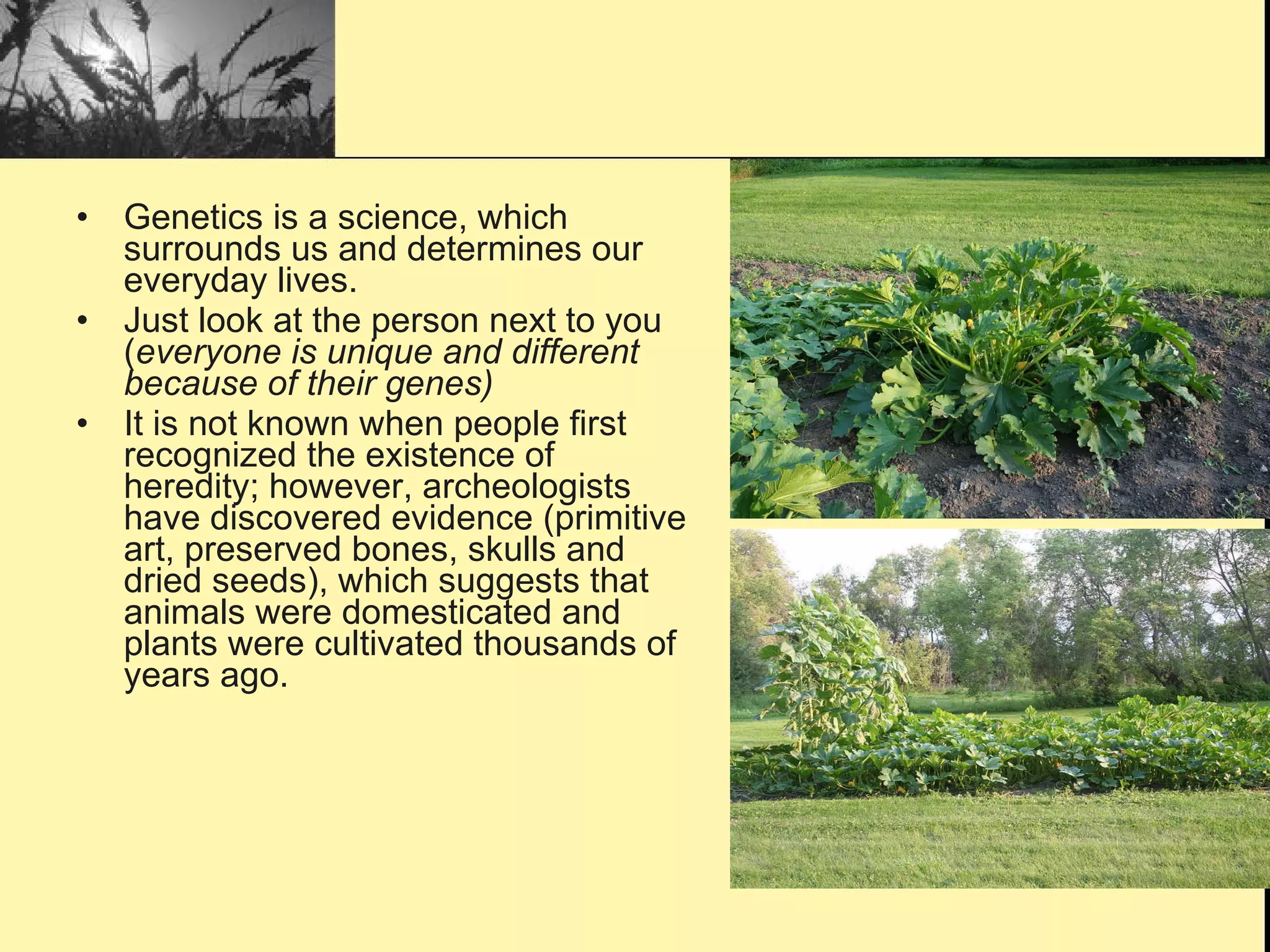
Genetics is a science, which surrounds us and determines our everyday lives. Just look at the person next to you ( everyone is unique and different because of their genes) It is not known when people first recognized the existence of heredity; however, archeologists have discovered evidence (primitive art, preserved bones, skulls and dried seeds), which suggests that animals were domesticated and plants were cultivated thousands of years ago.
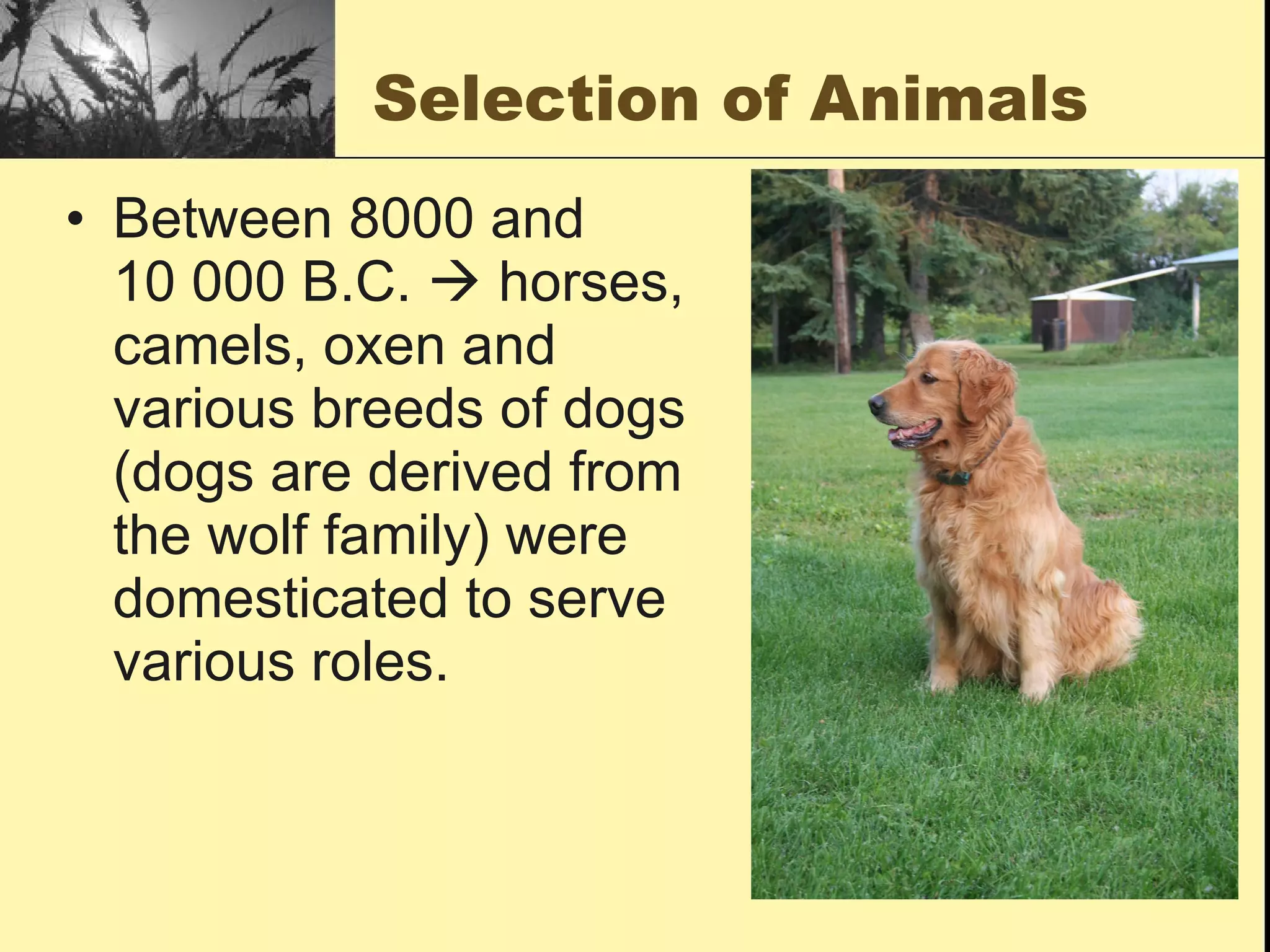
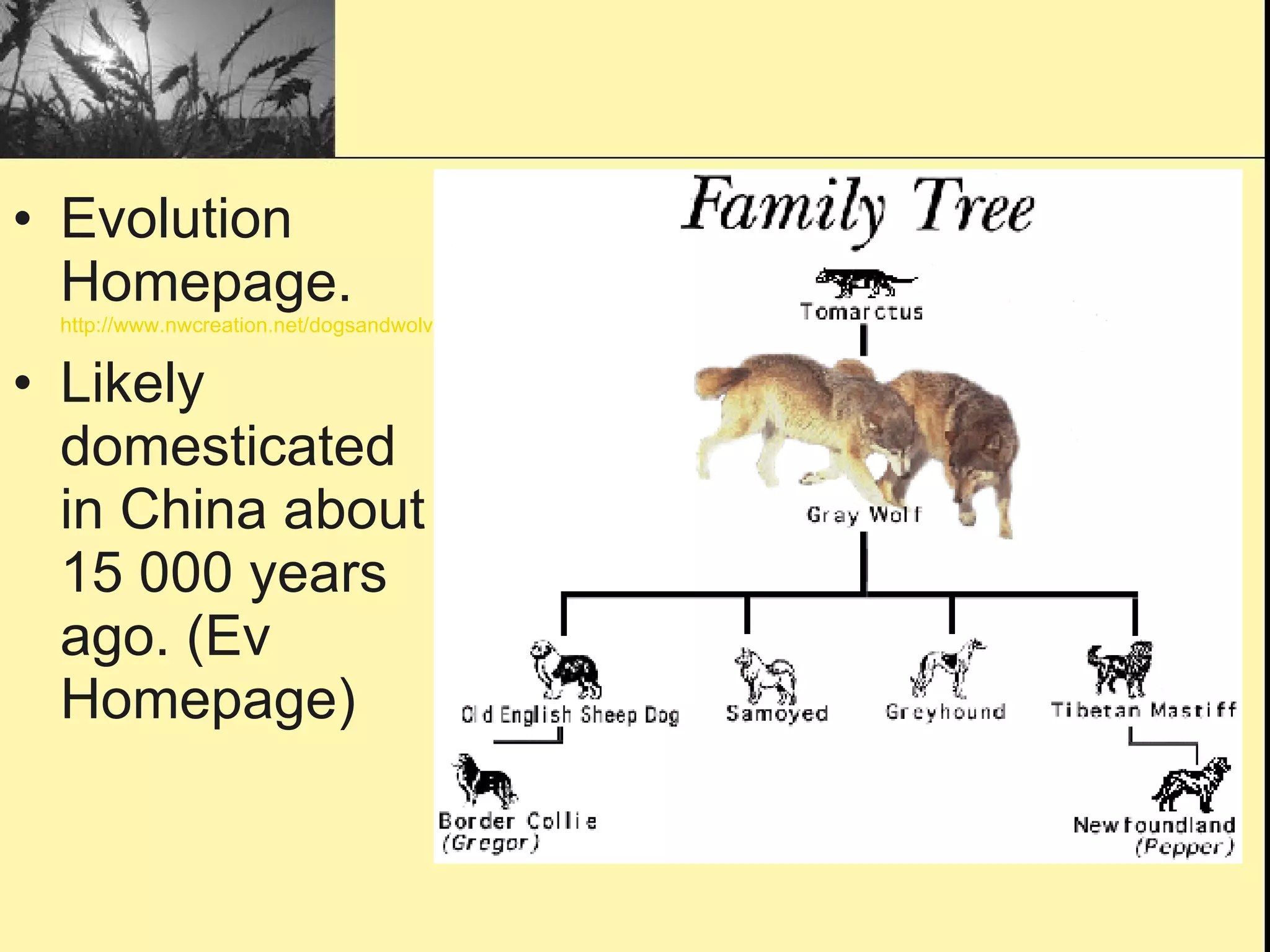
Selection of Animals Between 8000 and  10 000 B.C.    horses, camels, oxen and various breeds of dogs (dogs are derived from the wolf family) were domesticated to serve various roles.
Evolution Homepage.  http://www.nwcreation.net/dogsandwolves.html Likely domesticated in China about 15 000 years ago. (Ev Homepage)
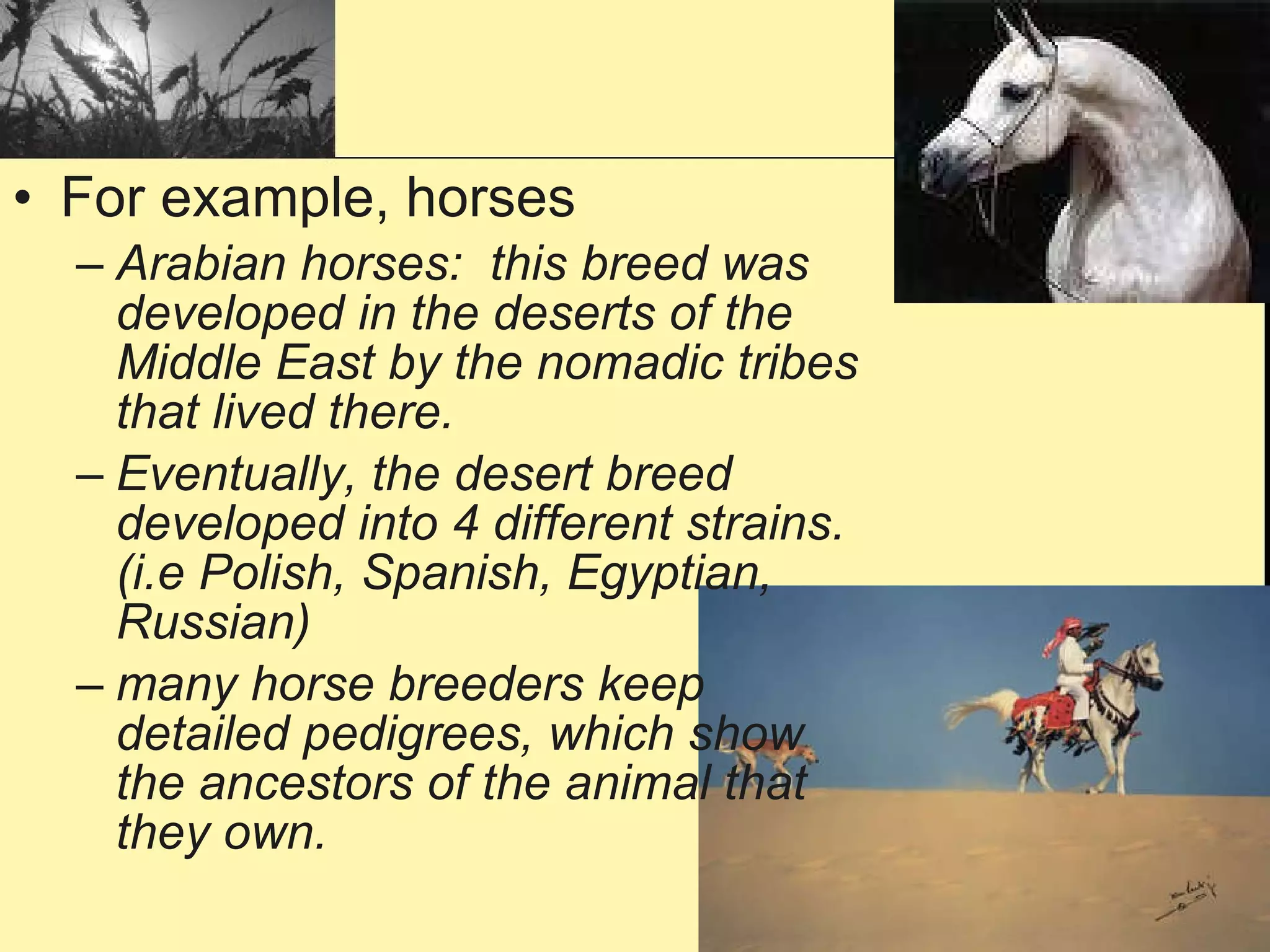
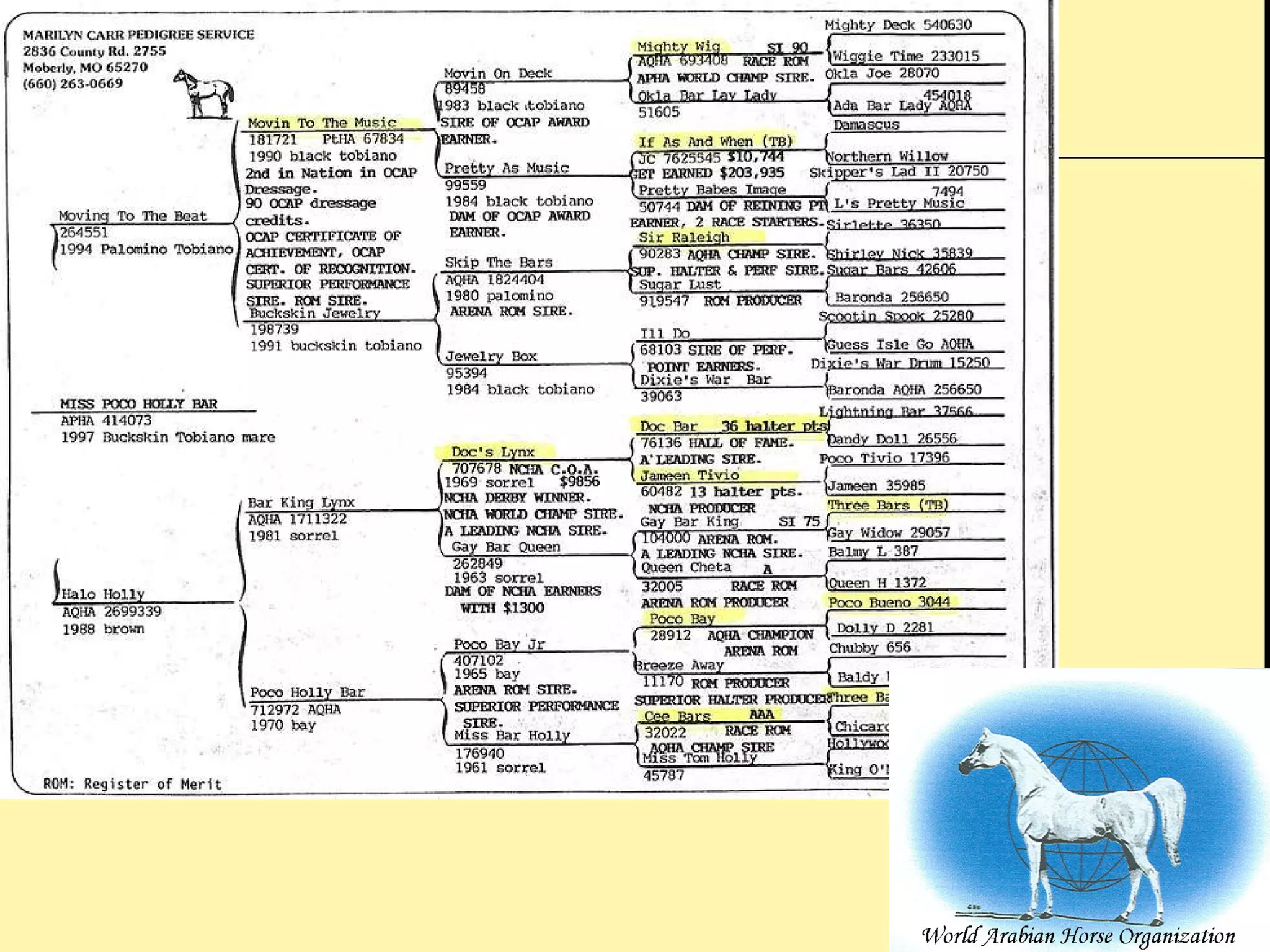
For example, horses Arabian horses:  this breed was developed in the deserts of the Middle East by the nomadic tribes that lived there. Eventually, the desert breed developed into 4 different strains. (i.e Polish, Spanish, Egyptian, Russian) many horse breeders keep detailed pedigrees, which show the ancestors of the animal that they own.
 
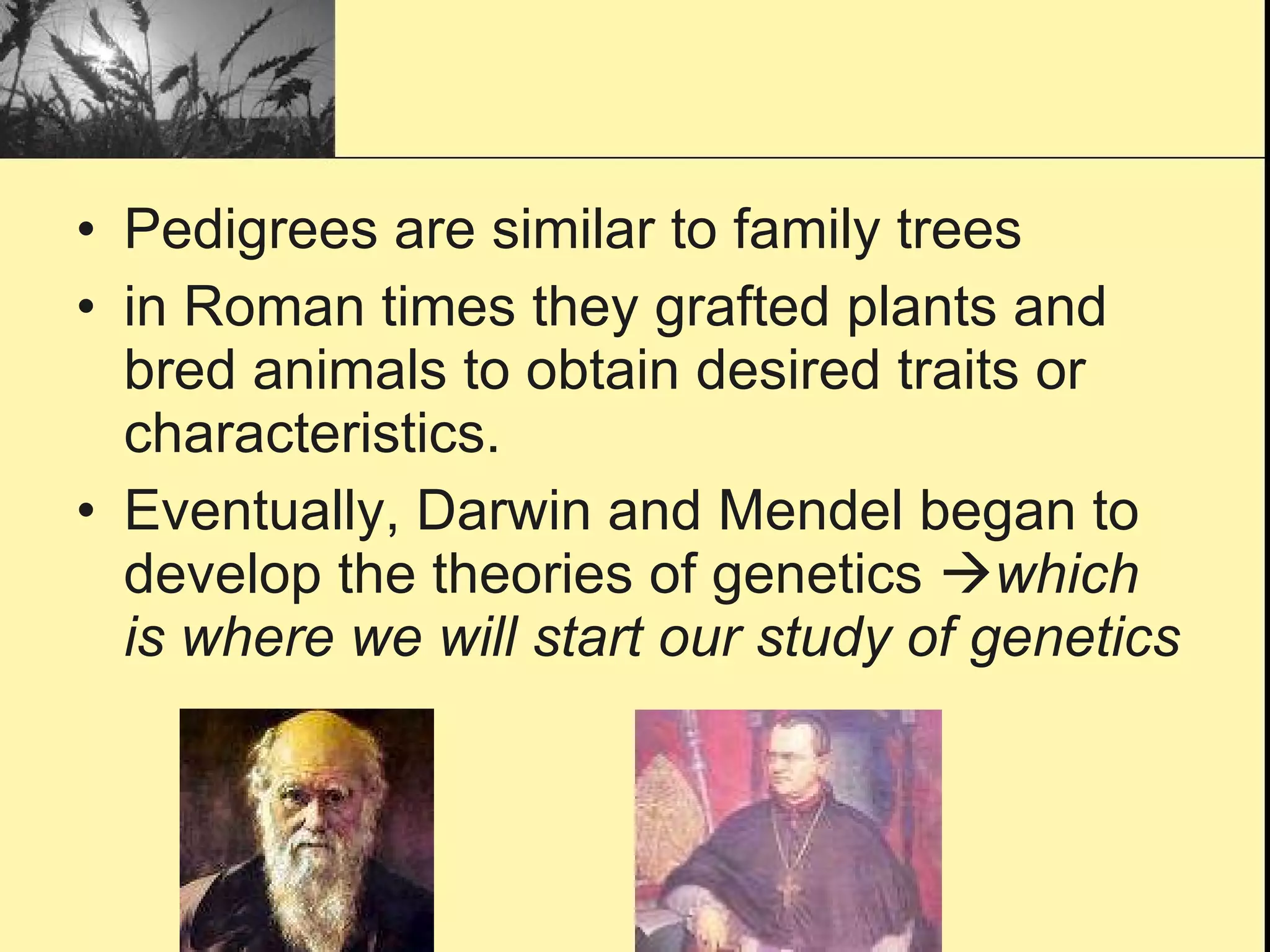
Pedigrees are similar to family trees in Roman times they grafted plants and bred animals to obtain desired traits or characteristics. Eventually, Darwin and Mendel began to develop the theories of genetics   which is where we will start our study of genetics
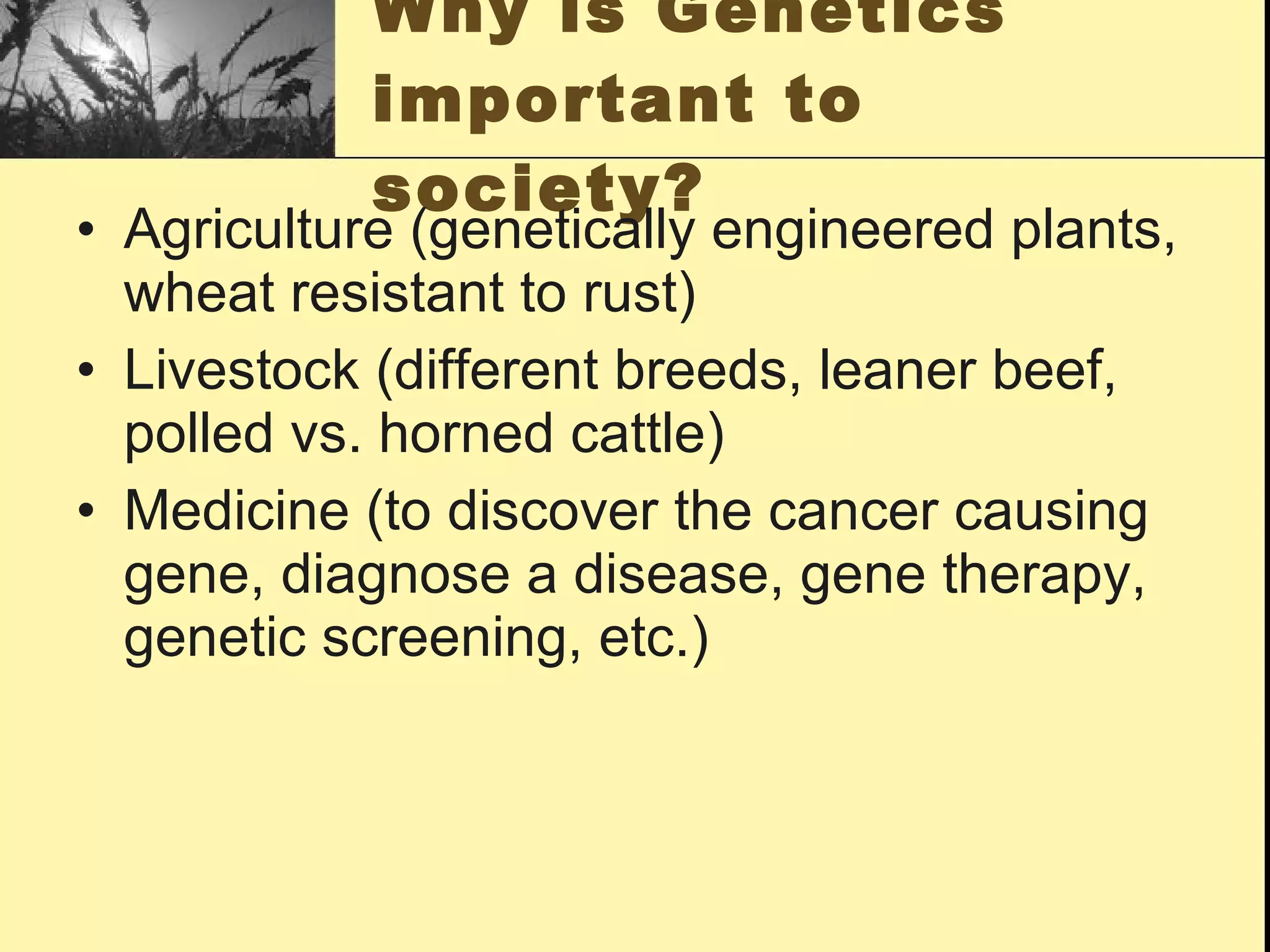
Why is Genetics important to society? Agriculture (genetically engineered plants, wheat resistant to rust) Livestock (different breeds, leaner beef, polled vs. horned cattle) Medicine (to discover the cancer causing gene, diagnose a disease, gene therapy, genetic screening, etc.)
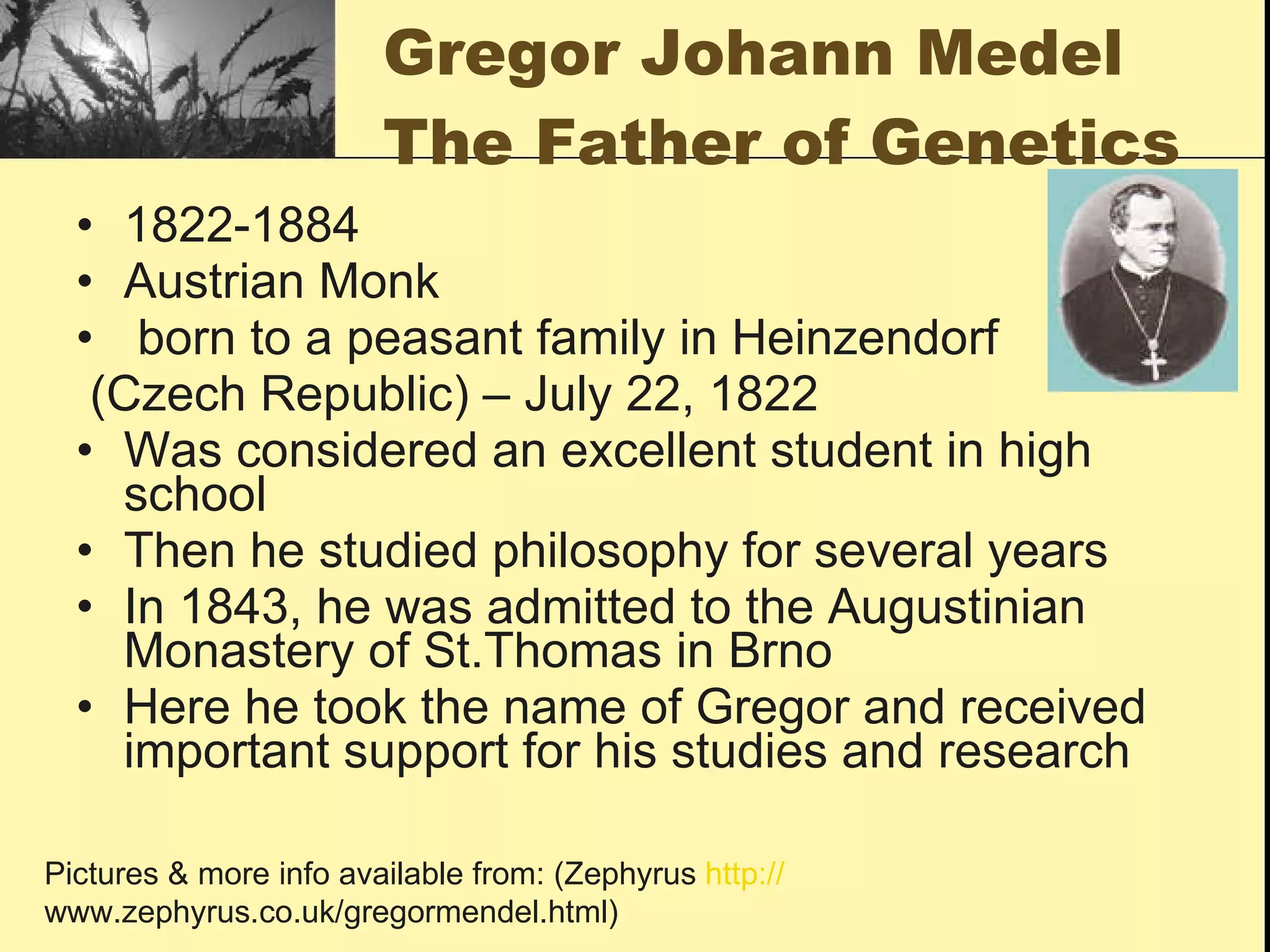
Gregor Johann Medel The Father of Genetics 1822-1884 Austrian Monk born to a peasant family in Heinzendorf (Czech Republic) – July 22, 1822 Was considered an excellent student in high school Then he studied philosophy for several years In 1843, he was admitted to the Augustinian Monastery of St.Thomas in Brno Here he took the name of Gregor and received important support for his studies and research Pictures & more info available from: (Zephyrus  http:// www.zephyrus.co.uk/gregormendel.html )
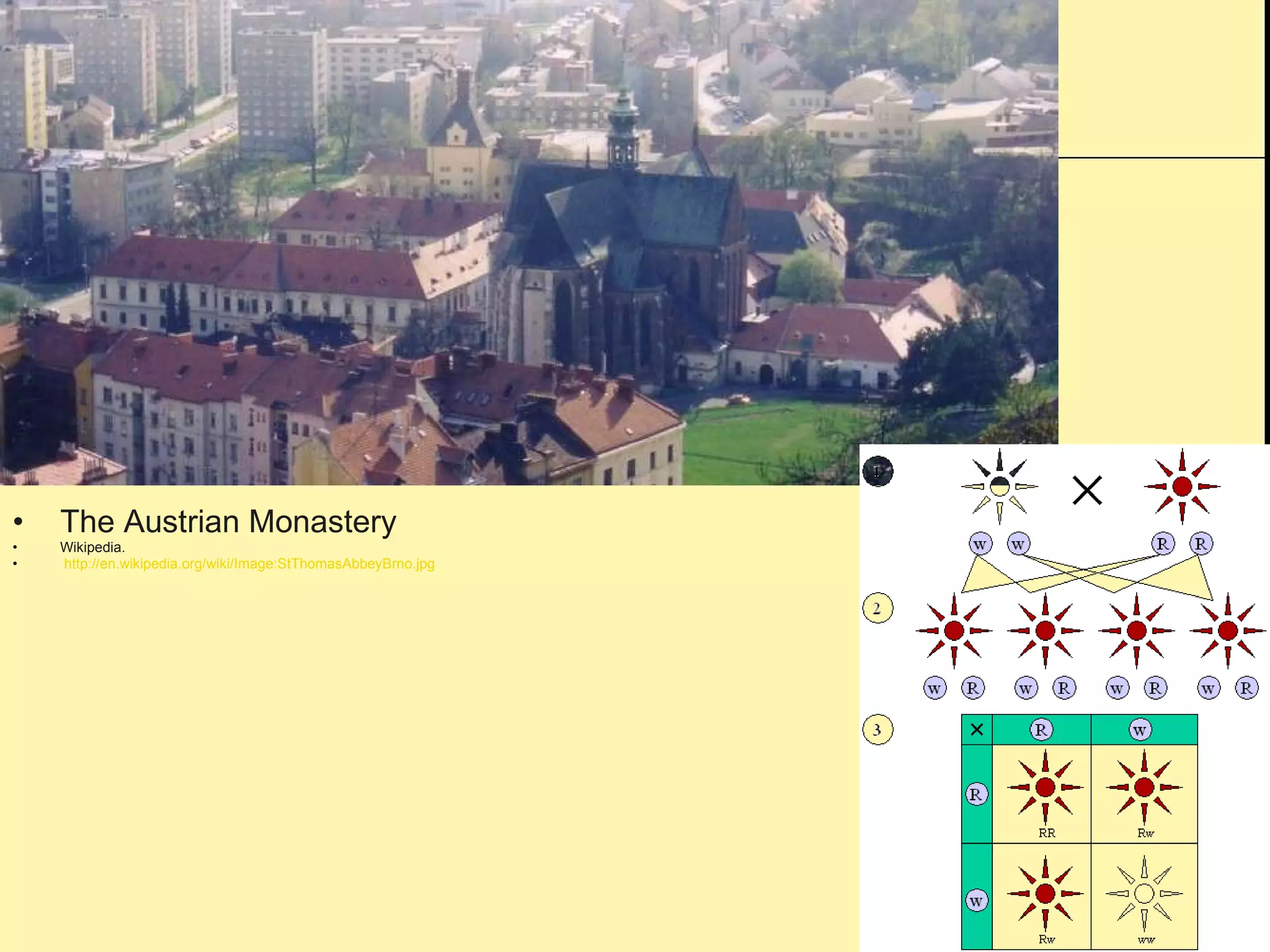
The Austrian Monastery  Wikipedia. http://en.wikipedia.org/wiki/Image:StThomasAbbeyBrno.jpg
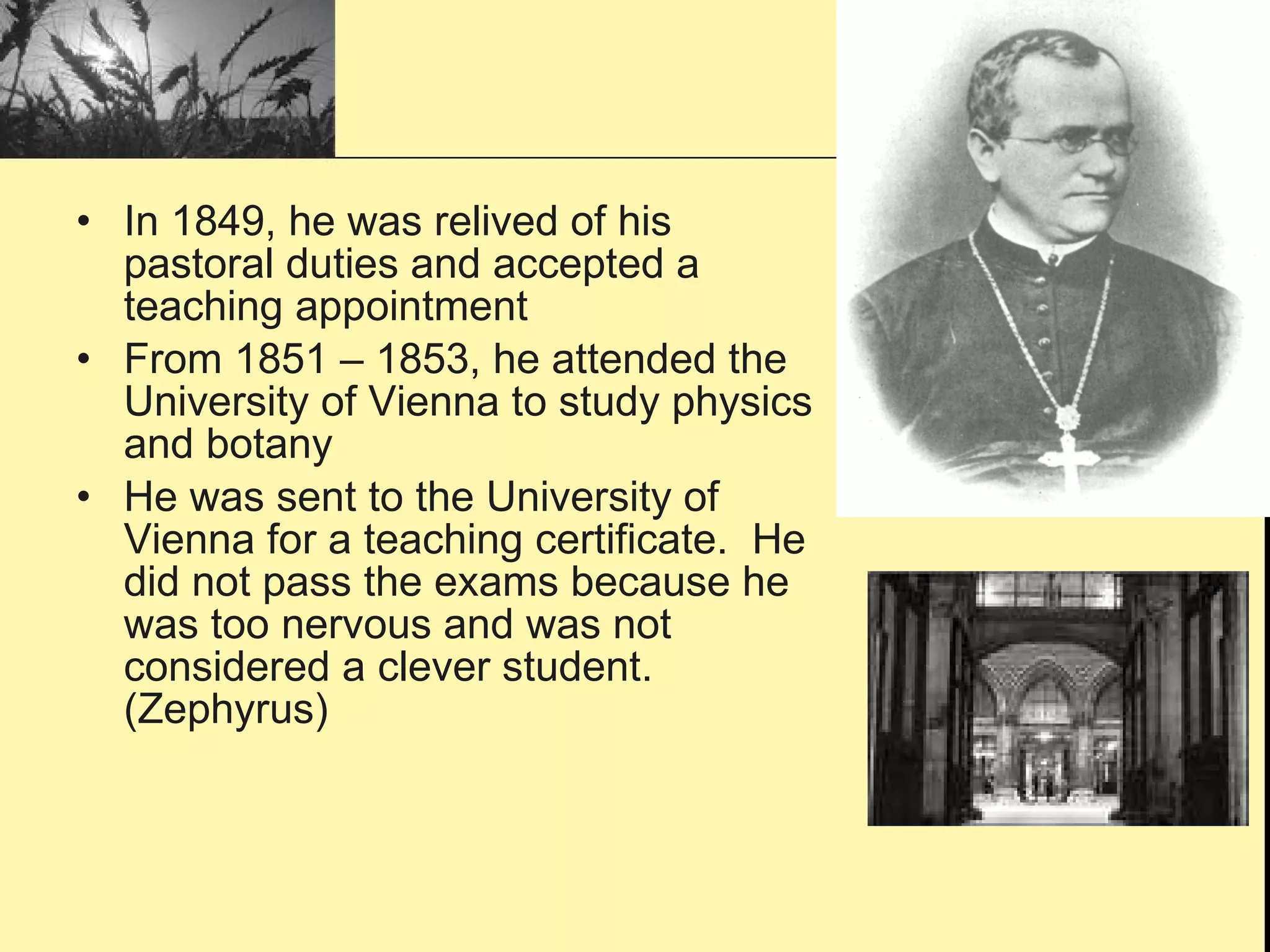
In 1849, he was relived of his pastoral duties and accepted a teaching appointment From 1851 – 1853, he attended the University of Vienna to study physics and botany He was sent to the University of Vienna for a teaching certificate.  He did not pass the exams because he was too nervous and was not considered a clever student. (Zephyrus)
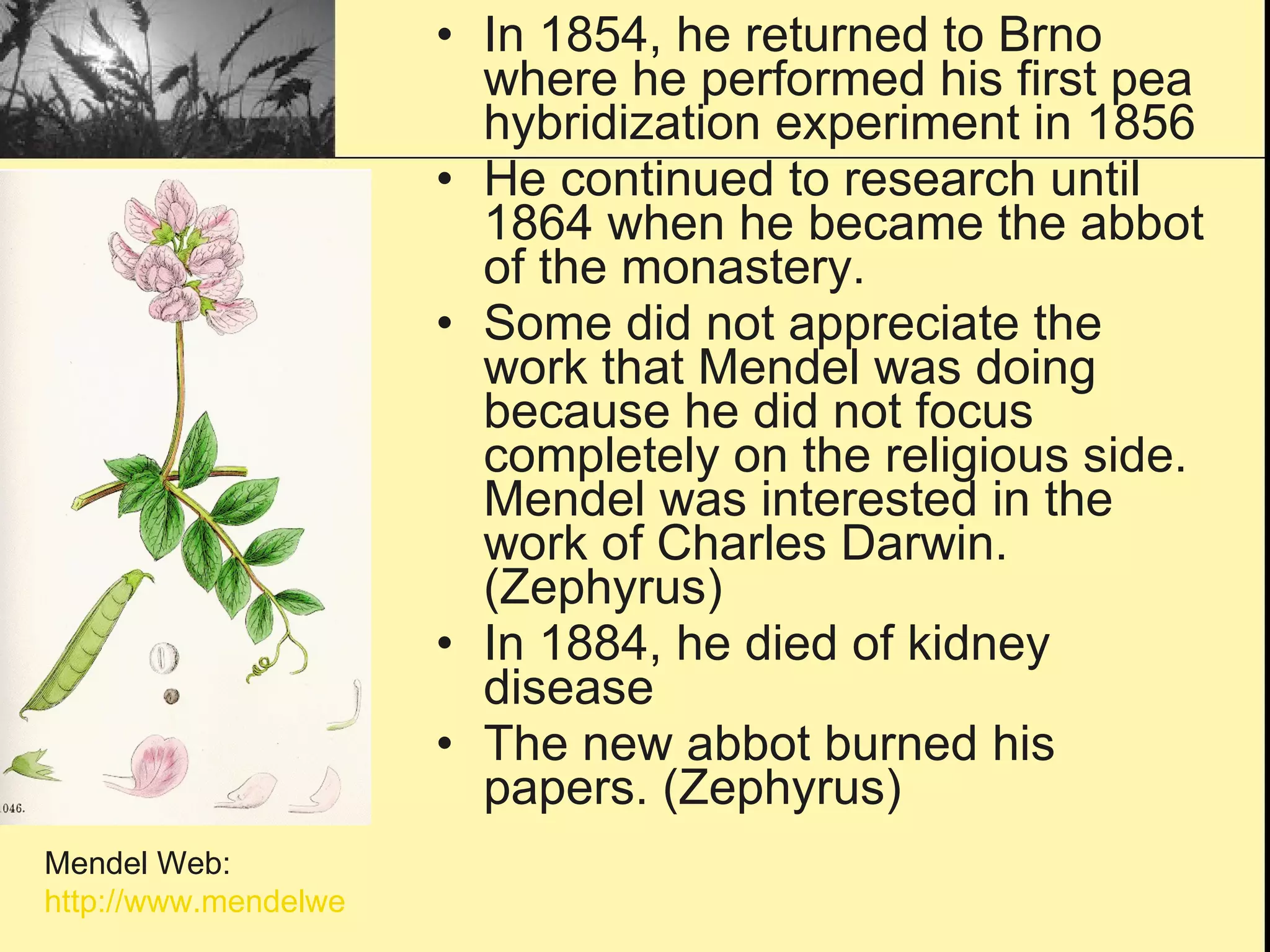
In 1854, he returned to Brno where he performed his first pea hybridization experiment in 1856 He continued to research until 1864 when he became the abbot of the monastery. Some did not appreciate the work that Mendel was doing because he did not focus completely on the religious side.  Mendel was interested in the work of Charles Darwin. (Zephyrus) In 1884, he died of kidney disease The new abbot burned his papers. (Zephyrus) Mendel Web:  http://www.mendelweb.org/images/lathyrus.mar.GIF
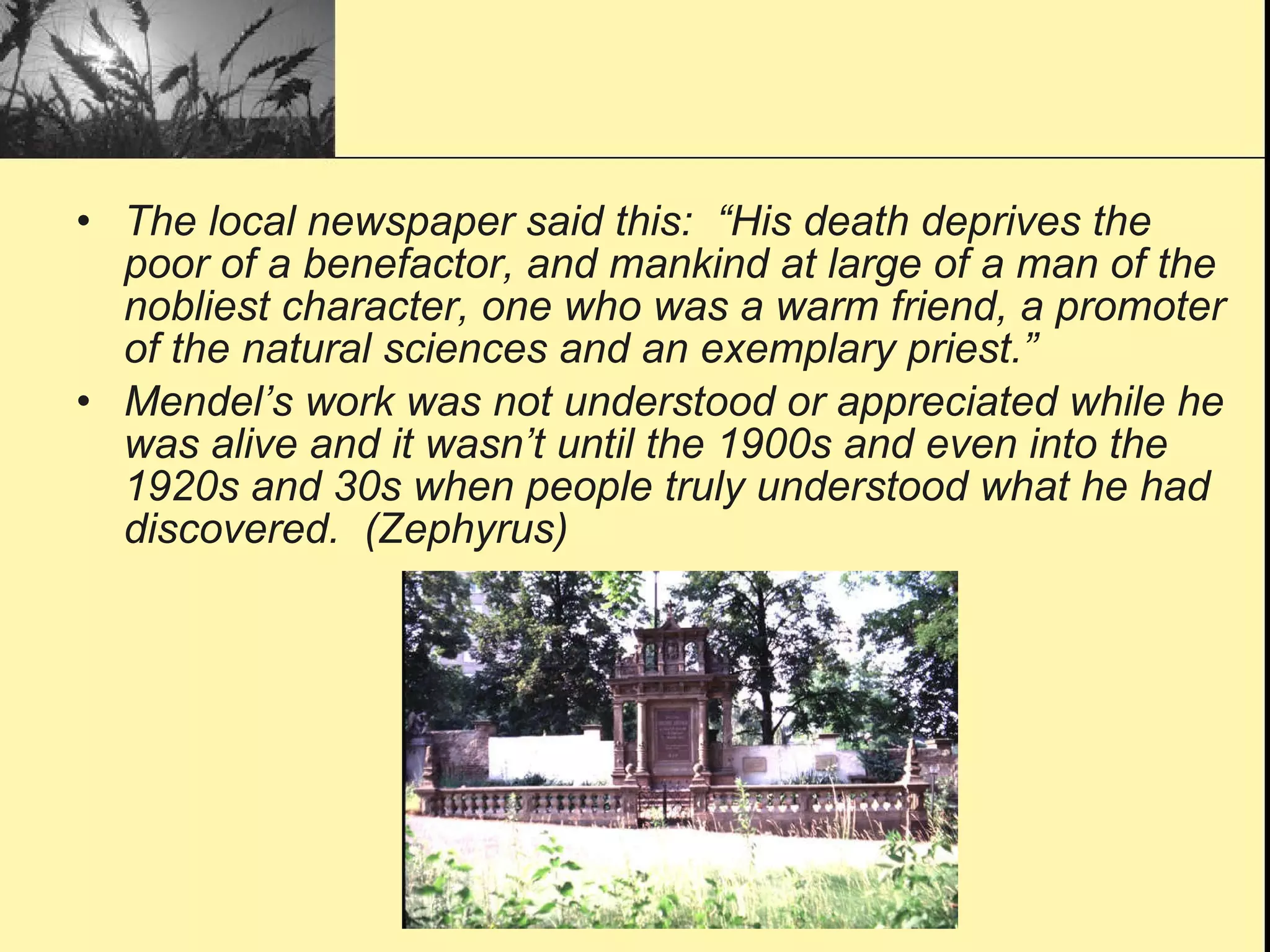
The local newspaper said this:  “His death deprives the poor of a benefactor, and mankind at large of a man of the nobliest character, one who was a warm friend, a promoter of the natural sciences and an exemplary priest.” Mendel’s work was not understood or appreciated while he was alive and it wasn’t until the 1900s and even into the 1920s and 30s when people truly understood what he had discovered.  (Zephyrus)
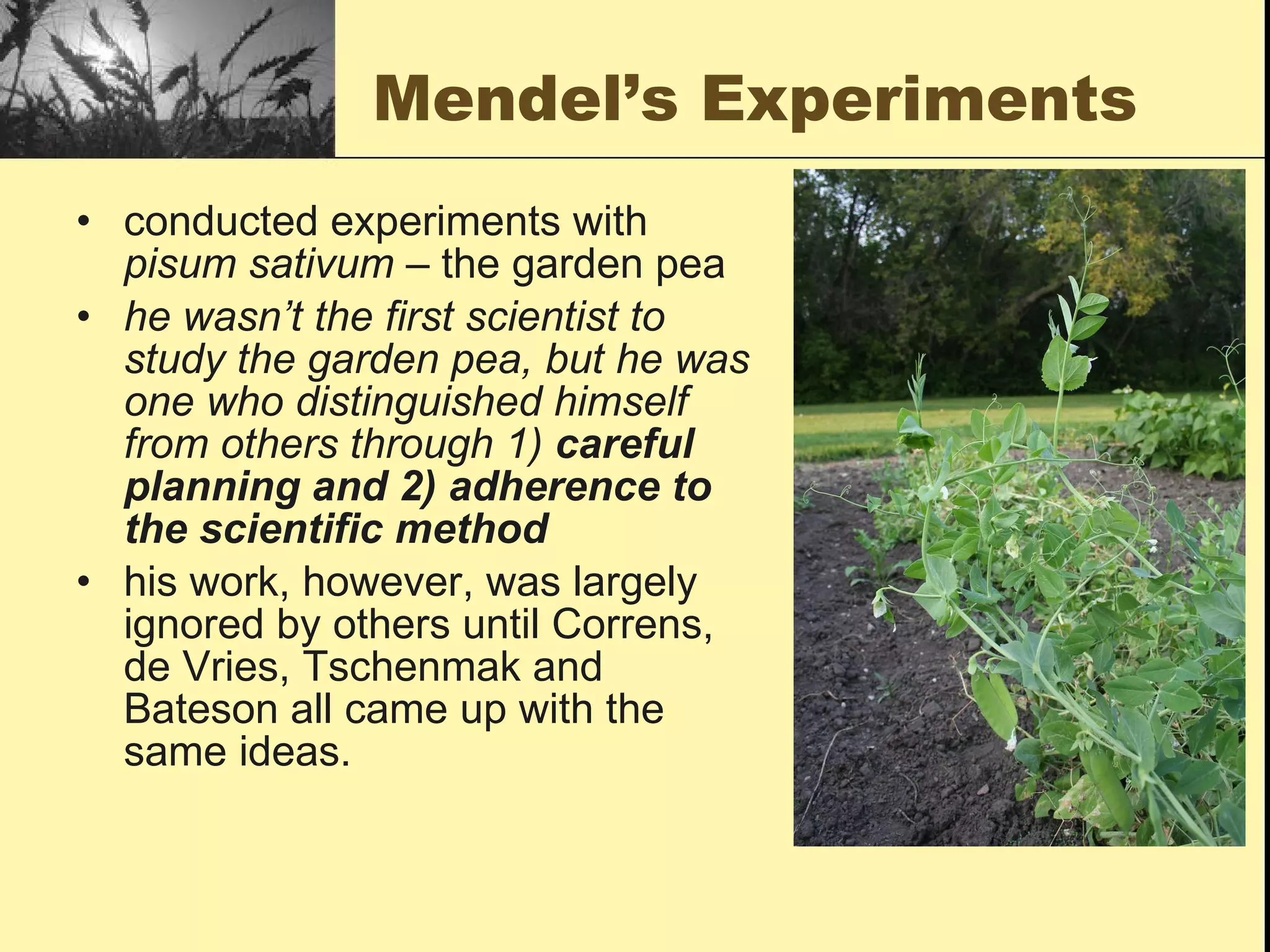
Mendel’s Experiments conducted experiments with  pisum sativum  – the garden pea he wasn’t the first scientist to study the garden pea, but he was one who distinguished himself from others through 1)  careful planning and 2) adherence to the scientific method his work, however, was largely ignored by others until Correns, de Vries, Tschenmak and Bateson all came up with the same ideas.
Mendel Selected the Garden Pea because . . . it was cheap and readily available as seed in a variety of shapes and colors. Normally self pollinates It’s easy to cross pollinate Takes up little space Have relatively short generation time (single season) Produces many offspring (1 pod = 6-10 peas)
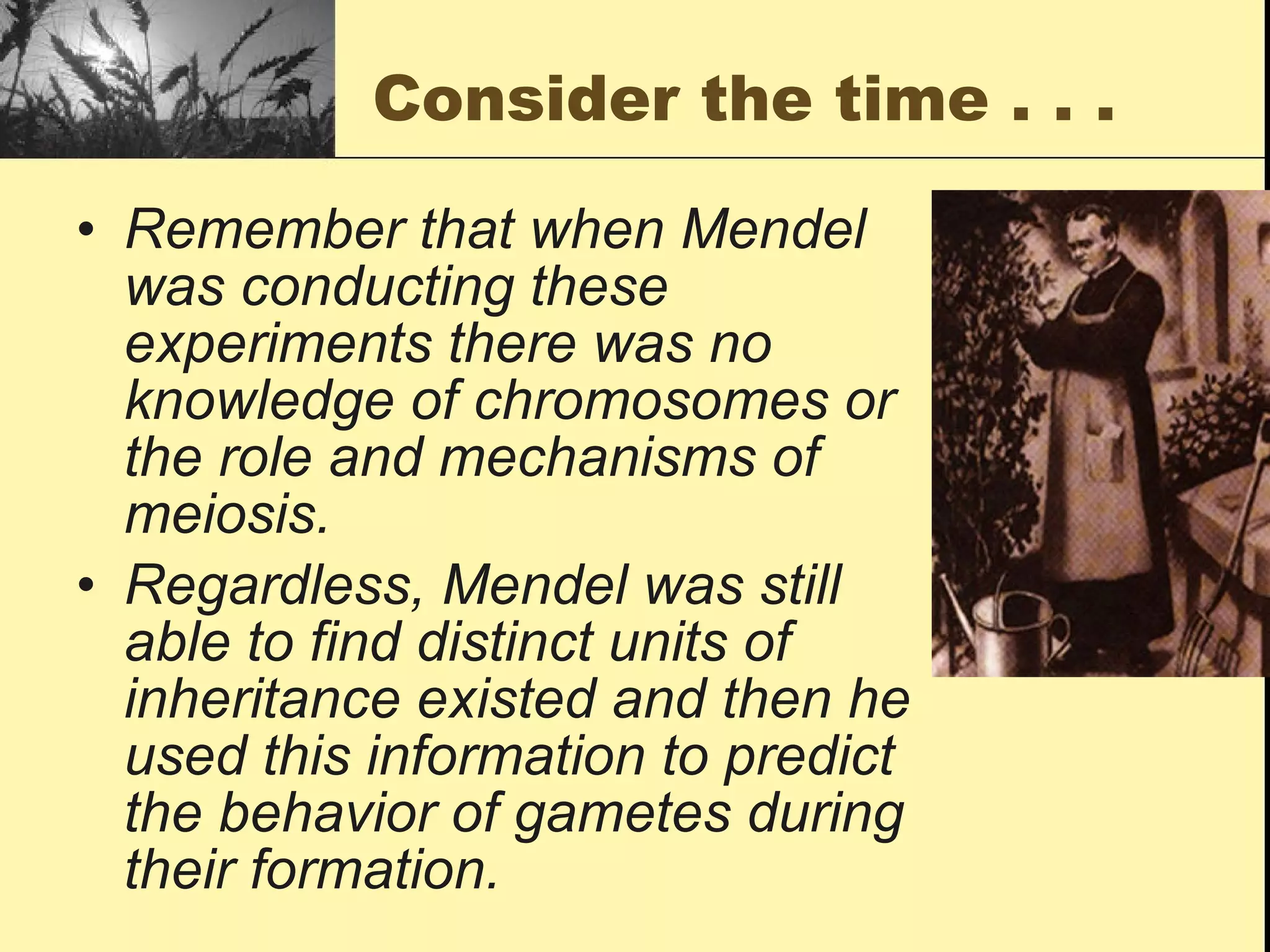
Consider the time . . . Remember that when Mendel was conducting these experiments there was no knowledge of chromosomes or the role and mechanisms of meiosis. Regardless, Mendel was still able to find distinct units of inheritance existed and then he used this information to predict the behavior of gametes during their formation.
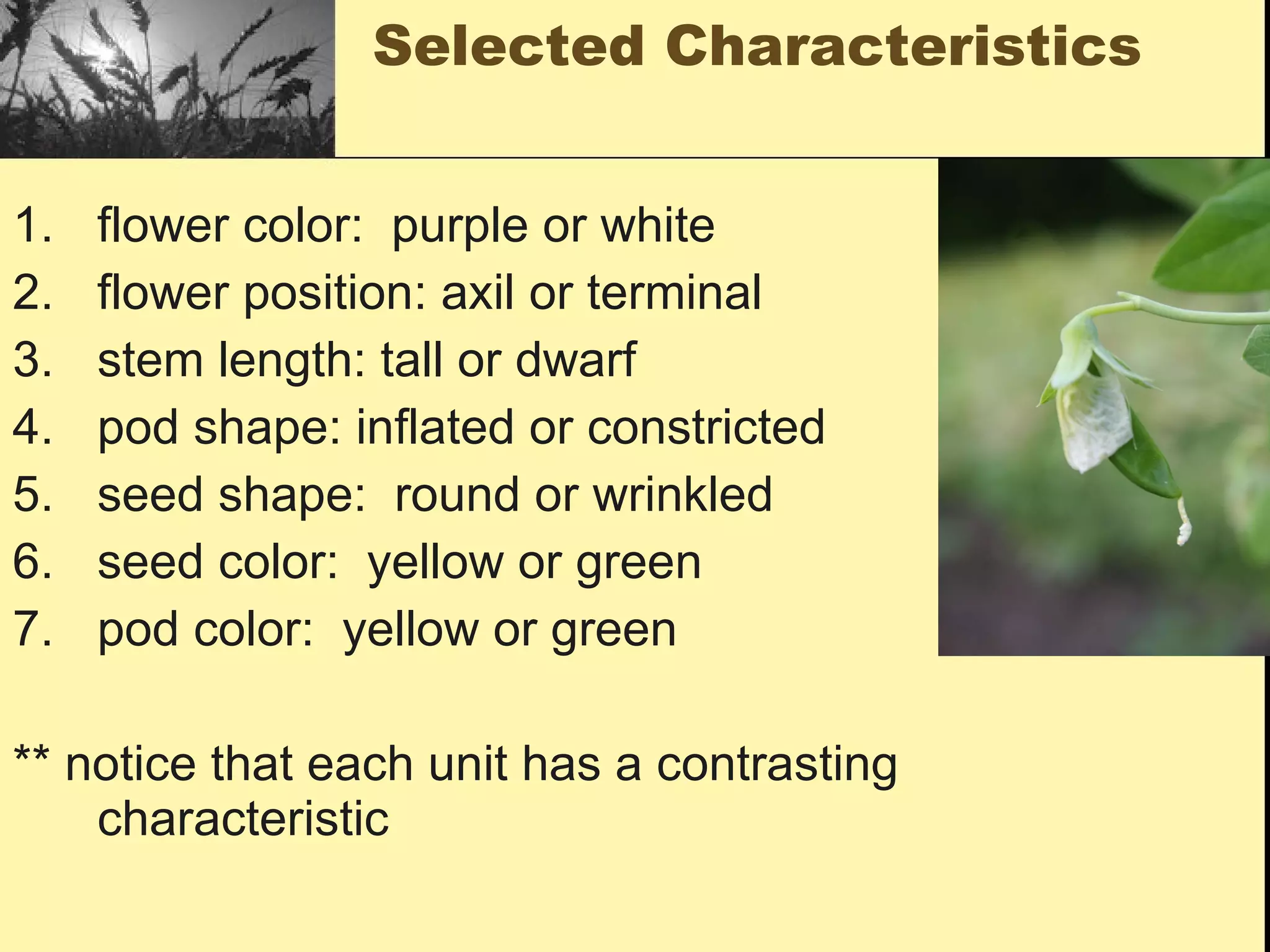
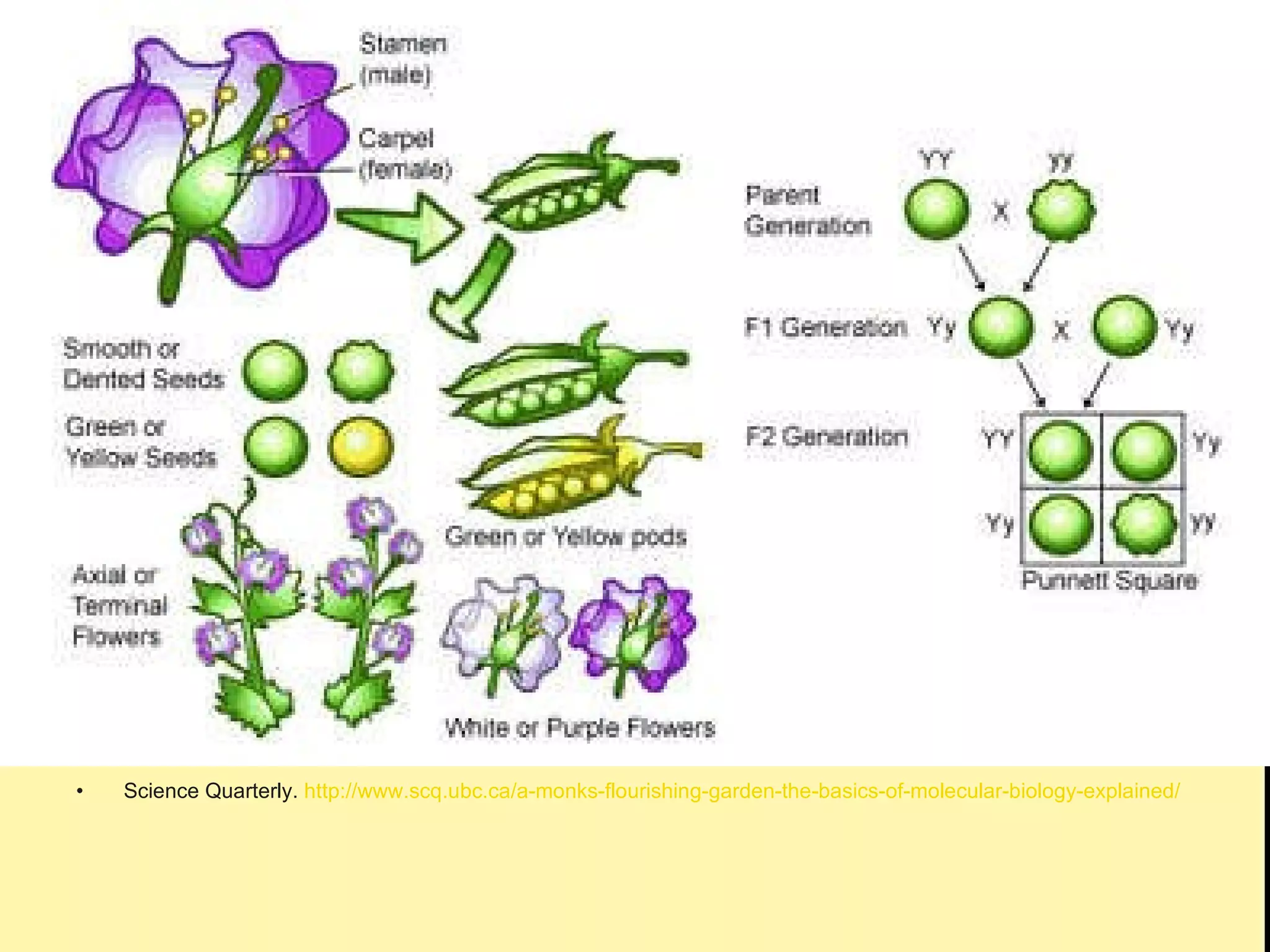
Selected Characteristics flower color:  purple or white flower position: axil or terminal stem length: tall or dwarf pod shape: inflated or constricted seed shape:  round or wrinkled seed color:  yellow or green pod color:  yellow or green ** notice that each unit has a contrasting characteristic
** all strains used were “ true breeding ” peas seeds offspring looks like the parent i.e. white flowers give rise to white flowers each  trait  (characteristic) remains unchanged generation after generation. **  TRAIT :  is a characteristic that is heritable from one generation to the next.
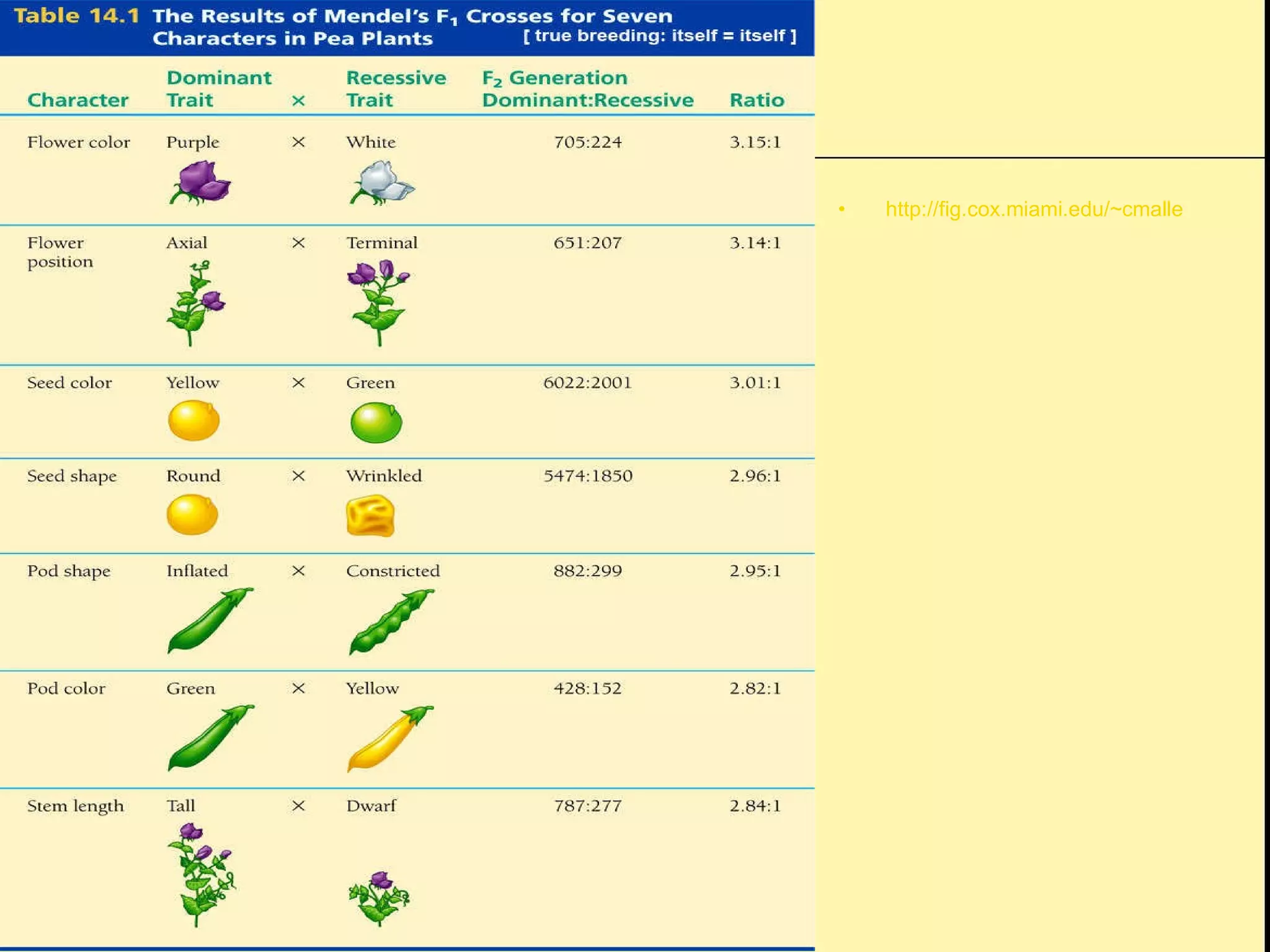
http://fig.cox.miami.edu/~cmallery/150/mendel/c7.14.1.traits.jpg
Science Quarterly.  http://www.scq.ubc.ca/a-monks-flourishing-garden-the-basics-of-molecular-biology-explained/
Mendel’s Experiments were successful because. . .  he choose peas he restricted his study to  a few contrasting traits he kept accurate quantitative  records his analysis of the data  allowed for certain postulates  to be developed which provided  the underlying basis for  transmission genetics
The Experiment 1ST:  Cross true breeding pea plants that had different characteristics with each other. 2nd: he would examine the peas and record the results 3rd:  he would collect the seeds that were the result of the cross and then plant these seeds and then collect data on them
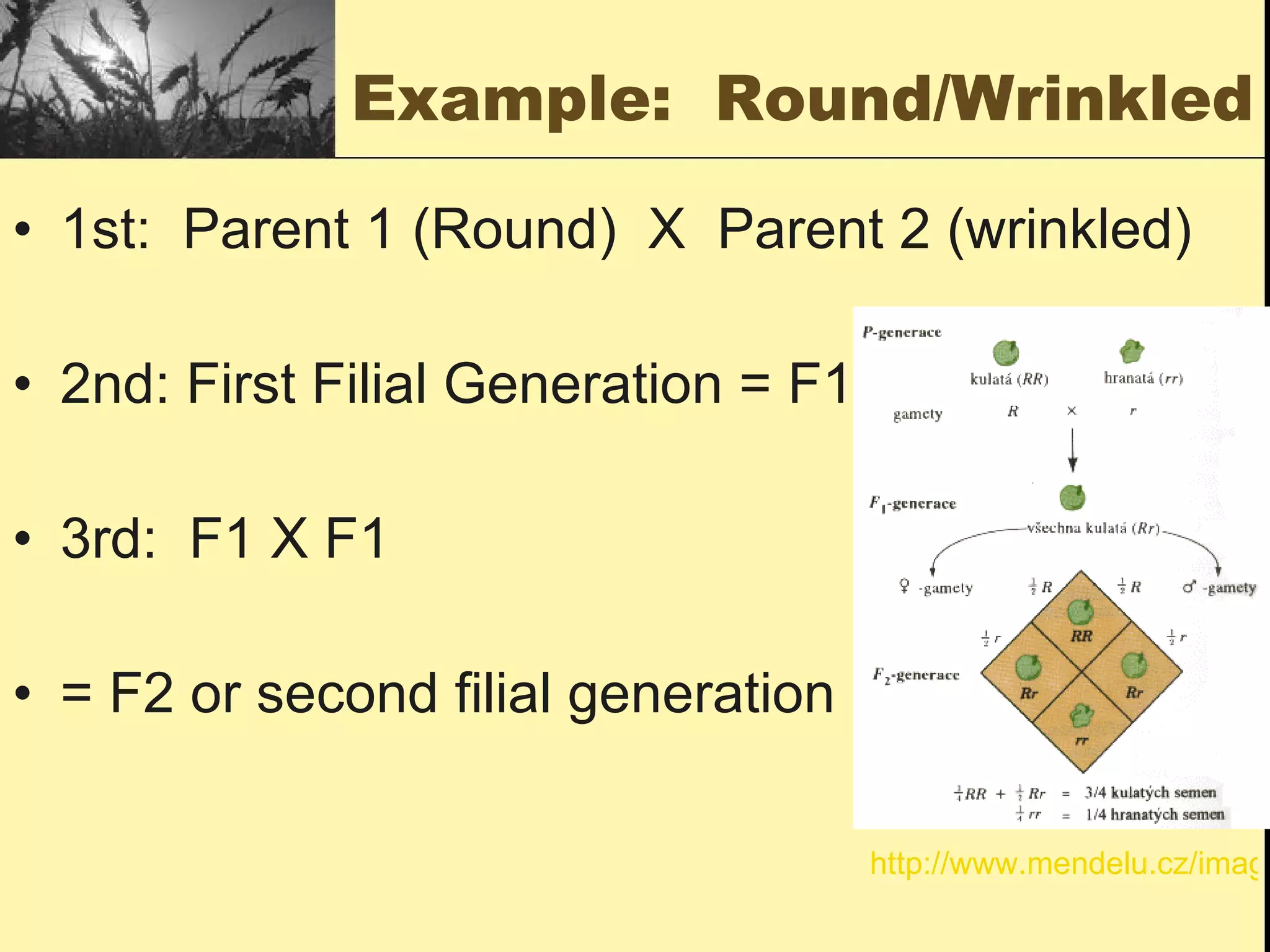
Example:  Round/Wrinkled 1st:  Parent 1 (Round)  X  Parent 2 (wrinkled) 2nd: First Filial Generation = F1 3rd:  F1 X F1 = F2 or second filial generation http://www.mendelu.cz/images/mendel_krizeni2.png
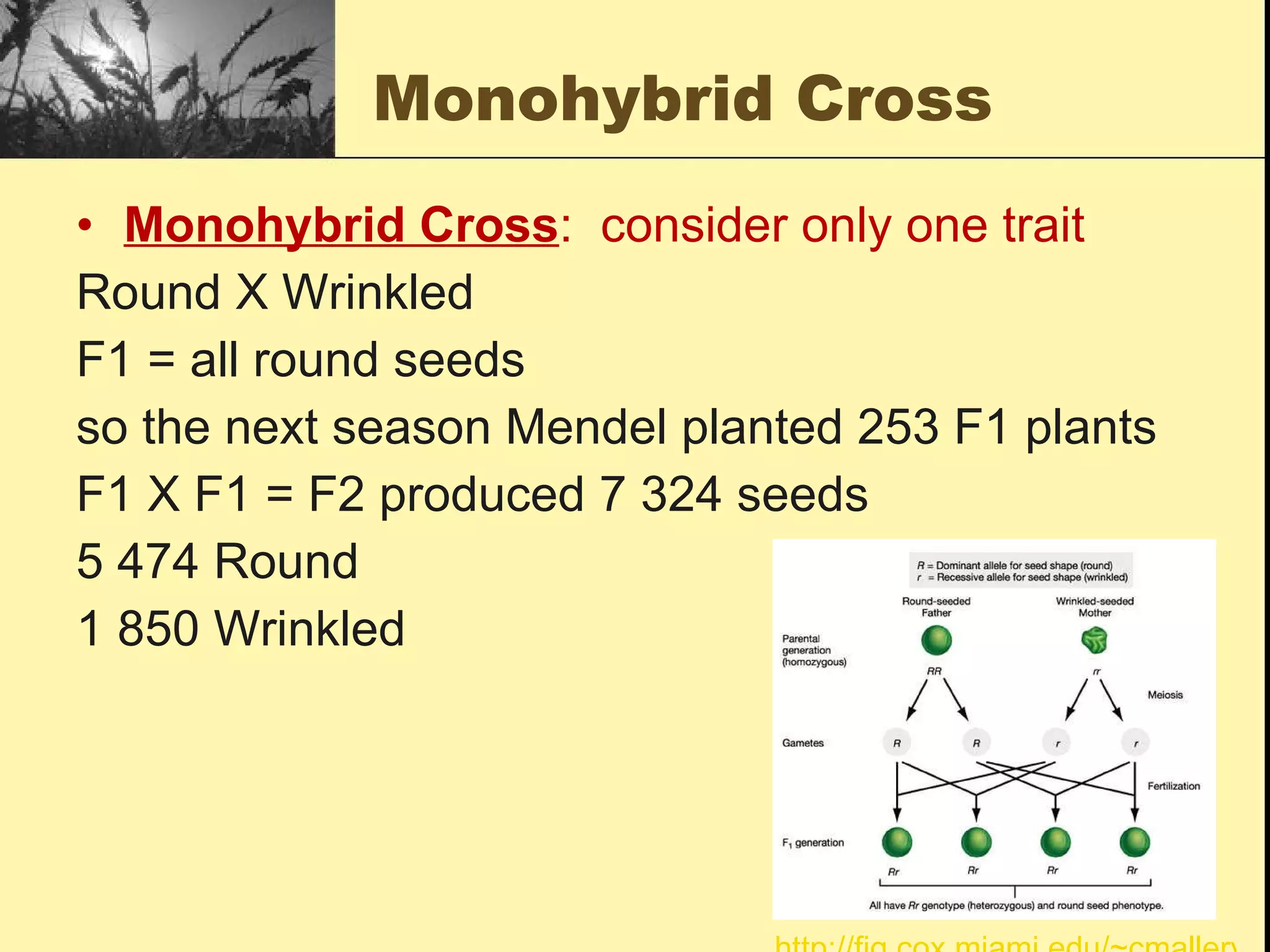
Monohybrid Cross Monohybrid Cross :  consider only one trait Round X Wrinkled  F1 = all round seeds  so the next season Mendel planted 253 F1 plants F1 X F1 = F2 produced 7 324 seeds 5 474 Round 1 850 Wrinkled http://fig.cox.miami.edu/~cmallery/150/mendel/sf10x4.jpg
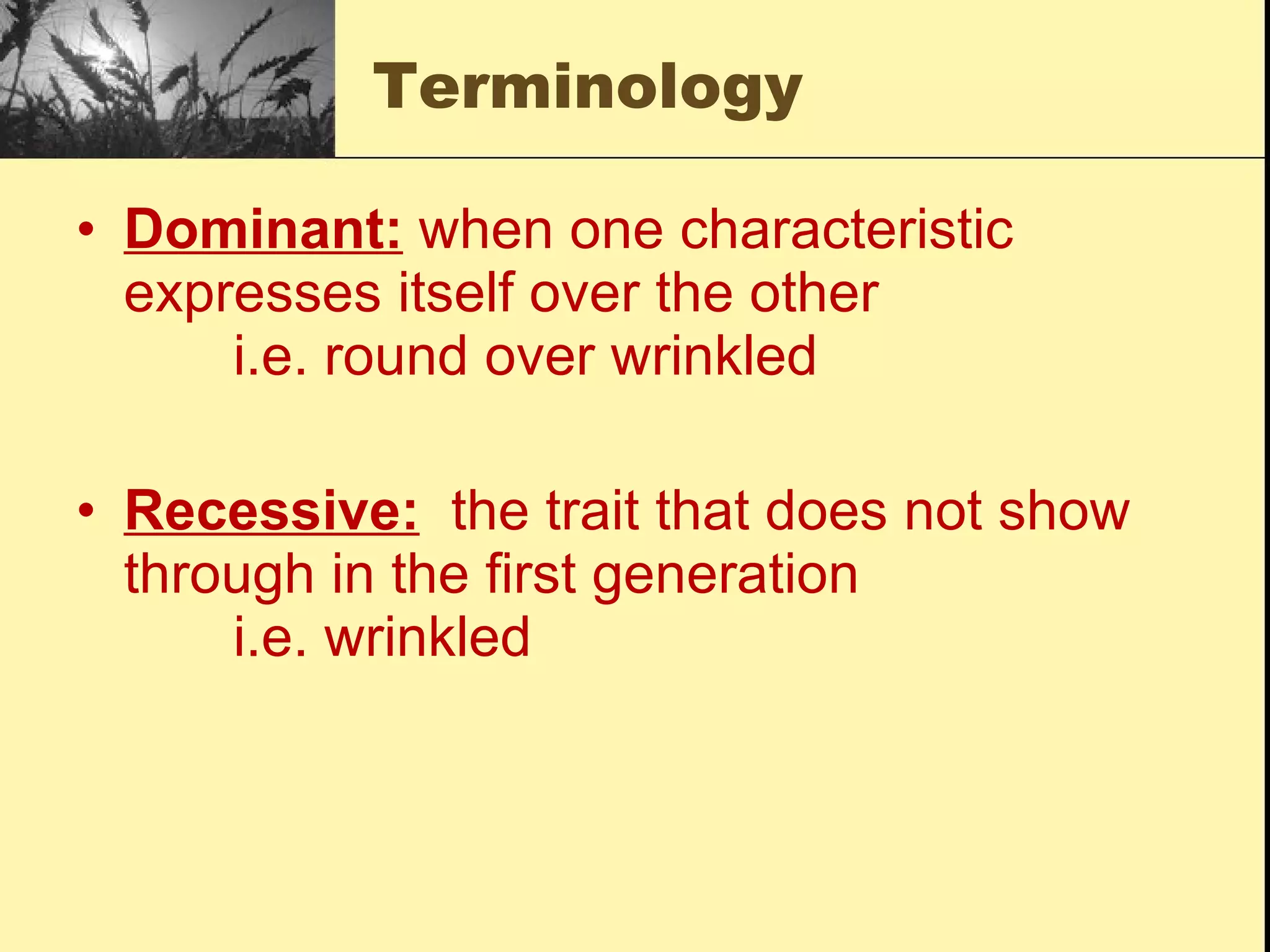
Terminology Dominant:  when one characteristic expresses itself over the other    i.e. round over wrinkled Recessive:   the trait that does not show through in the first generation    i.e. wrinkled
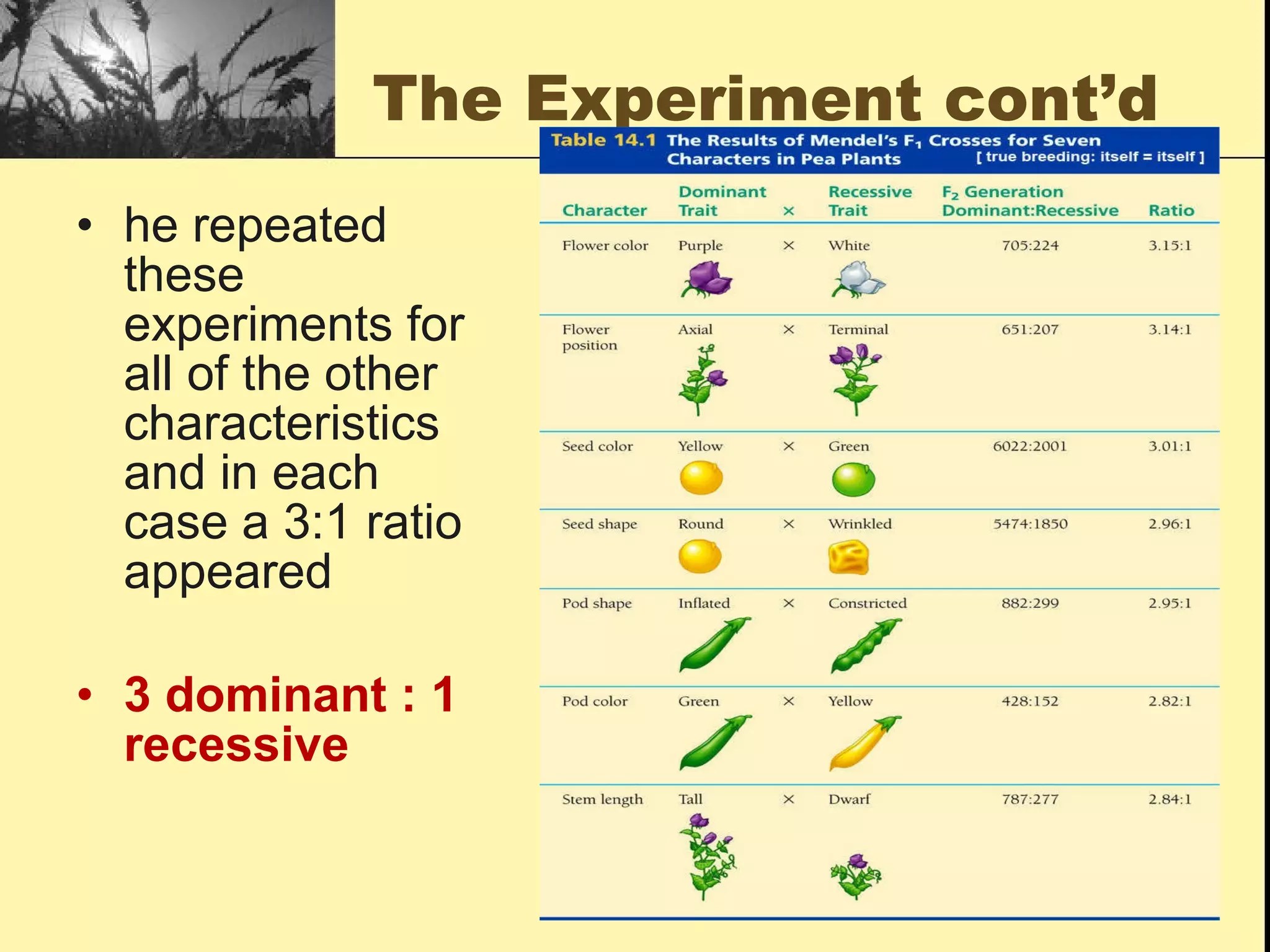
The Experiment cont’d he repeated these experiments for all of the other characteristics and in each case a 3:1 ratio appeared 3 dominant : 1 recessive
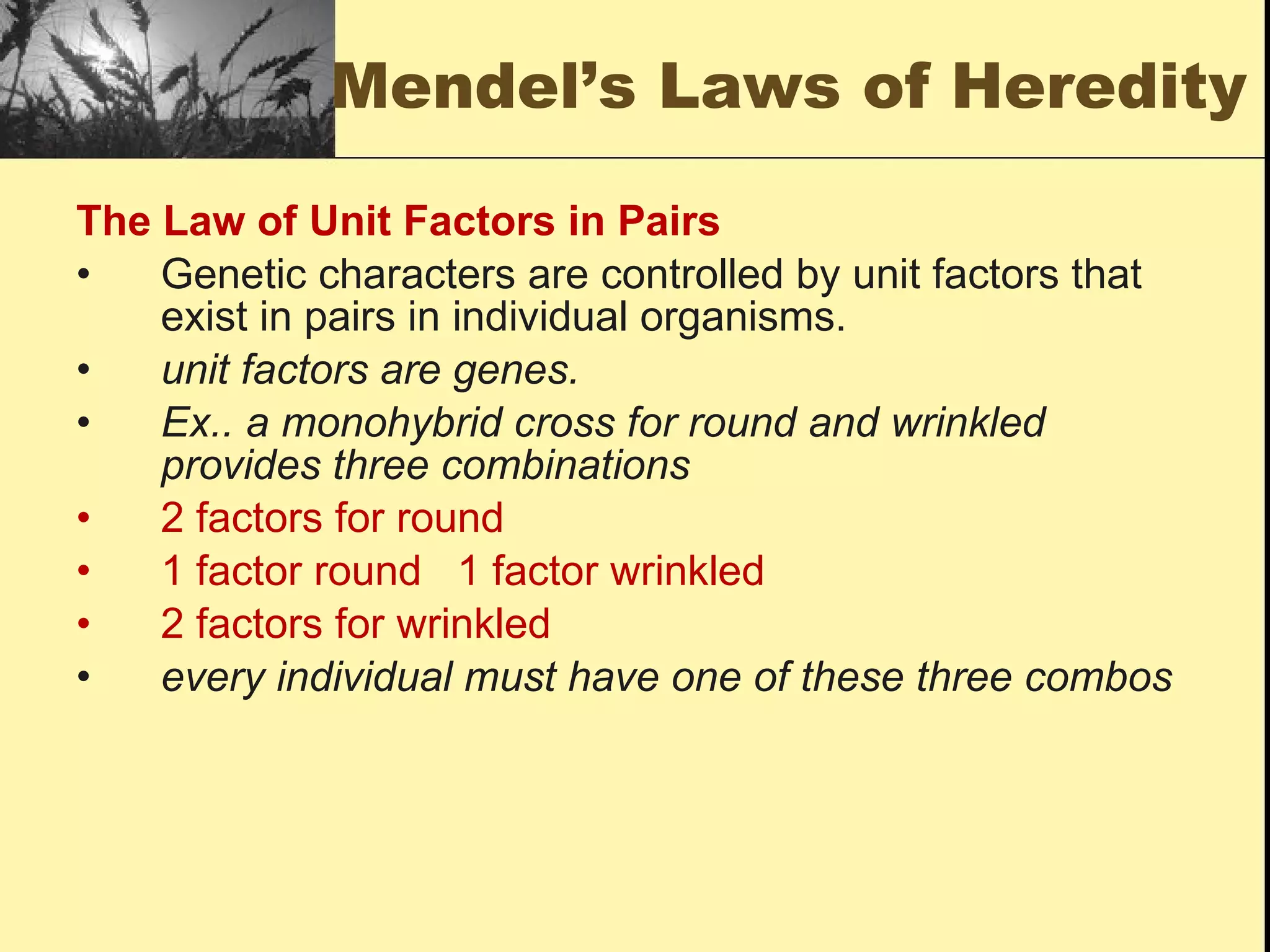
Mendel’s Laws of Heredity The Law of Unit Factors in Pairs Genetic characters are controlled by unit factors that exist in pairs in individual organisms. unit factors are genes. Ex.. a monohybrid cross for round and wrinkled provides three combinations 2 factors for round 1 factor round  1 factor wrinkled 2 factors for wrinkled every individual must have one of these three combos
The Law of Dominance When 2 unlike unit factors are responsible for a single character and are present in a single individual,  one unit factor is dominant  to the other, which is said to be recessive. Ex.. look at monohybrid crosses and the f1  generation One gene pair may mask or prevent the expression of the other.
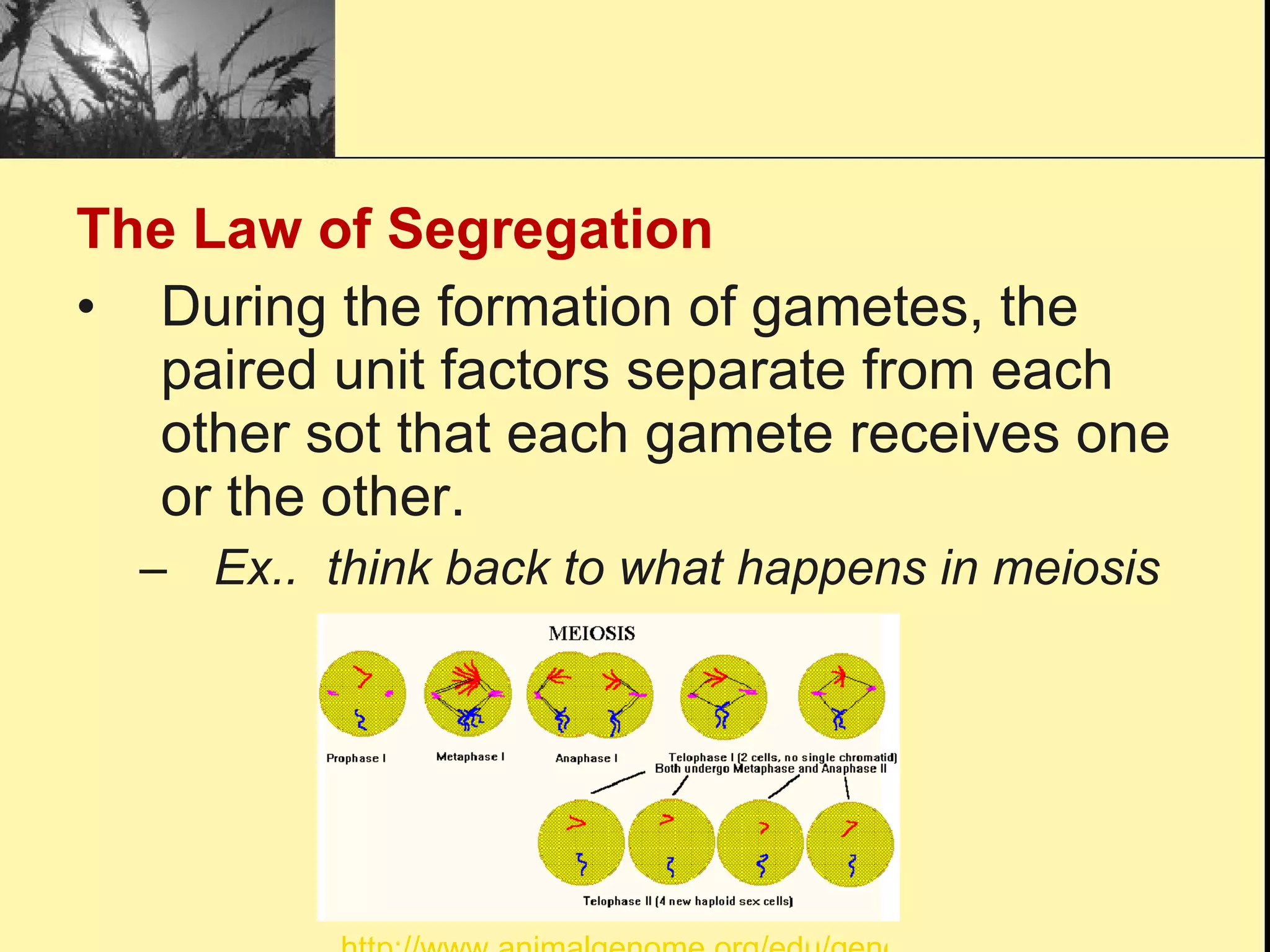
The Law of Segregation During the formation of gametes, the paired unit factors separate from each other sot that each gamete receives one or the other. Ex..  think back to what happens in meiosis http://www.animalgenome.org/edu/genetics/meiosis.gif
Mendel’s Reasoning p1 plants that were true-breeding round had 2 unit factors for round p2 plants also had two unit factors for wrinkled gametes of the parents each received one unit factor after fertilization all f1 plants had 1 unit factor from round and 1 from wrinkled when the f2 gametes are formed there are 4 possible random outcomes r/r; r/w; w/w; w/r according to the law of dominance 1 and 4 will be round as well Therefore, you get a three to one ratio
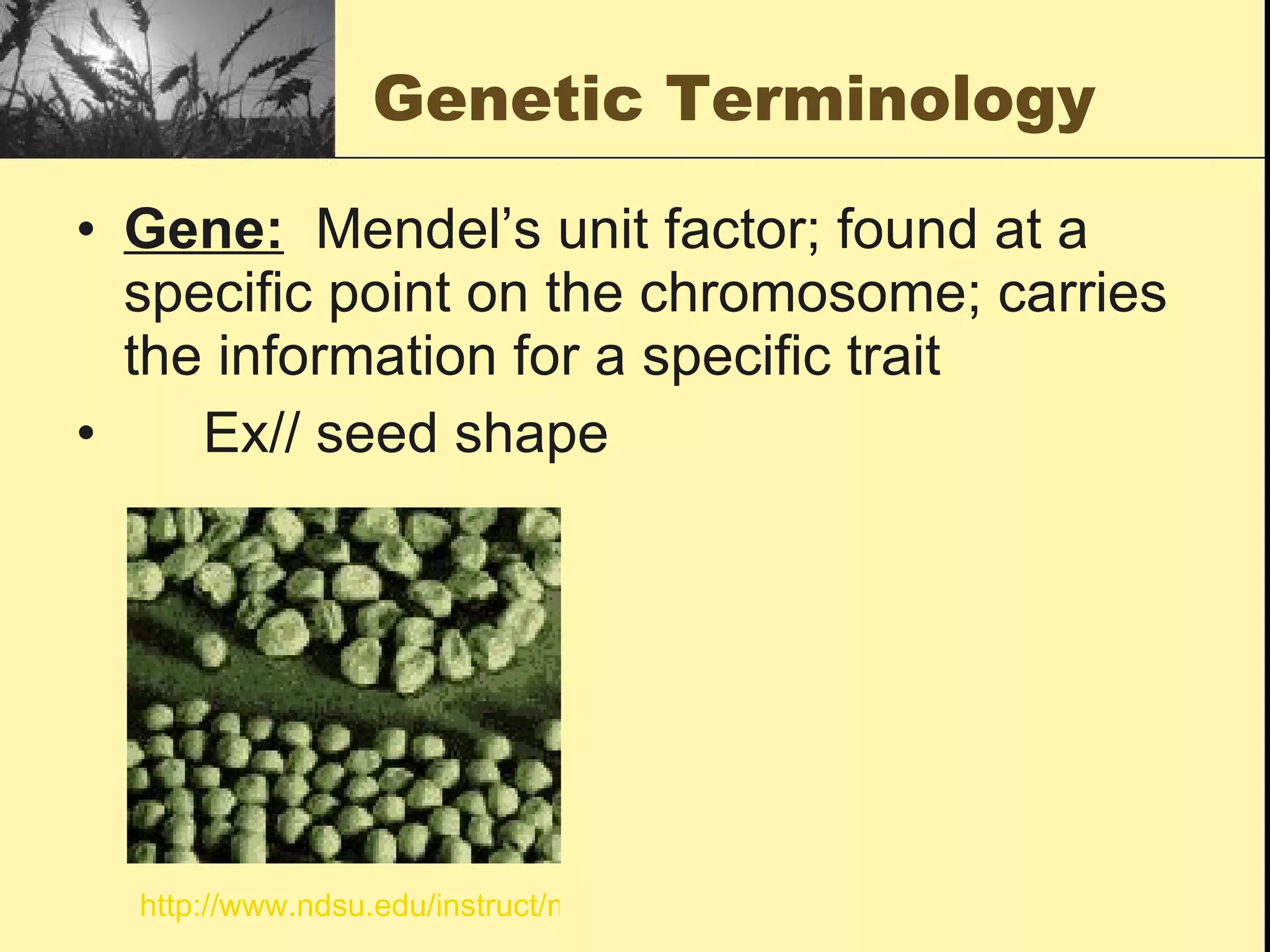
Genetic Terminology Gene:   Mendel’s unit factor; found at a specific point on the chromosome; carries the information for a specific trait Ex// seed shape http://www.ndsu.edu/instruct/mcclean/plsc431/mendel/peashape.gif
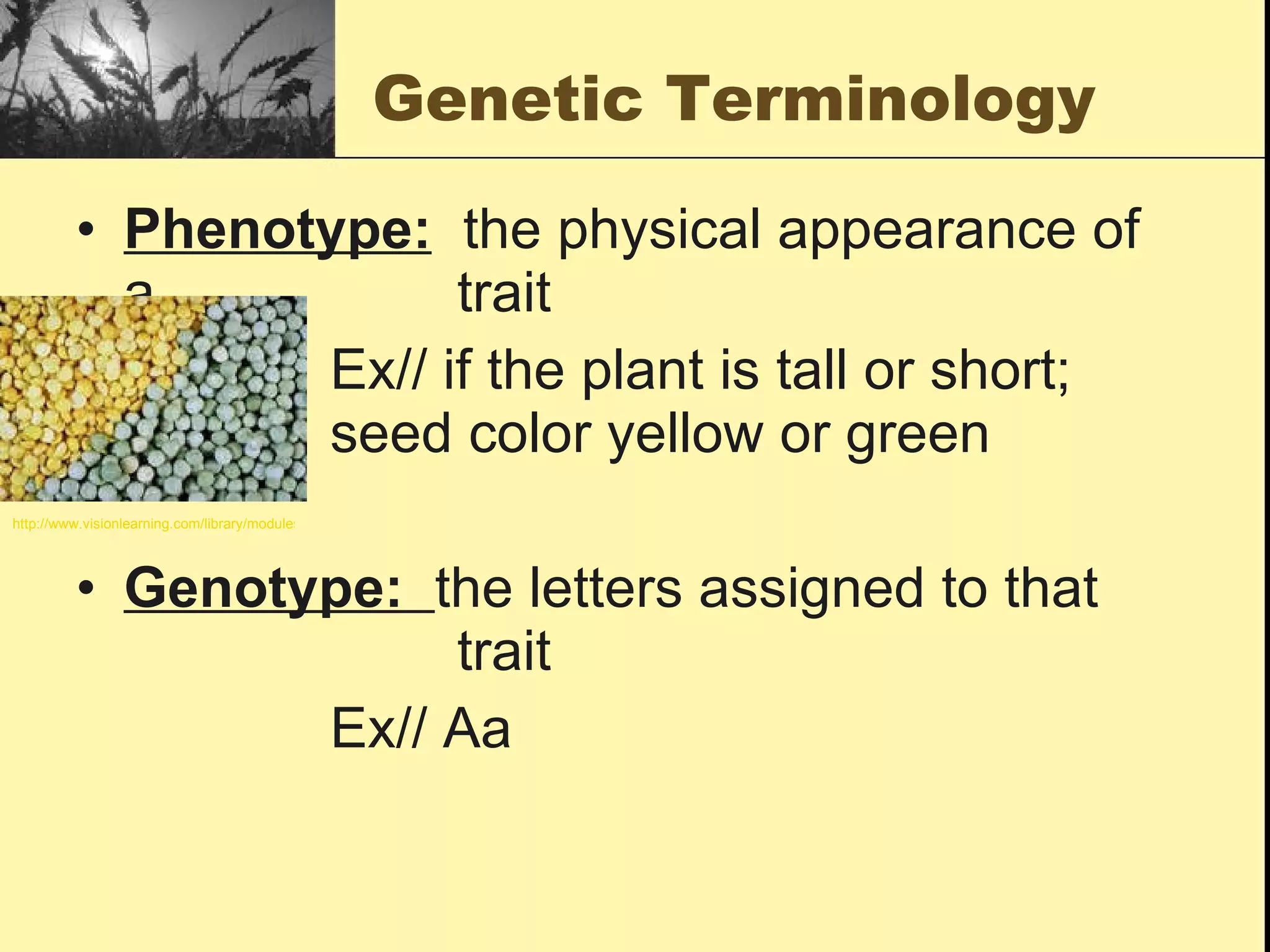
Genetic Terminology Phenotype:   the physical appearance of a  trait Ex// if the plant is tall or short;  seed color yellow or green Genotype:  the letters assigned to that  trait Ex// Aa http://www.visionlearning.com/library/modules/mid129/Image/VLObject-3225-050214020235.jpg
Genetic Terminology Allele:   is an alternate form of a single gene Ex//  the unit factors  round  and  wrinkled  are alleles that make up  seed shape.
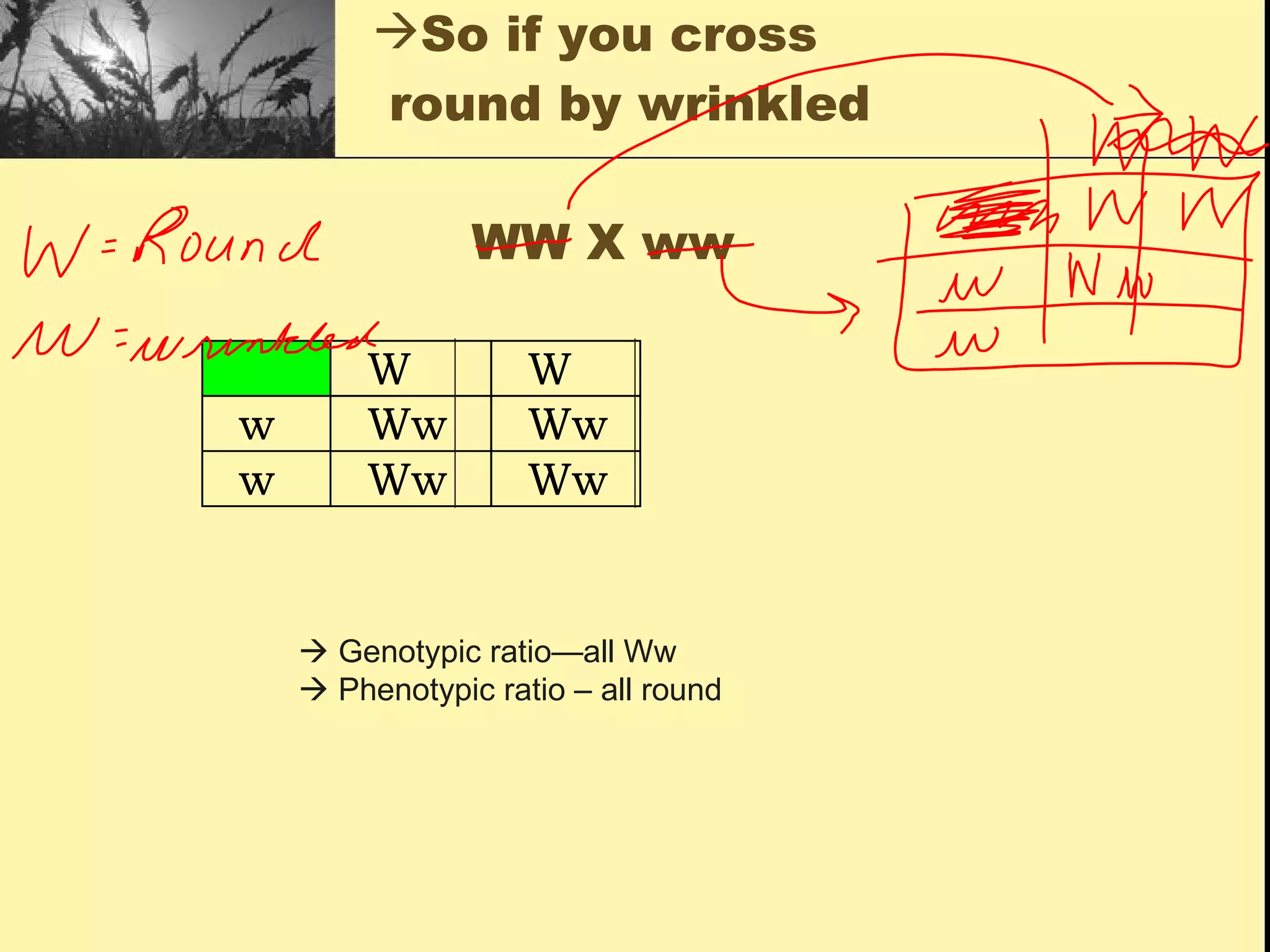
Hints for working with genetic traits . . .  traits are assigned letters the  recessive  trait usually provides the letter designate Ex// round vs. wrinkled = W= round w= wrinkled ( be sure to keep your writing  neat  enough so that you can read the letters) Capital  letters refer to  dominant  traits while  lower  case letters refer to  recessive  traits Letters usually appear in  pairs Ex// Round = WW vs Wrinkled = ww remember the genotype will tell you the phenotype.
Genetic Terminology Homozygous:   both alleles are the same  Ex// WW or ww HOMO = SAME Heterozygous:   when alleles are different Ex// Ww HETERO = DIFFERENT
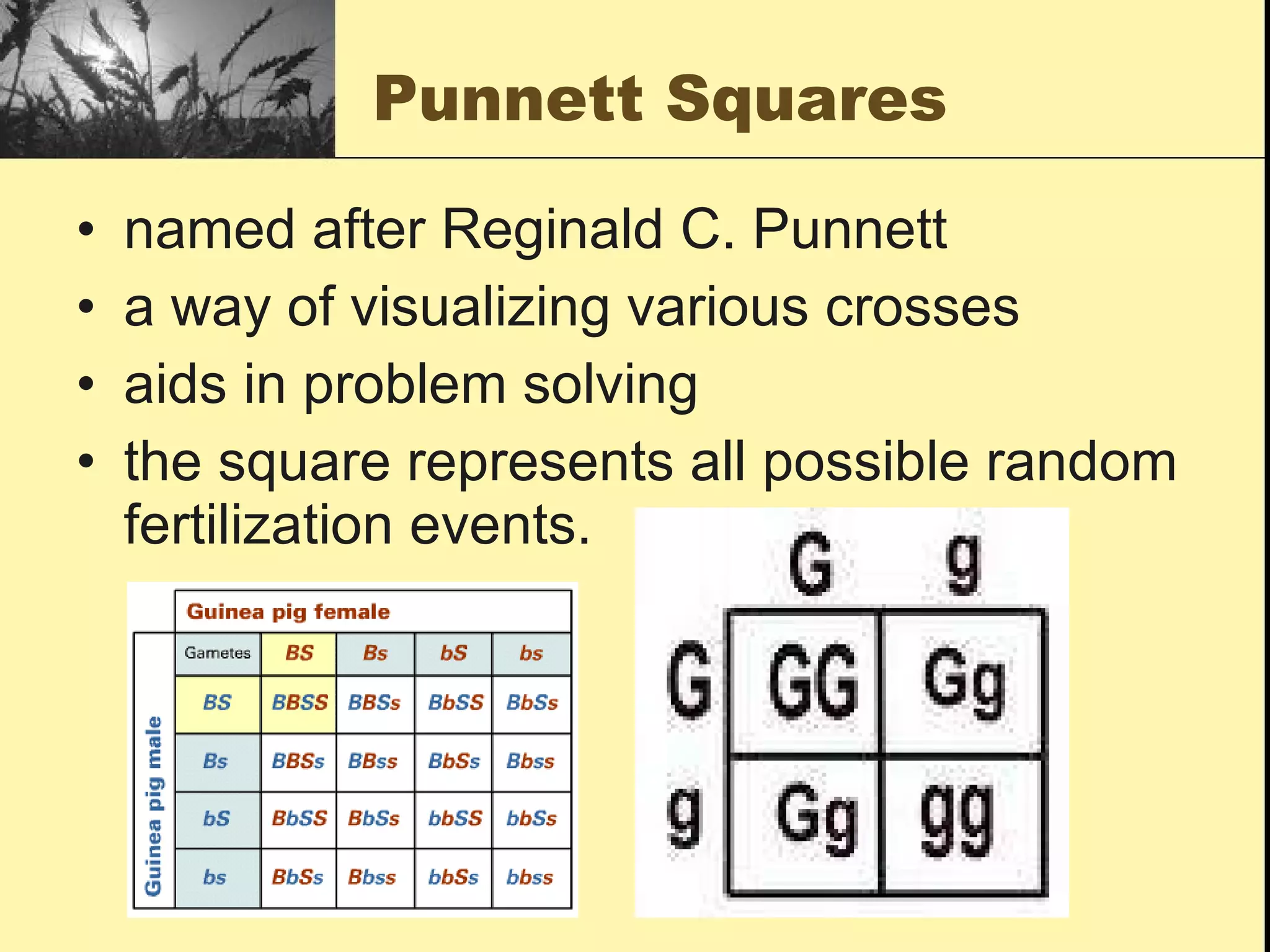
Punnett Squares named after Reginald C. Punnett a way of visualizing various crosses  aids in problem solving the square represents all possible random fertilization events.
So if you cross  round by wrinkled      WW X ww    Genotypic ratio—all Ww    Phenotypic ratio – all round
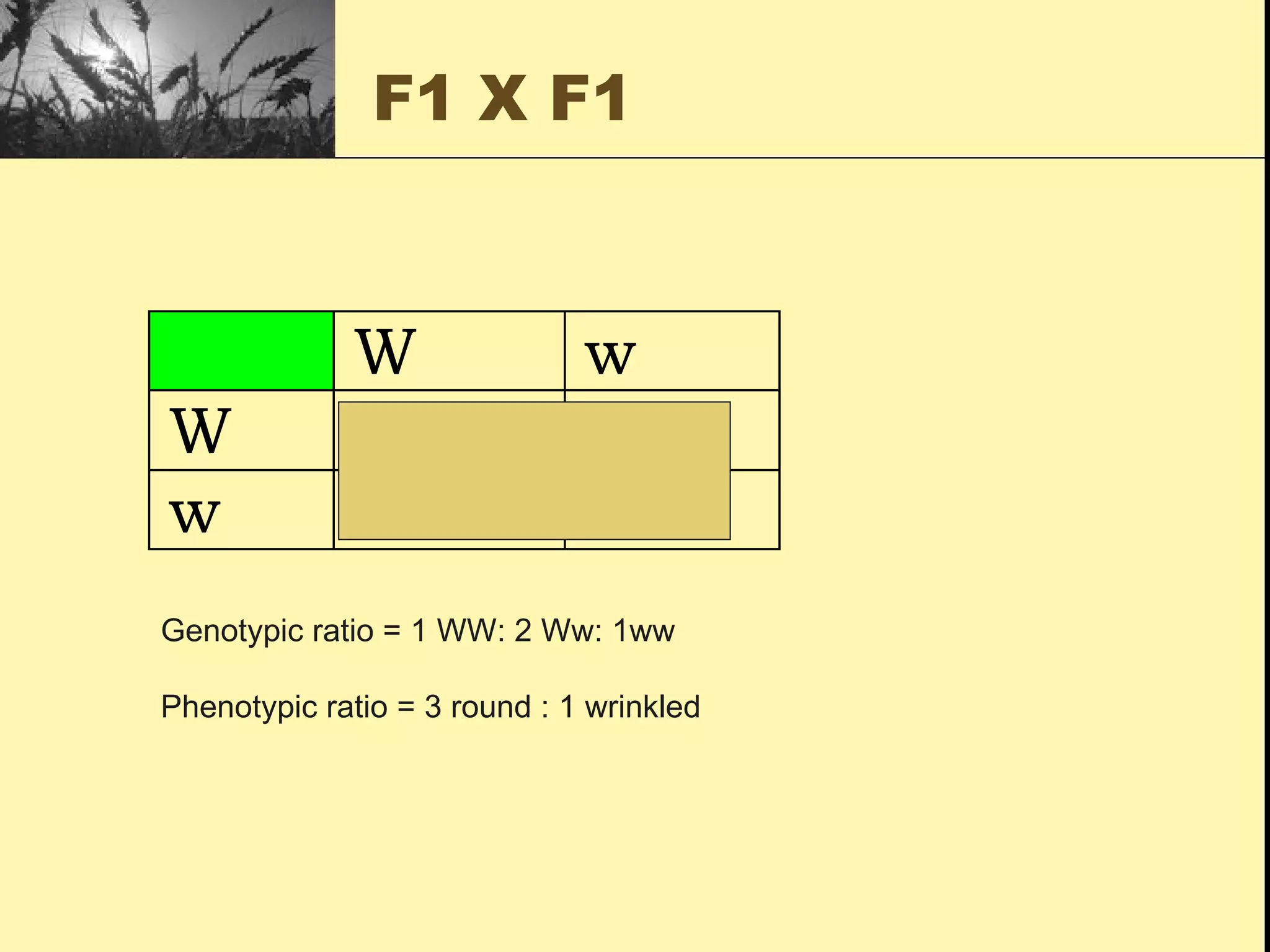
F1 X F1 Genotypic ratio = 1 WW: 2 Ww: 1ww Phenotypic ratio = 3 round : 1 wrinkled
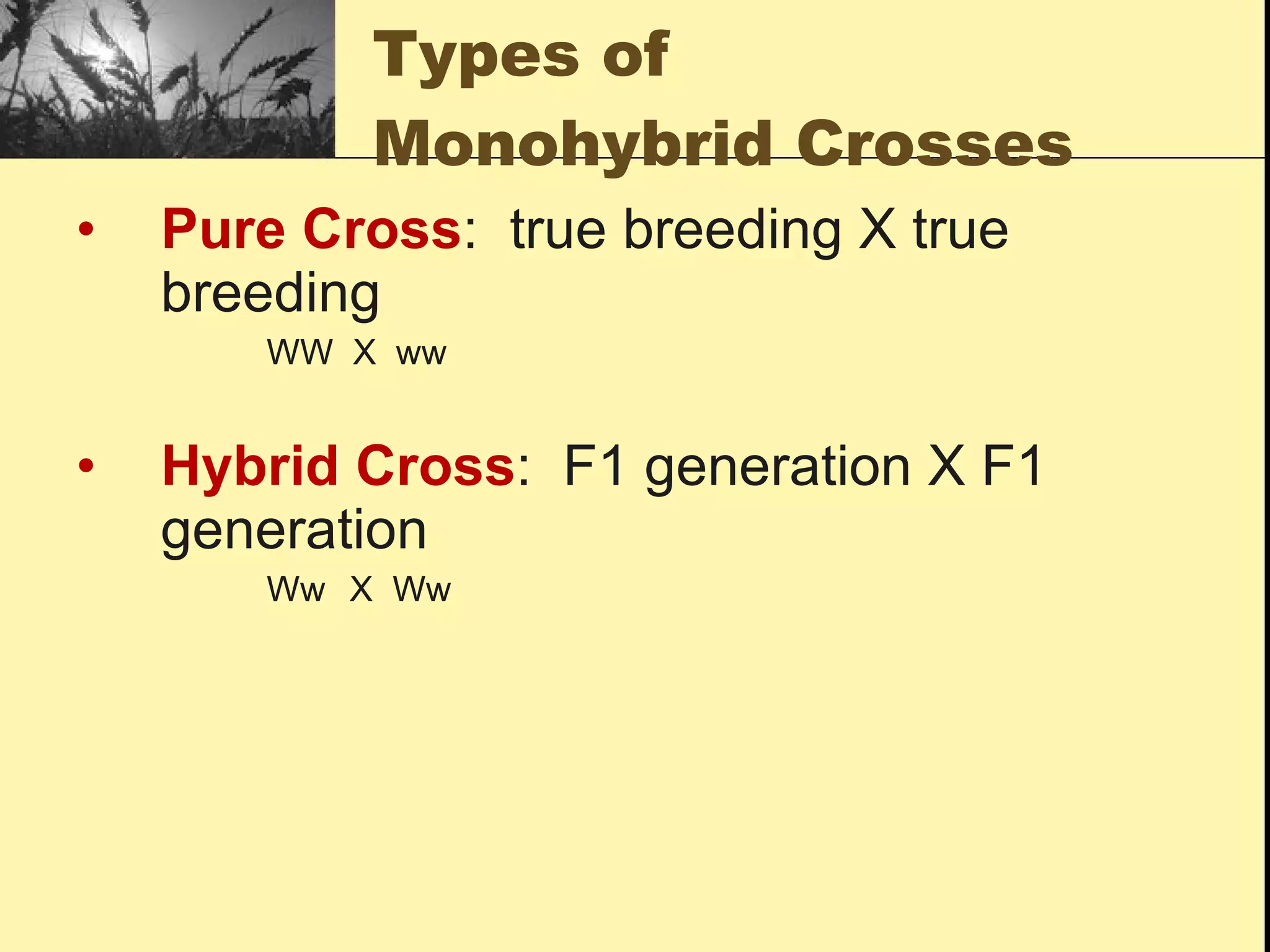
Types of  Monohybrid Crosses Pure Cross :  true breeding X true breeding WW  X  ww Hybrid Cross :  F1 generation X F1 generation Ww   X  Ww
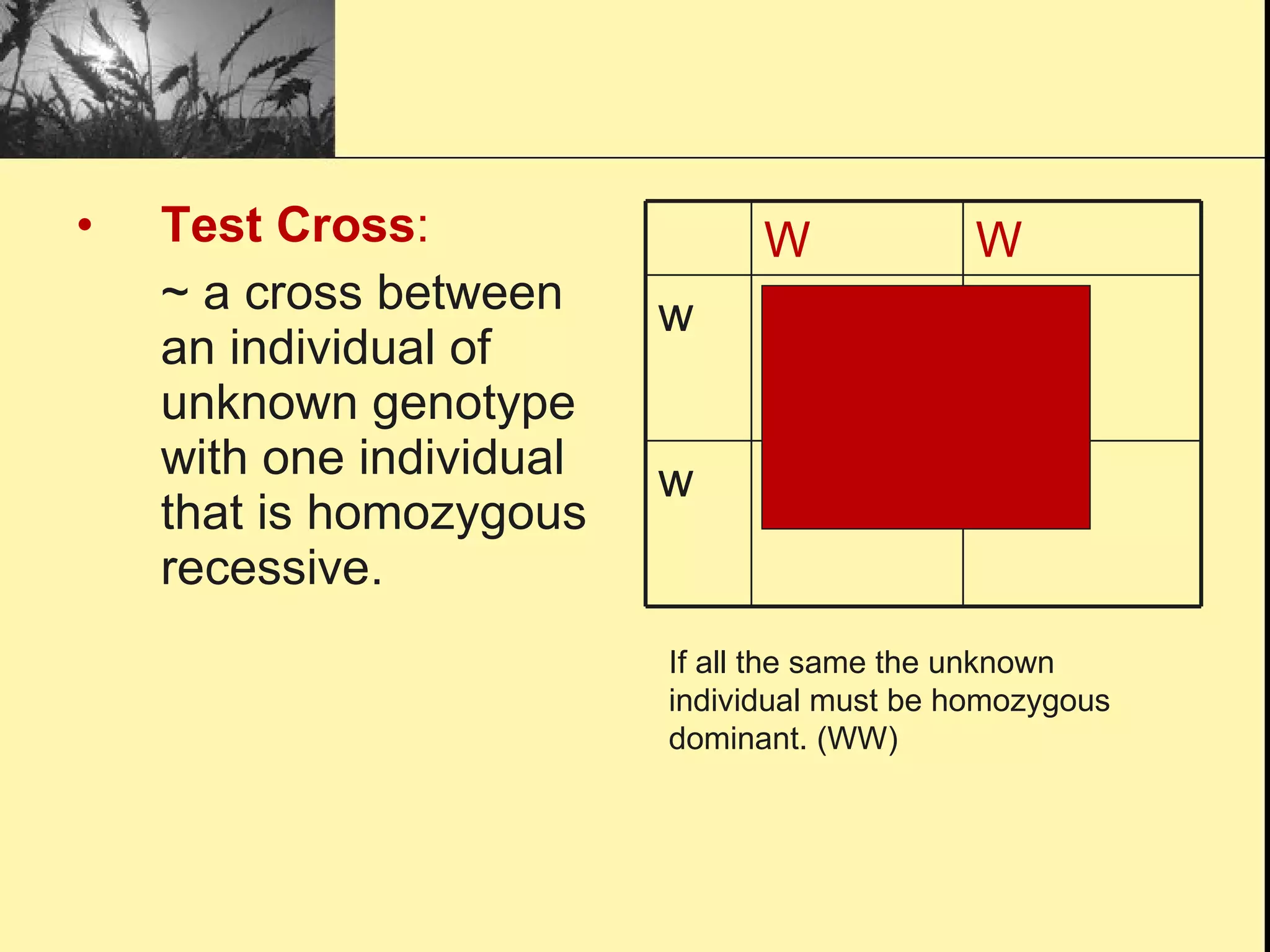
Test Cross :   ~ a cross between an individual of unknown genotype with one individual that is homozygous recessive. If all the same the unknown individual must be homozygous dominant. (WW) Ww Ww w Ww Ww w W W
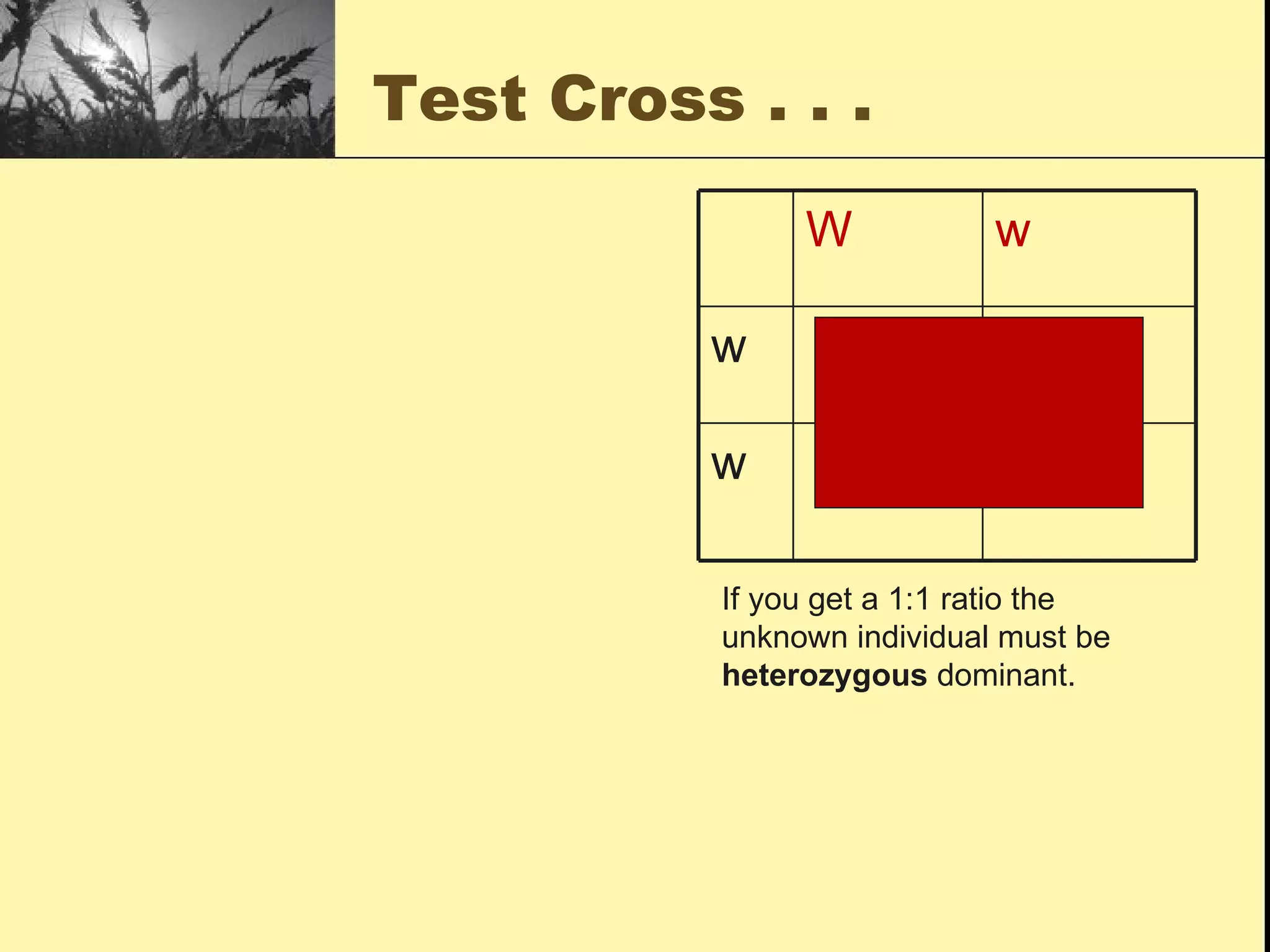
Test Cross . . .  If you get a 1:1 ratio the unknown individual must be  heterozygous  dominant. ww Ww w ww Ww w w W
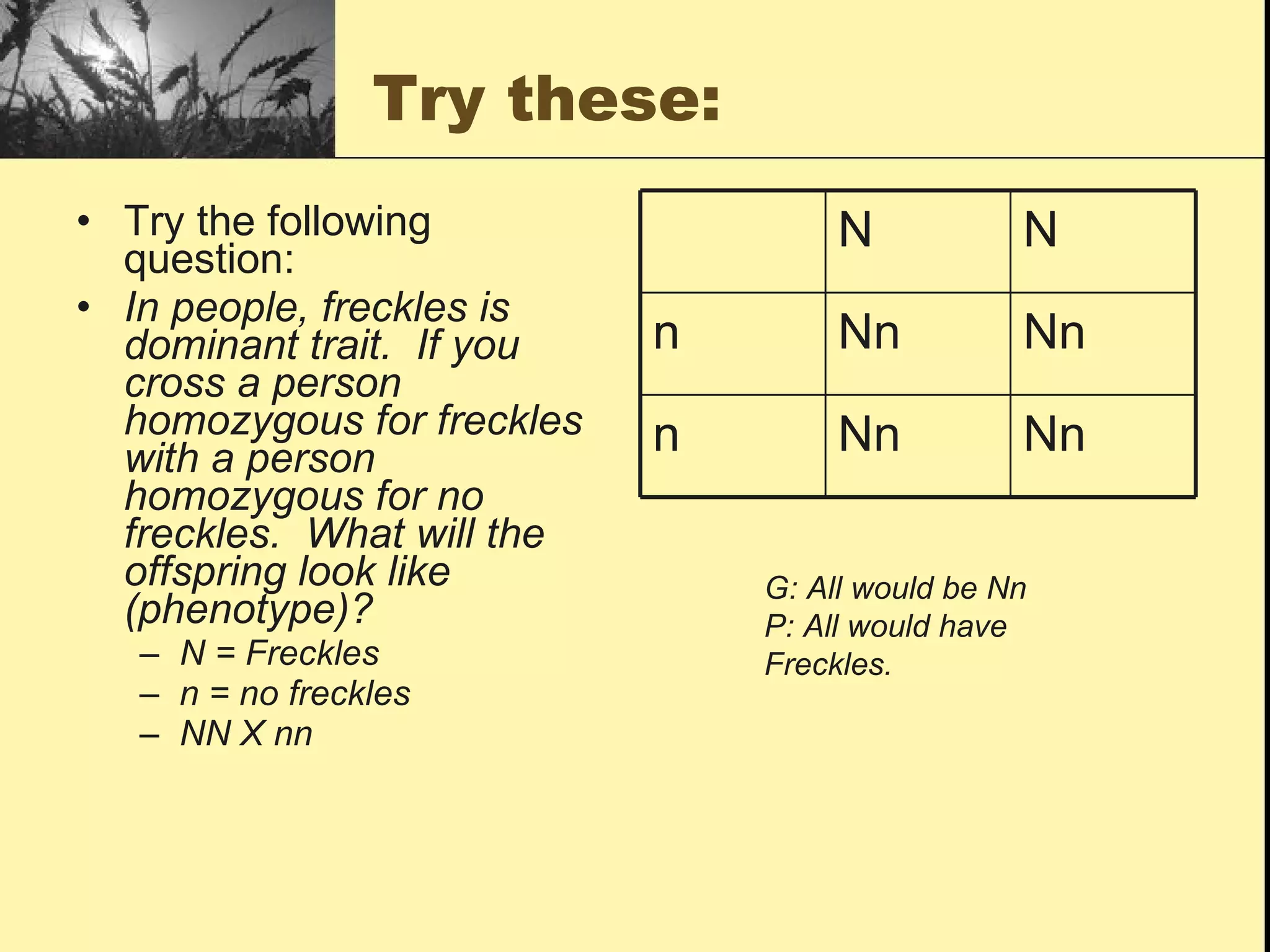
Try these: Try the following question: In people, freckles is dominant trait.  If you cross a person homozygous for freckles with a person homozygous for no freckles.  What will the offspring look like (phenotype)? N = Freckles n = no freckles NN X nn G: All would be Nn P: All would have Freckles. n n N N Nn Nn n Nn Nn n N N
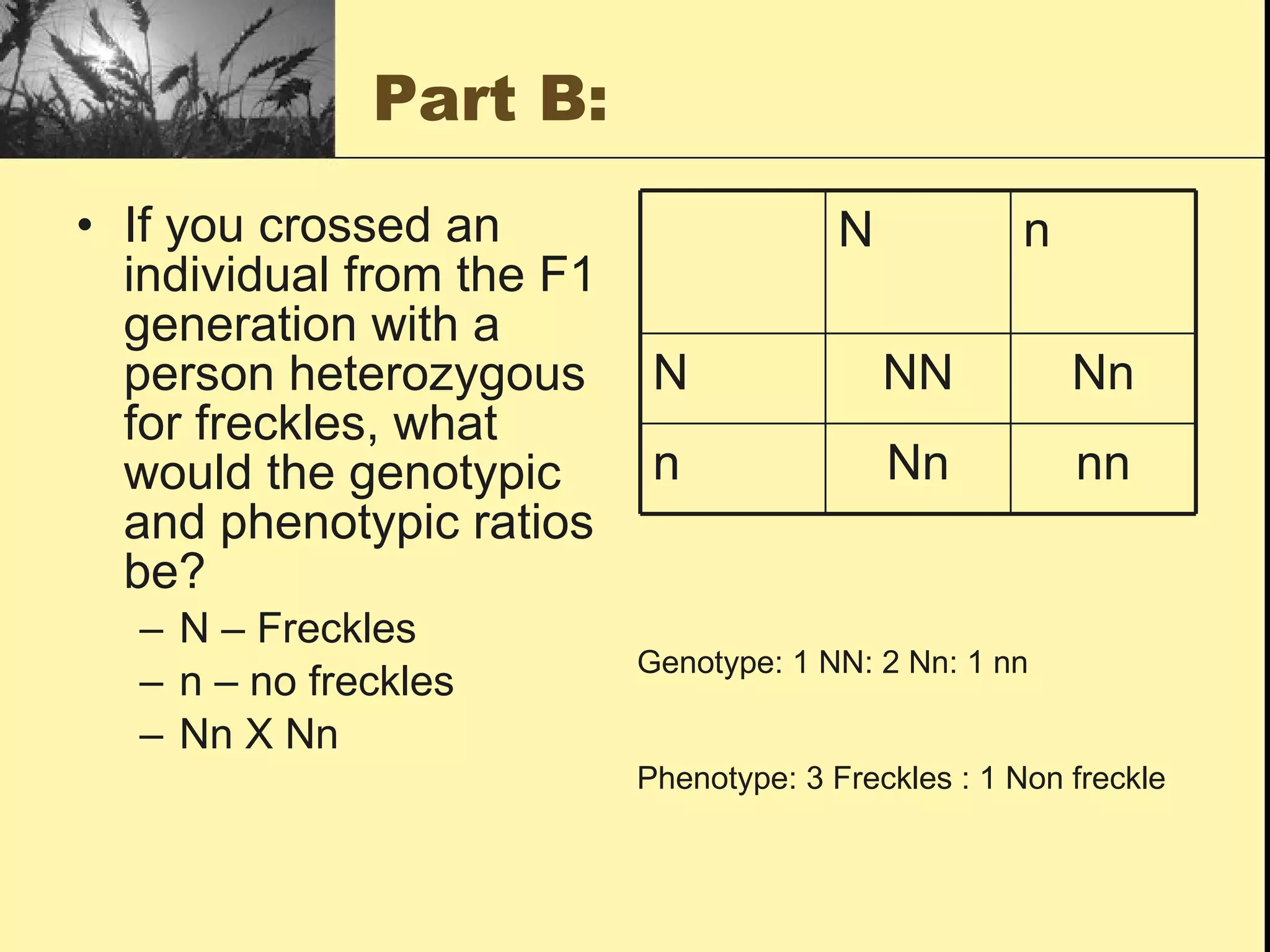
Part B: If you crossed an individual from the F1 generation with a person heterozygous for freckles, what would the genotypic and phenotypic ratios be? N – Freckles n – no freckles Nn X Nn Genotype: 1 NN: 2 Nn: 1 nn Phenotype: 3 Freckles : 1 Non freckle n N n N nn Nn n Nn NN N n N
Now Try Next try the assigned questions in the  Bio 30 duotang: Monohybrid Crosses
Resource Websites: Science of Heredity.  http://fig.cox.miami.edu/~cmallery/150/mendel/heredity.htm

Genetics Intro Powerpoint

  • 1.
    Biology 30 –Unit 3 ~Mrs. S. Pipke-Painchaud Genetics Overview
  • 2.
    What is Genetics? - a branch of biology that deals with the heredity of an organism It is a field in which every year large numbers of significant findings are made. Over the past 5 decades, no five year period has passed without the establishment of 1 or more major research frontiers in genetics.
  • 3.
    Genetics is ascience, which surrounds us and determines our everyday lives. Just look at the person next to you ( everyone is unique and different because of their genes) It is not known when people first recognized the existence of heredity; however, archeologists have discovered evidence (primitive art, preserved bones, skulls and dried seeds), which suggests that animals were domesticated and plants were cultivated thousands of years ago.
  • 4.
    Selection of AnimalsBetween 8000 and 10 000 B.C.  horses, camels, oxen and various breeds of dogs (dogs are derived from the wolf family) were domesticated to serve various roles.
  • 5.
    Evolution Homepage. http://www.nwcreation.net/dogsandwolves.html Likely domesticated in China about 15 000 years ago. (Ev Homepage)
  • 6.
    For example, horsesArabian horses: this breed was developed in the deserts of the Middle East by the nomadic tribes that lived there. Eventually, the desert breed developed into 4 different strains. (i.e Polish, Spanish, Egyptian, Russian) many horse breeders keep detailed pedigrees, which show the ancestors of the animal that they own.
  • 7.
  • 8.
    Pedigrees are similarto family trees in Roman times they grafted plants and bred animals to obtain desired traits or characteristics. Eventually, Darwin and Mendel began to develop the theories of genetics  which is where we will start our study of genetics
  • 9.
    Why is Geneticsimportant to society? Agriculture (genetically engineered plants, wheat resistant to rust) Livestock (different breeds, leaner beef, polled vs. horned cattle) Medicine (to discover the cancer causing gene, diagnose a disease, gene therapy, genetic screening, etc.)
  • 10.
    Gregor Johann MedelThe Father of Genetics 1822-1884 Austrian Monk born to a peasant family in Heinzendorf (Czech Republic) – July 22, 1822 Was considered an excellent student in high school Then he studied philosophy for several years In 1843, he was admitted to the Augustinian Monastery of St.Thomas in Brno Here he took the name of Gregor and received important support for his studies and research Pictures & more info available from: (Zephyrus http:// www.zephyrus.co.uk/gregormendel.html )
  • 11.
    The Austrian Monastery Wikipedia. http://en.wikipedia.org/wiki/Image:StThomasAbbeyBrno.jpg
  • 12.
    In 1849, hewas relived of his pastoral duties and accepted a teaching appointment From 1851 – 1853, he attended the University of Vienna to study physics and botany He was sent to the University of Vienna for a teaching certificate. He did not pass the exams because he was too nervous and was not considered a clever student. (Zephyrus)
  • 13.
    In 1854, hereturned to Brno where he performed his first pea hybridization experiment in 1856 He continued to research until 1864 when he became the abbot of the monastery. Some did not appreciate the work that Mendel was doing because he did not focus completely on the religious side. Mendel was interested in the work of Charles Darwin. (Zephyrus) In 1884, he died of kidney disease The new abbot burned his papers. (Zephyrus) Mendel Web: http://www.mendelweb.org/images/lathyrus.mar.GIF
  • 14.
    The local newspapersaid this: “His death deprives the poor of a benefactor, and mankind at large of a man of the nobliest character, one who was a warm friend, a promoter of the natural sciences and an exemplary priest.” Mendel’s work was not understood or appreciated while he was alive and it wasn’t until the 1900s and even into the 1920s and 30s when people truly understood what he had discovered. (Zephyrus)
  • 15.
    Mendel’s Experiments conductedexperiments with pisum sativum – the garden pea he wasn’t the first scientist to study the garden pea, but he was one who distinguished himself from others through 1) careful planning and 2) adherence to the scientific method his work, however, was largely ignored by others until Correns, de Vries, Tschenmak and Bateson all came up with the same ideas.
  • 16.
    Mendel Selected theGarden Pea because . . . it was cheap and readily available as seed in a variety of shapes and colors. Normally self pollinates It’s easy to cross pollinate Takes up little space Have relatively short generation time (single season) Produces many offspring (1 pod = 6-10 peas)
  • 17.
    Consider the time. . . Remember that when Mendel was conducting these experiments there was no knowledge of chromosomes or the role and mechanisms of meiosis. Regardless, Mendel was still able to find distinct units of inheritance existed and then he used this information to predict the behavior of gametes during their formation.
  • 18.
    Selected Characteristics flowercolor: purple or white flower position: axil or terminal stem length: tall or dwarf pod shape: inflated or constricted seed shape: round or wrinkled seed color: yellow or green pod color: yellow or green ** notice that each unit has a contrasting characteristic
  • 19.
    ** all strainsused were “ true breeding ” peas seeds offspring looks like the parent i.e. white flowers give rise to white flowers each trait (characteristic) remains unchanged generation after generation. ** TRAIT : is a characteristic that is heritable from one generation to the next.
  • 20.
  • 21.
    Science Quarterly. http://www.scq.ubc.ca/a-monks-flourishing-garden-the-basics-of-molecular-biology-explained/
  • 22.
    Mendel’s Experiments weresuccessful because. . . he choose peas he restricted his study to a few contrasting traits he kept accurate quantitative records his analysis of the data allowed for certain postulates to be developed which provided the underlying basis for transmission genetics
  • 23.
    The Experiment 1ST: Cross true breeding pea plants that had different characteristics with each other. 2nd: he would examine the peas and record the results 3rd: he would collect the seeds that were the result of the cross and then plant these seeds and then collect data on them
  • 24.
    Example: Round/Wrinkled1st: Parent 1 (Round) X Parent 2 (wrinkled) 2nd: First Filial Generation = F1 3rd: F1 X F1 = F2 or second filial generation http://www.mendelu.cz/images/mendel_krizeni2.png
  • 25.
    Monohybrid Cross MonohybridCross : consider only one trait Round X Wrinkled F1 = all round seeds so the next season Mendel planted 253 F1 plants F1 X F1 = F2 produced 7 324 seeds 5 474 Round 1 850 Wrinkled http://fig.cox.miami.edu/~cmallery/150/mendel/sf10x4.jpg
  • 26.
    Terminology Dominant: when one characteristic expresses itself over the other i.e. round over wrinkled Recessive: the trait that does not show through in the first generation i.e. wrinkled
  • 27.
    The Experiment cont’dhe repeated these experiments for all of the other characteristics and in each case a 3:1 ratio appeared 3 dominant : 1 recessive
  • 28.
    Mendel’s Laws ofHeredity The Law of Unit Factors in Pairs Genetic characters are controlled by unit factors that exist in pairs in individual organisms. unit factors are genes. Ex.. a monohybrid cross for round and wrinkled provides three combinations 2 factors for round 1 factor round 1 factor wrinkled 2 factors for wrinkled every individual must have one of these three combos
  • 29.
    The Law ofDominance When 2 unlike unit factors are responsible for a single character and are present in a single individual, one unit factor is dominant to the other, which is said to be recessive. Ex.. look at monohybrid crosses and the f1 generation One gene pair may mask or prevent the expression of the other.
  • 30.
    The Law ofSegregation During the formation of gametes, the paired unit factors separate from each other sot that each gamete receives one or the other. Ex.. think back to what happens in meiosis http://www.animalgenome.org/edu/genetics/meiosis.gif
  • 31.
    Mendel’s Reasoning p1plants that were true-breeding round had 2 unit factors for round p2 plants also had two unit factors for wrinkled gametes of the parents each received one unit factor after fertilization all f1 plants had 1 unit factor from round and 1 from wrinkled when the f2 gametes are formed there are 4 possible random outcomes r/r; r/w; w/w; w/r according to the law of dominance 1 and 4 will be round as well Therefore, you get a three to one ratio
  • 32.
    Genetic Terminology Gene: Mendel’s unit factor; found at a specific point on the chromosome; carries the information for a specific trait Ex// seed shape http://www.ndsu.edu/instruct/mcclean/plsc431/mendel/peashape.gif
  • 33.
    Genetic Terminology Phenotype: the physical appearance of a trait Ex// if the plant is tall or short; seed color yellow or green Genotype: the letters assigned to that trait Ex// Aa http://www.visionlearning.com/library/modules/mid129/Image/VLObject-3225-050214020235.jpg
  • 34.
    Genetic Terminology Allele: is an alternate form of a single gene Ex// the unit factors round and wrinkled are alleles that make up seed shape.
  • 35.
    Hints for workingwith genetic traits . . . traits are assigned letters the recessive trait usually provides the letter designate Ex// round vs. wrinkled = W= round w= wrinkled ( be sure to keep your writing neat enough so that you can read the letters) Capital letters refer to dominant traits while lower case letters refer to recessive traits Letters usually appear in pairs Ex// Round = WW vs Wrinkled = ww remember the genotype will tell you the phenotype.
  • 36.
    Genetic Terminology Homozygous: both alleles are the same Ex// WW or ww HOMO = SAME Heterozygous: when alleles are different Ex// Ww HETERO = DIFFERENT
  • 37.
    Punnett Squares namedafter Reginald C. Punnett a way of visualizing various crosses aids in problem solving the square represents all possible random fertilization events.
  • 38.
    So if youcross round by wrinkled WW X ww  Genotypic ratio—all Ww  Phenotypic ratio – all round
  • 39.
    F1 X F1Genotypic ratio = 1 WW: 2 Ww: 1ww Phenotypic ratio = 3 round : 1 wrinkled
  • 40.
    Types of Monohybrid Crosses Pure Cross : true breeding X true breeding WW X ww Hybrid Cross : F1 generation X F1 generation Ww X Ww
  • 41.
    Test Cross : ~ a cross between an individual of unknown genotype with one individual that is homozygous recessive. If all the same the unknown individual must be homozygous dominant. (WW) Ww Ww w Ww Ww w W W
  • 42.
    Test Cross .. . If you get a 1:1 ratio the unknown individual must be heterozygous dominant. ww Ww w ww Ww w w W
  • 43.
    Try these: Trythe following question: In people, freckles is dominant trait. If you cross a person homozygous for freckles with a person homozygous for no freckles. What will the offspring look like (phenotype)? N = Freckles n = no freckles NN X nn G: All would be Nn P: All would have Freckles. n n N N Nn Nn n Nn Nn n N N
  • 44.
    Part B: Ifyou crossed an individual from the F1 generation with a person heterozygous for freckles, what would the genotypic and phenotypic ratios be? N – Freckles n – no freckles Nn X Nn Genotype: 1 NN: 2 Nn: 1 nn Phenotype: 3 Freckles : 1 Non freckle n N n N nn Nn n Nn NN N n N
  • 45.
    Now Try Nexttry the assigned questions in the Bio 30 duotang: Monohybrid Crosses
  • 46.
    Resource Websites: Scienceof Heredity. http://fig.cox.miami.edu/~cmallery/150/mendel/heredity.htm