Genetic Variation
www.alsa.org
Dr. G.D. HANDE
Goal
To learn the basic genetic
mechanisms that determines the traits
expressed by individuals in a
population
Natural Selection Theory
Variation in a population of organisms
Results of Mutations
Results of Immigration
Result of survival features of individual
organisms
Natural Selection Theory
Environments are dynamic
Changing resources
Climate (long term weather)
Natural disasters
Natural Selection Theory
Selective Pressure
Environmental changes can cause
pressure
Organisms unable to adapt quickly
enough will die
Organisms that adapt are able to pass
on their successful traits to future
generations
Natural Selection Theory
Isolation
If one portion of a population is
separated from another portion then a
new species may evolve
Natural Selection Theory
Mechanisms for population change
Key to change is variation among the
individuals in the population
Individuals are unique due to their genes
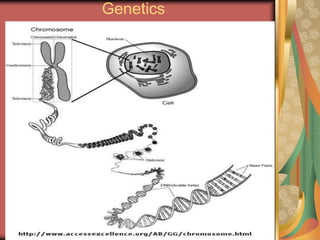
Genetics
Genetics
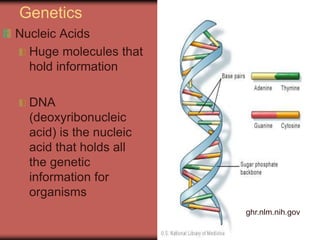
Nucleic Acids
Huge molecules that
hold information
DNA
(deoxyribonucleic
acid) is the nucleic
acid that holds all
the genetic
information for
organisms
ghr.nlm.nih.gov
DNA
Genetic code of all living things
Complete set of blueprints and operating
instructions for assembling and managing
one particular kind of organism
Has four basic building blocks
Adenine (A)
Thymine (T)
Guanine (G)
Cytosine (C)
DNA
A and T can only bond with each
other
G and C can only bond with each
other
When four bases bond together in a
long chain they form a double helix
(ladder)
Typical DNA molecule may be about
5 cm long
DNA
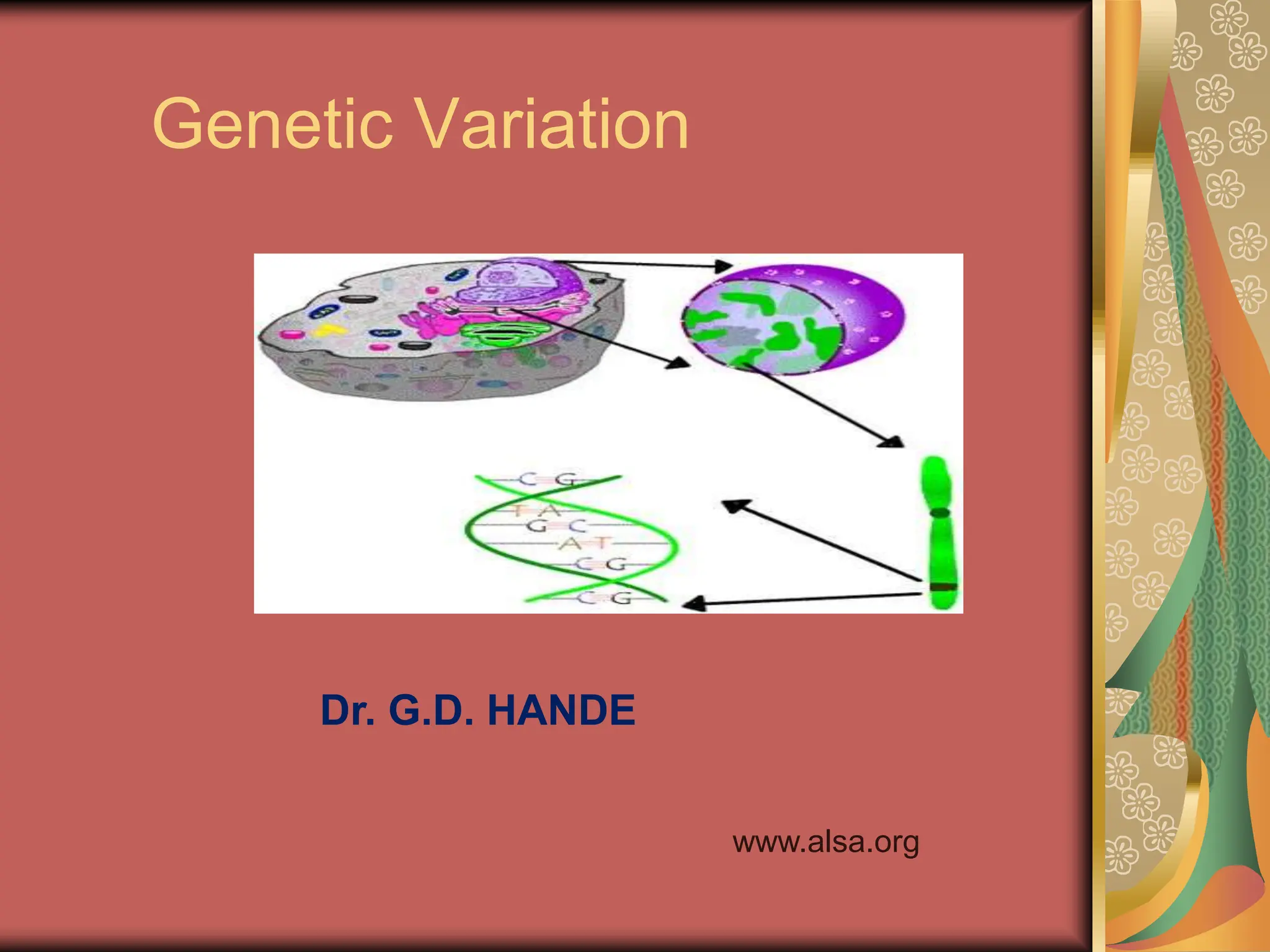
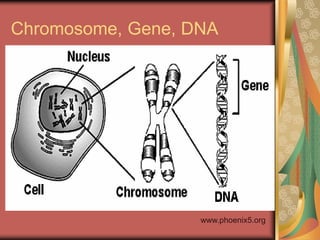
DNA found in the nucleus of the cell
DNA is coiled into a compact structure
called a chromosome
Every cell in every plant and animal has a
completed set of chromosomes that define
the organism
Every time the cell divides to produce two
daughter cells the complete set of
chromosomes is produced
Chromosome, Gene, DNA
www.phoenix5.org
Genes determine traits
Genes: are the units of heredity that is a
sequence of bases (A,T,G,C) that give
instructions on how to assemble a certain
protein
Genes are the sugars, phosphates, and
bases along the DNA strand in the
chromosome
The proteins go to the cells to make things
such as fats, bone, muscle, nerves, and
everything else in a living organism
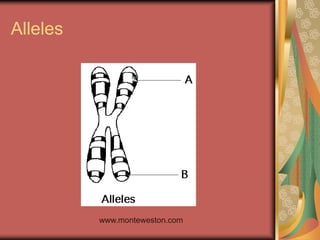
Alleles
www.monteweston.com
Alleles
Each gene has two copies which are called
the alleles.
(2 alleles= 1 gene)
Dominant allele the allele that controls
what will happen or which trait will be
exhibited (Capital Letter)
Recessive allele the allele that is
“overruled” and this trait or function will not
be seen because of the dominant allele
(Lower case letter).
Punnett Squares
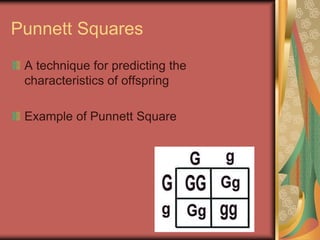
A technique for predicting the
characteristics of offspring
Example of Punnett Square
Punnett Square
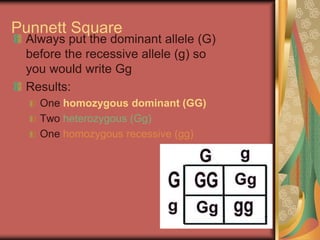
Always put the dominant allele (G)
before the recessive allele (g) so
you would write Gg
Results:
One homozygous dominant (GG)
Two heterozygous (Gg)
One homozygous recessive (gg)
Discovery of Heredity
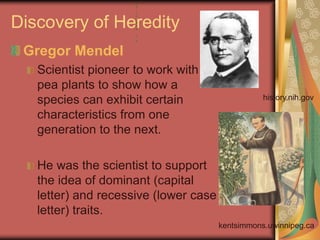
Gregor Mendel
Scientist pioneer to work with
pea plants to show how a
species can exhibit certain
characteristics from one
generation to the next.
He was the scientist to support
the idea of dominant (capital
letter) and recessive (lower case
letter) traits.
history.nih.gov
.
u
w
i
n
n
i
p
e
g
.
c
a
kentsimmons.uwinnipeg.ca
Genotype
Genotype
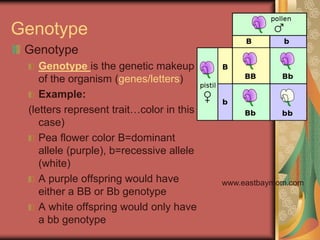
Genotype is the genetic makeup
of the organism (genes/letters)
Example:
(letters represent trait…color in this
case)
Pea flower color B=dominant
allele (purple), b=recessive allele
(white)
A purple offspring would have
either a BB or Bb genotype
A white offspring would only have
a bb genotype
www.eastbaymom.com
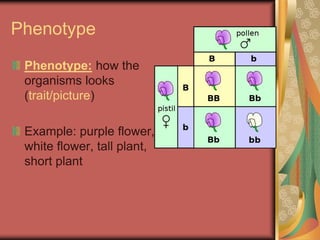
Phenotype
Phenotype: how the
organisms looks
(trait/picture)
Example: purple flower,
white flower, tall plant,
short plant
Inheritance
Inheritance is passing genetic
information from one generation to
the next
You inherited alleles from your
parents

Genetic Variation.ppt

  • 1.
  • 2.
    Goal To learn thebasic genetic mechanisms that determines the traits expressed by individuals in a population
  • 3.
    Natural Selection Theory Variationin a population of organisms Results of Mutations Results of Immigration Result of survival features of individual organisms
  • 4.
    Natural Selection Theory Environmentsare dynamic Changing resources Climate (long term weather) Natural disasters
  • 5.
    Natural Selection Theory SelectivePressure Environmental changes can cause pressure Organisms unable to adapt quickly enough will die Organisms that adapt are able to pass on their successful traits to future generations
  • 6.
    Natural Selection Theory Isolation Ifone portion of a population is separated from another portion then a new species may evolve
  • 7.
    Natural Selection Theory Mechanismsfor population change Key to change is variation among the individuals in the population Individuals are unique due to their genes
  • 8.
  • 9.
    Genetics Nucleic Acids Huge moleculesthat hold information DNA (deoxyribonucleic acid) is the nucleic acid that holds all the genetic information for organisms ghr.nlm.nih.gov
  • 10.
    DNA Genetic code ofall living things Complete set of blueprints and operating instructions for assembling and managing one particular kind of organism Has four basic building blocks Adenine (A) Thymine (T) Guanine (G) Cytosine (C)
  • 11.
    DNA A and Tcan only bond with each other G and C can only bond with each other When four bases bond together in a long chain they form a double helix (ladder) Typical DNA molecule may be about 5 cm long
  • 12.
    DNA DNA found inthe nucleus of the cell DNA is coiled into a compact structure called a chromosome Every cell in every plant and animal has a completed set of chromosomes that define the organism Every time the cell divides to produce two daughter cells the complete set of chromosomes is produced
  • 13.
  • 14.
    Genes determine traits Genes:are the units of heredity that is a sequence of bases (A,T,G,C) that give instructions on how to assemble a certain protein Genes are the sugars, phosphates, and bases along the DNA strand in the chromosome The proteins go to the cells to make things such as fats, bone, muscle, nerves, and everything else in a living organism
  • 15.
  • 16.
    Alleles Each gene hastwo copies which are called the alleles. (2 alleles= 1 gene) Dominant allele the allele that controls what will happen or which trait will be exhibited (Capital Letter) Recessive allele the allele that is “overruled” and this trait or function will not be seen because of the dominant allele (Lower case letter).
  • 17.
    Punnett Squares A techniquefor predicting the characteristics of offspring Example of Punnett Square
  • 18.
    Punnett Square Always putthe dominant allele (G) before the recessive allele (g) so you would write Gg Results: One homozygous dominant (GG) Two heterozygous (Gg) One homozygous recessive (gg)
  • 19.
    Discovery of Heredity GregorMendel Scientist pioneer to work with pea plants to show how a species can exhibit certain characteristics from one generation to the next. He was the scientist to support the idea of dominant (capital letter) and recessive (lower case letter) traits. history.nih.gov . u w i n n i p e g . c a kentsimmons.uwinnipeg.ca
  • 20.
    Genotype Genotype Genotype is thegenetic makeup of the organism (genes/letters) Example: (letters represent trait…color in this case) Pea flower color B=dominant allele (purple), b=recessive allele (white) A purple offspring would have either a BB or Bb genotype A white offspring would only have a bb genotype www.eastbaymom.com
  • 21.
    Phenotype Phenotype: how the organismslooks (trait/picture) Example: purple flower, white flower, tall plant, short plant
  • 22.
    Inheritance Inheritance is passinggenetic information from one generation to the next You inherited alleles from your parents