Generative AI forResearch (PhD
Level)
Advanced Methods, Case Studies,
and Ethical Research Practices
2.
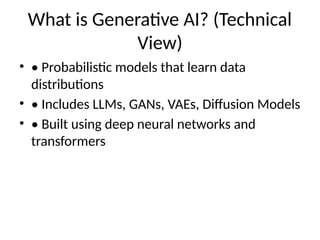
What is GenerativeAI? (Technical
View)
• • Probabilistic models that learn data
distributions
• • Includes LLMs, GANs, VAEs, Diffusion Models
• • Built using deep neural networks and
transformers
3.
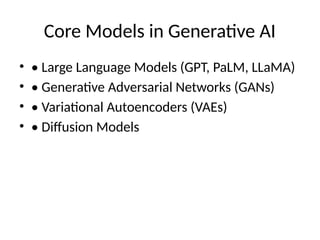
Core Models inGenerative AI
• • Large Language Models (GPT, PaLM, LLaMA)
• • Generative Adversarial Networks (GANs)
• • Variational Autoencoders (VAEs)
• • Diffusion Models
4.
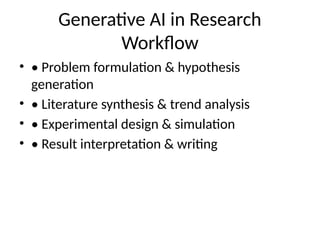
Generative AI inResearch
Workflow
• • Problem formulation & hypothesis
generation
• • Literature synthesis & trend analysis
• • Experimental design & simulation
• • Result interpretation & writing
5.
Advanced Literature Reviewusing
LLMs
• • Semantic search over large corpora
• • Automatic summarization and clustering
• • Citation mapping and gap identification
6.
Data Generation &Augmentation
• • Synthetic data for scarce datasets
• • Privacy-preserving data generation
• • Bias mitigation through controlled sampling
7.
Case Study 1:Biomedical Research
• • Protein structure prediction
• • Drug discovery and molecule generation
• • Clinical report summarization
8.
Case Study 2:Engineering &
Computing
• • Automated code generation and verification
• • Design optimization using generative models
• • Simulation-based research acceleration
9.
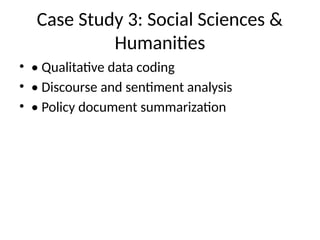
Case Study 3:Social Sciences &
Humanities
• • Qualitative data coding
• • Discourse and sentiment analysis
• • Policy document summarization
10.
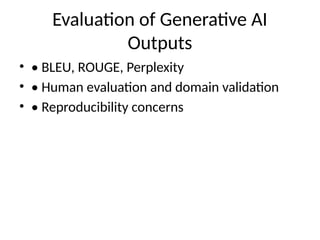
Evaluation of GenerativeAI
Outputs
• • BLEU, ROUGE, Perplexity
• • Human evaluation and domain validation
• • Reproducibility concerns
11.
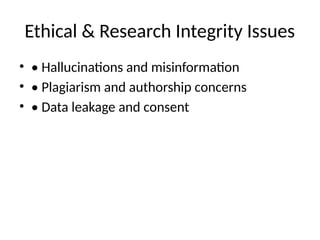
Ethical & ResearchIntegrity Issues
• • Hallucinations and misinformation
• • Plagiarism and authorship concerns
• • Data leakage and consent
12.
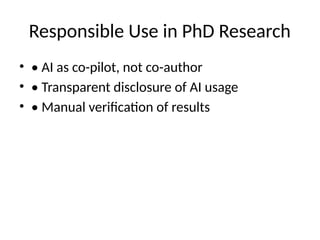
Responsible Use inPhD Research
• • AI as co-pilot, not co-author
• • Transparent disclosure of AI usage
• • Manual verification of results
13.
Future Directions
• •Autonomous research agents
• • Multi-modal AI for science
• • AI-driven hypothesis testing
14.
Conclusion
• Generative AIcan significantly enhance PhD
research productivity when applied with
technical rigor, ethical awareness, and critical
thinking.
Editor's Notes
#1 Introduce Generative AI as a paradigm shift in research methodology. Emphasize doctoral-level expectations: rigor, validation, and ethics.
#2 Explain transformer architecture, attention mechanism, and training on large corpora.
#3 Highlight mathematical foundations and loss functions of each model.



![[DSC Adria 23] Muthu Ramachandran AI Ethics Framework for Generative AI such ...](https://cdn.slidesharecdn.com/ss_thumbnails/muthuramachandranaiethicsframeworkforgenerativeaisuchaschatgptdscmay2023-230530191644-0a1125e3-thumbnail.jpg?width=640&height=640&fit=bounds)


