HAFSA SANIYA
ACCOUNTING
The process of identifying, measuring
and communicating economic
information to permit informed
judgments and decisions by the users
of account
(or)
Accounting is the art of recording,
classifying, and summarizing in a
significant manner
HAFSA SANIYA
General Accepted Accounting
Principal (GAAPs)
 Accounting is the language of business. Financial
statements prepared by the accountants
communicate financial information to the various
stakeholders for decision making purpose .
 Therefore , it is important that financial statement
prepared by the different organization should be
prepared on uniform basis. Also there should be
consistency over a period of time in the preparation
of these financial statements. It every accountant
starts following his own norms and notions for
accounting of different items then there will be an
utter confusion
HAFSA SANIYA
 To avoid confusion and to achieve uniformity,
accounting process is applied within the conceptual
framework of GAAPs.
 The term GAAPs is used to describe rules developed
for the preparation of the financial statement and are
called concepts, conventions, principles etc.
 The GAAPs are the backbone of accounting
information system, without which the whole system
cannot stand
erectly. These principles are the ground rules, which
defines the parameter and constraints within the
accounting reports are generated
 GAAPs is the set of common accounting principle,
standards and procedures
HAFSA SANIYA
ACCOUNTING PRINCIPLES
 Accounting principle are a body of doctrine
commonly associated with the theory and
procedures of accounting serving as an
explanation of current practices and as a guide
for selection of convention or procedures
 Provides fair image to the company
 Provides with different information:
-Revenue recognition
-Balance sheet item classification
-Outstanding share measurements
HAFSA SANIYA
III MAIN CATEGORIES OF
GAAPs
 ASSET: An asset is an item of value
owned by a company
 LIABILITIES: In accounting liabilities are
obligations of the company, to
transfer something of value to another
party
 EQUITY: Equity is the owner’s value in
an asset (or) group of assets
HAFSA SANIYA
GAAP PRINCIPLES
The GAAP principles are divided in to two
categories:
1. Accounting Concepts: Accounting
concepts are basic assumptions (or)
conditions upon which science of accounting
is based.
2. Accounting conventions: Accounting
conventions includes those customs and
traditions which followed up by an accountant
while preparing a financial statement.
HAFSA SANIYA
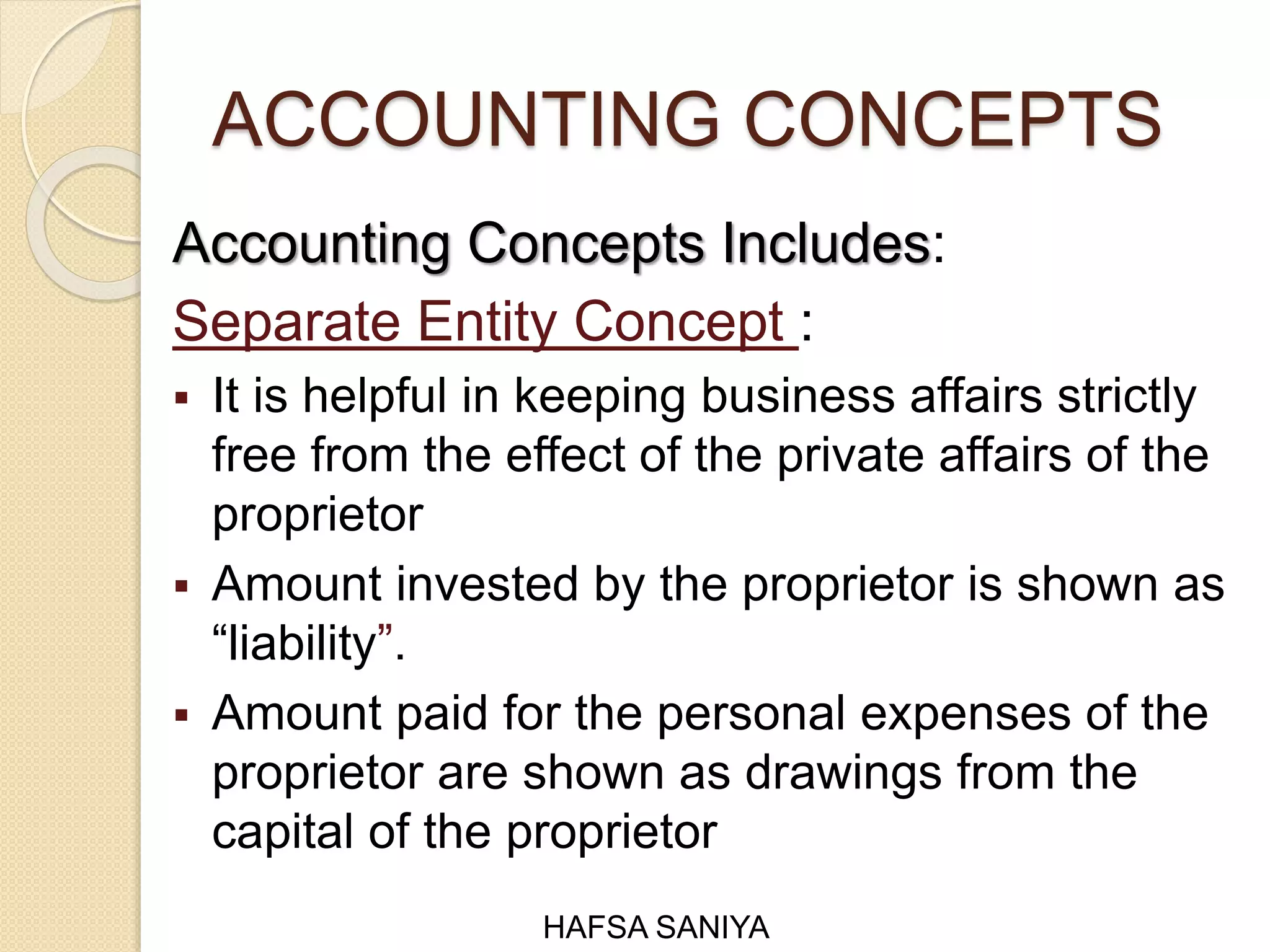
ACCOUNTING CONCEPTS
Accounting Concepts Includes:
Separate Entity Concept :
 It is helpful in keeping business affairs strictly
free from the effect of the private affairs of the
proprietor
 Amount invested by the proprietor is shown as
“liability”.
 Amount paid for the personal expenses of the
proprietor are shown as drawings from the
capital of the proprietor
HAFSA SANIYA
Money Measurement Concept :
 Only those transaction which can be recorded
in terms of money are recorded
 This is being used so as to provide a common
“yardstick” (i.e. money) for measurement
Dual Aspect Concept :
 Every business transaction has dual effect i.e. it
affects two accounts
 This is on accounting equation:
Liabilities=Asset
Owner’s equity + Outsider’s equity = Assets
 This definition can be explained as “for every
debit there is an equivalent credit”.
HAFSA SANIYA
Matching Concept :
It is the basis for recording expenses and
includes two steps:
 Identify all the expenses incurred during
the accounting period.
 Measure the expenses and match the
expenses against the revenue earned.
Revenue – cost = Net income (or) profit.
Going Concern Concept :
Business would continue to operate
indefinite in the future .Business will not
cease doing business ,neither; it will sell its
asset to pay off its liabilities
HAFSA SANIYA
Cost Concept :
 Asset and liabilities should be recorded at the historical cost
i.e. costs as on acquisition
Accounting Period Concept :
 Accounting period is the span of time, at the end of which
financial statement prepared to throw light on the result of the
operation as the end of a relevant period and the financial
position at the of the relevant period.
Realization Concept :
The revenue principle governs two things:
1. When to record revenue
2. Amount of revenue to record
To recognize revenue must be
Earned : Good are delivered (or) services are performed.
Realize : Cash (or) claim to credit is received in exchange for
goods and services rendered
HAFSA SANIYA
ACCOUNTING CONVENTIONS
Full Disclosure :
 Financial statement should be honestly prepared
and sufficiently, disclose information which is
material interest to proprietor present and potential
creditor and investor
Materiality :
 Only material (or) significant details are to be
recorded leaving the insignificant (or) minute
details. This is done to prevent over burning of
account
HAFSA SANIYA
THANK YOU
PREPARED BY HAFSA SANIYA

Generally Accepted Accounting Principles

  • 1.
  • 2.
    ACCOUNTING The process ofidentifying, measuring and communicating economic information to permit informed judgments and decisions by the users of account (or) Accounting is the art of recording, classifying, and summarizing in a significant manner HAFSA SANIYA
  • 3.
    General Accepted Accounting Principal(GAAPs)  Accounting is the language of business. Financial statements prepared by the accountants communicate financial information to the various stakeholders for decision making purpose .  Therefore , it is important that financial statement prepared by the different organization should be prepared on uniform basis. Also there should be consistency over a period of time in the preparation of these financial statements. It every accountant starts following his own norms and notions for accounting of different items then there will be an utter confusion HAFSA SANIYA
  • 4.
     To avoidconfusion and to achieve uniformity, accounting process is applied within the conceptual framework of GAAPs.  The term GAAPs is used to describe rules developed for the preparation of the financial statement and are called concepts, conventions, principles etc.  The GAAPs are the backbone of accounting information system, without which the whole system cannot stand erectly. These principles are the ground rules, which defines the parameter and constraints within the accounting reports are generated  GAAPs is the set of common accounting principle, standards and procedures HAFSA SANIYA
  • 5.
    ACCOUNTING PRINCIPLES  Accountingprinciple are a body of doctrine commonly associated with the theory and procedures of accounting serving as an explanation of current practices and as a guide for selection of convention or procedures  Provides fair image to the company  Provides with different information: -Revenue recognition -Balance sheet item classification -Outstanding share measurements HAFSA SANIYA
  • 6.
    III MAIN CATEGORIESOF GAAPs  ASSET: An asset is an item of value owned by a company  LIABILITIES: In accounting liabilities are obligations of the company, to transfer something of value to another party  EQUITY: Equity is the owner’s value in an asset (or) group of assets HAFSA SANIYA
  • 7.
    GAAP PRINCIPLES The GAAPprinciples are divided in to two categories: 1. Accounting Concepts: Accounting concepts are basic assumptions (or) conditions upon which science of accounting is based. 2. Accounting conventions: Accounting conventions includes those customs and traditions which followed up by an accountant while preparing a financial statement. HAFSA SANIYA
  • 8.
    ACCOUNTING CONCEPTS Accounting ConceptsIncludes: Separate Entity Concept :  It is helpful in keeping business affairs strictly free from the effect of the private affairs of the proprietor  Amount invested by the proprietor is shown as “liability”.  Amount paid for the personal expenses of the proprietor are shown as drawings from the capital of the proprietor HAFSA SANIYA
  • 9.
    Money Measurement Concept:  Only those transaction which can be recorded in terms of money are recorded  This is being used so as to provide a common “yardstick” (i.e. money) for measurement Dual Aspect Concept :  Every business transaction has dual effect i.e. it affects two accounts  This is on accounting equation: Liabilities=Asset Owner’s equity + Outsider’s equity = Assets  This definition can be explained as “for every debit there is an equivalent credit”. HAFSA SANIYA
  • 10.
    Matching Concept : Itis the basis for recording expenses and includes two steps:  Identify all the expenses incurred during the accounting period.  Measure the expenses and match the expenses against the revenue earned. Revenue – cost = Net income (or) profit. Going Concern Concept : Business would continue to operate indefinite in the future .Business will not cease doing business ,neither; it will sell its asset to pay off its liabilities HAFSA SANIYA
  • 11.
    Cost Concept : Asset and liabilities should be recorded at the historical cost i.e. costs as on acquisition Accounting Period Concept :  Accounting period is the span of time, at the end of which financial statement prepared to throw light on the result of the operation as the end of a relevant period and the financial position at the of the relevant period. Realization Concept : The revenue principle governs two things: 1. When to record revenue 2. Amount of revenue to record To recognize revenue must be Earned : Good are delivered (or) services are performed. Realize : Cash (or) claim to credit is received in exchange for goods and services rendered HAFSA SANIYA
  • 12.
    ACCOUNTING CONVENTIONS Full Disclosure:  Financial statement should be honestly prepared and sufficiently, disclose information which is material interest to proprietor present and potential creditor and investor Materiality :  Only material (or) significant details are to be recorded leaving the insignificant (or) minute details. This is done to prevent over burning of account HAFSA SANIYA
  • 13.