Global Eyes Magazine Spring/Summer 2018 1
Global Eyes Magazine
Quarterly Publication focusing on African/Caribbean News and events
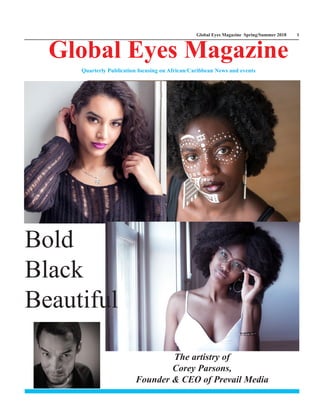
Bold
Black
Beautiful
The artistry of
Corey Parsons,
Founder & CEO of Prevail Media
LM
2
Global Eyes Magazine Spring/Summer 2018
Congratulations to The 2018-19 COBW Board.
President Tatenda Bwana thanked the outgoing
President Dr. Lois Stewart Archer for rounding
some new and interesting and accomplished
women to the Board.
Mrs. Tatenda Bwawa-Okoi, President
Dr. Lois Stewart Archer, Immediate Past Pres
President Elect, Kenny Daodu
Treasurer, Rhonda Thompson Wilson
Secretary, Nadia Thompson
Fundraising ,Michelle Evans
Program Lynette Chitando and Ms. Ebele Nwani
Membership, Dr. Randi Gage
Publicity, Ms. Natalie Bell
Social Daniella Archer
You can reach the Congress by calling (204) 930-
2448. Best wishes for another successful year.
NEW BOARD
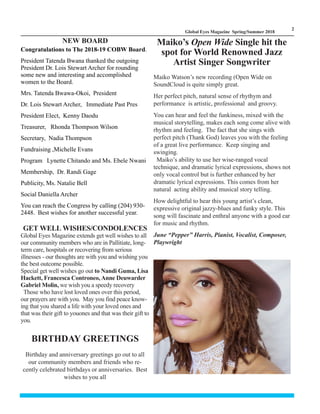
Maiko Watson’s new recording (Open Wide on
SoundCloud is quite simply great.
Her perfect pitch, natural sense of rhythym and
performance is artistic, professional and groovy.
You can hear and feel the funkiness, mixed with the
musical storytelling, makes each song come alive with
rhythm and feeling. The fact that she sings with
perfect pitch (Thank God) leaves you with the feeling
of a great live performance. Keep singing and
swinging.
Maiko’s ability to use her wise-ranged vocal
technique, and dramatic lyrical expressions, shows not
only vocal control but is further enhanced by her
dramatic lyrical expressions. This comes from her
natural acting ability and musical story telling.
How delightful to hear this young artist’s clean,
expressive original jazzy-blues and funky style. This
song will fascinate and enthral anyone with a good ear
for music and rhythm.
June “Pepper” Harris, Pianist, Vocalist, Composer,
Playwright
Maiko’s Open Wide Single hit the
spot for World Renowned Jazz
Artist Singer Songwriter
GET WELL WISHES/CONDOLENCES
Global Eyes Magazine extends get well wishes to all
our community members who are in Pallitiate, long-
term care, hospitals or recovering from serious
illnesses - our thoughts are with you and wishing you
the best outcome possible.
Special get well wishes go out to Nandi Guma, Lisa
Hackett, Francesca Controneo,Anne Deuwarder
Gabriel Molin, we wish you a speedy recovery
Those who have lost loved ones over this period,
our prayers are with you. May you find peace know-
ing that you shared a life with your loved ones and
that was their gift to youones and that was their gift to
you.
BIRTHDAY GREETINGS
Birthday and anniversary greetings go out to all
our community members and friends who re-
cently celebrated birthdays or anniversaries. Best
wishes to you all
Global Eyes Magazine Spring/Summer 2018 3Take One
Black History Month is more relevant now than ever
before. The façade of the old racists, sexists, classists is
wearing thin. Some people are weary of being “politically
correct.” There are issues whenever there is an influx of fore
in people into communities. Good people’s fears get the
better of them and as immigrants and newcomers, we have
to understand that. Some communities are having a hard
time integrating into their way of life, new customs and
traditions and may feel the old world, as they know it is
slipping away from them. Newcomers, immigrants, and
Black people once relegated to the bottom rung of the ladder
are proving their worth to the economy in skills and talents.
While some Caucasian born Canadians feel it is their right to
have better jobs more opportunities that blacks and
newcomers. This new idea of levelling the playing field
does not feel good to people who have enjoyed Affirmative
action that privileged white skinned people over Indigenous
and minorities. It is not their fault that the authorities used
everyone as paws in their power plays.
In fairness to the communities that are ill prepared by
governments a to deal with large numbers of newcomers all
at once, it can be a daunting task especially for those who
have never travelled abroad and having to deal with strange
customs, different languages and different religions etc. We
cannot brand these people as racists, they just want things to
go back to being the same familiar way where everyone
spoke English, all people in power reflected the majority of
the population and everyone knew their place. It is human to
feel uncomfortable among strangers. Many newcomers have
come from countries that practice ethnocentrism. They treat
people who are different differently.
Barbados and Trinidad are having problems with their
immigration and these nations do not treat other Caribbean
immigrants favorably as well. A few years ago, a Barbadian
diplomat speaking at the Barbadian Independence said the
influx of immigrants to Barbados is threatening the
Barbadian cultural balance in that Island and many of those
immigrants were of Guyanese extraction. Should we expect
a higher standard from ordinary Caucasian people who
believe whether true or not that they are becoming
minorities with this influx? As immigrants we have to be
understanding of human nature and ask ourselves how you
would we feel in their situation. This does not mean to we
have to encourage and be silent when it comes of
discrimination and racism in our society but at the same
time, look beyond that at the people and let us do our part in
reaching out and making it easy for our new neighbors to
feel at ease. The Muslim community through Shahina
Siddique have done a good job of reaching out to the
mainstream and the Indigenous community through
partnership and involvement, but when attached she speaks
out on behalf of Muslims to build bridges.
Many newcomers and blacks may say, “We’re
tired to teaching and being nice nothing changes”. It
takes a while but things do change. We do not always
see these changes, as bad news is light news they
float on top and the solid things goes on beneath.
Show people your best side, smile more often, and
help to put people who have been here before at ease
because it is the right thing to do.
Black history month is a time for us to revisit,
repair and recharge our foundation as Black people.
Model and teach our children that it is okay to be
black, it is just another colour on Creation’s palette
and no one colour or culture surpasses as MLK said it
is not the colour of our skin but the content of our
character that matter. We teach our children to stand
tall and confident in who they are. We tell them about
the contributions Black people have made in science,
literature, arts, politics etc. European brought out
ancestors from African as slaves and they fought for
their freedom from day one. They sacrificed their
lives for us to stand shoulder to shoulder with anyone
who is a human being. They were giants of a special
kind. Black history month we take pause to reflect
and respect our ancestors and to strategize how to
carry forward their dream with dignity. There is a
canon of important Black literature that ought to be
mandatory for every thinking black person to read. A
person who does not know their history and therefore
himself stand on porous ground. It will not take a
tornado but a baby’s toe to topple him. A person who
does not know his history ought not to be trusted.
These are some of the reasons we need Black History
Month. We need to refuel and recharge for our
journey against the winds of recidivism. We need to
stand strong, to meet the fire of ignorance with the
water of knowledge and compassion. We need to
understand that the fear people have of black folks is
the fear of the blackness in their own hearts. We
must teach Black children not to seek approval to be
black but to embraces their blackness as a warm
blanket of security. We are part of the puzzle of
humankind. We all have our unique space and role to
play in the world and we must not rob the world of
our gifts.
Thanks to the for BHM Committee’s efforts to
reach out and do the work. Their success depends on
our participation in the events they plan. Let us all do
our parts. Participate.
LM
4
Global Eyes Magazine Spring/Summer 2018
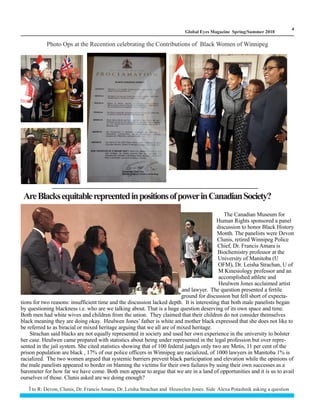
Photo Ops at the Recention celebrating the Contributions of Black Women of Winnipeg
AreBlacksequitablerepreentedinpositionsofpowerinCanadianSociety?
The Canadian Museum for
Human Rights sponsored a panel
discussion to honor Black History
Month. The panelists were Devon
Clunis, retired Winnipeg Police
Chief, Dr. Francis Amara is
Biochemistry professor at the
University of Manitoba (U
OFM), Dr. Leisha Strachan, U of
M Kinesiology professor and an
accomplished athlete and
Heulwen Jones acclaimed artist
and lawyer. The question presented a fertile
ground for discussion but fell short of expecta-
tions for two reasons: insufficient time and the discussion lacked depth. It is interesting that both male panelists began
by questioning blackness i.e. who are we talking about. That is a huge question deserving of its own space and time.
Both men had white wives and children from the union. They claimed that their children do not consider themselves
black meaning they are doing okay. Heulwen Jones’ father is white and mother black expressed that she does not like to
be referred to as biracial or mixed heritage arguing that we all are of mixed heritage.
Strachan said blacks are not equally represented in society and used her own experience in the university to bolster
her case. Heulwen came prepared with statistics about being under represented in the legal profession but over repre-
sented in the jail system. She cited statistics showing that of 100 federal judges only two are Metis, 11 per cent of the
prison population are black , 17% of our police officers in Winnipeg are racialized, of 1000 lawyers in Manitoba 1% is
racialized. The two women argued that systemic barriers prevent black participation and elevation while the opinions of
the male panelists appeared to border on blaming the victims for their own failures by using their own successes as a
barometer for how far we have come. Both men appear to argue that we are in a land of opportunities and it is us to avail
ourselves of those. Clunis asked are we doing enough?
l to R: Devon, Clunis, Dr. Francis Amara, Dr. Leisha Strachan and Heuwelen Jones. Side Alexa Potashnik asking a question
Global Eyes Magazine Spring/Summer 2018 5
Letter to my children
My dear children,
There is so much going on; I do not know where
to start. A lot of sad news, loss of friends, and serious
diagnosis of people who are in the prime of their lives.
I cannot even image what it is like for a mother of
young preteen and teen children to get the news of a
terminal illness, there is nothing the medical profession can
do, and sure enough, these people are likely to end up as
predicted.
Of course, you know that I firmly believe in the
best medicine being in the food. Nature is smart enough
to do this. The truth is, universities do not train doctors
in nutrition, they train them to diagnose and medicate
and to take off the offending part. That is it. We have to
do more for ourselves. There is a ton of research out
there with hundreds of people overcoming serious
illnesses through diet, nutrition, alternative medicine
and the power of mind. The Creator promised man is
three score and ten years and if they are lucky, they can
live beyond that. While death is inevitable. However
too many people die from environmental diseases that
are incurable. We have to take pause and ease the
stresses in our lives and how we do that is by
disentangling ourselves from the rat race, falling prey to
advertisements all clamouring for us to buy this or that
with the underlying message that we’re not enough.
Advertisers urge us to buy when we cannot afford to do
so and credit is easy as turning on your tap with the
chlorinated water.
Do not get caught in the web of advertisement. At
the end of the day, you would wish you did not. You are
more than enough once you have good health and a roof
over your head. We have to see through the guise of
businesses that push us to our limits for added profits
for them, be aware of the foods that restaurants serve
you that tastes good but poison to the body. A good chef
does not need a pile of creams and salts and MSG to
make food tastes good – these are chefs of death, a good
chef uses herbs and spices to delight the tongue that
does not create addiction but satiation. Be mindful of
where you spend your money. Spend it on those
businesses that use products grown locally as much as
possible instead of products that come from across the
globe saturated with chemicals to keep them fresh.
Set your heart at ease, maintain a meditation
practice, do some physical exercise and make an effort
to spend some quiet moments in the park and with
nature. You can counteract the effects of our current
lifestyle of running against the clock and grabbing foods
that are very unhealthy for us just because it is
accessible in these ways. I just want you all to take
great care of your health, your body, your mind and
your spirit. Without health life, you are poor. With
health, you are rich.
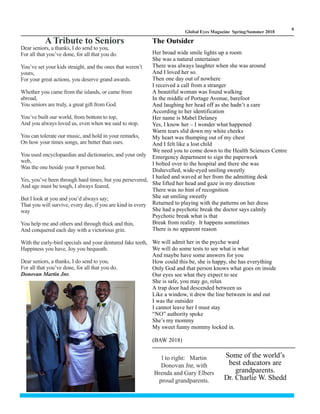
Global Counsellor
Dear global counsellor
My wife and I just had our first baby and she has
been off for six months and is thinking of cutting short
her maternity leave and returning to work. I am very
upset with her. Why would she want to entrust our
precious child to a stranger. I cannot understand this.
She is bored and wants to get back to her life at work.
Maybe I am wrong but I thought all women put their
children first and love to take care of their children. My
wife does not seem to be one of them. At five months,
she stopped breast-feeding saying she did not want to
be bothered with that when formula is even better than
breast milk. I asked here where she read that. She saw
she saw the advertisement claiming that breast milk is
lacking important nutrients.As for me, I did not see any
such research except from companies that benefit from
selling formula. I as so disappointed and I felt it was a
deal breaker but I could not let my child down. What
can I do? How can I accept this? Daycares are hard to
come by and there is no one to take care of our child. I
am feeling that I have to quit my job to be the mommy
for my child.
Royally pissed.
Dear royally pissed
It is strange indeed for a mom to miss her job more
than her child is. We do not expect women to be like
that. Not all women fit this model mom stereotype sir.
Many women also experience post partum depression.
Post partum depression expresses itself in many ways.
It can range from a mother trying to kill hr own child to
not being able to feel much warmth towards her child.
This is a serious condition and I would urge you to
maybe encourage your wife to speak to her doctor
about her feelings.
On the other hand, if it is possible for you to be
home with your child for the next six months, you will
never regret it. You will also have peace of mind and
hopefully may come to understand your wife a little
better. Have a conversation with her and try not to
judge her behaviour as you may not be able top walk in
her shoe.
LM
6
Global Eyes Magazine Spring/Summer 2018
The Outsider
Her broad wide smile lights up a room
She was a natural entertainer
There was always laughter when she was around
And I loved her so.
Then one day out of nowhere
I received a call from a stranger
A beautiful woman was found walking
In the middle of Portage Avenue, barefoot
And laughing her head off as she hadn’t a care
According to her identification
Her name is Mabel Delaney
Yes, I know her – I wonder what happened
Warm tears slid down my white cheeks
My heart was thumping out of my chest
And I felt like a lost child
We need you to come down to the Health Sciences Centre
Emergency department to sign the paperwork
I bolted over to the hospital and there she was
Dishevelled, wide-eyed smiling sweetly
I hailed and waved at her from the admitting desk
She lifted her head and gaze in my direction
There was no hint of recognition
She sat smiling sweetly
Returned to playing with the patterns on her dress
She had a psychotic break the doctor says calmly
Psychotic break what is that
Break from reality. It happens sometimes
There is no apparent reason
We will admit her in the psyche ward
We will do some tests to see what is what
And maybe have some answers for you
How could this be, she is happy, she has everything
Only God and that person knows what goes on inside
Our eyes see what they expect to see
She is safe, you may go, relax
A trap door had descended between us
Like a window, it drew the line between in and out
I was the outsider
I cannot leave her I must stay
“NO” authority spoke
She’s my mommy
My sweet funny mommy locked in.
(BAW 2018)
Dear seniors, a thanks, I do send to you,
For all that you’ve done, for all that you do.
You’ve set your kids straight, and the ones that weren’t
yours,
For your great actions, you deserve grand awards.
Whether you came from the islands, or came from
abroad,
You seniors are truly, a great gift from God.
You’ve built our world, from bottom to top,
And you always loved us, even when we said to stop.
You can tolerate our music, and hold in your remarks,
On how your times songs, are better than ours.
You used encyclopaedias and dictionaries, and your only
web,
Was the one beside your 8 person bed.
Yes, you’ve been through hard times, but you persevered,
And age must be tough, I always feared,
But I look at you and you’d always say;
That you will survive, every day, if you are kind in every
way
You help me and others and through thick and thin,
And conquered each day with a victorious grin.
With the early-bird specials and your dentured fake teeth,
Happiness you have, Joy you bequeath.
Dear seniors, a thanks, I do send to you,
For all that you’ve done, for all that you do.
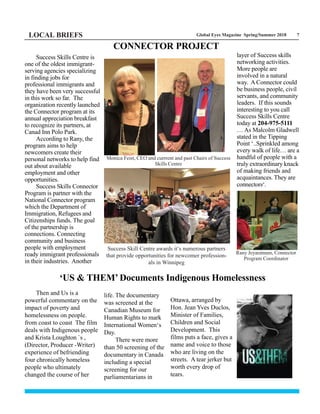
Donovan Martin Jnr.
A Tribute to Seniors
l to right: Martin
Donovan Jnr, with
Brenda and Gary Elbers
proud grandparents.
Some of the world’s
best educators are
grandparents.
Dr. Charlie W. Shedd
Global Eyes Magazine Spring/Summer 2018 7LOCAL BRIEFS
Success Skills Centre is
one of the oldest immigrant-
serving agencies specializing
in finding jobs for
professional immigrants and
they have been very successful
in this work so far. The
organization recently launched
the Connector program at its
annual appreciation breakfast
to recognize its partners, at
Canad Inn Polo Park.
According to Rany, the
program aims to help
newcomers create their
personal networks to help find
out about available
employment and other
opportunities.
Success Skills Connector
Program is partner with the
National Connector program
which the Department of
Immigration, Refugees and
Citizenships funds. The goal
of the partnership is
connections. Connecting
community and business
people with employment
ready immigrant professionals
in their industries. Another
layer of Success skills
networking activities.
More people are
involved in a natural
way. A Connector could
be business people, civil
servants, and community
leaders. If this sounds
interesting to you call
Success Skills Centre
today at 204-975-5111
… As Malcolm Gladwell
stated in the Tipping
Point ‘..Sprinkled among
every walk of life… are a
handful of people with a
truly extraordinary knack
of making friends and
acquaintances. They are
connectors‘.
CONNECTOR PROJECT
Then and Us is a
powerful commentary on the
impact of poverty and
homelessness on people.
from coast to coast The film
deals with Indigenous people
and Krista Loughton `s ,
(Director, Producer -Writer)
experience of befriending
four chronically homeless
people who ultimately
changed the course of her
life. The documentary
was screened at the
Canadian Museum for
Human Rights to mark
International Women‘s
Day.
There were more
than 50 screening of the
documentary in Canada
including a special
screening for our
parliamentarians in
Ottawa, arranged by
Hon. Jean Yves Duclos,
Minister of Families,
Children and Social
Development. This
films puts a face, gives a
name and voice to those
who are living on the
streets. A tear jerker but
worth every drop of
tears.
‘US & THEM’ Documents Indigenous Homelessness
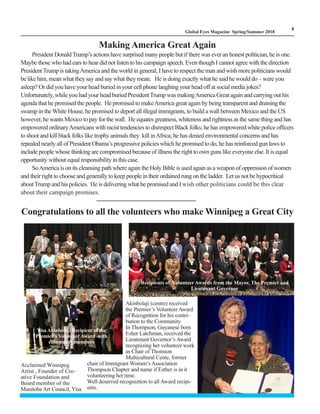
Success Skill Centre awards it’s numerous partners
that provide opportunities for newcomer profession-
als in Winnipeg
Monica Feist, CEO and currrent and past Chairs of Success
Skills Centre
Rany Jeyaratnam, Connector
Program Coordinator
LM
8
Global Eyes Magazine Spring/Summer 2018
Making America Great Again
President DonaldTrump’s actions have surprised many people but if there was ever an honest politician, he is one.
Maybe those who had ears to hear did not listen to his campaign speech. Even though I cannot agree with the direction
President Trump is takingAmerica and the world in general, I have to respect the man and wish more politicians would
be like him, mean what they say and say what they mean. He is doing exactly what he said he would do – were you
asleep? Or did you have your head buried in your cell phone laughing your head off at social media jokes?
Unfortunately, while you had your head buried PresidentTrump was makingAmerica Great again and carrying out his
agenda that he promised the people. He promised to makeAmerica great again by being transparent and draining the
swamp in theWhite House, he promised to deport all illegal immigrants, to build a wall between Mexico and the US
however, he wants Mexico to pay for the wall. He equates greatness, whiteness and rightness as the same thing and has
empowered ordinaryAmericans with racist tendencies to disrespect Black folks; he has empowered white police officers
to shoot and kill black folks like trophy animals they kill inAfrica; he has denied environmental concerns and has
repealed nearly all of President Obama’s progressive policies which he promised to do, he has reinforced gun laws to
include people whose thinking are compromised because of illness the right to own guns like everyone else. It is equal
opportunity without equal responsibility in this case.
SoAmerica is on its cleansing path where again the Holy Bible is used again as a weapon of oppression of women
and their right to choose and generally to keep people in their ordained rung on the ladder. Let us not be hypocritical
aboutTrump and his policies. He is delivering what he promised and I wish other politicians could be this clear
about their campaign promises.
Congratulations to all the volunteers who make Winnipeg a Great City
Acclaimed Winnipeg
Artist , Founder of Cre-
ative Foundation and
Board member of the
Manitoba Art Council, Yisa
Akinbolaji (centre) received
the Premier’s Volunteer Award
of Recognition for his contri-
bution to the Community
In Thompson, Guyanese born
Esher Latchman, received the
Lieutenant Governor’s Award
recognizing her volunteer work
as Chair of Thomson
Multicultural Cente, former
chair of Immigrant Women’s Association
Thompson Chapter and name if Esther is in it
volunteering her time.
Well deserved recogniztion to all Award recipi-
ents.
Recipients of Volunteer Awards from the Mayor, The Premier and
Lieutenant Governor
Yisa Akinbolaji Recipient of the
Premier’s Volunteer Award with
community members
Global Eyes Magazine Spring/Summer 2018 9
NATURALLY
You laugh
Call me ‘redundant’
How many times have I drawn
The same substance
’As many times as a man
Needs to breathe...’
Be it a recipe for a barbeque
Or new method for the
abdomens
Or a better way to wear my
pants
I would continue to pretend...
AROUND
You’d rather split profit
Than to share a secret
Somehow, I thought it
The other way...
Sure we had something
Not much for promoting
But kept a smile glowing
The other way.
Neil Pitamber
You just do not expect some people to die and
when they do, you are stunned. Marty Dolin was one
such person. He was larger than life and has a voice and
he used it to speak up on behalf of those who could not
speak for themselves. He had a big heart for
immigrants and refugees and most of his working life he
spent advocating and working with people from those
far away countries whom he embraced and made them
feel as Canadian as apple pie.
Marty pass away on Valentine’s day, February 14,
2018 and few months shy of his 80th
birthday (June 15,
2018.) The Service started with Change going to come
and ended with Imagine and Scotch was served to toast
to Marty’s goodbye. How cool is that.
Marty was a person you love or hate because he
spoke his mind and he was loud. The Thomson funeral
chapel across from Crossways in Common was
where people gathered for their final farewell to
Marty. Not surprisingly, it was a multicultural
crowd of people of different hues and accents.
These were the immigrants for whom Marty work
hard to seek help bring to safety in Canada. His
work as Executive
Director of Manitoba
Interfaith Immigration
Counsel was his calling
more than it was a job.
We will undoubtedly
miss his presence in
Winnipeg but Creator
called him to higher
heights. RIP
Marty Dolin’s Memorial a Gathering of the Socially Conscious
Dianna Scarth, former Executive Director of the Manitoba Human Rights
Commission is a new Canadian Human Rights Commission (CHRC) part time
Commissioner.
R e c e n t l y appointed by Order in Council,
Dianna is a human rights warrior and spent the
best part of her career promoting human rights,
equality and social justice issues.
A highly qualified individual in human rights
work, Dianna obtained a Master of Social Work and
Bachelor of Laws degrees from the University of
Manitoba. Her experience is broad and deep in
both legal and social work areas. It includes
probation officer, social worker, Manitoba Accessibility
Advisory Council, Diversity and Harassment
Officer, Global College’s Vising Professor
University of Winnipeg
Dianna is human rights visionary. She was
instrumental in moving the work at the MHRC into
alternative dispute resolutions areas, introducing
mediation practice in the Commission’s complaint process and tackling systemic
complaints that had the potential to benefit large groups of people. Human Rights
practitioners throughout Canada recognised her proactive approach and followed
her lead in many areas. Her leadership at the MHRC followed a period of growth
and excitement at the MHRC and brought human rights issues into the limelight
through strategic employment of the media.
We at the GEM wish Dianna much success and satisfaction in her new role.
Dianna Scarth lands job at the Canadian Human
Rights Commission
LM
10
Global Eyes Magazine Spring/Summer 2018
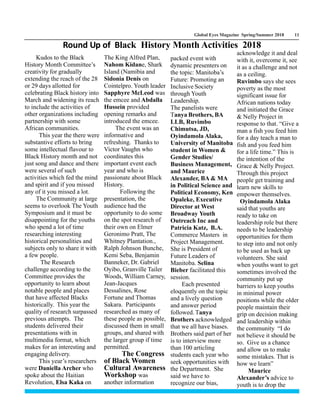
David Graham of Steinbach MB
performs at Baha’i sponsored at Soul Food
Flosoul, R & B singer/
songwriter entertains the
participants at the Black
History Month Recognition of
the contriubitons of Black
Women in Manitoba Reception
sponsored by Hon. Sheila Cox
Dr. Steve Kirby performs some great
Jazz music at the St. Vital Park for
Baha’i sponsored soul food event
Larry Strachan only Black Director in Manitoba celebrates Canada 150 with a
multicultural crowd at the Gas Station Theatre on June 2018
Soul Food is a program of the Baha’is of
Winnipeg for reflection and spiritual
growth, combining live music audio visuals
, readings from faiths and philosphers,
authors, leaders and Indigenous cultures
from all around the world.
“The Soul is a sign of God, a heavenly gem
whose reality the most learned of men hath
failed to grasp, and whose mystery no mind,
however acute can ever hope to unravel.”
The program happens monthly . If you
have a musical talent and would like to
share or you would like to attend one of
these events call 204-452-0139
Young
Kirby
obsrves
dad
New Beginnings
Listening to good music is an elegant balm for the soul as it was at the orchestral
production by the Orchestral Music of Canada featuring Conductor Larry Strachan,
titled Beyond 150 featuring a variety of artists and composers ranging from Indigenous
to Welsh. Held at the Gas Station Theatre on there was a full house on the beautiful
May 27, 2018 summer’s evening. Some of the artists featured included Vincent Ellin,
bassoon,Tracy Bone, vocals, Heulwen Marion Zilla Jones, mezzo-soprano and Collin
Mehmel, Clarinet. Musical compositions were fromAlejandra Odgers Nimitzotia
(Mexico) Kym Gouchie (First Nations)Andrew Balfour (First Nations)
BEYOND 150 Musical Event
Global Eyes Magazine Spring/Summer 2018 11
Kudos to the Black
History Month Committee’s
creativity for gradually
extending the reach of the 28
or 29 days allotted for
celebrating Black history into
March and widening its reach
to include the activities of
other organizations including
partnership with some
African communities.
This year the there were
substantive efforts to bring
some intellectual flavour to
Black History month and not
just song and dance and there
were several of such
activities which fed the mind
and spirit and if you missed
any of it you missed a lot.
The Community at large
seems to overlook The Youth
Symposium and it must be
disappointing for the youths
who spend a lot of time
researching interesting
historical personalities and
subjects only to share it with
a few people.
The Research
challenge according to the
Committee provides the
opportunity to learn about
notable people and places
that have affected Blacks
historically. This year the
quality of research surpassed
previous attempts. The
students delivered their
presentations with in
multimedia format, which
makes for an interesting and
engaging delivery.
This year’s researchers
were Daniella Archer who
spoke about the Haitian
Revolution, Elsa Kaka on
The King Alfred Plan,
Nahom Kidane, Shark
Island (Namibia and
Sidonia Denis on
Cointelpro. Youth leader
Sapphyre McLeod was
the emcee and Abdalla
Hussein provided
opening remarks and
introduced the emcee.
The event was an
informative and
refreshing. Thanks to
Victor Vaughn who
coordinates this
important event each
year and who is
passionate about Black
History.
Following the
presentation, the
audience had the
opportunity to do some
on the spot research of
their own on Elmer
Geronimo Pratt, The
Whitney Plantation.,
Ralph Johnson Bunche,
Kemi Seba, Benjamin
Banneker, Dr. Gabriel
Oyibo, Granville Tailer
Woods, William Carney,
Jean-Jacques
Dessalines, Rose
Fortune and Thomas
Sakara. Participants
researched as many of
these people as possible,
discussed them in small
groups, and shared with
the larger group if time
permitted.
The Congress
of Black Women
Cultural Awareness
Workshop was
another information
packed event with
dynamic presenters on
the topic: Manitoba’s
Future: Promoting an
Inclusive Society
through Youth
Leadership.
The panelists were
Tanya Brothers, BA
LLB, Ruvimbo
Chimutsa, JD,
Oyindamola Alaka,
University of Manitoba
student in Women &
Gender Studies/
Business Management,
and Maurice
Alexander, BA & MA
in Political Science and
Political Economy, Ken
Opaleke, Executive
Director at West
Broadway Youth
Outreach Inc and
Patricia Katz, B.A.
Commerce Masters in
Project Management.
She is President of
Future Leaders of
Manitoba. Selina
Bieber facilitated this
session.
Each presented
eloquently on the topic
and a lively question
and answer period
followed. Tanya
Brothers acknowledged
that we all have biases.
Brothers said part of her
is to interview more
than 100 articling
students each year who
seek opportunities with
the Department. She
said we have to
recognize our bias,
acknowledge it and deal
with it, overcome it, see
it as a challenge and not
as a ceiling.
Ruvimbo says she sees
poverty as the most
significant issue for
African nations today
and initiated the Grace
& Nelly Project in
response to that. “Give a
man a fish you feed him
for a day teach a man to
fish and you feed him
for a life time.” This is
the intention of the
Grace & Nelly Project.
Through this project
people get training and
learn new skills to
empower themselves.
Oyindamola Alaka
said that youths are
ready to take on
leadership role but there
needs to be leadership
opportunities for them
to step into and not only
to be used as back up
volunteers. She said
when youths want to get
sometimes involved the
community put up
barriers to keep youths
in minimal power
positions while the older
people maintain their
grip on decision making
and leadership within
the community “I do
not believe it should be
so. Give us a chance
and allow us to make
some mistakes. That is
how we learn”
Maurice
Alexander’s advice to
youth is to drop the
Round Up of Black History Month Activities 2018
LM
12
Global Eyes Magazine Spring/Summer 2018
burdens of the past. “Do
not carry the burdens of
the past. Determine what
the actual barriers are. I
am asked to relive the
racism that my dad felt
that I am not experiencing.
Our leaders do not need
our support because they
do not ask for assistance.
Leadership does not have
to be as it was in the
past. There are many
ways of being a leader.
Not all are going to be
Devon Clunis. An
important aspect of being
a leader is to say what
you mean and do what
Heart & Spirit Soul Annual BHM Concert
New acts added a rich
texture to the spicy
annual event that
encourage people to
dance and jump up in
Church unconstrained.
That‘s Black Gospel
Concert.
The venue was Wide
World of Faith Church in
down town Winnipeg,
Highlight of the evening
was special guest Scribe,
hip hop artist from
Jamaica heritage but
adopted as a child by a
White Canadian family.
Even though he was
loved he was confused
about the difference
between him and his
parents but that‘s all
water under the bridge.
Music is a healing for his
soul. He commanded the
stage, jumped into the
audience and stirred up
folks. The Ghanaian
Union of Manitoba Choir
brought the African
flavour of praising
theLlord with dancing
and entertainment.
Linda Emmons and
Friends provided steel
Band music. The
staples including
Revelation Band and
New Anointing Dance
Ministry all made the
evening one to
remember.
you say you`re going to
do`
Christine
Forbes, Emcee
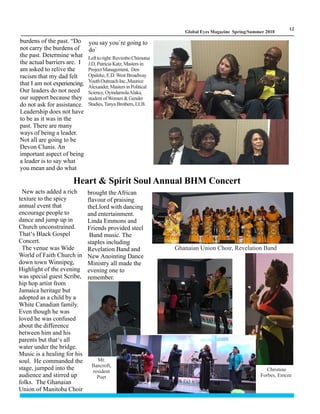
Ghanaian Union Choir, Revelation Band
Mr.
Bancroft,
resident
Poet
Lefttoright RuvimboChimutsa
J.D, Patricia Katz, Masters in
Project Management, Den
Opaleke, E.D. West Broadway
YouthOutreachInc.,Maurice
Alexander,MastersinPolitical
Science,OyindamolaAlaka,
student ofWomen & Gender
Studies,TanyaBrothers,LLB.
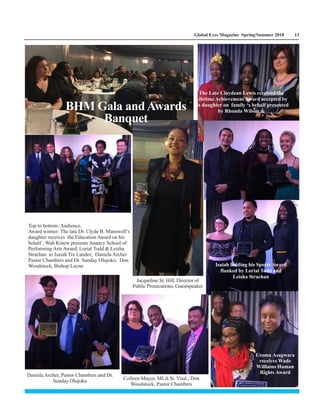
Global Eyes Magazine Spring/Summer 2018 13
Top to bottom: Audience,
Award winner: The late Dr. Clyde B. Manswell’s
daughter receives the Education Award on his
behalf ; Wab Kinew presents Anancy School of
Performing Arts Award, Lorial Todd & Leisha
Strachan to Isaiah Tre Lander; Daniela Archer
Pastor Chambers and Dr. Sunday Olujoko, Don
Woodstock, Bishop Layne
Daniela Archer, Pastor Chambers and Dr.
Sunday Olujoku Colleen Mayor, MLA St. Vital , Don
Woodstock, Pastor Chambers
Jacqueline St. Hill, Director of
Public Prosecutions, Guestspeaker
Isaiah holding his Sports Award
flanked by Lorial Todd and
Leisha Strachan
Uzoma Asagwara
receives Wade
Williams Human
Rights Award
The Late Claydean Lewis received the
Lifetime Achievement Award accepted by
his daughter on family ‘s behalf presented
by Rhonda Wilson &BHM Gala and Awards
Banquet
LM
14
Global Eyes Magazine Spring/Summer 2018
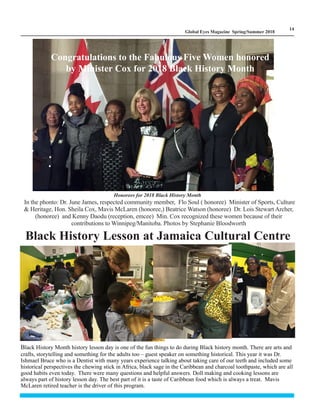
Honorees for 2018 Black History Month
In the phonto: Dr. June James, respected community member, Flo Soul ( honoree) Minister of Sports, Culture
& Heritage, Hon. Sheila Cox, Mavis McLaren (honoree,) Beatrice Watson (honoree) Dr. Lois Stewart Archer,
(honoree) and Kenny Daodu (reception, emcee) Min. Cox recognized these women because of their
contributions to Winnipeg/Manitoba. Photos by Stephanie Bloodworth
Congratulations to the Fabulous Five Women honored
by Minister Cox for 2018 Black History Month
Black History Lesson at Jamaica Cultural Centre
Black History Month history lesson day is one of the fun things to do during Black history month. There are arts and
crafts, storytelling and something for the adults too – guest speaker on something historical. This year it was Dr.
Ishmael Bruce who is a Dentist with many years experience talking about taking care of our teeth and included some
historical perspectives the chewing stick in Africa, black sage in the Caribbean and charcoal toothpaste, which are all
good habits even today. There were many questions and helpful answers. Doll making and cooking lessons are
always part of history lesson day. The best part of it is a taste of Caribbean food which is always a treat. Mavis
McLaren retired teacher is the driver of this program.
Global Eyes Magazine Spring/Summer 2018 15
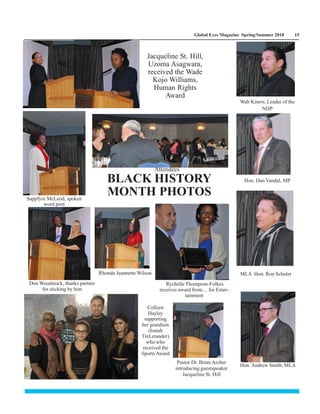
Colleen
Hayley
supporting
her grandson
(Isaiah
TreLetander)
who who
received the
Sports Award
Pastor Dr. Brian Archer
introducing guestspeaker
Jacqueline St. Hill
Rhonda Jeannette Wilson MLA Hon. Ron Schuler
Hon. Dan Vandal, MP
Wab Kinew, Leader of the
NDP
Hon. Andrew Smith, MLA
Don Woodstock, thanks partner
for sticking by him
Rychelle Thompson-Folkes
receives award from.... for Enter-
tainment
Sappfyre McLeod, spoken
word poet
BLACK HISTORY
MONTH PHOTOS
Jacqueline St. Hill,
Uzoma Asagwara,
received the Wade
Kojo Williams,
Human Rights
Award
Attendees
LM
16
Global Eyes Magazine Spring/Summer 2018
It crossed my mind the other day at a friend’s
house when some of us had gathered to extend our
condolences to the family for the passing of a mother
and a grandmother. In addition, the flash realization was
this: that every Ghanaian household (and by extension
everyAfrican family) has a story to tell about their
parents...mothers, fathers and grandparents.These were
people who nurtured us, their children, for us to become
parents and pioneers here in Canada and now with our
children. We each have a story to tell but we all have a
common story, and that is:
1. Our parents, particularly our mothers and
grandmothers, showed and taught us how they could
“feed 5000 with only one loaf of bread”. Poor as many
of our families were, these parents were still able to
show unfathomable kindness and engaged in the art of
giving that would shame most billionaires in the “devel-
oped world”. They did with the little they had and still
had some to give to the next neighbour who had less.
2. It is a wonder how some of us made it this far.
With the abject poverty all over the village, some of us
living in dilapidated half broken mud structures we
called a house, my mother... your mother, all our moth-
ers, were able to still reserve a little bit of fufu (when we
the kids have even not really had enough) for the
itinerant cousins who would magically show up at
supper time.
3.There was illiteracy all around us. In my village
with the exception of the teachers and the Pastors of the
three main churches we had in the village, nobody else
could read or write. WeAfricans always make a mis-
take, equating the acquisition of the English language as
an indication of “being educated”. However, this
“illiterate” woman brought you and I up and gave us all
the wisdom we have needed to live and ably compete in
the white man’s country. “Illiterate”, are you kidding?
Yes, we should be even more proud to unceasingly
tell our children about these our heroes, our parents and
grandparents. Our society back home is a repository of
infinite wisdom, as I call it, a library of incomparable
untapped nurturing information, a collection of sane
living techniques, almost a second Bible hiding in the
bosom of our mothers and grandmothers. We should
proudly instill in our children born overseas that their
roots are 100% Ghanaian (even when one is not Ghana-
ian. In fact, they are through and through Ghanaians.They are
Canadians only by geography.Your blood is Ghanaian, a pure
Ghanaian.You may speak the “slang” that we cannot speak,
we may have a heavy and thickAfrican accent that you may
be ashamed of but under the surface, it is this humble begin-
ning that has created you, and has nurtured you into the
mountain out of the molehill that you were.
I always say that theEuropeans gave the world
industrialisation but theAfrican gave us socialisation. Chaotic
though our society may seem,Africans know how to live in a
community, caring for each other and living with all kinds of
people with different attitudes and characteristics but in a
relatively happy multicultural milieu.There may be a lot of
gossip going around the village but in the end people still get
along.They know each other and are not strangers to each
other. That is why mostAfricans, no matter how long they
have lived overseas, do go back home periodically no matter
how integrated or assimilated they are overseas.We are
“diasporeans” exactly because we know we are travelers with
a homeland...yes,Africa is always and will always be the
black immigrants’ homeland, no matter how impoverished
home might be. It is therefore important that we educate our
children about all the attributes of our cherished and beloved
parents and grandparents back home before they die off and
are forgotten. We should try to remember them like we do
with personalities like Livingston, Stanley, Ghandi, and
MadamTheresa and revive stories and exploits of our parents
that have impressed and molded us. We should tell stories of
bravery, of kindness, of patience and love, of self-control so
our children will come to recognize where these attributes
show up in the parents and even in themselves. In addition,
really, revealing the nature and kind of people our parents and
grandparents were would
lay down the roots and
foundation of the family
tree and be an
encyclopaediaforreference
bythegenerations.
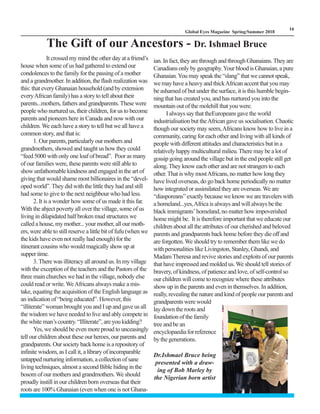
The Gift of our Ancestors - Dr. Ishmael Bruce
Dr.Ishmael Bruce being
presented with a draw-
ing of Bob Marley by
the Nigerian born artist
Global Eyes Magazine Spring/Summer 2018 17
During the campaign to elect the
president of the United States of
America, a tape surfaced in which
candidate Donald Trump said some
obnoxious things. This turned women
everywhere against him, deservedly.
Immediately after inauguration women
the world over started vigorously
protesting, donning hats bearing the
name of the offensive word.
This was a free and fair election in
a largely Christian society. Trump’s
opponent was purported to be as
despicable as he with his maltreatment
of women. Hillary also has a history of
maltreatment of wome including the cover-up her
husband’s improprieties. One would think that this
would be cause for a call to rally to arms and pray for
the nation under the incoming president, but Christians
have abandoned the oft stated “God knows all, trust
him.”
A look at the Christian Bible should produce several
examples to indicate that this is not totally out of place.
Donald Trump received more Electoral College votes
than Hilary Clinton, satisfying the only condition
required. When King Saul fell out of the Lord’s favour,
Samuel anointed David as the successor to Saul. This
angered Saul, who tried on several occasions to kill
David, chasing him all over the country. When David
was in a position to kill Saul, David himself gave
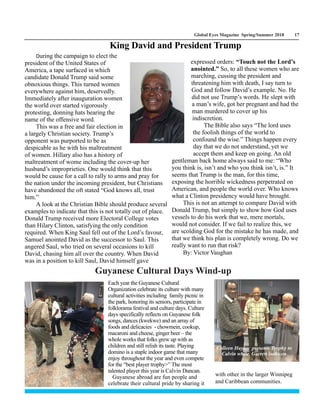
King David and President Trump
expressed orders: “Touch not the Lord’s
anointed.” So, to all these women who are
marching, cussing the president and
threatening him with death, I say turn to
God and follow David’s example. No. He
did not use Trump’s words. He slept with
a man’s wife, got her pregnant and had the
man murdered to cover up his
indiscretion.
The Bible also says “The lord uses
the foolish things of the world to
confound the wise.” Things happen every
day that we do not understand, yet we
accept them and keep on going. An old
gentleman back home always said to me: “Who
you think is, isn’t and who you think isn’t, is.” It
seems that Trump is the man, for this time,
exposing the horrible wickedness perpetrated on
American, and people the world over. Who knows
what a Clinton presidency would have brought.
This is not an attempt to compare David with
Donald Trump, but simply to show how God uses
vessels to do his work that we, mere mortals,
would not consider. If we fail to realize this, we
are scolding God for the mistake he has made, and
that we think his plan is completely wrong. Do we
really want to run that risk?
By: Victor Vaughan
Each year the Guyanese Cultural
Organization celebrate its culture with many
cultural activities including family picnic in
the park, honoring its seniors, participate in
folklorama festival and culture days. Culture
days specifically reflects on Guyanese folk
songs, dances (kwekwe) and an array of
foods and delicacies - chowmein, cookup,
macaroni and cheese, ginger beer – the
whole works that folks grew up with as
children and still relish its taste. Playing
domino is a staple indoor game that many
enjoy throughout the year and even compete
for the “best player trophy>” The most
talented player this year is Calvin Duncan.
Guyanese abroad are fun people and
celebrate their cultural pride by sharing it
with other in the larger Winnipeg
and Caribbean communities.
Guyanese Cultural Days Wind-up
Colleen Hayley presents Trophy to
Calvin while Garrett looks on
LM
18
Global Eyes Magazine Spring/Summer 2018
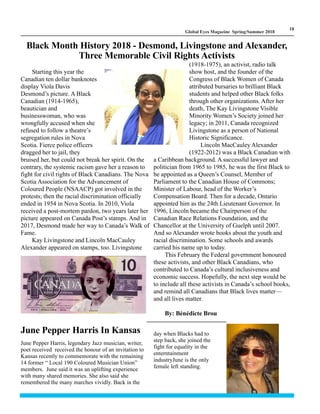
Starting this year the
Canadian ten dollar banknotes
display Viola Davis
Desmond’s picture. A Black
Canadian (1914-1965),
beautician and
businesswoman, who was
wrongfully accused when she
refused to follow a theatre’s
segregation rules in Nova
Scotia. Fierce police officers
dragged her to jail, they
bruised her, but could not break her spirit. On the
contrary, the systemic racism gave her a reason to
fight for civil rights of Black Canadians. The Nova
Scotia Association for the Advancement of
Coloured People (NSAACP) got involved in the
protests; then the racial discrimination officially
ended in 1954 in Nova Scotia. In 2010, Viola
received a post-mortem pardon, two years later her
picture appeared on Canada Post’s stamps. And in
2017, Desmond made her way to Canada’s Walk of
Fame.
Kay Livingstone and Lincoln MacCauley
Alexander appeared on stamps, too. Livingstone
(1918-1975), an activist, radio talk
show host, and the founder of the
Congress of Black Women of Canada
attributed bursaries to brilliant Black
students and helped other Black folks
through other organizations. After her
death, The Kay Livingstone Visible
Minority Women’s Society joined her
legacy; in 2011, Canada recognized
Livingstone as a person of National
Historic Significance.
Lincoln MacCauley Alexander
(1922-2012) was a Black Canadian with
a Caribbean background. A successful lawyer and
politician from 1965 to 1985, he was the first Black to
be appointed as a Queen’s Counsel, Member of
Parliament to the Canadian House of Commons;
Minister of Labour, head of the Worker’s
Compensation Board. Then for a decade, Ontario
appointed him as the 24th Lieutenant Governor. In
1996, Lincoln became the Chairperson of the
Canadian Race Relations Foundation, and the
Chancellor at the University of Guelph until 2007.
And so Alexander wrote books about the youth and
racial discrimination. Some schools and awards
carried his name up to today.
This February the Federal government honoured
these activists, and other Black Canadians, who
contributed to Canada’s cultural inclusiveness and
economic success. Hopefully, the next step would be
to include all these activists in Canada’s school books,
and remind all Canadians that Black lives matter—
and all lives matter.
By: Bénédicte Brou
Black Month History 2018 - Desmond, Livingstone and Alexander,
Three Memorable Civil Rights Activists
June Pepper Harris In Kansas
June Pepper Harris, legendary Jazz musician, writer,
poet received received the honour of an invitation to
Kansas recently to commemorate with the remaining
14 former “ Local 190 Coloured Musician Union”
members. June said it was an uplifting experience
with many shared memories. She also said she
remembered the many marches vividly. Back in the
day when Blacks had to
step back, she joined the
fight for equality in the
enterntainment
industryJune is the only
female left standing.
Global Eyes Magazine Spring/Summer 2018 19
When the Egyptian
Mohammed Salah won the
2017 African Footballer of
the Year, the internet went
into an uproar. Why? Some
Africans did not think Salah
was ‘African’ enoughto have
earned the title.
This is certainly not the
first time, and probably
won’t be the last, that a
North African’s
“Africanness” was
questioned. In July 2015,
The Guardian reported that
Nigerian Chigozie Obioma
was “the sole African writer
on the longlist” for that
year’s Man Booker Prize for
literature, overlooking the
presence of Moroccan-born
writer Leila Lalami among
the 13 shortlistees.
Which raises the
question: Why are Africans
from north of the Sahara
sometimes not considered
definitively “African”?
North and south of the
desert
The term “Sub-Saharan
Africa” usually refers to the
46 countries that lie south of
the Sahara Desert. Countries
north of the Sahara, along
with Sudan, are included in
the geographical and
geopolitical unit known as
the “Middle East and North
Africa region”, or MENA,
as their linguistic, religious
and cultural characteristics
have more in common with
the nations of the Middle
East than with their
neighbours south of the
desert.
This divide has sparked
heated debate among
African intellectuals.
Some blame
colonialismfor sowing
the seeds of division,
while others say the
division existed much
earlier.
The vision of the
African Union
The organisation
that theoretically unites
the continent is the
African Union (AU),
which comprises all 55
sovereign states on the
African continent,
divided into five
geographic regions:
North, South, West,
East, and Central. North
Africa is made up of
seven countries: Algeria,
Egypt, Libya,
Mauritania, Morocco,
Sahrawi Arab
Democratic Republic
and Tunisia,
The AU traces its
conception to Pan-
Africanism, an
intellectual movement
which sought to
strengthen African
integration in the face of
colonial intrusion. The
main actors who
formedthe Organisation
of African Unity, which
later became the AU,
were five heads of state,
three from Sub-Saharan
Africa and two from
North Africa: Kwame
Nkrumah, who later
became the first
president of Ghana,
Sekou Toure of Guinea,
Leopold Senghor of
Senegal, Gamal Abdel
Nasser of Egypt and
Ahmed Ben Bella of
Algeria.
North African
leaders, therefore,
played an equally
important role in the
formation of the African
Union, the continent’s
most important
geopolitical institution.
Northern “white”
and Sub-Saharan
“black” Africa
Yet many North
Africans identify more
as Arab or Arab-Muslim
than as African, and it is
the case that the
“countries south of the
Sahara have long been
considered authentically
“African” [emphasis
added] while those to
the north have been
perceived as the
Mediterranean, Middle
Eastern or Islamic”
argues Egyptian
journalist Shahira Amin.
In an article titled “Are
Egyptians Africans or
Arabs”, Amin gives an
account about
interviewing hundreds
of Egyptians from
various walks of life
about how they viewed
themselves:
My question raised
a few eyebrows among
people on the streets, the
majority of whom
replied ‘I’m a Muslim
Arab, of course’ or “an
Arab Muslim.’They
shrugged their shoulders
and looked perplexed as
they responded for
wasn’t it an already-
known fact that
Egyptians are Arabs and
that Egypt has a
majority Muslim
population? A few of the
interviewees said that
they ‘were descendants
of the Pharoahs’ but
surprisingly, none in the
sample interviewed
thought of themselves as
Africans.
“I’m not surprised
to hear about some
Africans (particularly in
sub-Saharan Africa)
questioning the
‘Africanness’ of us,
North Africans,” said
Afef Abrougui, one of
Global Voices MENA
editors:
I come from
Tunisia, and most
Tunisians would identify
as Arabs. There is this
joke in Tunisia which
says that Tunisians only
feel African when our
national team is playing
in the African Cup of
Nations. I don’t
remember in school that
we learnt that Tunisia
was not ‘’African’’ but
the country’s Arab-
Muslim identity is
emphasized, particularly
in politics.
To give an example,
in its preamble the 2014
Tunisian Constitution
refers several times to
the country’s Arab and
How African are North Africans
contd on p20
LM
20
Global Eyes Magazine Spring/Summer 2018
Muslim identities, and
only once toAfrica. Of
course, I understand why
Tunisians would mostly
identify asArabs because
of the language element.
Growing up as a child it’s
Syrian,Egyptianand
Lebanese series and music
that were on our
televisions. This, however,
is unfortunate because
identifying as anArab
does not prevent one from
also identifying as an
African.Africa is diverse
and we should celebrate
that, instead of putting a
label on what anAfrican is.
For NorthAfricans,
the definition of
‘Africanness’mayalsobe
related to influence and
power.After
independence, countries
like Egypt andAlgeria
looked to the Middle East
for a model of an Islamic
nation, and north to
Europe for economic
partnerships.
EgyptianGlobal
Voices contributor Rawan
Gharib saw the issue in
light of recent tensions
between Ethiopia and
Egypt concerning an
Ethiopian dam project:
… [the] Egypt
regime’s attitude of
looking down towards
Ethiopia ruined an
amazing opportunity to
collaborate and revive the
African Union concept of
the ’60s. I think that the
sense of detachment from
Africanityamong
Egyptians comes from the
lack of believing in a truth
that’s no longer factual or
tangible.We’reAfricans,
yes. The list-song of
African countries the Nile
River crosses was one of
the first history lessons we
learned in elementary
school, some of us may
even still remember it by
heart so well, but over the
last three decades the only
time we were reminded
we wereAfricans, we
were referred to as
Africans was during the
Africa Cup of Nations.
AsAlgerian
columnist ImanAmrani
has written in The
Guardian, the divide also
has to do with the
perpetuation of hierarchies
of value in terms of skin
color, class and race:
[C]ertainly there is
something to be said
about NorthAfricans
trying to distance
themselves from ‘black
Africa’.
Prejudices rooted in
language, culture,
religion
Racism expressed by
NorthAfricans toward
sub-SaharanAfricans,
however, does not justify
its reverse.And the notion
that “black” is the same as
“African” is itself rooted
in racism. For centuries,
the term “Sub-Saharan
Africa” has lumped
together cultures and
nations far more diverse
and complex in terms of
ethnicity,language,
experience, and history,
than the stereotypes would
suggest.
Global Voices
contributor Prudence
Nyamishana from Uganda
was forced to confront
some of her
preconceptions about
NorthAfrica on a recent
visit to Cairo:
I dressed like a clown
in a big dress and jeans
underneath. I had a scarf
ready to cover myself. I
was told that women were
supposed to be all covered
because it is a Muslim
country and all this stuff I
had read on the Internet.
When I boarded the
Emirates flight from
Dubai to Cairo, there were
many Egyptian women
dressed in fancy jeans
with beautiful uncovered
hair. I wanted to go to the
bathroom to change my
dress because I had got it
all wrong… I understood
that my prejudices and
fears were all hidden in
the disconnection between
NorthAfrica and the rest
ofAfrica. The history of
Arabs and slave trade, the
news we get fed is from
western media houses.At
first being asked whether I
was fromAfrica was
irritating. But then I
realised that the Egyptians
that were asking me if I
wasAfrican had never
traveled outside their own
country. Maybe if it was
easy to travel within
Africa these barriers
would be broken down
brick by brick.
JoeyAyoub, a Global
Voices MENAeditor from
Lebanon, notes that unlike
Pan-Arabism, Pan-
Africanism did not
become an ideal with
institutional backing:
The divide between
‘black’Sub-SaharanAfricans
and ‘Arab’NorthAfrica seems
to me to be the result of Pan-
Africanism occupying a
different historical route than
Pan-Arabism. Pan-Arabism
‘won’ in the sense that its
narrative had more significant
structural backing (Arab
League). I also think it ‘won’
because the Palestinian cause
coincided with the period of
‘anti-imperialism’.
Nwachukwu Egbunike,
Global Voices contributor from
Nigeria recalls that he wasn’t
taught about Pan-Africanism in
school:
Nigeria’s fractured past,
having fought a civil war,
explains why history was kept
out of high school curriculum. .
. . Nonetheless, I grew up in a
Nigeria when almost all our
musicians sang about the
horrors ofApartheid rule in
SouthAfrica. Thus, the deep-
seated belief inAfrica solidarity
was a mark of my childhood….
Nonetheless, I am not oblivious
to the equally prevalent
dichotomy between black Sub
SaharanAfrica andArab
NorthernAfrica. I think the
reason behind these labels is
obvious, stereotypes need to be
reinforced. I have come to
realize that ethnic or racial bias
are integral aspects of our
deeply flawed humanity.
People hide behind categories
and labels because to do
otherwise means a radical
transformation; an encounter
with that ‘other’in truth and
love.
“It is hard to recognize
todayAlgeria, the country that
Nelson Mandela said: “It’s
cont`d from p19
cont`d on p22
Global Eyes Magazine Spring/Summer 2018 21
Algeria that made me a man,”
said Global Voices contributor
Abdoulaye Bah, a Guinean-
born Italian formerly with the
United Nations:
Algeria played a big role in
liberating former colonies in
Africa. That is why it is difficult
to see today that this
government issues racial laws
stigmatizing and limiting the
freedoms of blacks on its soil.
In Morocco and Tunisia
also the Sub-Saharan suffers.
Yet these two countries also
played a great role in the
creation of the Organization of
African Unity. In addition, these
two countries are becoming
members of theAfrican
regional economic groupings,
south of Sahara. GamalAbdel
Nasser’s Egypt has also been
very active in terms ofAfrican
unity.
On the other hand, the
citizens of some sub-Saharan
countries did not need an entry
visa [for these countries] when I
was there the last time. In
addition, all these countries
have trained thousands of sub-
Saharan academics. In my
opinion, despite all that the
Sub-Saharans endure in these
countries, it is difficult to
question theirAfricanity.
Political analyst Imad
Mesdoua, anAlgerian raised in
Nigeria, asserts that the
dichotomy between anArab
NorthAfrica and a supposedly
black Sub-SaharanAfrica is
false.Africans, says Mesdoua,
are not defined by language,
boundaries or geography but
rather a “common history,
binding values, and a common
destiny.”
Perhaps, in the spirit of its
founding Pan-African
values and vision, the
African Union should
focus on
deconstructing this
divide between the
north and sub-Saharan
Africa and this
common destiny.
(From Guyanese
on-line and reprinted
from Global Voices
Credit: Written by
Nwachukwu Egbunike,
Nigerian poet, writer,
researcher)
In the Know
Nelson Mandela Exhibition
Caribbean Pavilion Ambassadors
cont`d on p22
*Have you seen the
Nelson Mandela Exhibi-
tion at the Canadian
Museum for Human
Rights? It is worth the
trip.
*Get out and about it’s
two weeks of the
worlds’s biggest cultural
festival - Folkorama
right at your doorsteps.
Have a great
summer
everyone
LM
22
Global Eyes Magazine Spring/Summer 2018
The tendrils of creativity can take root anywhere,
and Rwanda is no exception. When we couple imagination
with gender equality, we have a formula whose spin-offs
can make major strides in social or economic development.
After the genocide in 1994, Rwanda’s government
pushed for gender equality.As of 2017, it ranks globally
tops in terms of greatest proportion of women in its lower
house (61%) and in its upper house (38.5%), outshining the
runners-up — Bolivia, Cuba, Iceland, and Nicaragua.
Rwanda has in its favour a slight edge, given that the post-
genocide population is 60-70% female.
But Rwanda’s new arrangement is fertile ground
from which sprout notions that nudge and nurture nations
towards greater self-reliance and prosperity. In 2014, a
group of female tech entrepreneurs sought to ditch the Miss
Rwanda beauty contest, and replace it with challenges that
have grit and some usefulness. The emphasis now was on
what’s above the nape and interior, not below it and
exterior. Contestants had to think and invent, not just
project a swank image. More precisely, competitors would
have to use technology to make a practical solution for a
social or economic problem. Now known as Ms Geek
Rwanda, the annual design challenge has attracted female
techies from otherAfrican countries, and now runs under
the designate, Ms GeekAfrica.
In Kigale this year in early May, 200 girls and
women aged 13 to 25 pitted against each other in the battle
of brains. From Niger, Salissou Hassane Latifa, 21, became
this year’s Ms GeekAfrica. She designed a First Responder
app that gives information for non-professional members of
the public to use, getting a headstart on treating an injured
crash victim until the ambulance arrives. Her prize of RWF
3M (CAD 4,460).
The winner in 2016, Rosine Mwiseneza, was
orphaned during the genocide, but had powerful women as
mother figures. Enrolled in business management at Kepler
University in Kigali, she heard of and entered the Ms Geek
contest. Her winning idea was for an automated irrigation
system that would allow farmers to cultivate their fields
year-round as opposed to just during the rainy season.
In 2017, Ruth Njeri Waiganjo from the University
of Nairobi in Kenya beat four other competitors. She won
the grand prize of RWF 3M, plus a trip to the Telecom
World 2017 conference in Busan, South Korea. Waiganjo
developed a mobile phone application called Safe Drive,
the most intelligent way to protect road users. It is an
innovative solution that responds to transport problems like
frequent accidents and driving flaws of individual drivers.
As moreAfrican educators understand the long-
term rewards of female students having a strong grounding
in STEM (science technology engineering math), events
like Ms Geek Africa can’t help but flourish.
Designers Fair
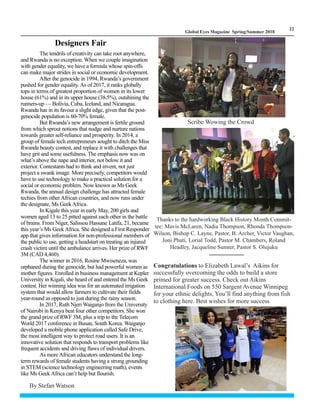
Thanks to the hardworking Black History Month Commit-
tee: Mavis McLaren, Nadia Thompson, Rhonda Thompson-
Wilson, Bishop C. Layne, Pastor, B. Archer, Victor Vaughan,
Joni Phuti, Lorial Todd, Pastor M. Chambers, Roland
Headley, Jacqueline Sumter, Pastor S. Olujuku
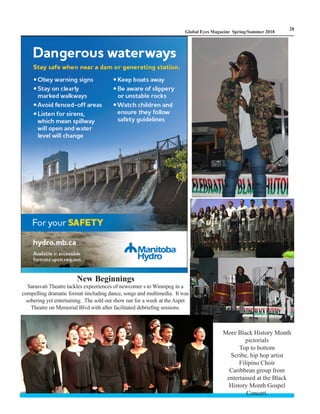
Scribe Wowing the Crowd
By Stefan Watson
Congratulations to Elizabeth Lawal’s Aikins for
successfully overcoming the odds to build a store
primed for greater success. Check out Aikins
International Foods on 550 Sargent Avenue Winnipeg
for your ethnic delights. You’ll find anything from fish
to clothing here. Best wishes for more success
Global Eyes Magazine Spring/Summer 2018 23
Creamy Avocado Roll
Ingredients:
1 to 2 large organic English cucumbers
3 ripe avocados
Freshly cracked black pepper
¼ cup capers
¼ cup fresh parsley(chopped finely)
1/8 cup fresh dill (chopped finely)
½ tsp. pink Himalayan salt
2 Tbsp. freshly squeezed lemon juice
Procedure:
1. Wash and dry the cucumbers, and use a
mandoline slicer to cut thin slices all the way through.
Keep on cutting the sides until you reach the center, but
be careful that they don’t break. You can save the thin
pieces for a salad or compost them.
2. In a bowl, mash the avocado meat, add the other
ingredients and mix.
3. Lay out the cucumber slices and layer with a
coat of the avocado spread all the way across.
Start rolling on one side until you reach the end, but
make sure to have some avocado spread (without
capers) at the end to seal each slice.
4. Dress with extra parsley and capers
Ingredients: ·
2 tortillas made from approved flour (spelt,
amaranth, or quinoa, especially.)·
4 tbsp. Avocado hummus ·
1 cup halved cherry tomatoes·
1 cup chopped lettuce (all, except iceberg)·
1/2 cup chopped bell peppers·
1/2 cup chopped mushrooms (all, except Shiitake)·
1/2 cup chopped onion·
1 tbsp. grapeseed oil·
Sea salt and Cayenne pepper to taste
Instructions: .
In a pan, sautée bell peppers, mushrooms, and
onion. Season with sea salt and cayenne pepper to
taste.2.
Heat tortillas on a large skillet until they’re
pliable. 3.
Spread tortillas with hummus. Arrange veggies on
top and roll’em up!
Dr. Sebi’s famous Avocado Hummus
Wrap
-Some thin slices of ginger root
-1.5 liters of water
-Juice of a Lemon (optional)
PREPARATION AND USE:
To prepare ginger water, you will just have to boil
the water, and add the ginger slices. Let the
mixture simmer for 15 minutes. Remove the
preparation from the heat, let it cool, strain it, add
a little lemon, and go! Have a glass every day
before breakfast and one before dinner.
Other Benefits:
Improves blood circulation
Prevents colds and flu,
Strengthens the immune system
Relieves joint pain
Ingredients
1 lb fine/large egg noodles; 2 tbsp soya sauce
1 tsp Chinese spice; 2 tsp salt; 1 tsp black pepper
2 egg; Oil
2 medium onions
½ lb cabbage
1 oz dried mushrooms, cut finely, if desired
20 - 30 bora beans
1 Vegetarian cub if optional
Chopped eschallot
Preparation
• Cut all the vegetables into very small pieces.
• Boil the noodles in water for 5 - 7 minutes,
strain and pour cold water through to loosen the
noodles.
• Heat the oil and fry the vegetables and fry for
about 5 minutes.
• Add the noodles and fry for a further 5 minutes.
Add cube or food enhancer – Mrs. Dash – Salt free
seasoning etc.
• Pile onto a dish, and garnish with chopped
eschallot.
Chow Mein BENEFITS OF GINGER WATER
HEALTHY RECIPES
LM
24
Global Eyes Magazine Spring/Summer 2018
Smoothie or Juice
According to Dr. Sebi, juicing tends to separate out
the pulp, which is where you’ll find more of the fiber
content in smoothies. Even though juices contain
minerals, and other phytonutrients, you’re probably
getting a lot less of the plant-derived compounds that
you’ll get in a smoothie.
When you’re blending a smoothie, you end up with
the whole fruit or vegetable. The volume is greater
and what you get out of it is greater too.
• Juice can be more concentrated and that can
be important for the few of us looking for a low-fiber
diet
• But juice requires a greater volume of
whatever you’re juicing. So that can make it a lot
more expensive.
• Smoothies help you to retain fiber, and that
helps you to feel fuller, even though you’re
technically just drinking a glass. You should get
more nutrition and benefits from a smoothie.
• Smoothies also can contain the nuts and
seeds, that are important to mineral intake and to
providing healthy proteins and fats.
• Smoothies can also help you to use up
produce that you don’t have time to cook or prepare
and they doesn’t need to be beautifully fresh when
you toss them in the blender
• Smoothies can also contain more of the less
intense green vegetables like lettuce and amaranth
greens that you could never really adequately juice.
So if you’ve got a juicer, go ahead and use it. For
most of the rest of us, a blender works just fine. Just
remember to only blend or juice the natural foods on
Dr. Sebi’s Nutritional Guide.
Dr. Sebi’s
Meanest Greenest Juice
This one is powerfully green AND you can make it
in the juicer or the blender!
Ingredients:
• 2 seeded cucumbers
• 1 cup romaine lettuce
• 1 apple
• 1 Key lime
• Dash of cayenne pepper
Instructions:
1. Run all ingredients through a juicer. If you’re
using a blender, add a little water to keep things
moving, and pass juice through a mesh cloth or sieve
to remove the pulp.
2. Sprinkle a dash of cayenne pepper for an
extra kick, and enjoy!
Gaffin Wid Buddy
Howdy, howdy me people. Lang time man but
goiod times. Ah Enjay meself at dis years Black History
Month Events. Ah like to see de kids get
excited bout sports. A latta dem show up
fuh da5t, cuz everyone hoping to be a big
star, get drafted an live happy eva aftta,
dats is de dream and nuttin wrong wid dat
but de cold fact is only a fraction of a
percentage eva mek it dat far so we kinds have to have
a more solid plan fuh success. Deh gatto stay in school
an aff de streets lukking to have fun. Specially dem
byes. De girls gat de head screwed on tight. Dey know
dey kiant dependend on dese Guys today so de women
a hustling bad to mek sure if an when de get a chile de
can tek good care of dem. It’s sad but it come to dat.
De girls excuse is dat the black men of substance
tripping ova sisters to get to the other side ah de fence
dat seems greener. A man is free to choos who he like
an if de adda side want to put up wie de crap so be it.
Dis mustt be only Caribbean men because I went to
about three African weddings and dey all were t ribal
man. Good stuff.Just who ar5edese men of substance?
We gatta stap being so backward, Nah because a
,man gat he PhD mek he a good man. Whjat about de
honest hardworking man who jhust want to tek care of
hhe family, working hard fuh dat dollar.Dere are lats a
good men out dere but women too briga to go out wid
some a dem because de dont have a university degree.
Eh, eh, Martiun Lutha din’t seh, it is the cantent of of a
man or woman.s character not how much money de
mek. Let’s face it women are smarter dan men and
since women’s liberation we can’t fake dat we smarta
dan women. I’m glad women ah smarta because de
got moh impact on de next generation, dey is the hand
dat shake de cradle man, Give de women we respect
dese are ouw modds and sista man.
With fame comes opportunity, but
it also includes responsibility–to
advocate and share, to focus less
on glass slippers and more on
pushing through glass ceilings. I
always want off-the-beaten-path,
Anthony Bourdain-inspired travel.
Meghan Markle
Global Eyes Magazine Spring/Summer 2018 25
by H.RogueRaiders
My life is punctuated by air travel. The many
different legs of my journeys make the chapters. This
anecdote is a paragraph, from my travel years when I was
very young. Thirty-two years of age. Mother of three boys
under six. This is a true event but I tell it on hindsight. I
acquired a unique silver ring fitted with a large red piece
of glass, so I thought, in the desert village of Kassala at the
three-country border of Eritrea, Ethiopia and The Sudan.
Leaving the kids with the nanny, I had travelled with a
group of women to the site of a Holy Spring near that
border town. The big raw ruby might be real, but I had to
imagine that part of the story, as it couldn’t be proven.
It was some years before I hitched my wagon to J.R’s.
whom I met at seventeen while living in my sisters home
in England near old Windsor Castle. I was the au pair girl,
going to commercial college during the morning, and
babysitting my niece of 9 months in the afternoon until my
sister would come home from work. She was a
physiotherapist at the Windsor Hospital. J.R. had already
impressed me with organizing skiing trips to Norway for
his Grammar school peers. As well he had sat in the United
Nations Youth Assembly. Not so surprising as he spent his
formative years in the International School of Cairo. His
Dad was stationed in Egypt with the British Army during
the Suez crisis. Army housing was provided in the
picturesque town of Ismailia, on the banks of the Blue
Nile. J.R. spent weekends and holidays away from the
teaming metropolis in the Egyptian countryside that hadn’t
changed in centuries.
J.R. and I got married and produced three sons. There
was still wanderlust in J.R. We just took the boys along
and home schooled or sent them to schools serving
expatriates. So, after one of our sojourns at the University
of Lusaka, Zambia, he and I were going the long way
home via Mauritius, Seychelles, Sri Lanka, Hong Kong,
Kweilin China, and Macao, Greece then via Frankfurt back
to Canada. The reunion with our three boys was to be at
Winnipeg Airport where we would be arriving at the same
time, the kids having returned from England where they
had spend time with their grandparents.
Ah, the ring with the red glass. I believed it was plain
glass. That ring was a souvenir from a previous African
sabbatical. As I mentioned in the beginning of this story, it
had involved a trip across the desert from Khartoum to a
Holy Spring near Kassala. Five young women, expatriates,
with great spirit made up the travel party to that pilgim
spot. Transportation was a bus. It was a regular bus route
for merchants and pilgrims as well family visit. It would
be a daylong trip across the desert. The look of the bus
wasn’t too inspiring. No windows, no air-conditioning. A
tower of luggage on top. We young white girls amongst the
local travelers were used to travel on city buses, but this
awesome creation of mode of transport, instilled in me
alertness. Still, I placed my trust in the kindness of
Sudanese people towards foreigners, was dressed
appropriately in long cover ups, a basket full of food,
and there was in our party an Armenian girl who spoke
Arabic fluently. We settled into our seats. Shut both
eyes. Dozed for a while. Read. Exhaled a sigh of relief
at the first rest stop in the middle of nowhere. A stall
with the customary sugary hot tea servings, which was
a very refreshing beverage and a safe to drink on the
road. Goats tethered to thorn brush. Children begging
for baksheesh. Men sat on their haunches clad in the
quintessential long white gowns, their heads wrapped
in Sudanese fashion with white turbans. Staring. And
no Canadian style rest rooms. What is a girl to do?
Huddled apart from the crowd we girls were thinking
on our feet. The lovely Armenian girl from New York
was dressed in jeans and a halter-top. She had to pee.
At a little distance the girls who wore skirts closed
rank for each girl who had to pee.
The bus rumbled on. The pale daylight changed to
yellow. The pages of our books were suddenly covered
in beige sand. Sand swirled thick inside the
windowless bus. Filled our mouths when we tried to
speak. A full-blown sandstorm. Dense. Gritty.
Passengers disappeared into blankets, towels. Covered
in sand the handsome black men turned white. An eerie
sight. Almost darkness. What if we got lost? I prayed
many tense hours under my blanket, while the dead
silent bus with its ghosts heaved and strained along an
invisible route through desert sand.
The motionless people suddenly became
animated. Excited. Hands pointed at flickering lights.
Kassala. Its sparse lights from hurricane lamps,
waving. A lone electric light bulb indicating the hostel
we were to stay the night.
This was a market town. For centuries a hub at the
cross roads into the Kassala Mountains to the Arabia
Sea. The camel market’s pungent smell wafting over
everything. The tinsmiths’ hammers clang kept a
steady beat. Lumber, provisions and utensils for every
need. And the silver- and goldsmiths lining the edges.
Sight and smell etched forever on my brain. Groups of
men trailing us girls, our Arabic speaking Armenian
beauty, in jeans and halter, the magnet. In the
silversmith lane a tall imposing man proffered the
silver ring. Something I had never seen before. Built
up high three-quarters of an inch and a red stone set in
this silver crown. I bartered over price, not very hard,
as there were just a few Sudanese pounds involved. It
was big, too loose for any of my fingers but I had to
have it.
I treasured my silver ring, but was put off by that
big piece of red glass, chipped to boot. I resolved to
replace that glass piece. This chance came later in Sri
Lanka. We did the usual sightseeing but with a
personalized touch. J.R. arranged a private car with
driver. This way we got to see the country from a
different angle than a tourist group would have. As
There is a price to pay…
LM
26
Global Eyes Magazine Spring/Summer 2018
always J.R. was adept in organizing. He planned a stop
at a region where moonstones were found. Sri Lanka
formerly Ceylon, is known for its moonstone gems,
which are recovered by boys and small men, who dive
into horrid, murky water holes to retrieve stones. These
small creatures looked to me like ‘Martians’ their bodies
chalk-grey, as if a potter had washed clay slip over the
divers. The gemstones brought into daylight, were very
much worth that effort.
I so wanted a moonstone to replace the piece of
glass in that silver ring. We visited a popular jewellers’
quarter with silver and gold smiths lining the street. The
profusion of colour and sparkle was overwhelming. All
designs were dainty filigree workings. So very Indian.
Not to my taste. I was partial to African design, from
ivory and ebony. Bold. I found a lovely big moonstone.
When turning it in the light, the glow was of the full
moon on a misty night in Canada. I bought it. The next
day I admired the fitting of my moonstone in that
glorious ring, and how the jeweller had cut and reduced
the size so it would fit my finger. Off I went on our next
leg of world travel, blissfully enjoying my authentic
moonstone.
Let me fast forward the years passed. The boys
finished college, university. I collected my BFA HONS
at forty-seven years of age and started my adventure in
building an art career. As technology advanced, we all
subscribed to computers, Ipads smartphones. The
gamut. I again educated myself further bringing
knowledge to me via that handy portable little gadget. I
placed it everywhere, while I washed dishes, read the
newspaper (multi-tasking), then to end my evenings
with a Miss Marple movie or Hercules Poirot etc.
Got hooked on The Royal Antique Road Show.
Even the American one. The plethora of jewels studded
with diamonds and rubies, vintage and contemporary,
inspired me to research rubies. I needed to know, red
glass or possibly an uncut ruby. It would make a good
story.
The incredible thing, though, was that, yes, rubies
were reportedly found lying about and didn’t have to be
mined. Heresy was that in the Kassala region of Africa,
rubies were practically lying on top of the dirt for you to
pick up, if you knew what you were looking for. LOL. It
should follow that my carelessly discarded piece of red glass
the size of an acorn, a medium raspberry, mounted in the
silver ring, may have been a raw ruby. Silversmithed in the
remote Kassala Mountains.
Nausea overcame me the first time I completed that
thought. Could it be possible? First a hysterical laugh then
anger. Third, I took a deep breath. Exclaimed ‘Oh, whatever’.
My vivid memories, like a moving film in front of my eyes,
recall that the jeweller never placed the piece of worthless red
glass into my hands together with that ring he had newly
fitted with a moonstone. For centuries, already, it was practice
to return bits to the owner who had commissioned design
changes to a piece of jewellery, n’est ce pas? I did not receive
the red glass nor the silver piece he had removed so the ring
would fit better. If I had asked for
it, maybe, yes. But I had not, that’s
how naïve I was at that age.
There you have it. To this
day, I’m overcome with the cold
then hot feeling of dread, I missed
out. A huge wonderful red ruby
from Africa in my possession
once, slipped from me because of
naiveté. Gone. I consoled myself,
cursing that no good thief. Often
when flying comfortably over
oceans and long stretches of continents, a quiet inner voice
will appease me - you are travelling, always returning home
unharmed, there is a price to pay…
* * * * *
Ticking Time Bomb
Mother Nature is screaming,
Can’t hear her tears,
Hatred running through our veins,
Perfect in our own eyes,
Paranoia running through the White House, Man
child running a nation, World ending around us,
Laughing what we become, Cause we destroy
ourselves.
By: Samantha Duncan
Bridging Intergenerational Gap
The Barbados Association of Winnipeg (BAW) has
embarked on a project to bring seniors and youth
together to create friendships, understanding and to
share their gifts with each other.
The project runs over a six-month period and the
group meets once a month at the Winter Club from 9
a.m to 3 p.m. with lunch served.
Valerie Williams is the project facilitator and
several group facilitators assist with small group
discussions. The sessions are well attended and a lot of
fun and exchange of information. There are guest
speakers at each event. The project brainchild is
Antoinette Zloty, board member of the BAW
Claude Neblett, Alexa Potasnik, Anna Tynes
and Gregory Gaskin discuss Volunteering
price to pay cont`d from
Global Eyes Magazine Spring/Summer 2018 27
Dr. Sebi’s advice
uicing tends to separate out the pulp, which is where you’ll
find more of the fiber content in smoothies. Even though
juices contain minerals, and other phytonutrients, you’re
probably getting a lot less of the plant-derived compounds
that you’ll get in a smoothie.
When you’re blending a smoothie, you end up with the
whole fruit or vegetable. The volume is greater and what you
get out of it is greater too.
• Juice can be more concentrated and that can be
important for the few of us looking for a low-fiber diet
• But juice requires a greater volume of whatever
you’re juicing. So that can make it a lot more expensive.
• Smoothies help you to retain fiber, and that helps
you to feel fuller, even though you’re technically just
drinking a glass. You should get more nutrition and benefits
from a smoothie.
• Smoothies also can contain the nuts and seeds, that
are important to mineral intake and to providing healthy
proteins and fats.
• Smoothies can also help you to use up produce that
you don’t have time to cook or prepare and they doesn’t
need to be beautifully fresh when you toss them in the
blender
• Smoothies can also contain more of the less intense
green vegetables like lettuce and amaranth greens that you
could never really adequately juice.
Dr. Sebi’s
Meanest Greenest Juice
This one is powerfully green AND you can make it in the
juicer or the blender!
Ingredients:
• 2 seeded cucumbers
• 1 cup romaine lettuce
• 1 apple
• 1 Key lime
• Dash of cayenne pepper
Instructions:
1. Run all ingredients through a juicer. If you’re using
a blender, add a little water to keep things moving, and pass
juice through a mesh cloth or sieve to remove the pulp.
2. Sprinkle a dash of cayenne pepper for an extra kick,
and enjoy!
Helpful tips from Dr. Sebi to help you out
1. Switch to sea salt. Eat less of it, but just by switching
you should see improvement next month.
Smoothie or Juicie
Having the PMS Blues
Mark your calendar - October
26, 2018 7:00 a.m.
Professor Joanne St. Lewis, dynamic speaker and
Black activist will be Guest speaker at the Women in
Support of Equality (WISE) Breakfast at the RBC
Convention Centre October 26, 2018 from 7:00 to
9:00 am. St. Lewis is the first elected black woman
Bencher of the Upper Canada Law Society in its 219-
year-old history. It’s a society that governs 47000
lawyers and 7500 paralegals. St. Lewis is a Law
Professor at the
University of Ottawa.
Her specialty areas
include sexual
violence, racial
profiling, social
justice communities
and much more but
you must come to
hear her. Can’t be
missed.
2. Drink spring water. A gallon a day. That sounds
like a lot, but once you start, your periods will be
better and you’ll experience less bloating and
better digestion. Flavor it with Key limes or
cucumber slices.
3. Leafy greens and fruits are your friends. Rich in
iron and antioxidants, they give you energy and
lots of fiber.
4. Nuts. Both walnuts and Brazil nuts are rich in
healthy fats, minerals and nutrients recommended
for reducing PMS symptoms.
5. Squash = complex carbs. Complex
carbohydrates are simply slower to digest and that
helps to stabilize your mood and keep cravings
under control.
6. Whole grains, like those in Dr. Sebi’s
Nutritional Guide, help to stabilize mood swings
and deter depression. Try quinoa, rye, spelt, and
amaranth, for a big change in your diet and in your
mood.
LM
28
Global Eyes Magazine Spring/Summer 2018
New Beginnings
Sarasvati Theatre tackles expeeriences of newcomer s to Winnipeg in a
compelling dramatic format iincluding dance, songs and multimedia. It was
sobering yet entertaining. The sold out show ran for a week at the Aspet
Theatre on Memorial Blvd with after facilitated debriefing sessions.
More Black History Month
pictorials
Top to bottom
Scribe, hip hop artist
Filipino Choir
Caribbean group from
entertained at the Black
History Month Gospel
Concert.

Gem spring&summer (1)

  • 1.
    Global Eyes MagazineSpring/Summer 2018 1 Global Eyes Magazine Quarterly Publication focusing on African/Caribbean News and events Bold Black Beautiful The artistry of Corey Parsons, Founder & CEO of Prevail Media
  • 2.
    LM 2 Global Eyes MagazineSpring/Summer 2018 Congratulations to The 2018-19 COBW Board. President Tatenda Bwana thanked the outgoing President Dr. Lois Stewart Archer for rounding some new and interesting and accomplished women to the Board. Mrs. Tatenda Bwawa-Okoi, President Dr. Lois Stewart Archer, Immediate Past Pres President Elect, Kenny Daodu Treasurer, Rhonda Thompson Wilson Secretary, Nadia Thompson Fundraising ,Michelle Evans Program Lynette Chitando and Ms. Ebele Nwani Membership, Dr. Randi Gage Publicity, Ms. Natalie Bell Social Daniella Archer You can reach the Congress by calling (204) 930- 2448. Best wishes for another successful year. NEW BOARD Maiko Watson’s new recording (Open Wide on SoundCloud is quite simply great. Her perfect pitch, natural sense of rhythym and performance is artistic, professional and groovy. You can hear and feel the funkiness, mixed with the musical storytelling, makes each song come alive with rhythm and feeling. The fact that she sings with perfect pitch (Thank God) leaves you with the feeling of a great live performance. Keep singing and swinging. Maiko’s ability to use her wise-ranged vocal technique, and dramatic lyrical expressions, shows not only vocal control but is further enhanced by her dramatic lyrical expressions. This comes from her natural acting ability and musical story telling. How delightful to hear this young artist’s clean, expressive original jazzy-blues and funky style. This song will fascinate and enthral anyone with a good ear for music and rhythm. June “Pepper” Harris, Pianist, Vocalist, Composer, Playwright Maiko’s Open Wide Single hit the spot for World Renowned Jazz Artist Singer Songwriter GET WELL WISHES/CONDOLENCES Global Eyes Magazine extends get well wishes to all our community members who are in Pallitiate, long- term care, hospitals or recovering from serious illnesses - our thoughts are with you and wishing you the best outcome possible. Special get well wishes go out to Nandi Guma, Lisa Hackett, Francesca Controneo,Anne Deuwarder Gabriel Molin, we wish you a speedy recovery Those who have lost loved ones over this period, our prayers are with you. May you find peace know- ing that you shared a life with your loved ones and that was their gift to youones and that was their gift to you. BIRTHDAY GREETINGS Birthday and anniversary greetings go out to all our community members and friends who re- cently celebrated birthdays or anniversaries. Best wishes to you all
  • 3.
    Global Eyes MagazineSpring/Summer 2018 3Take One Black History Month is more relevant now than ever before. The façade of the old racists, sexists, classists is wearing thin. Some people are weary of being “politically correct.” There are issues whenever there is an influx of fore in people into communities. Good people’s fears get the better of them and as immigrants and newcomers, we have to understand that. Some communities are having a hard time integrating into their way of life, new customs and traditions and may feel the old world, as they know it is slipping away from them. Newcomers, immigrants, and Black people once relegated to the bottom rung of the ladder are proving their worth to the economy in skills and talents. While some Caucasian born Canadians feel it is their right to have better jobs more opportunities that blacks and newcomers. This new idea of levelling the playing field does not feel good to people who have enjoyed Affirmative action that privileged white skinned people over Indigenous and minorities. It is not their fault that the authorities used everyone as paws in their power plays. In fairness to the communities that are ill prepared by governments a to deal with large numbers of newcomers all at once, it can be a daunting task especially for those who have never travelled abroad and having to deal with strange customs, different languages and different religions etc. We cannot brand these people as racists, they just want things to go back to being the same familiar way where everyone spoke English, all people in power reflected the majority of the population and everyone knew their place. It is human to feel uncomfortable among strangers. Many newcomers have come from countries that practice ethnocentrism. They treat people who are different differently. Barbados and Trinidad are having problems with their immigration and these nations do not treat other Caribbean immigrants favorably as well. A few years ago, a Barbadian diplomat speaking at the Barbadian Independence said the influx of immigrants to Barbados is threatening the Barbadian cultural balance in that Island and many of those immigrants were of Guyanese extraction. Should we expect a higher standard from ordinary Caucasian people who believe whether true or not that they are becoming minorities with this influx? As immigrants we have to be understanding of human nature and ask ourselves how you would we feel in their situation. This does not mean to we have to encourage and be silent when it comes of discrimination and racism in our society but at the same time, look beyond that at the people and let us do our part in reaching out and making it easy for our new neighbors to feel at ease. The Muslim community through Shahina Siddique have done a good job of reaching out to the mainstream and the Indigenous community through partnership and involvement, but when attached she speaks out on behalf of Muslims to build bridges. Many newcomers and blacks may say, “We’re tired to teaching and being nice nothing changes”. It takes a while but things do change. We do not always see these changes, as bad news is light news they float on top and the solid things goes on beneath. Show people your best side, smile more often, and help to put people who have been here before at ease because it is the right thing to do. Black history month is a time for us to revisit, repair and recharge our foundation as Black people. Model and teach our children that it is okay to be black, it is just another colour on Creation’s palette and no one colour or culture surpasses as MLK said it is not the colour of our skin but the content of our character that matter. We teach our children to stand tall and confident in who they are. We tell them about the contributions Black people have made in science, literature, arts, politics etc. European brought out ancestors from African as slaves and they fought for their freedom from day one. They sacrificed their lives for us to stand shoulder to shoulder with anyone who is a human being. They were giants of a special kind. Black history month we take pause to reflect and respect our ancestors and to strategize how to carry forward their dream with dignity. There is a canon of important Black literature that ought to be mandatory for every thinking black person to read. A person who does not know their history and therefore himself stand on porous ground. It will not take a tornado but a baby’s toe to topple him. A person who does not know his history ought not to be trusted. These are some of the reasons we need Black History Month. We need to refuel and recharge for our journey against the winds of recidivism. We need to stand strong, to meet the fire of ignorance with the water of knowledge and compassion. We need to understand that the fear people have of black folks is the fear of the blackness in their own hearts. We must teach Black children not to seek approval to be black but to embraces their blackness as a warm blanket of security. We are part of the puzzle of humankind. We all have our unique space and role to play in the world and we must not rob the world of our gifts. Thanks to the for BHM Committee’s efforts to reach out and do the work. Their success depends on our participation in the events they plan. Let us all do our parts. Participate.
  • 4.
    LM 4 Global Eyes MagazineSpring/Summer 2018 Photo Ops at the Recention celebrating the Contributions of Black Women of Winnipeg AreBlacksequitablerepreentedinpositionsofpowerinCanadianSociety? The Canadian Museum for Human Rights sponsored a panel discussion to honor Black History Month. The panelists were Devon Clunis, retired Winnipeg Police Chief, Dr. Francis Amara is Biochemistry professor at the University of Manitoba (U OFM), Dr. Leisha Strachan, U of M Kinesiology professor and an accomplished athlete and Heulwen Jones acclaimed artist and lawyer. The question presented a fertile ground for discussion but fell short of expecta- tions for two reasons: insufficient time and the discussion lacked depth. It is interesting that both male panelists began by questioning blackness i.e. who are we talking about. That is a huge question deserving of its own space and time. Both men had white wives and children from the union. They claimed that their children do not consider themselves black meaning they are doing okay. Heulwen Jones’ father is white and mother black expressed that she does not like to be referred to as biracial or mixed heritage arguing that we all are of mixed heritage. Strachan said blacks are not equally represented in society and used her own experience in the university to bolster her case. Heulwen came prepared with statistics about being under represented in the legal profession but over repre- sented in the jail system. She cited statistics showing that of 100 federal judges only two are Metis, 11 per cent of the prison population are black , 17% of our police officers in Winnipeg are racialized, of 1000 lawyers in Manitoba 1% is racialized. The two women argued that systemic barriers prevent black participation and elevation while the opinions of the male panelists appeared to border on blaming the victims for their own failures by using their own successes as a barometer for how far we have come. Both men appear to argue that we are in a land of opportunities and it is us to avail ourselves of those. Clunis asked are we doing enough? l to R: Devon, Clunis, Dr. Francis Amara, Dr. Leisha Strachan and Heuwelen Jones. Side Alexa Potashnik asking a question
  • 5.
    Global Eyes MagazineSpring/Summer 2018 5 Letter to my children My dear children, There is so much going on; I do not know where to start. A lot of sad news, loss of friends, and serious diagnosis of people who are in the prime of their lives. I cannot even image what it is like for a mother of young preteen and teen children to get the news of a terminal illness, there is nothing the medical profession can do, and sure enough, these people are likely to end up as predicted. Of course, you know that I firmly believe in the best medicine being in the food. Nature is smart enough to do this. The truth is, universities do not train doctors in nutrition, they train them to diagnose and medicate and to take off the offending part. That is it. We have to do more for ourselves. There is a ton of research out there with hundreds of people overcoming serious illnesses through diet, nutrition, alternative medicine and the power of mind. The Creator promised man is three score and ten years and if they are lucky, they can live beyond that. While death is inevitable. However too many people die from environmental diseases that are incurable. We have to take pause and ease the stresses in our lives and how we do that is by disentangling ourselves from the rat race, falling prey to advertisements all clamouring for us to buy this or that with the underlying message that we’re not enough. Advertisers urge us to buy when we cannot afford to do so and credit is easy as turning on your tap with the chlorinated water. Do not get caught in the web of advertisement. At the end of the day, you would wish you did not. You are more than enough once you have good health and a roof over your head. We have to see through the guise of businesses that push us to our limits for added profits for them, be aware of the foods that restaurants serve you that tastes good but poison to the body. A good chef does not need a pile of creams and salts and MSG to make food tastes good – these are chefs of death, a good chef uses herbs and spices to delight the tongue that does not create addiction but satiation. Be mindful of where you spend your money. Spend it on those businesses that use products grown locally as much as possible instead of products that come from across the globe saturated with chemicals to keep them fresh. Set your heart at ease, maintain a meditation practice, do some physical exercise and make an effort to spend some quiet moments in the park and with nature. You can counteract the effects of our current lifestyle of running against the clock and grabbing foods that are very unhealthy for us just because it is accessible in these ways. I just want you all to take great care of your health, your body, your mind and your spirit. Without health life, you are poor. With health, you are rich. Global Counsellor Dear global counsellor My wife and I just had our first baby and she has been off for six months and is thinking of cutting short her maternity leave and returning to work. I am very upset with her. Why would she want to entrust our precious child to a stranger. I cannot understand this. She is bored and wants to get back to her life at work. Maybe I am wrong but I thought all women put their children first and love to take care of their children. My wife does not seem to be one of them. At five months, she stopped breast-feeding saying she did not want to be bothered with that when formula is even better than breast milk. I asked here where she read that. She saw she saw the advertisement claiming that breast milk is lacking important nutrients.As for me, I did not see any such research except from companies that benefit from selling formula. I as so disappointed and I felt it was a deal breaker but I could not let my child down. What can I do? How can I accept this? Daycares are hard to come by and there is no one to take care of our child. I am feeling that I have to quit my job to be the mommy for my child. Royally pissed. Dear royally pissed It is strange indeed for a mom to miss her job more than her child is. We do not expect women to be like that. Not all women fit this model mom stereotype sir. Many women also experience post partum depression. Post partum depression expresses itself in many ways. It can range from a mother trying to kill hr own child to not being able to feel much warmth towards her child. This is a serious condition and I would urge you to maybe encourage your wife to speak to her doctor about her feelings. On the other hand, if it is possible for you to be home with your child for the next six months, you will never regret it. You will also have peace of mind and hopefully may come to understand your wife a little better. Have a conversation with her and try not to judge her behaviour as you may not be able top walk in her shoe.
  • 6.
    LM 6 Global Eyes MagazineSpring/Summer 2018 The Outsider Her broad wide smile lights up a room She was a natural entertainer There was always laughter when she was around And I loved her so. Then one day out of nowhere I received a call from a stranger A beautiful woman was found walking In the middle of Portage Avenue, barefoot And laughing her head off as she hadn’t a care According to her identification Her name is Mabel Delaney Yes, I know her – I wonder what happened Warm tears slid down my white cheeks My heart was thumping out of my chest And I felt like a lost child We need you to come down to the Health Sciences Centre Emergency department to sign the paperwork I bolted over to the hospital and there she was Dishevelled, wide-eyed smiling sweetly I hailed and waved at her from the admitting desk She lifted her head and gaze in my direction There was no hint of recognition She sat smiling sweetly Returned to playing with the patterns on her dress She had a psychotic break the doctor says calmly Psychotic break what is that Break from reality. It happens sometimes There is no apparent reason We will admit her in the psyche ward We will do some tests to see what is what And maybe have some answers for you How could this be, she is happy, she has everything Only God and that person knows what goes on inside Our eyes see what they expect to see She is safe, you may go, relax A trap door had descended between us Like a window, it drew the line between in and out I was the outsider I cannot leave her I must stay “NO” authority spoke She’s my mommy My sweet funny mommy locked in. (BAW 2018) Dear seniors, a thanks, I do send to you, For all that you’ve done, for all that you do. You’ve set your kids straight, and the ones that weren’t yours, For your great actions, you deserve grand awards. Whether you came from the islands, or came from abroad, You seniors are truly, a great gift from God. You’ve built our world, from bottom to top, And you always loved us, even when we said to stop. You can tolerate our music, and hold in your remarks, On how your times songs, are better than ours. You used encyclopaedias and dictionaries, and your only web, Was the one beside your 8 person bed. Yes, you’ve been through hard times, but you persevered, And age must be tough, I always feared, But I look at you and you’d always say; That you will survive, every day, if you are kind in every way You help me and others and through thick and thin, And conquered each day with a victorious grin. With the early-bird specials and your dentured fake teeth, Happiness you have, Joy you bequeath. Dear seniors, a thanks, I do send to you, For all that you’ve done, for all that you do. Donovan Martin Jnr. A Tribute to Seniors l to right: Martin Donovan Jnr, with Brenda and Gary Elbers proud grandparents. Some of the world’s best educators are grandparents. Dr. Charlie W. Shedd
  • 7.
    Global Eyes MagazineSpring/Summer 2018 7LOCAL BRIEFS Success Skills Centre is one of the oldest immigrant- serving agencies specializing in finding jobs for professional immigrants and they have been very successful in this work so far. The organization recently launched the Connector program at its annual appreciation breakfast to recognize its partners, at Canad Inn Polo Park. According to Rany, the program aims to help newcomers create their personal networks to help find out about available employment and other opportunities. Success Skills Connector Program is partner with the National Connector program which the Department of Immigration, Refugees and Citizenships funds. The goal of the partnership is connections. Connecting community and business people with employment ready immigrant professionals in their industries. Another layer of Success skills networking activities. More people are involved in a natural way. A Connector could be business people, civil servants, and community leaders. If this sounds interesting to you call Success Skills Centre today at 204-975-5111 … As Malcolm Gladwell stated in the Tipping Point ‘..Sprinkled among every walk of life… are a handful of people with a truly extraordinary knack of making friends and acquaintances. They are connectors‘. CONNECTOR PROJECT Then and Us is a powerful commentary on the impact of poverty and homelessness on people. from coast to coast The film deals with Indigenous people and Krista Loughton `s , (Director, Producer -Writer) experience of befriending four chronically homeless people who ultimately changed the course of her life. The documentary was screened at the Canadian Museum for Human Rights to mark International Women‘s Day. There were more than 50 screening of the documentary in Canada including a special screening for our parliamentarians in Ottawa, arranged by Hon. Jean Yves Duclos, Minister of Families, Children and Social Development. This films puts a face, gives a name and voice to those who are living on the streets. A tear jerker but worth every drop of tears. ‘US & THEM’ Documents Indigenous Homelessness Success Skill Centre awards it’s numerous partners that provide opportunities for newcomer profession- als in Winnipeg Monica Feist, CEO and currrent and past Chairs of Success Skills Centre Rany Jeyaratnam, Connector Program Coordinator
  • 8.
    LM 8 Global Eyes MagazineSpring/Summer 2018 Making America Great Again President DonaldTrump’s actions have surprised many people but if there was ever an honest politician, he is one. Maybe those who had ears to hear did not listen to his campaign speech. Even though I cannot agree with the direction President Trump is takingAmerica and the world in general, I have to respect the man and wish more politicians would be like him, mean what they say and say what they mean. He is doing exactly what he said he would do – were you asleep? Or did you have your head buried in your cell phone laughing your head off at social media jokes? Unfortunately, while you had your head buried PresidentTrump was makingAmerica Great again and carrying out his agenda that he promised the people. He promised to makeAmerica great again by being transparent and draining the swamp in theWhite House, he promised to deport all illegal immigrants, to build a wall between Mexico and the US however, he wants Mexico to pay for the wall. He equates greatness, whiteness and rightness as the same thing and has empowered ordinaryAmericans with racist tendencies to disrespect Black folks; he has empowered white police officers to shoot and kill black folks like trophy animals they kill inAfrica; he has denied environmental concerns and has repealed nearly all of President Obama’s progressive policies which he promised to do, he has reinforced gun laws to include people whose thinking are compromised because of illness the right to own guns like everyone else. It is equal opportunity without equal responsibility in this case. SoAmerica is on its cleansing path where again the Holy Bible is used again as a weapon of oppression of women and their right to choose and generally to keep people in their ordained rung on the ladder. Let us not be hypocritical aboutTrump and his policies. He is delivering what he promised and I wish other politicians could be this clear about their campaign promises. Congratulations to all the volunteers who make Winnipeg a Great City Acclaimed Winnipeg Artist , Founder of Cre- ative Foundation and Board member of the Manitoba Art Council, Yisa Akinbolaji (centre) received the Premier’s Volunteer Award of Recognition for his contri- bution to the Community In Thompson, Guyanese born Esher Latchman, received the Lieutenant Governor’s Award recognizing her volunteer work as Chair of Thomson Multicultural Cente, former chair of Immigrant Women’s Association Thompson Chapter and name if Esther is in it volunteering her time. Well deserved recogniztion to all Award recipi- ents. Recipients of Volunteer Awards from the Mayor, The Premier and Lieutenant Governor Yisa Akinbolaji Recipient of the Premier’s Volunteer Award with community members
  • 9.
    Global Eyes MagazineSpring/Summer 2018 9 NATURALLY You laugh Call me ‘redundant’ How many times have I drawn The same substance ’As many times as a man Needs to breathe...’ Be it a recipe for a barbeque Or new method for the abdomens Or a better way to wear my pants I would continue to pretend... AROUND You’d rather split profit Than to share a secret Somehow, I thought it The other way... Sure we had something Not much for promoting But kept a smile glowing The other way. Neil Pitamber You just do not expect some people to die and when they do, you are stunned. Marty Dolin was one such person. He was larger than life and has a voice and he used it to speak up on behalf of those who could not speak for themselves. He had a big heart for immigrants and refugees and most of his working life he spent advocating and working with people from those far away countries whom he embraced and made them feel as Canadian as apple pie. Marty pass away on Valentine’s day, February 14, 2018 and few months shy of his 80th birthday (June 15, 2018.) The Service started with Change going to come and ended with Imagine and Scotch was served to toast to Marty’s goodbye. How cool is that. Marty was a person you love or hate because he spoke his mind and he was loud. The Thomson funeral chapel across from Crossways in Common was where people gathered for their final farewell to Marty. Not surprisingly, it was a multicultural crowd of people of different hues and accents. These were the immigrants for whom Marty work hard to seek help bring to safety in Canada. His work as Executive Director of Manitoba Interfaith Immigration Counsel was his calling more than it was a job. We will undoubtedly miss his presence in Winnipeg but Creator called him to higher heights. RIP Marty Dolin’s Memorial a Gathering of the Socially Conscious Dianna Scarth, former Executive Director of the Manitoba Human Rights Commission is a new Canadian Human Rights Commission (CHRC) part time Commissioner. R e c e n t l y appointed by Order in Council, Dianna is a human rights warrior and spent the best part of her career promoting human rights, equality and social justice issues. A highly qualified individual in human rights work, Dianna obtained a Master of Social Work and Bachelor of Laws degrees from the University of Manitoba. Her experience is broad and deep in both legal and social work areas. It includes probation officer, social worker, Manitoba Accessibility Advisory Council, Diversity and Harassment Officer, Global College’s Vising Professor University of Winnipeg Dianna is human rights visionary. She was instrumental in moving the work at the MHRC into alternative dispute resolutions areas, introducing mediation practice in the Commission’s complaint process and tackling systemic complaints that had the potential to benefit large groups of people. Human Rights practitioners throughout Canada recognised her proactive approach and followed her lead in many areas. Her leadership at the MHRC followed a period of growth and excitement at the MHRC and brought human rights issues into the limelight through strategic employment of the media. We at the GEM wish Dianna much success and satisfaction in her new role. Dianna Scarth lands job at the Canadian Human Rights Commission
  • 10.
    LM 10 Global Eyes MagazineSpring/Summer 2018 David Graham of Steinbach MB performs at Baha’i sponsored at Soul Food Flosoul, R & B singer/ songwriter entertains the participants at the Black History Month Recognition of the contriubitons of Black Women in Manitoba Reception sponsored by Hon. Sheila Cox Dr. Steve Kirby performs some great Jazz music at the St. Vital Park for Baha’i sponsored soul food event Larry Strachan only Black Director in Manitoba celebrates Canada 150 with a multicultural crowd at the Gas Station Theatre on June 2018 Soul Food is a program of the Baha’is of Winnipeg for reflection and spiritual growth, combining live music audio visuals , readings from faiths and philosphers, authors, leaders and Indigenous cultures from all around the world. “The Soul is a sign of God, a heavenly gem whose reality the most learned of men hath failed to grasp, and whose mystery no mind, however acute can ever hope to unravel.” The program happens monthly . If you have a musical talent and would like to share or you would like to attend one of these events call 204-452-0139 Young Kirby obsrves dad New Beginnings Listening to good music is an elegant balm for the soul as it was at the orchestral production by the Orchestral Music of Canada featuring Conductor Larry Strachan, titled Beyond 150 featuring a variety of artists and composers ranging from Indigenous to Welsh. Held at the Gas Station Theatre on there was a full house on the beautiful May 27, 2018 summer’s evening. Some of the artists featured included Vincent Ellin, bassoon,Tracy Bone, vocals, Heulwen Marion Zilla Jones, mezzo-soprano and Collin Mehmel, Clarinet. Musical compositions were fromAlejandra Odgers Nimitzotia (Mexico) Kym Gouchie (First Nations)Andrew Balfour (First Nations) BEYOND 150 Musical Event
  • 11.
    Global Eyes MagazineSpring/Summer 2018 11 Kudos to the Black History Month Committee’s creativity for gradually extending the reach of the 28 or 29 days allotted for celebrating Black history into March and widening its reach to include the activities of other organizations including partnership with some African communities. This year the there were substantive efforts to bring some intellectual flavour to Black History month and not just song and dance and there were several of such activities which fed the mind and spirit and if you missed any of it you missed a lot. The Community at large seems to overlook The Youth Symposium and it must be disappointing for the youths who spend a lot of time researching interesting historical personalities and subjects only to share it with a few people. The Research challenge according to the Committee provides the opportunity to learn about notable people and places that have affected Blacks historically. This year the quality of research surpassed previous attempts. The students delivered their presentations with in multimedia format, which makes for an interesting and engaging delivery. This year’s researchers were Daniella Archer who spoke about the Haitian Revolution, Elsa Kaka on The King Alfred Plan, Nahom Kidane, Shark Island (Namibia and Sidonia Denis on Cointelpro. Youth leader Sapphyre McLeod was the emcee and Abdalla Hussein provided opening remarks and introduced the emcee. The event was an informative and refreshing. Thanks to Victor Vaughn who coordinates this important event each year and who is passionate about Black History. Following the presentation, the audience had the opportunity to do some on the spot research of their own on Elmer Geronimo Pratt, The Whitney Plantation., Ralph Johnson Bunche, Kemi Seba, Benjamin Banneker, Dr. Gabriel Oyibo, Granville Tailer Woods, William Carney, Jean-Jacques Dessalines, Rose Fortune and Thomas Sakara. Participants researched as many of these people as possible, discussed them in small groups, and shared with the larger group if time permitted. The Congress of Black Women Cultural Awareness Workshop was another information packed event with dynamic presenters on the topic: Manitoba’s Future: Promoting an Inclusive Society through Youth Leadership. The panelists were Tanya Brothers, BA LLB, Ruvimbo Chimutsa, JD, Oyindamola Alaka, University of Manitoba student in Women & Gender Studies/ Business Management, and Maurice Alexander, BA & MA in Political Science and Political Economy, Ken Opaleke, Executive Director at West Broadway Youth Outreach Inc and Patricia Katz, B.A. Commerce Masters in Project Management. She is President of Future Leaders of Manitoba. Selina Bieber facilitated this session. Each presented eloquently on the topic and a lively question and answer period followed. Tanya Brothers acknowledged that we all have biases. Brothers said part of her is to interview more than 100 articling students each year who seek opportunities with the Department. She said we have to recognize our bias, acknowledge it and deal with it, overcome it, see it as a challenge and not as a ceiling. Ruvimbo says she sees poverty as the most significant issue for African nations today and initiated the Grace & Nelly Project in response to that. “Give a man a fish you feed him for a day teach a man to fish and you feed him for a life time.” This is the intention of the Grace & Nelly Project. Through this project people get training and learn new skills to empower themselves. Oyindamola Alaka said that youths are ready to take on leadership role but there needs to be leadership opportunities for them to step into and not only to be used as back up volunteers. She said when youths want to get sometimes involved the community put up barriers to keep youths in minimal power positions while the older people maintain their grip on decision making and leadership within the community “I do not believe it should be so. Give us a chance and allow us to make some mistakes. That is how we learn” Maurice Alexander’s advice to youth is to drop the Round Up of Black History Month Activities 2018
  • 12.
    LM 12 Global Eyes MagazineSpring/Summer 2018 burdens of the past. “Do not carry the burdens of the past. Determine what the actual barriers are. I am asked to relive the racism that my dad felt that I am not experiencing. Our leaders do not need our support because they do not ask for assistance. Leadership does not have to be as it was in the past. There are many ways of being a leader. Not all are going to be Devon Clunis. An important aspect of being a leader is to say what you mean and do what Heart & Spirit Soul Annual BHM Concert New acts added a rich texture to the spicy annual event that encourage people to dance and jump up in Church unconstrained. That‘s Black Gospel Concert. The venue was Wide World of Faith Church in down town Winnipeg, Highlight of the evening was special guest Scribe, hip hop artist from Jamaica heritage but adopted as a child by a White Canadian family. Even though he was loved he was confused about the difference between him and his parents but that‘s all water under the bridge. Music is a healing for his soul. He commanded the stage, jumped into the audience and stirred up folks. The Ghanaian Union of Manitoba Choir brought the African flavour of praising theLlord with dancing and entertainment. Linda Emmons and Friends provided steel Band music. The staples including Revelation Band and New Anointing Dance Ministry all made the evening one to remember. you say you`re going to do` Christine Forbes, Emcee Ghanaian Union Choir, Revelation Band Mr. Bancroft, resident Poet Lefttoright RuvimboChimutsa J.D, Patricia Katz, Masters in Project Management, Den Opaleke, E.D. West Broadway YouthOutreachInc.,Maurice Alexander,MastersinPolitical Science,OyindamolaAlaka, student ofWomen & Gender Studies,TanyaBrothers,LLB.
  • 13.
    Global Eyes MagazineSpring/Summer 2018 13 Top to bottom: Audience, Award winner: The late Dr. Clyde B. Manswell’s daughter receives the Education Award on his behalf ; Wab Kinew presents Anancy School of Performing Arts Award, Lorial Todd & Leisha Strachan to Isaiah Tre Lander; Daniela Archer Pastor Chambers and Dr. Sunday Olujoko, Don Woodstock, Bishop Layne Daniela Archer, Pastor Chambers and Dr. Sunday Olujoku Colleen Mayor, MLA St. Vital , Don Woodstock, Pastor Chambers Jacqueline St. Hill, Director of Public Prosecutions, Guestspeaker Isaiah holding his Sports Award flanked by Lorial Todd and Leisha Strachan Uzoma Asagwara receives Wade Williams Human Rights Award The Late Claydean Lewis received the Lifetime Achievement Award accepted by his daughter on family ‘s behalf presented by Rhonda Wilson &BHM Gala and Awards Banquet
  • 14.
    LM 14 Global Eyes MagazineSpring/Summer 2018 Honorees for 2018 Black History Month In the phonto: Dr. June James, respected community member, Flo Soul ( honoree) Minister of Sports, Culture & Heritage, Hon. Sheila Cox, Mavis McLaren (honoree,) Beatrice Watson (honoree) Dr. Lois Stewart Archer, (honoree) and Kenny Daodu (reception, emcee) Min. Cox recognized these women because of their contributions to Winnipeg/Manitoba. Photos by Stephanie Bloodworth Congratulations to the Fabulous Five Women honored by Minister Cox for 2018 Black History Month Black History Lesson at Jamaica Cultural Centre Black History Month history lesson day is one of the fun things to do during Black history month. There are arts and crafts, storytelling and something for the adults too – guest speaker on something historical. This year it was Dr. Ishmael Bruce who is a Dentist with many years experience talking about taking care of our teeth and included some historical perspectives the chewing stick in Africa, black sage in the Caribbean and charcoal toothpaste, which are all good habits even today. There were many questions and helpful answers. Doll making and cooking lessons are always part of history lesson day. The best part of it is a taste of Caribbean food which is always a treat. Mavis McLaren retired teacher is the driver of this program.
  • 15.
    Global Eyes MagazineSpring/Summer 2018 15 Colleen Hayley supporting her grandson (Isaiah TreLetander) who who received the Sports Award Pastor Dr. Brian Archer introducing guestspeaker Jacqueline St. Hill Rhonda Jeannette Wilson MLA Hon. Ron Schuler Hon. Dan Vandal, MP Wab Kinew, Leader of the NDP Hon. Andrew Smith, MLA Don Woodstock, thanks partner for sticking by him Rychelle Thompson-Folkes receives award from.... for Enter- tainment Sappfyre McLeod, spoken word poet BLACK HISTORY MONTH PHOTOS Jacqueline St. Hill, Uzoma Asagwara, received the Wade Kojo Williams, Human Rights Award Attendees
  • 16.
    LM 16 Global Eyes MagazineSpring/Summer 2018 It crossed my mind the other day at a friend’s house when some of us had gathered to extend our condolences to the family for the passing of a mother and a grandmother. In addition, the flash realization was this: that every Ghanaian household (and by extension everyAfrican family) has a story to tell about their parents...mothers, fathers and grandparents.These were people who nurtured us, their children, for us to become parents and pioneers here in Canada and now with our children. We each have a story to tell but we all have a common story, and that is: 1. Our parents, particularly our mothers and grandmothers, showed and taught us how they could “feed 5000 with only one loaf of bread”. Poor as many of our families were, these parents were still able to show unfathomable kindness and engaged in the art of giving that would shame most billionaires in the “devel- oped world”. They did with the little they had and still had some to give to the next neighbour who had less. 2. It is a wonder how some of us made it this far. With the abject poverty all over the village, some of us living in dilapidated half broken mud structures we called a house, my mother... your mother, all our moth- ers, were able to still reserve a little bit of fufu (when we the kids have even not really had enough) for the itinerant cousins who would magically show up at supper time. 3.There was illiteracy all around us. In my village with the exception of the teachers and the Pastors of the three main churches we had in the village, nobody else could read or write. WeAfricans always make a mis- take, equating the acquisition of the English language as an indication of “being educated”. However, this “illiterate” woman brought you and I up and gave us all the wisdom we have needed to live and ably compete in the white man’s country. “Illiterate”, are you kidding? Yes, we should be even more proud to unceasingly tell our children about these our heroes, our parents and grandparents. Our society back home is a repository of infinite wisdom, as I call it, a library of incomparable untapped nurturing information, a collection of sane living techniques, almost a second Bible hiding in the bosom of our mothers and grandmothers. We should proudly instill in our children born overseas that their roots are 100% Ghanaian (even when one is not Ghana- ian. In fact, they are through and through Ghanaians.They are Canadians only by geography.Your blood is Ghanaian, a pure Ghanaian.You may speak the “slang” that we cannot speak, we may have a heavy and thickAfrican accent that you may be ashamed of but under the surface, it is this humble begin- ning that has created you, and has nurtured you into the mountain out of the molehill that you were. I always say that theEuropeans gave the world industrialisation but theAfrican gave us socialisation. Chaotic though our society may seem,Africans know how to live in a community, caring for each other and living with all kinds of people with different attitudes and characteristics but in a relatively happy multicultural milieu.There may be a lot of gossip going around the village but in the end people still get along.They know each other and are not strangers to each other. That is why mostAfricans, no matter how long they have lived overseas, do go back home periodically no matter how integrated or assimilated they are overseas.We are “diasporeans” exactly because we know we are travelers with a homeland...yes,Africa is always and will always be the black immigrants’ homeland, no matter how impoverished home might be. It is therefore important that we educate our children about all the attributes of our cherished and beloved parents and grandparents back home before they die off and are forgotten. We should try to remember them like we do with personalities like Livingston, Stanley, Ghandi, and MadamTheresa and revive stories and exploits of our parents that have impressed and molded us. We should tell stories of bravery, of kindness, of patience and love, of self-control so our children will come to recognize where these attributes show up in the parents and even in themselves. In addition, really, revealing the nature and kind of people our parents and grandparents were would lay down the roots and foundation of the family tree and be an encyclopaediaforreference bythegenerations. The Gift of our Ancestors - Dr. Ishmael Bruce Dr.Ishmael Bruce being presented with a draw- ing of Bob Marley by the Nigerian born artist
  • 17.
    Global Eyes MagazineSpring/Summer 2018 17 During the campaign to elect the president of the United States of America, a tape surfaced in which candidate Donald Trump said some obnoxious things. This turned women everywhere against him, deservedly. Immediately after inauguration women the world over started vigorously protesting, donning hats bearing the name of the offensive word. This was a free and fair election in a largely Christian society. Trump’s opponent was purported to be as despicable as he with his maltreatment of women. Hillary also has a history of maltreatment of wome including the cover-up her husband’s improprieties. One would think that this would be cause for a call to rally to arms and pray for the nation under the incoming president, but Christians have abandoned the oft stated “God knows all, trust him.” A look at the Christian Bible should produce several examples to indicate that this is not totally out of place. Donald Trump received more Electoral College votes than Hilary Clinton, satisfying the only condition required. When King Saul fell out of the Lord’s favour, Samuel anointed David as the successor to Saul. This angered Saul, who tried on several occasions to kill David, chasing him all over the country. When David was in a position to kill Saul, David himself gave King David and President Trump expressed orders: “Touch not the Lord’s anointed.” So, to all these women who are marching, cussing the president and threatening him with death, I say turn to God and follow David’s example. No. He did not use Trump’s words. He slept with a man’s wife, got her pregnant and had the man murdered to cover up his indiscretion. The Bible also says “The lord uses the foolish things of the world to confound the wise.” Things happen every day that we do not understand, yet we accept them and keep on going. An old gentleman back home always said to me: “Who you think is, isn’t and who you think isn’t, is.” It seems that Trump is the man, for this time, exposing the horrible wickedness perpetrated on American, and people the world over. Who knows what a Clinton presidency would have brought. This is not an attempt to compare David with Donald Trump, but simply to show how God uses vessels to do his work that we, mere mortals, would not consider. If we fail to realize this, we are scolding God for the mistake he has made, and that we think his plan is completely wrong. Do we really want to run that risk? By: Victor Vaughan Each year the Guyanese Cultural Organization celebrate its culture with many cultural activities including family picnic in the park, honoring its seniors, participate in folklorama festival and culture days. Culture days specifically reflects on Guyanese folk songs, dances (kwekwe) and an array of foods and delicacies - chowmein, cookup, macaroni and cheese, ginger beer – the whole works that folks grew up with as children and still relish its taste. Playing domino is a staple indoor game that many enjoy throughout the year and even compete for the “best player trophy>” The most talented player this year is Calvin Duncan. Guyanese abroad are fun people and celebrate their cultural pride by sharing it with other in the larger Winnipeg and Caribbean communities. Guyanese Cultural Days Wind-up Colleen Hayley presents Trophy to Calvin while Garrett looks on
  • 18.
    LM 18 Global Eyes MagazineSpring/Summer 2018 Starting this year the Canadian ten dollar banknotes display Viola Davis Desmond’s picture. A Black Canadian (1914-1965), beautician and businesswoman, who was wrongfully accused when she refused to follow a theatre’s segregation rules in Nova Scotia. Fierce police officers dragged her to jail, they bruised her, but could not break her spirit. On the contrary, the systemic racism gave her a reason to fight for civil rights of Black Canadians. The Nova Scotia Association for the Advancement of Coloured People (NSAACP) got involved in the protests; then the racial discrimination officially ended in 1954 in Nova Scotia. In 2010, Viola received a post-mortem pardon, two years later her picture appeared on Canada Post’s stamps. And in 2017, Desmond made her way to Canada’s Walk of Fame. Kay Livingstone and Lincoln MacCauley Alexander appeared on stamps, too. Livingstone (1918-1975), an activist, radio talk show host, and the founder of the Congress of Black Women of Canada attributed bursaries to brilliant Black students and helped other Black folks through other organizations. After her death, The Kay Livingstone Visible Minority Women’s Society joined her legacy; in 2011, Canada recognized Livingstone as a person of National Historic Significance. Lincoln MacCauley Alexander (1922-2012) was a Black Canadian with a Caribbean background. A successful lawyer and politician from 1965 to 1985, he was the first Black to be appointed as a Queen’s Counsel, Member of Parliament to the Canadian House of Commons; Minister of Labour, head of the Worker’s Compensation Board. Then for a decade, Ontario appointed him as the 24th Lieutenant Governor. In 1996, Lincoln became the Chairperson of the Canadian Race Relations Foundation, and the Chancellor at the University of Guelph until 2007. And so Alexander wrote books about the youth and racial discrimination. Some schools and awards carried his name up to today. This February the Federal government honoured these activists, and other Black Canadians, who contributed to Canada’s cultural inclusiveness and economic success. Hopefully, the next step would be to include all these activists in Canada’s school books, and remind all Canadians that Black lives matter— and all lives matter. By: Bénédicte Brou Black Month History 2018 - Desmond, Livingstone and Alexander, Three Memorable Civil Rights Activists June Pepper Harris In Kansas June Pepper Harris, legendary Jazz musician, writer, poet received received the honour of an invitation to Kansas recently to commemorate with the remaining 14 former “ Local 190 Coloured Musician Union” members. June said it was an uplifting experience with many shared memories. She also said she remembered the many marches vividly. Back in the day when Blacks had to step back, she joined the fight for equality in the enterntainment industryJune is the only female left standing.
  • 19.
    Global Eyes MagazineSpring/Summer 2018 19 When the Egyptian Mohammed Salah won the 2017 African Footballer of the Year, the internet went into an uproar. Why? Some Africans did not think Salah was ‘African’ enoughto have earned the title. This is certainly not the first time, and probably won’t be the last, that a North African’s “Africanness” was questioned. In July 2015, The Guardian reported that Nigerian Chigozie Obioma was “the sole African writer on the longlist” for that year’s Man Booker Prize for literature, overlooking the presence of Moroccan-born writer Leila Lalami among the 13 shortlistees. Which raises the question: Why are Africans from north of the Sahara sometimes not considered definitively “African”? North and south of the desert The term “Sub-Saharan Africa” usually refers to the 46 countries that lie south of the Sahara Desert. Countries north of the Sahara, along with Sudan, are included in the geographical and geopolitical unit known as the “Middle East and North Africa region”, or MENA, as their linguistic, religious and cultural characteristics have more in common with the nations of the Middle East than with their neighbours south of the desert. This divide has sparked heated debate among African intellectuals. Some blame colonialismfor sowing the seeds of division, while others say the division existed much earlier. The vision of the African Union The organisation that theoretically unites the continent is the African Union (AU), which comprises all 55 sovereign states on the African continent, divided into five geographic regions: North, South, West, East, and Central. North Africa is made up of seven countries: Algeria, Egypt, Libya, Mauritania, Morocco, Sahrawi Arab Democratic Republic and Tunisia, The AU traces its conception to Pan- Africanism, an intellectual movement which sought to strengthen African integration in the face of colonial intrusion. The main actors who formedthe Organisation of African Unity, which later became the AU, were five heads of state, three from Sub-Saharan Africa and two from North Africa: Kwame Nkrumah, who later became the first president of Ghana, Sekou Toure of Guinea, Leopold Senghor of Senegal, Gamal Abdel Nasser of Egypt and Ahmed Ben Bella of Algeria. North African leaders, therefore, played an equally important role in the formation of the African Union, the continent’s most important geopolitical institution. Northern “white” and Sub-Saharan “black” Africa Yet many North Africans identify more as Arab or Arab-Muslim than as African, and it is the case that the “countries south of the Sahara have long been considered authentically “African” [emphasis added] while those to the north have been perceived as the Mediterranean, Middle Eastern or Islamic” argues Egyptian journalist Shahira Amin. In an article titled “Are Egyptians Africans or Arabs”, Amin gives an account about interviewing hundreds of Egyptians from various walks of life about how they viewed themselves: My question raised a few eyebrows among people on the streets, the majority of whom replied ‘I’m a Muslim Arab, of course’ or “an Arab Muslim.’They shrugged their shoulders and looked perplexed as they responded for wasn’t it an already- known fact that Egyptians are Arabs and that Egypt has a majority Muslim population? A few of the interviewees said that they ‘were descendants of the Pharoahs’ but surprisingly, none in the sample interviewed thought of themselves as Africans. “I’m not surprised to hear about some Africans (particularly in sub-Saharan Africa) questioning the ‘Africanness’ of us, North Africans,” said Afef Abrougui, one of Global Voices MENA editors: I come from Tunisia, and most Tunisians would identify as Arabs. There is this joke in Tunisia which says that Tunisians only feel African when our national team is playing in the African Cup of Nations. I don’t remember in school that we learnt that Tunisia was not ‘’African’’ but the country’s Arab- Muslim identity is emphasized, particularly in politics. To give an example, in its preamble the 2014 Tunisian Constitution refers several times to the country’s Arab and How African are North Africans contd on p20
  • 20.
    LM 20 Global Eyes MagazineSpring/Summer 2018 Muslim identities, and only once toAfrica. Of course, I understand why Tunisians would mostly identify asArabs because of the language element. Growing up as a child it’s Syrian,Egyptianand Lebanese series and music that were on our televisions. This, however, is unfortunate because identifying as anArab does not prevent one from also identifying as an African.Africa is diverse and we should celebrate that, instead of putting a label on what anAfrican is. For NorthAfricans, the definition of ‘Africanness’mayalsobe related to influence and power.After independence, countries like Egypt andAlgeria looked to the Middle East for a model of an Islamic nation, and north to Europe for economic partnerships. EgyptianGlobal Voices contributor Rawan Gharib saw the issue in light of recent tensions between Ethiopia and Egypt concerning an Ethiopian dam project: … [the] Egypt regime’s attitude of looking down towards Ethiopia ruined an amazing opportunity to collaborate and revive the African Union concept of the ’60s. I think that the sense of detachment from Africanityamong Egyptians comes from the lack of believing in a truth that’s no longer factual or tangible.We’reAfricans, yes. The list-song of African countries the Nile River crosses was one of the first history lessons we learned in elementary school, some of us may even still remember it by heart so well, but over the last three decades the only time we were reminded we wereAfricans, we were referred to as Africans was during the Africa Cup of Nations. AsAlgerian columnist ImanAmrani has written in The Guardian, the divide also has to do with the perpetuation of hierarchies of value in terms of skin color, class and race: [C]ertainly there is something to be said about NorthAfricans trying to distance themselves from ‘black Africa’. Prejudices rooted in language, culture, religion Racism expressed by NorthAfricans toward sub-SaharanAfricans, however, does not justify its reverse.And the notion that “black” is the same as “African” is itself rooted in racism. For centuries, the term “Sub-Saharan Africa” has lumped together cultures and nations far more diverse and complex in terms of ethnicity,language, experience, and history, than the stereotypes would suggest. Global Voices contributor Prudence Nyamishana from Uganda was forced to confront some of her preconceptions about NorthAfrica on a recent visit to Cairo: I dressed like a clown in a big dress and jeans underneath. I had a scarf ready to cover myself. I was told that women were supposed to be all covered because it is a Muslim country and all this stuff I had read on the Internet. When I boarded the Emirates flight from Dubai to Cairo, there were many Egyptian women dressed in fancy jeans with beautiful uncovered hair. I wanted to go to the bathroom to change my dress because I had got it all wrong… I understood that my prejudices and fears were all hidden in the disconnection between NorthAfrica and the rest ofAfrica. The history of Arabs and slave trade, the news we get fed is from western media houses.At first being asked whether I was fromAfrica was irritating. But then I realised that the Egyptians that were asking me if I wasAfrican had never traveled outside their own country. Maybe if it was easy to travel within Africa these barriers would be broken down brick by brick. JoeyAyoub, a Global Voices MENAeditor from Lebanon, notes that unlike Pan-Arabism, Pan- Africanism did not become an ideal with institutional backing: The divide between ‘black’Sub-SaharanAfricans and ‘Arab’NorthAfrica seems to me to be the result of Pan- Africanism occupying a different historical route than Pan-Arabism. Pan-Arabism ‘won’ in the sense that its narrative had more significant structural backing (Arab League). I also think it ‘won’ because the Palestinian cause coincided with the period of ‘anti-imperialism’. Nwachukwu Egbunike, Global Voices contributor from Nigeria recalls that he wasn’t taught about Pan-Africanism in school: Nigeria’s fractured past, having fought a civil war, explains why history was kept out of high school curriculum. . . . Nonetheless, I grew up in a Nigeria when almost all our musicians sang about the horrors ofApartheid rule in SouthAfrica. Thus, the deep- seated belief inAfrica solidarity was a mark of my childhood…. Nonetheless, I am not oblivious to the equally prevalent dichotomy between black Sub SaharanAfrica andArab NorthernAfrica. I think the reason behind these labels is obvious, stereotypes need to be reinforced. I have come to realize that ethnic or racial bias are integral aspects of our deeply flawed humanity. People hide behind categories and labels because to do otherwise means a radical transformation; an encounter with that ‘other’in truth and love. “It is hard to recognize todayAlgeria, the country that Nelson Mandela said: “It’s cont`d from p19 cont`d on p22
  • 21.
    Global Eyes MagazineSpring/Summer 2018 21 Algeria that made me a man,” said Global Voices contributor Abdoulaye Bah, a Guinean- born Italian formerly with the United Nations: Algeria played a big role in liberating former colonies in Africa. That is why it is difficult to see today that this government issues racial laws stigmatizing and limiting the freedoms of blacks on its soil. In Morocco and Tunisia also the Sub-Saharan suffers. Yet these two countries also played a great role in the creation of the Organization of African Unity. In addition, these two countries are becoming members of theAfrican regional economic groupings, south of Sahara. GamalAbdel Nasser’s Egypt has also been very active in terms ofAfrican unity. On the other hand, the citizens of some sub-Saharan countries did not need an entry visa [for these countries] when I was there the last time. In addition, all these countries have trained thousands of sub- Saharan academics. In my opinion, despite all that the Sub-Saharans endure in these countries, it is difficult to question theirAfricanity. Political analyst Imad Mesdoua, anAlgerian raised in Nigeria, asserts that the dichotomy between anArab NorthAfrica and a supposedly black Sub-SaharanAfrica is false.Africans, says Mesdoua, are not defined by language, boundaries or geography but rather a “common history, binding values, and a common destiny.” Perhaps, in the spirit of its founding Pan-African values and vision, the African Union should focus on deconstructing this divide between the north and sub-Saharan Africa and this common destiny. (From Guyanese on-line and reprinted from Global Voices Credit: Written by Nwachukwu Egbunike, Nigerian poet, writer, researcher) In the Know Nelson Mandela Exhibition Caribbean Pavilion Ambassadors cont`d on p22 *Have you seen the Nelson Mandela Exhibi- tion at the Canadian Museum for Human Rights? It is worth the trip. *Get out and about it’s two weeks of the worlds’s biggest cultural festival - Folkorama right at your doorsteps. Have a great summer everyone
  • 22.
    LM 22 Global Eyes MagazineSpring/Summer 2018 The tendrils of creativity can take root anywhere, and Rwanda is no exception. When we couple imagination with gender equality, we have a formula whose spin-offs can make major strides in social or economic development. After the genocide in 1994, Rwanda’s government pushed for gender equality.As of 2017, it ranks globally tops in terms of greatest proportion of women in its lower house (61%) and in its upper house (38.5%), outshining the runners-up — Bolivia, Cuba, Iceland, and Nicaragua. Rwanda has in its favour a slight edge, given that the post- genocide population is 60-70% female. But Rwanda’s new arrangement is fertile ground from which sprout notions that nudge and nurture nations towards greater self-reliance and prosperity. In 2014, a group of female tech entrepreneurs sought to ditch the Miss Rwanda beauty contest, and replace it with challenges that have grit and some usefulness. The emphasis now was on what’s above the nape and interior, not below it and exterior. Contestants had to think and invent, not just project a swank image. More precisely, competitors would have to use technology to make a practical solution for a social or economic problem. Now known as Ms Geek Rwanda, the annual design challenge has attracted female techies from otherAfrican countries, and now runs under the designate, Ms GeekAfrica. In Kigale this year in early May, 200 girls and women aged 13 to 25 pitted against each other in the battle of brains. From Niger, Salissou Hassane Latifa, 21, became this year’s Ms GeekAfrica. She designed a First Responder app that gives information for non-professional members of the public to use, getting a headstart on treating an injured crash victim until the ambulance arrives. Her prize of RWF 3M (CAD 4,460). The winner in 2016, Rosine Mwiseneza, was orphaned during the genocide, but had powerful women as mother figures. Enrolled in business management at Kepler University in Kigali, she heard of and entered the Ms Geek contest. Her winning idea was for an automated irrigation system that would allow farmers to cultivate their fields year-round as opposed to just during the rainy season. In 2017, Ruth Njeri Waiganjo from the University of Nairobi in Kenya beat four other competitors. She won the grand prize of RWF 3M, plus a trip to the Telecom World 2017 conference in Busan, South Korea. Waiganjo developed a mobile phone application called Safe Drive, the most intelligent way to protect road users. It is an innovative solution that responds to transport problems like frequent accidents and driving flaws of individual drivers. As moreAfrican educators understand the long- term rewards of female students having a strong grounding in STEM (science technology engineering math), events like Ms Geek Africa can’t help but flourish. Designers Fair Thanks to the hardworking Black History Month Commit- tee: Mavis McLaren, Nadia Thompson, Rhonda Thompson- Wilson, Bishop C. Layne, Pastor, B. Archer, Victor Vaughan, Joni Phuti, Lorial Todd, Pastor M. Chambers, Roland Headley, Jacqueline Sumter, Pastor S. Olujuku Scribe Wowing the Crowd By Stefan Watson Congratulations to Elizabeth Lawal’s Aikins for successfully overcoming the odds to build a store primed for greater success. Check out Aikins International Foods on 550 Sargent Avenue Winnipeg for your ethnic delights. You’ll find anything from fish to clothing here. Best wishes for more success
  • 23.
    Global Eyes MagazineSpring/Summer 2018 23 Creamy Avocado Roll Ingredients: 1 to 2 large organic English cucumbers 3 ripe avocados Freshly cracked black pepper ¼ cup capers ¼ cup fresh parsley(chopped finely) 1/8 cup fresh dill (chopped finely) ½ tsp. pink Himalayan salt 2 Tbsp. freshly squeezed lemon juice Procedure: 1. Wash and dry the cucumbers, and use a mandoline slicer to cut thin slices all the way through. Keep on cutting the sides until you reach the center, but be careful that they don’t break. You can save the thin pieces for a salad or compost them. 2. In a bowl, mash the avocado meat, add the other ingredients and mix. 3. Lay out the cucumber slices and layer with a coat of the avocado spread all the way across. Start rolling on one side until you reach the end, but make sure to have some avocado spread (without capers) at the end to seal each slice. 4. Dress with extra parsley and capers Ingredients: · 2 tortillas made from approved flour (spelt, amaranth, or quinoa, especially.)· 4 tbsp. Avocado hummus · 1 cup halved cherry tomatoes· 1 cup chopped lettuce (all, except iceberg)· 1/2 cup chopped bell peppers· 1/2 cup chopped mushrooms (all, except Shiitake)· 1/2 cup chopped onion· 1 tbsp. grapeseed oil· Sea salt and Cayenne pepper to taste Instructions: . In a pan, sautée bell peppers, mushrooms, and onion. Season with sea salt and cayenne pepper to taste.2. Heat tortillas on a large skillet until they’re pliable. 3. Spread tortillas with hummus. Arrange veggies on top and roll’em up! Dr. Sebi’s famous Avocado Hummus Wrap -Some thin slices of ginger root -1.5 liters of water -Juice of a Lemon (optional) PREPARATION AND USE: To prepare ginger water, you will just have to boil the water, and add the ginger slices. Let the mixture simmer for 15 minutes. Remove the preparation from the heat, let it cool, strain it, add a little lemon, and go! Have a glass every day before breakfast and one before dinner. Other Benefits: Improves blood circulation Prevents colds and flu, Strengthens the immune system Relieves joint pain Ingredients 1 lb fine/large egg noodles; 2 tbsp soya sauce 1 tsp Chinese spice; 2 tsp salt; 1 tsp black pepper 2 egg; Oil 2 medium onions ½ lb cabbage 1 oz dried mushrooms, cut finely, if desired 20 - 30 bora beans 1 Vegetarian cub if optional Chopped eschallot Preparation • Cut all the vegetables into very small pieces. • Boil the noodles in water for 5 - 7 minutes, strain and pour cold water through to loosen the noodles. • Heat the oil and fry the vegetables and fry for about 5 minutes. • Add the noodles and fry for a further 5 minutes. Add cube or food enhancer – Mrs. Dash – Salt free seasoning etc. • Pile onto a dish, and garnish with chopped eschallot. Chow Mein BENEFITS OF GINGER WATER HEALTHY RECIPES
  • 24.
    LM 24 Global Eyes MagazineSpring/Summer 2018 Smoothie or Juice According to Dr. Sebi, juicing tends to separate out the pulp, which is where you’ll find more of the fiber content in smoothies. Even though juices contain minerals, and other phytonutrients, you’re probably getting a lot less of the plant-derived compounds that you’ll get in a smoothie. When you’re blending a smoothie, you end up with the whole fruit or vegetable. The volume is greater and what you get out of it is greater too. • Juice can be more concentrated and that can be important for the few of us looking for a low-fiber diet • But juice requires a greater volume of whatever you’re juicing. So that can make it a lot more expensive. • Smoothies help you to retain fiber, and that helps you to feel fuller, even though you’re technically just drinking a glass. You should get more nutrition and benefits from a smoothie. • Smoothies also can contain the nuts and seeds, that are important to mineral intake and to providing healthy proteins and fats. • Smoothies can also help you to use up produce that you don’t have time to cook or prepare and they doesn’t need to be beautifully fresh when you toss them in the blender • Smoothies can also contain more of the less intense green vegetables like lettuce and amaranth greens that you could never really adequately juice. So if you’ve got a juicer, go ahead and use it. For most of the rest of us, a blender works just fine. Just remember to only blend or juice the natural foods on Dr. Sebi’s Nutritional Guide. Dr. Sebi’s Meanest Greenest Juice This one is powerfully green AND you can make it in the juicer or the blender! Ingredients: • 2 seeded cucumbers • 1 cup romaine lettuce • 1 apple • 1 Key lime • Dash of cayenne pepper Instructions: 1. Run all ingredients through a juicer. If you’re using a blender, add a little water to keep things moving, and pass juice through a mesh cloth or sieve to remove the pulp. 2. Sprinkle a dash of cayenne pepper for an extra kick, and enjoy! Gaffin Wid Buddy Howdy, howdy me people. Lang time man but goiod times. Ah Enjay meself at dis years Black History Month Events. Ah like to see de kids get excited bout sports. A latta dem show up fuh da5t, cuz everyone hoping to be a big star, get drafted an live happy eva aftta, dats is de dream and nuttin wrong wid dat but de cold fact is only a fraction of a percentage eva mek it dat far so we kinds have to have a more solid plan fuh success. Deh gatto stay in school an aff de streets lukking to have fun. Specially dem byes. De girls gat de head screwed on tight. Dey know dey kiant dependend on dese Guys today so de women a hustling bad to mek sure if an when de get a chile de can tek good care of dem. It’s sad but it come to dat. De girls excuse is dat the black men of substance tripping ova sisters to get to the other side ah de fence dat seems greener. A man is free to choos who he like an if de adda side want to put up wie de crap so be it. Dis mustt be only Caribbean men because I went to about three African weddings and dey all were t ribal man. Good stuff.Just who ar5edese men of substance? We gatta stap being so backward, Nah because a ,man gat he PhD mek he a good man. Whjat about de honest hardworking man who jhust want to tek care of hhe family, working hard fuh dat dollar.Dere are lats a good men out dere but women too briga to go out wid some a dem because de dont have a university degree. Eh, eh, Martiun Lutha din’t seh, it is the cantent of of a man or woman.s character not how much money de mek. Let’s face it women are smarter dan men and since women’s liberation we can’t fake dat we smarta dan women. I’m glad women ah smarta because de got moh impact on de next generation, dey is the hand dat shake de cradle man, Give de women we respect dese are ouw modds and sista man. With fame comes opportunity, but it also includes responsibility–to advocate and share, to focus less on glass slippers and more on pushing through glass ceilings. I always want off-the-beaten-path, Anthony Bourdain-inspired travel. Meghan Markle
  • 25.
    Global Eyes MagazineSpring/Summer 2018 25 by H.RogueRaiders My life is punctuated by air travel. The many different legs of my journeys make the chapters. This anecdote is a paragraph, from my travel years when I was very young. Thirty-two years of age. Mother of three boys under six. This is a true event but I tell it on hindsight. I acquired a unique silver ring fitted with a large red piece of glass, so I thought, in the desert village of Kassala at the three-country border of Eritrea, Ethiopia and The Sudan. Leaving the kids with the nanny, I had travelled with a group of women to the site of a Holy Spring near that border town. The big raw ruby might be real, but I had to imagine that part of the story, as it couldn’t be proven. It was some years before I hitched my wagon to J.R’s. whom I met at seventeen while living in my sisters home in England near old Windsor Castle. I was the au pair girl, going to commercial college during the morning, and babysitting my niece of 9 months in the afternoon until my sister would come home from work. She was a physiotherapist at the Windsor Hospital. J.R. had already impressed me with organizing skiing trips to Norway for his Grammar school peers. As well he had sat in the United Nations Youth Assembly. Not so surprising as he spent his formative years in the International School of Cairo. His Dad was stationed in Egypt with the British Army during the Suez crisis. Army housing was provided in the picturesque town of Ismailia, on the banks of the Blue Nile. J.R. spent weekends and holidays away from the teaming metropolis in the Egyptian countryside that hadn’t changed in centuries. J.R. and I got married and produced three sons. There was still wanderlust in J.R. We just took the boys along and home schooled or sent them to schools serving expatriates. So, after one of our sojourns at the University of Lusaka, Zambia, he and I were going the long way home via Mauritius, Seychelles, Sri Lanka, Hong Kong, Kweilin China, and Macao, Greece then via Frankfurt back to Canada. The reunion with our three boys was to be at Winnipeg Airport where we would be arriving at the same time, the kids having returned from England where they had spend time with their grandparents. Ah, the ring with the red glass. I believed it was plain glass. That ring was a souvenir from a previous African sabbatical. As I mentioned in the beginning of this story, it had involved a trip across the desert from Khartoum to a Holy Spring near Kassala. Five young women, expatriates, with great spirit made up the travel party to that pilgim spot. Transportation was a bus. It was a regular bus route for merchants and pilgrims as well family visit. It would be a daylong trip across the desert. The look of the bus wasn’t too inspiring. No windows, no air-conditioning. A tower of luggage on top. We young white girls amongst the local travelers were used to travel on city buses, but this awesome creation of mode of transport, instilled in me alertness. Still, I placed my trust in the kindness of Sudanese people towards foreigners, was dressed appropriately in long cover ups, a basket full of food, and there was in our party an Armenian girl who spoke Arabic fluently. We settled into our seats. Shut both eyes. Dozed for a while. Read. Exhaled a sigh of relief at the first rest stop in the middle of nowhere. A stall with the customary sugary hot tea servings, which was a very refreshing beverage and a safe to drink on the road. Goats tethered to thorn brush. Children begging for baksheesh. Men sat on their haunches clad in the quintessential long white gowns, their heads wrapped in Sudanese fashion with white turbans. Staring. And no Canadian style rest rooms. What is a girl to do? Huddled apart from the crowd we girls were thinking on our feet. The lovely Armenian girl from New York was dressed in jeans and a halter-top. She had to pee. At a little distance the girls who wore skirts closed rank for each girl who had to pee. The bus rumbled on. The pale daylight changed to yellow. The pages of our books were suddenly covered in beige sand. Sand swirled thick inside the windowless bus. Filled our mouths when we tried to speak. A full-blown sandstorm. Dense. Gritty. Passengers disappeared into blankets, towels. Covered in sand the handsome black men turned white. An eerie sight. Almost darkness. What if we got lost? I prayed many tense hours under my blanket, while the dead silent bus with its ghosts heaved and strained along an invisible route through desert sand. The motionless people suddenly became animated. Excited. Hands pointed at flickering lights. Kassala. Its sparse lights from hurricane lamps, waving. A lone electric light bulb indicating the hostel we were to stay the night. This was a market town. For centuries a hub at the cross roads into the Kassala Mountains to the Arabia Sea. The camel market’s pungent smell wafting over everything. The tinsmiths’ hammers clang kept a steady beat. Lumber, provisions and utensils for every need. And the silver- and goldsmiths lining the edges. Sight and smell etched forever on my brain. Groups of men trailing us girls, our Arabic speaking Armenian beauty, in jeans and halter, the magnet. In the silversmith lane a tall imposing man proffered the silver ring. Something I had never seen before. Built up high three-quarters of an inch and a red stone set in this silver crown. I bartered over price, not very hard, as there were just a few Sudanese pounds involved. It was big, too loose for any of my fingers but I had to have it. I treasured my silver ring, but was put off by that big piece of red glass, chipped to boot. I resolved to replace that glass piece. This chance came later in Sri Lanka. We did the usual sightseeing but with a personalized touch. J.R. arranged a private car with driver. This way we got to see the country from a different angle than a tourist group would have. As There is a price to pay…
  • 26.
    LM 26 Global Eyes MagazineSpring/Summer 2018 always J.R. was adept in organizing. He planned a stop at a region where moonstones were found. Sri Lanka formerly Ceylon, is known for its moonstone gems, which are recovered by boys and small men, who dive into horrid, murky water holes to retrieve stones. These small creatures looked to me like ‘Martians’ their bodies chalk-grey, as if a potter had washed clay slip over the divers. The gemstones brought into daylight, were very much worth that effort. I so wanted a moonstone to replace the piece of glass in that silver ring. We visited a popular jewellers’ quarter with silver and gold smiths lining the street. The profusion of colour and sparkle was overwhelming. All designs were dainty filigree workings. So very Indian. Not to my taste. I was partial to African design, from ivory and ebony. Bold. I found a lovely big moonstone. When turning it in the light, the glow was of the full moon on a misty night in Canada. I bought it. The next day I admired the fitting of my moonstone in that glorious ring, and how the jeweller had cut and reduced the size so it would fit my finger. Off I went on our next leg of world travel, blissfully enjoying my authentic moonstone. Let me fast forward the years passed. The boys finished college, university. I collected my BFA HONS at forty-seven years of age and started my adventure in building an art career. As technology advanced, we all subscribed to computers, Ipads smartphones. The gamut. I again educated myself further bringing knowledge to me via that handy portable little gadget. I placed it everywhere, while I washed dishes, read the newspaper (multi-tasking), then to end my evenings with a Miss Marple movie or Hercules Poirot etc. Got hooked on The Royal Antique Road Show. Even the American one. The plethora of jewels studded with diamonds and rubies, vintage and contemporary, inspired me to research rubies. I needed to know, red glass or possibly an uncut ruby. It would make a good story. The incredible thing, though, was that, yes, rubies were reportedly found lying about and didn’t have to be mined. Heresy was that in the Kassala region of Africa, rubies were practically lying on top of the dirt for you to pick up, if you knew what you were looking for. LOL. It should follow that my carelessly discarded piece of red glass the size of an acorn, a medium raspberry, mounted in the silver ring, may have been a raw ruby. Silversmithed in the remote Kassala Mountains. Nausea overcame me the first time I completed that thought. Could it be possible? First a hysterical laugh then anger. Third, I took a deep breath. Exclaimed ‘Oh, whatever’. My vivid memories, like a moving film in front of my eyes, recall that the jeweller never placed the piece of worthless red glass into my hands together with that ring he had newly fitted with a moonstone. For centuries, already, it was practice to return bits to the owner who had commissioned design changes to a piece of jewellery, n’est ce pas? I did not receive the red glass nor the silver piece he had removed so the ring would fit better. If I had asked for it, maybe, yes. But I had not, that’s how naïve I was at that age. There you have it. To this day, I’m overcome with the cold then hot feeling of dread, I missed out. A huge wonderful red ruby from Africa in my possession once, slipped from me because of naiveté. Gone. I consoled myself, cursing that no good thief. Often when flying comfortably over oceans and long stretches of continents, a quiet inner voice will appease me - you are travelling, always returning home unharmed, there is a price to pay… * * * * * Ticking Time Bomb Mother Nature is screaming, Can’t hear her tears, Hatred running through our veins, Perfect in our own eyes, Paranoia running through the White House, Man child running a nation, World ending around us, Laughing what we become, Cause we destroy ourselves. By: Samantha Duncan Bridging Intergenerational Gap The Barbados Association of Winnipeg (BAW) has embarked on a project to bring seniors and youth together to create friendships, understanding and to share their gifts with each other. The project runs over a six-month period and the group meets once a month at the Winter Club from 9 a.m to 3 p.m. with lunch served. Valerie Williams is the project facilitator and several group facilitators assist with small group discussions. The sessions are well attended and a lot of fun and exchange of information. There are guest speakers at each event. The project brainchild is Antoinette Zloty, board member of the BAW Claude Neblett, Alexa Potasnik, Anna Tynes and Gregory Gaskin discuss Volunteering price to pay cont`d from
  • 27.
    Global Eyes MagazineSpring/Summer 2018 27 Dr. Sebi’s advice uicing tends to separate out the pulp, which is where you’ll find more of the fiber content in smoothies. Even though juices contain minerals, and other phytonutrients, you’re probably getting a lot less of the plant-derived compounds that you’ll get in a smoothie. When you’re blending a smoothie, you end up with the whole fruit or vegetable. The volume is greater and what you get out of it is greater too. • Juice can be more concentrated and that can be important for the few of us looking for a low-fiber diet • But juice requires a greater volume of whatever you’re juicing. So that can make it a lot more expensive. • Smoothies help you to retain fiber, and that helps you to feel fuller, even though you’re technically just drinking a glass. You should get more nutrition and benefits from a smoothie. • Smoothies also can contain the nuts and seeds, that are important to mineral intake and to providing healthy proteins and fats. • Smoothies can also help you to use up produce that you don’t have time to cook or prepare and they doesn’t need to be beautifully fresh when you toss them in the blender • Smoothies can also contain more of the less intense green vegetables like lettuce and amaranth greens that you could never really adequately juice. Dr. Sebi’s Meanest Greenest Juice This one is powerfully green AND you can make it in the juicer or the blender! Ingredients: • 2 seeded cucumbers • 1 cup romaine lettuce • 1 apple • 1 Key lime • Dash of cayenne pepper Instructions: 1. Run all ingredients through a juicer. If you’re using a blender, add a little water to keep things moving, and pass juice through a mesh cloth or sieve to remove the pulp. 2. Sprinkle a dash of cayenne pepper for an extra kick, and enjoy! Helpful tips from Dr. Sebi to help you out 1. Switch to sea salt. Eat less of it, but just by switching you should see improvement next month. Smoothie or Juicie Having the PMS Blues Mark your calendar - October 26, 2018 7:00 a.m. Professor Joanne St. Lewis, dynamic speaker and Black activist will be Guest speaker at the Women in Support of Equality (WISE) Breakfast at the RBC Convention Centre October 26, 2018 from 7:00 to 9:00 am. St. Lewis is the first elected black woman Bencher of the Upper Canada Law Society in its 219- year-old history. It’s a society that governs 47000 lawyers and 7500 paralegals. St. Lewis is a Law Professor at the University of Ottawa. Her specialty areas include sexual violence, racial profiling, social justice communities and much more but you must come to hear her. Can’t be missed. 2. Drink spring water. A gallon a day. That sounds like a lot, but once you start, your periods will be better and you’ll experience less bloating and better digestion. Flavor it with Key limes or cucumber slices. 3. Leafy greens and fruits are your friends. Rich in iron and antioxidants, they give you energy and lots of fiber. 4. Nuts. Both walnuts and Brazil nuts are rich in healthy fats, minerals and nutrients recommended for reducing PMS symptoms. 5. Squash = complex carbs. Complex carbohydrates are simply slower to digest and that helps to stabilize your mood and keep cravings under control. 6. Whole grains, like those in Dr. Sebi’s Nutritional Guide, help to stabilize mood swings and deter depression. Try quinoa, rye, spelt, and amaranth, for a big change in your diet and in your mood.
  • 28.
    LM 28 Global Eyes MagazineSpring/Summer 2018 New Beginnings Sarasvati Theatre tackles expeeriences of newcomer s to Winnipeg in a compelling dramatic format iincluding dance, songs and multimedia. It was sobering yet entertaining. The sold out show ran for a week at the Aspet Theatre on Memorial Blvd with after facilitated debriefing sessions. More Black History Month pictorials Top to bottom Scribe, hip hop artist Filipino Choir Caribbean group from entertained at the Black History Month Gospel Concert.