R. GLENN
HUBBAR
D
Economics
FOURTH EDITION
ANTHONY PATRICK
O’BRIE
N
2 of 43© 2013 Pearson Education, Inc. Publishing as Prentice Hall
Economics:
Foundations and Models
Chapter Outline and
Learning Objectives
CHAPTER
1
1.1 Three Key Economic Ideas
1.2 The Economic Problem That
Every Society Must Solve
1.3 Economic Models
1.4 Microeconomics and
Macroeconomics
1.5 A Preview of Important
Economic Terms
APPENDIX: Using Graphs and
Formulas
3 of 43© 2013 Pearson Education, Inc. Publishing as Prentice Hall
People make choices as they try to attain their goals. Choices
are necessary because we live in a world of scarcity.
Scarcity: A situation in which unlimited wants exceed the limited
resources available to fulfill those wants
Economics is the study of these choices.
Economists study these choices using economic models,
simplified versions of reality used to analyze real-world economic
applications.
What is this class about?
4 of 43© 2013 Pearson Education, Inc. Publishing as Prentice Hall
We will learn how to answer questions like these:
• How are the prices of goods and services determined?
• How does pollution affect the economy, and how should
government policy deal with these effects?
• Why do firms engage in international trade, and how do
government policies affect international trade?
• Why does government control the prices of some goods and
services, and what are the effects of those controls?
What is this class about?
5 of 43© 2013 Pearson Education, Inc. Publishing as Prentice Hall
Explain these three key economic ideas:
People are rational
People respond to incentives
Optimal decisions are made at the margin.
1.1 LEARNING OBJECTIVE
Three Key Economic Ideas
6 of 43© 2013 Pearson Education, Inc. Publishing as Prentice Hall
Economists generally assume that people are rational.
Rational: Using all available information to achieve your goals.
Rational consumers and firms weigh the benefits and costs of
each action, and try to make the best decision possible.
Example: Microsoft doesn’t randomly choose the price of its
Windows software; it chooses the price(s) that it thinks will be
most profitable.
1. People are rational
7 of 43© 2013 Pearson Education, Inc. Publishing as Prentice Hall
As incentives change, so do the actions that people will take.
Example: Changes in several factors have resulted in increased
obesity in Americans over the last couple of decades, including:
•Decreases in the price of fast food relative to healthful food
•Improved non-active entertainment options
•Increased availability of health care and insurance, protecting
people against the consequences of their actions
2. People respond to incentives
8 of 43© 2013 Pearson Education, Inc. Publishing as Prentice Hall
While some decisions are all-or-nothing, most decisions involve
doing a little more or a little less of something.
Example: Should you watch an extra hour of TV, or study
instead?
Economists think about decisions like this in terms of the
marginal cost and benefit (MC and MB): the additional cost or
benefit associated with a small amount extra of some action.
Comparing MC and MB is known as Marginal Analysis.
3. Optimal decisions are made at the margin
9 of 43© 2013 Pearson Education, Inc. Publishing as Prentice Hall
How will you spend this evening?
You probably didn’t answer this question with studying!
What about the night before your first exam? Hopefully, you will study
then.
An economist sees you as a rational person who performs marginal
analysis unknowingly:
•The marginal cost of study (i.e. foregoing the opportunity for more
entertaining activities) has stayed the same, but…
•The marginal benefit of study (i.e. the likely increase in your grade) has
increased.
So you switch your choice from “entertainment” to “study”.
Making
the
Connection
10 of 43© 2013 Pearson Education, Inc. Publishing as Prentice Hall
Discuss how an economy answers these questions:
What goods and services will be produced?
How will the goods and services be produced?
Who will receive the goods and services produced?
1.2 LEARNING OBJECTIVE
The Economic Problem That Every Society Must
Solve
11 of 43© 2013 Pearson Education, Inc. Publishing as Prentice Hall
Individuals, firms, and governments must decide on the goods
and services that should be produced.
An increase in the production of one good requires the reduction
in the production of some other good. This is a trade-off,
resulting from the scarcity of productive resources.
The highest-valued alternative given up in order to engage in
some activity is known as the opportunity cost.
Example: the opportunity cost of increased funding for space
exploration might be giving up the opportunity to fund cancer
research.
1. What goods and services will be produced?
12 of 43© 2013 Pearson Education, Inc. Publishing as Prentice Hall
A firm might have several different methods for producing its goods
and services.
Example: A music producer can make a song sound good by:
•Hiring a great singer and using standard production techniques
OR
•Hiring a mediocre singer, and using Auto-Tune to correct the
inaccuracies.
Example: As the cost of manufacturing labor changes, a firm might
respond by:
•Changing its production technique to one that employs more
machines and fewer workers
OR
•Moving its factory to a location with cheaper labor
2. How will the goods and services be produced?
13 of 43© 2013 Pearson Education, Inc. Publishing as Prentice Hall
The way we are most familiar with in the United States is that
people with higher incomes obtain more goods and services.
Changes in tax and welfare policies change the distribution of
income; though people often disagree about the extent to which
this “redistribution” is desirable.
3. Who will receive the goods and services produced?
14 of 43© 2013 Pearson Education, Inc. Publishing as Prentice Hall
Centrally planned economies result when governments decide
what to produce, how to produce it, and who received the goods
and services.
Market economies result when the decisions of households and
firms determine what is produced, how it is produced, and who
receives the goods and services.
Market: A group of buyers and sellers of a good or service
Mixed economies have features of both of the above. Most
economic decisions result from the interaction of buyers and
sellers, but governments play a significant role in the allocation
of resources.
Types of economies
15 of 43© 2013 Pearson Education, Inc. Publishing as Prentice Hall
Market economies tend to be more efficient than centrally-
planned economies.
Market economies promote:
•Productive efficiency, where goods or services are produced
at the lowest possible cost; and
•Allocative efficiency, where production is consistent with
consumer preferences: the marginal benefit of production is
equal to its marginal cost
These efficiencies come about because all transactions result
from voluntary exchange: transactions that make both the
buyer and seller better off.
Efficiency of economies
16 of 43© 2013 Pearson Education, Inc. Publishing as Prentice Hall
Markets may not result in fully efficient outcomes. For example:
•People might not immediately do things in the most efficient way
•Governments might interfere with market outcomes
•Market outcomes might ignore the desires of people who are
not involved in transactions – ex: pollution
Economically efficient outcomes may not be the most desirable.
Markets result in high inequality; some people prefer more
equity, i.e. fairer distribution of economic benefits.
Caveats about market economies
17 of 43© 2013 Pearson Education, Inc. Publishing as Prentice Hall
Understand the role of models in economic analysis.
1.3 LEARNING OBJECTIVE
Economic Models
18 of 43© 2013 Pearson Education, Inc. Publishing as Prentice Hall
Economists develop economic models to analyze real-world
issue. Building an economic model often follows these steps:
1. Decide on the assumptions to use in developing the model.
2. Formulate a testable hypothesis.
3. Use economic data to test the hypothesis.
4. Revise the model if it fails to explain the economic data well.
5. Retain the revised model to help answer similar economic
questions in the future.
Economic models
19 of 43© 2013 Pearson Education, Inc. Publishing as Prentice Hall
Assumptions and simplifications: every model needs them in
order to be useful.
Testability: good models generate testable predictions, which
can be verified or disproven using data.
Economic variables: measurable items that can be used to
insert real-world data into the model.
Important features of economic models
20 of 43© 2013 Pearson Education, Inc. Publishing as Prentice Hall
Economists try to mimic natural scientists by using the scientific
method. But economics is a social science; studying the
behavior of people is often tricky.
When analyzing human behavior, we can perform:
•Positive analysis, the study of “what is?”
•Normative analysis, the study of “what ought to be?”
Economists generally perform positive analysis.
The scientific nature of economics
21 of 43© 2013 Pearson Education, Inc. Publishing as Prentice Hall
In the United States, we are used to paying tuition to attend
college.
In Finland, universities do not collect tuition fees.
Should the United States also provide free public university
education?
Economists can develop models to estimate the effect on the
economy (national output, incomes, etc.) of such a policy. This is
positive analysis.
Judgment based on these effects requires normative analysis.
Should college be free?
Making
the
Connection
22 of 43© 2013 Pearson Education, Inc. Publishing as Prentice Hall
Distinguish between microeconomics and macroeconomics.
1.4 LEARNING OBJECTIVE
Microeconomics and Macroeconomics
23 of 43© 2013 Pearson Education, Inc. Publishing as Prentice Hall
Microeconomics is the study of:
•How households and firms make choices,
•How they interact in markets, and
•How the government attempts to influence their choices
Macroeconomics is the study of the economy as a whole,
including topics such as inflation, unemployment, and economic
growth.
Microeconomics and Macroeconomics
24 of 43© 2013 Pearson Education, Inc. Publishing as Prentice Hall
Define important economic terms.
1.5 LEARNING OBJECTIVE
A Preview of Important Economic Terms
25 of 43© 2013 Pearson Education, Inc. Publishing as Prentice Hall
Like all fields of study, economics uses terms or jargon with
specific, precise meanings.
Sometimes these terms will be used in ways that differ even from
closely related disciplines.
Examples:
Technology: the processes a firm uses for turning inputs into
outputs of goods and services
Capital: manufactured goods that are used to produce other
goods and services
Pay close attention to terms defined in class and in the textbook!
Terminology in Economics
26 of 43© 2013 Pearson Education, Inc. Publishing as Prentice Hall
Believing economics is only about money.
Confusing positive and normative analysis.
Assuming familiar meanings for economic terms.
Common misconceptions to avoid
27 of 43© 2013 Pearson Education, Inc. Publishing as Prentice Hall
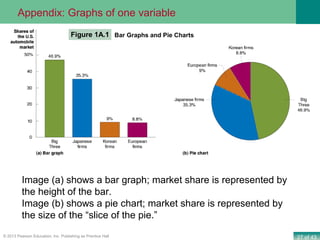
Image (a) shows a bar graph; market share is represented by
the height of the bar.
Image (b) shows a pie chart; market share is represented by
the size of the “slice of the pie.”
Appendix: Graphs of one variable
Figure 1A.1 Bar Graphs and Pie Charts
28 of 43© 2013 Pearson Education, Inc. Publishing as Prentice Hall
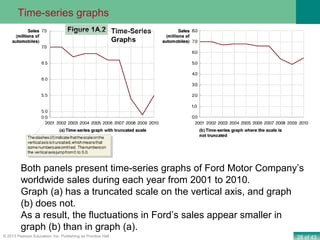
Figure 1A.2 Time-Series
Graphs
Both panels present time-series graphs of Ford Motor Company’s
worldwide sales during each year from 2001 to 2010.
Graph (a) has a truncated scale on the vertical axis, and graph
(b) does not.
As a result, the fluctuations in Ford’s sales appear smaller in
graph (b) than in graph (a).
Time-series graphs
29 of 43© 2013 Pearson Education, Inc. Publishing as Prentice Hall
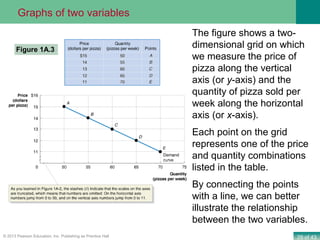
Figure 1A.3
The figure shows a two-
dimensional grid on which
we measure the price of
pizza along the vertical
axis (or y-axis) and the
quantity of pizza sold per
week along the horizontal
axis (or x-axis).
Each point on the grid
represents one of the price
and quantity combinations
listed in the table.
By connecting the points
with a line, we can better
illustrate the relationship
between the two variables.
Graphs of two variables
30 of 43© 2013 Pearson Education, Inc. Publishing as Prentice Hall
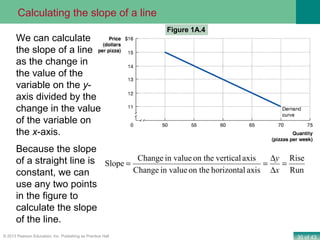
Figure 1A.4
We can calculate
the slope of a line
as the change in
the value of the
variable on the y-
axis divided by the
change in the value
of the variable on
the x-axis.
Because the slope
of a straight line is
constant, we can
use any two points
in the figure to
calculate the slope
of the line.
Run
Rise
axishorizontalon thein valueChange
axisverticalon thein valueChange
Slope =
∆
∆
==
x
y
Calculating the slope of a line
31 of 43© 2013 Pearson Education, Inc. Publishing as Prentice Hall
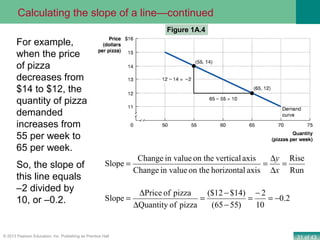
For example,
when the price
of pizza
decreases from
$14 to $12, the
quantity of pizza
demanded
increases from
55 per week to
65 per week.
So, the slope of
this line equals
–2 divided by
10, or –0.2. 2.0
10
2
)5565(
)14$12($
pizzaofQuantity
pizzaofPrice
Slope −=
−
=
−
−
=
∆
∆
=
Run
Rise
axishorizontalon thein valueChange
axisverticalon thein valueChange
Slope =
∆
∆
==
x
y
Calculating the slope of a line—continued
Figure 1A.4
32 of 43© 2013 Pearson Education, Inc. Publishing as Prentice Hall
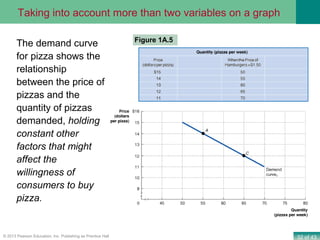
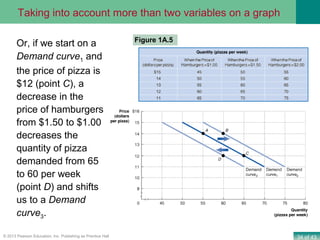
Figure 1A.5
The demand curve
for pizza shows the
relationship
between the price of
pizzas and the
quantity of pizzas
demanded, holding
constant other
factors that might
affect the
willingness of
consumers to buy
pizza.
Taking into account more than two variables on a graph
33 of 43© 2013 Pearson Education, Inc. Publishing as Prentice Hall
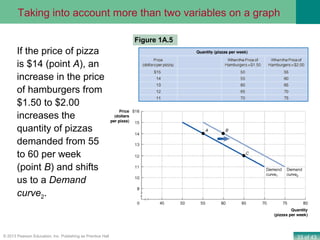
If the price of pizza
is $14 (point A), an
increase in the price
of hamburgers from
$1.50 to $2.00
increases the
quantity of pizzas
demanded from 55
to 60 per week
(point B) and shifts
us to a Demand
curve2.
Taking into account more than two variables on a graph
Figure 1A.5
34 of 43© 2013 Pearson Education, Inc. Publishing as Prentice Hall
Or, if we start on a
Demand curve1 and
the price of pizza is
$12 (point C), a
decrease in the
price of hamburgers
from $1.50 to $1.00
decreases the
quantity of pizza
demanded from 65
to 60 per week
(point D) and shifts
us to a Demand
curve3.
Taking into account more than two variables on a graph
Figure 1A.5
35 of 43© 2013 Pearson Education, Inc. Publishing as Prentice Hall
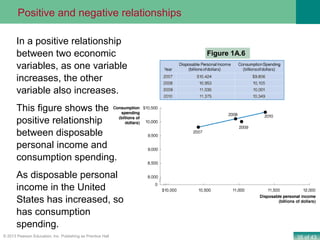
In a positive relationship
between two economic
variables, as one variable
increases, the other
variable also increases.
This figure shows the
positive relationship
between disposable
personal income and
consumption spending.
As disposable personal
income in the United
States has increased, so
has consumption
spending.
Figure 1A.6
Positive and negative relationships
36 of 43© 2013 Pearson Education, Inc. Publishing as Prentice Hall
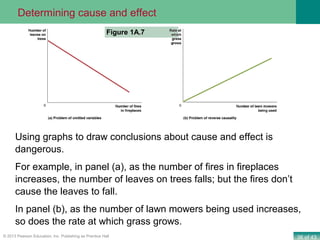
Figure 1A.7
Using graphs to draw conclusions about cause and effect is
dangerous.
For example, in panel (a), as the number of fires in fireplaces
increases, the number of leaves on trees falls; but the fires don’t
cause the leaves to fall.
In panel (b), as the number of lawn mowers being used increases,
so does the rate at which grass grows.
Determining cause and effect
37 of 43© 2013 Pearson Education, Inc. Publishing as Prentice Hall
The relationship between two variables is linear when it can be
represented by a straight line.
Few economic relationships are actually linear. However linear
approximations are simpler to use, and are often “good enough”
in modeling.
Are graphs of economic relationships always linear?
38 of 43© 2013 Pearson Education, Inc. Publishing as Prentice Hall
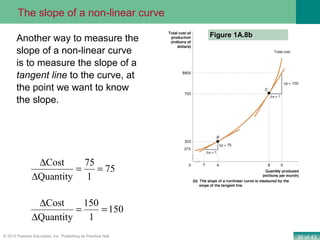
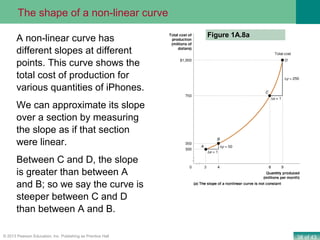
Figure 1A.8a
A non-linear curve has
different slopes at different
points. This curve shows the
total cost of production for
various quantities of iPhones.
We can approximate its slope
over a section by measuring
the slope as if that section
were linear.
Between C and D, the slope
is greater than between A
and B; so we say the curve is
steeper between C and D
than between A and B.
The shape of a non-linear curve
39 of 43© 2013 Pearson Education, Inc. Publishing as Prentice Hall
Another way to measure the
slope of a non-linear curve
is to measure the slope of a
tangent line to the curve, at
the point we want to know
the slope.
75
1
75
Quantity
Cost
==
∆
∆
150
1
150
Quantity
Cost
==
∆
∆
Figure 1A.8b
The slope of a non-linear curve
40 of 43© 2013 Pearson Education, Inc. Publishing as Prentice Hall
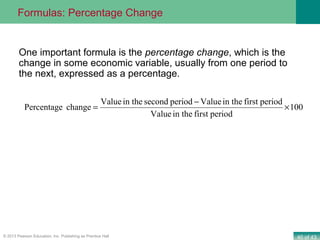
Formulas: Percentage Change
100
periodfirstin theValue
periodfirstin theValueperiodsecondin theValue
changePercentage ×
−
=
One important formula is the percentage change, which is the
change in some economic variable, usually from one period to
the next, expressed as a percentage.
41 of 43© 2013 Pearson Education, Inc. Publishing as Prentice Hall
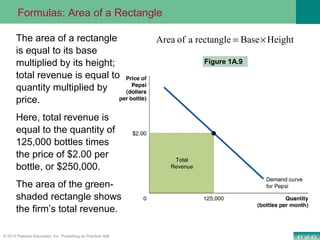
Figure 1A.9
The area of a rectangle
is equal to its base
multiplied by its height;
total revenue is equal to
quantity multiplied by
price.
Here, total revenue is
equal to the quantity of
125,000 bottles times
the price of $2.00 per
bottle, or $250,000.
The area of the green-
shaded rectangle shows
the firm’s total revenue.
HeightBaserectangleaofArea ×=
Formulas: Area of a Rectangle
42 of 43© 2013 Pearson Education, Inc. Publishing as Prentice Hall
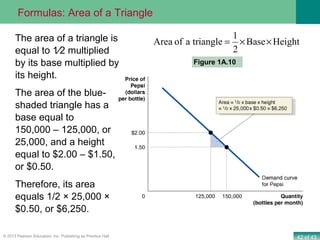
Figure 1A.10
HeightBase
2
1
triangleaofArea ××=The area of a triangle is
equal to 1⁄2 multiplied
by its base multiplied by
its height.
The area of the blue-
shaded triangle has a
base equal to
150,000 – 125,000, or
25,000, and a height
equal to $2.00 – $1.50,
or $0.50.
Therefore, its area
equals 1/2 × 25,000 ×
$0.50, or $6,250.
Formulas: Area of a Triangle
43 of 43© 2013 Pearson Education, Inc. Publishing as Prentice Hall
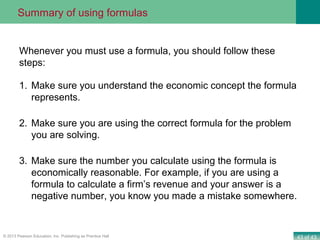
1. Make sure you understand the economic concept the formula
represents.
2. Make sure you are using the correct formula for the problem
you are solving.
3. Make sure the number you calculate using the formula is
economically reasonable. For example, if you are using a
formula to calculate a firm’s revenue and your answer is a
negative number, you know you made a mistake somewhere.
Whenever you must use a formula, you should follow these
steps:
Summary of using formulas

Ge273.u1.pp1

  • 1.
  • 2.
    2 of 43©2013 Pearson Education, Inc. Publishing as Prentice Hall Economics: Foundations and Models Chapter Outline and Learning Objectives CHAPTER 1 1.1 Three Key Economic Ideas 1.2 The Economic Problem That Every Society Must Solve 1.3 Economic Models 1.4 Microeconomics and Macroeconomics 1.5 A Preview of Important Economic Terms APPENDIX: Using Graphs and Formulas
  • 3.
    3 of 43©2013 Pearson Education, Inc. Publishing as Prentice Hall People make choices as they try to attain their goals. Choices are necessary because we live in a world of scarcity. Scarcity: A situation in which unlimited wants exceed the limited resources available to fulfill those wants Economics is the study of these choices. Economists study these choices using economic models, simplified versions of reality used to analyze real-world economic applications. What is this class about?
  • 4.
    4 of 43©2013 Pearson Education, Inc. Publishing as Prentice Hall We will learn how to answer questions like these: • How are the prices of goods and services determined? • How does pollution affect the economy, and how should government policy deal with these effects? • Why do firms engage in international trade, and how do government policies affect international trade? • Why does government control the prices of some goods and services, and what are the effects of those controls? What is this class about?
  • 5.
    5 of 43©2013 Pearson Education, Inc. Publishing as Prentice Hall Explain these three key economic ideas: People are rational People respond to incentives Optimal decisions are made at the margin. 1.1 LEARNING OBJECTIVE Three Key Economic Ideas
  • 6.
    6 of 43©2013 Pearson Education, Inc. Publishing as Prentice Hall Economists generally assume that people are rational. Rational: Using all available information to achieve your goals. Rational consumers and firms weigh the benefits and costs of each action, and try to make the best decision possible. Example: Microsoft doesn’t randomly choose the price of its Windows software; it chooses the price(s) that it thinks will be most profitable. 1. People are rational
  • 7.
    7 of 43©2013 Pearson Education, Inc. Publishing as Prentice Hall As incentives change, so do the actions that people will take. Example: Changes in several factors have resulted in increased obesity in Americans over the last couple of decades, including: •Decreases in the price of fast food relative to healthful food •Improved non-active entertainment options •Increased availability of health care and insurance, protecting people against the consequences of their actions 2. People respond to incentives
  • 8.
    8 of 43©2013 Pearson Education, Inc. Publishing as Prentice Hall While some decisions are all-or-nothing, most decisions involve doing a little more or a little less of something. Example: Should you watch an extra hour of TV, or study instead? Economists think about decisions like this in terms of the marginal cost and benefit (MC and MB): the additional cost or benefit associated with a small amount extra of some action. Comparing MC and MB is known as Marginal Analysis. 3. Optimal decisions are made at the margin
  • 9.
    9 of 43©2013 Pearson Education, Inc. Publishing as Prentice Hall How will you spend this evening? You probably didn’t answer this question with studying! What about the night before your first exam? Hopefully, you will study then. An economist sees you as a rational person who performs marginal analysis unknowingly: •The marginal cost of study (i.e. foregoing the opportunity for more entertaining activities) has stayed the same, but… •The marginal benefit of study (i.e. the likely increase in your grade) has increased. So you switch your choice from “entertainment” to “study”. Making the Connection
  • 10.
    10 of 43©2013 Pearson Education, Inc. Publishing as Prentice Hall Discuss how an economy answers these questions: What goods and services will be produced? How will the goods and services be produced? Who will receive the goods and services produced? 1.2 LEARNING OBJECTIVE The Economic Problem That Every Society Must Solve
  • 11.
    11 of 43©2013 Pearson Education, Inc. Publishing as Prentice Hall Individuals, firms, and governments must decide on the goods and services that should be produced. An increase in the production of one good requires the reduction in the production of some other good. This is a trade-off, resulting from the scarcity of productive resources. The highest-valued alternative given up in order to engage in some activity is known as the opportunity cost. Example: the opportunity cost of increased funding for space exploration might be giving up the opportunity to fund cancer research. 1. What goods and services will be produced?
  • 12.
    12 of 43©2013 Pearson Education, Inc. Publishing as Prentice Hall A firm might have several different methods for producing its goods and services. Example: A music producer can make a song sound good by: •Hiring a great singer and using standard production techniques OR •Hiring a mediocre singer, and using Auto-Tune to correct the inaccuracies. Example: As the cost of manufacturing labor changes, a firm might respond by: •Changing its production technique to one that employs more machines and fewer workers OR •Moving its factory to a location with cheaper labor 2. How will the goods and services be produced?
  • 13.
    13 of 43©2013 Pearson Education, Inc. Publishing as Prentice Hall The way we are most familiar with in the United States is that people with higher incomes obtain more goods and services. Changes in tax and welfare policies change the distribution of income; though people often disagree about the extent to which this “redistribution” is desirable. 3. Who will receive the goods and services produced?
  • 14.
    14 of 43©2013 Pearson Education, Inc. Publishing as Prentice Hall Centrally planned economies result when governments decide what to produce, how to produce it, and who received the goods and services. Market economies result when the decisions of households and firms determine what is produced, how it is produced, and who receives the goods and services. Market: A group of buyers and sellers of a good or service Mixed economies have features of both of the above. Most economic decisions result from the interaction of buyers and sellers, but governments play a significant role in the allocation of resources. Types of economies
  • 15.
    15 of 43©2013 Pearson Education, Inc. Publishing as Prentice Hall Market economies tend to be more efficient than centrally- planned economies. Market economies promote: •Productive efficiency, where goods or services are produced at the lowest possible cost; and •Allocative efficiency, where production is consistent with consumer preferences: the marginal benefit of production is equal to its marginal cost These efficiencies come about because all transactions result from voluntary exchange: transactions that make both the buyer and seller better off. Efficiency of economies
  • 16.
    16 of 43©2013 Pearson Education, Inc. Publishing as Prentice Hall Markets may not result in fully efficient outcomes. For example: •People might not immediately do things in the most efficient way •Governments might interfere with market outcomes •Market outcomes might ignore the desires of people who are not involved in transactions – ex: pollution Economically efficient outcomes may not be the most desirable. Markets result in high inequality; some people prefer more equity, i.e. fairer distribution of economic benefits. Caveats about market economies
  • 17.
    17 of 43©2013 Pearson Education, Inc. Publishing as Prentice Hall Understand the role of models in economic analysis. 1.3 LEARNING OBJECTIVE Economic Models
  • 18.
    18 of 43©2013 Pearson Education, Inc. Publishing as Prentice Hall Economists develop economic models to analyze real-world issue. Building an economic model often follows these steps: 1. Decide on the assumptions to use in developing the model. 2. Formulate a testable hypothesis. 3. Use economic data to test the hypothesis. 4. Revise the model if it fails to explain the economic data well. 5. Retain the revised model to help answer similar economic questions in the future. Economic models
  • 19.
    19 of 43©2013 Pearson Education, Inc. Publishing as Prentice Hall Assumptions and simplifications: every model needs them in order to be useful. Testability: good models generate testable predictions, which can be verified or disproven using data. Economic variables: measurable items that can be used to insert real-world data into the model. Important features of economic models
  • 20.
    20 of 43©2013 Pearson Education, Inc. Publishing as Prentice Hall Economists try to mimic natural scientists by using the scientific method. But economics is a social science; studying the behavior of people is often tricky. When analyzing human behavior, we can perform: •Positive analysis, the study of “what is?” •Normative analysis, the study of “what ought to be?” Economists generally perform positive analysis. The scientific nature of economics
  • 21.
    21 of 43©2013 Pearson Education, Inc. Publishing as Prentice Hall In the United States, we are used to paying tuition to attend college. In Finland, universities do not collect tuition fees. Should the United States also provide free public university education? Economists can develop models to estimate the effect on the economy (national output, incomes, etc.) of such a policy. This is positive analysis. Judgment based on these effects requires normative analysis. Should college be free? Making the Connection
  • 22.
    22 of 43©2013 Pearson Education, Inc. Publishing as Prentice Hall Distinguish between microeconomics and macroeconomics. 1.4 LEARNING OBJECTIVE Microeconomics and Macroeconomics

  • 23.
    23 of 43©2013 Pearson Education, Inc. Publishing as Prentice Hall Microeconomics is the study of: •How households and firms make choices, •How they interact in markets, and •How the government attempts to influence their choices Macroeconomics is the study of the economy as a whole, including topics such as inflation, unemployment, and economic growth. Microeconomics and Macroeconomics
  • 24.
    24 of 43©2013 Pearson Education, Inc. Publishing as Prentice Hall Define important economic terms. 1.5 LEARNING OBJECTIVE A Preview of Important Economic Terms
  • 25.
    25 of 43©2013 Pearson Education, Inc. Publishing as Prentice Hall Like all fields of study, economics uses terms or jargon with specific, precise meanings. Sometimes these terms will be used in ways that differ even from closely related disciplines. Examples: Technology: the processes a firm uses for turning inputs into outputs of goods and services Capital: manufactured goods that are used to produce other goods and services Pay close attention to terms defined in class and in the textbook! Terminology in Economics
  • 26.
    26 of 43©2013 Pearson Education, Inc. Publishing as Prentice Hall Believing economics is only about money. Confusing positive and normative analysis. Assuming familiar meanings for economic terms. Common misconceptions to avoid
  • 27.
    27 of 43©2013 Pearson Education, Inc. Publishing as Prentice Hall Image (a) shows a bar graph; market share is represented by the height of the bar. Image (b) shows a pie chart; market share is represented by the size of the “slice of the pie.” Appendix: Graphs of one variable Figure 1A.1 Bar Graphs and Pie Charts
  • 28.
    28 of 43©2013 Pearson Education, Inc. Publishing as Prentice Hall Figure 1A.2 Time-Series Graphs Both panels present time-series graphs of Ford Motor Company’s worldwide sales during each year from 2001 to 2010. Graph (a) has a truncated scale on the vertical axis, and graph (b) does not. As a result, the fluctuations in Ford’s sales appear smaller in graph (b) than in graph (a). Time-series graphs
  • 29.
    29 of 43©2013 Pearson Education, Inc. Publishing as Prentice Hall Figure 1A.3 The figure shows a two- dimensional grid on which we measure the price of pizza along the vertical axis (or y-axis) and the quantity of pizza sold per week along the horizontal axis (or x-axis). Each point on the grid represents one of the price and quantity combinations listed in the table. By connecting the points with a line, we can better illustrate the relationship between the two variables. Graphs of two variables
  • 30.
    30 of 43©2013 Pearson Education, Inc. Publishing as Prentice Hall Figure 1A.4 We can calculate the slope of a line as the change in the value of the variable on the y- axis divided by the change in the value of the variable on the x-axis. Because the slope of a straight line is constant, we can use any two points in the figure to calculate the slope of the line. Run Rise axishorizontalon thein valueChange axisverticalon thein valueChange Slope = ∆ ∆ == x y Calculating the slope of a line
  • 31.
    31 of 43©2013 Pearson Education, Inc. Publishing as Prentice Hall For example, when the price of pizza decreases from $14 to $12, the quantity of pizza demanded increases from 55 per week to 65 per week. So, the slope of this line equals –2 divided by 10, or –0.2. 2.0 10 2 )5565( )14$12($ pizzaofQuantity pizzaofPrice Slope −= − = − − = ∆ ∆ = Run Rise axishorizontalon thein valueChange axisverticalon thein valueChange Slope = ∆ ∆ == x y Calculating the slope of a line—continued Figure 1A.4
  • 32.
    32 of 43©2013 Pearson Education, Inc. Publishing as Prentice Hall Figure 1A.5 The demand curve for pizza shows the relationship between the price of pizzas and the quantity of pizzas demanded, holding constant other factors that might affect the willingness of consumers to buy pizza. Taking into account more than two variables on a graph
  • 33.
    33 of 43©2013 Pearson Education, Inc. Publishing as Prentice Hall If the price of pizza is $14 (point A), an increase in the price of hamburgers from $1.50 to $2.00 increases the quantity of pizzas demanded from 55 to 60 per week (point B) and shifts us to a Demand curve2. Taking into account more than two variables on a graph Figure 1A.5
  • 34.
    34 of 43©2013 Pearson Education, Inc. Publishing as Prentice Hall Or, if we start on a Demand curve1 and the price of pizza is $12 (point C), a decrease in the price of hamburgers from $1.50 to $1.00 decreases the quantity of pizza demanded from 65 to 60 per week (point D) and shifts us to a Demand curve3. Taking into account more than two variables on a graph Figure 1A.5
  • 35.
    35 of 43©2013 Pearson Education, Inc. Publishing as Prentice Hall In a positive relationship between two economic variables, as one variable increases, the other variable also increases. This figure shows the positive relationship between disposable personal income and consumption spending. As disposable personal income in the United States has increased, so has consumption spending. Figure 1A.6 Positive and negative relationships
  • 36.
    36 of 43©2013 Pearson Education, Inc. Publishing as Prentice Hall Figure 1A.7 Using graphs to draw conclusions about cause and effect is dangerous. For example, in panel (a), as the number of fires in fireplaces increases, the number of leaves on trees falls; but the fires don’t cause the leaves to fall. In panel (b), as the number of lawn mowers being used increases, so does the rate at which grass grows. Determining cause and effect
  • 37.
    37 of 43©2013 Pearson Education, Inc. Publishing as Prentice Hall The relationship between two variables is linear when it can be represented by a straight line. Few economic relationships are actually linear. However linear approximations are simpler to use, and are often “good enough” in modeling. Are graphs of economic relationships always linear?
  • 38.
    38 of 43©2013 Pearson Education, Inc. Publishing as Prentice Hall Figure 1A.8a A non-linear curve has different slopes at different points. This curve shows the total cost of production for various quantities of iPhones. We can approximate its slope over a section by measuring the slope as if that section were linear. Between C and D, the slope is greater than between A and B; so we say the curve is steeper between C and D than between A and B. The shape of a non-linear curve
  • 39.
    39 of 43©2013 Pearson Education, Inc. Publishing as Prentice Hall Another way to measure the slope of a non-linear curve is to measure the slope of a tangent line to the curve, at the point we want to know the slope. 75 1 75 Quantity Cost == ∆ ∆ 150 1 150 Quantity Cost == ∆ ∆ Figure 1A.8b The slope of a non-linear curve
  • 40.
    40 of 43©2013 Pearson Education, Inc. Publishing as Prentice Hall Formulas: Percentage Change 100 periodfirstin theValue periodfirstin theValueperiodsecondin theValue changePercentage × − = One important formula is the percentage change, which is the change in some economic variable, usually from one period to the next, expressed as a percentage.
  • 41.
    41 of 43©2013 Pearson Education, Inc. Publishing as Prentice Hall Figure 1A.9 The area of a rectangle is equal to its base multiplied by its height; total revenue is equal to quantity multiplied by price. Here, total revenue is equal to the quantity of 125,000 bottles times the price of $2.00 per bottle, or $250,000. The area of the green- shaded rectangle shows the firm’s total revenue. HeightBaserectangleaofArea ×= Formulas: Area of a Rectangle
  • 42.
    42 of 43©2013 Pearson Education, Inc. Publishing as Prentice Hall Figure 1A.10 HeightBase 2 1 triangleaofArea ××=The area of a triangle is equal to 1⁄2 multiplied by its base multiplied by its height. The area of the blue- shaded triangle has a base equal to 150,000 – 125,000, or 25,000, and a height equal to $2.00 – $1.50, or $0.50. Therefore, its area equals 1/2 × 25,000 × $0.50, or $6,250. Formulas: Area of a Triangle
  • 43.
    43 of 43©2013 Pearson Education, Inc. Publishing as Prentice Hall 1. Make sure you understand the economic concept the formula represents. 2. Make sure you are using the correct formula for the problem you are solving. 3. Make sure the number you calculate using the formula is economically reasonable. For example, if you are using a formula to calculate a firm’s revenue and your answer is a negative number, you know you made a mistake somewhere. Whenever you must use a formula, you should follow these steps: Summary of using formulas