By: Dr.A.R.Moorthy
Head QA- Syngene International Ltd.
Goals and Objectives
 To understand:
 The affect of Good Clinical Practices on institutions conducting
Clinical Research
 To discuss:
 What is GCP
 Guidelines for GCP
 The history of Good Clinical Practices
 Basic principles
 Practices and strategy for staying compliant with Good Clinical
Practices.
What Is GCP?
Good Clinical Practice (GCP) is defined as a
‘standard for the design, conduct, performance,
monitoring, auditing, recording, analyses and
reporting of clinical trials that provides
assurance that the data and reported results
are credible and accurate, and that the rights,
integrity and confidentiality of trial subjects are
protected’
Good Clinical Practice Guidelines
 Are mainly focused on the protection of human
rights in clinical trial.
 Provide assurance of the safety of the newly
developed compounds.
 Provide standards on how clinical trials should
be conducted.
 Define the roles and responsibilities of clinical
sponsors, clinical research investigators, Clinical
Research Associates, and monitors.
Good Clinical Practice Guidelines
(Continued)
 GCPs are generally accepted, international best practices
for conducting clinical trials and device studies
 They are defined as an international ethical and
scientific standard for designing, conducting,
recording and reporting trials that involve the
participation of human subjects
 Compliance with GCPs provide public assurance
that the rights and safety of participants in human
subject research are protected and that the data
that arises from the study is credible
The Core of the Consolidated GCP
Guidance
1 Clinical trials should be conducted in accordance with the ethical
principles that have their origin in the Declaration of Helsinki, and that
are consistent with GCP and the applicable regulatory requirements
2 Before a trial is initiated, foreseeable risks and inconveniences should be
weighed against the anticipated benefit for the individual trial subject
and society. A trial should be initiated and continued only if the
anticipated benefits justify the risks
3 The rights, safety, and well-being of the trial subjects are the most
important considerations and should prevail over interests of science and
society
4 The available non clinical and clinical information on an investigational
product should be adequate to support the proposed clinical trial
5 Clinical trials should be scientifically sound, and described in a clear,
detailed protocol
6 A trial should be conducted in compliance with the protocol that has
received prior institutional review board (IRB)/independent ethics
committee (IEC) approval/favorable opinion
7 The medical care given to, and medical decisions made on behalf of,
subjects should always be the responsibility of a qualified physician or,
when appropriate, of a qualified dentist
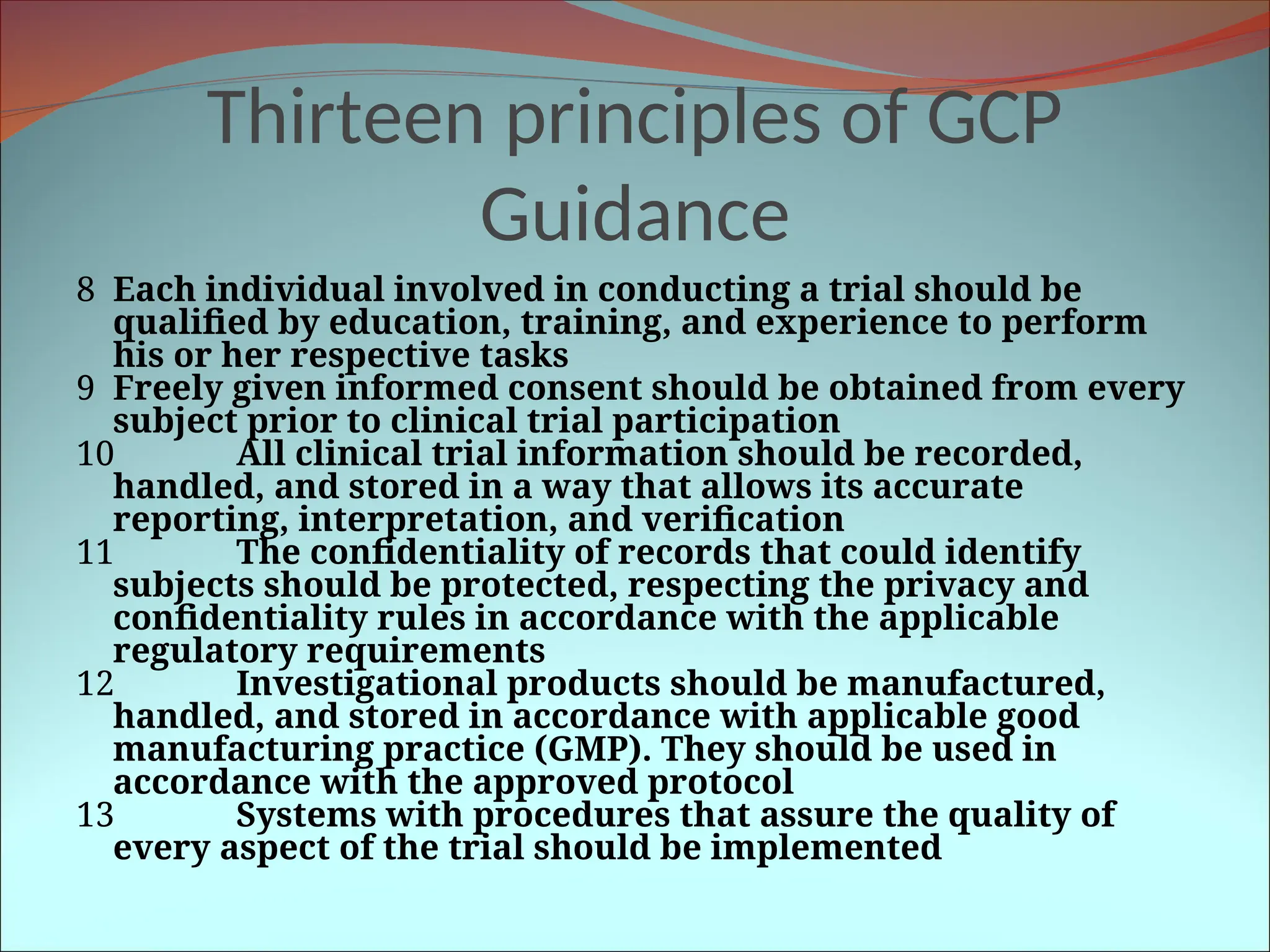
Thirteen principles of GCP
Guidance
8 Each individual involved in conducting a trial should be
qualified by education, training, and experience to perform
his or her respective tasks
9 Freely given informed consent should be obtained from every
subject prior to clinical trial participation
10 All clinical trial information should be recorded,
handled, and stored in a way that allows its accurate
reporting, interpretation, and verification
11 The confidentiality of records that could identify
subjects should be protected, respecting the privacy and
confidentiality rules in accordance with the applicable
regulatory requirements
12 Investigational products should be manufactured,
handled, and stored in accordance with applicable good
manufacturing practice (GMP). They should be used in
accordance with the approved protocol
13 Systems with procedures that assure the quality of
every aspect of the trial should be implemented
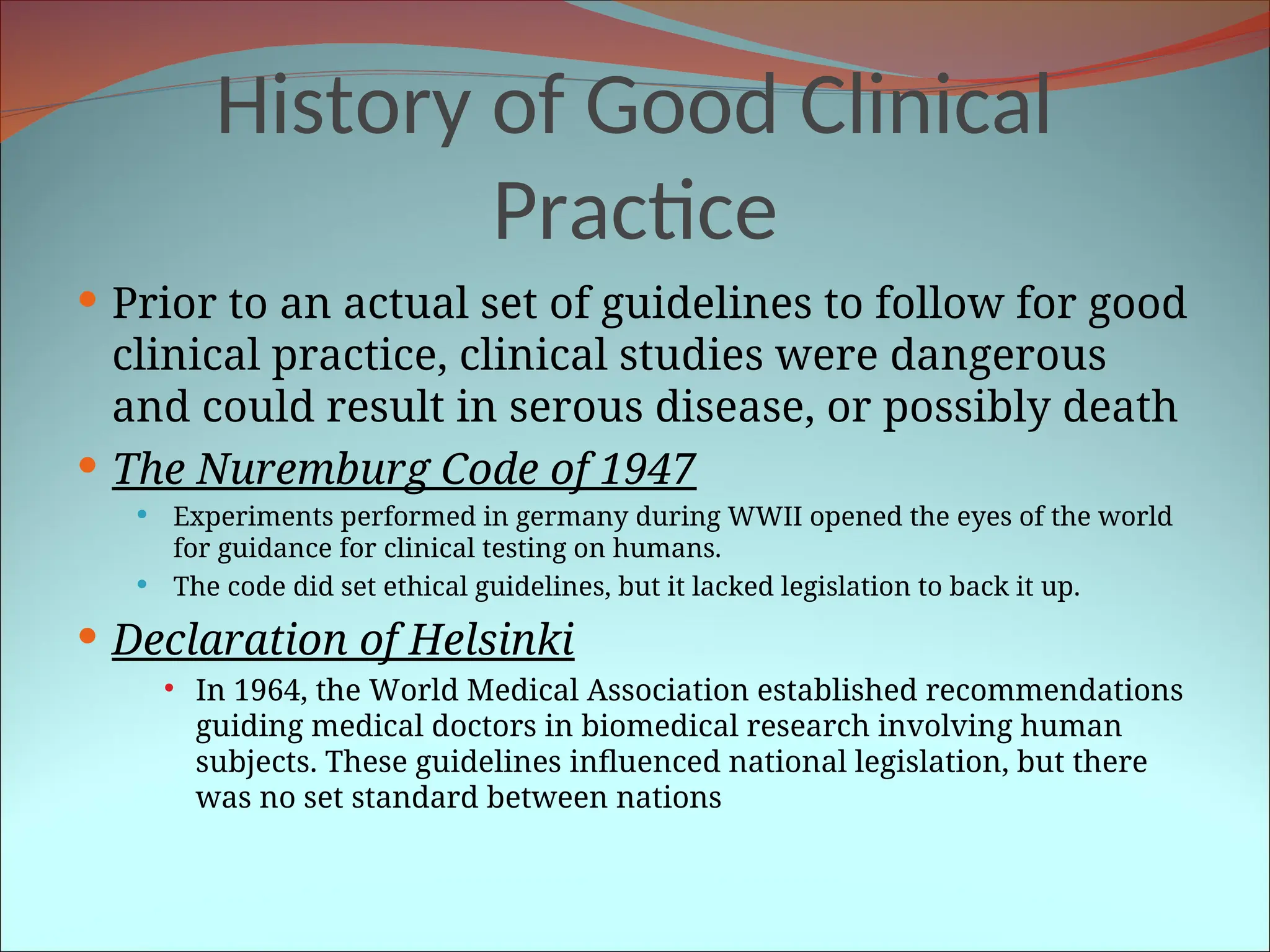
History of Good Clinical
Practice
 Prior to an actual set of guidelines to follow for good
clinical practice, clinical studies were dangerous
and could result in serous disease, or possibly death
 The Nuremburg Code of 1947
 Experiments performed in germany during WWII opened the eyes of the world
for guidance for clinical testing on humans.
 The code did set ethical guidelines, but it lacked legislation to back it up.
 Declaration of Helsinki
 In 1964, the World Medical Association established recommendations
guiding medical doctors in biomedical research involving human
subjects. These guidelines influenced national legislation, but there
was no set standard between nations
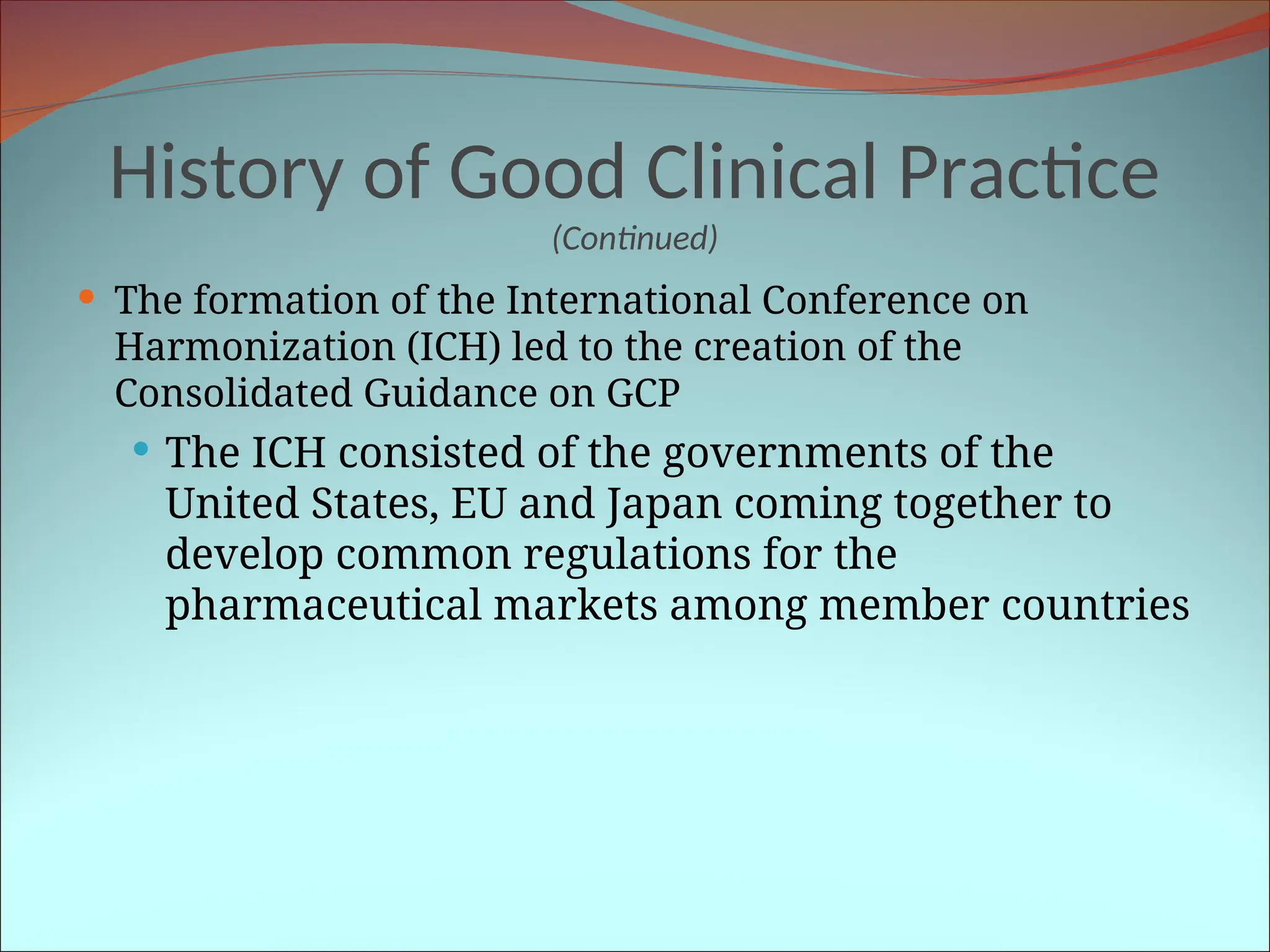
History of Good Clinical Practice
(Continued)
 The formation of the International Conference on
Harmonization (ICH) led to the creation of the
Consolidated Guidance on GCP
 The ICH consisted of the governments of the
United States, EU and Japan coming together to
develop common regulations for the
pharmaceutical markets among member countries
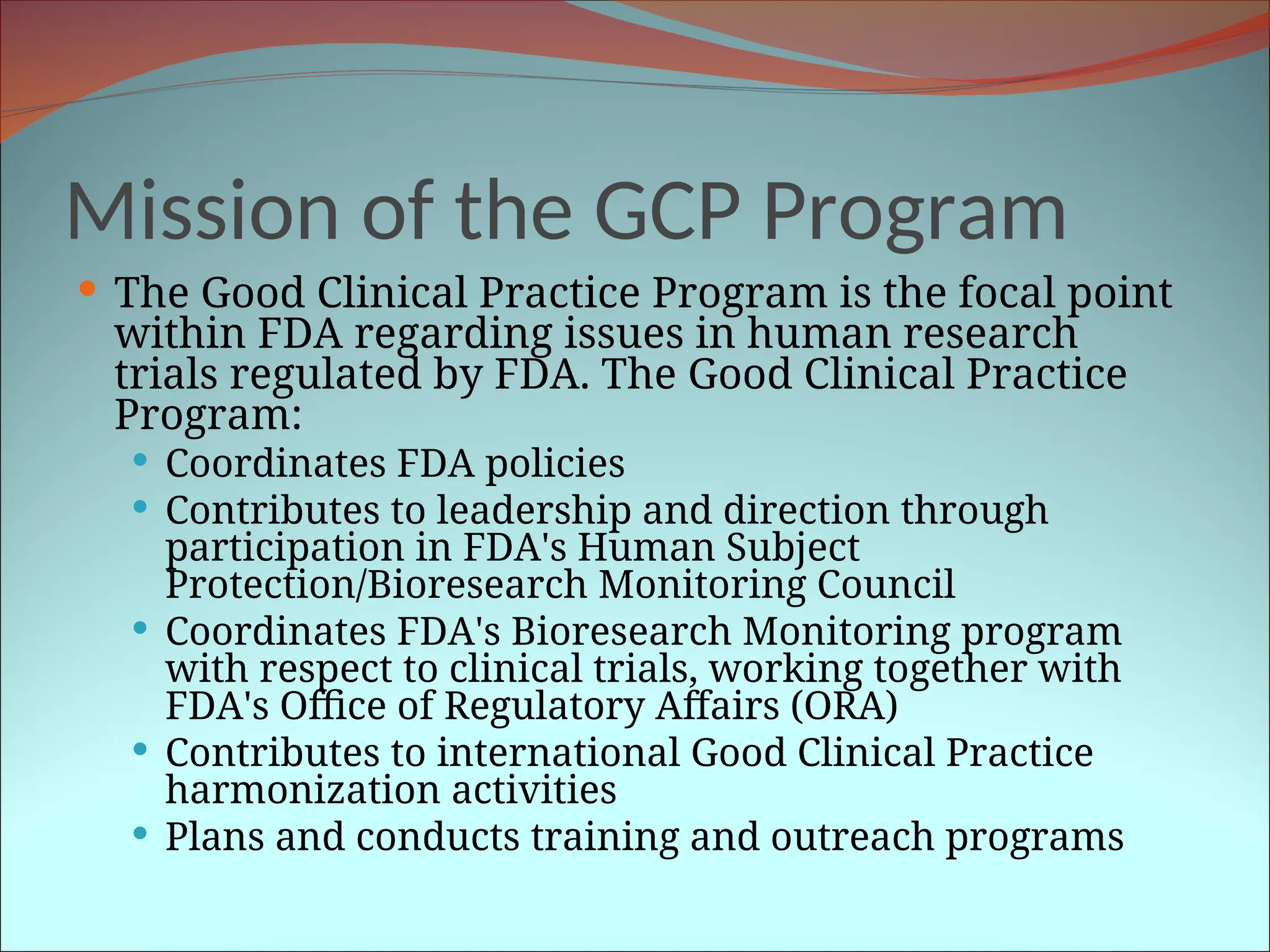
Mission of the GCP Program
 The Good Clinical Practice Program is the focal point
within FDA regarding issues in human research
trials regulated by FDA. The Good Clinical Practice
Program:
 Coordinates FDA policies
 Contributes to leadership and direction through
participation in FDA's Human Subject
Protection/Bioresearch Monitoring Council
 Coordinates FDA's Bioresearch Monitoring program
with respect to clinical trials, working together with
FDA's Office of Regulatory Affairs (ORA)
 Contributes to international Good Clinical Practice
harmonization activities
 Plans and conducts training and outreach programs
Under GCP, the FDA Requires That
People be Informed:
 The study involves research of an unproven drug, the
purpose of the research
 How long the participant will be expected to participate
in the study
 What will happen in the study
 Possible risks/benefits to the participant
 Participation is voluntary and that participants can quit
the study at any time without penalty or loss of benefits
to which they are otherwise entitled.
Procedures During a Clinical Trial?
 New drug research starts by studying how the body
functions at its most basic levels.
 The first series of tests are on performed on Human
enzymes and proteins to observe the basic effect.
 Next, the drug must be tested in living animals to ensure
safety for human consumption.
 With this, drug companies make every effort to use as few
animals as possible and ensure they are properly cared
for.
 Then a protocol is created to map out what study
procedures will be done, by whom, and why within a
clinical trial.
What Happens in a Clinical Trial?
(Continued)
 The trials are conducted in 4 phases.
 Phase 1 trials are for determining dosing, document
how a drug is metabolized and identify side effects.
 Phase 2 trials gather further safety data and
evidence of the drug's efficacy.
 Phase 3 further tests the product's effectiveness on
a greater number of participants, and monitors side
effects.
 Phase 4 trials can be conducted after a product is
already approved and on the market to find out
more about the treatment's long-term risks
What Happens in a Clinical Trial?
(Continued)
 It is estimated that only 5 in 5,000 compounds
that enter preclinical testing make it to human
testing, and only 1 of those 5 may be safe and
effective enough to reach pharmacy shelves.

Further Information
 http://www.youtube.com/watch?v=ZiTBO8I9oBY.
References
 http://www.fda.gov/
 http://en.wikipedia.org/wiki/ICH-GCP
 http://www.youtube.com/watch?v=ZiTBO8I9oBY.
Questions?
That’s Enough For Today

GCP___________________________________.PPT

  • 1.
    By: Dr.A.R.Moorthy Head QA-Syngene International Ltd.
  • 2.
    Goals and Objectives To understand:  The affect of Good Clinical Practices on institutions conducting Clinical Research  To discuss:  What is GCP  Guidelines for GCP  The history of Good Clinical Practices  Basic principles  Practices and strategy for staying compliant with Good Clinical Practices.
  • 3.
    What Is GCP? GoodClinical Practice (GCP) is defined as a ‘standard for the design, conduct, performance, monitoring, auditing, recording, analyses and reporting of clinical trials that provides assurance that the data and reported results are credible and accurate, and that the rights, integrity and confidentiality of trial subjects are protected’
  • 4.
    Good Clinical PracticeGuidelines  Are mainly focused on the protection of human rights in clinical trial.  Provide assurance of the safety of the newly developed compounds.  Provide standards on how clinical trials should be conducted.  Define the roles and responsibilities of clinical sponsors, clinical research investigators, Clinical Research Associates, and monitors.
  • 5.
    Good Clinical PracticeGuidelines (Continued)  GCPs are generally accepted, international best practices for conducting clinical trials and device studies  They are defined as an international ethical and scientific standard for designing, conducting, recording and reporting trials that involve the participation of human subjects  Compliance with GCPs provide public assurance that the rights and safety of participants in human subject research are protected and that the data that arises from the study is credible
  • 6.
    The Core ofthe Consolidated GCP Guidance 1 Clinical trials should be conducted in accordance with the ethical principles that have their origin in the Declaration of Helsinki, and that are consistent with GCP and the applicable regulatory requirements 2 Before a trial is initiated, foreseeable risks and inconveniences should be weighed against the anticipated benefit for the individual trial subject and society. A trial should be initiated and continued only if the anticipated benefits justify the risks 3 The rights, safety, and well-being of the trial subjects are the most important considerations and should prevail over interests of science and society 4 The available non clinical and clinical information on an investigational product should be adequate to support the proposed clinical trial 5 Clinical trials should be scientifically sound, and described in a clear, detailed protocol 6 A trial should be conducted in compliance with the protocol that has received prior institutional review board (IRB)/independent ethics committee (IEC) approval/favorable opinion 7 The medical care given to, and medical decisions made on behalf of, subjects should always be the responsibility of a qualified physician or, when appropriate, of a qualified dentist
  • 7.
    Thirteen principles ofGCP Guidance 8 Each individual involved in conducting a trial should be qualified by education, training, and experience to perform his or her respective tasks 9 Freely given informed consent should be obtained from every subject prior to clinical trial participation 10 All clinical trial information should be recorded, handled, and stored in a way that allows its accurate reporting, interpretation, and verification 11 The confidentiality of records that could identify subjects should be protected, respecting the privacy and confidentiality rules in accordance with the applicable regulatory requirements 12 Investigational products should be manufactured, handled, and stored in accordance with applicable good manufacturing practice (GMP). They should be used in accordance with the approved protocol 13 Systems with procedures that assure the quality of every aspect of the trial should be implemented
  • 8.
    History of GoodClinical Practice  Prior to an actual set of guidelines to follow for good clinical practice, clinical studies were dangerous and could result in serous disease, or possibly death  The Nuremburg Code of 1947  Experiments performed in germany during WWII opened the eyes of the world for guidance for clinical testing on humans.  The code did set ethical guidelines, but it lacked legislation to back it up.  Declaration of Helsinki  In 1964, the World Medical Association established recommendations guiding medical doctors in biomedical research involving human subjects. These guidelines influenced national legislation, but there was no set standard between nations
  • 9.
    History of GoodClinical Practice (Continued)  The formation of the International Conference on Harmonization (ICH) led to the creation of the Consolidated Guidance on GCP  The ICH consisted of the governments of the United States, EU and Japan coming together to develop common regulations for the pharmaceutical markets among member countries
  • 10.
    Mission of theGCP Program  The Good Clinical Practice Program is the focal point within FDA regarding issues in human research trials regulated by FDA. The Good Clinical Practice Program:  Coordinates FDA policies  Contributes to leadership and direction through participation in FDA's Human Subject Protection/Bioresearch Monitoring Council  Coordinates FDA's Bioresearch Monitoring program with respect to clinical trials, working together with FDA's Office of Regulatory Affairs (ORA)  Contributes to international Good Clinical Practice harmonization activities  Plans and conducts training and outreach programs
  • 11.
    Under GCP, theFDA Requires That People be Informed:  The study involves research of an unproven drug, the purpose of the research  How long the participant will be expected to participate in the study  What will happen in the study  Possible risks/benefits to the participant  Participation is voluntary and that participants can quit the study at any time without penalty or loss of benefits to which they are otherwise entitled.
  • 12.
    Procedures During aClinical Trial?  New drug research starts by studying how the body functions at its most basic levels.  The first series of tests are on performed on Human enzymes and proteins to observe the basic effect.  Next, the drug must be tested in living animals to ensure safety for human consumption.  With this, drug companies make every effort to use as few animals as possible and ensure they are properly cared for.  Then a protocol is created to map out what study procedures will be done, by whom, and why within a clinical trial.
  • 13.
    What Happens ina Clinical Trial? (Continued)  The trials are conducted in 4 phases.  Phase 1 trials are for determining dosing, document how a drug is metabolized and identify side effects.  Phase 2 trials gather further safety data and evidence of the drug's efficacy.  Phase 3 further tests the product's effectiveness on a greater number of participants, and monitors side effects.  Phase 4 trials can be conducted after a product is already approved and on the market to find out more about the treatment's long-term risks
  • 14.
    What Happens ina Clinical Trial? (Continued)  It is estimated that only 5 in 5,000 compounds that enter preclinical testing make it to human testing, and only 1 of those 5 may be safe and effective enough to reach pharmacy shelves.
  • 15.
  • 16.
  • 17.
  • 18.