Sour Beef &
Cheesecake:
A Food & Family Memoir
•
By Grace Kenneth Collins
Sour Beef &
Cheesecake:
A Food & Family Memoir
•
Grace Kenneth Collins
1  Featuring 43 Family Recipes  2
Copyright © 2011 by Greenbranch Publishing, LLC
ISBN: 978-0-982-7055-9-9
eISBN: 978-0-982-7055-8-2
Published by Greenbranch Publishing, LLC
PO Box 208
Phoenix, MD 21131
Phone: (800) 933-3711
Fax: (410) 329-1510
Email: info@greenbranch.com
Website: www.gracecollinsmedia.com, www.greenbranch.com
All rights reserved. No part of this publication may be reproduced or transmitted in any form, by
any means, without prior written permission of the publisher.
Ebook edition also available.
Requests for permission, information on our multi-copy pricing program, or other infor­
mation should be addressed to the Permissions Department, Greenbranch Publishing, LLC.
info@greenbranch.com
Attention schools and companies: Greenbranch books are available at quantity discounts for
education, business or sales promotions. info@greenbranch.com
The Author’s references to various brand-name products (Aqua Net®, Bacardi Rum®, Boursin®,
Campari®, Cheerios®, Corning Ware, Crisco®, Gravy Master®, Jell-O, National Bohemian®, Old
Bay Seasoning®, Pepperidge Farm Goldfish®, Play-Doh, Sell’s Liver Pate®, Stella Artois®, Taylor
Pork Roll®) are for information only and not intended to suggest endorsement or sponsorship
of the product by the Author or her publisher. Several products mentioned in this book are
trademarked. The companies that own these trademarks have not participated in, nor do they
endorse, this book.
Printed in the United States of America by Gasch Printing.
Library of Congress Cataloging-in-Publication Data is available
Book Designer
Laura Carter
Copy Editor
Karen Doyle
1  About the Author  2
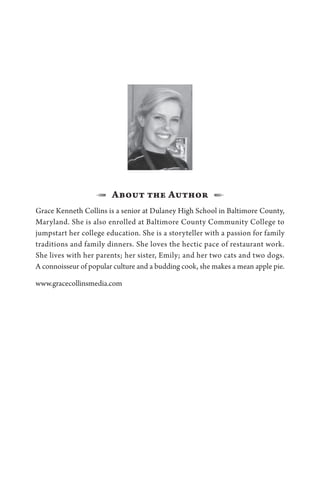
Grace Kenneth Collins is a senior at Dulaney High School in Balti­more County,
Maryland. She is also enrolled at Baltimore County Community College to
jumpstart her college education. She is a storyteller with a passion for ­family
traditions and family dinners. She loves the hectic pace of restaurant work.
She lives with her parents; her sister, Emily; and her two cats and two dogs.
A connoisseur of popular culture and a budding cook, she makes a mean apple pie.
www.gracecollinsmedia.com
Acknowledgments v
Acknowledgments
Since this is my first book, I have learned much about what goes
into producing a book! I have been fortunate to have some great
partners guiding me through this adventure on the editorial and pro-
duction side.
Thanks first to Karen Doyle, who served as my copy editor; her editorial
suggestions, especially on the recipes, made this a more useful book. I’d also
like to thank Laura Carter for working with me on the final “look” of the
book. She is a book designer with extraordinary talent!
Thanks to my energetic grandmother YaYa (Marilyn McSherry) for the
shared meals and sleepovers, making me laugh, and the endless love. I will
always be your “sunshine”!
To Emily, thank you for everything you’ve done for me—the laughs, the
tears, the hugs, and most importantly your friendship. I love you so much,
Big Sis.
Thanks to my Aunt Laurel McSherry and Michael McGrath for their sup-
port and love, and my introduction to Stella. Also, thanks for the sweatshirt.
Thanks to my New Jersey family, Gail and Andy Carlstrom; Patti, Marc,
and Lucas Feola; Danny and Lisa Carlstrom and their children, Brendan,
Brea, and Jack; and Andy and Sharon Carlstrom and their children, Rachel,
Terry, and Halle, for helping me to keep my roots in New Jersey.
Thanks to Rosemary Hanley for being there and to Ms. Knott, my junior
year cooking teacher, for taking me on that culinary journey around the world.
A particular special thank you to Mollie, Sadie, and Carl Kellenberger;
The Faller Family: Uncle Greg, Aunt Rita, and Henrik; The Prassas Family:
Uncle Dean, Aunt Rita, Jennifer, and Katherine; John Gardner and Wil
Barrueto; Skylar Lasky, Kathy Tontarski and her mother, Edna Degen; and
Stash Wojcik.
vi Sour Beef  Cheesecake: A Food  Family Memoir
I am grateful for my amazing circle of friends, Amanda Chesser, Natalie
Crawford, Hallie Criste, Daisy Hilliard, Jessica Mattson, Kate Shipley,
Lorrie Sinibaldi, Jamie Tambor, and Melissa Webster, who are so very
important to me. Also to “Tonka,” my protector.
Thanks to Sam Sunderland for being like a brother, supporter, and best
friend. I am lucky to have a friend like you. One Love.
Thanks to my mom and dad who have always pushed me to be the best I
could be. Their love and support through everything, the good times and the
bad, truly mean the world to me. I’m honored to record the great meals we’ve
had in our house. I can’t believe I did this!
I dedicate this labor of love to my dad, Steve Collins, for his never-ending
love for and pride in both his daughters. I’m happy to have captured your
family stories. Hands down, you are the best father in the world.
I am indebted to my mom, Nancy Collins, for her invaluable suggestions
on my writing, and her enthusiasm and inexhaustible support for this book.
Thank you so much for your love and your belief in me.
And special thanks are due to my Grandmother Mickey (Marie) Smock,
who inspired my enthusiasm for treasured family recipes. She was not a fancy
cook, just a good, old-fashioned cook, and without her this book would not
have been written.
“Go thy way, eat thy bread with joy, and drink thy wine with a merry heart; for
God now accepteth thy works.”  —Ecclesiastes 9:7
vii
1  Table of Contents  2
About the Author.  .  .  .  .  .  .  .  .  .  .  .  .  .  .  .  .  .  .  .  .  .  .  .  .  .  .  .  .  .  .  . iii
Acknowledgments.  .  .  .  .  .  .  .  .  .  .  .  .  .  .  .  .  .  .  .  .  .  .  .  .  .  .  .  .  .  .  .v
Introduction.  .  .  .  .  .  .  .  .  .  .  .  .  .  .  .  .  .  .  .  .  .  .  .  .  .  .  .  .  .  .  .  .  .  viii
Chapter 1:  Ninth Day, Ninth Night.  .  .  .  .  .  .  .  .  .  .  .  .  .  .  .  .  .  .  . 1
Chapter 2:  Baltimore: Weird and Proud of It.  .  .  .  .  .  .  .  .  .  .  .  .  .  .7
Chapter 3:  Thank You for Being a Friend .  .  .  .  .  .  .  .  .  .  .  .  .  .  .  . 13
Chapter 4:  I think I’d Be Her Favorite .  .  .  .  .  .  .  .  .  .  .  .  .  .  .  .  .  . 17
Chapter 5:  Vive le France .  .  .  .  .  .  .  .  .  .  .  .  .  .  .  .  .  .  .  .  .  .  .  .  . 23
Chapter 6:  Appetizers .  .  .  .  .  .  .  .  .  .  .  .  .  .  .  .  .  .  .  .  .  .  .  .  .  .  . 31
Chapter 7:  The Restaurant Life.  .  .  .  .  .  .  .  .  .  .  .  .  .  .  .  .  .  .  .  .  . 39
Chapter 8:  Soup Is Home.  .  .  .  .  .  .  .  .  .  .  .  .  .  .  .  .  .  .  .  .  .  .  .  . 45
Chapter 9:  “Stressed” Spelled Backwards Is “Desserts”.  .  .  .  .  .  . 51
Chapter 10:  My Ukrainian YaYa.  .  .  .  .  .  .  .  .  .  .  .  .  .  .  .  .  .  .  .  .  . 59
Chapter 11:  Picnic Food.  .  .  .  .  .  .  .  .  .  .  .  .  .  .  .  .  .  .  .  .  .  .  .  .  . 65
Chapter 12:  That’s Amore .  .  .  .  .  .  .  .  .  .  .  .  .  .  .  .  .  .  .  .  .  .  .  .  . 71
Chapter 13:  Adventurous Eating and Foods from the East.  .  .  .  . 79
Chapter 14:  New Jersey Feels Like Home.  .  .  .  .  .  .  .  .  .  .  .  .  .  . 85
Chapter 15:  “Oh, That’s Okay. I Make Lamb.”.  .  .  .  .  .  .  .  .  .  .  .  . 89
Chapter 16:  A Few More Family Recipes . . . . . . . . . . . . . . . 95
Index of Recipes.  .  .  .  .  .  .  .  .  .  .  .  .  .  .  .  .  .  .  .  .  .  .  .  .  .  .  .  .  .  .  . 99
ix
Introduction
This book started with another book—a calico-covered journal
filled with handwritten recipes left behind by my grandmother on
my father’s side, Grandma Mickey. That book, sitting on our kitchen
bookshelf, is now falling apart from use. By writing this book, it is my goal to
preserve not only my grandmother’s legacy of great recipes but also to start
my own family legacy. This book is the story of my life in the context of fam-
ily traditions, family recipes, and personal experiences.
From an early age, I was lucky to have a sophisticated palate, and I could
judge a good meal from a bad one. I have been blessed with the good food
that has been on my dinner table and the experiences I have had. I have a
love of food and travel, and I’m most grateful for the advantages I’ve had.
I’d like to share what I’ve learned so far, even though I am only 17 years old.
You hold in your hands a collection of recipes that have been passed down
to me and are among my friends’ and family’s favorites. I believe that good
food and drink is good for the soul, especially when food is shared with those
you love. I hope that you enjoy these stories that show my enduring love of
food and family and the recipes that go with them.
I must confess that I am more of a storyteller and an eater than a cook.
In fact, I’m learning how to cook. So for this project, think memoir meets
cookbook. I tell stories of my life such as my strange choice of favorite televi-
sion show, my trip to France and the quest for the perfect French onion soup,
how to create the ultimate baklava, life as a teenage girl working in a busy
restaurant and learning the business, the competition of Jersey vs. Maryland
tomatoes, why there is no good pizza in Baltimore, my 14 days of hell, and
why cheesecake fixes all of life’s problems.
I also wrote this book as a guide to teach people my age how to cook.
Actually, these recipes can be mastered by new cooks of all ages. Basic cook-
ing know-how is a skill that every young person should have. Once you reach
x Sour Beef  Cheesecake: A Food  Family Memoir
your twenties, regardless of gender (because men who know how to cook are
hot!), you should have some elementary cooking skills. And you should have
a few meals that you can assemble on short notice. In the Index of Recipes, in
the back of the book, I have noted the recipes that are vegetarian.
Although I was initially intimidated by the idea of cooking these dishes,
I have found these recipes to be reliable; they have been kitchen tested for
many years. Investing the time to learn these recipes will be well worth it
in the end. Once you try these dishes, you will understand why they are so
special.
Try my family’s easy mushroom barley soup and tuna with spicy pine-
apple relish; our twist on cornbread by adding fresh blueberries; my recipe
for satay with peanut sauce; a cherry noodle Kugel; chocolate chip cookies
from one of the best cooks I know; classic clams casino and crab imperial;
the secret family recipe for sauerbraten and potato balls; and the best New
York-style cheesecake you will ever taste.
My recommendation to you is to start slowly, and don’t be afraid to try
something new. Think of my book as a road map for learning how to prepare
great food. My mother talks sometimes about putting on your “fearless
shoes.” I say put on your “fearless oven mitts!” Your reward will be some
very satisfying meals, and you will be on your way to developing a list of your
own specialty recipes. Feel free to send me your best family recipes at www.
gracecollinsmedia.com.
I’d like to thank my family and friends for their warm generosity in con-
tributing their own family recipes and stories. The inspiration of my cooking
memoir comes from my grandmother and my mother, both amazing women
who inspire me on daily basis. I hope you enjoy my stories; good stories and
good recipes can endure forever.
Grace Kenneth Collins
July 17, 2011
1
Chapter 1
Ninth Day, Ninth Night
Iwas cold. I was wet. I was alone. The only sensation I felt was the
stinging pain of bug bites—new bites and old ones I had scratched too
much. I remember looking up and seeing a large tree over me with its
branches reaching out as if it was attempting to keep me from getting even
wetter. Then it all goes black. The summer between my high school freshman
and sophomore years, I spent two weeks canoeing and backpacking in the
middle of nowhere in Maine. The timing of the trip was awful because the
Outward Bound course I chose was during two weeks of record-breaking
rain on the northern East Coast. Having my parents drop me off at the
airport in Bangor, Maine, where the group got together, was a scary experi-
ence. There were all these people I didn’t know, all of the kids looking sort
of stunned.
Before I continue, you may need to know some terms for clarification:
Portage: This is the act of carrying boats across land to reach a body of
water.
Lightning Drill: When lightning is seen within a seven-second count of
the rumbling sound of thunder, for safety, one must rush to an open space
of land and lie in the fetal position on a rubber sleeping mat to wait out the
storm.
For the first eight days, the adventure was terrifying yet exciting. From the
very beginning, however, I missed good, home-cooked meals. The food on
the trip was simply awful. Don’t get me wrong, I loved putting water in my
food bowl, washing it out with my finger, and being instructed to drink the
rinse water so we wouldn’t leave a “footprint” behind. There were other small
environmental footprint techniques we were taught as well, but that was the
most stunning by far. It was disgusting.
2 Sour Beef  Cheesecake: A Food  Family Memoir
It was the same routine everyday: wake up; eat; canoe 15 miles; eat;
portage 8 to 10 miles on rocky pathways around trees, swampy water, hills,
and over boulders; find a campsite; eat; go to sleep; lather, rinse, repeat.
The ninth day began with the sun sneaking its way through the clouds
and an interesting breakfast of dehydrated oatmeal and iodinated lake water.
It was the first sunny day of the whole trip, so I decided to wear a light
t-shirt and shorts. As we were canoeing down the Moose River, laughing,
singing, and splashing each other, we noticed a large cloud. Five minutes
later, we were rushing to land because it began storming. The raindrops felt
like bullets, and my light clothing was drenched. I had no time to even grab
a jacket as I ran into a field, laid out my mat, and sat down. We performed
lightning drills more than a dozen times that day. Once it was over, we
walked back to our canoes so we could portage to the other side of the island.
I noticed my canoe was filled with water, and my backpack was floating in
it. My instructors told me to put on my wet clothes from the backpack to
conserve body heat. I am told that during the portage I wandered off from
the group and was found under a tree. I remember crying and looking up at
the tree, wondering how I got there. I was crying because I was scared, and
my teardrops were warm compared to the freezing rain droplets. Two of my
friends found me and carried me back to the group.
After we canoed another six miles that day (stopping seven times for a
lightning drill on another island), we found a campsite. Thus began the ninth
night. Everyone began setting up their tents but for some reason mine was
broken. I had to sleep in a contraption consisting of a tarp tied to four trees
making a barrier between the water and me, a rubber mat, and a sleeping
bag. It was a little drafty. My leaders instructed me to wear a life jacket to keep
my core warm since I had lost a good amount of body warmth. I slept in the
middle while my two friends slept on either side of me in hopes of keeping
me safe and warm. Again, that night I wandered off and woke up lying down
in the waterlogged mud. I got up, wiped the mud from my face and arms and
walked in the direction of a light. Luckily, I made it back to the campsite safely.
I have no recollection of how I walked away from the camp that night, which is
actually quite strange since that was the second time I blacked out in one day.
After those 24 hours of absolute hell, everything seemed to be easier and
I had a better outlook. I constantly thought about the little things at home,
like family dinners or being tucked up in my parents’ bed watching “Sunday
Chapter 1 — Ninth Day, Ninth Night 3
Morning” with them. One thing I will never miss is the food on that trip.
Dehydrated and high-fiber meals, nuts, and lake water which we cleansed
with iodine were on the menu each day. What was my favorite meal, you
may wonder? Well, as a snack during the day we were given salsa and cubes
of cheese on bread. So simple, yet so delicious.
Every day and night I thought about food—the food I was familiar with.
On the 11th day, my group hiked up a mountain. We crossed over a road
when suddenly a flash of red caught my eye—strawberries. Beautiful, small
wild strawberries were scattered along the side of the road. We were never
given sweets or fruits during the two weeks of the trip. I was so eager for
a familiar taste that I knelt down and picked the berries one-by-one and
gobbled them down. They were sweet and pungent. Those berries were one
of the best things that I’ve ever tasted, and eating them reassured me that I
would be home soon.
When my parents picked me up after 14 days, there were only two
things I wanted: comfort food and the hottest shower I could get. After a
45-minute shower of “de-scuzzing,” we drove to Boston, because it was 4th
of July weekend and we did not want to travel 14 hours back to our home
in Maryland. That night we stayed in a hotel, and I ordered a chicken pot
pie from room service. What could be more comforting? It was perfect. My
parents asked if I wanted to go watch fireworks but I was perfectly content to
stay in a warm, cozy bed watching John Candy in the movie “Uncle Buck,”
putting lotion on my bug bites, bandaging up the sores on my feet, and
savoring each bite of my pot pie.
The next day, we began our drive back to Maryland, and midway I
received a phone call from my sister, Emily, who said to hurry home because
she was working on a surprise for me. Five hours later I opened the door
to our house, and to my surprise the kitchen table was covered with the
most comfortable comfort food you could ask for—my Grandma Mickey’s
traditional pot roast, gravy, and mashed potatoes; cookies; Goldfish® crackers
(flavor-blasted, of course), and one of the greatest desserts I’ve ever had,
black-bottomed cheesecake brownies. My family thought that I would enjoy
the pot roast, the ultimate comfort food. My sister and her friend, Skylar,
made the brownies for me, and their work really paid off, they were delicious.
The next surprise came when I walked into my room. It was spotlessly
clean, and trust me, I am a messy person. Skylar and Emily had cleaned my
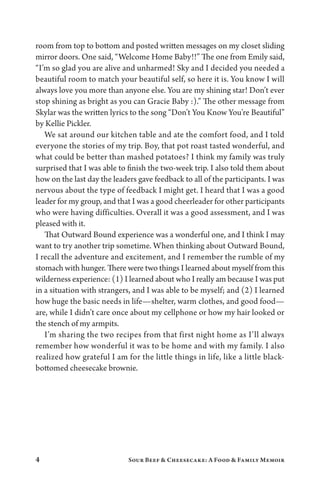
4 Sour Beef  Cheesecake: A Food  Family Memoir
room from top to bottom and posted written messages on my closet sliding
mirror doors. One said, “Welcome Home Baby!!” The one from Emily said,
“I’m so glad you are alive and unharmed! Sky and I decided you needed a
beautiful room to match your beautiful self, so here it is. You know I will
always love you more than anyone else. You are my shining star! Don’t ever
stop shining as bright as you can Gracie Baby :).” The other message from
Skylar was the written lyrics to the song “Don’t You Know You’re Beautiful”
by Kellie Pickler.
We sat around our kitchen table and ate the comfort food, and I told
everyone the stories of my trip. Boy, that pot roast tasted wonderful, and
what could be better than mashed potatoes? I think my family was truly
surprised that I was able to finish the two-week trip. I also told them about
how on the last day the leaders gave feedback to all of the participants. I was
nervous about the type of feedback I might get. I heard that I was a good
leader for my group, and that I was a good cheerleader for other participants
who were having difficulties. Overall it was a good assessment, and I was
pleased with it.
That Outward Bound experience was a wonderful one, and I think I may
want to try another trip sometime. When thinking about Outward Bound,
I recall the adventure and excitement, and I remember the rumble of my
stomach with hunger. There were two things I learned about myself from this
wilderness experience: (1) I learned about who I really am because I was put
in a situation with strangers, and I was able to be myself; and (2) I learned
how huge the basic needs in life—shelter, warm clothes, and good food—
are, while I didn’t care once about my cellphone or how my hair looked or
the stench of my armpits.
I’m sharing the two recipes from that first night home as I’ll always
remember how wonderful it was to be home and with my family. I also
realized how grateful I am for the little things in life, like a little black-
bottomed cheesecake brownie.
Chapter 1 — Ninth Day, Ninth Night 5
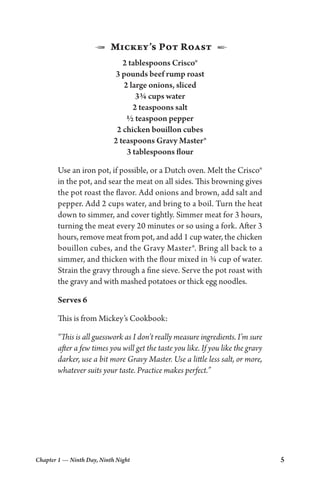
1  Mickey’s Pot Roast  2
2 tablespoons Crisco®
3 pounds beef rump roast
2 large onions, sliced
3¾ cups water
2 teaspoons salt
½ teaspoon pepper
2 chicken bouillon cubes
2 teaspoons Gravy Master®
3 tablespoons flour
Use an iron pot, if possible, or a Dutch oven. Melt the Crisco®
in the pot, and sear the meat on all sides. This browning gives
the pot roast the flavor. Add onions and brown, add salt and
pepper. Add 2 cups water, and bring to a boil. Turn the heat
down to simmer, and cover tightly. Simmer meat for 3 hours,
turning the meat every 20 minutes or so using a fork. After 3
hours, remove meat from pot, and add 1 cup water, the chicken
bouillon cubes, and the Gravy Master®. Bring all back to a
simmer, and thicken with the flour mixed in ¾ cup of water.
Strain the gravy through a fine sieve. Serve the pot roast with
the gravy and with mashed potatoes or thick egg noodles.
Serves 6
This is from Mickey’s Cookbook:
“This is all guesswork as I don’t really measure ingredients. I’m sure
after a few times you will get the taste you like. If you like the gravy
darker, use a bit more Gravy Master. Use a little less salt, or more,
whatever suits your taste. Practice makes perfect.”
6 Sour Beef  Cheesecake: A Food  Family Memoir
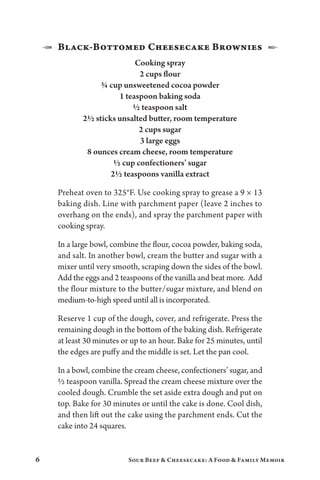
1  Black-Bottomed Cheesecake Brownies  2
Cooking spray
2 cups flour
¾ cup unsweetened cocoa powder
1 teaspoon baking soda
½ teaspoon salt
2½ sticks unsalted butter, room temperature
2 cups sugar
3 large eggs
8 ounces cream cheese, room temperature
½ cup confectioners’ sugar
2½ teaspoons vanilla extract
Preheat oven to 325°F. Use cooking spray to grease a 9 × 13
baking dish. Line with parchment paper (leave 2 inches to
overhang on the ends), and spray the parchment paper with
cooking spray.
In a large bowl, combine the flour, cocoa powder, baking soda,
and salt. In another bowl, cream the butter and sugar with a
mixer until very smooth, scraping down the sides of the bowl.
Add the eggs and 2 teaspoons of the vanilla and beat more. Add
the flour mixture to the butter/sugar mixture, and blend on
medium-to-high speed until all is incorporated.
Reserve 1 cup of the dough, cover, and refrigerate. Press the
remaining dough in the bottom of the baking dish. Refrigerate
at least 30 minutes or up to an hour. Bake for 25 minutes, until
the edges are puffy and the middle is set. Let the pan cool.
In a bowl, combine the cream cheese, confectioners’ sugar, and
½ teaspoon vanilla. Spread the cream cheese mixture over the
cooled dough. Crumble the set aside extra dough and put on
top. Bake for 30 minutes or until the cake is done. Cool dish,
and then lift out the cake using the parchment ends. Cut the
cake into 24 squares.
7
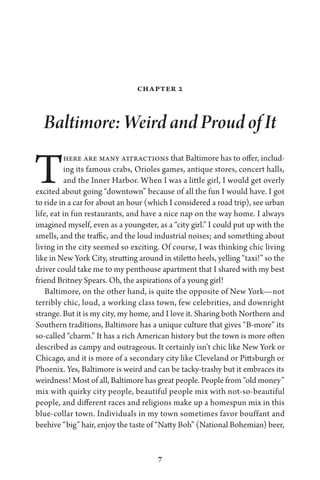
Chapter 2
Baltimore: Weird and Proud of It
There are many attractions that Baltimore has to offer, includ-
ing its famous crabs, Orioles games, antique stores, concert halls,
and the Inner Harbor. When I was a little girl, I would get overly
excited about going “downtown” because of all the fun I would have. I got
to ride in a car for about an hour (which I considered a road trip), see urban
life, eat in fun restaurants, and have a nice nap on the way home. I always
imagined myself, even as a youngster, as a “city girl.” I could put up with the
smells, and the traffic, and the loud industrial noises; and something about
living in the city seemed so exciting. Of course, I was thinking chic living
like in New York City, strutting around in stiletto heels, yelling “taxi!” so the
driver could take me to my penthouse apartment that I shared with my best
friend Britney Spears. Oh, the aspirations of a young girl!
Baltimore, on the other hand, is quite the opposite of New York—not
terribly chic, loud, a working class town, few celebrities, and downright
strange. But it is my city, my home, and I love it. Sharing both Northern and
Southern traditions, Baltimore has a unique culture that gives “B-more” its
so-called “charm.” It has a rich American history but the town is more often
described as campy and outrageous. It certainly isn’t chic like New York or
Chicago, and it is more of a secondary city like Cleveland or Pittsburgh or
Phoenix. Yes, Baltimore is weird and can be tacky-trashy but it embraces its
weirdness! Most of all, Baltimore has great people. People from “old money”
mix with quirky city people, beautiful people mix with not-so-beautiful
people, and different races and religions make up a homespun mix in this
blue-collar town. Individuals in my town sometimes favor bouffant and
beehive “big” hair, enjoy the taste of “Natty Boh” (National Bohemian) beer,
8 Sour Beef  Cheesecake: A Food  Family Memoir
live in row homes with beautifully polished marble steps, and insist on end-
ing every statement or question with “Hon.” More about “Hon” in a minute.
I’d like to tell you about two of the signature foods of Maryland. The first
is Old Bay Seasoning. This spicy seasoning composed of pepper, mustard,
bay leaf, paprika, and other herbs is used in many crab dishes. Named after
the “Old Bay Line” ships that would travel back and forth from Virginia to
Baltimore, it is produced in Baltimore by McCormick  Company. Not
only seafood benefits from this product (think great shrimp salad), but also
popcorn, salads, eggs, and the famous crab potato chips. If you like your
cocktails, why not put a Baltimore spin on them? In local bars and restau-
rants, you can have a Bloody Mary with Old Bay flavoring on the rim of
the glass. A funny use of Old Bay is on the rim of a glass of Natty Boh beer,
known as an “Old Boh.”
Then there are our crabs. Our blue crabs come from the Chesapeake
Bay, which is the East Coast’s main source of crabs. Crabs are traditionally
steamed in Old Bay Seasoning and rock salt, and served B-more style on a
picnic table covered by newspaper or brown paper. These crustaceans are
tough little suckers from which to pick the crab meat, but it is so worth it.
It’s hard work to crack open, pick apart, and pull off parts of the crab but sit-
ting with friends or family and drinking Natty Boh beer lets you forget the
frustration of getting the meat. Picking crabs is a social event. A nice touch is
to slice local Maryland tomatoes and smear the crab spices all over the toma-
toes. You’re probably thinking what a mess. But it is easy to clean up after a
crab feast. You simply roll up the brown paper or newspaper with all of the
crab shells in it, throw it in a big trash bag, and that’s it! We use the blue crabs
in lots of dishes like traditional crab cakes, crab soups (both a cream of crab
and a lighter, spicy, red vegetable crab soup), a funny dish called crab balls,
and the fancy crab imperial.
I live in Baltimore County, just outside the city. I’m close enough that
I can enjoy the city and the country. Yes, people think of Baltimore as the
location where “Homicide: Life on the Street,” the show from the 1990s,
was filmed, and more recently of “The Wire,” which depicts the crime in
Baltimore. Yes, it is a city that has lots of crime and drugs and poverty. There
are parts of the city where flashing blue lights on the top of light poles warn
people to be extra careful when traveling through. But Baltimore has lots of
good points too. It can boast of Edgar Allen Poe’s haunted grave site; “Ace
Chapter 2 — Baltimore: Weird and Proud of It 9
of Cakes”; houses with Formstone, which is a symbol of Baltimore’s funky
architecture; screens painted with landscape designs; and the Baltimore
Orioles, although it seems like people care about the Orioles only when they
are winning. Baltimore has wonderful waterfront neighborhoods like Fells
Point and Federal Hill, full of history and terrific restaurants and hotels. But
remember, I told you that the best part of Baltimore is our people!
Let me tell you about Honfest. “Hon” (abbreviation for “Honey”) is the
word of Baltimore, and we will call everyone “Hon” whether we know your
name or not. We celebrate the Baltimore history of Hon at the Honfest each
June in the neighborhood of Hamden, with women dressing in brightly
printed 1960s dresses with outdated kitty cat glasses and a beehive hairdo.
Modern-day women who dress in these outrageous get-ups represent the
ultimate 1950s or 1960s “Hon.” Face painting, food, games and a contest for
“Baltimore’s Best Hon” complete the festival.
For all of those “LAX” players, you will be happy to know that lacrosse
is the official team sport of Baltimore. Many universities and colleges are
Division One, and even high school teams are a big deal, for both boys and
girls. All spring and summer, there are lacrosse clubs and camps to choose
from. I’ve never been a big team sports person, and the fact that I could not
cradle a ball in a lacrosse stick has kept me from playing the game. But games
are still fun to watch.
Every great summer must end, and every painful school year must begin,
but for 10 days around Labor Day the Maryland State Fair takes place in
Baltimore County. There are best-in-show livestock, live music, and contests
for the best-grown vegetables. But while there, you can also spend way too
much money on overpriced corn dogs, funnel cake, and lemonade; fight the
lines for amusement park rides that make you sick; and encounter the creepy
carnival workers known as “carnies.” The smell of puke and funnel cake wafts
in the hot summer night air while you walk the fair grounds. Sounds wonder-
ful doesn’t it? Well actually it is pretty fun, and the fair is part of growing up for
most Baltimore kids. I would wait all summer for the fair, and make my par-
ents take me and my friends. Once there, we would eat funnel cake until we
felt sick and freak out on the roller coaster ride, begging the carnie to let us off.
Baltimore also has its very own language! Some people think it is quite
amusing when native-born Baltimore residents drop syllables when they
speak and multiple words are chopped into short phrases. “Baltimore,
10 Sour Beef  Cheesecake: A Food  Family Memoir
Maryland” becomes “Bawlmer, Murland.” If someone wants to go to the
Maryland shore, which is usually what people my age always want to do, they
would say “I’m gohn downy o-shen,” which translates to “I’m going down
to the ocean.” Or there is my personal favorite phrase (and one I’m guilty of
using every now and then), “Zah-rite?,” which translates to “Is that right?”
I think it’s safe to say that Baltimore is a weird, yet charming place. A place
where the universal name is Hon and where we have a strange obsession with
crabs and are highly defensive against any “crab haters”—frankly just a bit of
an odd place. With that said, it is my home, and I love it. We may say strange
phrases and pronounce our words differently but we mean it with the best
intentions of being friendly. Most people who visit Baltimore are pleasantly
surprised when they see what it has to offer. Baltimore is a city that accepts
you for your craziness because chances are we are twice as crazy. As John
Waters, our hometown filmmaker, writer, and Baltimore-city enthusiast, says,
“Nothing is in bad taste if it makes you laugh.” The creator of “Hairspray,”
which gave the entire world a sense of what went on in Baltimore during the
1950s and 1960s, said when asked why people should visit Baltimore, “You
should come to Baltimore because we have a great sense of humor here. It’s
the only city in the world where if you say ‘I’m moving to New York,’ people
say, ‘Why?’” Maybe I will live in New York City someday, but for now, I’ll
enjoy my Baltimore home with all its eccentricities.
1  Edna’s Crab Imperial  2
3 tablespoons butter
2 tablespoons flour
1 cup milk
½ teaspoon salt
1 heaping tablespoon mayonnaise
1 small onion, finely chopped
2 hard boiled eggs, chopped
¼ cup green pepper, finely chopped (optional)
¼ cup pimento, finely chopped (optional)
1 pound crabmeat (can mix ½ pound backfin and ½ pound lump)
1/3 cup butter, melted
½ cup unflavored breadcrumbs
Chapter 2 — Baltimore: Weird and Proud of It 11
In a medium-heavy saucepan, melt the 3 tablespoons of butter
and whisk in the flour. When smooth, add the milk and cook
over high heat, stirring constantly, until it makes a thick, white
sauce. Add the salt, the mayonnaise, the onion, the hard-boiled
eggs, the green pepper, and the pimento.
Put a layer of the sauce in the bottom of a casserole dish,
and layer the crabmeat on top. Cover the crabmeat with the
remaining sauce. Press down with a fork. Cover with plastic
wrap and chill for at least 3 hours or overnight.
Preheat oven to 350°F. Put the 1/3 cup melted butter in a small
saucepan and add the breadcrumbs. Top the casserole with the
buttered breadcrumbs. Bake at 350°F for 30 to 35 minutes or
until hot throughout.
Serves 8
And this 1960s’ style recipe captures the essence of “Hon.”
1  Edna’s Vegetable Jell-O Mold  2
1 6-ounce box lemon Jell-O
2 cups hot water
2 tablespoons white vinegar
2 tablespoons onion, finely chopped
3 cups cabbage, finely chopped
1 cucumber, diced, with the skin on
1 small jar of pimento, diced
2 tablespoons sweet India relish
Parsley for garnish
Combine the first three ingredients. Oil a mold, add the
Jell-O mixture, and chill for 1 hour. Combine the next five
ingredients, and mix into the partially set Jell-O. Refrigerate
until set firmly. At serving time, unmold the Jell-O onto a
serving platter and garnish with parsley.
Serves 12
13
Chapter 3
Thank You for Being a Friend
“Thank you for being a friend. Travelled down the road and back again.
Your heart is true, you’re a pal and a confidant.”
—Andrew Maurice Gold (1951–2011)
Whether it is a high school survey that I’m taking or an
adult trying to make small talk with me, the question “What
is your favorite TV show?” usually comes up. I have no hesita-
tion about which program tops my list but I’m sometimes embarrassed to
admit the truth. You see, my absolute favorite television show is the three-
time Golden Globe winner “The Golden Girls,” which ran on NBC from
1985 to 1992, ending two years before I was born. Some may question my
excitement when the famous “Thank You for Being a Friend” theme song
begins to play and the sky view of the Miami, Florida, coast flashes on the
screen, but my love of the four sassy ladies—Sophia, Dorothy, Blanche, and
Rose—dates back to when I was nine years old. At that time, “Golden Girl”
reruns were shown Monday through Friday, 9 am until 2 pm. I would watch
them whenever I could. You would find me in front of the TV (on days I
didn’t have school) at 8:30 am with a bowl of cereal and milk, waiting with
anticipation.
My parents could never understand why a child would so love the show.
To this day, I still love it; and over the years, the sitcom has taught me many
lessons about life. I stand by the theory that I am the person I am today
in part because of “The Golden Girls.” All of life’s lessons can be found in
a “Golden Girls” episode. And thanks to a Christmas gift, I can watch the
boxed set of seven seasons whenever I want.
14 Sour Beef  Cheesecake: A Food  Family Memoir
If someone told me about a TV show set in Florida with four postmeno-
pausal women as the stars, I guess it wouldn’t seem very appealing. The show
depicts three older women, named Dorothy, Rose, and Blanche, living in
Miami along with Dorothy’s mother, Sophia. Dorothy, a tall, Italian school
teacher from Brooklyn, who never let anything get to her, was the brains of
the friendship. Getting pregnant at 16, having her husband cheat on her and
leave her for a 25-year old named Chrissie, Dorothy holds strong.
Then there’s Rose, a bubbly airhead blond from St. Olaf, Minnesota.
She began the show with a job as a grief counselor and later became a news
reporter’s assistant. After her husband, Charlie, passed away, she moved to
Florida where she answered an ad to rent a room. Rose’s dimwitted com-
ments and her “back in St. Olaf” stories make her a lovable character. One of
my favorite Rose quotes would have to be, “Like we say in St. Olaf, Christmas
without fruitcake is like St. Sigmund’s Day without the headless boy!”
Blanche Devereaux is the owner of the house, a sexy, lively, and outgoing
woman who is not shy when it comes to men. She is a museum curator, and
she decides to rent rooms in her house after her husband, George, passes
away. Blanche is always ready for late-night chats about men, sex, and love—
and she always has a piece of cheesecake in front of her. I always wondered
how she could keep her figure with all of that cheesecake.
Finally, there is Sophia, an 80-year-old tough Italian woman, and mother
of Dorothy, who although suffering from the effects of a stroke, never fails to
make a comedic joke or witty comment.
These friends taught me a lot. Dorothy taught me never to let the tough
times stop me from trying to succeed, Rose taught me to always be nice and
embrace my innocence, and Blanche taught me to live my life and love every
aspect of it.
In elementary school, I dreaded my first two morning classes because
being in school kept me from my ladies. Sitting in class, I would wonder
which episode was on. Was it the episode where Dorothy’s successful, hand-
some boyfriend threw it all away to join the circus? Or maybe it was the
episode where Blanche’s daughter announces she’s tired of men. Or perhaps
it was the episode where innocent Rose brings a man home to bed and
awakens in the morning to find that he’s died. Or maybe it was my favorite
episode, where Dorothy and Sophia compete in a mother-daughter beauty
Chapter 3 — Thank You for Being a Friend 15
pageant, and they dress up as Sonny and Cher for the talent portion and sing
“I Got You Babe!”
The question is still, why do I love the show? Here’s why: their friendship.
Even though they bicker and argue, they are all best friends, and they love
each other, and they are always there for each other. I also like that the situa-
tions they get themselves into are hilarious, the jokes are very witty, and their
late-night chats include cheesecake. Of course, there was always cheesecake.
Whether it was talks about sex, stories of life’s lessons learned, or Rose’s
idiotic tales of her home town of St. Olaf, cheesecake was always a necessity.
(Actually, sometimes they had other desserts, but over the seven seasons
the girls ate over 100 cheesecakes.) They always sat in the kitchen, around
the round table with some type of cheesecake handy. This is why I love this
show. They discussed life and its tough moments and kept a sense of humor.
When I see “The Golden Girls” and their friendship, it reminds me of the
bond I have with my lifelong friends Hallie and Daisy. Friendship means the
world to me, and just like Rose and Blanche and Dorothy and Sophia, I know
that whatever comes my way I have my girls on my side ready to fight with
me. And cheesecake fixes everything.
In my family, there is only one cheesecake we ever make. It is a New York-
style creamy cheesecake that is extremely rich. No fancy ingredients, just
a pure, unadorned, creamy cheesecake that relies on cream cheese, heavy
cream, eggs, and sugar. More than one thin slice can result in a stomachache.
My grandmother Mickey made the cheesecake for my father, Steve, and she
even called it Best Cheese Cake, Steven’s Favorite. Oh, just think of the prob-
lems that “The Golden Girls” could have fixed while eating Grandmother
Mickey’s cheesecake!
1  Best Cheese Cake, Steven’s Favorite  2
For the crust:
1½ cups graham cracker crumbs
1 cup sugar
5 tablespoons butter, melted
For the filling:
1 8-ounce package cream cheese, softened
16 Sour Beef  Cheesecake: A Food  Family Memoir
1 cup sugar
2 medium eggs
1 pint sour cream
2 tablespoons flour
2 teaspoons vanilla extract
1 teaspoon fresh lemon juice
1 cup heavy cream
Preheat oven to 325°F. Grease the bottom and sides of
a 10-inch springform pan with butter. In a medium bowl,
combine the ingredients for the crust: graham cracker crumbs,
sugar, melted butter. Press mixture firmly into the bottom of
the pan. Place the pan in the freezer while making the cake
filling.
In a large bowl, make the filling. Using an electric mixer, add
each of the ingredients in the order listed, adding each one
by one, and beating and mixing each ingredient thoroughly.
Pour the mixture into the chilled pan and bake for 20 minutes.
Lower the heat to 300°F, and bake another 40 minutes. Turn
off the oven, and let the cheesecake sit and cool in the closed
oven for 1 hour. Remove cheesecake from oven, and cool on a
wire rack to room temperature. Refrigerate the cheesecake for
at least 3 hours or overnight. “This cheesecake can be served with
canned cherries or blueberries. This is a great cheese cake. Steven’s
favorite.” —Grandma Mickey
17
Chapter 4
I Think I’d Be Her Favorite
This book chapter may be the most important, not because
it includes the best recipes or the best story, but because the main
character gave me the inspiration to write this book. My Grandma
Marie (Mickey), on my dad’s side, was born in Newark, New Jersey, in 1922.
She grew up in a poor family on Avon Avenue. Mickey was the youngest of
eight children, and she didn’t have many advantages. She inherited hand-me-
downs from her older siblings; and as is the case with many big families, she
didn’t get much attention. Mickey was married at age 15 and gave birth to
her first baby at 16. By the time she was 25 years old, she had four children.
She was a great mother and homemaker, and she did what she could to make
delicious food for her family, learning how to stretch recipes to feed more
people at a meal. She would make amazing soups, casseroles, and roasts
using inexpensive ingredients. She also learned to make great desserts.
When she was living in an apartment in Newark, she befriended an elderly
German lady who lived in the apartment upstairs. Mickey fell in love with
the food this lady prepared, much of which was new to Mickey. One dish in
particular stood out—sauerbraten and potato balls. Sauerbraten, a German
dish, is usually made with beef but can also be made with venison, lamb, or
pork. Before braising, the beef is marinated in water, cider vinegar, onions,
and pickling spices. Traditionally, it is served with red cabbage, boiled pota-
toes, dumplings, or noodles; but Grandma Mickey invented an even better
side dish. She made what she called potato balls, based on the recipe that her
German friend gave her.
Mickey learned the tricks and ingredients for sauerbraten, and she per-
fected it over many years. My father tells me that he and all his siblings
were raised on sauerbraten and potato balls, and many of his neighbors
18 Sour Beef  Cheesecake: A Food  Family Memoir
and childhood friends also remember Mickey’s sauerbraten. Amazingly,
at a recent reunion, my father’s childhood friend told him how much he
remembered Mickey’s sauerbraten, as did another old friend on Facebook. A
memory of a dish eaten 40 years ago is truly a “memorable” recipe.
Many restaurants that serve sauerbraten serve it with big pasty dumplings,
which is a big no-no. Firm potato balls, a little larger than a golf ball, is the
way to go. (The trick is to rice the potatoes when they are warm, allowing the
steam to escape.) You’ll need to invest in a handheld potato ricer but trust
me, this makes all the difference. For Mickey, it didn’t matter that normal
dumplings are cooked twice, once when the raw potato is first boiled and
then after the dumpling is boiled again. She cooked them a third time, by cut-
ting the balls in half and frying them in a mixture of butter and Crisco®. What
a brilliant idea—that is a special potato ball. Steven (my father and the baby
of the family) ended up being the tallest boy in the family at 6 feet 6 inches.
As a teenager, he held the record of eating the most potato balls, 36 halves,
which equates to 18 full balls. Way to go, Dad!
My father and his family never realized how special this meal was because
they had it several times a year. After Mickey had perfected the sauerbraten
recipe, everyone wanted it. It was that good. The only problem with people
loving the meal was that Mickey was very superstitious about putting the
recipe in writing. She hesitated to give people the recipe. She would describe
the recipe but she never wanted to write it down. She fully believed that if
she wrote down the recipe, it would result in her immediate death.
When my mom and dad got engaged, my dad asked Grandma Mickey for
one thing: “To please write down all her recipes.” My mom went to the sta­
tionery store and bought Mickey a simple little journal, with a pretty fabric
cover decorated with strawberries, so Mickey could hand-write the recipes and
keep them all in one place. Mickey agreed to do the journal, because it was for
her youngest, Steven. Once she got started, she found that this was more diffi-
cult than she originally thought because she had to convert all her “eyeballing”
techniques to actual measurements and steps in the recipes. But she did get it
finished. Many of her best recipes and best desserts were captured in that little
book. Although convinced her death was coming near as she finished the last
sentence something surprising happened: she did not die!
Sadly, years later Grandma Mickey did pass away (just to reiterate, not
because of the sauerbraten recipe), and the recipe book was passed down to
Chapter 4 — I Think I’d Be Her Favorite 19
“her Steven.” We still have that journal with all of her great recipes and des-
serts. My mom, knowing that she would never be able to live up to Mickey’s
cooking abilities, waited a good 10 years before she attempted the sauerbra-
ten recipe. My first encounter with this dish made me a little unsettled. The
idea of sour meat just didn’t appeal to me; but hearing all the stories all those
years, I knew I was going to have to eat it. But no worries . . . once I smelled
the heavenly gravy and the fried potato balls, my mind quickly changed.
Sauerbraten is so savory and is the ultimate comfort food! I can still taste it
even as I write this now, though it has been a year since the last time we made
it. Once winter comes, I’m sure we will make it again. It isn’t overly compli-
cated, you just have to use the very best ingredients and take the time to go
through the steps. But one bite is all it takes. It is so worth the effort.
As I said before, the recipe journal that my grandmother wrote included
great family recipes and is truly the inspiration for me to write my own book.
This chapter may be focused on sauerbraten—as it should be because it is
delicious—but it is also about my amazing grandmother Mickey. She dealt
with a tough upbringing and life but she was the best example of the saying,
“When the world gives you lemons, make lemonade.” She really is an inspira-
tion for my sister and me. It is important not to let hardships keep you from
being the best you can be, and don’t ever give up, even in the toughest of
times. I never met this amazing lady but a day doesn’t go by that I don’t think
about her. I’m sure when things are hard and I’m at the point of giving up,
she is somewhere looking down on me, cheering me on. Since I’m the one
passing on her best recipe to the world, if she were alive today. . . I think I’d
be her favorite.
1  Mom’s Sour Beef or Sauerbraten  2
(Note: I’ve reproduced Mickey’s recipe here directly from her
handwritten notes, complete with her commentary. Even though
her notes say, “I never measure anything,” these measurements have
been tested by my family, and they work very well. She does say to
make all of this a day ahead of time, and we agree that the meal
tastes much better the next day.)
4- to 5-pound piece top round or rump roast
1 quart cider vinegar
20 Sour Beef  Cheesecake: A Food  Family Memoir
2 quarts water
3 heaping tablespoons whole pickling spice
1 tablespoon salt
5 large onions, peeled and sliced
Crisco®
Gravy Master®
2 tablespoons sugar
½ to 1 large box of ginger snaps (depending on taste)
Flour and water to thicken gravy
Mix all above ingredients together, up through and including
the onions, and marinate meat for 4 days. Do not use an
aluminum pan. I use a big plastic container with a tight lid.
Keep in a cool place. Turn the meat every day. Make sure meat
is covered in the brine.
After 4 days, remove the meat and dry a little on paper towels.
In a large pot, put 2 tablespoons of Crisco®, and brown meat
on all sides. Be careful as meat may spatter. After the meat is
browned, add the onion slices from the brine. Dry them a little
first. The onions don’t have to brown too much. Add the brine
to the pot with the meat, bring to a full boil, and then turn
down the heat to low and simmer for 3 hours. Put a little Gravy
Master® into the brine to make a nice, dark-brown color. Add 2
tablespoons of sugar.
When the meat is fork-tender, remove and place on a platter,
cover, and refrigerate. In a large bowl, put ½ of a large box
of old fashioned ginger snaps and warm water to cover. Let
ginger snaps get soft and mushy, and then add to your pot of
gravy. Add more Gravy Master® if it isn’t as dark as you like.
Thicken the gravy with flour and water until it reaches the
thickness you desire.
Drain the gravy first through a colander and then again through
a sieve. When the meat is cold, slice in thick slices and then put
back into the gravy. If gravy is too sour, add a little more sugar
or more ginger snaps.
Chapter 4 — I Think I’d Be Her Favorite 21
Heat the sour meat and gravy on the stove on low or heat in a
warm oven until the meat slices are warm through the middle.
“This is the best I can tell you because I never measured any­thing.
Just remember practice makes perfect. Next is the recipe for potato
balls. Make all this a day ahead as it is much better the next day.”
1  Mom’s Own German Potato Balls
(Kartoffelkloesse)  2
5 pounds Idaho baking potatoes
2 teaspoons salt
1 teaspoon pepper
2 large eggs
1 cup flour
1 cup plain bread crumbs
2 medium onions, grated
1 tablespoon dry parsley
Boil potatoes in their jackets until well done. Drain. Cool
potatoes a little and then peel them. It is important to rice the
potatoes with a potato ricer while they are warm so the steam
escapes. This makes a better potato ball. Add salt, pepper, eggs,
flour, and bread crumbs. Add the grated onions and parsley.
With very clean hands, knead all ingredients together. Form
round balls with the mixture, a little larger than a golf ball.
Fill a large pot ¾ full with water, and add ½ teaspoon of salt.
Bring to a boil. Drop the potato balls in the boiling water and
turn the heat to a simmer. The balls will rise to the top, and
when they do, let them cook another minute. Then remove the
potato balls with a slotted spoon. Place potato balls on a tray,
wait until they cool completely, then cover them, and put them
in the refrigerator to chill a few hours or overnight.
22 Sour Beef  Cheesecake: A Food  Family Memoir
Put ½ stick of butter and ¼ cup of Crisco® in a large frying pan.
Cut the chilled potato balls in half and fry in the melted fat,
about 3 to 4 minutes, until golden brown.
Best to serve this meal with bottled red cabbage on the side in
a separate little dish.
“This is my own way of making these Potato Balls and it is a family
secret.”—Grandma Mickey
23
Chapter 5
Vive le France
At the tender age of 15, my mom decided to take me on a trip
of food and history. It was my first trip to France, and I will remem-
ber that trip for the rest of my life. I had long dreamt of the day
I would step foot in Paris, and that dream became a reality in the summer
of 2009. I think my fascination with French culture started because of my
Ukrainian grandmother, Marilyn McSherry, whom we call YaYa. She would
always teach me French phrases such as “Je t’aime,” which translates to “I love
you,” and she would show me her diaries from when she was a young girl,
all written in French. When I got older I loved movies based in France, like
“Chocolat,” “Lili,” and “An American in Paris.” And finally, there’s the food.
The first time I had escargot in the velvety garlic butter, I knew I was going
to love French cuisine.
In my house, we’ve always made a French bistro-type dish of scallops
served over wilted endive and dressed with a lemon butter sauce. How do
the French combine such simple ingredients to make such rich flavors?
The first thing I wanted to do once we arrived in Paris was to eat a fresh,
crusty baguette, right from a bakery. I felt like a real Parisian walking through
the narrow streets eating a fresh baguette. After that mission was completed,
the quest for the perfect bowl of French onion soup began. I am a sucker for
the savory, rich onion soup with cheese melted all over the top, and what bet-
ter place to have this than in Paris? Although it was August, we were still able
to find the soup in many restaurants and bistros in the city . . . and my plan
was to eat as much French onion soup as I could in the 10 days of our trip.
My first tasting was the very first night. At about 9 that night (because
in Paris, I learned, dinner is eaten late), we left our hotel and began walk-
ing down the street to find a bistro. When we arrived at a tightly packed,
24 Sour Beef  Cheesecake: A Food  Family Memoir
small café located on the sidewalk, we chose a small table for two out in
the open air. I ordered escargot as my appetizer and the soup as my entrée.
While I was waiting, and with my mom’s coaxing, I ordered a Kir, a lovely
mixture of white wine and black currant syrup (cassis). But wait a minute,
I’m underage! My mom told me that I was able to drink wine in France so it
would be OK. I was panicking that I was going to get “carded” so I begged
my mom to go ask the maitre d’. Sure enough, a waiter came to our table
and with a chuckle told us that it was OK. The Kir, served in a tall glass flute,
was refreshing, and the escargot was just what I expected. When my French
onion soup arrived, it appeared to be creamier than I experienced in the
United States. It was a respectable try but it surely wasn’t up to the standard I
expected in Paris. The quest would have to continue. After dinner we walked
through the streets and returned to our hotel in the St. Germain area of the
Left Bank. There we tuned into CNN from America for two reasons: first it
was the only English-language channel; and second, we wanted to see what
was going on back home.
The next experience with French onion soup occurred at 2:00 in the
morning two days later. After a full day of walking and sightseeing, we
returned to our room but neither of us was tired. On a whim, we decided to
dress again and walk the winding River Seine all the way to the Eiffel Tower.
It ended up being a seven mile round-trip walk, and we decided not to take
time to eat, just to get to the Tower as soon as we could. Our idea was to visit
the Tower at night because there were shorter lines, and we wanted to see
the city lit up. We walked along the Seine toward the bright, glowing lights
of the 1063-foot tower. When we arrived, we still had to wait two hours just
to ride in the elevator to the top. After reaching the middle level, we exited
the elevator with the crowds of people and went to the railing to see all of the
streets of Paris, glowing.
By the time we took the ride back down, it was already after midnight,
and my stomach was growling. We took the long winding walk back by the
river, and the only place that was open to dine was the Café de Flore. This
sidewalk café was in our neighborhood, and the guidebooks all said it was
an expensive tourist trap (along with the nearby Les Deux Magots), but we
loved the look of the place, and after midnight it was quiet and the streets
were deserted. There were a few couples smoking and kissing at the tables
in the corners, so French! Since it was so late, the waiter informed us they
Chapter 5 — Vive le France 25
had only soups and small appetizer plates available. Of course, I ordered the
French onion soup. It was one of the better soup encounters I had, and after
the meal, I was ready for bed.
My final onion soup tasting in Paris occurred on the last night there.
During the day, my mom and I took the subway to the famous Père Lachaise
Cemetery. We had a list of famous people’s graves to see, and we added Jim
Morrison to that list. His grave was rather small and sort of depressing. But
at least we saw it. Not too many people know about the infamous Victor
Noir, a man who died in the 1800s after losing a pistol duel. He is also bur-
ied in Lachaise, and there are quirky superstitions related to his grave site.
I’ll leave it to YOU to do the Web research to find out who this man really
was. It is pretty racy. After touring the cemetery for hours, we again visited
a wonderful Parisian bistro and ordered soup and Nicoise salad. After my
two years of French class and a few days in Paris, I made a good attempt to
order our meal in French. It wasn’t perfect but our handsome waiter said he
was impressed I tried.
The next part of our trip consisted of a train to Bayeux in Normandy.
This part of the trip was less about food and more about the history of the
French north coast. Since Bayeux was one of the first towns liberated by the
American troops in World War II, the town is beautifully preserved because
it was not bombed like the other French towns further in from the coast. It
is a charming little place. We took a tour of the D Day beaches, including
Omaha and Utah, and even went to the very top of the hill where Germans
watched as the Allied Forces stormed the beach. It had to be terrifying for
those few hundred German soldiers watching the Americans swarm toward
land. Seeing “Saving Private Ryan” is one thing, but being there in person is
an entirely different experience. Touring the American Cemetery is an expe-
rience that every American citizen should have.
After a gloomy day of sightseeing, we thought we’d lighten our spirits
by taking a walk around Bayeux. The only exciting encounter with food
occurred in a pastry shop. I never experienced an eclair at home, and I knew
this was the place to get a good one—pâtè a choux with chocolate creme
filling, who could ask for more? The next day we woke up early and walked
to the train to take us to first to Paris and then onward on the fast train to
Montbard and the town of Flavigny-sur-Ozerain where we stayed with my
mother’s good friends, John and Wil. Flavigny is a remote and ancient town
26 Sour Beef  Cheesecake: A Food  Family Memoir
that captures all the peace and beauty of the Burgundy region of France. It
is also the town where “Chocolat” with Johnny Depp was filmed. On our
first night in Flavigny, John made a tomato tart, tarte Dijonnaise, that he said
was a favorite recipe of Madame Genevieve Plastre, a friend and cook from
one of the local bed and breakfasts, L’Ange Sourant. It was delicious! The
dish consisted of fresh, local tomatoes, sliced very thinly, flaky crust, crème
fraiche, and Comté cheese, a special cheese that is similar in style to Gruyere.
Following the tart was the main course . . . a rabbit dish served with rice. I
am not shy when it comes to food, and I will try nearly anything but the idea
of eating “Thumper” really creeped me out. However, I’ve been known to try
strange foods, and I did not want to appear to be a rude and nonadventurous
American kid so I tried it enthusiastically. The rabbit was prepared in a broth
and cream sauce with carrots, onions, and mushrooms; and the meat was
more tender than I expected it to be. It was also delicious. John and Wil also
served an interesting vegetable dish, again with very simple ingredients in the
French fashion. Someone had given them fresh wax beans picked right fresh
from the garden, and they cooked the beans in water, drained them, dressed
them with a simple vinaigrette, and then topped the platter of beans with
sliced hard-boiled eggs, salt, and pepper. The beans were tender and served
at room temperature.
Desserts in Flavigny were mainly sweet cheeses and fruit but one mem­
orable dish was a clafoutis à la american, which is often made with unpitted
cherries, although this dessert was made with pitted yellow plums. The fruit
is arranged in a buttered dish and covered with a thick pancake-like batter,
baked, dusted with powdered sugar, and served lukewarm. Over the next
few days, I had wonderful French meals—croissants with jam for breakfast,
wonderful cheeses. From a simple baguette sandwich with a slice of cheese
and ham, served from a stall in the train station, to the rich garlic and butter
sauce on snails, the food in France is what I will always remember.
But for all of the French onion soup I sampled, I was still on a quest for
the perfect onion soup, and I regret to say that I never did find a “perfect”
version. A week or so after we returned home from France, still not pleased
with my onion soup tastings, my dad shared with us his mother’s French
onion soup recipe. Naturally, we had to make it. As we sat down and I
reached with my spoon and began to dig through the drippy melted cheese,
I knew it would be something special. It seems that the real secret to French
Chapter 5 — Vive le France 27
onion soup is to very thoroughly toast the bread so that it is dry through and
through. Otherwise, it dissolves into mush, and that’s how the “creamy” tex-
ture can sneak into the dish. To my surprise, my Grandma Mickey’s French
onion soup outdid the soups in many of the bistros in France. I guess instead
of traveling to another country to find the perfect recipe, I should have just
looked in our family cookbook and used the ingredients in our pantry!
1  French Onion Soup  2
9 large onions
One 10¾ ounce can of beef consomme soup
5 chicken bouillon cubes
6 cups water
⅔ stick butter
½ teaspoon pepper
2 teaspoons cornstarch
½ cup water
5 slices of Italian bread, toasted
1 cup Parmesan cheese, grated
1 cup mozzarella cheese, shredded
Slice the onions and saute in butter until golden but not brown.
Add the consomme, bouillon cubes, 5½ cups of the water, and
pepper. Simmer for 1 hour. In a small dish, mix the cornstarch
with ½ a cup of water. Thicken the onion mixture slightly with
the cornstarch mixture.
Serve in ovenware soup dishes or bowls. Ladle in soup, and top
with a slice of the Italian bread, topped with the Parmesan and
mozzarella cheeses. Put under broiler until cheese melts.
Serves 5
28 Sour Beef  Cheesecake: A Food  Family Memoir
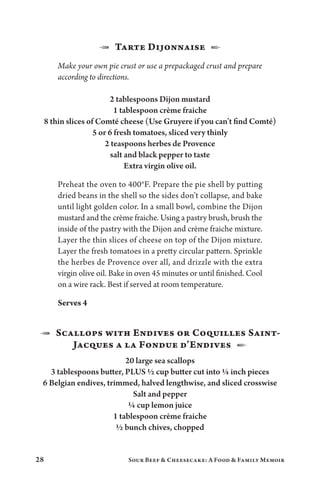
1  Tarte Dijonnaise  2
Make your own pie crust or use a prepackaged crust and prepare
according to directions.
2 tablespoons Dijon mustard
1 tablespoon crème fraiche
8 thin slices of Comté cheese (Use Gruyere if you can’t find Comté)
5 or 6 fresh tomatoes, sliced very thinly
2 teaspoons herbes de Provence
salt and black pepper to taste
Extra virgin olive oil.
Preheat the oven to 400°F. Prepare the pie shell by putting
dried beans in the shell so the sides don’t collapse, and bake
until light golden color. In a small bowl, combine the Dijon
mustard and the crème fraiche. Using a pastry brush, brush the
inside of the pastry with the Dijon and crème fraiche mixture.
Layer the thin slices of cheese on top of the Dijon mixture.
Layer the fresh tomatoes in a pretty circular pattern. Sprinkle
the herbes de Provence over all, and drizzle with the extra
virgin olive oil. Bake in oven 45 minutes or until finished. Cool
on a wire rack. Best if served at room temperature.
Serves 4
1  Scallops with Endives or Coquilles Saint-
Jacques a la Fondue d’Endives  2
20 large sea scallops
3 tablespoons butter, PLUS ½ cup butter cut into ¼ inch pieces
6 Belgian endives, trimmed, halved lengthwise, and sliced crosswise
Salt and pepper
¼ cup lemon juice
1 tablespoon crème fraiche
½ bunch chives, chopped
Chapter 5 — Vive le France 29
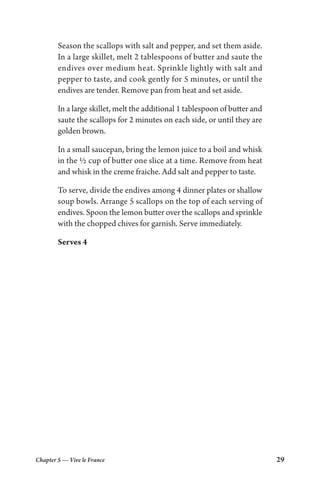
Season the scallops with salt and pepper, and set them aside.
In a large skillet, melt 2 tablespoons of butter and saute the
endives over medium heat. Sprinkle lightly with salt and
pepper to taste, and cook gently for 5 minutes, or until the
endives are tender. Remove pan from heat and set aside.
In a large skillet, melt the additional 1 tablespoon of butter and
saute the scallops for 2 minutes on each side, or until they are
golden brown.
In a small saucepan, bring the lemon juice to a boil and whisk
in the ½ cup of butter one slice at a time. Remove from heat
and whisk in the creme fraiche. Add salt and pepper to taste.
To serve, divide the endives among 4 dinner plates or shallow
soup bowls. Arrange 5 scallops on the top of each serving of
endives. Spoon the lemon butter over the scallops and sprinkle
with the chopped chives for garnish. Serve immediately.
Serves 4
31
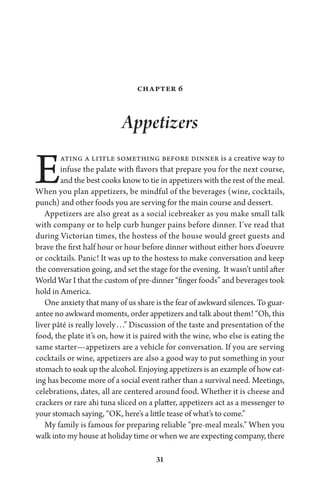
Chapter 6
Appetizers
Eating a little something before dinner is a creative way to
infuse the palate with flavors that prepare you for the next course,
and the best cooks know to tie in appetizers with the rest of the meal.
When you plan appetizers, be mindful of the beverages (wine, cocktails,
punch) and other foods you are serving for the main course and dessert.
Appetizers are also great as a social icebreaker as you make small talk
with company or to help curb hunger pains before dinner. I’ve read that
during Victorian times, the hostess of the house would greet guests and
brave the first half hour or hour before dinner without either hors d’oeuvre
or cocktails. Panic! It was up to the hostess to make conversation and keep
the conversation going, and set the stage for the evening. It wasn’t until after
World War I that the custom of pre-dinner “finger foods” and beverages took
hold in America.
One anxiety that many of us share is the fear of awkward silences. To guar-
antee no awkward moments, order appetizers and talk about them! “Oh, this
liver pâté is really lovely . . .” Discussion of the taste and presentation of the
food, the plate it’s on, how it is paired with the wine, who else is eating the
same starter—appetizers are a vehicle for conversation. If you are serving
cocktails or wine, appetizers are also a good way to put something in your
stomach to soak up the alcohol. Enjoying appetizers is an example of how eat-
ing has become more of a social event rather than a survival need. Meetings,
celebrations, dates, all are centered around food. Whether it is cheese and
crackers or rare ahi tuna sliced on a platter, appetizers act as a messenger to
your stomach saying, “OK, here’s a little tease of what’s to come.”
My family is famous for preparing reliable “pre-meal meals.” When you
walk into my house at holiday time or when we are expecting company, there
32 Sour Beef  Cheesecake: A Food  Family Memoir
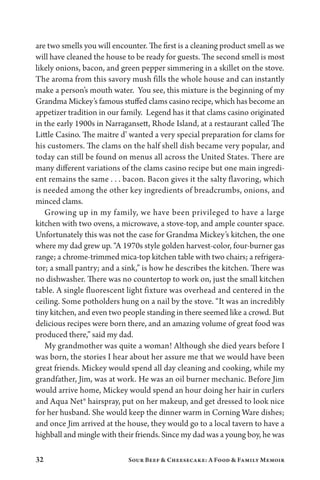
are two smells you will encounter. The first is a cleaning product smell as we
will have cleaned the house to be ready for guests. The second smell is most
likely onions, bacon, and green pepper simmering in a skillet on the stove.
The aroma from this savory mush fills the whole house and can instantly
make a person’s mouth water. You see, this mixture is the beginning of my
Grandma Mickey’s famous stuffed clams casino recipe, which has become an
appetizer tradition in our family. Legend has it that clams casino originated
in the early 1900s in Narragansett, Rhode Island, at a restaurant called The
Little Casino. The maitre d’ wanted a very special preparation for clams for
his customers. The clams on the half shell dish became very popular, and
today can still be found on menus all across the United States. There are
many different variations of the clams casino recipe but one main ingredi-
ent remains the same . . . bacon. Bacon gives it the salty flavoring, which
is needed among the other key ingredients of breadcrumbs, onions, and
minced clams.
Growing up in my family, we have been privileged to have a large
kitchen with two ovens, a microwave, a stove-top, and ample counter space.
Unfortunately this was not the case for Grandma Mickey’s kitchen, the one
where my dad grew up. “A 1970s style golden harvest-color, four-burner gas
range; a chrome-trimmed mica-top kitchen table with two chairs; a refrigera-
tor; a small pantry; and a sink,” is how he describes the kitchen. There was
no dishwasher. There was no countertop to work on, just the small kitchen
table. A single fluorescent light fixture was overhead and centered in the
ceiling. Some potholders hung on a nail by the stove. “It was an incredibly
tiny kitchen, and even two people standing in there seemed like a crowd. But
delicious recipes were born there, and an amazing volume of great food was
produced there,” said my dad.
My grandmother was quite a woman! Although she died years before I
was born, the stories I hear about her assure me that we would have been
great friends. Mickey would spend all day cleaning and cooking, while my
grandfather, Jim, was at work. He was an oil burner mechanic. Before Jim
would arrive home, Mickey would spend an hour doing her hair in curlers
and Aqua Net® hairspray, put on her makeup, and get dressed to look nice
for her husband. She would keep the dinner warm in Corning Ware dishes;
and once Jim arrived at the house, they would go to a local tavern to have a
highball and mingle with their friends. Since my dad was a young boy, he was
Chapter 6 — Appetizers 33
unable to stay home alone so they would take him along to the bar. The bar
patrons were very nice to young Steven, and he would explore the hidden
rooms in the tavern, making up fun games until it was time to go home and
have the dinner that Mickey had lovingly prepared.
Steve learned many things about cooking in that small kitchen; and as the
baby in the family, he loved the time spent with his mom. It made him a won-
derful cook for his own family, and he also learned other household duties
such as how to iron shirts, fold fitted sheets, and hang tie-back curtains.
One of his favorite memories is making clams casino with his mother. In a
skillet on the stove, the bacon, celery, green peppers, onion, and seasonings
would be cooking. As he tells the story, his mother had an old-fashioned
meat grinder that would clamp on to the side of the counter. Little Steven’s
job was to grind the fresh clams and add to the mix. Since they lived on the
New Jersey shore, there were always fresh clams to use. Once the clams and
other ingredients were combined, Mickey would add breadcrumbs and
Parmesan cheese to thicken the texture. Then the mix would be stuffed into
the clam shells and baked. I can imagine it was difficult and maybe even gross
to push all those clams through the grinder.
After the masterpiece of clams casino was complete, there many dishes
to be washed and no dishwasher. So by hand, they began washing dish after
dish. To make it easier, Mickey would soak the clam shells in soapy water,
rinse, and reuse. This tradition has carried into my family. There is a big bag
of clam shells sitting in my pantry as I write this sentence. We don’t use fresh
clams for our dish, but the canned, chopped clams are a good alternative and
make clams casino easier to put together for modern cooks.
Another famous appetizer in the Collins’ household is the simple yet
highly pleasing stuffed mushrooms Véronique. Anything “Véronique” means
“green grapes,” and the grapes plus the cheese in the stuffed mushroom
seems so random, but it adds a burst of flavor when you bite into the mush-
room. Whenever my mom makes this appetizer, there are always people
asking for the recipe. I encourage you to learn to make this easy appetizer as
it will surely impress your friends and family!
Another lovely appetizer is Italian-style tomato nibbles, made with cherry
tomatoes. This past year, I took a class called Intercultural Nutrition and
Foods; and on the first day of class, each kitchen group was assigned a differ-
ent finger food. My kitchen was assigned this dish. Basically, you cut cherry
34 Sour Beef  Cheesecake: A Food  Family Memoir
tomatoes in half and scoop out the pulp on the inside. Then in a food proces-
sor, you mix whipping cream, cheese, basil, and garlic until blended. Finally,
you stuff the blended mixture into the tomato halves and serve. So easy and
so good! I expected a mediocre little nibble but I was very surprised by how
tasty they were.
Finger food, nibbles, “a little something before dinner,” appetizers, hors
d’oeuvre, antipasti, starters, whatever you’d like to call them, little pre-meals
really add an extra something to the dining experience. Here are some
recipes to use as you develop your group of specialty appetizers. These were
chosen because they have been kitchen tested for many years. You can also
bring the Italian-style tomato nibbles or the liver pâté to a party when you
need to bring a nice appetizer.
My mother would like me to remind you never to bring to a dinner party
an appetizer that needs to be baked or warmed in the oven. This is not polite
or helpful for the host or hostess if he or she has to stop everything and warm
an oven and look for a cookie sheet or monitor something being cooked.
(Along the same lines, bringing flowers at the beginning of a party, although
a nice idea, is a distraction to the host or hostess to stop, cut the flowers, get
a vase, etc.) In France, it is bad taste to bring flowers, again a distraction from
the preparation of the food! So bring wine, a nice dessert, or an appetizer
that can be put out immediately. This way you can enjoy the pre-meal con-
versation and party and get out of the kitchen. How the Victorian hostess
would have welcomed our modern custom of appetizers; she probably would
not have considered dinner parties to be quite the ordeal!
1  Stuffed Clams Casino, Mom’s Favorite  2
12 medium-to-large clam shells
6 slices bacon
1 large onion, chopped in very small, almost minced pieces
½ large green pepper, chopped in very small, almost minced pieces
2 large stalks celery, chopped in very small, almost minced pieces
Two 8-ounce cans of chopped clams and juice
½ teaspoon dried oregano
2 tablespoons grated Parmesan cheese, plus a bit more for sprinkling
½ teaspoon paprika, plus a bit more for sprinkling
Chapter 6 — Appetizers 35
1 tablespoon dried parsley
¼ teaspoon cayenne pepper
½ cup Italian-flavored breadcrumbs
In a large skillet, fry the bacon until crisp. Drain bacon and set
aside. Saute the onion, peppers, and celery in the bacon grease
until soft, but do not brown. Crumble or chop the cooled
bacon into very small pieces and add to the vegetable mixture.
Along with the clams and juice, add oregano, Parmesan cheese,
paprika, parsley, and cayenne pepper to the mixture. Stir in the
breadcrumbs. Put aside to let the mixture cool.
Preheat oven to 350°F. Stuff the clam mixture into the clam
shells. Sprinkle with more Parmesan cheese and more paprika.
Bake 15 to 20 minutes until clams are bubbly. Can be served
hot or at room temperature.
Makes 12
1  Stuffed Mushrooms Veronique  2
18 to 20 mushrooms, 1 inch in diameter
18 to 20 seedless green grapes
1 package (5 ounces) Boursin cheese, slightly room temperature
1 stick unsalted butter, melted
1 cup Parmesan cheese, from a container
(don’t use freshly grated cheese)
Black pepper to taste
Wipe mushrooms with a damp cloth. Remove mushroom
stems and reserve stems for another use. Put a grape in each
mushroom. Using a very small spoon, mound ½ tablespoon of
Boursin over grape. Roll each stuffed mushroom in the melted
butter and then in the Parmesan cheese. (Save any cheese that
doesn’t stick.) Put mushrooms on an ungreased baking sheet
and refrigerate for 20 minutes.
36 Sour Beef  Cheesecake: A Food  Family Memoir
Preheat oven to 400°F. Bake mushrooms for 15 minutes, and
sprinkle with additional Parmesan and some black pepper as
soon as they are removed from the oven.
Serves 6
1  Italian-Style Tomato Nibbles  2
1 pint cherry tomatoes, halved
3 tablespoons heavy whipping cream
1 cup of fresh mozzarella cheese, cut in small pieces
6 large basil leaves
1 medium garlic clove, minced
1 tablespoon balsamic vinegar
Wash and dry the tomatoes and cut the tops off. Scoop out the
inside with a very small spoon or measuring spoon and discard
pulp. On paper towels, invert the tomato shells to drain.
In a food processor, combine the heavy cream, mozzarella
cheese, basil leaves, and garlic until blended.
Cut a very small hole in the corner of a heavy-duty resealable
plastic bag. Fill with the cheese mixture. On a serving platter,
turn over the tomato halves and drizzle the balsamic vinegar
over all. Using the plastic bag, pipe the cheese mixture into the
tomatoes. Garnish with additional basil leaves and serve.
Makes about 20
1  Pretty Liver Pâté  2
One 3-ounce package cream cheese
1 can Sell’s Liver Pate®
1 envelope unflavored gelatin
¼ cup bourbon or whisky
One 10¾-ounce can of beef consomme
Parsley for garnish
Chapter 6 — Appetizers 37
Bring the cream cheese to room temperature and put into a
small bowl. With a fork, mix in the liver pâté. Set aside.
In a small saucepan, mix the gelatin and the bourbon or whiskey.
Add the can of consomme and heat until the gelatin is dissolved.
Heat it through but do not boil.
Grease a small, 18-ounce mold, and pour in ½ of the gelatin
mixture. Refrigerate the mold until the gelatin has set. Mix
the remaining half of the gelatin mix with the pate and cream
cheese mix. (It’s best to use an electric beater to thoroughly
combine the ingredients.) Pour the beaten mixture on top of
the set consomme. Return to the refrigerator for a few hours or
overnight. To serve, unmold the pâté on a plate, garnish with
parsley, and serve with crackers or small rye breads.
Serves 6 to 8
1  Sausage Biscuit Bites  2
1 pound bulk sausage, mild or hot
1 pound sharp Cheddar cheese, shredded
3 cups dry biscuit baking mix
Preheat oven to 400°F. In a large frying pan, cook the sausage
together with the shredded cheese. Use a wooden spoon to
stir together until the cheese has melted. Stir in the biscuit mix
until smooth. Take off the heat and cool. Then put the pan in
the refrigerator for about 30 minutes for ease in handling.
Shape mixture into small balls the size of a quarter. Place on
an ungreased baking sheet. Bake for 8 to 10 minutes. Remove
from oven and place on paper towels to drain. Serve warm.
Makes 4 dozen
39
Chapter 7
Restaurant Life
When I was 15, my mom and I came to a conclusion. I needed a
job. I’m not really into sports, and I’m not really that interested
in school clubs. But I do like to work. So I began going to the
little stores in my neighborhood and asking for applications. After applying
at grocery stores, country clubs, and small shops, I was told that a nearby
restaurant was looking for a hostess. The idea of working in a restaurant was
very appealing to me. The restaurant is located in the heart of the Maryland
countryside in what we call “horse country.” Also known as the building that
housed George Washington’s horse, the tavern is proud of its rich history.
Nervously, I walked up the front stairs and asked the young man for an appli-
cation. I completed it and returned it a few days later and was interviewed by
two young restaurant managers. Late the next day, they called me and asked
me to come in and train as their hostess the following Tuesday.
I showed up 10 minutes early and was greeted by a manager. He taught
me the table numbers, dining room layout, and how to answer the phone. I
remember being terrified to leave my desk and wander into the kitchen. Later
in my career you couldn’t get me out of the kitchen! That was where all the
fun was! On that first night, the first table that came in was a party of two or
“two-top” as it’s called in the biz. I was told to go to table 27. While I walked
them down the stairs, my mind went blank, and I sat them at the wrong table.
Luckily it was the same server’s section. Things got easier over time.
People underestimate the job of the hostess. I used to also, before I did
the job. Yes, we are hired to look nice, make a good impression when guests
come in the door, and then show people to their tables, but it is more diffi-
cult than it seems. You have to keep the servers’ table counts equal, deal with
their sometimes unreasonable demands, and handle the difficult phone calls
40 Sour Beef  Cheesecake: A Food  Family Memoir
with “upset” guests. Yes, you say, “Hello” and “Have a nice evening,” but the
hostess is the first person customers (guests) see when they walk in the door
and the last person they see when they leave. It better be a good impression.
The one thing I don’t understand is how some people can be so angry after
a meal. Eating meals with friends or family should be a happy experience. I
know I’m happy after I have a family dinner, at home or out. I even witnessed
a man walk into the kitchen to give the head chef a hard time because his
food was late. Really? Sometimes people are cranky, make noise, and yell,
and at times I’d like to yell right back. Just because the hostess is the last per-
son you see when leaving, doesn’t mean she is the person to complain to. But
that is just part of the restaurant business, so I will continue to put up with it.
I cannot explain the craziness of a restaurant. . . the pace is definitely crazy.
There are some, let’s say, “interesting” people in this world. During a Sunday
brunch I worked, there was a wedding shower going on in the next room. At
the time, I did not have a driver’s license, so my mom came to pick me up.
Before I was allowed to leave, my manager wanted me to help clean up dirty
dishes. After I finished, I walked back out front and greeted my mom who
had a strange look on her face. I asked her what was wrong. “Grace, does
the restaurant have small, brass lamps on the tables?” she asked. To which I
replied that yes, it did. She then informed me that a woman had just walked
out with a lamp hidden under her raincoat. She put the lamp on the floor
in the back of her luxury car, didn’t even cover it up, and went back into the
party. In fact, she was a guest at the fancy wedding shower. Yes, a woman
stole a lamp from the restaurant.
I went back inside to tell the manager but he was nowhere to be found,
and frankly, nobody seemed to really care. I didn’t feel like it was my job to
confront the woman but I didn’t want her to think she had gotten away with
it. I don’t know why I felt so strongly about this—I felt like she was ripping
off my restaurant. We came up with a plan. My mom cleverly wrote a note
saying, “Someone saw what you did,” and I placed it on her windshield so
she couldn’t miss it. We left before seeing her come outside so we don’t know
how she reacted but my guess is next time she’ll think twice before stealing
another light fixture.
I think it is interesting to see the trends in restaurant food. I guess there
are trends everywhere in life, and these days, it seems as if every restaurant
I go to has short ribs on the menu. Why is that? Doesn’t that seem to be a
Chapter 7 — Restaurant Life 41
strange addition? There’s probably a reason why this trend got started but I
don’t know what it is. Heirloom tomatoes—that’s another trend. And blue
cheese! There are blue cheese crumbles on everything—potatoes, steak, sal-
ads, burgers. Maybe people got used to eating blue cheese dressing with their
hot chicken wings. Or maybe it is because everyone who is on a low-carb diet
seems to eat blue cheese.
The wedge salad is another trend. Something to make with awful iceberg
lettuce? It is a brilliant solution. Some chopped tomatoes, maybe some
chopped egg, blue cheese dressing, maybe some crabmeat to make it fancy.
Served very chilled, it is fabulous! What about marrow bones? Serving
bones and digging out the marrow to spread on toast points? Unusual but
really delicious. And tuna that is served rare in the middle. Never used to see
this, and now you see it on nearly every menu, either as an appetizer or as an
entrée. Included with this chapter is a wonderful tuna recipe served with a
spicy pineapple relish. The tuna must be red or rare in the middle.
Working in a restaurant is like being part of a big family, and I made many
friends during my work experience. One special relationship was with a
bartender named Charlie and his girlfriend, Rachel. They were expecting a
baby girl, and I offered my babysitting services. Rachel and Charlie named
their baby girl Charlie Grace, after me. It was such a honor! She is a beautiful
child, and I hope to be a part of her life and stay close to her amazing parents.
After a year and a half, I moved on to a new restaurant that was opening.
When I arrived on my first day, I was homesick for the old place. I tried to
straddle working at both restaurants but I learned quickly that that was a
no-no—not something you do in a small community. The new restaurant
really grew on me, and I enjoyed it more and more. It was really interesting
to witness the opening of a new restaurant. There were compliments on the
food, and the location is brilliant with a view overlooking a beautiful reser-
voir in Baltimore County.
I have now worked there for nearly a year, and I love my job. Originally, I
had been hostessing but I really wanted to be a busser. The money is better,
and my goal is to do every job, at least for a bit, in the restaurant business.
I carefully watched the bussers, and I paid attention to the ones who were
good—and the ones who weren’t. I knew I could do the job well. I had
bussed at my previous job and knew I had what it takes. I wanted to prove to
my managers that I could do it and would even stay late to help the bussers
42 Sour Beef  Cheesecake: A Food  Family Memoir
reset the dining room. Finally, after eight months of begging, I was offered
my chance during the Mother’s Day brunch since the restaurant was under-
staffed and I was the only one who didn’t need to be trained. At 9:45 AM
I showed up in black pants, black shoes, a white long-sleeved button-down
shirt, a black tie, and my hair back in a high ponytail. I was ready for action.
When people started coming in, I was on my A game. This was my first
and probably only opportunity to prove to my managers and coworkers
that I was up to the task. Once the day got rolling, I heard comments such
as, “Where have you been the last eight months?” and “You’re better than
the other bussers!” that were greatly appreciated. I was then asked to stay
on to work the night shift—a “double” as we call it in the restaurant busi-
ness. I stayed late that night, hustling the entire time, and I worked my butt
off. When I got home, I raved to my parents about how well I did. I was
exhausted yet exhilarated. A few days later, my manager hired me on as a
busser as well as the hostess. I was also proud that I was the first female
busser that the restaurant had hired.
Even though I’ve been in this business for only a few years, there are
many, many observations I have made and techniques I have learned. For
example, did you know the format of a menu is designed to increase the
money spent in the restaurant? Smart menus do not include dollar signs as
they remind you that you are paying money for food. There is also a trick
where you place an overpriced dish among the other entrées to make guests
feel they are being smart with their money. And describing a particular dish
as “Aunt Clara’s Secret Rice Pudding” sounds more interesting than just
“rice pudding,” and you can get a customer to pay more for Aunt Clara’s pud-
ding. Smart restaurants limit their food choices and design their menus to
manipulate the diner; having pages and pages of options is not as effective.
Another strategy is never put bar snacks on the bar. If there are no snacks,
people will order appetizers or dinners at the bar. Lastly, maybe the most
important lesson I’ve learned is when to stay out of the kitchen. On a good
night, the cooks will be yelling and, yes, possibly cursing but it is only in a
joking matter, not to be taken seriously. If you walk in and the kitchen is dead
silent, get out quickly; it means the cooks are stressed and don’t need more
distractions in their way.
Also, I’ve observed that there are patrons who will come in, eat and
talk, then leave. On the other hand, there are guests who will stay too long
Chapter 7 — Restaurant Life 43
after the meal and after the dessert and after the “dropping of the bill.” I’ve
watched bussers purposely blow out the table candles around the seated
table in an effort to hint to the customers that it’s time to leave.
Recently, I asked my manager if he could see me in the hospitality business,
and he responded with a question, “Do you mind working long hours, late
nights, and exhausting days? Do you mind occasionally putting up with rude
people?” NowwhenpeopleaskmewhatmyhobbiesareIrespond,“Working.”
Some say I work too much for a 17-year old but I really want to learn all I can
about the restaurant business. I would love to spend my life working long
nights and hard days; some say it is crazy . . . I say that is the restaurant business.
1  Braised Short Ribs  2
5 to 6 pounds bone-in short ribs
Kosher salt
Freshly ground pepper
1 tablespoon extra-virgin olive oil
1 large onion, chopped
3 ribs celery, chopped
2 carrots, peeled and sliced
2 cloves garlic, chopped
2 cups tomato paste
3 cups dry red wine, preferably cabernet sauvignon
1 cup water
1 cup chicken broth
4 sprigs of fresh thyme
2 bay leaves
Preheat the oven to 375°F. Puree the vegetables and the garlic
in a food processor until it resembles a thick mash and set aside.
Season the short ribs with salt and pepper. In a large skillet, heat
the olive oil to high, and brown the ribs on all sides, about 3
minutes on each side. Cook in batches so the pan isn’t crowded.
When the ribs are brown on all sides, remove them from the
pan and set aside. Wipe out the pan and add more olive oil, and
cook the pureed vegetables in the olive oil. Add salt and pepper
44 Sour Beef  Cheesecake: A Food  Family Memoir
to the vegetables and cook about 7 minutes until thick on the
bottom of the pan. Scrape the pan and cook again for 5 minutes.
Scrape the pan again, add the tomato paste, and cook for 5 more
minutes. Add the wine, and scrape all of the browned vegetable
bits. Reduce the vegetable/wine mix by half.
Add the short ribs back to the pan, and add the water and
chicken broth. Add the thyme and bay leaves. Cover the pan,
and cook in the oven for 3 hours. If needed, add more water or
broth during the cooking. After 1½ hours, turn the short ribs
and continue cooking. During the last 15 minutes of cooking,
remove the lid to further reduce the liquid. Serve with buttered
noodles or mashed potatoes.
Serves 8
1  Tuna with Spicy Pineapple Relish  2
Eight 6- to 8-ounce tuna steaks, about 1-inch thick
½ cup vegetable oil
Relish ingredients:
1 ripe fresh pineapple, peeled and cored, chopped, save all the juice
1 large red onion, diced
6 tablespoons cilantro, minced
6 tablespoons fresh lime juice
2 tablespoons green or red jalapeno chilis, seeded and minced
4 dashes of hot sauce
Salt
Pepper
Preheat broiler to 400°F (or you can cook tuna on a grill).
Bring the tuna steaks to room temperature and brush with oil.
In a large bowl, combine the relish ingredients and set aside.
Cook the tuna steaks for 4 to 5 minutes on each side, for rare in
the middle. Serve with the pineapple relish spooned over the
top of the steak.
Serves 8
45
Chapter 8
Soup Is Home
It all started with chicken noodle soup. My mom was carrying
a steaming bowl of soup in one hand and an Advil® in the other. As far
back as I can remember, I had a tendency to be sick more often than the
other kids. Whether it was strep throat, bronchitis, or a sinus infection, there
I was in bed, complaining of my sore throat or pain-ridden chest. When sick,
I would eat a big bowl of soup because it soothed my pain. Soup is a great
way to put some food in your stomach before you have to take an antibiotic!
In elementary school, it was strep throat. For awhile there, I was home sick
twice a month. For a week and a half, my throat was on fire. I would get
104°F fevers, throw up, and not eat. The only highlights were missing school,
so I could stay home and watch “The Golden Girls” reruns on TV, and eating
soup. Come to think of it, that doesn’t sound too bad! On the days I was tired
of chicken noodle soup, my mom would make me beef broth with alphabet
or star pastina pasta. This continued for a good three years, until I was old
enough to get my tonsils out. After the surgery, talk about soup! I couldn’t
eat anything else, so soup and ice cream were all I ate. My health improved
dramatically thanks to my tonsillectomy.
Soup is the perfect meal because it is easy and convenient; and if some-
thing goes wrong you can just adjust the seasonings, and it will probably be
just fine. Broths, chowders, bisques, cold soups, fruit soups—I love them
all. I love French onion soup so much, I’ve dedicated an entire chapter to
the quest for the perfect soup. (See Vive le France on page 23.) With a good
soup as the basis for the meal, add some good bread and butter, a small salad,
a nice dessert, and you’re all set.
My absolute favorite soup is lobster bisque. The first time I had it was in
the Circular Dining Room at The Hotel Hershey in Hershey, Pennsylvania,
46 Sour Beef  Cheesecake: A Food  Family Memoir
the home of the Hershey Chocolate Factory. The Circular Dining Room is a
beautiful gourmet restaurant. There is a story that in his many world travels,
Milton S. Hershey noticed that the guests who did not tip well were often
placed in the corners of restaurants. That’s why he designed his flagship
restaurant at the hotel with no corners. The room is perfectly round with
windows that look out over sculptured gardens. Anyway, the lobster bisque
I had there was a creamy, rich soup with a big lump of lobster. It makes my
mouth water just thinking about it. It has been difficult to find that soup
anywhere else although the Wegmans Supermarket near my house does
a pretty decent job of it. No big chunks of lobster but a good flavor and a
nice texture. Now I drive the seven miles round trip to get a medium-sized
cardboard container filled with heaven. Bisques and seafood chowders are
terrific comfort soups, but indulged only on occasion because of the cream
and high fat content.
Being from Maryland, I do love our state’s well known-crab soups. There
are two traditional types; and when you say “crab soup” in Maryland, that
primarily means the spicy, tomato-based, vegetable soup with jumbo lump
crab meat. Then there is the cream-of-crab soup, which is my favorite. Like a
cross between a bisque and a chowder, cream of crab could be a meal in itself.
If you eat steamed crabs and have some leftovers, you can use the shells for
flavoring a stock—a great basis for crab soups. I guess I think of the red crab
soup as being more of a summer soup whereas the thick cream-of-crab soup
is more suited for a cold winter day.
Growing up in the Collins household, my mom was famous for making
soups out of the strangest ingredients. She likes to make soups for some very
basic reasons. First, they are economical, and she is very frugal. Second, as
the soups are simmering they make the house smell like “home.” And third,
they are very nutritious.
Her soups sometimes look strange but taste amazing. Take her sweet and
sour cabbage soup, which she has perfected over many years. The first time
she had this dish was in a deli in California near the UCLA campus. It was
the cook’s special for the day, scribbled on notepaper, and clipped to the plas-
tic menu. She had never heard of such a thing, so she tried it. She enjoyed it
so much that she asked if the chef would give her the recipe. He was not too
forthcoming about the ingredients. She explained that she was from New
Jersey so it wasn’t like she wanted to steal his recipe, she just wanted to be
Chapter 8 — Soup Is Home 47
able to make it at home. He gave her a broad description of how to make the
soup, and then she came home and researched old Jewish cookbooks to find
the perfect balance of tart and sweet ingredients that are in her soup today.
Then there is the soup she calls her “Italian soup.” She starts with a leftover
chicken or turkey carcass and makes broth. (We always have a few chicken or
turkey carcasses frozen and wrapped up in our freezer.) Then she adds in a
can or two of tomatoes, some oregano and basil, and every type of vegetable
that she has in the fridge. This could be some onions or scallions, green or
red peppers, mushrooms, or yellow squash, whatever. She also adds a bit of
frozen chopped spinach, probably to get a few more vitamins in the soup.
She pops in a chicken bouillon cube or two, and this simmers for a few hours
on low. It gives the whole house a nice, homey smell.
Initially a soup made from so many vegetables was not high on my list.
For a girl who answers, “I don’t have one” when asked about her favorite
vegetable, this was not a soup I wanted. When the Italian soup is ready, it
is ladled into big bowls, and grated mozzarella cheese is added to the top of
each serving. The first time I saw this bowl of vegetable soup with melted
cheese on top, I considered faking a stomachache so I could be excused from
dinner. To my surprise, this melted gooey mess was actually quite wonderful.
My family still laughs about how we thought she was crazy to think we would
enjoy this soup. When my mom makes this soup everyone gives her a hard
time, “Really, again Nancy?” but the funny thing is we forget how good it is
before she makes it. The idea of it sounds bad but every time we have it we
laugh about how much we really like it! This is the same with her mushroom
barley soup.
Mushroom barley soup always gets rave reviews at our house. My mom
tells a story that back in the 1980s she had this soup at the Russian Tea Room
in New York City. It made such an impression on her she got a Russian Tea
Room cookbook out of the library and researched the ingredients for the
soup. So her recipe was first based on that rich and classic soup, and she has
changed it a bit over time. For me, the soup tastes and looks like food peas-
ants of the seventeenth century would have eaten. The mushrooms are such
a wonderful addition, and it really makes moms happy when their kids are
scarfing down bowls of this healthy soup. Another soup is her turkey rice
soup, which I am convinced was nothing more than a lucky experiment.
Maybe she didn’t have noodles the day she made it, and she substituted rice.
48 Sour Beef  Cheesecake: A Food  Family Memoir
Anyway, it’s along the same lines as chicken noodle soup but opposite ingre-
dients: chicken vs. turkey, noodles vs. rice, and then lots of black pepper.
It sounds sort of bland but I promise you, turkey rice soup is one of those
soups that you could eat and eat and eat.
Soup is a big part of my life, whether to help cure an illness, dine in style,
or experience one of my mom’s concoctions. It supports the idea that you
can put a handful of ingredients into a pot, season it properly, add chicken
or vegetable stock, and turn it into a hardy soup. I equate soups with home.
When my sister comes home for the winter holidays, and it is just starting to
snow outside, we all sit around the table eating soup. And it is an easy meal
when you don’t quite know when your guests may arrive. The soup can just
sit and be ready for when everyone arrives—and it can always stretch to feed
unexpected guests. It is comforting for me when I am sick and I can have
some soup and then fall asleep in my bed. Lastly, soup reminds me of where
my mom is. She’s the crazy scientist of soup. And she’s the one who brings
me soup, in the hope that it will make me feel better. And it always does.
Soup is extravagantly simple. It is home.
1  Sweet and Sour Cabbage Soup  2
2 pounds stew beef, cubed
2 tablespoons sugar
2 tablespoons dark-brown sugar
2 pounds cabbage, shredded
2 large onions, chopped
1 large carrot, sliced
4 cups water
½ cup white vinegar or to taste
2 cans (28 ounces) tomatoes with juice
1 small can (8 ounces) tomato sauce
½ cup raisins
Salt
Pepper
In a large, heavy pot, sear the beef cubes in the white and brown
sugars. Add the cabbage, onions, and carrot. Add the water and
Chapter 8 — Soup Is Home 49
vinegar. Chop the canned tomatoes into large chunks, and
add tomatoes and juice to the pot. Add tomato sauce. Bring
to a boil and skim foam from the top. Turn the heat down to
low-to-medium, and simmer for a few hours. In the last hour of
cooking, add the raisins. Before serving, adjust taste with salt
and pepper and a bit more vinegar, if necessary.
Makes enough for a big pot of soup
1  Mushroom Barley Soup  2
¼ cup olive oil
2 medium onions, chopped
1 large carrot, peeled and shredded
1 cup pearl barley
2 pounds fresh mushrooms, sliced
6 cups chicken stock or broth
Salt
Pepper
1 cup sour cream or plain yogurt
¼ cup of fresh dill weed, snipped
In a large pot or Dutch oven, heat the oil, add the onions and
carrot, and cook until the onions are tender and translucent.
Add the barley, stir, and cook for 4 to 5 minutes. Add the
mushrooms, stir, and cook for a few more minutes. Add the
chicken broth. Turn up the heat to high, and boil the soup.
Skim off some of the foam that forms on the top. Turn the heat
down to simmer, cover, and cook for at least 1 hour, or until the
barley is tender.
Right before serving, adjust seasoning with salt and pepper.
Ladle soup into bowls, and add a dollop of either sour cream
or yogurt to the bowl. Garnish with dill.
Makes enough for a big pot of soup
51
Chapter 9
“Stressed” Spelled Backwards
Is “Desserts”
Leaning back in my chair, feeling full from dinner, I’ve been
known to say, “There’s always room for dessert!” Though the meals
at my house are delicious, they are always missing something. What
could it be? Dessert! Since my mom would rather cook than bake, and my
dad tends to indulge in sweets too much, we usually don’t have dessert in the
house. This is a shame because everybody likes dessert. Rich desserts on a
regular basis can be unhealthy; but in moderation desserts are just fine, and
they are a terrific ending to a good meal.
Growing up, I loved everything sweet, and I still do. I would joke about
having “a mouthful of sweet teeth instead of one sweet tooth.” My favorite
dessert, you may ask? Well there are different categories of desserts such as
light and sweet, or heavy and rich, or healthy and non-guilt inducing.
In the light and sweet category, my choice is lemon sorbet. I’ve been to
a number of restaurants that serve a refreshing sorbet stuffed in a carved-
out frozen half of a lemon—really refreshing. I believe after a big meal, the
somewhat-tart treat cleanses the palate.
I choose a heavy and rich dessert after a light meal such as a salad or soup.
This translates to, “Now that I’ve had a healthy meal, bring on the hunk of
cake or slice of pie that will leave me bent over in pain, holding my stom-
ach, yet happy because it tasted sooooo good.” If this is the scenario, my
favorite rich dessert would be the classic and pure apple pie I make from my
Grandma Mickey’s recipe, either with a scoop of vanilla ice cream or just
plain on its own. I don’t want to toot my own horn but my pie is pretty good.
Fresh apples, cinnamon, sugar, and butter—what could be more beautiful?
52 Sour Beef  Cheesecake: A Food  Family Memoir
The first time I made this pie was after my dad and I went apple picking.
I always joked with my dad about how he was a horrible father because he
never took me apple picking. After all the jokes, he surprised me one fall day
by driving to an apple orchard. Once we picked a good amount of apples, we
went home to make a pie. He taught me the recipe he knew, and he showed
me all the tricks to making it perfect, for example combining the sugar
and cinnamon and mixing all with the apple slices rather than just layering
each ingredient in. Cutting slits in the top of the double crust also ensures
that the steam escapes. Even though my grandmother’s recipe includes a
“never-fail pie crust,” I must admit that I use the pre-made pie crusts found
in the refrigerator section of the supermarket. They can be frozen, and you’ll
always have pie crust ready to go. Their quality is quite good, so always keep
some stashed in the freezer so that you can make a pie in a snap. Ever since I
learned the apple pie recipe, I’ve been the one in the family to make the apple
pie for Thanksgiving or whenever a pie is needed.
Finally, in the category of healthy and guilt-free dessert, my favorite would
be a simple bowl of ripe strawberries and fresh whipped cream. This is also
good for a low-carb diet, which everyone seems to be on these days.
It is hard not to think of the number of sit ups you’ll have to do or the num-
ber of miles you’ll have to run to burn off the calories in a sugary dessert. But
during those 5 to 10 minutes of pure joy as you slowly scoop a spoonful into
your mouth, you can forget everything else and just taste the sweet happiness.
Cookies are always an easy dessert. They are a crowd pleaser for adults
and children alike, go with almost any meal, and are really easy to serve and
cleanup, just use a nice napkin or a small dessert plate. I love cookies so much
that I even named my cat “Cookie.” Cookies remind me of the winter holi-
days and family, when it seems everyone is baking and giving cookies. My
Uncle Greg, Aunt Rita, and their son Henrik have kept a wonderful family
tradition of baking an assortment of the most wonderful Christmas cookies.
They start in November with their preparations. They have a standard cook-
ies that they make year in and year out: Some of those include: Shortbread,
Linzer tart, cherry cookies, chestnut fingers, cinnamon stars, and of course,
their beloved chocolate chip cookies. Uncle Greg says the trick to their
chocolate chip cookies is to melt the butter. He claims it results in a more
buttery, thinner, and crispy cookie. We look forward to our plate of Faller
family cookies every year, and we fight over the chocolate chip cookies.
Chapter 9 — “Stressed” Spelled Backwards Is “Desserts” 53
When my mother first got married, she bought a magazine called McCall’s
Cooking School. I guess as she was starting out she wanted to learn how to
cook. To this day, we still have this worn-out magazine, and my mother has
made many of the recipes, many many times. Her pretty holiday dessert is
the classic Grenoble tart, which is guaranteed to be a hit at any holiday din-
ner party. It is easy to make and tastes more complicated than it is to put
together. It is also a very pretty dessert when used to decorate a dinner table
or sitting on a cake stand garnished with some fresh holly leaves.
Not only do desserts please the palate but also the eye. Have you ever
seen an “ugly” dessert? No, because it doesn’t exist. Well, actually there may
be a few exceptions. There is a family joke about my mother making a sad
attempt at a Bûche de Noël, and another story about the one time my Uncle
Greg made a chocolate bread pudding. The result wasn’t what the cooks had
planned. From a flambé to a chocolate chip cookie, in my opinion desserts all
look nice. It could be the frostings, sprinkles, variations in size and color—
each enhancing the attraction of the dish.
One of my favorite hobbies is watching shows that involve extravagant
ways to make sweets such as “Ace of Cakes,” shot here in Baltimore, or “Cake
Boss” because the chefs combine creativity, excitement, and desserts. These
shows are more about sculpture and art but it is interesting how they include
sugar, pastries, and cake. It’s an “outside of the box” way of presenting and
eating desserts.
Desserts are also romantic. Whenever I think of desserts, my mind flashes
to the image of John Cusack and Kate Beckinsale discussing the frozen hot
chocolate delicacy in the movie “Serendipity.” They have a chance encounter,
and a romance develops as they discuss the particulars of this special dessert.
I look forward to the day where my dream man will present me with a platter
of chocolate-covered strawberries and a glass of champagne for an anniver-
sary or Valentine’s Day or even just because he wanted to. Or when we will
be sitting in a restaurant, finishing a wonderful dinner, and the server will
deliver to us a single piece of yellow cake with rich dark-chocolate frosting
and two forks.
Along the topic of romance and sweet things, my mom has a saying that
I live by, “There are two types of men . . . chocolate and broccoli.” A “choco-
late” man is a handsome, suave, hot man who is fun but not terribly serious.
My grandmother calls these types of men “operators.” You can have a good
54 Sour Beef  Cheesecake: A Food  Family Memoir
time with a “chocolate” man, but you need to be careful not to make a habit
of this type of man—or to fall in love with one. Too much of a “chocolate”
man is not especially good for you. A “broccoli” man, on the other hand, may
not be the handsomest or hottest man, but in the long run, he is GREAT for
you. You know the kind—good hearted, kind, moral, and a wise choice for
a life mate. If you find a “broccoli” man covered in “chocolate,” that is a real
score. They are out there, for sure [wink, wink].
I think it is amusing that “desserts” spelled backwards is “stressed.” I know
that there are chemicals in chocolate that make you feel good, and I know
that a nice dessert also makes me feel good. Whether it is love, lust, a broken
heart, a midnight craving, or for you ladies, possibly just that “time of the
month,” desserts are a good way to ease your stress.
1  Apple Pie  2 
Use the Never-Fail Pie Crust for a double pie crust or use pre-
made refrigerator crust.
2 tablespoons flour
8 large apples, peeled, sliced thinly (Granny Smiths work best)
¼ cup lemon juice
3 teaspoons cinnamon
¾ cup sugar
3 tablespoons butter, cut in small pieces
¼ cup milk
Preheat oven to 350°F. Prepare pie crust as below, or follow the
package instructions for a pre-made pie crust.
Sprinkle the flour in the bottom of the prepared pie shell. In
a large bowl, combine the apple slices, drizzle with the lemon
juice so they don’t turn brown. Add the cinnamon, and sugar.
Mix all thoroughly. Pour the apples into the pie crust, heaping
full. Tuck the dabs of butter in the apples. Add the top pie
crust, and press edges together with a floured fork. Cut 6 small
slits or holes in the top crust to let steam escape during baking.
Chapter 9 — “Stressed” Spelled Backwards Is “Desserts” 55
Bush a bit of milk on the top crust, and dust with a little sugar
before baking. Bake for 1 hour or until pie is golden brown and
the apples are soft.
Serves 6
1  Never-Fail Pie Crust  2
2¼ cups flour
1 teaspoon salt
⅓ cup cold water
¾ cup Crisco®
Plastic wrap
In a large bowl, mix together the flour and salt. In a smaller
bowl, measure out ¼ cup of the flour mixture and ⅓ cup of
cold water. Mix together to make a liquid paste.
In the large bowl with flour and salt, add the Crisco® and mix
into small particles. Add the flour and water paste and knead
into a ball, then cut the pie crust dough into 2 balls. With a
rolling pin, roll out the crusts between layers of plastic wrap.
Bake just the single bottom crust for about 25 minutes at 350°F
or until golden in color.
Makes 1 double pie crust or 2 single crusts
1  Grenoble Tart  2
From McCall’s Cooking School, Step-by-Step Directions for
Mistake-Proof Recipes, Newfield Publications.
Tart Shell:
⅓ cup butter
¼ cup sugar
1 egg yolk
1 cup unsifted flour
56 Sour Beef  Cheesecake: A Food  Family Memoir
Preheat oven to 375°F. In a bowl, beat the butter with sugar
with an electric mixer. Add yolk, beat well. Gradually add
flour and beat until crumbly. Do not overbeat. Form dough
into a ball, and press evenly into a 9-inch fluted tart pan with a
removable bottom. Bake for about 15 minutes or until golden
brown. Cool on rack.
Filling:
2 cups walnuts, coarsely chopped
⅔ cup dark-brown sugar, packed
¼ cup butter
¼ cup dark corn syrup
½ cup heavy cream
Spread walnuts on a cookie sheet, and bake at 400° for 5
minutes. Sprinkle walnuts in the tart shell. In a heavy saucepan,
stir the brown sugar with the butter, the corn syrup, and 2
tablespoons of the heavy cream. Stirring constantly, bring
to a boil over medium heat and boil for 1 minute. Pour over
walnuts. Bake in the center of a 375°F oven for 10 minutes
or until bubbly. Place on a rack to cool. Beat remaining heavy
cream until stiff. Refrigerate cream until serving. Serve tart at
room temperature with bowl of cream.
Serves 12
1  Swedish Confectionery Balls
or Pecan Balls  2
¼ pound butter
pinch salt
¼ cup sugar
2 teaspoons vanilla
2 cups flour, sifted
2 cups pecans, finely ground
In a bowl, cream the butter and the sugar thoroughly with an
electric mixer. Add in the salt, vanilla, flour, and pecans. Let
stand for a few hours or overnight, covered.
Chapter 9 — “Stressed” Spelled Backwards Is “Desserts” 57
Preheat oven to 325°F. Scoop out the dough with a teaspoon,
and roll it in your palm to make a ball. Place on an ungreased
cookie sheet, and bake for 30 minutes or until golden brown.
Let cool on a wire rack.
Makes 90 to 100 balls
1  Faller Family Chocolate Chip Cookies  2
1 cup unsalted butter
¾ cup sugar
¾ cup packed dark-brown sugar
2 large eggs
1 tsp vanilla
1 tsp sea salt
1 tsp baking soda
2 to 2½ cups flour
Chocolate chips (as many as you prefer, but at least 12 oz)
Preheat oven to 375°F. Melt butter and add to both sugars,
and beat with an electric mixer until creamy. Add eggs (one at
a time), vanilla, salt, and baking soda. Add 2 cups flour; if too
soft, add a little more flour. Stir in chocolate chips. Bake in oven
about 12 minutes or until golden brown. Cool 1 minute and
then remove to rack to cool completely.
Makes about 3 dozen 3-inch cookies
59
Chapter 10
My Ukrainian YaYa
The name Marilyn McSherry sounds like a movie star’s name,
right? Well to me, the actual woman is a movie star. Marilyn grew
up as Miroslava Tarnopolsky, a Ukrainian girl in the Lower East Side
of New York City. Her first memory, she recalls, was of sitting on a curb on
Broadway in 1927 during the ticker-tape parade for Charles Lindbergh for
his solo flight across the Atlantic. She thinks a man gave her a piece of candy,
or maybe he just asked her to move off the street. Regardless, she was part
of history.
When she was in first grade, little Miroslava was given the name “Marilyn”
by her first grade teacher. She’s not sure why, maybe it was because the
teacher was taking it upon herself to give the little girls more American-
sounding names. Anyway, she was “Marilyn” after that. Marilyn was a
bookworm and a brilliant student, yet she was too shy to speak up in class.
She went to an all-girls high school and later Hunter College, and she gradu-
ated as a chemist when many women weren’t interested in or able to have a
career. In her high school yearbook, her friends wrote about her, “May she
find happiness in a test tube!”
Since she had to wear a skirted uniform at school, she loved weekends or
taking vacations when she could wear “slacks.” Like many other girls during
that era, she kept wonderful handwritten diaries. In her diaries, she had long
entries about how there was “no better tonic than wearing slacks.” Marilyn
kept a number of diaries, one she wrote in French. I wonder why she chose
to write those entries in another language?
During World War II, Marilyn worked in a lab at an army base in New
Jersey. She tells stories of drawing blood from soldiers before they were
going off to the war. In her free time, she tooled around the Jersey Shore
60 Sour Beef  Cheesecake: A Food  Family Memoir
in a light-blue jeep. Again, not something many women did then. She was
single and enjoying herself, but once she met a handsome man named Luke
Kenneth, who also worked at the base, it was all over. Luke himself tooled
around the Jersey Shore in a white Cadillac convertible with a red interior.
He also had a big, snow-white malamute dog named Corky. He must have
looked great in that car with the dog.
Marilyn and Luke fell in love, got married, and had two little girls, Nancy
and Laurel. Marilyn was beautiful, and Luke was handsome and literally
looked like he was part of The Rat Pack; and Luke couldn’t get enough of
Marilyn. She was beautiful, and they made a stunning pair. In those days,
many people smoked; and even though Marilyn didn’t smoke, Luke espe-
cially liked when she held a cigarette. At cocktail parties or in restaurants,
Luke would hand a lit cigarette to Marilyn and ask her to just hold it. And
Marilyn loved the smell of smoke. Years later, she would ask a male smoker
to just “blow a bit of smoke into my face!”
Up until her daughters were 8 or 10, Marilyn would dress them in match-
ing clothes, like twins. She thought that was cute, although the little girls
weren’t crazy about the idea. The pictures today of the little girls are wonder-
ful. They took family trips all over the world, a number of them on cruise
ships in the 1960s and 1970s when people dressed for tea and made a big
deal of going to the Captain’s Ball. Marilyn loved planning for those trips and
laying out all of the clothes for her daughters.
Marilyn would pack her daughters school lunches of cream cheese and
green olives on white bread and send them off to Catholic school. They lived
in a small town by the ocean in New Jersey. Once Nancy and Laurel grew
up, one went on to have two little girls herself. Nancy turned out to be my
mother, and that second generation of little girls is my sister, Emily, and me.
Marilyn McSherry is my grandmother, and she is a sexy, sophisticated,
beautiful, elegant grandmother. Widowed when she was only 58, and becom-
ing a grandmother at 68, Marilyn made it very clear that she did not want
to be called “Babushka” or “Grandmother.” She said that babies couldn’t
pronounce “Babushka,” and the word “sounded like an old lady with a rag on
her head.” So my parents were in a quandary about what Marilyn would be
called by the grandchildren.
Some of our Greek friends suggested that we call her “YaYa” like they do in
Greece, and it stuck. So I have a Ukrainian grandmother whom we call YaYa.
Chapter 10 — My Ukrainian YaYa 61
Since none of us look like we have a Greek heritage, this was always amusing
to Greek people who heard me calling her YaYa on trips to the mall.
I have many memories of my grandmother, and I was always excited when
I was able to go over to YaYa’s house. After my sister and I were born, she
moved from New Jersey to Maryland, so she could be closer to her grand-
children. Her first home was a farmhouse in a beautiful part of Baltimore
County. Although I was only 5 or 6 years old, I remember she had peacocks
and chickens on the farm. The peacocks were so beautiful, and we had great
sleepovers at that farmhouse. Her next stop was an apartment with lots of
neighbors. I mostly stayed up late at night there because I was getting older,
and I liked watching TV. YaYa had cable TV, and I remember I wasn’t allowed
to watch “Channel 3” and “Channel 4” since they were “inappropriate.” Of
course, I wanted to watch those channels, and one day I peeked at the chan-
nel and heard the “F-word.” I ran in the other room and informed her of what
I learned. Shocked, she said, “Say it only when you grow up and in private.”
What did that mean?
There were many sayings that originated with YaYa. “Don’t complain and
don’t explain,” is a great one, but her most memorable quote is, “Men are like
streetcars. . . there’s always another one around the block.” To this day, if a
boy breaks my heart, I think of YaYa’s advice, and I immediately feel better.
My grandmother’s greatest attribute is her enthusiasm for life. Even
though she is getting older, at 89 her attitude toward life is as young as ever.
I can remember walking into her house countless times, and before seeing
her, hearing her yell “Who is Queen Elizabeth?” and knowing she was watch-
ing her favorite show “Jeopardy” with Alex Trebek. She loves Alex Trebek,
another Ukrainian. Sometimes if she was asked to stay with us for dinner,
she would say, “No, I’m having dinner with Alex tonight.” And she is quick to
tell you that he’s never been the same since he shaved off his mustache. She
always loved being active, convincing me to get out of bed while watching
“silly cartoons” as she phrased it, and go for a walk with her.
YaYa describes herself as an “eater” not a “cook” but she has made some
amazing meals. Her famous rum cake is the best cake ever, and believe me,
I know my cake. When I grew up, I found out that YaYa’s rum cake is the
famous Bacardi Rum® cake that many women in the 1960s and 1970s made.
It is probably a bit out of fashion now since it is prepared in a Bundt pan, but
I think it is the simple type of cake that everyone should learn how to make.
62 Sour Beef  Cheesecake: A Food  Family Memoir
It is good for picnics, formal dinners, and casual buffets. It is made with a
packaged yellow-cake mix, so it is very easy to make and delicious.
Another classic recipe my YaYa makes is shrimp DeJonghe. In the late 19th
or early 20th century, I understand, this recipe originated at the DeJonghe
Hotel and Restaurant in Chicago. How my grandmother learned about it, I
don’t know. It is a casserole of shrimp topped with garlic, sherry, and bread
crumbs. It can be served either as an appetizer or a main course but make
sure that you have no plans after you eat this shrimp dish as it is very garlicky
and gives you garlic breath.
YaYa is absolutely a child of the Depression. She eats little meals through-
out the day, which she refers to as “grazing,” and she has truly followed the
“Mediterranean diet” before it became fashionable or known as a healthy
way to eat. Sardines, salmon, almost any sort of olives, eggplant, crusty bread,
she loves it all. She never wastes food, and she always saves leftovers. She
will even go so far as to say at dinner, “I don’t eat dessert” and then eat half
of yours or even take your dessert leftovers home with her. My mother and
I joke about how YaYa will comment, “Are you sure you want that, honey?”
when we take an extra helping of dessert—a not-so-subtle-way to say we’ve
eaten too much.
One condiment she will never consume is mayonnaise. Yaya cannot
understand the hype about mayonnaise; to her, it is the most disgusting
product ever created. She substitutes everything which should have mayo in
it with yogurt. My mother tells a story that once YaYa made tuna salad with
yogurt, which was not a good choice. But if YaYa doesn’t want to eat mayon-
naise, that is just fine. If it makes her happy, that’s all that matters. Not much
of a drinker, in YaYa’s later years she has come to enjoy a cold beer. “The first
cold sip of a Stella is the best” she’s been quoted as saying numerous times.
Often, my Aunt Laurel calls me and tells me to meet YaYa and her at a little
Italian restaurant that pours Stella Artois® on tap. We sit outside and talk and
people-watch while they drink (I’m too young for Stella, unfortunately).
She also likes a Campari® now and then but I’ve come to realize that many
restaurants and bars don’t stock it.
Marilyn McSherry is an amazing woman, and she is my idol. She is every-
thing a grandmother should be. God made grandmothers to give double the
support,doublethehugs,anddoublethelove.AttimesI’msadthatIdon’thave
fourgrandparentslikemyfriendsdo,buthavingmyoneYaYamakesupforthat.
Chapter 10 — My Ukrainian YaYa 63
1  Shrimp de Jonghe  2
2 tablespoons butter
1 to 3 cloves garlic, depending on preference, peeled and minced
Salt to taste
1 tablespoon chives, minced
1 tablespoon parsley, minced
2 tablespoons dry sherry
16 large raw shrimp, peeled and deveined
¼ cup unflavored fine bread crumbs
Preheat the oven to 375°F. In a large skillet, melt the butter.
Add the garlic, and saute over medium heat for about 5
minutes, or until tender. Remove pan from the heat, and stir
in the salt, chives, parsley, and sherry. Wash the shrimp, and
if you prefer, slice the shrimp lengthwise. In a shallow baking
dish or casserole dish, arrange the shrimp and pour the butter
mixture over them. Sprinkle with bread crumbs. Bake for 10 to
12 minutes until the bread crumbs are golden brown.
Serves 2
1  Bacardi® Rum Cake  2
1 cup pecans or walnuts, chopped
1 package yellow-cake mix
(don’t use the cake mix that has pudding in it)
1 (3¾-ounce) vanilla instant pudding
4 eggs
½ cup cold water
½ cup vegetable oil
½ cup Bacardi dark rum (80 proof )
Preheat oven to 325°F. Grease and flour a 10-inch tube or
12-cup Bundt pan. Sprinkle nuts over bottom of pan and set
aside. Mix all remaining ingredients together. Pour batter over
nuts. Bake for 1 hour. Cool cake on a wire rack.
64 Sour Beef  Cheesecake: A Food  Family Memoir
When cool, invert the cake onto a serving plate. Prick the top
with a fork so the glaze will penetrate the cake. Spoon and
brush glaze evenly over top and sides. Decorate with whipped
cream if desired before serving.
Serves 10
Glaze:
1 stick butter
¼ cup water
1 cup sugar
½ cup Bacardi dark rum ( 80 proof )
Melt the butter in saucepan. Stir in water and sugar, and boil
for 5 minutes, stirring constantly, and remove from heat. Stir in
rum. Cool mix slightly before glazing the cake.
65
Chapter 11
Picnic Food
Living in a rural part of Baltimore County, there are many pic-
nics to be had complete with baskets, blankets, and yummy food galore.
It began with my sister, when we were very young—dragging a basket
across the yard, laying out a blanket, and serving up the main course, which
consisted of Play-Doh® and Cheerios®. Those were the good old days. As the
years went on, picnics became less frequent and more suitable for certain
occasions such as Father’s Day or the 4th of July.
I think picnics should be more frequent and not just for holidays. They are
a way to enjoy a light meal in the company of good friends, surrounded by
beautiful scenery. Once, on a beautiful summer day, we drove to a local win-
ery in Baltimore County with our good friend Carl and his wife, Mollie. We
sat among the grapevines enjoying a little meal of fresh fruit, cheese, pasta
salad, and, of course, wine.
There are a few dishes that come to mind when I hear the word “picnic.”
The first is the deviled egg. Many people don’t know that there is a strategy to
making the perfect deviled egg. My mom is one of the few to have mastered
this technique. The first step is to use eggs that are a week or two old because
less-fresh eggs are easier to peel once they have been cooked. Before cooking
the eggs, you have to rest them on their side for at least eight hours or over-
night. This centers the yolks so in the final deviled egg they will be pretty, and
the whites of the egg will be more sturdy when picked up. To allow for eggs
that may crack or get damaged along the way, always plan ahead by cooking
a few extras.
Bring the eggs to room temperature before boiling them. Put a big pot of
cold water on the stove, and add a teaspoon of salt and a teaspoon of vinegar.
Make sure there is plenty of room in the pot for the eggs so that they are in
66 Sour Beef  Cheesecake: A Food  Family Memoir
one layer on the bottom of the pot. You don’t want them to bang together
when they are cooking as that can crack them. Cover the pot and bring it to
boil (about six minutes), and then move the pot off the burner and let it sit
for 15 minutes. Drain the hot water and immediately fill the pot with cold
water, adding some ice cubes to keep the water cold. This dunk in cold water
will help with peeling the eggs. Let the eggs sit in the cold water for 10 to 15
minutes, and then take them out and peel them.
Once the eggs are cool, use a sharp knife, and cut them into halves. Having
a towel or napkin to wipe the blade between each slice will make sure no
yolk crumbs stick to the white part of the egg, which will give a cleaner look.
Finally, pop out the yolks and put them in a small bowl. Use a fork to break
up the yolks, and then mix them with mayonnaise, brown mustard, and
strained sweet relish. Stuff the mixture back into the egg white and sprinkle
with paprika. If you prefer, you can put the filling in a plastic bag, make a hole
in the corner, and squeeze the filling into the egg white. Like a pastry bag,
this gives the eggs a pretty look. And that, my friends, is how you make the
perfect deviled egg.
The second food I think of is potato salad. Everyone raves about how their
potato salad is the best but I’ve come to realize that taste lies in the mouth of
the beholder. I think the most frequently heard comment at picnics nation-
wide, mostly from older ladies, is, “Ah! This potato salad is good, but mine
is better...” There is no universal potato salad recipe because it varies among
cooks. Our family recipe is simple: boiling little red potatoes (so the step
of peeling is eliminated), chopping them up, putting them in a big bowl,
and adding mayonnaise cut with a little fresh lemon juice, some scallions,
and lots of salt and pepper. A bit of celery can be added but it isn’t really
necessary. Chill before the picnic but bring the potato salad to almost-room
temperature before serving. It is divine.
Cornbread is a mainstay of picnics, and we make an amazing blueberry
cornbread that we never tire of. At any party we host at our house, we know
to make two big dishes of cornbread because we never have any left. This
cornbread is beautiful cut in squares and served in a big basket with a red-
and-white-checkered napkin. With a smear of soft butter on the top, it is
heaven. Cornbread is also a perfect picnic food for children. A child of any
age will gobble down blueberry cornbread and butter and some fruit salad
and be fed and happy. Mom and dad will be very happy too as they can enjoy
Chapter 11 — Picnic Food 67
the party themselves. Take my advice. Make this blueberry cornbread your
specialty, and you will be the hit of any picnic.
Let’s talk about cole slaw. It isn’t my favorite but I feel I must include my
grandmother Mickie’s recipe here because a picnic at my house wouldn’t be
the same without it. The trick is to cut (shred) the cabbage into a very tiny
dice. It is amazing to me to think that my grandmother didn’t have a food
processor, and she cut all of the cabbage by hand. It must have taken her
hours. I have heard stories of her providing buckets and buckets of her signa-
ture cole slaw for big parties and weddings and even for a seafood restaurant
in Highlands, New Jersey. Today we just shred the cabbage finely in the food
processor. It took my dad a while to come around to this method as I think
he was wedded to the old-fashioned way his mother did it—as if it tasted bet-
ter if it was cut by hand. But he’s realized how much more slaw you can make
by using the processor. These days, we don’t do it by hand at all.
There is another nice salad that you can make for picnics. It is just toma-
toes, peppers, onions, salt, and pepper; you don’t even add dressing. The
idea is that if you let the veggies sit for awhile at room temperature, they will
make their own juice. This salad is also a terrific alternative for people who
are on diets or don’t like salad dressing. It is pretty, and it stays fresh-looking
since there is no dressing. For those guests who really need dressing, they
can always add some. If there is any salad left over, you can use it as a basis
for gazpacho. Just put it in the food processor.
Picnics also make me think of competition. Yes, competition. Am I
the only one who realizes there is a huge competition going on out there
between Miracle Whip® and mayonnaise? As long as I can remember, there
has been a debate at picnics about the preferences of these spreads in potato,
tuna, macaroni, and chicken salads, or on sandwiches. Which is the better
spread? Who knows. My mom and dad think mayonnaise is the winner; and
for my dad, it needs to be Helmann’s®. My mom thinks Miracle Whip is too
sweet. Then there’s my Aunt Gail and my cousin Patricia who believe that
Miracle Whip® is the clear winner. There are entire cookbooks dedicated to
Miracle Whip® or Helmann’s® Mayonnaise recipes. People are downright pas-
sionate about their sandwich spreads.
Then there are people like my YaYa who believe both are too greasy and
disgusting. She makes a delicious warm potato salad with bacon fat! She uses
butter on all sandwiches, not mayo or Miracle Whip®. But she will eat chicken
68 Sour Beef  Cheesecake: A Food  Family Memoir
salad and say, “This is really good and not too dry!” What is she thinking? It
isn’t dry because it has butter in it, it has mayonnaise in it! For me, I’m not
going to take sides. I think it is nice to have options, and I will continue to ask
people at picnics, “What is your vote? Mayo or Miracle Whip®?”
There is another type of competition. Jersey tomatoes vs. Maryland toma-
toes or Jersey corn vs. Maryland corn. It is really funny. If a guest from New
Jersey asks, “Where did you get this corn?” and you say, “New Jersey,” then
the guest is happy and says the corn is great. If you say it is local corn from
Maryland, the guest will then go on to tell you how good Jersey corn is. It
never fails. And it’s the same with tomatoes. People are very loyal to their
locally grown produce!
Picnics are a way to enjoy the company of loved ones, eat easy-yet-delicious
food, and step away from the day-to-day routine of eating around a dinner
table. So put together some cole slaw and blueberry cornbread, invite some
family or friends, and enjoy the food, company, and maybe some nature.
1  Mom’s Cole Slaw  2
2 pounds cabbage, shredded and chopped fine
2 large stalks celery
1 teaspoon celery seed
1⅓ cups mayonnaise
2 tablespoons sugar
½ cup milk
1 teaspoon white vinegar
Mix all ingredients together and stir vigorously until small
bubbles form. Refrigerate for a few hours or overnight.
Serves 12
1  Blueberry Cornbread  2
6 tablespoons unsalted butter, room temperature
1 cup sugar
3 large eggs, room temperature
1½ cups yellow cornmeal
Chapter 11 — Picnic Food 69
2 cups flour
1 tablespoon baking powder
½ teaspoon salt
2 cups whole milk
1½ cups fresh blueberries
Preheat oven to 375°F. Grease the bottom and sides of a 9 ×
13 baking pan. Cream the butter and sugar until fluffy and pale
yellow in color. Add each egg and beat thoroughly after each.
Stir in the cornmeal until combined. Don’t overbeat the batter.
In a separate bowl, sift together the flour, baking powder, and
salt. Add the dry ingredients and the milk to the butter mixture
in thirds. Beat after each addition to thoroughly combine the
ingredients. Again, don’t overbeat. Fold in the blueberries.
Pour the batter into the baking pan, and bake until cornbread
is lightly brown, about 40 to 50 minutes. Test doneness with
a knife or toothpick; it must come out clean when inserted in
the center. Let cool completely on a wire rack before cutting.
Cut cornbread into 3-inch squares. Makes 15 squares.
1  Fresh Tomato and Green Pepper Salad  2
4 large ripe, fresh tomatoes, chopped in large chunks
1 large green pepper, seeded, sliced into ¼-inch-thick pieces and then
cut in thirds
½ of a large sweet onion, sliced very thinly
Salt and pepper to taste
Thissaladmakesenoughnaturaljuicesonodressingisnecessary.
Place the tomatoes, green pepper, onions, salt, and pepper in a
large bowl and toss. Let sit at room temperature for at least 1
hour. Can serve immediately or refrigerate for a few hours.
Serves 4
70 Sour Beef  Cheesecake: A Food  Family Memoir
1  German Potato Salad  2
3 pounds potatoes, preferably red
¼ pound bacon
¼ cup onion, chopped
1 tablespoon flour
2 teaspoons salt
1¼ tablespoons sugar
¼ teaspoon pepper
⅔ cup cider vinegar
⅓ cup water
½ teaspoon celery seed
3 tablespoons fresh parsley, fresh or dried
Boil potatoes in jackets until tender. Cool, peel, and slice the
potatoes thinly. Fry bacon until crisp. Remove the bacon from
the pan and crumble. Add the onion to the bacon and fat, and
cook on medium-to-high heat for 1 minute. Blend in the flour,
salt, sugar, and pepper. Add vinegar and water, and lower the
heat to medium and cook another 10 minutes, stirring well.
Add the crumbled bacon back into the pan. Pour the sauce
over the sliced potatoes. Add celery seed and parsley. Toss
gently, and serve warm.
Serves 6
71
Chapter 12
That’s Amore
Baltimore’s “Little Italy” is what triggered my love for Italian
food. With my mom’s passion for good spaghetti and sauce (she calls
it her “Death Row Meal,” the last meal you ask for when you are on
death row) and my father’s Death Row Meal being pizza, you might assume
I would also love Italian food, but that wasn’t always the case. It was strange
because I have always loved Italian traditions and clothing styles, the bronzed
Mediterranean men, and Italian-themed movies.
Ever since I can remember, I have been quoting lines from one of my
favorite movies of all time, “Moonstruck,” starring Cher and Nicholas Cage.
Like when Cher wakes up her father to tell him she’s getting married, and
he says, “I can’t sleep anymore. It’s too much like death.” Or when Cage’s
character, in a fit of rage over his brother, says, “Chrissy, over on the wall,
bring me the big knife. I want to cut my throat!” As I got older, I was ready
for movies such as “Goodfellas” and “The Godfather” parts one and two
(didn’t like part three that much). And did I tell you that I love Dean Martin
singing “That’s Amore”?
Do you know what I like best about the Italian people? It’s how family
comes first. Family is the most important above all other things. And even
though I don’t have an Italian bone in my body, I would gladly do anything
for my mom, dad, and sister. But even after all of this love for Italy, the food
was not that exciting to me.
Growing up, I really hated pizza, if you can believe it. I had no problem
with spaghetti or any type of pasta and sauce, or “gravy,” but for some reason
I just didn’t crave pizza like the rest of my family did. A lifetime of hearing
my father say, “The crust has to be thin and crispy!” just really annoyed me.
Since the majority of my relatives live in New Jersey and my parents grew up
72 Sour Beef  Cheesecake: A Food  Family Memoir
there, they would argue that the best pizza and Italian meals are found in the
good old Garden State: “Nothing beats New Jersey pizza. Blah, Blah, Blah.”
For some reason (some say it is the water), the pizza in Baltimore is really
pretty crummy. There are very few exceptions. Actually, the Italian bread in
Baltimore is pretty crummy, too. Maybe it is the water.
When I was eight, one of my favorite plays, “Little Shop of Horrors,”
came to Baltimore. I so wanted to see it, and my dad agreed to take me. Our
seats in the recently renovated Hippodrome Theater were very tight, and my
father is tall at 6′6″, so he barely fit in the seat but he put up with it. After an
exhilarating night at the play, we left and began driving through the city. It
was 10:00 at night, and it was getting late for an eight-year old. My dad then
told me that we were going to call my mom to let her know we were safe
but that we wouldn’t be home soon. Truth be known, I was tired and really
wasn’t looking forward to a night on the town. After my mom questioned
what we were doing, Dad responded with, “We are going to paint the town
red.” What did that mean? I was worried. I had never heard that expression.
I was eight!
We drove into a neighborhood where the houses were painted bright
colors, and there were little white lights in the trees. The row homes were
neat and tidy with flowers in window boxes. Some had religious statues in
the living room windows. What a beautiful and mystical part of the city, I
thought to myself. Then in the distance there was a glowing sign that read
“Little Italy.” Dad pulled over to the side of the road, parked, and shut off
the car. As I got out, I noticed right away how crowded the streets were with
cars and how the streets were illuminated by the old-fashioned light posts
and the brightly lit windows lining the sidewalk. The air smelled like garlic,
which was quite different and nice. I noticed the restaurants were open and
crowded at 10:45 at night.
As we kept walking, I saw a sign with letters arranged vertically that read
“Chiapparelli’s.” We walked up the steps and opened the door. There were
waiters and busboys running around, and the restaurant was bustling. The
hostess grabbed two laminated menus and seated us at a table for two right
by the window so we could see all of the action out on the street. As our
server took our drinks order (I went all out and got a Shirley Temple), I
looked at the menu and immediately decided on ravioli. The server informed
me that the dinner came with a salad. I was an eight-year old who wanted no
Chapter 12 — That’s Amore 73
part of salad. But my dad overruled me and told me I would really like the
salad. I agreed but I was angry I had to eat it; the only bummer of the night so
far. When the salad arrived, it was crispy iceberg lettuce tossed in a garlicky
vinaigrette loaded with the most Parmesan (later to learn Romano) cheese
I have ever seen. And this was no side salad. It was a full entrée-sized salad.
I took a bite and fell in love. To this day when someone asks me about my
favorite food I tell them without hesitation: Chiapparelli’s salad.
But the salad was only the beginning. My ravioli arrived. It was baked per-
fectly, and the cheese was melted beautifully. My Chiapparelli’s experience
was perfect. We left and walked back to the car, passing the neighborhood
bocce ball court. Although there were no games going on that late, my dad
walked me around the court and explained the rules of bocce.
As we walked along the streets of Little Italy, he told me stories of his
own father being stationed on a battleship during World War II in the
Mediterranean and how he had spent so much time in the ports in Italy,
mostly Naples and Salerno. His father would tell stories of how much he loved
the food and the warm local people and how beautiful the Italian women
were. That night is one of the most memorable experiences I have ever had
with my father. He introduced me to a restaurant with wonderful Italian food,
told me great stories, and taught me about some Italian traditions.
In subsequent years, I continued to go to Chiapparelli’s for special occa-
sions. As an older teenager, one night after my shift as a restaurant hostess,
my father picked me up late. When I climbed into the blue truck, I noticed
he was dressed in nice clothes. This was different from his usual attire of
jeans and a t-shirt because he would usually get out of bed to come pick
me up. He explained that we were going to rush downtown to get the last
seating at Chiapparelli’s. As he said that, I can’t explain the excitement I felt
as a smile stretched from ear to ear on my face. We arrived as the restaurant
was closing but we chatted quickly with the hostess, and she showed us to
a table. I still start with the Chipp’s salad but now I usually order the penne
con vodka, a creamy tomato sauce and another favorite that you can have
with shrimp or chicken added to it. There is always enough to take home
for the next day’s lunch.
Over the years, these experiences in Little Italy taught me to enjoy Italian
cuisine, and I now love it. I’ve experienced pastas, veal dishes, eggplant
dishes, and seafood all at Italian restaurants in Baltimore. My aunt Laurel
74 Sour Beef  Cheesecake: A Food  Family Memoir
was happy to hear of my new love for Italian food. She spent a year at the
American Academy in Rome, and she came home with a number of won-
derful recipes, her best being a Bolognese (meat) sauce for pasta. She makes
it with a thick spaghetti-like pasta called bucatini, which is very popular in
Rome. The pasta has a hole running through it, and it complements the
Bolognese wonderfully.
She also introduced us to a lemon-flavored liqueur called limoncella,
which is served after dinner in Rome, probably all over Italy too. The tradi-
tion is that it aids in digestion. My father now makes a homemade batch of
limoncella each year, when beautiful lemons are plentiful. Rounding out a
wonderful meal like Bolognese is a light appetizer or first course like brus-
chetta. Or sometimes bruschetta is perfect on its own served with some
olives, a wedge of Parmesan Reggiano, and some fruit. Bruschetta was also
something I had to get used to. Along with my early dislike of pizza, I also
really didn’t like tomatoes. They were slimy, almost sour tasting to me, and
up for debate—a fruit or a vegetable? I was that irritating kid that picked
tomatoes out of dishes. When I heard that tomato was the main ingredient
in bruschetta, I wasn’t interested. As I got older, however, I did eat tomatoes
on occasion; and finally as I watched the minced garlic and basil being added
to the chopped tomatoes, then spread on a toasted and thinly cut piece of
baguette, I thought it looked pretty good. I picked up a piece and tasted it,
and discovered its refreshing and light taste, savory from the garlic and salt.
People always rave about the taste of my family’s bruschetta, as they should;
it’s delicious and easy to make! Just make sure you use the ripest tomatoes
you can find, in season.
All right, I know what you’re wondering . . . did Grace ever find a love for
pizza? And the answer is yes. Finally after many years of avoiding the oven-
baked crust with cheese and tomato sauce, I’ve become a pizza girl. Now
I’m not saying that I love it as much as my dad does, but I do tend to crave
it every now and then. When we are in New Jersey, we will make a special
trip to one of our favorite pizza restaurants. Because New Jersey is the only
place to get pizza. It’s funny to think that a late, late night in Baltimore and a
father’s surprise turned into an introduction and love for Italian food, along
with a lifelong family memory.
Chapter 12 — That’s Amore 75
1 Bruschetta 2
2 pounds fresh, ripe tomatoes, diced
3 to 4 cloves garlic, minced
1 bunch of basil, chopped very small
4 tablespoons extra-virgin olive oil
Kosher salt and freshly ground pepper, to taste
Baguette or Italian bread
Dice the tomatoes and put in a large bowl, reserving the juice
as that also goes into the Bruschetta mix. Add the minced
garlic, basil, olive oil, and salt and pepper. Set aside for at least
an hour to combine the flavors.
When ready to serve, slice the baguette in ½-inch slices, on
the diagonal, spread pieces on a cookie sheet, and drizzle with
olive oil. Toast only one side of the bread until golden brown.
Mound the bruschetta mixture on the untoasted side of the
bread, letting the juices soak into the bread. Arrange on a
platter, garnish with additional basil. Serve immediately.
1 Bolognese 2
5 cans (28 ounces) crushed tomatoes (in thick puree)
1 medium yellow onion, diced
4 stalks celery, diced
5 medium carrots, peeled and diced
1 stick butter
1 tsp salt
1 tsp sugar
1 cup dry, red wine
1 tablespoon extra virgin olive oil
2 pounds ground beef
½ teaspoon ground nutmeg
1 cup whole milk
2 pounds bucatini pasta
1 cup of Pecorino Romano cheese, grated
76 Sour Beef  Cheesecake: A Food  Family Memoir
In a large pot, place the tomatoes, the diced vegetables, butter,
salt, sugar, and wine. Cook at a lazy simmer (uncovered) for 2
to 3 hours (until vegetables are soft) stirring occasionally.
Using a food mill, strain the sauce into a second large pot and
set aside. Discard the vegetables.
In a large skillet, gently heat the olive oil. Crumble in the
ground beef and sprinkle liberally with nutmeg. Cook slowly
until beef is brown (about 20 minutes). Add milk, and bring
the mixture to a low simmer. Using a slotted spoon, transfer the
meat to the strained sauce. Simmer uncovered for an additional
1 to 2 hours.
Prepare the bucatini pasta according to package directions.
Serve the Bolognese on the pasta with freshly grated Pecorino
Romano cheese.
1 Limoncello 2
15 large and thick-skinned lemons
2 bottles of 100-proof vodka or grain alcohol
4 cups sugar
5 cups water
Scrub the lemons with a vegetable brush to remove wax and
chemicals, and dry them with paper towels. Zest the lemons
with a vegetable peeler but use only the yellow part of the rind.
Make sure absolutely none of the white “pith” underneath the
yellow skin is used or it will make the limoncello bitter.
In a 1-gallon jar, add one bottle of the alcohol or vodka and the
lemon zest. Cover the jar, and keep in a cool, dark place for at
least a week or up to 40 days. (The longer the better.)
In a large saucepan, mix the sugar and water, and cook for 5 to
7 minutes or until thick. Let the syrup cool completely before
adding it to the alcohol mixture. After adding the syrup to
Chapter 12 — That’s Amore 77
the limoncello mix, add in the additional bottle of alcohol or
vodka. Cover the jar, and keep again in a cool, dark place for
another week to 40 days.
When ready to serve, strain the limoncello and discard the
lemon zest pieces. Pour the liqueur into bottles with a cork or
tight-fitting top, and store in the freezer. Using the 100 proof
vodka or alcohol will ensure that the limoncello will not freeze.
79
Chapter 13
Adventurous Eating and
Foods from the East
I’m just going to say it, no sugar coating or anything. . . I am one
strange eater. Ever since I was a young girl, I would pick the weird-
est-sounding dish on a menu and order it. My parents were always
flabbergasted when little Gracie would order the king crab legs, or escargot,
or shark, or swordfish, or Lima beans. All of those shows with the hosts eat-
ing “bizarre” foods ain’t got nothing on me. I have always had a fascination
with nontypical meals. I do love mac-and-cheese and chicken fingers, natu-
rally, but foods such as those don’t “tickle my fancy.” Everyone nowadays eats
sushi but I enjoyed it years ago as a six-year old. If it is spicy, has a strange
name, or has a strange texture, you’ll know I’ll be ordering it.
One of my first experiences with “adventurous” eating occurred when I
was in Florida when I was about seven years old. We were on a trip to visit
my Uncle Stash, a Miami Beach police officer. There were so many exciting
things to do in the great “Sunshine State.” Go to the beach, enjoy the sun,
and walk around the streets of Miami listening to Latino music and watching
people roller skate. As lunchtime approached on a hot, sunny day, we spotted
a little Thai café. We nabbed a table on the sidewalk and began looking over
the menu. It had the usual entrée and appetizer choices, satay and pad Thai,
but something caught my eye—“Baby Octopus.” Absolutely, I was going
to order it! What was placed in front of me was a small bowl with tentacles
positioned around the perimeter and a green, slimy substance in the middle.
Oh yes! I dug right in, and let me tell you, it was fantastic tasting.
My mom sat in shock and watched as I scarfed down the raw baby
octopus. I learned that the green stuff in the middle was a wasabi seaweed
80 Sour Beef  Cheesecake: A Food  Family Memoir
salad-type mixture, which I also enjoyed quite a bit. That Florida trip was full
of excitement but eating that baby octopus for the first time was the begin-
ning of a lifetime of adventurous eating.
Two years ago, when I transferred to a new school, I had all the typical
fears one has when switching schools, such as will I make friends, what if
I get lost, will I get beat up, and so on. But luckily, a small group of friends
made everything easier for me. After a couple of days, I learned all my classes
and their locations; everyone seemed really nice, and I made friends. Every
now and then, my friends and I would go to a local sushi restaurant for
dinner or to celebrate a birthday. The first time I went, I was worried that
these girls would find it odd if I ordered the strangest-sounding thing on the
menu. As we sat down and ordered our Japanese-style marble sodas, one
of the girls, Kate, announced with excitement, “Yes! They have baby octo-
pus!” I looked up from the menu and asked her if she liked that too, and she
responded with, “Oh yeah, I love foods that are out of the ordinary.” When I
told her about my love for adventurous eating, her face lit up. Everyone else
at the table looked at us like we were crazy, but we didn’t care! We agreed to
split the baby octopus; and from then on, whenever we were together at a
restaurant, we’d order something “weird.”
The next couple of times, we stuck to our agreement, ordering such
delicacies as raw, not battered calamari, which really was not very good; and
seaweed salads. In December of 2010, after a day of preparing Christmas
presents for a local charity, we went to an amazing Thai restaurant and sushi
bar. We sat down, looked at each other, and began scanning the menu for
our next tasting adventure. We both knew immediately: “Sea Urchin.” The
description of the sea urchin sushi roll made it sound very unappealing but
we still wanted to try it. Our waiter looked perplexed when we ordered the
roll. When it came, it looked like a normal sushi roll except for the giant
glob of mud-brown paste on each roll. We both picked one up, laughed,
and simultaneously ate the whole thing in one bite. I apologize to those
who enjoy sea urchin sushi roll, but I am not one of you. It was repulsive. I
thought I had already thrown up in my mouth but then I realized it was the
roll I was trying to swallow. I would describe the texture as snot that tasted
like ocean seawater. When my mom tried a little bit left on the plate, she
discreetly spit it into her napkin.
Chapter 13 — Adventurous Eating and Foods from the East 81
When our server saw us having a hard time with this rarely ordered roll,
he informed us that most people can’t stomach the texture. Now we know
why. We all started laughing as my mom told the man how Kate and I are on
a mission to try all strange, weird, different nontypical foods. He said if that
was our goal, then we had to travel to New York for the blow fish, or fugu as
it is known in Japan. This is a deadly fish, and of the 17 restaurants licensed to
sell the blow fish in the world, 12 of them are in New York City. The chefs are
trained to rigorous Japanese specifications, and they leave a tiny bit of poison
in the fish to give one’s mouth a slightly numb feeling. This sounds awesome!
Of course, if the fugu is not prepared well, it can result in poisoning, which
happens on occasion. This fish is not cheap; one roll can cost more than
$100. So Kate and I have a plan that when we graduate, we will take a trip to
the Big Apple and eat this expensive, poisonous fish. Since we are young and
don’t really have $100 to spend on fugu, we will each bring $50 and do what
we have always done and split it.
Kate and I always get into debates concerning who’s eaten the most
bizarre foods. I say rabbit, she argues crickets; I argue shark, she says roasted
dragonfly. I can never win! She always beats me, and the reason is China. She
recently went on exchange program to China, a place I have always wanted
to go. A trip to Asia, including China, Japan, Thailand, and Malaysia, would
be a dream trip for me. Not only would I add a few more oddities to the list
of food but I’d also learn more about the culture and the history of those
countries. I am so envious that Kate was given the opportunity to go, and I
hope one day I will travel to Asia as well.
My family has Asian friends, mostly from China and Malaysia. Not only
are they sweet, polite, and quiet people, but I truly love their cuisine. I think
my favorite cuisine is Thai with the lemon grass and cilantro and touches of
basil and coconut. The recipes in this chapter are some of our family-favorite
Thai dishes. Although these preparations are not that unusual on a Thai
menu, they have been kitchen tested and are a great way to learn how to cook
some very basic Asian food.
I look forward to learning more about the foods and cultures of other
countries. Many times, the people of other countries have very different
food preferences than what we have in the United States. I remember one
family story about when a group of Malaysian men was visiting us. My mom
made a stewed chicken with vegetables and arranged the beautiful slices of
82 Sour Beef  Cheesecake: A Food  Family Memoir
white meat on a platter for the table. Toward the end of the meal, we noticed
that two guests were standing at the pot on the stove, picking out the dark
meat and eating it. My dad asked his friend if the men were still hungry. He
responded that no, but in their country the dark meat was the prized part of
the chicken, and they thought (or maybe were offended) that we were keep-
ing the best part of the meal for ourselves. My mother spent the rest of the
evening apologizing to our guests and explaining how in the States the white
meat was preferred. Just a simple story of how cultures vary.
Growingup,it’ssafetosay,Iwasnotthetypicalchild.Andevennowat17,I’m
still far from typical. I will always be an adventurous eater, and I will never have
anyregretsfortryinganewfood.Whatdoyouhavetolose?Well,withtheblow
fish,possiblythefeelinginyourfaceforawhile,butit’sallpartoflife’sadventure.
1  Satay with Peanut Sauce  2
1½ pounds pork loin, thinly sliced in 2-inch strips, ½-inch thick
2 teaspoons sugar
3 tablespoons Asian fish sauce
2 teaspoons curry powder
¼ teaspoon black pepper
1½ cups unsweetened coconut milk
4 tablespoons chunky peanut butter
In a large bowl, combine the pork, sugar, 1 tablespoon of the
fish sauce, curry powder, and pepper. Cover and marinate the
pork overnight or for at least 6 hours.
In a saucepan, mix together the coconut milk, peanut butter,
and remaining 2 tablespoons of fish sauce. Over high heat,
bring the mix to a boil. Cover and refrigerate.
Soak 12 wooden skewers in water for 30 minutes before use.
Thread the marinated pork pieces onto the skewers, and broil
the pork for about 10 minutes, turning the skewers frequently.
Servethesataywiththepeanutbuttersauceandcucumber salad.
Serves 6
Chapter 13 — Adventurous Eating and Foods from the East 83
1  Cucumber Salad  2
2 cups white vinegar
½ cup sugar
2 teaspoons salt
½ cup ground peanuts, unsalted and unroasted
2 large cucumbers, cut in four pieces lengthwise and sliced very thinly
3 to 4 tablespoons cilantro, chopped
In a saucepan, boil the vinegar, sugar, and salt for 20 minutes.
Let cool. Roast the peanuts in a slow oven until golden brown.
Chop peanuts in a food processor to a rough chop, not too
fine. Add the cucumber, peanuts, and cilantro to the vinegar
mixture. Refrigerate for a few hours and serve chilled.
Serves 6
1  Gai Pad Kaprow, Chicken with Basil  2
2 tablespoons vegetable oil
3 garlic cloves, minced
1 teaspoon red pepper flakes
1 to 2 teaspoons sriracha (chili garlic sauce)
2 chicken breasts, sliced thinly
2 teaspoons sugar
2 teaspoons soy sauce
2 tablespoons Asian fish sauce
2 carrots, peeled and sliced
1 onion, sliced into strips
½ pound green pea pods
2 cups fresh Thai basil leaves
Jasmine rice
In a large skillet, heat oil, and saute garlic until golden brown.
Add red pepper flakes, sriracha sauce, and chicken. Saute over
medium heat for about 4 minutes or until opaque in color.
Stir in the sugar, soy sauce, and fish sauce, and cook for about
84 Sour Beef  Cheesecake: A Food  Family Memoir
1 minute. Add carrots, onions, and green pea pods, and cook
for 2 to 3 minutes or until slightly tender. Mix in the fresh Thai
basil leaves and cook until just wilted. Serve with jasmine rice.
Serves 4
85
Chapter 14
New Jersey Feels Like Home
These days, when someone mentions “New Jersey,” many people
automatically think of fake tans, big hair, and fist pumping. Or
maybe “The Sopranos.” Or maybe Bruce Springsteen. But when I
think of New Jersey, I think of walks on the beach with my family. My parents
are both native to New Jersey, to the area near Sandy Hook, the most north-
ern beach of the Jersey Shore. But my Jersey Shore is definitely not like the
one you see on the TV show of the same name.
Ever since I can remember, I have been taking week-long vacations with
my relatives in New Jersey, staying with my Aunt Gail and Uncle Andy. My
Aunt Gail is my dad’s sister and daughter to Mickey, whom I’ve mentioned
many times in this book!
Whenever I stayed with my Aunt Gail and Uncle Andy, at their pretty
house in Atlantic Highlands, I would wake up and run outside to see Uncle
Andy while he worked in his yard or cleaned his pool. He would always be
prepared with a new rhyme or riddle for me, like this classic:
“One bright morning in the middle of the night, two dead boys got up to fight.
Back to back they faced each other, drew their swords, and shot each other. A deaf
policeman heard the noise, came right over, and shot those two dead boys.”
Where did he get these? Did he make them up? I would take pains to mem-
orize every one of Uncle Andy’s sayings. When he finished his chores, we’d
walk down along the beach; usually it was low tide. Even now, I can remember
how low tide smells and how refreshing the cool sea breezes are at that time
in the morning. Across the bay, I could see the skyline of New York City, and
in the distance I could see the airplanes landing at Kennedy Airport. As we
walked, we would talk about life, and he would tell me funny stories from his
childhood, growing up in the 1950s and 1960s at the shore. We would finish
86 Sour Beef  Cheesecake: A Food  Family Memoir
our walk by going into town, and grabbing a traditional Jersey hard roll and
butter and sitting in the gazebo at the boat harbor. I could never stop laughing
when I was with my “Silly Uncle Andy.” I should mention that I started to call
Uncle Andy “Fill-In.” You see, my own grandfathers died before I was born so
I’ve never had a granddad. The closest thing to what a grandfather would be is
my Uncle Andy, so he’s my “fill-in” of a grandfather.
Uncle Andy and I would go back to his house, and then I’d watch “The
Golden Girls” reruns on TV until my Aunt Gail would be ready to start our
day together, which usually included going to the beach or a visit to the store.
Sometimes we did both. Sometimes we would call the cousins so they could
join us.
Luckily, Aunt Gail and Uncle Andy have all of their children and grand-
children living within just a few miles of them. This way, when I visit from
Maryland I get to see everyone. And did I mention that I have seven cousins
all currently under the age of 10? After shopping or lounging on the beach,
I would return to my aunt’s house for her delicious cooking, my personal
favorite being her macaroni and cheese. I could eat bowls and bowls of it. My
Aunt Gail is such an amazing person; she would go to the end of the world
just to make her family happy.
When I think of New Jersey and Aunt Gail and Uncle Andy I also think
something else very “Jersey”—pork roll or “Taylor Ham®.” Come to think of
it, my Aunt Gail and I have shared many pork roll sandwiches over the years.
If you’ve never heard of pork roll, it is a meat product, mostly prepared for
breakfast. In my opinion, it is better than bacon, sausage, or scrapple. Some
describe its taste like a summer sausage or Spam. Pork roll is a staple in my
family, and I’ve introduced the salty meat to many of my friends in Maryland.
Originating in Trenton, New Jersey, a man named John Taylor invented it
in the late 19th century. Taylor originally called it “Taylor’s Prepared Ham”
but was forced to change the name after the enactment of the Pure Food and
Drug Act of 1906 because the product didn’t meet the new legal definition of
“ham.” He renamed it “pork roll,” and it was sold as both “Taylor’s Pork Roll®”
and “Trenton Pork Roll.” The specific ingredients are a mystery as I’ve tried
to find out what exactly is in pork roll. In this case, maybe ignorance is bliss.
Pork roll is sliced thin and fried or grilled, and it is rarely found outside
of the New Jersey/Philadelphia area. Served alongside eggs in diners or as a
breakfast sandwich, the traditional pork roll, egg, and cheese sandwich, also
Chapter 14 — New Jersey Feels Like Home 87
called the “Jersey breakfast” or to some, “the triple bypass sandwich,” is the
usual way it is served. Did I neglect to mention that this meat has a lot of fat
and sodium, and you should probably eat pork roll only on occasion?
The preparation of this delicious meat is easy. Melt some butter in a frying
pan, and fry the pork roll slices. The trick is to cut a few slits on the pork roll
edges before frying to prevent the slices from curling up. My mom tells me
that her sister, Laurel, loved pork roll sandwiches when they were children.
Laurel had a precise way of making the sandwich: fry the pork roll, save the
butter drippings, put the pork roll slices between two pieces of white bread
and then pour some of the butter drippings on the bread, squash the sand-
wich down with the palm of her hand, and the sandwich would flatten out
with all of the butter and grease. Delicious!
When I describe pork roll to my friends in Maryland, it is very difficult
to explain the taste. It is just one of those foods you have to try for yourself.
In 2007, my family, including the Jersey Shore contingent, spent some time
in the Adirondack Mountains in New York State. I was allowed to bring one
friend so I invited my friend Hallie. We stayed in cabins along the perimeter
of Lake George. It was an exciting trip filled with swimming, hiking, boat-
ing and . . . pork roll. My Cousin Danny brought with him a huge six-pound
hunk of pork roll. Hallie didn’t like the name “pork roll” the first time she
heard it, and she really didn’t want to try it. I told her that she would never
understand the hype if she didn’t take a bite. She loved it. Every morning,
Hallie and I would wake to the smell of pork roll grilling on the cabins’ char-
coal grill. So our family breakfasts consisted of the 12 of us packed at picnic
tables eating pork roll sandwiches, the traditional Jersey breakfast. To this
day, Hallie still talks about how good that pork roll was.
I’m grateful that I have such a wonderful family in New Jersey. For me, it
will always be a place of memories and love. Yes, I am from Baltimore but
perhaps I belong in New Jersey?
88 Sour Beef  Cheesecake: A Food  Family Memoir
1  “Jersey Breakfast” Pork Roll Sandwich 2
1 teaspoon butter
1 package of Taylor Pork Roll® (6 slices)
6 hard or Kaiser rolls
6 eggs
6 slices of yellow American cheese
Ketchup
Melt the butter in a large frying pan. Cut 4 slits in the edges of
the pork roll slices. Fry in the butter on medium high heat for
3 minutes on each side or until brown. Remove pork roll slices,
set aside, and keep warm.
In the pork roll grease and butter, fry the eggs. Flip the eggs over
to make an “over easy” egg. When eggs are flipped over, lay a
slice of American cheese on the egg to melt. Remove from heat.
Slice the hard roll in half, and assemble the sandwich as
follows: Pork roll slice on the bottom, egg with melted cheese
on top. Add pepper and salt to taste (remember pork roll is
salty), add ketchup, and put top of roll on sandwich. Slice
sandwich in half, and serve immediately.
Makes 6 sandwiches
89
Chapter 15
“Oh, That’s Okay. I Make Lamb.”
I’ve been to several countries over the years thanks to my travel-
loving parents—France, Spain, Great Britain, Iceland—but there is one
place I’ve yet to visit although I feel as if I know some of the traditions
and LOTS about the food: Greece. I’ve told you before about how my
grandmother got the name “YaYa,” which is Greek for “grandmother,” but I’m
blessed to have other connections to the Greek culture. We have very close
family friends who are Greek, and over the years they have taught us many
things about the food, the culture, and the religion.
The first time I ever had Greek food was in Chicago in the part of the city
called Greektown. I remember the wonderful appetizer where the waiters
flamed kasseri cheese table-side and then put out the flames over the gooey
mess with fresh lemon juice. And they all yelled, “Opa!” Later I learned this
dish was called saganaki. I’m not going to suggest you try making this at
home, but defiantly get it if you visit a Greek restaurant.
The famous writer Josep Pla said, “A country’s cuisine is its landscape in
a cooking pot.” And Greek cooking combines wonderful Mediterranean
sun-drenched ingredients, all uniquely Greek: Kalamata or green cracked
olives, eggplant, garlic, lamb, lovely seafood, lemon. Combine those with feta
cheese and filo dough, honey and herbs, and the Greeks produce nutritious
and delicious meals. Fortunately all of these ingredients are available here in
the United States.
Although Greek olives and feta cheese are staples in our house, we also
make many Greek dishes in our far-from-Greek household. My mother
always made moussaka, the national dish of Greece with eggplant and meat
and pasta, and our Greek friends, the Prassas family, gave my mother their
recipe for pastitsio, similar to moussaka but without the eggplant. It is a
90 Sour Beef  Cheesecake: A Food  Family Memoir
Greek version of creamy lasagna. Shrimp a la Santorini takes advantage of
fresh tomatoes and shrimp and feta cheese. It is an easy-to-make, colorful
dish—great to make for company. It looks beautiful as a centerpiece on a
buffet table and is always a hit.
My Uncle Dean tells a story that his mother would make a dish they called
“Trofima Plousion” but translates to “rich man’s food.” Uncle Dean describes
how this casserole would be made by his mother, YaYa Sophia, for special
occasions. Everyone went wild for this homemade dish. And he is passing
down this recipe to his own daughters. In a big frying pan, saute a pound of
ground beef and a large sliced onion in olive oil. When the meat is brown,
take the beef and onions out, and set aside. Slice six large potatoes, leaving
the skins on, fry in the pan until tender, then set aside. In a large baking pan,
add the sliced potatoes and layer the meat and onions on top. Add two large
cans of diced tomatoes, salt and pepper to taste, and oregano, parsley, and
garlic powder. Bake at 350°F for 45 to 55 minutes until potatoes are tender
and the casserole is bubbly. Greek comfort food.
I remember falling in love with Greece in a movie theatre at the premiere
of “Mama Mia.” As I sat waiting for the movie to begin, I wondered if this
version was going to be similar to the stage version I had seen in Baltimore.
When it began, and the perfectly turquoise-blue water below the pearl-white
houses positioned on a hill flashed on the screen, I wondered where the
scenery had been shot. I leaned over and asked my cousin if that was really
Greece. What a magical place! The scene in the movie where all of the Greek
women are dancing and singing down the hill and finally Meryl Streep jumps
from the dock into the water is a perfect example of the lively spirit I associ-
ate with the Greek people.
And what about the popular movie “My Big Fat Greek Wedding”? Every
time I watch it, I always laugh at the lines even though I’ve memorized every
upcoming phrase. At the beach with my girlfriends one night, I watched it
for the nineteenth or so time. We were laughing so hard we were crying! The
central character is Toula, and she wants to take classes at the local commu-
nity college. She tells her mom to talk her father into it because he believes
Greek women are supposed to grow up, get married, and make babies. “Ma,
Dad is so stubborn. What he says goes,” Toula says. To which her mother
replies, “Ah, the man is the head of the house! Let me tell you something,
Toula. The man is the head, but the woman is the neck. And she can turn the
Chapter 15 — “Oh, That’s Okay. I Make Lamb.” 91
head any way she wants.” Toula’s father, Gus Portokalos, is hysterical, with his
saying, “There are two kinds of people in the world—Greeks, and everyone
else who wish they was Greek.”
Toula meets and falls in love with a non-Greek man, and they get engaged.
He agrees to be baptized in the Greek Orthodox Church to please Toula’s
father. The family has the ceremony and then a big party so he can meet the
entire clan. They have huge amounts of Greek food. Only one problem . . .
the fiance is a vegetarian. When Toula’s Aunt Voula hears this, she snaps at
him, “What do you mean he don’t eat no meat? Oh, that’s OK. I make lamb.”
Both “Mama Mia” and “My Big Fat Greek Wedding” portray Greek
culture in different ways. “Mama Mia” shows off the beautiful scenery and
landscape of Greece, whereas “My Big Fat Greek Wedding” portrays the
Greek traditions and family structures in a very funny way.
My older sister, Emily, at an early age decided to make baklava her sig-
nature dessert; just as apple pie is mine. Baklava is a rich and sweet pastry
made of layers of paper-thin filo dough filled with chopped nuts and sweet-
ened with syrup or honey. Emily has absolutely perfected this dessert, and
although it is somewhat time consuming to make, it is so worth taking the
time and making the effort to learn how to make it well. Moist and dripping
with syrup, it is a lovely ending to any meal, Greek or not. The filo dough
pastry makes it taste very light whereas the simple syrup (or honey) and
chopped nuts give it a fantastic texture. It is a perfectly balanced dessert;
not too much, not too little. I remember when I was younger, I watched my
sister as she spread each layer of filo dough carefully, taking extra care to keep
the dough sheets damp so they didn’t dry out. Spreading the nuts and syrup
seemed to take forever! I didn’t know how she had the patience to do it.
Emily is also the mythology expert in our family. She always loved mythol-
ogy, and she read books about the Greek gods and goddesses and what each
one of them represented. She would tell me the stories of the myths such as
Hercules and the Trojan War, and, my favorite, the stories of the goddess of
love, Aphrodite. Myths are full of excitement, sometimes tragedy, adventure,
love, food, and wine—what’s better than that?
Greek people have a sense of pride about their country, and I admire this
very much. I love their food and their traditions. I know I’ll visit there some-
day; just think how much more I’ll love it then!
92 Sour Beef  Cheesecake: A Food  Family Memoir
1  Shrimp a la Santorini  2
1½ pounds raw shrimp (24 count)
3 tablespoons fresh lemon juice
¼ cup extra-virgin olive oil
1 cup scallions, thinly sliced
½ cup celery, minced
½ cup parsley, minced
2 large garlic cloves, minced
2 cups fresh plum tomatoes, chopped
½ cup chicken broth
½ cup dry white wine
Salt and pepper to taste
½ teaspoon dry oregano
1 cup feta cheese, crumbled
Preheat oven to 400°F. Remove shells and veins from shrimp,
and rinse under cold water. Place shrimp in a bowl, sprinkle
with lemon juice, and set aside. Heat the olive oil in a skillet,
and saute the scallions, celery, parsley, and garlic until scallions
get soft. Add tomatoes and bring to a boil. Simmer for 20
minutes, stirring occasionally. Add the chicken broth, wine,
salt, and pepper, and simmer an additional 5 minutes.
Spoon half of the sauce into a shallow, ovenproof casserole
dish. Add the shrimp, sprinkle with oregano, and spoon over
the rest of the sauce. Sprinkle feta cheese over the top. Bake for
20 minutes or until the cheese melts.
Serves 6
1 Baklava 2
Nut filling:
4 cups walnuts, coarsely ground
2 cups almonds, coarsely ground
4 tablespoons sugar
Chapter 15 — “Oh, That’s Okay. I Make Lamb.” 93
½ teaspoon cinnamon
¼ teaspoon nutmeg
¼ ground cloves
3 tablespoons salted butter, melted
Combine nuts, sugar, cinnamon, nutmeg, and cloves in a large
bowl. Stir in the melted butter, and set the mixture aside.
Two 1-pound packages filo dough
4 sticks (1 pound) unsalted butter, melted, divided in half
2 cups simple syrup (recipe follows)
Preheat oven to 325°F. Place the filo dough between sheets of
waxed paper, and cover with a slightly damp towel; the goal is
to prevent the filo dough from drying out.
Brush the bottom and sides of a jelly roll pan (18 x 12) with
half of the melted butter. Layer 8 filo sheets in the pan, making
sure to brush each layer with melter butter. Place an additional
4 sheets of filo in the pan, allowing the sheets to drape over
each of the 4 sides of the pan. Brush these with melted butter.
Place 2 cups of the nut mixture into the filo-lined pan, and
spread out evenly. Fold over the overlapping filo sheets,
brushing with butter, to encase the nut filling. Repeat the
process 2 additional times, to form 3 filo-nut mixture layers.
Top pastry with remaining filo dough, and liberally brush the
top layer with melted butter. Use a pastry brush to gently go
around the edges and tuck in the filo.
With a sharp knife, score through the top layers of pastry,
making 6 strips lengthwise. Then cut 10 strips diagonally
to form the traditional diamond-shaped pieces. Pour the
remaining butter over the top of the pastry as this will anchor
the top layer of filo during baking.
Bake for 1 hour. Remove and cool on a rack for 5 to 10 minutes.
Gently spoon the cool simple syrup over the pastry. Allow to
94 Sour Beef  Cheesecake: A Food  Family Memoir
stand at least 3 hours or preferably overnight. Cut through the
scored pieces and serve.
Makes 5 dozen pieces
1  Simple Syrup (Siropi)  2
2 cups sugar
1½ cups water
1 tablespoon fresh lemon juice
2 inch piece of lemon rind
2 inch piece of orange rind
In a small saucepan, combine sugar and water. Gently bring to
a boil, stirring occasionally, until sugar dissolves. Add lemon
juice and lemon and orange rinds, and cook over medium heat
for 10 minutes. Set aside to cool.
Makes 2 cups
95
Chapter 16
A Few More Family Recipes
Two Ukrainian Classic Recipes
1  Babushka’s Pot Roast  2
3 tablespoons flour
2 teaspoons salt
4 pounds boneless pork or pork shoulder
2 tablespoons canola oil
2 large onions, sliced thinly
4 medium/large fresh beets
1 pound prunes, pitted
1 cup sour cream
Salt and fresh ground pepper, to taste
1 teaspoon paprika
Egg noodles or kasha
Combine 2 tablespoons of flour with the salt. Pat meat dry
with paper towels, and rub with the flour and salt mixture. In a
large, heavy pot, brown meat on all sides in the oil on medium
to high heat. Add the onions. Cover, reduce heat to low, and
cook 1 hour. If dry, add a little water. Turn meat a few times as
it cooks.
Scrub the beets and cook them in water until tender, reserving
the liquid. Cool the beets for a few minutes, and then peel and
chop into cubes. Add the beets to the roast. Add the prunes
96 Sour Beef  Cheesecake: A Food  Family Memoir
and beet liquid, cover, and simmer for 5 minutes. Remove the
roast to a platter and cover with foil.
Mix remaining tablespoon of flour with the sour cream, pour it
in the pot, and mix well, scraping the sides of the pot. Simmer
the mixture until it thickens. Taste and adjust seasoning with
salt and pepper. Add paprika. Pour the gravy over the roast and
serve with egg noodles or kasha.
Serves 6
1  Kasha and Bow-Ties  2
2 cups onion, chopped
½ cup olive oil (or rendered chicken fat)
¾ cups kasha (buckwheat groats)
Salt and freshly ground black pepper
½ pound bow-tie (farfalle) noodles
Cook onion for 10 minutes in a large pan, covered, over
medium heat. Add the oil or chicken fat, and turn up the heat
to medium high. Cook another 10 minutes or so, until the
onions are brown, stirring occasionally.
In a medium saucepan, boil 1½ cups of water, and stir in the
kasha. Add 1 teaspoon of salt. Cover and simmer until kasha
is fluffy and soft, about 15 minutes. Remove from heat and set
aside, covered.
Boil a large pot of salter water, and cook the bow-tie noodles
until al dente. Drain the bow-ties, and combine in a large bowl
with the kasha and the onions. Season with salt and pepper.
Serve immediately.
Serves 4
Chapter 16 — A Few More Family Recipes 97
My Aunt Laurel’s Recipe
1  Cherry Noodle Kugel  2
1 pound medium egg noodles
8 ounces cream cheese
1 pint sour cream
7½ ounces farmer cheese
4 eggs, beaten
¼ cup sugar
2 teaspoons vanilla
½ teaspoon cinnamon
½ cup raisins
2 cups pitted sweet cherries (drained)
Preheat oven to 350°F. Boil noodles, rinse in cold water, and
drain.
In a large bowl, mash cream cheese and gradually add sour
cream, farmer cheese, and beaten eggs, sugar, vanilla, and
cinnamon. Fold in raisins and cherries. Mix thoroughly. Fold
in noodles.
Pour into buttered 9 × 13 rectangular pan. Bake for 1 hour.
Serves 8
My Mother’s Recipe
1  Irish Soda Bread  2
3 cups flour
½ cup sugar
1 tablespoon baking powder
1 teaspoon salt
½ teaspoon baking soda
1 cup raisins
1 tablespoon (or a bit more) caraway seed
98 Sour Beef  Cheesecake: A Food  Family Memoir
1½ cups buttermilk
4 teaspoons butter, melted
Preheat oven to 350°F. Grease a 2-quart round, ovenproof
casserole. In a large bowl, combine flour, sugar, baking powder,
salt, and baking soda. Stir in raisins and caraway seed. With a
fork, blend in the buttermilk and the melted butter until evenly
moist. Turn the batter into the greased casserole. Using a sharp
knife, carve an “X” on the top of the batter.
Bake 1 hour and 10 minutes or until an inserted knife comes
out clean. Cool on a wire rack, and serve with butter.
Serves 10
99
Index of Recipes
(*denotes recipes suitable for vegetarians)
Appetizers
Bruschetta* 75
Italian-Style Tomato Nibbles*  36
Pretty Liver Pâté  36
Sausage Biscuit Bites  007
Stuffed Clams Casino, Mom’s Favorite  34
Stuffed Mushrooms Veronique*  35
Salads
Cucumber Salad*  83
Fresh Tomato and Green Pepper Salad*  69
Soups
French Onion Soup  27
Mushroom Barley Soup  49
Sweet and Sour Cabbage Soup  48
Entrées
Babushka’s Pot Roast  95
Bolognese 75
Braised Short Ribs  43
Edna’s Crab Imperial  10
Gai Pad Kaprow, Chicken with Basil  83
“Jersey Breakfast” Pork Roll Sandwich  88
Kasha and Bow-Ties*  96
Mom’s Sauerbraten or “Sour Beef”  19
Mickey’s Pot Roast  5
Satay with Peanut Sauce  82
Scallops with Endives or Coquilles Saint-Jacques a la Fondue d’Endives  28
100 Sour Beef  Cheesecake: A Food  Family Memoir
Shrimp a la Santorini  92
Shrimp de Jonghe  63
Tarte Dijonnaise*  28
Tuna with Spicy Pineapple Relish  44
Side Dishes
Blueberry Cornbread*  68
Edna’s Vegetable Jell-O Mold*  11
German Potato Salad  70
Irish Soda Bread*  97
Mom’s Cole Slaw*  68
Mom’s Own German Potato Balls*  21
Desserts
Apple Pie*  54
Bacardi® Rum Cake*  63
Baklava* 94
Best Cheese Cake, Steven’s Favorite*  15
Black-Bottomed Cheesecake Brownies*  6
Cherry Noodle Kugel*  97
Faller Family Chocolate Chip Cookies*  57
Grenoble Tart*  55
Never-Fail Pie Crust*  55
Swedish Confectionery Balls or Pecan Balls*  56
Liqueur
Limoncello 76
Grace Collins combines her love of food, family, and travel with anec-
dotes of growing up in Baltimore. Her heartfelt and humorous reflections
on food and family traditions are combined with stylish recipes that are
kitchen-tested and easy to make.
Read Grace’s stories that show her passion for family traditions and deli-
cious, unfussy food. From her philosophy of the perfect picnic food, to
descriptions of her experiences of restaurant life, to her quest for the best
French onion soup, to her stories of adventurous eating in Asian restau-
rants, Grace will make you laugh while sharing recipes along the way.
Filled with folksy tidbits, like the secret to making the perfect deviled egg,
or where Clams Casino originated, or why a good cheesecake fixes every-
thing, she lays out a plan for new cooks (and cooks of all ages) to map out
their own culinary adventure.
ISBN: 978-0-982-7055-9-9
eISBN: 978-0-9827055-8-2www.greenbranch.com
Greenbranch Publishing
(800) 933-3711
Phoenix, Maryland
$14.50
About the Author
Grace Kenneth Collins is a senior at Dulaney High
School in Baltimore County, Maryland. She is a story­
teller with a passion for family traditions and family
dinners. She lives with her parents; her sister, Emily;
and her two cats and two dogs. A connoisseur of popular
culture and a budding cook, she makes a mean apple pie.
www.gracecollinsmedia.com
Sour Beef  Cheesecake:
A Food  Family Memoir
Sour Beef 
Cheesecake:
A Food  Family Memoir
•
By Grace Kenneth Collins

GCollins_book_full_final

  • 1.
    Sour Beef & Cheesecake: AFood & Family Memoir • By Grace Kenneth Collins
  • 2.
    Sour Beef & Cheesecake: AFood & Family Memoir • Grace Kenneth Collins 1  Featuring 43 Family Recipes  2
  • 3.
    Copyright © 2011by Greenbranch Publishing, LLC ISBN: 978-0-982-7055-9-9 eISBN: 978-0-982-7055-8-2 Published by Greenbranch Publishing, LLC PO Box 208 Phoenix, MD 21131 Phone: (800) 933-3711 Fax: (410) 329-1510 Email: info@greenbranch.com Website: www.gracecollinsmedia.com, www.greenbranch.com All rights reserved. No part of this publication may be reproduced or transmitted in any form, by any means, without prior written permission of the publisher. Ebook edition also available. Requests for permission, information on our multi-copy pricing program, or other infor­ mation should be addressed to the Permissions Department, Greenbranch Publishing, LLC. info@greenbranch.com Attention schools and companies: Greenbranch books are available at quantity discounts for education, business or sales promotions. info@greenbranch.com The Author’s references to various brand-name products (Aqua Net®, Bacardi Rum®, Boursin®, Campari®, Cheerios®, Corning Ware, Crisco®, Gravy Master®, Jell-O, National Bohemian®, Old Bay Seasoning®, Pepperidge Farm Goldfish®, Play-Doh, Sell’s Liver Pate®, Stella Artois®, Taylor Pork Roll®) are for information only and not intended to suggest endorsement or sponsorship of the product by the Author or her publisher. Several products mentioned in this book are trademarked. The companies that own these trademarks have not participated in, nor do they endorse, this book. Printed in the United States of America by Gasch Printing. Library of Congress Cataloging-in-Publication Data is available Book Designer Laura Carter Copy Editor Karen Doyle
  • 4.
    1  About theAuthor  2 Grace Kenneth Collins is a senior at Dulaney High School in Balti­more County, Maryland. She is also enrolled at Baltimore County Community College to jumpstart her college education. She is a storyteller with a passion for ­family traditions and family dinners. She loves the hectic pace of restaurant work. She lives with her parents; her sister, Emily; and her two cats and two dogs. A connoisseur of popular culture and a budding cook, she makes a mean apple pie. www.gracecollinsmedia.com
  • 6.
    Acknowledgments v Acknowledgments Since thisis my first book, I have learned much about what goes into producing a book! I have been fortunate to have some great partners guiding me through this adventure on the editorial and pro- duction side. Thanks first to Karen Doyle, who served as my copy editor; her editorial suggestions, especially on the recipes, made this a more useful book. I’d also like to thank Laura Carter for working with me on the final “look” of the book. She is a book designer with extraordinary talent! Thanks to my energetic grandmother YaYa (Marilyn McSherry) for the shared meals and sleepovers, making me laugh, and the endless love. I will always be your “sunshine”! To Emily, thank you for everything you’ve done for me—the laughs, the tears, the hugs, and most importantly your friendship. I love you so much, Big Sis. Thanks to my Aunt Laurel McSherry and Michael McGrath for their sup- port and love, and my introduction to Stella. Also, thanks for the sweatshirt. Thanks to my New Jersey family, Gail and Andy Carlstrom; Patti, Marc, and Lucas Feola; Danny and Lisa Carlstrom and their children, Brendan, Brea, and Jack; and Andy and Sharon Carlstrom and their children, Rachel, Terry, and Halle, for helping me to keep my roots in New Jersey. Thanks to Rosemary Hanley for being there and to Ms. Knott, my junior year cooking teacher, for taking me on that culinary journey around the world. A particular special thank you to Mollie, Sadie, and Carl Kellenberger; The Faller Family: Uncle Greg, Aunt Rita, and Henrik; The Prassas Family: Uncle Dean, Aunt Rita, Jennifer, and Katherine; John Gardner and Wil Barrueto; Skylar Lasky, Kathy Tontarski and her mother, Edna Degen; and Stash Wojcik.
  • 7.
    vi Sour Beef Cheesecake: A Food Family Memoir I am grateful for my amazing circle of friends, Amanda Chesser, Natalie Crawford, Hallie Criste, Daisy Hilliard, Jessica Mattson, Kate Shipley, Lorrie Sinibaldi, Jamie Tambor, and Melissa Webster, who are so very important to me. Also to “Tonka,” my protector. Thanks to Sam Sunderland for being like a brother, supporter, and best friend. I am lucky to have a friend like you. One Love. Thanks to my mom and dad who have always pushed me to be the best I could be. Their love and support through everything, the good times and the bad, truly mean the world to me. I’m honored to record the great meals we’ve had in our house. I can’t believe I did this! I dedicate this labor of love to my dad, Steve Collins, for his never-ending love for and pride in both his daughters. I’m happy to have captured your family stories. Hands down, you are the best father in the world. I am indebted to my mom, Nancy Collins, for her invaluable suggestions on my writing, and her enthusiasm and inexhaustible support for this book. Thank you so much for your love and your belief in me. And special thanks are due to my Grandmother Mickey (Marie) Smock, who inspired my enthusiasm for treasured family recipes. She was not a fancy cook, just a good, old-fashioned cook, and without her this book would not have been written. “Go thy way, eat thy bread with joy, and drink thy wine with a merry heart; for God now accepteth thy works.”  —Ecclesiastes 9:7
  • 8.
    vii 1  Table ofContents  2 About the Author. . . . . . . . . . . . . . . . . . . . . . . . . . . . . . . . iii Acknowledgments. . . . . . . . . . . . . . . . . . . . . . . . . . . . . . . .v Introduction. . . . . . . . . . . . . . . . . . . . . . . . . . . . . . . . . . viii Chapter 1:  Ninth Day, Ninth Night. . . . . . . . . . . . . . . . . . . . 1 Chapter 2:  Baltimore: Weird and Proud of It. . . . . . . . . . . . . . .7 Chapter 3:  Thank You for Being a Friend . . . . . . . . . . . . . . . . 13 Chapter 4:  I think I’d Be Her Favorite . . . . . . . . . . . . . . . . . . 17 Chapter 5:  Vive le France . . . . . . . . . . . . . . . . . . . . . . . . . 23 Chapter 6:  Appetizers . . . . . . . . . . . . . . . . . . . . . . . . . . . 31 Chapter 7:  The Restaurant Life. . . . . . . . . . . . . . . . . . . . . . 39 Chapter 8:  Soup Is Home. . . . . . . . . . . . . . . . . . . . . . . . . 45 Chapter 9:  “Stressed” Spelled Backwards Is “Desserts”. . . . . . . 51 Chapter 10:  My Ukrainian YaYa. . . . . . . . . . . . . . . . . . . . . . 59 Chapter 11:  Picnic Food. . . . . . . . . . . . . . . . . . . . . . . . . . 65 Chapter 12:  That’s Amore . . . . . . . . . . . . . . . . . . . . . . . . . 71 Chapter 13:  Adventurous Eating and Foods from the East. . . . . 79 Chapter 14:  New Jersey Feels Like Home. . . . . . . . . . . . . . . 85 Chapter 15:  “Oh, That’s Okay. I Make Lamb.”. . . . . . . . . . . . . 89 Chapter 16:  A Few More Family Recipes . . . . . . . . . . . . . . . 95 Index of Recipes. . . . . . . . . . . . . . . . . . . . . . . . . . . . . . . . 99
  • 10.
    ix Introduction This book startedwith another book—a calico-covered journal filled with handwritten recipes left behind by my grandmother on my father’s side, Grandma Mickey. That book, sitting on our kitchen bookshelf, is now falling apart from use. By writing this book, it is my goal to preserve not only my grandmother’s legacy of great recipes but also to start my own family legacy. This book is the story of my life in the context of fam- ily traditions, family recipes, and personal experiences. From an early age, I was lucky to have a sophisticated palate, and I could judge a good meal from a bad one. I have been blessed with the good food that has been on my dinner table and the experiences I have had. I have a love of food and travel, and I’m most grateful for the advantages I’ve had. I’d like to share what I’ve learned so far, even though I am only 17 years old. You hold in your hands a collection of recipes that have been passed down to me and are among my friends’ and family’s favorites. I believe that good food and drink is good for the soul, especially when food is shared with those you love. I hope that you enjoy these stories that show my enduring love of food and family and the recipes that go with them. I must confess that I am more of a storyteller and an eater than a cook. In fact, I’m learning how to cook. So for this project, think memoir meets cookbook. I tell stories of my life such as my strange choice of favorite televi- sion show, my trip to France and the quest for the perfect French onion soup, how to create the ultimate baklava, life as a teenage girl working in a busy restaurant and learning the business, the competition of Jersey vs. Maryland tomatoes, why there is no good pizza in Baltimore, my 14 days of hell, and why cheesecake fixes all of life’s problems. I also wrote this book as a guide to teach people my age how to cook. Actually, these recipes can be mastered by new cooks of all ages. Basic cook- ing know-how is a skill that every young person should have. Once you reach
  • 11.
    x Sour Beef Cheesecake: A Food Family Memoir your twenties, regardless of gender (because men who know how to cook are hot!), you should have some elementary cooking skills. And you should have a few meals that you can assemble on short notice. In the Index of Recipes, in the back of the book, I have noted the recipes that are vegetarian. Although I was initially intimidated by the idea of cooking these dishes, I have found these recipes to be reliable; they have been kitchen tested for many years. Investing the time to learn these recipes will be well worth it in the end. Once you try these dishes, you will understand why they are so special. Try my family’s easy mushroom barley soup and tuna with spicy pine- apple relish; our twist on cornbread by adding fresh blueberries; my recipe for satay with peanut sauce; a cherry noodle Kugel; chocolate chip cookies from one of the best cooks I know; classic clams casino and crab imperial; the secret family recipe for sauerbraten and potato balls; and the best New York-style cheesecake you will ever taste. My recommendation to you is to start slowly, and don’t be afraid to try something new. Think of my book as a road map for learning how to prepare great food. My mother talks sometimes about putting on your “fearless shoes.” I say put on your “fearless oven mitts!” Your reward will be some very satisfying meals, and you will be on your way to developing a list of your own specialty recipes. Feel free to send me your best family recipes at www. gracecollinsmedia.com. I’d like to thank my family and friends for their warm generosity in con- tributing their own family recipes and stories. The inspiration of my cooking memoir comes from my grandmother and my mother, both amazing women who inspire me on daily basis. I hope you enjoy my stories; good stories and good recipes can endure forever. Grace Kenneth Collins July 17, 2011
  • 12.
    1 Chapter 1 Ninth Day,Ninth Night Iwas cold. I was wet. I was alone. The only sensation I felt was the stinging pain of bug bites—new bites and old ones I had scratched too much. I remember looking up and seeing a large tree over me with its branches reaching out as if it was attempting to keep me from getting even wetter. Then it all goes black. The summer between my high school freshman and sophomore years, I spent two weeks canoeing and backpacking in the middle of nowhere in Maine. The timing of the trip was awful because the Outward Bound course I chose was during two weeks of record-breaking rain on the northern East Coast. Having my parents drop me off at the airport in Bangor, Maine, where the group got together, was a scary experi- ence. There were all these people I didn’t know, all of the kids looking sort of stunned. Before I continue, you may need to know some terms for clarification: Portage: This is the act of carrying boats across land to reach a body of water. Lightning Drill: When lightning is seen within a seven-second count of the rumbling sound of thunder, for safety, one must rush to an open space of land and lie in the fetal position on a rubber sleeping mat to wait out the storm. For the first eight days, the adventure was terrifying yet exciting. From the very beginning, however, I missed good, home-cooked meals. The food on the trip was simply awful. Don’t get me wrong, I loved putting water in my food bowl, washing it out with my finger, and being instructed to drink the rinse water so we wouldn’t leave a “footprint” behind. There were other small environmental footprint techniques we were taught as well, but that was the most stunning by far. It was disgusting.
  • 13.
    2 Sour Beef Cheesecake: A Food Family Memoir It was the same routine everyday: wake up; eat; canoe 15 miles; eat; portage 8 to 10 miles on rocky pathways around trees, swampy water, hills, and over boulders; find a campsite; eat; go to sleep; lather, rinse, repeat. The ninth day began with the sun sneaking its way through the clouds and an interesting breakfast of dehydrated oatmeal and iodinated lake water. It was the first sunny day of the whole trip, so I decided to wear a light t-shirt and shorts. As we were canoeing down the Moose River, laughing, singing, and splashing each other, we noticed a large cloud. Five minutes later, we were rushing to land because it began storming. The raindrops felt like bullets, and my light clothing was drenched. I had no time to even grab a jacket as I ran into a field, laid out my mat, and sat down. We performed lightning drills more than a dozen times that day. Once it was over, we walked back to our canoes so we could portage to the other side of the island. I noticed my canoe was filled with water, and my backpack was floating in it. My instructors told me to put on my wet clothes from the backpack to conserve body heat. I am told that during the portage I wandered off from the group and was found under a tree. I remember crying and looking up at the tree, wondering how I got there. I was crying because I was scared, and my teardrops were warm compared to the freezing rain droplets. Two of my friends found me and carried me back to the group. After we canoed another six miles that day (stopping seven times for a lightning drill on another island), we found a campsite. Thus began the ninth night. Everyone began setting up their tents but for some reason mine was broken. I had to sleep in a contraption consisting of a tarp tied to four trees making a barrier between the water and me, a rubber mat, and a sleeping bag. It was a little drafty. My leaders instructed me to wear a life jacket to keep my core warm since I had lost a good amount of body warmth. I slept in the middle while my two friends slept on either side of me in hopes of keeping me safe and warm. Again, that night I wandered off and woke up lying down in the waterlogged mud. I got up, wiped the mud from my face and arms and walked in the direction of a light. Luckily, I made it back to the campsite safely. I have no recollection of how I walked away from the camp that night, which is actually quite strange since that was the second time I blacked out in one day. After those 24 hours of absolute hell, everything seemed to be easier and I had a better outlook. I constantly thought about the little things at home, like family dinners or being tucked up in my parents’ bed watching “Sunday
  • 14.
    Chapter 1 —Ninth Day, Ninth Night 3 Morning” with them. One thing I will never miss is the food on that trip. Dehydrated and high-fiber meals, nuts, and lake water which we cleansed with iodine were on the menu each day. What was my favorite meal, you may wonder? Well, as a snack during the day we were given salsa and cubes of cheese on bread. So simple, yet so delicious. Every day and night I thought about food—the food I was familiar with. On the 11th day, my group hiked up a mountain. We crossed over a road when suddenly a flash of red caught my eye—strawberries. Beautiful, small wild strawberries were scattered along the side of the road. We were never given sweets or fruits during the two weeks of the trip. I was so eager for a familiar taste that I knelt down and picked the berries one-by-one and gobbled them down. They were sweet and pungent. Those berries were one of the best things that I’ve ever tasted, and eating them reassured me that I would be home soon. When my parents picked me up after 14 days, there were only two things I wanted: comfort food and the hottest shower I could get. After a 45-minute shower of “de-scuzzing,” we drove to Boston, because it was 4th of July weekend and we did not want to travel 14 hours back to our home in Maryland. That night we stayed in a hotel, and I ordered a chicken pot pie from room service. What could be more comforting? It was perfect. My parents asked if I wanted to go watch fireworks but I was perfectly content to stay in a warm, cozy bed watching John Candy in the movie “Uncle Buck,” putting lotion on my bug bites, bandaging up the sores on my feet, and savoring each bite of my pot pie. The next day, we began our drive back to Maryland, and midway I received a phone call from my sister, Emily, who said to hurry home because she was working on a surprise for me. Five hours later I opened the door to our house, and to my surprise the kitchen table was covered with the most comfortable comfort food you could ask for—my Grandma Mickey’s traditional pot roast, gravy, and mashed potatoes; cookies; Goldfish® crackers (flavor-blasted, of course), and one of the greatest desserts I’ve ever had, black-bottomed cheesecake brownies. My family thought that I would enjoy the pot roast, the ultimate comfort food. My sister and her friend, Skylar, made the brownies for me, and their work really paid off, they were delicious. The next surprise came when I walked into my room. It was spotlessly clean, and trust me, I am a messy person. Skylar and Emily had cleaned my
  • 15.
    4 Sour Beef Cheesecake: A Food Family Memoir room from top to bottom and posted written messages on my closet sliding mirror doors. One said, “Welcome Home Baby!!” The one from Emily said, “I’m so glad you are alive and unharmed! Sky and I decided you needed a beautiful room to match your beautiful self, so here it is. You know I will always love you more than anyone else. You are my shining star! Don’t ever stop shining as bright as you can Gracie Baby :).” The other message from Skylar was the written lyrics to the song “Don’t You Know You’re Beautiful” by Kellie Pickler. We sat around our kitchen table and ate the comfort food, and I told everyone the stories of my trip. Boy, that pot roast tasted wonderful, and what could be better than mashed potatoes? I think my family was truly surprised that I was able to finish the two-week trip. I also told them about how on the last day the leaders gave feedback to all of the participants. I was nervous about the type of feedback I might get. I heard that I was a good leader for my group, and that I was a good cheerleader for other participants who were having difficulties. Overall it was a good assessment, and I was pleased with it. That Outward Bound experience was a wonderful one, and I think I may want to try another trip sometime. When thinking about Outward Bound, I recall the adventure and excitement, and I remember the rumble of my stomach with hunger. There were two things I learned about myself from this wilderness experience: (1) I learned about who I really am because I was put in a situation with strangers, and I was able to be myself; and (2) I learned how huge the basic needs in life—shelter, warm clothes, and good food— are, while I didn’t care once about my cellphone or how my hair looked or the stench of my armpits. I’m sharing the two recipes from that first night home as I’ll always remember how wonderful it was to be home and with my family. I also realized how grateful I am for the little things in life, like a little black- bottomed cheesecake brownie.
  • 16.
    Chapter 1 —Ninth Day, Ninth Night 5 1  Mickey’s Pot Roast  2 2 tablespoons Crisco® 3 pounds beef rump roast 2 large onions, sliced 3¾ cups water 2 teaspoons salt ½ teaspoon pepper 2 chicken bouillon cubes 2 teaspoons Gravy Master® 3 tablespoons flour Use an iron pot, if possible, or a Dutch oven. Melt the Crisco® in the pot, and sear the meat on all sides. This browning gives the pot roast the flavor. Add onions and brown, add salt and pepper. Add 2 cups water, and bring to a boil. Turn the heat down to simmer, and cover tightly. Simmer meat for 3 hours, turning the meat every 20 minutes or so using a fork. After 3 hours, remove meat from pot, and add 1 cup water, the chicken bouillon cubes, and the Gravy Master®. Bring all back to a simmer, and thicken with the flour mixed in ¾ cup of water. Strain the gravy through a fine sieve. Serve the pot roast with the gravy and with mashed potatoes or thick egg noodles. Serves 6 This is from Mickey’s Cookbook: “This is all guesswork as I don’t really measure ingredients. I’m sure after a few times you will get the taste you like. If you like the gravy darker, use a bit more Gravy Master. Use a little less salt, or more, whatever suits your taste. Practice makes perfect.”
  • 17.
    6 Sour Beef Cheesecake: A Food Family Memoir 1  Black-Bottomed Cheesecake Brownies  2 Cooking spray 2 cups flour ¾ cup unsweetened cocoa powder 1 teaspoon baking soda ½ teaspoon salt 2½ sticks unsalted butter, room temperature 2 cups sugar 3 large eggs 8 ounces cream cheese, room temperature ½ cup confectioners’ sugar 2½ teaspoons vanilla extract Preheat oven to 325°F. Use cooking spray to grease a 9 × 13 baking dish. Line with parchment paper (leave 2 inches to overhang on the ends), and spray the parchment paper with cooking spray. In a large bowl, combine the flour, cocoa powder, baking soda, and salt. In another bowl, cream the butter and sugar with a mixer until very smooth, scraping down the sides of the bowl. Add the eggs and 2 teaspoons of the vanilla and beat more. Add the flour mixture to the butter/sugar mixture, and blend on medium-to-high speed until all is incorporated. Reserve 1 cup of the dough, cover, and refrigerate. Press the remaining dough in the bottom of the baking dish. Refrigerate at least 30 minutes or up to an hour. Bake for 25 minutes, until the edges are puffy and the middle is set. Let the pan cool. In a bowl, combine the cream cheese, confectioners’ sugar, and ½ teaspoon vanilla. Spread the cream cheese mixture over the cooled dough. Crumble the set aside extra dough and put on top. Bake for 30 minutes or until the cake is done. Cool dish, and then lift out the cake using the parchment ends. Cut the cake into 24 squares.
  • 18.
    7 Chapter 2 Baltimore: Weirdand Proud of It There are many attractions that Baltimore has to offer, includ- ing its famous crabs, Orioles games, antique stores, concert halls, and the Inner Harbor. When I was a little girl, I would get overly excited about going “downtown” because of all the fun I would have. I got to ride in a car for about an hour (which I considered a road trip), see urban life, eat in fun restaurants, and have a nice nap on the way home. I always imagined myself, even as a youngster, as a “city girl.” I could put up with the smells, and the traffic, and the loud industrial noises; and something about living in the city seemed so exciting. Of course, I was thinking chic living like in New York City, strutting around in stiletto heels, yelling “taxi!” so the driver could take me to my penthouse apartment that I shared with my best friend Britney Spears. Oh, the aspirations of a young girl! Baltimore, on the other hand, is quite the opposite of New York—not terribly chic, loud, a working class town, few celebrities, and downright strange. But it is my city, my home, and I love it. Sharing both Northern and Southern traditions, Baltimore has a unique culture that gives “B-more” its so-called “charm.” It has a rich American history but the town is more often described as campy and outrageous. It certainly isn’t chic like New York or Chicago, and it is more of a secondary city like Cleveland or Pittsburgh or Phoenix. Yes, Baltimore is weird and can be tacky-trashy but it embraces its weirdness! Most of all, Baltimore has great people. People from “old money” mix with quirky city people, beautiful people mix with not-so-beautiful people, and different races and religions make up a homespun mix in this blue-collar town. Individuals in my town sometimes favor bouffant and beehive “big” hair, enjoy the taste of “Natty Boh” (National Bohemian) beer,
  • 19.
    8 Sour Beef Cheesecake: A Food Family Memoir live in row homes with beautifully polished marble steps, and insist on end- ing every statement or question with “Hon.” More about “Hon” in a minute. I’d like to tell you about two of the signature foods of Maryland. The first is Old Bay Seasoning. This spicy seasoning composed of pepper, mustard, bay leaf, paprika, and other herbs is used in many crab dishes. Named after the “Old Bay Line” ships that would travel back and forth from Virginia to Baltimore, it is produced in Baltimore by McCormick Company. Not only seafood benefits from this product (think great shrimp salad), but also popcorn, salads, eggs, and the famous crab potato chips. If you like your cocktails, why not put a Baltimore spin on them? In local bars and restau- rants, you can have a Bloody Mary with Old Bay flavoring on the rim of the glass. A funny use of Old Bay is on the rim of a glass of Natty Boh beer, known as an “Old Boh.” Then there are our crabs. Our blue crabs come from the Chesapeake Bay, which is the East Coast’s main source of crabs. Crabs are traditionally steamed in Old Bay Seasoning and rock salt, and served B-more style on a picnic table covered by newspaper or brown paper. These crustaceans are tough little suckers from which to pick the crab meat, but it is so worth it. It’s hard work to crack open, pick apart, and pull off parts of the crab but sit- ting with friends or family and drinking Natty Boh beer lets you forget the frustration of getting the meat. Picking crabs is a social event. A nice touch is to slice local Maryland tomatoes and smear the crab spices all over the toma- toes. You’re probably thinking what a mess. But it is easy to clean up after a crab feast. You simply roll up the brown paper or newspaper with all of the crab shells in it, throw it in a big trash bag, and that’s it! We use the blue crabs in lots of dishes like traditional crab cakes, crab soups (both a cream of crab and a lighter, spicy, red vegetable crab soup), a funny dish called crab balls, and the fancy crab imperial. I live in Baltimore County, just outside the city. I’m close enough that I can enjoy the city and the country. Yes, people think of Baltimore as the location where “Homicide: Life on the Street,” the show from the 1990s, was filmed, and more recently of “The Wire,” which depicts the crime in Baltimore. Yes, it is a city that has lots of crime and drugs and poverty. There are parts of the city where flashing blue lights on the top of light poles warn people to be extra careful when traveling through. But Baltimore has lots of good points too. It can boast of Edgar Allen Poe’s haunted grave site; “Ace
  • 20.
    Chapter 2 —Baltimore: Weird and Proud of It 9 of Cakes”; houses with Formstone, which is a symbol of Baltimore’s funky architecture; screens painted with landscape designs; and the Baltimore Orioles, although it seems like people care about the Orioles only when they are winning. Baltimore has wonderful waterfront neighborhoods like Fells Point and Federal Hill, full of history and terrific restaurants and hotels. But remember, I told you that the best part of Baltimore is our people! Let me tell you about Honfest. “Hon” (abbreviation for “Honey”) is the word of Baltimore, and we will call everyone “Hon” whether we know your name or not. We celebrate the Baltimore history of Hon at the Honfest each June in the neighborhood of Hamden, with women dressing in brightly printed 1960s dresses with outdated kitty cat glasses and a beehive hairdo. Modern-day women who dress in these outrageous get-ups represent the ultimate 1950s or 1960s “Hon.” Face painting, food, games and a contest for “Baltimore’s Best Hon” complete the festival. For all of those “LAX” players, you will be happy to know that lacrosse is the official team sport of Baltimore. Many universities and colleges are Division One, and even high school teams are a big deal, for both boys and girls. All spring and summer, there are lacrosse clubs and camps to choose from. I’ve never been a big team sports person, and the fact that I could not cradle a ball in a lacrosse stick has kept me from playing the game. But games are still fun to watch. Every great summer must end, and every painful school year must begin, but for 10 days around Labor Day the Maryland State Fair takes place in Baltimore County. There are best-in-show livestock, live music, and contests for the best-grown vegetables. But while there, you can also spend way too much money on overpriced corn dogs, funnel cake, and lemonade; fight the lines for amusement park rides that make you sick; and encounter the creepy carnival workers known as “carnies.” The smell of puke and funnel cake wafts in the hot summer night air while you walk the fair grounds. Sounds wonder- ful doesn’t it? Well actually it is pretty fun, and the fair is part of growing up for most Baltimore kids. I would wait all summer for the fair, and make my par- ents take me and my friends. Once there, we would eat funnel cake until we felt sick and freak out on the roller coaster ride, begging the carnie to let us off. Baltimore also has its very own language! Some people think it is quite amusing when native-born Baltimore residents drop syllables when they speak and multiple words are chopped into short phrases. “Baltimore,
  • 21.
    10 Sour Beef Cheesecake: A Food Family Memoir Maryland” becomes “Bawlmer, Murland.” If someone wants to go to the Maryland shore, which is usually what people my age always want to do, they would say “I’m gohn downy o-shen,” which translates to “I’m going down to the ocean.” Or there is my personal favorite phrase (and one I’m guilty of using every now and then), “Zah-rite?,” which translates to “Is that right?” I think it’s safe to say that Baltimore is a weird, yet charming place. A place where the universal name is Hon and where we have a strange obsession with crabs and are highly defensive against any “crab haters”—frankly just a bit of an odd place. With that said, it is my home, and I love it. We may say strange phrases and pronounce our words differently but we mean it with the best intentions of being friendly. Most people who visit Baltimore are pleasantly surprised when they see what it has to offer. Baltimore is a city that accepts you for your craziness because chances are we are twice as crazy. As John Waters, our hometown filmmaker, writer, and Baltimore-city enthusiast, says, “Nothing is in bad taste if it makes you laugh.” The creator of “Hairspray,” which gave the entire world a sense of what went on in Baltimore during the 1950s and 1960s, said when asked why people should visit Baltimore, “You should come to Baltimore because we have a great sense of humor here. It’s the only city in the world where if you say ‘I’m moving to New York,’ people say, ‘Why?’” Maybe I will live in New York City someday, but for now, I’ll enjoy my Baltimore home with all its eccentricities. 1  Edna’s Crab Imperial  2 3 tablespoons butter 2 tablespoons flour 1 cup milk ½ teaspoon salt 1 heaping tablespoon mayonnaise 1 small onion, finely chopped 2 hard boiled eggs, chopped ¼ cup green pepper, finely chopped (optional) ¼ cup pimento, finely chopped (optional) 1 pound crabmeat (can mix ½ pound backfin and ½ pound lump) 1/3 cup butter, melted ½ cup unflavored breadcrumbs
  • 22.
    Chapter 2 —Baltimore: Weird and Proud of It 11 In a medium-heavy saucepan, melt the 3 tablespoons of butter and whisk in the flour. When smooth, add the milk and cook over high heat, stirring constantly, until it makes a thick, white sauce. Add the salt, the mayonnaise, the onion, the hard-boiled eggs, the green pepper, and the pimento. Put a layer of the sauce in the bottom of a casserole dish, and layer the crabmeat on top. Cover the crabmeat with the remaining sauce. Press down with a fork. Cover with plastic wrap and chill for at least 3 hours or overnight. Preheat oven to 350°F. Put the 1/3 cup melted butter in a small saucepan and add the breadcrumbs. Top the casserole with the buttered breadcrumbs. Bake at 350°F for 30 to 35 minutes or until hot throughout. Serves 8 And this 1960s’ style recipe captures the essence of “Hon.” 1  Edna’s Vegetable Jell-O Mold  2 1 6-ounce box lemon Jell-O 2 cups hot water 2 tablespoons white vinegar 2 tablespoons onion, finely chopped 3 cups cabbage, finely chopped 1 cucumber, diced, with the skin on 1 small jar of pimento, diced 2 tablespoons sweet India relish Parsley for garnish Combine the first three ingredients. Oil a mold, add the Jell-O mixture, and chill for 1 hour. Combine the next five ingredients, and mix into the partially set Jell-O. Refrigerate until set firmly. At serving time, unmold the Jell-O onto a serving platter and garnish with parsley. Serves 12
  • 24.
    13 Chapter 3 Thank Youfor Being a Friend “Thank you for being a friend. Travelled down the road and back again. Your heart is true, you’re a pal and a confidant.” —Andrew Maurice Gold (1951–2011) Whether it is a high school survey that I’m taking or an adult trying to make small talk with me, the question “What is your favorite TV show?” usually comes up. I have no hesita- tion about which program tops my list but I’m sometimes embarrassed to admit the truth. You see, my absolute favorite television show is the three- time Golden Globe winner “The Golden Girls,” which ran on NBC from 1985 to 1992, ending two years before I was born. Some may question my excitement when the famous “Thank You for Being a Friend” theme song begins to play and the sky view of the Miami, Florida, coast flashes on the screen, but my love of the four sassy ladies—Sophia, Dorothy, Blanche, and Rose—dates back to when I was nine years old. At that time, “Golden Girl” reruns were shown Monday through Friday, 9 am until 2 pm. I would watch them whenever I could. You would find me in front of the TV (on days I didn’t have school) at 8:30 am with a bowl of cereal and milk, waiting with anticipation. My parents could never understand why a child would so love the show. To this day, I still love it; and over the years, the sitcom has taught me many lessons about life. I stand by the theory that I am the person I am today in part because of “The Golden Girls.” All of life’s lessons can be found in a “Golden Girls” episode. And thanks to a Christmas gift, I can watch the boxed set of seven seasons whenever I want.
  • 25.
    14 Sour Beef Cheesecake: A Food Family Memoir If someone told me about a TV show set in Florida with four postmeno- pausal women as the stars, I guess it wouldn’t seem very appealing. The show depicts three older women, named Dorothy, Rose, and Blanche, living in Miami along with Dorothy’s mother, Sophia. Dorothy, a tall, Italian school teacher from Brooklyn, who never let anything get to her, was the brains of the friendship. Getting pregnant at 16, having her husband cheat on her and leave her for a 25-year old named Chrissie, Dorothy holds strong. Then there’s Rose, a bubbly airhead blond from St. Olaf, Minnesota. She began the show with a job as a grief counselor and later became a news reporter’s assistant. After her husband, Charlie, passed away, she moved to Florida where she answered an ad to rent a room. Rose’s dimwitted com- ments and her “back in St. Olaf” stories make her a lovable character. One of my favorite Rose quotes would have to be, “Like we say in St. Olaf, Christmas without fruitcake is like St. Sigmund’s Day without the headless boy!” Blanche Devereaux is the owner of the house, a sexy, lively, and outgoing woman who is not shy when it comes to men. She is a museum curator, and she decides to rent rooms in her house after her husband, George, passes away. Blanche is always ready for late-night chats about men, sex, and love— and she always has a piece of cheesecake in front of her. I always wondered how she could keep her figure with all of that cheesecake. Finally, there is Sophia, an 80-year-old tough Italian woman, and mother of Dorothy, who although suffering from the effects of a stroke, never fails to make a comedic joke or witty comment. These friends taught me a lot. Dorothy taught me never to let the tough times stop me from trying to succeed, Rose taught me to always be nice and embrace my innocence, and Blanche taught me to live my life and love every aspect of it. In elementary school, I dreaded my first two morning classes because being in school kept me from my ladies. Sitting in class, I would wonder which episode was on. Was it the episode where Dorothy’s successful, hand- some boyfriend threw it all away to join the circus? Or maybe it was the episode where Blanche’s daughter announces she’s tired of men. Or perhaps it was the episode where innocent Rose brings a man home to bed and awakens in the morning to find that he’s died. Or maybe it was my favorite episode, where Dorothy and Sophia compete in a mother-daughter beauty
  • 26.
    Chapter 3 —Thank You for Being a Friend 15 pageant, and they dress up as Sonny and Cher for the talent portion and sing “I Got You Babe!” The question is still, why do I love the show? Here’s why: their friendship. Even though they bicker and argue, they are all best friends, and they love each other, and they are always there for each other. I also like that the situa- tions they get themselves into are hilarious, the jokes are very witty, and their late-night chats include cheesecake. Of course, there was always cheesecake. Whether it was talks about sex, stories of life’s lessons learned, or Rose’s idiotic tales of her home town of St. Olaf, cheesecake was always a necessity. (Actually, sometimes they had other desserts, but over the seven seasons the girls ate over 100 cheesecakes.) They always sat in the kitchen, around the round table with some type of cheesecake handy. This is why I love this show. They discussed life and its tough moments and kept a sense of humor. When I see “The Golden Girls” and their friendship, it reminds me of the bond I have with my lifelong friends Hallie and Daisy. Friendship means the world to me, and just like Rose and Blanche and Dorothy and Sophia, I know that whatever comes my way I have my girls on my side ready to fight with me. And cheesecake fixes everything. In my family, there is only one cheesecake we ever make. It is a New York- style creamy cheesecake that is extremely rich. No fancy ingredients, just a pure, unadorned, creamy cheesecake that relies on cream cheese, heavy cream, eggs, and sugar. More than one thin slice can result in a stomachache. My grandmother Mickey made the cheesecake for my father, Steve, and she even called it Best Cheese Cake, Steven’s Favorite. Oh, just think of the prob- lems that “The Golden Girls” could have fixed while eating Grandmother Mickey’s cheesecake! 1  Best Cheese Cake, Steven’s Favorite  2 For the crust: 1½ cups graham cracker crumbs 1 cup sugar 5 tablespoons butter, melted For the filling: 1 8-ounce package cream cheese, softened
  • 27.
    16 Sour Beef Cheesecake: A Food Family Memoir 1 cup sugar 2 medium eggs 1 pint sour cream 2 tablespoons flour 2 teaspoons vanilla extract 1 teaspoon fresh lemon juice 1 cup heavy cream Preheat oven to 325°F. Grease the bottom and sides of a 10-inch springform pan with butter. In a medium bowl, combine the ingredients for the crust: graham cracker crumbs, sugar, melted butter. Press mixture firmly into the bottom of the pan. Place the pan in the freezer while making the cake filling. In a large bowl, make the filling. Using an electric mixer, add each of the ingredients in the order listed, adding each one by one, and beating and mixing each ingredient thoroughly. Pour the mixture into the chilled pan and bake for 20 minutes. Lower the heat to 300°F, and bake another 40 minutes. Turn off the oven, and let the cheesecake sit and cool in the closed oven for 1 hour. Remove cheesecake from oven, and cool on a wire rack to room temperature. Refrigerate the cheesecake for at least 3 hours or overnight. “This cheesecake can be served with canned cherries or blueberries. This is a great cheese cake. Steven’s favorite.” —Grandma Mickey
  • 28.
    17 Chapter 4 I ThinkI’d Be Her Favorite This book chapter may be the most important, not because it includes the best recipes or the best story, but because the main character gave me the inspiration to write this book. My Grandma Marie (Mickey), on my dad’s side, was born in Newark, New Jersey, in 1922. She grew up in a poor family on Avon Avenue. Mickey was the youngest of eight children, and she didn’t have many advantages. She inherited hand-me- downs from her older siblings; and as is the case with many big families, she didn’t get much attention. Mickey was married at age 15 and gave birth to her first baby at 16. By the time she was 25 years old, she had four children. She was a great mother and homemaker, and she did what she could to make delicious food for her family, learning how to stretch recipes to feed more people at a meal. She would make amazing soups, casseroles, and roasts using inexpensive ingredients. She also learned to make great desserts. When she was living in an apartment in Newark, she befriended an elderly German lady who lived in the apartment upstairs. Mickey fell in love with the food this lady prepared, much of which was new to Mickey. One dish in particular stood out—sauerbraten and potato balls. Sauerbraten, a German dish, is usually made with beef but can also be made with venison, lamb, or pork. Before braising, the beef is marinated in water, cider vinegar, onions, and pickling spices. Traditionally, it is served with red cabbage, boiled pota- toes, dumplings, or noodles; but Grandma Mickey invented an even better side dish. She made what she called potato balls, based on the recipe that her German friend gave her. Mickey learned the tricks and ingredients for sauerbraten, and she per- fected it over many years. My father tells me that he and all his siblings were raised on sauerbraten and potato balls, and many of his neighbors
  • 29.
    18 Sour Beef Cheesecake: A Food Family Memoir and childhood friends also remember Mickey’s sauerbraten. Amazingly, at a recent reunion, my father’s childhood friend told him how much he remembered Mickey’s sauerbraten, as did another old friend on Facebook. A memory of a dish eaten 40 years ago is truly a “memorable” recipe. Many restaurants that serve sauerbraten serve it with big pasty dumplings, which is a big no-no. Firm potato balls, a little larger than a golf ball, is the way to go. (The trick is to rice the potatoes when they are warm, allowing the steam to escape.) You’ll need to invest in a handheld potato ricer but trust me, this makes all the difference. For Mickey, it didn’t matter that normal dumplings are cooked twice, once when the raw potato is first boiled and then after the dumpling is boiled again. She cooked them a third time, by cut- ting the balls in half and frying them in a mixture of butter and Crisco®. What a brilliant idea—that is a special potato ball. Steven (my father and the baby of the family) ended up being the tallest boy in the family at 6 feet 6 inches. As a teenager, he held the record of eating the most potato balls, 36 halves, which equates to 18 full balls. Way to go, Dad! My father and his family never realized how special this meal was because they had it several times a year. After Mickey had perfected the sauerbraten recipe, everyone wanted it. It was that good. The only problem with people loving the meal was that Mickey was very superstitious about putting the recipe in writing. She hesitated to give people the recipe. She would describe the recipe but she never wanted to write it down. She fully believed that if she wrote down the recipe, it would result in her immediate death. When my mom and dad got engaged, my dad asked Grandma Mickey for one thing: “To please write down all her recipes.” My mom went to the sta­ tionery store and bought Mickey a simple little journal, with a pretty fabric cover decorated with strawberries, so Mickey could hand-write the recipes and keep them all in one place. Mickey agreed to do the journal, because it was for her youngest, Steven. Once she got started, she found that this was more diffi- cult than she originally thought because she had to convert all her “eyeballing” techniques to actual measurements and steps in the recipes. But she did get it finished. Many of her best recipes and best desserts were captured in that little book. Although convinced her death was coming near as she finished the last sentence something surprising happened: she did not die! Sadly, years later Grandma Mickey did pass away (just to reiterate, not because of the sauerbraten recipe), and the recipe book was passed down to
  • 30.
    Chapter 4 —I Think I’d Be Her Favorite 19 “her Steven.” We still have that journal with all of her great recipes and des- serts. My mom, knowing that she would never be able to live up to Mickey’s cooking abilities, waited a good 10 years before she attempted the sauerbra- ten recipe. My first encounter with this dish made me a little unsettled. The idea of sour meat just didn’t appeal to me; but hearing all the stories all those years, I knew I was going to have to eat it. But no worries . . . once I smelled the heavenly gravy and the fried potato balls, my mind quickly changed. Sauerbraten is so savory and is the ultimate comfort food! I can still taste it even as I write this now, though it has been a year since the last time we made it. Once winter comes, I’m sure we will make it again. It isn’t overly compli- cated, you just have to use the very best ingredients and take the time to go through the steps. But one bite is all it takes. It is so worth the effort. As I said before, the recipe journal that my grandmother wrote included great family recipes and is truly the inspiration for me to write my own book. This chapter may be focused on sauerbraten—as it should be because it is delicious—but it is also about my amazing grandmother Mickey. She dealt with a tough upbringing and life but she was the best example of the saying, “When the world gives you lemons, make lemonade.” She really is an inspira- tion for my sister and me. It is important not to let hardships keep you from being the best you can be, and don’t ever give up, even in the toughest of times. I never met this amazing lady but a day doesn’t go by that I don’t think about her. I’m sure when things are hard and I’m at the point of giving up, she is somewhere looking down on me, cheering me on. Since I’m the one passing on her best recipe to the world, if she were alive today. . . I think I’d be her favorite. 1  Mom’s Sour Beef or Sauerbraten  2 (Note: I’ve reproduced Mickey’s recipe here directly from her handwritten notes, complete with her commentary. Even though her notes say, “I never measure anything,” these measurements have been tested by my family, and they work very well. She does say to make all of this a day ahead of time, and we agree that the meal tastes much better the next day.) 4- to 5-pound piece top round or rump roast 1 quart cider vinegar
  • 31.
    20 Sour Beef Cheesecake: A Food Family Memoir 2 quarts water 3 heaping tablespoons whole pickling spice 1 tablespoon salt 5 large onions, peeled and sliced Crisco® Gravy Master® 2 tablespoons sugar ½ to 1 large box of ginger snaps (depending on taste) Flour and water to thicken gravy Mix all above ingredients together, up through and including the onions, and marinate meat for 4 days. Do not use an aluminum pan. I use a big plastic container with a tight lid. Keep in a cool place. Turn the meat every day. Make sure meat is covered in the brine. After 4 days, remove the meat and dry a little on paper towels. In a large pot, put 2 tablespoons of Crisco®, and brown meat on all sides. Be careful as meat may spatter. After the meat is browned, add the onion slices from the brine. Dry them a little first. The onions don’t have to brown too much. Add the brine to the pot with the meat, bring to a full boil, and then turn down the heat to low and simmer for 3 hours. Put a little Gravy Master® into the brine to make a nice, dark-brown color. Add 2 tablespoons of sugar. When the meat is fork-tender, remove and place on a platter, cover, and refrigerate. In a large bowl, put ½ of a large box of old fashioned ginger snaps and warm water to cover. Let ginger snaps get soft and mushy, and then add to your pot of gravy. Add more Gravy Master® if it isn’t as dark as you like. Thicken the gravy with flour and water until it reaches the thickness you desire. Drain the gravy first through a colander and then again through a sieve. When the meat is cold, slice in thick slices and then put back into the gravy. If gravy is too sour, add a little more sugar or more ginger snaps.
  • 32.
    Chapter 4 —I Think I’d Be Her Favorite 21 Heat the sour meat and gravy on the stove on low or heat in a warm oven until the meat slices are warm through the middle. “This is the best I can tell you because I never measured any­thing. Just remember practice makes perfect. Next is the recipe for potato balls. Make all this a day ahead as it is much better the next day.” 1  Mom’s Own German Potato Balls (Kartoffelkloesse)  2 5 pounds Idaho baking potatoes 2 teaspoons salt 1 teaspoon pepper 2 large eggs 1 cup flour 1 cup plain bread crumbs 2 medium onions, grated 1 tablespoon dry parsley Boil potatoes in their jackets until well done. Drain. Cool potatoes a little and then peel them. It is important to rice the potatoes with a potato ricer while they are warm so the steam escapes. This makes a better potato ball. Add salt, pepper, eggs, flour, and bread crumbs. Add the grated onions and parsley. With very clean hands, knead all ingredients together. Form round balls with the mixture, a little larger than a golf ball. Fill a large pot ¾ full with water, and add ½ teaspoon of salt. Bring to a boil. Drop the potato balls in the boiling water and turn the heat to a simmer. The balls will rise to the top, and when they do, let them cook another minute. Then remove the potato balls with a slotted spoon. Place potato balls on a tray, wait until they cool completely, then cover them, and put them in the refrigerator to chill a few hours or overnight.
  • 33.
    22 Sour Beef Cheesecake: A Food Family Memoir Put ½ stick of butter and ¼ cup of Crisco® in a large frying pan. Cut the chilled potato balls in half and fry in the melted fat, about 3 to 4 minutes, until golden brown. Best to serve this meal with bottled red cabbage on the side in a separate little dish. “This is my own way of making these Potato Balls and it is a family secret.”—Grandma Mickey
  • 34.
    23 Chapter 5 Vive leFrance At the tender age of 15, my mom decided to take me on a trip of food and history. It was my first trip to France, and I will remem- ber that trip for the rest of my life. I had long dreamt of the day I would step foot in Paris, and that dream became a reality in the summer of 2009. I think my fascination with French culture started because of my Ukrainian grandmother, Marilyn McSherry, whom we call YaYa. She would always teach me French phrases such as “Je t’aime,” which translates to “I love you,” and she would show me her diaries from when she was a young girl, all written in French. When I got older I loved movies based in France, like “Chocolat,” “Lili,” and “An American in Paris.” And finally, there’s the food. The first time I had escargot in the velvety garlic butter, I knew I was going to love French cuisine. In my house, we’ve always made a French bistro-type dish of scallops served over wilted endive and dressed with a lemon butter sauce. How do the French combine such simple ingredients to make such rich flavors? The first thing I wanted to do once we arrived in Paris was to eat a fresh, crusty baguette, right from a bakery. I felt like a real Parisian walking through the narrow streets eating a fresh baguette. After that mission was completed, the quest for the perfect bowl of French onion soup began. I am a sucker for the savory, rich onion soup with cheese melted all over the top, and what bet- ter place to have this than in Paris? Although it was August, we were still able to find the soup in many restaurants and bistros in the city . . . and my plan was to eat as much French onion soup as I could in the 10 days of our trip. My first tasting was the very first night. At about 9 that night (because in Paris, I learned, dinner is eaten late), we left our hotel and began walk- ing down the street to find a bistro. When we arrived at a tightly packed,
  • 35.
    24 Sour Beef Cheesecake: A Food Family Memoir small café located on the sidewalk, we chose a small table for two out in the open air. I ordered escargot as my appetizer and the soup as my entrée. While I was waiting, and with my mom’s coaxing, I ordered a Kir, a lovely mixture of white wine and black currant syrup (cassis). But wait a minute, I’m underage! My mom told me that I was able to drink wine in France so it would be OK. I was panicking that I was going to get “carded” so I begged my mom to go ask the maitre d’. Sure enough, a waiter came to our table and with a chuckle told us that it was OK. The Kir, served in a tall glass flute, was refreshing, and the escargot was just what I expected. When my French onion soup arrived, it appeared to be creamier than I experienced in the United States. It was a respectable try but it surely wasn’t up to the standard I expected in Paris. The quest would have to continue. After dinner we walked through the streets and returned to our hotel in the St. Germain area of the Left Bank. There we tuned into CNN from America for two reasons: first it was the only English-language channel; and second, we wanted to see what was going on back home. The next experience with French onion soup occurred at 2:00 in the morning two days later. After a full day of walking and sightseeing, we returned to our room but neither of us was tired. On a whim, we decided to dress again and walk the winding River Seine all the way to the Eiffel Tower. It ended up being a seven mile round-trip walk, and we decided not to take time to eat, just to get to the Tower as soon as we could. Our idea was to visit the Tower at night because there were shorter lines, and we wanted to see the city lit up. We walked along the Seine toward the bright, glowing lights of the 1063-foot tower. When we arrived, we still had to wait two hours just to ride in the elevator to the top. After reaching the middle level, we exited the elevator with the crowds of people and went to the railing to see all of the streets of Paris, glowing. By the time we took the ride back down, it was already after midnight, and my stomach was growling. We took the long winding walk back by the river, and the only place that was open to dine was the Café de Flore. This sidewalk café was in our neighborhood, and the guidebooks all said it was an expensive tourist trap (along with the nearby Les Deux Magots), but we loved the look of the place, and after midnight it was quiet and the streets were deserted. There were a few couples smoking and kissing at the tables in the corners, so French! Since it was so late, the waiter informed us they
  • 36.
    Chapter 5 —Vive le France 25 had only soups and small appetizer plates available. Of course, I ordered the French onion soup. It was one of the better soup encounters I had, and after the meal, I was ready for bed. My final onion soup tasting in Paris occurred on the last night there. During the day, my mom and I took the subway to the famous Père Lachaise Cemetery. We had a list of famous people’s graves to see, and we added Jim Morrison to that list. His grave was rather small and sort of depressing. But at least we saw it. Not too many people know about the infamous Victor Noir, a man who died in the 1800s after losing a pistol duel. He is also bur- ied in Lachaise, and there are quirky superstitions related to his grave site. I’ll leave it to YOU to do the Web research to find out who this man really was. It is pretty racy. After touring the cemetery for hours, we again visited a wonderful Parisian bistro and ordered soup and Nicoise salad. After my two years of French class and a few days in Paris, I made a good attempt to order our meal in French. It wasn’t perfect but our handsome waiter said he was impressed I tried. The next part of our trip consisted of a train to Bayeux in Normandy. This part of the trip was less about food and more about the history of the French north coast. Since Bayeux was one of the first towns liberated by the American troops in World War II, the town is beautifully preserved because it was not bombed like the other French towns further in from the coast. It is a charming little place. We took a tour of the D Day beaches, including Omaha and Utah, and even went to the very top of the hill where Germans watched as the Allied Forces stormed the beach. It had to be terrifying for those few hundred German soldiers watching the Americans swarm toward land. Seeing “Saving Private Ryan” is one thing, but being there in person is an entirely different experience. Touring the American Cemetery is an expe- rience that every American citizen should have. After a gloomy day of sightseeing, we thought we’d lighten our spirits by taking a walk around Bayeux. The only exciting encounter with food occurred in a pastry shop. I never experienced an eclair at home, and I knew this was the place to get a good one—pâtè a choux with chocolate creme filling, who could ask for more? The next day we woke up early and walked to the train to take us to first to Paris and then onward on the fast train to Montbard and the town of Flavigny-sur-Ozerain where we stayed with my mother’s good friends, John and Wil. Flavigny is a remote and ancient town
  • 37.
    26 Sour Beef Cheesecake: A Food Family Memoir that captures all the peace and beauty of the Burgundy region of France. It is also the town where “Chocolat” with Johnny Depp was filmed. On our first night in Flavigny, John made a tomato tart, tarte Dijonnaise, that he said was a favorite recipe of Madame Genevieve Plastre, a friend and cook from one of the local bed and breakfasts, L’Ange Sourant. It was delicious! The dish consisted of fresh, local tomatoes, sliced very thinly, flaky crust, crème fraiche, and Comté cheese, a special cheese that is similar in style to Gruyere. Following the tart was the main course . . . a rabbit dish served with rice. I am not shy when it comes to food, and I will try nearly anything but the idea of eating “Thumper” really creeped me out. However, I’ve been known to try strange foods, and I did not want to appear to be a rude and nonadventurous American kid so I tried it enthusiastically. The rabbit was prepared in a broth and cream sauce with carrots, onions, and mushrooms; and the meat was more tender than I expected it to be. It was also delicious. John and Wil also served an interesting vegetable dish, again with very simple ingredients in the French fashion. Someone had given them fresh wax beans picked right fresh from the garden, and they cooked the beans in water, drained them, dressed them with a simple vinaigrette, and then topped the platter of beans with sliced hard-boiled eggs, salt, and pepper. The beans were tender and served at room temperature. Desserts in Flavigny were mainly sweet cheeses and fruit but one mem­ orable dish was a clafoutis à la american, which is often made with unpitted cherries, although this dessert was made with pitted yellow plums. The fruit is arranged in a buttered dish and covered with a thick pancake-like batter, baked, dusted with powdered sugar, and served lukewarm. Over the next few days, I had wonderful French meals—croissants with jam for breakfast, wonderful cheeses. From a simple baguette sandwich with a slice of cheese and ham, served from a stall in the train station, to the rich garlic and butter sauce on snails, the food in France is what I will always remember. But for all of the French onion soup I sampled, I was still on a quest for the perfect onion soup, and I regret to say that I never did find a “perfect” version. A week or so after we returned home from France, still not pleased with my onion soup tastings, my dad shared with us his mother’s French onion soup recipe. Naturally, we had to make it. As we sat down and I reached with my spoon and began to dig through the drippy melted cheese, I knew it would be something special. It seems that the real secret to French
  • 38.
    Chapter 5 —Vive le France 27 onion soup is to very thoroughly toast the bread so that it is dry through and through. Otherwise, it dissolves into mush, and that’s how the “creamy” tex- ture can sneak into the dish. To my surprise, my Grandma Mickey’s French onion soup outdid the soups in many of the bistros in France. I guess instead of traveling to another country to find the perfect recipe, I should have just looked in our family cookbook and used the ingredients in our pantry! 1  French Onion Soup  2 9 large onions One 10¾ ounce can of beef consomme soup 5 chicken bouillon cubes 6 cups water ⅔ stick butter ½ teaspoon pepper 2 teaspoons cornstarch ½ cup water 5 slices of Italian bread, toasted 1 cup Parmesan cheese, grated 1 cup mozzarella cheese, shredded Slice the onions and saute in butter until golden but not brown. Add the consomme, bouillon cubes, 5½ cups of the water, and pepper. Simmer for 1 hour. In a small dish, mix the cornstarch with ½ a cup of water. Thicken the onion mixture slightly with the cornstarch mixture. Serve in ovenware soup dishes or bowls. Ladle in soup, and top with a slice of the Italian bread, topped with the Parmesan and mozzarella cheeses. Put under broiler until cheese melts. Serves 5
  • 39.
    28 Sour Beef Cheesecake: A Food Family Memoir 1  Tarte Dijonnaise  2 Make your own pie crust or use a prepackaged crust and prepare according to directions. 2 tablespoons Dijon mustard 1 tablespoon crème fraiche 8 thin slices of Comté cheese (Use Gruyere if you can’t find Comté) 5 or 6 fresh tomatoes, sliced very thinly 2 teaspoons herbes de Provence salt and black pepper to taste Extra virgin olive oil. Preheat the oven to 400°F. Prepare the pie shell by putting dried beans in the shell so the sides don’t collapse, and bake until light golden color. In a small bowl, combine the Dijon mustard and the crème fraiche. Using a pastry brush, brush the inside of the pastry with the Dijon and crème fraiche mixture. Layer the thin slices of cheese on top of the Dijon mixture. Layer the fresh tomatoes in a pretty circular pattern. Sprinkle the herbes de Provence over all, and drizzle with the extra virgin olive oil. Bake in oven 45 minutes or until finished. Cool on a wire rack. Best if served at room temperature. Serves 4 1  Scallops with Endives or Coquilles Saint- Jacques a la Fondue d’Endives  2 20 large sea scallops 3 tablespoons butter, PLUS ½ cup butter cut into ¼ inch pieces 6 Belgian endives, trimmed, halved lengthwise, and sliced crosswise Salt and pepper ¼ cup lemon juice 1 tablespoon crème fraiche ½ bunch chives, chopped
  • 40.
    Chapter 5 —Vive le France 29 Season the scallops with salt and pepper, and set them aside. In a large skillet, melt 2 tablespoons of butter and saute the endives over medium heat. Sprinkle lightly with salt and pepper to taste, and cook gently for 5 minutes, or until the endives are tender. Remove pan from heat and set aside. In a large skillet, melt the additional 1 tablespoon of butter and saute the scallops for 2 minutes on each side, or until they are golden brown. In a small saucepan, bring the lemon juice to a boil and whisk in the ½ cup of butter one slice at a time. Remove from heat and whisk in the creme fraiche. Add salt and pepper to taste. To serve, divide the endives among 4 dinner plates or shallow soup bowls. Arrange 5 scallops on the top of each serving of endives. Spoon the lemon butter over the scallops and sprinkle with the chopped chives for garnish. Serve immediately. Serves 4
  • 42.
    31 Chapter 6 Appetizers Eating alittle something before dinner is a creative way to infuse the palate with flavors that prepare you for the next course, and the best cooks know to tie in appetizers with the rest of the meal. When you plan appetizers, be mindful of the beverages (wine, cocktails, punch) and other foods you are serving for the main course and dessert. Appetizers are also great as a social icebreaker as you make small talk with company or to help curb hunger pains before dinner. I’ve read that during Victorian times, the hostess of the house would greet guests and brave the first half hour or hour before dinner without either hors d’oeuvre or cocktails. Panic! It was up to the hostess to make conversation and keep the conversation going, and set the stage for the evening. It wasn’t until after World War I that the custom of pre-dinner “finger foods” and beverages took hold in America. One anxiety that many of us share is the fear of awkward silences. To guar- antee no awkward moments, order appetizers and talk about them! “Oh, this liver pâté is really lovely . . .” Discussion of the taste and presentation of the food, the plate it’s on, how it is paired with the wine, who else is eating the same starter—appetizers are a vehicle for conversation. If you are serving cocktails or wine, appetizers are also a good way to put something in your stomach to soak up the alcohol. Enjoying appetizers is an example of how eat- ing has become more of a social event rather than a survival need. Meetings, celebrations, dates, all are centered around food. Whether it is cheese and crackers or rare ahi tuna sliced on a platter, appetizers act as a messenger to your stomach saying, “OK, here’s a little tease of what’s to come.” My family is famous for preparing reliable “pre-meal meals.” When you walk into my house at holiday time or when we are expecting company, there
  • 43.
    32 Sour Beef Cheesecake: A Food Family Memoir are two smells you will encounter. The first is a cleaning product smell as we will have cleaned the house to be ready for guests. The second smell is most likely onions, bacon, and green pepper simmering in a skillet on the stove. The aroma from this savory mush fills the whole house and can instantly make a person’s mouth water. You see, this mixture is the beginning of my Grandma Mickey’s famous stuffed clams casino recipe, which has become an appetizer tradition in our family. Legend has it that clams casino originated in the early 1900s in Narragansett, Rhode Island, at a restaurant called The Little Casino. The maitre d’ wanted a very special preparation for clams for his customers. The clams on the half shell dish became very popular, and today can still be found on menus all across the United States. There are many different variations of the clams casino recipe but one main ingredi- ent remains the same . . . bacon. Bacon gives it the salty flavoring, which is needed among the other key ingredients of breadcrumbs, onions, and minced clams. Growing up in my family, we have been privileged to have a large kitchen with two ovens, a microwave, a stove-top, and ample counter space. Unfortunately this was not the case for Grandma Mickey’s kitchen, the one where my dad grew up. “A 1970s style golden harvest-color, four-burner gas range; a chrome-trimmed mica-top kitchen table with two chairs; a refrigera- tor; a small pantry; and a sink,” is how he describes the kitchen. There was no dishwasher. There was no countertop to work on, just the small kitchen table. A single fluorescent light fixture was overhead and centered in the ceiling. Some potholders hung on a nail by the stove. “It was an incredibly tiny kitchen, and even two people standing in there seemed like a crowd. But delicious recipes were born there, and an amazing volume of great food was produced there,” said my dad. My grandmother was quite a woman! Although she died years before I was born, the stories I hear about her assure me that we would have been great friends. Mickey would spend all day cleaning and cooking, while my grandfather, Jim, was at work. He was an oil burner mechanic. Before Jim would arrive home, Mickey would spend an hour doing her hair in curlers and Aqua Net® hairspray, put on her makeup, and get dressed to look nice for her husband. She would keep the dinner warm in Corning Ware dishes; and once Jim arrived at the house, they would go to a local tavern to have a highball and mingle with their friends. Since my dad was a young boy, he was
  • 44.
    Chapter 6 —Appetizers 33 unable to stay home alone so they would take him along to the bar. The bar patrons were very nice to young Steven, and he would explore the hidden rooms in the tavern, making up fun games until it was time to go home and have the dinner that Mickey had lovingly prepared. Steve learned many things about cooking in that small kitchen; and as the baby in the family, he loved the time spent with his mom. It made him a won- derful cook for his own family, and he also learned other household duties such as how to iron shirts, fold fitted sheets, and hang tie-back curtains. One of his favorite memories is making clams casino with his mother. In a skillet on the stove, the bacon, celery, green peppers, onion, and seasonings would be cooking. As he tells the story, his mother had an old-fashioned meat grinder that would clamp on to the side of the counter. Little Steven’s job was to grind the fresh clams and add to the mix. Since they lived on the New Jersey shore, there were always fresh clams to use. Once the clams and other ingredients were combined, Mickey would add breadcrumbs and Parmesan cheese to thicken the texture. Then the mix would be stuffed into the clam shells and baked. I can imagine it was difficult and maybe even gross to push all those clams through the grinder. After the masterpiece of clams casino was complete, there many dishes to be washed and no dishwasher. So by hand, they began washing dish after dish. To make it easier, Mickey would soak the clam shells in soapy water, rinse, and reuse. This tradition has carried into my family. There is a big bag of clam shells sitting in my pantry as I write this sentence. We don’t use fresh clams for our dish, but the canned, chopped clams are a good alternative and make clams casino easier to put together for modern cooks. Another famous appetizer in the Collins’ household is the simple yet highly pleasing stuffed mushrooms Véronique. Anything “Véronique” means “green grapes,” and the grapes plus the cheese in the stuffed mushroom seems so random, but it adds a burst of flavor when you bite into the mush- room. Whenever my mom makes this appetizer, there are always people asking for the recipe. I encourage you to learn to make this easy appetizer as it will surely impress your friends and family! Another lovely appetizer is Italian-style tomato nibbles, made with cherry tomatoes. This past year, I took a class called Intercultural Nutrition and Foods; and on the first day of class, each kitchen group was assigned a differ- ent finger food. My kitchen was assigned this dish. Basically, you cut cherry
  • 45.
    34 Sour Beef Cheesecake: A Food Family Memoir tomatoes in half and scoop out the pulp on the inside. Then in a food proces- sor, you mix whipping cream, cheese, basil, and garlic until blended. Finally, you stuff the blended mixture into the tomato halves and serve. So easy and so good! I expected a mediocre little nibble but I was very surprised by how tasty they were. Finger food, nibbles, “a little something before dinner,” appetizers, hors d’oeuvre, antipasti, starters, whatever you’d like to call them, little pre-meals really add an extra something to the dining experience. Here are some recipes to use as you develop your group of specialty appetizers. These were chosen because they have been kitchen tested for many years. You can also bring the Italian-style tomato nibbles or the liver pâté to a party when you need to bring a nice appetizer. My mother would like me to remind you never to bring to a dinner party an appetizer that needs to be baked or warmed in the oven. This is not polite or helpful for the host or hostess if he or she has to stop everything and warm an oven and look for a cookie sheet or monitor something being cooked. (Along the same lines, bringing flowers at the beginning of a party, although a nice idea, is a distraction to the host or hostess to stop, cut the flowers, get a vase, etc.) In France, it is bad taste to bring flowers, again a distraction from the preparation of the food! So bring wine, a nice dessert, or an appetizer that can be put out immediately. This way you can enjoy the pre-meal con- versation and party and get out of the kitchen. How the Victorian hostess would have welcomed our modern custom of appetizers; she probably would not have considered dinner parties to be quite the ordeal! 1  Stuffed Clams Casino, Mom’s Favorite  2 12 medium-to-large clam shells 6 slices bacon 1 large onion, chopped in very small, almost minced pieces ½ large green pepper, chopped in very small, almost minced pieces 2 large stalks celery, chopped in very small, almost minced pieces Two 8-ounce cans of chopped clams and juice ½ teaspoon dried oregano 2 tablespoons grated Parmesan cheese, plus a bit more for sprinkling ½ teaspoon paprika, plus a bit more for sprinkling
  • 46.
    Chapter 6 —Appetizers 35 1 tablespoon dried parsley ¼ teaspoon cayenne pepper ½ cup Italian-flavored breadcrumbs In a large skillet, fry the bacon until crisp. Drain bacon and set aside. Saute the onion, peppers, and celery in the bacon grease until soft, but do not brown. Crumble or chop the cooled bacon into very small pieces and add to the vegetable mixture. Along with the clams and juice, add oregano, Parmesan cheese, paprika, parsley, and cayenne pepper to the mixture. Stir in the breadcrumbs. Put aside to let the mixture cool. Preheat oven to 350°F. Stuff the clam mixture into the clam shells. Sprinkle with more Parmesan cheese and more paprika. Bake 15 to 20 minutes until clams are bubbly. Can be served hot or at room temperature. Makes 12 1  Stuffed Mushrooms Veronique  2 18 to 20 mushrooms, 1 inch in diameter 18 to 20 seedless green grapes 1 package (5 ounces) Boursin cheese, slightly room temperature 1 stick unsalted butter, melted 1 cup Parmesan cheese, from a container (don’t use freshly grated cheese) Black pepper to taste Wipe mushrooms with a damp cloth. Remove mushroom stems and reserve stems for another use. Put a grape in each mushroom. Using a very small spoon, mound ½ tablespoon of Boursin over grape. Roll each stuffed mushroom in the melted butter and then in the Parmesan cheese. (Save any cheese that doesn’t stick.) Put mushrooms on an ungreased baking sheet and refrigerate for 20 minutes.
  • 47.
    36 Sour Beef Cheesecake: A Food Family Memoir Preheat oven to 400°F. Bake mushrooms for 15 minutes, and sprinkle with additional Parmesan and some black pepper as soon as they are removed from the oven. Serves 6 1  Italian-Style Tomato Nibbles  2 1 pint cherry tomatoes, halved 3 tablespoons heavy whipping cream 1 cup of fresh mozzarella cheese, cut in small pieces 6 large basil leaves 1 medium garlic clove, minced 1 tablespoon balsamic vinegar Wash and dry the tomatoes and cut the tops off. Scoop out the inside with a very small spoon or measuring spoon and discard pulp. On paper towels, invert the tomato shells to drain. In a food processor, combine the heavy cream, mozzarella cheese, basil leaves, and garlic until blended. Cut a very small hole in the corner of a heavy-duty resealable plastic bag. Fill with the cheese mixture. On a serving platter, turn over the tomato halves and drizzle the balsamic vinegar over all. Using the plastic bag, pipe the cheese mixture into the tomatoes. Garnish with additional basil leaves and serve. Makes about 20 1  Pretty Liver Pâté  2 One 3-ounce package cream cheese 1 can Sell’s Liver Pate® 1 envelope unflavored gelatin ¼ cup bourbon or whisky One 10¾-ounce can of beef consomme Parsley for garnish
  • 48.
    Chapter 6 —Appetizers 37 Bring the cream cheese to room temperature and put into a small bowl. With a fork, mix in the liver pâté. Set aside. In a small saucepan, mix the gelatin and the bourbon or whiskey. Add the can of consomme and heat until the gelatin is dissolved. Heat it through but do not boil. Grease a small, 18-ounce mold, and pour in ½ of the gelatin mixture. Refrigerate the mold until the gelatin has set. Mix the remaining half of the gelatin mix with the pate and cream cheese mix. (It’s best to use an electric beater to thoroughly combine the ingredients.) Pour the beaten mixture on top of the set consomme. Return to the refrigerator for a few hours or overnight. To serve, unmold the pâté on a plate, garnish with parsley, and serve with crackers or small rye breads. Serves 6 to 8 1  Sausage Biscuit Bites  2 1 pound bulk sausage, mild or hot 1 pound sharp Cheddar cheese, shredded 3 cups dry biscuit baking mix Preheat oven to 400°F. In a large frying pan, cook the sausage together with the shredded cheese. Use a wooden spoon to stir together until the cheese has melted. Stir in the biscuit mix until smooth. Take off the heat and cool. Then put the pan in the refrigerator for about 30 minutes for ease in handling. Shape mixture into small balls the size of a quarter. Place on an ungreased baking sheet. Bake for 8 to 10 minutes. Remove from oven and place on paper towels to drain. Serve warm. Makes 4 dozen
  • 50.
    39 Chapter 7 Restaurant Life WhenI was 15, my mom and I came to a conclusion. I needed a job. I’m not really into sports, and I’m not really that interested in school clubs. But I do like to work. So I began going to the little stores in my neighborhood and asking for applications. After applying at grocery stores, country clubs, and small shops, I was told that a nearby restaurant was looking for a hostess. The idea of working in a restaurant was very appealing to me. The restaurant is located in the heart of the Maryland countryside in what we call “horse country.” Also known as the building that housed George Washington’s horse, the tavern is proud of its rich history. Nervously, I walked up the front stairs and asked the young man for an appli- cation. I completed it and returned it a few days later and was interviewed by two young restaurant managers. Late the next day, they called me and asked me to come in and train as their hostess the following Tuesday. I showed up 10 minutes early and was greeted by a manager. He taught me the table numbers, dining room layout, and how to answer the phone. I remember being terrified to leave my desk and wander into the kitchen. Later in my career you couldn’t get me out of the kitchen! That was where all the fun was! On that first night, the first table that came in was a party of two or “two-top” as it’s called in the biz. I was told to go to table 27. While I walked them down the stairs, my mind went blank, and I sat them at the wrong table. Luckily it was the same server’s section. Things got easier over time. People underestimate the job of the hostess. I used to also, before I did the job. Yes, we are hired to look nice, make a good impression when guests come in the door, and then show people to their tables, but it is more diffi- cult than it seems. You have to keep the servers’ table counts equal, deal with their sometimes unreasonable demands, and handle the difficult phone calls
  • 51.
    40 Sour Beef Cheesecake: A Food Family Memoir with “upset” guests. Yes, you say, “Hello” and “Have a nice evening,” but the hostess is the first person customers (guests) see when they walk in the door and the last person they see when they leave. It better be a good impression. The one thing I don’t understand is how some people can be so angry after a meal. Eating meals with friends or family should be a happy experience. I know I’m happy after I have a family dinner, at home or out. I even witnessed a man walk into the kitchen to give the head chef a hard time because his food was late. Really? Sometimes people are cranky, make noise, and yell, and at times I’d like to yell right back. Just because the hostess is the last per- son you see when leaving, doesn’t mean she is the person to complain to. But that is just part of the restaurant business, so I will continue to put up with it. I cannot explain the craziness of a restaurant. . . the pace is definitely crazy. There are some, let’s say, “interesting” people in this world. During a Sunday brunch I worked, there was a wedding shower going on in the next room. At the time, I did not have a driver’s license, so my mom came to pick me up. Before I was allowed to leave, my manager wanted me to help clean up dirty dishes. After I finished, I walked back out front and greeted my mom who had a strange look on her face. I asked her what was wrong. “Grace, does the restaurant have small, brass lamps on the tables?” she asked. To which I replied that yes, it did. She then informed me that a woman had just walked out with a lamp hidden under her raincoat. She put the lamp on the floor in the back of her luxury car, didn’t even cover it up, and went back into the party. In fact, she was a guest at the fancy wedding shower. Yes, a woman stole a lamp from the restaurant. I went back inside to tell the manager but he was nowhere to be found, and frankly, nobody seemed to really care. I didn’t feel like it was my job to confront the woman but I didn’t want her to think she had gotten away with it. I don’t know why I felt so strongly about this—I felt like she was ripping off my restaurant. We came up with a plan. My mom cleverly wrote a note saying, “Someone saw what you did,” and I placed it on her windshield so she couldn’t miss it. We left before seeing her come outside so we don’t know how she reacted but my guess is next time she’ll think twice before stealing another light fixture. I think it is interesting to see the trends in restaurant food. I guess there are trends everywhere in life, and these days, it seems as if every restaurant I go to has short ribs on the menu. Why is that? Doesn’t that seem to be a
  • 52.
    Chapter 7 —Restaurant Life 41 strange addition? There’s probably a reason why this trend got started but I don’t know what it is. Heirloom tomatoes—that’s another trend. And blue cheese! There are blue cheese crumbles on everything—potatoes, steak, sal- ads, burgers. Maybe people got used to eating blue cheese dressing with their hot chicken wings. Or maybe it is because everyone who is on a low-carb diet seems to eat blue cheese. The wedge salad is another trend. Something to make with awful iceberg lettuce? It is a brilliant solution. Some chopped tomatoes, maybe some chopped egg, blue cheese dressing, maybe some crabmeat to make it fancy. Served very chilled, it is fabulous! What about marrow bones? Serving bones and digging out the marrow to spread on toast points? Unusual but really delicious. And tuna that is served rare in the middle. Never used to see this, and now you see it on nearly every menu, either as an appetizer or as an entrée. Included with this chapter is a wonderful tuna recipe served with a spicy pineapple relish. The tuna must be red or rare in the middle. Working in a restaurant is like being part of a big family, and I made many friends during my work experience. One special relationship was with a bartender named Charlie and his girlfriend, Rachel. They were expecting a baby girl, and I offered my babysitting services. Rachel and Charlie named their baby girl Charlie Grace, after me. It was such a honor! She is a beautiful child, and I hope to be a part of her life and stay close to her amazing parents. After a year and a half, I moved on to a new restaurant that was opening. When I arrived on my first day, I was homesick for the old place. I tried to straddle working at both restaurants but I learned quickly that that was a no-no—not something you do in a small community. The new restaurant really grew on me, and I enjoyed it more and more. It was really interesting to witness the opening of a new restaurant. There were compliments on the food, and the location is brilliant with a view overlooking a beautiful reser- voir in Baltimore County. I have now worked there for nearly a year, and I love my job. Originally, I had been hostessing but I really wanted to be a busser. The money is better, and my goal is to do every job, at least for a bit, in the restaurant business. I carefully watched the bussers, and I paid attention to the ones who were good—and the ones who weren’t. I knew I could do the job well. I had bussed at my previous job and knew I had what it takes. I wanted to prove to my managers that I could do it and would even stay late to help the bussers
  • 53.
    42 Sour Beef Cheesecake: A Food Family Memoir reset the dining room. Finally, after eight months of begging, I was offered my chance during the Mother’s Day brunch since the restaurant was under- staffed and I was the only one who didn’t need to be trained. At 9:45 AM I showed up in black pants, black shoes, a white long-sleeved button-down shirt, a black tie, and my hair back in a high ponytail. I was ready for action. When people started coming in, I was on my A game. This was my first and probably only opportunity to prove to my managers and coworkers that I was up to the task. Once the day got rolling, I heard comments such as, “Where have you been the last eight months?” and “You’re better than the other bussers!” that were greatly appreciated. I was then asked to stay on to work the night shift—a “double” as we call it in the restaurant busi- ness. I stayed late that night, hustling the entire time, and I worked my butt off. When I got home, I raved to my parents about how well I did. I was exhausted yet exhilarated. A few days later, my manager hired me on as a busser as well as the hostess. I was also proud that I was the first female busser that the restaurant had hired. Even though I’ve been in this business for only a few years, there are many, many observations I have made and techniques I have learned. For example, did you know the format of a menu is designed to increase the money spent in the restaurant? Smart menus do not include dollar signs as they remind you that you are paying money for food. There is also a trick where you place an overpriced dish among the other entrées to make guests feel they are being smart with their money. And describing a particular dish as “Aunt Clara’s Secret Rice Pudding” sounds more interesting than just “rice pudding,” and you can get a customer to pay more for Aunt Clara’s pud- ding. Smart restaurants limit their food choices and design their menus to manipulate the diner; having pages and pages of options is not as effective. Another strategy is never put bar snacks on the bar. If there are no snacks, people will order appetizers or dinners at the bar. Lastly, maybe the most important lesson I’ve learned is when to stay out of the kitchen. On a good night, the cooks will be yelling and, yes, possibly cursing but it is only in a joking matter, not to be taken seriously. If you walk in and the kitchen is dead silent, get out quickly; it means the cooks are stressed and don’t need more distractions in their way. Also, I’ve observed that there are patrons who will come in, eat and talk, then leave. On the other hand, there are guests who will stay too long
  • 54.
    Chapter 7 —Restaurant Life 43 after the meal and after the dessert and after the “dropping of the bill.” I’ve watched bussers purposely blow out the table candles around the seated table in an effort to hint to the customers that it’s time to leave. Recently, I asked my manager if he could see me in the hospitality business, and he responded with a question, “Do you mind working long hours, late nights, and exhausting days? Do you mind occasionally putting up with rude people?” NowwhenpeopleaskmewhatmyhobbiesareIrespond,“Working.” Some say I work too much for a 17-year old but I really want to learn all I can about the restaurant business. I would love to spend my life working long nights and hard days; some say it is crazy . . . I say that is the restaurant business. 1  Braised Short Ribs  2 5 to 6 pounds bone-in short ribs Kosher salt Freshly ground pepper 1 tablespoon extra-virgin olive oil 1 large onion, chopped 3 ribs celery, chopped 2 carrots, peeled and sliced 2 cloves garlic, chopped 2 cups tomato paste 3 cups dry red wine, preferably cabernet sauvignon 1 cup water 1 cup chicken broth 4 sprigs of fresh thyme 2 bay leaves Preheat the oven to 375°F. Puree the vegetables and the garlic in a food processor until it resembles a thick mash and set aside. Season the short ribs with salt and pepper. In a large skillet, heat the olive oil to high, and brown the ribs on all sides, about 3 minutes on each side. Cook in batches so the pan isn’t crowded. When the ribs are brown on all sides, remove them from the pan and set aside. Wipe out the pan and add more olive oil, and cook the pureed vegetables in the olive oil. Add salt and pepper
  • 55.
    44 Sour Beef Cheesecake: A Food Family Memoir to the vegetables and cook about 7 minutes until thick on the bottom of the pan. Scrape the pan and cook again for 5 minutes. Scrape the pan again, add the tomato paste, and cook for 5 more minutes. Add the wine, and scrape all of the browned vegetable bits. Reduce the vegetable/wine mix by half. Add the short ribs back to the pan, and add the water and chicken broth. Add the thyme and bay leaves. Cover the pan, and cook in the oven for 3 hours. If needed, add more water or broth during the cooking. After 1½ hours, turn the short ribs and continue cooking. During the last 15 minutes of cooking, remove the lid to further reduce the liquid. Serve with buttered noodles or mashed potatoes. Serves 8 1  Tuna with Spicy Pineapple Relish  2 Eight 6- to 8-ounce tuna steaks, about 1-inch thick ½ cup vegetable oil Relish ingredients: 1 ripe fresh pineapple, peeled and cored, chopped, save all the juice 1 large red onion, diced 6 tablespoons cilantro, minced 6 tablespoons fresh lime juice 2 tablespoons green or red jalapeno chilis, seeded and minced 4 dashes of hot sauce Salt Pepper Preheat broiler to 400°F (or you can cook tuna on a grill). Bring the tuna steaks to room temperature and brush with oil. In a large bowl, combine the relish ingredients and set aside. Cook the tuna steaks for 4 to 5 minutes on each side, for rare in the middle. Serve with the pineapple relish spooned over the top of the steak. Serves 8
  • 56.
    45 Chapter 8 Soup IsHome It all started with chicken noodle soup. My mom was carrying a steaming bowl of soup in one hand and an Advil® in the other. As far back as I can remember, I had a tendency to be sick more often than the other kids. Whether it was strep throat, bronchitis, or a sinus infection, there I was in bed, complaining of my sore throat or pain-ridden chest. When sick, I would eat a big bowl of soup because it soothed my pain. Soup is a great way to put some food in your stomach before you have to take an antibiotic! In elementary school, it was strep throat. For awhile there, I was home sick twice a month. For a week and a half, my throat was on fire. I would get 104°F fevers, throw up, and not eat. The only highlights were missing school, so I could stay home and watch “The Golden Girls” reruns on TV, and eating soup. Come to think of it, that doesn’t sound too bad! On the days I was tired of chicken noodle soup, my mom would make me beef broth with alphabet or star pastina pasta. This continued for a good three years, until I was old enough to get my tonsils out. After the surgery, talk about soup! I couldn’t eat anything else, so soup and ice cream were all I ate. My health improved dramatically thanks to my tonsillectomy. Soup is the perfect meal because it is easy and convenient; and if some- thing goes wrong you can just adjust the seasonings, and it will probably be just fine. Broths, chowders, bisques, cold soups, fruit soups—I love them all. I love French onion soup so much, I’ve dedicated an entire chapter to the quest for the perfect soup. (See Vive le France on page 23.) With a good soup as the basis for the meal, add some good bread and butter, a small salad, a nice dessert, and you’re all set. My absolute favorite soup is lobster bisque. The first time I had it was in the Circular Dining Room at The Hotel Hershey in Hershey, Pennsylvania,
  • 57.
    46 Sour Beef Cheesecake: A Food Family Memoir the home of the Hershey Chocolate Factory. The Circular Dining Room is a beautiful gourmet restaurant. There is a story that in his many world travels, Milton S. Hershey noticed that the guests who did not tip well were often placed in the corners of restaurants. That’s why he designed his flagship restaurant at the hotel with no corners. The room is perfectly round with windows that look out over sculptured gardens. Anyway, the lobster bisque I had there was a creamy, rich soup with a big lump of lobster. It makes my mouth water just thinking about it. It has been difficult to find that soup anywhere else although the Wegmans Supermarket near my house does a pretty decent job of it. No big chunks of lobster but a good flavor and a nice texture. Now I drive the seven miles round trip to get a medium-sized cardboard container filled with heaven. Bisques and seafood chowders are terrific comfort soups, but indulged only on occasion because of the cream and high fat content. Being from Maryland, I do love our state’s well known-crab soups. There are two traditional types; and when you say “crab soup” in Maryland, that primarily means the spicy, tomato-based, vegetable soup with jumbo lump crab meat. Then there is the cream-of-crab soup, which is my favorite. Like a cross between a bisque and a chowder, cream of crab could be a meal in itself. If you eat steamed crabs and have some leftovers, you can use the shells for flavoring a stock—a great basis for crab soups. I guess I think of the red crab soup as being more of a summer soup whereas the thick cream-of-crab soup is more suited for a cold winter day. Growing up in the Collins household, my mom was famous for making soups out of the strangest ingredients. She likes to make soups for some very basic reasons. First, they are economical, and she is very frugal. Second, as the soups are simmering they make the house smell like “home.” And third, they are very nutritious. Her soups sometimes look strange but taste amazing. Take her sweet and sour cabbage soup, which she has perfected over many years. The first time she had this dish was in a deli in California near the UCLA campus. It was the cook’s special for the day, scribbled on notepaper, and clipped to the plas- tic menu. She had never heard of such a thing, so she tried it. She enjoyed it so much that she asked if the chef would give her the recipe. He was not too forthcoming about the ingredients. She explained that she was from New Jersey so it wasn’t like she wanted to steal his recipe, she just wanted to be
  • 58.
    Chapter 8 —Soup Is Home 47 able to make it at home. He gave her a broad description of how to make the soup, and then she came home and researched old Jewish cookbooks to find the perfect balance of tart and sweet ingredients that are in her soup today. Then there is the soup she calls her “Italian soup.” She starts with a leftover chicken or turkey carcass and makes broth. (We always have a few chicken or turkey carcasses frozen and wrapped up in our freezer.) Then she adds in a can or two of tomatoes, some oregano and basil, and every type of vegetable that she has in the fridge. This could be some onions or scallions, green or red peppers, mushrooms, or yellow squash, whatever. She also adds a bit of frozen chopped spinach, probably to get a few more vitamins in the soup. She pops in a chicken bouillon cube or two, and this simmers for a few hours on low. It gives the whole house a nice, homey smell. Initially a soup made from so many vegetables was not high on my list. For a girl who answers, “I don’t have one” when asked about her favorite vegetable, this was not a soup I wanted. When the Italian soup is ready, it is ladled into big bowls, and grated mozzarella cheese is added to the top of each serving. The first time I saw this bowl of vegetable soup with melted cheese on top, I considered faking a stomachache so I could be excused from dinner. To my surprise, this melted gooey mess was actually quite wonderful. My family still laughs about how we thought she was crazy to think we would enjoy this soup. When my mom makes this soup everyone gives her a hard time, “Really, again Nancy?” but the funny thing is we forget how good it is before she makes it. The idea of it sounds bad but every time we have it we laugh about how much we really like it! This is the same with her mushroom barley soup. Mushroom barley soup always gets rave reviews at our house. My mom tells a story that back in the 1980s she had this soup at the Russian Tea Room in New York City. It made such an impression on her she got a Russian Tea Room cookbook out of the library and researched the ingredients for the soup. So her recipe was first based on that rich and classic soup, and she has changed it a bit over time. For me, the soup tastes and looks like food peas- ants of the seventeenth century would have eaten. The mushrooms are such a wonderful addition, and it really makes moms happy when their kids are scarfing down bowls of this healthy soup. Another soup is her turkey rice soup, which I am convinced was nothing more than a lucky experiment. Maybe she didn’t have noodles the day she made it, and she substituted rice.
  • 59.
    48 Sour Beef Cheesecake: A Food Family Memoir Anyway, it’s along the same lines as chicken noodle soup but opposite ingre- dients: chicken vs. turkey, noodles vs. rice, and then lots of black pepper. It sounds sort of bland but I promise you, turkey rice soup is one of those soups that you could eat and eat and eat. Soup is a big part of my life, whether to help cure an illness, dine in style, or experience one of my mom’s concoctions. It supports the idea that you can put a handful of ingredients into a pot, season it properly, add chicken or vegetable stock, and turn it into a hardy soup. I equate soups with home. When my sister comes home for the winter holidays, and it is just starting to snow outside, we all sit around the table eating soup. And it is an easy meal when you don’t quite know when your guests may arrive. The soup can just sit and be ready for when everyone arrives—and it can always stretch to feed unexpected guests. It is comforting for me when I am sick and I can have some soup and then fall asleep in my bed. Lastly, soup reminds me of where my mom is. She’s the crazy scientist of soup. And she’s the one who brings me soup, in the hope that it will make me feel better. And it always does. Soup is extravagantly simple. It is home. 1  Sweet and Sour Cabbage Soup  2 2 pounds stew beef, cubed 2 tablespoons sugar 2 tablespoons dark-brown sugar 2 pounds cabbage, shredded 2 large onions, chopped 1 large carrot, sliced 4 cups water ½ cup white vinegar or to taste 2 cans (28 ounces) tomatoes with juice 1 small can (8 ounces) tomato sauce ½ cup raisins Salt Pepper In a large, heavy pot, sear the beef cubes in the white and brown sugars. Add the cabbage, onions, and carrot. Add the water and
  • 60.
    Chapter 8 —Soup Is Home 49 vinegar. Chop the canned tomatoes into large chunks, and add tomatoes and juice to the pot. Add tomato sauce. Bring to a boil and skim foam from the top. Turn the heat down to low-to-medium, and simmer for a few hours. In the last hour of cooking, add the raisins. Before serving, adjust taste with salt and pepper and a bit more vinegar, if necessary. Makes enough for a big pot of soup 1  Mushroom Barley Soup  2 ¼ cup olive oil 2 medium onions, chopped 1 large carrot, peeled and shredded 1 cup pearl barley 2 pounds fresh mushrooms, sliced 6 cups chicken stock or broth Salt Pepper 1 cup sour cream or plain yogurt ¼ cup of fresh dill weed, snipped In a large pot or Dutch oven, heat the oil, add the onions and carrot, and cook until the onions are tender and translucent. Add the barley, stir, and cook for 4 to 5 minutes. Add the mushrooms, stir, and cook for a few more minutes. Add the chicken broth. Turn up the heat to high, and boil the soup. Skim off some of the foam that forms on the top. Turn the heat down to simmer, cover, and cook for at least 1 hour, or until the barley is tender. Right before serving, adjust seasoning with salt and pepper. Ladle soup into bowls, and add a dollop of either sour cream or yogurt to the bowl. Garnish with dill. Makes enough for a big pot of soup
  • 62.
    51 Chapter 9 “Stressed” SpelledBackwards Is “Desserts” Leaning back in my chair, feeling full from dinner, I’ve been known to say, “There’s always room for dessert!” Though the meals at my house are delicious, they are always missing something. What could it be? Dessert! Since my mom would rather cook than bake, and my dad tends to indulge in sweets too much, we usually don’t have dessert in the house. This is a shame because everybody likes dessert. Rich desserts on a regular basis can be unhealthy; but in moderation desserts are just fine, and they are a terrific ending to a good meal. Growing up, I loved everything sweet, and I still do. I would joke about having “a mouthful of sweet teeth instead of one sweet tooth.” My favorite dessert, you may ask? Well there are different categories of desserts such as light and sweet, or heavy and rich, or healthy and non-guilt inducing. In the light and sweet category, my choice is lemon sorbet. I’ve been to a number of restaurants that serve a refreshing sorbet stuffed in a carved- out frozen half of a lemon—really refreshing. I believe after a big meal, the somewhat-tart treat cleanses the palate. I choose a heavy and rich dessert after a light meal such as a salad or soup. This translates to, “Now that I’ve had a healthy meal, bring on the hunk of cake or slice of pie that will leave me bent over in pain, holding my stom- ach, yet happy because it tasted sooooo good.” If this is the scenario, my favorite rich dessert would be the classic and pure apple pie I make from my Grandma Mickey’s recipe, either with a scoop of vanilla ice cream or just plain on its own. I don’t want to toot my own horn but my pie is pretty good. Fresh apples, cinnamon, sugar, and butter—what could be more beautiful?
  • 63.
    52 Sour Beef Cheesecake: A Food Family Memoir The first time I made this pie was after my dad and I went apple picking. I always joked with my dad about how he was a horrible father because he never took me apple picking. After all the jokes, he surprised me one fall day by driving to an apple orchard. Once we picked a good amount of apples, we went home to make a pie. He taught me the recipe he knew, and he showed me all the tricks to making it perfect, for example combining the sugar and cinnamon and mixing all with the apple slices rather than just layering each ingredient in. Cutting slits in the top of the double crust also ensures that the steam escapes. Even though my grandmother’s recipe includes a “never-fail pie crust,” I must admit that I use the pre-made pie crusts found in the refrigerator section of the supermarket. They can be frozen, and you’ll always have pie crust ready to go. Their quality is quite good, so always keep some stashed in the freezer so that you can make a pie in a snap. Ever since I learned the apple pie recipe, I’ve been the one in the family to make the apple pie for Thanksgiving or whenever a pie is needed. Finally, in the category of healthy and guilt-free dessert, my favorite would be a simple bowl of ripe strawberries and fresh whipped cream. This is also good for a low-carb diet, which everyone seems to be on these days. It is hard not to think of the number of sit ups you’ll have to do or the num- ber of miles you’ll have to run to burn off the calories in a sugary dessert. But during those 5 to 10 minutes of pure joy as you slowly scoop a spoonful into your mouth, you can forget everything else and just taste the sweet happiness. Cookies are always an easy dessert. They are a crowd pleaser for adults and children alike, go with almost any meal, and are really easy to serve and cleanup, just use a nice napkin or a small dessert plate. I love cookies so much that I even named my cat “Cookie.” Cookies remind me of the winter holi- days and family, when it seems everyone is baking and giving cookies. My Uncle Greg, Aunt Rita, and their son Henrik have kept a wonderful family tradition of baking an assortment of the most wonderful Christmas cookies. They start in November with their preparations. They have a standard cook- ies that they make year in and year out: Some of those include: Shortbread, Linzer tart, cherry cookies, chestnut fingers, cinnamon stars, and of course, their beloved chocolate chip cookies. Uncle Greg says the trick to their chocolate chip cookies is to melt the butter. He claims it results in a more buttery, thinner, and crispy cookie. We look forward to our plate of Faller family cookies every year, and we fight over the chocolate chip cookies.
  • 64.
    Chapter 9 —“Stressed” Spelled Backwards Is “Desserts” 53 When my mother first got married, she bought a magazine called McCall’s Cooking School. I guess as she was starting out she wanted to learn how to cook. To this day, we still have this worn-out magazine, and my mother has made many of the recipes, many many times. Her pretty holiday dessert is the classic Grenoble tart, which is guaranteed to be a hit at any holiday din- ner party. It is easy to make and tastes more complicated than it is to put together. It is also a very pretty dessert when used to decorate a dinner table or sitting on a cake stand garnished with some fresh holly leaves. Not only do desserts please the palate but also the eye. Have you ever seen an “ugly” dessert? No, because it doesn’t exist. Well, actually there may be a few exceptions. There is a family joke about my mother making a sad attempt at a Bûche de Noël, and another story about the one time my Uncle Greg made a chocolate bread pudding. The result wasn’t what the cooks had planned. From a flambé to a chocolate chip cookie, in my opinion desserts all look nice. It could be the frostings, sprinkles, variations in size and color— each enhancing the attraction of the dish. One of my favorite hobbies is watching shows that involve extravagant ways to make sweets such as “Ace of Cakes,” shot here in Baltimore, or “Cake Boss” because the chefs combine creativity, excitement, and desserts. These shows are more about sculpture and art but it is interesting how they include sugar, pastries, and cake. It’s an “outside of the box” way of presenting and eating desserts. Desserts are also romantic. Whenever I think of desserts, my mind flashes to the image of John Cusack and Kate Beckinsale discussing the frozen hot chocolate delicacy in the movie “Serendipity.” They have a chance encounter, and a romance develops as they discuss the particulars of this special dessert. I look forward to the day where my dream man will present me with a platter of chocolate-covered strawberries and a glass of champagne for an anniver- sary or Valentine’s Day or even just because he wanted to. Or when we will be sitting in a restaurant, finishing a wonderful dinner, and the server will deliver to us a single piece of yellow cake with rich dark-chocolate frosting and two forks. Along the topic of romance and sweet things, my mom has a saying that I live by, “There are two types of men . . . chocolate and broccoli.” A “choco- late” man is a handsome, suave, hot man who is fun but not terribly serious. My grandmother calls these types of men “operators.” You can have a good
  • 65.
    54 Sour Beef Cheesecake: A Food Family Memoir time with a “chocolate” man, but you need to be careful not to make a habit of this type of man—or to fall in love with one. Too much of a “chocolate” man is not especially good for you. A “broccoli” man, on the other hand, may not be the handsomest or hottest man, but in the long run, he is GREAT for you. You know the kind—good hearted, kind, moral, and a wise choice for a life mate. If you find a “broccoli” man covered in “chocolate,” that is a real score. They are out there, for sure [wink, wink]. I think it is amusing that “desserts” spelled backwards is “stressed.” I know that there are chemicals in chocolate that make you feel good, and I know that a nice dessert also makes me feel good. Whether it is love, lust, a broken heart, a midnight craving, or for you ladies, possibly just that “time of the month,” desserts are a good way to ease your stress. 1  Apple Pie  2  Use the Never-Fail Pie Crust for a double pie crust or use pre- made refrigerator crust. 2 tablespoons flour 8 large apples, peeled, sliced thinly (Granny Smiths work best) ¼ cup lemon juice 3 teaspoons cinnamon ¾ cup sugar 3 tablespoons butter, cut in small pieces ¼ cup milk Preheat oven to 350°F. Prepare pie crust as below, or follow the package instructions for a pre-made pie crust. Sprinkle the flour in the bottom of the prepared pie shell. In a large bowl, combine the apple slices, drizzle with the lemon juice so they don’t turn brown. Add the cinnamon, and sugar. Mix all thoroughly. Pour the apples into the pie crust, heaping full. Tuck the dabs of butter in the apples. Add the top pie crust, and press edges together with a floured fork. Cut 6 small slits or holes in the top crust to let steam escape during baking.
  • 66.
    Chapter 9 —“Stressed” Spelled Backwards Is “Desserts” 55 Bush a bit of milk on the top crust, and dust with a little sugar before baking. Bake for 1 hour or until pie is golden brown and the apples are soft. Serves 6 1  Never-Fail Pie Crust  2 2¼ cups flour 1 teaspoon salt ⅓ cup cold water ¾ cup Crisco® Plastic wrap In a large bowl, mix together the flour and salt. In a smaller bowl, measure out ¼ cup of the flour mixture and ⅓ cup of cold water. Mix together to make a liquid paste. In the large bowl with flour and salt, add the Crisco® and mix into small particles. Add the flour and water paste and knead into a ball, then cut the pie crust dough into 2 balls. With a rolling pin, roll out the crusts between layers of plastic wrap. Bake just the single bottom crust for about 25 minutes at 350°F or until golden in color. Makes 1 double pie crust or 2 single crusts 1  Grenoble Tart  2 From McCall’s Cooking School, Step-by-Step Directions for Mistake-Proof Recipes, Newfield Publications. Tart Shell: ⅓ cup butter ¼ cup sugar 1 egg yolk 1 cup unsifted flour
  • 67.
    56 Sour Beef Cheesecake: A Food Family Memoir Preheat oven to 375°F. In a bowl, beat the butter with sugar with an electric mixer. Add yolk, beat well. Gradually add flour and beat until crumbly. Do not overbeat. Form dough into a ball, and press evenly into a 9-inch fluted tart pan with a removable bottom. Bake for about 15 minutes or until golden brown. Cool on rack. Filling: 2 cups walnuts, coarsely chopped ⅔ cup dark-brown sugar, packed ¼ cup butter ¼ cup dark corn syrup ½ cup heavy cream Spread walnuts on a cookie sheet, and bake at 400° for 5 minutes. Sprinkle walnuts in the tart shell. In a heavy saucepan, stir the brown sugar with the butter, the corn syrup, and 2 tablespoons of the heavy cream. Stirring constantly, bring to a boil over medium heat and boil for 1 minute. Pour over walnuts. Bake in the center of a 375°F oven for 10 minutes or until bubbly. Place on a rack to cool. Beat remaining heavy cream until stiff. Refrigerate cream until serving. Serve tart at room temperature with bowl of cream. Serves 12 1  Swedish Confectionery Balls or Pecan Balls  2 ¼ pound butter pinch salt ¼ cup sugar 2 teaspoons vanilla 2 cups flour, sifted 2 cups pecans, finely ground In a bowl, cream the butter and the sugar thoroughly with an electric mixer. Add in the salt, vanilla, flour, and pecans. Let stand for a few hours or overnight, covered.
  • 68.
    Chapter 9 —“Stressed” Spelled Backwards Is “Desserts” 57 Preheat oven to 325°F. Scoop out the dough with a teaspoon, and roll it in your palm to make a ball. Place on an ungreased cookie sheet, and bake for 30 minutes or until golden brown. Let cool on a wire rack. Makes 90 to 100 balls 1  Faller Family Chocolate Chip Cookies  2 1 cup unsalted butter ¾ cup sugar ¾ cup packed dark-brown sugar 2 large eggs 1 tsp vanilla 1 tsp sea salt 1 tsp baking soda 2 to 2½ cups flour Chocolate chips (as many as you prefer, but at least 12 oz) Preheat oven to 375°F. Melt butter and add to both sugars, and beat with an electric mixer until creamy. Add eggs (one at a time), vanilla, salt, and baking soda. Add 2 cups flour; if too soft, add a little more flour. Stir in chocolate chips. Bake in oven about 12 minutes or until golden brown. Cool 1 minute and then remove to rack to cool completely. Makes about 3 dozen 3-inch cookies
  • 70.
    59 Chapter 10 My UkrainianYaYa The name Marilyn McSherry sounds like a movie star’s name, right? Well to me, the actual woman is a movie star. Marilyn grew up as Miroslava Tarnopolsky, a Ukrainian girl in the Lower East Side of New York City. Her first memory, she recalls, was of sitting on a curb on Broadway in 1927 during the ticker-tape parade for Charles Lindbergh for his solo flight across the Atlantic. She thinks a man gave her a piece of candy, or maybe he just asked her to move off the street. Regardless, she was part of history. When she was in first grade, little Miroslava was given the name “Marilyn” by her first grade teacher. She’s not sure why, maybe it was because the teacher was taking it upon herself to give the little girls more American- sounding names. Anyway, she was “Marilyn” after that. Marilyn was a bookworm and a brilliant student, yet she was too shy to speak up in class. She went to an all-girls high school and later Hunter College, and she gradu- ated as a chemist when many women weren’t interested in or able to have a career. In her high school yearbook, her friends wrote about her, “May she find happiness in a test tube!” Since she had to wear a skirted uniform at school, she loved weekends or taking vacations when she could wear “slacks.” Like many other girls during that era, she kept wonderful handwritten diaries. In her diaries, she had long entries about how there was “no better tonic than wearing slacks.” Marilyn kept a number of diaries, one she wrote in French. I wonder why she chose to write those entries in another language? During World War II, Marilyn worked in a lab at an army base in New Jersey. She tells stories of drawing blood from soldiers before they were going off to the war. In her free time, she tooled around the Jersey Shore
  • 71.
    60 Sour Beef Cheesecake: A Food Family Memoir in a light-blue jeep. Again, not something many women did then. She was single and enjoying herself, but once she met a handsome man named Luke Kenneth, who also worked at the base, it was all over. Luke himself tooled around the Jersey Shore in a white Cadillac convertible with a red interior. He also had a big, snow-white malamute dog named Corky. He must have looked great in that car with the dog. Marilyn and Luke fell in love, got married, and had two little girls, Nancy and Laurel. Marilyn was beautiful, and Luke was handsome and literally looked like he was part of The Rat Pack; and Luke couldn’t get enough of Marilyn. She was beautiful, and they made a stunning pair. In those days, many people smoked; and even though Marilyn didn’t smoke, Luke espe- cially liked when she held a cigarette. At cocktail parties or in restaurants, Luke would hand a lit cigarette to Marilyn and ask her to just hold it. And Marilyn loved the smell of smoke. Years later, she would ask a male smoker to just “blow a bit of smoke into my face!” Up until her daughters were 8 or 10, Marilyn would dress them in match- ing clothes, like twins. She thought that was cute, although the little girls weren’t crazy about the idea. The pictures today of the little girls are wonder- ful. They took family trips all over the world, a number of them on cruise ships in the 1960s and 1970s when people dressed for tea and made a big deal of going to the Captain’s Ball. Marilyn loved planning for those trips and laying out all of the clothes for her daughters. Marilyn would pack her daughters school lunches of cream cheese and green olives on white bread and send them off to Catholic school. They lived in a small town by the ocean in New Jersey. Once Nancy and Laurel grew up, one went on to have two little girls herself. Nancy turned out to be my mother, and that second generation of little girls is my sister, Emily, and me. Marilyn McSherry is my grandmother, and she is a sexy, sophisticated, beautiful, elegant grandmother. Widowed when she was only 58, and becom- ing a grandmother at 68, Marilyn made it very clear that she did not want to be called “Babushka” or “Grandmother.” She said that babies couldn’t pronounce “Babushka,” and the word “sounded like an old lady with a rag on her head.” So my parents were in a quandary about what Marilyn would be called by the grandchildren. Some of our Greek friends suggested that we call her “YaYa” like they do in Greece, and it stuck. So I have a Ukrainian grandmother whom we call YaYa.
  • 72.
    Chapter 10 —My Ukrainian YaYa 61 Since none of us look like we have a Greek heritage, this was always amusing to Greek people who heard me calling her YaYa on trips to the mall. I have many memories of my grandmother, and I was always excited when I was able to go over to YaYa’s house. After my sister and I were born, she moved from New Jersey to Maryland, so she could be closer to her grand- children. Her first home was a farmhouse in a beautiful part of Baltimore County. Although I was only 5 or 6 years old, I remember she had peacocks and chickens on the farm. The peacocks were so beautiful, and we had great sleepovers at that farmhouse. Her next stop was an apartment with lots of neighbors. I mostly stayed up late at night there because I was getting older, and I liked watching TV. YaYa had cable TV, and I remember I wasn’t allowed to watch “Channel 3” and “Channel 4” since they were “inappropriate.” Of course, I wanted to watch those channels, and one day I peeked at the chan- nel and heard the “F-word.” I ran in the other room and informed her of what I learned. Shocked, she said, “Say it only when you grow up and in private.” What did that mean? There were many sayings that originated with YaYa. “Don’t complain and don’t explain,” is a great one, but her most memorable quote is, “Men are like streetcars. . . there’s always another one around the block.” To this day, if a boy breaks my heart, I think of YaYa’s advice, and I immediately feel better. My grandmother’s greatest attribute is her enthusiasm for life. Even though she is getting older, at 89 her attitude toward life is as young as ever. I can remember walking into her house countless times, and before seeing her, hearing her yell “Who is Queen Elizabeth?” and knowing she was watch- ing her favorite show “Jeopardy” with Alex Trebek. She loves Alex Trebek, another Ukrainian. Sometimes if she was asked to stay with us for dinner, she would say, “No, I’m having dinner with Alex tonight.” And she is quick to tell you that he’s never been the same since he shaved off his mustache. She always loved being active, convincing me to get out of bed while watching “silly cartoons” as she phrased it, and go for a walk with her. YaYa describes herself as an “eater” not a “cook” but she has made some amazing meals. Her famous rum cake is the best cake ever, and believe me, I know my cake. When I grew up, I found out that YaYa’s rum cake is the famous Bacardi Rum® cake that many women in the 1960s and 1970s made. It is probably a bit out of fashion now since it is prepared in a Bundt pan, but I think it is the simple type of cake that everyone should learn how to make.
  • 73.
    62 Sour Beef Cheesecake: A Food Family Memoir It is good for picnics, formal dinners, and casual buffets. It is made with a packaged yellow-cake mix, so it is very easy to make and delicious. Another classic recipe my YaYa makes is shrimp DeJonghe. In the late 19th or early 20th century, I understand, this recipe originated at the DeJonghe Hotel and Restaurant in Chicago. How my grandmother learned about it, I don’t know. It is a casserole of shrimp topped with garlic, sherry, and bread crumbs. It can be served either as an appetizer or a main course but make sure that you have no plans after you eat this shrimp dish as it is very garlicky and gives you garlic breath. YaYa is absolutely a child of the Depression. She eats little meals through- out the day, which she refers to as “grazing,” and she has truly followed the “Mediterranean diet” before it became fashionable or known as a healthy way to eat. Sardines, salmon, almost any sort of olives, eggplant, crusty bread, she loves it all. She never wastes food, and she always saves leftovers. She will even go so far as to say at dinner, “I don’t eat dessert” and then eat half of yours or even take your dessert leftovers home with her. My mother and I joke about how YaYa will comment, “Are you sure you want that, honey?” when we take an extra helping of dessert—a not-so-subtle-way to say we’ve eaten too much. One condiment she will never consume is mayonnaise. Yaya cannot understand the hype about mayonnaise; to her, it is the most disgusting product ever created. She substitutes everything which should have mayo in it with yogurt. My mother tells a story that once YaYa made tuna salad with yogurt, which was not a good choice. But if YaYa doesn’t want to eat mayon- naise, that is just fine. If it makes her happy, that’s all that matters. Not much of a drinker, in YaYa’s later years she has come to enjoy a cold beer. “The first cold sip of a Stella is the best” she’s been quoted as saying numerous times. Often, my Aunt Laurel calls me and tells me to meet YaYa and her at a little Italian restaurant that pours Stella Artois® on tap. We sit outside and talk and people-watch while they drink (I’m too young for Stella, unfortunately). She also likes a Campari® now and then but I’ve come to realize that many restaurants and bars don’t stock it. Marilyn McSherry is an amazing woman, and she is my idol. She is every- thing a grandmother should be. God made grandmothers to give double the support,doublethehugs,anddoublethelove.AttimesI’msadthatIdon’thave fourgrandparentslikemyfriendsdo,buthavingmyoneYaYamakesupforthat.
  • 74.
    Chapter 10 —My Ukrainian YaYa 63 1  Shrimp de Jonghe  2 2 tablespoons butter 1 to 3 cloves garlic, depending on preference, peeled and minced Salt to taste 1 tablespoon chives, minced 1 tablespoon parsley, minced 2 tablespoons dry sherry 16 large raw shrimp, peeled and deveined ¼ cup unflavored fine bread crumbs Preheat the oven to 375°F. In a large skillet, melt the butter. Add the garlic, and saute over medium heat for about 5 minutes, or until tender. Remove pan from the heat, and stir in the salt, chives, parsley, and sherry. Wash the shrimp, and if you prefer, slice the shrimp lengthwise. In a shallow baking dish or casserole dish, arrange the shrimp and pour the butter mixture over them. Sprinkle with bread crumbs. Bake for 10 to 12 minutes until the bread crumbs are golden brown. Serves 2 1  Bacardi® Rum Cake  2 1 cup pecans or walnuts, chopped 1 package yellow-cake mix (don’t use the cake mix that has pudding in it) 1 (3¾-ounce) vanilla instant pudding 4 eggs ½ cup cold water ½ cup vegetable oil ½ cup Bacardi dark rum (80 proof ) Preheat oven to 325°F. Grease and flour a 10-inch tube or 12-cup Bundt pan. Sprinkle nuts over bottom of pan and set aside. Mix all remaining ingredients together. Pour batter over nuts. Bake for 1 hour. Cool cake on a wire rack.
  • 75.
    64 Sour Beef Cheesecake: A Food Family Memoir When cool, invert the cake onto a serving plate. Prick the top with a fork so the glaze will penetrate the cake. Spoon and brush glaze evenly over top and sides. Decorate with whipped cream if desired before serving. Serves 10 Glaze: 1 stick butter ¼ cup water 1 cup sugar ½ cup Bacardi dark rum ( 80 proof ) Melt the butter in saucepan. Stir in water and sugar, and boil for 5 minutes, stirring constantly, and remove from heat. Stir in rum. Cool mix slightly before glazing the cake.
  • 76.
    65 Chapter 11 Picnic Food Livingin a rural part of Baltimore County, there are many pic- nics to be had complete with baskets, blankets, and yummy food galore. It began with my sister, when we were very young—dragging a basket across the yard, laying out a blanket, and serving up the main course, which consisted of Play-Doh® and Cheerios®. Those were the good old days. As the years went on, picnics became less frequent and more suitable for certain occasions such as Father’s Day or the 4th of July. I think picnics should be more frequent and not just for holidays. They are a way to enjoy a light meal in the company of good friends, surrounded by beautiful scenery. Once, on a beautiful summer day, we drove to a local win- ery in Baltimore County with our good friend Carl and his wife, Mollie. We sat among the grapevines enjoying a little meal of fresh fruit, cheese, pasta salad, and, of course, wine. There are a few dishes that come to mind when I hear the word “picnic.” The first is the deviled egg. Many people don’t know that there is a strategy to making the perfect deviled egg. My mom is one of the few to have mastered this technique. The first step is to use eggs that are a week or two old because less-fresh eggs are easier to peel once they have been cooked. Before cooking the eggs, you have to rest them on their side for at least eight hours or over- night. This centers the yolks so in the final deviled egg they will be pretty, and the whites of the egg will be more sturdy when picked up. To allow for eggs that may crack or get damaged along the way, always plan ahead by cooking a few extras. Bring the eggs to room temperature before boiling them. Put a big pot of cold water on the stove, and add a teaspoon of salt and a teaspoon of vinegar. Make sure there is plenty of room in the pot for the eggs so that they are in
  • 77.
    66 Sour Beef Cheesecake: A Food Family Memoir one layer on the bottom of the pot. You don’t want them to bang together when they are cooking as that can crack them. Cover the pot and bring it to boil (about six minutes), and then move the pot off the burner and let it sit for 15 minutes. Drain the hot water and immediately fill the pot with cold water, adding some ice cubes to keep the water cold. This dunk in cold water will help with peeling the eggs. Let the eggs sit in the cold water for 10 to 15 minutes, and then take them out and peel them. Once the eggs are cool, use a sharp knife, and cut them into halves. Having a towel or napkin to wipe the blade between each slice will make sure no yolk crumbs stick to the white part of the egg, which will give a cleaner look. Finally, pop out the yolks and put them in a small bowl. Use a fork to break up the yolks, and then mix them with mayonnaise, brown mustard, and strained sweet relish. Stuff the mixture back into the egg white and sprinkle with paprika. If you prefer, you can put the filling in a plastic bag, make a hole in the corner, and squeeze the filling into the egg white. Like a pastry bag, this gives the eggs a pretty look. And that, my friends, is how you make the perfect deviled egg. The second food I think of is potato salad. Everyone raves about how their potato salad is the best but I’ve come to realize that taste lies in the mouth of the beholder. I think the most frequently heard comment at picnics nation- wide, mostly from older ladies, is, “Ah! This potato salad is good, but mine is better...” There is no universal potato salad recipe because it varies among cooks. Our family recipe is simple: boiling little red potatoes (so the step of peeling is eliminated), chopping them up, putting them in a big bowl, and adding mayonnaise cut with a little fresh lemon juice, some scallions, and lots of salt and pepper. A bit of celery can be added but it isn’t really necessary. Chill before the picnic but bring the potato salad to almost-room temperature before serving. It is divine. Cornbread is a mainstay of picnics, and we make an amazing blueberry cornbread that we never tire of. At any party we host at our house, we know to make two big dishes of cornbread because we never have any left. This cornbread is beautiful cut in squares and served in a big basket with a red- and-white-checkered napkin. With a smear of soft butter on the top, it is heaven. Cornbread is also a perfect picnic food for children. A child of any age will gobble down blueberry cornbread and butter and some fruit salad and be fed and happy. Mom and dad will be very happy too as they can enjoy
  • 78.
    Chapter 11 —Picnic Food 67 the party themselves. Take my advice. Make this blueberry cornbread your specialty, and you will be the hit of any picnic. Let’s talk about cole slaw. It isn’t my favorite but I feel I must include my grandmother Mickie’s recipe here because a picnic at my house wouldn’t be the same without it. The trick is to cut (shred) the cabbage into a very tiny dice. It is amazing to me to think that my grandmother didn’t have a food processor, and she cut all of the cabbage by hand. It must have taken her hours. I have heard stories of her providing buckets and buckets of her signa- ture cole slaw for big parties and weddings and even for a seafood restaurant in Highlands, New Jersey. Today we just shred the cabbage finely in the food processor. It took my dad a while to come around to this method as I think he was wedded to the old-fashioned way his mother did it—as if it tasted bet- ter if it was cut by hand. But he’s realized how much more slaw you can make by using the processor. These days, we don’t do it by hand at all. There is another nice salad that you can make for picnics. It is just toma- toes, peppers, onions, salt, and pepper; you don’t even add dressing. The idea is that if you let the veggies sit for awhile at room temperature, they will make their own juice. This salad is also a terrific alternative for people who are on diets or don’t like salad dressing. It is pretty, and it stays fresh-looking since there is no dressing. For those guests who really need dressing, they can always add some. If there is any salad left over, you can use it as a basis for gazpacho. Just put it in the food processor. Picnics also make me think of competition. Yes, competition. Am I the only one who realizes there is a huge competition going on out there between Miracle Whip® and mayonnaise? As long as I can remember, there has been a debate at picnics about the preferences of these spreads in potato, tuna, macaroni, and chicken salads, or on sandwiches. Which is the better spread? Who knows. My mom and dad think mayonnaise is the winner; and for my dad, it needs to be Helmann’s®. My mom thinks Miracle Whip is too sweet. Then there’s my Aunt Gail and my cousin Patricia who believe that Miracle Whip® is the clear winner. There are entire cookbooks dedicated to Miracle Whip® or Helmann’s® Mayonnaise recipes. People are downright pas- sionate about their sandwich spreads. Then there are people like my YaYa who believe both are too greasy and disgusting. She makes a delicious warm potato salad with bacon fat! She uses butter on all sandwiches, not mayo or Miracle Whip®. But she will eat chicken
  • 79.
    68 Sour Beef Cheesecake: A Food Family Memoir salad and say, “This is really good and not too dry!” What is she thinking? It isn’t dry because it has butter in it, it has mayonnaise in it! For me, I’m not going to take sides. I think it is nice to have options, and I will continue to ask people at picnics, “What is your vote? Mayo or Miracle Whip®?” There is another type of competition. Jersey tomatoes vs. Maryland toma- toes or Jersey corn vs. Maryland corn. It is really funny. If a guest from New Jersey asks, “Where did you get this corn?” and you say, “New Jersey,” then the guest is happy and says the corn is great. If you say it is local corn from Maryland, the guest will then go on to tell you how good Jersey corn is. It never fails. And it’s the same with tomatoes. People are very loyal to their locally grown produce! Picnics are a way to enjoy the company of loved ones, eat easy-yet-delicious food, and step away from the day-to-day routine of eating around a dinner table. So put together some cole slaw and blueberry cornbread, invite some family or friends, and enjoy the food, company, and maybe some nature. 1  Mom’s Cole Slaw  2 2 pounds cabbage, shredded and chopped fine 2 large stalks celery 1 teaspoon celery seed 1⅓ cups mayonnaise 2 tablespoons sugar ½ cup milk 1 teaspoon white vinegar Mix all ingredients together and stir vigorously until small bubbles form. Refrigerate for a few hours or overnight. Serves 12 1  Blueberry Cornbread  2 6 tablespoons unsalted butter, room temperature 1 cup sugar 3 large eggs, room temperature 1½ cups yellow cornmeal
  • 80.
    Chapter 11 —Picnic Food 69 2 cups flour 1 tablespoon baking powder ½ teaspoon salt 2 cups whole milk 1½ cups fresh blueberries Preheat oven to 375°F. Grease the bottom and sides of a 9 × 13 baking pan. Cream the butter and sugar until fluffy and pale yellow in color. Add each egg and beat thoroughly after each. Stir in the cornmeal until combined. Don’t overbeat the batter. In a separate bowl, sift together the flour, baking powder, and salt. Add the dry ingredients and the milk to the butter mixture in thirds. Beat after each addition to thoroughly combine the ingredients. Again, don’t overbeat. Fold in the blueberries. Pour the batter into the baking pan, and bake until cornbread is lightly brown, about 40 to 50 minutes. Test doneness with a knife or toothpick; it must come out clean when inserted in the center. Let cool completely on a wire rack before cutting. Cut cornbread into 3-inch squares. Makes 15 squares. 1  Fresh Tomato and Green Pepper Salad  2 4 large ripe, fresh tomatoes, chopped in large chunks 1 large green pepper, seeded, sliced into ¼-inch-thick pieces and then cut in thirds ½ of a large sweet onion, sliced very thinly Salt and pepper to taste Thissaladmakesenoughnaturaljuicesonodressingisnecessary. Place the tomatoes, green pepper, onions, salt, and pepper in a large bowl and toss. Let sit at room temperature for at least 1 hour. Can serve immediately or refrigerate for a few hours. Serves 4
  • 81.
    70 Sour Beef Cheesecake: A Food Family Memoir 1  German Potato Salad  2 3 pounds potatoes, preferably red ¼ pound bacon ¼ cup onion, chopped 1 tablespoon flour 2 teaspoons salt 1¼ tablespoons sugar ¼ teaspoon pepper ⅔ cup cider vinegar ⅓ cup water ½ teaspoon celery seed 3 tablespoons fresh parsley, fresh or dried Boil potatoes in jackets until tender. Cool, peel, and slice the potatoes thinly. Fry bacon until crisp. Remove the bacon from the pan and crumble. Add the onion to the bacon and fat, and cook on medium-to-high heat for 1 minute. Blend in the flour, salt, sugar, and pepper. Add vinegar and water, and lower the heat to medium and cook another 10 minutes, stirring well. Add the crumbled bacon back into the pan. Pour the sauce over the sliced potatoes. Add celery seed and parsley. Toss gently, and serve warm. Serves 6
  • 82.
    71 Chapter 12 That’s Amore Baltimore’s“Little Italy” is what triggered my love for Italian food. With my mom’s passion for good spaghetti and sauce (she calls it her “Death Row Meal,” the last meal you ask for when you are on death row) and my father’s Death Row Meal being pizza, you might assume I would also love Italian food, but that wasn’t always the case. It was strange because I have always loved Italian traditions and clothing styles, the bronzed Mediterranean men, and Italian-themed movies. Ever since I can remember, I have been quoting lines from one of my favorite movies of all time, “Moonstruck,” starring Cher and Nicholas Cage. Like when Cher wakes up her father to tell him she’s getting married, and he says, “I can’t sleep anymore. It’s too much like death.” Or when Cage’s character, in a fit of rage over his brother, says, “Chrissy, over on the wall, bring me the big knife. I want to cut my throat!” As I got older, I was ready for movies such as “Goodfellas” and “The Godfather” parts one and two (didn’t like part three that much). And did I tell you that I love Dean Martin singing “That’s Amore”? Do you know what I like best about the Italian people? It’s how family comes first. Family is the most important above all other things. And even though I don’t have an Italian bone in my body, I would gladly do anything for my mom, dad, and sister. But even after all of this love for Italy, the food was not that exciting to me. Growing up, I really hated pizza, if you can believe it. I had no problem with spaghetti or any type of pasta and sauce, or “gravy,” but for some reason I just didn’t crave pizza like the rest of my family did. A lifetime of hearing my father say, “The crust has to be thin and crispy!” just really annoyed me. Since the majority of my relatives live in New Jersey and my parents grew up
  • 83.
    72 Sour Beef Cheesecake: A Food Family Memoir there, they would argue that the best pizza and Italian meals are found in the good old Garden State: “Nothing beats New Jersey pizza. Blah, Blah, Blah.” For some reason (some say it is the water), the pizza in Baltimore is really pretty crummy. There are very few exceptions. Actually, the Italian bread in Baltimore is pretty crummy, too. Maybe it is the water. When I was eight, one of my favorite plays, “Little Shop of Horrors,” came to Baltimore. I so wanted to see it, and my dad agreed to take me. Our seats in the recently renovated Hippodrome Theater were very tight, and my father is tall at 6′6″, so he barely fit in the seat but he put up with it. After an exhilarating night at the play, we left and began driving through the city. It was 10:00 at night, and it was getting late for an eight-year old. My dad then told me that we were going to call my mom to let her know we were safe but that we wouldn’t be home soon. Truth be known, I was tired and really wasn’t looking forward to a night on the town. After my mom questioned what we were doing, Dad responded with, “We are going to paint the town red.” What did that mean? I was worried. I had never heard that expression. I was eight! We drove into a neighborhood where the houses were painted bright colors, and there were little white lights in the trees. The row homes were neat and tidy with flowers in window boxes. Some had religious statues in the living room windows. What a beautiful and mystical part of the city, I thought to myself. Then in the distance there was a glowing sign that read “Little Italy.” Dad pulled over to the side of the road, parked, and shut off the car. As I got out, I noticed right away how crowded the streets were with cars and how the streets were illuminated by the old-fashioned light posts and the brightly lit windows lining the sidewalk. The air smelled like garlic, which was quite different and nice. I noticed the restaurants were open and crowded at 10:45 at night. As we kept walking, I saw a sign with letters arranged vertically that read “Chiapparelli’s.” We walked up the steps and opened the door. There were waiters and busboys running around, and the restaurant was bustling. The hostess grabbed two laminated menus and seated us at a table for two right by the window so we could see all of the action out on the street. As our server took our drinks order (I went all out and got a Shirley Temple), I looked at the menu and immediately decided on ravioli. The server informed me that the dinner came with a salad. I was an eight-year old who wanted no
  • 84.
    Chapter 12 —That’s Amore 73 part of salad. But my dad overruled me and told me I would really like the salad. I agreed but I was angry I had to eat it; the only bummer of the night so far. When the salad arrived, it was crispy iceberg lettuce tossed in a garlicky vinaigrette loaded with the most Parmesan (later to learn Romano) cheese I have ever seen. And this was no side salad. It was a full entrée-sized salad. I took a bite and fell in love. To this day when someone asks me about my favorite food I tell them without hesitation: Chiapparelli’s salad. But the salad was only the beginning. My ravioli arrived. It was baked per- fectly, and the cheese was melted beautifully. My Chiapparelli’s experience was perfect. We left and walked back to the car, passing the neighborhood bocce ball court. Although there were no games going on that late, my dad walked me around the court and explained the rules of bocce. As we walked along the streets of Little Italy, he told me stories of his own father being stationed on a battleship during World War II in the Mediterranean and how he had spent so much time in the ports in Italy, mostly Naples and Salerno. His father would tell stories of how much he loved the food and the warm local people and how beautiful the Italian women were. That night is one of the most memorable experiences I have ever had with my father. He introduced me to a restaurant with wonderful Italian food, told me great stories, and taught me about some Italian traditions. In subsequent years, I continued to go to Chiapparelli’s for special occa- sions. As an older teenager, one night after my shift as a restaurant hostess, my father picked me up late. When I climbed into the blue truck, I noticed he was dressed in nice clothes. This was different from his usual attire of jeans and a t-shirt because he would usually get out of bed to come pick me up. He explained that we were going to rush downtown to get the last seating at Chiapparelli’s. As he said that, I can’t explain the excitement I felt as a smile stretched from ear to ear on my face. We arrived as the restaurant was closing but we chatted quickly with the hostess, and she showed us to a table. I still start with the Chipp’s salad but now I usually order the penne con vodka, a creamy tomato sauce and another favorite that you can have with shrimp or chicken added to it. There is always enough to take home for the next day’s lunch. Over the years, these experiences in Little Italy taught me to enjoy Italian cuisine, and I now love it. I’ve experienced pastas, veal dishes, eggplant dishes, and seafood all at Italian restaurants in Baltimore. My aunt Laurel
  • 85.
    74 Sour Beef Cheesecake: A Food Family Memoir was happy to hear of my new love for Italian food. She spent a year at the American Academy in Rome, and she came home with a number of won- derful recipes, her best being a Bolognese (meat) sauce for pasta. She makes it with a thick spaghetti-like pasta called bucatini, which is very popular in Rome. The pasta has a hole running through it, and it complements the Bolognese wonderfully. She also introduced us to a lemon-flavored liqueur called limoncella, which is served after dinner in Rome, probably all over Italy too. The tradi- tion is that it aids in digestion. My father now makes a homemade batch of limoncella each year, when beautiful lemons are plentiful. Rounding out a wonderful meal like Bolognese is a light appetizer or first course like brus- chetta. Or sometimes bruschetta is perfect on its own served with some olives, a wedge of Parmesan Reggiano, and some fruit. Bruschetta was also something I had to get used to. Along with my early dislike of pizza, I also really didn’t like tomatoes. They were slimy, almost sour tasting to me, and up for debate—a fruit or a vegetable? I was that irritating kid that picked tomatoes out of dishes. When I heard that tomato was the main ingredient in bruschetta, I wasn’t interested. As I got older, however, I did eat tomatoes on occasion; and finally as I watched the minced garlic and basil being added to the chopped tomatoes, then spread on a toasted and thinly cut piece of baguette, I thought it looked pretty good. I picked up a piece and tasted it, and discovered its refreshing and light taste, savory from the garlic and salt. People always rave about the taste of my family’s bruschetta, as they should; it’s delicious and easy to make! Just make sure you use the ripest tomatoes you can find, in season. All right, I know what you’re wondering . . . did Grace ever find a love for pizza? And the answer is yes. Finally after many years of avoiding the oven- baked crust with cheese and tomato sauce, I’ve become a pizza girl. Now I’m not saying that I love it as much as my dad does, but I do tend to crave it every now and then. When we are in New Jersey, we will make a special trip to one of our favorite pizza restaurants. Because New Jersey is the only place to get pizza. It’s funny to think that a late, late night in Baltimore and a father’s surprise turned into an introduction and love for Italian food, along with a lifelong family memory.
  • 86.
    Chapter 12 —That’s Amore 75 1 Bruschetta 2 2 pounds fresh, ripe tomatoes, diced 3 to 4 cloves garlic, minced 1 bunch of basil, chopped very small 4 tablespoons extra-virgin olive oil Kosher salt and freshly ground pepper, to taste Baguette or Italian bread Dice the tomatoes and put in a large bowl, reserving the juice as that also goes into the Bruschetta mix. Add the minced garlic, basil, olive oil, and salt and pepper. Set aside for at least an hour to combine the flavors. When ready to serve, slice the baguette in ½-inch slices, on the diagonal, spread pieces on a cookie sheet, and drizzle with olive oil. Toast only one side of the bread until golden brown. Mound the bruschetta mixture on the untoasted side of the bread, letting the juices soak into the bread. Arrange on a platter, garnish with additional basil. Serve immediately. 1 Bolognese 2 5 cans (28 ounces) crushed tomatoes (in thick puree) 1 medium yellow onion, diced 4 stalks celery, diced 5 medium carrots, peeled and diced 1 stick butter 1 tsp salt 1 tsp sugar 1 cup dry, red wine 1 tablespoon extra virgin olive oil 2 pounds ground beef ½ teaspoon ground nutmeg 1 cup whole milk 2 pounds bucatini pasta 1 cup of Pecorino Romano cheese, grated
  • 87.
    76 Sour Beef Cheesecake: A Food Family Memoir In a large pot, place the tomatoes, the diced vegetables, butter, salt, sugar, and wine. Cook at a lazy simmer (uncovered) for 2 to 3 hours (until vegetables are soft) stirring occasionally. Using a food mill, strain the sauce into a second large pot and set aside. Discard the vegetables. In a large skillet, gently heat the olive oil. Crumble in the ground beef and sprinkle liberally with nutmeg. Cook slowly until beef is brown (about 20 minutes). Add milk, and bring the mixture to a low simmer. Using a slotted spoon, transfer the meat to the strained sauce. Simmer uncovered for an additional 1 to 2 hours. Prepare the bucatini pasta according to package directions. Serve the Bolognese on the pasta with freshly grated Pecorino Romano cheese. 1 Limoncello 2 15 large and thick-skinned lemons 2 bottles of 100-proof vodka or grain alcohol 4 cups sugar 5 cups water Scrub the lemons with a vegetable brush to remove wax and chemicals, and dry them with paper towels. Zest the lemons with a vegetable peeler but use only the yellow part of the rind. Make sure absolutely none of the white “pith” underneath the yellow skin is used or it will make the limoncello bitter. In a 1-gallon jar, add one bottle of the alcohol or vodka and the lemon zest. Cover the jar, and keep in a cool, dark place for at least a week or up to 40 days. (The longer the better.) In a large saucepan, mix the sugar and water, and cook for 5 to 7 minutes or until thick. Let the syrup cool completely before adding it to the alcohol mixture. After adding the syrup to
  • 88.
    Chapter 12 —That’s Amore 77 the limoncello mix, add in the additional bottle of alcohol or vodka. Cover the jar, and keep again in a cool, dark place for another week to 40 days. When ready to serve, strain the limoncello and discard the lemon zest pieces. Pour the liqueur into bottles with a cork or tight-fitting top, and store in the freezer. Using the 100 proof vodka or alcohol will ensure that the limoncello will not freeze.
  • 90.
    79 Chapter 13 Adventurous Eatingand Foods from the East I’m just going to say it, no sugar coating or anything. . . I am one strange eater. Ever since I was a young girl, I would pick the weird- est-sounding dish on a menu and order it. My parents were always flabbergasted when little Gracie would order the king crab legs, or escargot, or shark, or swordfish, or Lima beans. All of those shows with the hosts eat- ing “bizarre” foods ain’t got nothing on me. I have always had a fascination with nontypical meals. I do love mac-and-cheese and chicken fingers, natu- rally, but foods such as those don’t “tickle my fancy.” Everyone nowadays eats sushi but I enjoyed it years ago as a six-year old. If it is spicy, has a strange name, or has a strange texture, you’ll know I’ll be ordering it. One of my first experiences with “adventurous” eating occurred when I was in Florida when I was about seven years old. We were on a trip to visit my Uncle Stash, a Miami Beach police officer. There were so many exciting things to do in the great “Sunshine State.” Go to the beach, enjoy the sun, and walk around the streets of Miami listening to Latino music and watching people roller skate. As lunchtime approached on a hot, sunny day, we spotted a little Thai café. We nabbed a table on the sidewalk and began looking over the menu. It had the usual entrée and appetizer choices, satay and pad Thai, but something caught my eye—“Baby Octopus.” Absolutely, I was going to order it! What was placed in front of me was a small bowl with tentacles positioned around the perimeter and a green, slimy substance in the middle. Oh yes! I dug right in, and let me tell you, it was fantastic tasting. My mom sat in shock and watched as I scarfed down the raw baby octopus. I learned that the green stuff in the middle was a wasabi seaweed
  • 91.
    80 Sour Beef Cheesecake: A Food Family Memoir salad-type mixture, which I also enjoyed quite a bit. That Florida trip was full of excitement but eating that baby octopus for the first time was the begin- ning of a lifetime of adventurous eating. Two years ago, when I transferred to a new school, I had all the typical fears one has when switching schools, such as will I make friends, what if I get lost, will I get beat up, and so on. But luckily, a small group of friends made everything easier for me. After a couple of days, I learned all my classes and their locations; everyone seemed really nice, and I made friends. Every now and then, my friends and I would go to a local sushi restaurant for dinner or to celebrate a birthday. The first time I went, I was worried that these girls would find it odd if I ordered the strangest-sounding thing on the menu. As we sat down and ordered our Japanese-style marble sodas, one of the girls, Kate, announced with excitement, “Yes! They have baby octo- pus!” I looked up from the menu and asked her if she liked that too, and she responded with, “Oh yeah, I love foods that are out of the ordinary.” When I told her about my love for adventurous eating, her face lit up. Everyone else at the table looked at us like we were crazy, but we didn’t care! We agreed to split the baby octopus; and from then on, whenever we were together at a restaurant, we’d order something “weird.” The next couple of times, we stuck to our agreement, ordering such delicacies as raw, not battered calamari, which really was not very good; and seaweed salads. In December of 2010, after a day of preparing Christmas presents for a local charity, we went to an amazing Thai restaurant and sushi bar. We sat down, looked at each other, and began scanning the menu for our next tasting adventure. We both knew immediately: “Sea Urchin.” The description of the sea urchin sushi roll made it sound very unappealing but we still wanted to try it. Our waiter looked perplexed when we ordered the roll. When it came, it looked like a normal sushi roll except for the giant glob of mud-brown paste on each roll. We both picked one up, laughed, and simultaneously ate the whole thing in one bite. I apologize to those who enjoy sea urchin sushi roll, but I am not one of you. It was repulsive. I thought I had already thrown up in my mouth but then I realized it was the roll I was trying to swallow. I would describe the texture as snot that tasted like ocean seawater. When my mom tried a little bit left on the plate, she discreetly spit it into her napkin.
  • 92.
    Chapter 13 —Adventurous Eating and Foods from the East 81 When our server saw us having a hard time with this rarely ordered roll, he informed us that most people can’t stomach the texture. Now we know why. We all started laughing as my mom told the man how Kate and I are on a mission to try all strange, weird, different nontypical foods. He said if that was our goal, then we had to travel to New York for the blow fish, or fugu as it is known in Japan. This is a deadly fish, and of the 17 restaurants licensed to sell the blow fish in the world, 12 of them are in New York City. The chefs are trained to rigorous Japanese specifications, and they leave a tiny bit of poison in the fish to give one’s mouth a slightly numb feeling. This sounds awesome! Of course, if the fugu is not prepared well, it can result in poisoning, which happens on occasion. This fish is not cheap; one roll can cost more than $100. So Kate and I have a plan that when we graduate, we will take a trip to the Big Apple and eat this expensive, poisonous fish. Since we are young and don’t really have $100 to spend on fugu, we will each bring $50 and do what we have always done and split it. Kate and I always get into debates concerning who’s eaten the most bizarre foods. I say rabbit, she argues crickets; I argue shark, she says roasted dragonfly. I can never win! She always beats me, and the reason is China. She recently went on exchange program to China, a place I have always wanted to go. A trip to Asia, including China, Japan, Thailand, and Malaysia, would be a dream trip for me. Not only would I add a few more oddities to the list of food but I’d also learn more about the culture and the history of those countries. I am so envious that Kate was given the opportunity to go, and I hope one day I will travel to Asia as well. My family has Asian friends, mostly from China and Malaysia. Not only are they sweet, polite, and quiet people, but I truly love their cuisine. I think my favorite cuisine is Thai with the lemon grass and cilantro and touches of basil and coconut. The recipes in this chapter are some of our family-favorite Thai dishes. Although these preparations are not that unusual on a Thai menu, they have been kitchen tested and are a great way to learn how to cook some very basic Asian food. I look forward to learning more about the foods and cultures of other countries. Many times, the people of other countries have very different food preferences than what we have in the United States. I remember one family story about when a group of Malaysian men was visiting us. My mom made a stewed chicken with vegetables and arranged the beautiful slices of
  • 93.
    82 Sour Beef Cheesecake: A Food Family Memoir white meat on a platter for the table. Toward the end of the meal, we noticed that two guests were standing at the pot on the stove, picking out the dark meat and eating it. My dad asked his friend if the men were still hungry. He responded that no, but in their country the dark meat was the prized part of the chicken, and they thought (or maybe were offended) that we were keep- ing the best part of the meal for ourselves. My mother spent the rest of the evening apologizing to our guests and explaining how in the States the white meat was preferred. Just a simple story of how cultures vary. Growingup,it’ssafetosay,Iwasnotthetypicalchild.Andevennowat17,I’m still far from typical. I will always be an adventurous eater, and I will never have anyregretsfortryinganewfood.Whatdoyouhavetolose?Well,withtheblow fish,possiblythefeelinginyourfaceforawhile,butit’sallpartoflife’sadventure. 1  Satay with Peanut Sauce  2 1½ pounds pork loin, thinly sliced in 2-inch strips, ½-inch thick 2 teaspoons sugar 3 tablespoons Asian fish sauce 2 teaspoons curry powder ¼ teaspoon black pepper 1½ cups unsweetened coconut milk 4 tablespoons chunky peanut butter In a large bowl, combine the pork, sugar, 1 tablespoon of the fish sauce, curry powder, and pepper. Cover and marinate the pork overnight or for at least 6 hours. In a saucepan, mix together the coconut milk, peanut butter, and remaining 2 tablespoons of fish sauce. Over high heat, bring the mix to a boil. Cover and refrigerate. Soak 12 wooden skewers in water for 30 minutes before use. Thread the marinated pork pieces onto the skewers, and broil the pork for about 10 minutes, turning the skewers frequently. Servethesataywiththepeanutbuttersauceandcucumber salad. Serves 6
  • 94.
    Chapter 13 —Adventurous Eating and Foods from the East 83 1  Cucumber Salad  2 2 cups white vinegar ½ cup sugar 2 teaspoons salt ½ cup ground peanuts, unsalted and unroasted 2 large cucumbers, cut in four pieces lengthwise and sliced very thinly 3 to 4 tablespoons cilantro, chopped In a saucepan, boil the vinegar, sugar, and salt for 20 minutes. Let cool. Roast the peanuts in a slow oven until golden brown. Chop peanuts in a food processor to a rough chop, not too fine. Add the cucumber, peanuts, and cilantro to the vinegar mixture. Refrigerate for a few hours and serve chilled. Serves 6 1  Gai Pad Kaprow, Chicken with Basil  2 2 tablespoons vegetable oil 3 garlic cloves, minced 1 teaspoon red pepper flakes 1 to 2 teaspoons sriracha (chili garlic sauce) 2 chicken breasts, sliced thinly 2 teaspoons sugar 2 teaspoons soy sauce 2 tablespoons Asian fish sauce 2 carrots, peeled and sliced 1 onion, sliced into strips ½ pound green pea pods 2 cups fresh Thai basil leaves Jasmine rice In a large skillet, heat oil, and saute garlic until golden brown. Add red pepper flakes, sriracha sauce, and chicken. Saute over medium heat for about 4 minutes or until opaque in color. Stir in the sugar, soy sauce, and fish sauce, and cook for about
  • 95.
    84 Sour Beef Cheesecake: A Food Family Memoir 1 minute. Add carrots, onions, and green pea pods, and cook for 2 to 3 minutes or until slightly tender. Mix in the fresh Thai basil leaves and cook until just wilted. Serve with jasmine rice. Serves 4
  • 96.
    85 Chapter 14 New JerseyFeels Like Home These days, when someone mentions “New Jersey,” many people automatically think of fake tans, big hair, and fist pumping. Or maybe “The Sopranos.” Or maybe Bruce Springsteen. But when I think of New Jersey, I think of walks on the beach with my family. My parents are both native to New Jersey, to the area near Sandy Hook, the most north- ern beach of the Jersey Shore. But my Jersey Shore is definitely not like the one you see on the TV show of the same name. Ever since I can remember, I have been taking week-long vacations with my relatives in New Jersey, staying with my Aunt Gail and Uncle Andy. My Aunt Gail is my dad’s sister and daughter to Mickey, whom I’ve mentioned many times in this book! Whenever I stayed with my Aunt Gail and Uncle Andy, at their pretty house in Atlantic Highlands, I would wake up and run outside to see Uncle Andy while he worked in his yard or cleaned his pool. He would always be prepared with a new rhyme or riddle for me, like this classic: “One bright morning in the middle of the night, two dead boys got up to fight. Back to back they faced each other, drew their swords, and shot each other. A deaf policeman heard the noise, came right over, and shot those two dead boys.” Where did he get these? Did he make them up? I would take pains to mem- orize every one of Uncle Andy’s sayings. When he finished his chores, we’d walk down along the beach; usually it was low tide. Even now, I can remember how low tide smells and how refreshing the cool sea breezes are at that time in the morning. Across the bay, I could see the skyline of New York City, and in the distance I could see the airplanes landing at Kennedy Airport. As we walked, we would talk about life, and he would tell me funny stories from his childhood, growing up in the 1950s and 1960s at the shore. We would finish
  • 97.
    86 Sour Beef Cheesecake: A Food Family Memoir our walk by going into town, and grabbing a traditional Jersey hard roll and butter and sitting in the gazebo at the boat harbor. I could never stop laughing when I was with my “Silly Uncle Andy.” I should mention that I started to call Uncle Andy “Fill-In.” You see, my own grandfathers died before I was born so I’ve never had a granddad. The closest thing to what a grandfather would be is my Uncle Andy, so he’s my “fill-in” of a grandfather. Uncle Andy and I would go back to his house, and then I’d watch “The Golden Girls” reruns on TV until my Aunt Gail would be ready to start our day together, which usually included going to the beach or a visit to the store. Sometimes we did both. Sometimes we would call the cousins so they could join us. Luckily, Aunt Gail and Uncle Andy have all of their children and grand- children living within just a few miles of them. This way, when I visit from Maryland I get to see everyone. And did I mention that I have seven cousins all currently under the age of 10? After shopping or lounging on the beach, I would return to my aunt’s house for her delicious cooking, my personal favorite being her macaroni and cheese. I could eat bowls and bowls of it. My Aunt Gail is such an amazing person; she would go to the end of the world just to make her family happy. When I think of New Jersey and Aunt Gail and Uncle Andy I also think something else very “Jersey”—pork roll or “Taylor Ham®.” Come to think of it, my Aunt Gail and I have shared many pork roll sandwiches over the years. If you’ve never heard of pork roll, it is a meat product, mostly prepared for breakfast. In my opinion, it is better than bacon, sausage, or scrapple. Some describe its taste like a summer sausage or Spam. Pork roll is a staple in my family, and I’ve introduced the salty meat to many of my friends in Maryland. Originating in Trenton, New Jersey, a man named John Taylor invented it in the late 19th century. Taylor originally called it “Taylor’s Prepared Ham” but was forced to change the name after the enactment of the Pure Food and Drug Act of 1906 because the product didn’t meet the new legal definition of “ham.” He renamed it “pork roll,” and it was sold as both “Taylor’s Pork Roll®” and “Trenton Pork Roll.” The specific ingredients are a mystery as I’ve tried to find out what exactly is in pork roll. In this case, maybe ignorance is bliss. Pork roll is sliced thin and fried or grilled, and it is rarely found outside of the New Jersey/Philadelphia area. Served alongside eggs in diners or as a breakfast sandwich, the traditional pork roll, egg, and cheese sandwich, also
  • 98.
    Chapter 14 —New Jersey Feels Like Home 87 called the “Jersey breakfast” or to some, “the triple bypass sandwich,” is the usual way it is served. Did I neglect to mention that this meat has a lot of fat and sodium, and you should probably eat pork roll only on occasion? The preparation of this delicious meat is easy. Melt some butter in a frying pan, and fry the pork roll slices. The trick is to cut a few slits on the pork roll edges before frying to prevent the slices from curling up. My mom tells me that her sister, Laurel, loved pork roll sandwiches when they were children. Laurel had a precise way of making the sandwich: fry the pork roll, save the butter drippings, put the pork roll slices between two pieces of white bread and then pour some of the butter drippings on the bread, squash the sand- wich down with the palm of her hand, and the sandwich would flatten out with all of the butter and grease. Delicious! When I describe pork roll to my friends in Maryland, it is very difficult to explain the taste. It is just one of those foods you have to try for yourself. In 2007, my family, including the Jersey Shore contingent, spent some time in the Adirondack Mountains in New York State. I was allowed to bring one friend so I invited my friend Hallie. We stayed in cabins along the perimeter of Lake George. It was an exciting trip filled with swimming, hiking, boat- ing and . . . pork roll. My Cousin Danny brought with him a huge six-pound hunk of pork roll. Hallie didn’t like the name “pork roll” the first time she heard it, and she really didn’t want to try it. I told her that she would never understand the hype if she didn’t take a bite. She loved it. Every morning, Hallie and I would wake to the smell of pork roll grilling on the cabins’ char- coal grill. So our family breakfasts consisted of the 12 of us packed at picnic tables eating pork roll sandwiches, the traditional Jersey breakfast. To this day, Hallie still talks about how good that pork roll was. I’m grateful that I have such a wonderful family in New Jersey. For me, it will always be a place of memories and love. Yes, I am from Baltimore but perhaps I belong in New Jersey?
  • 99.
    88 Sour Beef Cheesecake: A Food Family Memoir 1  “Jersey Breakfast” Pork Roll Sandwich 2 1 teaspoon butter 1 package of Taylor Pork Roll® (6 slices) 6 hard or Kaiser rolls 6 eggs 6 slices of yellow American cheese Ketchup Melt the butter in a large frying pan. Cut 4 slits in the edges of the pork roll slices. Fry in the butter on medium high heat for 3 minutes on each side or until brown. Remove pork roll slices, set aside, and keep warm. In the pork roll grease and butter, fry the eggs. Flip the eggs over to make an “over easy” egg. When eggs are flipped over, lay a slice of American cheese on the egg to melt. Remove from heat. Slice the hard roll in half, and assemble the sandwich as follows: Pork roll slice on the bottom, egg with melted cheese on top. Add pepper and salt to taste (remember pork roll is salty), add ketchup, and put top of roll on sandwich. Slice sandwich in half, and serve immediately. Makes 6 sandwiches
  • 100.
    89 Chapter 15 “Oh, That’sOkay. I Make Lamb.” I’ve been to several countries over the years thanks to my travel- loving parents—France, Spain, Great Britain, Iceland—but there is one place I’ve yet to visit although I feel as if I know some of the traditions and LOTS about the food: Greece. I’ve told you before about how my grandmother got the name “YaYa,” which is Greek for “grandmother,” but I’m blessed to have other connections to the Greek culture. We have very close family friends who are Greek, and over the years they have taught us many things about the food, the culture, and the religion. The first time I ever had Greek food was in Chicago in the part of the city called Greektown. I remember the wonderful appetizer where the waiters flamed kasseri cheese table-side and then put out the flames over the gooey mess with fresh lemon juice. And they all yelled, “Opa!” Later I learned this dish was called saganaki. I’m not going to suggest you try making this at home, but defiantly get it if you visit a Greek restaurant. The famous writer Josep Pla said, “A country’s cuisine is its landscape in a cooking pot.” And Greek cooking combines wonderful Mediterranean sun-drenched ingredients, all uniquely Greek: Kalamata or green cracked olives, eggplant, garlic, lamb, lovely seafood, lemon. Combine those with feta cheese and filo dough, honey and herbs, and the Greeks produce nutritious and delicious meals. Fortunately all of these ingredients are available here in the United States. Although Greek olives and feta cheese are staples in our house, we also make many Greek dishes in our far-from-Greek household. My mother always made moussaka, the national dish of Greece with eggplant and meat and pasta, and our Greek friends, the Prassas family, gave my mother their recipe for pastitsio, similar to moussaka but without the eggplant. It is a
  • 101.
    90 Sour Beef Cheesecake: A Food Family Memoir Greek version of creamy lasagna. Shrimp a la Santorini takes advantage of fresh tomatoes and shrimp and feta cheese. It is an easy-to-make, colorful dish—great to make for company. It looks beautiful as a centerpiece on a buffet table and is always a hit. My Uncle Dean tells a story that his mother would make a dish they called “Trofima Plousion” but translates to “rich man’s food.” Uncle Dean describes how this casserole would be made by his mother, YaYa Sophia, for special occasions. Everyone went wild for this homemade dish. And he is passing down this recipe to his own daughters. In a big frying pan, saute a pound of ground beef and a large sliced onion in olive oil. When the meat is brown, take the beef and onions out, and set aside. Slice six large potatoes, leaving the skins on, fry in the pan until tender, then set aside. In a large baking pan, add the sliced potatoes and layer the meat and onions on top. Add two large cans of diced tomatoes, salt and pepper to taste, and oregano, parsley, and garlic powder. Bake at 350°F for 45 to 55 minutes until potatoes are tender and the casserole is bubbly. Greek comfort food. I remember falling in love with Greece in a movie theatre at the premiere of “Mama Mia.” As I sat waiting for the movie to begin, I wondered if this version was going to be similar to the stage version I had seen in Baltimore. When it began, and the perfectly turquoise-blue water below the pearl-white houses positioned on a hill flashed on the screen, I wondered where the scenery had been shot. I leaned over and asked my cousin if that was really Greece. What a magical place! The scene in the movie where all of the Greek women are dancing and singing down the hill and finally Meryl Streep jumps from the dock into the water is a perfect example of the lively spirit I associ- ate with the Greek people. And what about the popular movie “My Big Fat Greek Wedding”? Every time I watch it, I always laugh at the lines even though I’ve memorized every upcoming phrase. At the beach with my girlfriends one night, I watched it for the nineteenth or so time. We were laughing so hard we were crying! The central character is Toula, and she wants to take classes at the local commu- nity college. She tells her mom to talk her father into it because he believes Greek women are supposed to grow up, get married, and make babies. “Ma, Dad is so stubborn. What he says goes,” Toula says. To which her mother replies, “Ah, the man is the head of the house! Let me tell you something, Toula. The man is the head, but the woman is the neck. And she can turn the
  • 102.
    Chapter 15 —“Oh, That’s Okay. I Make Lamb.” 91 head any way she wants.” Toula’s father, Gus Portokalos, is hysterical, with his saying, “There are two kinds of people in the world—Greeks, and everyone else who wish they was Greek.” Toula meets and falls in love with a non-Greek man, and they get engaged. He agrees to be baptized in the Greek Orthodox Church to please Toula’s father. The family has the ceremony and then a big party so he can meet the entire clan. They have huge amounts of Greek food. Only one problem . . . the fiance is a vegetarian. When Toula’s Aunt Voula hears this, she snaps at him, “What do you mean he don’t eat no meat? Oh, that’s OK. I make lamb.” Both “Mama Mia” and “My Big Fat Greek Wedding” portray Greek culture in different ways. “Mama Mia” shows off the beautiful scenery and landscape of Greece, whereas “My Big Fat Greek Wedding” portrays the Greek traditions and family structures in a very funny way. My older sister, Emily, at an early age decided to make baklava her sig- nature dessert; just as apple pie is mine. Baklava is a rich and sweet pastry made of layers of paper-thin filo dough filled with chopped nuts and sweet- ened with syrup or honey. Emily has absolutely perfected this dessert, and although it is somewhat time consuming to make, it is so worth taking the time and making the effort to learn how to make it well. Moist and dripping with syrup, it is a lovely ending to any meal, Greek or not. The filo dough pastry makes it taste very light whereas the simple syrup (or honey) and chopped nuts give it a fantastic texture. It is a perfectly balanced dessert; not too much, not too little. I remember when I was younger, I watched my sister as she spread each layer of filo dough carefully, taking extra care to keep the dough sheets damp so they didn’t dry out. Spreading the nuts and syrup seemed to take forever! I didn’t know how she had the patience to do it. Emily is also the mythology expert in our family. She always loved mythol- ogy, and she read books about the Greek gods and goddesses and what each one of them represented. She would tell me the stories of the myths such as Hercules and the Trojan War, and, my favorite, the stories of the goddess of love, Aphrodite. Myths are full of excitement, sometimes tragedy, adventure, love, food, and wine—what’s better than that? Greek people have a sense of pride about their country, and I admire this very much. I love their food and their traditions. I know I’ll visit there some- day; just think how much more I’ll love it then!
  • 103.
    92 Sour Beef Cheesecake: A Food Family Memoir 1  Shrimp a la Santorini  2 1½ pounds raw shrimp (24 count) 3 tablespoons fresh lemon juice ¼ cup extra-virgin olive oil 1 cup scallions, thinly sliced ½ cup celery, minced ½ cup parsley, minced 2 large garlic cloves, minced 2 cups fresh plum tomatoes, chopped ½ cup chicken broth ½ cup dry white wine Salt and pepper to taste ½ teaspoon dry oregano 1 cup feta cheese, crumbled Preheat oven to 400°F. Remove shells and veins from shrimp, and rinse under cold water. Place shrimp in a bowl, sprinkle with lemon juice, and set aside. Heat the olive oil in a skillet, and saute the scallions, celery, parsley, and garlic until scallions get soft. Add tomatoes and bring to a boil. Simmer for 20 minutes, stirring occasionally. Add the chicken broth, wine, salt, and pepper, and simmer an additional 5 minutes. Spoon half of the sauce into a shallow, ovenproof casserole dish. Add the shrimp, sprinkle with oregano, and spoon over the rest of the sauce. Sprinkle feta cheese over the top. Bake for 20 minutes or until the cheese melts. Serves 6 1 Baklava 2 Nut filling: 4 cups walnuts, coarsely ground 2 cups almonds, coarsely ground 4 tablespoons sugar
  • 104.
    Chapter 15 —“Oh, That’s Okay. I Make Lamb.” 93 ½ teaspoon cinnamon ¼ teaspoon nutmeg ¼ ground cloves 3 tablespoons salted butter, melted Combine nuts, sugar, cinnamon, nutmeg, and cloves in a large bowl. Stir in the melted butter, and set the mixture aside. Two 1-pound packages filo dough 4 sticks (1 pound) unsalted butter, melted, divided in half 2 cups simple syrup (recipe follows) Preheat oven to 325°F. Place the filo dough between sheets of waxed paper, and cover with a slightly damp towel; the goal is to prevent the filo dough from drying out. Brush the bottom and sides of a jelly roll pan (18 x 12) with half of the melted butter. Layer 8 filo sheets in the pan, making sure to brush each layer with melter butter. Place an additional 4 sheets of filo in the pan, allowing the sheets to drape over each of the 4 sides of the pan. Brush these with melted butter. Place 2 cups of the nut mixture into the filo-lined pan, and spread out evenly. Fold over the overlapping filo sheets, brushing with butter, to encase the nut filling. Repeat the process 2 additional times, to form 3 filo-nut mixture layers. Top pastry with remaining filo dough, and liberally brush the top layer with melted butter. Use a pastry brush to gently go around the edges and tuck in the filo. With a sharp knife, score through the top layers of pastry, making 6 strips lengthwise. Then cut 10 strips diagonally to form the traditional diamond-shaped pieces. Pour the remaining butter over the top of the pastry as this will anchor the top layer of filo during baking. Bake for 1 hour. Remove and cool on a rack for 5 to 10 minutes. Gently spoon the cool simple syrup over the pastry. Allow to
  • 105.
    94 Sour Beef Cheesecake: A Food Family Memoir stand at least 3 hours or preferably overnight. Cut through the scored pieces and serve. Makes 5 dozen pieces 1  Simple Syrup (Siropi)  2 2 cups sugar 1½ cups water 1 tablespoon fresh lemon juice 2 inch piece of lemon rind 2 inch piece of orange rind In a small saucepan, combine sugar and water. Gently bring to a boil, stirring occasionally, until sugar dissolves. Add lemon juice and lemon and orange rinds, and cook over medium heat for 10 minutes. Set aside to cool. Makes 2 cups
  • 106.
    95 Chapter 16 A FewMore Family Recipes Two Ukrainian Classic Recipes 1  Babushka’s Pot Roast  2 3 tablespoons flour 2 teaspoons salt 4 pounds boneless pork or pork shoulder 2 tablespoons canola oil 2 large onions, sliced thinly 4 medium/large fresh beets 1 pound prunes, pitted 1 cup sour cream Salt and fresh ground pepper, to taste 1 teaspoon paprika Egg noodles or kasha Combine 2 tablespoons of flour with the salt. Pat meat dry with paper towels, and rub with the flour and salt mixture. In a large, heavy pot, brown meat on all sides in the oil on medium to high heat. Add the onions. Cover, reduce heat to low, and cook 1 hour. If dry, add a little water. Turn meat a few times as it cooks. Scrub the beets and cook them in water until tender, reserving the liquid. Cool the beets for a few minutes, and then peel and chop into cubes. Add the beets to the roast. Add the prunes
  • 107.
    96 Sour Beef Cheesecake: A Food Family Memoir and beet liquid, cover, and simmer for 5 minutes. Remove the roast to a platter and cover with foil. Mix remaining tablespoon of flour with the sour cream, pour it in the pot, and mix well, scraping the sides of the pot. Simmer the mixture until it thickens. Taste and adjust seasoning with salt and pepper. Add paprika. Pour the gravy over the roast and serve with egg noodles or kasha. Serves 6 1  Kasha and Bow-Ties  2 2 cups onion, chopped ½ cup olive oil (or rendered chicken fat) ¾ cups kasha (buckwheat groats) Salt and freshly ground black pepper ½ pound bow-tie (farfalle) noodles Cook onion for 10 minutes in a large pan, covered, over medium heat. Add the oil or chicken fat, and turn up the heat to medium high. Cook another 10 minutes or so, until the onions are brown, stirring occasionally. In a medium saucepan, boil 1½ cups of water, and stir in the kasha. Add 1 teaspoon of salt. Cover and simmer until kasha is fluffy and soft, about 15 minutes. Remove from heat and set aside, covered. Boil a large pot of salter water, and cook the bow-tie noodles until al dente. Drain the bow-ties, and combine in a large bowl with the kasha and the onions. Season with salt and pepper. Serve immediately. Serves 4
  • 108.
    Chapter 16 —A Few More Family Recipes 97 My Aunt Laurel’s Recipe 1  Cherry Noodle Kugel  2 1 pound medium egg noodles 8 ounces cream cheese 1 pint sour cream 7½ ounces farmer cheese 4 eggs, beaten ¼ cup sugar 2 teaspoons vanilla ½ teaspoon cinnamon ½ cup raisins 2 cups pitted sweet cherries (drained) Preheat oven to 350°F. Boil noodles, rinse in cold water, and drain. In a large bowl, mash cream cheese and gradually add sour cream, farmer cheese, and beaten eggs, sugar, vanilla, and cinnamon. Fold in raisins and cherries. Mix thoroughly. Fold in noodles. Pour into buttered 9 × 13 rectangular pan. Bake for 1 hour. Serves 8 My Mother’s Recipe 1  Irish Soda Bread  2 3 cups flour ½ cup sugar 1 tablespoon baking powder 1 teaspoon salt ½ teaspoon baking soda 1 cup raisins 1 tablespoon (or a bit more) caraway seed
  • 109.
    98 Sour Beef Cheesecake: A Food Family Memoir 1½ cups buttermilk 4 teaspoons butter, melted Preheat oven to 350°F. Grease a 2-quart round, ovenproof casserole. In a large bowl, combine flour, sugar, baking powder, salt, and baking soda. Stir in raisins and caraway seed. With a fork, blend in the buttermilk and the melted butter until evenly moist. Turn the batter into the greased casserole. Using a sharp knife, carve an “X” on the top of the batter. Bake 1 hour and 10 minutes or until an inserted knife comes out clean. Cool on a wire rack, and serve with butter. Serves 10
  • 110.
    99 Index of Recipes (*denotesrecipes suitable for vegetarians) Appetizers Bruschetta* 75 Italian-Style Tomato Nibbles*  36 Pretty Liver Pâté  36 Sausage Biscuit Bites  007 Stuffed Clams Casino, Mom’s Favorite  34 Stuffed Mushrooms Veronique*  35 Salads Cucumber Salad*  83 Fresh Tomato and Green Pepper Salad*  69 Soups French Onion Soup  27 Mushroom Barley Soup  49 Sweet and Sour Cabbage Soup  48 Entrées Babushka’s Pot Roast  95 Bolognese 75 Braised Short Ribs  43 Edna’s Crab Imperial  10 Gai Pad Kaprow, Chicken with Basil  83 “Jersey Breakfast” Pork Roll Sandwich  88 Kasha and Bow-Ties*  96 Mom’s Sauerbraten or “Sour Beef”  19 Mickey’s Pot Roast  5 Satay with Peanut Sauce  82 Scallops with Endives or Coquilles Saint-Jacques a la Fondue d’Endives  28
  • 111.
    100 Sour Beef Cheesecake: A Food Family Memoir Shrimp a la Santorini  92 Shrimp de Jonghe  63 Tarte Dijonnaise*  28 Tuna with Spicy Pineapple Relish  44 Side Dishes Blueberry Cornbread*  68 Edna’s Vegetable Jell-O Mold*  11 German Potato Salad  70 Irish Soda Bread*  97 Mom’s Cole Slaw*  68 Mom’s Own German Potato Balls*  21 Desserts Apple Pie*  54 Bacardi® Rum Cake*  63 Baklava* 94 Best Cheese Cake, Steven’s Favorite*  15 Black-Bottomed Cheesecake Brownies*  6 Cherry Noodle Kugel*  97 Faller Family Chocolate Chip Cookies*  57 Grenoble Tart*  55 Never-Fail Pie Crust*  55 Swedish Confectionery Balls or Pecan Balls*  56 Liqueur Limoncello 76
  • 112.
    Grace Collins combinesher love of food, family, and travel with anec- dotes of growing up in Baltimore. Her heartfelt and humorous reflections on food and family traditions are combined with stylish recipes that are kitchen-tested and easy to make. Read Grace’s stories that show her passion for family traditions and deli- cious, unfussy food. From her philosophy of the perfect picnic food, to descriptions of her experiences of restaurant life, to her quest for the best French onion soup, to her stories of adventurous eating in Asian restau- rants, Grace will make you laugh while sharing recipes along the way. Filled with folksy tidbits, like the secret to making the perfect deviled egg, or where Clams Casino originated, or why a good cheesecake fixes every- thing, she lays out a plan for new cooks (and cooks of all ages) to map out their own culinary adventure. ISBN: 978-0-982-7055-9-9 eISBN: 978-0-9827055-8-2www.greenbranch.com Greenbranch Publishing (800) 933-3711 Phoenix, Maryland $14.50 About the Author Grace Kenneth Collins is a senior at Dulaney High School in Baltimore County, Maryland. She is a story­ teller with a passion for family traditions and family dinners. She lives with her parents; her sister, Emily; and her two cats and two dogs. A connoisseur of popular culture and a budding cook, she makes a mean apple pie. www.gracecollinsmedia.com Sour Beef Cheesecake: A Food Family Memoir
  • 113.
    Sour Beef Cheesecake: AFood Family Memoir • By Grace Kenneth Collins