Peritoneal Mesothelioma

             Cytoreductive Surgery and
           Intraperitoneal Chemotherapy


                             Garrett Nash MD, MPH
                          Assistant Attending Surgeon
                      Memorial Sloan-Kettering Cancer Center
                              September 28th, 2012
Peritoneal Mesothelioma


                          About me
     • Training in Colorectal Surgery and
       Surgical Oncology
     • Peritoneal based diseases
           – Appendix Cancer
           – Metastatic Colorectal Cancer
           – Peritoneal Mesothelioma
Peritoneal Mesothelioma


                   Peritoneal Mesothelioma
     • What is the disease?
     • What are the surgical options?
     • What are the outcomes after surgery?
Peritoneal Mesothelioma


                   Peritoneal Mesothelioma
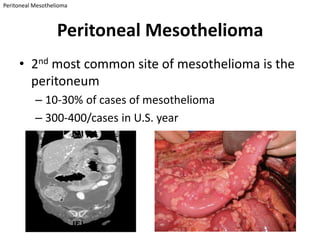
     • 2nd most common site of mesothelioma is the
       peritoneum
           – 10-30% of cases of mesothelioma
           – 300-400/cases in U.S. year
Peritoneal Mesothelioma


                          Background
     • Causes
           – Asbestos exposure
           – Simian virus-40
           – Radiation
           – Chronic inflammation of the peritoneum
     • Presentation
           – Increased abdominal girth
           – Ascites (fluid in the abdomen)
           – Abdominal pain
           – Weight loss
Peritoneal Mesothelioma


                          Treatment Options
     • “Traditional”
           – Chemotherapy (doxorubicin and cisplatin)
           – Radiation
           – Drainage of abdominal fluid to alleviate pressure
             (palliative paracentesis)
           – Surgical excision of some of the tumor to alleviate
             intestinal blockage (palliative debulking)
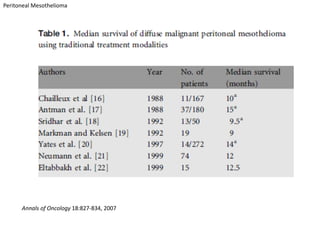
Peritoneal Mesothelioma


      Annals of Oncology 18:827-834, 2007
Peritoneal Mesothelioma


                          Surgical Options
     • Cytoreductive surgery (CRS) and perioperative
       intraperitoneal chemotherapy (IPC)
           – Surgical cytoreduction to eliminate visible disease
             by destroying tumor (burning/peeling/wiping) or
             removing organs
           – Delivery of chemotherapy directly to the
             peritoneal surfaces to eliminate microscopic
             disease
Peritoneal Mesothelioma


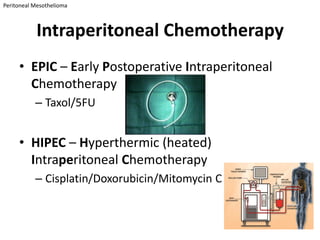
           Intraperitoneal Chemotherapy
     • EPIC – Early Postoperative Intraperitoneal
       Chemotherapy
           – Taxol/5FU


     • HIPEC – Hyperthermic (heated)
       Intraperitoneal Chemotherapy
           – Cisplatin/Doxorubicin/Mitomycin C
Peritoneal Mesothelioma


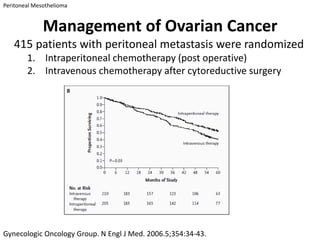
              Management of Ovarian Cancer
   415 patients with peritoneal metastasis were randomized
        1. Intraperitoneal chemotherapy (post operative)
        2. Intravenous chemotherapy after cytoreductive surgery


Gynecologic Oncology Group. N Engl J Med. 2006.5;354:34-43.
Peritoneal Mesothelioma


            Management of Colorectal Cancer
     105 patients with peritoneal metastasis were randomized
          1. Intravenous chemotherapy
          2. Cytoreductive surgery + intraperitoneal chemo + intravenous
             chemo


                                                    CRS + IPC + IVC


                                              IVC


Verwaal. J Clin Oncol. 2003;21(20):3737-43.
Peritoneal Mesothelioma


     • Review of cytoreductive surgery and IPC
     • 7 non randomized studies
     • 240 patients
Peritoneal Mesothelioma


    Inclusion Criteria                Exclusion Criteria
   • Histological diagnosis of      • Surgical debulking without IPC
      diffuse malignant peritoneal • Studies that mix in other
      mesothelioma (DMPM)              cancer types
   • Patients undergoing
      cytoreductive surgery (CRS) +
      intraperitoneal chemo (IPC)


Annals of Oncology 18:827-834, 2007
Peritoneal Mesothelioma


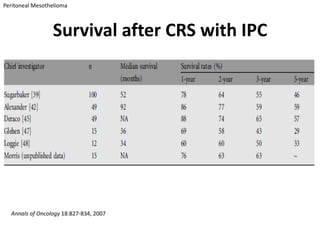
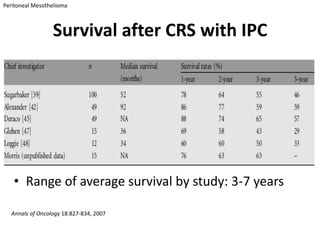
                 Survival after CRS with IPC


  Annals of Oncology 18:827-834, 2007
Peritoneal Mesothelioma


                 Survival after CRS with IPC


   • Range of average survival by study: 3-7 years

  Annals of Oncology 18:827-834, 2007
Peritoneal Mesothelioma


         Complications and Mortality after
          Cytoreductive Surgery and IPC
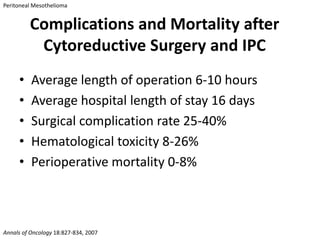
     •    Average length of operation 6-10 hours
     •    Average hospital length of stay 16 days
     •    Surgical complication rate 25-40%
     •    Hematological toxicity 8-26%
     •    Perioperative mortality 0-8%


Annals of Oncology 18:827-834, 2007
Peritoneal Mesothelioma


          How can we predict prognosis?
     • No widely accepted staging system for
       peritoneal mesothelioma
     • No information on National Cancer Institute
       website (cancer.gov)
Peritoneal Mesothelioma


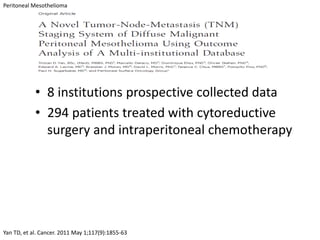
            • 8 institutions prospective collected data
            • 294 patients treated with cytoreductive
              surgery and intraperitoneal chemotherapy


Yan TD, et al. Cancer. 2011 May 1;117(9):1855-63
Peritoneal Mesothelioma


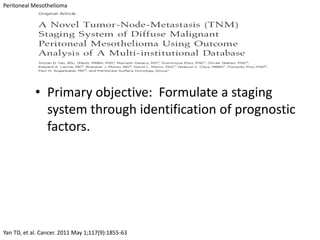
            • Primary objective: Formulate a staging
              system through identification of prognostic
              factors.


Yan TD, et al. Cancer. 2011 May 1;117(9):1855-63
Peritoneal Mesothelioma

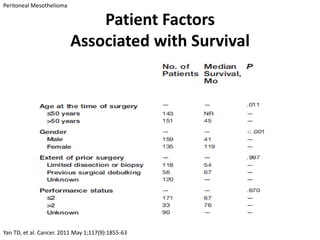
                              Patient Factors
                          Associated with Survival


Yan TD, et al. Cancer. 2011 May 1;117(9):1855-63
Peritoneal Mesothelioma

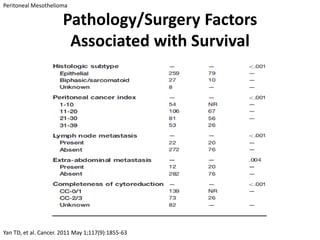
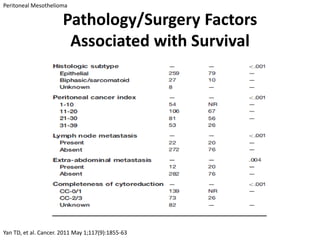
                       Pathology/Surgery Factors
                        Associated with Survival


Yan TD, et al. Cancer. 2011 May 1;117(9):1855-63
Peritoneal Mesothelioma

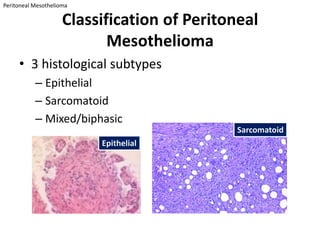
                     Classification of Peritoneal
                            Mesothelioma
     • 3 histological subtypes
           – Epithelial
           – Sarcomatoid
           – Mixed/biphasic
                                              Sarcomatoid
                          Epithelial
Peritoneal Mesothelioma

                       Pathology/Surgery Factors
                        Associated with Survival


Yan TD, et al. Cancer. 2011 May 1;117(9):1855-63
Peritoneal Mesothelioma


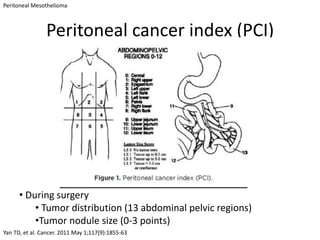
                Peritoneal cancer index (PCI)


      • During surgery
          • Tumor distribution (13 abdominal pelvic regions)
          •Tumor nodule size (0-3 points)
Yan TD, et al. Cancer. 2011 May 1;117(9):1855-63
Peritoneal Mesothelioma

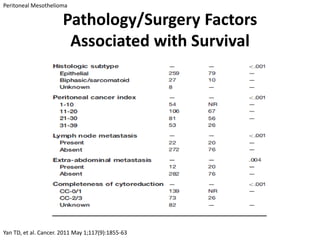
                       Pathology/Surgery Factors
                        Associated with Survival


Yan TD, et al. Cancer. 2011 May 1;117(9):1855-63
Peritoneal Mesothelioma


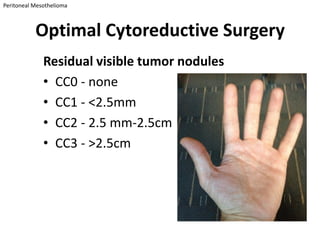
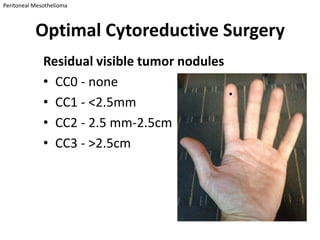
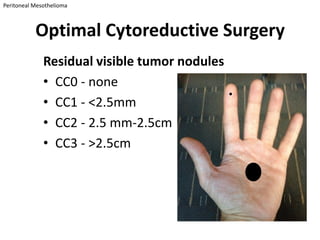
           Optimal Cytoreductive Surgery
              Residual visible tumor nodules
              • CC0 - none
              • CC1 - <2.5mm
              • CC2 - 2.5 mm-2.5cm
              • CC3 - >2.5cm
Peritoneal Mesothelioma


           Optimal Cytoreductive Surgery
              Residual visible tumor nodules
              • CC0 - none
              • CC1 - <2.5mm
              • CC2 - 2.5 mm-2.5cm
              • CC3 - >2.5cm
Peritoneal Mesothelioma


           Optimal Cytoreductive Surgery
              Residual visible tumor nodules
              • CC0 - none
              • CC1 - <2.5mm
              • CC2 - 2.5 mm-2.5cm
              • CC3 - >2.5cm
Peritoneal Mesothelioma


           Optimal Cytoreductive Surgery
              Residual visible tumor nodules
              • CC0 - none
              • CC1 - <2.5mm
              • CC2 - 2.5 mm-2.5cm
              • CC3 - >2.5cm
Peritoneal Mesothelioma


                          TNM staging system
     • Most common system used for staging cancer
     • T stage – size or depth of tumor (1-4)
     • N stage – presence of lymph nodes with cancer (0-2)
     • M stage – presence of metastasis to organs (0- 1)
Peritoneal Mesothelioma


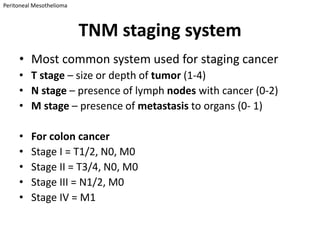
                          TNM staging system
     • Most common system used for staging cancer
     • T stage – size or depth of tumor (1-4)
     • N stage – presence of lymph nodes with cancer (0-2)
     • M stage – presence of metastasis to organs (0- 1)

     •    For colon cancer
     •    Stage I = T1/2, N0, M0
     •    Stage II = T3/4, N0, M0
     •    Stage III = N1/2, M0
     •    Stage IV = M1
Peritoneal Mesothelioma

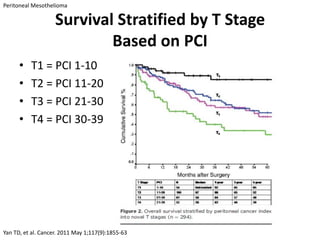
                    Survival Stratified by T Stage
                            Based on PCI
      •   T1 = PCI 1-10
      •   T2 = PCI 11-20
      •   T3 = PCI 21-30
      •   T4 = PCI 30-39


Yan TD, et al. Cancer. 2011 May 1;117(9):1855-63
Peritoneal Mesothelioma


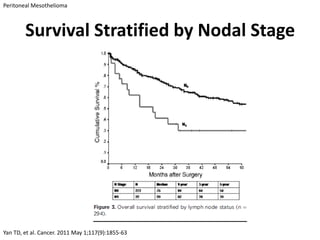
        Survival Stratified by Nodal Stage


Yan TD, et al. Cancer. 2011 May 1;117(9):1855-63
Peritoneal Mesothelioma


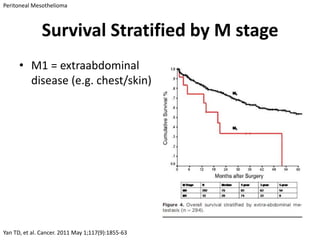
              Survival Stratified by M stage
      • M1 = extraabdominal
        disease (e.g. chest/skin)


Yan TD, et al. Cancer. 2011 May 1;117(9):1855-63
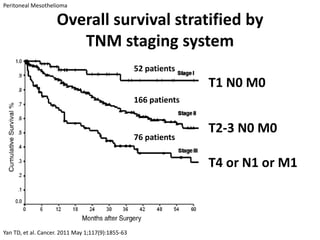
Peritoneal Mesothelioma

                    Overall survival stratified by
                       TNM staging system
                                                   52 patients
                                                                  T1 N0 M0
                                                   166 patients


                                                                  T2-3 N0 M0
                                                   76 patients


                                                                  T4 or N1 or M1


Yan TD, et al. Cancer. 2011 May 1;117(9):1855-63
Peritoneal Mesothelioma

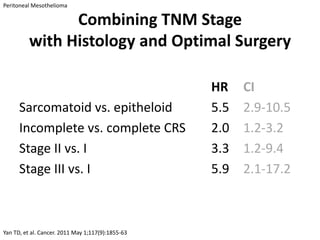
                Combining TNM Stage
          with Histology and Optimal Surgery

                                                   HR    CI
      Sarcomatoid vs. epitheloid                   5.5   2.9-10.5
      Incomplete vs. complete CRS                  2.0   1.2-3.2
      Stage II vs. I                               3.3   1.2-9.4
      Stage III vs. I                              5.9   2.1-17.2


Yan TD, et al. Cancer. 2011 May 1;117(9):1855-63
Peritoneal Mesothelioma


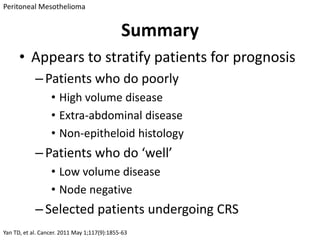
                                             Summary
      • Appears to stratify patients for prognosis
            – Patients who do poorly
                  • High volume disease
                  • Extra-abdominal disease
                  • Non-epitheloid histology
            – Patients who do ‘well’
                  • Low volume disease
                  • Node negative
            – Selected patients undergoing CRS
Yan TD, et al. Cancer. 2011 May 1;117(9):1855-63
Peritoneal Mesothelioma


                          Conclusions
    • Surgery offers good long term outcomes
      for selected patients with favorable
      tumors
    • Surgery is high risk
    • We need comparative studies that
      demonstrate how much surgery and
      intraperitoneal chemotherapy may
      benefit patients
Peritoneal Mesothelioma


                          Thank You
    • Mesothelioma Applied Research
      Foundation and Lee Krug, MD
Peritoneal Mesothelioma


                          Thank You
    • Mesothelioma Applied Research
      Foundation and Lee Krug, MD
    • My medical oncology collaborator,
      Andrea Cercek, MD
Peritoneal Mesothelioma


                          Thank You
    • Mesothelioma Applied Research
      Foundation and Lee Krug, MD
    • My medical oncology collaborator,
      Andrea Cercek, MD
    • The patients who allow us to study their
      tumors

Peritoneal Surgery and Intraperitoneal Chemotherapy | Mesothelioma Applied Research Foundation

  • 1.
    Peritoneal Mesothelioma Cytoreductive Surgery and Intraperitoneal Chemotherapy Garrett Nash MD, MPH Assistant Attending Surgeon Memorial Sloan-Kettering Cancer Center September 28th, 2012
  • 2.
    Peritoneal Mesothelioma About me • Training in Colorectal Surgery and Surgical Oncology • Peritoneal based diseases – Appendix Cancer – Metastatic Colorectal Cancer – Peritoneal Mesothelioma
  • 3.
    Peritoneal Mesothelioma Peritoneal Mesothelioma • What is the disease? • What are the surgical options? • What are the outcomes after surgery?
  • 4.
    Peritoneal Mesothelioma Peritoneal Mesothelioma • 2nd most common site of mesothelioma is the peritoneum – 10-30% of cases of mesothelioma – 300-400/cases in U.S. year
  • 5.
    Peritoneal Mesothelioma Background • Causes – Asbestos exposure – Simian virus-40 – Radiation – Chronic inflammation of the peritoneum • Presentation – Increased abdominal girth – Ascites (fluid in the abdomen) – Abdominal pain – Weight loss
  • 6.
    Peritoneal Mesothelioma Treatment Options • “Traditional” – Chemotherapy (doxorubicin and cisplatin) – Radiation – Drainage of abdominal fluid to alleviate pressure (palliative paracentesis) – Surgical excision of some of the tumor to alleviate intestinal blockage (palliative debulking)
  • 7.
    Peritoneal Mesothelioma Annals of Oncology 18:827-834, 2007
  • 8.
    Peritoneal Mesothelioma Surgical Options • Cytoreductive surgery (CRS) and perioperative intraperitoneal chemotherapy (IPC) – Surgical cytoreduction to eliminate visible disease by destroying tumor (burning/peeling/wiping) or removing organs – Delivery of chemotherapy directly to the peritoneal surfaces to eliminate microscopic disease
  • 9.
    Peritoneal Mesothelioma Intraperitoneal Chemotherapy • EPIC – Early Postoperative Intraperitoneal Chemotherapy – Taxol/5FU • HIPEC – Hyperthermic (heated) Intraperitoneal Chemotherapy – Cisplatin/Doxorubicin/Mitomycin C
  • 10.
    Peritoneal Mesothelioma Management of Ovarian Cancer 415 patients with peritoneal metastasis were randomized 1. Intraperitoneal chemotherapy (post operative) 2. Intravenous chemotherapy after cytoreductive surgery Gynecologic Oncology Group. N Engl J Med. 2006.5;354:34-43.
  • 11.
    Peritoneal Mesothelioma Management of Colorectal Cancer 105 patients with peritoneal metastasis were randomized 1. Intravenous chemotherapy 2. Cytoreductive surgery + intraperitoneal chemo + intravenous chemo CRS + IPC + IVC IVC Verwaal. J Clin Oncol. 2003;21(20):3737-43.
  • 12.
    Peritoneal Mesothelioma • Review of cytoreductive surgery and IPC • 7 non randomized studies • 240 patients
  • 13.
    Peritoneal Mesothelioma Inclusion Criteria Exclusion Criteria • Histological diagnosis of • Surgical debulking without IPC diffuse malignant peritoneal • Studies that mix in other mesothelioma (DMPM) cancer types • Patients undergoing cytoreductive surgery (CRS) + intraperitoneal chemo (IPC) Annals of Oncology 18:827-834, 2007
  • 14.
    Peritoneal Mesothelioma Survival after CRS with IPC Annals of Oncology 18:827-834, 2007
  • 15.
    Peritoneal Mesothelioma Survival after CRS with IPC • Range of average survival by study: 3-7 years Annals of Oncology 18:827-834, 2007
  • 16.
    Peritoneal Mesothelioma Complications and Mortality after Cytoreductive Surgery and IPC • Average length of operation 6-10 hours • Average hospital length of stay 16 days • Surgical complication rate 25-40% • Hematological toxicity 8-26% • Perioperative mortality 0-8% Annals of Oncology 18:827-834, 2007
  • 17.
    Peritoneal Mesothelioma How can we predict prognosis? • No widely accepted staging system for peritoneal mesothelioma • No information on National Cancer Institute website (cancer.gov)
  • 18.
    Peritoneal Mesothelioma • 8 institutions prospective collected data • 294 patients treated with cytoreductive surgery and intraperitoneal chemotherapy Yan TD, et al. Cancer. 2011 May 1;117(9):1855-63
  • 19.
    Peritoneal Mesothelioma • Primary objective: Formulate a staging system through identification of prognostic factors. Yan TD, et al. Cancer. 2011 May 1;117(9):1855-63
  • 20.
    Peritoneal Mesothelioma Patient Factors Associated with Survival Yan TD, et al. Cancer. 2011 May 1;117(9):1855-63
  • 21.
    Peritoneal Mesothelioma Pathology/Surgery Factors Associated with Survival Yan TD, et al. Cancer. 2011 May 1;117(9):1855-63
  • 22.
    Peritoneal Mesothelioma Classification of Peritoneal Mesothelioma • 3 histological subtypes – Epithelial – Sarcomatoid – Mixed/biphasic Sarcomatoid Epithelial
  • 23.
    Peritoneal Mesothelioma Pathology/Surgery Factors Associated with Survival Yan TD, et al. Cancer. 2011 May 1;117(9):1855-63
  • 24.
    Peritoneal Mesothelioma Peritoneal cancer index (PCI) • During surgery • Tumor distribution (13 abdominal pelvic regions) •Tumor nodule size (0-3 points) Yan TD, et al. Cancer. 2011 May 1;117(9):1855-63
  • 25.
    Peritoneal Mesothelioma Pathology/Surgery Factors Associated with Survival Yan TD, et al. Cancer. 2011 May 1;117(9):1855-63
  • 26.
    Peritoneal Mesothelioma Optimal Cytoreductive Surgery Residual visible tumor nodules • CC0 - none • CC1 - <2.5mm • CC2 - 2.5 mm-2.5cm • CC3 - >2.5cm
  • 27.
    Peritoneal Mesothelioma Optimal Cytoreductive Surgery Residual visible tumor nodules • CC0 - none • CC1 - <2.5mm • CC2 - 2.5 mm-2.5cm • CC3 - >2.5cm
  • 28.
    Peritoneal Mesothelioma Optimal Cytoreductive Surgery Residual visible tumor nodules • CC0 - none • CC1 - <2.5mm • CC2 - 2.5 mm-2.5cm • CC3 - >2.5cm
  • 29.
    Peritoneal Mesothelioma Optimal Cytoreductive Surgery Residual visible tumor nodules • CC0 - none • CC1 - <2.5mm • CC2 - 2.5 mm-2.5cm • CC3 - >2.5cm
  • 30.
    Peritoneal Mesothelioma TNM staging system • Most common system used for staging cancer • T stage – size or depth of tumor (1-4) • N stage – presence of lymph nodes with cancer (0-2) • M stage – presence of metastasis to organs (0- 1)
  • 31.
    Peritoneal Mesothelioma TNM staging system • Most common system used for staging cancer • T stage – size or depth of tumor (1-4) • N stage – presence of lymph nodes with cancer (0-2) • M stage – presence of metastasis to organs (0- 1) • For colon cancer • Stage I = T1/2, N0, M0 • Stage II = T3/4, N0, M0 • Stage III = N1/2, M0 • Stage IV = M1
  • 32.
    Peritoneal Mesothelioma Survival Stratified by T Stage Based on PCI • T1 = PCI 1-10 • T2 = PCI 11-20 • T3 = PCI 21-30 • T4 = PCI 30-39 Yan TD, et al. Cancer. 2011 May 1;117(9):1855-63
  • 33.
    Peritoneal Mesothelioma Survival Stratified by Nodal Stage Yan TD, et al. Cancer. 2011 May 1;117(9):1855-63
  • 34.
    Peritoneal Mesothelioma Survival Stratified by M stage • M1 = extraabdominal disease (e.g. chest/skin) Yan TD, et al. Cancer. 2011 May 1;117(9):1855-63
  • 35.
    Peritoneal Mesothelioma Overall survival stratified by TNM staging system 52 patients T1 N0 M0 166 patients T2-3 N0 M0 76 patients T4 or N1 or M1 Yan TD, et al. Cancer. 2011 May 1;117(9):1855-63
  • 36.
    Peritoneal Mesothelioma Combining TNM Stage with Histology and Optimal Surgery HR CI Sarcomatoid vs. epitheloid 5.5 2.9-10.5 Incomplete vs. complete CRS 2.0 1.2-3.2 Stage II vs. I 3.3 1.2-9.4 Stage III vs. I 5.9 2.1-17.2 Yan TD, et al. Cancer. 2011 May 1;117(9):1855-63
  • 37.
    Peritoneal Mesothelioma Summary • Appears to stratify patients for prognosis – Patients who do poorly • High volume disease • Extra-abdominal disease • Non-epitheloid histology – Patients who do ‘well’ • Low volume disease • Node negative – Selected patients undergoing CRS Yan TD, et al. Cancer. 2011 May 1;117(9):1855-63
  • 38.
    Peritoneal Mesothelioma Conclusions • Surgery offers good long term outcomes for selected patients with favorable tumors • Surgery is high risk • We need comparative studies that demonstrate how much surgery and intraperitoneal chemotherapy may benefit patients
  • 39.
    Peritoneal Mesothelioma Thank You • Mesothelioma Applied Research Foundation and Lee Krug, MD
  • 40.
    Peritoneal Mesothelioma Thank You • Mesothelioma Applied Research Foundation and Lee Krug, MD • My medical oncology collaborator, Andrea Cercek, MD
  • 41.
    Peritoneal Mesothelioma Thank You • Mesothelioma Applied Research Foundation and Lee Krug, MD • My medical oncology collaborator, Andrea Cercek, MD • The patients who allow us to study their tumors