Game Theory Bayesian Games at HelpWithAssignment.comwww.HelpWithAssignment.com
In games of complete information, the players know not only their own preferences, but also the preferences of other players as well. In many situations of economic interest, however, there is likely to be considerable uncertainty on the part of each player regarding the preferences of his or her opponents. Game Theory Bayesian Gameswww.HelpWithAssignment.com
To incorporate this possibility, we introduce Bayesian Games, or games of incomplete information. Complete games are characterized by three things: players, actions and payoffs. Bayesian Games build on the static games of complete information. Game Theory Bayesian Gameswww.HelpWithAssignment.com
In Bayesian Games, each player can be one of a certain number of types. Each player knows his or her own type, but cannot observe the type of the other players directly. From the perspective of a given player the others’ types are random draws from some given prior distribution. Game Theory Bayesian Gameswww.HelpWithAssignment.com
The type of a player influences that player in two ways. First, the player’s payoff in the game can depend on both the actions chosen, and on the types of all players. Thus, the combination of types influences each player’s payoff. Game Theory Bayesian Gameswww.HelpWithAssignment.com
Second, each type of each player has its own set of possible actions in the game, but we frequently assume that the set of possible actions does not depend on the type of player. Given his type, each player in the game selects an action from those available.Game Theory Bayesian Gameswww.HelpWithAssignment.com
Similar to dynamic games, in Bayesian Games a strategy for each player is a plan which specifies an action for each possible type. Knowing another player’s strategy in a Bayesian Game does not yet allow a player to predict the other’s action for certain, because other players’ type is unknown.Game Theory Bayesian Gameswww.HelpWithAssignment.com
However, given the other player’s strategy and the player’s prior distribution each player can figure out his or her expected payoff from the actions that are available to him or her. Game Theory Bayesian Gameswww.HelpWithAssignment.com
Of the actions available, each player will choose some particular action. Therefore, given his or her type, the strategy of each player and the prior distribution, each player can figure out his or her expected payoff from the actions that are available to him or her. Game Theory Bayesian Gameswww.HelpWithAssignment.com
Of the actions available, each player can therefore figure out a best possible action or actions for each of his or her own types. The best possible action for each of his or her types is a player’s best responses to each other then the strategies constitute a Bayesian Nash Equilibrium. Game Theory Bayesian Gameswww.HelpWithAssignment.com
An Example of Bayesian Game: Take It Or Leave It OfferAs in the standard Take it or leave it offer game, there are two players: a buyer and a seller. Each player’s type is his value for the good, vB; vS.Take It Or Leave It Offerwww.HelpWithAssignment.com
Both values are independent draws form a uniform distribution on [0; 1] ;so that Pr (vi ≤ x) = x. The buyer is given the opportunity to make a take it or leave it offer to the seller of a price p at which he or she will be willing to buy the good. Take It Or Leave It Offerwww.HelpWithAssignment.com
If the price exceeds the seller’s value, then the seller accepts, if it isn’t the seller rejects the proposal. What price will the buyer choose? Given his or her value vB the buyer selects her price to maximize her expected payoffTake It Or Leave It Offerwww.HelpWithAssignment.com
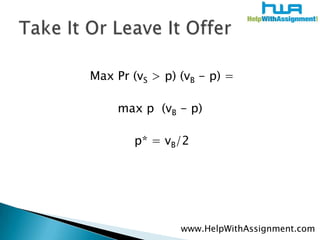
Max Pr (vS > p) (vB - p) =max p  (vB - p) p* = vB/2Take It Or Leave It Offerwww.HelpWithAssignment.com
Thus the buyer "shades" her bid by half in order to trade o¤ the chance that her offer is rejected with her payoff if it is accepted. This leads to a outcomes that can be bad socially. Take It Or Leave It Offerwww.HelpWithAssignment.com
If the seller’s value were known, whenever the buyer’s value was larger the parties would transact.Thus the party who values the good most would always receive it and the collective payoff is as large as possible. Take It Or Leave It Offerwww.HelpWithAssignment.com
When the seller’s value is unknown, the buyer shades his bid, so in order for trade to occur, the buyer’s value has to be larger than twice the seller’s value, which occurs less often. Thus, because a value is private, it is more difficult to trade and the collective good is harmed.Take It Or Leave It Offerwww.HelpWithAssignment.com
For more details you can visit our website at  http://www.helpwithassignment.com/economics-assignment-help  and  http://www.helpwiththesis.comThank Youwww.HelpWithAssignment.comwww.HelpWithAssignment.com

Game theory Bayesian Games at HelpWithAssignment.com

  • 1.
    Game Theory BayesianGames at HelpWithAssignment.comwww.HelpWithAssignment.com
  • 2.
    In games ofcomplete information, the players know not only their own preferences, but also the preferences of other players as well. In many situations of economic interest, however, there is likely to be considerable uncertainty on the part of each player regarding the preferences of his or her opponents. Game Theory Bayesian Gameswww.HelpWithAssignment.com
  • 3.
    To incorporate thispossibility, we introduce Bayesian Games, or games of incomplete information. Complete games are characterized by three things: players, actions and payoffs. Bayesian Games build on the static games of complete information. Game Theory Bayesian Gameswww.HelpWithAssignment.com
  • 4.
    In Bayesian Games,each player can be one of a certain number of types. Each player knows his or her own type, but cannot observe the type of the other players directly. From the perspective of a given player the others’ types are random draws from some given prior distribution. Game Theory Bayesian Gameswww.HelpWithAssignment.com
  • 5.
    The type ofa player influences that player in two ways. First, the player’s payoff in the game can depend on both the actions chosen, and on the types of all players. Thus, the combination of types influences each player’s payoff. Game Theory Bayesian Gameswww.HelpWithAssignment.com
  • 6.
    Second, each typeof each player has its own set of possible actions in the game, but we frequently assume that the set of possible actions does not depend on the type of player. Given his type, each player in the game selects an action from those available.Game Theory Bayesian Gameswww.HelpWithAssignment.com
  • 7.
    Similar to dynamicgames, in Bayesian Games a strategy for each player is a plan which specifies an action for each possible type. Knowing another player’s strategy in a Bayesian Game does not yet allow a player to predict the other’s action for certain, because other players’ type is unknown.Game Theory Bayesian Gameswww.HelpWithAssignment.com
  • 8.
    However, given theother player’s strategy and the player’s prior distribution each player can figure out his or her expected payoff from the actions that are available to him or her. Game Theory Bayesian Gameswww.HelpWithAssignment.com
  • 9.
    Of the actionsavailable, each player will choose some particular action. Therefore, given his or her type, the strategy of each player and the prior distribution, each player can figure out his or her expected payoff from the actions that are available to him or her. Game Theory Bayesian Gameswww.HelpWithAssignment.com
  • 10.
    Of the actionsavailable, each player can therefore figure out a best possible action or actions for each of his or her own types. The best possible action for each of his or her types is a player’s best responses to each other then the strategies constitute a Bayesian Nash Equilibrium. Game Theory Bayesian Gameswww.HelpWithAssignment.com
  • 11.
    An Example ofBayesian Game: Take It Or Leave It OfferAs in the standard Take it or leave it offer game, there are two players: a buyer and a seller. Each player’s type is his value for the good, vB; vS.Take It Or Leave It Offerwww.HelpWithAssignment.com
  • 12.
    Both values areindependent draws form a uniform distribution on [0; 1] ;so that Pr (vi ≤ x) = x. The buyer is given the opportunity to make a take it or leave it offer to the seller of a price p at which he or she will be willing to buy the good. Take It Or Leave It Offerwww.HelpWithAssignment.com
  • 13.
    If the priceexceeds the seller’s value, then the seller accepts, if it isn’t the seller rejects the proposal. What price will the buyer choose? Given his or her value vB the buyer selects her price to maximize her expected payoffTake It Or Leave It Offerwww.HelpWithAssignment.com
  • 14.
    Max Pr (vS> p) (vB - p) =max p (vB - p) p* = vB/2Take It Or Leave It Offerwww.HelpWithAssignment.com
  • 15.
    Thus the buyer"shades" her bid by half in order to trade o¤ the chance that her offer is rejected with her payoff if it is accepted. This leads to a outcomes that can be bad socially. Take It Or Leave It Offerwww.HelpWithAssignment.com
  • 16.
    If the seller’svalue were known, whenever the buyer’s value was larger the parties would transact.Thus the party who values the good most would always receive it and the collective payoff is as large as possible. Take It Or Leave It Offerwww.HelpWithAssignment.com
  • 17.
    When the seller’svalue is unknown, the buyer shades his bid, so in order for trade to occur, the buyer’s value has to be larger than twice the seller’s value, which occurs less often. Thus, because a value is private, it is more difficult to trade and the collective good is harmed.Take It Or Leave It Offerwww.HelpWithAssignment.com
  • 18.
    For more detailsyou can visit our website at http://www.helpwithassignment.com/economics-assignment-help and http://www.helpwiththesis.comThank Youwww.HelpWithAssignment.comwww.HelpWithAssignment.com