Grade 2 Mathematics Unit Preview
           Quarter 1: Number Relationships and Computation (Place Value)

 Objectives: (Your student will be able to)
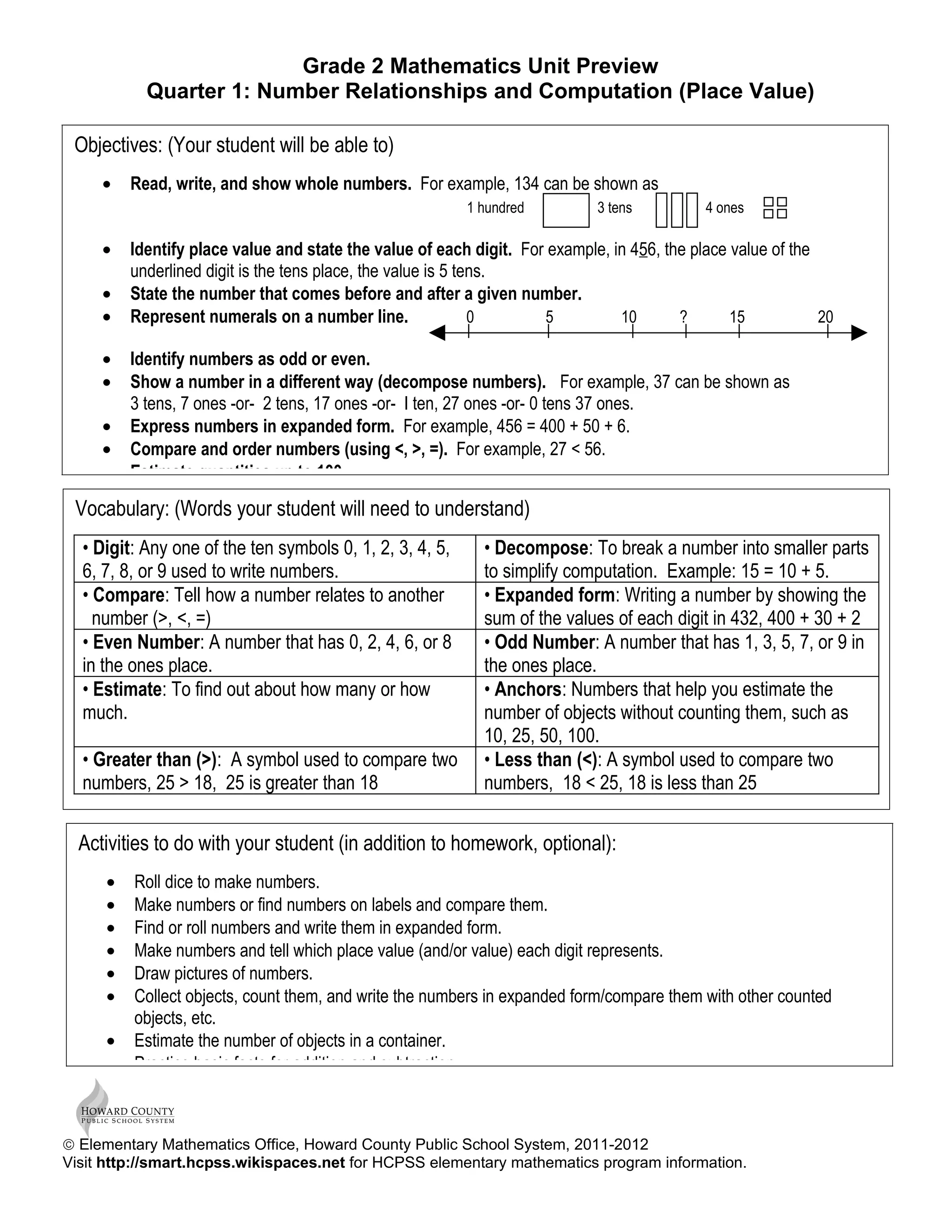
     •   Read, write, and show whole numbers. For example, 134 can be shown as
                                                          1 hundred         3 tens          4 ones

     •   Identify place value and state the value of each digit. For example, in 456, the place value of the
         underlined digit is the tens place, the value is 5 tens.
     •   State the number that comes before and after a given number.
     •   Represent numerals on a number line.                 0     5          10       ?       15           20

     •   Identify numbers as odd or even.
     •   Show a number in a different way (decompose numbers). For example, 37 can be shown as
         3 tens, 7 ones -or- 2 tens, 17 ones -or- I ten, 27 ones -or- 0 tens 37 ones.
     •   Express numbers in expanded form. For example, 456 = 400 + 50 + 6.
     •   Compare and order numbers (using <, >, =). For example, 27 < 56.
     •   Estimate quantities up to 100.

 Vocabulary: (Words your student will need to understand)
  • Digit: Any one of the ten symbols 0, 1, 2, 3, 4, 5,     • Decompose: To break a number into smaller parts
  6, 7, 8, or 9 used to write numbers.                      to simplify computation. Example: 15 = 10 + 5.
  • Compare: Tell how a number relates to another           • Expanded form: Writing a number by showing the
    number (>, <, =)                                        sum of the values of each digit in 432, 400 + 30 + 2
  • Even Number: A number that has 0, 2, 4, 6, or 8         • Odd Number: A number that has 1, 3, 5, 7, or 9 in
  in the ones place.                                        the ones place.
  • Estimate: To find out about how many or how             • Anchors: Numbers that help you estimate the
  much.                                                     number of objects without counting them, such as
                                                            10, 25, 50, 100.
  • Greater than (>): A symbol used to compare two          • Less than (<): A symbol used to compare two
  numbers, 25 > 18, 25 is greater than 18                   numbers, 18 < 25, 18 is less than 25


  Activities to do with your student (in addition to homework, optional):
     •   Roll dice to make numbers.
     •   Make numbers or find numbers on labels and compare them.
     •   Find or roll numbers and write them in expanded form.
     •   Make numbers and tell which place value (and/or value) each digit represents.
     •   Draw pictures of numbers.
     •   Collect objects, count them, and write the numbers in expanded form/compare them with other counted
         objects, etc.
     •   Estimate the number of objects in a container.
     •   Practice basic facts for addition and subtraction.


© Elementary Mathematics Office, Howard County Public School System, 2011-2012
Visit http://smart.hcpss.wikispaces.net for HCPSS elementary mathematics program information.

G2 q1numrelplacevaluepreview

  • 1.
    Grade 2 MathematicsUnit Preview Quarter 1: Number Relationships and Computation (Place Value) Objectives: (Your student will be able to) • Read, write, and show whole numbers. For example, 134 can be shown as 1 hundred 3 tens 4 ones • Identify place value and state the value of each digit. For example, in 456, the place value of the underlined digit is the tens place, the value is 5 tens. • State the number that comes before and after a given number. • Represent numerals on a number line. 0 5 10 ? 15 20 • Identify numbers as odd or even. • Show a number in a different way (decompose numbers). For example, 37 can be shown as 3 tens, 7 ones -or- 2 tens, 17 ones -or- I ten, 27 ones -or- 0 tens 37 ones. • Express numbers in expanded form. For example, 456 = 400 + 50 + 6. • Compare and order numbers (using <, >, =). For example, 27 < 56. • Estimate quantities up to 100. Vocabulary: (Words your student will need to understand) • Digit: Any one of the ten symbols 0, 1, 2, 3, 4, 5, • Decompose: To break a number into smaller parts 6, 7, 8, or 9 used to write numbers. to simplify computation. Example: 15 = 10 + 5. • Compare: Tell how a number relates to another • Expanded form: Writing a number by showing the number (>, <, =) sum of the values of each digit in 432, 400 + 30 + 2 • Even Number: A number that has 0, 2, 4, 6, or 8 • Odd Number: A number that has 1, 3, 5, 7, or 9 in in the ones place. the ones place. • Estimate: To find out about how many or how • Anchors: Numbers that help you estimate the much. number of objects without counting them, such as 10, 25, 50, 100. • Greater than (>): A symbol used to compare two • Less than (<): A symbol used to compare two numbers, 25 > 18, 25 is greater than 18 numbers, 18 < 25, 18 is less than 25 Activities to do with your student (in addition to homework, optional): • Roll dice to make numbers. • Make numbers or find numbers on labels and compare them. • Find or roll numbers and write them in expanded form. • Make numbers and tell which place value (and/or value) each digit represents. • Draw pictures of numbers. • Collect objects, count them, and write the numbers in expanded form/compare them with other counted objects, etc. • Estimate the number of objects in a container. • Practice basic facts for addition and subtraction. © Elementary Mathematics Office, Howard County Public School System, 2011-2012 Visit http://smart.hcpss.wikispaces.net for HCPSS elementary mathematics program information.