


Fuzzy	Self-Learning	Controllers	for	Elasticity	
Management	in	Dynamic	Cloud	Architectures
Pooyan Jamshidi
Imperial College London
p.jamshidi@imperial.ac.uk
Invited talk at Sharif University of Technology
12 April 2016
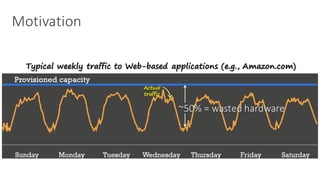
Motivation
~50%	=	wasted	hardware
Actual
traffic
Typical weekly traffic to Web-based applications (e.g., Amazon.com)
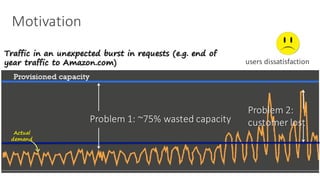
Motivation
Problem	1:	~75%	wasted	capacity
Actual
demand
Problem	2:	
customer	lost
Traffic in an unexpected burst in requests (e.g. end of
year traffic to Amazon.com)
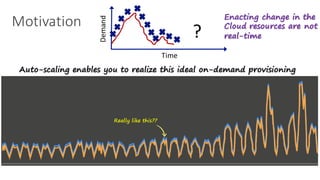
Motivation
Really like this??
Auto-scaling enables you to realize this ideal on-demand provisioning
Time
Demand
?
Enacting change in the
Cloud resources are not
real-time
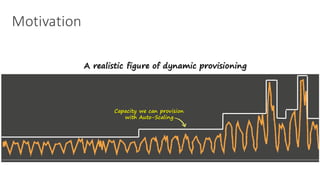
Motivation
Capacity we can provision
with Auto-Scaling
A realistic figure of dynamic provisioning
Research	Challenges
• Challenge 1.	Parameters’	value	prediction	ahead	of	time.	
• Challenge	2.	Qualitative	specification	of	thresholds.
• Challenge	3.	Robust	control	of	uncertainty	in	measurement	data.
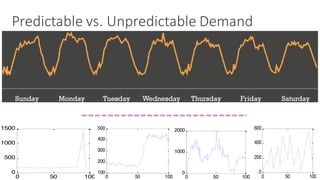
Predictable	vs.	Unpredictable	Demand
0 50 100
0
500
1000
1500
0 50 100
100
200
300
400
500
0 50 100
0
1000
2000
0 50 100
0
200
400
600
Research	Challenges
• Challenge 1.	Parameters’	value	prediction	ahead	of	time.	
• Challenge	2.	Qualitative	specification	of	thresholds.
• Challenge	3.	Robust	control	of	uncertainty	in	measurement	data.
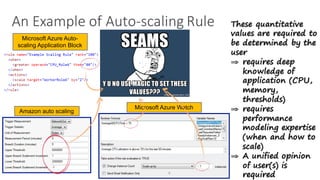
An	Example	of	Auto-scaling	Rule These quantitative
values are required to
be determined by the
user
Þ requires deep
knowledge of
application (CPU,
memory,
thresholds)
Þ requires
performance
modeling expertise
(when and how to
scale)
Þ A unified opinion
of user(s) is
required
Amazon auto scaling
Microsoft Azure Watch
9
Microsoft Azure Auto-
scaling Application Block
Research	Challenges
• Challenge 1.	Parameters’	value	prediction	ahead	of	time.	
• Challenge	2.	Qualitative	specification	of	thresholds.
• Challenge	3.	Robust	control	of	uncertainty	in	measurement	data.
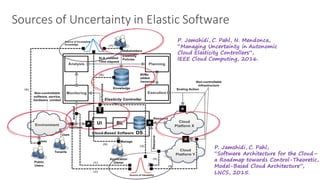
Sources	of	Uncertainty	in	Elastic	Software
P. Jamshidi, C. Pahl, N. Mendonca,
“Managing Uncertainty in Autonomic
Cloud Elasticity Controllers”,
IEEE Cloud Computing, 2016.
P. Jamshidi, C. Pahl,
“Software Architecture for the Cloud–
a Roadmap towards Control-Theoretic,
Model-Based Cloud Architecture”,
LNCS, 2015.
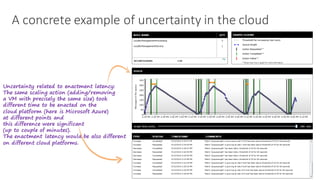
A	concrete	example	of	uncertainty	in	the	cloud
Uncertainty related to enactment latency:
The same scaling action (adding/removing
a VM with precisely the same size) took
different time to be enacted on the
cloud platform (here is Microsoft Azure)
at different points and
this difference were significant
(up to couple of minutes).
The enactment latency would be also different
on different cloud platforms.
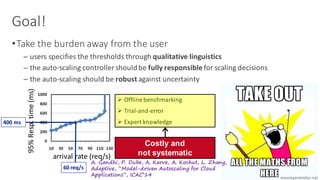
Goal!
•Take	the	burden	away	from	the	user
─ users	specifies	the	thresholds	through	qualitative	linguistics
─ the	auto-scaling	controller	should	be	fully	responsible	for	scaling	decisions
─ the	auto-scaling	should	be	robust against	uncertainty
Ø Offline	benchmarking
Ø Trial-and-error
Ø Expert	knowledge
Costly and
not systematic
A. Gandhi, P. Dube, A. Karve, A. Kochut, L. Zhang,
Adaptive, “Model-driven Autoscaling for Cloud
Applications”, ICAC’14
arrival	rate	(req/s)
95%	Resp.	time	(ms)
400	ms	
60	req/s
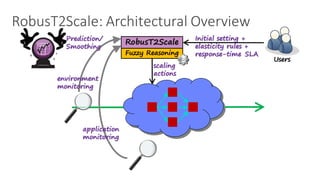
RobusT2Scale:	Architectural	Overview
RobusT2Scale
Initial setting +
elasticity rules +
response-time SLA
environment
monitoring
application
monitoring
scaling
actions
Fuzzy Reasoning
Users
Prediction/
Smoothing
Internal	Details	of	RobusT2Scale
Code:	https://github.com/pooyanjamshidi/RobusT2Scale
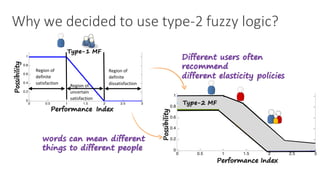
Why	we	decided	to	use	type-2	fuzzy	logic?
	 	 	0 0.5 1 1.5 2 2.5 3
0
0.2
0.4
0.6
0.8
1
1.2
1.4
1.6
1.8
2
Region	of	
definite	
satisfaction	
Region	of	
definite	
dissatisfaction	Region	of	
uncertain	
satisfaction	
Performance Index
Possibility
Performance Index
Possibility
words can mean different
things to different people
Different users often
recommend
different elasticity policies
0 0.5 1 1.5 2 2.5 3
0
0.2
0.4
0.6
0.8
1
1.2
1.4
1.6
1.8
2
Type-2 MF
Type-1 MF
How	we	designed	the	fuzzy	controller?
- The	fuzzy	logic	controller	is	completely	defined	by	its	
“membership	functions”	and	“fuzzy	rules”.
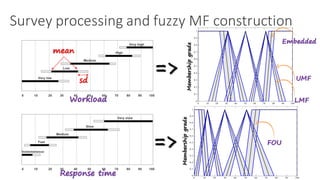
- Knowledge	elicitation	through	a	survey of	10 experts.
Survey	processing	and	fuzzy	MF	construction
Workload
Response time
0 10 20 30 40 50 60 70 80 90 100
0
0.1
0.2
0.3
0.4
0.5
0.6
0.7
0.8
0.9
1
x2
uMembershipgrade
0 10 20 30 40 50 60 70 80 90 100
0
0.1
0.2
0.3
0.4
0.5
0.6
0.7
0.8
0.9
1
uMembershipgrade
=>
=>
UMF
LMF
Embedded
FOU
mean
sd
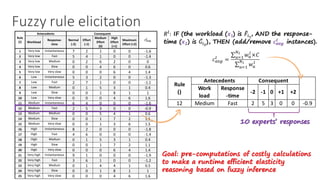
Fuzzy	rule	elicitation
Rule	
(𝒍)	
Antecedents	 Consequent	
𝒄 𝒂𝒗𝒈
𝒍 	
Workload	
Response-
time	
Normal	
(-2)	
Effort	
(-1)	
Medium	
Effort	
(0)	
High	
Effort	
(+1)	
Maximum	
Effort	(+2)	
1	 Very	low	 Instantaneous	 7	 2	 1	 0	 0	 -1.6	
2	 Very	low	 Fast	 5	 4	 1	 0	 0	 -1.4	
3	 Very	low	 Medium	 0	 2	 6	 2	 0	 0	
4	 Very	low	 Slow	 0	 0	 4	 6	 0	 0.6	
5	 Very	low	 Very	slow	 0	 0	 0	 6	 4	 1.4	
6	 Low	 Instantaneous	 5	 3	 2	 0	 0	 -1.3	
7	 Low	 Fast	 2	 7	 1	 0	 0	 -1.1	
8	 Low	 Medium	 0	 1	 5	 3	 1	 0.4	
9	 Low	 Slow	 0	 0	 1	 8	 1	 1	
10	 Low	 Very	slow	 0	 0	 0	 4	 6	 1.6	
11	 Medium	 Instantaneous	 6	 4	 0	 0	 0	 -1.6	
12	 Medium	 Fast	 2	 5	 3	 0	 0	 -0.9	
13	 Medium	 Medium	 0	 0	 5	 4	 1	 0.6	
14	 Medium	 Slow	 0	 0	 1	 7	 2	 1.1	
15	 Medium	 Very	slow	 0	 0	 1	 3	 6	 1.5	
16	 High	 Instantaneous	 8	 2	 0	 0	 0	 -1.8	
17	 High	 Fast	 4	 6	 0	 0	 0	 -1.4	
18	 High	 Medium	 0	 1	 5	 3	 1	 0.4	
19	 High	 Slow	 0	 0	 1	 7	 2	 1.1	
20	 High	 Very	slow	 0	 0	 0	 6	 4	 1.4	
21	 Very	high	 Instantaneous	 9	 1	 0	 0	 0	 -1.9	
22	 Very	high	 Fast	 3	 6	 1	 0	 0	 -1.2	
23	 Very	high	 Medium	 0	 1	 4	 4	 1	 0.5	
24	 Very	high	 Slow	 0	 0	 1	 8	 1	 1	
25	 Very	high	 Very	slow	 0	 0	 0	 4	 6	 1.6	
Rule	
()
Antecedents Consequent
Work
load
Response
-time
-2 -1 0 +1 +2
12 Medium Fast 2 5 3 0 0 -0.9
10 experts’ responses
𝑅"
: IF (the workload (𝑥%) is 𝐹'()
, AND the response-
time (𝑥*) is 𝐺'(,
), THEN (add/remove 𝑐./0
"
instances).
𝑐./0
"
=
∑ 𝑤4
"
×𝐶
78
49%
∑ 𝑤4
"78
49%
Goal: pre-computations of costly calculations
to make a runtime efficient elasticity
reasoning based on fuzzy inference
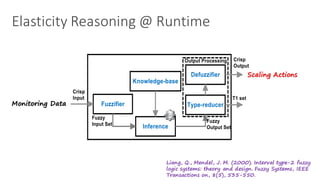
Elasticity	Reasoning	@	Runtime
Liang, Q., Mendel, J. M. (2000). Interval type-2 fuzzy
logic systems: theory and design. Fuzzy Systems, IEEE
Transactions on, 8(5), 535-550.
Scaling Actions
Monitoring Data
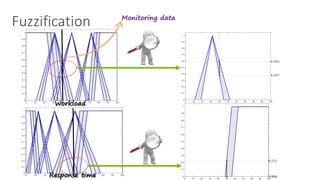
Fuzzification
0 10 20 30 40 50 60 70 80 90 100
0
0.1
0.2
0.3
0.4
0.5
0.6
0.7
0.8
0.9
1
0.5954
0.3797
𝑀
0 10 20 30 40 50 60 70 80 90 100
0
0.1
0.2
0.3
0.4
0.5
0.6
0.7
0.8
0.9
1
0.2212
0.0000
0 10 20 30 40 50 60 70 80 90 100
0
0.1
0.2
0.3
0.4
0.5
0.6
0.7
0.8
0.9
1
x2
u
0 10 20 30 40 50 60 70 80 90 100
0
0.1
0.2
0.3
0.4
0.5
0.6
0.7
0.8
0.9
1
u Monitoring data
Workload
Response time
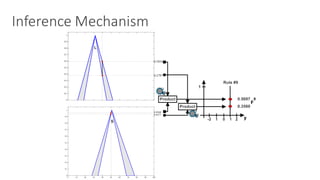
Inference	Mechanism
0 10 20 30 40 50 60 70 80 90 100
0
0.1
0.2
0.3
0.4
0.5
0.6
0.7
0.8
0.9
1
0.5954
0.3797
0 10 20 30 40 50 60 70 80 90 100
0
0.1
0.2
0.3
0.4
0.5
0.6
0.7
0.8
0.9
1
0.9568
0.9377
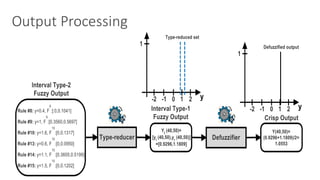
Output	Processing
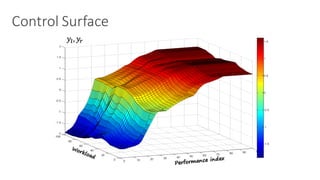
Control	Surface
𝑦", 𝑦=
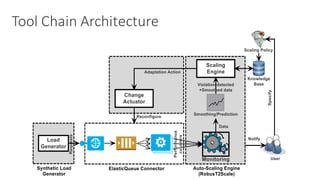
Tool	Chain	Architecture
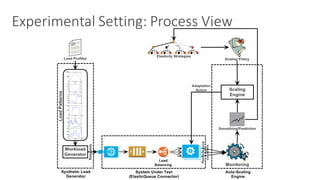
Experimental	Setting:	Process	View
0 50 100
0
500
1000
1500
0 50 100
100
200
300
400
500
0 50 100
0
1000
2000
0 50 100
0
200
400
600
0 50 100
0
500
1000
0 50 100
0
500
1000
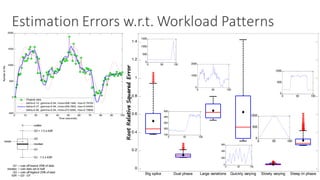
Estimation	Errors	w.r.t.	Workload	Patterns
0 10 20 30 40 50 60 70 80 90 100
-500
0
500
1000
1500
2000
Time (seconds)
Numberofhits
Original data
betta=0.10, gamma=0.94, rmse=308.1565, rrse=0.79703
betta=0.27, gamma=0.94, rmse=209.7852, rrse=0.54504
betta=0.80, gamma=0.94, rmse=272.6285, rrse=0.70858
0
0.2
0.4
0.6
0.8
1
1.2
1.4
Big spike Dual phase Large variations Quickly varying Slowly varying Steep tri phase
0 50 100
0
500
1000
1500
0 50 100
100
200
300
400
500
0 50 100
0
1000
2000
0 50 100
0
200
400
600
0 50 100
0
500
1000
0 50 100
0
500
1000
RootRelativeSquaredError
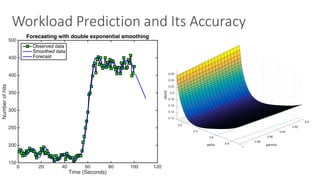
Workload	Prediction	and	Its	Accuracy
0 20 40 60 80 100 120
Time (Seconds)
150
200
250
300
350
400
450
500
Numberofhits
Forecasting with double exponential smoothing
Observed data
Smoothed data
Forecast
0.12
0.9
0.14
0.2
0.16
0.92
0.18
0.4 0.94
0.2
alpha gamma
Root mean squared error versus alpha
RMSE
0.22
0.960.6
0.24
0.98
0.26
0.8
1
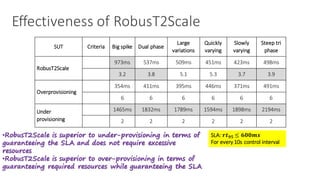
Effectiveness	of	RobusT2Scale
SUT Criteria Big	spike Dual	phase
Large	
variations
Quickly	
varying
Slowly	
varying
Steep	tri	
phase
RobusT2Scale
973ms 537ms 509ms 451ms 423ms 498ms
3.2 3.8 5.1 5.3 3.7 3.9
Overprovisioning
354ms 411ms 395ms 446ms 371ms 491ms
6 6 6 6 6 6
Under	
provisioning
1465ms 1832ms 1789ms 1594ms 1898ms 2194ms
2 2 2 2 2 2
SLA:	 𝒓𝒕 𝟗𝟓 ≤ 𝟔𝟎𝟎𝒎𝒔
For	every	10s	control	interval
•RobusT2Scale is superior to under-provisioning in terms of
guaranteeing the SLA and does not require excessive
resources
•RobusT2Scale is superior to over-provisioning in terms of
guaranteeing required resources while guaranteeing the SLA
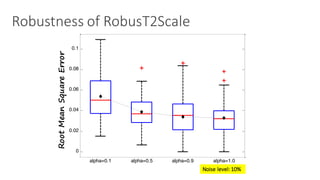
Robustness	of	RobusT2Scale
0
0.02
0.04
0.06
0.08
0.1
alpha=0.1 alpha=0.5 alpha=0.9 alpha=1.0
RootMeanSquareError
Noise	level:	10%
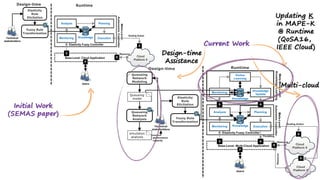
Self-Learning	Controller
Initial Work
(SEMAS paper)
Current Work
Updating K
in MAPE-K
@ Runtime
(QoSA16,
IEEE Cloud)
Design-time
Assistance
Multi-cloud
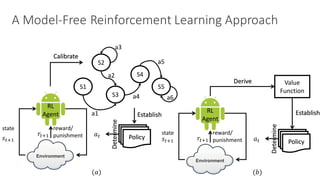
A	Model-Free	Reinforcement	Learning	Approach
S1
S2
S3
S4
S5
a1
a2
a3
a4
a5
a6
Environment
RL
Agent
!"0
state
#"$%0
reward/
punishment&"$%0 PolicyPolicyPolicy
Calibrate
EstablishDetermine
Environment
RL
Agent
!"0
state
#"$%0
reward/
punishment&"$%0 PolicyPolicyPolicy
Derive
Establish
Determine
Value0
Function
(!) ())
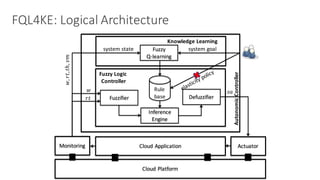
Fuzzifier
Inference	
Engine
Defuzzifier
Rule	
base
Fuzzy
Q-learning
Cloud	ApplicationMonitoring Actuator
Cloud	Platform
Fuzzy	Logic	
Controller
Knowledge	Learning
Autonomic	Controller
𝑟𝑡
𝑤
𝑤,𝑟𝑡,𝑡ℎ,𝑣𝑚
𝑠𝑎
system	state system	goal
FQL4KE:	Logical	Architecture
Fuzzy	Q-Learning
Algorithm 1 : Fuzzy Q-Learning
Require: , ⌘, ✏
1: Initialize q-values:
q[i, j] = 0, 1 < i < N , 1 < j < J
2: Select an action for each fired rule:
ai = argmaxkq[i, k] with probability 1 ✏ . Eq. 5
ai = random{ak, k = 1, 2, · · · , J} with probability ✏
3: Calculate the control action by the fuzzy controller:
a =
PN
i=1 µi(x) ⇥ ai, . Eq. 1
where ↵i(s) is the firing level of the rule i
4: Approximate the Q function from the current
q-values and the firing level of the rules:
Q(s(t), a) =
PN
i=1 ↵i(s) ⇥ q[i, ai],
where Q(s(t), a) is the value of the Q function for
the state current state s(t) in iteration t and the action a
5: Take action a and let system goes to the next state s(t+1).
6: Observe the reinforcement signal, r(t + 1)
and compute the value for the new state:
V (s(t + 1)) =
PN
i=1 ↵i(s(t + 1)).maxk(q[i, qk]).
7: Calculate the error signal:
Q = r(t + 1) + ⇥ Vt(s(t + 1)) Q(s(t), a), . Eq. 4
where is a discount factor
8: Update q-values:
q[i, ai] = q[i, ai] + ⌘ · Q · ↵i(s(t)), . Eq. 4
where ⌘ is a learning rate
9: Repeat the process for the new state until it converges
D
c
c
a
o
b
o
S
a
r
d
a
w
if
th
to
r
a
Low Medium High
Workload
1
0
α β γ δ
Bad OK Good
Response Time
1
0
λ μ ν
of w and rt that correspond to the state of the system, s(t) (cf.
Step 4 in Algorithm 1). The control signal sa represents the
action a that the controller take at each loop. We define the
reward signal r(t) based on three criteria: (i) numbers of the
desired response time violations, (ii) the amount of resource
acquired, and (iii) throughput, as follows:
r(t) = U(t) U(t 1), (6)
where U(t) is the utility value of the system at time t. Hence,
if a controlling action leads to an increased utility, it means
that the action is appropriate. Otherwise, if the reward is close
to zero, it implies that the action is not effective. A negative
reward (punishment) warns that the situation becomes worse
after taking the action. The utility function is defined as:
U(t) = w1 ·
th(t)
thmax
+w2 ·(1
vm(t)
vmmax
)+w3 ·(1 H(t)) (7)
H(t) =
8
><
>:
(rt(t) rtdes)
rtdes
rtdes  rt(t)  2 · rtdes
1 rt(t) 2 · rtdes
0 rt(t)  rtdes
where th(t), vm(t) and rt(t) are throughput, number of worker
roles and response time of the system, respectively. w1,w2 and
w3 are their corresponding weights determining their relative
o possible but due to the intricacies of updating
e, we consider this as a natural future extension
r the problem areas that requires coordination
controllers, see [9].
ion. The controller receives the current values
t correspond to the state of the system, s(t) (cf.
rithm 1). The control signal sa represents the
e controller take at each loop. We define the
(t) based on three criteria: (i) numbers of the
e time violations, (ii) the amount of resource
ii) throughput, as follows:
r(t) = U(t) U(t 1), (6)
he utility value of the system at time t. Hence,
action leads to an increased utility, it means
s appropriate. Otherwise, if the reward is close
ies that the action is not effective. A negative
ment) warns that the situation becomes worse
action. The utility function is defined as:
h(t)
max
+w2 ·(1
vm(t)
vmmax
)+w3 ·(1 H(t)) (7)
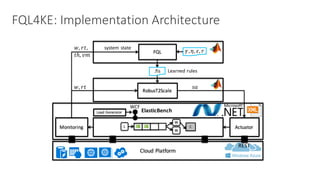
Code:
https://github.com/pooyanjamshidi/Fuzzy-Q-Learning
RobusT2Scale
Learned	rules
FQL
Monitoring Actuator
Cloud	Platform
.fis
L
W
W
ElasticBench
𝑤, 𝑟𝑡
𝑤, 𝑟𝑡,	
	𝑡ℎ, 𝑣𝑚
𝑠𝑎
Load	Generator
C
system	state
WCF
REST
𝛾, 𝜂, 𝜀, 𝑟
FQL4KE:	Implementation	Architecture
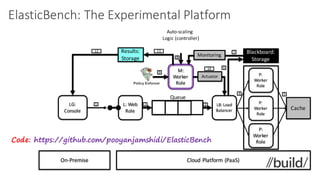
Cloud	Platform	(PaaS)On-Premise
P:	
Worker	
Role
L:	Web	
Role
P:	
Worker	
Role
P:	
Worker	
Role
Cache
M:	
Worker	
Role
Results:	
Storage
Blackboard:	
Storage
LG:	
Console
Auto-scaling	
Logic	(controller)
Policy Enforcer
1 2 3
7
8
1112
4
10
9
LB:	Load	
Balancer
6
5
Queue
Actuator
Monitoring
Code: https://github.com/pooyanjamshidi/ElasticBench
ElasticBench:	The	Experimental	Platform
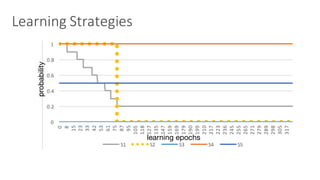
Learning	Strategies
0
0.2
0.4
0.6
0.8
1
1.2
0
8
15
23
33
42
53
61
75
87
95
105
118
127
135
147
159
169
179
190
199
210
217
223
236
245
255
265
271
279
289
298
305
317
S1 S2 S3 S4 S5
learning epochs
probability
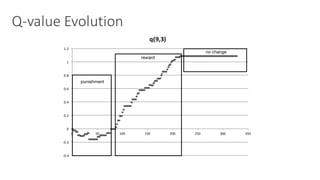
Q-value	Evolution
-0.4
-0.2
0
0.2
0.4
0.6
0.8
1
1.2
0 50 100 150 200 250 300 350
q(9,3)
punishment
reward
no change
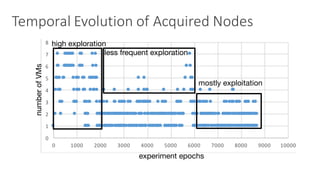
Temporal	Evolution	of	Acquired	Nodes
0
1
2
3
4
5
6
7
8
0 1000 2000 3000 4000 5000 6000 7000 8000 9000 10000
high exploration
less frequent exploration
mostly exploitation
experiment epochs
numberofVMs
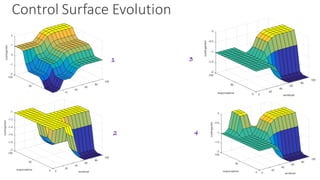
Control	Surface	Evolution
1
2
3
4
Experimental	Results
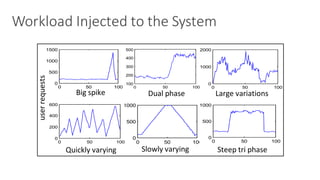
Workload	Injected	to	the	System
0 50 100
0
500
1000
1500
0 50 100
100
200
300
400
500
0 50 100
0
1000
2000
0 50 100
0
200
400
600
0 50 100
0
500
1000
0 50 100
0
500
1000
Big spike Dual phase Large variations
Quickly varying Slowly varying Steep tri phase
0
1000
2:00
userrequests
userrequests
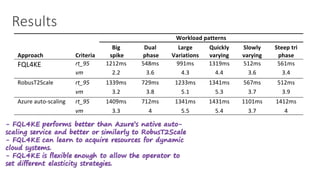
Results
IV. Unlike	supervised	techniques	that	learn	from	training	data,	FQL4KE	does	not	require	off-line	
training,	which	saves	significant	amounts	of	time	and	effort.	
Table	3.	Comparison	of	the	effectiveness	of	FQL4KE,	RobusT2Scale	and	Azure	auto-scaling	under	different	workloads.	
Approach	 Criteria	
Workload	patterns	
Big	
	spike	
Dual	
	phase	
Large	
Variations	
Quickly	
varying	
Slowly	
varying	
Steep	tri	
phase	
FQL4KE	 rt_95	 1212ms	 548ms	 991ms	 1319ms	 512ms	 561ms	
vm	 2.2	 3.6	 4.3	 4.4	 3.6	 3.4	
RobusT2Scale	 rt_95	 1339ms	 729ms	 1233ms	 1341ms	 567ms	 512ms	
	 vm	 3.2	 3.8	 5.1	 5.3	 3.7	 3.9	
Azure	auto-scaling	 rt_95	 1409ms	 712ms	 1341ms	 1431ms	 1101ms	 1412ms	
vm	 3.3	 4	 5.5	 5.4	 3.7	 4	
	
5. Conclusions	
We	 propose	 a	 new	 learning	 based	 self-adaptation	 framework,	 called	 MAPE-KE,	 which	 is	
particularly	 suited	 for	 engineering	 elastic	 systems	 that	 need	 to	 cope	 with	 uncertain	
environments,	such	as	cloud	and	big	data,	and	need	to	be	robust	enough	by	taking	the	human	
- FQL4KE performs better than Azure’s native auto-
scaling service and better or similarly to RobusT2Scale
- FQL4KE can learn to acquire resources for dynamic
cloud systems.
- FQL4KE is flexible enough to allow the operator to
set different elasticity strategies.
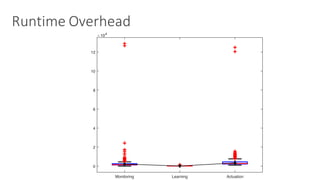
Runtime	Overhead
Monitoring Learning Actuation
104
0
2
4
6
8
10
12
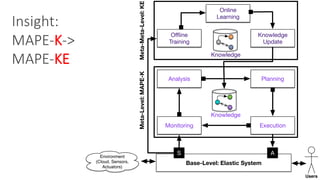
Insight:
MAPE-K->
MAPE-KE
Monitoring
Analysis Planning
Execution
Offline
Training
Online
Learning
Knowledge
Update
Base-Level: Elastic System
Environment
(Cloud, Sensors,
Actuators)
Knowledge
Knowledge
Users
S A
Meta-Level:MAPE-KMeta-Meta-Level:KE
Current	work
- Implementation	on	OpenStack with	Intel,	Ireland
- Policy	learning	through	other	ML	techniques	(e.g.,	GP,	BO)
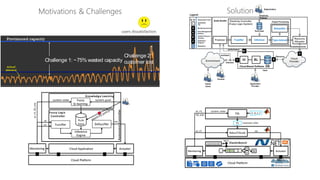
Challenge 1: ~75% wasted capacity
Actual
demand
Challenge 2:
customer lost
Fuzzifier
Inference	
Engine
Defuzzifier
Rule	
base
Fuzzy
Q-learning
Cloud	ApplicationMonitoring Actuator
Cloud	Platform
Fuzzy	Logic	
Controller
Knowledge	Learning
Autonomic	Controller
𝑟𝑡
𝑤
𝑤,𝑟𝑡,𝑡ℎ,𝑣𝑚
𝑠𝑎
system	state system	goal
RobusT2Scale
Learned	rules
FQL
Monitoring Actuator
Cloud	Platform
.fis
L
W
W
ElasticBench
𝑤, 𝑟𝑡
𝑤, 𝑟𝑡,	
	𝑡ℎ, 𝑣𝑚
𝑠𝑎
Load	Generator
C
system	state
WCF
REST
𝛾, 𝜂, 𝜀, 𝑟
http://www.doc.ic.ac.uk/~pjamshid/PDF/qosa16.pdf
More
Details?
=>
http://www.slideshare.net/pooyanjamshidi/
Slides?
=>
Thank you!
https://github.com/pooyanjamshidi
Code?
=>
Submit	to	CloudWays 2016!
Paper submission deadline July 1st, 2016
Decision notification August 1st, 2016
Final version due August 8th, 2016
Workshop date September 5th, 2016
Collocated with ESOCC, Vienna
Topics: Cloud Architecture, Big Data, DevOps
- Details: https://sites.google.com/site/cloudways2016/call-for-papers

Fuzzy Self-Learning Controllers for Elasticity Management in Dynamic Cloud Architectures