Chapter one: Introduction to the fungi
Topic: Classification and Importance of fungi
Contents:
 Classification
 Economic Importance
Teaching and learning methods: Lectures, visual aid, interactive forms,
question-answer session, and group discussion.
At end of the lecture student should be able to answer the following
questions:
• Summarize the economic importance of fungi
• Classify the fungi with examples
Reference books:
• Introductory Mycology, 4th Edition- Alexopoulos CJ, Mims CW and Blackwell
M; Chapter two; page: 52-56
• Introduction of Fungi, 3rd edition, HC dube; Chapter two; page: 32-36
Characteristics of the Fungal Divisions:
• The traditional taxonomic scheme used by mycologists classifies the fungi into
four divisions:
• Zygomycota, ii. Ascomycota, iii. Basidiomycota, iv. Deuteromycota
• Classification is primarily based on variations in sexual reproduction. (In
mycology a division is equivalent to a phylum in animal classification
schemes). Based on 18S rRNA studies, molecular microbiologists place the
Deuteromycota (Fungi Imperfecti) among their closest relatives in either the
Zygomycota, Ascomycota, or Basidiomycota and add the class
Chytridiomycetes.
Characteristics of the Fungal Divisions:
Division Zygomycota:
• The division Zygomycota contains the fungi called zygomycetes. Most live on
decaying plant and animal matter in the soil; a few are parasites of plants,
insects, animals, and humans. The hyphae of zygomycetes are coenocytic,
with many haploid nuclei. Asexual spores, usually wind dispersed, develop in
sporangia at the tips of aerial hyphae. Sexual reproduction produces tough,
thick-walled zygotes called zygospores that can remain dormant when the
environment is too harsh for growth of the fungus. The bread mold, Rhizopus
stolonifer, is a very common member of this division.
Characteristics of the Fungal Divisions:
Division Ascomycota:
• The division Ascomycota contains the fungi called ascomycetes, commonly
known as the sac fungi. Many species are quite familiar and economically
important. For example, most of the red, brown, and blue-green molds that
cause food spoilage are ascomycetes. The powdery mildews that attack plant
leaves and the fungi that cause chestnut blight and Dutch elm disease are
ascomycetes. Many yeasts as well as edible morels and truffles are
ascomycetes. The pink bread mold Neurospora crassa, also an ascomycete,
has been a most important research tool in genetics and biochemistry.
Characteristics of the Fungal Divisions:
Division Basidiomycota:
• The division Basidiomycota contains the basidiomycetes, commonly known as
the club fungi. Examples include the smuts, jelly fungi, rusts, shelf fungi,
stinkhorns, puffballs, toadstools, mushrooms, and bird’s nest fungi. The
basidiomycetes affect humans in many ways. Most are saprophytes that
decompose plant debris, especially cellulose and lignin. Many mushrooms are
used as food throughout the world. The cultivation of Agaricus campestris is a
multimillion-dollar business
Characteristics of the Fungal Divisions:
Division Deuteromycota:
• To a large degree, classical fungal taxonomy is based on specific patterns of
sexual reproduction. When a fungus lacks the sexual phase (perfect stage), or
if this phase has not been observed, it is placed within the division
Deuteromycota, commonly called the Fungi Imperfecti or deuteromycetes
(“secondary fungi”). Once a perfect stage is observed, the fungus is
transferred to its proper division.
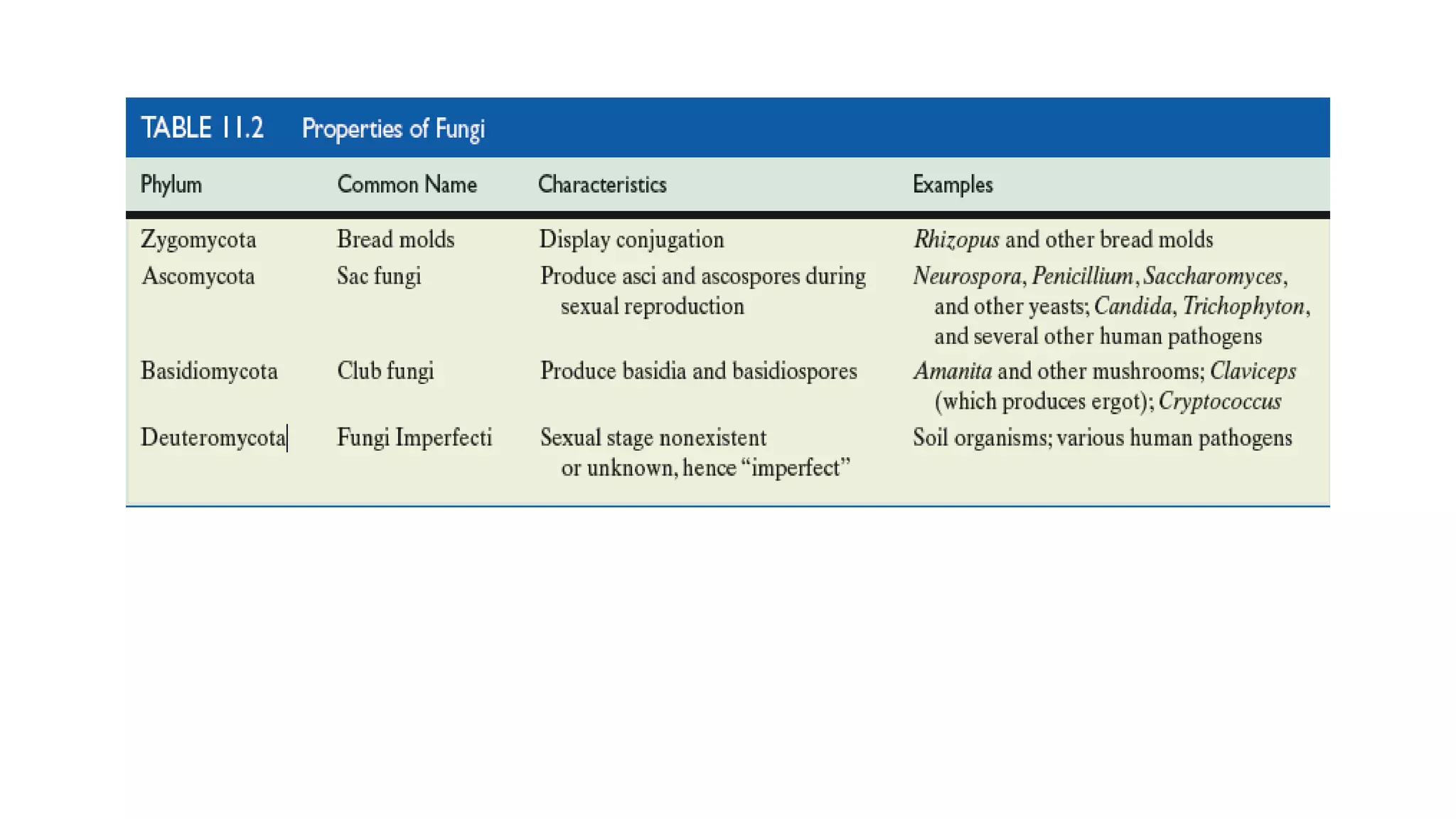
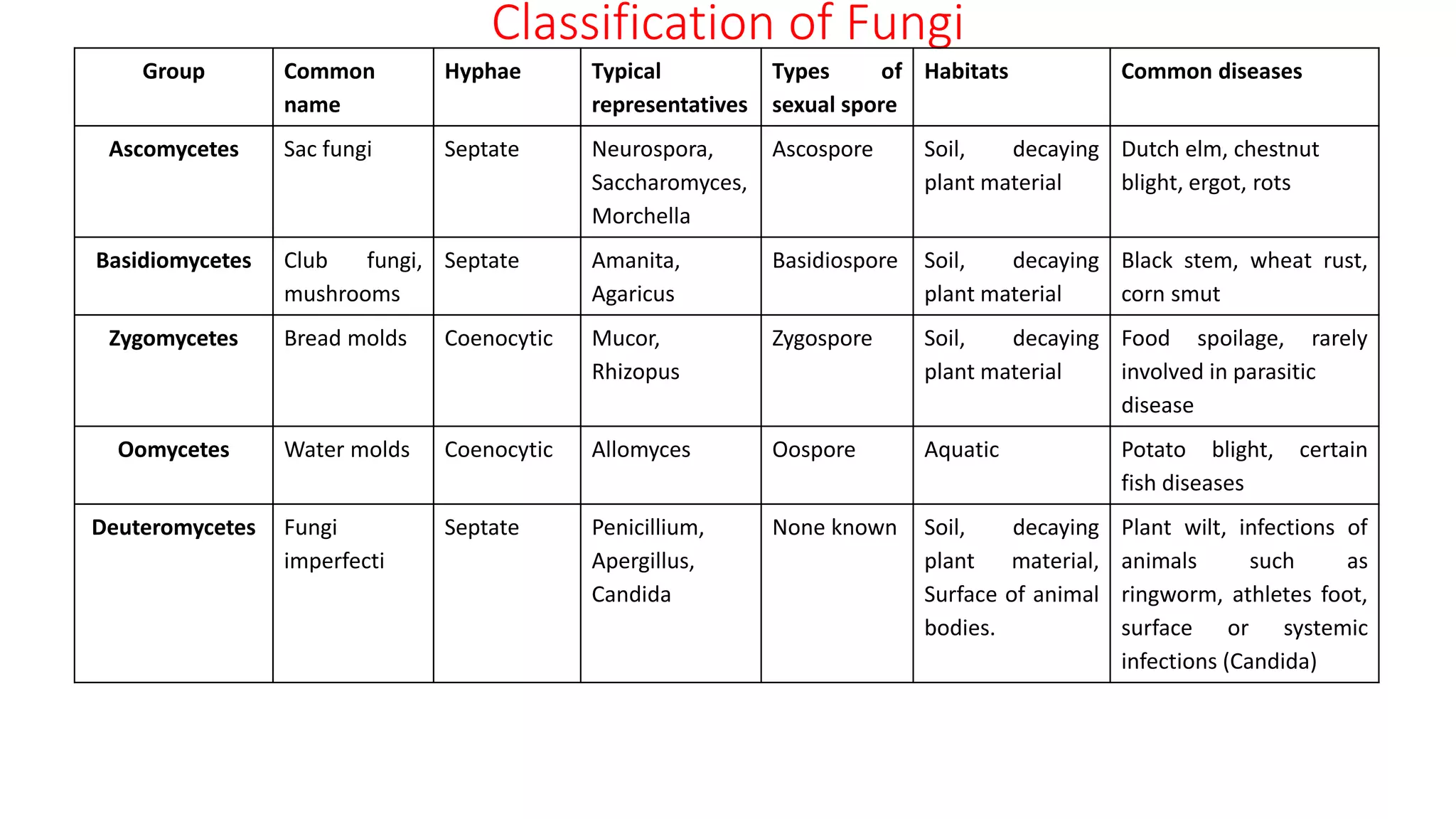
Classification of Fungi
Group Common
name
Hyphae Typical
representatives
Types of
sexual spore
Habitats Common diseases
Ascomycetes Sac fungi Septate Neurospora,
Saccharomyces,
Morchella
Ascospore Soil, decaying
plant material
Dutch elm, chestnut
blight, ergot, rots
Basidiomycetes Club fungi,
mushrooms
Septate Amanita,
Agaricus
Basidiospore Soil, decaying
plant material
Black stem, wheat rust,
corn smut
Zygomycetes Bread molds Coenocytic Mucor,
Rhizopus
Zygospore Soil, decaying
plant material
Food spoilage, rarely
involved in parasitic
disease
Oomycetes Water molds Coenocytic Allomyces Oospore Aquatic Potato blight, certain
fish diseases
Deuteromycetes Fungi
imperfecti
Septate Penicillium,
Apergillus,
Candida
None known Soil, decaying
plant material,
Surface of animal
bodies.
Plant wilt, infections of
animals such as
ringworm, athletes foot,
surface or systemic
infections (Candida)
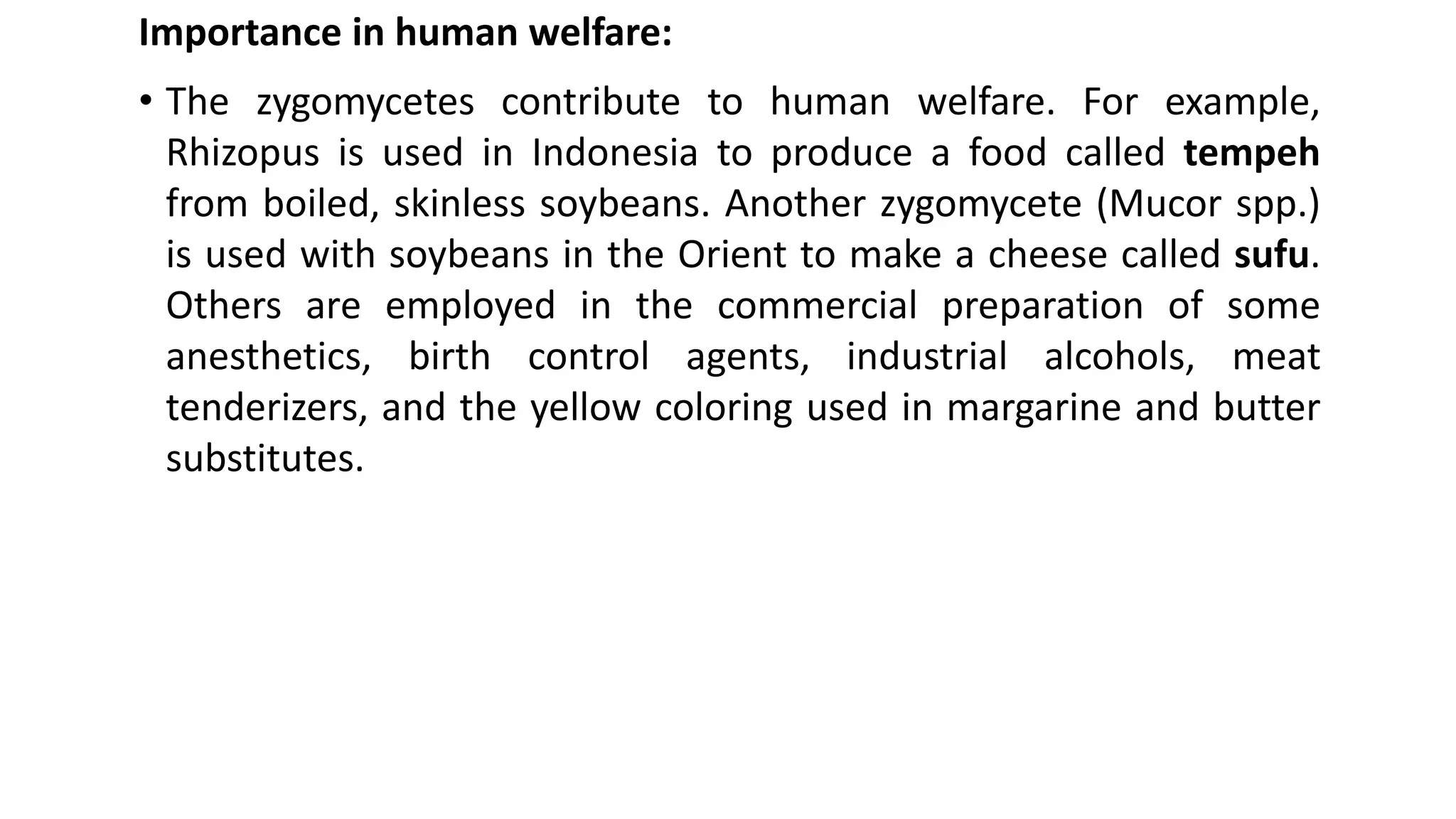
Importance in human welfare:
• The zygomycetes contribute to human welfare. For example,
Rhizopus is used in Indonesia to produce a food called tempeh
from boiled, skinless soybeans. Another zygomycete (Mucor spp.)
is used with soybeans in the Orient to make a cheese called sufu.
Others are employed in the commercial preparation of some
anesthetics, birth control agents, industrial alcohols, meat
tenderizers, and the yellow coloring used in margarine and butter
substitutes.
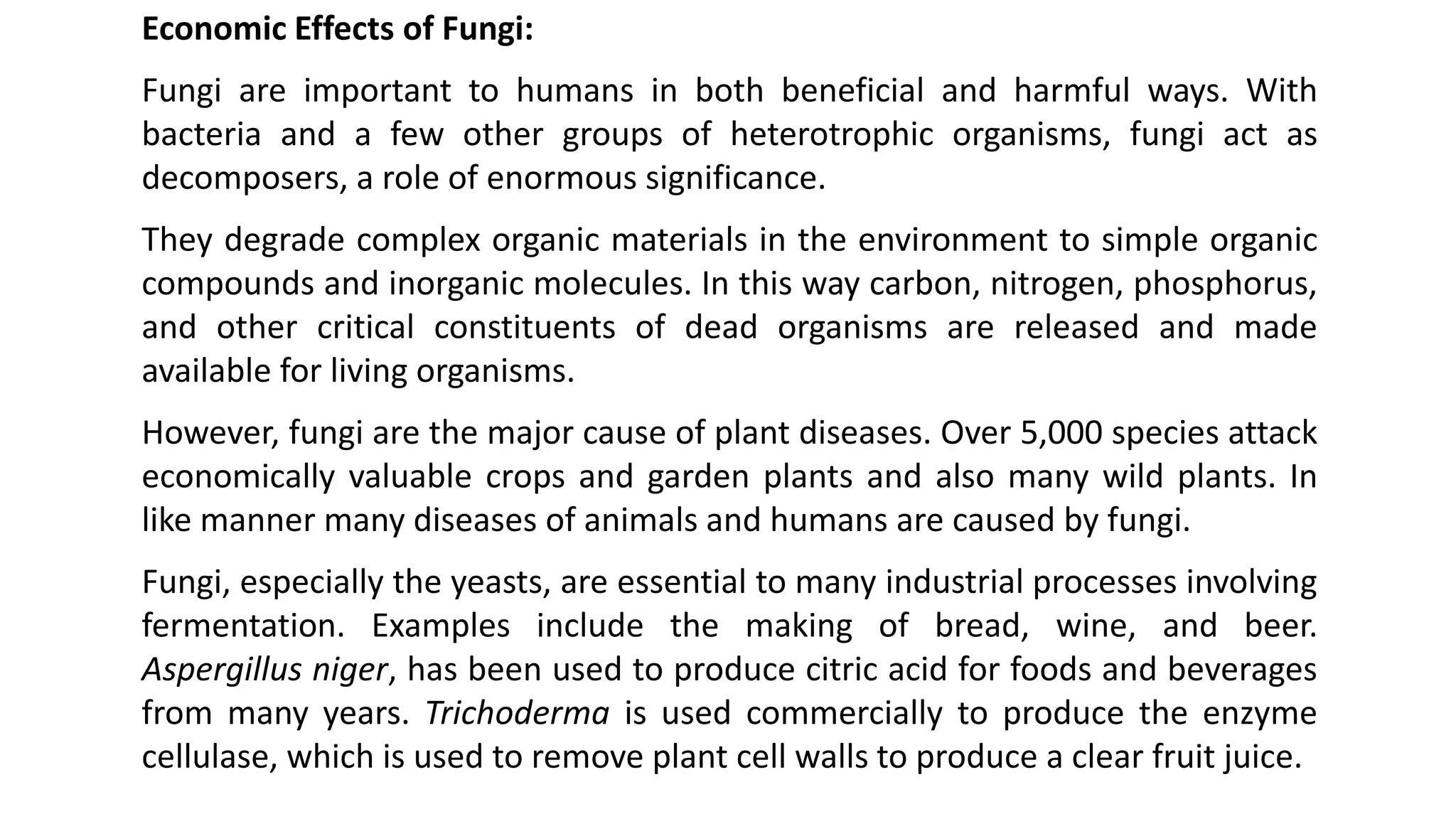
Economic Effects of Fungi:
Fungi are important to humans in both beneficial and harmful ways. With
bacteria and a few other groups of heterotrophic organisms, fungi act as
decomposers, a role of enormous significance.
They degrade complex organic materials in the environment to simple organic
compounds and inorganic molecules. In this way carbon, nitrogen, phosphorus,
and other critical constituents of dead organisms are released and made
available for living organisms.
However, fungi are the major cause of plant diseases. Over 5,000 species attack
economically valuable crops and garden plants and also many wild plants. In
like manner many diseases of animals and humans are caused by fungi.
Fungi, especially the yeasts, are essential to many industrial processes involving
fermentation. Examples include the making of bread, wine, and beer.
Aspergillus niger, has been used to produce citric acid for foods and beverages
from many years. Trichoderma is used commercially to produce the enzyme
cellulase, which is used to remove plant cell walls to produce a clear fruit juice.
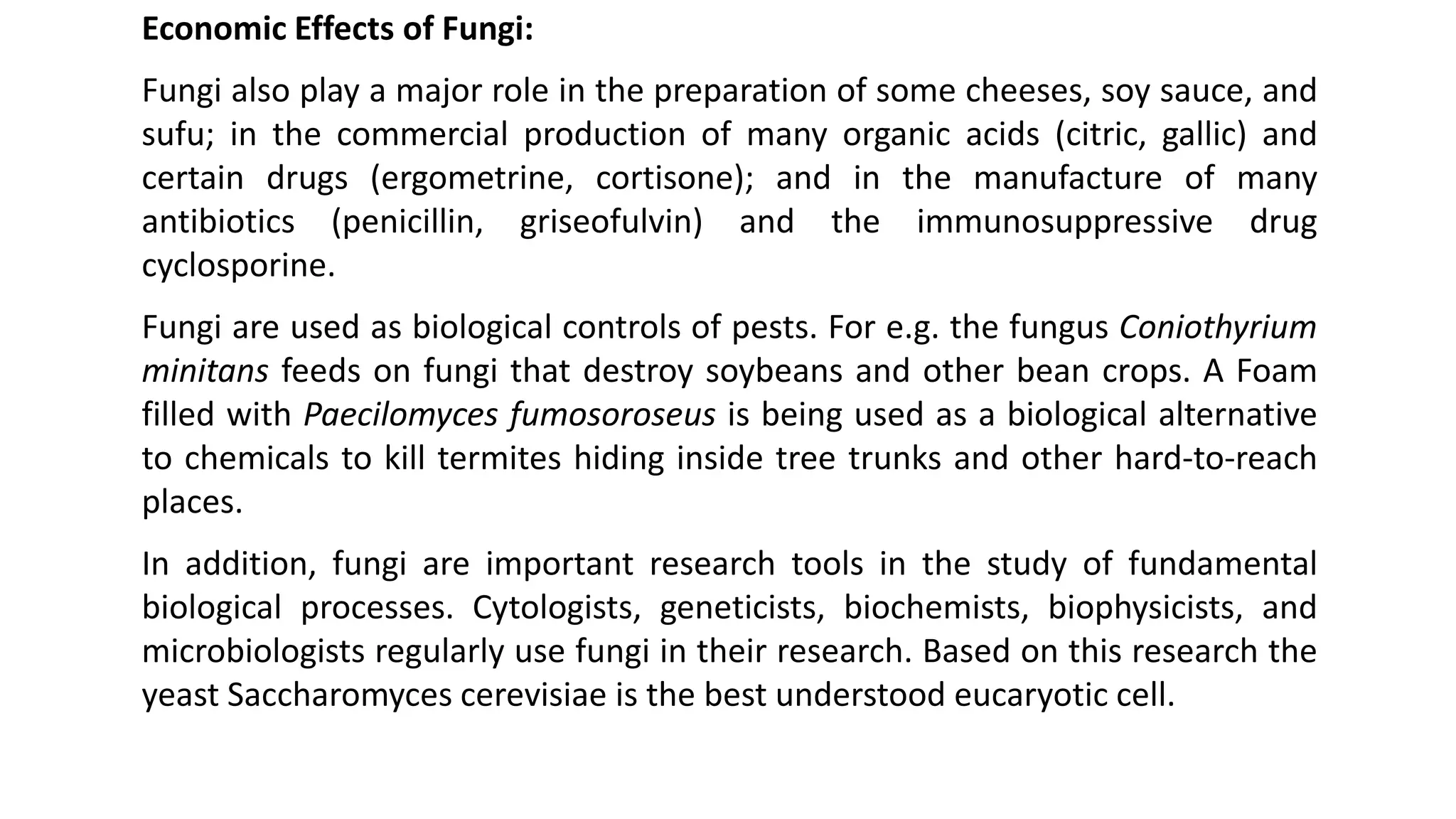
Economic Effects of Fungi:
Fungi also play a major role in the preparation of some cheeses, soy sauce, and
sufu; in the commercial production of many organic acids (citric, gallic) and
certain drugs (ergometrine, cortisone); and in the manufacture of many
antibiotics (penicillin, griseofulvin) and the immunosuppressive drug
cyclosporine.
Fungi are used as biological controls of pests. For e.g. the fungus Coniothyrium
minitans feeds on fungi that destroy soybeans and other bean crops. A Foam
filled with Paecilomyces fumosoroseus is being used as a biological alternative
to chemicals to kill termites hiding inside tree trunks and other hard-to-reach
places.
In addition, fungi are important research tools in the study of fundamental
biological processes. Cytologists, geneticists, biochemists, biophysicists, and
microbiologists regularly use fungi in their research. Based on this research the
yeast Saccharomyces cerevisiae is the best understood eucaryotic cell.
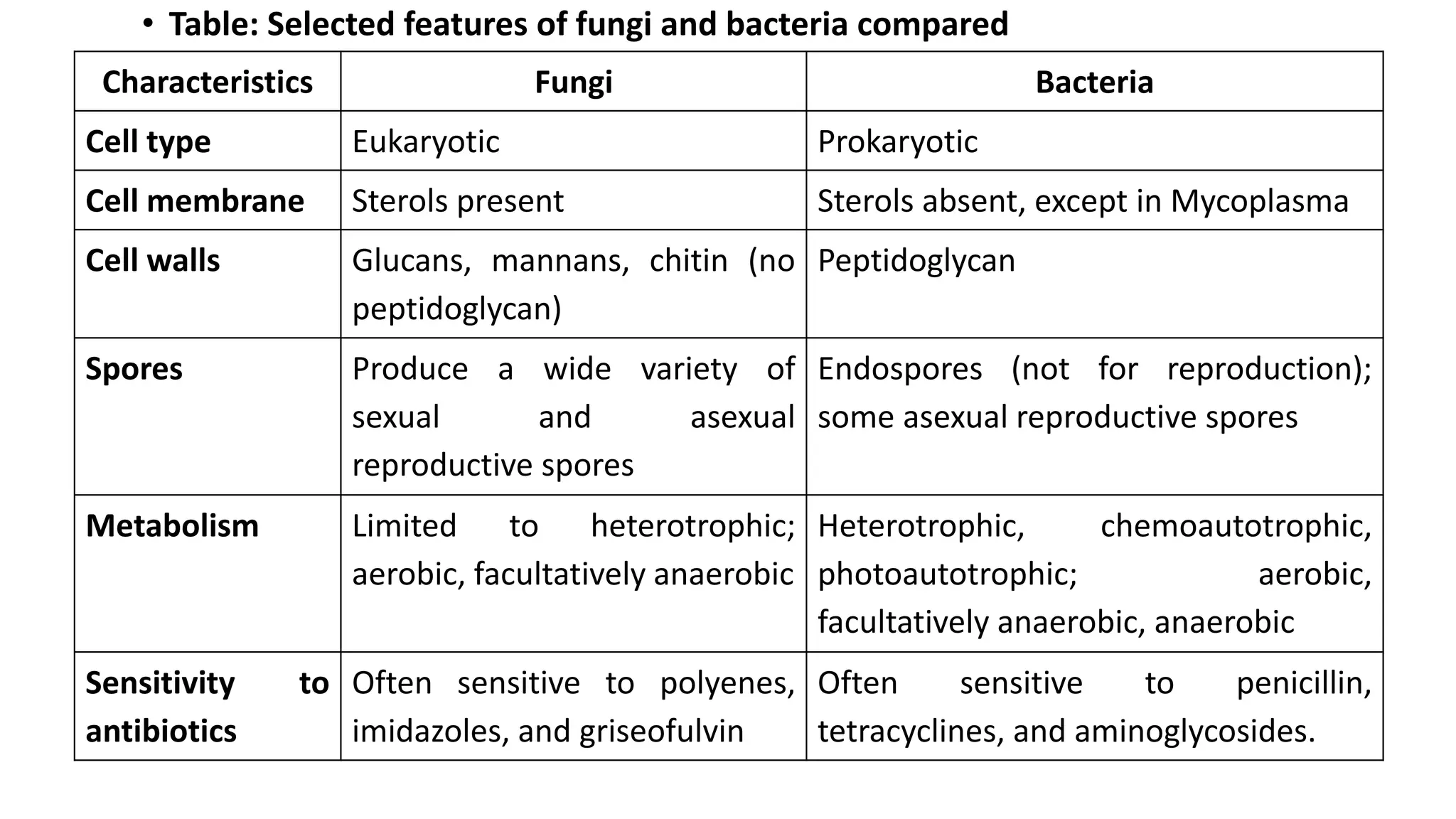
• Table: Selected features of fungi and bacteria compared
Characteristics Fungi Bacteria
Cell type Eukaryotic Prokaryotic
Cell membrane Sterols present Sterols absent, except in Mycoplasma
Cell walls Glucans, mannans, chitin (no
peptidoglycan)
Peptidoglycan
Spores Produce a wide variety of
sexual and asexual
reproductive spores
Endospores (not for reproduction);
some asexual reproductive spores
Metabolism Limited to heterotrophic;
aerobic, facultatively anaerobic
Heterotrophic, chemoautotrophic,
photoautotrophic; aerobic,
facultatively anaerobic, anaerobic
Sensitivity to
antibiotics
Often sensitive to polyenes,
imidazoles, and griseofulvin
Often sensitive to penicillin,
tetracyclines, and aminoglycosides.

Fungi_Classification and Importance

  • 1.
    Chapter one: Introductionto the fungi Topic: Classification and Importance of fungi Contents:  Classification  Economic Importance
  • 2.
    Teaching and learningmethods: Lectures, visual aid, interactive forms, question-answer session, and group discussion. At end of the lecture student should be able to answer the following questions: • Summarize the economic importance of fungi • Classify the fungi with examples Reference books: • Introductory Mycology, 4th Edition- Alexopoulos CJ, Mims CW and Blackwell M; Chapter two; page: 52-56 • Introduction of Fungi, 3rd edition, HC dube; Chapter two; page: 32-36
  • 3.
    Characteristics of theFungal Divisions: • The traditional taxonomic scheme used by mycologists classifies the fungi into four divisions: • Zygomycota, ii. Ascomycota, iii. Basidiomycota, iv. Deuteromycota • Classification is primarily based on variations in sexual reproduction. (In mycology a division is equivalent to a phylum in animal classification schemes). Based on 18S rRNA studies, molecular microbiologists place the Deuteromycota (Fungi Imperfecti) among their closest relatives in either the Zygomycota, Ascomycota, or Basidiomycota and add the class Chytridiomycetes.
  • 4.
    Characteristics of theFungal Divisions: Division Zygomycota: • The division Zygomycota contains the fungi called zygomycetes. Most live on decaying plant and animal matter in the soil; a few are parasites of plants, insects, animals, and humans. The hyphae of zygomycetes are coenocytic, with many haploid nuclei. Asexual spores, usually wind dispersed, develop in sporangia at the tips of aerial hyphae. Sexual reproduction produces tough, thick-walled zygotes called zygospores that can remain dormant when the environment is too harsh for growth of the fungus. The bread mold, Rhizopus stolonifer, is a very common member of this division.
  • 5.
    Characteristics of theFungal Divisions: Division Ascomycota: • The division Ascomycota contains the fungi called ascomycetes, commonly known as the sac fungi. Many species are quite familiar and economically important. For example, most of the red, brown, and blue-green molds that cause food spoilage are ascomycetes. The powdery mildews that attack plant leaves and the fungi that cause chestnut blight and Dutch elm disease are ascomycetes. Many yeasts as well as edible morels and truffles are ascomycetes. The pink bread mold Neurospora crassa, also an ascomycete, has been a most important research tool in genetics and biochemistry.
  • 6.
    Characteristics of theFungal Divisions: Division Basidiomycota: • The division Basidiomycota contains the basidiomycetes, commonly known as the club fungi. Examples include the smuts, jelly fungi, rusts, shelf fungi, stinkhorns, puffballs, toadstools, mushrooms, and bird’s nest fungi. The basidiomycetes affect humans in many ways. Most are saprophytes that decompose plant debris, especially cellulose and lignin. Many mushrooms are used as food throughout the world. The cultivation of Agaricus campestris is a multimillion-dollar business
  • 7.
    Characteristics of theFungal Divisions: Division Deuteromycota: • To a large degree, classical fungal taxonomy is based on specific patterns of sexual reproduction. When a fungus lacks the sexual phase (perfect stage), or if this phase has not been observed, it is placed within the division Deuteromycota, commonly called the Fungi Imperfecti or deuteromycetes (“secondary fungi”). Once a perfect stage is observed, the fungus is transferred to its proper division.
  • 9.
    Classification of Fungi GroupCommon name Hyphae Typical representatives Types of sexual spore Habitats Common diseases Ascomycetes Sac fungi Septate Neurospora, Saccharomyces, Morchella Ascospore Soil, decaying plant material Dutch elm, chestnut blight, ergot, rots Basidiomycetes Club fungi, mushrooms Septate Amanita, Agaricus Basidiospore Soil, decaying plant material Black stem, wheat rust, corn smut Zygomycetes Bread molds Coenocytic Mucor, Rhizopus Zygospore Soil, decaying plant material Food spoilage, rarely involved in parasitic disease Oomycetes Water molds Coenocytic Allomyces Oospore Aquatic Potato blight, certain fish diseases Deuteromycetes Fungi imperfecti Septate Penicillium, Apergillus, Candida None known Soil, decaying plant material, Surface of animal bodies. Plant wilt, infections of animals such as ringworm, athletes foot, surface or systemic infections (Candida)
  • 10.
    Importance in humanwelfare: • The zygomycetes contribute to human welfare. For example, Rhizopus is used in Indonesia to produce a food called tempeh from boiled, skinless soybeans. Another zygomycete (Mucor spp.) is used with soybeans in the Orient to make a cheese called sufu. Others are employed in the commercial preparation of some anesthetics, birth control agents, industrial alcohols, meat tenderizers, and the yellow coloring used in margarine and butter substitutes.
  • 11.
    Economic Effects ofFungi: Fungi are important to humans in both beneficial and harmful ways. With bacteria and a few other groups of heterotrophic organisms, fungi act as decomposers, a role of enormous significance. They degrade complex organic materials in the environment to simple organic compounds and inorganic molecules. In this way carbon, nitrogen, phosphorus, and other critical constituents of dead organisms are released and made available for living organisms. However, fungi are the major cause of plant diseases. Over 5,000 species attack economically valuable crops and garden plants and also many wild plants. In like manner many diseases of animals and humans are caused by fungi. Fungi, especially the yeasts, are essential to many industrial processes involving fermentation. Examples include the making of bread, wine, and beer. Aspergillus niger, has been used to produce citric acid for foods and beverages from many years. Trichoderma is used commercially to produce the enzyme cellulase, which is used to remove plant cell walls to produce a clear fruit juice.
  • 12.
    Economic Effects ofFungi: Fungi also play a major role in the preparation of some cheeses, soy sauce, and sufu; in the commercial production of many organic acids (citric, gallic) and certain drugs (ergometrine, cortisone); and in the manufacture of many antibiotics (penicillin, griseofulvin) and the immunosuppressive drug cyclosporine. Fungi are used as biological controls of pests. For e.g. the fungus Coniothyrium minitans feeds on fungi that destroy soybeans and other bean crops. A Foam filled with Paecilomyces fumosoroseus is being used as a biological alternative to chemicals to kill termites hiding inside tree trunks and other hard-to-reach places. In addition, fungi are important research tools in the study of fundamental biological processes. Cytologists, geneticists, biochemists, biophysicists, and microbiologists regularly use fungi in their research. Based on this research the yeast Saccharomyces cerevisiae is the best understood eucaryotic cell.
  • 13.
    • Table: Selectedfeatures of fungi and bacteria compared Characteristics Fungi Bacteria Cell type Eukaryotic Prokaryotic Cell membrane Sterols present Sterols absent, except in Mycoplasma Cell walls Glucans, mannans, chitin (no peptidoglycan) Peptidoglycan Spores Produce a wide variety of sexual and asexual reproductive spores Endospores (not for reproduction); some asexual reproductive spores Metabolism Limited to heterotrophic; aerobic, facultatively anaerobic Heterotrophic, chemoautotrophic, photoautotrophic; aerobic, facultatively anaerobic, anaerobic Sensitivity to antibiotics Often sensitive to polyenes, imidazoles, and griseofulvin Often sensitive to penicillin, tetracyclines, and aminoglycosides.