Jeff Brody
Divisional Safety Director, Pepsi Cola Bottling Company of New York
Kathy Tazic
Senior Vice President, Client Services, Sedgwick
Vicki Telford
Director, Global Insurance and Risk Management, Hanesbrands Inc.
Tuesday, April 23, 2013
Session Time: 2:15 to 3:30 p.m.
Agenda
• Claims investigation
• Medical management
• Disability management
• Litigation management
• Resolution
• Updates and developments
• Q&A
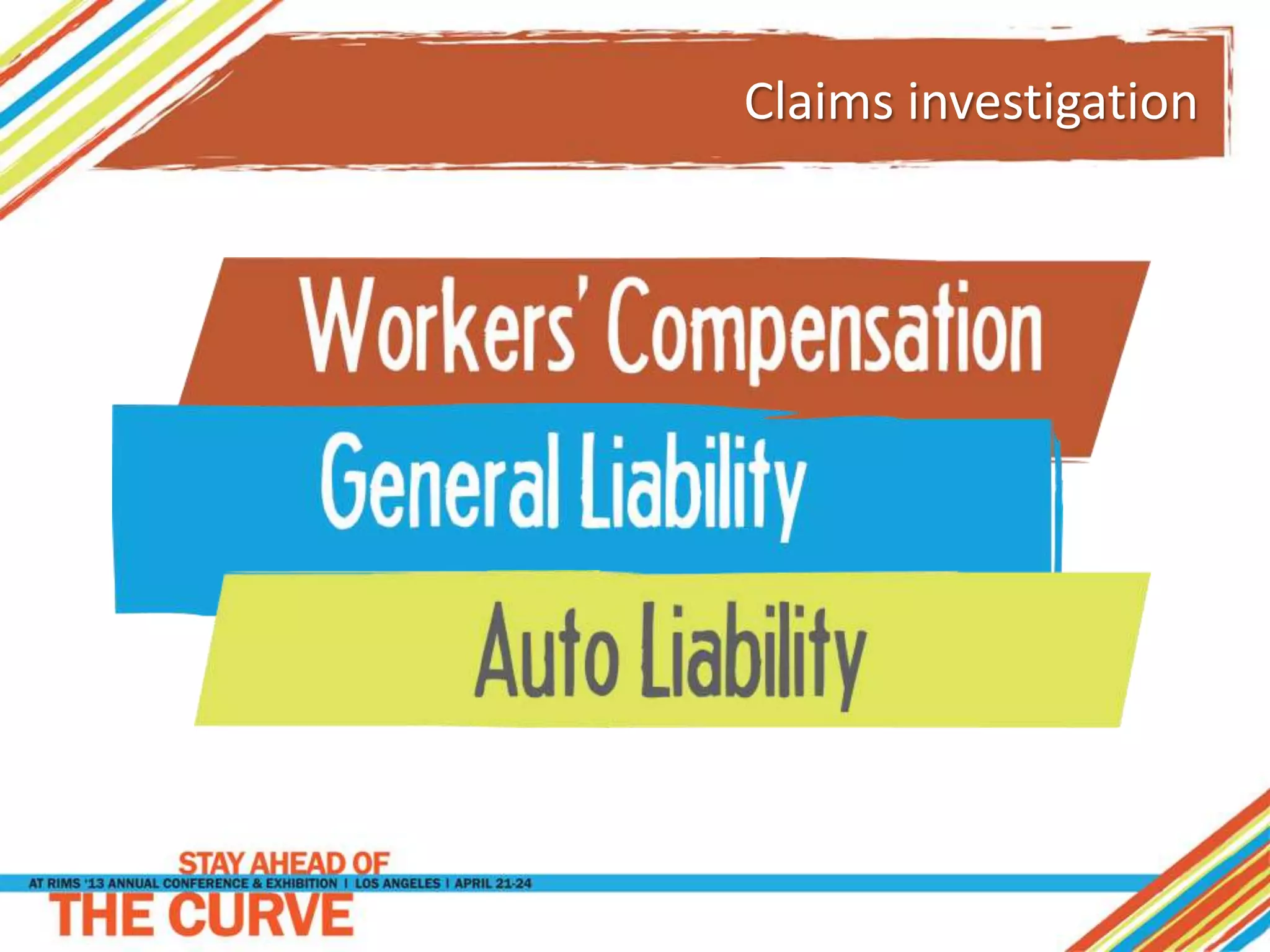
Claims investigation
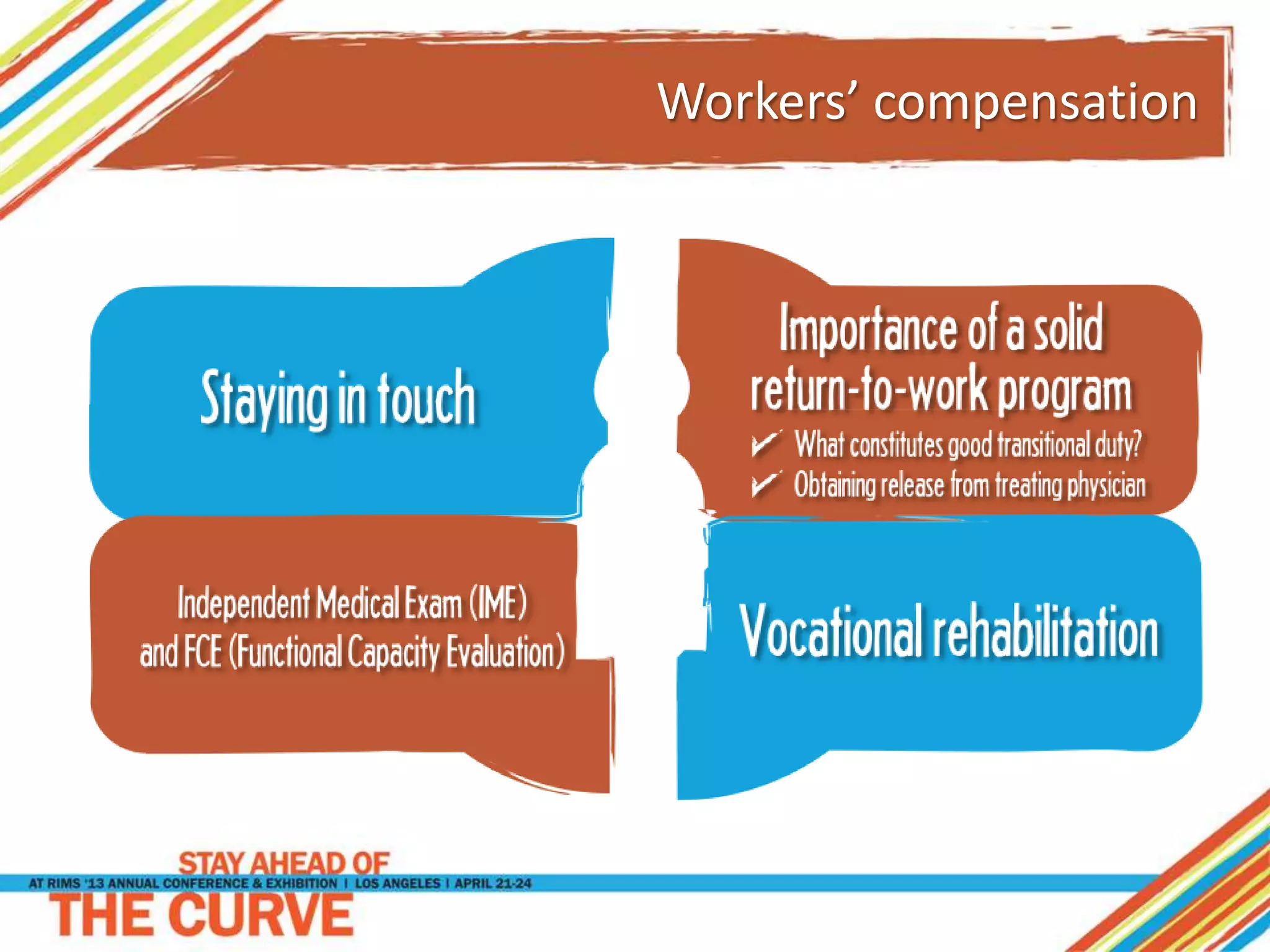
Workers’ compensation
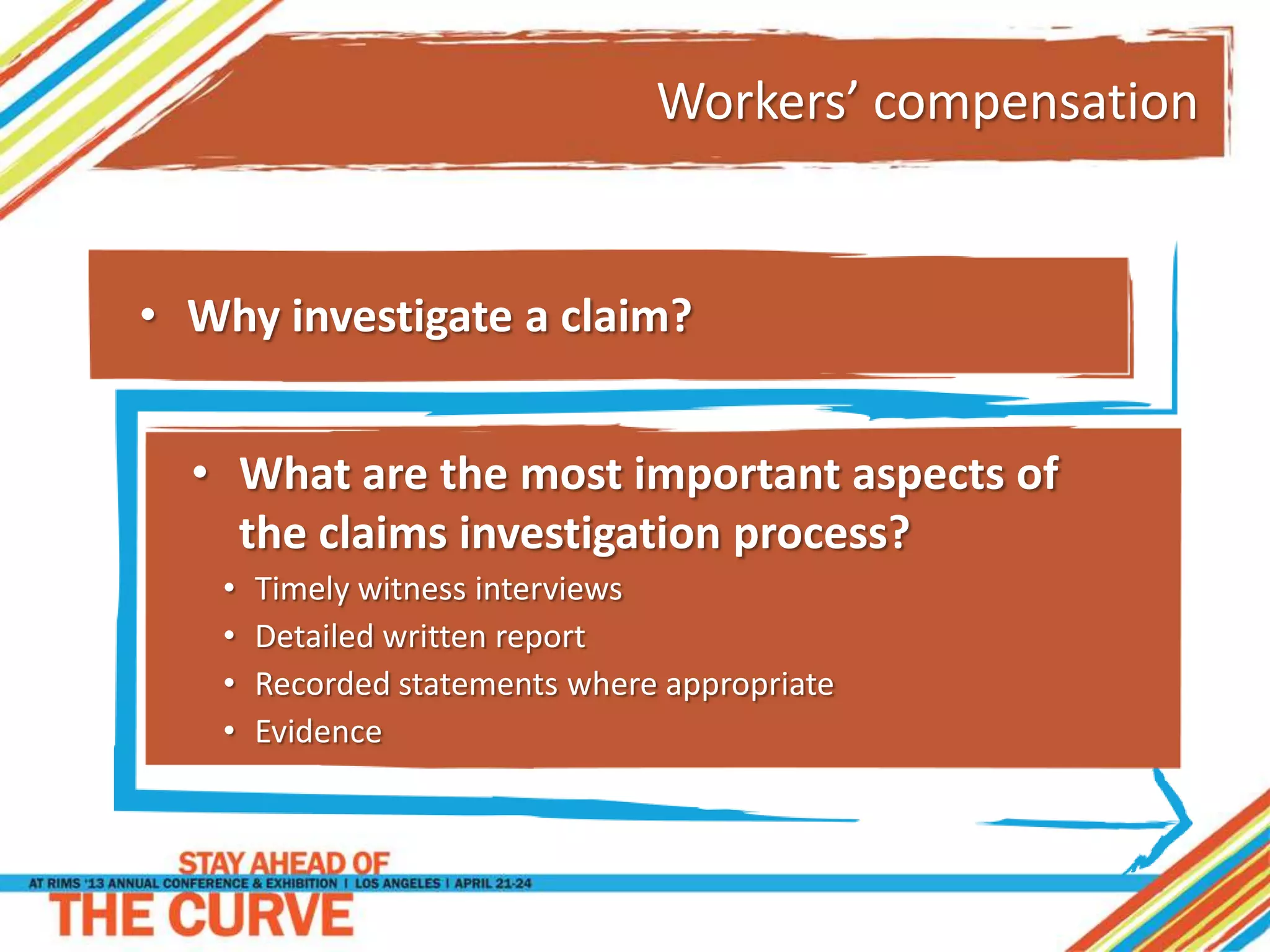
• What are the most important aspects of
the claims investigation process?
• Timely witness interviews
• Detailed written report
• Recorded statements where appropriate
• Evidence
• Why investigate a claim?
Workers’ compensation
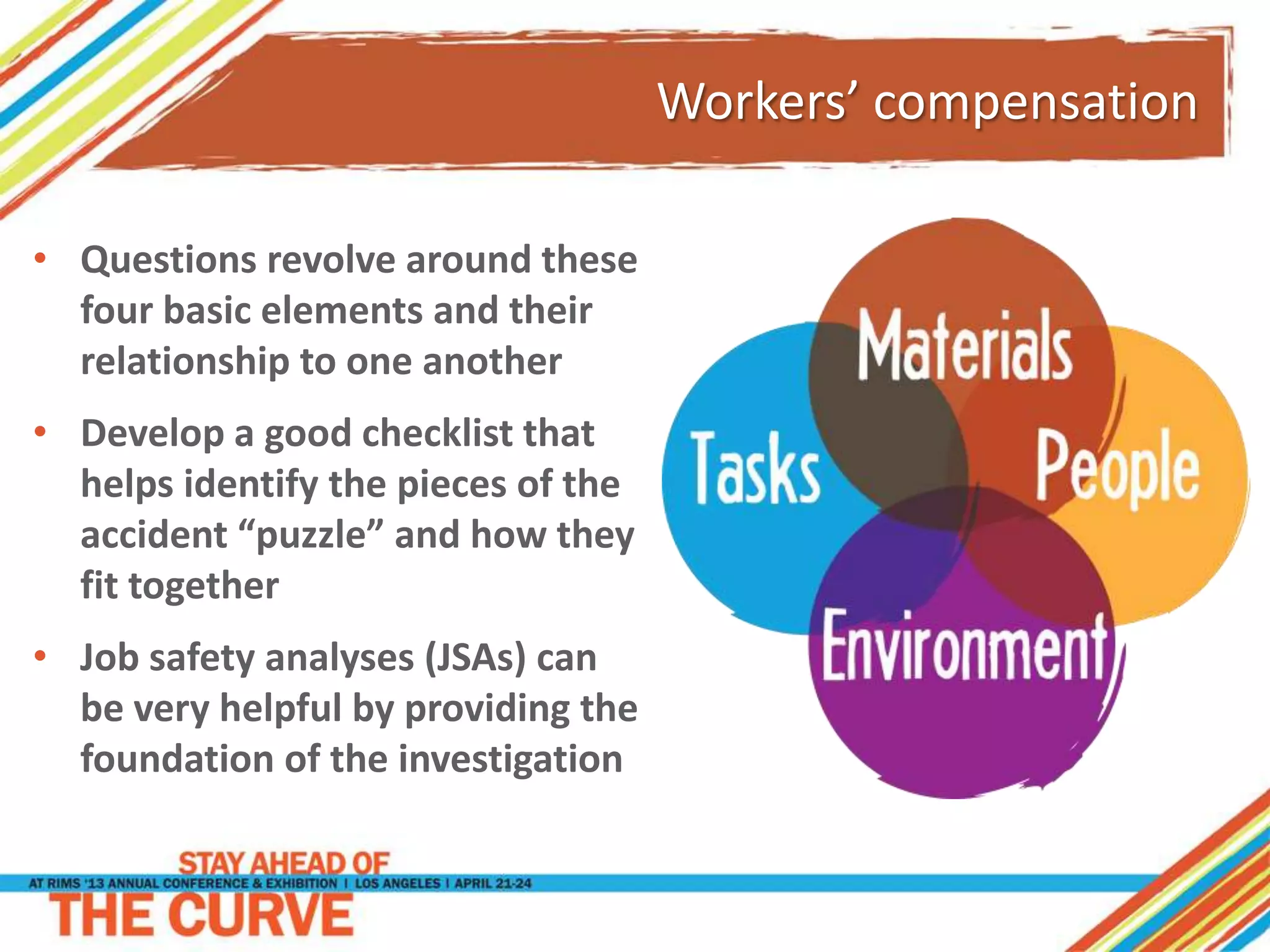
• Questions revolve around these
four basic elements and their
relationship to one another
• Develop a good checklist that
helps identify the pieces of the
accident “puzzle” and how they
fit together
• Job safety analyses (JSAs) can
be very helpful by providing the
foundation of the investigation
Workers’ compensation
• Once the information is gathered, it’s time to
get it off to your TPA or insurance adjuster
• Ask 5 “W” questions: who, what, where, when
and, most importantly, why
• Team approach usually works best
• Take pictures and get prompt interviews
• Root causes sometimes are elusive,
but without them, it’s Groundhog Day!
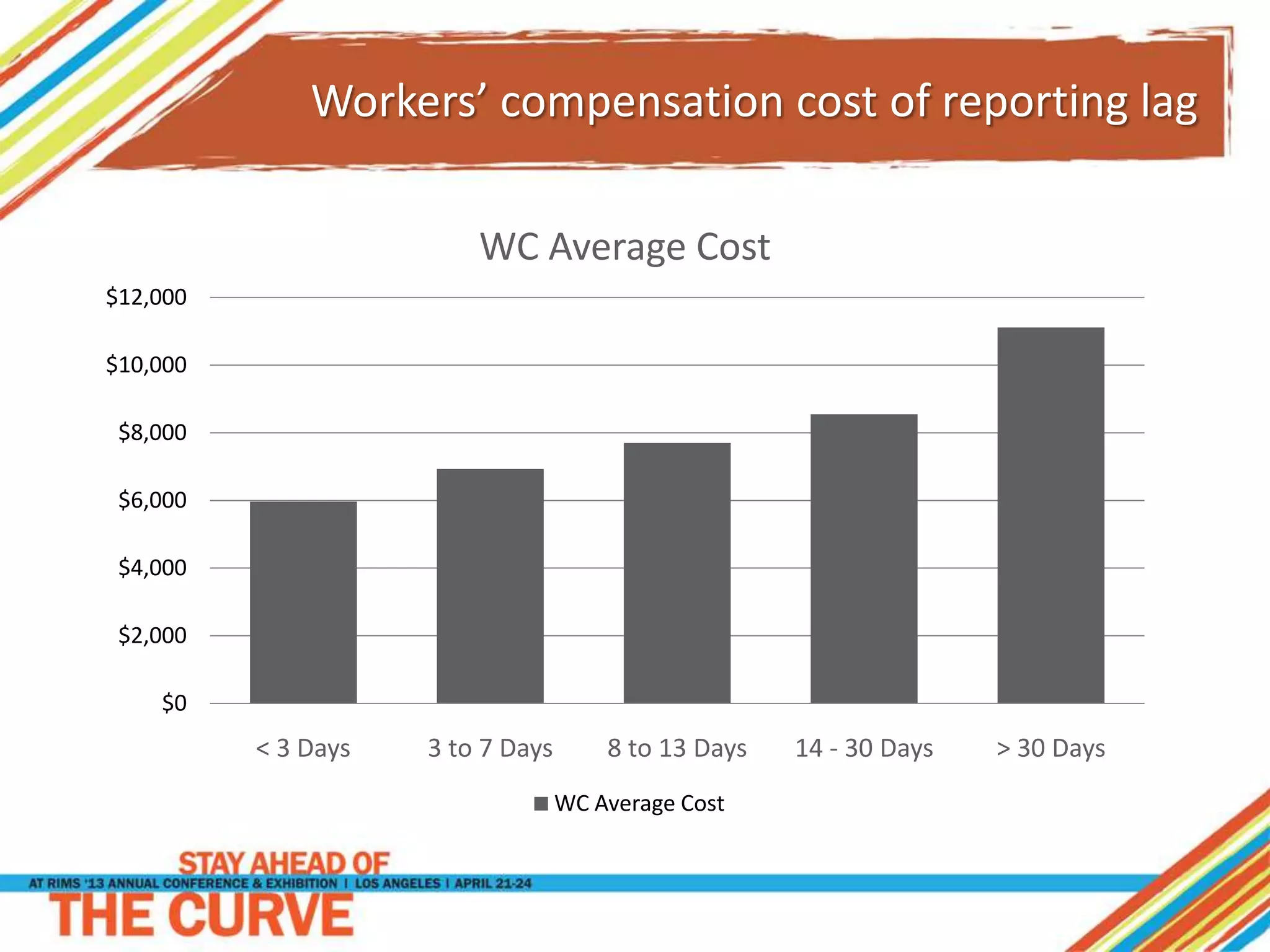
Workers’ compensation cost of reporting lag
$0
$2,000
$4,000
$6,000
$8,000
$10,000
$12,000
< 3 Days 3 to 7 Days 8 to 13 Days 14 - 30 Days > 30 Days
WC Average Cost
WC Average Cost
General liability
• Work from a checklist
• Develop/ personalize your form
• Team effort with insured is critical
• Always keep fraud in your process
• Get a statement from claimant, written or recorded very
early on before they lawyer-up
General liability
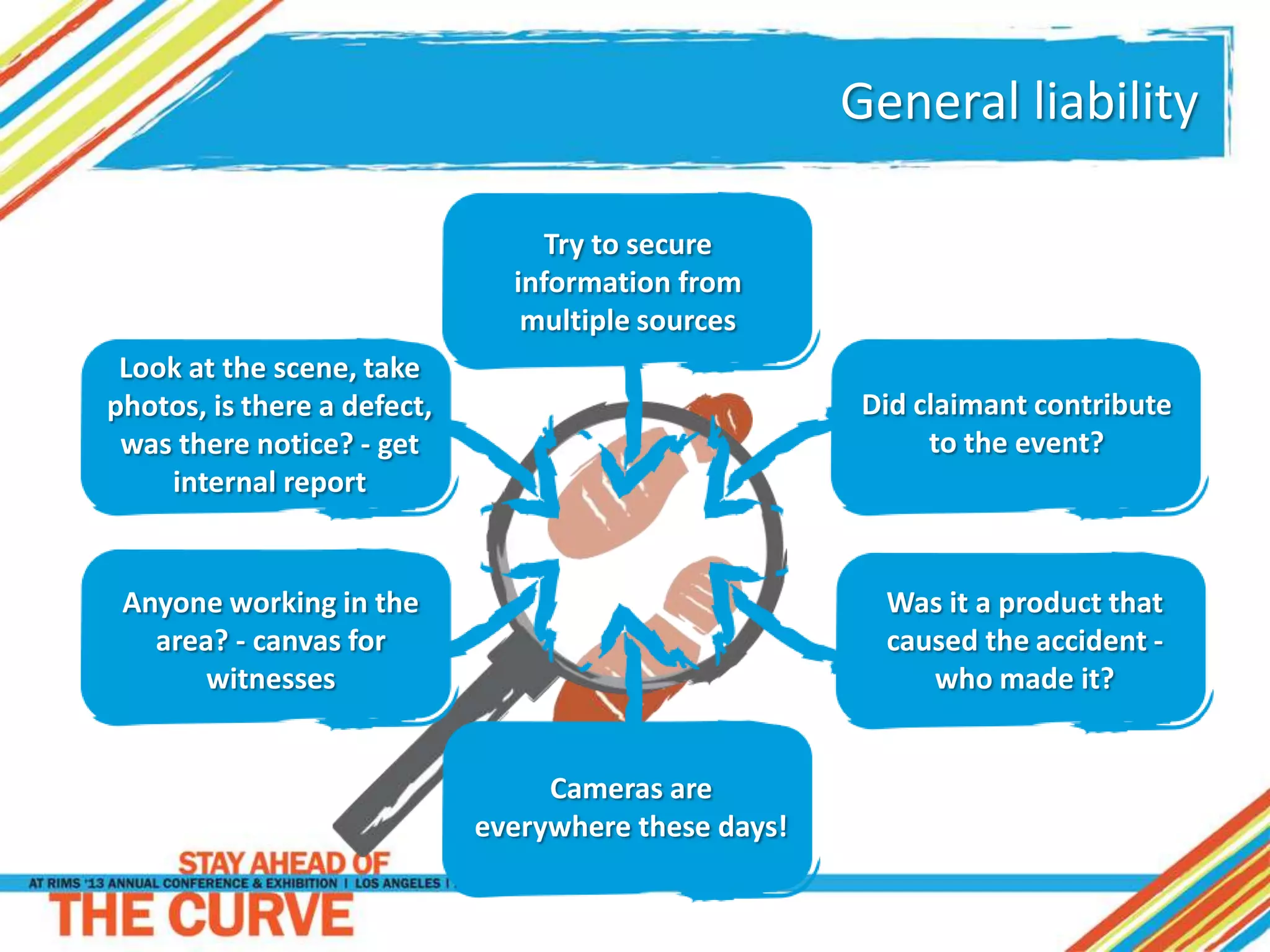
Try to secure
information from
multiple sources
Look at the scene, take
photos, is there a defect,
was there notice? - get
internal report
Anyone working in the
area? - canvas for
witnesses
Did claimant contribute
to the event?
Was it a product that
caused the accident -
who made it?
Cameras are
everywhere these days!
Auto liability
• Paperwork – where is the form
• Pedestrians, bicyclists, skateboarders
• On-scene pix are essential
• Fraud – huge issue in auto liability
• By the way, whose fault is it – witnesses
• Drivers and other occupants
Auto liability
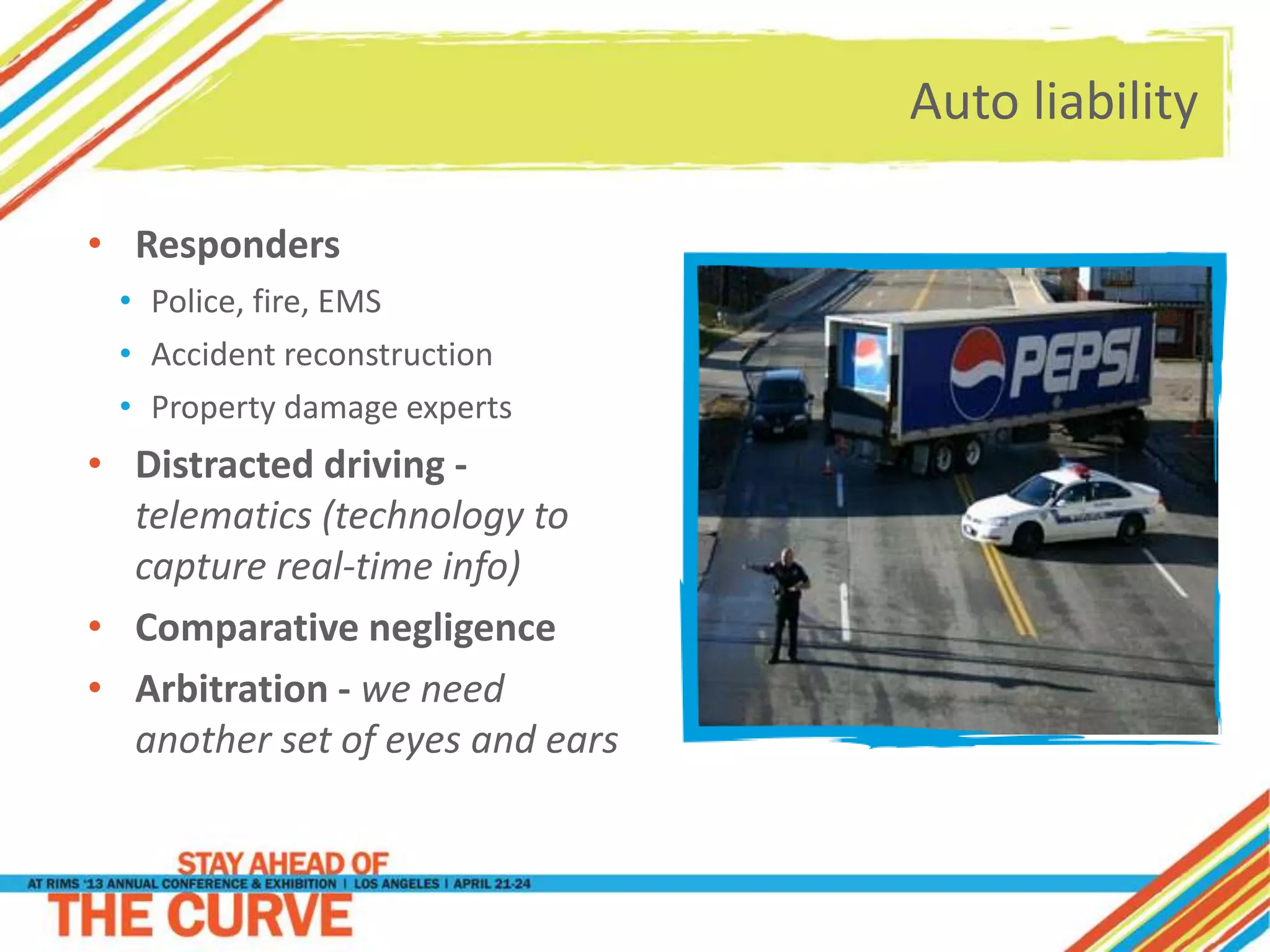
• Responders
• Police, fire, EMS
• Accident reconstruction
• Property damage experts
• Distracted driving -
telematics (technology to
capture real-time info)
• Comparative negligence
• Arbitration - we need
another set of eyes and ears
Medical management
Workers’ compensation
• Roles and responsibilities
• Adjuster
• Nurse case manager
• Utilization review
• Pharmacy benefit management
• What is it and why is it critical?
• Examples of medical management tools
General liability
• Sometimes we will get a second medical opinion
on necessity of all treatment, issue of tangential
injuries, soft tissue claims and maximum
medical improvement or future care but this is
usually later in the claim
• Check for priors - do an ISO search - never know
what will turn up - there are way too many
‘professionals’ out there!
• Seldom do we get to manage medical treatment
Auto liability
• Medical management of your employees will be
pursuant to workers’ compensation
• No fault - an opportunity for medical mills to do
their $$$ thing
• Not much opportunity to manage driver/other
occupants
• HIPPA laws prevent prying eyes
• Use activity checks – know who your claimant is and
what type of lifestyle they are leading
Disability management
Workers’ compensation
General liability
• May require second medical opinion,
life care plan, modifications to home
or vehicle
• Ongoing physical therapy, prosthesis,
home care may be warranted
• Settlement may need Medicare
approval
• Disability does not mean the end
Auto liability
• For your employees refer
to workers’ compensation
• For other driver and
occupants
• Carefully scrutinize injury,
treatment and recovery in light
of severity of collision
• Pay special attention to psych
claims
• Often unable to control third
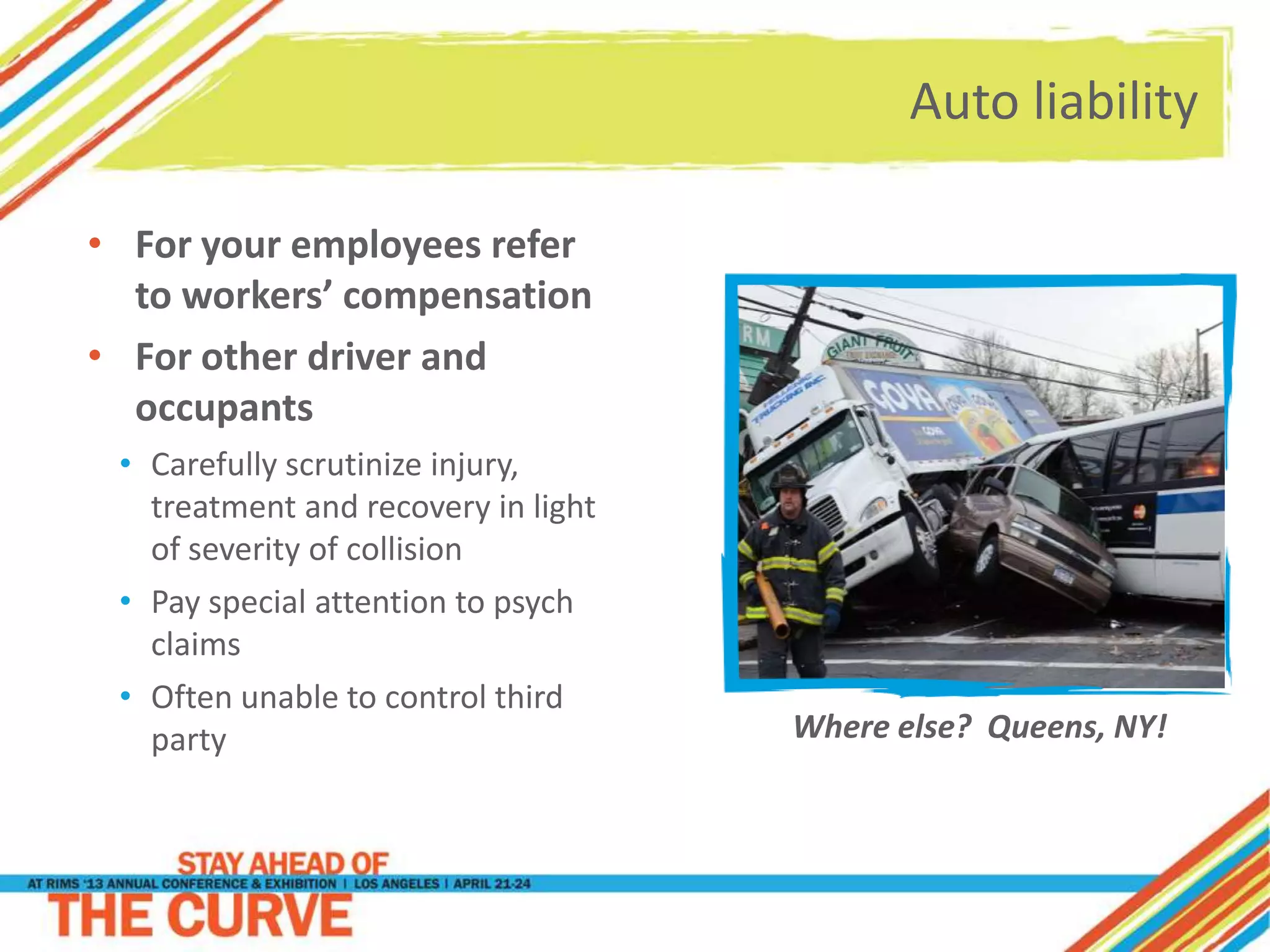
party Where else? Queens, NY!
Litigation management
Workers’ compensation
General liability
• Work with counsel, share all information available, statements, photos,
claim, previous history of claims from claimant, problems with the site
• Defend or negotiate a settlement - take a position
• Attend settlement/mediation hearings, have pre-arranged range of
agreed upon values
• Let the attorney do the talking - but make sure you understand what he is
saying and why
• Stay away from jury trials in unfriendly venues bent on giving away your
client’s money
• Be ready for day of haggling - it’s an art - learn it!
• 90% of claims can resolve prior to court
Auto liability
Ability of adjuster to
resolve matter prior
to litigation
• Settle non-disputed
portions of the claim
Settle v. litigate -
what is your
preference
Work with a team of
trained legal
professionals familiar
with your business
• Clear understanding of
your legal strategies
Resolution
Workers’ compensation
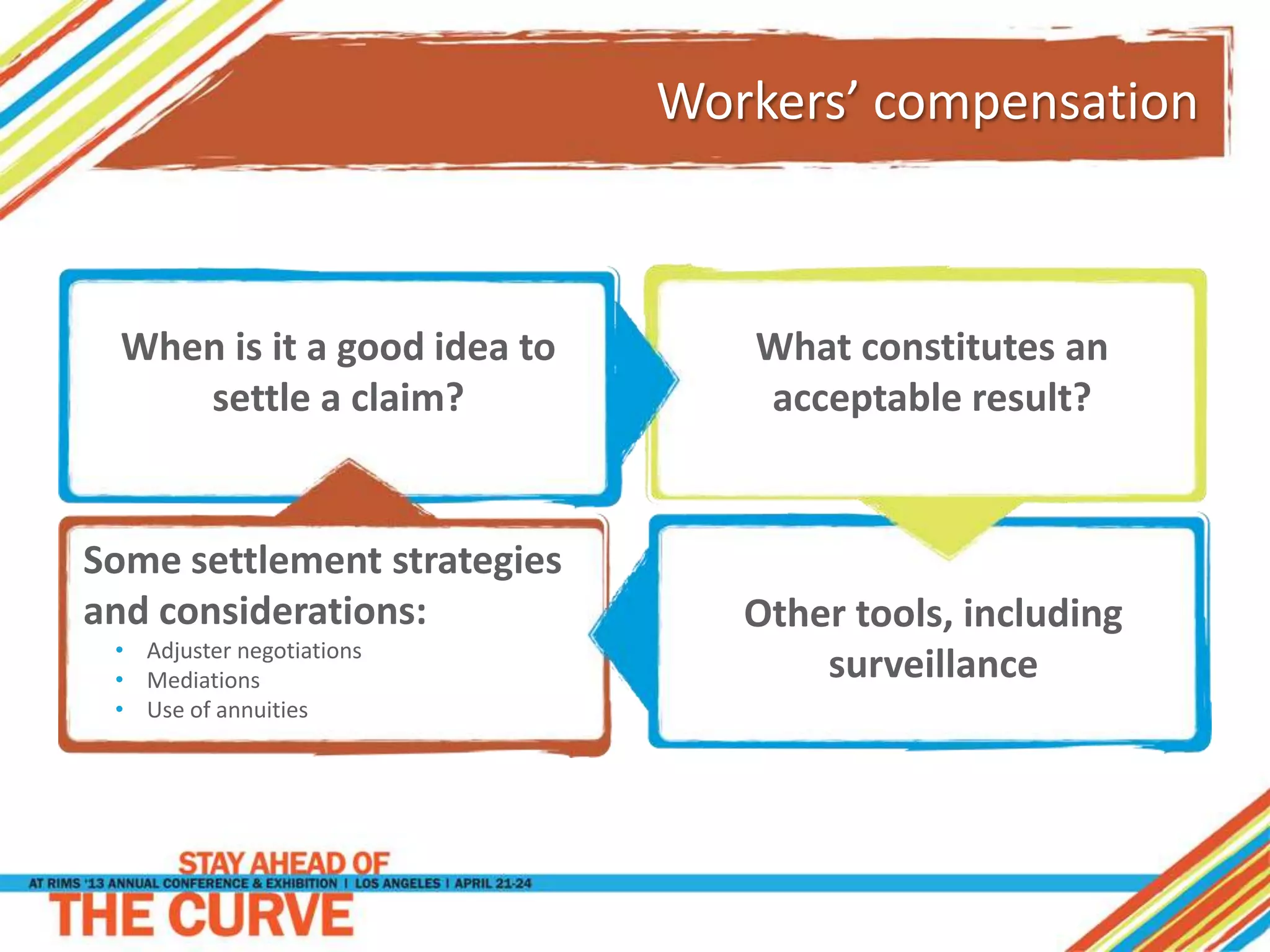
Some settlement strategies
and considerations:
• Adjuster negotiations
• Mediations
• Use of annuities
When is it a good idea to
settle a claim?
What constitutes an
acceptable result?
Other tools, including
surveillance
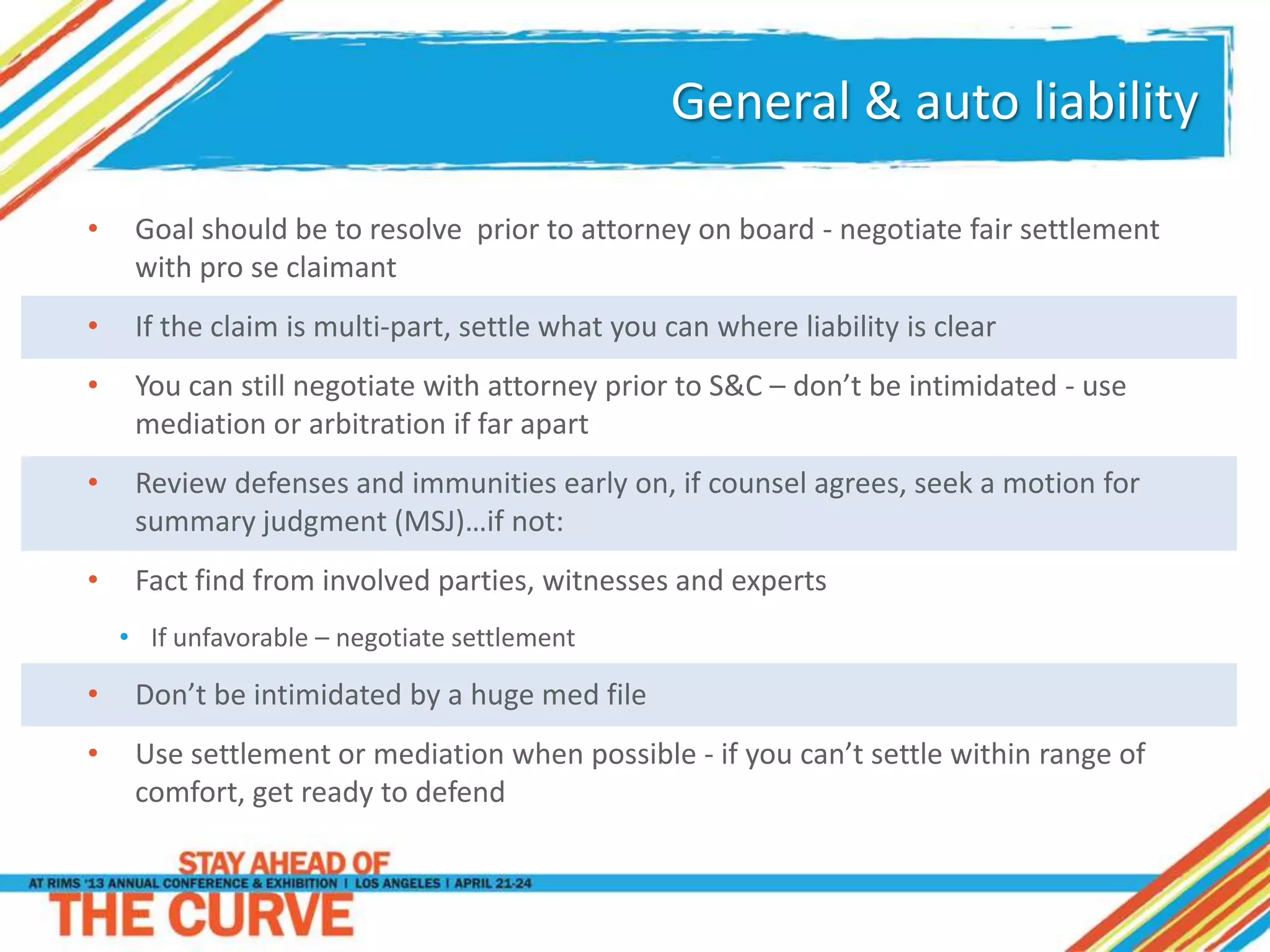
General & auto liability
• Goal should be to resolve prior to attorney on board - negotiate fair settlement
with pro se claimant
• If the claim is multi-part, settle what you can where liability is clear
• You can still negotiate with attorney prior to S&C – don’t be intimidated - use
mediation or arbitration if far apart
• Review defenses and immunities early on, if counsel agrees, seek a motion for
summary judgment (MSJ)…if not:
• Fact find from involved parties, witnesses and experts
• If unfavorable – negotiate settlement
• Don’t be intimidated by a huge med file
• Use settlement or mediation when possible - if you can’t settle within range of
comfort, get ready to defend
Updates and developments
Fundamentals of Claims Management

Fundamentals of Claims Management

  • 1.
    Jeff Brody Divisional SafetyDirector, Pepsi Cola Bottling Company of New York Kathy Tazic Senior Vice President, Client Services, Sedgwick Vicki Telford Director, Global Insurance and Risk Management, Hanesbrands Inc. Tuesday, April 23, 2013 Session Time: 2:15 to 3:30 p.m.
  • 2.
    Agenda • Claims investigation •Medical management • Disability management • Litigation management • Resolution • Updates and developments • Q&A
  • 3.
  • 4.
    Workers’ compensation • Whatare the most important aspects of the claims investigation process? • Timely witness interviews • Detailed written report • Recorded statements where appropriate • Evidence • Why investigate a claim?
  • 5.
    Workers’ compensation • Questionsrevolve around these four basic elements and their relationship to one another • Develop a good checklist that helps identify the pieces of the accident “puzzle” and how they fit together • Job safety analyses (JSAs) can be very helpful by providing the foundation of the investigation
  • 6.
    Workers’ compensation • Oncethe information is gathered, it’s time to get it off to your TPA or insurance adjuster • Ask 5 “W” questions: who, what, where, when and, most importantly, why • Team approach usually works best • Take pictures and get prompt interviews • Root causes sometimes are elusive, but without them, it’s Groundhog Day!
  • 7.
    Workers’ compensation costof reporting lag $0 $2,000 $4,000 $6,000 $8,000 $10,000 $12,000 < 3 Days 3 to 7 Days 8 to 13 Days 14 - 30 Days > 30 Days WC Average Cost WC Average Cost
  • 8.
    General liability • Workfrom a checklist • Develop/ personalize your form • Team effort with insured is critical • Always keep fraud in your process • Get a statement from claimant, written or recorded very early on before they lawyer-up
  • 9.
    General liability Try tosecure information from multiple sources Look at the scene, take photos, is there a defect, was there notice? - get internal report Anyone working in the area? - canvas for witnesses Did claimant contribute to the event? Was it a product that caused the accident - who made it? Cameras are everywhere these days!
  • 10.
    Auto liability • Paperwork– where is the form • Pedestrians, bicyclists, skateboarders • On-scene pix are essential • Fraud – huge issue in auto liability • By the way, whose fault is it – witnesses • Drivers and other occupants
  • 11.
    Auto liability • Responders •Police, fire, EMS • Accident reconstruction • Property damage experts • Distracted driving - telematics (technology to capture real-time info) • Comparative negligence • Arbitration - we need another set of eyes and ears
  • 13.
  • 14.
    Workers’ compensation • Rolesand responsibilities • Adjuster • Nurse case manager • Utilization review • Pharmacy benefit management • What is it and why is it critical? • Examples of medical management tools
  • 15.
    General liability • Sometimeswe will get a second medical opinion on necessity of all treatment, issue of tangential injuries, soft tissue claims and maximum medical improvement or future care but this is usually later in the claim • Check for priors - do an ISO search - never know what will turn up - there are way too many ‘professionals’ out there! • Seldom do we get to manage medical treatment
  • 16.
    Auto liability • Medicalmanagement of your employees will be pursuant to workers’ compensation • No fault - an opportunity for medical mills to do their $$$ thing • Not much opportunity to manage driver/other occupants • HIPPA laws prevent prying eyes • Use activity checks – know who your claimant is and what type of lifestyle they are leading
  • 17.
  • 18.
  • 19.
    General liability • Mayrequire second medical opinion, life care plan, modifications to home or vehicle • Ongoing physical therapy, prosthesis, home care may be warranted • Settlement may need Medicare approval • Disability does not mean the end
  • 20.
    Auto liability • Foryour employees refer to workers’ compensation • For other driver and occupants • Carefully scrutinize injury, treatment and recovery in light of severity of collision • Pay special attention to psych claims • Often unable to control third party Where else? Queens, NY!
  • 21.
  • 22.
  • 23.
    General liability • Workwith counsel, share all information available, statements, photos, claim, previous history of claims from claimant, problems with the site • Defend or negotiate a settlement - take a position • Attend settlement/mediation hearings, have pre-arranged range of agreed upon values • Let the attorney do the talking - but make sure you understand what he is saying and why • Stay away from jury trials in unfriendly venues bent on giving away your client’s money • Be ready for day of haggling - it’s an art - learn it! • 90% of claims can resolve prior to court
  • 24.
    Auto liability Ability ofadjuster to resolve matter prior to litigation • Settle non-disputed portions of the claim Settle v. litigate - what is your preference Work with a team of trained legal professionals familiar with your business • Clear understanding of your legal strategies
  • 25.
  • 26.
    Workers’ compensation Some settlementstrategies and considerations: • Adjuster negotiations • Mediations • Use of annuities When is it a good idea to settle a claim? What constitutes an acceptable result? Other tools, including surveillance
  • 27.
    General & autoliability • Goal should be to resolve prior to attorney on board - negotiate fair settlement with pro se claimant • If the claim is multi-part, settle what you can where liability is clear • You can still negotiate with attorney prior to S&C – don’t be intimidated - use mediation or arbitration if far apart • Review defenses and immunities early on, if counsel agrees, seek a motion for summary judgment (MSJ)…if not: • Fact find from involved parties, witnesses and experts • If unfavorable – negotiate settlement • Don’t be intimidated by a huge med file • Use settlement or mediation when possible - if you can’t settle within range of comfort, get ready to defend
  • 28.

Editor's Notes

  • #6 A Job Safety / Hazard Analysis helps in this aspect:Task – Was an unsafe work procedure used?Change in normal work conditions? Appropriate tools and materials available and used?Safety devices working? Lockout/tagout used, if applicable.Material – Was there equipment failure, and if so, what caused it to fail? Was material badly designed?Were hazardous substances present, and were they clearly identified?Was correct PPE used? Were users of PPE property trained?Was there regular maintenance of equipment?People – need to stress that you are not trying to assign blame, but you do need to explore the human factors involved, such as :Was the worker properly trained and experienced ?Physically able to perform tasks?Tired? Stressed? Health issues?What about substance abuse? – post accident testing – in many states, if EE was under the influence and it was sole cause of event, employer has a remedyIn looking at management, need to ask: were safety rules adequately communicated &amp; understood by all? Written procedures enforced? Was there adequate training and supervision?Were unsafe conditions corrected? Adequate on-boarding / OJT program if new employee?Environment – What were the weather conditions? Was poor housekeeping an issue? Was it too hot or too cold? Was excess noise a problem? Was there adequate lighting? Were hazardous gases, dust , smoke or fumes present?
  • #7 You are seeking to find the root cause(s) of the incident, and thus develop a plan to minimize the possibility of a re-occurrence. Who should be on the team? Safety managerSafety committee member(s)Injured worker’s supervisorOther supervisor familiar with the job
  • #8 Critical to get claims investigated and reported promptly. The longer you wait, the fuzzier the details become and the likelihood of attorney involvement increases.This is for med-only (first aid) and incident only, not just lost time