Department of
Mechanical
Engineering.
Prof. Malay Badodariya
+91 9429 158833
Unit no.: 2
Fundamental Of
Statics
Subject Name: FMD
01ME0305
FundamentalOfMachineDesign (01ME0504)
Unit 2: Fundamental of
Statics
(Part 1)
Topic will be cover:
1. Coplanar concurrent force system:
a) Resultant Force
b) Equilibrant Force
c) Composition Of Force
d) Parallelogram Law of Forces
e) Triangle Law of Forces
f) Resolution Of Forces
g) Resolution of more than two
concurrent forces
h) Polygon Law Of Forces
Department of Mechanical
Engineering.
Prof. Malay Badodariya
malay.badodariya@gmail.com
Unit no.: 2
Fundamental Of
Statics
Subject Name: FMD
01ME0305
a)
Resultant
Force
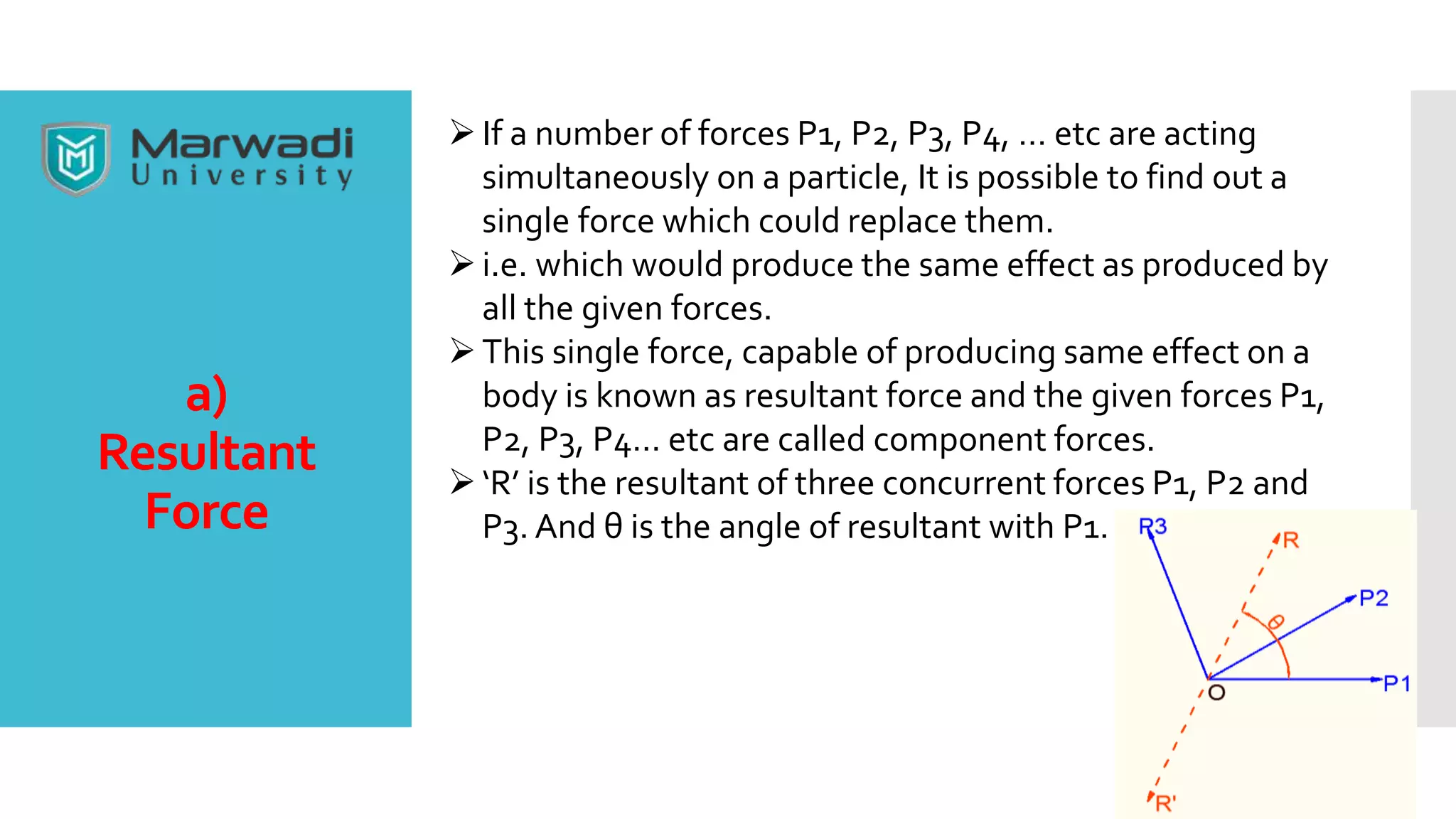
If a number of forces P1, P2, P3, P4, … etc are acting
simultaneously on a particle, It is possible to find out a
single force which could replace them.
i.e. which would produce the same effect as produced by
all the given forces.
This single force, capable of producing same effect on a
body is known as resultant force and the given forces P1,
P2, P3, P4… etc are called component forces.
‘R’ is the resultant of three concurrent forces P1, P2 and
P3. And θ is the angle of resultant with P1.
Topic will be cover:
1. Coplanar concurrent force system:
a) Resultant Force
b) Equilibrant Force
c) Composition Of Force
d) Parallelogram Law of Forces
e) Triangle Law of Forces
f) Resolution Of Forces
g) Resolution of more than two
concurrent forces
h) Polygon Law Of Forces
Department of Mechanical
Engineering.
Prof. Malay Badodariya
malay.badodariya@marwadie
ducation.edu.in
Unit no.: 2
Fundamental Of
Statics
Subject Name: FMD
01ME0305
b)
Equilibrant
Force
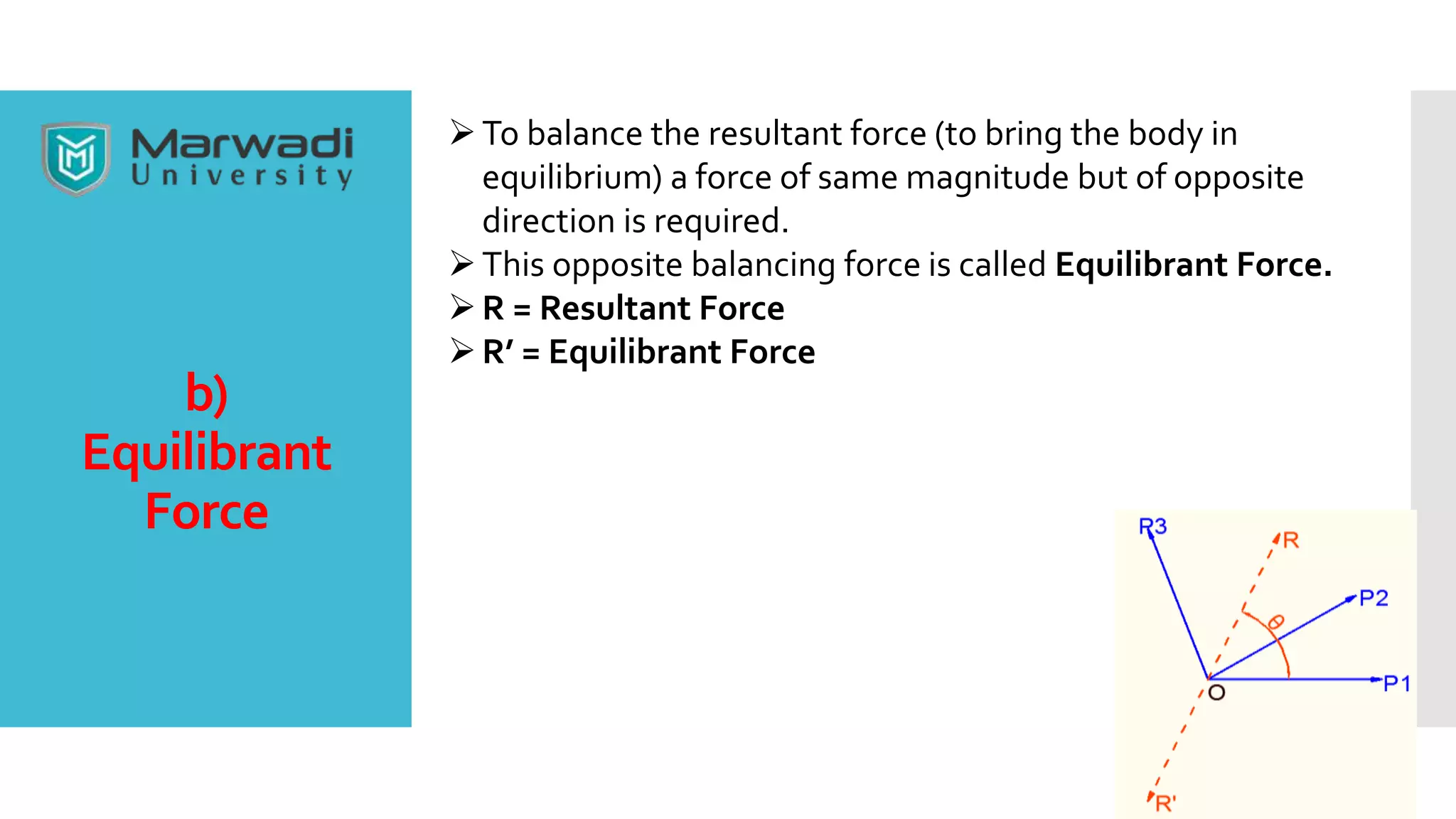
To balance the resultant force (to bring the body in
equilibrium) a force of same magnitude but of opposite
direction is required.
This opposite balancing force is called Equilibrant Force.
R = Resultant Force
R’ = Equilibrant Force
Topic will be cover:
1. Coplanar concurrent force system:
a) Resultant Force
b) Equilibrant Force
c) Composition Of Force
d) Parallelogram Law of Forces
e) Triangle Law of Forces
f) Resolution Of Forces
g) Resolution of more than two
concurrent forces
h) Polygon Law Of Forces
Department of Mechanical
Engineering.
Prof. Malay Badodariya
malay.badodariya@marwadie
ducation.edu.in
Unit no.: 2
Fundamental Of
Statics
Subject Name: FMD
01ME0305
c)
Composition
Of Force
The process of finding out resultant force of a number of
given forces is called composition of forces.
MethodOf Resultant
Forces
Analytical
Method
Parallelogram
law of forces
Resolution of
Forces
Triangle law of
forces
Graphical
Method
Triangle law of
forces
Polygon law
of forces
Topic will be cover:
1. Coplanar concurrent force system:
a) Resultant Force
b) Equilibrant Force
c) Composition Of Force
d) Parallelogram Law of Forces
e) Triangle Law of Forces
f) Resolution Of Forces
g) Resolution of more than two
concurrent forces
h) Polygon Law Of Forces
Department of Mechanical
Engineering.
Prof. Malay Badodariya
malay.badodariya@marwadie
ducation.edu.in
Unit no.: 2
Fundamental Of
Statics
Subject Name: FMD
01ME0305
d)
Parallelogram
Law of Forces
 “This law states that two forces acting on a particle may
be replaced by a single force (called resultant of the two
forces) obtained by drawing the diagonal of a
parallelogram whose two adjacent sides are equal to the
given two forces.”
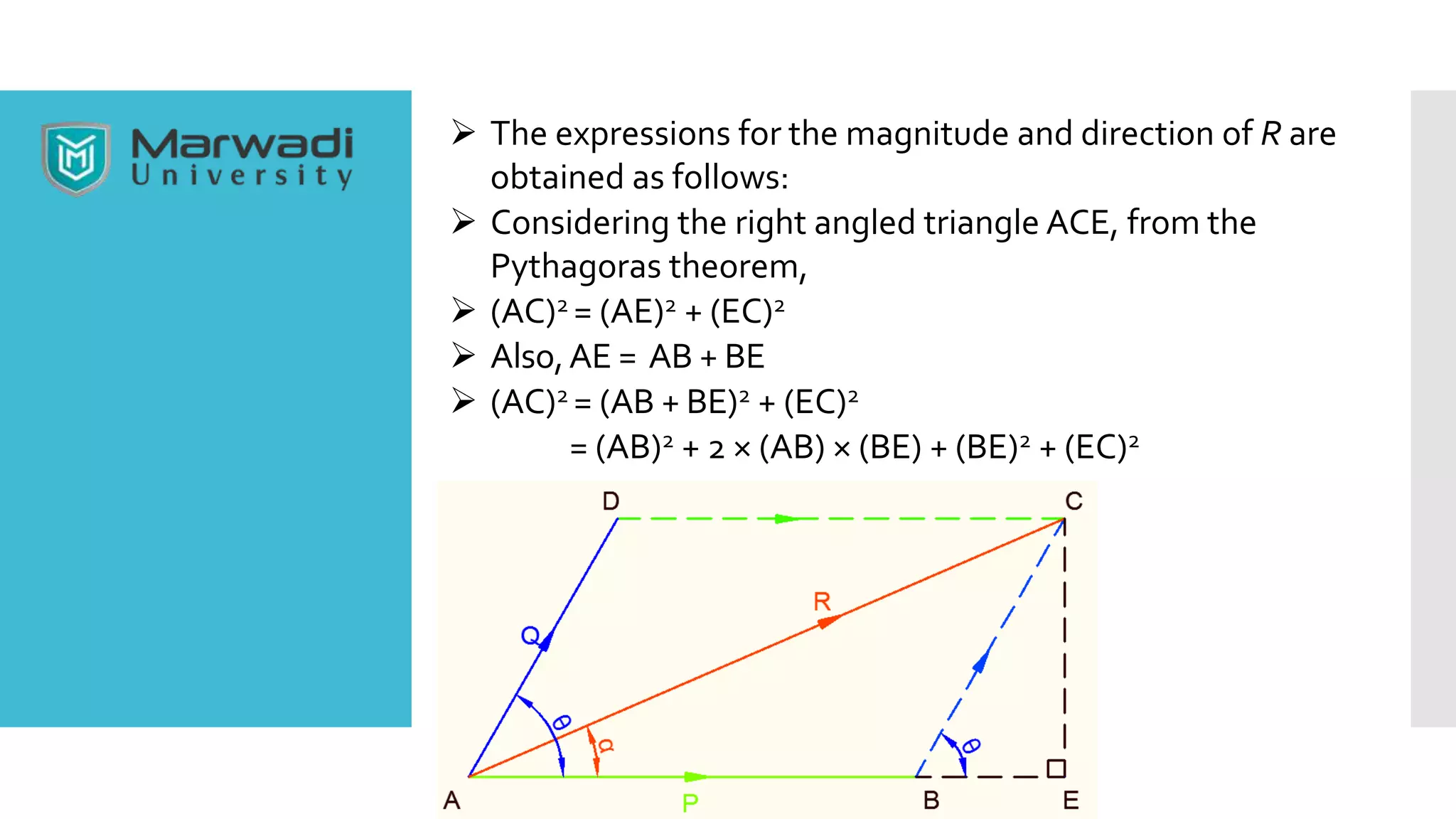
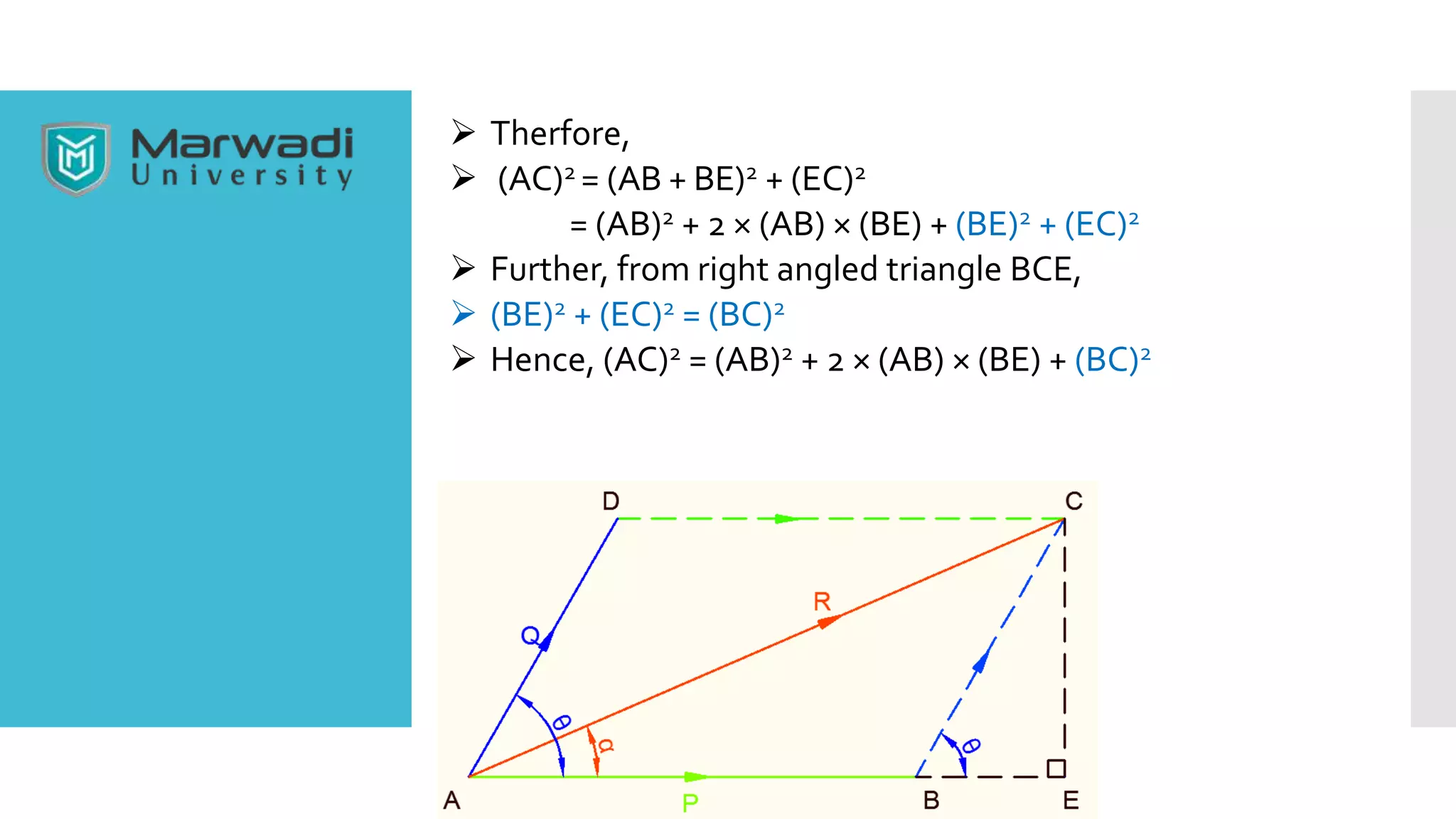
 Let P and Q be two forces acting on a particle A as
shown in Fig.
 Constructing a parallelogram ABCD taking P and Q as its
adjacent sides, the diagonal AC gives the resultant
force R of the two forces P and Q.
 The expressions for the magnitude and direction of R are
obtained as follows:
 Considering the right angled triangle ACE, from the
Pythagoras theorem,
 (AC)2 = (AE)2 + (EC)2
 Also,AE = AB + BE
 (AC)2 = (AB + BE)2 + (EC)2
= (AB)2 + 2 × (AB) × (BE) + (BE)2 + (EC)2
 Therfore,
 (AC)2 = (AB + BE)2 + (EC)2
= (AB)2 + 2 × (AB) × (BE) + (BE)2 + (EC)2
 Further, from right angled triangle BCE,
 (BE)2 + (EC)2 = (BC)2
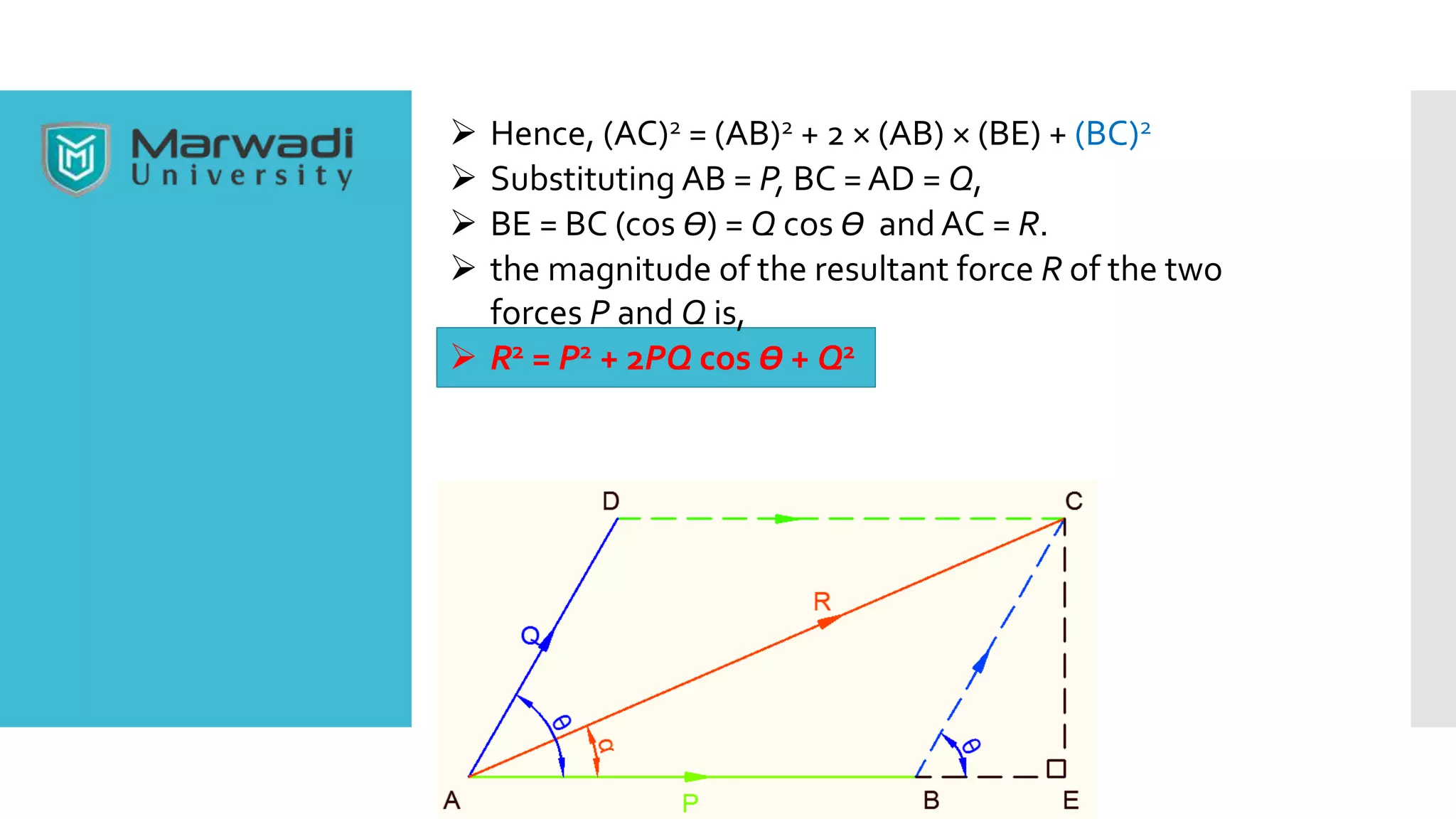
 Hence, (AC)2 = (AB)2 + 2 × (AB) × (BE) + (BC)2
 Substituting AB = P, BC = AD = Q,
 BE = BC (cos Ө) = Q cos Ө and AC = R.
 the magnitude of the resultant force R of the two
forces P and Q is,
 R2 = P2 + 2PQ cos Ө + Q2
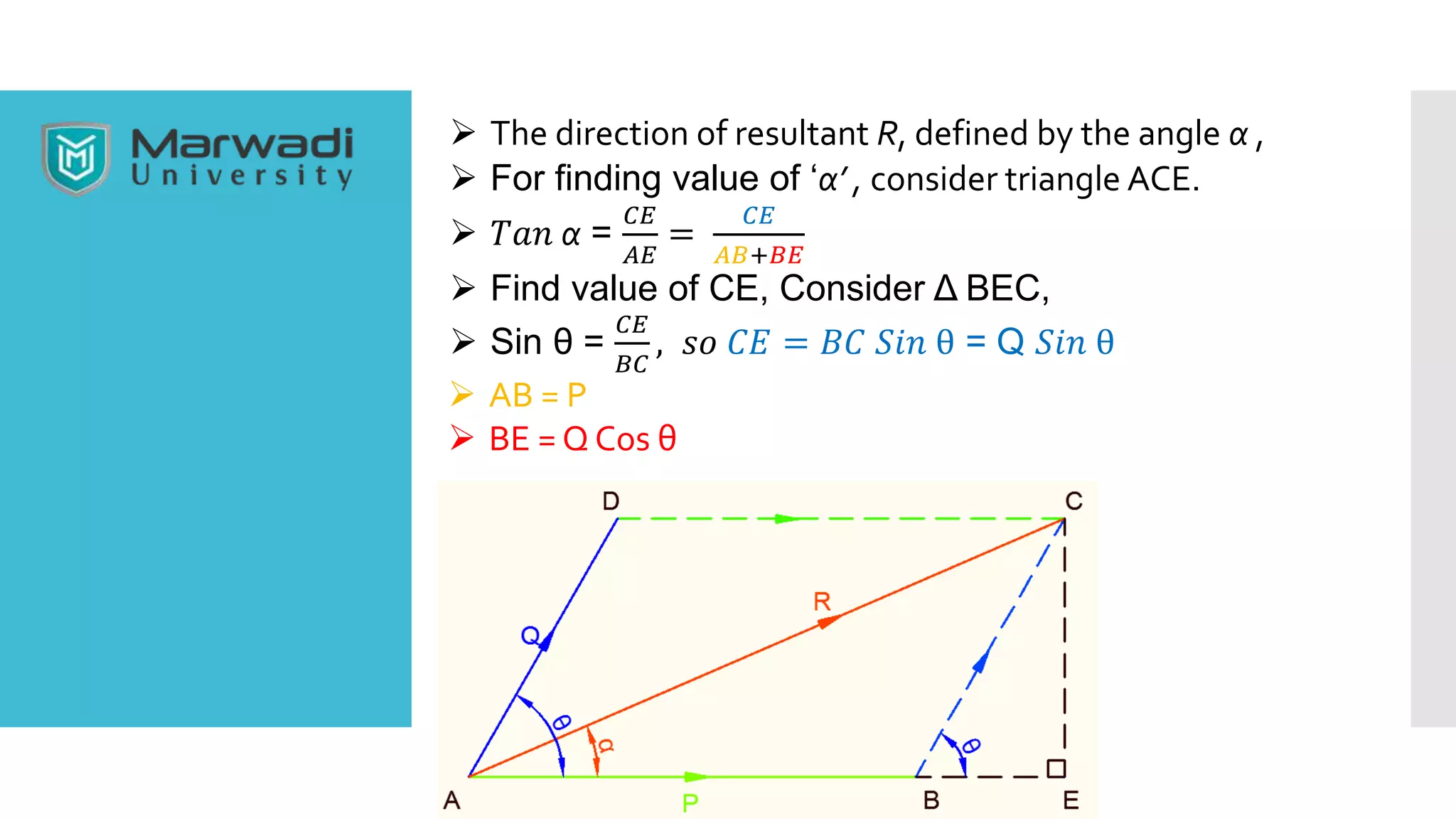
 The direction of resultant R, defined by the angle α ,
 For finding value of ‘α’ , consider triangle ACE.
 𝑇𝑎𝑛 α =
𝐶𝐸
𝐴𝐸
=
𝐶𝐸
𝐴𝐵+𝐵𝐸
 Find value of CE, Consider Δ BEC,
 Sin θ =
𝐶𝐸
𝐵𝐶
, 𝑠𝑜 𝐶𝐸 = 𝐵𝐶 𝑆𝑖𝑛 θ = Q 𝑆𝑖𝑛 θ
 AB = P
 BE = Q Cos θ
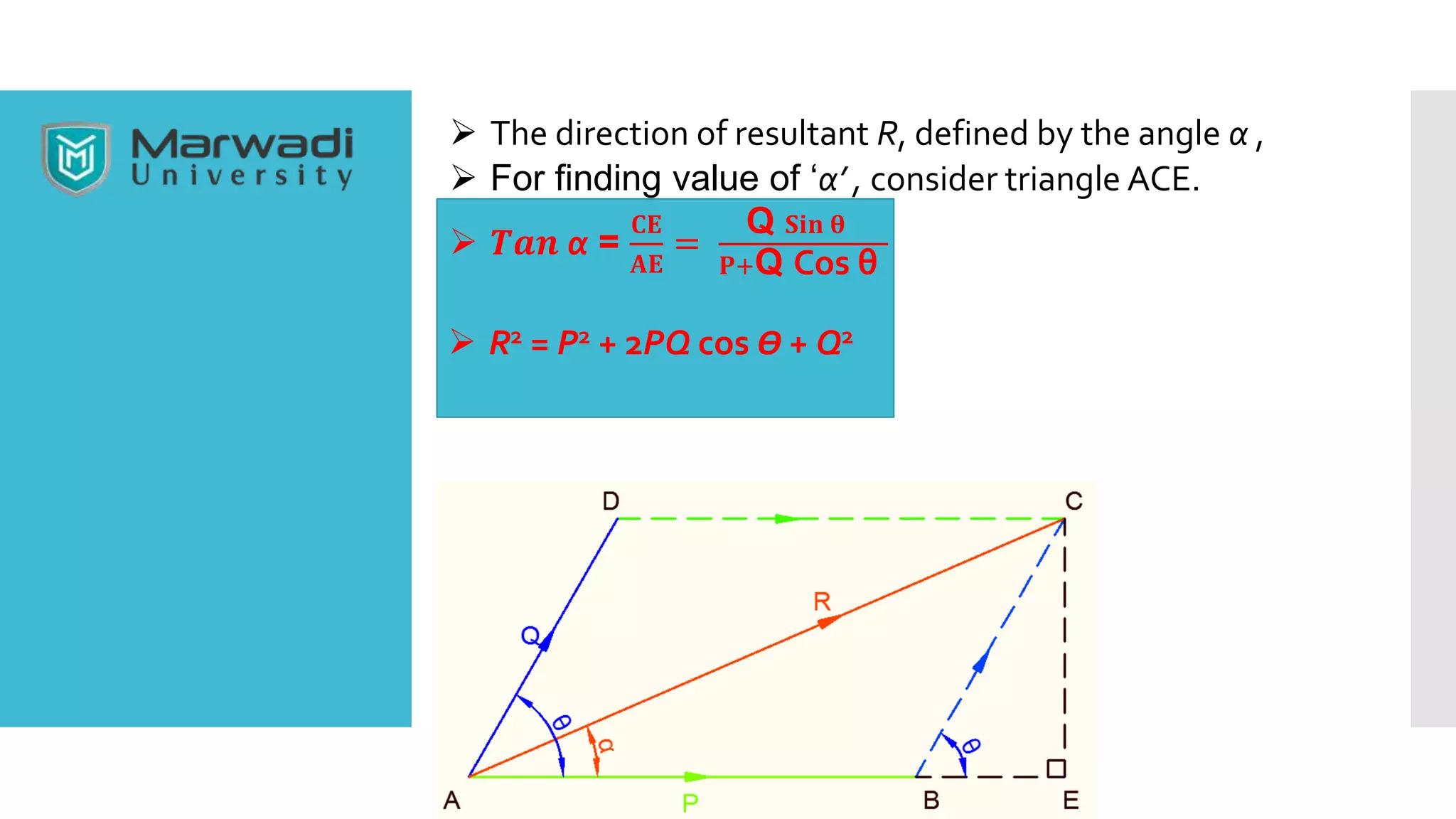
 The direction of resultant R, defined by the angle α ,
 For finding value of ‘α’ , consider triangle ACE.
 𝑻𝒂𝒏 α =
𝐂𝐄
𝐀𝐄
=
Q 𝐒𝐢𝐧 𝛉
𝐏+Q Cos θ
 R2 = P2 + 2PQ cos Ө + Q2
Example on Parallelogram Law of Forces
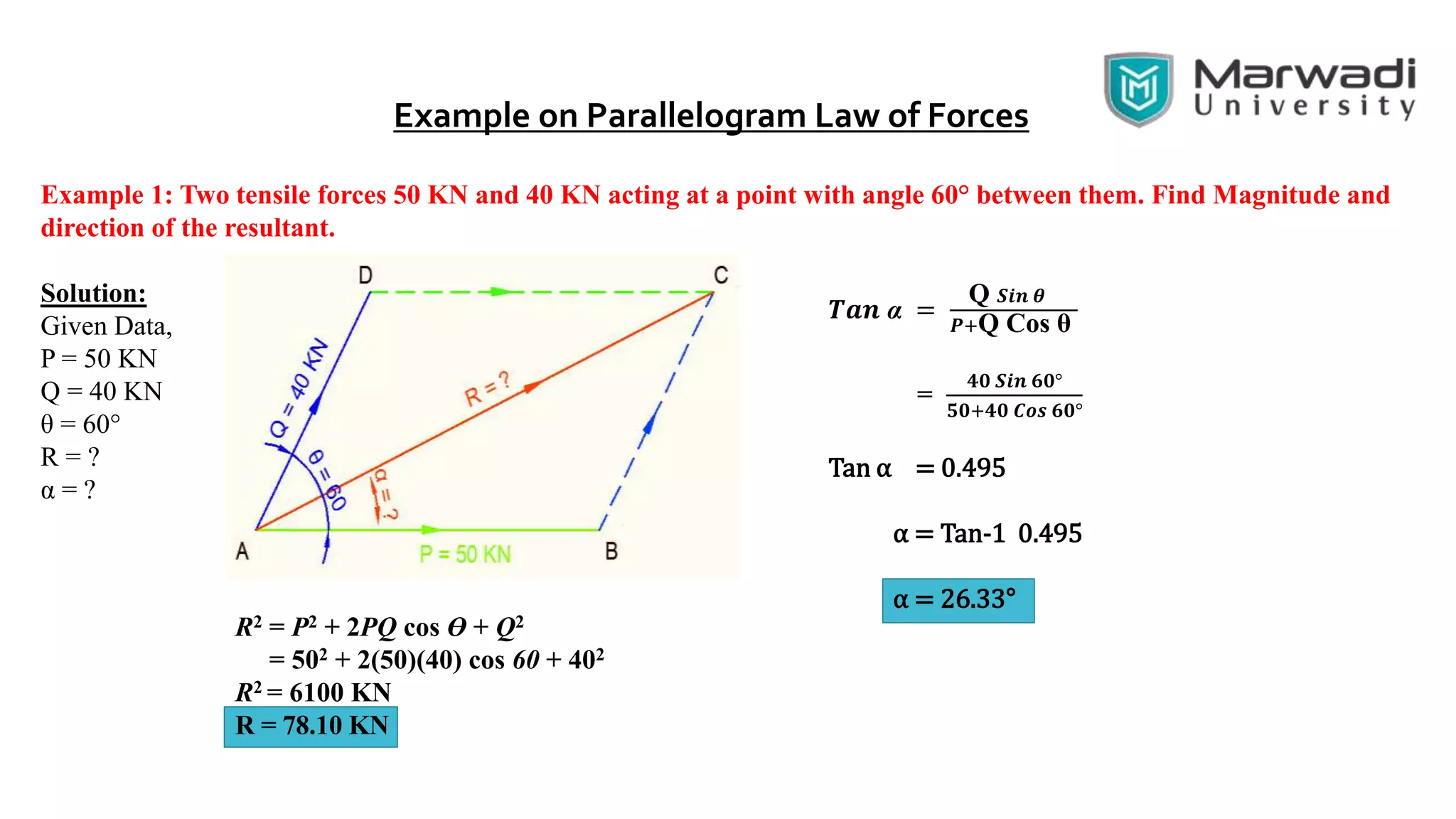
Example 1: Two tensile forces 50 KN and 40 KN acting at a point with angle 60° between them. Find Magnitude and
direction of the resultant.
Solution:
Given Data,
P = 50 KN
Q = 40 KN
θ = 60°
R = ?
α = ?
R2 = P2 + 2PQ cos Ө + Q2
= 502 + 2(50)(40) cos 60 + 402
R2 = 6100 KN
R = 78.10 KN
𝑻𝒂𝒏 α =
Q 𝑺𝒊𝒏 𝜽
𝑷+Q Cos θ
=
𝟒𝟎 𝑺𝒊𝒏 𝟔𝟎°
𝟓𝟎+𝟒𝟎 𝑪𝒐𝒔 𝟔𝟎°
Tan α = 0.495
α = Tan-1 0.495
α = 26.33°
Example on Parallelogram Law of Forces
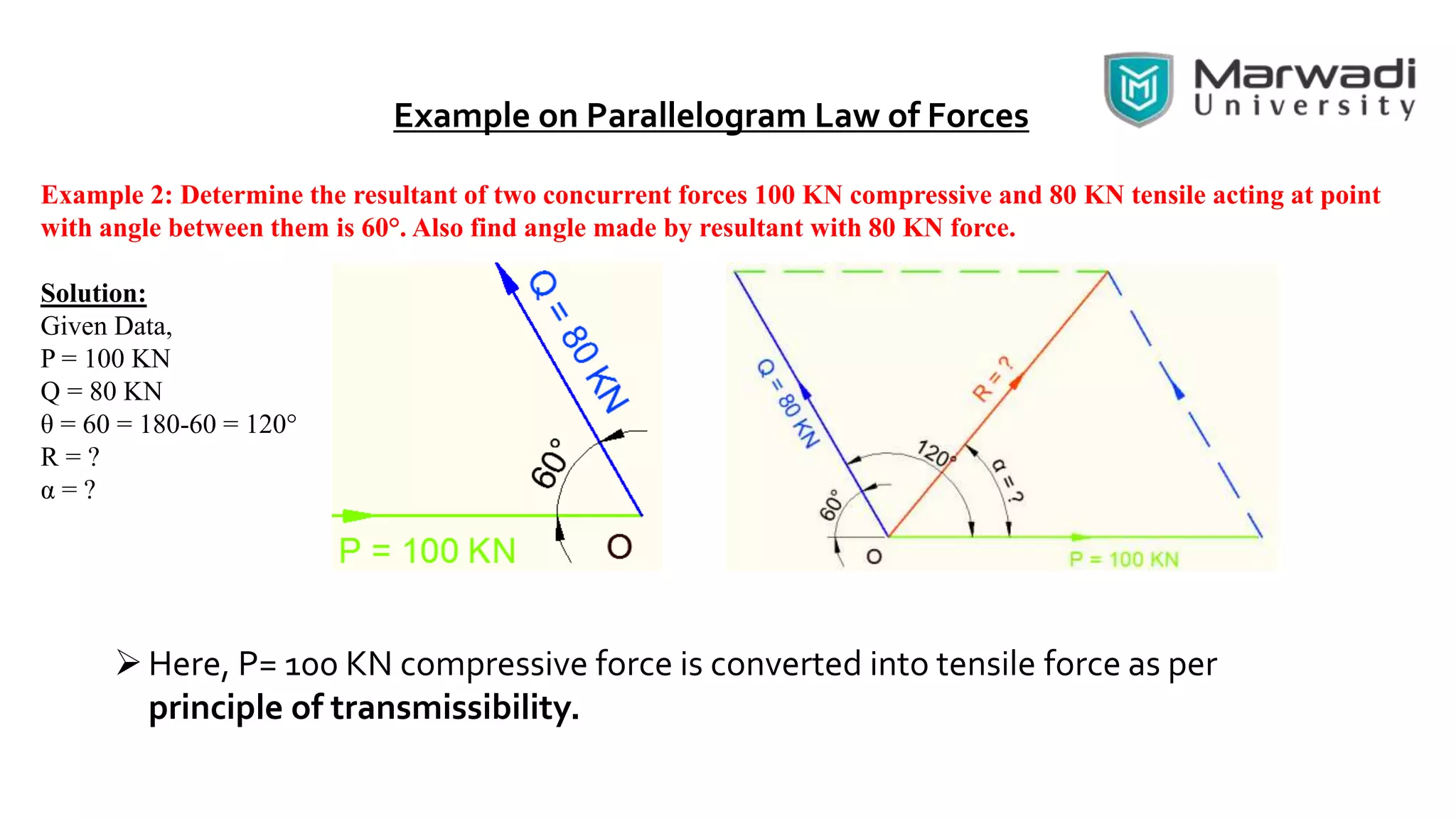
Example 2: Determine the resultant of two concurrent forces 100 KN compressive and 80 KN tensile acting at point
with angle between them is 60°. Also find angle made by resultant with 80 KN force.
Solution:
Given Data,
P = 100 KN
Q = 80 KN
θ = 60 = 180-60 = 120°
R = ?
α = ?
Here, P= 100 KN compressive force is converted into tensile force as per
principle of transmissibility.
Example on Parallelogram Law of Forces
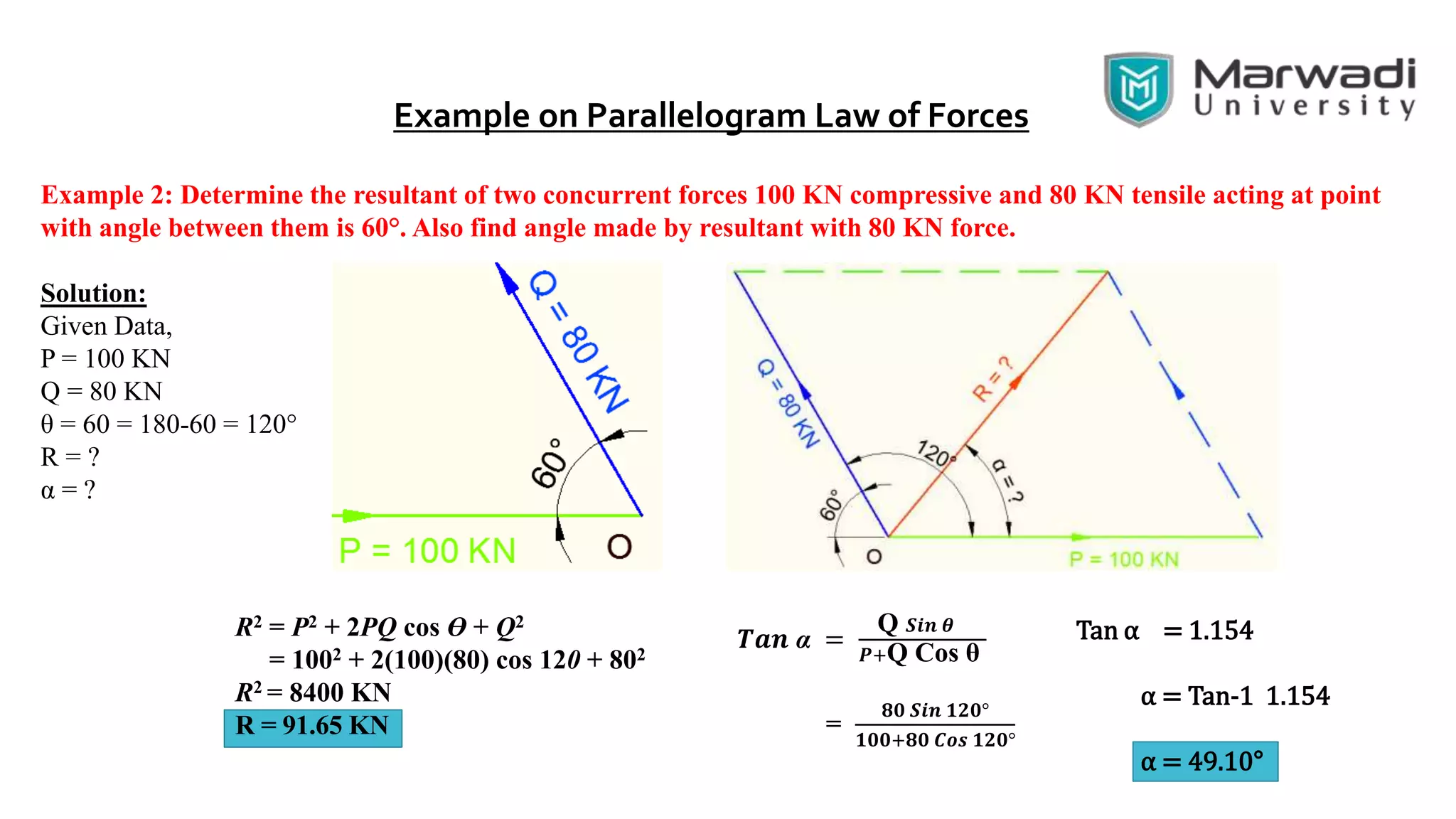
Example 2: Determine the resultant of two concurrent forces 100 KN compressive and 80 KN tensile acting at point
with angle between them is 60°. Also find angle made by resultant with 80 KN force.
Solution:
Given Data,
P = 100 KN
Q = 80 KN
θ = 60 = 180-60 = 120°
R = ?
α = ?
R2 = P2 + 2PQ cos Ө + Q2
= 1002 + 2(100)(80) cos 120 + 802
R2 = 8400 KN
R = 91.65 KN
𝑻𝒂𝒏 α =
Q 𝑺𝒊𝒏 𝜽
𝑷+Q Cos θ
=
𝟖𝟎 𝑺𝒊𝒏 𝟏𝟐𝟎°
𝟏𝟎𝟎+𝟖𝟎 𝑪𝒐𝒔 𝟏𝟐𝟎°
Tan α = 1.154
α = Tan-1 1.154
α = 49.10°
Example on Parallelogram Law of Forces
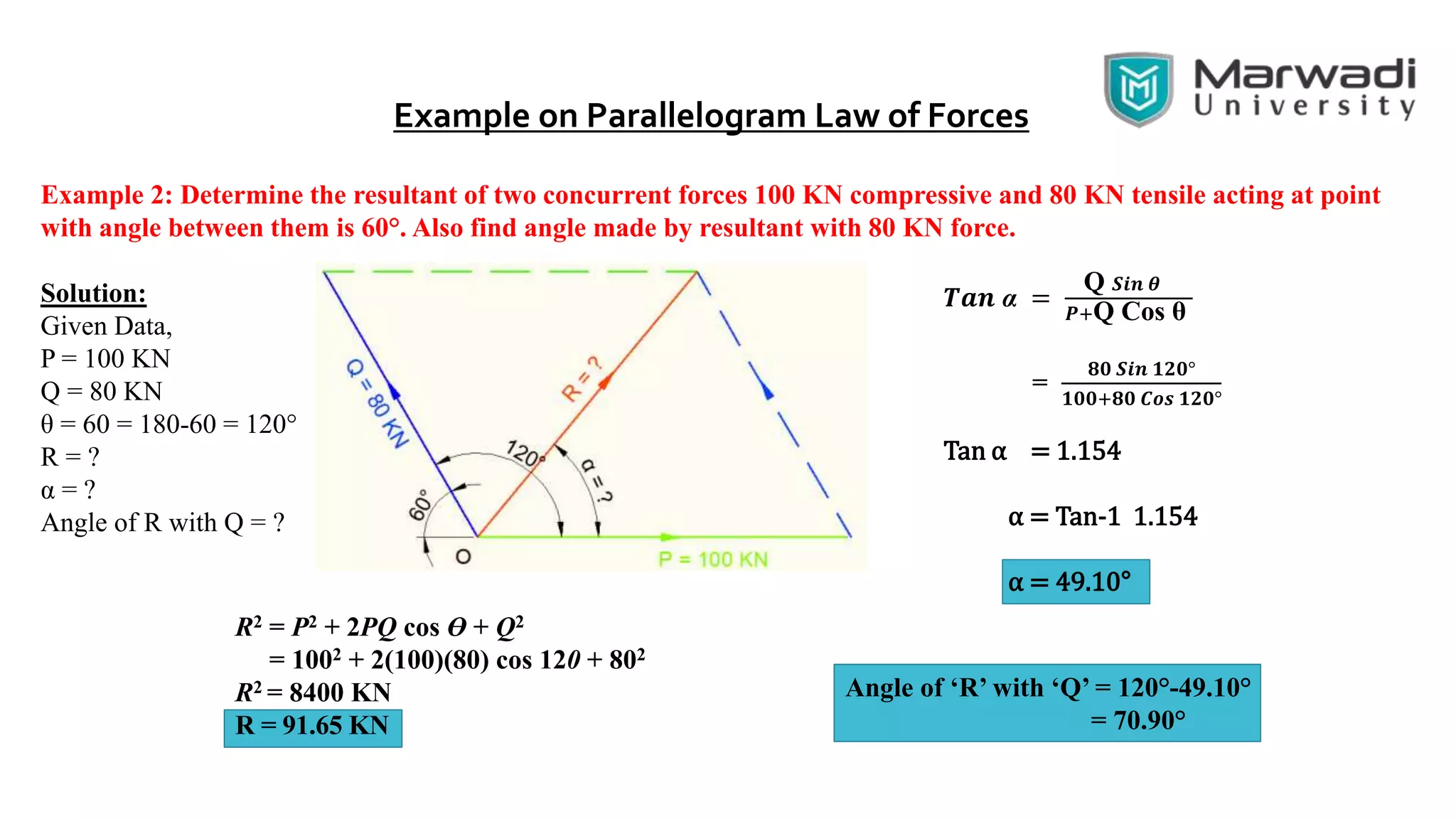
Example 2: Determine the resultant of two concurrent forces 100 KN compressive and 80 KN tensile acting at point
with angle between them is 60°. Also find angle made by resultant with 80 KN force.
Solution:
Given Data,
P = 100 KN
Q = 80 KN
θ = 60 = 180-60 = 120°
R = ?
α = ?
Angle of R with Q = ?
R2 = P2 + 2PQ cos Ө + Q2
= 1002 + 2(100)(80) cos 120 + 802
R2 = 8400 KN
R = 91.65 KN
𝑻𝒂𝒏 α =
Q 𝑺𝒊𝒏 𝜽
𝑷+Q Cos θ
=
𝟖𝟎 𝑺𝒊𝒏 𝟏𝟐𝟎°
𝟏𝟎𝟎+𝟖𝟎 𝑪𝒐𝒔 𝟏𝟐𝟎°
Tan α = 1.154
α = Tan-1 1.154
α = 49.10°
Angle of ‘R’ with ‘Q’ = 120°-49.10°
= 70.90°
Example on Parallelogram Law of Forces
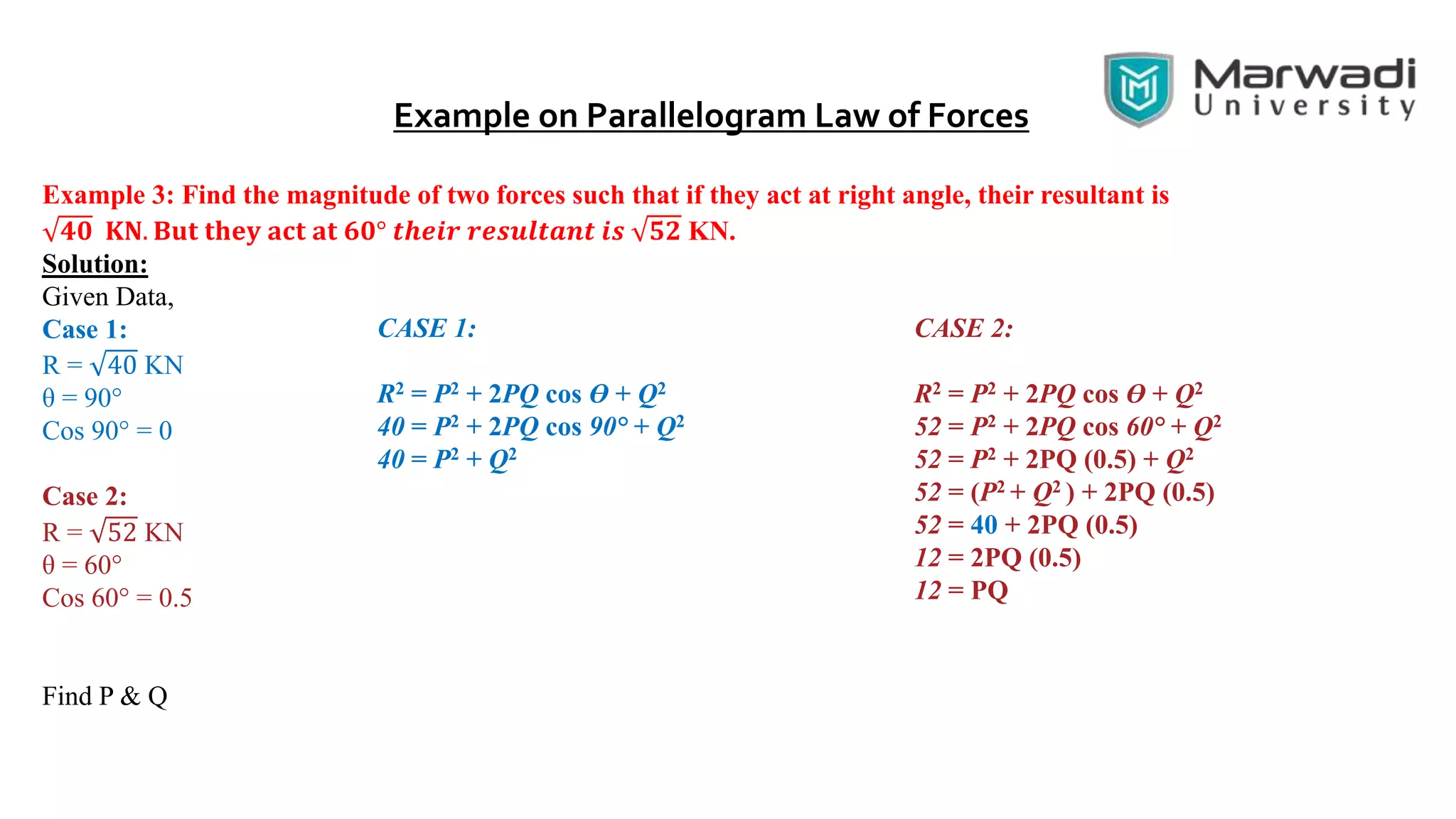
Example 3: Find the magnitude of two forces such that if they act at right angle, their resultant is
𝟒𝟎 𝐊𝐍. 𝐁𝐮𝐭 𝐭𝐡𝐞𝐲 𝐚𝐜𝐭 𝐚𝐭 𝟔𝟎° 𝒕𝒉𝒆𝒊𝒓 𝒓𝒆𝒔𝒖𝒍𝒕𝒂𝒏𝒕 𝒊𝒔 𝟓𝟐 KN.
Solution:
Given Data,
Case 1:
R = 40 KN
θ = 90°
Cos 90° = 0
Case 2:
R = 52 KN
θ = 60°
Cos 60° = 0.5
Find P & Q
CASE 1:
R2 = P2 + 2PQ cos Ө + Q2
40 = P2 + 2PQ cos 90° + Q2
40 = P2 + Q2
CASE 2:
R2 = P2 + 2PQ cos Ө + Q2
52 = P2 + 2PQ cos 60° + Q2
52 = P2 + 2PQ (0.5) + Q2
52 = (P2 + Q2 ) + 2PQ (0.5)
52 = 40 + 2PQ (0.5)
12 = 2PQ (0.5)
12 = PQ
Example on Parallelogram Law of Forces
Example 3: Find the magnitude of two forces such that if they act at right angle, their resultant is
𝟒𝟎 𝐊𝐍. 𝐁𝐮𝐭 𝐭𝐡𝐞𝐲 𝐚𝐜𝐭 𝐚𝐭 𝟔𝟎° 𝒕𝒉𝒆𝒊𝒓 𝒓𝒆𝒔𝒖𝒍𝒕𝒂𝒏𝒕 𝒊𝒔 𝟓𝟐 KN.
Solution:
Given Data,
Case 1:
R = 40 KN
θ = 90°
Cos 90° = 0
Case 2:
R = 52 KN
θ = 60°
Cos 60° = 0.5
Find P & Q
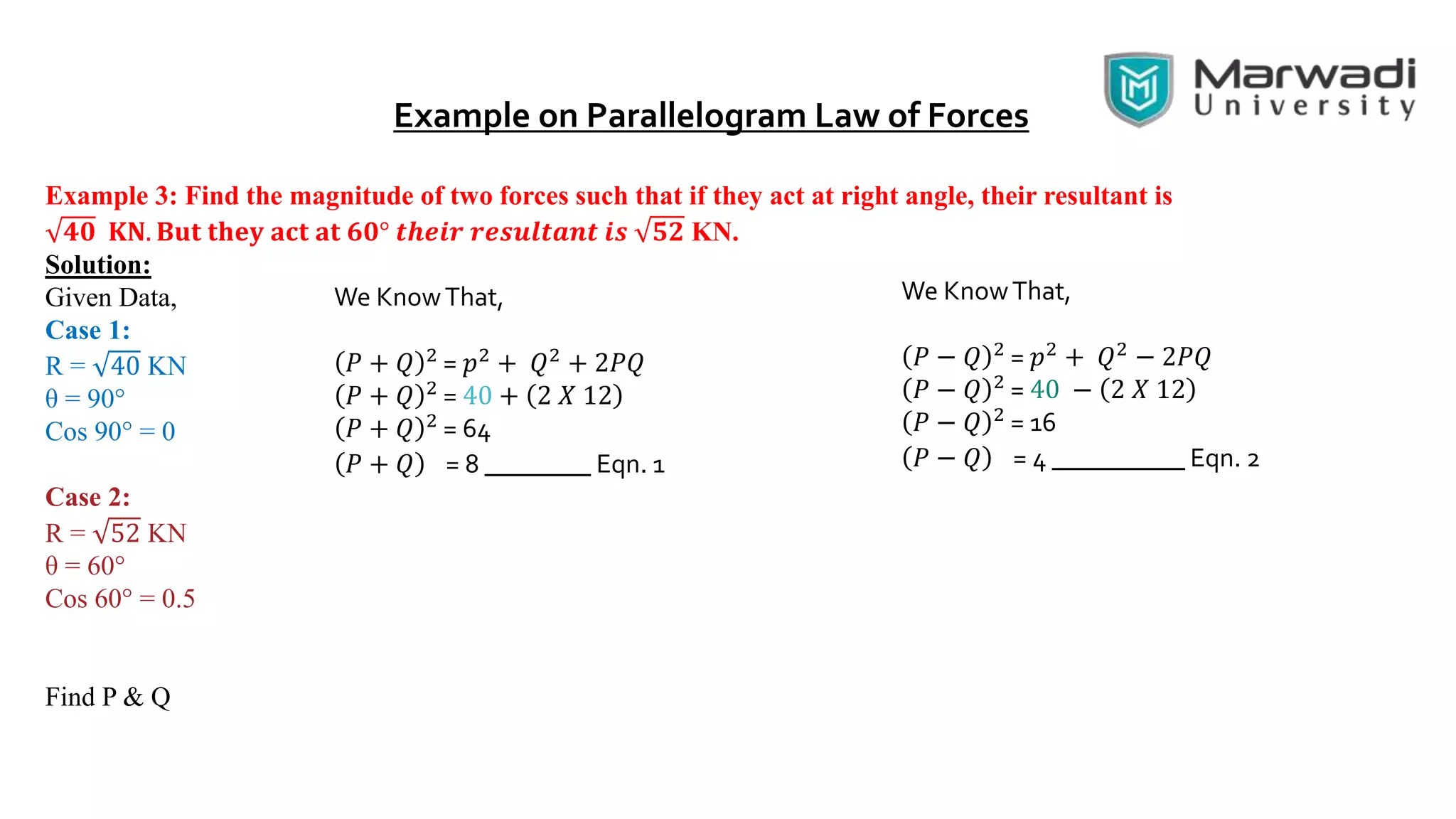
We KnowThat,
𝑃 + 𝑄 2 = 𝑝2 + 𝑄2 + 2𝑃𝑄
𝑃 + 𝑄 2
= 40 + 2 𝑋 12
𝑃 + 𝑄 2
= 64
𝑃 + 𝑄 = 8 ________ Eqn. 1
We KnowThat,
𝑃 − 𝑄 2 = 𝑝2 + 𝑄2 − 2𝑃𝑄
𝑃 − 𝑄 2
= 40 − 2 𝑋 12
𝑃 − 𝑄 2
= 16
𝑃 − 𝑄 = 4 __________ Eqn. 2
Example on Parallelogram Law of Forces
Example 3: Find the magnitude of two forces such that if they act at right angle, their resultant is
𝟒𝟎 𝐊𝐍. 𝐁𝐮𝐭 𝐭𝐡𝐞𝐲 𝐚𝐜𝐭 𝐚𝐭 𝟔𝟎° 𝒕𝒉𝒆𝒊𝒓 𝒓𝒆𝒔𝒖𝒍𝒕𝒂𝒏𝒕 𝒊𝒔 𝟓𝟐 KN.
Solution:
Given Data,
Case 1:
R = 40 KN
θ = 90°
Cos 90° = 0
Case 2:
R = 52 KN
θ = 60°
Cos 60° = 0.5
Find P & Q
We KnowThat,
𝑃 + 𝑄 2 = 𝑝2 + 𝑄2 + 2𝑃𝑄
𝑃 + 𝑄 2
= 40 + 2 𝑋 12
𝑃 + 𝑄 2
= 64
𝑃 + 𝑄 = 8 ________ Eqn. 1
We KnowThat,
𝑃 − 𝑄 2 = 𝑝2 + 𝑄2 − 2𝑃𝑄
𝑃 − 𝑄 2
= 40 − 2 𝑋 12
𝑃 − 𝑄 2
= 16
𝑃 − 𝑄 = 4 __________ Eqn. 2
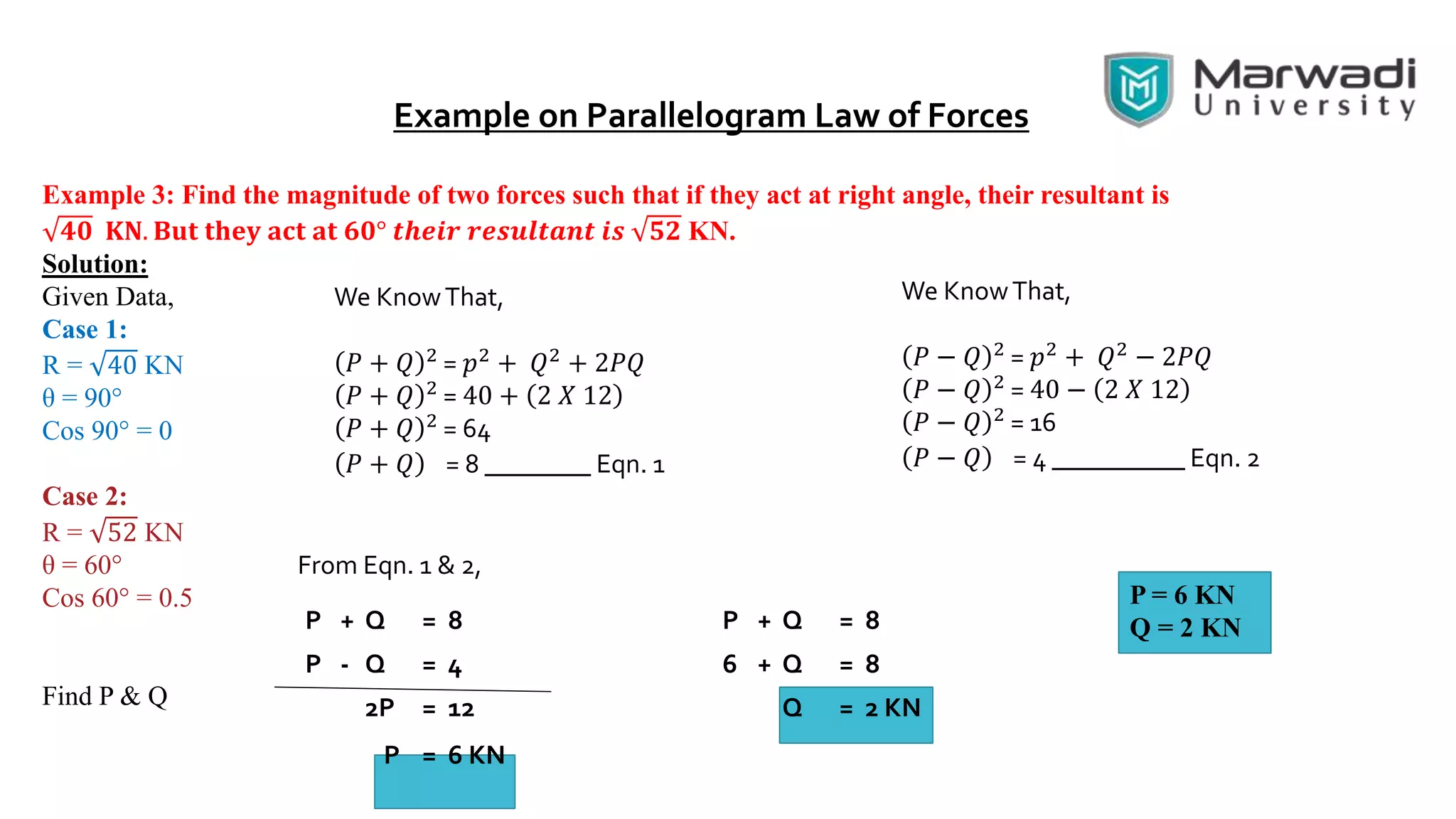
From Eqn. 1 & 2,
P + Q = 8
P - Q = 4
2P = 12
P = 6 KN
P + Q = 8
6 + Q = 8
Q = 2 KN
P = 6 KN
Q = 2 KN
Example on Parallelogram Law of Forces
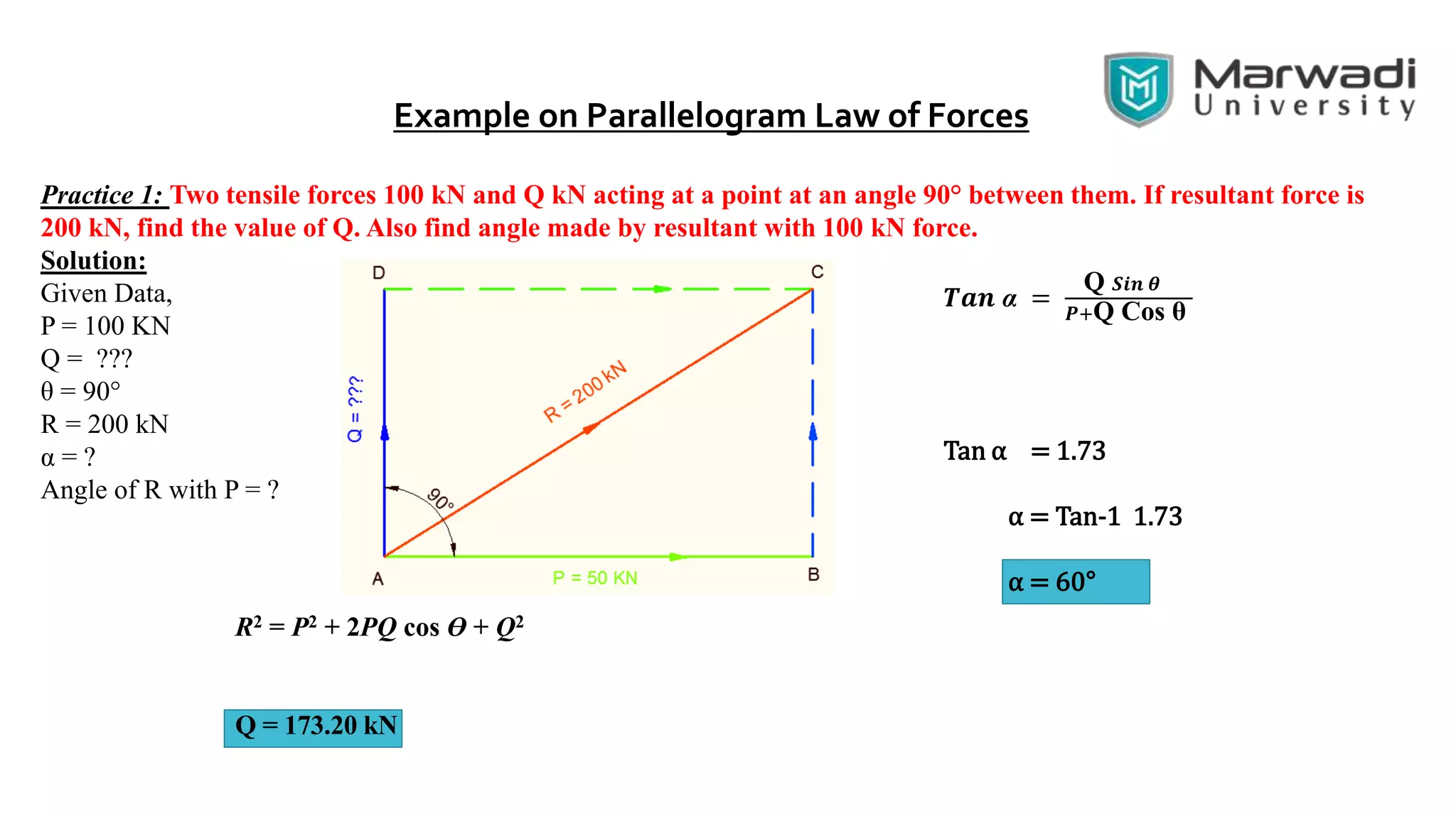
Practice 1: Two tensile forces 100 kN and Q kN acting at a point at an angle 90° between them. If resultant force is
200 kN, find the value of Q. Also find angle made by resultant with 100 kN force.
Solution:
Given Data,
P = 100 KN
Q = ???
θ = 90°
R = 200 kN
α = ?
Angle of R with P = ?
R2 = P2 + 2PQ cos Ө + Q2
Q = 173.20 kN
𝑻𝒂𝒏 α =
Q 𝑺𝒊𝒏 𝜽
𝑷+Q Cos θ
Tan α = 1.73
α = Tan-1 1.73
α = 60°
Example on Parallelogram Law of Forces
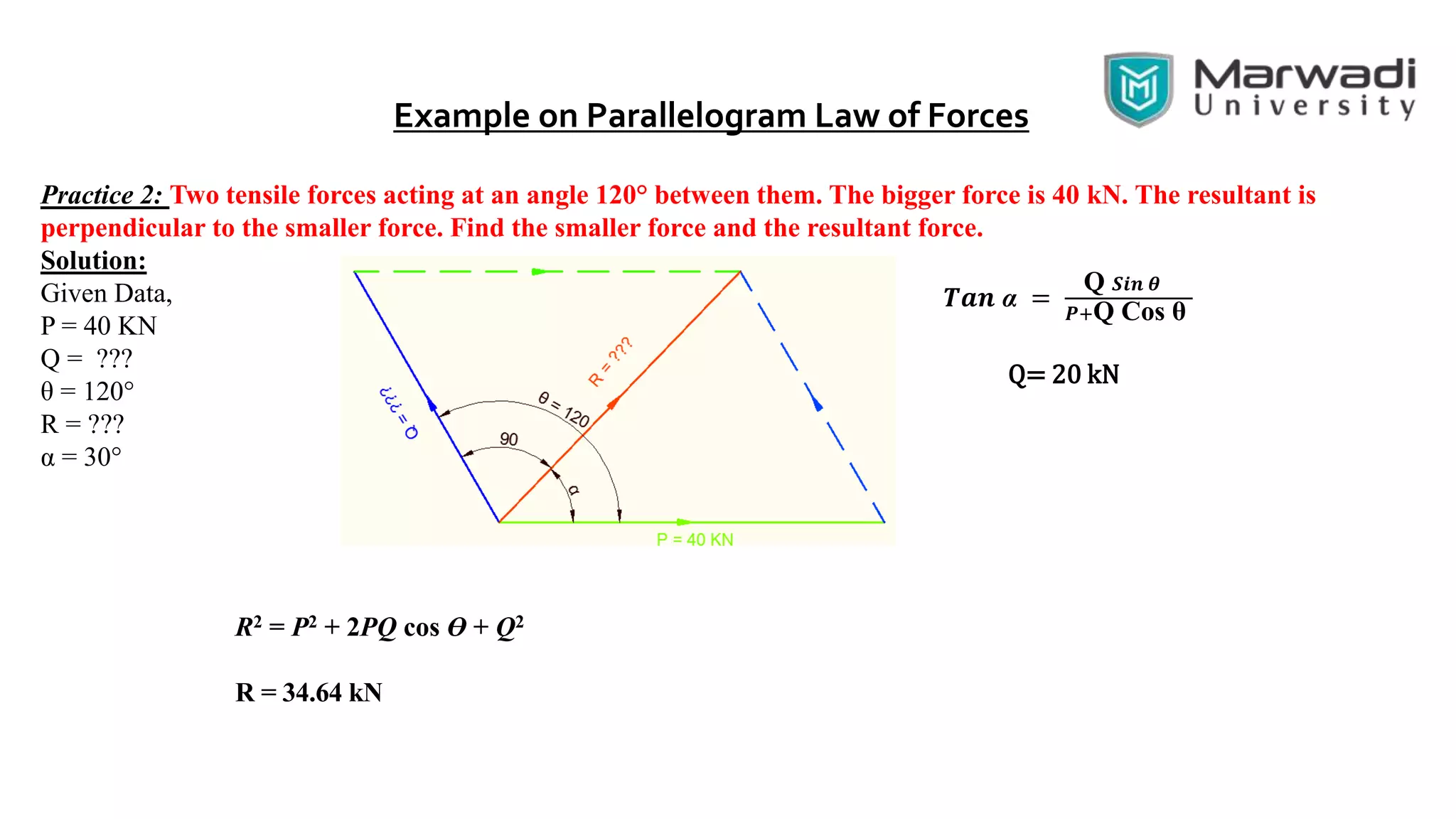
Practice 2: Two tensile forces acting at an angle 120° between them. The bigger force is 40 kN. The resultant is
perpendicular to the smaller force. Find the smaller force and the resultant force.
Solution:
Given Data,
P = 40 KN
Q = ???
θ = 120°
R = ???
α = 30°
R2 = P2 + 2PQ cos Ө + Q2
R = 34.64 kN
𝑻𝒂𝒏 α =
Q 𝑺𝒊𝒏 𝜽
𝑷+Q Cos θ
Q= 20 kN
Topic will be cover:
1. Coplanar concurrent force system:
a) Resultant Force
b) Equilibrant Force
c) Composition Of Force
d) Parallelogram Law of Forces
e) Triangle Law of Forces
f) Resolution Of Forces
g) Resolution of more than two
concurrent forces
h) Polygon Law Of Forces
Department of Mechanical
Engineering.
Prof. Malay Badodariya
malay.badodariya@marwadie
ducation.edu.in
Unit no.: 2
Fundamental Of
Statics
Subject Name: FMD
01ME0305
e)
Triangle Law
of Forces
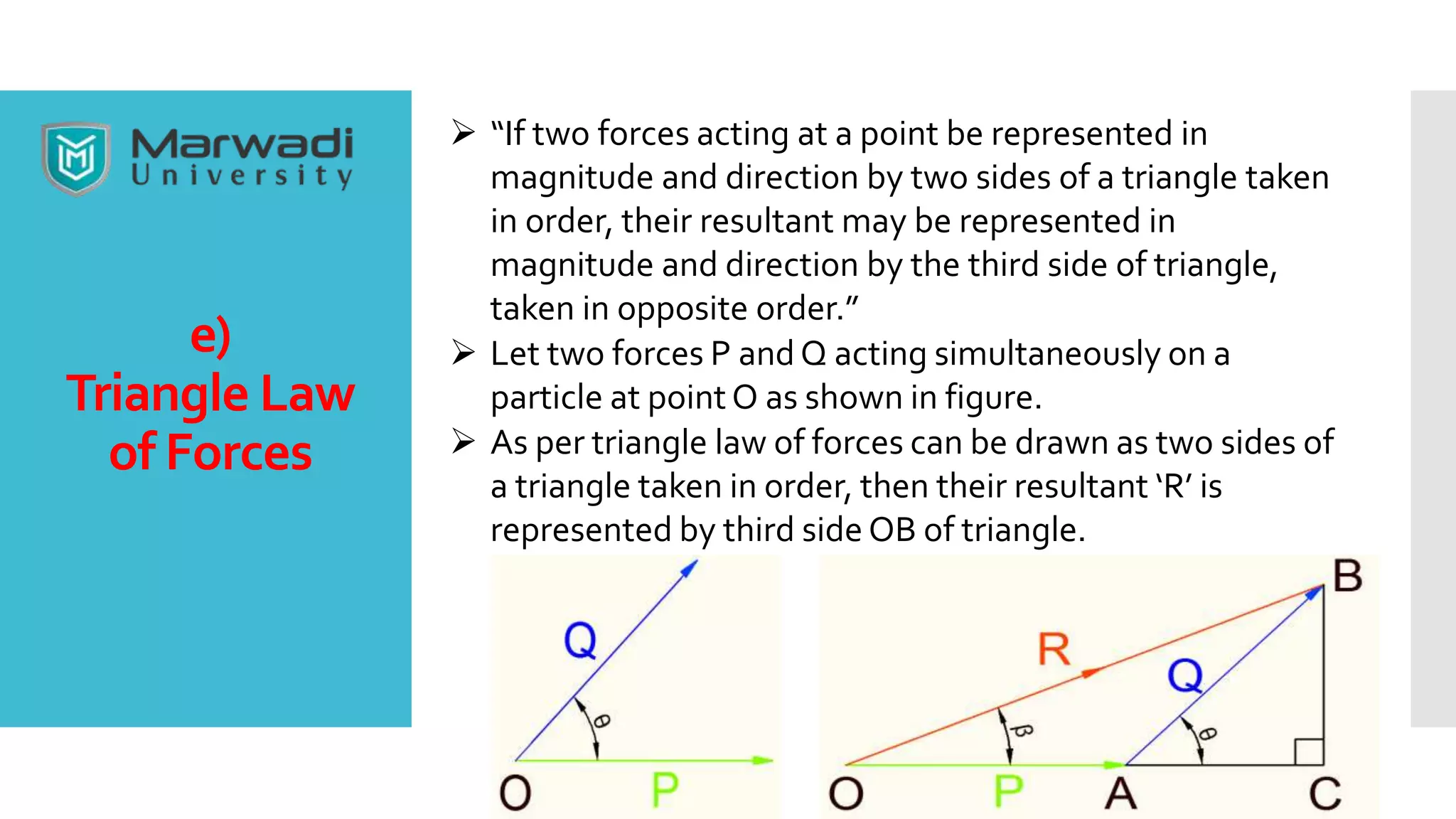
 “If two forces acting at a point be represented in
magnitude and direction by two sides of a triangle taken
in order, their resultant may be represented in
magnitude and direction by the third side of triangle,
taken in opposite order.”
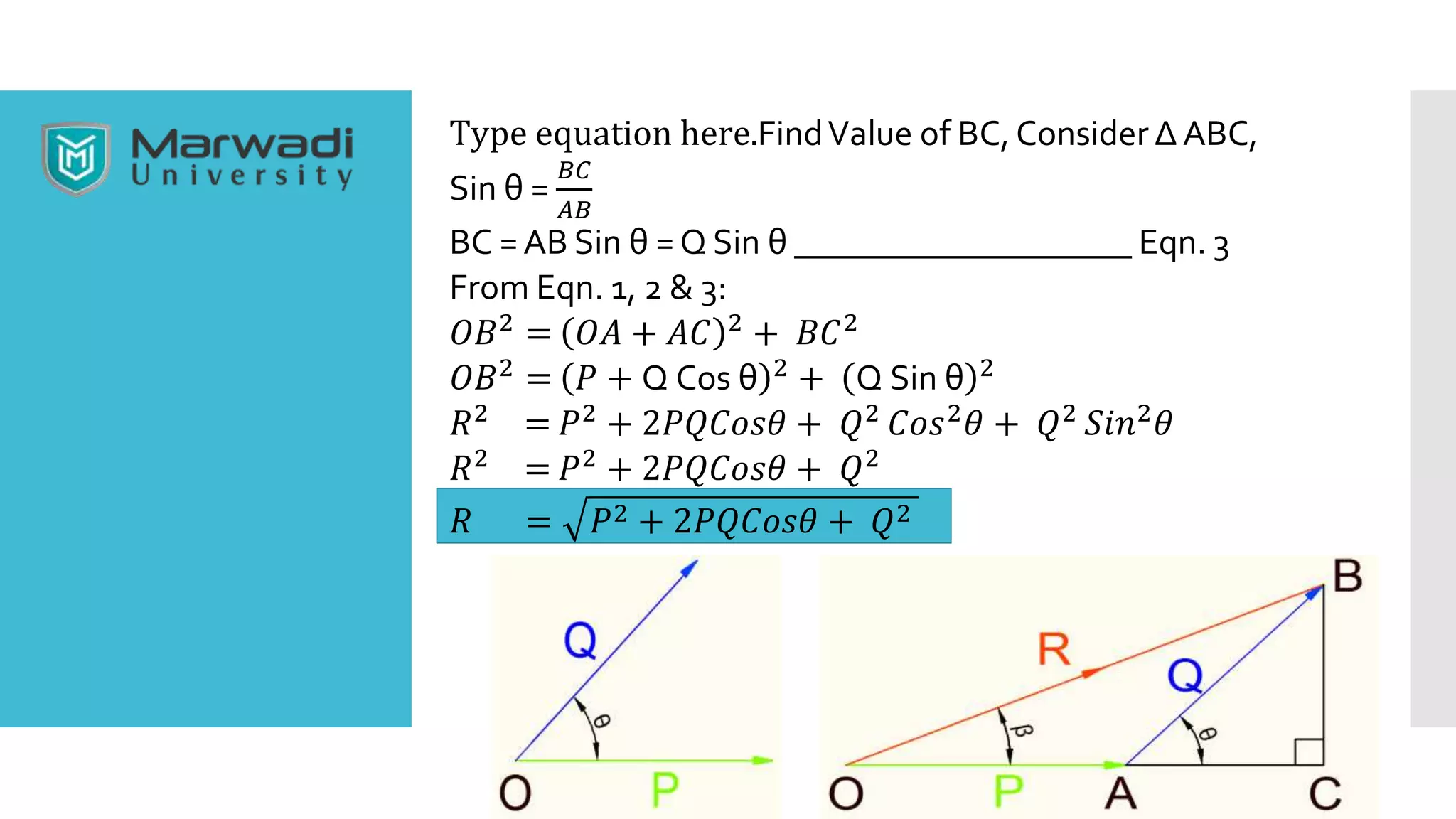
 Let two forces P andQ acting simultaneously on a
particle at pointO as shown in figure.
 As per triangle law of forces can be drawn as two sides of
a triangle taken in order, then their resultant ‘R’ is
represented by third side OB of triangle.
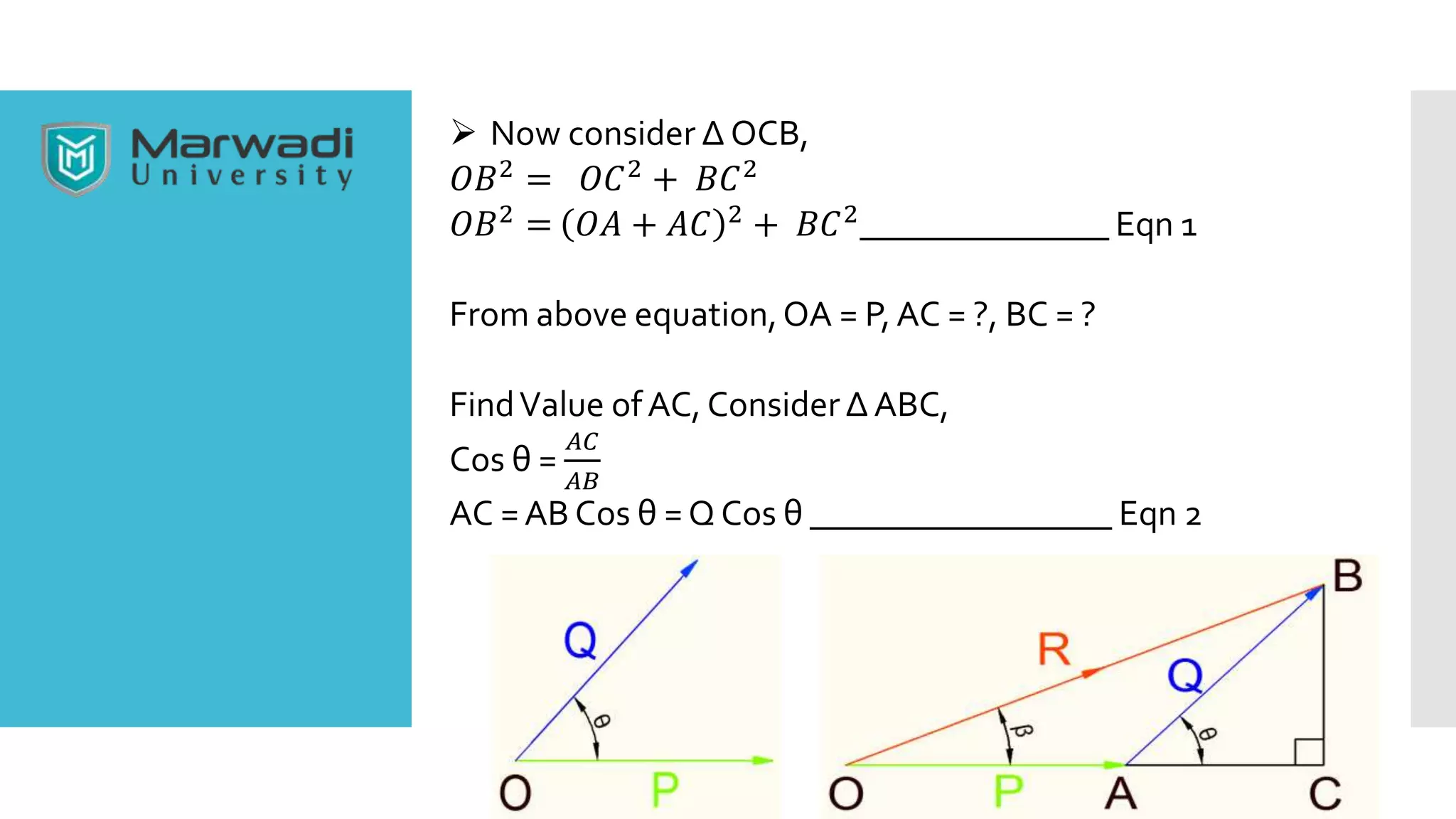
 Now consider Δ OCB,
𝑂𝐵2
= 𝑂𝐶2
+ 𝐵𝐶2
𝑂𝐵2 = 𝑂𝐴 + 𝐴𝐶 2 + 𝐵𝐶2______________ Eqn 1
From above equation,OA = P, AC = ?, BC = ?
FindValue ofAC, ConsiderΔ ABC,
Cos θ =
𝐴𝐶
𝐴𝐵
AC =AB Cos θ = Q Cos θ _________________ Eqn 2
Type equation here.FindValue of BC, Consider Δ ABC,
Sin θ =
𝐵𝐶
𝐴𝐵
BC =AB Sin θ = Q Sin θ ___________________ Eqn. 3
From Eqn. 1, 2 & 3:
𝑂𝐵2 = 𝑂𝐴 + 𝐴𝐶 2 + 𝐵𝐶2
𝑂𝐵2 = 𝑃 + Q Cos θ 2 + Q Sin θ 2
𝑅2 = 𝑃2 + 2𝑃𝑄𝐶𝑜𝑠𝜃 + 𝑄2 𝐶𝑜𝑠2 𝜃 + 𝑄2 𝑆𝑖𝑛2 𝜃
𝑅2 = 𝑃2 + 2𝑃𝑄𝐶𝑜𝑠𝜃 + 𝑄2
𝑅 = 𝑃2 + 2𝑃𝑄𝐶𝑜𝑠𝜃 + 𝑄2
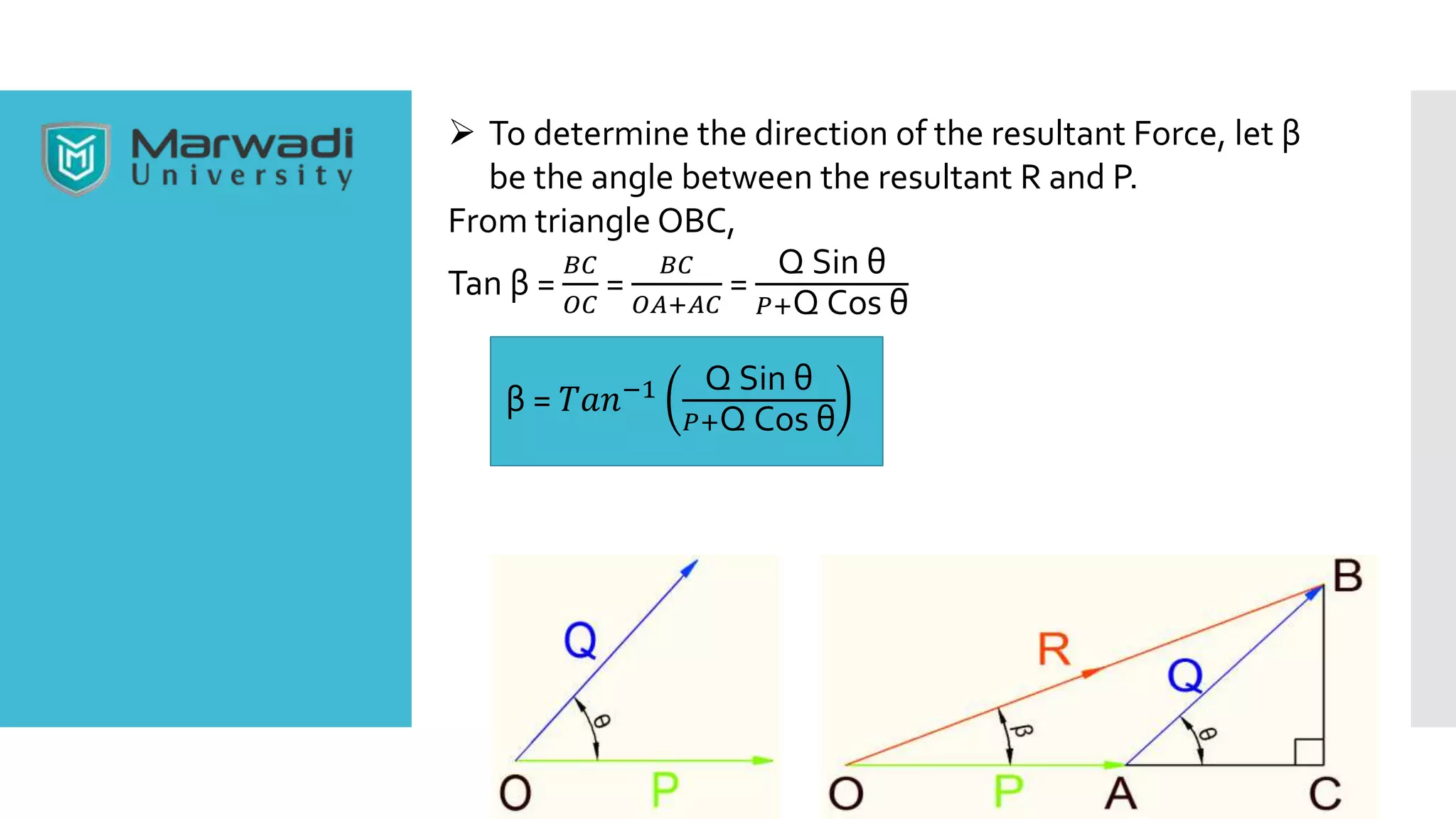
 To determine the direction of the resultant Force, let β
be the angle between the resultant R and P.
From triangle OBC,
Tan β =
𝐵𝐶
𝑂𝐶
=
𝐵𝐶
𝑂𝐴+𝐴𝐶
=
Q Sin θ
𝑃+Q Cos θ
β = 𝑇𝑎𝑛−1 Q Sin θ
𝑃+Q Cos θ
Example on Law ofTriangle of Forces
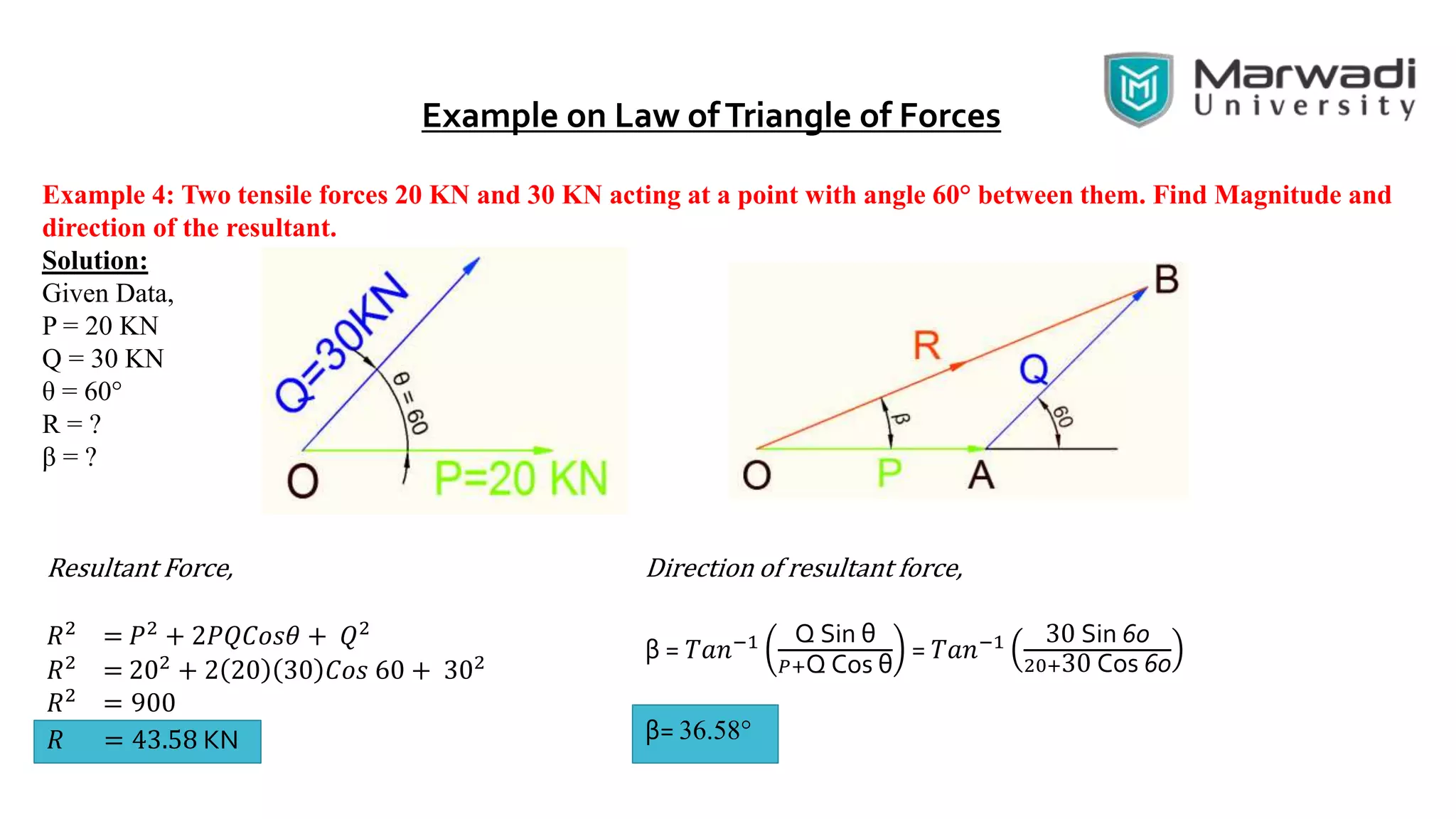
Example 4: Two tensile forces 20 KN and 30 KN acting at a point with angle 60° between them. Find Magnitude and
direction of the resultant.
Solution:
Given Data,
P = 20 KN
Q = 30 KN
θ = 60°
R = ?
β = ?
Resultant Force,
𝑅2
= 𝑃2
+ 2𝑃𝑄𝐶𝑜𝑠𝜃 + 𝑄2
𝑅2
= 202
+ 2 20 30 𝐶𝑜𝑠 60 + 302
𝑅2 = 900
𝑅 = 43.58 KN
Direction of resultant force,
β = 𝑇𝑎𝑛−1 Q Sin θ
𝑃+Q Cos θ
= 𝑇𝑎𝑛−1 30 Sin 60
20+30 Cos 60
β= 36.58°
Example on Law ofTriangle of Forces
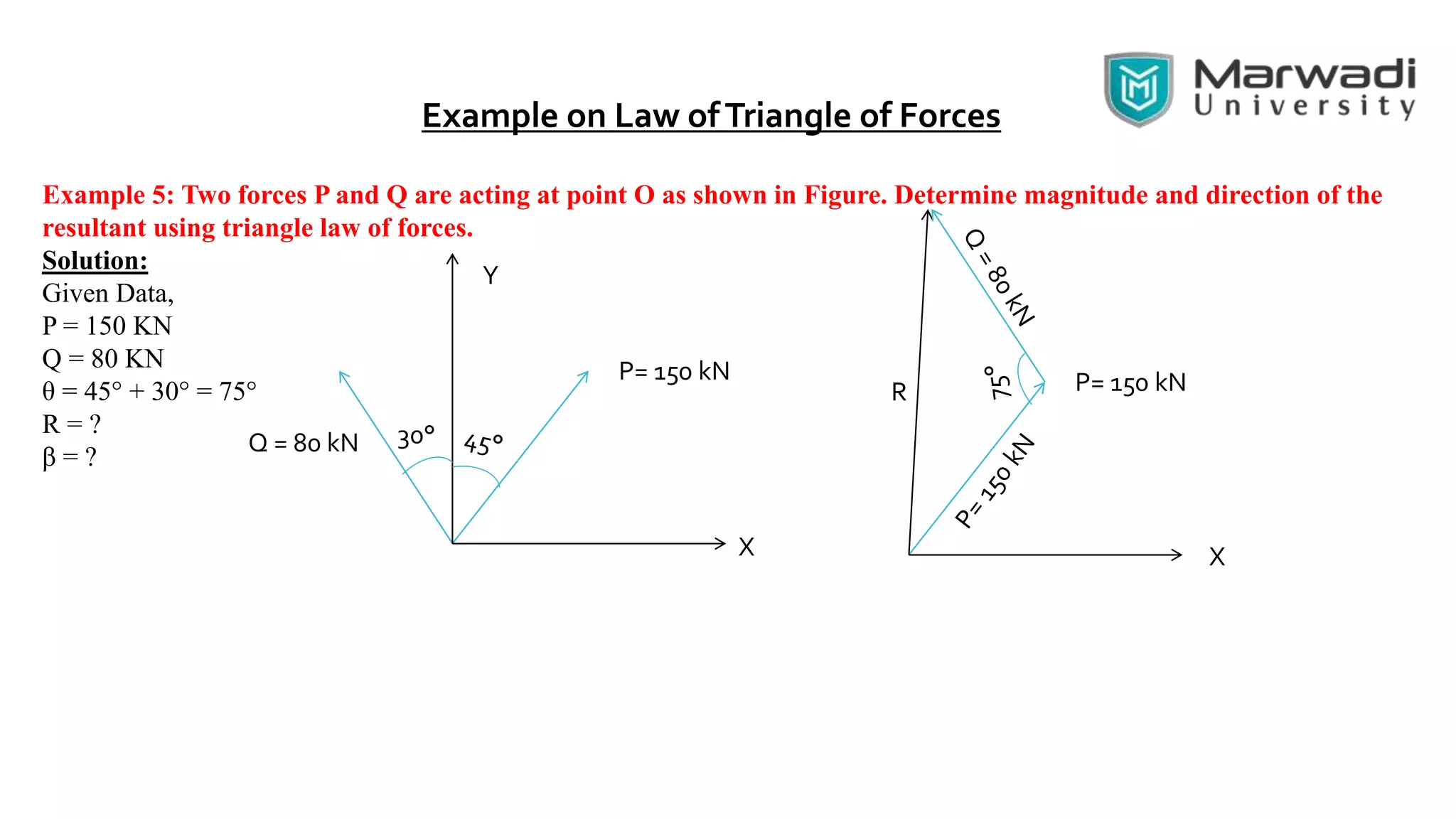
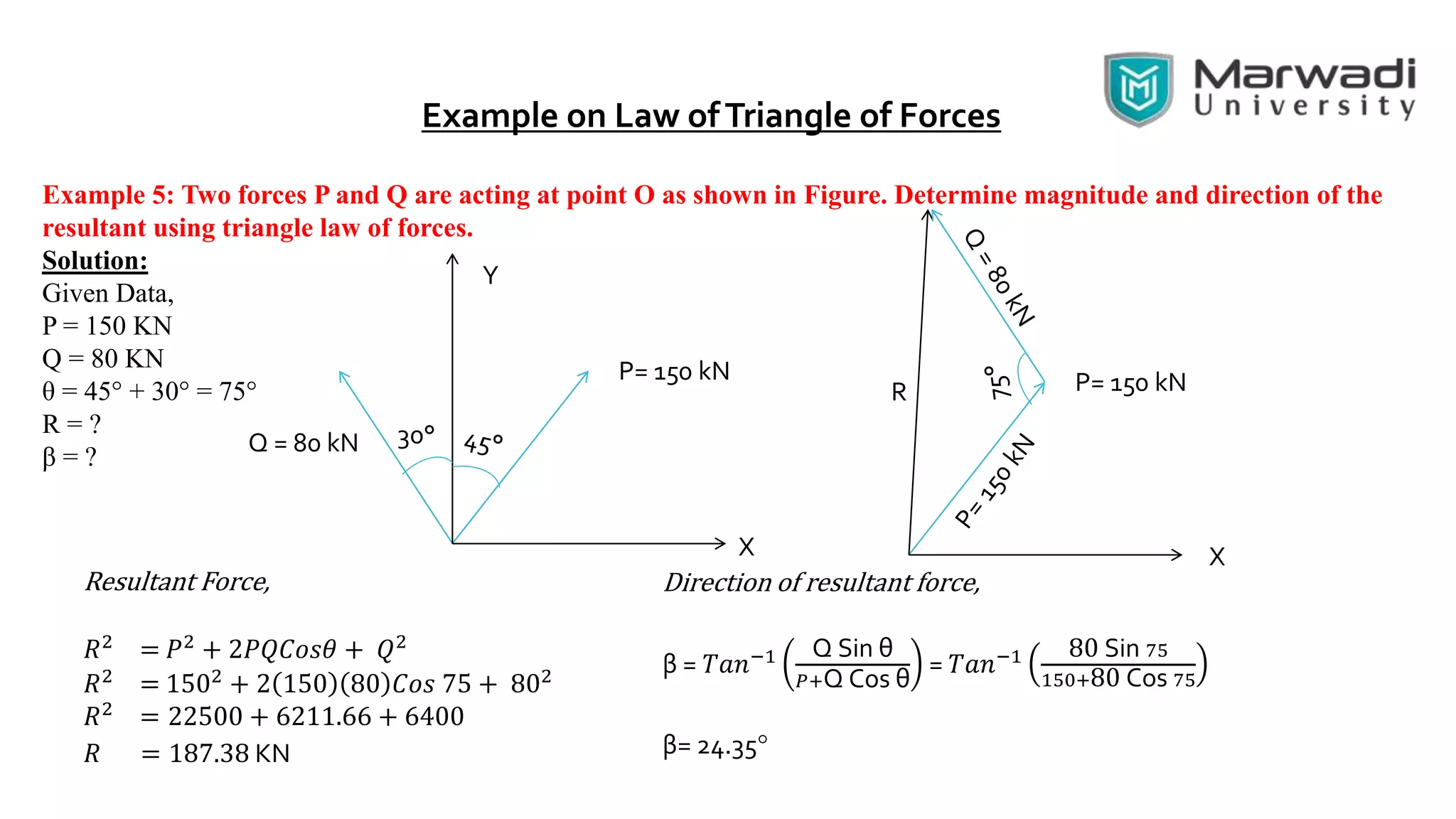
Example 5: Two forces P and Q are acting at point O as shown in Figure. Determine magnitude and direction of the
resultant using triangle law of forces.
Solution:
Given Data,
P = 150 KN
Q = 80 KN
θ = 45° + 30° = 75°
R = ?
β = ?
X
P= 150 kN
Q = 80 kN 30°
Y
X
P= 150 kNR
Example on Law ofTriangle of Forces
Example 5: Two forces P and Q are acting at point O as shown in Figure. Determine magnitude and direction of the
resultant using triangle law of forces.
Solution:
Given Data,
P = 150 KN
Q = 80 KN
θ = 45° + 30° = 75°
R = ?
β = ?
X
P= 150 kN
Q = 80 kN 30°
Resultant Force,
𝑅2
= 𝑃2
+ 2𝑃𝑄𝐶𝑜𝑠𝜃 + 𝑄2
𝑅2
= 1502
+ 2 150 80 𝐶𝑜𝑠 75 + 802
𝑅2 = 22500 + 6211.66 + 6400
𝑅 = 187.38 KN
Y
X
P= 150 kNR
Direction of resultant force,
β = 𝑇𝑎𝑛−1 Q Sin θ
𝑃+Q Cos θ
= 𝑇𝑎𝑛−1 80 Sin 75
150+80 Cos 75
β= 24.35°
Topic will be cover:
1. Coplanar concurrent force system:
a) Resultant Force
b) Equilibrant Force
c) Composition Of Force
d) Parallelogram Law of Forces
e) Triangle Law of Forces
f) Resolution Of Forces
g) Resolution of more than two
concurrent forces
h) Polygon Law Of Forces
Department of Mechanical
Engineering.
Prof. Malay Badodariya
malay.badodariya@marwadie
ducation.edu.in
Unit no.: 2
Fundamental Of
Statics
Subject Name: FMD
01ME0305
 The process of splitting up the given force in to two or
more components, in particular direction without
changing effect on the body is called resolution of a
force.
 There are two type of components.
i. Orthogonal Components (Rectangular Component)
ii. Non-Orthogonal Components
f)
Resolution
of A
Forces
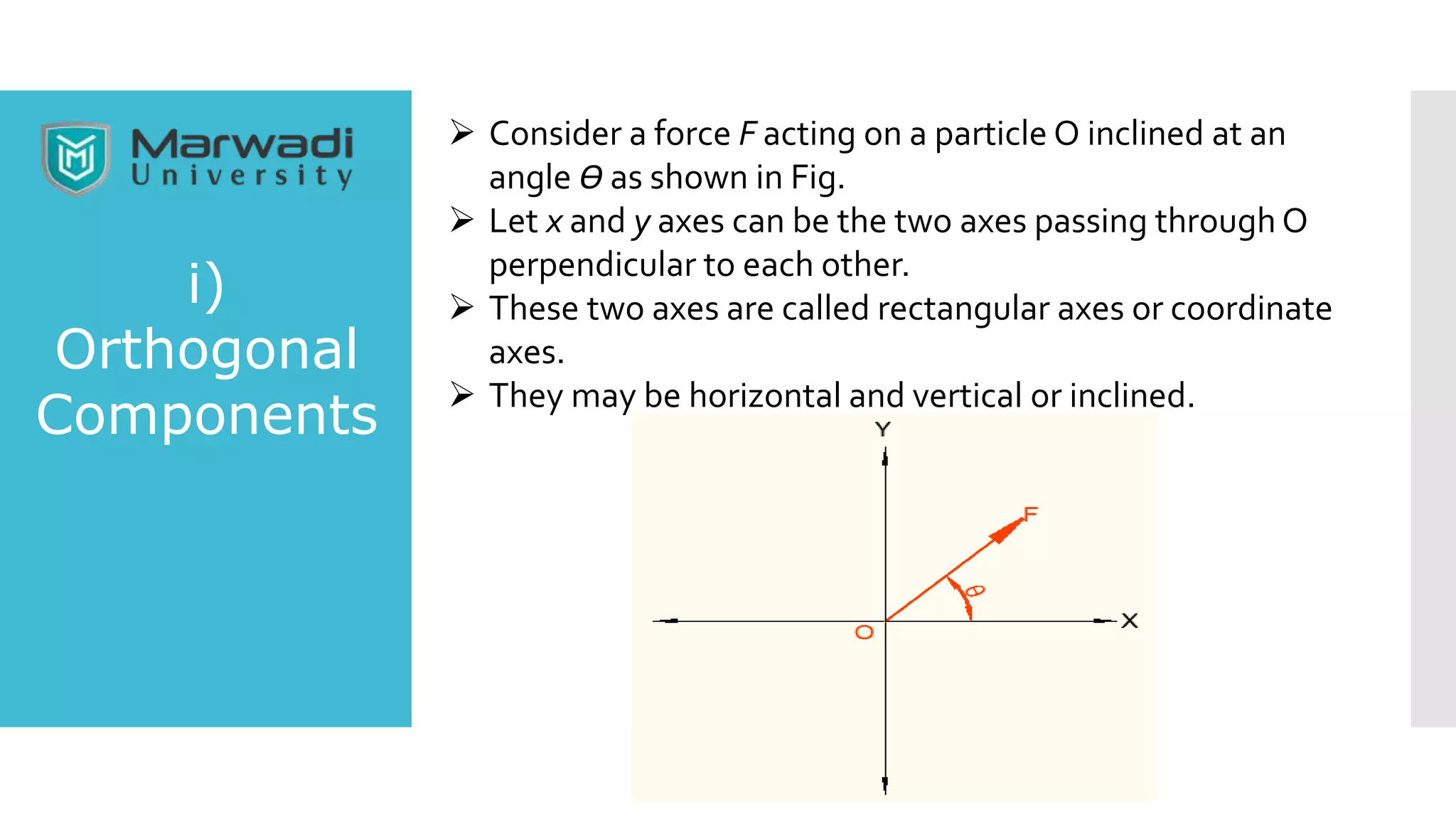
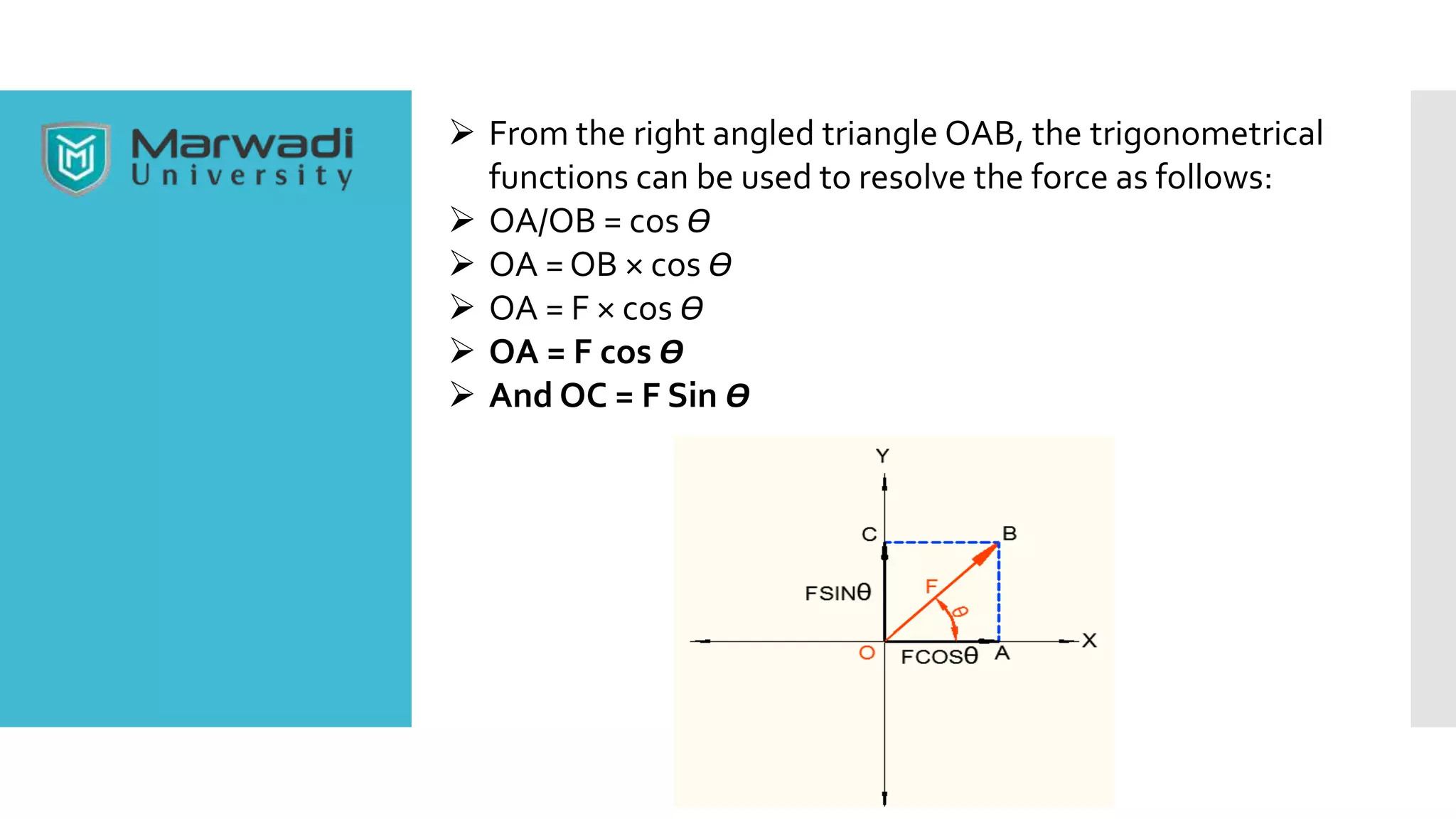
 Consider a force F acting on a particle O inclined at an
angle Ө as shown in Fig.
 Let x and y axes can be the two axes passing through O
perpendicular to each other.
 These two axes are called rectangular axes or coordinate
axes.
 They may be horizontal and vertical or inclined.
i)
Orthogonal
Components
 The force F can now be resolved into two
components Fx and Fy along the x and y axes and hence,
the components are called rectangular components.
 Further, the polygon constructed with these two
components as adjacent sides will form a rectangle
OABC and, therefore, the components are known as
rectangular components.
 From the right angled triangle OAB, the trigonometrical
functions can be used to resolve the force as follows:
 OA/OB = cos Ө
 OA = OB × cos Ө
 OA = F × cos Ө
 OA = F cos Ө
 And OC = F Sin Ө
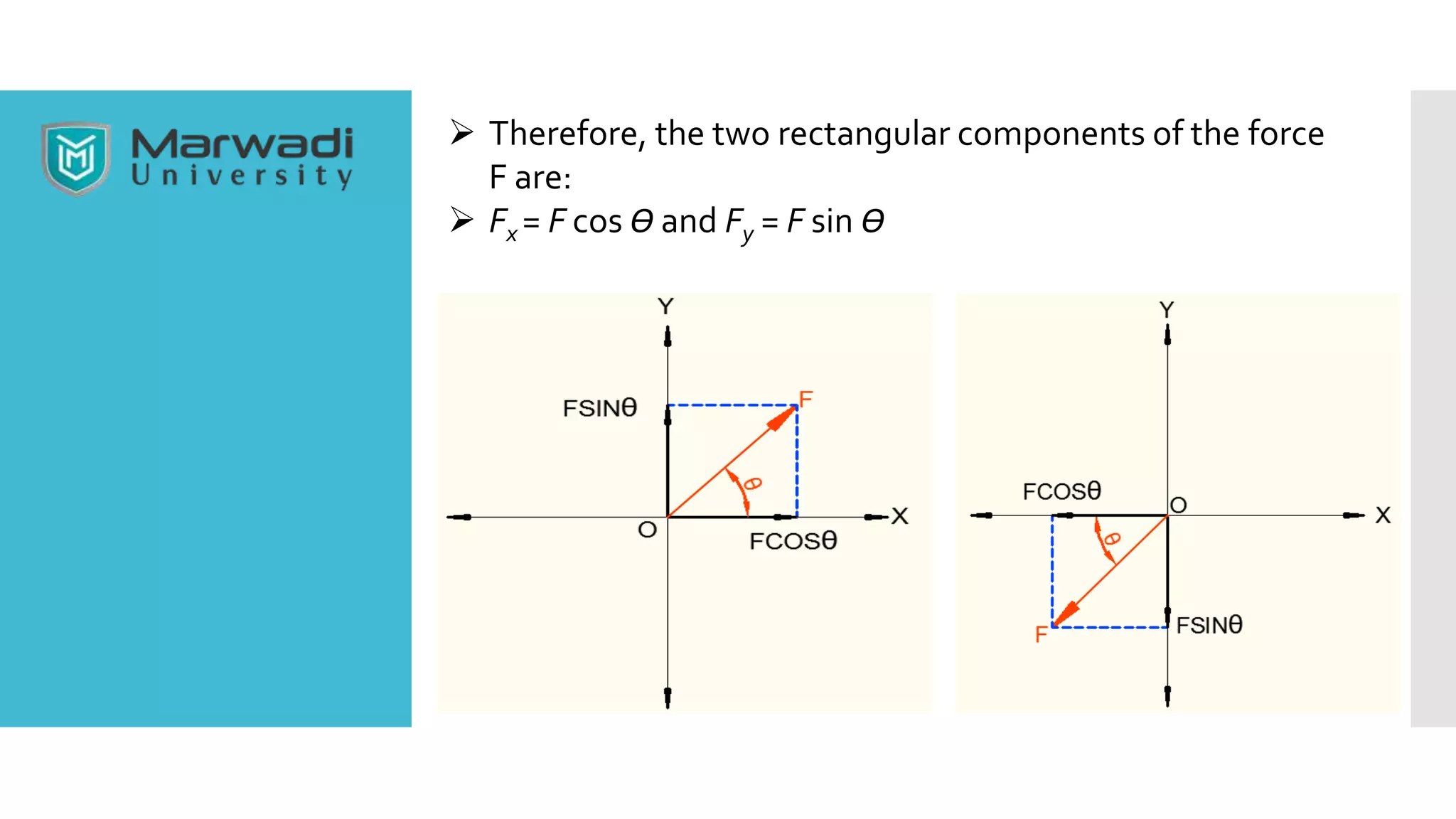
 Therefore, the two rectangular components of the force
F are:
 Fx = F cos Ө and Fy = F sin Ө
ii)
Non
Orthogonal
Components
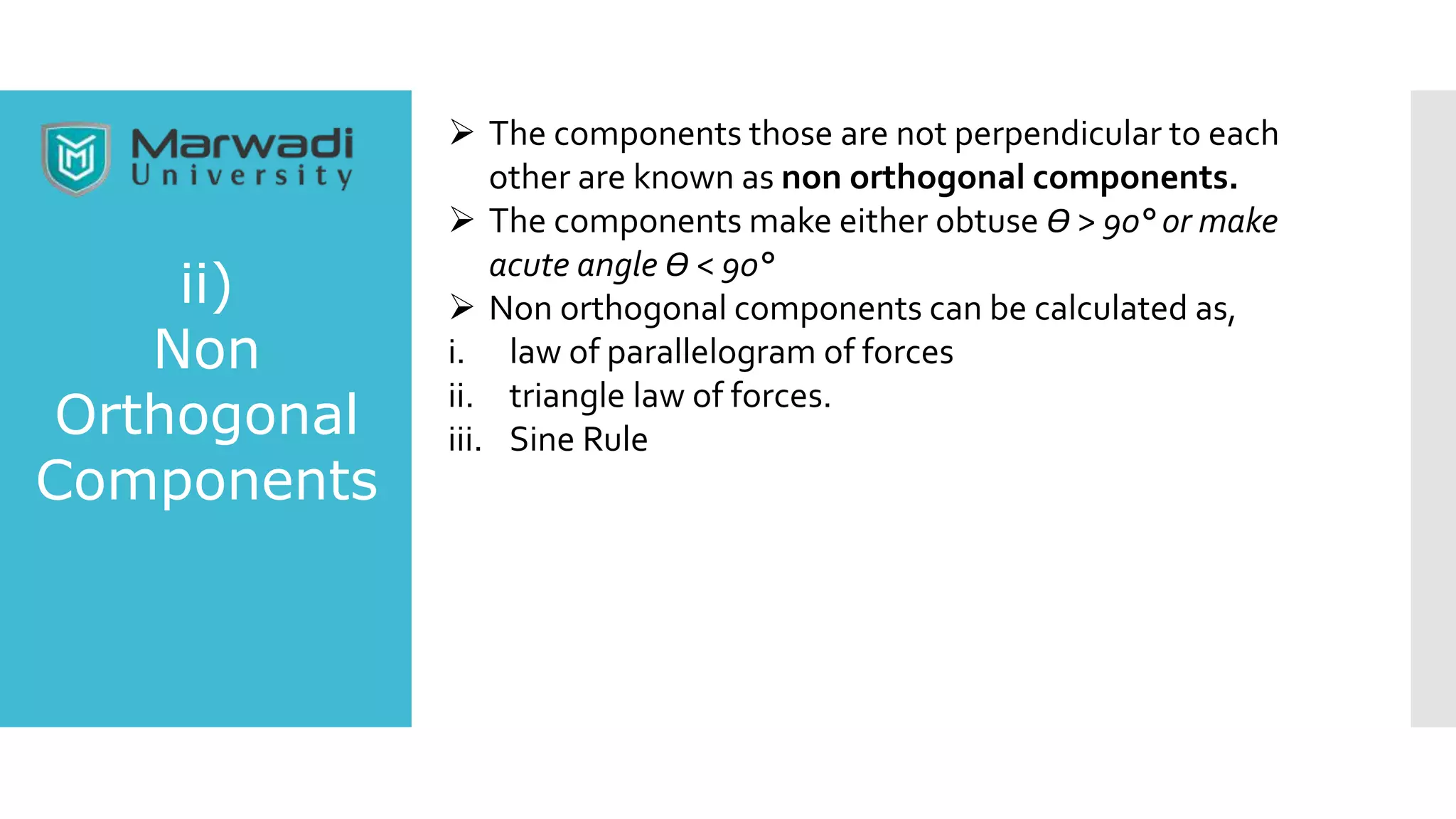
 The components those are not perpendicular to each
other are known as non orthogonal components.
 The components make either obtuse Ө > 90° or make
acute angle Ө < 90°
 Non orthogonal components can be calculated as,
i. law of parallelogram of forces
ii. triangle law of forces.
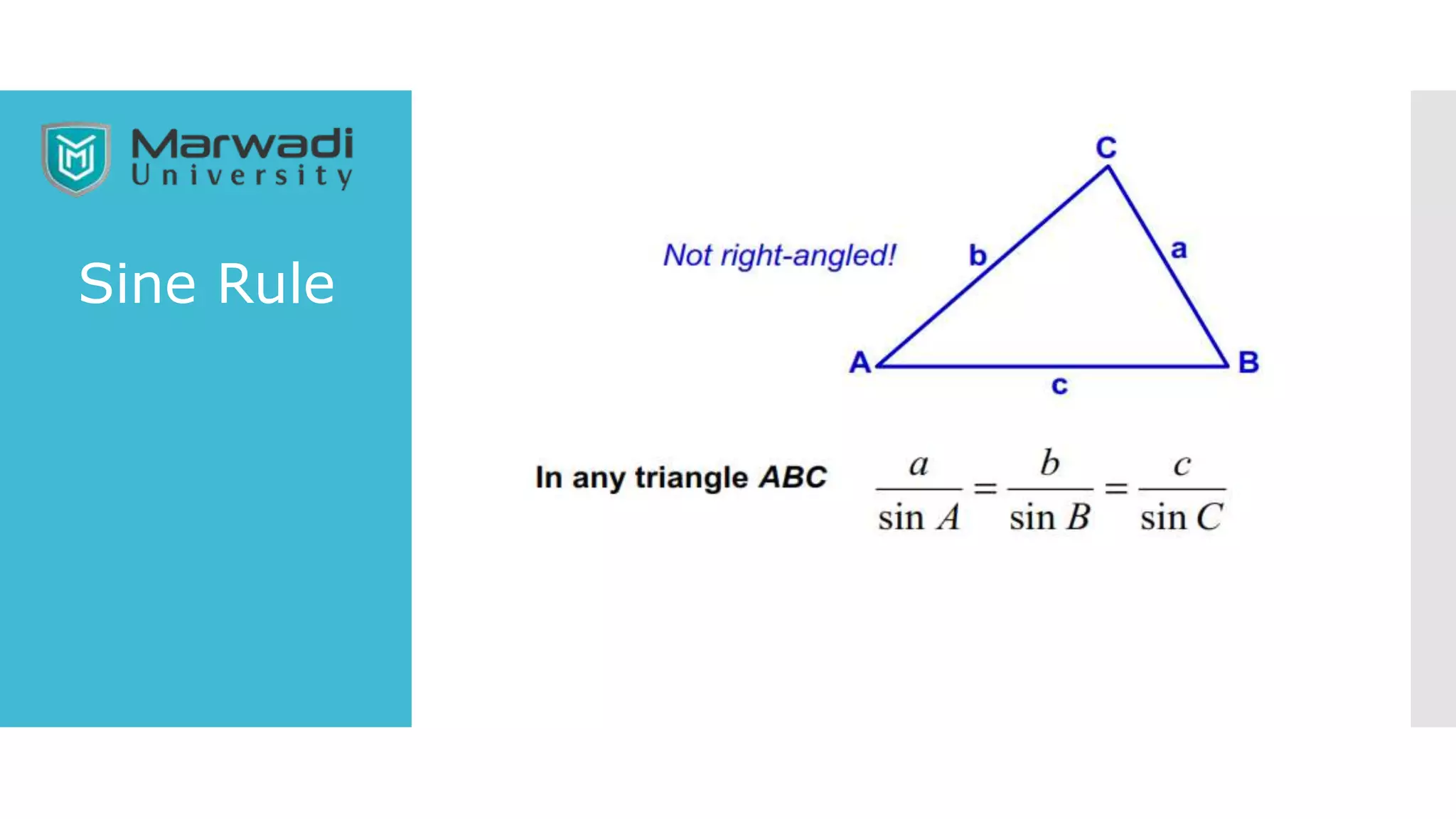
iii. Sine Rule
Sine Rule
Example on Orthogonal & Non Orthogonal Component
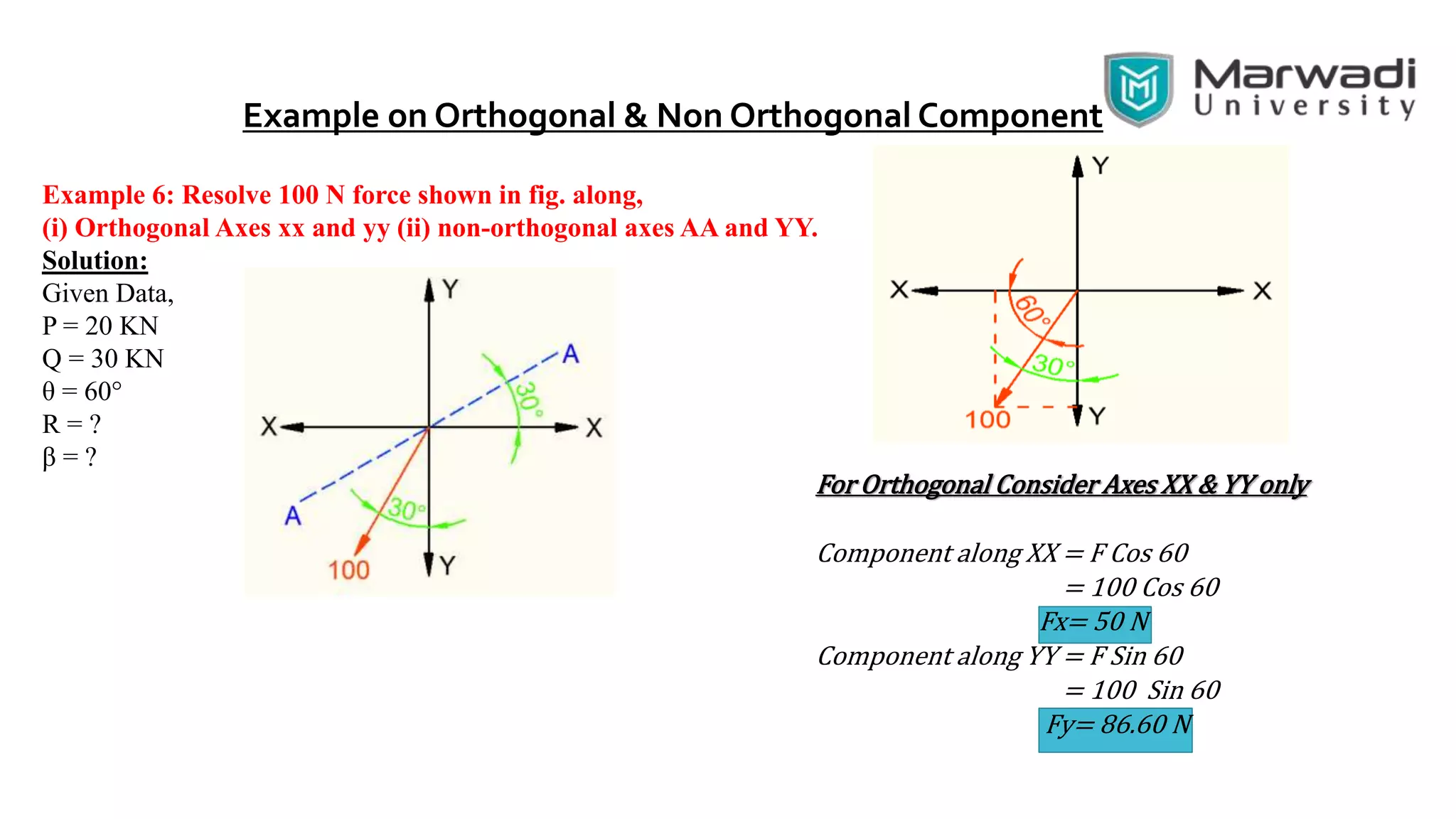
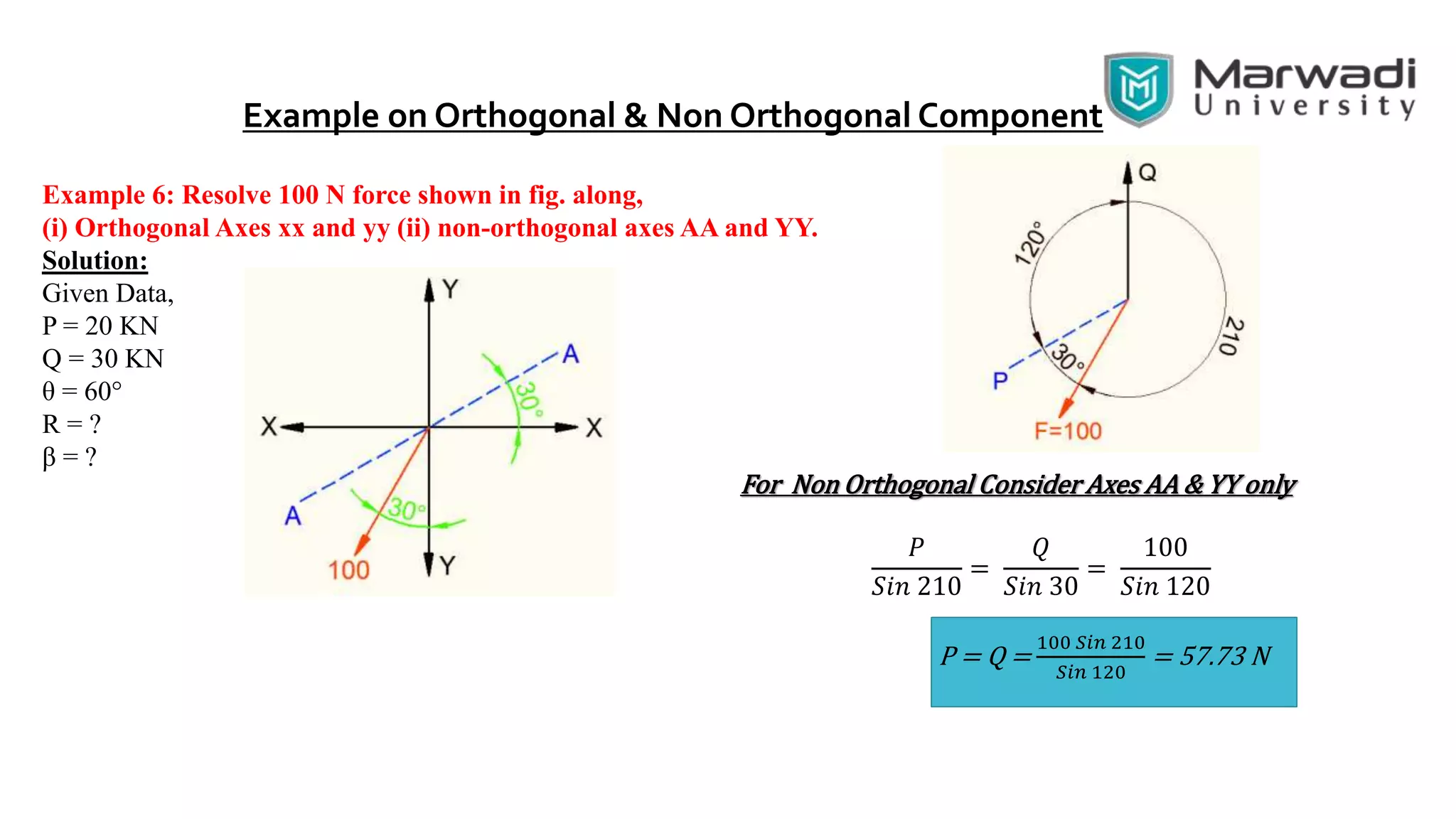
Example 6: Resolve 100 N force shown in fig. along,
(i) Orthogonal Axes xx and yy (ii) non-orthogonal axes AA and YY.
Solution:
Given Data,
P = 20 KN
Q = 30 KN
θ = 60°
R = ?
β = ?
For Orthogonal Consider Axes XX & YY only
Component along XX = F Cos 60
= 100 Cos 60
Fx= 50 N
Component along YY = F Sin 60
= 100 Sin 60
Fy= 86.60 N
Example on Orthogonal & Non Orthogonal Component
Example 6: Resolve 100 N force shown in fig. along,
(i) Orthogonal Axes xx and yy (ii) non-orthogonal axes AA and YY.
Solution:
Given Data,
P = 20 KN
Q = 30 KN
θ = 60°
R = ?
β = ?
For Non Orthogonal Consider Axes AA & YY only
𝑃
𝑆𝑖𝑛 210
=
𝑄
𝑆𝑖𝑛 30
=
100
𝑆𝑖𝑛 120
P = Q =
100 𝑆𝑖𝑛 210
𝑆𝑖𝑛 120
= 57.73 N
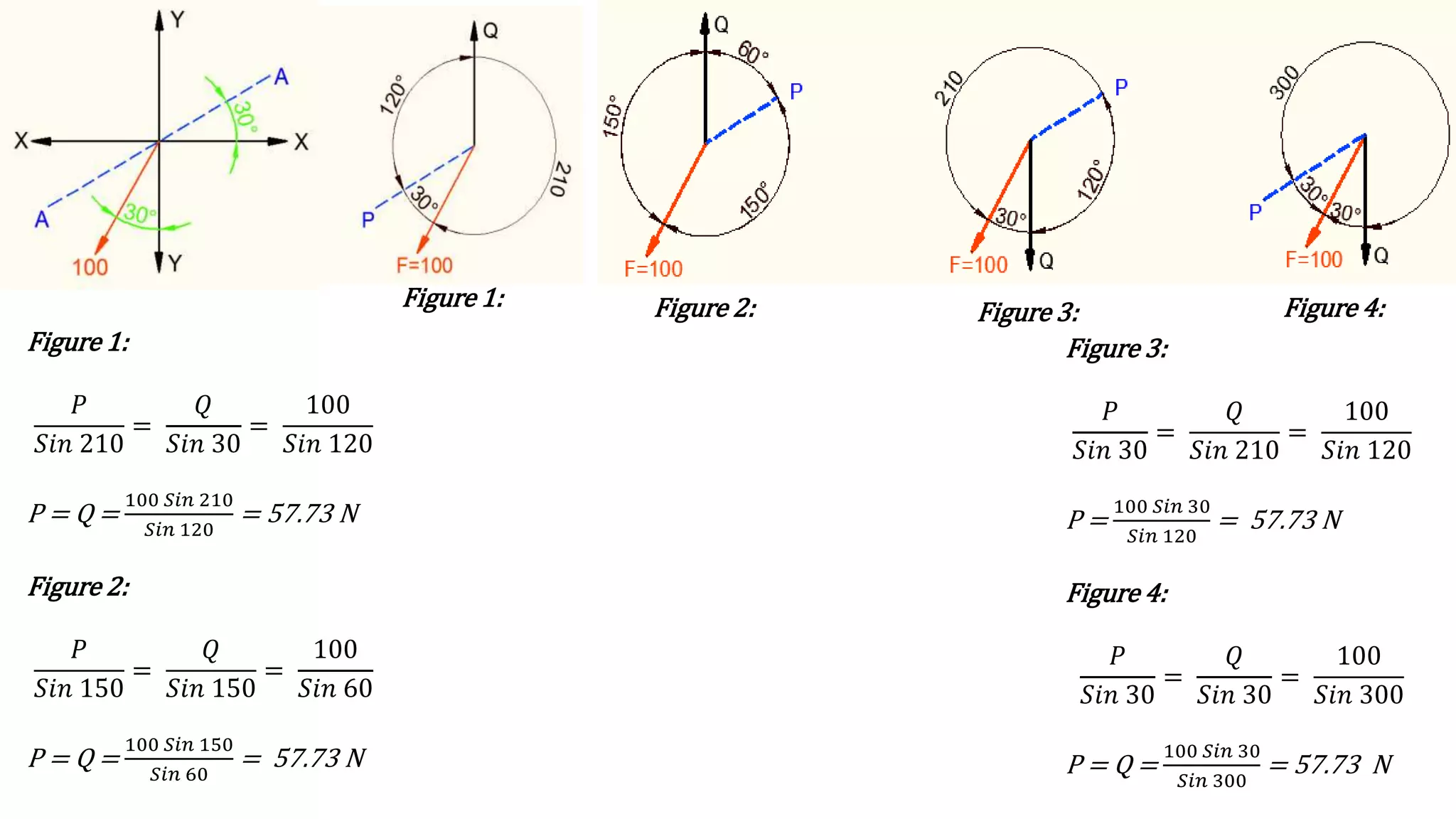
Figure 1:
𝑃
𝑆𝑖𝑛 210
=
𝑄
𝑆𝑖𝑛 30
=
100
𝑆𝑖𝑛 120
P = Q =
100 𝑆𝑖𝑛 210
𝑆𝑖𝑛 120
= 57.73 N
Figure 2:
𝑃
𝑆𝑖𝑛 150
=
𝑄
𝑆𝑖𝑛 150
=
100
𝑆𝑖𝑛 60
P = Q =
100 𝑆𝑖𝑛 150
𝑆𝑖𝑛 60
= 57.73 N
Figure 3:
𝑃
𝑆𝑖𝑛 30
=
𝑄
𝑆𝑖𝑛 210
=
100
𝑆𝑖𝑛 120
P =
100 𝑆𝑖𝑛 30
𝑆𝑖𝑛 120
= 57.73 N
Figure 4:
𝑃
𝑆𝑖𝑛 30
=
𝑄
𝑆𝑖𝑛 30
=
100
𝑆𝑖𝑛 300
P = Q =
100 𝑆𝑖𝑛 30
𝑆𝑖𝑛 300
= 57.73 N
Figure 1: Figure 2: Figure 3: Figure 4:
Topic will be cover:
1. Coplanar concurrent force system:
a) Resultant Force
b) Equilibrant Force
c) Composition Of Force
d) Parallelogram Law of Forces
e) Triangle Law of Forces
f) Resolution Of Forces
g) Resolution of more than two
concurrent forces
h) Polygon Law Of Forces
Department of Mechanical
Engineering.
Prof. Malay Badodariya
malay.badodariya@marwadie
ducation.edu.in
Unit no.: 2
Fundamental Of
Statics
Subject Name: FMD
01ME0305
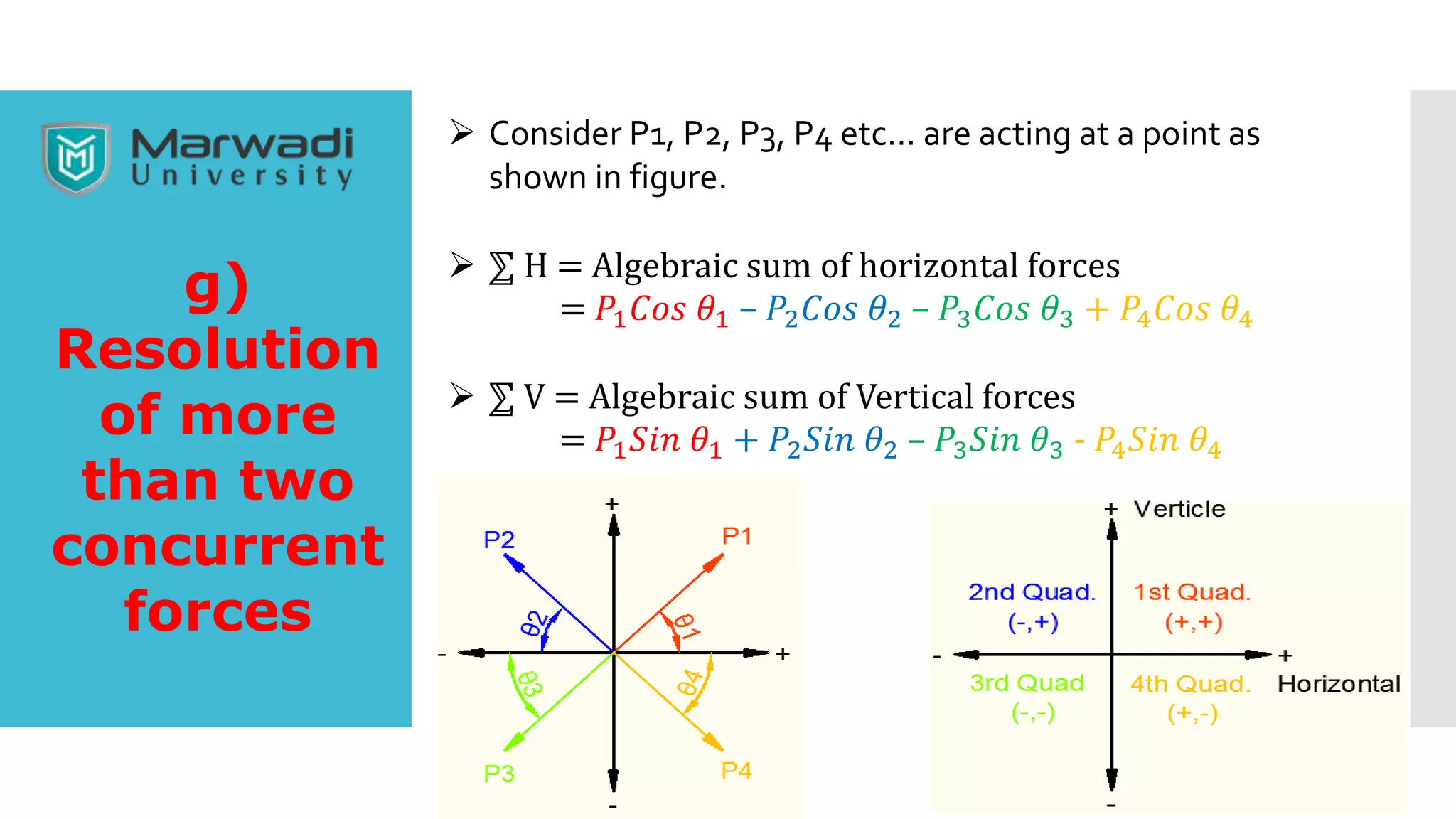
 Consider P1, P2, P3, P4 etc… are acting at a point as
shown in figure.
 ⅀ H = Algebraic sum of horizontal forces
= 𝑃1 𝐶𝑜𝑠 𝜃1 – 𝑃2 𝐶𝑜𝑠 𝜃2 – 𝑃3 𝐶𝑜𝑠 𝜃3 + 𝑃4 𝐶𝑜𝑠 𝜃4
 ⅀ V = Algebraic sum of Vertical forces
= 𝑃1 𝑆𝑖𝑛 𝜃1 + 𝑃2 𝑆𝑖𝑛 𝜃2 – 𝑃3 𝑆𝑖𝑛 𝜃3 - 𝑃4 𝑆𝑖𝑛 𝜃4
g)
Resolution
of more
than two
concurrent
forces
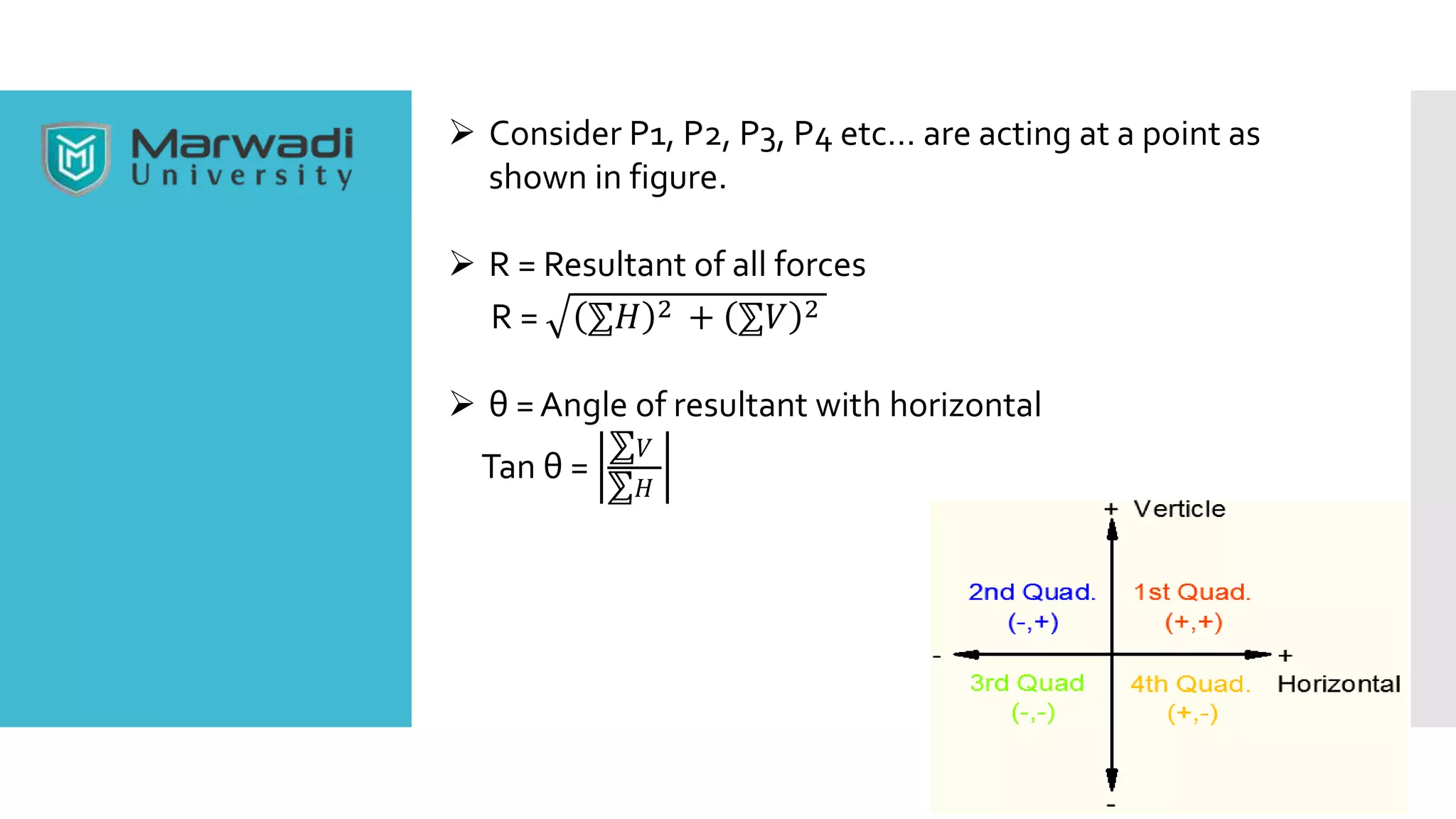
 Consider P1, P2, P3, P4 etc… are acting at a point as
shown in figure.
 R = Resultant of all forces
R = ⅀𝐻 2 + ⅀𝑉 2
 θ =Angle of resultant with horizontal
Tan θ =
⅀ 𝑉
⅀ 𝐻
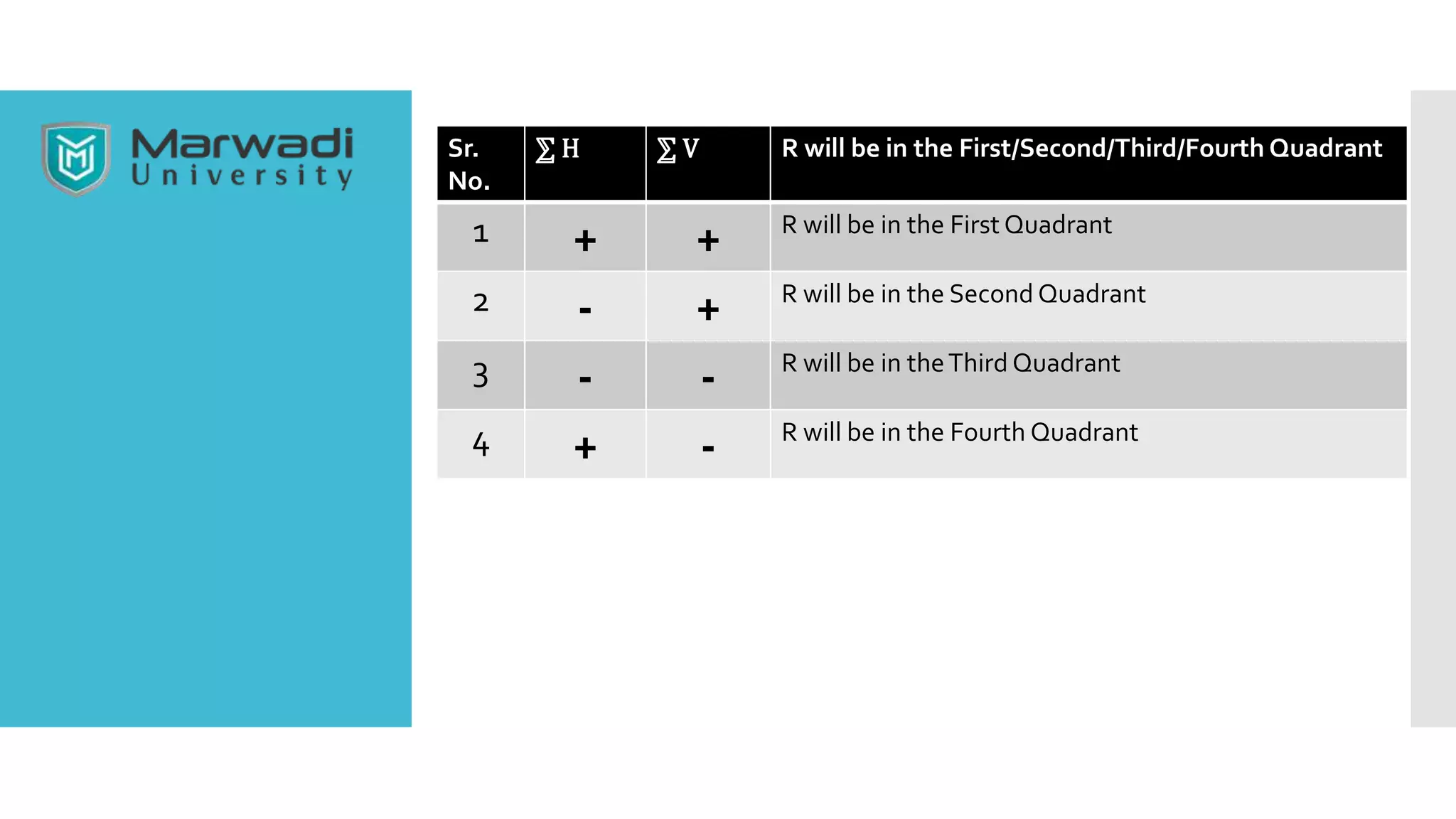
Sr.
No.
⅀ H ⅀ V R will be in the First/Second/Third/Fourth Quadrant
1 + + R will be in the First Quadrant
2 - + R will be in the Second Quadrant
3 - - R will be in theThird Quadrant
4 + - R will be in the Fourth Quadrant
Example on Orthogonal & Non Orthogonal Component
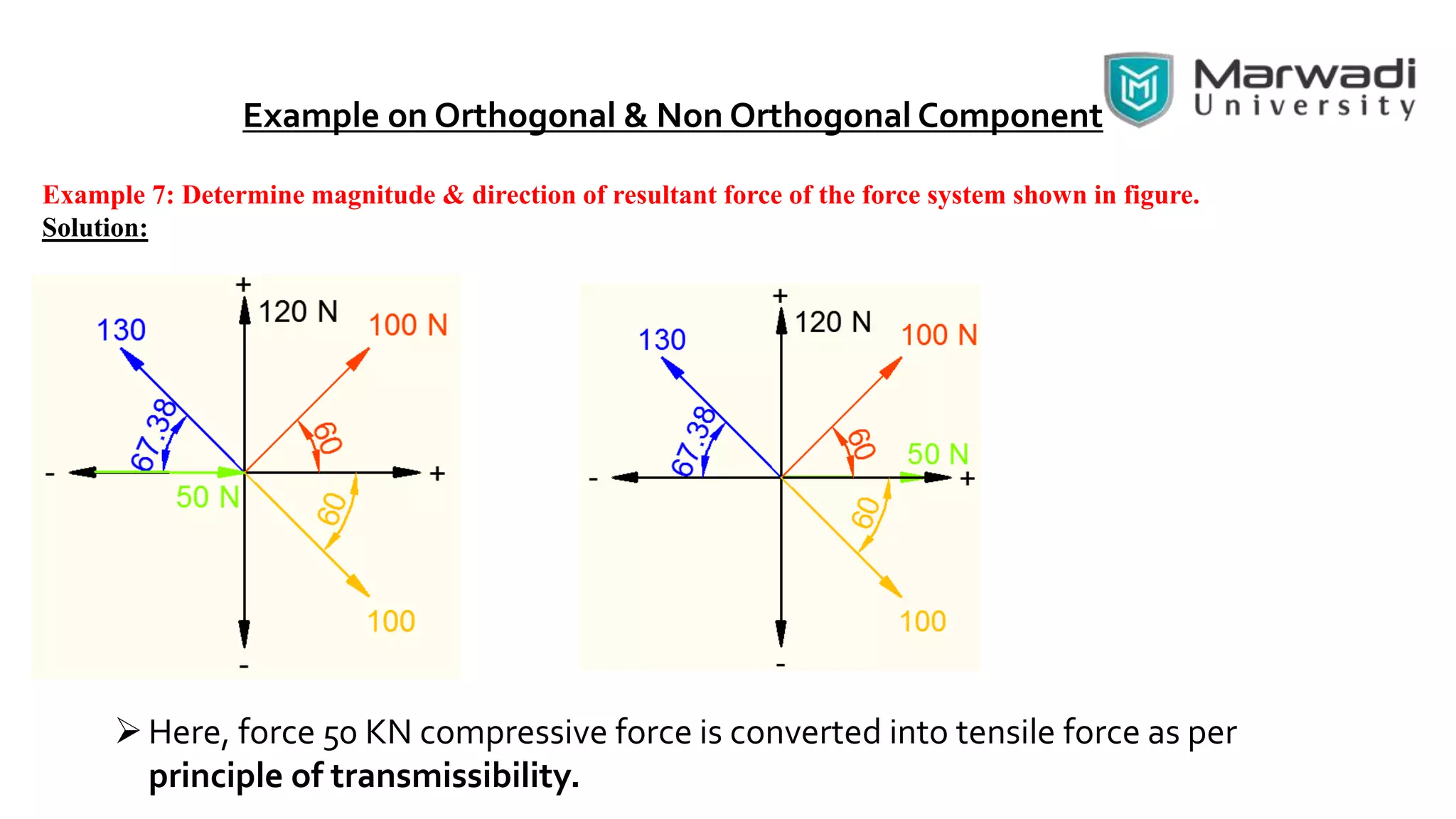
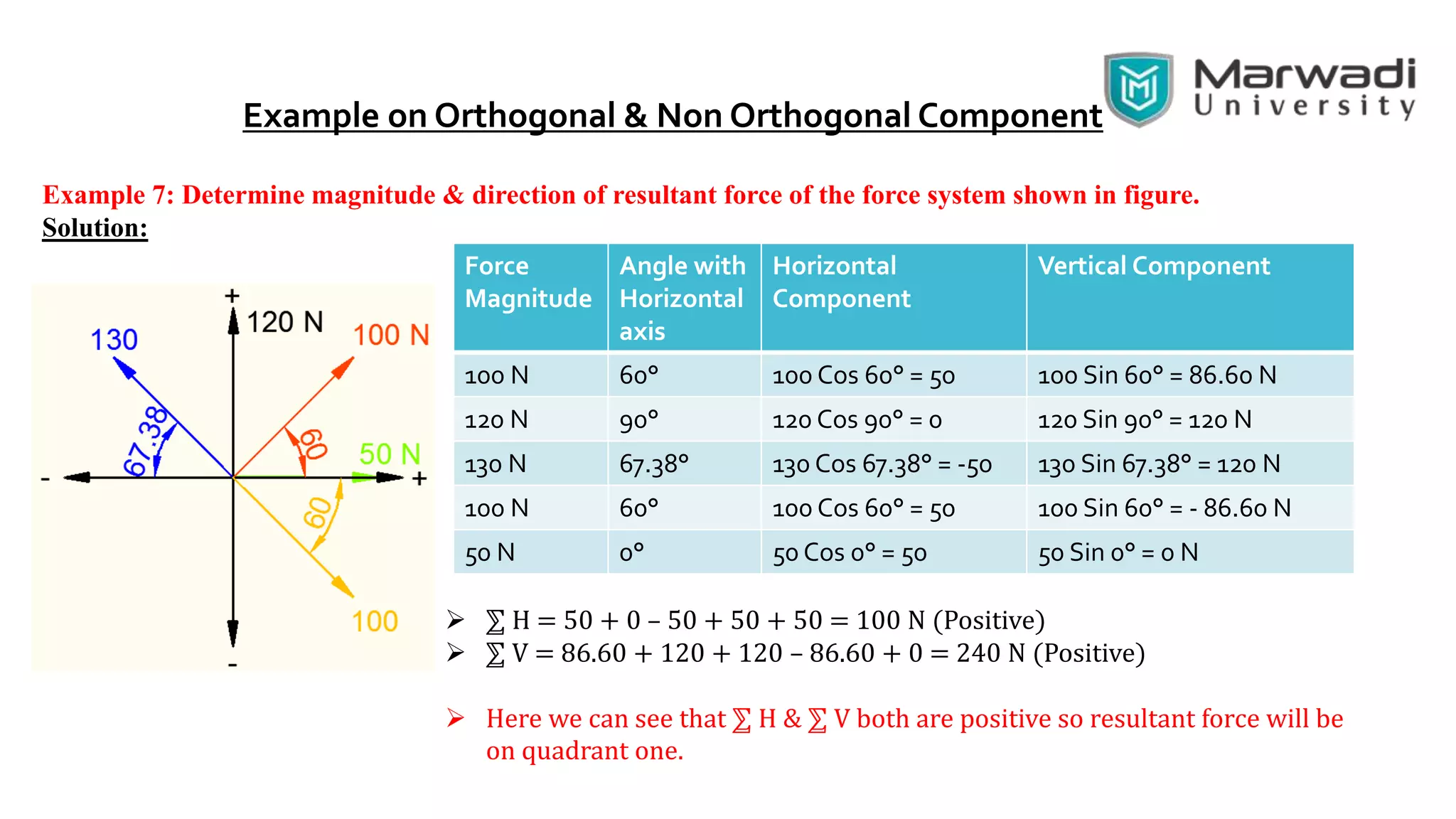
Example 7: Determine magnitude & direction of resultant force of the force system shown in figure.
Solution:
Here, force 50 KN compressive force is converted into tensile force as per
principle of transmissibility.
Example on Orthogonal & Non Orthogonal Component
Example 7: Determine magnitude & direction of resultant force of the force system shown in figure.
Solution:
Force
Magnitude
Angle with
Horizontal
axis
Horizontal
Component
Vertical Component
100 N 60° 100 Cos 60° = 50 100 Sin 60° = 86.60 N
120 N 90° 120 Cos 90° = 0 120 Sin 90° = 120 N
130 N 67.38° 130 Cos 67.38° = -50 130 Sin 67.38° = 120 N
100 N 60° 100 Cos 60° = 50 100 Sin 60° = - 86.60 N
50 N 0° 50 Cos 0° = 50 50 Sin 0° = 0 N
 ⅀ H = 50 + 0 – 50 + 50 + 50 = 100 N (Positive)
 ⅀ V = 86.60 + 120 + 120 – 86.60 + 0 = 240 N (Positive)
 Here we can see that ⅀ H & ⅀ V both are positive so resultant force will be
on quadrant one.
Example on Orthogonal & Non Orthogonal Component
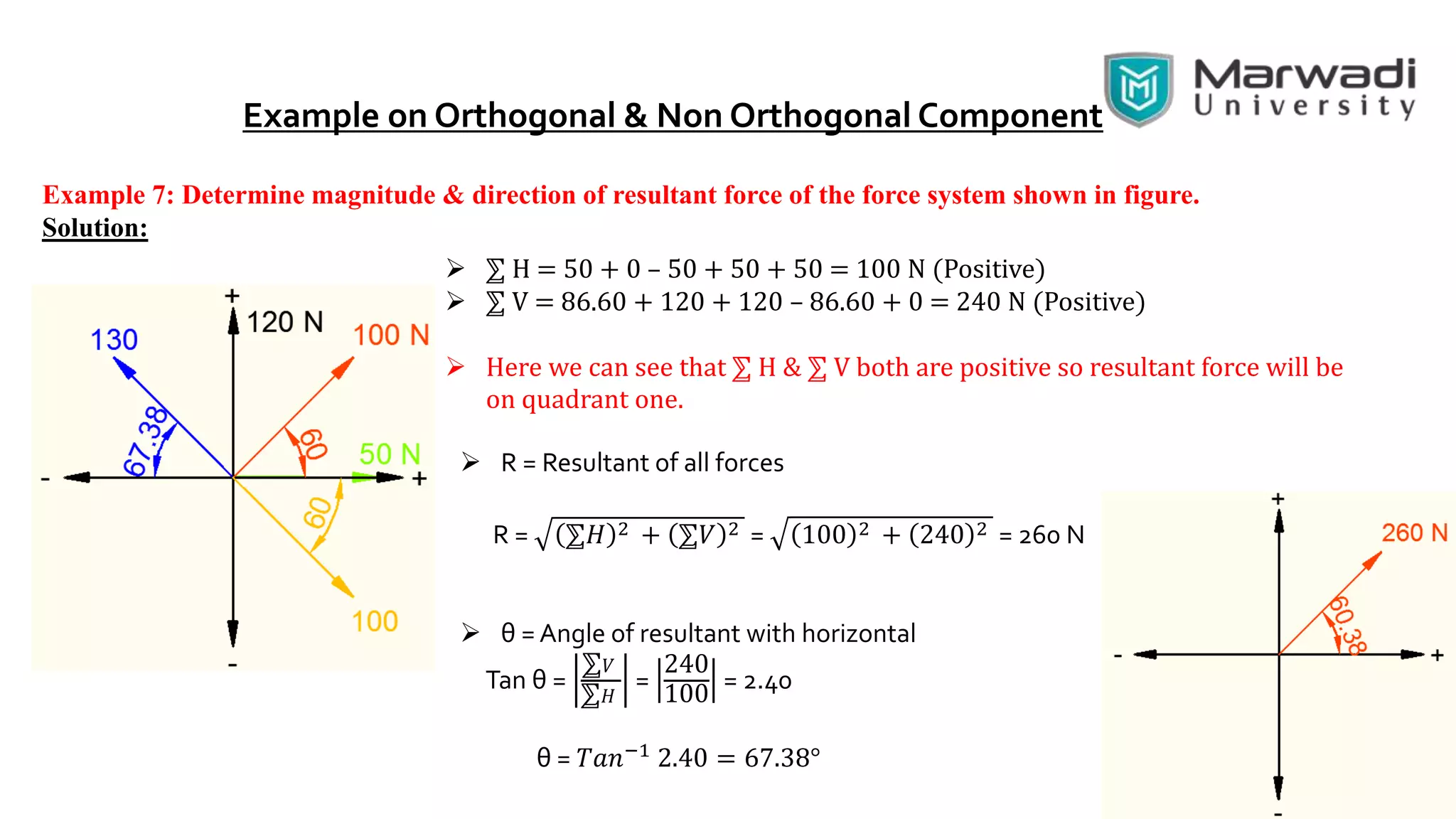
Example 7: Determine magnitude & direction of resultant force of the force system shown in figure.
Solution:
 ⅀ H = 50 + 0 – 50 + 50 + 50 = 100 N (Positive)
 ⅀ V = 86.60 + 120 + 120 – 86.60 + 0 = 240 N (Positive)
 Here we can see that ⅀ H & ⅀ V both are positive so resultant force will be
on quadrant one.
 R = Resultant of all forces
R = ⅀𝐻 2 + ⅀𝑉 2 = 100 2 + 240 2 = 260 N
 θ = Angle of resultant with horizontal
Tan θ =
⅀ 𝑉
⅀ 𝐻
=
240
100
= 2.40
θ = 𝑇𝑎𝑛−1
2.40 = 67.38°
Example on Orthogonal & Non Orthogonal Component
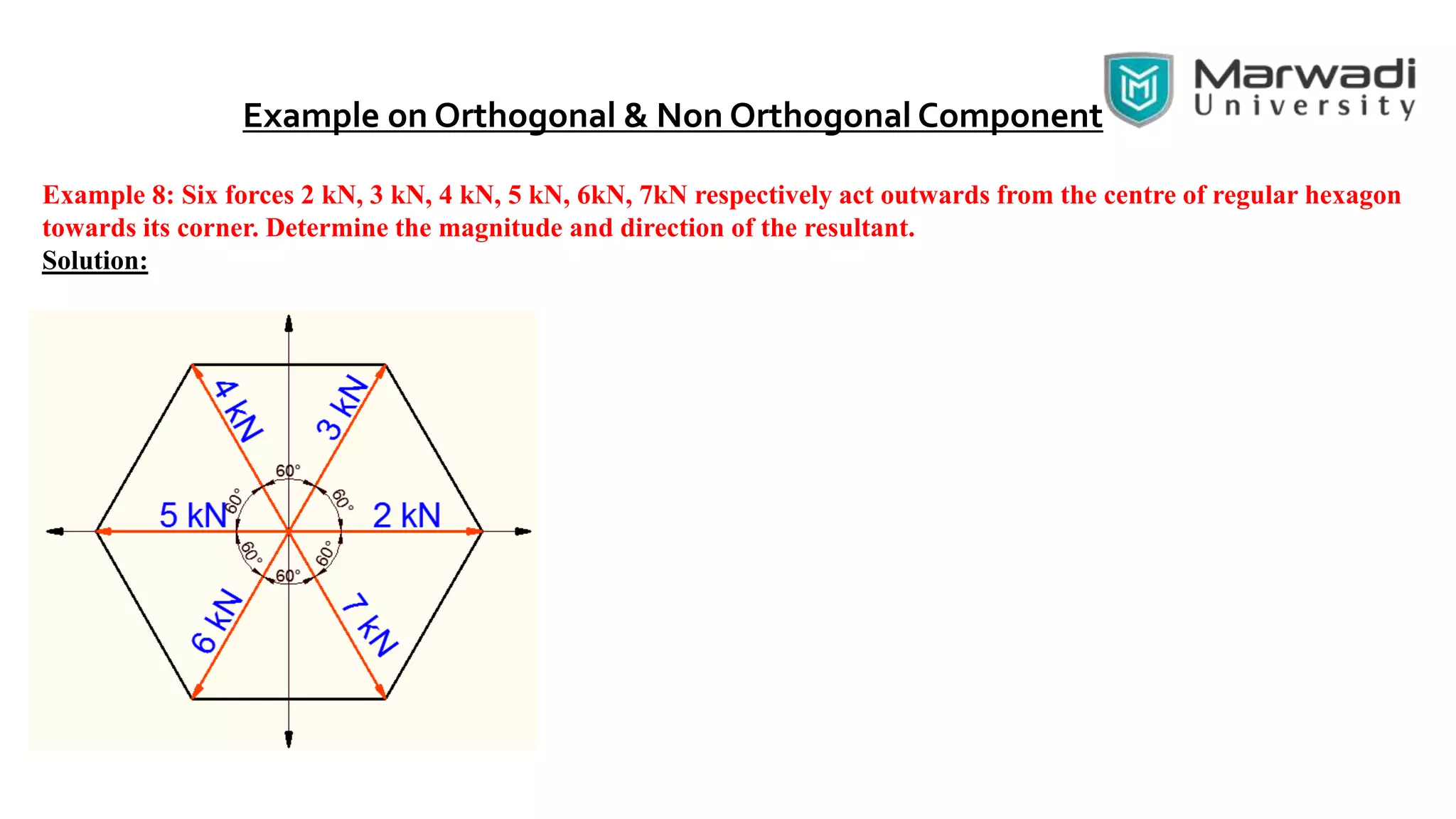
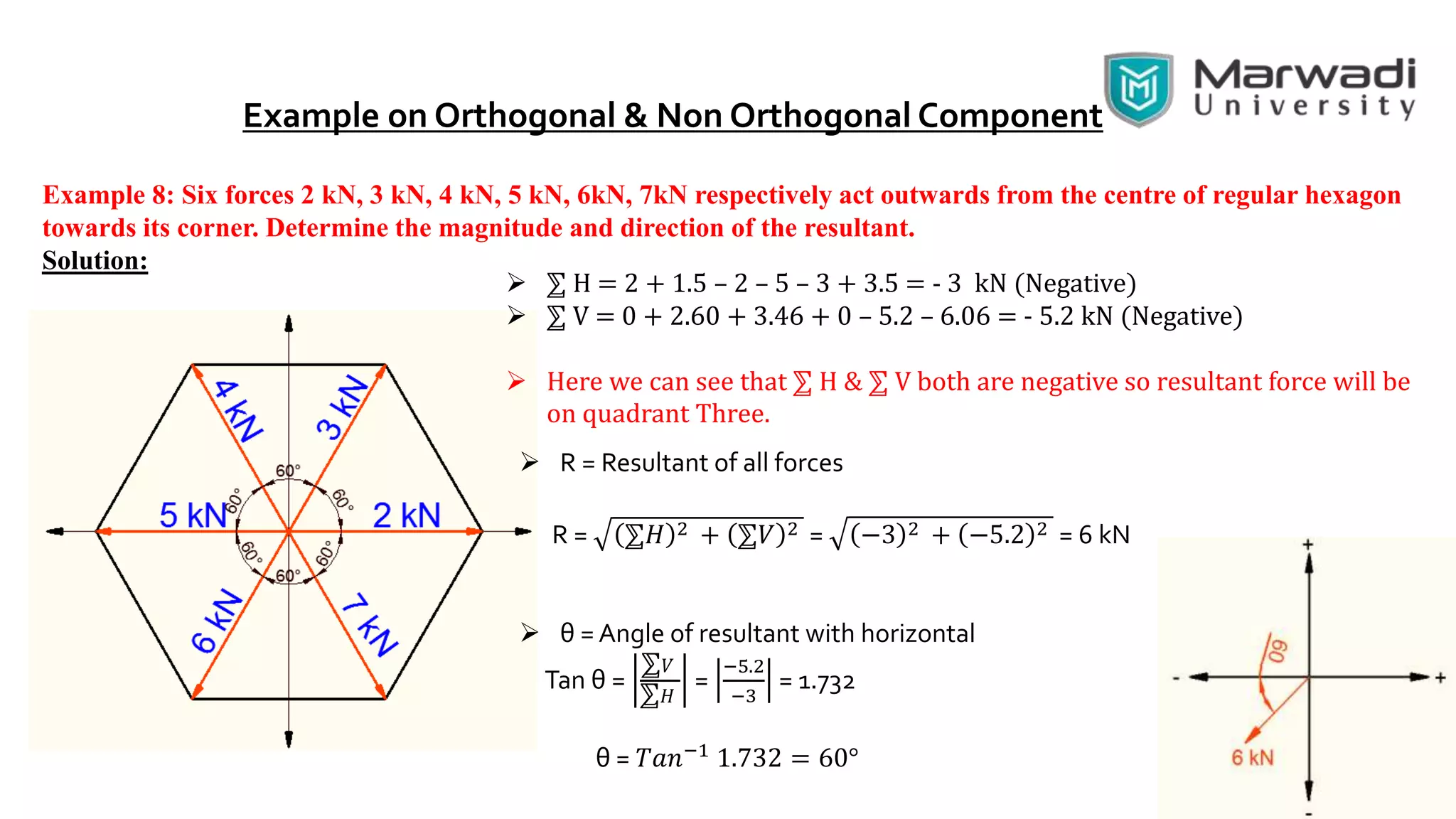
Example 8: Six forces 2 kN, 3 kN, 4 kN, 5 kN, 6kN, 7kN respectively act outwards from the centre of regular hexagon
towards its corner. Determine the magnitude and direction of the resultant.
Solution:
Example on Orthogonal & Non Orthogonal Component
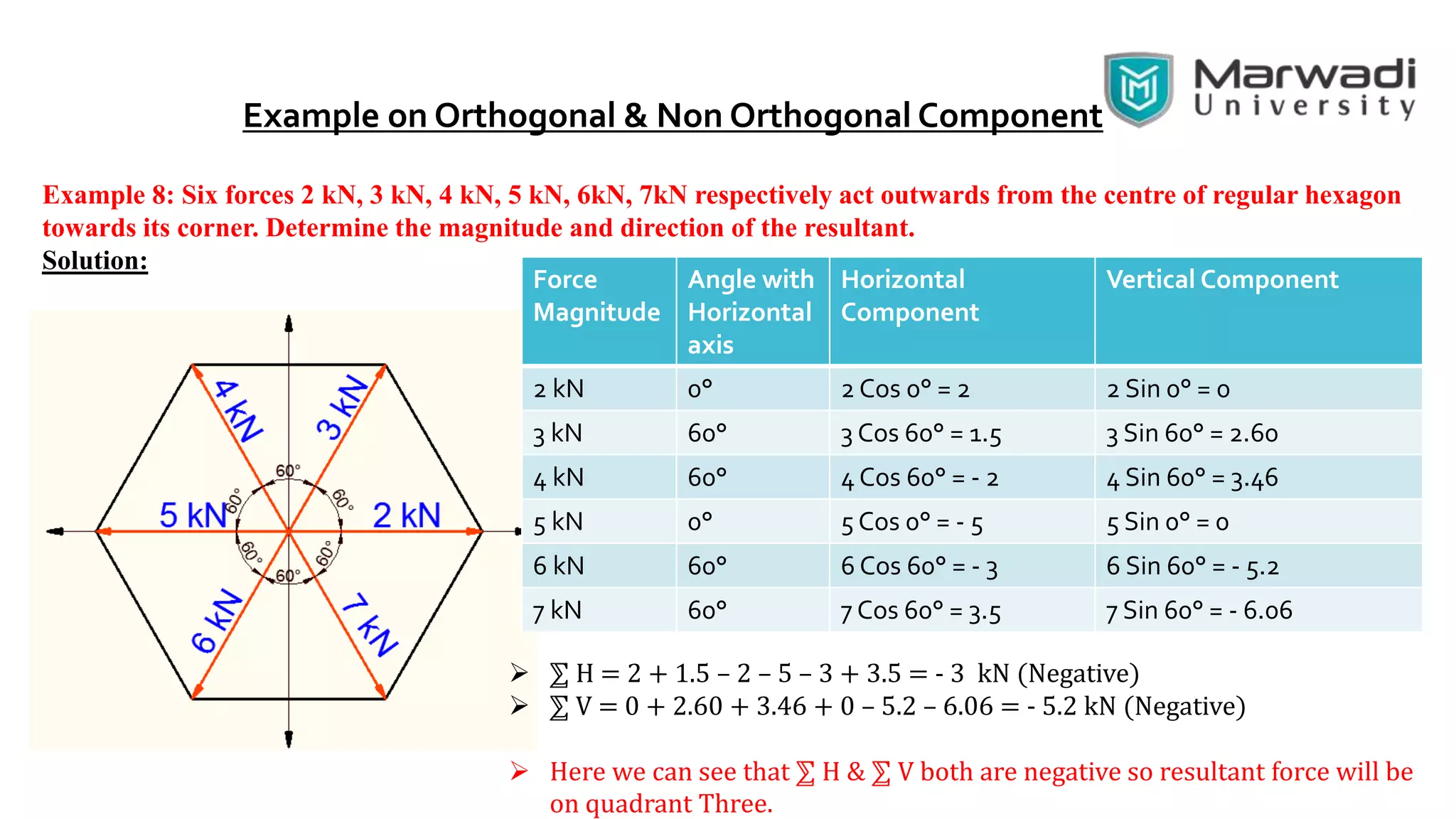
Example 8: Six forces 2 kN, 3 kN, 4 kN, 5 kN, 6kN, 7kN respectively act outwards from the centre of regular hexagon
towards its corner. Determine the magnitude and direction of the resultant.
Solution:
Force
Magnitude
Angle with
Horizontal
axis
Horizontal
Component
Vertical Component
2 kN 0° 2 Cos 0° = 2 2 Sin 0° = 0
3 kN 60° 3 Cos 60° = 1.5 3 Sin 60° = 2.60
4 kN 60° 4 Cos 60° = - 2 4 Sin 60° = 3.46
5 kN 0° 5 Cos 0° = - 5 5 Sin 0° = 0
6 kN 60° 6 Cos 60° = - 3 6 Sin 60° = - 5.2
7 kN 60° 7 Cos 60° = 3.5 7 Sin 60° = - 6.06
 ⅀ H = 2 + 1.5 – 2 – 5 – 3 + 3.5 = - 3 kN (Negative)
 ⅀ V = 0 + 2.60 + 3.46 + 0 – 5.2 – 6.06 = - 5.2 kN (Negative)
 Here we can see that ⅀ H & ⅀ V both are negative so resultant force will be
on quadrant Three.
Example on Orthogonal & Non Orthogonal Component
Example 8: Six forces 2 kN, 3 kN, 4 kN, 5 kN, 6kN, 7kN respectively act outwards from the centre of regular hexagon
towards its corner. Determine the magnitude and direction of the resultant.
Solution:
 ⅀ H = 2 + 1.5 – 2 – 5 – 3 + 3.5 = - 3 kN (Negative)
 ⅀ V = 0 + 2.60 + 3.46 + 0 – 5.2 – 6.06 = - 5.2 kN (Negative)
 Here we can see that ⅀ H & ⅀ V both are negative so resultant force will be
on quadrant Three.
 R = Resultant of all forces
R = ⅀𝐻 2 + ⅀𝑉 2 = −3 2 + −5.2 2 = 6 kN
 θ = Angle of resultant with horizontal
Tan θ =
⅀ 𝑉
⅀ 𝐻
=
−5.2
−3
= 1.732
θ = 𝑇𝑎𝑛−1
1.732 = 60°
Example on Orthogonal & Non Orthogonal Component
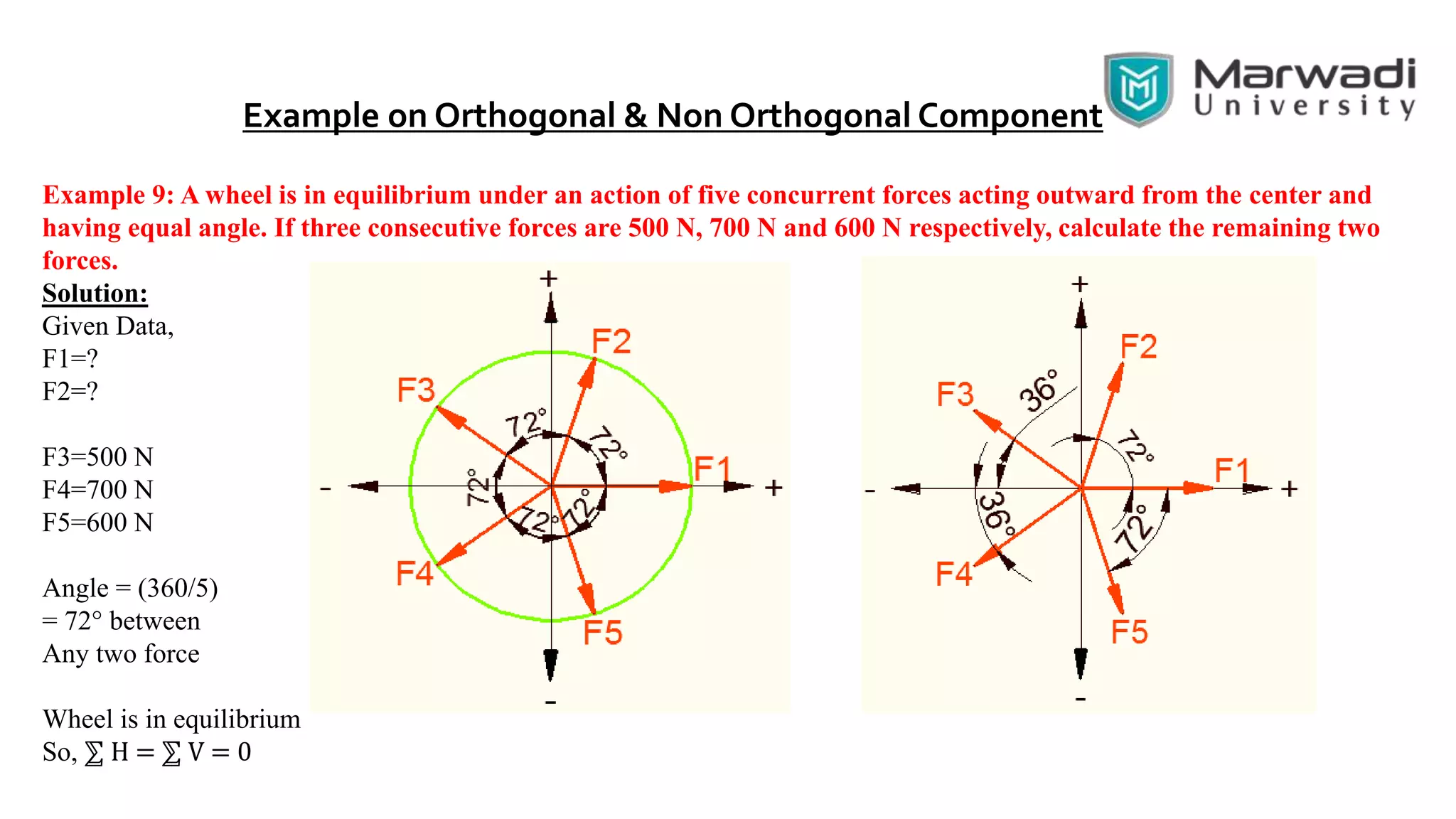
Example 9: A wheel is in equilibrium under an action of five concurrent forces acting outward from the center and
having equal angle. If three consecutive forces are 500 N, 700 N and 600 N respectively, calculate the remaining two
forces.
Solution:
Given Data,
F1=?
F2=?
F3=500 N
F4=700 N
F5=600 N
Angle = (360/5)
= 72° between
Any two force
Wheel is in equilibrium
So, ⅀ H = ⅀ V = 0
Example on Orthogonal & Non Orthogonal Component
Example 9: A wheel is in equilibrium under an action of five concurrent forces acting outward from the center and
having equal angle. If three consecutive forces are 500 N, 700 N and 600 N respectively, calculate the remaining two
forces.
Solution:
Given Data,
F1=?
F2=?
F3=500 N
F4=700 N
F5=600 N
Angle = (360/5)
= 72° between
Any two force
Wheel is in equilibrium
So, ⅀ H = ⅀ V = 0
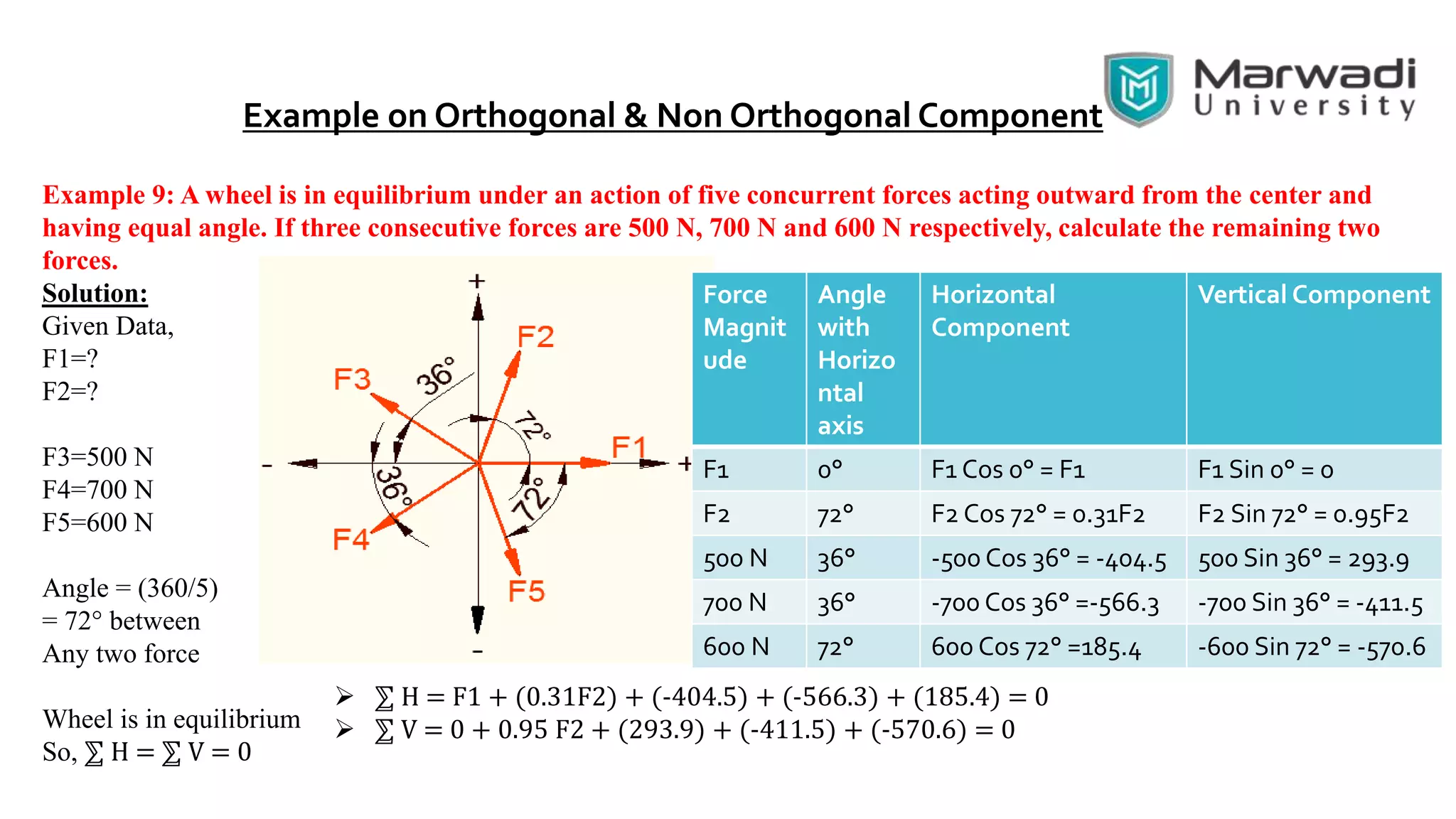
Force
Magnit
ude
Angle
with
Horizo
ntal
axis
Horizontal
Component
Vertical Component
F1 0° F1 Cos 0° = F1 F1 Sin 0° = 0
F2 72° F2 Cos 72° = 0.31F2 F2 Sin 72° = 0.95F2
500 N 36° -500 Cos 36° = -404.5 500 Sin 36° = 293.9
700 N 36° -700 Cos 36° =-566.3 -700 Sin 36° = -411.5
600 N 72° 600 Cos 72° =185.4 -600 Sin 72° = -570.6
 ⅀ H = F1 + (0.31F2) + (-404.5) + (-566.3) + (185.4) = 0
 ⅀ V = 0 + 0.95 F2 + (293.9) + (-411.5) + (-570.6) = 0
Example on Orthogonal & Non Orthogonal Component
Example 9: A wheel is in equilibrium under an action of five concurrent forces acting outward from the center and
having equal angle. If three consecutive forces are 500 N, 700 N and 600 N respectively, calculate the remaining two
forces.
Solution:
Given Data,
F1=?
F2=?
F3=500 N
F4=700 N
F5=600 N
Angle 72° between
Any two force
Wheel is in equilibrium
So, ⅀ H = ⅀ V = 0
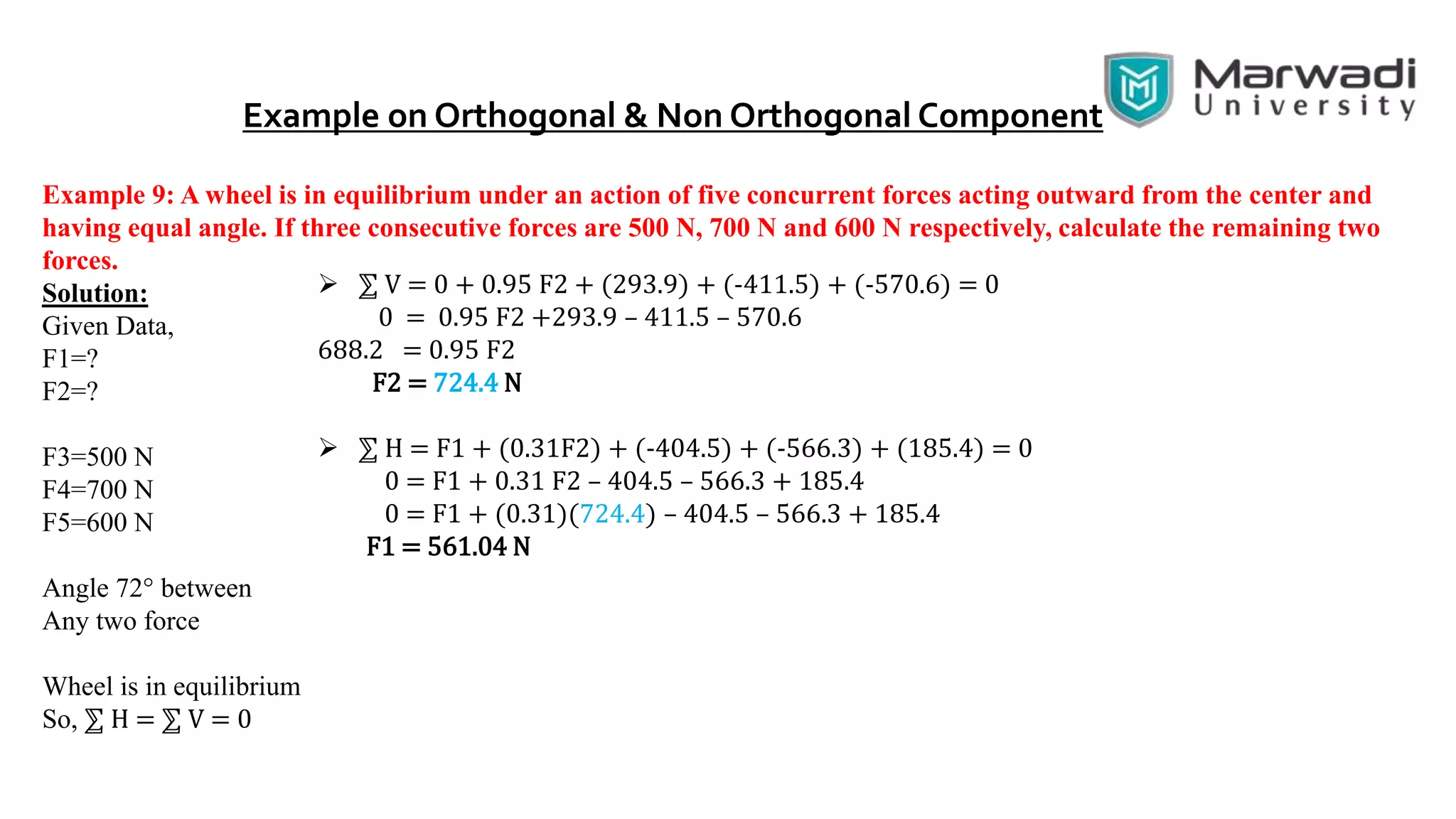
 ⅀ V = 0 + 0.95 F2 + (293.9) + (-411.5) + (-570.6) = 0
0 = 0.95 F2 +293.9 – 411.5 – 570.6
688.2 = 0.95 F2
F2 = 724.4 N
 ⅀ H = F1 + (0.31F2) + (-404.5) + (-566.3) + (185.4) = 0
0 = F1 + 0.31 F2 – 404.5 – 566.3 + 185.4
0 = F1 + (0.31)(724.4) – 404.5 – 566.3 + 185.4
F1 = 561.04 N
Topic will be cover:
1. Coplanar concurrent force system:
a) Resultant Force
b) Equilibrant Force
c) Composition Of Force
d) Parallelogram Law of Forces
e) Triangle Law of Forces
f) Resolution Of Forces
g) Resolution of more than two
concurrent forces
h) Polygon Law Of Forces
Department of Mechanical
Engineering.
Prof. Malay Badodariya
malay.badodariya@marwadie
ducation.edu.in
Unit no.: 2
Fundamental Of
Statics
Subject Name: FMD
01ME0305
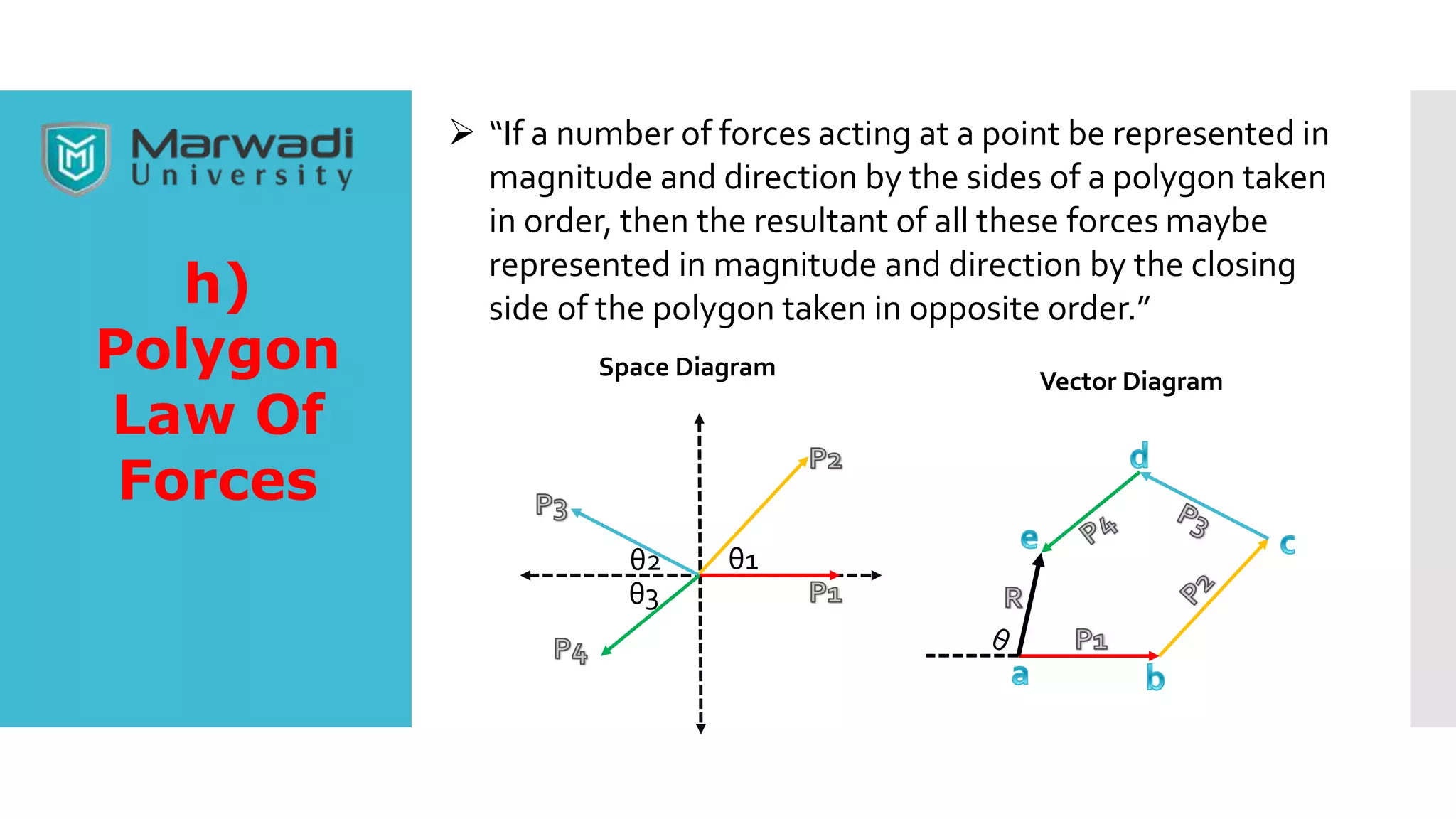
 “If a number of forces acting at a point be represented in
magnitude and direction by the sides of a polygon taken
in order, then the resultant of all these forces maybe
represented in magnitude and direction by the closing
side of the polygon taken in opposite order.”h)
Polygon
Law Of
Forces
θ1θ2
θ3
Space Diagram
Vector Diagram
Example on Graphical Method
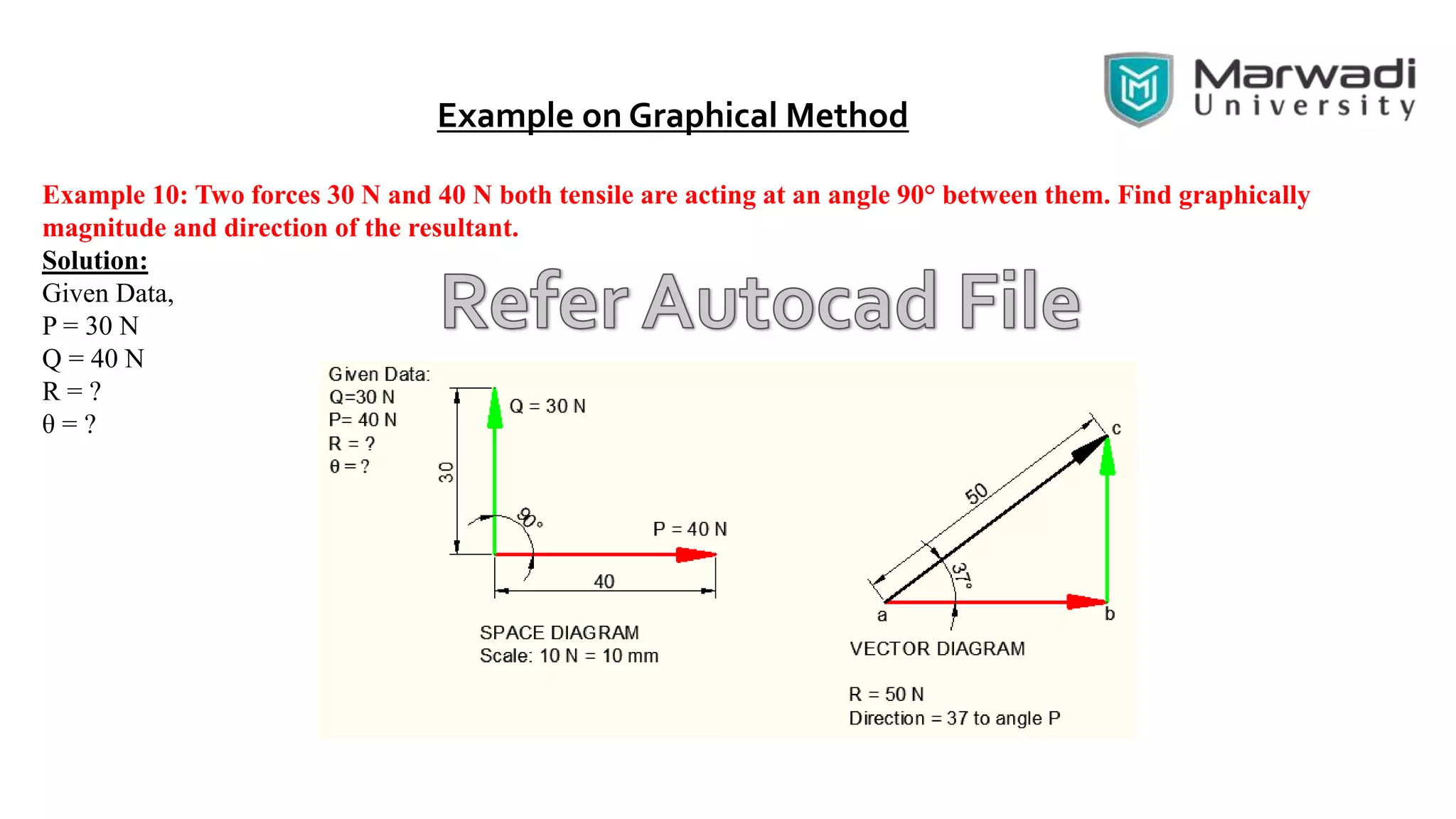
Example 10: Two forces 30 N and 40 N both tensile are acting at an angle 90° between them. Find graphically
magnitude and direction of the resultant.
Solution:
Given Data,
P = 30 N
Q = 40 N
R = ?
θ = ?
Example on Graphical Method
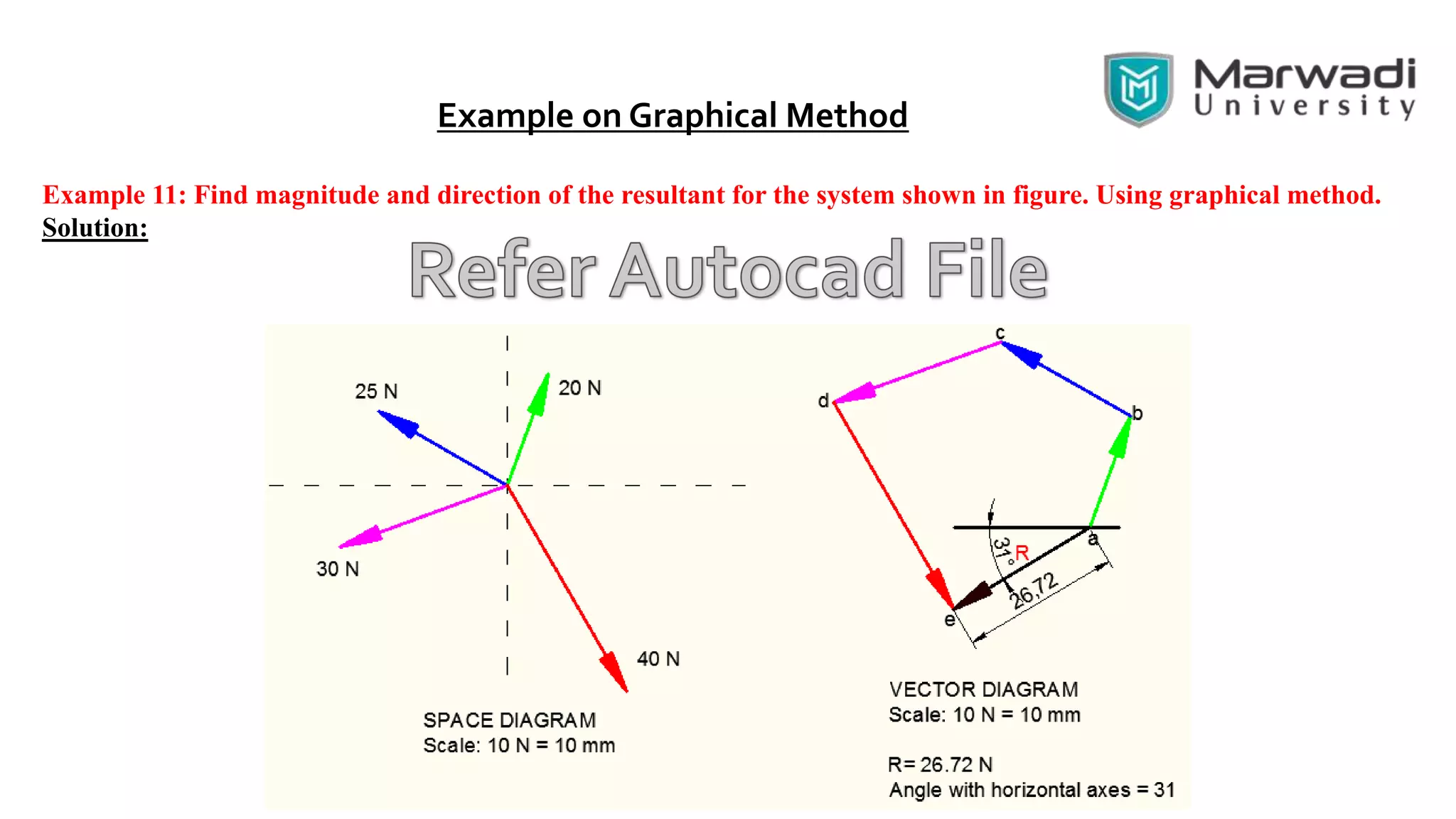
Example 11: Find magnitude and direction of the resultant for the system shown in figure. Using graphical method.
Solution:
Department of Mechanical
Engineering.
Prof. Malay Badodariya
malay.badodariya@marwadie
ducation.edu.in

Fundamental of Statics (Part 1)

  • 1.
    Department of Mechanical Engineering. Prof. MalayBadodariya +91 9429 158833 Unit no.: 2 Fundamental Of Statics Subject Name: FMD 01ME0305 FundamentalOfMachineDesign (01ME0504) Unit 2: Fundamental of Statics (Part 1)
  • 2.
    Topic will becover: 1. Coplanar concurrent force system: a) Resultant Force b) Equilibrant Force c) Composition Of Force d) Parallelogram Law of Forces e) Triangle Law of Forces f) Resolution Of Forces g) Resolution of more than two concurrent forces h) Polygon Law Of Forces Department of Mechanical Engineering. Prof. Malay Badodariya malay.badodariya@gmail.com Unit no.: 2 Fundamental Of Statics Subject Name: FMD 01ME0305
  • 3.
    a) Resultant Force If a numberof forces P1, P2, P3, P4, … etc are acting simultaneously on a particle, It is possible to find out a single force which could replace them. i.e. which would produce the same effect as produced by all the given forces. This single force, capable of producing same effect on a body is known as resultant force and the given forces P1, P2, P3, P4… etc are called component forces. ‘R’ is the resultant of three concurrent forces P1, P2 and P3. And θ is the angle of resultant with P1.
  • 4.
    Topic will becover: 1. Coplanar concurrent force system: a) Resultant Force b) Equilibrant Force c) Composition Of Force d) Parallelogram Law of Forces e) Triangle Law of Forces f) Resolution Of Forces g) Resolution of more than two concurrent forces h) Polygon Law Of Forces Department of Mechanical Engineering. Prof. Malay Badodariya malay.badodariya@marwadie ducation.edu.in Unit no.: 2 Fundamental Of Statics Subject Name: FMD 01ME0305
  • 5.
    b) Equilibrant Force To balance theresultant force (to bring the body in equilibrium) a force of same magnitude but of opposite direction is required. This opposite balancing force is called Equilibrant Force. R = Resultant Force R’ = Equilibrant Force
  • 6.
    Topic will becover: 1. Coplanar concurrent force system: a) Resultant Force b) Equilibrant Force c) Composition Of Force d) Parallelogram Law of Forces e) Triangle Law of Forces f) Resolution Of Forces g) Resolution of more than two concurrent forces h) Polygon Law Of Forces Department of Mechanical Engineering. Prof. Malay Badodariya malay.badodariya@marwadie ducation.edu.in Unit no.: 2 Fundamental Of Statics Subject Name: FMD 01ME0305
  • 7.
    c) Composition Of Force The processof finding out resultant force of a number of given forces is called composition of forces. MethodOf Resultant Forces Analytical Method Parallelogram law of forces Resolution of Forces Triangle law of forces Graphical Method Triangle law of forces Polygon law of forces
  • 8.
    Topic will becover: 1. Coplanar concurrent force system: a) Resultant Force b) Equilibrant Force c) Composition Of Force d) Parallelogram Law of Forces e) Triangle Law of Forces f) Resolution Of Forces g) Resolution of more than two concurrent forces h) Polygon Law Of Forces Department of Mechanical Engineering. Prof. Malay Badodariya malay.badodariya@marwadie ducation.edu.in Unit no.: 2 Fundamental Of Statics Subject Name: FMD 01ME0305
  • 9.
    d) Parallelogram Law of Forces “This law states that two forces acting on a particle may be replaced by a single force (called resultant of the two forces) obtained by drawing the diagonal of a parallelogram whose two adjacent sides are equal to the given two forces.”  Let P and Q be two forces acting on a particle A as shown in Fig.  Constructing a parallelogram ABCD taking P and Q as its adjacent sides, the diagonal AC gives the resultant force R of the two forces P and Q.
  • 10.
     The expressionsfor the magnitude and direction of R are obtained as follows:  Considering the right angled triangle ACE, from the Pythagoras theorem,  (AC)2 = (AE)2 + (EC)2  Also,AE = AB + BE  (AC)2 = (AB + BE)2 + (EC)2 = (AB)2 + 2 × (AB) × (BE) + (BE)2 + (EC)2
  • 11.
     Therfore,  (AC)2= (AB + BE)2 + (EC)2 = (AB)2 + 2 × (AB) × (BE) + (BE)2 + (EC)2  Further, from right angled triangle BCE,  (BE)2 + (EC)2 = (BC)2  Hence, (AC)2 = (AB)2 + 2 × (AB) × (BE) + (BC)2
  • 12.
     Hence, (AC)2= (AB)2 + 2 × (AB) × (BE) + (BC)2  Substituting AB = P, BC = AD = Q,  BE = BC (cos Ө) = Q cos Ө and AC = R.  the magnitude of the resultant force R of the two forces P and Q is,  R2 = P2 + 2PQ cos Ө + Q2
  • 13.
     The directionof resultant R, defined by the angle α ,  For finding value of ‘α’ , consider triangle ACE.  𝑇𝑎𝑛 α = 𝐶𝐸 𝐴𝐸 = 𝐶𝐸 𝐴𝐵+𝐵𝐸  Find value of CE, Consider Δ BEC,  Sin θ = 𝐶𝐸 𝐵𝐶 , 𝑠𝑜 𝐶𝐸 = 𝐵𝐶 𝑆𝑖𝑛 θ = Q 𝑆𝑖𝑛 θ  AB = P  BE = Q Cos θ
  • 14.
     The directionof resultant R, defined by the angle α ,  For finding value of ‘α’ , consider triangle ACE.  𝑻𝒂𝒏 α = 𝐂𝐄 𝐀𝐄 = Q 𝐒𝐢𝐧 𝛉 𝐏+Q Cos θ  R2 = P2 + 2PQ cos Ө + Q2
  • 15.
    Example on ParallelogramLaw of Forces Example 1: Two tensile forces 50 KN and 40 KN acting at a point with angle 60° between them. Find Magnitude and direction of the resultant. Solution: Given Data, P = 50 KN Q = 40 KN θ = 60° R = ? α = ? R2 = P2 + 2PQ cos Ө + Q2 = 502 + 2(50)(40) cos 60 + 402 R2 = 6100 KN R = 78.10 KN 𝑻𝒂𝒏 α = Q 𝑺𝒊𝒏 𝜽 𝑷+Q Cos θ = 𝟒𝟎 𝑺𝒊𝒏 𝟔𝟎° 𝟓𝟎+𝟒𝟎 𝑪𝒐𝒔 𝟔𝟎° Tan α = 0.495 α = Tan-1 0.495 α = 26.33°
  • 16.
    Example on ParallelogramLaw of Forces Example 2: Determine the resultant of two concurrent forces 100 KN compressive and 80 KN tensile acting at point with angle between them is 60°. Also find angle made by resultant with 80 KN force. Solution: Given Data, P = 100 KN Q = 80 KN θ = 60 = 180-60 = 120° R = ? α = ? Here, P= 100 KN compressive force is converted into tensile force as per principle of transmissibility.
  • 17.
    Example on ParallelogramLaw of Forces Example 2: Determine the resultant of two concurrent forces 100 KN compressive and 80 KN tensile acting at point with angle between them is 60°. Also find angle made by resultant with 80 KN force. Solution: Given Data, P = 100 KN Q = 80 KN θ = 60 = 180-60 = 120° R = ? α = ? R2 = P2 + 2PQ cos Ө + Q2 = 1002 + 2(100)(80) cos 120 + 802 R2 = 8400 KN R = 91.65 KN 𝑻𝒂𝒏 α = Q 𝑺𝒊𝒏 𝜽 𝑷+Q Cos θ = 𝟖𝟎 𝑺𝒊𝒏 𝟏𝟐𝟎° 𝟏𝟎𝟎+𝟖𝟎 𝑪𝒐𝒔 𝟏𝟐𝟎° Tan α = 1.154 α = Tan-1 1.154 α = 49.10°
  • 18.
    Example on ParallelogramLaw of Forces Example 2: Determine the resultant of two concurrent forces 100 KN compressive and 80 KN tensile acting at point with angle between them is 60°. Also find angle made by resultant with 80 KN force. Solution: Given Data, P = 100 KN Q = 80 KN θ = 60 = 180-60 = 120° R = ? α = ? Angle of R with Q = ? R2 = P2 + 2PQ cos Ө + Q2 = 1002 + 2(100)(80) cos 120 + 802 R2 = 8400 KN R = 91.65 KN 𝑻𝒂𝒏 α = Q 𝑺𝒊𝒏 𝜽 𝑷+Q Cos θ = 𝟖𝟎 𝑺𝒊𝒏 𝟏𝟐𝟎° 𝟏𝟎𝟎+𝟖𝟎 𝑪𝒐𝒔 𝟏𝟐𝟎° Tan α = 1.154 α = Tan-1 1.154 α = 49.10° Angle of ‘R’ with ‘Q’ = 120°-49.10° = 70.90°
  • 19.
    Example on ParallelogramLaw of Forces Example 3: Find the magnitude of two forces such that if they act at right angle, their resultant is 𝟒𝟎 𝐊𝐍. 𝐁𝐮𝐭 𝐭𝐡𝐞𝐲 𝐚𝐜𝐭 𝐚𝐭 𝟔𝟎° 𝒕𝒉𝒆𝒊𝒓 𝒓𝒆𝒔𝒖𝒍𝒕𝒂𝒏𝒕 𝒊𝒔 𝟓𝟐 KN. Solution: Given Data, Case 1: R = 40 KN θ = 90° Cos 90° = 0 Case 2: R = 52 KN θ = 60° Cos 60° = 0.5 Find P & Q CASE 1: R2 = P2 + 2PQ cos Ө + Q2 40 = P2 + 2PQ cos 90° + Q2 40 = P2 + Q2 CASE 2: R2 = P2 + 2PQ cos Ө + Q2 52 = P2 + 2PQ cos 60° + Q2 52 = P2 + 2PQ (0.5) + Q2 52 = (P2 + Q2 ) + 2PQ (0.5) 52 = 40 + 2PQ (0.5) 12 = 2PQ (0.5) 12 = PQ
  • 20.
    Example on ParallelogramLaw of Forces Example 3: Find the magnitude of two forces such that if they act at right angle, their resultant is 𝟒𝟎 𝐊𝐍. 𝐁𝐮𝐭 𝐭𝐡𝐞𝐲 𝐚𝐜𝐭 𝐚𝐭 𝟔𝟎° 𝒕𝒉𝒆𝒊𝒓 𝒓𝒆𝒔𝒖𝒍𝒕𝒂𝒏𝒕 𝒊𝒔 𝟓𝟐 KN. Solution: Given Data, Case 1: R = 40 KN θ = 90° Cos 90° = 0 Case 2: R = 52 KN θ = 60° Cos 60° = 0.5 Find P & Q We KnowThat, 𝑃 + 𝑄 2 = 𝑝2 + 𝑄2 + 2𝑃𝑄 𝑃 + 𝑄 2 = 40 + 2 𝑋 12 𝑃 + 𝑄 2 = 64 𝑃 + 𝑄 = 8 ________ Eqn. 1 We KnowThat, 𝑃 − 𝑄 2 = 𝑝2 + 𝑄2 − 2𝑃𝑄 𝑃 − 𝑄 2 = 40 − 2 𝑋 12 𝑃 − 𝑄 2 = 16 𝑃 − 𝑄 = 4 __________ Eqn. 2
  • 21.
    Example on ParallelogramLaw of Forces Example 3: Find the magnitude of two forces such that if they act at right angle, their resultant is 𝟒𝟎 𝐊𝐍. 𝐁𝐮𝐭 𝐭𝐡𝐞𝐲 𝐚𝐜𝐭 𝐚𝐭 𝟔𝟎° 𝒕𝒉𝒆𝒊𝒓 𝒓𝒆𝒔𝒖𝒍𝒕𝒂𝒏𝒕 𝒊𝒔 𝟓𝟐 KN. Solution: Given Data, Case 1: R = 40 KN θ = 90° Cos 90° = 0 Case 2: R = 52 KN θ = 60° Cos 60° = 0.5 Find P & Q We KnowThat, 𝑃 + 𝑄 2 = 𝑝2 + 𝑄2 + 2𝑃𝑄 𝑃 + 𝑄 2 = 40 + 2 𝑋 12 𝑃 + 𝑄 2 = 64 𝑃 + 𝑄 = 8 ________ Eqn. 1 We KnowThat, 𝑃 − 𝑄 2 = 𝑝2 + 𝑄2 − 2𝑃𝑄 𝑃 − 𝑄 2 = 40 − 2 𝑋 12 𝑃 − 𝑄 2 = 16 𝑃 − 𝑄 = 4 __________ Eqn. 2 From Eqn. 1 & 2, P + Q = 8 P - Q = 4 2P = 12 P = 6 KN P + Q = 8 6 + Q = 8 Q = 2 KN P = 6 KN Q = 2 KN
  • 22.
    Example on ParallelogramLaw of Forces Practice 1: Two tensile forces 100 kN and Q kN acting at a point at an angle 90° between them. If resultant force is 200 kN, find the value of Q. Also find angle made by resultant with 100 kN force. Solution: Given Data, P = 100 KN Q = ??? θ = 90° R = 200 kN α = ? Angle of R with P = ? R2 = P2 + 2PQ cos Ө + Q2 Q = 173.20 kN 𝑻𝒂𝒏 α = Q 𝑺𝒊𝒏 𝜽 𝑷+Q Cos θ Tan α = 1.73 α = Tan-1 1.73 α = 60°
  • 23.
    Example on ParallelogramLaw of Forces Practice 2: Two tensile forces acting at an angle 120° between them. The bigger force is 40 kN. The resultant is perpendicular to the smaller force. Find the smaller force and the resultant force. Solution: Given Data, P = 40 KN Q = ??? θ = 120° R = ??? α = 30° R2 = P2 + 2PQ cos Ө + Q2 R = 34.64 kN 𝑻𝒂𝒏 α = Q 𝑺𝒊𝒏 𝜽 𝑷+Q Cos θ Q= 20 kN
  • 24.
    Topic will becover: 1. Coplanar concurrent force system: a) Resultant Force b) Equilibrant Force c) Composition Of Force d) Parallelogram Law of Forces e) Triangle Law of Forces f) Resolution Of Forces g) Resolution of more than two concurrent forces h) Polygon Law Of Forces Department of Mechanical Engineering. Prof. Malay Badodariya malay.badodariya@marwadie ducation.edu.in Unit no.: 2 Fundamental Of Statics Subject Name: FMD 01ME0305
  • 25.
    e) Triangle Law of Forces “If two forces acting at a point be represented in magnitude and direction by two sides of a triangle taken in order, their resultant may be represented in magnitude and direction by the third side of triangle, taken in opposite order.”  Let two forces P andQ acting simultaneously on a particle at pointO as shown in figure.  As per triangle law of forces can be drawn as two sides of a triangle taken in order, then their resultant ‘R’ is represented by third side OB of triangle.
  • 26.
     Now considerΔ OCB, 𝑂𝐵2 = 𝑂𝐶2 + 𝐵𝐶2 𝑂𝐵2 = 𝑂𝐴 + 𝐴𝐶 2 + 𝐵𝐶2______________ Eqn 1 From above equation,OA = P, AC = ?, BC = ? FindValue ofAC, ConsiderΔ ABC, Cos θ = 𝐴𝐶 𝐴𝐵 AC =AB Cos θ = Q Cos θ _________________ Eqn 2
  • 27.
    Type equation here.FindValueof BC, Consider Δ ABC, Sin θ = 𝐵𝐶 𝐴𝐵 BC =AB Sin θ = Q Sin θ ___________________ Eqn. 3 From Eqn. 1, 2 & 3: 𝑂𝐵2 = 𝑂𝐴 + 𝐴𝐶 2 + 𝐵𝐶2 𝑂𝐵2 = 𝑃 + Q Cos θ 2 + Q Sin θ 2 𝑅2 = 𝑃2 + 2𝑃𝑄𝐶𝑜𝑠𝜃 + 𝑄2 𝐶𝑜𝑠2 𝜃 + 𝑄2 𝑆𝑖𝑛2 𝜃 𝑅2 = 𝑃2 + 2𝑃𝑄𝐶𝑜𝑠𝜃 + 𝑄2 𝑅 = 𝑃2 + 2𝑃𝑄𝐶𝑜𝑠𝜃 + 𝑄2
  • 28.
     To determinethe direction of the resultant Force, let β be the angle between the resultant R and P. From triangle OBC, Tan β = 𝐵𝐶 𝑂𝐶 = 𝐵𝐶 𝑂𝐴+𝐴𝐶 = Q Sin θ 𝑃+Q Cos θ β = 𝑇𝑎𝑛−1 Q Sin θ 𝑃+Q Cos θ
  • 29.
    Example on LawofTriangle of Forces Example 4: Two tensile forces 20 KN and 30 KN acting at a point with angle 60° between them. Find Magnitude and direction of the resultant. Solution: Given Data, P = 20 KN Q = 30 KN θ = 60° R = ? β = ? Resultant Force, 𝑅2 = 𝑃2 + 2𝑃𝑄𝐶𝑜𝑠𝜃 + 𝑄2 𝑅2 = 202 + 2 20 30 𝐶𝑜𝑠 60 + 302 𝑅2 = 900 𝑅 = 43.58 KN Direction of resultant force, β = 𝑇𝑎𝑛−1 Q Sin θ 𝑃+Q Cos θ = 𝑇𝑎𝑛−1 30 Sin 60 20+30 Cos 60 β= 36.58°
  • 30.
    Example on LawofTriangle of Forces Example 5: Two forces P and Q are acting at point O as shown in Figure. Determine magnitude and direction of the resultant using triangle law of forces. Solution: Given Data, P = 150 KN Q = 80 KN θ = 45° + 30° = 75° R = ? β = ? X P= 150 kN Q = 80 kN 30° Y X P= 150 kNR
  • 31.
    Example on LawofTriangle of Forces Example 5: Two forces P and Q are acting at point O as shown in Figure. Determine magnitude and direction of the resultant using triangle law of forces. Solution: Given Data, P = 150 KN Q = 80 KN θ = 45° + 30° = 75° R = ? β = ? X P= 150 kN Q = 80 kN 30° Resultant Force, 𝑅2 = 𝑃2 + 2𝑃𝑄𝐶𝑜𝑠𝜃 + 𝑄2 𝑅2 = 1502 + 2 150 80 𝐶𝑜𝑠 75 + 802 𝑅2 = 22500 + 6211.66 + 6400 𝑅 = 187.38 KN Y X P= 150 kNR Direction of resultant force, β = 𝑇𝑎𝑛−1 Q Sin θ 𝑃+Q Cos θ = 𝑇𝑎𝑛−1 80 Sin 75 150+80 Cos 75 β= 24.35°
  • 32.
    Topic will becover: 1. Coplanar concurrent force system: a) Resultant Force b) Equilibrant Force c) Composition Of Force d) Parallelogram Law of Forces e) Triangle Law of Forces f) Resolution Of Forces g) Resolution of more than two concurrent forces h) Polygon Law Of Forces Department of Mechanical Engineering. Prof. Malay Badodariya malay.badodariya@marwadie ducation.edu.in Unit no.: 2 Fundamental Of Statics Subject Name: FMD 01ME0305
  • 33.
     The processof splitting up the given force in to two or more components, in particular direction without changing effect on the body is called resolution of a force.  There are two type of components. i. Orthogonal Components (Rectangular Component) ii. Non-Orthogonal Components f) Resolution of A Forces
  • 34.
     Consider aforce F acting on a particle O inclined at an angle Ө as shown in Fig.  Let x and y axes can be the two axes passing through O perpendicular to each other.  These two axes are called rectangular axes or coordinate axes.  They may be horizontal and vertical or inclined. i) Orthogonal Components
  • 35.
     The forceF can now be resolved into two components Fx and Fy along the x and y axes and hence, the components are called rectangular components.  Further, the polygon constructed with these two components as adjacent sides will form a rectangle OABC and, therefore, the components are known as rectangular components.
  • 36.
     From theright angled triangle OAB, the trigonometrical functions can be used to resolve the force as follows:  OA/OB = cos Ө  OA = OB × cos Ө  OA = F × cos Ө  OA = F cos Ө  And OC = F Sin Ө
  • 37.
     Therefore, thetwo rectangular components of the force F are:  Fx = F cos Ө and Fy = F sin Ө
  • 38.
    ii) Non Orthogonal Components  The componentsthose are not perpendicular to each other are known as non orthogonal components.  The components make either obtuse Ө > 90° or make acute angle Ө < 90°  Non orthogonal components can be calculated as, i. law of parallelogram of forces ii. triangle law of forces. iii. Sine Rule
  • 39.
  • 40.
    Example on Orthogonal& Non Orthogonal Component Example 6: Resolve 100 N force shown in fig. along, (i) Orthogonal Axes xx and yy (ii) non-orthogonal axes AA and YY. Solution: Given Data, P = 20 KN Q = 30 KN θ = 60° R = ? β = ? For Orthogonal Consider Axes XX & YY only Component along XX = F Cos 60 = 100 Cos 60 Fx= 50 N Component along YY = F Sin 60 = 100 Sin 60 Fy= 86.60 N
  • 41.
    Example on Orthogonal& Non Orthogonal Component Example 6: Resolve 100 N force shown in fig. along, (i) Orthogonal Axes xx and yy (ii) non-orthogonal axes AA and YY. Solution: Given Data, P = 20 KN Q = 30 KN θ = 60° R = ? β = ? For Non Orthogonal Consider Axes AA & YY only 𝑃 𝑆𝑖𝑛 210 = 𝑄 𝑆𝑖𝑛 30 = 100 𝑆𝑖𝑛 120 P = Q = 100 𝑆𝑖𝑛 210 𝑆𝑖𝑛 120 = 57.73 N
  • 42.
    Figure 1: 𝑃 𝑆𝑖𝑛 210 = 𝑄 𝑆𝑖𝑛30 = 100 𝑆𝑖𝑛 120 P = Q = 100 𝑆𝑖𝑛 210 𝑆𝑖𝑛 120 = 57.73 N Figure 2: 𝑃 𝑆𝑖𝑛 150 = 𝑄 𝑆𝑖𝑛 150 = 100 𝑆𝑖𝑛 60 P = Q = 100 𝑆𝑖𝑛 150 𝑆𝑖𝑛 60 = 57.73 N Figure 3: 𝑃 𝑆𝑖𝑛 30 = 𝑄 𝑆𝑖𝑛 210 = 100 𝑆𝑖𝑛 120 P = 100 𝑆𝑖𝑛 30 𝑆𝑖𝑛 120 = 57.73 N Figure 4: 𝑃 𝑆𝑖𝑛 30 = 𝑄 𝑆𝑖𝑛 30 = 100 𝑆𝑖𝑛 300 P = Q = 100 𝑆𝑖𝑛 30 𝑆𝑖𝑛 300 = 57.73 N Figure 1: Figure 2: Figure 3: Figure 4:
  • 43.
    Topic will becover: 1. Coplanar concurrent force system: a) Resultant Force b) Equilibrant Force c) Composition Of Force d) Parallelogram Law of Forces e) Triangle Law of Forces f) Resolution Of Forces g) Resolution of more than two concurrent forces h) Polygon Law Of Forces Department of Mechanical Engineering. Prof. Malay Badodariya malay.badodariya@marwadie ducation.edu.in Unit no.: 2 Fundamental Of Statics Subject Name: FMD 01ME0305
  • 44.
     Consider P1,P2, P3, P4 etc… are acting at a point as shown in figure.  ⅀ H = Algebraic sum of horizontal forces = 𝑃1 𝐶𝑜𝑠 𝜃1 – 𝑃2 𝐶𝑜𝑠 𝜃2 – 𝑃3 𝐶𝑜𝑠 𝜃3 + 𝑃4 𝐶𝑜𝑠 𝜃4  ⅀ V = Algebraic sum of Vertical forces = 𝑃1 𝑆𝑖𝑛 𝜃1 + 𝑃2 𝑆𝑖𝑛 𝜃2 – 𝑃3 𝑆𝑖𝑛 𝜃3 - 𝑃4 𝑆𝑖𝑛 𝜃4 g) Resolution of more than two concurrent forces
  • 45.
     Consider P1,P2, P3, P4 etc… are acting at a point as shown in figure.  R = Resultant of all forces R = ⅀𝐻 2 + ⅀𝑉 2  θ =Angle of resultant with horizontal Tan θ = ⅀ 𝑉 ⅀ 𝐻
  • 46.
    Sr. No. ⅀ H ⅀V R will be in the First/Second/Third/Fourth Quadrant 1 + + R will be in the First Quadrant 2 - + R will be in the Second Quadrant 3 - - R will be in theThird Quadrant 4 + - R will be in the Fourth Quadrant
  • 47.
    Example on Orthogonal& Non Orthogonal Component Example 7: Determine magnitude & direction of resultant force of the force system shown in figure. Solution: Here, force 50 KN compressive force is converted into tensile force as per principle of transmissibility.
  • 48.
    Example on Orthogonal& Non Orthogonal Component Example 7: Determine magnitude & direction of resultant force of the force system shown in figure. Solution: Force Magnitude Angle with Horizontal axis Horizontal Component Vertical Component 100 N 60° 100 Cos 60° = 50 100 Sin 60° = 86.60 N 120 N 90° 120 Cos 90° = 0 120 Sin 90° = 120 N 130 N 67.38° 130 Cos 67.38° = -50 130 Sin 67.38° = 120 N 100 N 60° 100 Cos 60° = 50 100 Sin 60° = - 86.60 N 50 N 0° 50 Cos 0° = 50 50 Sin 0° = 0 N  ⅀ H = 50 + 0 – 50 + 50 + 50 = 100 N (Positive)  ⅀ V = 86.60 + 120 + 120 – 86.60 + 0 = 240 N (Positive)  Here we can see that ⅀ H & ⅀ V both are positive so resultant force will be on quadrant one.
  • 49.
    Example on Orthogonal& Non Orthogonal Component Example 7: Determine magnitude & direction of resultant force of the force system shown in figure. Solution:  ⅀ H = 50 + 0 – 50 + 50 + 50 = 100 N (Positive)  ⅀ V = 86.60 + 120 + 120 – 86.60 + 0 = 240 N (Positive)  Here we can see that ⅀ H & ⅀ V both are positive so resultant force will be on quadrant one.  R = Resultant of all forces R = ⅀𝐻 2 + ⅀𝑉 2 = 100 2 + 240 2 = 260 N  θ = Angle of resultant with horizontal Tan θ = ⅀ 𝑉 ⅀ 𝐻 = 240 100 = 2.40 θ = 𝑇𝑎𝑛−1 2.40 = 67.38°
  • 50.
    Example on Orthogonal& Non Orthogonal Component Example 8: Six forces 2 kN, 3 kN, 4 kN, 5 kN, 6kN, 7kN respectively act outwards from the centre of regular hexagon towards its corner. Determine the magnitude and direction of the resultant. Solution:
  • 51.
    Example on Orthogonal& Non Orthogonal Component Example 8: Six forces 2 kN, 3 kN, 4 kN, 5 kN, 6kN, 7kN respectively act outwards from the centre of regular hexagon towards its corner. Determine the magnitude and direction of the resultant. Solution: Force Magnitude Angle with Horizontal axis Horizontal Component Vertical Component 2 kN 0° 2 Cos 0° = 2 2 Sin 0° = 0 3 kN 60° 3 Cos 60° = 1.5 3 Sin 60° = 2.60 4 kN 60° 4 Cos 60° = - 2 4 Sin 60° = 3.46 5 kN 0° 5 Cos 0° = - 5 5 Sin 0° = 0 6 kN 60° 6 Cos 60° = - 3 6 Sin 60° = - 5.2 7 kN 60° 7 Cos 60° = 3.5 7 Sin 60° = - 6.06  ⅀ H = 2 + 1.5 – 2 – 5 – 3 + 3.5 = - 3 kN (Negative)  ⅀ V = 0 + 2.60 + 3.46 + 0 – 5.2 – 6.06 = - 5.2 kN (Negative)  Here we can see that ⅀ H & ⅀ V both are negative so resultant force will be on quadrant Three.
  • 52.
    Example on Orthogonal& Non Orthogonal Component Example 8: Six forces 2 kN, 3 kN, 4 kN, 5 kN, 6kN, 7kN respectively act outwards from the centre of regular hexagon towards its corner. Determine the magnitude and direction of the resultant. Solution:  ⅀ H = 2 + 1.5 – 2 – 5 – 3 + 3.5 = - 3 kN (Negative)  ⅀ V = 0 + 2.60 + 3.46 + 0 – 5.2 – 6.06 = - 5.2 kN (Negative)  Here we can see that ⅀ H & ⅀ V both are negative so resultant force will be on quadrant Three.  R = Resultant of all forces R = ⅀𝐻 2 + ⅀𝑉 2 = −3 2 + −5.2 2 = 6 kN  θ = Angle of resultant with horizontal Tan θ = ⅀ 𝑉 ⅀ 𝐻 = −5.2 −3 = 1.732 θ = 𝑇𝑎𝑛−1 1.732 = 60°
  • 53.
    Example on Orthogonal& Non Orthogonal Component Example 9: A wheel is in equilibrium under an action of five concurrent forces acting outward from the center and having equal angle. If three consecutive forces are 500 N, 700 N and 600 N respectively, calculate the remaining two forces. Solution: Given Data, F1=? F2=? F3=500 N F4=700 N F5=600 N Angle = (360/5) = 72° between Any two force Wheel is in equilibrium So, ⅀ H = ⅀ V = 0
  • 54.
    Example on Orthogonal& Non Orthogonal Component Example 9: A wheel is in equilibrium under an action of five concurrent forces acting outward from the center and having equal angle. If three consecutive forces are 500 N, 700 N and 600 N respectively, calculate the remaining two forces. Solution: Given Data, F1=? F2=? F3=500 N F4=700 N F5=600 N Angle = (360/5) = 72° between Any two force Wheel is in equilibrium So, ⅀ H = ⅀ V = 0 Force Magnit ude Angle with Horizo ntal axis Horizontal Component Vertical Component F1 0° F1 Cos 0° = F1 F1 Sin 0° = 0 F2 72° F2 Cos 72° = 0.31F2 F2 Sin 72° = 0.95F2 500 N 36° -500 Cos 36° = -404.5 500 Sin 36° = 293.9 700 N 36° -700 Cos 36° =-566.3 -700 Sin 36° = -411.5 600 N 72° 600 Cos 72° =185.4 -600 Sin 72° = -570.6  ⅀ H = F1 + (0.31F2) + (-404.5) + (-566.3) + (185.4) = 0  ⅀ V = 0 + 0.95 F2 + (293.9) + (-411.5) + (-570.6) = 0
  • 55.
    Example on Orthogonal& Non Orthogonal Component Example 9: A wheel is in equilibrium under an action of five concurrent forces acting outward from the center and having equal angle. If three consecutive forces are 500 N, 700 N and 600 N respectively, calculate the remaining two forces. Solution: Given Data, F1=? F2=? F3=500 N F4=700 N F5=600 N Angle 72° between Any two force Wheel is in equilibrium So, ⅀ H = ⅀ V = 0  ⅀ V = 0 + 0.95 F2 + (293.9) + (-411.5) + (-570.6) = 0 0 = 0.95 F2 +293.9 – 411.5 – 570.6 688.2 = 0.95 F2 F2 = 724.4 N  ⅀ H = F1 + (0.31F2) + (-404.5) + (-566.3) + (185.4) = 0 0 = F1 + 0.31 F2 – 404.5 – 566.3 + 185.4 0 = F1 + (0.31)(724.4) – 404.5 – 566.3 + 185.4 F1 = 561.04 N
  • 56.
    Topic will becover: 1. Coplanar concurrent force system: a) Resultant Force b) Equilibrant Force c) Composition Of Force d) Parallelogram Law of Forces e) Triangle Law of Forces f) Resolution Of Forces g) Resolution of more than two concurrent forces h) Polygon Law Of Forces Department of Mechanical Engineering. Prof. Malay Badodariya malay.badodariya@marwadie ducation.edu.in Unit no.: 2 Fundamental Of Statics Subject Name: FMD 01ME0305
  • 57.
     “If anumber of forces acting at a point be represented in magnitude and direction by the sides of a polygon taken in order, then the resultant of all these forces maybe represented in magnitude and direction by the closing side of the polygon taken in opposite order.”h) Polygon Law Of Forces θ1θ2 θ3 Space Diagram Vector Diagram
  • 58.
    Example on GraphicalMethod Example 10: Two forces 30 N and 40 N both tensile are acting at an angle 90° between them. Find graphically magnitude and direction of the resultant. Solution: Given Data, P = 30 N Q = 40 N R = ? θ = ?
  • 59.
    Example on GraphicalMethod Example 11: Find magnitude and direction of the resultant for the system shown in figure. Using graphical method. Solution:
  • 60.
    Department of Mechanical Engineering. Prof.Malay Badodariya malay.badodariya@marwadie ducation.edu.in