FUNCTIONAL
ENGLISH
PRESENTED TO: ZAINAB GUL
SOFTWARE ENGINEERING –BSE 1A
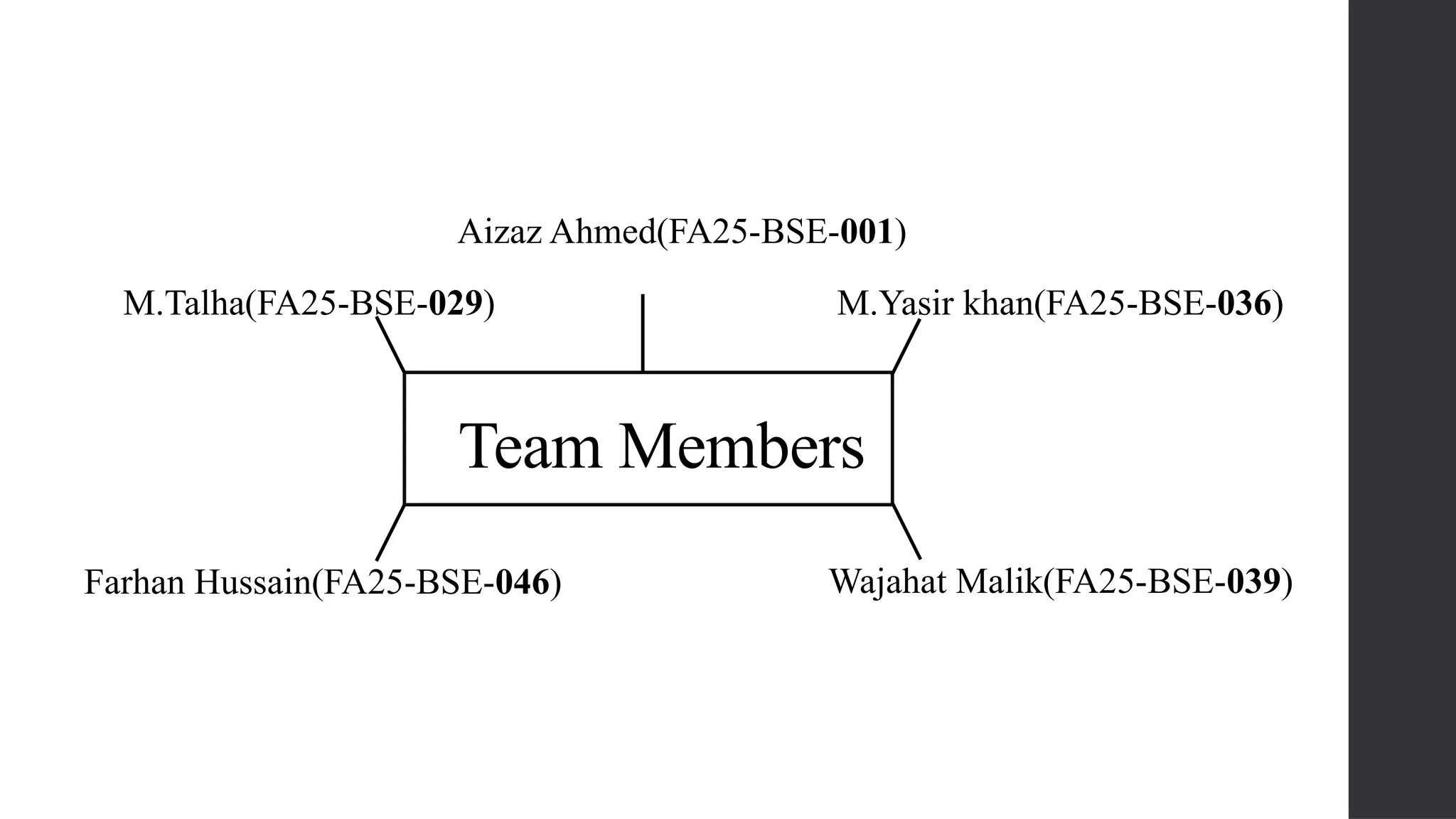
Team Members
M.Talha(FA25-BSE-029) M.Yasir khan(FA25-BSE-036)
Aizaz Ahmed(FA25-BSE-001)
Farhan Hussain(FA25-BSE-046) Wajahat Malik(FA25-BSE-039)
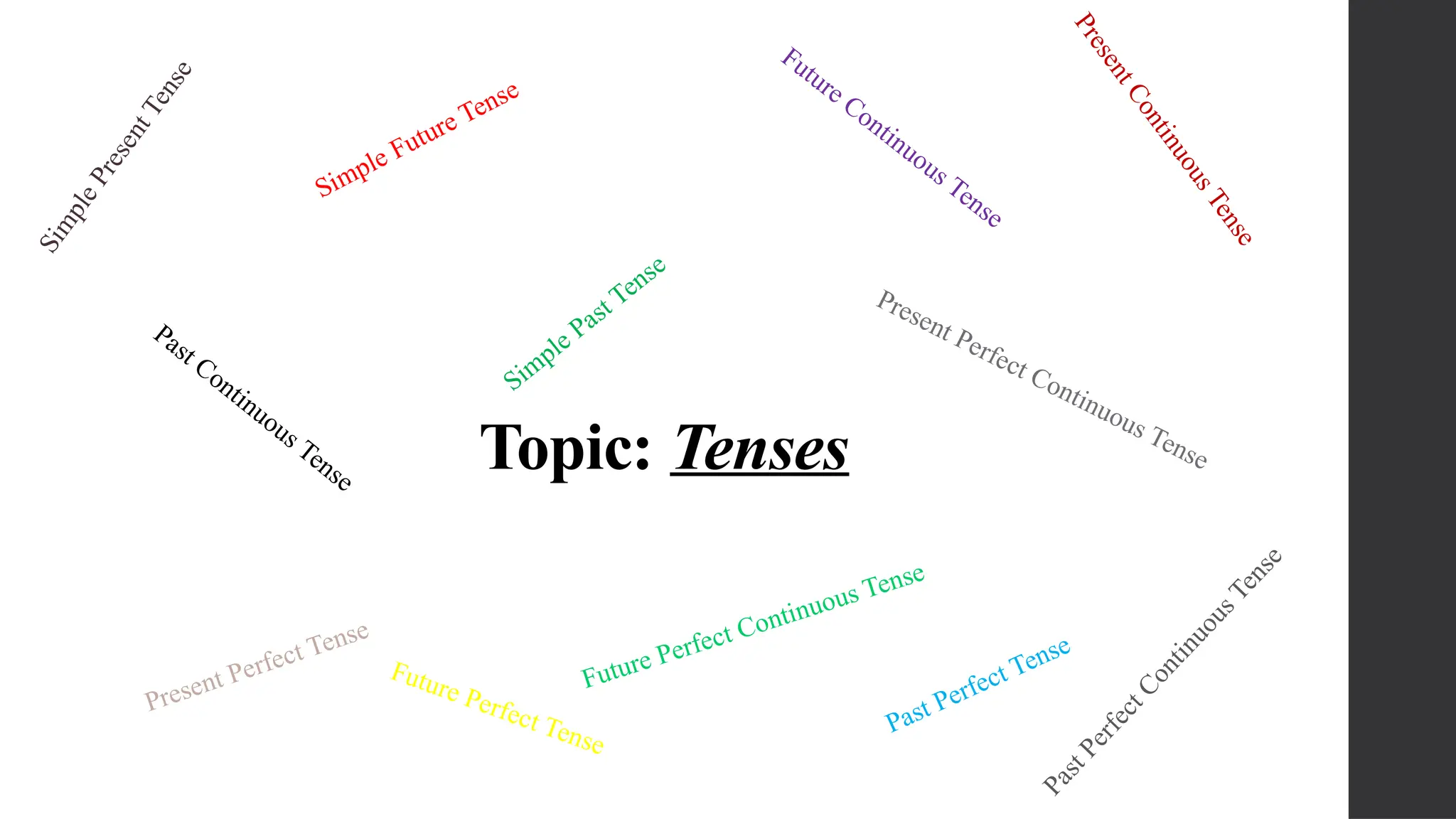
Topic: Tenses
S
i
m
p
l
e
P
r
e
s
e
n
t
T
e
n
s
e
P
r
e
s
e
n
t
C
o
n
t
i
n
u
o
u
s
T
e
n
s
e
Present Perfect Continuous Tense
Present Perfect Tense
Simple Past Tense
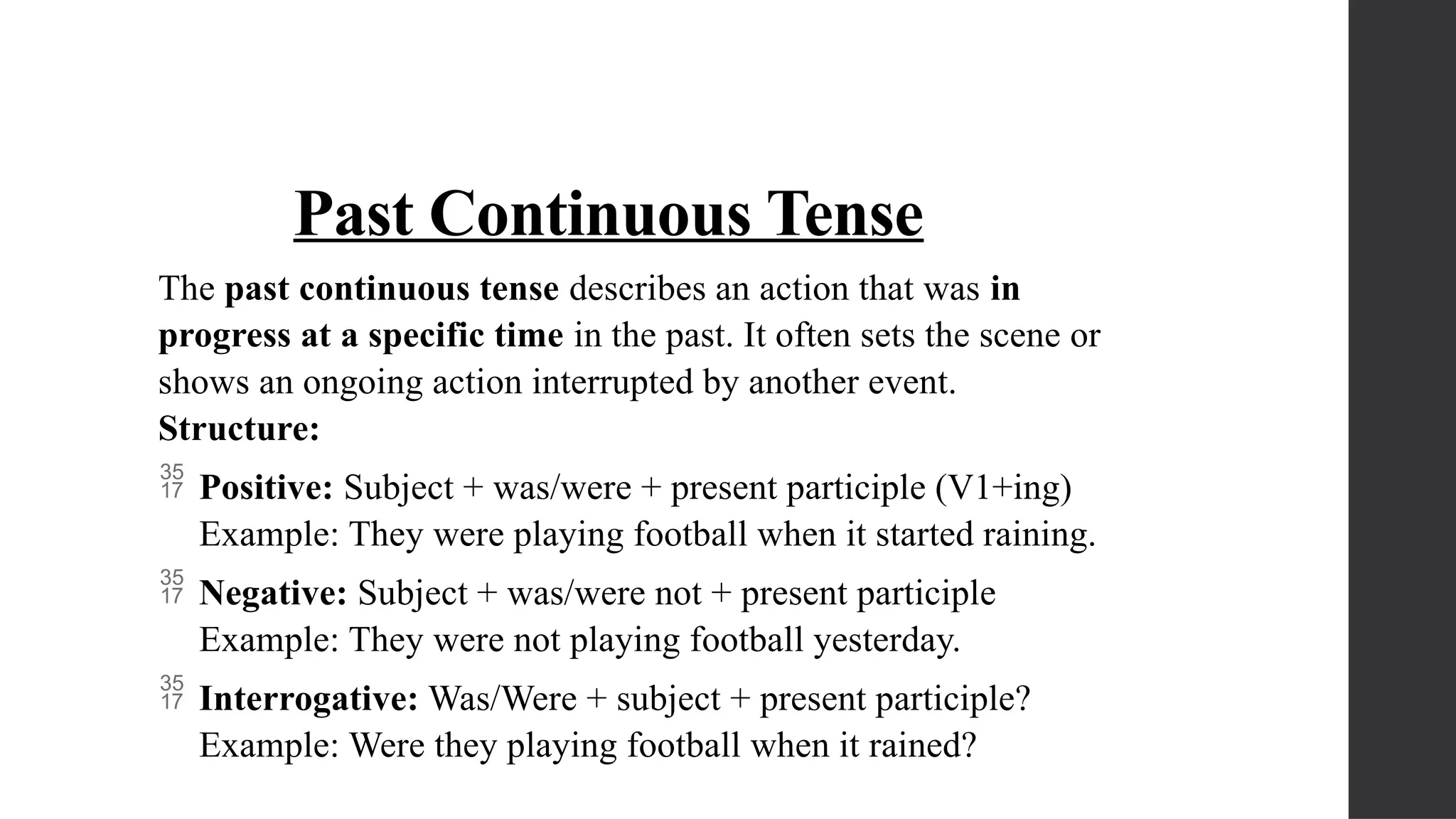
Past Continuous Tense
Past Perfect Tense
P
a
s
t
P
e
r
f
e
c
t
C
o
n
t
i
n
u
o
u
s
T
e
n
s
e
Simple Future Tense
Future Continuous Tense
Future Perfect Tense
Future Perfect Continuous Tense
Table of Content.
• Introduction to Tenses.
 Detail Overview.
• Present Tense in Detail.
• Past Tense in Detail.
• Future Tense in Detail.
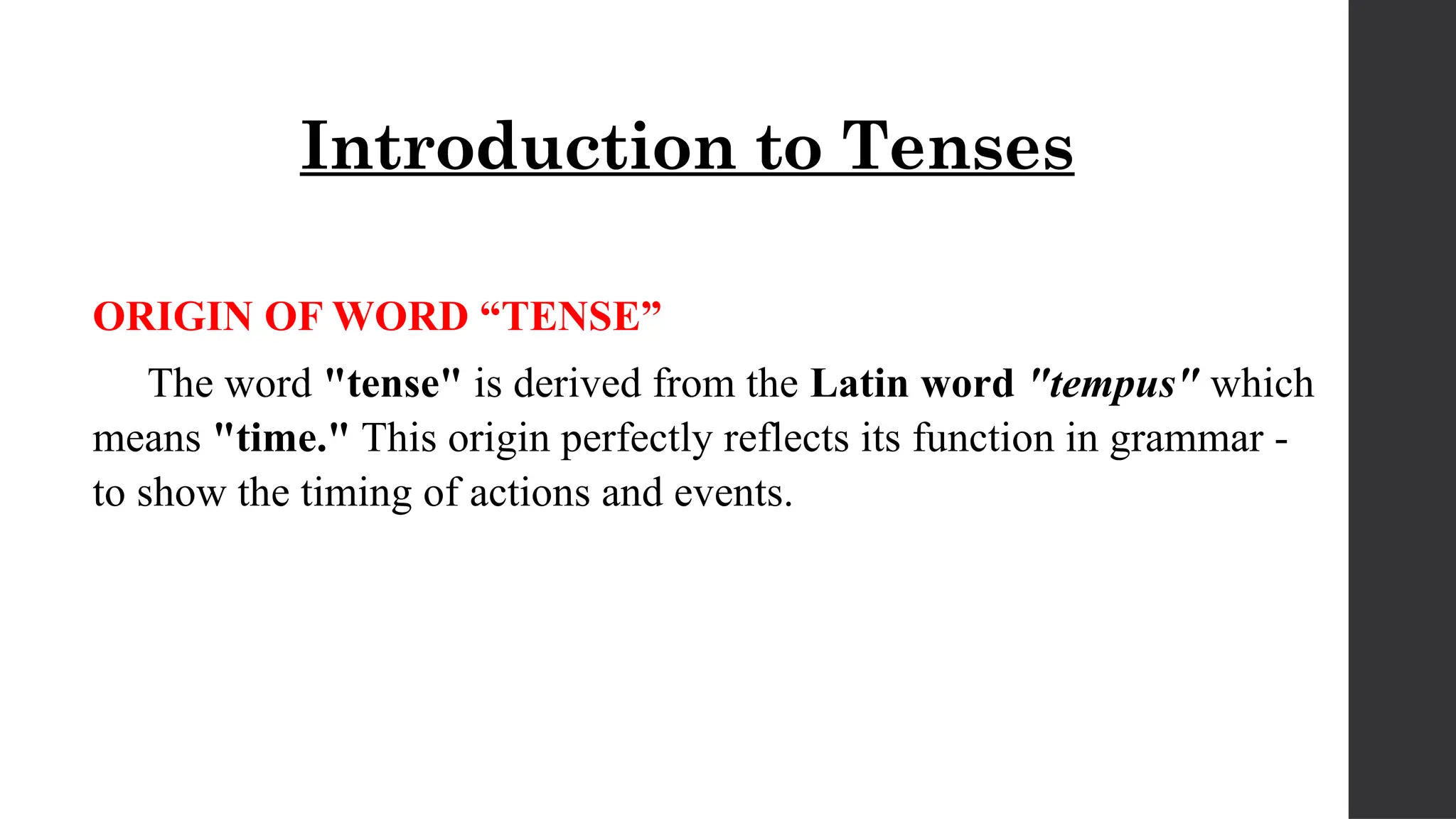
Introduction to Tenses
ORIGIN OF WORD “TENSE”
The word "tense" is derived from the Latin word "tempus" which
means "time." This origin perfectly reflects its function in grammar -
to show the timing of actions and events.
Definition
• Tense is a grammatical concept that helps us express the time of an
action or state of being. It indicates whether something happens in
the past, present, or future, allowing us to communicate clearly
about when events occur
Main Types of Tenses
English has three primary tenses, each with four aspects.
• Present Tense.
• Past Tense.
• Future Tense.
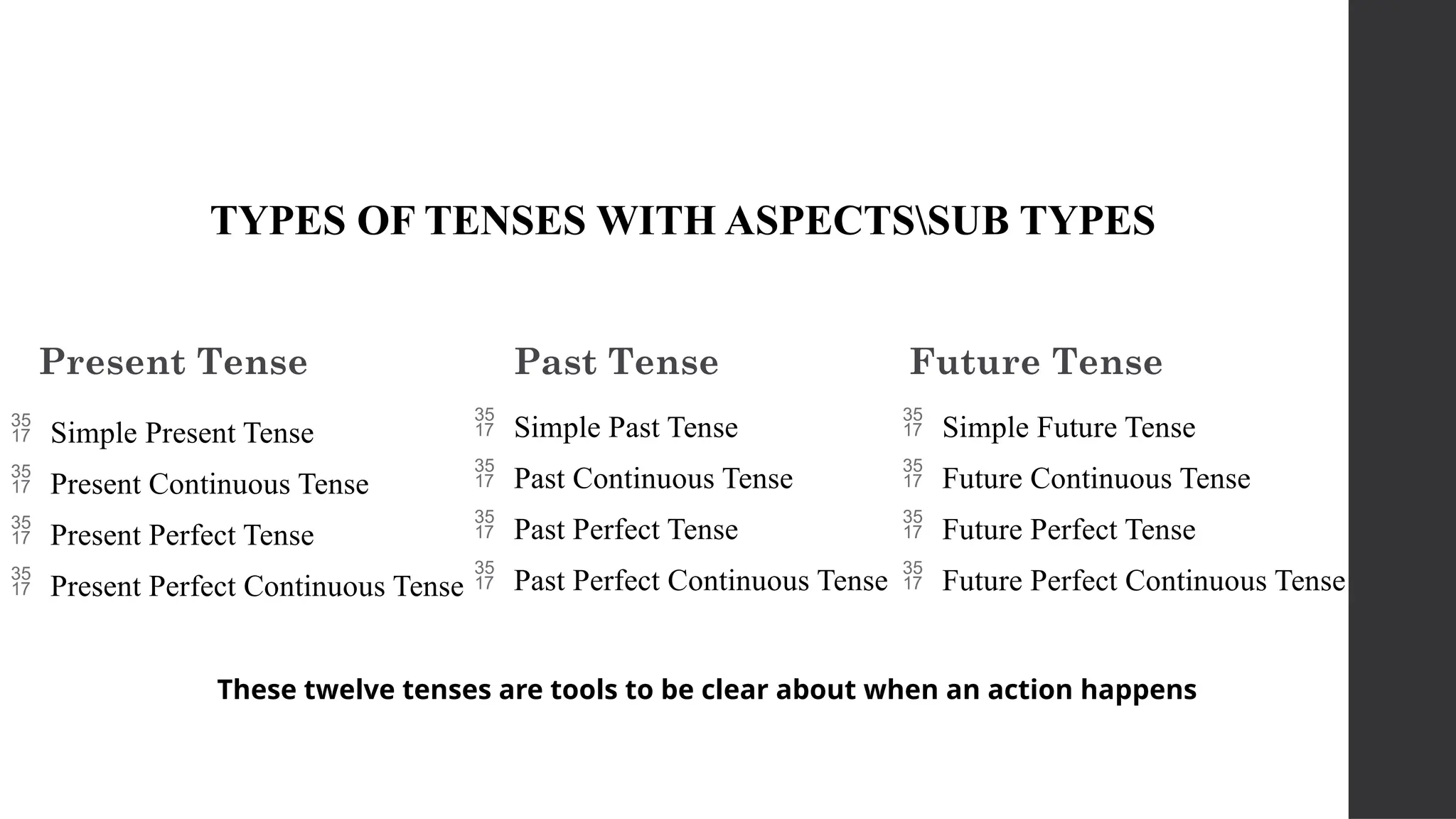
Present Tense
 Simple Present Tense
 Present Continuous Tense
 Present Perfect Tense
 Present Perfect Continuous Tense
Past Tense
 Simple Past Tense
 Past Continuous Tense
 Past Perfect Tense
 Past Perfect Continuous Tense
Future Tense
 Simple Future Tense
 Future Continuous Tense
 Future Perfect Tense
 Future Perfect Continuous Tense
TYPES OF TENSES WITH ASPECTSSUB TYPES
These twelve tenses are tools to be clear about when an action happens
Main Structure of Tense
• The structure of every tense in English is built by combining
three key components in different ways.
The Core Formula:
• Subject + Auxiliary Verb + Main Verb (in the correct form)
OR
Subject + H.V+ Main Verb+ Object
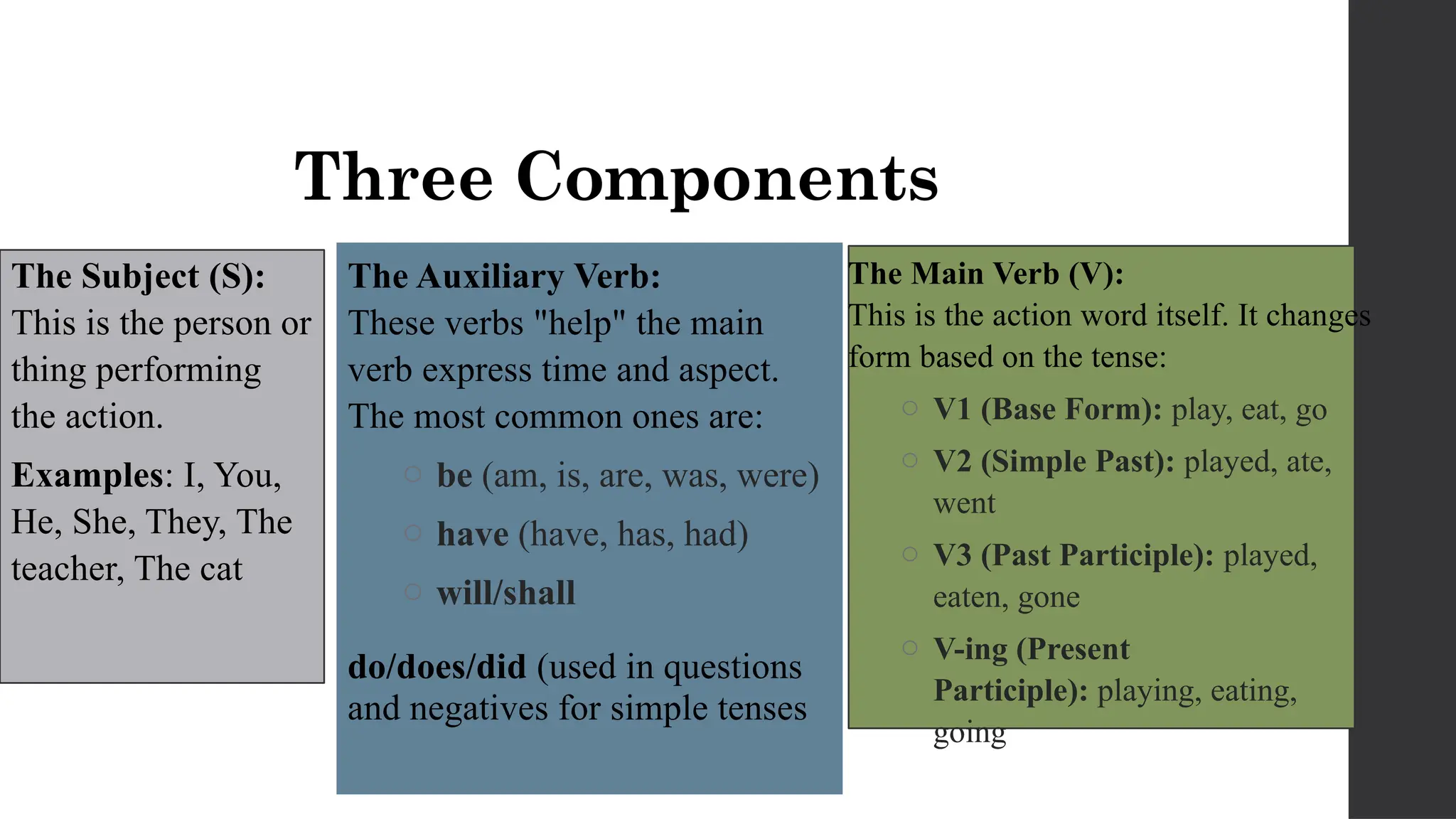
Three Components
The Auxiliary Verb:
These verbs "help" the main
verb express time and aspect.
The most common ones are:
o be (am, is, are, was, were)
o have (have, has, had)
o will/shall
do/does/did (used in questions
and negatives for simple tenses
The Main Verb (V):
This is the action word itself. It changes
form based on the tense:
o V1 (Base Form): play, eat, go
o V2 (Simple Past): played, ate,
went
o V3 (Past Participle): played,
eaten, gone
o V-ing (Present
Participle): playing, eating,
going
The Subject (S):
This is the person or
thing performing
the action.
Examples: I, You,
He, She, They, The
teacher, The cat
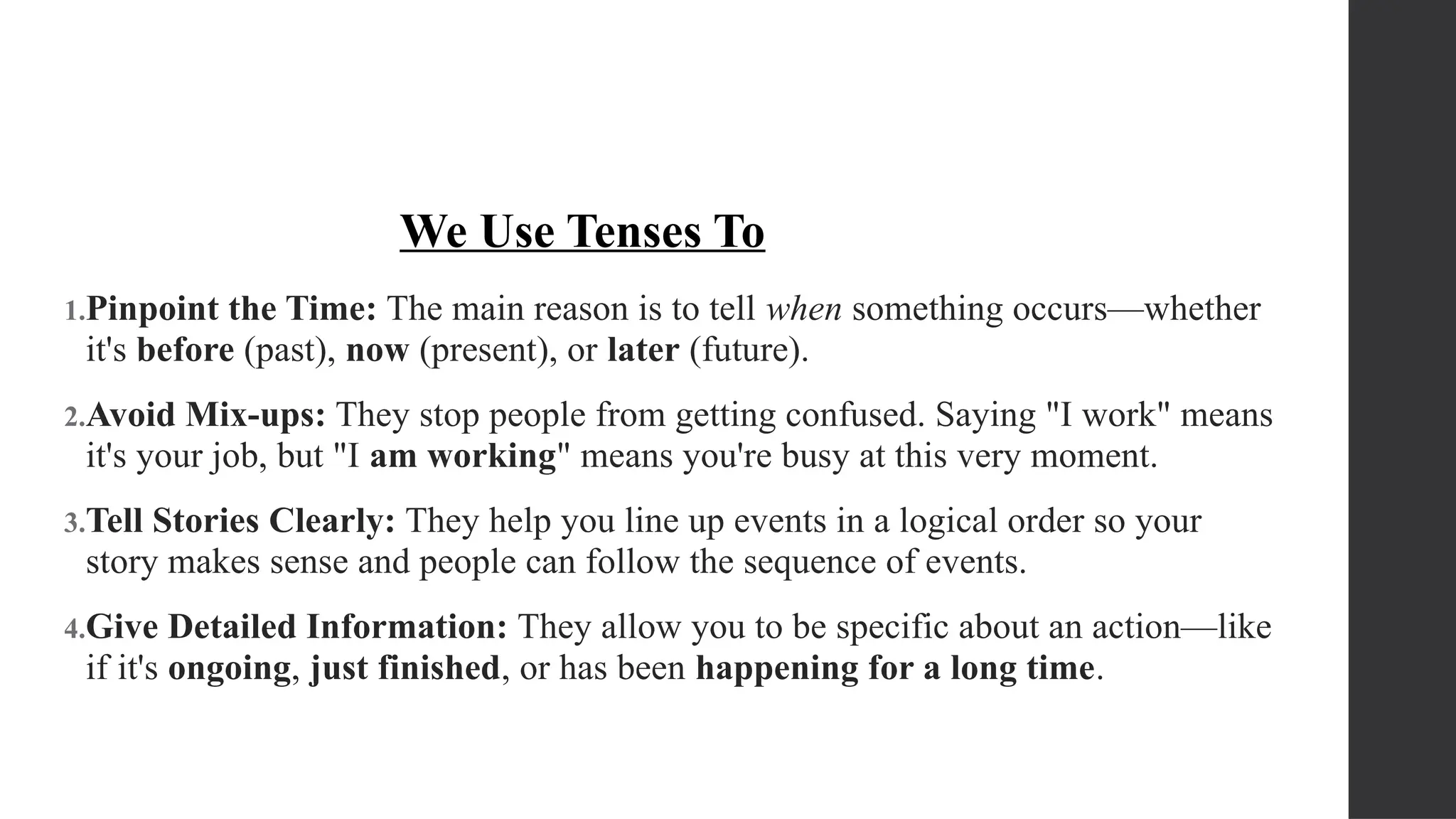
Why we use Tenses?
1.Pinpoint the Time: The main reason is to tell when something occurs—whether
it's before (past), now (present), or later (future).
2.Avoid Mix-ups: They stop people from getting confused. Saying "I work" means
it's your job, but "I am working" means you're busy at this very moment.
3.Tell Stories Clearly: They help you line up events in a logical order so your
story makes sense and people can follow the sequence of events.
4.Give Detailed Information: They allow you to be specific about an action—like
if it's ongoing, just finished, or has been happening for a long time.
We Use Tenses To
Tenses in details……
Present Tense
Present Tense
• The Present Tense is used to talk about actions, events, or states
that are happening now, regularly occur, or are generally true. It
helps us describe current situations, habits, universal facts, and
fixed future arrangements.
Structure of Present Tense
• Present tense is formed using the base form or present form of
the main verb, often combined with auxiliary verbs (helping
verbs) like do, does, am, is, are, have, or has. The structure
changes depending on whether the sentence is:
Simple Present Tense
 Positive: Subject + V1 (add 's' or 'es' for third person singular)
Example: She plays.
 Negative: Subject + do/does not + V1
Example: She does not play.
 Interrogative: Do/Does + subject + V1?
Example: Does she play?
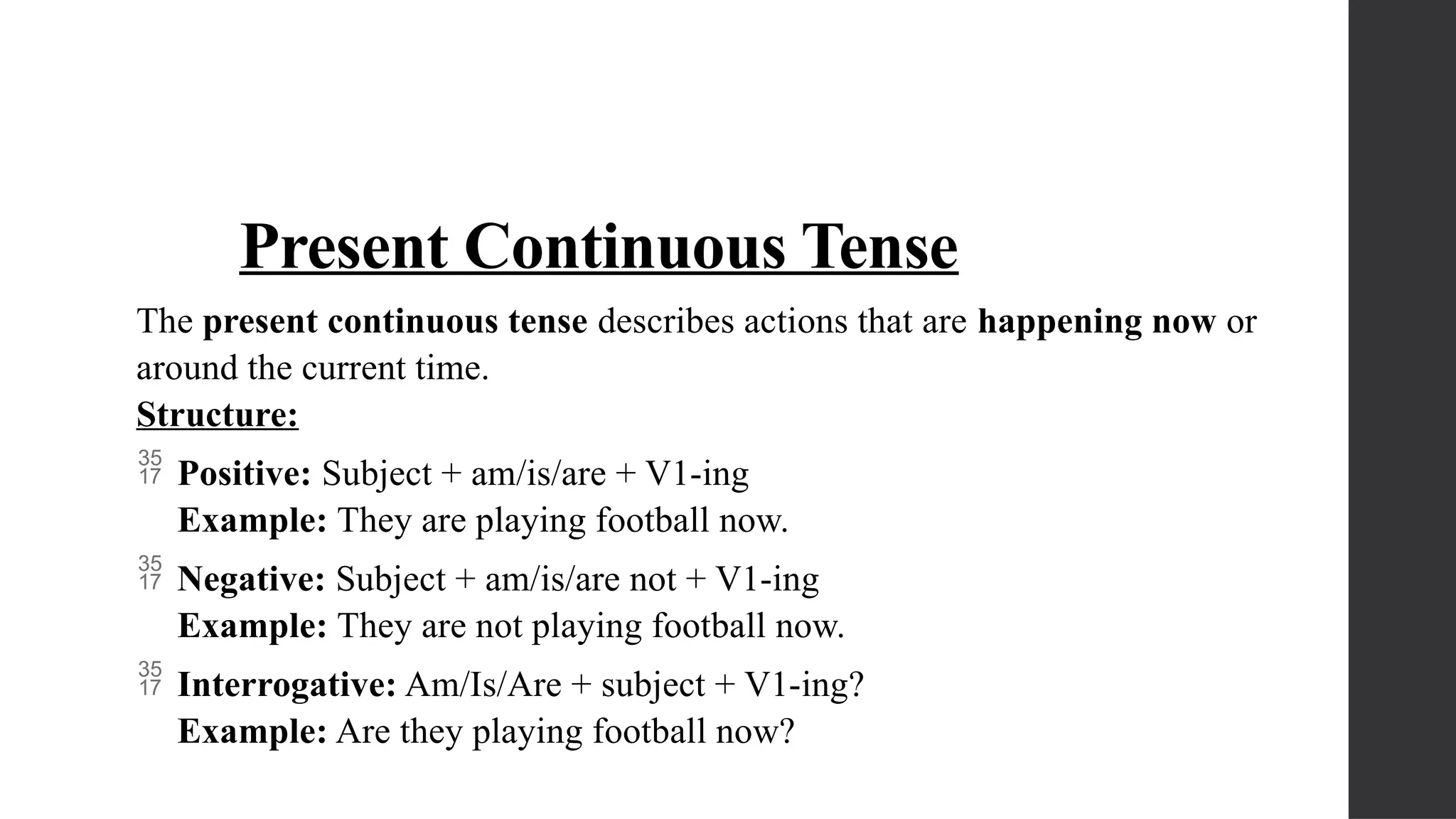
Present Continuous Tense
The present continuous tense describes actions that are happening now or
around the current time.
Structure:
 Positive: Subject + am/is/are + V1-ing
Example: They are playing football now.
 Negative: Subject + am/is/are not + V1-ing
Example: They are not playing football now.
 Interrogative: Am/Is/Are + subject + V1-ing?
Example: Are they playing football now?
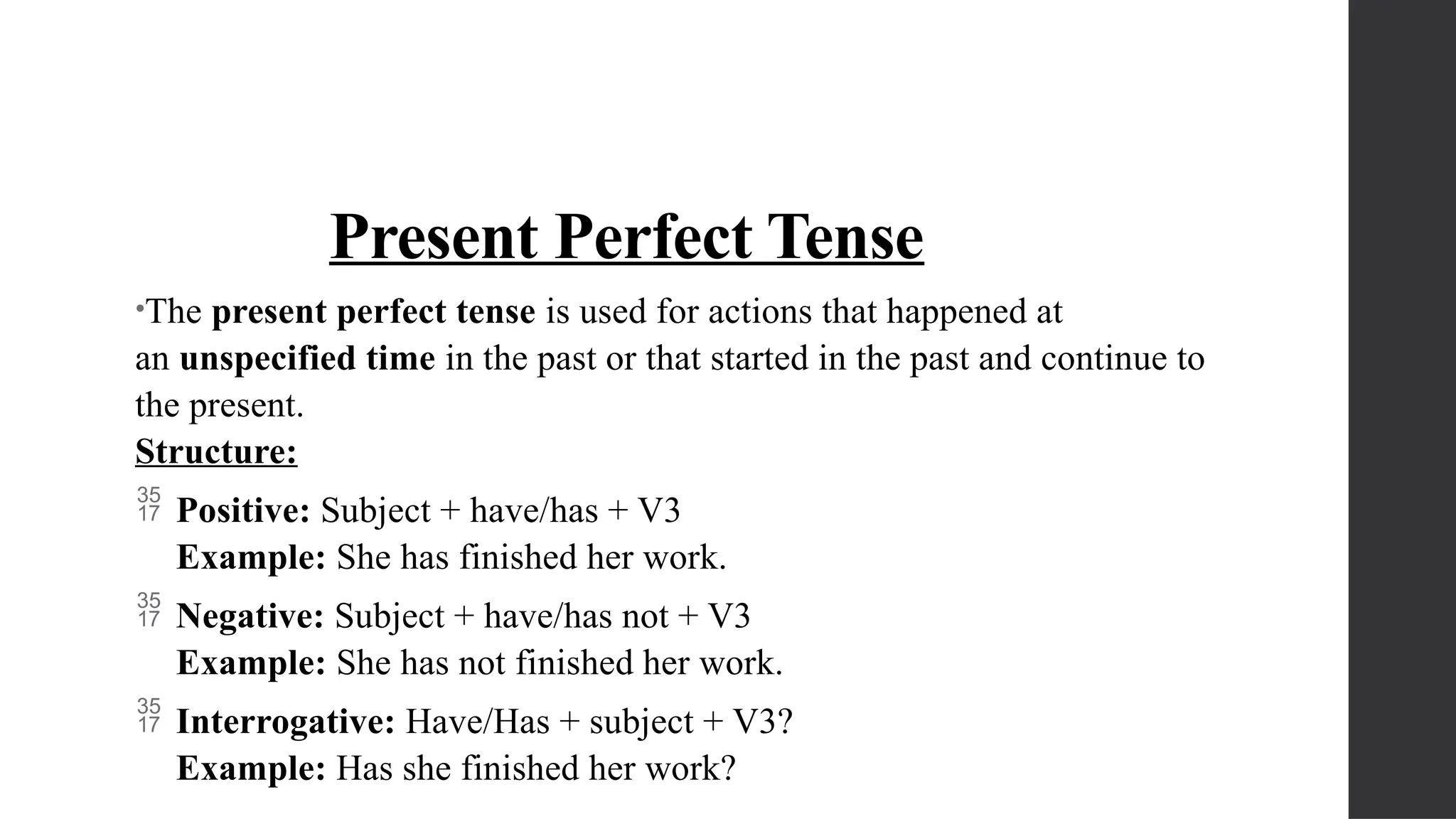
Present Perfect Tense
•The present perfect tense is used for actions that happened at
an unspecified time in the past or that started in the past and continue to
the present.
Structure:
 Positive: Subject + have/has + V3
Example: She has finished her work.
 Negative: Subject + have/has not + V3
Example: She has not finished her work.
 Interrogative: Have/Has + subject + V3?
Example: Has she finished her work?
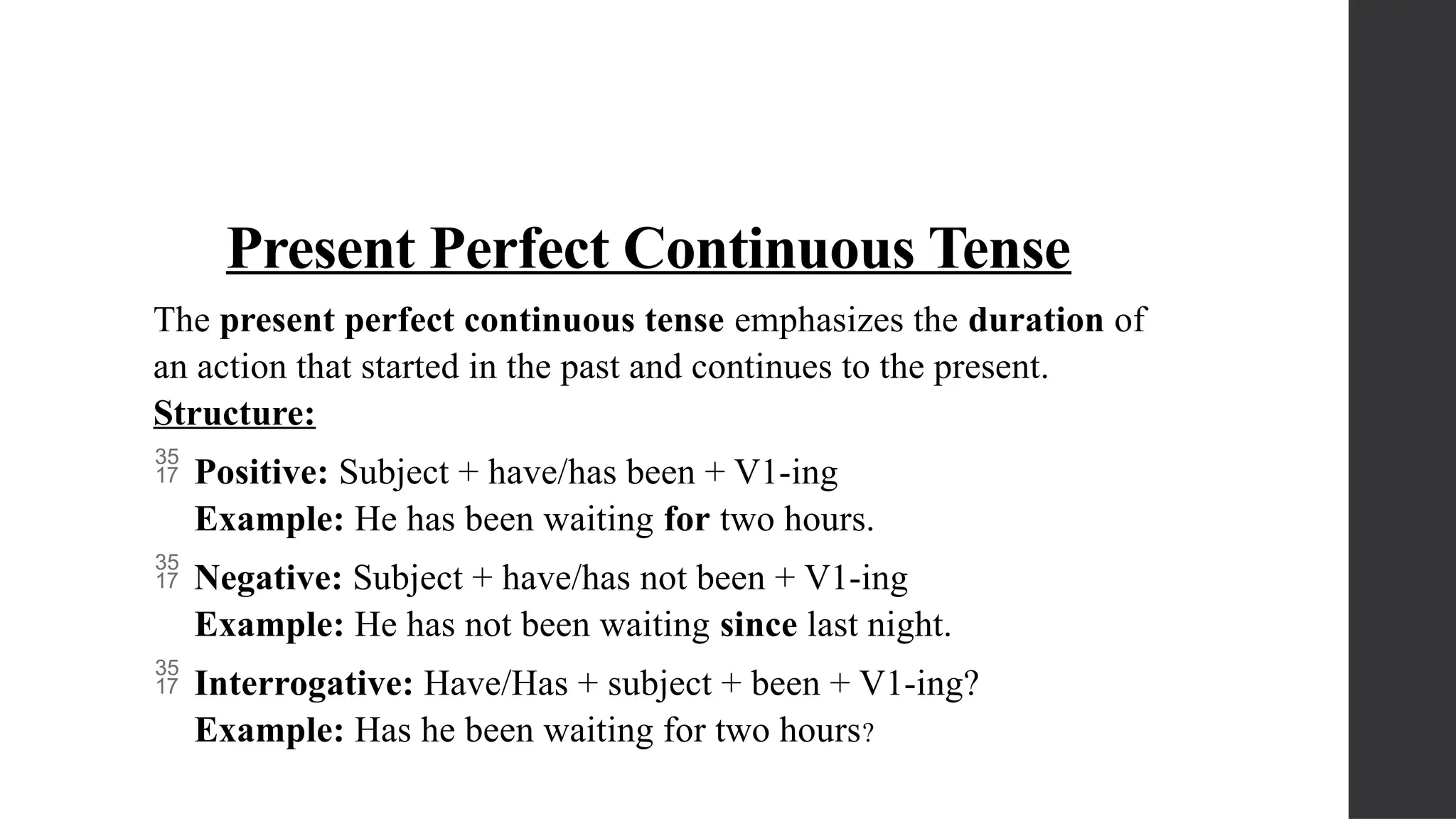
Present Perfect Continuous Tense
The present perfect continuous tense emphasizes the duration of
an action that started in the past and continues to the present.
Structure:
 Positive: Subject + have/has been + V1-ing
Example: He has been waiting for two hours.
 Negative: Subject + have/has not been + V1-ing
Example: He has not been waiting since last night.
 Interrogative: Have/Has + subject + been + V1-ing?
Example: Has he been waiting for two hours?
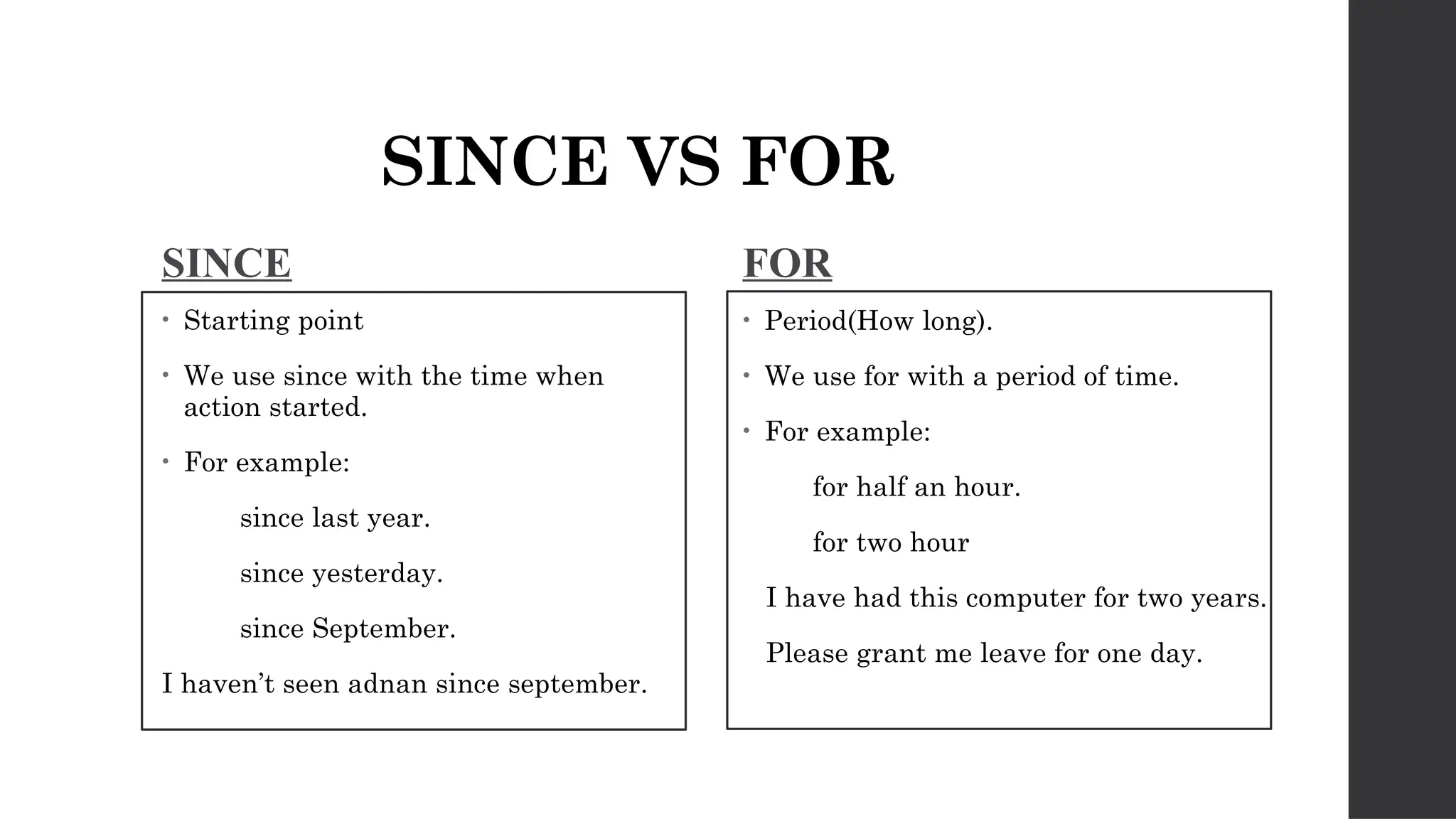
SINCE VS FOR
SINCE
• Starting point
• We use since with the time when
action started.
• For example:
since last year.
since yesterday.
since September.
I haven’t seen adnan since september.
FOR
• Period(How long).
• We use for with a period of time.
• For example:
for half an hour.
for two hour
I have had this computer for two years.
Please grant me leave for one day.
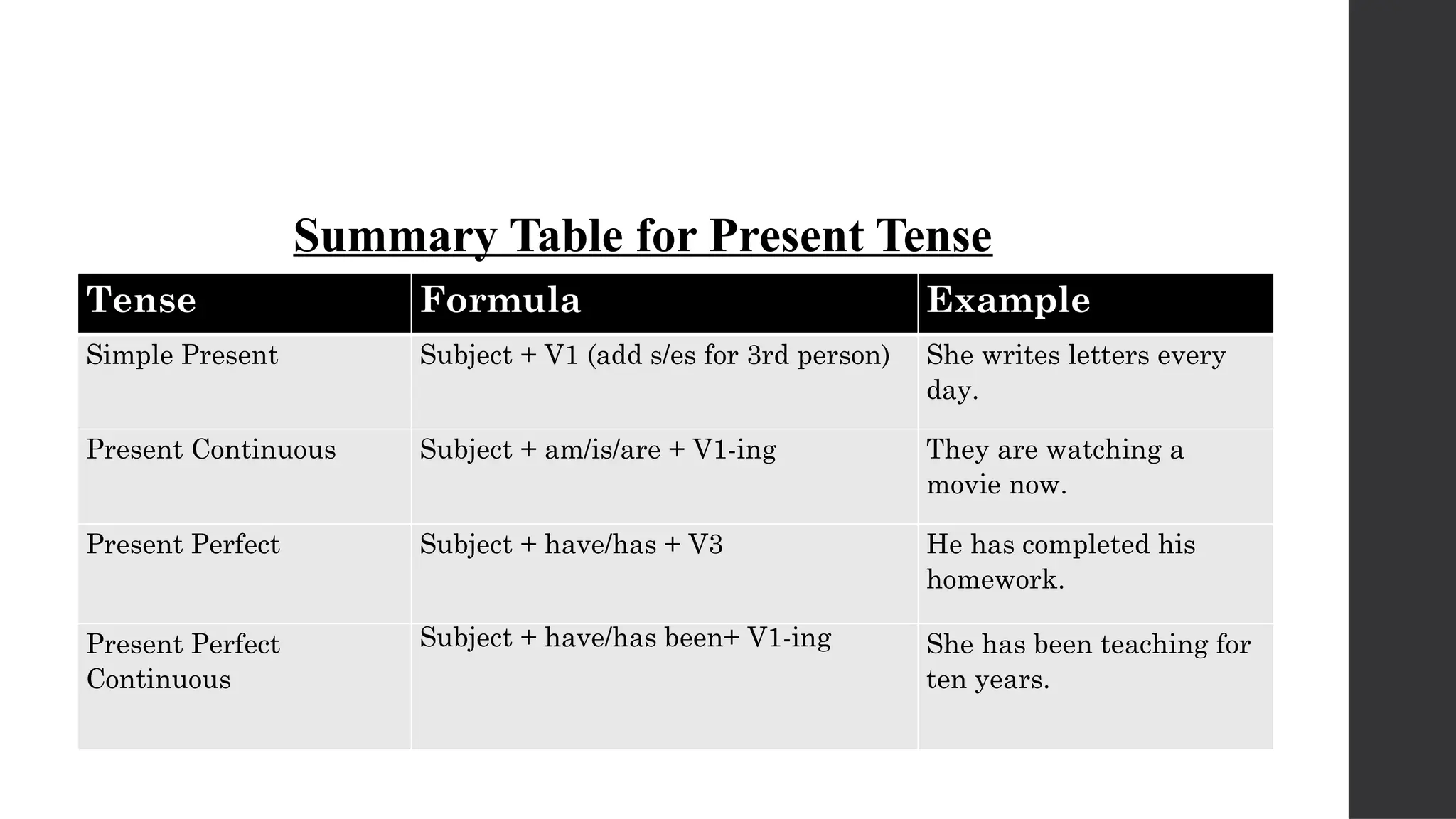
Tense Formula Example
Simple Present Subject + V1 (add s/es for 3rd person) She writes letters every
day.
Present Continuous Subject + am/is/are + V1-ing They are watching a
movie now.
Present Perfect Subject + have/has + V3 He has completed his
homework.
Present Perfect
Continuous
Subject + have/has been+ V1-ing She has been teaching for
ten years.
Summary Table for Present Tense
Past Tense
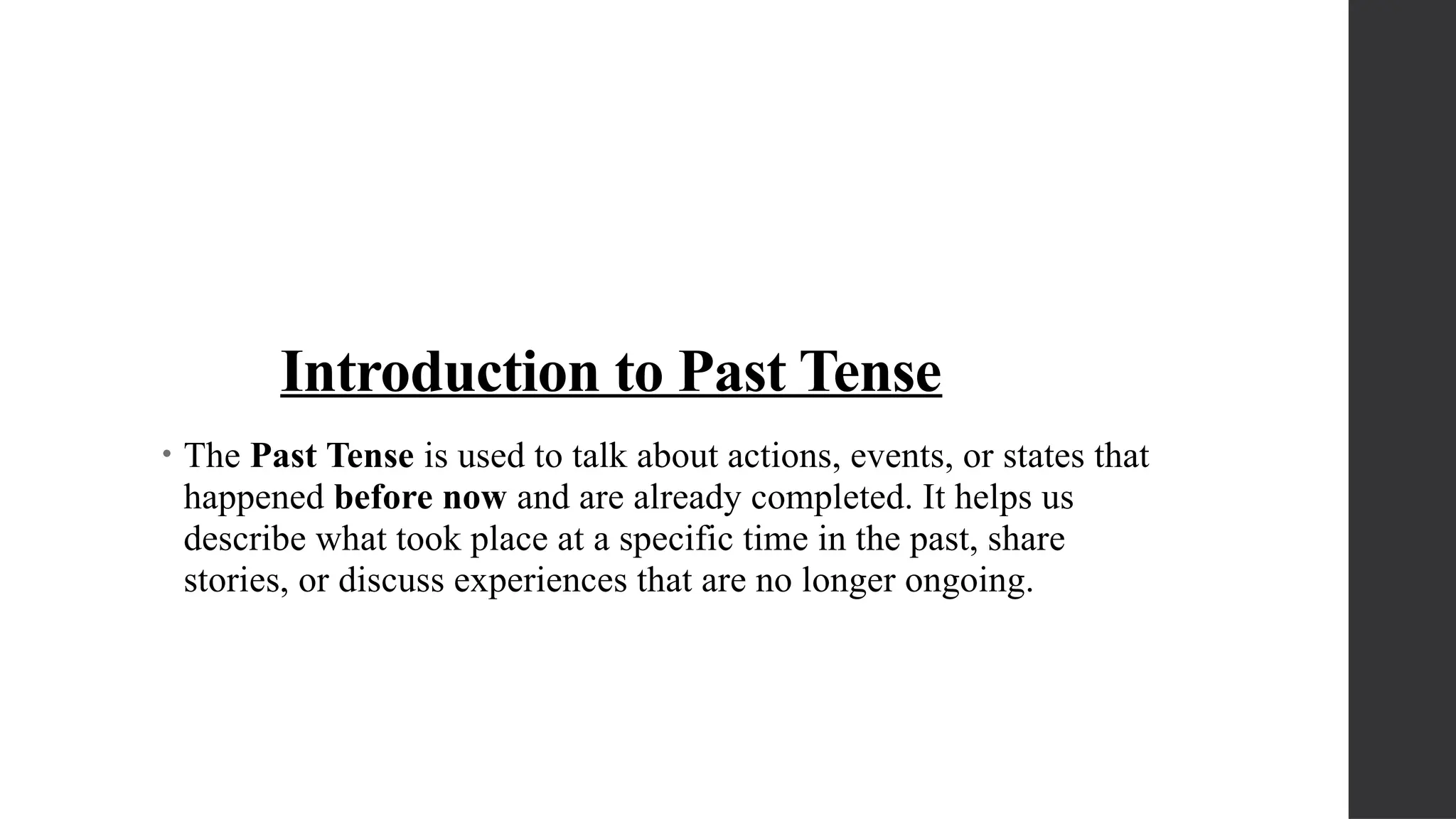
Introduction to Past Tense
• The Past Tense is used to talk about actions, events, or states that
happened before now and are already completed. It helps us
describe what took place at a specific time in the past, share
stories, or discuss experiences that are no longer ongoing.
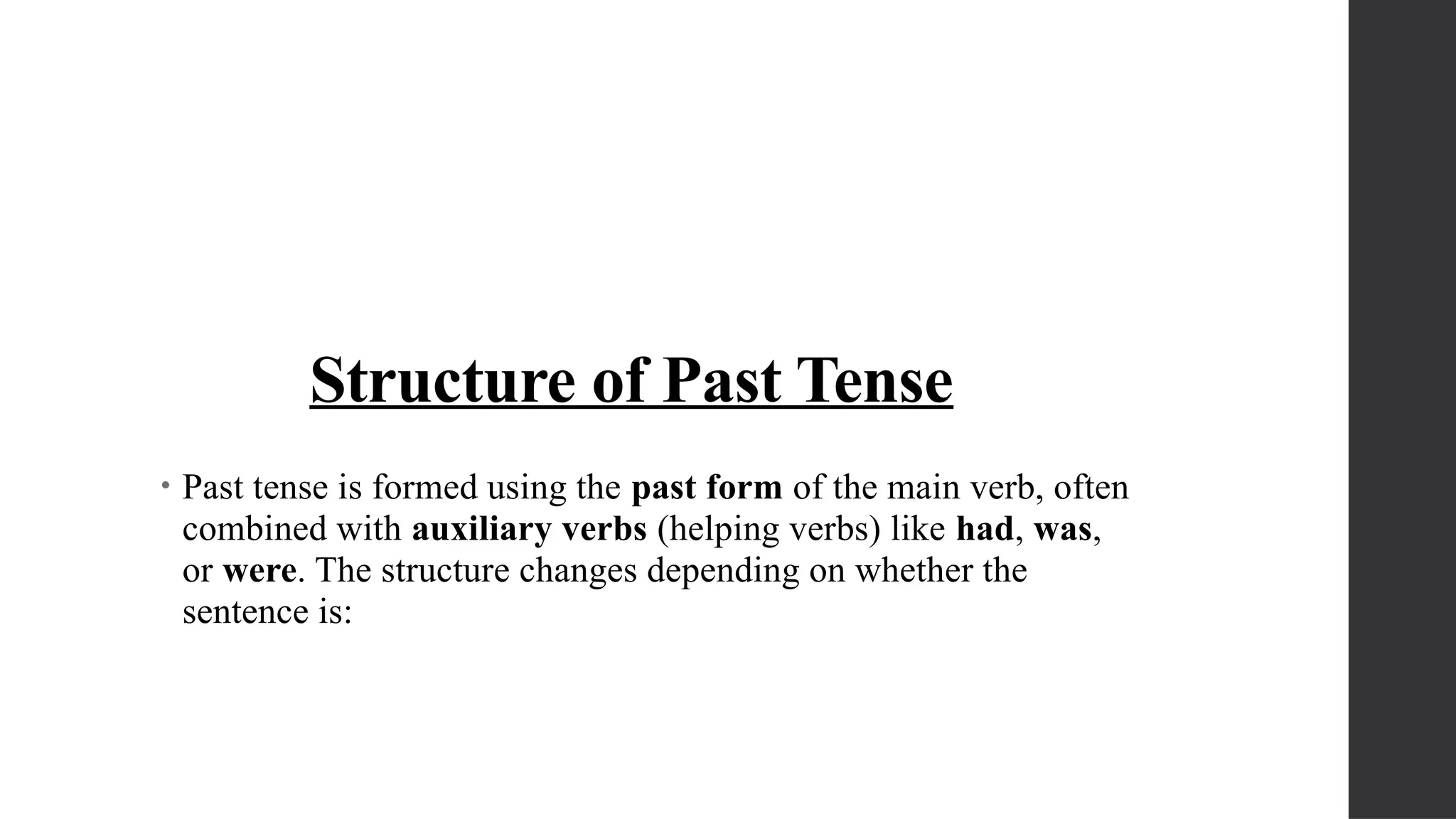
Structure of Past Tense
• Past tense is formed using the past form of the main verb, often
combined with auxiliary verbs (helping verbs) like had, was,
or were. The structure changes depending on whether the
sentence is:
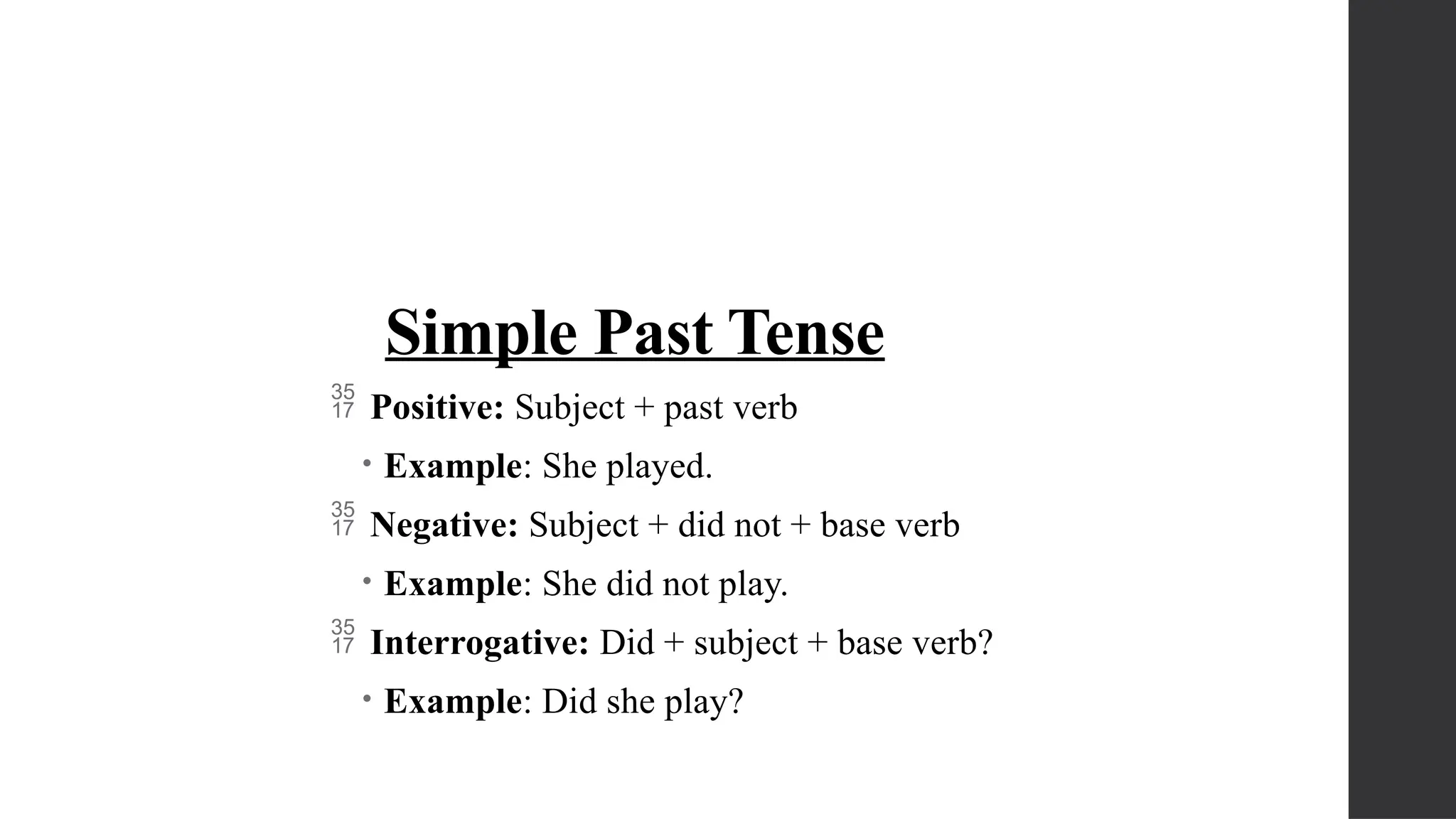
Simple Past Tense
 Positive: Subject + past verb
• Example: She played.
 Negative: Subject + did not + base verb
• Example: She did not play.
 Interrogative: Did + subject + base verb?
• Example: Did she play?
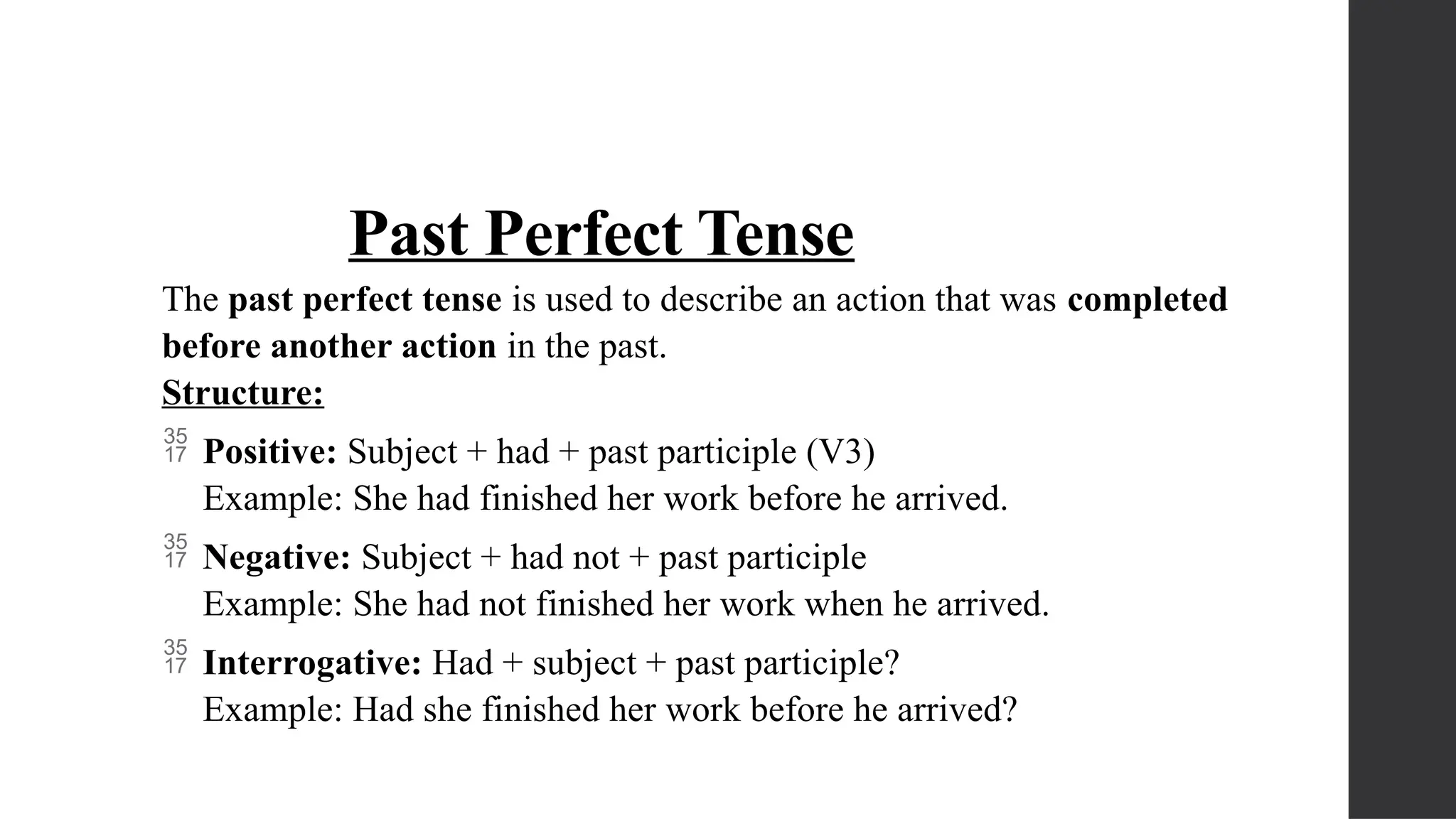
Past Perfect Tense
The past perfect tense is used to describe an action that was completed
before another action in the past.
Structure:
 Positive: Subject + had + past participle (V3)
Example: She had finished her work before he arrived.
 Negative: Subject + had not + past participle
Example: She had not finished her work when he arrived.
 Interrogative: Had + subject + past participle?
Example: Had she finished her work before he arrived?
Past Continuous Tense
The past continuous tense describes an action that was in
progress at a specific time in the past. It often sets the scene or
shows an ongoing action interrupted by another event.
Structure:
 Positive: Subject + was/were + present participle (V1+ing)
Example: They were playing football when it started raining.
 Negative: Subject + was/were not + present participle
Example: They were not playing football yesterday.
 Interrogative: Was/Were + subject + present participle?
Example: Were they playing football when it rained?
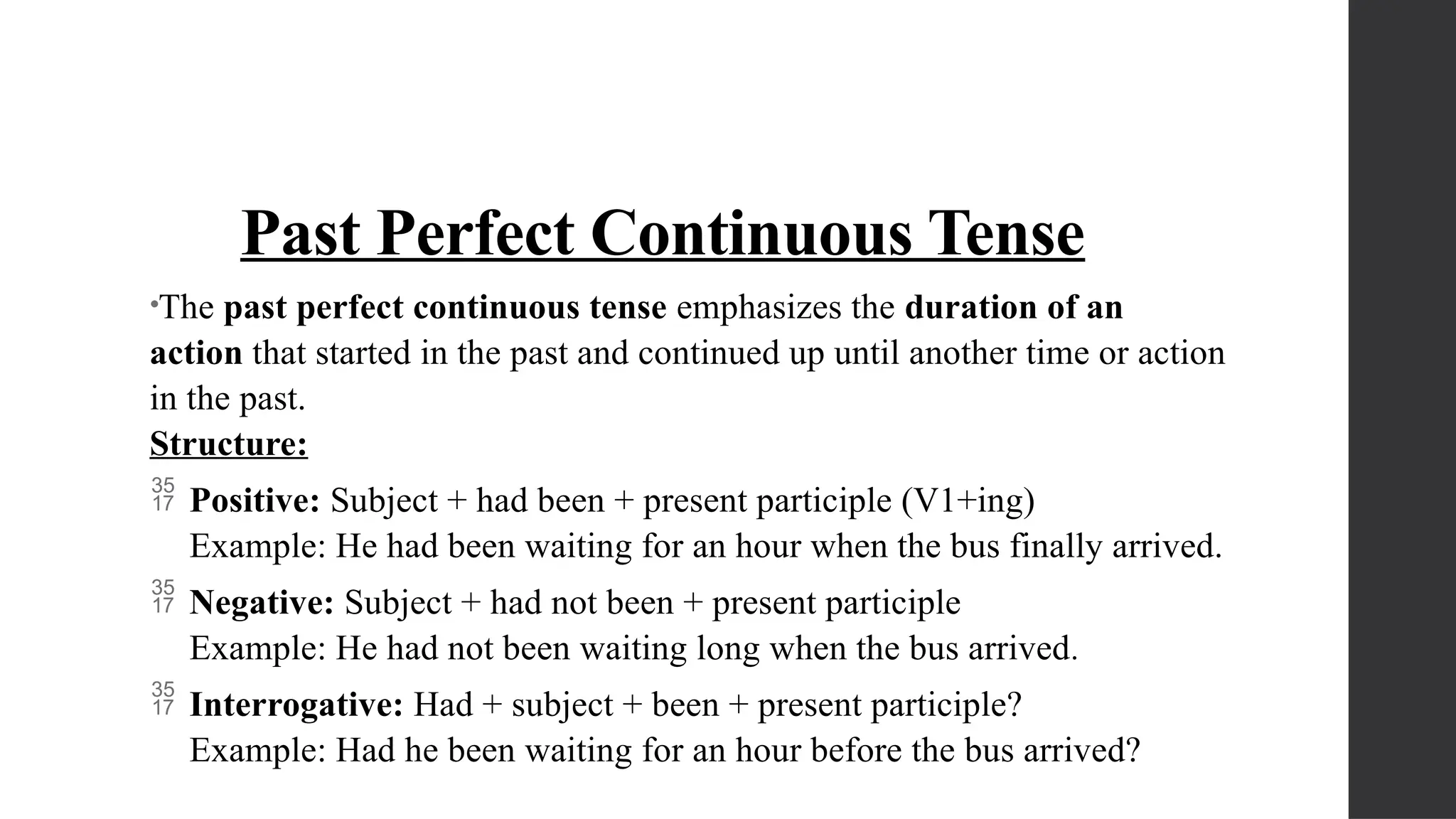
Past Perfect Continuous Tense
•The past perfect continuous tense emphasizes the duration of an
action that started in the past and continued up until another time or action
in the past.
Structure:
 Positive: Subject + had been + present participle (V1+ing)
Example: He had been waiting for an hour when the bus finally arrived.
 Negative: Subject + had not been + present participle
Example: He had not been waiting long when the bus arrived.
 Interrogative: Had + subject + been + present participle?
Example: Had he been waiting for an hour before the bus arrived?
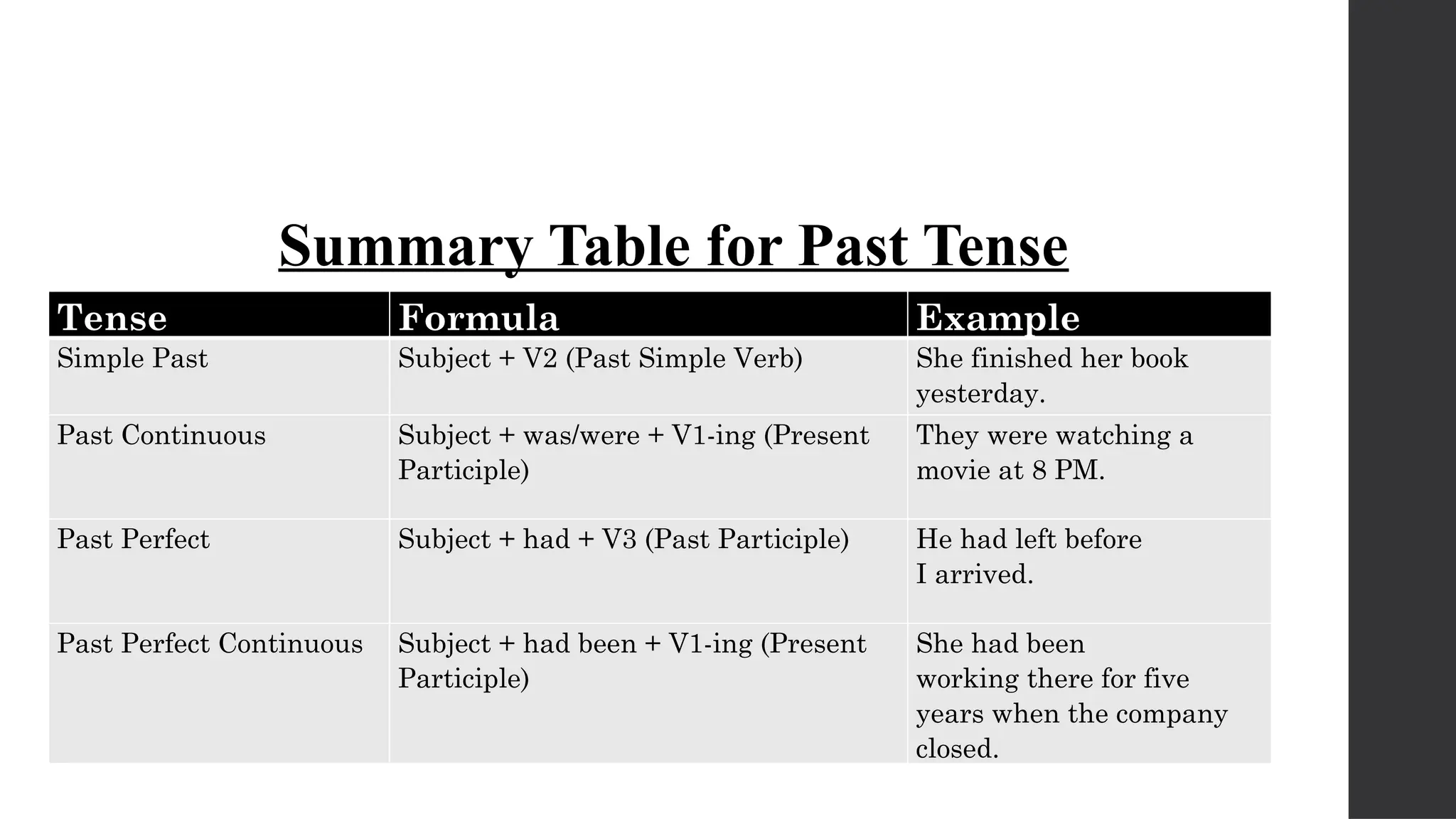
Tense Formula Example
Simple Past Subject + V2 (Past Simple Verb) She finished her book
yesterday.
Past Continuous Subject + was/were + V1-ing (Present
Participle)
They were watching a
movie at 8 PM.
Past Perfect Subject + had + V3 (Past Participle) He had left before
I arrived.
Past Perfect Continuous Subject + had been + V1-ing (Present
Participle)
She had been
working there for five
years when the company
closed.
Summary Table for Past Tense
Future Tense
Introduction to Future Tense
The Future Tense is used to talk about actions, events, or states that
have not happened yet but will occur after the present moment. It helps
us make predictions, express plans, announce decisions, and discuss
scheduled events that are yet to come.
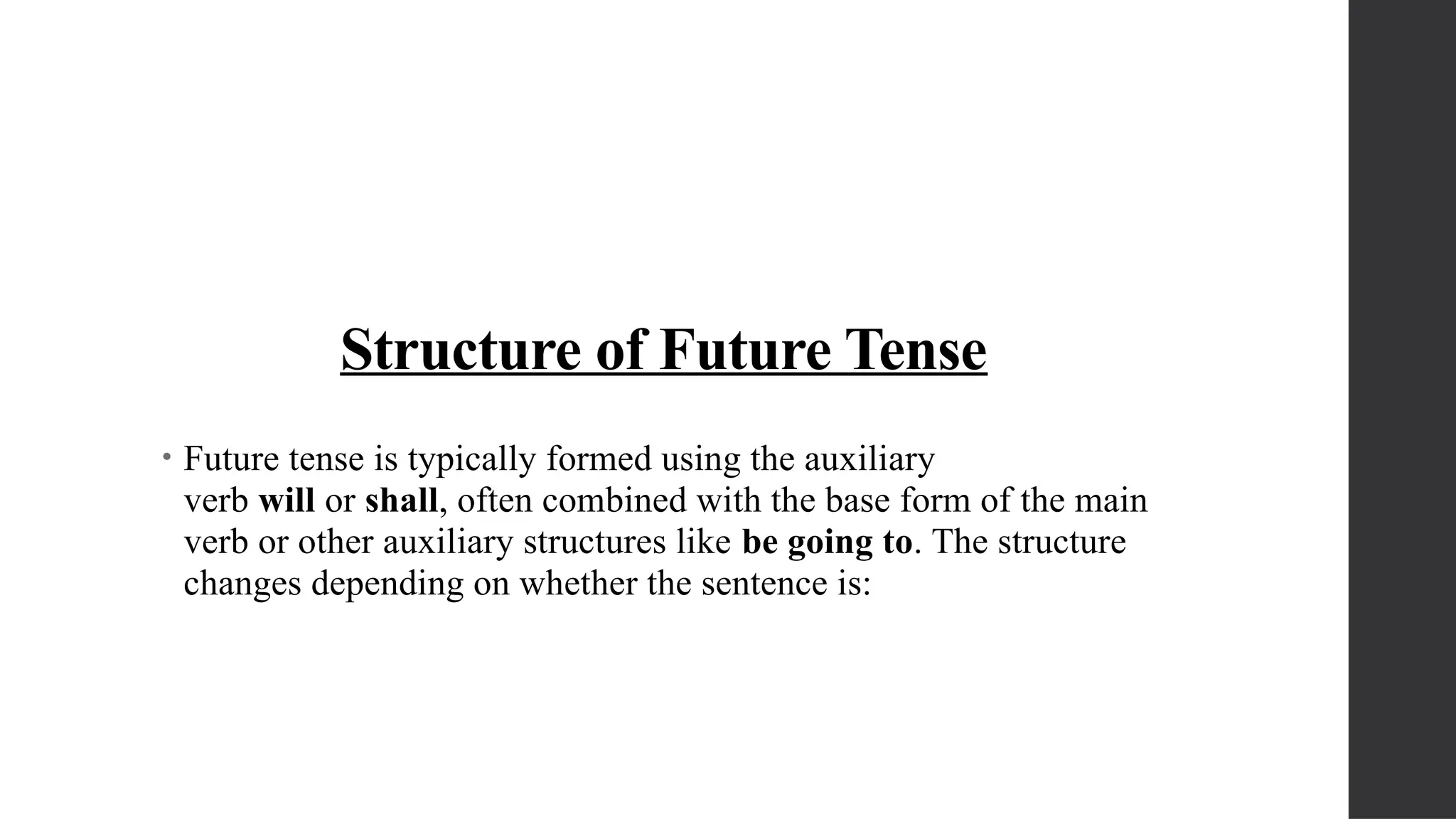
Structure of Future Tense
• Future tense is typically formed using the auxiliary
verb will or shall, often combined with the base form of the main
verb or other auxiliary structures like be going to. The structure
changes depending on whether the sentence is:
Simple Future Tense
 Positive: Subject + will + base verb (V1)
Example: She will play.
 Negative: Subject + will not + base verb
Example: She will not play.
 Interrogative: Will + subject + base verb?
Example: Will she play?
Future Continuous Tense
The future continuous tense describes actions that will be in
progress at a specific time in the future.
Structure:
 Positive: Subject + will be + V1-ing (Present Participle)
Example: She will be studying at 8 PM tonight.
 Negative: Subject + will not be + V1-ing
Example: She will not be studying at 8 PM.
 Interrogative: Will + subject + be + V1-ing?
Example: Will she be studying at 8 PM?
Future Perfect Tense
The future perfect tense is used for actions that will be completed
before a specific point in the future.
Structure:
 Positive: Subject + will have + V3 (Past Participle)
Example: By next week, he will have finished the report.
 Negative: Subject + will not have + V3
Example: By next week, he will not have finished the report.
 Interrogative: Will + subject + have + V3?
Example: Will he have finished the report by next week?
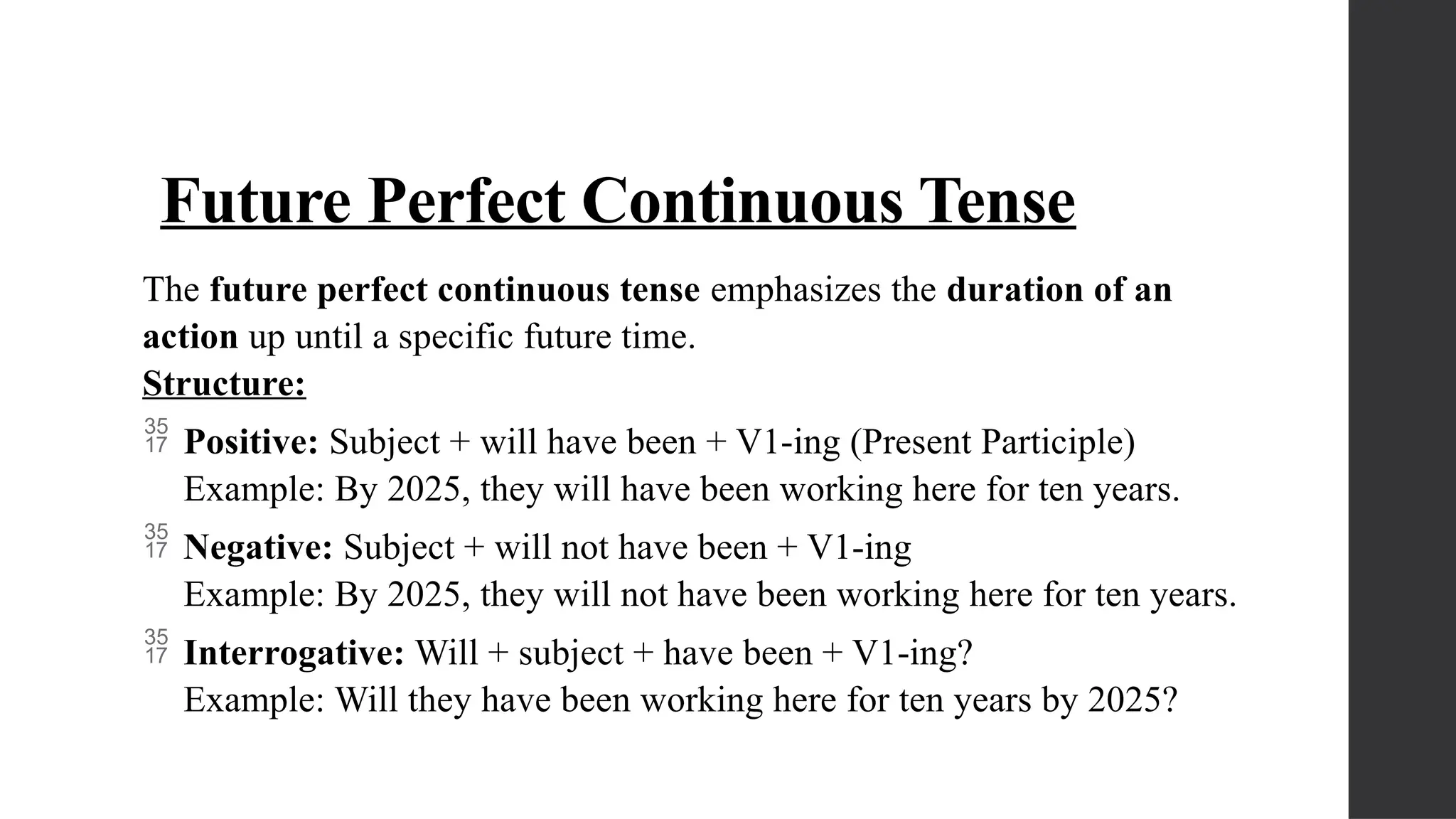
Future Perfect Continuous Tense
The future perfect continuous tense emphasizes the duration of an
action up until a specific future time.
Structure:
 Positive: Subject + will have been + V1-ing (Present Participle)
Example: By 2025, they will have been working here for ten years.
 Negative: Subject + will not have been + V1-ing
Example: By 2025, they will not have been working here for ten years.
 Interrogative: Will + subject + have been + V1-ing?
Example: Will they have been working here for ten years by 2025?
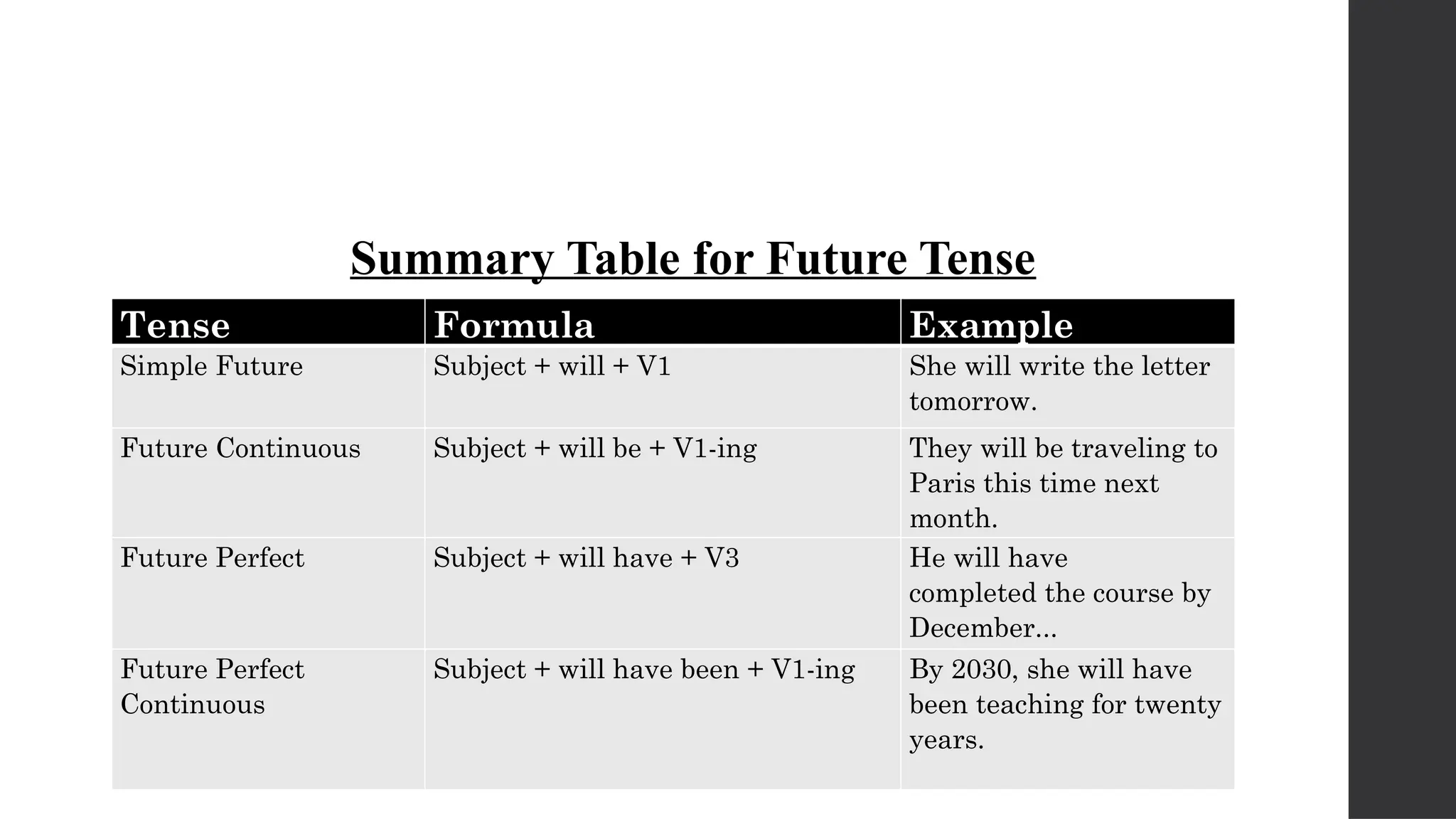
Tense Formula Example
Simple Future Subject + will + V1 She will write the letter
tomorrow.
Future Continuous Subject + will be + V1-ing They will be traveling to
Paris this time next
month.
Future Perfect Subject + will have + V3 He will have
completed the course by
December...
Future Perfect
Continuous
Subject + will have been + V1-ing By 2030, she will have
been teaching for twenty
years.
Summary Table for Future Tense
FUNCTIONAL ENGLISh(tenses and its types)

FUNCTIONAL ENGLISh(tenses and its types)

  • 1.
    FUNCTIONAL ENGLISH PRESENTED TO: ZAINABGUL SOFTWARE ENGINEERING –BSE 1A
  • 2.
    Team Members M.Talha(FA25-BSE-029) M.Yasirkhan(FA25-BSE-036) Aizaz Ahmed(FA25-BSE-001) Farhan Hussain(FA25-BSE-046) Wajahat Malik(FA25-BSE-039)
  • 3.
    Topic: Tenses S i m p l e P r e s e n t T e n s e P r e s e n t C o n t i n u o u s T e n s e Present PerfectContinuous Tense Present Perfect Tense Simple Past Tense Past Continuous Tense Past Perfect Tense P a s t P e r f e c t C o n t i n u o u s T e n s e Simple Future Tense Future Continuous Tense Future Perfect Tense Future Perfect Continuous Tense
  • 4.
    Table of Content. •Introduction to Tenses.  Detail Overview. • Present Tense in Detail. • Past Tense in Detail. • Future Tense in Detail.
  • 5.
    Introduction to Tenses ORIGINOF WORD “TENSE” The word "tense" is derived from the Latin word "tempus" which means "time." This origin perfectly reflects its function in grammar - to show the timing of actions and events.
  • 6.
    Definition • Tense isa grammatical concept that helps us express the time of an action or state of being. It indicates whether something happens in the past, present, or future, allowing us to communicate clearly about when events occur
  • 7.
    Main Types ofTenses English has three primary tenses, each with four aspects. • Present Tense. • Past Tense. • Future Tense.
  • 8.
    Present Tense  SimplePresent Tense  Present Continuous Tense  Present Perfect Tense  Present Perfect Continuous Tense Past Tense  Simple Past Tense  Past Continuous Tense  Past Perfect Tense  Past Perfect Continuous Tense Future Tense  Simple Future Tense  Future Continuous Tense  Future Perfect Tense  Future Perfect Continuous Tense TYPES OF TENSES WITH ASPECTSSUB TYPES These twelve tenses are tools to be clear about when an action happens
  • 9.
    Main Structure ofTense • The structure of every tense in English is built by combining three key components in different ways. The Core Formula: • Subject + Auxiliary Verb + Main Verb (in the correct form) OR Subject + H.V+ Main Verb+ Object
  • 10.
    Three Components The AuxiliaryVerb: These verbs "help" the main verb express time and aspect. The most common ones are: o be (am, is, are, was, were) o have (have, has, had) o will/shall do/does/did (used in questions and negatives for simple tenses The Main Verb (V): This is the action word itself. It changes form based on the tense: o V1 (Base Form): play, eat, go o V2 (Simple Past): played, ate, went o V3 (Past Participle): played, eaten, gone o V-ing (Present Participle): playing, eating, going The Subject (S): This is the person or thing performing the action. Examples: I, You, He, She, They, The teacher, The cat
  • 11.
    Why we useTenses?
  • 12.
    1.Pinpoint the Time:The main reason is to tell when something occurs—whether it's before (past), now (present), or later (future). 2.Avoid Mix-ups: They stop people from getting confused. Saying "I work" means it's your job, but "I am working" means you're busy at this very moment. 3.Tell Stories Clearly: They help you line up events in a logical order so your story makes sense and people can follow the sequence of events. 4.Give Detailed Information: They allow you to be specific about an action—like if it's ongoing, just finished, or has been happening for a long time. We Use Tenses To
  • 13.
  • 14.
  • 15.
    Present Tense • ThePresent Tense is used to talk about actions, events, or states that are happening now, regularly occur, or are generally true. It helps us describe current situations, habits, universal facts, and fixed future arrangements.
  • 16.
    Structure of PresentTense • Present tense is formed using the base form or present form of the main verb, often combined with auxiliary verbs (helping verbs) like do, does, am, is, are, have, or has. The structure changes depending on whether the sentence is:
  • 17.
    Simple Present Tense Positive: Subject + V1 (add 's' or 'es' for third person singular) Example: She plays.  Negative: Subject + do/does not + V1 Example: She does not play.  Interrogative: Do/Does + subject + V1? Example: Does she play?
  • 18.
    Present Continuous Tense Thepresent continuous tense describes actions that are happening now or around the current time. Structure:  Positive: Subject + am/is/are + V1-ing Example: They are playing football now.  Negative: Subject + am/is/are not + V1-ing Example: They are not playing football now.  Interrogative: Am/Is/Are + subject + V1-ing? Example: Are they playing football now?
  • 19.
    Present Perfect Tense •Thepresent perfect tense is used for actions that happened at an unspecified time in the past or that started in the past and continue to the present. Structure:  Positive: Subject + have/has + V3 Example: She has finished her work.  Negative: Subject + have/has not + V3 Example: She has not finished her work.  Interrogative: Have/Has + subject + V3? Example: Has she finished her work?
  • 20.
    Present Perfect ContinuousTense The present perfect continuous tense emphasizes the duration of an action that started in the past and continues to the present. Structure:  Positive: Subject + have/has been + V1-ing Example: He has been waiting for two hours.  Negative: Subject + have/has not been + V1-ing Example: He has not been waiting since last night.  Interrogative: Have/Has + subject + been + V1-ing? Example: Has he been waiting for two hours?
  • 21.
    SINCE VS FOR SINCE •Starting point • We use since with the time when action started. • For example: since last year. since yesterday. since September. I haven’t seen adnan since september. FOR • Period(How long). • We use for with a period of time. • For example: for half an hour. for two hour I have had this computer for two years. Please grant me leave for one day.
  • 22.
    Tense Formula Example SimplePresent Subject + V1 (add s/es for 3rd person) She writes letters every day. Present Continuous Subject + am/is/are + V1-ing They are watching a movie now. Present Perfect Subject + have/has + V3 He has completed his homework. Present Perfect Continuous Subject + have/has been+ V1-ing She has been teaching for ten years. Summary Table for Present Tense
  • 23.
  • 24.
    Introduction to PastTense • The Past Tense is used to talk about actions, events, or states that happened before now and are already completed. It helps us describe what took place at a specific time in the past, share stories, or discuss experiences that are no longer ongoing.
  • 25.
    Structure of PastTense • Past tense is formed using the past form of the main verb, often combined with auxiliary verbs (helping verbs) like had, was, or were. The structure changes depending on whether the sentence is:
  • 26.
    Simple Past Tense Positive: Subject + past verb • Example: She played.  Negative: Subject + did not + base verb • Example: She did not play.  Interrogative: Did + subject + base verb? • Example: Did she play?
  • 27.
    Past Perfect Tense Thepast perfect tense is used to describe an action that was completed before another action in the past. Structure:  Positive: Subject + had + past participle (V3) Example: She had finished her work before he arrived.  Negative: Subject + had not + past participle Example: She had not finished her work when he arrived.  Interrogative: Had + subject + past participle? Example: Had she finished her work before he arrived?
  • 28.
    Past Continuous Tense Thepast continuous tense describes an action that was in progress at a specific time in the past. It often sets the scene or shows an ongoing action interrupted by another event. Structure:  Positive: Subject + was/were + present participle (V1+ing) Example: They were playing football when it started raining.  Negative: Subject + was/were not + present participle Example: They were not playing football yesterday.  Interrogative: Was/Were + subject + present participle? Example: Were they playing football when it rained?
  • 29.
    Past Perfect ContinuousTense •The past perfect continuous tense emphasizes the duration of an action that started in the past and continued up until another time or action in the past. Structure:  Positive: Subject + had been + present participle (V1+ing) Example: He had been waiting for an hour when the bus finally arrived.  Negative: Subject + had not been + present participle Example: He had not been waiting long when the bus arrived.  Interrogative: Had + subject + been + present participle? Example: Had he been waiting for an hour before the bus arrived?
  • 30.
    Tense Formula Example SimplePast Subject + V2 (Past Simple Verb) She finished her book yesterday. Past Continuous Subject + was/were + V1-ing (Present Participle) They were watching a movie at 8 PM. Past Perfect Subject + had + V3 (Past Participle) He had left before I arrived. Past Perfect Continuous Subject + had been + V1-ing (Present Participle) She had been working there for five years when the company closed. Summary Table for Past Tense
  • 31.
  • 32.
    Introduction to FutureTense The Future Tense is used to talk about actions, events, or states that have not happened yet but will occur after the present moment. It helps us make predictions, express plans, announce decisions, and discuss scheduled events that are yet to come.
  • 33.
    Structure of FutureTense • Future tense is typically formed using the auxiliary verb will or shall, often combined with the base form of the main verb or other auxiliary structures like be going to. The structure changes depending on whether the sentence is:
  • 34.
    Simple Future Tense Positive: Subject + will + base verb (V1) Example: She will play.  Negative: Subject + will not + base verb Example: She will not play.  Interrogative: Will + subject + base verb? Example: Will she play?
  • 35.
    Future Continuous Tense Thefuture continuous tense describes actions that will be in progress at a specific time in the future. Structure:  Positive: Subject + will be + V1-ing (Present Participle) Example: She will be studying at 8 PM tonight.  Negative: Subject + will not be + V1-ing Example: She will not be studying at 8 PM.  Interrogative: Will + subject + be + V1-ing? Example: Will she be studying at 8 PM?
  • 36.
    Future Perfect Tense Thefuture perfect tense is used for actions that will be completed before a specific point in the future. Structure:  Positive: Subject + will have + V3 (Past Participle) Example: By next week, he will have finished the report.  Negative: Subject + will not have + V3 Example: By next week, he will not have finished the report.  Interrogative: Will + subject + have + V3? Example: Will he have finished the report by next week?
  • 37.
    Future Perfect ContinuousTense The future perfect continuous tense emphasizes the duration of an action up until a specific future time. Structure:  Positive: Subject + will have been + V1-ing (Present Participle) Example: By 2025, they will have been working here for ten years.  Negative: Subject + will not have been + V1-ing Example: By 2025, they will not have been working here for ten years.  Interrogative: Will + subject + have been + V1-ing? Example: Will they have been working here for ten years by 2025?

  • 38.
    Tense Formula Example SimpleFuture Subject + will + V1 She will write the letter tomorrow. Future Continuous Subject + will be + V1-ing They will be traveling to Paris this time next month. Future Perfect Subject + will have + V3 He will have completed the course by December... Future Perfect Continuous Subject + will have been + V1-ing By 2030, she will have been teaching for twenty years. Summary Table for Future Tense