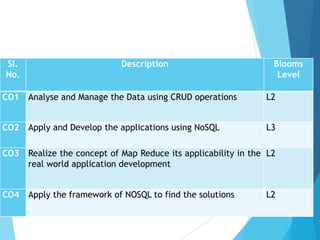
Sl.
No.
Description Blooms
Level
CO1 Analyseand Manage the Data using CRUD operations L2
CO2 Apply and Develop the applications using NoSQL L3
CO3 Realize the concept of Map Reduce its applicability in the
real world application development
L2
CO4 Apply the framework of NOSQL to find the solutions L2
5.
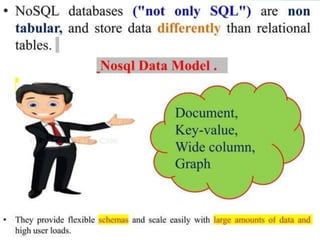
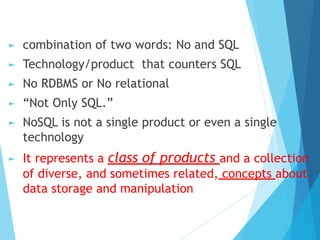
► combination oftwo words: No and SQL
► Technology/product that counters SQL
► No RDBMS or No relational
► “Not Only SQL.”
► NoSQL is not a single product or even a single
technology
► It represents a class of products and a collection
of diverse, and sometimes related, concepts about
data storage and manipulation
7.
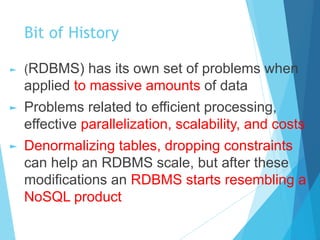
Bit of History
►(RDBMS) has its own set of problems when
applied to massive amounts of data
► Problems related to efficient processing,
effective parallelization, scalability, and costs
► Denormalizing tables, dropping constraints
can help an RDBMS scale, but after these
modifications an RDBMS starts resembling a
NoSQL product
8.
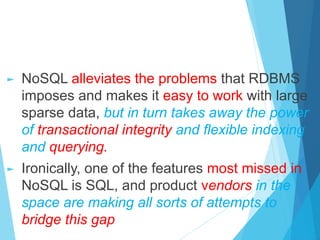
► NoSQL alleviatesthe problems that RDBMS
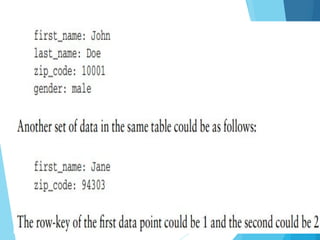
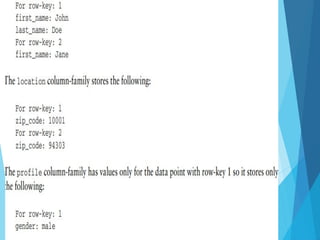
imposes and makes it easy to work with large
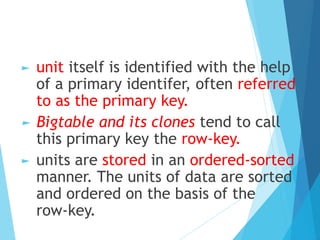
sparse data, but in turn takes away the power
of transactional integrity and flexible indexing
and querying.
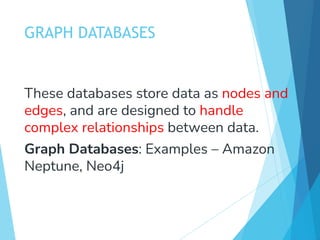
► Ironically, one of the features most missed in
NoSQL is SQL, and product vendors in the
space are making all sorts of attempts to
bridge this gap
9.
► Google hassearch engine and other
applications, including Google Maps,
Google Earth, GMail, Google Finance, and
Google Apps.
► Google’s approach was to solve the problem
at every level of the application stack.
► The goal was to build a scalable
infrastructure for parallel processing of large
amounts of data.
10.
► Google thencreated a full mechanism that
included a distributed filesystem, a
column-family-oriented data store, a distributed
coordination system, and a MapReduce-based
parallel algorithm execution environment.
► Google published and presented a series of
papers explaining some of the key pieces of its
infrastructure.
11.
► Google’s papersto the public spurred a lot
of interest among open-source developers.
► The creators of the open-source search
engine, Lucene, were the first to develop
an open-source version that replicated some
of the features of Google’s infrastructure.
12.
► the coreLucene developers joined Yahoo,
where with the help of a host of other
contributors, they created a parallel
universe that mimicked all the pieces of
the Google distributed computing stack.
► it’s important to note that the emergence
of Hadoop laid the groundwork for the
rapid growth of NoSQL.
13.
► A yearafter the Google papers had catalyzed
interest in parallel scalable processing and
nonrelational distributed data stores, Amazon
decided to share some of its own success
story.
► In 2007, Amazon presented its ideas of a
distributed highly available and eventually
consistent data store named Dynamo.
14.
► web giants— Google and Amazon — several
new products emerged in this space.
► In less than 5 years, NoSQL and related
concepts for managing big data have become
widespread.
► use cases have emerged from many well-known
companies, including Facebook, Netflix, Yahoo,
EBay, Hulu, IBM, and many more. Many of these
companies have also contributed by open
sourcing their extensions and newer products
to the world.
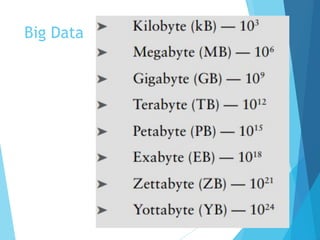
► The movieAvatar took up 1
petabyte of storage space for
the rendering of 3D CGI effects
18.
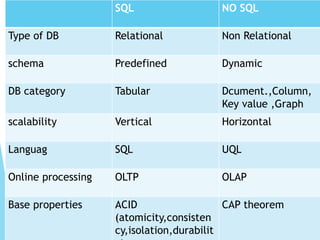
SQL NO SQL
Typeof DB Relational Non Relational
schema Predefined Dynamic
DB category Tabular Dcument.,Column,
Key value ,Graph
scalability Vertical Horizontal
Languag SQL UQL
Online processing OLTP OLAP
Base properties ACID
(atomicity,consisten
cy,isolation,durabilit
CAP theorem
19.
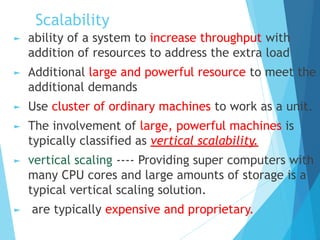
Scalability
► ability ofa system to increase throughput with
addition of resources to address the extra load
► Additional large and powerful resource to meet the
additional demands
► Use cluster of ordinary machines to work as a unit.
► The involvement of large, powerful machines is
typically classified as vertical scalability.
► vertical scaling ---- Providing super computers with
many CPU cores and large amounts of storage is a
typical vertical scaling solution.
► are typically expensive and proprietary.
20.
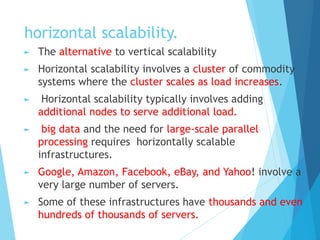
horizontal scalability.
► Thealternative to vertical scalability
► Horizontal scalability involves a cluster of commodity
systems where the cluster scales as load increases.
► Horizontal scalability typically involves adding
additional nodes to serve additional load.
► big data and the need for large-scale parallel
processing requires horizontally scalable
infrastructures.
► Google, Amazon, Facebook, eBay, and Yahoo! involve a
very large number of servers.
► Some of these infrastructures have thousands and even
hundreds of thousands of servers.
22.
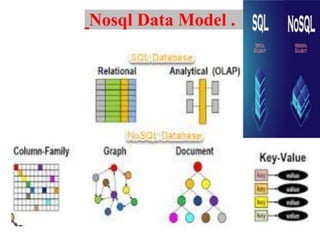
TYPES of NOSQL
1. Document databases: These databases
store data as semi-structured
documents, such as JSON or XML, and
can be queried using document-oriented
query languages.
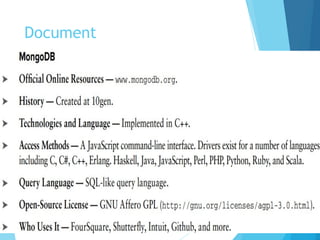
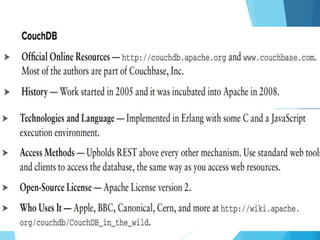
Document-based: Examples – MongoDB,
CouchDB, Cloudant
23.
DOCUMENT DATABASES
► typicallyJSON (JavaScript Object Notation),
and not documents or spreadsheets (though
these could be stored too)
► Document databases treat a document as a
whole and avoid splitting a document into its
constituent name/value pairs.
► At a collection level, this allows for putting
together a diverse set of documents into a
single collection.
►
24.
► Document databasesallow indexing of documents
on the basis of not only its primary identifier but
also its properties.
► A few different open-source document databases
are available today but the most prominent
among the available options are MongoDB and
CouchDB.
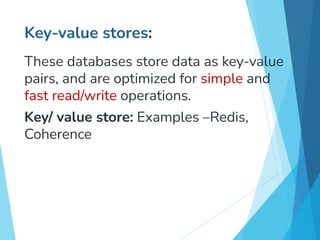
Key-value stores:
These databasesstore data as key-value
pairs, and are optimized for simple and
fast read/write operations.
Key/ value store: Examples –Redis,
Coherence
28.
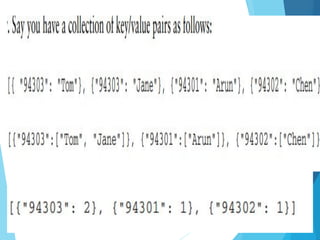
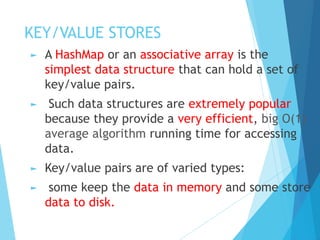
KEY/VALUE STORES
► AHashMap or an associative array is the
simplest data structure that can hold a set of
key/value pairs.
► Such data structures are extremely popular
because they provide a very efficient, big O(1)
average algorithm running time for accessing
data.
► Key/value pairs are of varied types:
► some keep the data in memory and some store
data to disk.
29.
► Key/value pairscan be distributed and
held in a cluster of nodes.
► A simple, yet powerful, key/value store
is Oracle’s Berkeley DB. Berkeley DB is a
pure storage engine where both key and
value are an array of bytes.
30.
► Another typeof key/value store in
common use is a cache. A cache provides
an in-memory snapshot of the most-used
data in an application.
► The purpose of cache is to reduce disk
I/O.
31.
SORTED ORDERED
COLUMN-ORIENTED STORES
►These databases store data as column
families, which are sets of columns that
are treated as a single entity. They are
optimized for fast and efficient
querying of large amounts of data.
Column: Examples – Hbase, Big Table,
Accumulo
32.
SORTED ORDERED
COLUMN-ORIENTED STORES
►allows data to be stored effectively.
► It avoids consuming space when storing
nulls by simply not storing a column when
a value doesn’t exist for that column.
► Each unit of data can be thought of as a
set of key/value pairs
33.
► unit itselfis identified with the help
of a primary identifer, often referred
to as the primary key.
► Bigtable and its clones tend to call
this primary key the row-key.
► units are stored in an ordered-sorted
manner. The units of data are sorted
and ordered on the basis of the
row-key.
36.
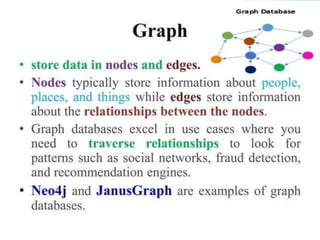
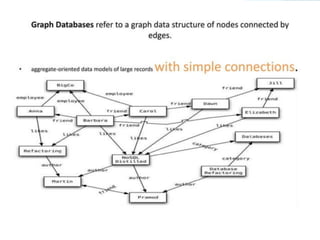
GRAPH DATABASES
These databasesstore data as nodes and
edges, and are designed to handle
complex relationships between data.
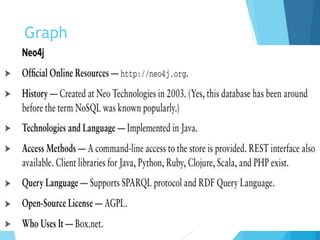
Graph Databases: Examples – Amazon
Neptune, Neo4j
40.
GRAPH DATABASES
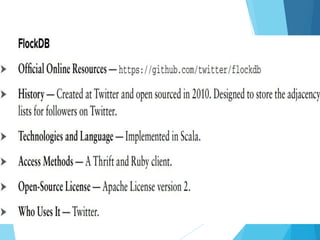
► Neo4jand FlockDB: Neo4J is an
ACID-compliant graph database. It
facilitates rapid traversal of graphs.
41.
Column : HBASE
►Official Online Resources —
http://hbase.apache.org.
► History — Created at Powerset (now part of
Microsoft) in 2007. Donated to the Apache
foundation before Powerset was acquired by
Microsoft.
► Technologies and Language — Implemented in
Java.
► Access Methods — A JRuby shell allows
command-line access to the store.
► . A Java API is available with the distribution.
42.
► Query Language— No native querying
language. Hive (http://hive.apache.org)
provides a SQL-like interface for HBase.
► Open-Source License — Apache License
version 2.
► Who Uses It — Facebook, StumbleUpon,
Hulu, Ning, Mahalo, Yahoo!, and others.
43.
WHAT IS THRIFT?
►thrift is a software framework and an interface defi
nition language
► that allows cross-language services and API
development.
► Services generated using Thrift work efficiently and
seamlessly between C++, Java, Python, PHP, Ruby,
Erlang, Perl, Haskell, C#, Cocoa, Smalltalk, and OCaml.
► Thrift was created by Facebook in 2007.
► It’s an Apache incubator project.
44.
Hypertable
► History —Created at Zvents in 2007. Now an
independent open-source project.
► Technologies and Language — Implemented in C++,
uses Google RE2 regular expression library. RE2
provides a fast and efficient implementation.
Hypertable ----performance boost over HBase, reduce
time and cost when dealing with large amounts of
data.
► Access Methods — A command-line shell is available.
In addition, a Thrift interface is supported. Language
bindings have been created based on the Thrift
interface. A creative.
45.
► Query Language— HQL (Hypertable Query Language)
is a SQL-like abstraction for querying Hypertable
data. Hypertable also has an adapter for Hive.
► Open-Source License — GNU GPL version 2.
► Who Uses It — Zvents, Baidu (China’s biggest search
engine), Rediff (India’s biggest portal).


![DOC-20241022-WA0000[1] - Read-Only.pptx](https://cdn.slidesharecdn.com/ss_thumbnails/doc-20241022-wa00001-read-only-241204064442-a137f7c3-thumbnail.jpg?width=640&height=640&fit=bounds)


